Unlike in most conventional milking systems, automatic milking systems (AMS) generally attach and detach each teat cup individually. This allows for each quarter to be milked until a defined threshold milk flow is reached and as a consequence, reduces or completely eliminates the occurrence of overmilking (Weiss and Worstorff, Reference Weiss and Worstorff2001).
Decades ago, cows used to be considered as milked out when the milk flow rate decreased below 0.2 kg/min on udder level, and hand or machine stripping was common practice to empty the udders (Ginsberg, Reference Ginsberg, Hogeveen and Lam2011). Today, high milk flow levels for cluster detachment are much more discussed in dairy practice than stripping at the end of milking. Earlier research has demonstrated that the mechanical impact on the teat tissue occurs mainly towards the end of milking when the udder is almost empty and milk flow decreases (Isaksson and Lind, Reference Isaksson and Lind1992; Odorcic et al., Reference Odorcic, Rasmussen, Paulrud and Bruckmaier2019; Stauffer et al., Reference Stauffer, Feierabend and Bruckmaier2020). Correspondingly, high levels of automatic cluster removal (ACR) have been demonstrated to improve teat tissue condition after milking in cows (Rasmussen, Reference Rasmussen1993). These effects are increasingly considered because teat-end conditions such as tissue thickness and callosity have been shown to be associated with increased risk of intramammary infection (Neijenhuis et al., Reference Neijenhuis, Barkema, Hogeveen and Noordhuizen2001; Breen et al., Reference Breen, Green and Bradley2009).
The argument that a high detachment level causes an increased risk of mastitis because of the higher amount of milk remaining in the udder has been disproven by several studies (Rasmussen, Reference Rasmussen1993; Burke and Jago, Reference Burke and Jago2011; Edwards et al., Reference Edwards, Jago and Lopez-Villalobos2013). In contrast, milking performance is considerably affected by a high cluster detachment level. It is well established that earlier removal of the teat cups at the end of milking can decrease milking time without a substantial loss of milk yield (Rasmussen, Reference Rasmussen1993; Besier and Bruckmaier, Reference Besier and Bruckmaier2016; Ferneborg et al., Reference Ferneborg, Thulin, Agenäs, Svennersten-Sjaunja, Krawczel and Ternman2019).
The goal of the present study was to investigate whether and how different teat cup detachment settings, milking intervals and lactational stage influence milking characteristics and teat condition in an AMS with all actions from teat cleaning to post-milking dipping in the same teat cup and liner on a commercial dairy farm. The particular difference of the AMS used here compared to most other AMS brands is the potential of a fast sequence of the different events at the start of milking, as well as the common start of milking in all quarters together.
Materials and methods
The data for this study were collected on a commercial dairy farm with an automatic milking system. Data were derived from a testing procedure initiated by the farmer to determine the optimal detachment levels for optimal milking performance at a minimum impact on the teat tissue.
Animals and housing
The dairy herd of the farm consisted of 57 lactating Holstein cows with an average annual herd performance of 9,500 kg milk. For the present investigation, 24 cows in their second to seventh lactation were divided into two groups depending on their lactational stages. Twelve cows were in early lactation (average lactation number 3.2 ± 1.1) with a range of 11 to 73 d in milk (DIM) and a milking frequency of 2.62 times per day, while the other 12 cows were in late lactation (average lactation number 3.8 ± 1.4) with a range of 186 to 346 DIM and a milking frequency of 2.47 times per day. The cows were divided into two groups with 6 cows in early and 6 in late lactation per group. One group had an average lactation number of 3.2 ± 1.1 and the other an average lactation number of 3.8 ± 1.4. The distribution of the lactation numbers per group is described in the online Supplementary File. Data collection lasted for 12 d. The bulk tank somatic cell count at the last DHI (Dairy Herd Improvement) recording before and the first after data collection was 115 000 and 100 000, respectively. The cows were housed in a free-stall barn with directed cow traffic as described in the Supplementary File.
Milking
Milking was performed with the automatic milking system DairyRobot R9500 (GEA, Bönen, Germany). With the ‘in-liner everything technology’, every step of the milking process (teat cleaning, prestimulation, forestripping, milk harvest and post-dipping) is performed after a single attachment in the same liner and teat cup per teat. When the teat cups are being attached, the stimulation time starts running. The duration depends on the DIM and can be adjusted by the farmer. With the StimoPuls technology (GEA, Bönen, Germany), the pulsation chamber vacuum (PCV) is reduced, and the liner kept closed and vibrating to stimulate the teats. Each teat is washed after the teat cup is attached and while the vibration stimulation is running. When the pre-set stimulation time is reached, PCV and pulsation switch to the regular milking settings simultaneously in all teat cups, and milk removal starts. The whole process of teat cup attachment, stimulation, cleaning, and start of milk removal is described in detail in the Supplementary File.
Tested detachment settings
The appointed teat cup detachment settings were 125, 87.5 or 50 g/min milk flow per quarter. Each setting was used for 4 d with no ‘washout’ period before adjusting the detachment setting. To counteract carry-over effects the cows were divided into two groups with the same number of cows in early and late lactation respectively. One group started with the detachment setting set to 125 g/min and the other with 50 g/min. Detachment was set to 87.5 g/min for both groups after 4 d. The latter setting was close to the original detachment settings used on the farm and was therefore used to recreate the original condition before data collection started. For the last 4 d, the detachment settings of the two groups were set to their respective remaining detachment level.
Milking characteristics
Milking characteristics were automatically recorded by the herd management programme DairyPlan (GEA, Bönen, Germany) during each individual milking. For statistical evaluations the data of the milkings between 5 a.m. and 1 p.m. were used because teat tissue thickness was measured after these milkings. Evaluated milking characteristics included intervals between milkings as well as milk yield per milking. Milk production per hour was calculated by dividing milk yield by milking interval to account for the fact that milk secretion can be influenced by milking intervals. Milk flow curves on udder level could be displayed by the DairyPlan programme. The occurrence of severe bimodality of milk flow as an indicator of delayed milk ejection and therefore separate removal of cisternal and alveolar milk (Bruckmaier and Blum, Reference Bruckmaier and Blum1998) was derived from the milk flow curves and defined as a transient reduction in whole udder milk flow to a level below 1 kg/min during the first minute of milking. Peak flow rate (PFR) on udder level was derived from the milk flow curves. The average milk flow (AMF) on udder level was calculated by dividing the milk yield by the milking time. Milking time started as soon as milk flow was registered after teat cleaning, which was usually as soon as the stimulation time ran out and ended when the milking was finished and before the dipping agent was applied. Milk flow was recorded for each quarter individually as well as the duration from first attachment to last detachment. The various milking characteristics are demonstrated in Figure 1 of a previous paper (Stauffer et al., Reference Stauffer, Feierabend and Bruckmaier2020).
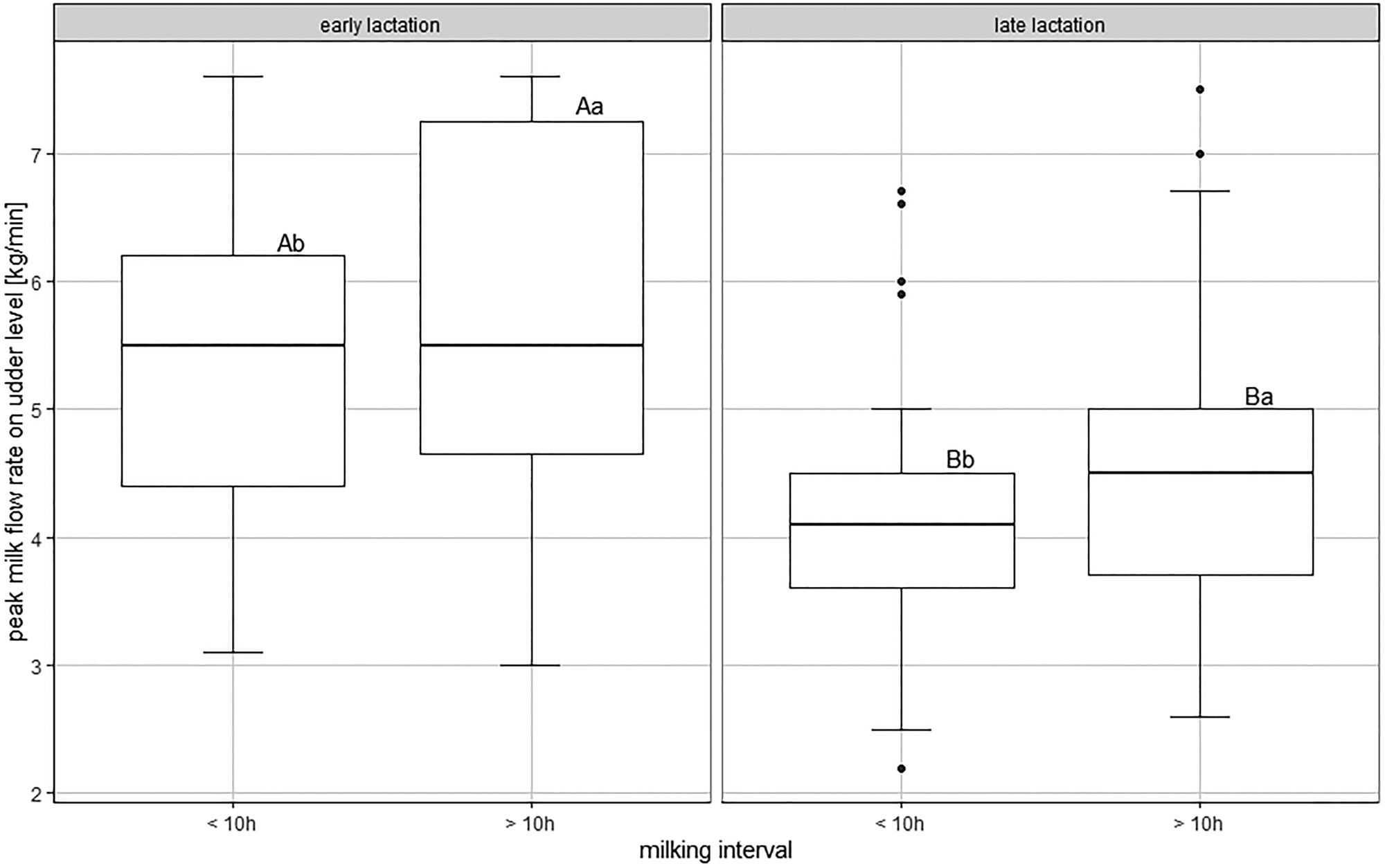
Peak flow rate at <10 h and >10 h milking intervals in early and late lactating cows. The rectangular box represents the inter quantile range (IQR) that encloses the middle half of the data. The bold line marks the median. The whiskers extend to the most extreme data point which is no more than 1.5 times the IQR away from the upper or lower quantile marked by the end of the box. Points are values that are further away from the box end than 1.5 times the IQR. Lower-case letters: No common letter means a significant difference (P < 0.05) between the milking intervals within a detachment level and lactational stage. Upper-case letters: No common letter means a significant difference (P < 0.05) between the lactational stage within a detachment level and milking interval.

Teat condition
To record short-term effects on teat tissue the teat tissue thickness was measured in the two hind teats within 4 min after teat cup detachment. The measurements with a spring-loaded caliper (Cutimeter; Hauptner und Herberholz, D-42651 Solingen, Germany) were performed both directly above the teat apex and at the teat barrel (2 cm above the teat apex). The spring constant of the cutimeter was 3.38 N/cm (4 N at closed jaws). This method has been used and approved to be suitable for the measurement of tissue thickness in a number of scientific studies (Hamann and Mein, Reference Hamann and Mein1990; Rasmussen, Reference Rasmussen1993; Odorcic et al., Reference Odorcic, Blau, Löfstrand and Bruckmaier2020; Wieland et al., Reference Wieland, Nydam, Heuwieser, Morrill, Ferlito, Watters and Virkler2020). The used procedure was described in detail by Stauffer et al. (Reference Stauffer, Feierabend and Bruckmaier2020). To check for potential visually detectable differences of the teat end, pictures of teat tips were taken with a digital camera within 3 min after teat cup detachment immediately before measuring teat tissue thickness. The pictures were rated with the teat end callosity classification introduced by Neijenhuis et al. (Reference Neijenhuis, Barkema, Hogeveen and Noordhuizen2000).
Statistical analysis
All data are presented as arithmetic means and the standard error of the means (sem). For statistical analysis, the Statistical Software R with the programming environment RStudio were used (RStudio Team, 2019; R Core Team, 2020). All parameters were tested for normal distribution by using the Shapiro–Wilk normality test. Normal distribution was confirmed for all tested parameters. To test for differences between treatments and groups, the linear mixed-effects models (lme) of the ‘nlme’ package of R (Pinheiro et al., Reference Pinheiro, Bates, DebRoy and Sarkar2020) was used. The model included the detachment setting, lactational stage, and milking interval (≤10 h v. >10 h) as fixed factors and the cow as repeated subject with the lactational stage as nesting factor. Differences between individual subgroups were localized by the Tukey test in the General linear hypotheses and multiple comparisons function of the ‘multcomp’ package of R (Hothorn et al., Reference Hothorn, Bretz and Westfall2008). Differences were considered significant if P < 0.05.
Results
Evaluated milkings
294 recordings were evaluated, 148 milkings in early lactation cows, and 146 milkings in late lactation cows. The median of all milking intervals was 9.9 h, and the mean and sem were 10.1 ± 0.1 h. Therefore, for evaluations with the milking interval as a factor the data was divided into two groups; milkings above and below 10 h interval since the last milking. Milking intervals were ≤10 h for 154 milkings, and >10 h for 140 milkings. Milking intervals in early lactation cows ranged from 6.1 to 14.8 h, with 81 milkings at intervals ≤10 h, and 67 milkings >10 h (median 9.8 h; mean and sem 9.9 ± 0.2 h). In late lactation cows the milking intervals ranged from 6.3 to 15.7 h, with 73 milkings at intervals ≤ and >10 h each (median 10.0 h; mean and sem 10.3 ± 0.2 h).
Milking characteristics
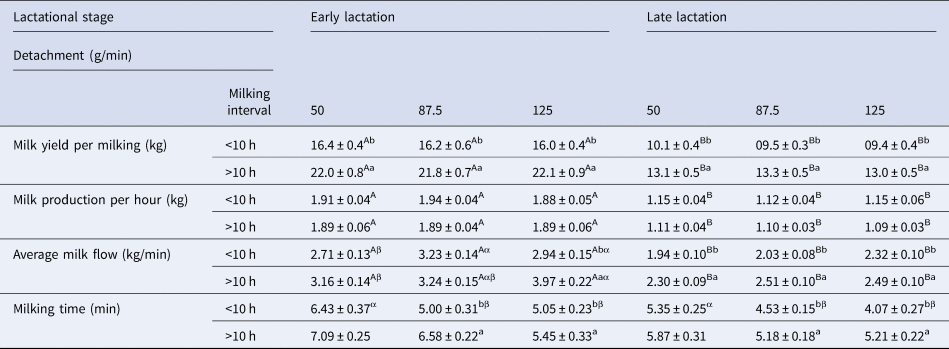
Significantly higher milk yield was recorded in early than in late lactational stage (Table 1). Milk yield was significantly higher at long than at short milking intervals. In none of the subgroups did milk yield per milking show significant differences between the tested detachment settings. Milk production per hour was significantly higher in early lactation than in late lactation. Milking intervals and detachment settings had no significant impact on milk production per hour (Table 1).
Milk yield, milk per hour, milking time and average milk flow (means ± sem) dependent of detachment levels and milking interval in early and late lactating cows

Lower-case letters: No common letter means a significant difference (P < 0.05) between the milking intervals within a detachment level and lactational stage.
Upper-case letters: No common letter means a significant difference (P < 0.05) between the lactational stage within a detachment level and milking interval.
Greek letters: No common letter means a significant difference (P < 0.05) between the detachment settings within a milking interval and lactational stage.
Severe bimodalities of milk flow were only observed in 6 cows, 5 of which were in early lactation and 1 in late lactation. Overall, there were 8 bimodalities in early lactation and 1 in late lactation. All these milkings were performed at milking intervals shorter than 10 h (range: 6 h 6 min to 9 h 56 min). In none of the recorded milkings was the milk flow completely interrupted (milk flow 0 kg/min) after removal of the cisternal milk and before the onset of milk ejection.
Peak flow rate (PFR) was significantly higher in early than in late lactation (Fig. 1). In both early and late lactation animals, the PFR was higher at long than at short milking intervals (P < 0.05). Average milk flow (AMF) was significantly higher in early than in late lactation (Table 1). The AMF was lower at short compared to long milking intervals (P < 0.05) at all detachment levels in late lactation and at 125 g/min detachment in early lactation. The AMF increased with increasing detachment levels, but significantly (P < 0.05) only in early lactation.
Milking time at an udder level did not show any significant differences between lactational stages (Table 1). At a quarter level, milking time in early lactation was longer compared to late lactation cows, but only in the left front quarters and at detachment level of 50 g/min (P < 0.05). Detailed data on quarter level milking performance are presented in the online Supplementary Table S2. Milking time was shorter at 87.5 g/min and 125 g/min detachment levels compared to 50 g/min, albeit only at milking intervals ≤ 10 h since the previous milking (P < 0.05). At a quarter level, milking time was longer at milking intervals >10 h than ≤10 h (P < 0.05). None of the detachment settings, nor the milking interval or the lactational stage had a significant impact on teat tissue thickness or teat end callosity (online Supplementary Table S3).
Discussion
The cows in the present study were housed with directed cow traffic. It was, therefore, not surprising that both early and late lactating cows visited the AMS voluntarily at similar milking intervals despite different milk production per hour. This finding confirms previous studies that udder filling is not the driving force to enter the AMS but rather the expected feeding and pasture by passing through the AMS (Prescott et al., Reference Prescott, Mottram and Webster1998; Melin et al., Reference Melin, Hermans, Pettersson and Wiktorsson2006). The most important motivation of voluntary milking was likely the expected concentrate feeding in the AMS (Prescott et al., Reference Prescott, Mottram and Webster1998). Consequently, the faster milk production rate in early lactation cows caused a higher milk yield in early than in late lactation (Bruckmaier and Gross, Reference Bruckmaier and Gross2017). Detachment settings at the studied levels did not affect milk yields which is in agreement with earlier studies (Edwards et al., Reference Edwards, Jago and Lopez-Villalobos2013; Besier and Bruckmaier, Reference Besier and Bruckmaier2016; Stauffer et al., Reference Stauffer, Feierabend and Bruckmaier2020). In only a few studies has a high ACR setting caused a reduced milk yield (Burke and Jago, Reference Burke and Jago2011; Fahim et al., Reference Fahim, Kamboj, Sirohi, Bhakat and Mohanty2019), always in conventional milking systems and with cluster detachment controlled by the whole udder milk flow. The reason was likely the occurrence of quarter milk flow lower than the detachment threshold in individual quarters. The present study strengthens the presumption that high detachment thresholds in AMS do not affect milk yield.
Very few severe bimodalities of milk flow, i.e. separate removal of cisternal und alveolar milk, were recorded, mostly at short milking intervals. This suggests that stimulation time is sufficiently adjusted for increased need of stimulation with higher DIM (Bruckmaier and Hilger, Reference Bruckmaier and Hilger2001). There are, however, no settings available to consider milking intervals in the stimulation time. We have previously shown that the lag time until milk ejection is longer at low than high udder filling. Therefore, short milking intervals require a longer stimulation time than long intervals (Weiss and Bruckmaier, Reference Weiss and Bruckmaier2005). Obviously, the udder preparation in the AMS used here was long enough to also cover the needs of short milking intervals. Even an additional shortening of the preparation time may be tested. Since every step of the milking process from cleaning to post-dipping occurred within the teat cups after a single attachment, there was no interruption between mechanical teat stimulation, cleaning and milking. This has the potential to accelerate the sequence of events mainly at the start of milking and hence to have a shorter per-cow stall occupation than systems which use several teat cups. As soon as one teat cup was attached, the stimulation began, inducing the release of oxytocin which is known to induce milk ejection systemically in all quarters (Bruckmaier and Blum, Reference Bruckmaier and Blum1998; Bruckmaier et al., Reference Bruckmaier, Macuhova and Meyer2001). Even if individual teats were attached after stimulation time ran out (which happened only 7 times during the course of the present study), milk ejection had already occurred ensuring a smooth milking process. Because the milking procedure included only one teat cup attachment for each teat it is possible that within the pre-set stimulation time usually all quarters can be cleaned, and milking can be started in all quarters immediately after the stimulation time. This was the case in the vast majority of milkings during the present study. This is considered as a precondition of a high milking performance of a milking system.
The PFR as well as AMF were higher in early than late lactation. This agrees with earlier studies that investigated this relationship (Mayer et al., Reference Mayer, Bruckmaier and Schams1991; Bruckmaier et al., Reference Bruckmaier, Rothenanger and Blum1995). Both PFR and AMF were also higher in longer than shorter milking intervals, i.e. both were higher at a higher degree of udder filling. Possibly, the higher intramammary pressure caused by more milk stored in the udder led to higher milk flow as long as the cisternal cavities of the udder are well filled, i.e. during the period of PFR. Detachment settings do not affect PFR, because PRF occurs long before and totally independent of detachment. The AMF increases with increasing duration of the plateau phase of milk flow because the relative contribution of declining milk flow at the end of milking to the AMF decreases (Mayer et al., Reference Mayer, Bruckmaier and Schams1991). Therefore, it was previously shown that AMF can be higher at higher detachment levels (Stewart et al., Reference Stewart, Godden, Rapnicki, Reid, Johnson and Eicker2002). However, because only the last quarter to be detached has an impact on the AMF at a whole udder level, early detachment had a notable effect on AMF only in cows in early lactation. In the present study, lactational stage did not affect milking time both at a quarter and at a whole udder level. Previous studies observed a longer milking time in early than in late lactation (Bruckmaier et al., Reference Bruckmaier, Rothenanger and Blum1995; Sandrucci et al., Reference Sandrucci, Tamburini, Bava and Zucali2007). This seems to be justified because milking time should correlate with milk yield. However, AMF was lower in late lactation than in early lactation, which led to a longer milking time and therefore reduced the difference in milking time between the lactational stages. Longer milking intervals lead to longer milking times but mainly in the detachment settings 87.5 and 125 g/min. The influence of milking interval on milking time can be explained with the difference in milk yield between the milking intervals. The results of the present study demonstrated that higher detachment settings led to a reduction of milking time both at a quarter and whole udder level. As a consequence, both machine-on time and reduced parlour occupancy time were reduced. This finding confirms earlier studies which have been performed both at the udder and quarter level (Rasmussen, Reference Rasmussen1993; Stewart et al., Reference Stewart, Godden, Rapnicki, Reid, Johnson and Eicker2002; Ferneborg et al., Reference Ferneborg, Thulin, Agenäs, Svennersten-Sjaunja, Krawczel and Ternman2019; Wieland et al., Reference Wieland, Nydam, Heuwieser, Morrill, Ferlito, Watters and Virkler2020). This prominent effect is likely due to the flattening of the milk flow curve after a first steep decline of milk flow (Besier and Bruckmaier, Reference Besier and Bruckmaier2016). Therefore, earlier detachment can significantly decrease the milking time without considerably affecting milk yield. Earlier teat cup removal could reduce the mechanical stress on teat ends thereby reducing increased teat end callosity which was shown to be associated with an increased susceptibility to clinical mastitis (Neijenhuis et al., Reference Neijenhuis, Barkema, Hogeveen and Noordhuizen2001). The fact that milking starts in all quarters at once could lead to the assumption that the results of the present study would be more similar to studies performed in conventional milking parlours compared to other AMS with quarter attachment. But the conclusions of the different studies recording changes in milking time with lactational stage or detachment settings were in agreement and therefore nothing conspicuous was noticeable.
Both approaches to measure teat condition, measuring the teat tissue thickness and rating the teat end callosity, did not react to detachment settings. This could indicate that the differences in the detachment settings were not big enough to have a measurable impact. Odorcic et al. (Reference Odorcic, Blau, Löfstrand and Bruckmaier2020) measured teat tissue thickness before and after milking and only found a significant increase in teat tissue thickness after overmilking for 5 min. The AMS in the present study prevented overmilking and detachment settings were chosen according to not endanger the health of the cows. Rasmussen (Reference Rasmussen1993) however, found increased teat end thickness for cows with cluster detachment of 0.2 kg/min compared to 0.4 kg/min and Wieland et al. (Reference Wieland, Nydam, Heuwieser, Morrill, Ferlito, Watters and Virkler2020) also supports these results by showing improved teat tissue condition in 1.2 kg/min compared to 0.8 kg/min cluster removal. It seems that teat cup detachment in modern dairy cows can be up to more than 1 kg/min at an udder level without any reduced milk yield or increased mastitis risk.
In conclusion, the results of the present study demonstrate that mainly in early lactation and at long milking intervals high teat cup detachment level settings can increase milking performance and hence the efficiency of an AMS. Our results show this effect for an AMS where the milk extraction starts in all four quarters concomitantly. Therefore, the time difference of cessation of milk flow among the four quarters may be shorter than in other AMS systems, and hence the effect of different teat cup detachment level settings on total machine-on time may be less.
Supplementary material
The supplementary material for this article can be found at https://doi.org/10.1017/S0022029922000528.