Introduction
Where have we come from, what is shaping research in the field and where are we going? Environmental education is an emerging field, albeit one that has been around for over forty years. (Gough, Reference Gough, Stevenson, Brody, Dillon and Wals2013, p. 9, italics in original)
This is the story often told in environmental education research, that the field is 40 or perhaps 50 years old, commencing in the 1970s. We offer a different storying, one that has taken place over thousands of years. The historical lines of environmental education research extend far beyond a 40-year period. The 40-year period marks the beginning of an epoch (in environmental education research) when UNESCO-UNEP (1976) formalised environmental education in a Western minorityFootnote 4 context. Environmental education is not new. For example, did environmental education begin with Homo sapiens or is it possible that environmental education began as the Earth itself evolved— species to species? In this sense, the history of environmental education is deep, slow and unfolding, rather than a shallow, fast, recent addition to education. We offer an alternative storying.
Environmental education is philosophically complex, yet a philosophical mapping has not previously been attempted in environmental education research. Any philosophical mapping commands an understanding of what constitutes philosophy. For Deleuze and Guattari (Reference Deleuze and Guattari1994) ‘philosophy is the art of forming, inventing, and fabricating concepts’ (p. 2). Philosophers ‘must no longer accept concepts as a gift, nor merely purify and polish them, but first make and create them, present them and make them convincing’ (Deleuze & Guattari, Reference Deleuze and Guattari1994, p. 35). In that sense, any philosophical mapping also necessitates making philosophy, and as such this paper is a meshwork of philosophical mapping-making.
During the period of the 1960s and 1970s, environmental philosophy in a Western minority context accelerated. A continuum emerged, akin to the left–right political continuum in environmental philosophy, tracing anthropocentric through to ecocentric philosophy. O’Riordan (Reference O’Riordan1990) argues that this dichotomy represents:
…the clash of two world views… between those who believe that the earth is capable of being improved or manipulated for the benefit both of human kind as well as for life on earth itself, and those who believe that human beings should at best be only equal with other forms of life on the planet and that societies must learn to adjust their economics and aspirations so as to cohabit with the imperatives of earth and life processes for the survivability, or sustainability, of the earth. (p. 143)
In broad terms, anthropocentric philosophy is grounded on the belief that the environment is a resource to be used by humans, whereas an ecocentric philosophy projects the belief that the environment is valued for its own sake (Eckersley, Reference Eckersley1992). It is readily foregrounded in environmental education literature that an anthropocentric philosophy is the overarching environmental philosophy in Western minority culture (see Bowers, Reference Bowers1997; O’Riordan, Reference O’Riordan1977, Reference O’Riordan1981, Reference O’Riordan, Peet and Thrift1989, Reference O’Riordan1990; Orr, Reference Orr1992; Weston, Reference Weston1994, Reference Weston1996, Reference Weston1999; White, Reference White1967). In the context of environmental education, an anthropocentric positioning has dominated, where environmental education is often perceived as a ‘practical process for equipping’ people with the ‘skills to improve the environment’ (Withrington, Reference Withrington and Hughes-Evans1977, p. 33). Such anthropocentric positionings place environmental education in a humanist tradition where knowledge is ‘already well-established, and as if it were the most obvious thing in the world what constitutes an improvement’ (Weston, Reference Weston1996, p. 39). Thus, environmental education philosophies differ markedly and will always be in ‘dynamic interaction’, where knowing is neither ‘certain’ or ‘entitled’ (Yunkaporta, Reference Yunkaporta2019, p. 23).
Engaging with possibilities requires a radical inclusion of more than human dimensions and entities, dislodging anthropocentric vortexes of ‘human-as-the-reference-point’ and acknowledging the dynamic and complex relationality of posthuman and indigenist ways of knowing.
Engaging with Posthuman and Indigenist Knowings
By engaging with where we are as a starting point, to staying-with the traces of our experience of place and our existence within it and with each other (human and more than human), we open ourselves to relationality, relationality with the Country where we live and work, as well as the knowledges of the local Aboriginal peoples. Country is a word given a capital to acknowledge its agency and complexity (Styres, Haig-Brown, & Bimkie, Reference Styres, Haig-Brown and Blimkie2013). The non-Indigenous researchers and environmental educators among us acknowledge our limitations in ‘knowing’ this place we all currently call home, viz. Australia. Our movement into diverse ways of knowing is a beginning, a willingness to acknowledge all that we do not know, and take a tentative step towards connecting the stories of our lives with the local Aboriginal peoples who continue to live here and all those who have lived here. In doing so, we acknowledge the need to challenge the binary of past and present and recognise the influence of the English language, which ‘inevitably places settler worldviews at the centre of every concept, obscuring truer understanding’ (Yunkaporta, Reference Yunkaporta2019, p. 21).
We choose to use the privilege of this opportunity to respectfully state our intention to refuse the colonial enactment of erasure of contemporaneous knowledges. To respond to the relationality and connectivity of the world, we seek to embrace diverse ways of knowing as well as an embodied and enacted nonlinear temporal understanding. We embrace Yunkaporta’s (Reference Yunkaporta2019) explanation of time as nonlinear and tangible, with ‘no start and finish but a constant state where past, present and future are all one thing, one time, one place’ (p. 44). In other words, we acknowledge the past as continuing and enfolded within the present, with the similarly enfolded yet-to-come (Barad, Reference Barad2007). This is a way of acknowledging the marks, the effects and ongoing influences — the continuing traces — of events and actions. Past as the never gone and future as also here now, the ‘everywhen’ of Indigenous understanding (Kwaymullina, Reference Kwaymullina2005). Such a perspective dissolves positivist edges and moves with interconnecting traces over time and place, opening the narrow and reductive rationality framing of humanist theory towards posthuman and diverse ways of knowing (Braidotti, Reference Braidotti2013). ‘Posthumanism evokes a rethink of what it is to be human’ (Cutter-Mackenzie-Knowles, Logan, Khatun, & Malone, Reference Cutter-Mackenzie-Knowles, Malone, Logan, Khatun, Lees and Vinuales2019, p. 11) through decentring the human as neither exceptional nor superior. The human body is overwhelmingly colonised by microbiota (Sender, Fuchs, & Milo, Reference Sender, Fuchs and Milo2016), signifying the mutability of the human whether consciously or unconsciously. The point is ‘that given enough time, everything becomes digestible to bacteria’ (Hird & Yusoff, Reference Hird, Yusoff, Braidotti and Bignall2019, p. 272), yet traces will remain.
Diverse ways of knowing are implicated when we consider that complex phenomena cannot be completely described or defined with any one paradigm or discourse (Morin, Reference Morin1977/1992, Reference Morin2008). The complex problems of the present geologic era (the Anthropocene) thus point to the need for a transepistemological perspective, one that does far more than include marginalised or excluded knowledges as an addition to the dominant paradigm, but rather one that offers an opening to the concurrence of knowledges (Santos, Reference Santos2007). Engaging with such epistemological concurrence may offer a way forward regarding continuing problems generated through reductionist approaches to our relationship with, in and as natureFootnote 5. It is an approach that offers a path for environmental education and educators to begin with the here-now and always-was, through the range of ways of knowing that can inform both knowledge and understanding.
Aboriginal and Torres Strait Islander peoples were and are undoubtedly the first human environmental educators with and on this wide land (Pascoe, Reference Pascoe2018). Indigenous ways of knowing environment encompass not only practical and proven knowledge of rhythms, flows and manifest relationships but also knowledge of the deeper complexity of the co-generative mutuality of all entities, both human and more than human (Rose, Reference Rose2008, Reference Rose, Rose, van Doren and Chrulew2017a; Wilson, Reference Wilson2008; Yunkaporta, Reference Yunkaporta2019). Such a relational ontology ‘articulates patterns and ethics of connectivities, continuities and responsibilities’ whereby ‘life is always lived in relationship with others’ (Rose, Reference Rose2017b, p. 496).
Alignment can and has been drawn between this worldview and the posthuman perspectives engaged here, in terms of human action and agency being both distributed and entangled within an integrated world (see, e. g., Bignall, Hemming, & Rigney, Reference Bignall, Hemming and Rigney2016; Rosiek, Snyder, & Pratt, Reference Rosiek, Snyder and Pratt2020). It is important, however, to acknowledge the tangible tension between the two fields, particularly due to the limited acknowledgement within posthumanist literature regarding the existence of more than human agency within Indigenous cultures ‘thousands of years earlier than contemporary philosophers of science’ (Rosiek et al., Reference Rosiek, Snyder and Pratt2020, p. 2; see also Todd, Reference Todd2016; Watts, Reference Watts2013). We recognise this fundamental relationality is only quite recently being engaged, for example, in the work of feminist and queer quantum physics theorist (Barad Reference Barad2007). Barad explains how considering the full ramifications of quantum physics can open thinking to challenge reductionist views and embrace the complexity of entanglement and the inherent responsibility of the mutual co-generativity of human and more than human. Considering the responsibility of the ways of knowing within both Indigenous Knowledge and Barad’s new materialist posthumanism compels us to explore diverse ways of knowing through this arts-based approach to staying-with the traces. However, we emphasise our determined commitment to respectfully engage with, learn from and cite Indigenous authors, in an attempt to address the ‘lack of engagement with Indigenous conceptualisations of non-human agency’ (Rosiek et al., Reference Rosiek, Snyder and Pratt2020, p. 2).
We acknowledge the marginalisation and suppression of Indigenous Knowledges across time, place and in the histories of many cultures. The past and ongoing ‘suppression of Indigenous knowledge and perspectives’ (Bignall et al., Reference Bignall, Hemming and Rigney2016, p. 456), ‘colonialist violence’ and ‘racism and Eurocentrism in academic disciplines’ (Rosiek et al., Reference Rosiek, Snyder and Pratt2020) are increasingly recognised (see also Todd, Reference Todd2016; Watts, Reference Watts2013). Knowledge erasure through reductionist epistemological approaches permeates academia and society more broadly. While the legal fiction of ‘terra nullius’ was overturned in the Supreme Court case of Mabo in 1992, it is a doctrine somewhat reconstituted in the disappearance of the Aboriginal and Torres Strait Islander peoples’ environmental knowledge, care and management within the field of environmental education. Erasure is also evident in the ways of knowing considered to constitute environmental knowledge. Rather than placing Indigenous environmental knowledge as an addition to Western minority knowledge, we look towards embodied and enacted diverse ways of knowing to illuminate our limitations and open up new expanded possibilities of relationality (Braidotti, Reference Braidotti2013; Yunkaporta, Reference Yunkaporta2019).
Embracing diverse ways of knowing necessitates recognition of the diversity within cultures as well as between cultures. Remembering and engaging with the deep time history of our own ancestors’ connection to place and relationship within environment can give space to diverse ways of knowing which underpin dominant neoliberal perspectives in Western minority culture. When considering people of diverse cultures, Meyer (Reference Meyer, Denzin, Lincoln and Smith2008) quotes ‘[b]eloved healer Halemakuna, “We are all indigenous”’ (p. 222). It is an awareness that strives to tap into deeply innate understanding of rhythms of time and place to generate love for Country as ‘self’ (Macy, Reference Macy1991; Mathews, Reference Mathews2007, Reference Mathews2012; Meyer, Reference Meyer, Denzin, Lincoln and Smith2008; Rose, Reference Rose1988, Reference Rose and Nile1998, Reference Rose2000). Within Indigenous Knowledge, all Knowledge belongs with Country (Hughes & Barlo, Reference Hughes and Barlo2020), and we engage in relationship with both Country and Knowledge. We seek to explore the possibility of engaging with our own diverse ways of knowing, while acknowledging and honouring the ways of knowing of the traditional custodians of this Country at Southern Cross University on the Gold Coast, the Yugambeh peoples of the Bundjalung nation and Indigenous peoples around Australia and the world. To support these efforts, we embrace staying-with as a relational method and practice.
Staying-with as a Relational Method
We propose staying-with as a method to enacting embodied relational practice. We explored what such a way of being and doing might look like by moving slowly, meandering through place, time and meaning, guided by an awareness that to move is to know and to describe, that being ‘observant means being alive to the world’ (Ingold, Reference Ingold2011, p. xii). We collectively chose to see, hear, feel and importantly to acknowledge, not only how and what we experience and engage but also how and what we might marginalise, colonise, suppress or attempt to disappear in the traces of material life, experience and memory. To respond to the complexity of the world in this way, including ourselves with/in it, we need to perceive without looking away, without reducing the world for our comfort. We must actively refuse to exclude or ignore even that which is uncomfortable and difficult, contradictory and painful. This is an approach described as staying-with by Haraway (Reference Haraway2003, Reference Haraway2016). Haraway (Reference Haraway2016) defines staying-with as being:
Truly present, not as a vanishing pivot between awful or edenic pasts and apocalyptic or salvific futures, but as mortal critters entwined in myriad unfinished configurations of places, times, matters, meanings. (p. 1)
Staying-with holds us open to the interdependence of all, including excluded and marginalised information, knowledge, people, more than human beings, life forms and matter. Such radical inclusion offers a relational methodology of connectivity in the broadest sense (Ferrando, Reference Ferrando2013). We acknowledge the challenging nature of such efforts. It is tempting to smooth discomfort into habitual lines of thought, holding any threatening reality at bay in the neatly known. Much formal Western minority knowledge has sought to reduce variables and narrow the focus of attention, simultaneously reducing what is considered relevant through delineations of inclusion and exclusion, real and not real. In seeking to engage with the theory of environmental education, we are reminded that it began in Western minority education as aligned with the neoliberal ideologies of growth and individualism (Cutter-Mackenzie-Knowles et al., Reference Cutter-Mackenzie-Knowles, Malone, Logan, Khatun, Lees and Vinuales2019). The reductionism and exclusions related to such ideology have brought us concomitant reductions in the health and wellbeing of ecosystems, and suppression of ways of being and knowing that are based in the radical inclusivity of relational and agentic ontology, expressed by Indigenous peoples for millennia (Rosiek et al., Reference Rosiek, Snyder and Pratt2020) and more recently in the quantum physics-based work of Barad (Reference Barad2007). Haraway (Reference Haraway2016) expresses this ontology of all that is within phenomena as the sympoieticFootnote 6 process of mutual coming into being — ‘we become-with each other or not at all’ (p. 5).
This co-generative interdependence is ontologically foundational within Indigenous Knowledge (Kovach, Reference Kovach2012; Meyer, Reference Meyer, Denzin, Lincoln and Smith2008; Rose, Reference Rose2000, Reference Rose2002, Reference Rose2011; Sheehan, Reference Sheehan2003; Wilson, Reference Wilson2008; Yunkaporta, Reference Yunkaporta2019). Indigenous culture is placed by Rose (Reference Rose2008) as perpetual staying-with, of Dreamings, Country, totems, kin and Law, meeting in song and dance, and patterned art, that shimmer with life as relational generativity. Barad’s (Reference Barad2012) work also emphasises connectivity, compelling us to consider everything as entangled within differentiation, as ‘one move’ (p. 12). That is, that the ‘matter of nature and the nature of matter’ are ‘iteratively reconfigured and reconstituted through an enacted multiplicity of force relations’ (Barad, Reference Barad, Tsing, Swanson, Gan and Bubandt2017, p. 110). In less complicated terms, whenever you meet someone or something (human or more than human) and ‘establish your relationship, you are bringing multiple universes together’ (Yunkaporta, Reference Yunkaporta2019, p. 46). By displacing agency from the anthropocentric subject to a relational subjectivity of all human and more than human entities with and within phenomena, Barad’s work articulates concurrence between this understanding of quantum physics and Indigenous Knowledge in terms of relationality, with inseparability, mutual co-generativity and distributed agency central within both knowledges (Martin, Reference Martin2017).
Despite the above-mentioned tensions, meetings between knowledges can form a relational basis for the knowing and acting required in light of the immense and diverse challenges of the Anthropocene. Yunkaporta (Reference Yunkaporta2019) advocates for the linking up of ‘many dissimilar minds and points of view… to form networks of dynamic interaction’ to devise ‘solutions to complex problems’ (p. 23). Opening ourselves to diverse knowledges requires diverse ways of knowing, an openness to other-than-usual ways of knowing. This requires acknowledgement of all those that can no longer be sidelined as ‘others’.
In this way, staying-with is an act of courage and openness, a commitment to purposefully and conspicuously enacting engagement with the complexity of the natureculture world (Haraway, Reference Haraway2003, Reference Haraway2016). That is, a world formed through process ontology of relationality (Braidotti, Reference Braidotti2006), whereby humans are inseparable from their material environment and ‘more-than-human entanglements in everyday encounters’ (Nxumalo, Reference Nxumalo2016, p. 40). Staying-with begins with the understanding that there is more going on than we might imagine (Haraway, Reference Haraway2003), particularly the reality of our position as mere ‘characters in a cast of many’ (Ulmer, Reference Ulmer2017, p. 833). Radical inclusion has epistemological as well as material and historical ramifications. Diverse knowledges and ways of knowing come into focus as integral facets of the focus of attention. Staying-with thus offers a way to engage inclusive enacted relationality, a practice that focuses on the connections within perceiving and feeling of everything around us, here and now.
In attempting to explore authentically relational approaches to environmental education, our small group of authors utilised the human mind’s necessary tendency to delineate and define life into categories from the vast multidimensionality of information around us, by choosing particular traces to stay-with. Traces can be defined as connections enacting that can make histories visible (Ingold, Reference Ingold2015; Tsing, Swanson, Gan, & Bubandt, Reference Tsing, Swanson, Gan and Bubandt2017). More than the simple movement of bounded entities as lines of particularised phenomenal beings — a person, tree or building, or a specific configuration of many beings in three-dimensional space — traces articulate wider relationality and transtemporality. Traces have indeterminate edges, expressing the quality of the relationality of entities, place and time. An entity is entangled with everything it engages. What has been before, and is yet to come, is acknowledged as enfolding, condensing within the present (Barad, Reference Barad2015). What is gone will never really be gone, it is patterned with/in traces all around us. As Yunkaporta (Reference Yunkaporta2019) explains, ‘nothing is created or destroyed; it just moves and changes… creation is in a constant state of motion’ (p. 45). And what is to come is not just imagined but already in-forming, already showing itself within the traces moving in the present (Barad, Reference Barad2015).
We see effects and ramifications of actions and events in the present as traces of our collective future to come. All traces meet in the co-present, the multiplicity of any moment (Haraway, Reference Haraway2016). A multifaceting of beings, temporalities and lives, the multidimensionality of timeplacebeing, is described in the term Country within Aboriginal knowledges (Rose, Reference Rose2004). Time is so inextricably entangled with kinship, land and sky, ‘that it is not even a separate concept from space’ (Yunkaporta, Reference Yunkaporta2019, p. 45). Yunkaporta explains that ‘time and place are usually the same word in Aboriginal languages — the two are indivisible’ (p. 66). There is a lot to stay-with, in the teeming fullness of life’s traces, and it is through engaging with existing tracings and creating our own, that ‘we can come to know’ (Cole & Somerville, Reference Cole, Somerville, Naughton, Biesta and Cole2017, p. 81).
With a focus on place and arts-based educational research methodologies, our efforts to stay-with the traces emerge from a slow engagement with both theory and practice. To stay-with knowing as embodied, immanent and broadly diverse in nature, we engaged with arts-based provocations, walking charcoal and pencils across pages as we moved, photographing the foci of our attention, recording sound and speech. In this way, we captured our staying-with engagement in the marks of material practice.
Staying-with Through Arts-Based Educational Research
The responsiveness of environmental education and its research to what can seem insurmountable challenges of the Anthropocene can be enhanced through art-based approaches (Rousell, Cutter-Mackenzie, & Foster, Reference Rousell, Cutter-Mackenzie and Foster2017). Embracing arts-based practice in educational research can harness its creative and generative potential to expand research. Such creative research facilitates staying-with, in, as and for nature more closely and affords powerful opportunities for expansion and expression of identification beyond the unitary individualised humanist subject (Braidotti, Reference Braidotti2013). Furthermore, arts-based research enables augmentation of perceptions relating to human activity and engagement with the world (Barone & Eisner, Reference Barone and Eisner2011). Of course, our understandings around the power and potential of the arts to share knowledge, inspire deep thinking and connection and enrich understandings are informed by the centrality of art to ‘Aboriginal life, identity and culture’ (Langton, Reference Langton2019, p. 79).
Through walking, mapping, reflecting and sharing stories, we expressed the traces that emerged through encounters during our cartographic practice. Arts-based educational research engages creative approaches to problem-solving, critical thinking and self-reflexive learning (Inwood, Reference Inwood2008). In order to foster ecological learning within environmental education and research, the arts play a pivotal pedagogical role in connecting a learner’s being and embodiment. Arts-based educational research affords tangible opportunities to engage learners with both the immediate context as an integrating factor for learning (Powers cited in Inwood, Reference Inwood2008) and the expanded connectivity and subjectivities indicated in both posthuman and Indigenist ways of knowing.
The significant issue within environmental education of the relationship of the mutual becoming of humans and the world was thus highlighted through our arts-based approach to staying-with the traces around us. Articulating the relationality of our methods, Ingold (Reference Ingold2015, Reference Ingold2016) considers art-based practice to be best read ‘with’ the world, rather than as artefacts ‘about’ the world, suggesting a fluidity of subjectivity in human/world relationality (Schildermans, Reference Schildermans2014, p. 66). In this way, we engaged in a radical immanence of knowledge engagement/production, blurring the edges of persons, art and nature, in the spontaneity of our stories, drawings, photography and recordings, as well as our willingness to engage in trans-species knowledge generation. We pursued the act of mapping as a means of ‘wayfinding’, that is, striving to make ‘sense of our surroundings so that we can go somewhere’ (O’Rourke, Reference O’Rourke2013, p. 101).
And so, in the process of crafting this paper we set out on an unknown path tracking through drawing as we walked alongside tall concrete buildings towards the green bushland beyond the fence. Making our way we made paths and tracks, lines as interfaces of engagement (Ingold, Reference Ingold2010). In attempting to stay-with, we observed numerous traces surrounding us, interpreting these as signs for meaning making. Yunkaporta (Reference Yunkaporta2019) explains that creation time, ancestor time and contemporary time are ‘constantly moving… expanding and contracting, rolling in on themselves over and over and reproducing in an infinite, stable system’ (p. 45). In other words, the knowledge in an ecological system is never fully accomplished since it is always transforming, evolving and troubled with uncertainty (Rose, Reference Rose2017b). Our spontaneous art-based practices moved with this indeterminacy of dynamic becoming, a fluidity evident in Indigenous Knowledge as the energy that links mindful associations with the agency of living individuals, life systems and the living planet (Rose, Reference Rose2017b).
Connectedness with the elements around the area of our exploration was expressed on our papers, entangling the traces we experienced and the light and dark traces on the page. Such art-based methods explicitly expressed our increasing engagement with everything around us in place and time. Diverse traces stimulated differences in expression, articulating the movement of human and trace in inseparable relationality. During the walk, we found ourselves forming connections with the five traces that emerged — traces of ‘bird’, ‘meeting’, ‘tree’, ‘watery’ and the ‘concrete’ of buildings that stand where there was once a lake, changing the relationality of human.
The first trace to be explored is the bird trace, marking the beginning of our meandering cartographic journey.
Staying-with the Bird Trace
Environmental education has struggled to grapple with the discourses of the more than human world, posthuman and diverse ways of knowing, including Indigenous Knowledge. Haraway (Reference Haraway2016) reminds us that the concept of ‘making-kin’ with more than human species is a rational move if we are to engage in the relationality indicated by the intersections of posthuman and indigenist ways of knowing. Tracings of this struggle come through in this staying-with story:
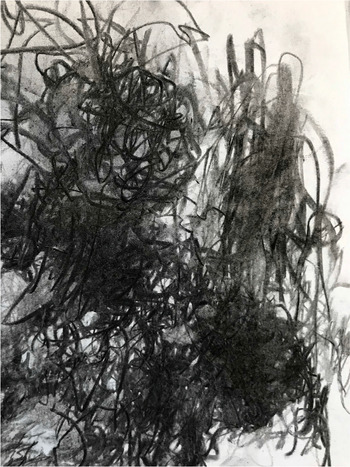
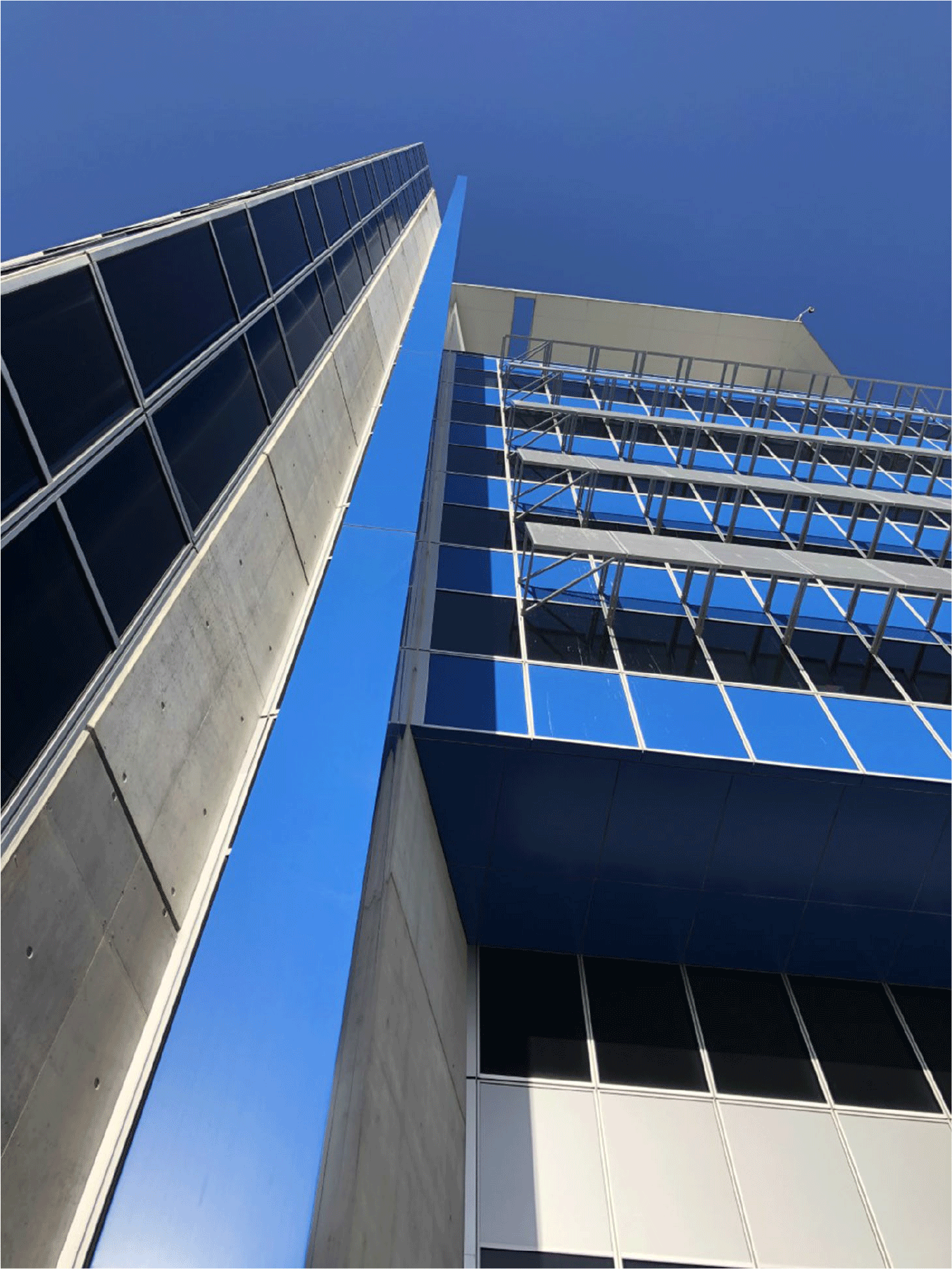
Hand gently holding the charcoal against the page as we walked ‘the traces theory knot’; attempting to stay-with that space in-between posthuman and indigenist ways of knowing (see Figure 1). This place was once known as an Aboriginal meeting place. A white man told us that. We can’t feel or sense that though — there seems to be little visible tracing of Aboriginal peoples as we stand among three stark sprawling concrete buildings — erecting from the earth. This place is a university — people coming and going between/through/up buildings. We picked up pace finding ourselves standing at a fence while looking back at a 10-storey high painting of what looks like two Caucasian young people — a man and a women wearing white shirts and long pants. It immediately grabs us; a sharp slap in the face to this Aboriginal meeting place with no whisper of Aboriginal culture. This university sees this creative work as a cultural piece of pride, but is it simply another act of colonisation? Colonisation — holding ever so tight.
Walking with charcoal.

We passage through a gate feeling heavy, angry, disappointed, perhaps even ashamed. A magpie sings — intently yet curiously watching us. We are lifted to a new trace — a more than human trace. We banter among ourselves about what ‘we’ think the magpie is trying to tell us, all the while the magpie continues to sing. As notes descend from the tree, we wander towards another gate and feel a strong pull not to go through, to instead move across into a green space; a green corridor replete with coastal banksias, casuarina, gum trees and wattle trees. A chorus of birds singing moves through me. Now we feel it. We feel the Aboriginal tracings of this land as sand slides between our feet and sandals. We can’t quite see those buildings anymore. We can breathe.
Here, we stay-with the Magpie, or what we call a bird trace. Tracing the more than human in environmental education and its research in recent times (the last 100–150 hundred years) can be seen through the works of Carson (Reference Carson1969), Weston (Reference Weston1994, Reference Weston1999), Abram (Reference Abram1996), Thoreau (Reference Thoreau1851-1860, Reference Thoreau1854/2014), Leopold (Reference Leopold1949) and Muir (Reference Muir1901). This modern tracing is also detectable in posthuman writings (Braidotti, Reference Braidotti2013; Cole & Mirzaei Rafe, Reference Cole and Mirzaei Rafe2017; Ferrando, Reference Ferrando2013; Hayles, Reference Hayles1999; Morgenstern, Reference Morgenstern2018; Morris, Reference Morris, Snaza and Weaver2015; Murris, Reference Murris2016; Snaza & Weaver, Reference Snaza and Weaver2015; Young & Cutter-Mackenzie-Knowles, Reference Young, Cutter-Mackenzie-Knowles, Cutter-Mackenzie-Knowles, Lasczik, Wilks, Logan, Turner and Boyd2020). Shifting our gaze to indigenist ways of knowing and relating between humans, Country, the land, energy and all other species represents over 60,000 years of knowing (Langton, Reference Langton2019). We think about Aboriginal peoples’ relationships with birds. Story, art, dance, ceremony and songlines readily feature Aboriginal–bird relationships:
We begin to traverse between the now and an imaginary future where this place shifts from being a ‘green corridor’ to an ‘ecological site of learning’. The possibility is within reach, but we know it will be a fight, having fought the battle many times. Convincing the men and sometimes women in suits. The conversation turns to the battles lost already in this university place. We speak of the lake drained and covered with fill and tar, where a car park now stands; where water and bodily creatures once assembled. We held strong hopes for that place. Imaginaries lost, but perhaps new imaginaries found singing with the birds.
During our meandering, we engaged slowly and thoughtfully with birds, trees, water, concrete and the more than human. These entangled inter-subjectivities of diverse traces constituted a purposeful staying-with, though it was the meeting trace that inspired the vital attentiveness to Indigenous histories, cultures and knowledges. In particular, the meeting trace inspired us to pursue more substantive engagement with Indigenous Knowledge within our own work and environmental education more broadly, despite our white fragility and fear of offending.
Staying-with the Meeting Trace
Meeting is a trace that speaks directly to the relational, the interfacing and the moving together and apart that expresses entanglements and new becomings. It is more conceptual than the materiality of the other traces and engages them all. Each of the traces is a meeting as well. Attunement to the meeting trace signifies a conscious effort to challenge the marginalisation of Indigenous peoples’ histories and cultures, both in Australia and around the world. Such efforts demand staying-with Indigenous, postcolonial and decolonising perspectives, as enduring colonisation of peoples and land remains firmly entrenched within teachers and researchers’ understandings, pedagogies and practices, both in environmental education and education more broadly (Tuck, McKenzie, & McCoy, Reference Tuck, McKenzie and McCoy2014).
Our grappling with the meeting trace offers insight into engaging with entangled pasts, presents and futures, to challenge colonialism and honour Aboriginal histories and cultures in this place. We acknowledge that attentiveness to settler colonialism is both an ‘ongoing and incomplete’ endeavour (Tuck et al., Reference Tuck, McKenzie and McCoy2014, p. 8). By sharing the story of our experience, we bring this intention into embodied enactment, into the direct relationality with diverse and multitudinous life, within the limitations of our movements in one moment. Feeling the discomfort of not knowing where to begin is a beginning.
Notably, we acknowledge that attentiveness to meeting traces also makes refusal visible. Refusal to meet is a barrier that is still a meeting — a meeting of rejection, of exclusion. Even in absence there is a meeting that emphasises whatever is being refused, rejected and disappeared. Who and that which is othered does not disappear (Tuck et al., Reference Tuck, McKenzie and McCoy2014), but is enfolded as traces. Meeting continues. There is no stopping or ignoring reality by simply looking the other way. In grappling with the meeting trace:
We strove to meet and stay-with, in perceiving and experiencing. Not dissociating away or refusing the meeting, but noticing each other, ourselves, and meeting in our engagement with/in place and its particularities. For us meeting is articulated through meanderings on a site of learning, a site of apparently higher learning. Higher than what? In searching for ‘meeting’ traces, we ask what and who is meeting here?, and what is the nature of the meeting itself? This urban landscape is here to meet the airport, to meet Australian and international students. In looking at what we see, we need to think about the ‘inbetween’, although it is only in between from a focus on the separate parts. Thinking about how traces move between and beyond edges we look for meetings, for spaces that might open new possibilities of knowing.
We identify an urgent need to stay-with meeting — the intermingling tensions of the not always complimentary, the sometimes contradictory, the uncomfortable and the difficult. It can be much easier to stay within the comfort of categories, the already known. However, the edge as a meeting place is a rich, generative zone. Holmgren (Reference Holmgren2013) refers to this as the edge effect of permaculture pattern understanding, whereby the meeting of mediums such as forest and grassland, and even fence lines, can generate an enriched microecology. We attempt to simply stay-with, without an immediate answer or action. Through attentiveness to meeting, we enrich our life world — by foregrounding the relationality of being-with, becoming-with and staying-with, not looking away, but embracing the diverse traces patterning all around us.
We meander along, noticing meeting, how our bodies meet the concrete, the built, the more than human. How the shapes and flows (or lack of flows) meet our experience of being. We observe and feel what is possible in that time-place of body/building meeting. Sharp starkness of buildings, edges. Buildings for education, yet they don’t meet us. We find no visible invitation. Inside the high, harsh wire fence, meeting is denied. The fence, definite and certain in its delineations, boundaries drawn, marks a refusal to meet with the trees and grass. It’s an uncomfortable border, a locking gate. Nature is relegated to outsider status, othered, excluded.
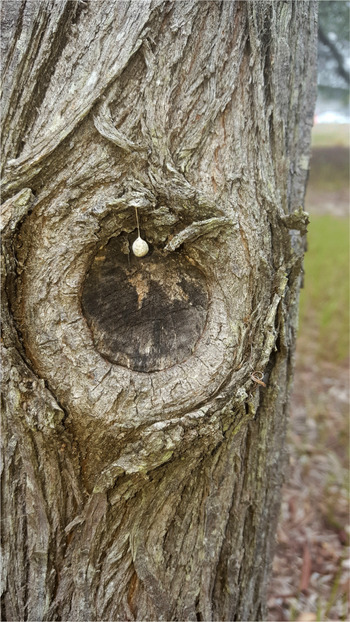
Immediately we are drawn there, as a place of softness where we can soften our own edges. Breathing more deeply as we move out under the trees, feeling like we have escaped for a moment. To let our edges out into the traces of human/place in a way that brings us to feel the meeting of all others, the human and more than human who have moved this way, stopped under this same tree, enjoyed this dappled light and cool oxygenated air. Tree is inseparably meeting us here. We talk of the sharing and learning of environmental knowledge, the learning on and with Country that may have happened here, in the depth of many tens of thousands of years. We are meeting the liminal of now and before, before the buildings and now, in a way that feels the before (see Figure 2).
Spider meets tree.

Aboriginal and Torres Strait Islander peoples have lived with/in/as/for this Country for many tens of thousands of years. As mentioned, it is said that this Country where this University stands is a meeting place, a meeting place that is a place of gathering, a place of movement and a between meeting place. Not ‘was’ as though the past has gone, a relic of frozen time, but ‘is’, the past meeting us here in the present (Barad, Reference Barad2007, Reference Barad2015). We must make a conscious effort to see, to know, to feel, to meet, to stay-with all that moved here, moves here and will move here. Meeting the now of before. There is no saying ‘that was then, and this is now’ in being here. To meet the fullness of life is to feel into the traces that are here-now. We resolve to stay-with not-yet-knowing, letting questions open a meeting place within us.
A meeting of temporalities is inseparable in a multitudinous seething present (Barad, Reference Barad2015, Reference Barad, Tsing, Swanson, Gan and Bubandt2017), contrasting with Ingold (Reference Ingold2011) who describes his life as lived in lines, continuing Deleuze and Guattari’s (Reference Deleuze, Guattari and Massumi2004 [1980]) line of thought that ‘we are lines’ (p. 215). Here, we soften the idea of lines — no longer a link between A and B, but blurring into traces of this and that in the same place, here and there overlapping in a multitude of ways. The meeting trace forms an interface of exchange, patterns and tangles of energy, matter and meaning (Haraway, Reference Haraway2016). Edges are diffractive waves of relationality, always in motion making new patterns. We embrace Barad’s (Reference Barad2007) view that all matter is diffractive patterning. Seeing and indeed meeting the overlapping concurrence of lives (human and more than human) and temporalities of varying rhythms require adjusting our focus.
Perhaps this is what Bateson (Reference Bateson2017, Reference Bateson2019) alludes to when she says we have to learn to perceive the complexity of the world before we can respond to it? Is this concept of meeting all-that-is crucial in our efforts to stay-with the traces? This meeting of the co-generative mutuality of all entities. A meeting that defies the freezing in of the notion of determined and the absolute? And the freezing out of the excluded? Is the ‘meeting’ where life grows? Melding together in ongoing co-generativity? Is the meeting trace to be found in the in-between of the Western minority notion of separate things? (Rose, Reference Rose2000, Reference Rose2008). It is a relationality that expresses the mutual coming-into-being in Indigenous onto-epistemology (Kovach, Reference Kovach2012; Meyer, Reference Meyer, Denzin, Lincoln and Smith2008; Wilson, Reference Wilson2008).
There are many questions to ask about the meeting we experience within the context of environmental education, the layers of issues at the intersections of society, technology and the environment. Such issues constitute a range of imperatives in terms of parenting and educating the next generation of children (Rousell & Cutter-Mackenzie-Knowles, Reference Rousell and Cutter-Mackenzie-Knowles2018). For educators, these issues generate questions regarding what it means to teach, what learning is and what education is for. For environmental educators, a pressing question considers how to engage with these issues in a way that is not alienating for students, particularly for children and young people who may already be feeling sustainability fatigue. Extending the possibilities of the meeting trace, Haraway (Reference Haraway2016) engages with Arendt’s words ‘to go visiting’, describing ‘visiting’ as a practice of suspending any preconceived notions of what we will discover and what we might think we know (p. 127). This notion of visiting-with ‘other’ species and places may afford new ways of being-with, staying-with and becoming-with, as a practice of finding the ‘other’ interesting, asking open questions and embracing a curious attitude to the possible. Each visit has not happened before. It is a meeting practice, a practice of meeting the meeting trace. As language engages cognition and informs action, the notions of visiting and staying-with offer a relational meeting practice within environmental education that is different than the knowledge production practices of measuring, monitoring, looking at, exploring and investigating. Such difference offers the opportunity for engaging with diverse ways of knowing through the possibility of inter-subjective meetings.
Staying-with the Tree Trace
The trees we are meeting as we wander attract us to be near them a while. Trees communicate, and electrical impulses are one way they do this, as well as using a sense of smell and taste (Wohlleben, Reference Wohlleben2016). The tree companions we meet in the nature corridor are a mix of small- to medium-sized Casuarinas, Banksia, gum and wattle rising out of a ground covering of introduced species of grass:
Threading our way through, the grasses giggle around our legs as we discuss how this small but indeed important corridor provides a natural break between the road and the university buildings rising before us. Many more than human and human traces criss-cross and weave their way over, adjacent, around, and through the nature corridor. These are the paths of animals, insects, and humans — students nipping into the forest for a cigarette, or walking through towards another destination — meeting the concrete path and the road.
The consistent repetition of movements up and down these routes is a living choreography (Ingold, Reference Ingold2015; Haskell, Reference Haskell2017). Testament to that which is rendered ‘outside’, ‘othered’ as irrelevant in the important business of higher education, still teeming with life and evidence of people seeking a green place, a place of trees:
A growth of slowness and quietude veils us. We begin to notice that this albeit human-altered natural area is also a retreat of another variety; providing safe haven for magpies and currawongs, spiders, crickets, ants and other insects. Creatures with a luxury of time on their hands can afford to take things at a leisurely pace. Maybe there is a borrowing of tree-time by the humans in the nature corridor as trees are slow in their manner; so become the humans in their walking (Wohlleben, Reference Wohlleben2016). Breathing slows, in the cooler softer air, reminding us that trees are indeed our companion species, generating the oxygen we cannot live without.
Trees are described as family in an Indigenous relational ontology by Morgan (Reference Morgan, Morgan, Mia and Kwaymullina2008), and as inseparable from human life by Troy (Reference Troy2019), who states, ‘When we destroy trees, we destroy ourselves. We cannot survive in a treeless world’ (para. 5). In the quietening we are experiencing among the trees here, we also know well that the clearing all around us inevitably compromises our air. So much concrete and a sense of potentially stolen time for these trees sharpens the pleasure of breathing together with them, for this while.
The easy companionship we feel is mixed with unspoken grief for all the trees that are gone. We stay with the feeling, staying-with the tree trace. Opening our minds and hearts through time, we wonder how old these treebeings are? We strain our ears to imagine the movement of earlier peoples through this Country. We rest beside one gnarly beauty, feeling bark and collecting photographs. Flessas and Zimmerman (Reference Flessas, Zimmerman, Letts and Fifield2019) put forward that all environmental degradation is gendered, racist, classist, ableist and generally oppressive, and offer that we cannot consider environmental education without engaging with the intersectional oppressions of othering in a multitude of ways. It seems that trees are othered, to the point of being rendered as irrelevant — bodies that are not alive and valued as such, bodies that can simply be removed, tidied out of the way.
Despite rampant mistreatment and destruction, people of all cultures feel trees as more than ‘other’, as alive and active agents, connectors in the ‘multispecies knots of time’ (Rose, Reference Rose2012). Trees communicate with each other and the wider world within a vast network of connectivity, through their roots and through mycelium networks, which can be visible where soil has been washed away to expose their entanglement. Scientists in the Harz Mountains of Germany consider this tree root entanglement to be interdependence (Wohlleben, Reference Wohlleben2016). It appears that through this interdependence trees form patterns of relationality, and nutrient and information exchange. It is tree nature to help neighbouring trees if they do not have enough nutrients available at that time. If one tree in a group of trees is suffering, the others will attempt to nourish it with their lanky root systems (Wohlleben, Reference Wohlleben2016). Sharing nourishment is tree wisdom, through reaching and connecting. Trees nourish and look after not only other trees in their forest families and in their species family, but they also provide sustenance for trees of different species in their family vicinity (Gagliano, Ryan, & Vieira, Reference Gagliano, Ryan and Vieira2017).
Recent research demonstrates that previous ideas of trees as solitary have dissolved in the light of awareness of the multiple ways that any tree is embedded and indeed entangled in many dimensions of interdependent connectivity. All plants exist in this web of communication and exchange of nutrients and information, a connectivity of collaborative survival. Many layers of interdependence within the multispecies landscapes attest to the inseparability of any tree from the multidimensional milieu of ecology. Trees and mycelium networks are integrated phenomena, their interconnectivity both branching and rhizomatic in nature (Haskell, Reference Haskell2017, p. 8), a synergy illustrative of the inseparability of all of life.
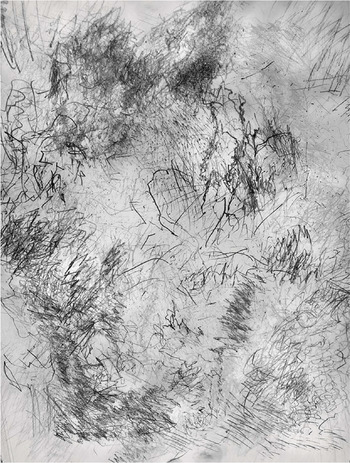
Trees are also known to seed rain-making moisture (many species ‘rain’ inside their leaf perimeter) holding moisture in the ground, distributing water so as not to erode soil and holding in relationship between soil and water. The air is moist under many trees with humidity absent in treelessness. Water is life, water and trees are life together (see Figure 3).
Tree trace drawing.

Staying-with the Watery Trace
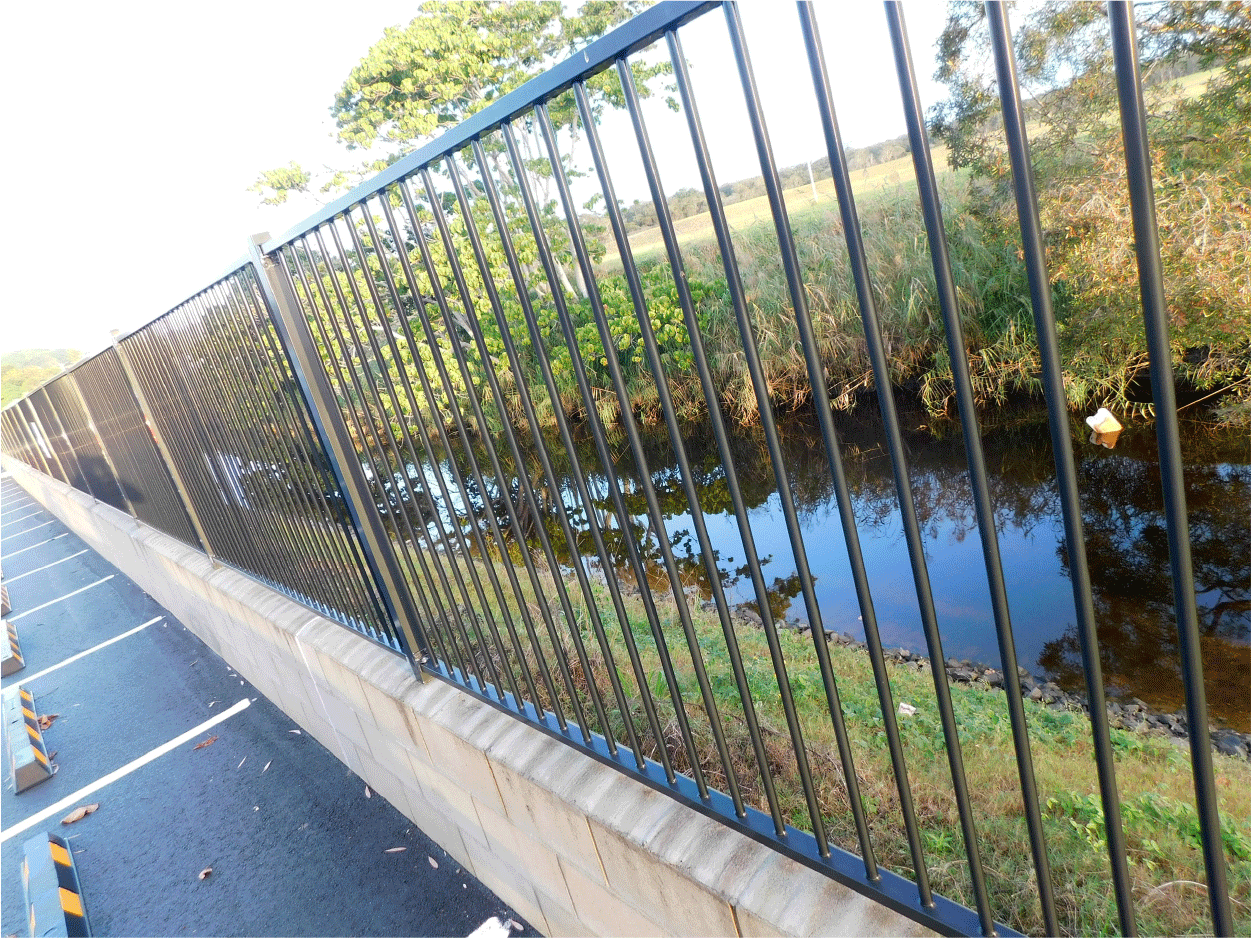
We move along the path — the place dense with concrete buildings and footpaths — to the secluded section of a patch with a few wondrous trees. We finally come to this location, which is filled with cars. We discuss while standing in the car park, that this place was previously a lake — filled with water, filled with life. But filled in now, suppressing the water to make sure the cars had enough space. The narrow channel of water that remains on one side of the carpark still adds coolness to the breeze. We imagine how it would have been to see the waters, and all we see are cars. (see Figure 4).
Watery trace.

As a part of our walking with/in/as nature and grappling with the tensions encountered during our arts-based research method, the one thing that stands out is the surface ‘tension’ of water in the paths we walked. As we walk towards the massive car park, we talk about how this area had once been a lake. Now piled up, filled, and filled and filled, spraying from one large hole once, suppressed again and not letting the water out. Moving slowly we question ourselves, ‘how could we let this happen?’ The guilt is deep. We are standing where the waters once flowed, staying-with the traces of water both present and missing, which constitute the ecology of this space:
We let the feeling of the water trace hold us, to experience how it would feel. We hear words ‘from’ the water. Standing up and walking towards the balcony gives a glimpse of the water. Suppressed. Worried. Wish it was untouched. Was it here, just here they wanted to have this car park? The water is still sad. It still has that melancholic feel as the day we walked up to it. It’s the same. Not changed, not different. The same. Sitting back and we think ‘What have we done?’
The world cannot be seen through a point of observation, rather movement is required in order to observe (Schildermans, Reference Schildermans2014, p. 59). Our walking and tracing emphasise the notion that to have a thorough understanding of environmental education we must be ready to shift our focus from objects of environmental education to interrelationships — the interactions and connectivities we form with people and environments, a process we also call ‘learning’ and between people and people which is termed ‘teaching’ (Robottom, Reference Robottom1987, p. 50). Our mappings are a learning-with the traces we engage.
We recall the maps we created. The darker lines outlining the dense emotions and the lighter ones with the casual walks we had. We recall how we were as caged humans looking at the narrow channel of water through a gateless fence, with all that remains of the large body of water. It talks to us.
We question the effects of the present on the past and the future. As we move with/in this path we feel the growing tension within. The traces we have drawn have now become much darker, drawing forth the anger within. We feel the connections with and of indigenist ways of knowing alongside the traces we have made, with arts-based engagement with place a connecting thread. We have now stepped onto a liminal state, forming encounters with humans, more than humans and diverse knowings. We follow the water trace back to an indigenist knowledge of staying-with nature. According to Bardon (Reference Bardon1979), an art teacher who explored the ‘Dreaming’ of Aboriginal peoples through art, water had been a dream. A dream that was related to living. Bardon (Reference Bardon1979) writes how Aboriginal men would sing at the fireplace stimulating the sky to rain, a slow-moving relationship with, in and as nature. We recall information that is now loud in thought:
As the driest inhabited continent, the rivers of Australia have been the focal point of life for up to 60,000 years, playing an important role in Aboriginal social life and identity. By changing how, when, and where rivers flow, water resource development has affected the way Aboriginal communities interact with the ‘landscape’. (H20 Thinking, n.d.)
For one of the philosophers on this paper, her mind returned back to the historical relationships her Sri Lankan ancestors had with water. In this powerful engagement, the bonds that are formed between humans and more than humans decentre the human from the apex of knowing and generate shared responsibilities. Barad (Reference Barad2010) terms this as an ‘ecological ontology’ wherein we have now formed connections, continuities and responsibilities (p. 496). Can we consider responsibilities in terms of a time when environmental education is deeply rooted in such connections?
Barad (Reference Barad2010) reiterates that there is no fixed form of continuity in place. Every scene is unique, and they diffract varied temporalities through the field of ‘spacetimemattering’ (p. 240). According to Barad (Reference Barad2010), these scenes never end but are restructured within traces that move through one another. Ecologists define this flow of energy as the movement of information across layers of change (Rose, Reference Rose2017b). Such connections are fundamental for life on earth. Moving in, deeply, slowly moving, to understand the indigenist way of knowing always here and moving out to the spectrum of possibilities, we consider the future. Thus, we grapple with the positioning of environmental education in this posthuman context of spacetimemattering and ask if it is possible to engage with water traces more responsibly.
The trace of water is indeed valuable to the landscape, environment and all of nature. The musings of water once spoken about with sacredness now call for the present generation to hear their stories, to listen to the stories the watery trace murmurs. Stories of human/water relationality, past, present and future. The materiality of water and the cultural relationships formed with water have a long history to relate. Yet here it whispers the stories under the traces of concrete — stories of human impacts and the entangled inseparability of urban and ‘natural’ landscapes. Staying-with the traces we discover within nature also compels staying-with the entanglement of human natureculture.
Staying-with the Concrete Trace
This trace explores concrete materialities and their impact on bodies, places and lives. This interaction and association provide a solid form and metaphor for mapping environmental education in/to its current position.
Concrete. An aggre(v/g)ation of raw materials from the Earth compressed and set in form work. Porous, cold, hard; the epitome of humans’ geologic imprint on Earth. Traces of Western minority human land-grabbing culture. Materiality of colonisation pouring through concrete as concrete pouring. Concrete traces of the entanglement of industrialisation and colonisation. The force of Western minority human dominance on more than human ecologies.
As a collective, we meandered through concrete university architectures. In the English language, concrete equates to permanence. It describes a physical reality that is tangible and solid, that the five bodily senses can engage with and make meaning from. The materiality of concrete begs for the right of permanence and provides humans a place where this may seem so. While gathered at our meeting place of the university grounds, we stayed-with the concrete’s condition of existence, involving land-grabbing of colonisation, the land torturing inflicted by Western minority development and the many un/told stories of human and more than human annihilation.
We felt the concrete trace through the visceral affect of the material, on our human bodies, and the physicality of impact of concrete on nature’s body. In the discomfort of the knowing that we are part of the effects of the impact, we seek to hide and perhaps even to escape; but we do not. We stay-with this tension and then some. We dive deep into this monolith, the concreteness of Western human dwelling, to challenge it from the inside by theorising with/in/though its traces.
Fittingly, annihilation can also relate to the paradoxical formation of concrete in the face of the obliteration of other/s. Massumi (Reference Massumi1992) refers to this as a process, which is considered here through Haraway’s (Reference Haraway2016) staying-with: where she describes staying-with the ‘trouble of living and dying in response-ability on a damaged earth’ (p. 2). Emergence, dissolution, living and dying are then parts of the process of becoming, yet how do we live in the tension of all of this? How do we make sense, meaning and forward movements as environmental educators?
Massumi (Reference Massumi1992) speculates that the present exists as a dynamic and perpetual actualisation. As such, the phenomenon of the present is more aptly described as a becoming rather than a being. This dynamic actuality postulates impermanence — the ‘future-past of the present: a thing’s destiny and condition of existence’ (Massumi, Reference Massumi1992, p. 37). The traces of concrete can then be described as an impermanent process, despite its seeming permanence, its dynamic actualisation of the material, discursive, historical and temporal conditions of existence.
This conceptual understanding of the nature of materiality as a becoming is also used in agential realist theory espoused by Barad (Reference Barad2007) who describes matter as ‘a substance in its intra-active becoming — not a thing but a doing, a congealing of agency’ (p. 151). Through this theorising, concrete can be conceptualised as a form of matter that is dynamic and discursive — not through its perceived bodily boundaries but rather through the indeterminate nature of boundaries as postulated by physics (Barad, Reference Barad2007). This expressive encounter is a generative intra-activity in concrete’s processual becoming that acknowledges the past, present and future traces through the agency and discourse of its materiality. We stay-with the concrete trace, (be)come-with each other in the ongoingness of human — more than human relationality (Haraway, Reference Haraway2016), pondering the inside of the building as still Country, still nature, within inseparable natureculture (Wilson, 2019, personal communication).
Walking together we think about the sense of separation and disconnection that spending amounts of time inside concrete buildings afford. Borrowing from Plumwood, Rose (Reference Rose2017b) uses the concept of hyperseparation to describe the dualistic construction of nature/culture, identifying this as ‘one of the key problems of the environmental crisis’ (p. 493; italics in original). Specifically, the concept of hyperseparation refers to the dominant/subordinate relationality of this traumatic dualism, which fittingly applies to concrete and nature. However, is it possible for the concrete and the natural environment to become with each other given the relentless procreation of concrete dominance (see Figure 5)? Indeed, Indigenous Knowledge tell us that concrete and building are still Country, are still nature, expressing an inseparability that confounds binaries (Wilson, 2019, personal communication).
Concrete domination.

Massumi (Reference Massumi1992) theorises the tension of becoming through ‘separation-connection’, a term used to describe the (non)relation of wood and tool working together. Perhaps the same needs to be considered in understanding concrete and nature. Wrestling against concrete materiality resists Haraway’s (Reference Haraway2016) call for the responsibility enacted in staying-with. Response-ability ‘is core to what I mean by staying with the trouble in serious multispecies worlds’ (Haraway, Reference Haraway2016, p. 13). In other words, the enactment of response-ability is the necessity of not shying away from what we are confronted with in the concrete trace. It is a slow, deep and not always comfortable affordance to see and feel all that we are entangled with, and inevitably a part of. In exploring responsibility, Rose (Reference Rose, Rose, van Doren and Chrulew2017a, Reference Rose2017b) describes the need to stay-with our own actions and consider all consequences.
Rose (Reference Rose, Rose, van Doren and Chrulew2017a, Reference Rose2017b) engages with connectivity in ecology, in which humans are not hyperseparated because we are, without question, part of the living earth. Along with responsibility, Rose (Reference Rose, Rose, van Doren and Chrulew2017a, Reference Rose2017b) reminds us that the domains of accountability, proximity, ethics and community belonging to connectivity are those which many Indigenous peoples have been living with for millennia. Within environmental education, there is much to learn regarding understanding and appreciating relationality, and therefore connectivity of Indigenous Knowledges — ways of being and becoming — with nature, that of a ‘multispecies kinship’ (Rose, Reference Rose2017b, p. 496).
In turning to connectivity with land, Anderson (Reference Anderson2000) troubled the notion of modern ‘national identity and belonging’ through land divisions and claims that give people ownership over lands, an ownership often marked by concrete in these times (p. 209). The relationships between Indigenous peoples and lands signify profoundly complex, multi-layered belonging beyond mere ‘contractual bonds’ (Anderson, Reference Anderson2000, p. 209). Gough and Gough (Reference Gough, Gough and Kridel2010) argue that this lack of understanding of Indigenous ways of knowing is also expressed in environmental education, especially in its ‘individualistic orientation’ that does little to explore relationality, connectivity and responsibility (p. 343).
Final Traces/Thoughts
Staying-with the traces is messy and complex. Our mapping-making meshwork journeyed through/with philosophical lineages and propositions in environmental education. The traces of bird, meeting, tree, watery and concrete are inseparably in relation. Staying and becoming-with these traces is the process of unravelling separateness inflicted through binaries and enacting generative ways of emerging as the entanglements we exist with and within.
Environmental education has the opportunity to play the role of sharing the stories, weaving the traces, firming the concepts or knots of connectivity, through identifying and engaging with diverse ways of knowing. Meandering, moving slowly, visiting and staying-with the traces through arts-based educational research methodologies and methods offer an exploration of diverse ways of becoming, and ways of knowing that enable embodied inseparable engagement with everything. We continue to pose questions, asking ourselves what is included, and what is excluded and othered, in these diverse yet entangled traces considered here? How are we enacting these inclusions and exclusions in our thinking and being? How are indigenist and Western minority ways of knowing meeting, or refusing to meet? By staying-with our unknowing, holding it open to possibilities of meeting, offering our willingness to ask, to be wrong, to stay-with the messiness and discomfort of now interdependent cultures, we stay-with the traces of mutual becoming. Such mutuality includes all entities, all species, all matter in this relational coming-into-being. Moving from imagining the world as outside of us, to understanding the environment as ‘[t]he very substance of ourselves’ (Gough & Whitehouse, Reference Gough and Whitehouse2018, p. 15) is a necessary shift of focus in environmental education.
Afterword
We grappled with including the more than human as an author, as this article was conceived with the more than human. However, after deep consideration we resolved to explore this complex matter in future publications. There are issues of ethics, consent, entitlement and appropriation that require thoughtful and humble engagement in any posthuman becoming in authorship.
Acknowledgements
We thank Associate Professor Shawn Wilson for his insight in the conceiving of this paper. We also acknowledge the funding body, the Australian Association for Research in Education (AARE).
Conflicts of Interest
None.
Amy Cutter-Mackenzie-Knowles is a Professor of Sustainability, Environment and Education at Southern Cross University, School of Education, Australia. She is the Dean and Head of School for the School of Education, as well as the Research Leader of the ‘Sustainability, Environment and the Arts in Education’ (SEAE) Research Cluster. She has led 40+ research projects in environmental education and published over 150 publications largely centred on ontologies in/as nature through socioecological and posthuman philosophy. She has a particular interest in child-framed arts-based research methodologies. Amy has also been recognised for both her teaching and research excellence in environmental education, including the Australian Association for Environmental Education Fellowship (Life Achievement Award) for her outstanding contribution to environmental education research.
Shae L. Brown is an educator with extensive experience in a wide range of learning environments and with diverse learners. Currently Shae is undertaking an Indigenist focused Doctoral research at Southern Cross University. Shae’s project contributes an identity emergence approach to learning generally and to the teaching and learning of complexity competence specifically. Shae’s project uses pattern thinking as an accessible language for all students. Shae is also the Senior Student Advocate at Southern Cross University and actively represents postgraduate students as President of the Southern Cross Postgraduate Association and as a Member of the National Council of Australian Postgraduate Associations.
Maia Osborn is a Post-doctoral Research Fellow within the Sustainability, Environment and the Arts in Education (SEAE) Research Cluster at Southern Cross University. Maia is a primary school teacher with experience working in diverse roles at SCU, including laboratory assistant, research assistant, university marker and tutor. Alongside these diverse roles, Maia earned an APA scholarship to complete her PhD Listening to environmentally conscious teachers: stories of philosophy, pedagogy and practice. Maia has drawn on her PhD research to publish and present nationally and internationally. Maia is deeply passionate about place-responsive pedagogies as a means to cultivate environmental consciousness and ecological understanding. Her childhood experiences living on a sustainable property in rural New South Wales strongly influence her values, interests, research and practice.
Simone M. Blom is currently completing PhD research into teachers’ perceptions of nature in the early years through the posthumanism lens, focusing on the quantum mechanics theories of Karen Barad. She enjoys engaging with and interrogating education through emergent theoretical and methodological approaches. Simone works in a number of different capacities in the academic space including teaching and research. She is an active member of Southern Cross University’s Sustainability, Environment and the Arts in Education (SEAE) Research Cluster.
Thilinika Wijesinghe is a current PhD candidate. Thilinika is an active member of the Sustainability, Environment and the Arts in Education (SEAE) Research Cluster at Southern Cross University. Thilinika’s PhD study explores how children and young people may be able to express their worldviews on climate change through a relatively new method called Speculative Drama. Thilinika works as a Research Assistant in the School of Education at Southern Cross University.
Adi Brown is a Visual Artist and Senior Lecturer in Creative Technologies at Hunan City University, and Hangzhou Vocational and Technical College, China for Whitireia Polytech, New Zealand. Currently, she is a PhD candidate and member of the Sustainability, Environment and the Arts in Education (SEAE) Research Cluster at Southern Cross University, Australia. Adi is committed to arts-based education that is collaborative and project based, and her interests are in Visual Arts pedagogies. Adi’s publications stretch across a number of fields. Her MFA thesis explored notions of the feminist uncanny, new materialism, photography and object making. Adi has exhibited widely in New Zealand and her work was included in a national survey show at Pataka Gallery, Wellington and The Sargent Gallery, Wanganui. She has been a finalist in a range of national art awards, including New Zealand’s prestigious annual Wallace Art Awards.