


INTRODUCTION
The emergence and stability of political regimes crucially depends on the support for these regimes in the population. A strong preference for democracy in the population can destabilize autocracies and lead to democratization, whereas a lack of support for democracy implies the risk of destabilization and breakdown of democracy (di Palma Reference Di Palma1990; Linz and Stepan Reference Linz and Stepan1996; Diamond Reference Diamond1999). Surprisingly little is known about the determinants of individual preferences for democracy, however. Traditionally, the literature has focused on macro-determinants that foster democratic attitudes, including, in particular, economic development, education, and inequality (Almond and Verba Reference Almond and Verba1963; Lipset Reference Lipset1959, Reference Lipset1960; Persson and Tabellini Reference Persson and Tabellini2009). Recent work has shifted attention to the analysis of survey data to explore individual support for democracy and its determinants. The results of this literature indicate that support for democracy is higher in democracies (Inglehart Reference Inglehart2003; Inglehart and Welzel Reference Inglehart and Welzel2003), and affected by perceived government effectiveness (Magalhaes Reference Magalhaes2014). An increasing body of evidence suggests that preferences in various domains, including political preferences, are influenced by environmental conditions as well as individual life experiences (Fehr and Hoff Reference Fehr and Hoff2011) and modernization in general (Inglehart and Welzel Reference Inglehart and Welzel2010). In the domain of political preferences, recent evidence has shown that the individual support for democracy is influenced by the individual experience with democracy, in terms of the length of time a person spent under a democratic regime (Fuchs-Schündeln and Schündeln Reference Fuchs-Schündeln and Schündeln2015).
While this body of evidence suggests that political preferences are to some extent endogenous with respect to the overall environment and to events or experiences in the past, little is known about how the remaining life horizon affects individual political preferences. Do young individuals have a systematically different predisposition toward democracy than older ones? Is the remaining life expectancy relevant for the attitudes toward the political regime? And can the influence of age effects be separated from the role of the expected length of the remaining life?
From a theoretical point of view, retrospective experiences should matter less for regime preferences than the beliefs or expectations about the personal costs and benefits in the future implied by alternative political regimes, as well as by the time horizon over which they are expected to accrue (e.g., Acemoglu and Robinson Reference Acemoglu and Robinson2006). A prominent example of this argument is the quality of the institutions set up by colonizers, which has been found to be crucially related to the colonizers’ life expectancy (Acemoglu, Johnson, and Robinson Reference Acemoglu, Johnson and Robinson2001). Greater life expectancy implies a greater incentive to set up inclusive institutions that allow for political participation, secure private property, and provide checks against power abuse by the state or the government, i.e., democratic regimes, in particular if the implementation of such institutions is costly and time intensive. The prominent role of demographic factors like the age structure for the emergence and stability of democracy has been recognized in the field of political demography (Dyson Reference Dyson2012; Wilson and Dyson Reference Wilson and Dyson2016), but the underlying mechanisms are still not fully understood. Building on the idea of a youth bulge according to which the presence of a large share of young adults within the population provides a favorable environment for civil conflict (Urdal Reference Urdal2006), Cincotta and Doces (Reference Cincotta, Doces, Goldstone, Kaufmann and Toft2012) and Weber (Reference Weber2013) provide evidence that the age composition of the population affects the likelihood of the establishment of liberal democracies or the likelihood of dictatorships, respectively. Likewise, a considerable body of evidence in social psychology has established a link between individuals’ awareness of mortality or threats to their life, and authoritarian attitudes (Doty, Peterson, and Winter Reference Doty, Peterson and Winter1991; Echebarria-Echabe and Fernandez-Guede Reference Echebarria-Echabe and Fernandez-Guede2006; Sales Reference Sales1973). The nexus between mortality salience and political attitudes has been confirmed in numerous studies (for a recent meta-analysis, see Burke, Kosloff, and Landau Reference Burke, Kosloff and Landau2013). Recent work by Foa and Mounk (Reference Foa and Mounk2016, Reference Foa and Mounk2017) on the decreasing support for democracy in Western countries, particularly among the young, has sparked an intense debate about “democratic deconsolidation”.Footnote 1 However, a study that provides systematic evidence regarding the distinct influence of age and the expected remaining life expectancy on the preferences for democratic political regimes is still missing.
This note reports results from an empirical study that explores the effect of the expected length of the remaining life faced by individuals of different ages on individual attitudes toward democracy. The identification strategy is based on individual-level observations for political regime preferences for a panel of countries and on variation in the remaining years of life across age-gender-country-period cells. Building on work in demography by Sanderson and Sherbov (Reference Sanderson and Sherbov2005, Reference Sanderson and Sherbov2013), this approach distinguishes between chronological age and a forward-looking definition of age reflected by remaining life expectancy. This allows controlling for other individual-level factors that might influence individual preferences for the political regime and for potential confounds at the country level such as economic and institutional factors, health infrastructure, or life expectancy. The evidence shows that support for democracy increases with age but declines with expected proximity to death, implying that increasing longevity might help fostering the support for democracy. Increasing age while keeping the remaining years of life fixed as well as increasing remaining years of life for a given age group both contribute to the support for democracy.
DATA AND METHODOLOGY
Data
The analysis is based on individual-level survey data collected as part of the World Value Surveys. The World Value Surveys are nationally representative surveys that are conducted repeatedly in almost 100 countries, using a common questionnaire that contains consistent and comparable sets of questions on various topics. The relevant questions for this study relate to the individual assessment of democracy as a form of governing a country, measured on a scale from one to four. We also use alternative questions regarding the subjective importance associated with living in a country that is governed democratically, with having a parliament and elections rather than a strong leader, and an assessment of democracy as best form of government, as well as indices that combine these questions (see Supplementary Material for details regarding text and coding). The same questions have been used previously in research on democratic attitudes (Fuchs-Schündeln and Schündeln Reference Fuchs-Schündeln and Schündeln2015; Inglehart and Welzel Reference Inglehart and Welzel2003). The empirical analysis is conducted using a sample with survey information from the World Value Survey rounds 3–6 (1994–98, 1999–2004, 2005–09, and 2010–14) for an unbalanced panel of 93 countries for which information is available for the relevant questions regarding individual attitudes toward democracy.
These data are combined with information about the years until the expected death of an individual of a given age and gender living in a particular country at a given point in time. Data about the remaining years of life of an individual are taken from period life tables assembled by the United Nations (2015) for the periods 1990–95, 1995–2000, 2000–05, 2005–10, and 2010–15, which contain the respective information for each country for age brackets of five years for both genders. Variation in remaining years of life is plausibly exogenous to individual preferences for a political regime and is thus suited for addressing the research question.
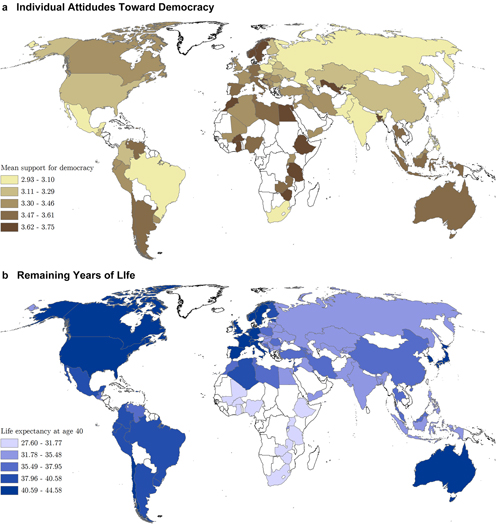
The pooled sample for the main specification consists of 267,426 individual observations.Footnote 2 Figure 1(a) displays the average attitude toward a democratic political system across countries, based on individual responses for the most recent survey wave of the World Values Survey available in each country. Figure 1(b) displays the corresponding average life expectancy at age 40 in terms of remaining years of life of the respondents for the year in which the most recent survey wave was elicited.
World Maps of Individual Democratic Attitudes and Individual Life Expectancy
Panel (a): World map of attitude toward democracy. Country averages for the estimation sample of individual responses for the most recent survey wave available in each country. Authors’ calculations are based on micro-data from World Values Survey. Panel (b): World map of average life expectancy in terms of remaining years of life of the respondents for the year in which the most recent survey wave was elicited. Authors’ calculations are based on period life tables. In both panels, the coloring reflects quintiles; white color indicates excluded country.

Empirical Methodology
To identify the effect of age and remaining years of life, the empirical strategy exploits variation in the remaining years of life that an individual of a given age and gender faces in the respective country at the respective point in time, therefore relying on variation across age-gender-groups in a country across time. Concretely, the estimation framework is based on a panel data set for age-gender-country-period cells and we estimate models of the general form,
 $$\eqalignb{\displaylines{ Attitude\;toward\;Democrac{y_{iagct}} }\cr= \alpha + \sum\limits_{\tau = 1}^T {{\beta _\tau }{\cal I}} \;\left( {\tau = Remaining\;Year{s_{iagct}}} \right) \cr + \sum\limits_{a = 15}^{97} {{\delta _a}{\cal I}} \;\left( {a = Ag{e_{iagct}}} \right) + \gamma {X_{iagct}} + {{\cal I}_{a,g,c,t}} + {\varepsilon _{iagct}}, \cr}$$
where Attitude to ward Democracy iagct measures the survey response regarding attitudes toward democracy by an individual i of age a ∈ [15, 97] and gender g ∈ {male, female} in country c at time (survey period) t. Remaining Years iagct measures the remaining years of life that this individual respondent can expect to live according to the most recent (period) life tables for this country. Age iagct is the age of the respondent. By estimating a distinct coefficient for each year of remaining life expectancy (the vector of β-coefficients) and for each age (the vector of δ-coefficients), this empirical specification provides flexible semi-parametric estimates of the respective patterns of the effects of remaining years of life and of age on attitudes toward democracy. The vector X iagct contains individual information about socio-demographic characteristics, such as number of children, marital status, income, and education level. Finally,  ${{\cal I}_{a,g,c,t}}$ denotes a vector of binary indicator variables that account for systematically different democratic attitudes by gender, country, and period cells, or heterogenous age effects. Besides fixed effects for remaining years and age, the baseline specification includes country fixed effects, period fixed effects, and gender fixed effects,
 $${{\cal I}_{a,g,c,t}} = {\delta _c} + {\delta _t} + {\delta _g},$$
while an extended specification also includes interactions,
 $${{\cal I}_{a,g,c,t}} = {\delta _{ct}} + {\delta _{ga}},$$
allowing for period-specific country effects and gender-specific age effects.Footnote 3 The estimation is conducted by least squares, the error term ε iagct allows for clustering at the country-age-gender-period level.
The identifying assumption underlying this estimation approach is that there are no unobserved factors at the age-gender-country-period level that are correlated systematically with individual remaining years of life or age. Covariates at the age, gender, country, and period level also account for factors that might affect democratic attitudes. To account for country or period-specific factors that might affect the attitudes toward democracy, the specification of the empirical model includes country and period effects that capture factors such as the quality of democratic institutions, political and civil liberties, ruling parties, the overall health status, and life expectancy at birth of the population. The same is true for country-specific historical events that influence the attitudes toward democracy.Footnote 4 Gender effects or in some specifications age-specific gender effects also capture differences between women and men that might be linked to culture or development.
With this estimation framework, the identification of the effects of remaining life years and age on attitudes toward democracy is based on within-country variation in remaining years of life across age-gender cells and over time. The use of information from life tables corresponds to quasi-experimental variation in the sense of an intention to treat approach, since individual life styles or factors directly related to the quality of or attitudes toward political institutions are not correlated with remaining years by construction and thus do not affect the estimates. In particular, endogeneity stemming from a third factor that is related to both the subjective life expectancy and the preference for democracy, as for instance with victims of political violence in autocracies who expect to only live a short period of time as consequence of ensuing health damages, or with individuals planning to conduct a suicide attack, is ruled out by this approach. Notably, such endogeneity concerns prevent the use of subjective health assessments or individual assessments of remaining years of life in terms of subjective life expectancy for the purpose of this study. Being based on objective life table information, our analysis also differs from the literature that focuses on the role of mortality salience, e.g., in the context of terror attacks, for political attitudes, see, e.g., Burke, Kosloff, and Landau (Reference Burke, Kosloff and Landau2013).
RESULTS
Main Results
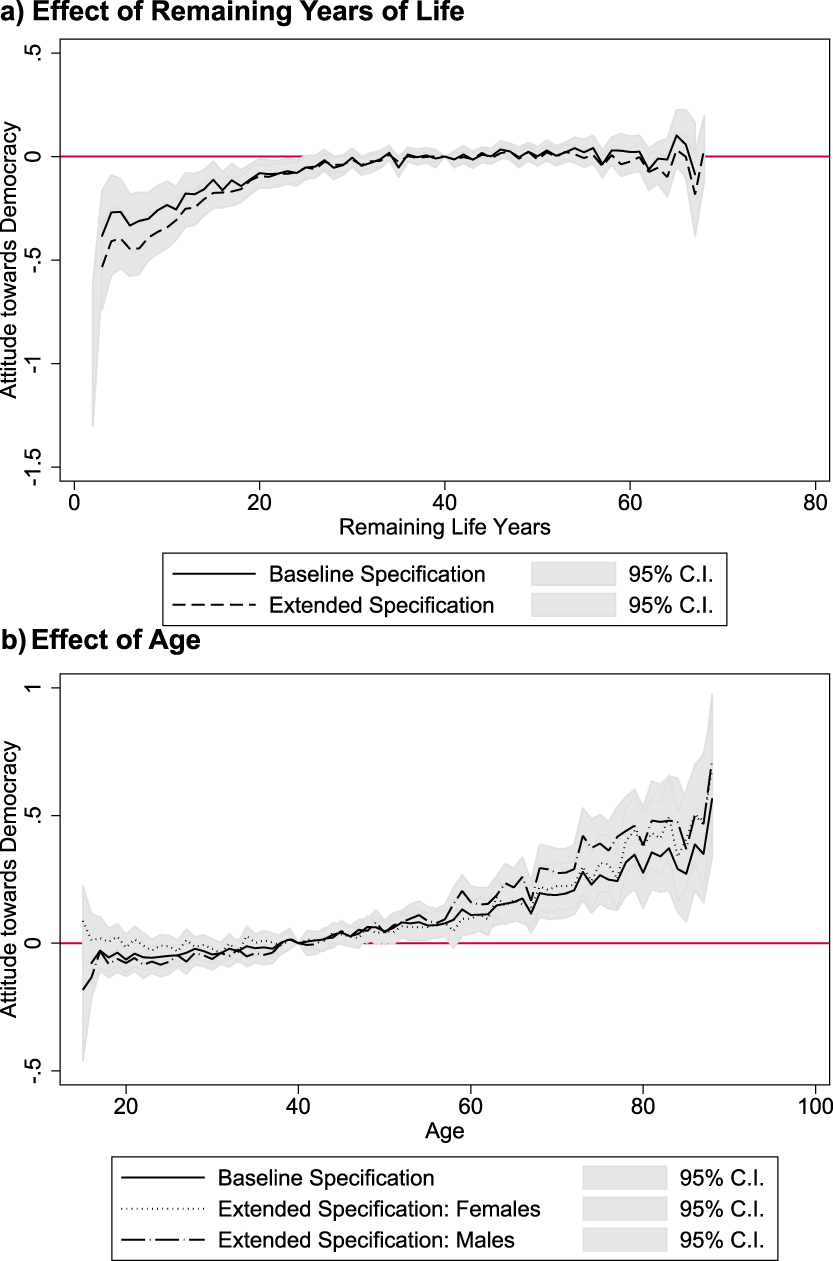
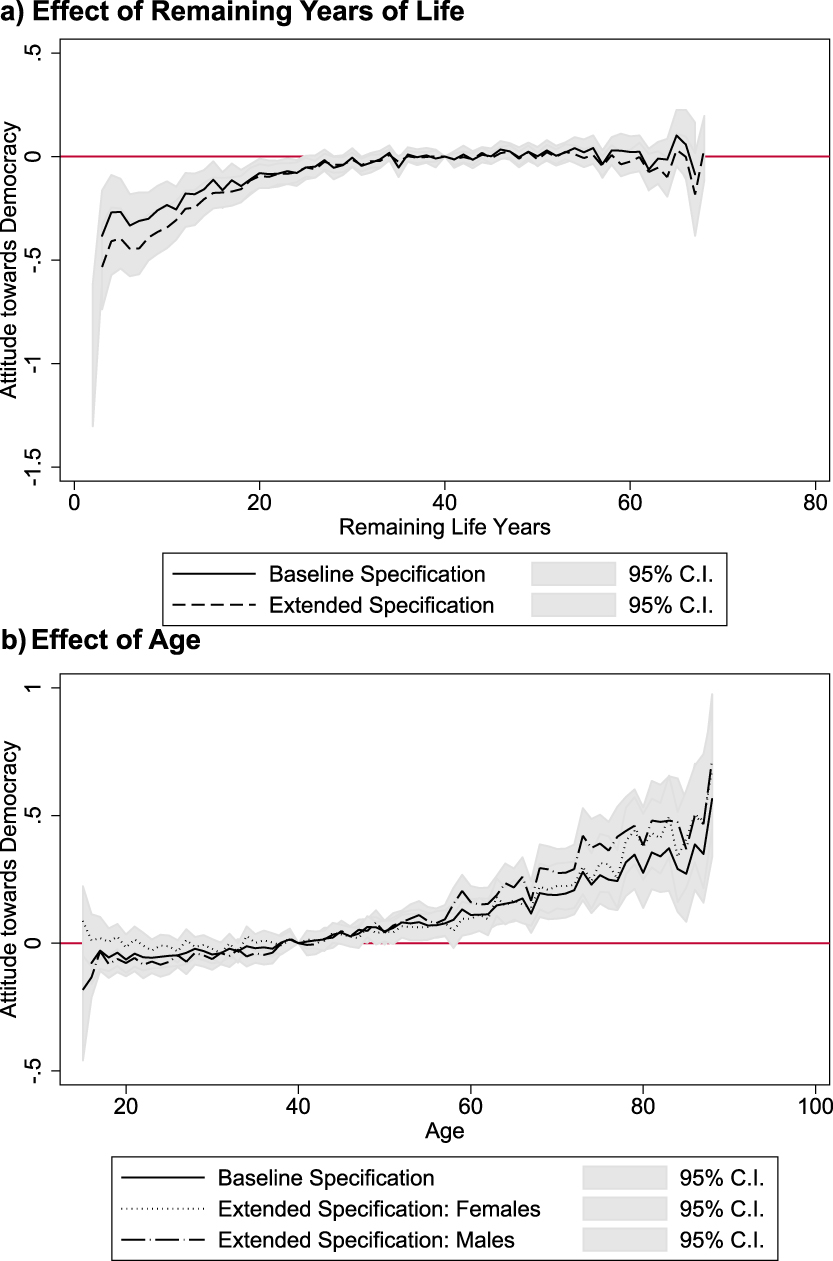
The estimation results reveal a significant gradient in the attitudes toward democracy with remaining life expectancy. Figure 2(a) visualizes the effect relative to the base category of individuals with 40 remaining life years. The effect is non-linear and monotonically increasing in remaining life years. Holding age and other regressors fixed, individuals that are closer to their expected end of life value democracy less than individuals that can still expect to live for 25 years or more. This effect is distinct from the age effect depicted in Figure 2(b). Relative to the base category of 40-year olds, age is associated with more positive attitudes toward democracy, with older individuals having significantly more positive attitudes toward democracy. The coefficients of remaining life years and general age-patterns [shown in Figure 2(a) and 2(b)] are estimated jointly within the same estimation framework holding all other covariates fixed. The figures plot the results of the baseline specification with age, gender, country, and period effects, as well as for the extended specification for gender-specific age and country-period fixed effects. The patterns are similar across both specifications.Footnote 5
Effect of Remaining Years of Life and Age on Subjective Assessment of Democracy
Coefficient estimates obtained from a multivariate regression model (1) with controls for a vector of binary indicator variables that identify gender, country, and period cells as in the baseline specification (1a), or with controls that allow for period-specific country effects and gender-specific age effects as in the extended specification (1b). Shaded areas represent +/−1.96 standard deviation bands around the respective coefficient estimate (95% confidence intervals).
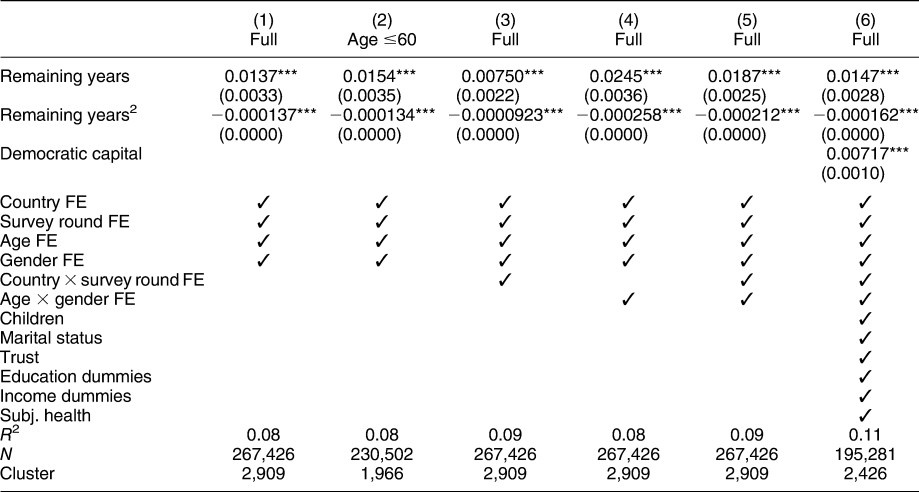
The results are reproduced in parametric multivariate regression settings with a quadratic specification of the effect of remaining years of life. Table 1 Column (1) presents the results obtained with the baseline specification. Restricting the estimation sample to individuals age 60 and younger to reduce potential collinearity between age and remaining years delivers almost identical point estimates, see Table 1 Column (2). To account for other sources of unobserved heterogeneity related to country-specific historical events or for age-specific gender roles, alternative specifications control for country-specific period effects, Table 1 Column (3), or for gender-specific age effects, see Table 1 Column (4), respectively, with similar results. The same holds when controlling for country-specific period effects and gender-specific age effects, see Table 1 Column (5).
Effect of Remaining Years of Life on Democratic Attitudes: Parametric Estimates

Least squares fixed effects (FE) estimates. Columns (1), (3), (4), (5), and (6) are based on the full sample, Column (2) is based on the sample of respondents aged ≤60 years. Column (1) corresponds to the parametric version of the baseline specification in (1a), Column (5) to the extended specification (1b) of the empirical framework (1). Standard errors (clustered by country-age group-gender-survey period) in parentheses. *** p < 0.01, ** p < 0.05, * p < 0.1.
To rule out that individual socio-economic background conditions, which may affect both longevity and attitudes toward democracy, affect the estimates, Column (6) of Table 1 presents results for an extended specification with a vector of control variables that includes the presence of dependent children, marital status, trust, educational attainment, income, and subjective health. In addition, we also control for individual experience with a democratic system following Fuchs-Schündeln and Schündeln (Reference Fuchs-Schündeln and Schündeln2015) to isolate the causal effect of remaining life expectancy on political attitudes and decompose it from the effect of democratic experience as well as country-specific period effects and gender-specific age fixed effects. Again, this specification delivers similar results as the baseline and at the same time reproduces earlier findings that individual experience with democracy shapes the preferences for democracy. The same is true for the corresponding semi-parametric estimates for the effects of remaining years of life and age on democratic attitudes across the different specifications, see Figures S2 and S3 in the Supplementary Material.
Robustness and Additional Findings
One challenge for identification in this context is the systematic correlation between age and remaining years of life. This correlation is highest for the cells with high ages and low remaining life years.Footnote 6 To investigate the sensitivity of the results with respect to potential empirical multicollinearity, we conduct several analyses. Estimates of variance inflation factors for the estimates for remaining years of life and age obtained on the full sample do not reveal evidence for excessive multicollinearity.Footnote 7
Alternatively, we analyze restricted samples of individuals of age 60 years and younger, or 40 years and younger. This reduces the correlation between age and remaining years of life.Footnote 8 The estimation results based on these sub-samples reveal similar patterns as the estimates obtained from regressions using the full sample, while the variance inflation factors for these estimates are consistently below six.Footnote 9 The results are robust with respect to the use of alternative estimators, such as ordered logit, or when estimating the effects separately for sub-samples for Western democracies and all other countries.Footnote 10 The results regarding the influence of remaining years of life and age on democratic preferences also extend to alternative measures of democratic preferences that have been used previously in the literature.Footnote 11
DISCUSSION
This note presents novel evidence that support for democracy increases with age but declines with expected proximity to death, indicating that longevity plays a crucial role for the support for democracy. More experience in life in general, as reflected by a greater individual age while holding other factors fixed, and a greater individual life expectancy, as reflected by the expected remaining years of life, are associated with more favorable attitudes toward democracy as political system. These findings hold above and beyond controlling for the usual macro-determinants and retrospective experiences, such as individual exposure to democracy that have been shown to affect support for democracy in the existing literature. The effects are quantitatively sizable, with an increase in remaining life years of 20 years being associated with attitudes toward democracy that are more favorable by about a third of a standard deviation of the world sample (Table 1 and Supplementary Material Table S1), and comparable in size to the age effect. Moreover, remaining years of life have the relatively largest influence of all explanatory variables.Footnote 12
The results have implications for policy. In terms of living environment, many developing countries exhibit non-democratic or weak institutions, poor health conditions, high mortality, violent conflicts, and generally gloomy perspectives for individual lives. Our findings suggest caution regarding the scope for democracy in these environments. Individual democratic attitudes, which are considered key for the viability of democratic regimes, appear to be weakened by short life horizons. Support for democracy is predicted to be lowest among young adults in environments that entail a short life expectancy. These are the conditions characterizing the reality in many developing countries, where the health infrastructure and coverage is deficient, and where ongoing conflicts and ineffective institutions imply low life expectancy and, related, low future orientation among the population. Increasing the life expectancy for any given age group would contribute to the support for democracy while simultaneously implying an increase in age for a given expected length of remaining life, with similar consequences for democratic attitudes.
Conversely, the results point at potentially detrimental consequences of declining life expectancy for the support for democracy. In developing countries, falling life expectancy as consequence of epidemics or conflicts is predicted to undermine popular support for democracy. This also raises a note of caution for developed countries in which life expectancy has been stalling recently (Xu et al. Reference Xu, Murphy, Kochanek and Arias2016). In light of considerable heterogeneity in the projections of life expectancy across developed and developing countries (Kontis et al. Reference Kontis, Bennet, Mathers, Li, Foreman and Ezzati2017), the findings suggest the possibility of heterogenous prospects for the popular support for democracy across the world. This also sheds new light on ongoing discussions about the stability of democracy in aging societies, which have largely focused on policies (Goldstone et al. Reference Goldstone, Kaufmann and Toft2012; Lee and Mason Reference Lee and Mason2011), but less on the public support for the political system at large. By highlighting the potential effects of health improvements on support for democracy, our results provide a novel perspective on the potential outcomes of health policies.
Future work is needed to address the links between political attitudes and institutions and between life expectancy and future orientation to corroborate the policy relevance of our results. In this respect, our study addresses two important points that deserve more attention. First, while the importance of individual attitudes toward democracy for the political system has been emphasized previously (Fuchs-Schündeln and Schündeln Reference Fuchs-Schündeln and Schündeln2015), more evidence is needed to establish the link between individual support for democracy and the emergence and stability of democratic institutions. A mapping between attitudes and a quantifiable outcome would facilitate the quantitative interpretation of our results. Second, while remaining years of life is likely to be a critical determinant of future orientation by affecting the life horizon of an individual, direct evidence for this link is scarce. Recent work suggests that life expectancy indeed correlates with time preference (Falk et al. Reference Falk, Becker, Dohmen, Enke, Huffman and Sunde2018). More work is needed to establish this link at the individual level and to uncover the causal pathways by which age and remaining life expectancy affect attitudes toward democracy.
SUPPLEMENTARY MATERIAL
To view supplementary material for this article, please visit https://doi.org/10.1017/S0003055419000200.
Replication materials can be found on Dataverse at: https://doi.org/10.7910/DVN/F9RCKB.






Comments
No Comments have been published for this article.