Take-Home Points
-
▪ Long-acting injectable (LAI) formulations of antipsychotics have traditionally been used for those patients with schizophrenia with the most severe symptoms, poorest compliance, most hospitalizations, and poorest outcomes, namely at the latter stages of their illness.
-
▪ However, early episode patients at the beginning of their illness may have the most to gain from LAI antipsychotics, at a time when schizophrenia is most treatable and when avoidance of recurrences and rehospitalizations may lead to the biggest gains in outcome.
-
▪ Administration of LAI formulations of antipsychotics to schizophrenia patients after first hospitalization has the potential to moderate the downhill course of this illness by preventing relapses, rehospitalization, and complications associated with noncompliance such as substance abuse, violence, arrests, referral to the criminal justice system, and treatment resistance for positive symptoms. More studies are needed that target the application of the technology of LAI antipsychotics to the treatment of early episode patients to see if treatments that are often administered last should now in fact be administered first.
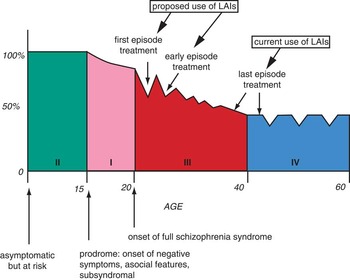
Technologies that can prolong the action of a single dose of an antipsychotic for several weeks have been available since the 1960s, and are known collectively as long-acting injectable antipsychotics (LAIs).Reference Stahl 1 Originally introduced for the classical (conventional, first generation) antipsychotics, and more recently for some of the atypical (second generation) antipsychotics,Reference Citrome 2 LAIs have only ever attained a low percentage of total prescriptions for antipsychotics. This low level of use has occurred despite the fact that up to half of patients with schizophrenia are noncompliant.Reference Lacro, Dunn, Dolder, Leckband and Jeste 3 LAIs have instead become “niched” for patients who are at the later stages of schizophrenia (Figure 1), and LAI treatment has been stigmatized as well, since patients receiving LAIs are more likely to be minorities, less likely to be veterans, have more psychiatric hospitalizations, are more likely to have been arrested, are more likely to use alcohol and illicit substances, and are more likely to show higher psychopathology, particularly positive psychotic symptoms and disorganized thinking.Reference Shi, Ascher-Svanum and Zhu 4 Even for those at the later stages of illness (see Figure 1), sometimes called “last episode psychosis”Reference Munk-Jorgensen, Nielsen, Nielsen and Stahl 5 (not last ever episode of psychosis, but the latest episode of psychosis), several treatment options are often elected prior to giving LAIs, such as trying yet another antipsychotic, or a trial of clozapine or of polypharmacy with two antipsychotics.Reference Morrisette and Stahl 6 , Reference Morrissette and Stahl 7
A Paradigm Shift for LAIs: The Last Shall Be First?

Since the introduction of LAIs, it is now better appreciated that compared with patients who receive early and stable antipsychotic treatment, untreated patients with schizophrenia can show greater loss of cerebral gray matter (eg, van Haren etal Reference van Haren, Hulshoff Pol and Schnack 8 ), and there is concern that delay in treatment might lead to poorer responses to antipsychotics and to more hospitalizations when antipsychotics are administered with either delay in treatment or via intermittent/chaotic administration.Reference van Haren, Hulshoff Pol and Schnack 8 , Reference Stahl 9 Although these concerns are not yet conclusively proven, as it is not easy to study long-term outcomes in patients with schizophrenia who receive no treatment or intermittent/chaotic treatment due to logistical and ethical concerns, genetic and neuroimaging studies strongly suggest that schizophrenia does have a progressive neurodegenerative long-term course, and that long-term outcomes may potentially be modified by aggressive and early treatment to prevent hospitalizations as well as the comorbidities and complications of untreated illness such as substance abuse, violence, and arrests (see references inReference Lacro, Dunn, Dolder, Leckband and Jeste 3 – Reference Stahl 9 ).
Despite these concerns about delayed or intermittent treatment immediately after the onset of schizophrenia, there has been insufficient emphasis on using LAI technology for antipsychotics in early episode patients (Figure 1). Since it is now clear that there is a high response rate to initial antipsychotic treatment in first episode schizophrenia,Reference Agid, Arenovich and Sajeev 10 with considerable loss of response to a second antipsychotic and beyond,Reference Morrisette and Stahl 6 , Reference Morrissette and Stahl 7 , Reference Stahl 9 , Reference Agid, Arenovich and Sajeev 10 and that LAIs show strong superiority compared to oral antipsychotics in preventing hospitalizationReference Kishimoto, Nitta, Borenstein, Kane and Correll 11 , Reference Tiihonen, Haukka and Taylor 12 in all but relatively stable populations such as compliant veterans,Reference Rosenheck, Krystal and Lew 13 with the loss of only a few doses of antipsychotic having devastating impact on the return of psychosis and rehospitalization,Reference Subotnik, Nuechterlein and Ventura 14 it is a wonder that there has not been more of a movement to utilize LAIs in first episode instead of last episode psychosis (Figure 1). If LAI antipsychotics have the potential to modify the outcome of schizophrenia to fewer relapses, fewer rehospitalizations, and less chance of complications, the time may have come when “the last shall be first” (Figure 1).Reference Tiihonen, Haukka and Taylor 12