Since North and Weingast's seminal treatment, England's Glorious Revolution has become the canonical example of how constitutional engineering can fundamentally alter a country's politics.Footnote 1 Yet, scholarly views on the Revolution divide more sharply today—both empirically and theoretically—than when North and Weingast first advanced their thesis.
On the empirical front, the “no structural breaks” school— including Nathan Sussman and YishayYafeh, Gregory Clark, and Peter Murrell—show that interest rates, property rights protection, and many other phenomena exhibit no sharp change at the Revolution.Footnote 2 In contrast, scholars such as North and Weingast, Dan Bogart, and Gary Cox show that credit access, property rights adjustment, and other phenomena exhibit sharp (and arguably growth-promoting) change after the Revolution.Footnote 3
On the theoretical front, members of the “slow development” school—including Patrick O'Brien, Stephan Epstein, and Murrell—argue that the Revolution should have affected little, because the important changes were more technical than political and accrued slowly during the Civil War and Restoration.Footnote 4 In contrast, North and Weingast and others believe the settlement enhanced the government's credibility in a variety of transactions, thereby sparking important developments in the political economy.Footnote 5
In this article, I argue that the Glorious Revolution should have affected a narrower range of transactions than North and Weingast envisioned; but that it nonetheless had fundamental effects. In my view, the Stuarts lacked credibility mainly in their commitment to respect Parliament's constitutional rights, rather than in their commitment to respect their subjects' private property rights. Thus, the Revolution winners' constitutional engineering aimed primarily to bolster Parliament's constitutional position—and did so in three main areas. First, Parliament sharply extended its power to grant tax revenues for limited periods, thereby putting the king on a short financial leash. Second, Parliament gained implicit recognition of its constitutional ability to block issuance of new government debt, further shortening the leash. Third, the main elements of ministerial responsibility were established, thereby giving Parliament its first workable means to control the executive branch's actions.
The rest of the article proceeds as follows. I first describe the constitutional struggle between the Stuarts and their parliamentary adversaries. I then consider the three constitutional changes mentioned above, whereby Parliament asserted control over taxation, debt, and Crown acts. In each case, I consider what constitutional engineering occurred and what effects it should theoretically have had, before reviewing pertinent evidence. I then briefly return to the question of whether the settlement causally affected the course of politics or merely summarized and systematized changes that had already occurred.
THE CONSTITUTIONAL STRUGGLE UNDER THE STUARTS AND THE REVOLUTION
Throughout the short seventeenth century (1603–1688), Parliament frequently asserted its power over the purse and the Crown repeatedly sought to evade that power and establish financial independence. While the battle at any particular historical moment was not always between the extremes of “parliamentary supremacy” and “absolutism,” those were the polar outcomes the two sides craved and feared. Most of the time, the war over the constitution was cold, with revenue-hungry kings respecting the letter of parliamentary rights while violating their spirit. Occasionally, as in the Civil War, the conflict over the sinews of power turned hot.
The Crown employed a three-pronged strategy to prevent parliamentary supremacy and promote absolutism. The first and least radical prong of royal strategy was to control Parliament from within, by buying seats, buying votes, and manipulating the parliamentary agenda. The second prong was to rule legally without Parliament; the Stuart kings could and did refuse to call Parliament for long periods, seeking to find sufficient revenues via various technically legal gambits. The third and most radical prong was to crush Parliament and establish a more absolutist regime by force.
Parliament's strategy to assure its supremacy, or at least bolster its constitutional position, was not simply to proclaim its rights in the broadest possible terms. It had tried that before—e.g., in the Petition of Right 1628—without success. Thus, radical parliamentarians began to devise constitutional impediments that would hinder each prong of the king's strategy. After the Revolution, new impediments were enshrined in the settlement documents sensulato, as I sketch in the next few subsections.
Crushing Parliament Military
To prevent the king from crushing Parliament militarily, the Bill of Rights forbade maintaining a standing army during peacetime without parliamentary assent and the Mutiny Act (1689) forbade forming a standing army without parliamentary assent. Neither provision had ever been embodied in statutory form before. Together they ensured that the Crown, were it determined to coerce Parliament, would need to undertake illegal acts early in the process of implementing its coercive strategy, thereby giving parliamentary forces more time to coordinate their countermeasures.
End-Running Parliament
To prevent the Crown from ruling legally without Parliament, parliamentarians put it on a shorter financial leash than ever before.Footnote 6 For example, when William III came to the throne, Parliament granted him the customs tax revenues for six months, then another six months, then one year, then four years, and then five.Footnote 7 A deadline always loomed at which the king would lose over a fifth of his total revenues, unless he could cut another deal with Parliament. This put William in a very different bargaining position than either Charles II or James II, both of whom had received the customs for life. I provide new evidence on just how much weaker William's bargaining position was below, as regards both taxes and loans.
Controlling Parliament
To prevent the Crown from controlling Parliament from within, the settlement erected new defenses against two of the main tactics of royal influence—viz., seat buying and vote buying. Let's consider each in turn.
The Bill of Rights proclaimed the goal of “no royal seat buying” clearly enough, in its call for freedom to elect Members of Parliament without royal interference. Yet, there was nothing new in this demand. The 1690 act reversing a King's Bench judgment against the city of London, however, was new. The original judgment, rendered in 1683, entailed forfeiture of the city of London's charter and franchises to the Crown; and constituted a landmark in the later Stuarts' long campaign to control Parliament by destroying old and issuing new charters of parliamentary corporations.Footnote 8 Parliament's explicit reversal of the decision was designed to make it more difficult in the future for monarchs to find sufficient legal pretexts for voiding parliamentary charters.
The Act of Settlement contained a new legal defense against royal vote buying. Reacting to William's vigorous attempts to influence the House of Commons, clause 5 declared that anyone who held an office under, or received a pension from, the Crown was ineligible to sit in Parliament. Statutes passed in 1705–1707 weakened this prohibition, allowing members to accept various offices from the king, so long as they resigned their seat in the Commons and stood for reelection. Even in this weakened form, however, the attack on placemen was a significant new attempt to reduce the Crown's vote buying.Footnote 9
Turning the Tables
In addition to playing defense by deterring the Crown's absolutist strategies, Parliament also played offense by extending its control over the executive branch. A series of reforms, some written and some unwritten, established ministerial responsibility to Parliament.Footnote 10 I take these reforms as the crowning achievement of the settlement (though they do not appear in the settlement documents as traditionally defined).
What Changed?
How did the English constitution change after the Revolution? Previous works have staked out at least three positions on this question. First, North and Weingast highlighted a particular set of reforms they viewed as crucial.Footnote 11 Second, Epstein, Murrell, Steven Pincus and James Robinson, and other “minimalists” have retorted that the settlement articulated few new rules, none of major import.Footnote 12 Third, Weingast has argued that what changed was not so much the articulation of new constitutional rules favoring Parliament as the coordination of support for its ancient rights.Footnote 13 Complementing this view, Julian Hoppitt has argued that the Revolution sharply weakened support for the divine right(s) of kings.Footnote 14
My account differs from all of the above as regards how the English constitution changed. It is true that many constitutional rules asserted after the Revolution had prerevolutionary precedents. From this perspective, it makes sense to debate whether the Revolution was simply one more signpost in a long and gradual evolution of support for these rules, or marked a sharper and more sudden increment of support. Rather than enter this debate, I highlight a series of newconstitutional rules enacted during the extended settlement period (1689–1706). My list of changes differs substantially from those offered by North and Weingast and their minimalist critics, none of whom mention either Parliament's short financial leash or ministerial responsibility. While popular support for old rules favoring Parliament may indeed have solidified, in what follows my aim is to trace the consequences of the particular new rules I identify, arguing that they were crucial.
While I differ as regards “what changed,” I nonetheless agree with North and Weingast that postrevolutionary constitutional reforms enhanced the Crown's credibility in a range of transactions. The next four sections describe the relevant transactions in greater detail. In particular, I consider how Parliament improved its control over taxes, debt, Crown acts, and property rights adjustment (as opposed to enforcement).
CONTROLLING TAXES
What constitutional changes pertinent to taxation did the Glorious Revolution bring? As Murrell and Pincus and Robinson point out, the Bill of Rights (1689) mostly repeats Parliament's ancient rights over taxation.Footnote 15 As Epstein and O'Brien point out, fundamental changes in the tax system occurred during the Civil War and Restoration. For example, “prerogative revenues…were all abolished or replaced by tax revenues in 1660” and henceforth all forms of taxation were legally under parliamentary control.Footnote 16 From this perspective, it is hard to see why the Glorious Revolution should be given the leading role in the history of Parliament's control over taxation.
Yet, although England's transition from what J.A. Schumpeter called a demesne state to a tax state was complete by 1660, that transition by itself was compatible with either an absolutist or a parliamentary future. Plenty of countries exist today in which the legislature legally controls taxation and yet a dictator rules as absolutely as any king. Thus, further constitutional reforms were necessary to secure parliamentary supremacy.Footnote 17
The key reforms concerned Parliament's use of time limits on revenue grants. Such limits lowered the horizon over which Parliament had to trust the Crown, leading (in combination with other developments) to its much greater willingness to grant taxes.
Increasing Use of Time Limits
Although Parliament had placed time limits on revenue grants before the Revolution, the Bill of Rights for the first time stipulated that “levying money…for longer time…than the same is or shall be granted [by statute], is illegal” (italics added).Footnote 18 Having made the point in principle, Parliament proceeded in practice to impose time limits much more intensively after the Revolution. Quantifying Parliament's increasing use of time-limited grants is an important exercise that, so far as I know, no one has previously undertaken.Footnote 19
My approach is to calculate the discounted present value of the funds that Parliament could potentially terminate, as a percentage of each monarch's total annual revenues. For example, if a monarch had a revenue stream of size T that could be terminated in n years; had a permanent revenue stream of P; and used a discount rate r; then the discounted present value of a threat to end the time-limited funds, expressed as a share of total annual revenue, would be T(1 + r)-n/(P + T). Table 1 shows how important terminable grants were to the last prerevolutionary and first postrevolutionary monarchs.
Soon after his accession, James II was granted most of his revenues for life but also received time-limited customs duties on wines and vinegar (for eight years), tobacco and sugar (for eight years), and linens and silks (for five years). The discounted present value of his potentially disappearing revenues, over the first two years of his reign, represented about 7 percent of James' total revenues. In contrast, William III had essentially no settled revenues over the first two years of his reign. Even if one credits him as having a permanent income equal to that he eventually acquired, the discounted present value of the revenues that Parliament could potentially terminate was roughly 69 percent. This tenfold increase in Crown revenues under effective parliamentary control qualitatively altered their bargaining relationship.
Moreover, Parliament “rewrote” its tax power abruptly after the Revolution via a series of statutes. Whigs and Tories immediatelyagreed that the customs and other revenues should be granted only for short periods and neither side wavered thereafter.Footnote 20 Thus, Parliament's right to place the Crown on a short financial leash was implied in the Bill of Rights' “for longer time” clause, repeatedly asserted as necessary in parliamentary debates, and put into practice by a series of statutes that granted revenues for short periods.Footnote 21
PARLIAMENTARY USE OF TIME LIMITS ON TAX GRANTS

Notes:
(1)My calculations use the formula in the text, focusing on each monarch six months after accession. I assume the Crown was risk neutral, was an unbiased estimator of future revenues, and discounted future revenues at a rate of 10 percent. Moderate alterations of these assumptions affect the results only slightly: the differences between James II and William III remain very substantial. The raw data for my calculations come from Shaw, “Revenue Accounts.”(2)Reitan (“From Revenue to Civil,” p. 572) estimates James' total annual revenue as £1,900,000. One can observe the receipts in 1689–1691 from each of the three grants of customs revenues to which time limits were attached, and convert to a discounted present value as of the first year of James II's reign (after his permanent revenues were settled). (3)William and Mary's total income (not counting loans) over the period November 1688 to September 29, 1691 was £8,693,331. Their yearly income was thus on average £2,897,777. I estimate their permanent income at £691,836, following Roberts (“Constitutional Significance,” p. 62). Finally, I assume that their unsettled revenues could be terminated in a year. This is too generous for customs revenues, which initially had a six-month time limit; and too generous also for those revenues that Parliament had not yet addressed at all (as these could in principle have been withdrawn at any time).
Increasing Tax Revenues
How did shortening the Crown's financial leash affect tax revenues? Parliament's willingness to approve new taxes was lessened mainly by its worries that the resulting funds would be spent in ways it disapproved. In principle, such worries could be mitigated by (1) improving the precision with which Parliament communicated its desires regarding expenditures; (2) improving Parliament's ability to observe how funds were in fact spent; and (3) increasing the immediacy and credibility of the punishments Parliament could mete out. After the Revolution, new constitutional practices addressed each of these desiderata.
First, Parliament improved its communication skills simply by increasing the use of appropriation language (stipulating proper uses of funds) in supply bills. Anyone who reads supply bills from before and after the Revolution will note a substantial increase in such language.
Second, Parliament improved its ability to detect fiscal mismanagement simply by increasing its use of audits. North and Weingast describe the basic trend here.Footnote 22
Third, Parliament increased the immediacy of its punishments by imposing stricter time limits on its tax grants. As just shown, these limits greatly increased the discounted present value of parliamentary threats to terminate funds. Relatedly, the post-Revolution practice of annual budgets meant that Parliament would have at least an annual opportunity to retaliate against any perceived misuse of funds.
Finally, Parliament improved the credibility of its punishments. As discussed in greater detail below, Parliament leveraged its increasing power over the purse to devise a newly credible and flexible mechanism of punishment: expelling ministers from office via votes of censure.
In my view, the key change after the Revolution, adumbrated in the Bill of Rights' “for longer time” clause, was Parliament's increasing use of time limits on tax grants. Indeed, without this crucial and large increase in its ability to punish, Parliament's increased investments in specifying ex ante how it expected funds to be spent (appropriation) and verifying ex post their actual use (audit) would both have been wasted. Once it had devised a credible punishment mechanism, however, Parliament had the confidence to invest in appropriations and audits.
The most direct consequence of the “for longer time” clause, and the combination of adjustments attendant on it, was that tax deals with Parliament were done on a regular basis, whereas before the Revolution they were rare and episodic. Thus, one's main expectation, on the account given above of how the Glorious Revolution changed bargaining over taxes, is simply that total tax revenues should have increased. What does the evidence show?
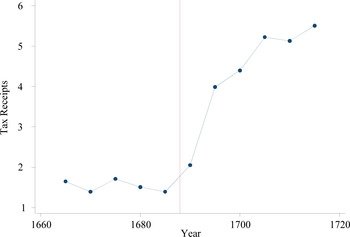
During the Restoration, notwithstanding the many improvements in tax collection, tax receipts showed a shallow decline from 1665 to 1685, averaging £1.53 million.Footnote 23 After the Revolution, tax receipts more than doubled the Restoration average by 1695 and tripled it by 1700 (see Figure 1). The structural break is clear.
TAX RECEIPTS AT EXCHEQUER, BY YEAR, 1665–1715

CONTROLLING LOANS
Some argue that England's famed revolution in debt management was primarily technical and administrative, rather than political. In particular, Epstein points out that Elizabeth I and the Stuarts had all been limited to short-term loans, while their continental rivals typically issued long-term debt.Footnote 24 As a consequence, English monarchs paid higher interest rates. Even in the early 1690s, Epstein notes, “the English Crown was still having to offer short-term rates of 10 percent…, when the Dutch Republic could offer [long-term] rates of 3–3.75 percent, Venice paid 4–5 percent, France offered 5 percent, and Hapsburg Austria 5–6 percent….[T]he sharp decline in English interest rates after 1700, which North and Weingast ascribe to the benefits of a parliamentary regime, was in fact the effect of a belated catch-up with the continental European…norm, principally through the introduction of a modern financial system and of its correlate, the consolidated public debt.”Footnote 25
Epstein is correct that most continental powers had established a consolidated public debt, meaning that general state revenues were available for debt servicing and repayment. However, England's inability to match this practice until 1693 was almost entirely a political problem, rather than a technical or administrative one.
As noted in the previous section, the ongoing battle between absolutism and parliamentarism was precisely over control of taxes (and other state revenues). While absolutist monarchs on the continent had broken their parliaments and established direct control over taxes, English kings had not. The English Crown's relatively weak control over taxation meant that it could not fund long-term debt on its own.
The general point here is that any monarch floating long-term debt on a large scale had to ensure purchasers that he could respond to fiscal shocks by raising new taxes, if necessary. Continental monarchs had secured enough control over their revenue streams that they could fund debts without parliamentary approval.Footnote 26 In England, however, the king's ability to raise new revenues was poor. To raise new taxes, he would need either to cut a deal with Parliament, or to end run Parliament via legal but “unconstitutional” gambits, or to abandon legalities and crush Parliament militarily. Bondholders might well have doubted the king's willingness to bear any of these costs, in order to repay them. Thus, in practice, English kings were limited to short-term loans and forced loans.
To underscore that political stalemate rather than administrative immaturity delayed England's development of long-term funded debt, consider events after the Revolution. William III came to the throne knowing full well the technical requirements of long-term debt. He also would have known that the House of Commons had recently sought a veto power over new debt similar to the veto power it already exercised over new taxation. As O'Brien notes, “The House of Commons resolved [in 1682] that anyone who lent to the Crown without parliamentary authority would be judged an enemy of Parliament.” J. R. Jones explains Parliament's rationale: “Loans from bankers, secured on taxes already voted or on the permanent revenue, could enable the Crown to evade the restrictions imposed by appropriation….”Footnote 27
Yet, William refused to reach an agreement on “national debt” issued by the Crown-in-Parliament until 1693, when his need for funds to wage war on the continent was dire and one of the deadlines for expiry of his customs revenues loomed. Thus, a consolidated public debt arose in England, not because administrators working in isolation from politics belatedly acquired the technical expertise to implement it, but rather because the Crown finally conceded a principle of major and lasting constitutional significance.
If my account is accurate, then why did Parliament not demand a new statute prohibiting the king from borrowing without parliamentary assent? Parliament preferred simply to exercise its new power over debt in practice, rather than to articulate it as an abstract principle. Supply bills before the Revolution often did not refer to Crown loans. Afterwards, in contrast, most supply bills set out conditions under which any new taxes could be used to fund (short- or long-term) loans. By proactively stipulating the maximum amount of new debt that could be based on each new revenue stream it granted (see the Appendix for an example), Parliament effectively deterred the Crown from funding debt on its own terms.
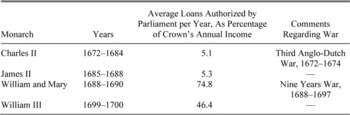
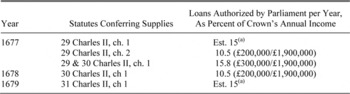
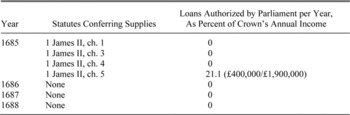
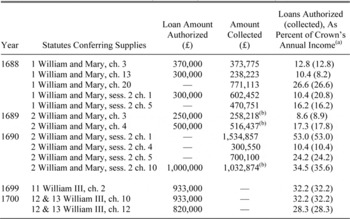
To document the unprecedented extent to which Parliament pushed its way into sovereign borrowing after the Revolution, I examined every supply bill in the periods 1672–1690 and 1699–1700. As can be seen in Table 2, the (estimated) loans authorized by Parliament per year, as a percentage of the Crown's annual income, averaged 5.1 percent in the last years of Charles II's reign (1672–1684), 5.3 percent during James II's reign (1685–1688), and 74.8 percent during the first three years of William and Mary's reign.
Warfare does not fully explain the fourteenfold increase. Parliament was no more involved in Charles' loans during the Third Anglo-Dutch War (1672–1674) than afterward (1675–1684). And Parliament authorized loans amounting to 46.4 percent of Crown income in 1699–1700, after the Nine Years' War had ended.
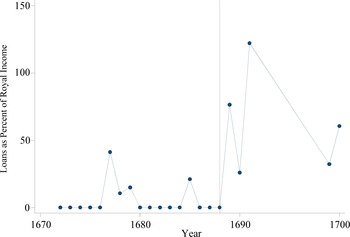
To further illustrate the Revolution's impact, Figure 2 plots the estimated amount of new loans authorized by Parliament per year, 1672–1700. Parliamentary loan authorizations clearly increase sharply after the Revolution.
PARLIAMENTARY INVOLVEMENT IN SOVEREIGN BORROWING, 1672–1700

Source:
Detailed calculations are provided in the Appendix.
Why a Veto over Debt Issuance?
One might ask why Parliament insisted on breaking the king's unilateral ability to borrow. After all, investors should have cared mainly about whether sufficient tax revenues funded the long-term debt; and they might have reasoned that Parliament would be willing to provide the needed taxes, because it had devised a credible system of appropriation, audit, and punishment. Thus, a parliamentary veto on debt issuance does not seem necessary to explain the enhanced credibility of England's long-term debt.
One reason Parliament insisted the Crown could not issue national debt unilaterally was to bring loan proceeds within the ambit of the appropriation-audit-punishment system. Were the Crown able to borrow unilaterally, Parliament might have no chance to articulate its demandsover how the resulting revenue would be spent or to set up audits. Worse, the Crown might substitute loans for taxes, thereby diminishing the pain Parliament could inflict by withholding tax grants.
Another reason Parliament disliked unilateral borrowing by the Crown had to do with the division of the “borrowing surplus” between the two sides. A king with the unilateral ability to issue national debtwould be able to present Parliament with a series of take-it-or- leave-it propositions: raise taxes to repay this loan or repudiate it. That such strong agenda control confers a formidable bargaining advantage is well-known theoretically and was presumably appreciated as a practical matter by contemporaries.Footnote 28 To deprive the Crown of this bargaining advantage, Parliament leveraged its newly nimble ability to limit tax revenues and ultimately (in 1693) forced the Crown to accept its constitutional right to veto the issuance of new public debt.
LOANS TO CROWN AUTHORIZED BY PARLIAMENT BY YEAR, AS A PERCENTAGE OF ANNUAL ROYAL INCOME, 1672–1690, 1699–1700

Note that my story differs substantially from North and Weingast's.Footnote 29 They envision the Revolution as giving Parliament a veto over debt repudiation (as do Weingast, David Stasavage, and others).Footnote 30 In contrast, I envision it as conferring a veto over debt initiation. I would further argue that a veto over default is logically impossible, if—as was typically the case in England at the time—earmarked taxes proved insufficient to repay the loan. For, when the funds to repay a debt do not exist, either side can unilaterally impose a partial default by refusing assent to the statute needed to raise new funds; and neither side can wield its veto to avoid such an outcome. Consistent with this observation, and the remarks above concerning the value of preventing unilateral borrowing by the executive, most of the world's current constitutions insist on the legislature's right to authorize new debt; but relatively few restrict the process of default.
The Consequences of Parliamentary Supremacy for Public Debt
If indeed Parliament secured a constitutional right to veto new debt, similar to its ancient right to veto new taxes, what should the consequences have been? In this section, I argue that the Revolution improved the credibility of short-term debt much less than it improved the credibility of long-term debt. Thus, as credibility is the main theoretical driver of credit access and price, one should examine the two kinds of loan (which were not perfect substitutes) separately.
Consider short-term debt first. Before the Revolution, the credibility of short-term loans had been enhanced in three main ways. First, specific taxes were earmarked to repay the loans. Second, loans were repaid in the strict order in which claims for repayment were received, in order to prevent the king from discriminating among debtholders.Footnote 31 Third, Parliament occasionally authorized loans to the Crown; and lenders would recall that debt with parliamentary authorization had not been repudiated in the Stop of the Exchequer, whereas purely royal debt had been.
After the Revolution, earmarking and the order system continued with little change but, as shown in Figure 2, Parliament was much more involved in the authorization of new debt. Thus, one expects some improvement in both the amount of short-term debt and the interest rate paid.
The story regarding long-term debt is rather different. Before the Revolution, the market saw no reason to believe the Crown alone could raise new taxes and so no long-term royal loans were extended. After the Revolution—or, more precisely, after 1693—the market saw substantial reason to believe the Crown-in-Parliament could raise new taxes, if needed, and so long-term national loans emerged. Thus, the Revolution created long-term debt, whereas it merely facilitated short-term debt.
In the event, long-term debt consisted mainly of loans from corporate entities. The creation of the Bank of England in 1694 set a precedent for subsequent bargains establishing the New East India Company (1698) and the South Sea Company (1711); and government debt to these three chartered companies composed more than 90 percent of the funded debt until the late 1740s. As J. Lawrence Broz and Richard S. Grossman point out, repeated negotiations over how to reschedule the national debt, and on what terms to recharter the Bank of England, tied Crown, Parliament, and the financial interest together in ways that the market could observe and react to.Footnote 32
Was There a Structural Break in Access to Credit?
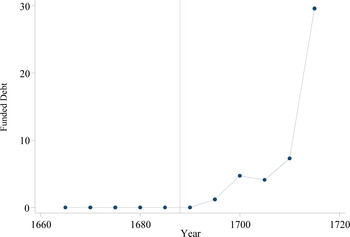
If establishing a consolidated public debt was the sine qua non of England's long-term debt, then one should mainly predict that England's long-term debt increased after 1693. By this standard, the evidence is about as clear as can be (see Figure 3). England's long-term funded debt stood at zero from 1600 to 1693, and then increased to £1,200,000 in 1695, £4,100,000 in 1705, and £29,600,000 in 1715.
Short-term debt shows a less spectacular rise. Such debt had been roughly constant at £1,000,000 from the mid-1630s to the end of the Restoration.Footnote 33 By Sussman and Yafeh's figures, short-term debt increased roughly fivefold by 1695 and was five to ten times the pre-Revolution mean until the Whig Supremacy began, declining slightly thereafter.Footnote 34
Was There a Structural Break in Interest Rates?
North and Weingast point to declining interest rates as additional evidence of the Crown's enhanced credibility.Footnote 35 Stasavage and Sussman and Yafeh, however, have shown that English interest rates did not match or dip below the best continental rates until 1730;Footnote 36 and the latter have interpreted this 40-year delay as showing that “financial markets do not reward countries for institutional reforms in the short run.”Footnote 37
One response to this line of criticism is theoretical. Robinson provides a model in which the market reacts to the risk of debt repudiation wholly by rationing credit.Footnote 38 Intuitively, charging a higher interest rate is a dangerous way to deal with a sovereign borrower because it increases the sovereign's incentive to repudiate the debt. Far safer ways to deal with an untrustworthy sovereign borrower are limiting the amount one loans them and shortening the loan period. If the conditions of Robinson's model generally obtain, then the evidence on interest rates is simply irrelevant to testing (a properly amended version of) North and Weingast's argument.
ENGLAND'S LONG-TERM FUNDED DEBT, BY YEAR, 1665–1715

My own view is that Robinson's model does not apply universally. For example, ParikshitGhosh, DilipMookherjee, and Debraj Ray state conditions under which the market reacts to risks of default with a mixture of credit rationing and higher interest rates.Footnote 39 Even in their model, however, rationing is the dominant tool with which the market seeks to manage the risk of default.Footnote 40 Thus, my reading of the theoretical models is that they tell us the market should react primarily, but not wholly, by credit rationing.Footnote 41
While one cannot simply dismiss the evidence on interest rates, one can insist on two points. First, the evidence is tricky to evaluate because sovereigns self-select into the market. Put simply, one cannot observe the interest rate when the sovereign faces credit rationing (or is offered unacceptably high interest rates). Second, although previous studies have combined them, as argued above it makes sense to look at long-term and short-term interest rates separately. Once one separates the two interest rate series, the evidence of a prompt market response becomes much clearer.
Interest rates on long-term loans before the Revolution were apparently prohibitively high, since no such loans were voluntarily made. After the Revolution, Sussman and Yafeh show the cost of long-term debt debuting in 1694 at 13.5 percent and declining steeply and monotonically to 8.5 percent by 1699.Footnote 42 Michael Tomz has persuasively argued that new sovereign borrowers must pay a risk premium in the market.Footnote 43 If we apply that insight to the English case, we see the invention of a wholly new debt instrument, the market demanding an initial risk premium, and that premium declining sharply as the market gained experience with the new debt and the new sovereign (the Crown-in-Parliament).
As for short-term sovereign debt, Epstein reports interest rates of 10 percent for the early 1690s, while Sussman and Yafeh report rates ranging between 7 percent and 9 percent in the period 1694–1700.Footnote 44 As expected, the improvement is smaller—but still noticeable.
All told, after the great constitutional bargain which created national debt in 1693, one finds an abrupt fall from 10 percent to 7–9 percent for short-term interest rates; and a slightly less abrupt fall from “prohibitive” to 8.5 percent for long-term interest rates. It remains true that Britain did not match or excel its most formidable competitors until a generation later. However, the Revolution both immediately affected public debt and, arguably, put the country on a quite different path of development.
CONTROLLING CROWN ACTS
Once the Crown accepted Parliament's control of the purse, rather than resorting to the trio of absolutist strategies upon which the Stuarts had relied, several other consequences followed in due course. First, as already noted, Parliament's oft-repeated demands that it be able to stipulate ex ante and verify ex post the uses of supply were met: appropriation language in supply bills became routine and audits common.Footnote 45
However, the right to stipulate how funds should be spent (appropriation) and to monitor whether they had been spent as intended (audits) still left open the question of punishment. How would Parliament express its displeasure, should it find funds misspent?
One option was to remove the king. Yet, regicide and expulsion were dangerous, costly, and inflexible tools with which to punish misallocation of funds. Indeed, my view—contra North and Weingast—is that the threat of regicide or forced abdication was not an important tool with which Parliament influenced the Crown. While this tool was on the shelf, others were invariably tried before it and were increasingly successful.
In particular, a much cheaper and more flexible option was to reduce supplies, exploiting Parliament's newly enhanced power to limit the duration of tax grants. Yet, depriving the Crown of money had its own dangers. For example, cutting off funds with troops in the field risked losing the war. General recognition of such facts would reduce the credibility of any parliamentary threat to reduce funding.
Contemporaries, appreciating the difficulties in the first two punishment strategies, eventually landed on a third: ministerial responsibility. The key principles were that the king must always act on advice; that such advice must always be imputed to the pertinent minister(s); and that Parliament could withhold supply to force the removal of ministers whose advice they found objectionable.Footnote 46 The great advantage of punishing ministers by removal from office was that Parliament's underlying threats to withhold supply typically did not need to be carried out, thus avoiding the dangers and costs of such interruptions.
Although ministerial responsibility in England (and later in Great Britain and the United Kingdom) is a canonical example of an unwritten constitutional rule, important formal rules helped establish it. In particular, ministers formally controlled the committees in charge of writing supply bills after 1693 and had a monopoly on proposals for new charges upon the public revenue after 1706.Footnote 47
All told, the establishment of ministerial responsibility, which I (unconventionally) take to be part of the Revolution settlement, produced the following change. Before the Revolution, the executive branch consisted of the king, his ministers, and various courtiers, none of whom could be removed from office by a parliamentary vote of no confidence. After the Revolution, courtiers were forced from the scene. Roberts describes in detail the tactics parliamentarians used; and notes that the Earl of Sunderland's forced resignation in 1697 marked the end of the era in which “parliamentary managers” entrenched at the royal court could play the leading role in politics.Footnote 48 As Roberts notes, courtiers could continue to advise the king in his closet but that advice could be put into effect only if the courtiers themselves became ministers (as did Lord Bute) or the king could find ministers willing to accept responsibility for their advice.Footnote 49 Thus, the post-Revolution executive branch effectively consisted of just the king and his ministers; and the latter could be removed by votes of censure, the predecessors of votes of no confidence.Footnote 50
Various structural breaks marked the emergence of the new system of controlling Crown acts. For example, the amount and detail of appropriations language in supply bills and the number and intensity of parliamentary audits sharply increased, while the use by ministers of the king's command as an excuse to avoid responsibility disappeared. Cumulatively, such changes contributed to a sea change in the legislature's ability to oversee and control the executive branch.Footnote 51
PROPERTY RIGHTS
Sections 2–4 have dealt with the constitutional balance of power between Crown and Parliament. In this section, I turn to the Crown's broader impact on the security of property rights.
Scholarly views on how the Glorious Revolution affected such rights diverge more starkly than on any other topic. While North and Weingast view the Revolution as crucially enhancing property rights enforcement, Clark, Epstein, and others assert that it had no effect at all.Footnote 52
Clark argues as follows. First, insecure private property rights tend “to deter investment in capital or in new techniques unless the return on capital rises sufficiently to compensate for the enhanced risk.”Footnote 53 Thus, second, if property rights became more secure after the Glorious evolution, one should see a decline in the rate of return on capital. But, third, no such decline appears in the historical record.
To establish his third point, Clark examines charities' assets—such as land, tithes, houses, rent charges, and private bonds—over the period 1540–1837. He implicitly assumes these assets faced a risk of sovereign predation typical of private property holdings generally. Yet, charities' assets were probably quite low on the “hit list” of predatory kings, which would explain why returns on such assets were undisturbed by political turmoil and did not decline after the Revolution.
Other assets existed that were both economically important and at higher risk of royal predation, such as development rights for local infrastructure (Bogart) and foreign trading rights (Jha). If the Revolution increased investment in such assets, then North and Weingast's basic point will be vindicated, albeit for a narrower class of assets than they originally envisioned.Footnote 54
In the remainder of this section, I consider the market for local development rights, documenting the Revolution's abrupt and significant effects. The discussion is complicated somewhat by the fact that development rights were an option, rather than a basic asset such as land. The decision to invest in them thus naturally divided into two parts: whether to buy the option (the development rights) and whether to exercise the option, once obtained (e.g., build the road or canal). Unlike investing in land, tithes, or houses, investing in development rights inevitably hinged on political considerations, because one bought the option either from the Crown or from Parliament. Thus, the Revolution should have directly affected property rights adjustments—conferred via development rights, enclosures, and the like—even if it had no effect on the enforcement of property rights in simpler assets.
Buying Development Rights
Consider an entrepreneur with investible funds Y who seeks to secure from Parliament the right to build a turnpike road. The entrepreneur anticipates paying costs d to introduce a bill in Parliament, which will then have a probability p of enactment. If his bill fails, the entrepreneur will receive nothing. However, if his bill is enacted, he will then have the option to build a road and will decide how much to invest in that option. Thus, the entrepreneur faces two sequential decisions: whether to invest d in securing the option to build a road; and how much to invest in pursuing that option, if attained. Let's consider each of these decisions, beginning with the latter.
Conditional on having secured development rights, the entrepreneur chooses an amount c, out of a total investment budget Y – d, to invest in building the road. Any remaining funds, Y – d – c, are invested in a riskless asset with rate of return r 0. After his investment decision, the king honors the entrepreneur's development rights with probability h and confiscates the built road (or the toll revenues therefrom) with probability 1 – h. If the king honors his rights, then the entrepreneur secures a total return of r(c); otherwise, he gets nothing.
All told, the entrepreneur's expected payoff, when he invests c in the road and Y – d – c in the riskless asset, is π(c) = hr(c) + (Y– d– c)(1+r 0). His investment decision entails choosing c in order to maximize π(c), subject to the constraint c∊ [0,Y– d]. Assuming that r is concave increasing (r′ > 0, r″ < 0) and that an interior solution exists (r′(0) > (1+r 0)/h>r′(Y– d)), the entrepreneur's optimal investment has the following closed-form solution: c* = r′–1[(1+r 0)/h]. For example, if r(c) = c 1/2, then 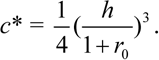
It is easy to see in this case, and is true more generally, thatincreasing the king's probability of honoring development rights increases the optimal investment made by entrepreneurs. That is, c* increases with h. It is also true that the marginal return declines with h.Footnote 55 This observation could be converted into a prediction about the total return, similar to that which Clark investigates. But such an extension would rely on further assumptions about the shape of the return function. Thus, the more straightforward and easily testable prediction is simply that entrepreneurs should invest more in their projects after the Revolution, to the extent that the Revolution reduced the probability of royal interference with developer's rights.
The Revolution should indeed have reduced the chance of royal interference, for two reasons. First, the Revolution ended the king's ability to sell development rights on his own account. Royal patents and charters had been a booming business at times during the seventeenth century, in competition with Parliament's statutes.Footnote 56 Once ministerial responsibility was in place, however, no courtier and no king could sell development rights against the wishes of the ministers, since all Crown acts were on the advice of ministers. Thus, as ministers could be removed by Parliament, the market became wholly parliamentary. Second, once the Crown-in-Parliament had granted development rights, the Crown's ability unilaterally to interfere with those rights also disappeared (as, again, the issuance of a new royal patent or charter conferring competing rights was no longer an option).
Now consider the entrepreneur's initial decision, whether to purchase development rights (at price d) or not. If he does not seek any rights, the entrepreneur's payoff is Y(1+r 0). If he does seek rights, his payoff is pπ(c*) – d. We can denote the entrepreneur's decision by d*, which is equal to zero, if he does not seek development rights, and equal to d, if he does.
The Glorious Revolution should have increased p, the probability of securing development rights from Parliament, for two reasons. First, ministerial responsibility put the king (and the courtier class) out of business as an alternative source of development rights. Second, Parliament sat more often, and the committee system—which processed the relevant bills—developed rapidly. Thus, post-Revolution entrepreneurs knew there was only one market for development rights, that market was open for business much more often, and was soon better organized to handle the increasing flow of business.
In the model just sketched, an increase in the probability, p, that the entrepreneur's bid for development rights will succeed leads to a greater demand for such rights (more bills), a greater volume of rights actually granted (more acts), and a decline in the option value, π(c*). The last is difficult to measure but the number of bills and acts is readily observable.
All told, the most direct predictions are three: the number of bills should have increased, the number of acts should have increased, and completed investment per act should have increased. Putting the last two together, total completed investment should have increased. What does the evidence show?
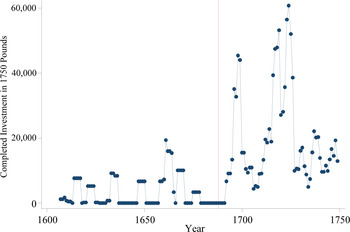
Bogart, exploiting a new and comprehensive database of investments in roads and rivers, reports as follows (see Figure 4): “The difference in completed investment before and after the Glorious Revolution is striking. Approximately the same amount was completed in the 15 years from 1695 to 1709 as in the previous 85 years from 1604 to 1688… [A]verage investment was £11,600 from 1689 to 1749 which is more than double the average of £5,000 from 1660 to 1688.”Footnote 57
Complementing these data on total investments, William Albert shows that the number of acts creating turnpike trusts was nil during every year of the Restoration save one; but that almost no year goes by without a turnpike act after the late 1690s (with the running average below five until mid-century).Footnote 58 Examining the broader category of “acts pertaining to property rights,” Bogart and Gary Richardson show the number of such acts increased sharply after the Revolution; while Bogart and Richardson focus particularly on estate acts.Footnote 59
As to the efficiency of trade, the MPhours spent in committee— where the vast bulk of legislative action took place—increased greatly, indicating that the MPs, lobbyists, and agents who attended those meetings expected successful bargaining. D. W. Hayton's examination of all legislative initiatives—based on Hoppitt—shows a (slowly declining) decadal success rate at or below 30 percent throughout the Restoration, jumping to 44 percent in 1690–1700 and then to 59 percent in 1701–1715. MPs, with a little practice, doubled the chance of a legislative deal being done.Footnote 60
DISCUSSION
What Were the Crown's Credibility Problems?
North and Weingast suggest that the Stuarts lacked credibility in a wide array of transactions, to such an extent that their subjects' basic property rights were insecure.Footnote 61 In contrast, I suggest that the Stuarts' goal was to build an absolutist state and that their major acts of arbitrary rule served that goal.Footnote 62 For example, Charles I stretched the original meaning of Ship Money in order to secure de facto tax revenues without parliamentary approval; and Charles II repudiated debt, in the infamous Stop of the Exchequer, as part of a broader plot to break free of Parliament's financial grip (having signed the secret Treaty of Dover with Louis XIV). While the Stuarts' maneuvers clearly violated their commitments to respect Parliament's constitutional position, most of them did not directly threaten the property rights of their individual subjects.
FOUR-YEAR MOVING AVERAGE OF COMPLETED INVESTMENT IN ROAD AND RIVER IMPROVEMENTS, 1607–1749

Relatedly, the important changes in the judiciary that North and Weingast highlight were not designed to ensure better court enforcement of private property rights. Rather, they were designed to prevent the Crown from extracting favorable court rulings on matters of central constitutional significance, as it did during the Ship Money affair and when it revoked the city of London's charter.
If the Stuarts' predatory sights were trained mainly upon Parliament's constitutional rights, then the Glorious Revolution should mostly have affected the credibility of the Crown's commitments to Parliament, rather than the credibility of its commitments to its subjects in areas of established law. In other words, the settlement should primarily have affected (a) Parliament's willingness to supply taxes, loans, and other revenues, in exchange for Crown promises to use funds for agreed purposes; and (b) subjects' willingness to invest in assets formerly ensnared in the constitutional struggle, such as development and trading rights.Footnote 63
The historical evidence shows that the Revolution greatly affected the exchange of “revenues” for “policy control” between Parliament and the Crown; and greatly affected the market for local development rights. Although many time series of data exhibit no structural breaks at the Revolution, none of this counts against the argument that the settlement enhanced the Crown's credibility in exchanges of central constitutional and economic importance.Footnote 64
What Effects Should the Crown's Improved Credibility Have Had?
The best statistics to examine in testing whether the Revolution enhanced credibility concern the aggregate value of goods and services sold in the affected markets, rather than the rate of return on investment. Let's elaborate on this point for each of the markets considered here, two concerning Parliament's exchange of taxes and loans for Crown promises to pursue agreed policies; and one concerning entrepreneurs' offer of fees in exchange for state promises to enforce local development rights.
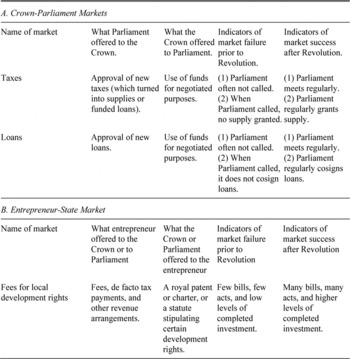
Table 3 summarizes what was traded in each of these markets; how the market failed prior to the Revolution; and how the market succeeded post-Revolution. The market for taxes failed before the Revolution in the sense that Parliament was rarely called and sometimes would not grant taxes even when called. The market for loans failed in the sense that Parliament rarely cosigned royal loans and would not provide the long-term tax authority the Crown would have needed to establish a consolidated public debt, with the consequence that the Crown was limited to short-term loans and forced loans. The market for development rights failed in the sense that total completed investment was low. After the Revolution, trade in all these markets boomed.
MARKET PERFORMANCE BEFORE AND AFTER THE REVOLUTION

Notes:
See the text.
Although one can also examine the rate of return on investment, selection bias and data censoring make this difficult. In the case of taxes, we lack a monetized account of what Parliament got in return for its investment of tax revenues, and thus cannot compute a rate of return.
In the case of loans, we cannot observe rates of return for some of them (e.g., tax farmers hid their returns, lest they be charged a higher rent). Moreover, as argued above, increasing a sovereign borrower's credibility should lead primarily to greater access to credit and only secondarily to a lower interest rate.
In the case of fees paid for development rights, we cannot assume that all investors faced a single risk of Crown predation and reacted to that risk as if it were a move of nature. Nor can we observe the full costs of obtaining rights, especially before but even after the Revolution.
Was Limited Government the Key?
Should the statutory and practical changes I have identified be viewed as causal factors, or should constitutions in general be viewed as merely summarizing the underlying balance of power?Footnote 65 This is too large a question to answer in the present article but I can opine that constitutions do have effects, over and above the structural factors that help create them. In particular, even if constitutions are “cheap talk,” they can have substantial effects in a world in which many equilibriapreferred to civil war exist. Moreover, the coordinating effects of constitutions can be particularly important when—as was true in the English case—one side in the constitutional struggle faces both endemic collective action problems and repeated “divide and conquer” tactics from the other side.Footnote 66
Supporting these general observations, empirical studies of how constitutional rules affect sovereign debt levels (and prices) provide three kinds of evidence. First, there are the historical case studies— e.g., of England (North and Weingast), Brazil (William R. Summerhill), and Argentina (Sebastian M. Saiegh).Footnote 67 Second, there are large-N cross-sectional studies exploiting twentieth-century datasets—e.g., by Emanuel Kohlscheen and Emily Beaulieu, Cox, and Saiegh.Footnote 68 Third, there are studies employing historical panel data—e.g., Mark Dincecco's study of major states and Stasavage's studies focusing on city states.Footnote 69 Cumulatively, the evidence is persuasive.
CONCLUSION
In this article, I have offered a new account of the reforms following the Glorious Revolution, stressing three in particular as key. First, I view the “for longer time” clause of the Bill of Rights, along withParliament's increasing use of time limits on revenue grants, as turning Parliament's ancient yet blunt right to veto new taxes into a flexible and effective weapon to deter the Crown from pursuing policies disliked by Parliament. Second, I argue that Parliament sought and attained a constitutional right to veto new public borrowing. Third, I argue that, once Parliament could start and stop both new taxes and new loans, on a timetable that it determined, the development of ministerial responsibility followed relatively quickly and logically.Footnote 70 Although North and Weingast stress parliamentary supremacy as the key achievement of the Revolution, neither they nor their various critics mention any of the specific constitutional reforms that I highlight.Footnote 71
My analysis of what drove post-Revolution reforms complements North and Weingast's. In my account, Stuart England was enmeshed in a century-long struggle between “parliamentary supremacy” and “absolutism.” To achieve absolute rule, the Crown sought better constitutional abilities to control Parliament, to rule legally without Parliament, and to crush Parliament militarily. After the Glorious Revolution, Parliament enacted statutes, adopted rules and began practices that blunted all three prongs of absolutist strategy.
Parliament had to succeed on all three defensive fronts to ensure its supremacy, while the king could achieve some form of absolutism with a large enough victory on any single front. Cumulatively, constitutional engineering after the Revolution pushed parliamentary supremacy much more than anything that had been tried before, because it pushed that project on all three defensive fronts simultaneously. Although precedents existed for several of Parliament's maneuvers, no precedent existed for such a comprehensive package of reforms. The intended and achieved effect was to force the Crown to bargain with Parliament over the main revenues of the state.
Once the Crown had been forced to bargain, it had to ensure the credibility of its promises to Parliament regarding how it would spend any funds granted. The combination of ministerial responsibility, specific appropriations, and parliamentary audits ensured that ministers could lose their offices, if Parliament disliked the handling of supplies. The credibility of the executive branch's promises to the legislature thus enhanced, an unprecedented stream of tax and loan deals were done. Tax revenues doubled in the first five years of the new regime and tripled in the first decade. Long-term debt increased from nil, in 1688, to £1,200,000 by 1695. Short-term debt increased fivefold over the same period.
What did Parliament get in return for the revenue it granted? In broad outlines, it secured control of the main executive offices and of military and foreign policy.Footnote 72 Importantly, although everyone knew that ministerial responsibility would significantly reduce the Crown's power, such responsibility was nonetheless imposed.Footnote 73 The Crown got its money but the price was power.
Perhaps my largest difference with North and Weingast is that I identify a narrower set of transactions in which the Crown faced severe credibility problems than they do—viz., all and only those directly entangled in the constitutional struggle between parliamentarism and absolutism. Domestic property rights enforcement was thus little affected by the Revolution. However, property rights adjustment (the granting of new development rights via turnpike acts, canal acts, enclosure acts, and the like) was a different matter entirely: both crucial for economic development and greatly affected by the Revolution.
The revised account I offer leaves intact North and Weingast's central theoretical point about the importance of credible commitment; and avoids the main criticisms that have been leveled at their theory. If one examines the specific transactions most seriously afflicted by royal credibility problems; and focuses on the size of the market for such transactions; one finds that the Glorious Revolution was truly a constitutional watershed.
Appendix: Loans Authorized by Parliament
This appendix lists all statutes conferring supplies in selected years, notes any loans associated with those acts, and estimates their size relative to the Crown's annual revenue.
DETAILS FOR CHARLES II, 1672–1684

(a)I estimate the total loans for two statutes that do not mention an explicit figure as roughly equaling the maximum loan authorized during the portion of Charles II's reign examined.
Note:
No statutes were passed and no loans authorized 1672–1676 and 1680–1684.
Source:
Statutes of the Realm, British History Online, available at http://www.british-history.ac.uk/catalogue.aspx?type=2&gid=83.
DETAILS FOR JAMES II

Source:
Statutes of the Realm, British History Online, available at http://www.british-history.ac.uk/catalogue.aspx?type=2&gid=83.
DETAILS FOR WILLIAM AND MARY, 1688–1690, AND WILLIAM III, 1699–1700

Notes:
(a) To compute the percentages reported in the last column, I estimated William III's annual income as £2,898,000. When the statute does not mention a maximum loan authorization, I use the actual amount collected as a proxy for the authorization amount. The actual amounts collected from the loan are from the Revenue Accounts cited in the notes to Table 1. (b) The revenues collected from the loans authorized by these three statutes are reported on a single line in the Revenue Accounts: £1,807,529. I apportion this total amount collected among the three in proportion to their authorization levels.
Source:
Statutes of the Realm, British History Online, available at http://www.british-history.ac.uk/catalogue.aspx?type=2&gid=83.
An Example of Limits on Loan Amounts, From 1 William and Mary, Ch. 3, XX
“And bee it further Enacted and Ordained by the Authoritie aforesaid That all and every person and persons who shall lend any Moneys not exceeding Three hundred and seventy thousand pounds in the whole to Your Majesties upon the Credit of this Act and Pay the same into the Receipt of the Exchequer shall immediately have a Talley of Loane struck for the same and an Order for his Repayment bearing the same Date with his Tally in which Order shall be alsoe contained a Warrant for Payment of Interest for forbearance not exceeding the Rate of Six pounds per Centum per Annum for his Consideration to be paid every three Months untill the Payment of his Principall.”
Note that it remained legal to loan the Crown additional amounts, after the total authorized amount of £370,000 had been reached. However, lenders in that case would receive no tallies and no orders for repayment, and would have claims subordinate to all those receiving tallies.