Introduction
Cucurbits are a prominent crop in the northeastern United States, accounting for $91 million in production value and representing approximately 22% of the total vegetable production value for the region in 2018 (USDA-NASS 2019a). In New Jersey, 3,560 ha of cucurbits were planted in 2018, the largest acreage of all fresh-market vegetable commodities. Cucumber and summer squash are the two major cucurbit crops of New Jersey and have a combined production value of $13 million (USDA-NASS 2019b).
Weed control remains an important challenge in cucurbit production because of the low crop tolerance to herbicides, the extended growing season of some crops such as pumpkins or winter squash, the vining habit of most species that prevents the use of cultivation to manage weeds, and the higher economic costs and time requirements associated with nonchemical strategies such as handweeding or cultivation (Grey et al. Reference Grey, Bridges and NeSmith2000b; Peachey et al. Reference Peachey, Doohan and Koch2012; Starke et al. Reference Starke, Monks, Mitchem and Macrae2006; Wallace and Bellinder Reference Wallace and Bellinder1992). Monks and Schultheis (Reference Monks and Schultheis1998) found that competition of large crabgrass with watermelon [Citrullus lanatus (Thunb.) Matsum. & Nakai] for 4, 6, and 10 wk resulted in reduction in fruit number by 25%, 66%, and 82%, respectively. Season-long interference of various weed species including Amaranthus spp., common lambsquarters (Chenopodium album L.), common ragweed (Ambrosia artemisiifolia L.), and ivyleaf morningglory (Ipomoea hederacea Jacq.) caused a 35% reduction in the number of marketable watermelons (Vollmer et al. Reference Vollmer, Besançon, Carr, VanGessel and Scott2020). Peachey et al. (Reference Peachey, Doohan and Koch2012) reported 63% and 86% yield reduction from weed competition in cucumber and summer squash, respectively, compared with the handweeded check.
Summer squash and cucumber in New Jersey are grown either on bare ground or in raised beds protected by polyethylene mulch that will help with disease and pest management. Regardless of cropping system, herbicides remain a critical component of weed management strategies for these two crops. The lack of available and effective POST herbicide options for controlling broadleaf weeds emphasizes the need for PRE herbicides at planting. Clomazone, bensulide, and halosulfuron are labeled PRE herbicides in New Jersey for use pretransplant or at seeding of summer squash and cucumber, whereas ethalfluralin is only labeled for direct-seeded cucurbits (Wyenandt et al. Reference Wyenandt, Kuhar, Hamilton, VanGessel and Arancibia2019). The application of halosulfuron PRE or POST is hindered by the spread of acetolactate synthase herbicide–resistant common ragweed and Palmer amaranth (Amaranthus palmeri S. Watson) (Heap Reference Heap2019). Clomazone at 0.5 to 0.8 kg ha−1 provides adequate control of hairy galinsoga (Galinsoga quadriradiata Cav.), common lambsquarters, common ragweed, and common purslane (Portulaca oleracea L.) (Brown and Masiunas Reference Brown and Masiunas2002; Jordan et al. Reference Jordan, Wilcut and Fortner1994; Scott et al. Reference Scott, Weston and Jones1995), but is ineffective on yellow nutsedge (Cyperus esculentus L.), smooth pigweed, or nightshades (Solanum spp.) (Al-Khatib et al. Reference Al-Khatib, Kadir and Libbey1995; Nurse et al. Reference Nurse, Robinson, Hamill and Sikkema2006; Trader et al. Reference Trader, Wilson and Hines2008).
The large diversity of genetic background and seed size of cucurbitaceous crops results in a broad range of interspecific and intervarietal tolerance to soil-applied herbicides, as demonstrated by previous studies on pumpkin (Ferebee et al. Reference Ferebee, Cahoon, Besançon, Flessner, Langston, Hines, Blake and Askew2019), summer squash (Grey et al. Reference Grey, Bridges and NeSmith2000b; Sosnoskie et al. Reference Sosnoskie, Davis and Culpepper2008; Trader et al. Reference Trader, Wilson and Hines2008; Webster et al. Reference Webster, Culpepper and Johnson2003), watermelon (Grey et al. Reference Grey, Bridges and NeSmith2000a; Macrae et al. Reference Macrae, Culpepper, Batts and Lewis2008), cantaloupe (Cucumis melo L.) (Johnson and Mullinix Reference Johnson and Mullinix2005), or cucumber (Peachey et al. Reference Peachey, Doohan and Koch2012). However, the use of multiple, effective herbicide sites of action (SOAs) is one of several weed management strategies that could alleviate the rapid spread of resistance to herbicides (Norsworthy et al. Reference Norsworthy, Ward, Shaw, Llewellyn, Nichols, Webster, Bradley, Frisvold, Powles, Burgos, Witt and Barrett2012). Thus, adding a new SOA to the list of currently registered herbicides for summer squash and cucumber would be beneficial toward management of herbicide resistance and troublesome weeds not controlled by currently registered herbicides.
S-metolachlor is a very-long-chain fatty acid biosynthesis inhibitor (WSSA Group 15) that would provide a different SOA not currently available for summer squash and cucumber production. S-metolachlor (Dual Magnum®; Syngenta Crop Protection, Greensboro, NC) received a Section 24(c) special local needs registration for use in these two crops in New York and Massachusetts, but not in New Jersey or any other state in the northeastern United States. S-metolachlor controls many annual grasses as well as some small-seeded annual broadleaf species such as pigweeds, carpetweed, or nightshades, and will help suppress yellow nutsedge (Shaner Reference Shaner2014; Wallace et al. Reference Wallace, Lingenfelter, VanGessel, Johnson, Vollmer, Besancon, Flessner and Chandran2020; Wyenandt et al. Reference Wyenandt, Kuhar, Hamilton, VanGessel and Arancibia2019). Sosnoskie et al. (Reference Sosnoskie, Davis and Culpepper2008) reported that PRE application of S-metolachlor at 0.5 to 1 kg ha−1 reduced cumulative fruit number and yield of summer squash by 17% and 20%, respectively, whereas POST application 3 wk after planting (WAP) at 0.5 kg ha−1 had no significant effect. Peachey et al. (Reference Peachey, Doohan and Koch2012) did not report any reduced crop emergence or marketable yield with S-metolachlor applied PRE alone at 1.1 or 2.1 kg ha−1 in cucumber and zucchini. Considering the lack of information on tolerance of cucurbits to S-metolachlor and the limited options for rotating SOAs applied PRE, a study was conducted to evaluate weed control, crop tolerance, and yield of summer squash and cucumber to S-metolachlor applied alone or mixed with bensulide at two timings.
Materials and Methods
The tests were conducted in 2 site-years at the Rutgers Agricultural Research and Extension Center in Bridgeton, New Jersey (39.31°N, 75.12°W). In 2018, soil was a Sassafras sandy loam (fine-loamy, siliceous, semiactive, mesic Typic Hapludults), 63% sand, 26% silt, and 10% clay, with pH of 6.2 and 1.1% organic matter content. In 2019, soil was a Fallsington sandy loams (Fine-loamy, mixed, active, mesic Typic Endoaquults), 53% sand, 35% silt, and 12% clay, with pH of 6.2 and 1.5% organic matter content.
Plant Material
Cucumber ‘Python’ and summer squash ‘Gold Prize’ were seeded on June 8, 2018, and June 5, 2019, in previously disked, flat seedbeds at an average depth of 2.1 cm. Plot size was 1.5 m wide by 6.1 m long with plants spaced 0.3 m and 0.5 m along the row for cucumber and summer squash, respectively. Fields were fertilized prior to planting with calcium nitrate to provide 60 kg N ha−1. Fungicides and insecticides were applied several times each year for mildew and cucumber beetle control according to the “Mid-Atlantic Commercial Vegetable Production Recommendations” (Wyenandt et al. Reference Wyenandt, Kuhar, Hamilton, VanGessel and Arancibia2019). The field was irrigated as needed with an irrigation gun set to deliver 2.5 cm water wk−1.
Treatments
The experimental design was a randomized complete block with treatments arranged as a 2 × 10 factorial with cucurbit species (cucumber or summer squash) as the first factor and herbicide treatment as the second factor. PRE herbicide treatments at seeding consisted of bensulide (Prefar® 0.5 kg ai L−1; Gowan Co., Yuma, AZ) at 4.5 kg ha−1, clomazone + ethalfluralin (Strategy® 0.3 kg ai L−1; Loveland Products, Greeley, CO) at 0.2 and 0.7 kg ha−1, S-metolachlor (Dual Magnum® 0.9 kg ai L−1; Syngenta Crop Protection) at 0.7 and 1.4 kg ha−1, alone or mixed with bensulide at 4.5 kg ha−1. Bensulide and clomazone +ethalfluralin are considered standard PRE herbicide treatments for cucumber and summer squash in New Jersey. S-metolachlor was also applied at the second- to third-leaf stage (EPOST) 3 WAP at 0.7 or 1.4 kg ha−1 on plots treated beforehand at seeding with bensulide alone at 4.5 kg ha−1. Both crops were at the third fully expanded leaf stage at the time of EPOST application on June 25, 2018, and June 26, 2019. A handweeded and a weedy check were also included. Herbicides were applied in water with a CO2-pressurized backpack sprayer equipped with XR11002 flat-fan nozzles (TeeJet, Glendale Heights, IL) calibrated to deliver 190 L ha−1 at 205 kPa. The field was irrigated with 1.3 cm of water within 6 to 8 h of application to incorporate herbicides.
Data Collection
Crop seedlings were counted in the whole plots at 2 and 5 WAP. Assessment of cucumber and summer squash tolerance was conducted 2, 4, and 7 WAP by visually scoring crop canopy for leaf injury (necrosis and chlorosis) and general stunting on a 0% (no injury or stunting) to 100% (entire canopy affected or plant death) scale (Frans et al. Reference Frans, Talbert, Marx, Crowley and Camper1986). Weed control was visually rated by species 3 WAP on a 0% (no control) to 100% (death of all plants) scale, based on a composite estimation of weed density reduction, growth inhibition, and foliar injury (Frans et al. Reference Frans, Talbert, Marx, Crowley and Camper1986). Weed control in plots treated EPOST was also rated 3 wk after the S-metolachlor application (6 WAP). To minimize the effect of weed competition on crop development and yield, weekly handweeding was conducted after the 3 WAP rating for plots treated with PRE herbicides at planting, whereas handweeding started 6 WAP for plots sprayed with EPOST herbicides.
Cucumbers and summer squashes were harvested and graded according to U.S. Department of Agriculture grades and standards instruction (USDA-AMS 2016; USDA-AMS 2018). Yield data for both crops consisted of count and weight of marketable, including U.S. No. 1 and No. 2, and cull fruits. In both years, cucumbers were picked five times and summer squashes six times. Cucumbers were harvested between July 25 and August 23 in 2018, and between July 24 and August 14 in 2019. Summer squashes were harvested between July 20 and August 27 in 2018, and between July 17 and August 14 in 2019.
Statistical Analysis
Data were combined across years and locations (hereafter referred to as “environment”). Environments, residual herbicide application, cucurbit species, and all interactions containing these three factors were considered fixed effects, whereas replications (nested within environments) were considered random effects (Carmer et al. Reference Carmer, Nyquist and Walker1989). Data were subjected to ANOVA using the generalized linear mixed model (GLIMMIX) procedure in SAS, version 9.4 (SAS Institute Inc., Cary, NC) to determine if years could be combined for regression analysis. Because of unequal variance, weed control and crop injury data were converted using the arcsine square root transformation prior to ANOVA and back-transformed for presentation purposes (Grafen and Hails Reference Grafen and Hails2002). Mean comparisons were performed using the Fisher protected LSD test when F values were statistically significant (P ≤ 0.05). Weedy and handweeded plots were excluded from the weed control analysis because values were 0% and 100%, respectively.
Results and Discussion
The two-way interaction of herbicide treatment by environment was not significant (P > 0.05) for weed control, crop tolerance, crop emergence, and crop yield. Thus, corresponding data were pooled across environments.
Weed Control
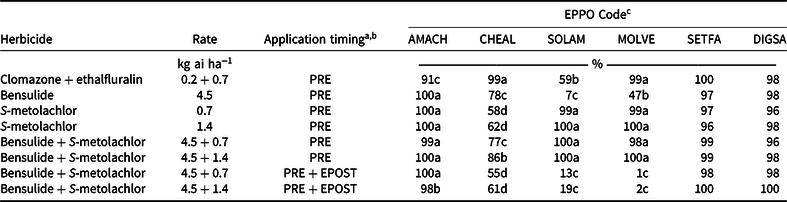
In the absence of a significant cucurbit species by herbicide treatment interaction, weed control ratings were pooled across cucurbit species (Table 1). The dominant weed species at the experimental sites were smooth pigweed, common lambsquarters, hairy galinsoga, American black nightshade, carpetweed, giant foxtail, and large crabgrass.
Weed control averaged across years and crop species 3 wk after herbicide application at Bridgeton, New Jersey.

a PRE applied at planting. EPOST applied 21 d after planting.
b Abbreviations: AMBEL, common ragweed; AMACH, smooth pigweed; CHEAL, common lambsquarters; DIGSA, large crabgrass; EPPO, European and Mediterranean Plant Protection Organization; MOLVE, carpetweed; SETFA, giant foxtail; SOLAM, American black nightshade.
c Means within a column followed by the same letters are not significantly different from each other according to Fisher’s protected LSD test at P ≤ 0.05. If no letters are included in a column, then no statistical differences were noted.
Smooth Pigweed. S-metolachlor or bensulide PRE controlled smooth pigweed at least 99% 3 WAP, whereas control significantly dropped to 91% with clomazone and ethalfluralin (Table 1). EPOST treatments provided at least 98% control. However, in the absence of weed control evaluation 6 WAP for bensulide alone, it is not possible to determine if excellent smooth pigweed control was the result of S-metolachlor applied EPOST or if bensulide PRE was still providing residual control. Other researchers had also reported a lack of smooth pigweed control with clomazone compared with other PRE herbicides (Liebl and Norman Reference Liebl and Norman1991; Trader et al. Reference Trader, Wilson and Hines2008). Efficacy of S-metolachlor on various pigweed species has been reported in previous studies. S-metolachlor applied PRE at 0.8 to1.3 kg ha−1 at transplanting provided 80% to 96% Palmer amaranth control in sweetpotato [Ipomoea batatas (L.) Lam.] (Meyers et al. Reference Meyers, Jennings, Schultheis and Monks2010). S-metolachlor PRE at 1.05 kg ha−1 can reduce redroot pigweed density by 98% in white bean (Phaseolus vulgaris L.) (Li et al. Reference Li, Van Acker, Robinson, Soltani and Sikkema2016) and 85% in kidney beans (P. vulgaris L.) (Soltani et al. Reference Soltani, Nurse and Sikkema2014).
Common Lambsquarters. S-metolachlor alone was not effective at controlling common lambsquarters regardless of rate or timing of application, in agreement with other studies (Table 1). Common lambsquarters control 4 wk after treatment (WAT) was only 66% with S-metolachlor PRE at 2.2 kg ha−1 in corn (Chomas and Kells Reference Chomas and Kells2004), and 55% and 52% in kidney bean and white bean, respectively, with S-metolachlor PRE at 1.05 kg ha−1 (Li et al. Reference Li, Van Acker, Robinson, Soltani and Sikkema2016; Soltani et al. Reference Soltani, Nurse and Sikkema2014). Common lambsquarters control 3 WAP was 99% with clomazone + ethalfluralin, but only 78%, on average, with bensulide alone or tank-mixed with S-metolachlor PRE at 0.7 kg ha−1. Increasing S-metolachlor rate PRE to 1.4 kg ha−1 significantly improved common lambsquarters control by 8%. Herbicide programs that included clomazone PRE have been reported to control common lambsquarters at least 98% in cotton (Troxler et al. Reference Troxler, Askew, Wilcut, Smith and Paulsgrove2002).
American Black Nightshade. Clomazone + ethalfluralin or bensulide PRE was not effective on nightshade, providing less than 60% control, whereas all treatments that included S-metolachlor PRE at 0.7 or 1.4 kg ha−1 resulted in at least 99% control 3 WAP (Table 1). Conversely, S-metolachlor applied EPOST did not control nightshade. Because bensulide PRE did not control this species, the delayed S-metolachlor application was sprayed after nightshade seedlings had already emerged. In previous studies, metolachlor or S-metolachlor applied PRE at rates ranging from 0.5 to 2.5 kg ha−1 provided excellent control (≥95%) of eastern black nightshade (Solanum ptychanthum Dunal), hairy nightshade (Solanum physalifolium Rusby) or American black nightshade (Hutchinson Reference Hutchinson2012; Norsworthy and Smith Reference Norsworthy and Smith2005; Ogg Reference Ogg1986). Metolachlor at 1.1 or 1.7 kg ha−1 provided between 25% and 84% hairy nightshade control 12 WAT, with highest control observed when conditions after herbicide application were cool and wet, potentially resulting in good herbicide activation and slower microbial degradation (Guttieri and Eberlein Reference Guttieri and Eberlein1997).
Carpetweed. PRE application of clomazone + ethalfluralin or any treatment containing S-metolachlor resulted in at least 95% carpetweed control, whereas bensulide controlled carpetweed only 47% (Table 1). Lack of control with bensulide applied PRE resulted in only 21% to 32% carpetweed control with S-metolachlor applied EPOST. These findings are similar to those of other studies, in which bensulide PRE at 2.2 kg ha−1 did not exceed 40% carpetweed control, whereas S-metolachlor at 0.7 kg ha−1 provided 96 % control 8 WAT (Norsworthy and Smith Reference Norsworthy and Smith2005).
Giant Foxtail and Large Crabgrass. All treatments provided at least 96% control of giant foxtail and large crabgrass, regardless or S-metolachlor rate or timing of application (Table 1). Other researchers have also reported excellent (≥90%) control of these species with S-metolachlor applied PRE (Norsworthy and Smith Reference Norsworthy and Smith2005; Soltani et al. Reference Soltani, Nurse and Sikkema2014).
Cucumber and Summer Squash Emergence
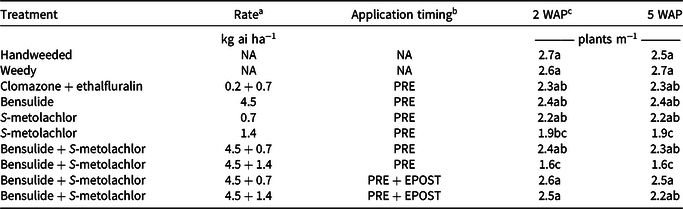
The herbicide treatment by cucurbit species interaction was significant (P < 0.001) for crop emergence; therefore, data were analyzed by crop. Summer squash emergence at 2 and 5 WAP was similar for all treatments and was not affected by herbicide application, with an average of 2 plants m−1 of linear row (data not shown). Cucumber emergence 2 WAP was not affected by clomazone + ethalfluralin, bensulide, or S-metolachlor at 0.7 kg ha−1 applied PRE compared with both weedy and handweeded checks, with an average of 2.5 plants m−1 (Table 2). However, S-metolachlor PRE at 1.4 kg ha−1 alone or mixed with bensulide reduced cucumber emergence 2 WAP by 29% and 40%, respectively, compared with the checks. Cucumber provided similar results 5 WAP, with a 28% reduction in the number of emerged seedlings with S-metolachlor applied at 1.4 kg ha−1 compared with 0.7 kg ha−1 or to standard PRE herbicides. S-metolachlor applied EPOST 3 WAP on already emerged cucumber seedlings did not reduce cucumber stands 5 WAP.
Cucumber emergence averaged across years in response to clomazone + ethalfluralin, bensulide, and S-metolachlor applied PRE and EPOST at Bridgeton, New Jersey.

a Abbreviations: NA, not applicable; WAP, wk after planting.
b PRE applied at planting. EPOST applied 21 d after planting.
c Means within a column followed by the same letters are not significantly different from each other according to Fisher protected LSD test at P ≤ 0.05.
Cucumber and Summer Squash Tolerance
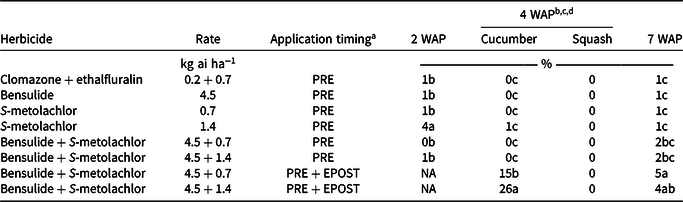
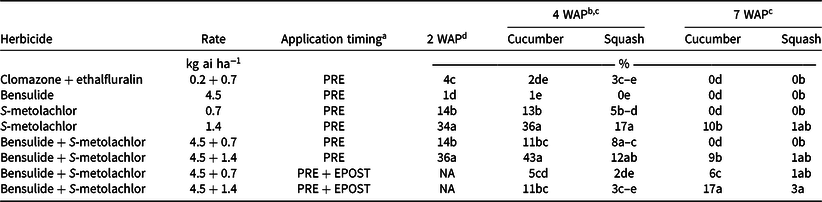
In the absence of a significant herbicide by cucurbit species interaction (P ≥ 0.05), data were pooled across cucurbit species for crop injury 2 and 7 WAP (Table 3) and for crop stunting 2 WAP (Table 4).
Cucumber and summer squash injury averaged across years in response to clomazone + ethalfluralin, bensulide, and S-metolachlor applied PRE and EPOST at Bridgeton, New Jersey.

a PRE applied at planting. EPOST applied 21 d after planting.
b Abbreviations: NA, not applicable; WAP, wk after planting.
c Because of a significant herbicide by crop species interaction 4 WAP, data for this rating were separated by crop species.
d Means within a column followed by the same letters are not significantly different from each other according to Fisher protected LSD test at P ≤ 0.05. If no letters are included in a column, then no statistical differences were noted.
Cucumber and summer squash stunting averaged across years in response to clomazone + ethalfluralin, bensulide, and S-metolachlor applied PRE and EPOST at Bridgeton, New Jersey.

a PRE applied at planting. EPOST applied 21 d after planting.
b Abbreviations: NA, not applicable; WAP, wk after planting.
c Means within a column followed by the same letters are not significantly different from each other according to Fisher’s protected LSD test at P ≤ 0.05. If no letters are included in a column, then no statistical differences were noted.
d In the absence of significant herbicide by crop species interaction 2 WAP, data for this rating were pooled across years and crop species.
S-metolachlor alone at 1.4 kg ha−1 caused a higher level of injury (4%) than any other treatment (≤1%) 2 WAP, mostly in the form of leaf cupping and chlorosis (Table 3). By 4 and 7 WAP, plants in all plots that received S-metolachlor PRE regardless of crop or herbicide rate did not show more injury than those in plots treated with clomazone + ethalfluralin or bensulide standards. By 4 WAP, S-metolachlor applied EPOST at 0.7 or 1.4 kg ha−1 caused 15% and 26% cucumber injury, respectively, but did not damage summer squash. Injury consisted primarily of leaf cupping at 7% and 16%, and chlorosis at 4%, and 6%, with the 0.7 and 1.4 kg ha−1 rates, respectively (data not shown). Lower cucumber tolerance to S-metolachlor was demonstrated by the persistence of injury 7 WAP, with an average of 4% injury across herbicide treatments in contrast to the absence of injury on summer squash (data not shown).
S-metolachlor PRE at 0.7 and 1.4 kg ha−1 caused 14% and 35% stunting 2 WAP, respectively, averaged across crops, whereas stunting remained less than 5% with bensulide or clomazone + ethalfluralin standards (Table 4). This trend persisted 4 WAP, with 12% and 39% stunting, respectively, for the 0.7 and 1.4 kg ha−1 rates of S-metolachlor compared with no more than 2% for the bensulide alone and clomazone + ethalfluralin standards. Summer squash exhibited higher tolerance to S-metolachlor with only the PRE application at 1.4 kg ha−1 causing 15% stunting, on average, 4 WAP. S-metolachlor applied EPOST at 1.4 kg ha−1 stunted the cucumber plants 11%, whereas the 0.7 kg ha−1 rate had no effect compared with the clomazone + ethalfluralin standard. Similar EPOST application of S-metolachlor had no effect on stunting of summer squash. Greater than 6% stunting persisted by 7 WAP with S-metolachlor PRE at 1.4 kg ha−1 or any rate EPOST on cucumber, whereas summer squash stunting did not exceed 3% at the highest S-metolachlor rate applied EPOST.
Squash tolerance to S-metolachlor applied PRE was also noted on pumpkin, with no more than 3% injury 4 WAP at a 0.9 kg ha−1 rate in two Virginia trials (Ferebee et al. Reference Ferebee, Cahoon, Besançon, Flessner, Langston, Hines, Blake and Askew2019). Sosnoskie et al. (Reference Sosnoskie, Davis and Culpepper2008) reported an average 20% summer squash yield reduction with S-metolachlor PRE at 0.5 or 1 kg ha−1 but no effect with POST application at the same rates.
Limited damage was noted 4 WAP on cucumber, with only 1% and 4% injury with S-metolachlor applied PRE at 1.1 and 2.1 kg ha−1 (Peachey et al. Reference Peachey, Doohan and Koch2012). However, the higher clay (20%) and organic matter (2.4%) content in this study may have increased S-metolachlor adsorption to soil particles, decreasing its uptake by the crop and thereby reducing the level of injury. Metolachlor more readily adsorbs to clay soils than to soil with low organic matter and clay content, and more readily adsorbs to organic matter than to clay (Shaner Reference Shaner2014).
Cucumber and Summer Squash Yield
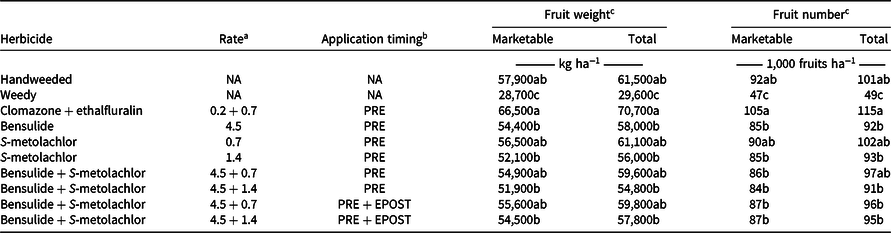
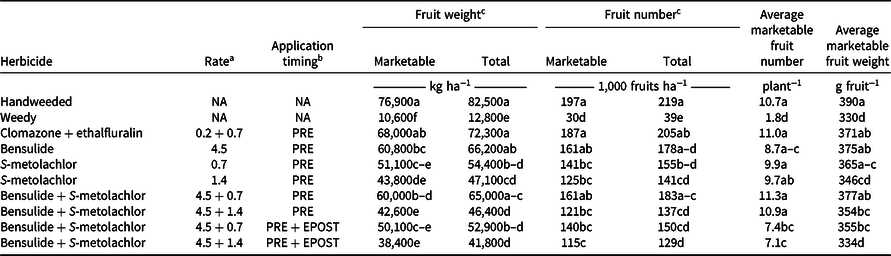
The herbicide treatment by cucurbit crop interaction was significant (P < 0.05) for marketable yield and fruit number; thus, data are presented by crop species (Tables 5 and 6).
Summer squash yield averaged across years in response to clomazone + ethalfluralin, bensulide, and S-metolachlor applied PRE and EPOST at Bridgeton, New Jersey.

a Abbreviation: NA, not applicable.
b PRE applied at planting. EPOST applied 21 d after planting.
c Yield and fruit number data were pooled over environments. Means within a column followed by the same letters are not significantly different from each other according to Fisher protected LSD test at P ≤ 0.05.
Cucumber yield averaged across years in response to clomazone + ethalfluralin, bensulide, and S-metolachlor applied PRE and EPOST at Bridgeton, New Jersey.

a Abbreviation: NA, not applicable.
b PRE applied at planting. EPOST applied 21 d after planting.
c Yield data were pooled over environments. Means within a column followed by the same letters are not significantly different from each other according to Fisher protected LSD test at P ≤ 0.05.
Summer squash total and marketable fruit weights from the handweeded check plots were 61,500 and 57,900 kg ha−1, respectively (Table 5). Fruit weight declined 50%, on average, when weeds were allowed to compete all season long. Total and marketable fruit weights in herbicide-sprayed plots ranged from 54,800 to 70,700 kg ha−1 and 51,900 to 66,500 kg ha−1, respectively, with no treatment yielding significantly less than the handweeded check. This was primarily because all herbicide-treated plots were kept weed-free from 3 wk after the EPOST application until harvest. The weight of total or marketable fruits as well as total fruit number were significantly reduced by 17% to 22% with S-metolachlor PRE or EPOST at 1.4 kg ha−1 in comparison with the clomazone + ethalfluralin standard. However, none of the S-metolachlor treatments differed from the bensulide standard with regard to summer squash fruit production. Fruit weight and number in plots treated with bensulide were lower than in those sprayed with clomazone + ethalfluralin. This is probably due to lower weed control with bensulide between 3 and 6 WAP compared with clomazone + ethalfluralin, which allowed weeds to compete with young seed. The number of marketable fruits per plant and individual fruit weight were not significantly different between treatments, averaging, respectively, 8.2 fruits and 628 g (data not shown).
Because of its prostrate growth habit, cucumber was more sensitive to weed competition than was summer squash; the former incurred 85% yield loss in the weedy check plots compared with the handweeded plots (Table 6). Cucumber treated with S-metolachlor at 0.7 kg ha−1 yielded the same as that treated with bensulide, regardless of application timing. Increasing S-metolachlor rate to 1.4 kg ha−1 decreased cucumber fruit weight and number by 36% and 33%, respectively, averaged across PRE treatments and compared with the clomazone + ethalfluralin standard. EPOST application at the same rate had a more drastic effect on yield and fruit number, which were decreased by 43% and 38%, respectively. Total and marketable yields for S-metolachlor at 1.4 kg ha−1, regardless of timing of application, were also significantly lower than for the bensulide standard. S-metolachlor applied PRE at 1.4 kg ha−1 did not significantly affected the number of marketable cucumbers per plant but did reduce marketable fruit weight by 40 g and 20 g, on average, compared with the handweeded check and clomazone + ethalfluralin standard, respectively. Similar comparison indicated EPOST application significantly lowered the number of fruits per plant by 33% and the individual fruit weight by 16 to 56 g, depending on the selected standard. Lower individual fruit weight for PRE application at the high rate or EPOST application can result from S-metolachlor injuries to the cucumber root system that limit the absorption of water and nutrients. Literature indicates that root absorption is an important pathway for S-metolachlor uptake in broadleaf species (Bollman et al. Reference Bollman, Sprague and Penner2008; Le Baron et al. Reference Le Baron, McFarland, Simoneaux, Ebert, Kerney and Kaufman1988). S-metolachlor reduced root enzymatic activity and inhibited the production and development of lateral roots in corn and rice (Liu et al. Reference Liu, Huang, Xie, Zhang and Shi2012) and reduced overall root biomass in bermudagrass [Cynodon dactylon (L.) Pers.] (Begitschke et al Reference Begitschke, McCurdy, Tseng, Barickman, Stewart, Baldwin, Richard and Tomaso-Peterson2018). However, additional studies would be required to evaluate the effect of S-metolachlor on root development and architecture of sensitive crops or varieties within a crop species.
This study demonstrates the tolerance of summer squash cultivar ‘Gold Prize’ to S-metolachlor at 0.7 kg ha−1 applied PRE at planting or EPOST. Transitory injury and the absence of effect on squash yield were observed with S-metolachlor at 0.7 kg ha−1. Doubling the rate of S-metolachlor reduced squash marketable yield in comparison with clomazone + ethalfluralin but not the bensulide standard. These results are in agreement with data from Georgia published by Sosnoskie et al. (Reference Sosnoskie, Davis and Culpepper2008), who did not report any effect of S-metolachlor applied EPOST at 0.5 or 1 kg ha−1 on yellow squash and green zucchini fruit yield. However, the same authors reported 9% to 48% yield reduction with similar PRE application, the detrimental effect of S-metolachlor being more pronounced on early than late-season yields. This was not the case in New Jersey despite similar soil texture, pH, and organic matter content. Difference in varietal sensitivity to S-metolachlor could explain the discrepancy between the two studies, but fruit yield in the Georgia study was, on average, 7 times lower than in New Jersey, which may have increased the negative effect of S-metolachlor applied PRE. This was illustrated by early-season harvest that did not exceed 1,200 kg ha−1 with a 48% fruit-yield reduction after S-metolachlor PRE compared with a 9% decrease for late-season harvest that yielded more than 7,000 kg ha−1. Cucumber was very sensitive to S-metolachlor, with stunting persisting up to 7 WAP and significant stand and yield loss in response to PRE application at the 1.4 kg ha−1 rate.
Acknowledgments
The authors acknowledge funding support for this research by Syngenta, the Vegetable Growers Association of New Jersey, and the Rutgers New Jersey Agricultural Experiment Station. The authors also express their appreciation for technical support provided by Erin Hitchner, Craig Austin, and farm crew at Rutgers Agricultural Research and Extension Center. No conflicts of interests have been declared.