Given that most national executives have been men, it is a commonplace to observe that access to executive power is gendered. Men have historically served as heads of government, and few women have been presidents or prime ministers. Women's numbers are increasing, however, as is research focusing on women who have achieved national executive leadership (e.g., Jalalzai Reference Jalalzai2013; Murray Reference Murray2010). Such research has emphasized women's individual resources and credentials, family background, and political experience as factors contributing to their political success; research focusing on the strategic and institutional structural factors that contribute to this success has been rare.Footnote 1
For most West European countries, and in parliamentary political systems generally, the prime minister is the formal national executive position (Jalalzai Reference Jalalzai2013, 48–52). A party's access to government is generally through the mechanism of winning a parliamentary election, with the result that the party's leader is invited to form a government, of which the leader is prime minister. If the process of women's access to prime ministerships is gendered, the initial starting point for examining that process is at the level of party leader (Cross and Blais Reference Cross and Blais2012, 118–23).
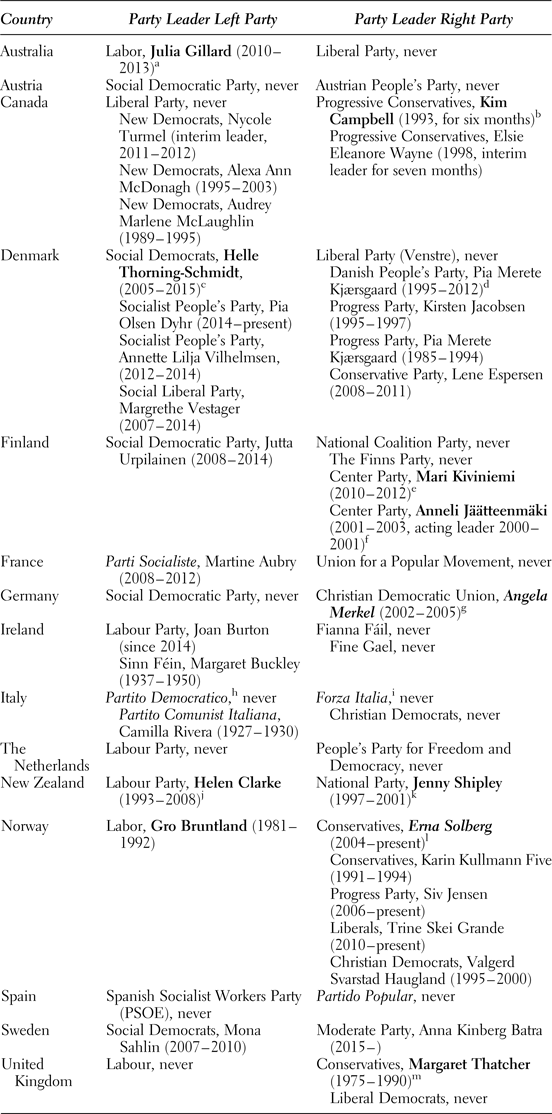
Few women have served as leaders of their parties in parliamentary systems, where party leadership can lead to the prime ministership. Although the number of female party leaders has been increasing (O'Brien Reference O'Brien2015, Figure 1), this increase has been attributable to women's leadership success in minor parties and in parties that are not meaningful contenders for governing. Among major parties—those able to compete effectively for parliament and governing—numbers of female party leaders remain small.Footnote 2 The rarity of women as party leaders in parliamentary systems, where leadership is the path to the prime ministership, is suggested by the evidence in Table 1, which lists major left and right parties for 12 European parliamentary systems and for Australia, Canada, and New Zealand.Footnote 3 For the 46 political parties included in the table, across their entire party histories, women have served as party leaders in 31 instances (an additional two women served briefly as interim party leaders); only five parties have had more than one female party leader (Canada's New Democrats, the Danish Socialist People's and Progress Parties, Finland's Center Party, and Norway's Conservative Party).Footnote 4 For the major parties in Austria, the Netherlands, and Spain, no woman has ever been party leader; nor has any woman ever led the Liberal Parties of Australia, Canada, or Denmark; the German Social Democratic Party; Ireland's Fianna Fáil, or Fine Gael; the Italian Democratic Party, Christian Democratic Party, or Forza Italia; or the UK Labour or Liberal Democratic Parties. Among these cases, only 11 female party leaders have become prime minister: Julia Gillard (Australia), Kim Campbell (Canada), Helle Thorning-Schmidt (Denmark), Mari Kiviniemi and Anneli Jäätteenmäki (Finland), Angela Merkel (Germany), Helen Clark and Jenny Shipley (New Zealand), Gro Bruntland and Erna Solberg (Norway), and Margaret Thatcher (the United Kingdom). Six of these women became prime minister in this century, two of whom are still in office (see Table 1).Footnote 5 Although women have succeeded in becoming leaders of major political parties in established parliamentary democracies, they are few in number and fewer still have become prime minister. For parliamentary systems, the major path to prime minister is through the gateway of party leader.
Female party leaders, major parties, selected parliamentary democracies (through April 1, 2015)

This table provides examples of cases of competitive political parties (that is, those that form or help to form governments) in twelve European countries, as well as Australia, Canada, and New Zealand. Note that these cases are exemplary, rather than constituting the universe of cases. Bold entries indicate prime ministers; italic bold indicates a current prime minister.
a Gillard was prime minister from 2010 to 2013, when she was removed in an internal party leadership contest.
b Campbell was prime minister from June to November 1993.
c Thorning-Schmidt has been prime minister since 2011.
d First and only female leader of the Danish People's Party, Kjærsgaard was a founding member of the party in 1995.
e Mari Kiviniemi was prime minister of Finland from June 22, 2010, to June 22, 2011.
f Jäätteenmäki was prime minister of Finland for 38 days (April 17–June 18, 2003); she resigned on June 18 (http://www.finlande.nl/public/default.aspx?contentid=109883).
g Includes its precursors, the Democratic Party of the Left and the Left Democrats (Democratici di Sinistra).
h Includes the original Forza Italia (1994–2009), its successor Popolo della Libertà (2009–2013), and the renewed Forza Italia, post-2013.
i Clark was prime minister of New Zealand from 1999 to 2008.
j Shipley was prime minister of New Zealand from 1997 to 1999.
k First female leader of the Labor Party; Bruntland was prime minister in 1981, 1986–1989, and 1990–1996.
l Solberg has been prime minister since 2013.
m Thatcher was prime minister from 1979 to 1990.
This article analyzes the pattern of women's success in becoming leaders of major parties. Identifying a set of conditions under which success is most likely, the research develops an inductive, gendered model for explaining women's party leadership success. Linking macropolitical events to microlevel strategic decisions, I argue that not only the behavior of political women advances them to executive office; the behavior of male politicians in specific crisis circumstances also creates the political opportunity of becoming party leader. That is, women's access to party leadership is gendered by the strategic interaction of male and female contenders. Two conditions create an opening for a woman's rise to party leadership: (1) a scandal or major electoral failure that removes a male party leader and his leadership team (removal); and (2) the candidacy deferral of quality male leader candidates in conditions of uncertainty (deferral). In developing the inductive model, the article presents two examples of women's party leadership succession and the process by which each approached executive power: Margaret Thatcher (Great Britain) and Angela Merkel (Federal Republic of Germany). I conclude with a discussion of appropriate research designs for further testing of the model.
THE DISTINCTIVE NATURE OF PRIME MINISTERSHIPS: OPPORTUNITIES AND CONSTRAINTS
Prime ministerial positions offer opportunities for women's executive power, given three components of the path to a prime ministership. First, in principle, the path to prime minister is the path to party leader. Analysis of women's access to the position of prime minister, therefore, must first focus on party leadership selection rather than on parliamentary elections.
Second, although party leader is an individual position, party leaders head a party team. The party leader, as prime minister, shares power with those who chose her, both in terms of leading the parliamentary party, but also in terms of bringing into her cabinet those who supported her bid for party leader. In a power-sharing arrangement, although only one person can be prime minister, not all power accrues to the prime minister. The prime minister is selected in an intraparty contest, involving negotiation, explicit support, and strategic voting.Footnote 6 In the process of leadership selection, possibilities (and actual positions) are anticipated in terms of explicit powers and positions to be allocated among multiple actors. Under such conditions, women are more likely to be considered and selected as party leader in the selection process; where multiple actors can share in political power, women's chances for inclusion are heightened. The assumption is that men in closed circles of power do not include women, have no “taste” for sharing power with women (Bhavnani Reference Bhavnani2009, 34), and manage competition among themselves. Under power-sharing arrangements, male political elites should be less reluctant (or more willing) to support a woman for party leader than in conditions where power is not shared.
Third, prime ministerships are also located in power-removing arrangements. “[U]npopular prime ministers can be replaced without destabilizing the whole administration through the impeachment process or through calling fresh elections.” Cabinet government arrangements “[facilitate] leadership turnover” (Norris Reference Norris2008, 34–35). Cabinet governments involve two points of potential removal. First, a party leader can be challenged internally in a leadership contest and, if the challenge is successful, replaced. Second, a prime minister can be removed as the result of a failed confidence vote in parliament. Removal of a prime minister through a vote of no confidence, in principle, invokes the resignation of the cabinet and requires new parliamentary elections, removing not just the leader but her supporters and, presumably, her opponents as well.
In short, a female party leader leads a team who not only share power, but can remove her from power as well.Footnote 7 Under gendered assumptions of women as political outsiders (even among political elites) and of male political elites’ hostility or resistance to women's political power, the power-sharing and power-removal components of prime ministerial parliamentary government may facilitate women's rise to party leader and prime minister. Removal mechanisms permit male political elites, with ambitions of their own, to support a woman as leader and potentially as prime minister, because they know they retain the power to remove her in the future and to create thereby opportunities for themselves. The “risk” of selecting a female party leader and a potential prime minister is moderated by the removal mechanism.
Indeed, party elites may identify strategic advantages in selecting a woman as party leader. For example, the electoral balance between competing political parties may be disrupted by the selection of a female leader, positioning the party more favorably for parliamentary elections than might otherwise have been the case. An internal party struggle might be averted by selecting a woman from outside the normal party leadership cadre, providing time for male political elites to negotiate for future leadership. Finally, a looming electoral defeat for the party might cause men in the party to defer their own candidacies until a more propitious time, selecting a woman as leader and hoping to replace her when circumstances improve (see Ryan and Haslam Reference Ryan and Haslam2005). Although the underlying assumption is that men will advance male rather than female candidates for party leader and prime minister, there are nonetheless a range of identifiable strategic advantages, for a party overall and for individual political actors, in advancing a woman's candidacy.
Parliamentary systems with prime ministerial arrangements are specifically gendered institutions offering discrete, if limited, political opportunities for women in the party elite to compete for party leadership and hence prime ministership. Given that power-sharing arrangements are gendered institutional structures that are more open to female party leadership than are those where power is concentrated in a single individual, female potential candidates nonetheless face gendered disadvantages in power-sharing institutions. In particular, male incumbency—the accumulation of male dominance in office across time—serves as a major impediment to new contenders such as women. Where a male party leader and male political elites predominate and are entrenched, women's access to the party leadership is limited. Removal of the incumbent—in this case, replacement of the party leader—may be necessary to open access for women in the party leader eligibility pool. Removal of an incumbent party leader opens opportunities for female potential candidates, and circumstances where such opportunities become available are identifiable. It is important to note, however, that an incumbent party leader does not foreclose electoral opportunities only for women. An incumbent party leader blocks access for everyone, so removal of the incumbent, while crucial, is insufficient to enhance women's opportunities exclusively.
MODELING GENDER IN PARTY LEADERSHIP CONTESTS
Gendered party leadership contests, postcrisis, create distinctive opportunities for female party elites. First, given male predominance in cabinets and shadow cabinets and in party leadership positions, political crisis, election loss, and/or scandal are likely to have a disproportionate impact upon male political elites, removing more men than women, and leaving women, in disproportionate if small numbers, unaffected.
Second, postcrisis leadership opportunities may be enhanced for women by the strategic choices of the remaining men in the party elite. A party, postcrisis, is likely to be poorly positioned for governing or for winning an upcoming election. Therefore, the context for a new party leader is highly unfavorable. A new leader of a party wracked by crisis is unlikely to be able to lead the party to electoral victory, at least at the first electoral opportunity, and is therefore more likely to be challenged by others within the party as electoral circumstances improve.
In crisis circumstances, some level of loss—political or individual, anticipated or actual—may either remove some party elites, predominantly men, or lead other party elites to decide not to advance their candidacies for party leader. Under such conditions, refraining from competing for the leadership and postponing one's ambitions are rational strategic choices for quality candidates. Why would women in the same party, in the same context of crisis, not make the same calculations that men make? Why would women be willing to contest for party leader when highly qualified men would not? The answer is that gendered power relations position women and men in different contexts in the same party, both structurally and strategically.Footnote 8
A major structural difference between women and men is their disproportionate representation as party leaders and cabinet members. Fewer women as party leaders means fewer women have led parties to electoral defeat; fewer women in cabinet positions means fewer women will be swept up in electoral or political crisis. Male political elites, by their positions and numbers, are more susceptible to removal by crisis than are their female counterparts. There are good reasons to believe that female party elites, generally less powerful and less prominent in the party in government, will be less affected by overall election loss or policy failure. Furthermore, in governing parties, fewer women than men have held high cabinet positions (defense, foreign affairs, treasury). As a result, women should be less likely to be tainted by serious policy failure than their male counterparts in the core executive. In terms of the gendered leadership structure of cabinet governments, women in a party elite are not in the same context of crisis as are men.
Second, women are structurally marginalized in male leadership networks.Footnote 9 Female party elites, especially in parties with few elite women, may not have access to the inner circles where male leaders may engage in corrupt or illegal activities. In order to function, corrupt activities require both trust and secrecy among a generally small number of participants. Where female party elites are excluded from male networks of intimacy and friendship, they may, ironically, be protected from inclusion in illegal party activities that would damage their party and political careers. Isolated and excluded, female party elites may be among the most qualified party members left standing in the aftermath of a widespread party scandal that involves—and then removes—men.
Under these circumstances, it is likely that members of the party elite will find themselves, postcrisis, positioned in a newly gendered competitive party context, gendered by at least three factors: (1) removal of incumbents, (2) variation in candidate quality, and (3) electoral calculations by likely candidates. First, postcrisis, it is likely that senior men—the most qualified, experienced, and highly credentialed male candidates for party leader—have been removed.Footnote 10 Second, as a result, among remaining members of the party elite, candidate quality is likely to vary between women and men; and, third, women and men who are potential leader candidates are likely to make different, gendered strategic decisions about candidacy.
Among male party elites, junior men, with less experience and fewer cabinet credentials, will remain in the potential eligibility pool; lacking experience, they are relatively weak potential leader candidates. Junior men are likely to recognize that they lack experience, which they can gain over time, and they are likely to refrain from candidacies until the political opportunity structure is more favorable. Strategic junior men will anticipate that the party will not do well in the next general election following a scandal or electoral defeat and hence will wait for a better opportunity for advancing their candidacies. In addition, junior men recognize that the passage of time may also increase their political experience (perhaps including a cabinet position or deputy ministership), hence improving their future chances.
In comparison, few women in the party are likely to have been removed from contention as the result of crisis. Within the female party elite, both junior and senior women are likely to remain in the potential eligibility pool. Unlike senior men in the party, senior women with experience and stature are still available for candidacy since they are unlikely to have been disadvantaged by scandal or defeat. Senior women of long allegiance to the party have both political experience and a base, and hence are likely to be stronger candidates and of higher quality than the junior men and women remaining in the leadership eligibility pool. In the gendered context of the postcrisis leadership competition, (some) women in the party are suddenly positioned as more qualified, more experienced, more able to attract support, and more capable of running a high-quality campaign for party leader than are their likely junior competitors.
The gendered nature of party leadership competition, postcrisis, leads rational party elites to different strategic calculations about their candidacy chances. With the removal of senior men (and few women) from leadership competition, remaining likely candidates vary, by sex, in their candidate quality. In a postcrisis context, uncertainty about a new party leader's chances of leading the party into government (rather than remaining in opposition) should be high, and quality candidates under such circumstances should be relatively unwilling to stand for leader. The gendered nature of the postcrisis context, however, is likely to result in different sets of strategic calculations by women and by men.
Given the predominance of men in party political elites, and the nearly universal male dominance in prime ministerships, junior men in a party elite can anticipate that, at least in terms of sex (male), they are not disadvantaged at the outset in intraparty contests. In a postcrisis context, junior men are likely to postpone their candidacy to await a better opportunity. Strategic junior men in the party recognize the strategic advantage accruing to specific senior female candidates and refrain from competing for the leadership. Some junior men may support a female candidate in order to gain favor and to improve their own future position; they may even make a strategic decision, with an eye to their own future, to support a weak or less qualified woman (Ryan and Haslam Reference Ryan and Haslam2005). In short, strategic junior men evaluate their immediate opportunities against the future likelihood of a successful candidacy and decide to refrain from competing. Junior men are likely to be confident that some day—another day—their chance will come.
Again, given nearly universal male dominance within party elites and in prime ministerships, female party elites face a different strategic context. Women in a party elite are fully aware that, on the basis of sex (female), they are disadvantaged at the outset in intraparty contests. Female party elites recognize that few opportunities for leadership, favorable or otherwise, are available to them. In a postcrisis context, however, political opportunities are likely to be more open to women than at any other time—poor as the prospect of leading one's party to victory and becoming prime minister might be. Strategic senior women recognize that better opportunities in the future are unlikely for them and hence may be willing to stand for leader. Senior women may also realize that their likely male opponents within the party are not candidates of high quality and hence are vulnerable to defeat by a highly qualified and experienced female contender. Female potential candidates will know which men (and which other women) are likely to contest for the leadership and can evaluate their own competitive chances, which, given the strategic choices by junior men in the party, are likely to be good. In short, strategic senior women evaluate their immediate opportunities against future unlikelihood of successful candidacy, and decide to compete. Senior women recognize that their chance has come—and that they had better take it.
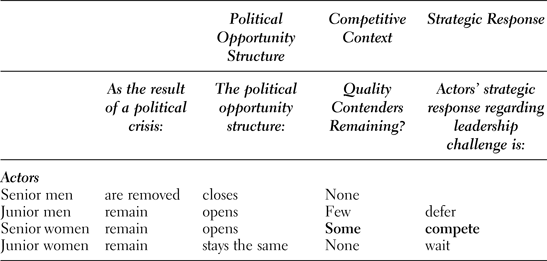
Table 2 presents a model for testing these relationships. The model presents a political opportunity structure that shapes the competitive context of quality contenders, who make strategic decisions about candidacy. The model can be used to predict the likelihood of female party leader candidates and to explain the path by which they become contenders. For example, reading across the rows, the model specifies that, as a result of political crisis, senior men in a party are removed from leadership contention as their political opportunities close, leaving no quality contenders among senior men. In contrast, junior men, as a result of political crisis, remain, and their political opportunities open, but they nonetheless defer, anticipating that future opportunities will be even better. As a result of a political crisis, senior women are likely to be untouched and hence remain potential contenders as their political opportunities open; and one (or more) will decide to contest for leader.
Removal and deferral: political opportunity structure and gendered strategic choices in leadership contests
Two cases, defined by removal and deferral, illustrate the model: those of Margaret Thatcher, who in 1975 became leader of the Conservative Party in Britain, and Angela Merkel, who became leader of the Christian Democratic Union of Germany in 2000. For each case I identify the party crisis that provoked removal, discuss likely candidates in each party leader eligibility pool and actual candidates for party leader, identify any deferrals, and analyze the gendered competitive context. I employ these cases not to test the model,Footnote 11 but to provide examples for an inductive model for future testing with other cases, including those where women contest for party leadership and loseFootnote 12 and those where women are available as potential party leader candidates but do not put their names forward.Footnote 13 In this regard, the two cases constitute comparative “pathway cases” that can be employed “to shed light on causal mechanisms” (Gerring Reference Gerring2007, 122–30).Footnote 14 Both Thatcher and Merkel became leaders of their parties and, following elections, became prime minister and chancellor, respectively, leading their parties from opposition to government. Both women are well known, and substantial evidence concerning their intraparty leadership contests is available. Both Thatcher and Merkel competed for leadership of major political parties in parliamentary systems in large non-Scandinavian countries.Footnote 15 These cases contribute to the scholarship on female political executives (Jalalzai Reference Jalalzai2013; Murray Reference Murray2010; Reynolds Reference Reynolds1999) by investigating the preceding contest for party leader, to deepen our understanding of the gendered hurdles women must clear—and the opportunities from which they may benefit—on the path to prime minister.
A model developed from cases of party leadership contests in Europe is likely to be challenged on generalizability grounds; the model, however, does not generalize but offers a frame that may be useful in understanding gendered strategic decision making of potential party leader candidates in European parliamentary systems. The unique contribution of the model is its specifically gendered components in considering the interaction of men and women in competition for a powerful party position, one that can lead to the most powerful political position: that of prime minister. The model will require further testing and perhaps revision when applied to new political systems (e.g., Latvia, Slovakia), where male elites may not yet be firmly established, and in postconflict countries (e.g., Rwanda, Croatia), where large numbers of potential male competitors have been removed by war. Parliamentary systems in which family networks dominate political parties (e.g., India, Bangladesh) are also likely locations for further testing.
MARGARET THATCHER AND THE LEADERSHIP CHALLENGE TO EDWARD HEATH
[L]eadership elections in the UK, despite it electing one of the world's most iconic female prime ministers, is still dominated by men.
Bale and Webb (Reference Bale, Webb, Pilet and Cross2014, 12–13)
The Conservative Party is the only major party in the UK that has selected a woman as its party leader. Margaret Thatcher was party leader from 1975 until her removal in 1990 and was one of the longest continually serving British prime ministers. Thatcher's access to Conservative leadership was shaped by three factors: (1) a political crisis that undermined the sitting leader; (2) Conservative Party selection and removal rules; and (3) candidacy deferral by Conservative men. These factors combined to open leadership opportunities for Thatcher.
As a potential Conservative Party leader candidate, Thatcher was well credentialed. “[L]eadership candidates, to have any chance of winning, had to have served for some considerable time in parliament and, ideally in government” (Bale and Webb Reference Bale, Webb, Pilet and Cross2014, 25). At the point of the leadership contest in 1975, Thatcher had served 16 years in parliament. Between 1961 and 1975, she held a series of subcabinet, cabinet, and shadow cabinet posts, including minister for education and science. Although she had not held any of the core cabinet positions (exchequer, foreign secretary, home secretary), Thatcher was sufficiently qualified in terms of credentials and sufficiently experienced in terms of party and cabinet to contend for party leader by 1975.
During the 1970s, the Conservative Party faced several crises, and by the close of 1974, Edward Heath had led his party into two election defeats in the course of a single calendar year. The Conservatives lost 20 seats and 1.5 million votes in elections between February and October of 1974, and the party was in disarray. Postelection, Heath did not resign his positions as party leader and shadow prime minister.
As a low-ranking member of the Cabinet, Thatcher was relatively untouched by the fallout of the government's defeat. She still held her seat in the Commons, having won reelection for Finchley, and, postelection, she was seconded to Shadow Treasury Minister Robert Carr, with special responsibility for the Finance Bill, and became a member of the steering committee, where, as Thatcher wrote (1995, 264), “I could make the most of my talents.”
Any challenge to an incumbent leader comes with potentially high costs; indeed, even in the absence of an incumbent, leadership contests can be “bruising” and acrimonious, with serious negative consequences for the challenger(s) (Alderman Reference Alderman1999, 271). Conservatives believed that Labour would call for further elections, circumstances under which “it hardly seemed sensible to change leaders” (Thatcher Reference Thatcher1995, 241). Although few senior men appeared willing to challenge Heath for the leadership, there was considerable discussion about the possibility of replacing Heath within the party elite, in the 1922 Committee, and in the Centre for Policy Studies, as well as in the mass media.
What were the conditions under which Thatcher challenged Heath for the leadership? First, Heath was a weakened incumbent and hence available for challenge. Second, Conservative Party rules (at the time) made it relatively easy to mount a challenge. Specifically in regard to “dissatisfaction with Edward Heath” as the incumbent, the Conservative Party changed its selection rules to require its leader to stand for “annual re-election early in each parliamentary session” (Alderman Reference Alderman1999, 261). In addition, a challenger for leadership needed only to be nominated and seconded by party members.Footnote 16 Rules adopted in 1965 provided that the leader be selected by a ballot of Conservative Members of Parliament, with an absolute majority of the vote and a 15% margin of victory over the next closest competitor (Bale and Webb Reference Bale, Webb, Pilet and Cross2014, 14), setting a high bar for an incumbent party leader and making it more difficult to fight off all contenders on a first ballot. Furthermore, party rules permitted new entrants on subsequent ballot rounds. This last provision was perhaps the most important insofar as it allowed potential competitors to defer until a second round once another challenger had served as “regicide” (Alderman Reference Alderman1999, 263), knocking out the incumbent leader, and after they had the opportunity to assess the competitive context.
Third, no highly qualified male candidates were willing to challenge Heath. Several potential candidates had already been removed from consideration for party leader because of their political failings or involvement in financial scandals. No candidates in the right wing of the partyFootnote 17 and no candidates who had served in one of the superministries of exchequer, foreign secretary, and home secretary contested for leadership on the first ballot.Footnote 18 Among potential party leaders, 10 men had served longer in the Commons than had Thatcher, and Alec Douglas-Home and James Prior had served in the Commons as long as had Thatcher; five men had less experience in the House. Although many men had served longer in parliament than had Thatcher, only a few had as many years of cabinet experience as she; and only a few had experience in more highly ranking ministries. No junior man matched Thatcher's credentials or level of experience, and no other Conservative women were available to compete for leadership.
In sum, 10 highly qualified candidates, with equivalent service in the Commons and equivalent (or superior) ministerial experience, were available to contest for party leader. Of these, only Heath and Thatcher stood on the first ballot. In addition, Hugh Fraser, a 25-year incumbent MP, who had not been included in the Heath cabinets or in the postelection defeat shadow cabinet, was the only other competitor.Footnote 19 On the first ballot, Thatcher's only experienced competitor was the weakened incumbent Edward Heath. In the first round of the party leadership contest, Thatcher managed to best Heath by 11 votes (although she failed to receive a majority). Heath withdrew from further competition, as did Fraser. Thatcher had managed to remove a serious incumbent, Heath, by defeating him on the first ballot.
Four new candidates joined Thatcher on the second ballot, only one of whom was more highly credentialed than she: William Whitelaw, with 20 years in parliament and experience in three cabinet ministries. Every other serious contender had removed himself (or had been ruled out of realistic political competition) by the first ballot.Footnote 20 On the second ballot, Thatcher won a majority of votes (140); Whitelaw, her next closest contender, won 79 votes; and the remaining three candidates split fewer than 50 votes among them. Having defeated Heath on the first ballot, Thatcher was elected leader of the Conservative Party on the second ballot.
Margaret Thatcher's rise to national executive power came with her first leadership try. In the 1979 general elections, Thatcher led her party to victory, garnering 43.9% of the total vote, electing 339 candidates (for a candidate election rate of 54.5%), and winning more than 13.5 million votes—a 30.9% increase over the previous general election (Butler and Butler Reference Butler and Butler2000, 238).
Leadership Election and the Gendered Competitive Context
For Thatcher, her ability and experience intersected with the political opportunity of the 1974 electoral defeats in the Conservative Party. The political crises of the Tories in the mid-1970s did not result in the party turning to a woman to fix things or nominating a woman based on gendered perceptions of women's political “incorruptibility” (Ríos Tobar Reference Ríos Tobar2008, 514). Rather, these crises shaped the political behavior of senior men, either removing or discouraging highly qualified male incumbents from competition and leaving a relatively senior woman to fight off few qualified incumbents and only one junior opponent.
These factors alone did not predict Thatcher's election as Conservative Party leader; rather, the conditions most favorable for her election were (1) a political crisis that removed the most highly qualified men from leadership consideration and (2) her parliamentary and ministerial experience relative to other potential contenders. More generally, these are the conditions under which qualified women's opportunities for leadership are likely to be heightened. It is not simply a political crisis that offers an opening for ambitious women. It is women's marginalization within party leadership that excludes—and protects—them from the impact of party crisis and attributions of responsibility for electoral defeat or scandalous behavior.
Thatcher was outside “the magic circle” of elite Conservative men who, under other circumstances, would not have selected her as leader (Denham and O'Hara Reference Denham and O'Hara2008, 36).Footnote 21 Only when party crisis removes the most talented senior men are the remaining qualified women (or woman) likely to find themselves better positioned to compete against the remaining less qualified men—in what may be a woman's only career opportunity to contest for party leadership with a chance of succeeding. Thatcher recognized these conditions and took her chance at a successful leadership bid. As Thatcher wrote in her memoirs, “I had no doubt that if I had failed against Ted [Heath], that would have been the end of me in politics” (Thatcher Reference Thatcher1995, 277).
ANGELA MERKEL AND THE LEADERSHIP CONTEST IN THE CDU/CSU
Women's access to party leadership in the Federal Republic of Germany is likely to be more constrained, in comparison to other West European parliamentary democracies, by three factors: (1) the nature of the chancellorship; (2) the distinctive chancellor and leader removal mechanisms; and (3) CDU/CSU candidacy coordination. These factors combine to construct a more highly competitive context for party leader and chancellor selection in Germany. Despite these country-specific factors, Merkel's path to power was similar to that of Thatcher.
First, the German chancellor, “according to the Constitution, [is] the leader of a government whose competition he [sic] determines and whose policies he [sic] defines.” These powers have been increasingly centralized “in the person and the office” (Goetz Reference Goetz, Padgett, Patterson and Smith2003, 32, 33). Hence, the chancellor position is less a team position than is the case in Westminster systems; and female leader candidates should therefore face a more competitive party leader selection context.
Second, a chancellor cannot be removed by his or her party alone. As Bell and Murray (2007, 9) note:
Germany … requires a constructive vote of no confidence to bring down the executive; in other words, the Chancellor can be removed from office only by the Bundestag if he or she is replaced by an alternative candidate in command of a parliamentary majority. Furthermore, the fixed term of the Bundestag removes from the Chancellor the option of calling an election at a time or his or her choosing.
For the German case, the centralized nature of the chancellorship (less power sharing) and the relative autonomy (less power removal) should combine to make women's access to party leader more difficult. Moreover, the CDU has no mechanism for removing its party leader (general secretary; see Detterbeck and Rohlfing Reference Detterbeck, Rohlfing, Pilet and Cross2014, 78–83). Under conditions of political crisis, male party elites may be reluctant, because of the structure of the chancellorship and lack of removal mechanisms, to support a female candidate for party leader.
Third, the Christian Democratic Union coordinates national-level candidacies with its regional sister party, the Christian Social Union (CSU). Internal competition for CDU party leader has involved negotiations within the CDU and CSU and coordination of competition among CDU-CSU elites (Helms Reference Helms2000, 429; Wiliarty Reference Wiliarty2008, 91–92; Reference Wiliarty2010). Not only is it likely that a potential chancellor will have to negotiate power sharing outside his or her party; the potential CDU/CSU candidate for party leader will also have to negotiate within his or her party. The possibility of several potential candidates from the CDU and the CSU, and the pattern of negotiations around leadership between the two sister parties, should increase competition and decrease a female candidate's likelihood of representing the CDU/CSU as their chancellor candidate.
Internal party coordination of political elite competition should make women's access to party leader more difficult because the level of competition at the level of party is likely to be fairly high.Footnote 22 Given that the chancellor is the first and foremost political leader, and not easily removable, the power-sharing and power-removing capacities that are likely to facilitate women's access to party and to government leadership elsewhere are diminished. Power-sharing and power-removing arrangements in the German case are likely to construct weaker opportunities for prospective female candidates for party leader and prime minister than would the Westminster model. Nonetheless, the strategic decision calculations on the part of individual female candidates are likely to be the same as in the UK: in a context of crisis, female cabinet members with substantial parliamentary experience are more likely to be available for and to contest for party leader and, in such circumstances, more likely to succeed.
Political Crises and Incumbent Removal
The CDU experienced two major crises at the end of the 1990s: a major electoral defeat and a political corruption scandal. First, under Party Leader and Chancellor Helmut Kohl, the CDU lost the 1998 elections. The magnitude of the CDU's defeat was substantial, and, as a result, CDU Leader Helmut Kohl and CSU Leader Theo Waigel resigned (Green Reference Green1999; James Reference James2000).
A corruption scandal in 1999 generated a second political crisis. In 1999, Germany experienced “its gravest political scandal for a decade” (Karacs Reference Karacs1999; see also Smith Reference Smith, Padgett, Paterson and Smith2003) when Helmut Kohl confessed, “after previous denials” (Andrews Reference Andrews1999), to having received illegal campaign contributions, which he channeled to local-level party organizations in the CDU and CSU. Beyond the violation of campaign finance regulations, allegations of conflict of interest and influence-peddling emerged, as well as charges that Kohl had established illegal bank accounts in Switzerland (Andrews Reference Andrews1999). The corruption scandal caught not only Kohl, who was out of office, but also snared his successor as party leader, Wolfgang Schäuble, who was removed as CDU party leader in 2000 (Green Reference Green1999, 313, 314; Smith Reference Smith, Padgett, Paterson and Smith2003, 93). As a result of the corruption scandal, Wolfgang Hullen, “head of the Christian Democratic Union parliamentary delegation's finance and budget department [for] 18 years,” committed suicide (“A German Suicide,” 2010).
The combination of these two crises—electoral defeat and corruption scandal—served to remove several powerful CDU party notables, all senior men; it caused the resignations of the previous party leader and chancellor and his chosen successor;Footnote 23 and it recast the political opportunity structure for leadership in the CDU.
Party Leadership Election and the Gendered Competitive Context
By the 2000 CDU leadership contest, Merkel was well positioned to compete for the CDU party leader position of general secretary. Merkel had 10 years’ experience as an elected member of the Bundestag, 8 years’ experience as a minister in two separate cabinet positions (women and youth, environment, nature conservation, and nuclear safety,Footnote 24 1991–1998), and had been deputy party leader since 1998. Moreover, Merkel was widely regarded as an effective administrator.
What were the conditions under which Merkel contended for the CDU leadership in 2000? First, the most powerful male contender, Helmut Kohl, had been removed from competition by double crisis. Wolfgang Schäuble, “the leader of the CDU/CSU parliamentary group and Kohl's chosen successor” (Green Reference Green1999, 314) was also removed from contention, as a result of scandal.Footnote 25 Other male contenders—such as Friederich Bohl, Kohl's chief of staff, and Volker Rühe, head of the CDU—were similarly removed.
Angela Merkel was not swept up in the CDU/CSU scandal. As Kohl's protégée, Merkel was excluded from the inner circle of campaign finance violations; moreover, Merkel broke with Kohl publicly over the issue of the financial scandal, “the first CDU leader to distance herself from Kohl” (Wiliarty Reference Wiliarty2008, 90), a move that “saved the party and advanced her career by ‘dismantling’ both former patrons” (Clemens Reference Clemens2006, 50). The predominance of men in the CDU leadership and the exclusivity of the CDU political elite marginalized women in the party, including elite women. This gendered exclusion served to protect women from contamination by the CDU financial scandal. Merkel, the woman closest to Kohl, was spared, and as the men in her party went down to internal defeat, she remained untouched by the scandal and survived the crisis.
Second, the remaining eligibility pool had few quality contenders. Candidates for party leader, regardless of party, are likely to be persons with experience in the Bundestag and as a cabinet minister.Footnote 26 In 2000, only fifteen men and eight women met these modest standards of legislative and ministerial experience. Of the eight women in the eligibility pool for party leader in 2000, none was as competitive as Merkel. Among the men in the party leader eligibility pool, few senior qualified men remained whose experience was equivalent to Merkel's: Jochem Borchert, Wolfgang Bötsch, Norbert Lammert, Eduard Oswald, Hans-Peter Repnik, Heinz Riesenhuber, Edmund Stoiber, and Matthias Wissmann. Only Stoiber had a stronger record of cabinet and party leadership experience. Other male potential contenders were “too unknown and inexperienced” (Wiliarty Reference Wiliarty2008, 88) or were unwilling to challenge for the leadership. Günther Christian Wulff, an unsuccessful candidate in 1994 and 1998 for minister president of Lower Saxony, deferred, removing himself from consideration, presumably because Wulff “had a stake in letting Merkel stay on longer until he had proven his bona fides” (Clemens 2006, 67).
Merkel was selected as CDU general secretary in 2000, having succeeded as a candidate with high qualifications and facing no incumbent or more senior member of her party in the general secretary competition. Many highly qualified candidates had been removed from competition by scandal; others voluntarily removed themselves from consideration; and no remaining candidates were sufficiently qualified to mount a credentialed campaign to compete with Merkel for the general secretary position. In the general secretary contest, Merkel was not only qualified; she was favorably situated in a changed political opportunity structure that had removed every other potentially competitive candidate.
The more serious competition for the chancellor candidacy came in 2002. Securing the general secretary post did not guarantee that Merkel would also become the party's candidate for chancellor for the 2002 federal elections. Successful as general secretary, Merkel was a strong candidate for chancellor. Nonetheless, the political opportunity structure for the chancellor candidacy had shifted to Merkel's disadvantage: she faced a major and highly qualified male opponent in Edmund Stoiber. His qualifications and position in the party made him more competitive than Merkel. A long-standing member of the Bundesrat, Stoiber had served as Bundesrat president from 1995 to 1996. He had been a member of the Bavarian parliament since 1974 and had been Bavarian prime minister since 1993; he had also been leader of the CSU since 1999.Footnote 27 At 59 years old, he was a decade older than Merkel, but still young enough to compete against the SPD candidate Gerhard Schröder in the general elections (Cross and Blais Reference Cross and Blais2012, 118–20).
In the ensuing struggle for the CDU-CSU chancellor candidacy, Merkel “[conceded] the title to Stoiber, campaigning loyally on his behalf, in exchange for his acceptance of her as caucus chair” (Clemens 2006, 50). Stoiber was chosen as chancellor candidate for the CDU/CSU; Merkel remained CDU general secretary. “In 2002, Stoiber politically out-maneuvered the leader of the CDU, Angela Merkel, and was elected the CDU/CSU's candidate for the office of chancellor, challenging Gerhard Schröder.”Footnote 28
Edmund Stoiber led the CDU/CSU into the 2002 elections, which they had been widely expected to win. “The CSU/CDU held a huge lead in the opinion polls and Stoiber famously remarked that ‘… this election is like a football match where it's the second half and my team is ahead by 2–0.’” What had been anticipated as a CDU/CSU victory resulted, however, in a substantial loss, some of which was attributed directly to Stoiber's quality as a candidate (Hogwood Reference Hogwood2004, 250, 253). The 2002 elections constituted the political crisis that removed Edmund Stoiber from any further consideration as a future potential chancellor candidate. In the context of two consecutive national election defeats and the aftermath of the corruption scandal, Angela Merkel remained as the only competitive—and most experienced—member of the CDU party elite.
By 2005, when the SPD called for new elections, the political opportunity structure in the CDU/CSU had been transformed and the competitive context had shifted in Merkel's favor. All previous highly qualified contenders, aside from Merkel, had already been removed as the result of political defeat or scandal; junior male contenders had refrained from competition; and no quality competitors remained or were willing to contest. In this context, Merkel, like Thatcher, actively positioned herself to improve her opportunities for becoming Chancellor candidate for her party, without violating the norms against self-promotion. She appeared at a series of regional CDU conferences in 2001–2002, consolidating her support among regional party members, particularly among young people and women (Clemens 2006, 59) and extending her support base into northern Germany and into predominantly Catholic areas; others in the CDU and the CSU already supported her or recognized the virtues of doing so. Seeing the opportunities for her candidacy open after the 2002 election loss, she was actively competitive, again within the norms of her party, increasing her chances against whatever opponents might remain.Footnote 29 In May 2005, Merkel was selected as the CDU/CSU chancellor candidate. Merkel led the party into the federal elections and emerged victorious, becoming the first female chancellor of Germany.
CONCLUSION:FUTURE RESEARCH AND THE IMPERMANENCE OF POLITICAL OPPORTUNITY
Party leader nomination contests are elite intraparty competitions. Selection as party leader is effectively the nomination stage for election to prime minister. As Marcela Ríos Tobar writes (2008, 511), “the major hurdle … [lies] at the nomination stage, rather than at the election itself.” The major hurdle of the nomination stage, for women, is the presence of experienced, high-quality male candidates. The removal from competition of incumbent men—likely nominees—is key to increasing women's chances for success at the nomination stage. Party crises—involving election loss, political or economic upheaval, party and personal scandals—often suffice to remove experienced male incumbents and to deter, temporarily, more junior men from standing for nomination as party leader.
The deferral of candidacy by the remaining male potential candidates further contributes to creating a more open political opportunity context for the remaining—and more senior and more experienced—women. The remaining men and women are positioned differently in regard to leadership opportunities following a crisis, and they identify their future leadership opportunities in gendered terms, causing them to strategize differently in the same postcrisis context. The postcrisis decision to advance or to defer a candidacy is a gendered strategic decision. These different strategies—deferral by men and concerted candidacy by women (or a woman)—reinforce the effect of incumbent removal to create a political opportunity context that offers female candidates their best chance for party leadership—and hence for becoming prime minister.
The cases presented in this paper, while not dispositive, illustrate the importance of incumbent removal specifically for women—remembering that incumbent removal offers no necessary advantage for women where competitive male challengers remain. The evidence from these cases supports Bhavnani's (Reference Bhavnani2009) findings in regard to men who are weak candidates in the face of incumbent women who are, in comparison, strong candidates. Where a highly qualified female candidate runs against a weak field of inexperienced men, her chances for winning are heightened, in comparison to running against qualified male incumbents. For Margaret Thatcher and Angela Merkel—the women who became their party's leader and then their country's prime minister—these were the circumstances that structured the opportunities for their success.
Women's Leadership, Political Learning, and Political Opportunity Transformed: Future Research
This model—where a crisis removes senior male incumbents, deters inexperienced junior men, creates advantage for an experienced political woman, and leads to her selection as party leader—is probabilistic rather than deterministic; moreover, this article focuses only on female victors and only on established parliamentary systems in Europe. It is likely that women also lose under these circumstances but arguably less often than under noncrisis conditions that encourage a full range of experienced incumbent men to contest for party leadership. Women's party leadership is more probable under conditions of political crisis that remove highly qualified senior men from leadership competition without removing senior women. In future research, scholars will need to identify internal party contests where qualified women are present in the eligibility pool, where they actually contest for leadership, and where they are defeated by another candidate in the leadership election, as well as to analyze leadership contests where junior men are able to prevail.
Women are “more likely to initially come to power when the post is least desirable. Attractive positions remain male-dominated” (O'Brien Reference O'Brien2015). However, unattractive positions also remain male-dominated; across the past half century, men in political parties have competed for party leadership under unfavorable as well as favorable electoral and political conditions. It is still the case that few women are selected as party leaders. Why, under unfavorable conditions, would men not continue to dominate party leadership? This article answers that question by focusing on the gendered interactions of women and of men making strategic decisions about leadership candidacy, identifying gendered removal and deferral as two factors that open the political opportunity structure for women. Political crises that remove a male party leader and prime minister appear to offer specific political opportunities to female party elites who, in the context of strategic deferral decisions by other (male) actors, win the party leader position and become, with electoral victory, prime minister.
Such political opportunities structured by strategic decisions are not likely to be permanent, as strategic political elites learn and adapt. As junior men postpone their candidacies—only to see a woman become party leader and, perhaps, as prime minister, dominate national and international politics for nearly a generation (i.e., Margaret Thatcher)—other junior men are likely to become alert to the risks of deferral and hence to the positive risks of their own relatively early candidacy. The relatively junior men in the German CDU, who did not contest for party leader in 2005, have found themselves waiting a decade for their chance at leadership. As junior men learn across time, they may make a different strategic decision: to compete early in their career, during a time of crisis, in the hope that they might prevail in the unusual circumstances created by crisis.
Political learning in regard to risk may also shape the strategic decisions of female political elites. As the numbers of women elected to parliaments increase, the pool of experienced political women eligible for party leadership is likely to increase. Junior women may begin to make the same strategic decisions as junior men, in the wake of a successful female prime minister: to advance a candidacy early. Alternatively, faced with ambitious, junior, competitive men, junior women may defer their candidacies in the context of what may appear to be a less propitious opportunity context. Finally, with increased numbers of experienced women in parliament, multiple women will have to take into account not just their male competitors but their female potential opponents as well.
The impermanence of political opportunity is most clearly evidenced by structural changes that political parties initiate in the aftermath of a woman's selection as party leader and prime minister. Political parties change their leadership selection rules in the wake of crisis (Cross and Blais Reference Cross and Blais2012, 83–85) and may be likely to do so following women's success in attaining party leadership. The British Conservative Party made minor changes in its party leader selection processes post-Thatcher and instituted major changes in 1998, which made it impossible for a future party leader to come to power under the rules that favored Thatcher's selection (Alderman Reference Alderman1999; Denham and O'Hara Reference Denham and O'Hara2008, 24). The CDU reportedly considered changing its leadership selection process following Merkel's selection as chancellor candidate in 2005. Those who study women's access to party leadership and to prime minister will need to identify not only the rules of selection, but also the pattern and timing of changes in selection rules in regard to women's candidacies (or their absence) as well.
With every change, however, it is more likely than not that highly qualified political women, having served in cabinet and/or shadow cabinet positions and holding substantial legislative experience, will recognize the gendered context of their position within their parties and will strategize—with some possible mistakes—in regard to their political future. These women anticipate that some day their chance will come, and when it comes, they will take it.