1. Introduction
Recent philosophical discussion of explanation in the special sciences has focused on mechanist theories of explanation. These theories maintain that explanations appeal to the mechanisms that underlie the scientific phenomenon of interest. While there are different versions of these theories, a significant number of them define mechanisms as the entities, activities, and organizational features that produce a target phenomenon of interest.Footnote 1 This general mechanist position provides an explanatory structure that has been successfully identified in a number of special sciences, including neuroscience, molecular biology, and genetics. However, this success has led a number of philosophers to make the stronger claim that in certain sciences mechanistic explanation is the only form of explanation. One example of this stronger mechanist thesis is found in recent work by Kaplan and Craver (Reference Kaplan and Craver2011) who claim that all explanations in neuroscience are mechanistic. They focus on dynamical systems neuroscience, where there has been significant resistance to this strong mechanist position. This resistance has been motivated by claims that mathematical models in this field can provide explanations without referencing the mechanisms that underlie neural systems. In response to these claims Kaplan and Craver argue for two main points in regard to the explanatory status of mathematical models in dynamical systems neuroscience. They argue that these models (1) must meet a model-to-mechanism-mapping (3M) constraint to be explanatory and that (2) their explanatory status increases as they include more relevant mechanistic detail.
In this article I argue against Kaplan and Craver’s strong mechanist position and their claims regarding the explanatory status of mathematical models in dynamical systems neuroscience. I support this argument by analyzing a dynamical model that provides an explanation, despite failing to meet their mechanist requirements. I indicate how this explanation is well characterized by Batterman’s account of minimal model explanations, which has been used to clarify the structure of explanations in the physical sciences, and more recently in biology (Batterman and Rice Reference Batterman and Rice2014). Understanding the explanation in this example involves attending to mathematical models and abstraction techniques that are common to dynamical systems neuroscience and used in understanding neural behavior. Such models can bear complex relationships to the neural systems they represent, and although they do not meet the mechanist mapping requirements or represent the causal mechanical details of these systems, I show how this does not prevent them from providing explanations.
This article is organized as follows. In section 2 I describe Kaplan and Craver’s mechanist position in more detail. Section 3 contains a brief background on dynamical systems neuroscience and an example of an explanation that these mathematical models provide. In section 4 I argue that this type of explanation cannot be accommodated by the mechanist approach and indicate how it is well characterized by Batterman’s account of minimal model explanations. Section 5 contains concluding remarks on the relationship between explanatory models and the systems they represent in the real world.
2. Kaplan and Craver’s Mechanist Position
This section contains further description of Kaplan and Craver’s claims regarding explanations in neuroscience, including their 3M constraint and the claim that the explanatory power of a model increases as it includes more mechanistic detail. They direct these claims at mathematical models in neuroscience and use them to distinguish between explanatory models and those that merely provide descriptions or predictions.
According to Kaplan and Craver, all explanations in neuroscience appeal to mechanisms as models in this field “carry explanatory force to the extent, and only to the extent, that they reveal (however dimly) aspects of the causal structure of a mechanism” (Reference Kaplan and Craver2011, 602). They define mechanisms as the underlying component parts of a system and the features, activities, and organization of these components that are relevant to the production of a particular phenomena of interest (605). Explaining this phenomenon requires citing all and only those actual components and activities that underlie and produce it. For example, an adequate explanation of neural firing (or the action potential) appeals to the relevant biological entities and activities that underlie and produce this firing. These biological entities include the relevant ion channels, ions, and the Na+/K+ pump, while the activities describe what these entities do (e.g., their attraction, blocking, diffusion; Craver Reference Craver2008, 1025). As an account of causal explanation, the mechanist position depends on the rationale that explaining a phenomena of interest requires citing the causal factors that produce it. In other words, it requires that the explanans invoke factors that are causally relevant to the explanandum. If a model merely describes or predicts the explanandum, without citing the causal factors that produce it, the model is regarded as non-explanatory.Footnote 2
There are two central claims that Kaplan and Craver make regarding the explanatory status of mathematical models in neuroscience. The first is their 3M constraint, which states:
(3M) In successful explanatory models in cognitive and systems neuroscience (a) the variables in the model correspond to components, activities, properties, and organizational features of the target mechanism that produces, maintains, or underlies the phenomenon, and (b) the (perhaps mathematical) dependencies posited among these variables in the model correspond to the (perhaps quantifiable) causal relations among the components of the target mechanism. (Kaplan and Craver Reference Kaplan and Craver2011, 611)
Although this statement of 3M explicitly addresses models in cognitive and systems neuroscience, Kaplan and Craver extend it to all models in neuroscience.Footnote 3 Their 3M constraint specifies two mapping relations that must be met between the model and a target system in order for the model to be explanatory. The first maps the variables of a model to components within the system, and the second maps dependencies among variables in the model to causal relations among components in the system. These criteria are intended to ensure that the model accurately represents the “internal aspects of the system” (Kaplan and Craver Reference Kaplan and Craver2011, 616). However, the degree to which a model needs to fulfill 3M in order to be explanatory is not made entirely explicit in their work. They indicate that models need not completely map to the target system or refrain from idealizations and abstractions to be explanatory. Kaplan states that “3M requires only that some (at least one) of the variables in the model correspond to at least some (at least one) identifiable component parts and causal dependencies among components in the mechanism responsible for producing the target phenomenon” (Kaplan Reference Kaplan2011, 347–48). In this manner, the 3M constraint is stated such that it requires only a minimal amount of mapping from the model to the target system.
The second main claim that Kaplan and Craver make is that among models meeting 3M, the explanatory power of a model increases as it includes more relevant mechanistic detail (Kaplan Reference Kaplan2011, 347). According to Kaplan, “As one incorporates more mechanistically relevant details into the model, for example, by including additional variables to represent additional mechanism components, by changing the relationships between variables to better reflect the causal dependencies among components, or by further adjusting the model parameters to fit more closely what is going on in the target mechanism, one correspondingly improves the quality of the explanation” (347). As including increasing amounts of detail into a model further reveals the causal structure of the mechanism, it increases the explanatory status of the model. Kaplan and Craver sometimes refer to this claim as a “fact” and at other times a “highly plausible assumption” (Kaplan and Craver Reference Kaplan and Craver2011, 613; Kaplan Reference Kaplan2011, 347). In either case, it is presented as a complement to their 3M constraint. This more-details claim provides a natural way of assessing the degree to which a model meets 3M or maps onto a causal mechanism. A more detailed mechanistic model, with a higher degree of mapping, will provide a better explanation because it will be able to answer a wider range of questions about the physical system of interest.
Kaplan and Craver defend a strong mechanist position in an ongoing debate about the explanatory status of dynamical models in neuroscience. They use their position to argue against the claim that dynamical models can be explanatory when they do not reveal the causal structure underlying system-level dynamics. However, as dynamical models often contain variables that represent macroscopic and behavioral features of neural systems, these variables do not always appear to map onto mechanisms in the 3M sense. In these cases, Kaplan and Craver claim that these variables “are not components in the sense of being the underlying parts of the mechanism” and merely provide mathematically compact characterizations of system-level behavior (Kaplan and Craver Reference Kaplan and Craver2011, 614–15). They state that these dynamical models provide at best descriptions or predictions of the behavior of complex mechanisms and that those who consider them explanatory “fundamentally misidentify the source of explanatory power in their models” (602). This criticism is directed toward those who have argued for distinctly dynamical, nonmechanistic explanations in neuroscience, which has been argued, most notably, by Stepp, Chemero, and Silberstein.Footnote 4 Unfortunately, these dynamicist arguments have remained susceptible to such an objection, because they have continued to reference the predictive success of these models without providing another clear sense in which they are explanatory. The strong mechanist position has likely benefited from the fact that these arguments for nonmechanistic dynamical explanation have not been viewed as entirely successful.
3. Dynamical Systems Neuroscience
With this description of Kaplan and Craver’s mechanist position, I move on to providing some background on dynamical systems neuroscience. In this section, I first discuss how neural excitability is understood and modeled with the dynamical systems approach. To do this I characterize neural excitability from a molecular perspective and contrast this with the dynamical systems perspective. After clarifying certain aims of dynamical modeling, I provide an example of an explanatory dynamical model in neuroscience. I indicate why this dynamical model is explanatory and what led neuroscientists to seek the explanation it provides.
3.1. Dynamical Models in Neuroscience
A major topic of study in neuroscience is the excitability of neurons, as this is important for understanding how they transmit information. From the molecular perspective, neural firing, or the action potential, is explained with a generic neuron model consisting of voltage-gated ion channels sensitive to Na+ and K+. When a neuron receives a strong enough signal a number of things happen in succession that cause it to fire. First, the sodium channels open quickly and Na+ rushes into the cell causing the membrane potential to increase. This results in depolarization of the neuron and the upstroke of the action potential. Shortly after this depolarization, the potassium channels open and K+ rushes out of the cell, while the sodium channels begin to close, decreasing the influx of Na+. These events cause the membrane potential to decrease, which contributes to the repolarization of the neuron and downstroke of the action potential. The action potential travels down the length of the neuron and constitutes a single firing event.
In dynamical systems neuroscience, neural excitability is understood and modeled in a different way: the main aim is to study qualitative features of neural systems irrespective of their fine-grained molecular details. Qualitative features of neural systems are studied by analyzing the graphical and topological structures of dynamical models that represent these systems. A dynamical model is a mathematical model that describes how variables representing a particular system evolve with time. In neuroscience it is common to model neural excitability in this way with coupled differential equations. For example, consider the following two-variable dynamical model:


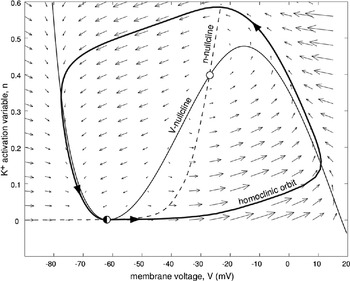
This is a system of coupled differential equations that describe how V and n change over time. Here, V is the excitation variable, which represents neural factors responsible for depolarization, and n is the recovery variable, which represents neural factors responsible for repolarization. The functions f and g describe the evolution of the two-dimensional state variable (V(t), n(t)). With this two-variable model the dynamical system can be represented graphically, as shown on the phase plane in figure 1. In this figure V is plotted along the x-axis and n is plotted along the y-axis. To each point (V, n) ∈ ℝ2 there is a corresponding vector whose x component is  and whose y component is
 . The vector field plotted shows
 at each (V, n).
Phase plane with vector field (Izhikevich Reference Izhikevich2007, 113).

Graphical analysis of the vector field on the phase plane can provide information about the system that may not be obvious from the differential equations alone. For example, a solution to the system of equations can be obtained from an analysis of the figure, as it is the curve (V(t), n(t)) on the phase plane tangent to the vector field. The significance of a solution to the system of equations is that it gives a full picture of how V and n change over time. This solution and its portrayal as a trajectory corresponds to a characterization of neural firing. Counter-clockwise movement on the trajectory tracks changes in V and n throughout the action potential, and the completion of this trajectory represents a single firing of the neuron.Footnote 5
In dynamical systems neuroscience the qualitative features of neural systems are often studied without reference to their fine-grained molecular detail. There are two main reasons for this. First, as graphical representations and qualitative features are exhibited by systems of differing molecular details, explaining these qualitative features does not depend on a shared physical structure. For example, the phase plane in figure 1 represents the qualitative behavior of neurons that differ in their physical structure (i.e., in terms of their ion channels, ion permeabilities, etc.). The fact that physically distinct neural systems can exhibit the same qualitative behavior motivates the view that this behavior is, in a sense, independent of any specific molecular microstructure. Hoppensteadt and Izhikevich express this sentiment when they state that “behavior can be quantitatively different, but qualitatively the same” (Reference Hoppensteadt and Izhikevich1997, 33).Footnote 6 As the focus in dynamical systems neuroscience is on studying and explaining the qualitative behavior of neural systems, the physical differences among systems that exhibit these behaviors are rarely referenced (and sometimes the full extent of these differences are unknown). A second reason for this inattention to molecular detail is that preferred graphical analyses, which concisely represent the comprehensive behavior of neural systems, constrain the number of variables that can be implemented to characterize these systems. This requires the use of simple models that abstract from the molecular details of neural systems, while preserving their system-level behavior. The use of such techniques by Fitzhugh and Nagumo et al. in the early 1960s essentially marks the beginning of dynamical systems neuroscience (Fitzhugh Reference Fitzhugh1960; Nagumo, Arimoto, and Yoshizawa Reference Nagumo, Arimoto and Yoshizawa1962). Fitzhugh pioneered this work by reducing the number of variables in the Hodgkin-Huxley model of the action potential so that the system could be “easily visualized” in a phase space, leading “to a better understanding of the complete system than can be obtained by considering all the variables at once” (Fitzhugh Reference Fitzhugh1960, 873). He reduced the number of variables in these neural models by exploiting their different timescales and functional effects.Footnote 7 This early work explicitly distinguished the qualitative features of neurons and the topological properties of their phase space, from an analysis of their physical constitution. As I discuss in the following subsections, these techniques and the general aims of dynamical systems neuroscience are central to understanding how some models in this field are used to provide explanations.
3.2. Explanatory Dynamical Model: The Canonical Model
In this subsection, I give an example of a dynamical model in neuroscience and present an account of its role in a particular explanation. In this example the dynamical model, referred to as a canonical model, represents the shared qualitative features of a number of physically distinct neural systems. I indicate how this dynamical model is used to provide explanations, after discussing the research findings that led neuroscientists to seek these explanations.
In 1948 Hodgkin published important results from his voltage clamp studies of single crab neurons (Hodgkin Reference Hodgkin1948). In these experiments he measured the electrical responses of neurons after injecting them with various levels of current. He identified three different types of neural excitability, which he referred to as class I, class II, and class III excitability, a categorization still used today.Footnote 8 Class I neurons exhibit a low frequency of firing to low levels of current and smoothly increase their firing with increases in current. Class II neurons begin firing when the current stimuli reaches a higher level, and their firing frequency increases minimally with increases in current, as represented by the step function in figure 2. The relationship between current introduced into class I and class II neurons and the frequency of their firing response is represented in the frequency-current (F-I) graph in figure 2. Class III neurons fail to maintain firing in response to current stimuli (and are not depicted in the figure). The qualitative distinctions between these classes is that for class I neurons the frequency-current relationship starts at zero and increases continuously, for class II neurons it is discontinuous, and for class III neurons it is not defined.
Frequency-current (F-I) relationship of class I and class II neurons (Izhikevich Reference Izhikevich2007, 14).

These excitability classes identify qualitative features that are shared among large groups of physically distinct neurons. Hodgkin was particularly interested in class I excitability because it had been identified in neurons from many different animals (Reference Hodgkin1948, 167). Since his work, neuroscientists have identified class I excitability in many other neural systems, including rat hippocampal neurons, rat cortical neurons, crustacean motor neurons, and the majority of neurons in the mammalian cortex (Connor Reference Connor1975; Cauli et al. Reference Cauli, Audinat, Lambolez, Angulo, Ropert, Tsuzuki, Hestrin and Rossier1997; Tateno Reference Tateno2004; Jia, Gu, and Li Reference Jia, Gu and Li2011). As neurons with class I excitability are found in animals of different biological phyla and even throughout the nervous systems of single species, it is unsurprising that this class encompasses neurons that differ in their microstructural details. What has been surprising, however, is the astonishing degree of this variation and the complexity of neural structures that has been revealed by recent advances in patch-clamp recording, heterologous expression of cloned channels, and genomic analysis (Bean Reference Bean2007, 451). For example, consider mammalian pyramidal neurons, the majority of which exhibit class I excitability. These neurons have three main types of voltage-gated ion channels responsible for excitability, including those selective for Na+, K+, and Ca2+. Of those channels that transmit distinct ions, each has an enormous variety of subtypes; for example, there are over 100 molecularly distinct K+ channels (Vacher, Mohapatra, and Trimmer Reference Vacher, Mohapatra and Trimmer2008). From this large selection of channels a single neuron typically expresses over a dozen different types, which vary in density along the neural membrane and result in many distinct voltage-dependent conductances. These voltage-dependent conductances contribute to the excitability of these neurons and can be composed of two to five different currents of each ion (Na+, K+, and Ca2+; Bean Reference Bean2007). This indicates a large degree of molecular difference among mammalian pyramidal neurons with class I excitability. The differences between all neurons that share this behavior is, of course, much greater.
Neuroscientists have sought an explanation for why neurons that differ so drastically in their microstructural details all exhibit the same type of excitability. In this case the explanandum is a behavior displayed by a group of physically distinct systems as opposed to a behavior produced by a single physically unique system. In 1986 Ermentrout and Kopell provided the crucial component of this explanation with their derivation of a canonical model for class I excitability.Footnote 9 Their work involves using mathematical abstraction techniques to reduce models of molecularly diverse neural systems to a single model, referred to as a canonical model. The canonical model and abstraction techniques used in this approach explain why molecularly diverse neural systems all exhibit the same qualitative behavior and why this behavior is captured in the canonical model. The explanation for this shared behavior is that when mathematical abstraction techniques are used to abstract away from details of mathematical representations of neural systems, all representations converge onto the same canonical model. In the next subsection, I further describe the abstraction steps, canonical model, and the explanations they provide.
3.2.1. Reducing Models of Neural Excitability
The first step in this canonical model approach involves reducing the number of variables in models of neural excitability. Generally, variables characterizing the dynamics of neural systems are classified into four groups depending on their timescale and effect on membrane potential. These variables include (1) the membrane potential variable, (2) excitation variables, (3) recovery variables, and (4) adaptation variables (Izhikevich Reference Izhikevich2007, 8). Excitation variables include neural factors that contribute to the upstroke of the action potential and firing of the neuron, while recovery variables represent neural factors that contribute to the downstroke of the action potential and recovery of the neuron. Adaptation variables stand for neural features that increase during continued spiking and can alter long-term neural excitability. This classification allows the factors characterizing neural excitability to be collapsed into one of the four variables that together characterize the dominant behaviors of the system.
Models for class I excitability do not contain variables of the fourth type, so our analysis begins with dynamical models characterized by three variables: the membrane potential variable, excitation variable, and recovery variable. A model with these three variables can be reduced to a two-variable model by exploiting differences in the rate of the kinetics between the excitation and recovery variables.Footnote 10 As the kinetics of the excitation variable are often much faster than the kinetics of the recovery variable, an idealization is introduced into the model by replacing the excitation variable with the value it quickly approaches (Rinzel and Ermentrout Reference Rinzel, Ermentrout, Koch and Segev1989). This reduces the model to two variables that characterize the macrolevel behavior and dynamics of the system: the “new” excitation variable V, which was formerly the membrane potential variable,Footnote 11 and the recovery variable n. This two-variable dynamical model takes the same form as the coupled differential equations (1) and (2).
When models of neural excitability are reduced to two variables and represented graphically, those systems with class I excitability all exhibit the same change in topological structure as they transition from resting to sustained firing. This qualitative feature is captured in dynamical systems theory by the presence of a particular kind of bifurcation. In the case of neurons with class I excitability, all exhibit the saddle node on invariant circle bifurcation (Izhikevich Reference Izhikevich2007, 164). This reduction of mathematical models of neural excitability to two-variable models is the first step in the canonical model approach and begins to reveal the shared qualitative features in their topology.Footnote 12
3.2.2. Ermentrout-Kopell Theorem
Identifying this particular bifurcation in all models of class I systems is significant because Ermentrout and Kopell’s theorem for class I excitability proves that all models which exhibit this bifurcation transform into the same model when they are reduced. They prove this by providing a continuous piecewise transformation, represented by h in figure 3, that transforms any one-variable model, among a family of models with this bifurcation, into a single canonical model.
Modeling techniques in neuroscience (Izhikevich Reference Izhikevich2007, 279).

In other words, Ermentrout and Kopell prove that all dynamical systems with the saddle node on invariant circle bifurcation of the form

can be mathematically transformed into the following canonical model:Footnote 13

where θ represents the activity of a neural system given a particular current input represented by r.Footnote 14 Given a particular fixed value of the bifurcation parameter r, the model describes how the activity of the neural system, represented by θ, changes over time by specifying the location of θ on the unit circle  . This is represented in figure 4, where the location of θ on the unit circle indicates whether the neural system is in the rest, threshold potential, spike, or refractory phase. Every completion of the unit circle by θ represents a single firing event of the neural system. The model indicates that with small values of r the neural system remains at rest, represented by the variable θ at the rest potential position. Larger values of r result in continuous firing of the neural system, represented by the continuous movement of θ around the unit circle.
Physiological state of a class I neural system (Hoppensteadt and Izhikevich Reference Hoppensteadt and Izhikevich1997, 228).

Ermentrout and Kopell’s theorem for class I excitability provides a continuous transformation  that converts solutions of 3 to solutions of 4, represented in figure 5. This figure shows how any point on the unit circle
 of the family model is represented on the unit circle
 of the canonical model. This transformation preserves the behavior of the original system and ensures that no artifacts or behavior not present in the original system are inherited by the canonical model. Neuroscientists describe this transformation as “extracting some particularly useful dynamical features” from these models, which are represented in the canonical model for class I excitability (Hoppensteadt and Izhikevich Reference Hoppensteadt and Izhikevich1997, 115). This approach reveals how all models of systems with class I excitability are transformed into the same canonical model when they are reduced with principled mathematical techniques. This reveals how mathematical representations of class I systems are stable under certain perturbations by abstracting away from details of each model.
Solution x(t) of equation (3) is mapped to the solution  of equation (4), the canonical model (Hoppensteadt and Izhikevich Reference Hoppensteadt and Izhikevich1997, 119).

One of the more impressive features of this canonical model is that it provides the frequency with which any class I neuron will oscillate given a particular fixed value of r (Hoppensteadt and Izhikevich Reference Hoppensteadt and Izhikevich1997, 227–28). The canonical model approach is valued by mathematical neuroscientists because it provides a rigorous method for gaining information about classes of neural systems that share a particular behavior without obscuring this similarity behind the details of any one system (Izhikevich Reference Izhikevich2007, 278). As Izhikevich notes, the “advantage of this approach is that we can study universal neurocomputational properties that are shared by all members of the family because all such members can be put into the canonical form” (278). Furthermore, as this canonical model approach pertains not just to single neurons but also to neural networks, it indicates the relevance of this explanatory approach to both cellular- and systems-level neuroscience.Footnote 15
It is worth emphasizing that this approach depends crucially on both the canonical model and mathematical abstraction techniques that relate it to models of distinct neural systems. Referring to the canonical model alone could be viewed as merely describing or predicting the behavior of class I neurons, as opposed to explaining it. The canonical model approach, however, including the canonical model and abstraction techniques, does more than just describe or predict the excitability of class I neurons. It explains why physically distinct neural systems all share the same behavior, by showing that principled mathematical abstraction techniques—which preserve qualitative behavior—can be used to reduce all models of these distinct systems to the same canonical model. These abstraction techniques involve exploiting timescale differences to introduce idealizations into models and transforming systems into simpler models that are topologically equivalent. This approach provides an explanation for this shared behavior—when principled mathematical techniques abstract from the details of different systems, they can all be simplified into the same canonical model that exhibits this behavior.
4. Analysis of the Canonical Model Approach
In this section, I examine whether Kaplan and Craver’s 3M constraint and claims regarding detailed models—which they created to account for explanatory mathematical models in neuroscience—can accommodate the explanations provided by the canonical model approach. I argue that their mechanist criteria and framework cannot account for this type of explanation. I then describe Batterman’s account of minimal model explanations and argue that it well characterizes the explanatory structure of the canonical model explanation, by elucidating the role of abstraction techniques and the canonical model in explaining a universal neural behavior.
4.1. Kaplan and Craver’s Mechanist Account
The canonical model approach contrasts with Kaplan and Craver’s claims because it is used to explain the shared behavior of neural systems without revealing their underlying causal mechanical structure. As the neural systems that share this behavior consist of differing causal mechanisms—different types of ion channels, with different distributions along the membrane, and permeabilities to specific ions, and so on—a mechanistic model that represented the causal structure of any single neural system would no longer represent the entire class of systems with this behavior. Explaining this shared behavior requires abstracting from the mechanistic details of these systems, a feature of the canonical model explanation that conflicts with Kaplan and Craver’s claim that explanations improve with further inclusion of mechanistic detail. A mechanistic explanation can be provided to explain why any single system displays class I excitability, but this answers a different question from that answered by the canonical model, which takes the shared behavior of all systems in the class as the desired explanandum. This explanandum does not fit well with the mechanist framework. As Kaplan and Craver state, “it is merely suggestive to note that a similar pattern is observed in a variety of other systems. This information might be useful in our search for general patterns in the organization of mechanisms, but it does nothing to explain the phenomenon we wanted to explain in the first place. If anything, it merely points out that many other similar phenomena require explanations as well, and perhaps these explanations will be similar” (Reference Kaplan and Craver2011, 618).
In contrast with this claim, the canonical model approach is a case in which a similar pattern or universal behavior is exactly what neuroscientists want to explain. Furthermore, dynamical systems neuroscientists do not explain this shared behavior by referencing the causal mechanisms that underlie the neural systems because their underlying mechanisms differ too greatly for such an approach. Instead, they explain this shared behavior by using a dynamical model that abstracts from mechanistic details and maps onto neural systems in a more complex fashion than the 3M criteria specify.
These points can be made clearer by considering Kaplan and Craver’s 3M constraint for explanatory models in neuroscience, which the canonical model does not meet. Recall that the first part of this constraint requires that the variables of a model map onto the mechanism of interest (i.e., the entities, activities, and organizational features of the target system producing the phenomena of interest). The canonical model contains a single variable θ and the bifurcation parameter r, representing the behavior of the neuron and a fixed input to the neuron, respectively. The bifurcation parameter does not represent a component (or internal aspect) of the neural system but rather an input stimulation to the system. This leaves the variable θ as a candidate for the first part of the 3M constraint. This single variable (θ) cannot fulfill this constraint because it does not map onto any identifiable entity, activity, or organizational feature of the mechanisms that underlie these neural systems. Rather it represents the overall behavior of the neural system by indicating its location on the unit circle. The second 3M requirement—that variables in the model map onto causal relations in the target system—is also problematic. As the only candidates for a dependency relation in this model are θ and r, it may be claimed that they meet the second part of the 3M constraint: a dependency relation between a fixed input to the neuron and its behavior. However, the fact that these variables do not meet the first part of the 3M requirement makes this dependency relationship difficult to interpret with the mechanist framework. Furthermore, Craver considers this type of input/output relation to be a “phenomenal model” that “black boxes” the underlying causal mechanism. He claims that such phenomenal models are not explanatory because they fail to represent the mechanism between the input and the output relations. As he has stated, phenomenal models “are complete black boxes; they reveal nothing about the underlying mechanisms and so merely ‘save the phenomenon’ to be explained” (Craver Reference Craver2006, 357). Thus the only possible dependency relation in the canonical model fails to meet 3M because it merely captures an input/output relation and fails to map onto an underlying causal structure.
Indicating that the canonical model does not meet the 3M constraint is not to say that the model does not represent or map onto neural systems in a manner relevant to its explanatory power. Surely models must bear some relationship to how things are in the real world in order to be explanatory. I am not arguing against there being an explanatorily relevant sense in which the canonical model maps onto physical systems. Instead I am arguing that the mechanists’ 3M requirement does not accurately characterize this mapping relationship for all explanatory models in neuroscience. There does not seem to be any straightforward modification of 3M that would allow the mechanist to accommodate the complex relationship between the canonical model and systems with this type of shared behavior.
On this basis it is fair to conclude that the canonical model for class I excitability cannot be accommodated by Kaplan and Craver’s mechanist account. This model fails to meet their 3M criteria, their claims regarding the inclusion of details in explanatory models, and their assertion that explanatory models reveal the structure of mechanisms. The specific example that I have provided indicates that even if the mechanist framework accounts for many explanations in neuroscience, it cannot not account for all of them.
4.2. Batterman’s Minimal Model Explanations
An account of explanation that accommodates this canonical model example is Batterman’s account of minimal model explanations. Explanations in science are often considered answers to why-questions, and Batterman has distinguished between two different types of these questions: type i and type ii why-questions (Batterman Reference Batterman2001, 23). A type i why-question asks why a phenomenon manifests in a particular circumstance, while a type ii why-question asks why a phenomenon manifests generally or in a number of different circumstances. For example, a type i why-question might ask why a particular firing behavior is exhibited by a rat hippocampal neuron. An answer to this question is likely to provide an account of how components of the rat hippocampal neuron bring about the spiking behavior of interest. A type ii why-question, however, might ask why a particular firing pattern is found generally among a group of microstructurally distinct neurons (e.g., rat hippocampal neurons, crustacean motor neurons, and human cortical neurons). An answer to this question is unlikely to reference the lower-level components of the systems because the components vary from system to system. An explanation for why all of these neurons exhibit the same firing behavior should explain why one can abstract away from the details of each system to achieve the same higher-level behavior. Whenever the lower-level components of a single system are invoked, explanation of the shared behavior of all these systems is lost.
While mechanistic explanations provide answers to type i why-questions, Batterman’s minimal model explanations aim to answer type ii why-questions. The first step in these explanations is the identification of a pattern or behavior that is shared among physically distinct systems. This shared behavior is often referred to as universal behavior, and the group of systems that exhibit it, as the universality class. The universality class can be delimited and made precise by using mathematical abstraction techniques to show how different physical systems display the same universal behavior. Batterman describes this strategy as involving an abstract space of possible systems, where each point in the space represents a particular physical system of interest.Footnote 16 The goal is to apply simplifying techniques to this space that allow for the elimination of details or degrees of freedom, while preserving the form of behavior of each system in the space. Repeated application of these techniques (which involve the renormalization group theory in Batterman’s example) rescales the systems and changes their representation in a way that can be tracked as the movement of the system through this space. Studying the topological features of this abstract space reveal fixed points, or points in the space where many represented systems flow to and remain. Importantly, the systems in this space that flow to the same fixed point are in the same universality class, and their shared behavior is determined by the fixed point that they all flow to. This procedure of creating, simplifying, and studying systems in this abstract space provides a precise way of delimiting the universality class (Batterman and Rice Reference Batterman and Rice2014). This strategy of delimiting a universality class explains why physically distinct systems all share the same behavior because it reveals that when details irrelevant to the behavior of each system are removed from the models that represent them, all systems share a common representation. As Batterman states, “explanation of universal behavior involves the elucidation of principled reasons for bracketing (or setting aside as ‘explanatory noise’) many of the microscopic details that genuinely distinguish one system from another. In other words, it is a method for extracting just those features of systems, viewed macroscopically, that are stable under perturbation of their microscopic details” (Reference Batterman2001, 43). Explaining this universal behavior answers a type ii why-question in explaining why physically distinct systems exhibit the same behavior.
Delimiting the universality class can be used to identify what Batterman calls a “minimal model,” which is known to be in the universality class and, thus, shares features of all models in the class. A minimal model often provides a compact characterization of universal behavior and, as Nigel Goldenfeld states, is a model that “most economically caricatures the essential physics” (Goldenfeld, Martin, and Oono Reference Goldenfeld, Martin and Oono1989; Batterman Reference Batterman2002). Thus, minimal models characterize the behavior of a universality class without representing the lower-level physical details of systems in the class. Such simple models are often used to study and explain universal behaviors, which Batterman refers to as minimal model explanations. What justifies the use of a minimal model in studying and explaining universal features? This justification is provided by the mathematical techniques that delimit the universality class and the identification of the minimal model as a member of this class.
There are striking similarities between Batterman’s account of minimal model explanations and the explanations provided by the canonical model approach. Like minimal model explanations, the canonical model approach is used to explain the universal behavior of class I neurons. It provides an answer to a type ii why-question by explaining why a particular neural behavior is found among physically distinct neural systems. Models of these systems are represented in the abstract space of phase diagrams where mathematical techniques are used to identify the stable features of these models. As Hoppensteadt and Izhikevich write, “instead of saying that the [canonical] model loses information about the original phenomena, we say that our model is insensitive to the dynamics within an equivalence class … and that it captures properties [of models in the family] that are transversal to the partitioning” (Reference Hoppensteadt and Izhikevich1997, 116).
The canonical model for class I excitability is a minimal model in the sense that it provides a compact characterization of the behavior of a universality class, which has been precisely demarcated and includes the canonical model as a member. As Hoppensteadt and Izhikevich state, “Canonical [m]odels arise when one studies critical regimes, such as bifurcations in brain dynamics. It is often the case that general systems at a critical regime can be transformed by a suitable change of variables to a canonical model that is usually simpler, but that captures the essence of the regime” (Reference Hoppensteadt and Izhikevich1997, 4). Moreover, “Using comprehensive models [which attempt to take into account all known neurophysiological facts and data] could become a trap, since the more neurophysiological facts are taken into consideration during the construction of the model, the more sophisticated and complex the model becomes. As a result, such a model can quickly come to a point beyond reasonable analysis even with the help of a computer. Moreover, the model is still far from being complete” (3, 5). Mathematical neuroscientists abstract away from the physical differences among systems that exhibit class I excitability, in order to explain this shared behavior. This procedure involves extracting such behavior with mathematical reduction techniques and representing it with dynamical models. The dynamical models that concisely capture these shared behaviors are often referred to as canonical models. Neuroscientists consider the canonical model for class I excitability a “one-dimensional caricature of a ‘real’ neuron,” and they use it to study and explain this universal neural behavior (Gutkin and Ermentrout Reference Gutkin and Ermentrout1998).Footnote 17
An all too common objection to the explanatory status of dynamical models has been the claim that—in the absence of representing components of biological mechanisms—they are merely phenomenological models that are only capable of describing or predicting scientific phenomena. Kaplan and Craver insist that “there is no currently available and philosophically tenable sense of ‘explanation’ according to which such models explain,” arguing that their mechanist theory alone best represents the standards of neuroscience (Reference Kaplan and Craver2011, 602). This article is intended to refute such claims in light of Batterman’s account of minimal model explanations and the similarity of this explanatory structure to explanations neuroscientists provide with the canonical model approach. This approach demonstrates how the techniques of dynamical systems neuroscience are used to explain why such universal behaviors are exhibited by physically distinct systems, as opposed to just providing descriptions or predictions of these behaviors or revealing their underlying causal mechanisms. Such explanations are provided by simplifying neural models of these systems in a way that reveals their shared qualitative features. That such features are represented by the canonical model is explained by using techniques to demarcate the universality class, of which the canonical model is a member.
I have indicated why Kaplan and Craver’s mechanist position cannot account for the explanations provided by the canonical model approach and how they can be characterized by Batterman’s account of minimal model explanations. This analysis indicates that there are explanations in neuroscience that do not meet Kaplan and Craver’s mechanistic account of explanation and, thus, that it should not be considered the sole form of explanation in neuroscience.
5. Conclusion
Models that are viewed as explanatory all seem to bear some relation to how things are in the real world. In the context of dynamical systems neuroscience, much more can be said about the constraints that explanation places on this relationship and how such constraints are justified. The canonical model approach indicates that this relationship can be much more complex than a direct mapping from variables and their interdependencies to components and their causal relations. Furthermore, it demonstrates that clarifying these issues involves attending to the specific phenomena scientists aim to explain and the techniques common to their field, as these are likely to influence their approaches toward understanding such phenomena. In a paper involving a dynamical systems analysis of neural excitability, Rinzel and Ermentrout conclude with the following remark: “Finally, we emphasize the value of using idealized, but biophysically reasonable, models in order to capture the essence of system behavior. If models are more detailed than necessary, identification of critical elements is often obscured by too many possibilities. On the other hand, if justified by adequate biophysical data, more detailed models are valuable for quantitative comparison with experiments. The modeler should be mindful and appreciative of these two different approaches: which one is chosen depends on the types of questions being asked and how much is known about the underlying physiology” (Reference Rinzel, Ermentrout, Koch and Segev1998, 290).
The canonical model approach clarifies a type of question that neuroscientists address but which has received little attention in this philosophical literature. Understanding the approach dynamical systems neuroscientists take in explaining this neural behavior requires attending to their explanandum of interest and the unique modeling tools common in their field. However, such explananda and their respective explanations do not fit well with the dominant mechanist account of explanation. Analysis of the practice and techniques of dynamical systems neuroscience reveals that there are alternative patterns of explanation in this domain.
 and ε is a small parameter (Hoppensteadt and Izhikevich