


1. Introduction
The real number system was dubbed the arithmetic continuum because it was held that this number system is completely adequate for the analytic representation of all types of continuous phenomena. In accordance with this view, the geometric linear continuum is assumed to be isomorphic with the arithmetic continuum, the axioms of geometry being so selected to ensure this would be the case. Since its inception, however, there has never been a time at which this now standard Cantor-Dedekind philosophy of the continuum has enjoyed the complete allegiance of philosophers, mathematicians, or scientists. One complaint that was, and to some extent still is, a stumbling block to the universal acceptance of the theory is the contention that the Cantor-Dedekind philosophy is committed to the reduction of the continuous to the discrete (e.g., Bell Reference Bell2008, 1–4), a program whose philosophical cogency, and even logical consistency, has been called into question since Zeno contended some 2,500 years ago that a geometrical magnitude could neither be constituted from, nor decomposed to, points, on pain of contradiction.
Contemporary discussions of the Zenonian challenge trace their roots to an argument attributed by Simplicius to Zeno that is intended to show that no magnitude is subject to an exhaustive division (Simplicius Reference Konstan1989, 139, 26–28, 31–32; 140, 1–6). A refinement of the argument is presented by Aristotle (without reference to Zeno) in On Generation and Corruption (I [2] 316a14–316b6) and proceeds by reductio ad absurdum as follows:
1. If a magnitude is divisible everywhere, then there is no impossibility in supposing it to have been divided everywhere.
2. But if it is divided everywhere, portions will be produced by the divisions that must be either (i) magnitudes or (ii) points or other entities without any magnitude.
3. If (i) is the case, then there are magnitudes left that could be further divided, and that contradicts the hypothesis.
4. Alternatively, if (ii) is the case, then the original magnitude has been shown to be composed of nonmagnitudes.
5. But it is absurd that a magnitude should be constituted from nonmagnitudes, for then it would possess no magnitude at all.
6. Hence, no magnitude is divisible everywhere!
Aristotle, of course, had a ready answer for Zeno. Indeed, insofar as the infinite divisibility of magnitude for Aristotle is merely potential as opposed to actual, it does not follow from the supposition that magnitude is divisible everywhere that there is no impossibility in supposing it to have been divided everywhere. However, since the latter part of the nineteenth century, when geometers embraced the ideas of Cantor, geometers have treated the collection of points on a line as an actual infinite collection; and since the decades bracketing the turn of the twentieth century, for the sake of theoretical economy, it has become commonplace for geometers (e.g., Tarski Reference Tarski, Henkin, Suppes and Tarski1959; Hartshorne Reference Hartshorne2000), following in the footsteps of Cantor (Reference Cantor1883), Peano (Reference Peano1889, Reference Peano1894), Pieri (Reference Pieri1899, Reference Pieri1908), and Veblen (Reference Veblen1904, Reference Veblen and Young1911/1955), to treat a line as a collection of points, thereby obviating the need to distinguish (as, say, Hilbert [Reference Hilbert1899, Reference Hilbert and Unger1971] does) between the structured collection of points on a line, on the one hand, and the line itself, on the other. While this does not imply, as some authors would have us believe, that geometers regard the line as composed of points, a string of late nineteenth- and twentieth-century mathematicians, philosophers, and scientists, beginning with Paul du Bois-Reymond (Reference Du Bois-Reymond1882), Charles Sanders Peirce (Reference Peirce and Ketner1898/1992) and William James (Reference James and Kuklick1911/1987), troubled by such Zenonian concerns, maintained that unlike the unextended points that by their lights compose the Cantor-Dedekind continuum, the elements of a genuine continuum must themselves have extension if the continuum itself is to have extension. The philosopher-physicist P. W. Bridgman later made the point quite explicitly when he proclaimed: “With regard to the paradoxes of Zeno … if I literally thought of a line as consisting of an assemblage of points of zero length … paradox would then present itself” (Reference Bridgman1949, 490). After all, as Paul du Bois-Reymond and William James had earlier proclaimed: “points are devoid of size, and so no matter how dense a series of points may be, it can never constitute an interval” (du Bois-Reymond Reference Du Bois-Reymond1882, 66); “For … if the … [points] … are themselves without extension it is inconceivable that by adding any number of them together … [line segments] … or spaces should accrue” (James Reference James and Kuklick1911/1987, 1061).
In response to P. W. Bridgman and his modern-day Zenonian counterparts, a number of authors, beginning with Adolf Grünbaum (Reference Grünbaum1952, Reference Grünbaum1963, Reference Grünbaum1967, Reference Grünbaum1968, Reference Grünbaum1973), while rejecting such pronouncements, have suggested that it is incumbent on the advocates of the modern conception to show that the conception of a continuous line as a structured collection of points does not succumb to such Zenonian challenges. In what has come to be the received view, Grünbaum finds the means to do so and, with it, he believes, the resolution of Zeno’s paradox in the tools real analysis—in Lebesgue measure theory, in particular. Moreover, to emphasize the central role played by Lebesgue’s theory in Grünbaum’s now standard resolution, Brian Skyrms has gone so far as to rename Zeno’s Paradox of Extension “Zeno’s Paradox of Measure” (Reference Skyrms, Cohen and Lauden1983).
However, Zeno’s paradox may be, and we believe should be, construed as a general paradox regarding infinitely divisible geometrical extension, not merely as a paradox of extension about classical real space. At a minimum this raises serious questions about the generality of Grünbaum’s treatment, since it appeals to considerations regarding the classical linear continuum that are not applicable to the more general class of lines treated as densely ordered collections of points by contemporary geometers.Footnote 1 In the discussion that follows, we will present an alternative to Grünbaum’s famous analysis that does not suffer from this limitation. More specifically, our resolution will not only be applicable to the lines of continuous Euclidean (and non-Euclidean) geometry, but to the lines of models of elementary Euclidean (and non-Euclidean) geometry more generally, as well as to a vast array of other lines treated as densely ordered collections of points by contemporary geometers including those of semi-Euclidean, semihyperbolic, semielliptic, and non-Pascalian geometry, to name only a few.Footnote 2 Moreover, and more importantly, our solution, unlike Grünbaum’s, is not merely a formal solution, but a philosophical solution in that it not only blocks the paradox by indicating which apparently unexceptional Zenonian premise must be disallowed, but also supplies an explanation of why that premise is, despite appearances, exceptionable. That is, our solution, unlike Grünbaum’s, will show that the rejected premise is one to which there are objections independent of its leading to paradox. At the heart of our resolution will not be the theory of Lebesgue measure, a generalization of the theory of length measure developed for the needs of real analysis, but the geometric theory of length measure itself and the theory of the analytic representation of line segments more generally. By addressing the latter, which takes into account the multiplicative as well as the ordered additive segment arithmetic of the space, our resolution, which concentrates on line segments, readily extends to areas and volumes, which were also targets of the ancient Zenonian argument. We will suggest that far from establishing the internal inconsistency of the contemporary theory of geometrical magnitude, the modern-day Zenonian merely establishes an inconsistency between the theory of geometrical magnitude and a misguided system of length measurement. The same will also be found to be the case for the geometry of Euclid’s Elements.
2. Grünbaum’s Measure-Theoretic Solution 1
Contemporary treatments of Zeno’s Paradox of Extension do not address the ancient argument sketched above, but rather one or another version of the following modern reconstruction thereof directed at any of the many contemporary treatments of geometry that embrace (A1) below, wherein and henceforth references to degenerate line segments are understood to be references to line segments containing a single point:
(A1) A line segment is an aggregate of points each of whose degenerate line segments has length zero.
(A2) The length of a line segment is equal to the sum of the lengths of its degenerate line segments.
(A3) The sum of any collection of zeros is zero.
Therefore, by (A1)–(A3), we have:
(A4) Each line segment has length zero.
But it is absurd that each line segment has length zero. Indeed, it is a consequence of the axioms of geometry that:
(A5) Each line segment ab has a nonzero length whenever a ≠ b and there are points a and b for which a ≠ b.
Accordingly, if we assume (A2), (A3), and (A5), it follows that:
(A6) It is impossible that a line segment is an aggregate of points each of whose degenerate line segments has length zero.
Or, to put this somewhat differently:
(A7) There is an inconsistency in the standard treatments of contemporary geometry that embrace (A1).
Since the above argument is valid, (A5) is not in question and (A1) is an assumption contemporary geometrical practice is willing to countenance, to avoid the rejection of (A1) and the problems it raises for contemporary geometrical practice, one must reject either (A2) or (A3). Following Grünbaum, most contemporary thinkers have done just that. Grünbaum articulates the matter thus: “Since a positive interval is the union of a continuum of degenerate intervals, we must now determine what meaning, if any, we can assign to ‘summing’ the lengths of all these degenerate intervals with a view to obtaining the paradoxical value zero for the length of the total interval. The answer … [is that] … our theory [i.e., the Lebesgue theory of measure] does not assign any meaning to ‘forming the arithmetic sum,’ when we are attempting to ‘sum’ a super-denumerable infinity of individual numbers (lengths)!” Accordingly, “though the finite interval (a, b) is the union of a continuum of degenerate subintervals, we cannot meaningfully determine its length in our theory by ‘adding’ the individual zero lengths of the degenerate subintervals” (Reference Grünbaum1952, 302–3; Reference Grünbaum1967, 129–30; Reference Grünbaum1968, 135–36). And so, assuming it is otherwise consistent, “the standard set-theoretical geometry … does not have the paradoxical feature of both assigning the non-zero length b − a to the interval (a, b) and permitting the inference via the additivity of lengths that (a, b) must have zero length on the grounds that its points each have zero length” (Grünbaum Reference Grünbaum1967, 130; Reference Grünbaum1968, 136).
As is evident from the above, Grünbaum rejects both (A2) and (A3), though the thrust of his refutation is directed against (A3). Indeed, one might say that for Grünbaum (writing in 1952–68), the rejection of (A2) is an incidental corollary of his rejection of (A3).
Wesley Salmon (Reference Salmon1970/2001, Reference Salmon1975), influenced by Grünbaum, likewise directs the thrust of his Zenonian refutation against (A3) when he observes: “if we try adding up a nondenumerable number of zeroes we are stuck at the outset, since addition [in Lebesgue measure theory] is defined only for sums of finitely many terms or sums of denumerable sets of terms. The operation of addition is not even defined for a nondenumerable set of terms; consequently, we have no justification for the [Zenonean conclusion]. … We have no basis whatever for saying that the sum of a nondenumerable set of zeroes must be zero” (Reference Salmon1975, 53–54). Moreover, to emphasize that it is the denial of (A3), rather than the denial of (A2), that is truly at stake in escaping the clutches of Zeno, Salmon hastens to add: “I do not mean to say that it is impossible to extend the definition of addition a step farther so as to make it applicable to sums of c [a continuum number of] terms. … Nevertheless, the mathematics we have considered so far does not force us to any such extension of the concept of addition, and for present purposes it would obviously be unwise to adopt one, if there is any way to avoid it” (54). However, Gerald Massey (Reference Massey1969, 337) and Max Jammer (Reference Jammer and di Francia1987, 86–88), who likewise follow Grünbaum in seeking a measure-theoretic resolution of Zeno’s paradox, direct their refutations against (A2), not only because rejecting (A2) suffices to block the paradox but also because they maintain (quite correctly) that no inconsistency would ensue in set-theoretic geometry if measure-theorists merely choose to define the sum of a nondenumerable number of zeros to be equal to zero.
To help shed further light on these purported measure-theoretic resolutions of Zeno’s puzzle we will review some of the basic ingredients of Lebesgue’s measure theory and its relevance to length measure. This will also provide the means to explain why we believe Lebesgue’s theory is the wrong place to look for a resolution of Zeno’s paradox that is more than a formal resolution and a rather narrow one at that.
3. Lebesgue Measure Theory
Prior to the nineteenth century, little thought was given to the existence or the definition of curve length. Curves of the form y = f(x) were simply assumed to have a length in a closed interval [a, b] given by the formula

where 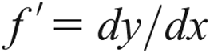 is the derivative of f. At the heart of this formula, which is a generalization of the Pythagorean theorem, is the idea that curve length is the limiting length of the inscribed polygonal lines. During the nineteenth-century it was shown that if f(x) has a continuous derivative for x in [a, b], the above formula does indeed hold where the integral is the familiar integral of Riemann. However, as a result of the growing understanding of infinite point-sets, it soon became clear that neither the existence of derivatives, nor the continuity of functions, nor even the Riemann integrability of functions is essential for the rectification of a curve or the determination of its length, and that the just-said formula is not generally valid. Against this backdrop serious doubts were raised about the general relevance of integration to curve length. However, in the years following the turn of the twentieth century, Henri Lebesgue showed that it is indeed possible to revive the earlier belief of an intimate connection between curve length and integration, but this requires a new kind of integral—a generalization of Riemann’s integral—the Lebesgue integral (Hawkins Reference Hawkins1970, 79–85, 130–31, 140–41).
Lebesgue’s integral is geometric in spirit and to define it he introduced a conception of measure that generalizes the familiar conception of length found in elementary geometry. The following description of the leading ideas underlying Lebesgue’s now standard conception comes from H. L. Royden’s classic text Real Analysis:
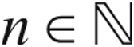
The length l(I) of an interval I is defined, as usual, to be the difference of the endpoints of the interval. …We should like to extend the notion of length to more complicated sets than intervals … [by means of] … a set function m which assigns to each set E in some collection M of sets of real numbers a nonnegative extended real number mE called the measure of E. Ideally, we should like m to have the following properties:
i. mE is defined for each set E of real numbers;
ii. for an interval I, mI = l(I);
iii. if
 [] is a sequence of disjoint sets (for which m is defined), [countable additivity];
iv. m is translation invariant; that is, if E is a set for which m is defined and E + y is the set
, obtained by replacing each point x in E by the point x + y, then m(E + y) = mE. …
 [
 ] is a sequence of disjoint sets (for which m is defined),
 [countable additivity];
 , obtained by replacing each point x in E by the point x + y, then m(E + y) = mE. …
Unfortunately … it is impossible to construct a set function having all four of these properties. … Consequently, one of these properties must be weakened, and it is most useful to retain the last three properties and to weaken the first. … [Accordingly,] … our goal … will be the construction of a countably additive measure which is translation invariant and has the property that mI = l(I) for each interval I. (Royden Reference Royden1968, 52–53)
4. Grünbaum’s Measure-Theoretic Solution 2
As one may gather from Royden’s synopsis, Grünbaum is correct in maintaining that Lebesgue measure theory “does not assign any meaning to forming the arithmetic sum,” when we are attempting to “sum a super-denumerable infinity of individual numbers (lengths)!” This being the case, Lebesgue measure theory likewise assigns no meaning to the following adaptations of (A2) and (A3) for the standard real number line:
I.
, where I is a nondegenerate closed interval of ℝ and Ii is the degenerate subinterval of I whose sole member is i;II.
, where I is a nondegenerate closed interval of ℝ.
 , where I is a nondegenerate closed interval of ℝ and Ii is the degenerate subinterval of I whose sole member is i;
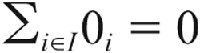 , where I is a nondegenerate closed interval of ℝ.
Accordingly, Grünbaum would appear to be correct in claiming to have refuted the Zenonian allegation of inconsistency made against the standard set-theoretical geometry on the basis of (A2) and (A3).
However, as we mentioned above, while we believe Grünbaum is correct in claiming to have shown that standard set-theoretical geometry can successfully meet the Zenonian challenge, we believe his resolution fails to uncover the source of Zeno’s metrical conundrum. On the other hand, it is worth emphasizing that it is doubtful that Grünbaum either attempted to provide such a resolution or even thought such a resolution was called for. After all, according to Grünbaum, the purpose of his refutation is “to exhibit those features of present mathematical theory which do indeed preclude the existence of such an inconsistency” (Reference Grünbaum1967, 115–17; Reference Grünbaum1968, 121–23). And while he claims “to have shown that set-theoretical geometry can successfully meet the challenge of Zeno’s additivity paradoxes if it is otherwise consistent,” he hastens to add that “I am not asserting that Zeno and his followers were either mistaken within the context of the mathematical knowledge of their time or that they were deficient in philosophical acumen” (Reference Grünbaum1967, 140; Reference Grünbaum1968, 146; Reference Grünbaum1973, 176).
We believe Massey and Jammer likewise fail to uncover the source of Zeno’s metrical conundrum. But in directing our attention to I, rather than II, we believe they move us in the right direction. Jammer motivates his proposed resolution with the following observation:Footnote 3 “Grünbaum … rejects … [II] … on the ground that mathematics does not assign any meaning to a ‘sum’ of super-denumerably many zeros. … This reasoning, I believe, is open to the following criticism. In mathematics the “meaning” of a sum of infinitely many terms, even if this infinity is [de]numerable, is a matter of definition. In fact, there are several summability criteria (or definitions). The question is, therefore, whether mathematics can consistently define an arithmetic sum of super-denumerably many zeros” (Reference Jammer and di Francia1987, 87).
Following in the footsteps of Massey (Reference Massey1969, 337), whose work he apparently was unaware of, Jammer shows that it is indeed possible to define a sum that is extensionally equivalent to the sum employed in Lebesgue measure theory for the finite and countable cases and for which the sum of a continuum number of zeros equals zero. This being the case, Jammer (again echoing Massey [Reference Massey1969, 337]) concludes: “Assumption II need not be rejected … 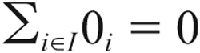 is meaningful. It follows that Assumption I is suspect of being responsible for the contradiction. In fact the metrical paradox of extension can be regarded as providing a proof, by reductio ad absurdum, of the logical impossibility of generalizing the notion of measure to one which is superdenumerably additive [in the sense that it satisfies I]” (Reference Jammer and di Francia1987, 88). That is, according to Jammer and Massey (Reference Massey1969, 337), no inconsistency would arise by supplementing Lebesgue measure theory with II if one does not further assume I.
Jammer and Massey are undoubtedly correct in this matter. In fact, while they do not say as much, there are topics in measure theory in which one treats certain uncountable measurable unions of measurable sets, some of them having measure zero. For example, there are cases where one considers uncountable unions of empty sets, which are themselves empty and therefore have measure zero (e.g., Kupka and Prikry Reference Kupka and Prikry1984, sec. 3). In such cases, one can certainly imagine the reasonableness of extending the notion of sum to the uncountable case.
Despite the soundness of Massey’s and Jammer’s observation, Grünbaum’s resolution of the Zenonian conundrum has been almost universally embraced (e.g., Huggett Reference Huggett and Zalta2010, §2.3). On the other hand, there have been occasional dissidents who have raised other doubts about his resolution that are arguably more telling. Hilary Putnam (Reference Putnam and Baumrin1963, 220–23), for example, rightly questioned its generality by emphasizing its lack of applicability to geometrical spaces coordinated by the countable set  of rational numbers, spaces acknowledged to be physically possible; and Massey (Reference Massey1969, 338) made the same point using the countable ordered field of surds. However, Massey, essentially in response to Putnam, emphasized that it is possible to generalize Grünbaum’s (or rather his own) measure-theoretic resolution, and thereby overcome the problem, by simply noting that just as “metrical consistency precludes the c-additivity of measures on continuous manifolds … it precludes the countable additivity of measures on denumerable dense manifolds” (337). In particular, with respect to the case at hand, just as consistency precludes Lebesgue measure theory from simultaneously embracing I and II above, it likewise precludes a measure theory defined on subsets of the countable set, say C, from simultaneously embracing the adaptations of (A2) and (A3), say I* and II*, that arise by replacing the occurrences of ℝ in I and II with occurrences of C.Footnote 4
“In a word” according to Massey, “it is Grünbaum’s merit to have made explicit how different species of additivity and cardinality combine to generate Zeno’s metrical paradox” (Massey Reference Massey1969, 337). Grünbaum (Reference Grünbaum1973, 532–33, 808–20) subsequently embraced Massey’s construal of his now standard resolution and implicitly acknowledged he had to accommodate the denumerable (Archimedean) cases when he admitted that he had earlier placed “excessive emphasis on superdenumerability” (Reference Grünbaum1973, 820).
Given the nature of the measure-theoretic treatments of the Zenonian puzzle, it is not surprising that doubts have already been raised as to whether they amount to anything more than formal solutions (Sherry Reference Sherry1988). On the other hand, as we noted earlier, it is unlikely that Grünbaum ever attempted to provide anything but such a solution, and given Salmon’s, Massey’s and Jammer’s emphasis on obtaining measure-theoretic generality while maintaining consistency, it seems likely they followed suit. However, as we intimated above, we believe there are strong independent reasons for rejecting (A2) over and above the mere desire to preserve the consistency of modern measure theory. Before turning our attention thereto, however, we will return to the question of where such a resolution should be sought.
5. Prolegomenon to a Resolution of Zeno’s Paradox
Where should one seek the basis of such a resolution? Should it be in Lebesgue measure theory? We believe that enough has already been said to see that the answer is no. As we mentioned above, the theory of Lebesgue integration and its underlying measure theory were introduced to extend the theory of integration beyond the limits of Riemann’s theory, and in the case of curve length, in particular, to make the theory applicable to a host of curves not treatable by Riemannian means. In the case of line segments, on the other hand, which are the only curves of concern in Zeno’s paradox, Lebesgue’s theory, like Riemann’s, assigns a segment a measure equal to its length as determined in ordinary geometry. In fact, as the synopsis of Royden quoted above indicates, this is an axiom of Lebesgue’s theory. Indeed, Lebesgue measure theory takes the consistency and adequacy of the classical geometrical theory of length measure as given and proceeds to extend critical ingredients thereof to a more general setting. Having done so, one may certainly ask if the extended theory is likewise consistent, and if so, how is it that the extended theory manages to sidestep the clutches of the Zenonian argument (assuming the classical theory does) and in what way(s) can it be extended further while still avoiding its clutches? These are the kinds of questions addressed collectively by Grünbaum, Massey and Jammer, and the answers they provide shed useful light on the matter. However, what they do not answer is the question whether the classical theory of line segments, including its theory of length measure, succumbs to the argument of Zeno! To answer this question, it is to the geometric theory itself that we must turn. For brevity and familiarity we will couch the main body of the discussion in terms of models of elementary Euclidean geometry (EEG) and subsequently explain how critical insights regarding EEG carry over either in their entirety or with minor modification to the panoply of contemporary geometries whose lines are treated as densely ordered collections of points.
6. Geometrical Background
By “EEG” we mean a system of axioms that is collectively equivalent to Hilbert’s (Reference Hilbert and Unger1971) axioms for Euclidean geometry save his continuity axioms, the latter being the axioms that limit the models of EEG to isomorphic copies of Cartesian geometry over ℝ. That is, by EEG we mean a system of axioms that is collectively equivalent to Hilbert’s axioms of order, incidence, congruence and parallelism—the axioms for a Hilbert plane satisfying the parallel axiom (e.g., Hartshorne Reference Hartshorne2000).
The relation between Zeno’s paradox and EEG can be fleshed out using any of the standard formulations of EEG that treat lines as structured collections of points, including Tarski’s system  (Reference Tarski, Henkin, Suppes and Tarski1959; Ehrlich Reference Ehrlich1997, 60–61), in which only points are treated as individuals and the only predicates employed in the axioms are a ternary predicate B (where Bxyz is read “y lies between x and z,” the case when y coincides with x or z not being excluded) and a quarternary predicate ≡ (where xy ≡ zu is read “x is as distant from y as z is from u”). In this framework, the line through distinct points a and c is the set of all points b such that Babc ∨ Bbca ∨ Bcab (i.e., the set of all points b collinear with a and c), and the segment ac is the set of all points b such that Babc, the segment being degenerate if a = c.
The conception that bridges the gap between the domains of number and of Euclidean magnitude is the classical notion of a Cartesian space over an ordered field. In the latest version of Tarski’s framework (Schwabhäuser, Szmielew, and Tarski Reference Schwabhäuser, Szmielew and Tarski1983) this familiar concept assumes the following form.
A Cartesian space over an ordered field  Footnote 5 is a structure
 where the betweenness relation BF and the equidistance relation
 are defined on
 by the stipulationsFootnote 6


The relation between Cartesian spaces and models of  is given by the following result, which has its roots in the work of Hilbert.
Representation Theorem for  . M is a model of
 if and only if M is isomorphic to a Cartesian space over a Pythagorean ordered field, that is, an ordered field K in which
 whenever a, b ∈ K.
One of the central ingredients in the proof of the Representation Theorem is what may be called the fundamental lemma of elementary Euclidean geometry (FL). It asserts: if l is the line in a model M of  containing the distinct points o and e, then by letting the segments oo and oe serve as the zero (segment) and unit (segment), respectively, and by appealing to the Euclidean theory of proportions, one can define operations
 and
 on, and a relation
 between, the directed segments of l (having o as an end point) so that the resulting structure

is a Pythagorean ordered field (that is to within isomorphism, independent of the choices of l, o and e ≠ o). Employing  together with an analog
 , where
 is congruent to oe and
 is perpendicular to l, one then introduces a system of Cartesian coordinates and shows that
(1) A model
of is isomorphic to M if and only if is isomorphic to a Cartesian space over an isomorphic copy of .Footnote 7
 of
 is isomorphic to M if and only if
 is isomorphic to a Cartesian space over an isomorphic copy of
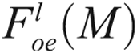 .
The nonnegative cone of an ordered field F is  , where 0F is the zero of F. Henceforth, by
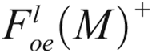 we mean the nonnegative cone of
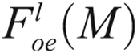 considered as a nonnegative ordered additive semigroup, that is,
 with the order and addition inherited from
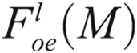 .
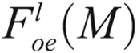
As the Representation Theorem and (1) make clear, to adequately address segment measure in a model M of  , one must work with the full segment arithmetic of M, which is related to the full structure of the nonnegative cone of
 , including multiplication. However, whether the system of segments can be measured by real numbers alone depends on a property of the ordered additive portion of the segment arithmetic, which is related to
 . It is to this property and the bifurcation of the models of
 it engenders that we now turn.
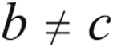
Let SM be the class of all segments in a model M of  with addition and order defined in the usual manner. That is, a (possibly degenerate) segment ac is said to be the sum of segments s and
 , written ac = s +M
 , if for some point b lying between a and c, s is congruent to ab and
 is congruent to bc, and ac is said to be longer than a segment s, written ac M> s, if for some point
 lying between a and c, s is congruent to ab.
Two segments s and  are said to be finite relative to one another if there are positive integers m and n such that
 (the m-fold sum of
 ) M> s and ns M> s′. If s and
 are not finite relative to one another,
 is said to be infinitesimal relative to s and s is said to be infinite relative to
 , if s M>
 . If all nondegenerate segments of a model of
 are finite relative to one another, the model is said to be Archimedean; otherwise it is said to be non-Archimedean.
While Euclid did not formulate the Archimedean axiom thus, he assumed his geometry to be Archimedean. Non-Archimedean geometries first emerged in the late nineteenth-century foundational work of Veronese (Reference Veronese1891) and Hilbert (Reference Hilbert1899), and they have played an important role in the foundations of geometry since. Accordingly, to address the full range of models of  in the subsequent discussion we will have to take into account non-Archimedean as well as Archimedean models of
 .Footnote 8
In harmony with the geometrical formulation of the Archimedean condition, a nonnegative ordered additive semigroup is said to be Archimedean if whenever 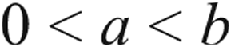 , there is a positive integer n such that
 , and an ordered field F is said to be Archimedean if its nonnegative cone considered as a nonnegative ordered additive semigroup is Archimedean; otherwise it is said to be non-Archimedean.
In light of the above, it is easy to see that: if M is a model of  and l is a line of M containing the distinct points o and e, then
(2) M is Archimedean if and only if
is Archimedean if and only if is Archimedean.
 is Archimedean if and only if
 is Archimedean.
With FL along with (1) and (2) at hand, we will now look a bit more closely at the nature of the analytic representations of systems of line segments in models of  . This will help to bring into focus the seminal differences between these representations and those of the Zenonian.
7. Length Measure and the Analytic Representation of Models of

As the reader will recall, an ordered field is a structure  , where
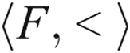 is a totally ordered class containing distinct elements 0F and 1F, and + and · are commutative, associative binary operations on F which (in conjunction with <) satisfy a number of properties familiar from the theory of real numbers, including
 , for all a in F (Warner Reference Warner1990, 216–17). 0F (resp. 1F), which is the additive (resp. multiplicative) identity of the field, is often called the zero (resp. unit) element of the field since it plays the role played by 0 (resp. 1) in the ordered field ℝ of real numbers. Like ℝ, every ordered field is a densely ordered class containing infinitely many elements.
A model of  is isomorphic to a Cartesian space over a Pythagorean ordered subfield of the reals if and only if it is Archimedean. Accordingly, for the analytic representation of arbitrary models of
 one must move beyond the reals. In fact, since there are non-Archimedean Pythagorean ordered fields and hence non-Archimedean models of
 of every infinite cardinality, a truly immense extension of the reals is required for a uniform treatment of the general case. The system of surreal numbers is ideally suited for this purpose.
Let ℝ and No be the ordered fields of real and surreal numbers, respectively, and let  and
 be their nonnegative cones considered as ordered additive semigroups. The ordered field of surreal numbers was introduced by J. H. Conway (1976) and expanded on by Ehrlich (see, e.g., Reference Ehrlich2012), who has argued that whereas the ordered field of reals should merely be regarded as an arithmetic continuum modulo the Archimedean axiom, the system of surreals may be regarded as an absolute arithmetic continuum modulo von Neumann-Bernays-Gödel set theory. For the purpose at hand, however, it suffices to note that whereas ℝ contains an isomorphic copy of every Archimedean ordered field, No contains an isomorphic copy of every ordered field (whose elements are sets of standard set theory [see, e.g., Ehrlich Reference Ehrlich2012]).
Theorem 1. Let M be an Archimedean model (resp. a model) of  , l be a line of M, and oe be a segment of l.
(i) If o ≠ e, there is an isomorphism ϕ of ordered fields from
into ℝ (resp. No) and, hence, there is an analytic representation of M given by the Cartesian space over .(ii) If o ≠ e, then
(ϕ restricted to ) is an isomorphism of ordered semigroups from into ℝ+ (resp. No+) for which ϕ(oe) = 1; moreover, for any isomorphism m of ordered semigroups from into ℝ+ (resp. No+), m(oe) = 0 if and only if o = e.
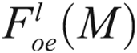 into ℝ (resp. No) and, hence, there is an analytic representation of M given by the Cartesian space over
 .
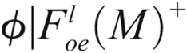 (ϕ restricted to
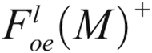 ) is an isomorphism of ordered semigroups from
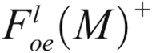 into ℝ+ (resp. No+) for which ϕ(oe) = 1; moreover, for any isomorphism m of ordered semigroups from
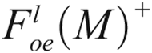 into ℝ+ (resp. No+), m(oe) = 0 if and only if o = e.
Proof. (i) follows from FL, (1), (2), and the fact that ℝ (resp. No) contains an isomorphic copy of every Archimedean ordered field (resp. ordered field), and the first part of (ii) follows from (i). Now suppose m is an isomorphism from  into ℝ+ (resp. No+). Then (a):
 . But since oe is the additive identity of
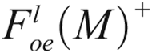 if and only if o = e, we have oe +l oe = oe if and only if o = e, which along with (a) implies
 if and only if o = e, which in turn implies m(oe) = 0 if and only if o = e. QED
8. A Prelude to the Zenonian Seduction
Let us now take stock of the import of theorem 1, where m may be regarded as a function that assigns real-(surreal-)valued length measures to the segments in a model M of  . To begin with, the bulk of theorem 1 highlights the fact that any nondegenerate segment of a line not only can be assigned measure 1 in a system of length measures that faithfully reflects the ordered additive structure of the system of segments of M, but it can also serve as the unit segment for constructing a faithful analytic representation for M itself—the Cartesian space over
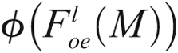 . These representations are faithful in the sense that the real-(and surreal-)valued measures they assign to the segments of M along with their familiar order, additive and multiplicative properties defined on ℝ (resp. No) mirror the algebraico-order theoretic relations that exist between the segments of M. In particular, for all
 ,
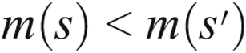 if
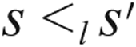 and
 , where
 ; and similarly for ϕ with respect to <l, +l and ·l for all
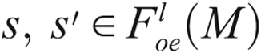 . Moreover, and perhaps more to the point, the second part of theorem 1 (ii) implies that any assignment m of real-(surreal-)valued length measures to the segments of M where m(oe) = 0 and o ≠ e is not faithful in the manner described above. Indeed, assigning “Zenonian measures” to the nondegenerate segments of l would be as devoid of informational and inferential import as assigning measures to segments by random. In fact, given the complete absence of informational and inferential import that would accrue from such an assignment, it is hard to see why such an assignment should be deemed to be an assignment of length measures at all.
Of course, the Zenonian assignment of length measures, henceforth mZeno, would be faithful if and only if all segments are degenerate. However, Zeno’s paradoxical contention is refutable in  , since it is a theorem of
 that there are pairs of noncongruent segments and, by Tarski’s celebrated theorem (1959, 22: theorem 2), the theory ℰ 2 of complete elementary Euclidean geometry, which is an extension of
 ,Footnote 9 is consistent and therefore free from contradiction.Footnote 10 This is also true for any subtheory of ℰ 2 containing
 with or without the full second-order theory of the characteristic ordered field
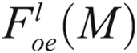 of segments associated with some particular model of
 , such as standard Cartesian geometry over ℝ, unless the resulting second-order theory is itself inconsistent. In fact, since the second-order theory of the Cartesian space over a given Pythagorean ordered field K is equiconsistent with the second-order theory of K, a proof of the inconsistency of Cartesian geometry over K readily translates into a proof of the inconsistency of the second-order theory of K. However, there is no reason to believe the second-order theory of ℝ (or of any other Pythagorean ordered field) is inconsistent, nor does the Zenonian assume it is. Nor would anyone take the following analytic version of the Zenonian argument to demonstrate the contrary.
(Aℝ1) An interval [a, b] of ℝ is an aggregate for which r − r = 0 for each r ∈ [a, b].
(Aℝ2)
for each interval [a, b] of ℝ.(Aℝ3)
.
 for each interval [a, b] of ℝ.
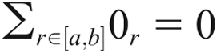 .
Hence, by , we have:
(Aℝ4)
for each interval [a, b] of ℝ.
 for each interval [a, b] of ℝ.
However, it must be admitted that the Zenonian argument has managed to seduce many into thinking that a faithful assignment of length measures is being obtained by invoking (A2) and (A3). Indeed, were this not the case the Zenonian argument would not have continued to exhibit the paradoxical bite it has for some 2,500 years now. After all, without the presumption of the faithfulness of mZeno, the Zenonian argument would constitute no threat at all to the geometer’s embrace of (A1)!
Unfortunately, the Zenonian offers little, if any, justification for (A2) and (A3), so we can only surmise why the Zenonian takes these assumptions, (A2) in particular, to be warranted in the sense of leading to a faithful assignment of length measures. In section 10, we will draw attention the misguided analogy we suspect seduces those compelled by the Zenonian argument into doing just this. For this purpose, however, it will be helpful to first introduce and briefly explore the idea of an s-covering.
9. s-Coverings
If s is a segment of a line l in a model of  and
 is either l or a nondegenerate segment thereof, then by an s-covering of
 we mean a collection of segments of l, each of which is congruent to s, any pair of which intersect at most at a common endpoint, whose union equals
 . Once one of the two total orderings of the points on l that are coherent with the betweenness relation is conventionally chosen (e.g., Szmielew Reference Henkin, Suppes and Tarski1983, 110–16), the members of an s-covering may be totally ordered in accordance with the condition: segment x precedes segment y if the points on x precede the points on y. Henceforth, we will assume that s-coverings are totally ordered in the just-said manner.
An ordered s-covering C of  will be said to be discrete if every member of C (save the last, if
 is a segment) has an immediate successor, and it will be said to be dense if between any two members there is another member. As is evident from the following elementary result, every ordered s-covering is of one these two kinds.
Theorem 2. If C is an ordered s-covering of a line l or a nondegenerate segment thereof in a model of  , then C is discrete if and only if s is nondegenerate if and only if C is not dense.
Proof. If s is degenerate, then plainly C is dense, which in turn implies C is not discrete. Conversely, if ab ∈ C where a precedes b, it follows from the axiom of segment construction (Tarski Reference Tarski, Henkin, Suppes and Tarski1959: 19 (Axiom 10)) that there is a point c on l such that bc is congruent to ab where b precedes c. Consequently, if either C is an s-covering of a segment of l and ab is not the last member of C or C is an s-covering of l, then bc is the immediate successor of ab in C, which proves C is discrete and hence not dense. QED
In virtue of theorem 2, every nondegenerate ordered segment has a unique dense s-covering, s being degenerate. By contrast, every nondegenerate ordered segment has infinitely many discrete s-coverings, the latter being a consequence of Proposition 9 of book 6 of Euclid’s Elements (Reference Heath1965), which essentially asserts that for each positive integer n each nondegenerate segment is divisible into n congruent subsegments, the so-called aliquot parts of the segment. In the Archimedean case (and only in the Archimedean case), the just-said s-coverings are the sole discrete s-coverings. They are also the basis of the ancient theory of length measurement and, as we shall suggest, the tenuous analogical basis of the Zenonian seduction.
10. The Zenonian Seduction
The theory of measurement bequeath to us by the ancient Greeks was propounded by Aristotle in his Physics and Metaphysics and developed in greater detail for geometrical magnitudes by Euclid in book 5 of his Elements where, as for Aristotle, the measurement of a segment’s length amounts to selecting an aliquot part to serve as a unit segment, counting the finite number n of congruent copies of the unit laid end to end that comprise the given segment, and taking the n-fold sum ns. And while the theory and practice of length measurement have undergone substantial generalization since the time of Euclid—for example, any nondegenerate segment can now serve as the unit segment for the entire system of segments of the space—it is an unwarranted extension of the ancient conception, we believe, that provides much of the seeming analogical justification for the misguided assumption that gives rise to the modern-day formulations of Zeno’s paradox. This confusion is no doubt exacerbated by the unfortunate talk of lines segments being composed of points that has been all too common since geometers embraced the Cantorian conception.Footnote 11
Given the structure of the system of segments of a model of  , a faithful assignment of segment lengths requires a unit segment—a nondegenerate unit segment. Indeed, as Aristotle (who only considered segments commensurable with the unit) expressed the matter more than 2,500 years ago, “the measure [by which Aristotle means “the unit”] is always homogeneous with the thing measured; the measure of spatial magnitudes is a spatial magnitude, and in particular that of length [i.e., a line segment] is a length [a line segment]” (Aristotle Reference Barnes1984, X (I) 1053a1 25–27), where, for Aristotle and the ancients more generally, points do not have length zero, they have no length at all. Nevertheless, a natural reading of the Zenonian argument suggests that, with (A2)—the assumption that the length of a line segment is equal to the sum of the lengths of its degenerate line segments—the Zenonian is asking us to treat a degenerate segment s as a unit segment and to measure therewith the length of a nondegenerate segment having an s-covering in the manner we, following Euclid, measure the length of a nondegenerate segment having a finite s-covering, that is, by summing the lengths of components in the s-covering, the latter of which with no loss of generality we may take to be one unit long. However, as we have already noted, treating a degenerate segment of
 as a unit segment is precisely what we cannot do, at least not if we expect to have a faithful system of length measures.
Closely related to this is a simple, yet subtle, consequence of theorems 1 and 2, whose import Aristotle (Reference Barnes, Waterfield, introduction and Bostock1996, V (3) 227a 28–31) loosely anticipated when he remarked that “a point and a unit … cannot be identified … because there can be something between two points (every line [and, hence, another point] is between points), whereas there cannot be anything between [succeeding] units (nothing comes between one and two).” Namely, the fact that the system of degenerate segments of a line constitutes a densely ordered s-covering precludes (in accordance with the axioms of geometry) the possibility that a degenerate segment can serve as the unit segment in a system of length measures that preserves the ordered algebraic structure of the system of line segments of an elementary Euclidean space.
An alternative (and, perhaps, the only alternative) possible reading of the Zenonian argument is that, with (A2) the Zenonian is attempting to provide an assignment of length measures that makes no use of a unit segment at all. After all, if a degenerate segment is not playing the role of the unit segment in their assignment of segment lengths, where does the requisite unit segment enter into their assignment of segment measures? However, whether with (A2) modern-day Zenonians are treating a degenerate segment as a unit segment or employing no unit segment at all, the ultimate warrant for their measurement-theoretic precept and for the paradoxical system of length measures it spawns rests on the faithfulness of mZeno, a test it provably fails.
What then might be the basis of the modern-day Zenonian’s misplaced confidence in (A2) and in the faithfulness of mZeno? As the words of Paul du Bois-Reymond and William James quoted above suggest, it is probably something like this. There is a tradition going back at least to the time of Zeno of construing line segments as being composed of parts, the paradigm case being a finite s-covering. Accompanying this view is the idea that the length of a nondegenerate segment is the sum of the lengths of the parts that comprise it, the n-fold sum of the length of s in the case of an n-fold s-covering. In this framework, s functions both as a unit segment in a system of length measures and as a unit of segment composition. Moreover, within its range of application consisting of segments commensurable with s the just-said assignment of length measures is indeed faithful. Although from the standpoint of  talk of segments being composed of parts is unwarranted, it appears that the modern-day Zenonian mistakenly believes that the geometer’s embrace of (A1) commits the geometer to treating degenerate segments as components of segment composition. By then applying the idea that the length of a nondegenerate segment is the sum of the lengths of the segment-components of the s-covering that comprise it, the modern-day Zenonian arrives at (A2) which, along with the innocuous assumption (A3), leads to mZeno. Moreover, maintaining, like Zeno and Aristotle before them, that no interval composed of degenerate intervals could be nondegenerate, the modern-day Zenonian concludes that mZeno is indeed faithful.
Of course, unlike Zeno, modern-day Zenonians do not deny the existence of nondegenerate segments. Rather, they maintain that it is treating line segments as collections of points having length zero that leads to absurdity. However, the consistency of  belies their contention and the fact that all of Euclidean geometry can be carried out in
 or in some first- or second-order extension thereof demonstrates that from the standpoint of theorem proving ability nothing of a geometrical nature is lost by embracing the Cantorian framework. What is lost or at least bypassed by embracing the Cantorian conception is getting mired in the age-old speculation about the purported “composition of the continuum” that appears to motivate and ultimately mislead the modern-day Zenonian. In
 a line segment is not composed of anything at all. It is simply the collection of all geometrical locations between a pair of points, whose length is not determined by summing the lengths of its degenerate segments, as (A2) contends, but by selecting a nondegenerate unit segment and appealing to the standard analytic techniques outlined above.
Thus, the modern-day Zenonian is not uncovering an internal inconsistency in the Euclidean theory of magnitude but is demonstrating that by supplementing the theory with a misguided tenet of length measurement and a relatively benign arithmetic assumption, an absurdity ensues. The absurdity ensues because mZeno, which follows from (A1)−(A3), is incompatible with any assignment of length measures that preserves the ordered algebraic structure of the system of segments of an elementary Euclidean line. This is the upshot of the Representation Theorem and theorem 1. Moreover, since analogs of these results hold for the multitude of other lines (treated as densely ordered collections of points) studied by contemporary geometers, this observation is applicable to them as well, as is the observation based on theorems 1 and 2 mentioned above. In each such case, the nature of the ordered algebraic system of segments is determined by the axioms of the geometry in question and the nature of the system in turn precludes the possibility of a faithful assignment of length measures that is free of the choice of a nondegenerate unit segment.Footnote 12 By so doing, it undercuts 2 and the modern-day Zenonian critique of the Cantorian conception of line segments more generally.
Accordingly, the now standard geometrical practice of treating lines as an ordered collections of points has as little to fear from Zeno’s metrical conundrum as Euclid’s non-set-theoretic conception did some 2,500 years ago. In the contemporary case, as in the ancient case, the fault lies not with geometrical practice but with the misguided system of measurement the Zenonian adds to it. Indeed, contrary to the Zenonian’s contention, no inconsistency is established in the theory of geometrical magnitude, but rather between the theory of geometrical magnitude and a system of measurement that is incompatible with the principles of measurement themselves. Needless to say, such an inconsistency should neither surprise, nor be of concern to, anyone.
 , but this is immaterial.
 , Tarski employs the isomorphic copy thereof that results from replacing each of the directed segments ox and yo of
 with their corresponding endpoints x and y, and other authors (e.g., Hartshorne
 based on equivalence classes of congruent segments of l. For the construction of
 itself, see Behnke et al. (
 . For example, in ℰ 2, unlike in
 , all constructions solely using finitely many applications of straightedge and compass can be performed and all angles can be trisected (e.g., Tarski
 , see Greenberg (


