In decades past, schizophrenia diagnosis and research hinged on psychotic symptoms. Cognitive impairment received little attention, which according to some authors, has stood in the way of advancing our understanding of the illness and developing adequate treatments (Kahn & Keefe, Reference Kahn and Keefe2013). Currently, in pursuing interventions to favor optimal adaptation and functioning in patients, attention has been focused on cognitive factors and components of social cognition. It seems social cognition is even more closely connected to functioning in schizophrenic patients than cognitive factors are (Fett et al., Reference Fett, Viechtbauer, Domínguez, Penn, van Os and Krabbendam2011).
While it is still the subject of debate, cognitive dysfunction is considered an essential element of schizophrenia (Lawrie, Olabi, Hall, & McIntosh, Reference Lawrie, Olabi, Hall and McIntosh2011). Some authors report that 70–85% of patients show differential cognitive functioning (Penadés & Gastó, Reference Penadés and Gastó2010). In recent research, McGorry et al. (Reference McGorry, Keshavan, Goldstone, Amminger, Allot, Berk and Hickie2014) argues that neurocognitive dysfunctions are present in every clinical stage of psychosis, and that neurocognition and social cognition can be very useful markers, applying a clinical staging model. The fact that the MATRICS consensus battery (Nuechterlein et al., Reference Nuechterlein, Green, Kern, Baade, Barch, Cohen and Marder2008) was specifically created to assess that dimension of the illness is testament to its research interest. According to Keefe and Eesley (Reference Keefe, Eesley, Lieberman, Stroup and Perkins2008), that deficit means performance 1.5 to 2 standard deviations below healthy individuals’ average performance on different cognitive tests, and a greater impact on memory, attention, working memory, problem solving, processing speed, and social cognition. Often impairments begin before the illness debuts, and before pharmacological treatment begins, and are not attributed to psychotic symptoms. Such deficits are associated with functional parameters and explain professional achievement and ability to live independently better than clinical symptoms do.
These dysfunctional patterns’ specific features and development are still debated; to determine those would help clarify unknowns about the illness’s etiopathophysiology and how to tackle it therapeutically.
In terms of development, the oldest hypothesis makes an argument for progressive decline in schizophrenia, and was proposed by Kraepelin. He considered this an essential feature of the illness and in 1893 referred to schizophrenia with the term “dementia praecox” (cf. Stone, Reference Stone, Lieberman, Stroup and Perkins2008). Nowadays that degenerative hypothesis, together with the neurodevelopmental hypothesis, are the main etiopathogenic hypotheses that attempt to respond to the determining factors, course, and prognosis of the illness. Mané’s recent review (2013) points to sufficient evidence of neurodevelopmental alteration in schizophrenia – though that does not seem to explain its full etiopathogenesis – and at the same time verifies that progressive cerebral changes are also associated with it. Finally, it concludes that the two hypotheses are not mutually exclusive, and that more research is needed on how the illness develops over time.
There is still debate about how these impairments progress. To settle that debate, the scientific literature has included longitudinal and cross-sectional studies of cognitive decline in schizophrenia. In our review, we found that in general, cross-sectional studies support the hypothesis of a progressive effect over the course of the illness, with chronic, generalized impairment observed in all cognitive domains and some variables suggested to accentuate it, like older adulthood, greater symptomology, male sex, longer or more frequent institutionalization, and early onset (Irani, Kalkstein, Moberg, & Moberg, Reference Irani, Kalkstein, Moberg and Moberg2011). Longitudinal studies – and one cross-sectional study (Bombin, Reference Bombin2004) – have reported stable cognitive impairment. Already present from the onset of the illness, cognitive impairment is stable for the first months/years of it, but the illness may develop differentially in different groups (Napal et al., Reference Napal, Ojeda, Sánchez, Elizagárate, Peña, Ezcurra and Gutiérrez2012). Other studies suggest, with some contradictory data, initial stability and a drop in cognitive performance in schizophrenia beginning at 65 years of age (Friedman et al., Reference Friedman, Harvey, Coleman, Moriarty, Bowie, Parrella and Davis2001; Kurtz, Reference Kurtz2005; Radhakrishnan, Butler, & Head, Reference Radhakrishnan, Butler and Head2012); other authors specify (Rajii & Muslant, Reference Rajii and Muslant2008) that this decline affects visuospatial activities first. McGorry et al. (Reference McGorry, Keshavan, Goldstone, Amminger, Allot, Berk and Hickie2014), applying the clinical staging model in his review of scientific findings about cognitive markers, maintains that the pattern and magnitude of impairment respondents exhibit in their first schizophrenic episodes are similar to those reported in meta-analyses of elderly patients with more chronic problems. On the other hand, longitudinal studies suggest the profile and severity of neurocognitive alterations tend to be stable during the first 10 years of the illness, and for periods of 6 years in elderly adults with chronic schizophrenia. McGorry also references heterogeneity in psychotic disorders and specific subgroups that may experience more severe cognitive decline (Irani et al., Reference Irani, Kalkstein, Moberg and Moberg2011).
While it is generally accepted that the domains most affected are attention, memory, and executive functions, the neurocognitive alterations found in schizophrenia are varied and do not all fall under one profile. Garrido and Alberni (Reference Garrido and Alberni2011) reviewed the cognitive domains that have received the most attention – Global Intellectual Functioning (IQ), Memory, Executive Functions, and Processing Speed (PS) – concluding that of those, PS is most affected in the early stages of the illness and can negatively impact other domains.
The Wechsler intelligence scales are among the instruments most widely utilized to assess cognitive functioning, and have been a point of reference in creating more sophisticated neuropsychology batteries, like the MATRICS (Neuchterlein et al., Reference Nuechterlein, Green, Kern, Baade, Barch, Cohen and Marder2008). Schizophrenia research in many forms has produced global scores below those of the general population, and in a single consistent pattern: higher Verbal IQ than Performance IQ (Allen et al., Reference Allen, Huegel, Seaton, Goldstein, Gurklis and van Kammen1998; Gold et al., Reference Gold, Hermann, Randolph, Wyler, Goldberg and Weinberger1994).
Results on the WAIS III version of the Wechsler Adult Intelligence Scale in adults with schizophrenia tend to reflect medium to medium-low intellectual functioning. Impairment is more pronounced on measures tied to Working Memory (WM) and Processing Speed (PS), with indices of Perceptual Organization (PO) and Verbal Comprehension (VC) slightly above WM and PS. These results support the premise that tasks requiring attention, working memory, and processing speed are more strongly affected by schizophrenia (Wechsler, Reference Wechsler1999). Using this version of the scale, Goikoetxea’s et al. (Reference Goikoetxea, Aznar, Cortajarena, Ponte, Ugarte and Uriarte2001) study supported the data above and confirmed a differential performance profile in patients with schizophrenia, as compared to controls (in her study, subjects without the illness were matched beforehand according to sex and total IQ). The control group’s scores followed a homogeneous pattern, whereas patients with schizophrenia performed irregularly, with higher Verbal than Performance IQ and a Verbal Comprehension index higher than Perceptual Organization, Working Memory, and Processing Speed. Lower performance in the schizophrenic versus control group was observed on Arithmetic, Letters-Number Sequencing, Similarities, and on performance tasks in general.
This study’s objective was to analyze differences in, and the course of, various cognitive dimensions of the Wechsler Adult Intelligence Scale (WAIS) in institutionalized women diagnosed with schizophrenia who were evaluated three times over the course of 31 years.
The basic hypotheses of our study are as follows:
-
a) We expect to find global scores below the general population average.
-
b) We hypothesize that those will portray a selective performance profile, with lower scores on performance areas.
-
c) Our longitudinal analysis will not support the neurodegenerative hypothesis of schizophrenia.
Method
Participants
The sample is comprised of 30 institutionalized women. Their average age in that initial exploration in 1981 was 42.70 years old (SD = 7.67); in the second in 1996, it was 58.70 (SD = 7.67); and in the third in 2012, 73.70 years old (SD = 7.67). Participants ranged in age from one another by 32 years. 90% were single, 6.6% married, and 3.3% celibate. Their level of education was as follows: 86.6% primary school, 6.6% could not read or write, and 6.6% unknown. Their ICD-10 diagnoses were Paranoid Schizophrenic 41%, Residual 28%. Hebephrenic, Simple, and Catatonic made up the rest.
We will not analyze differences in civil status, type of schizophrenia, nor level of education given the small sample size.
Instruments
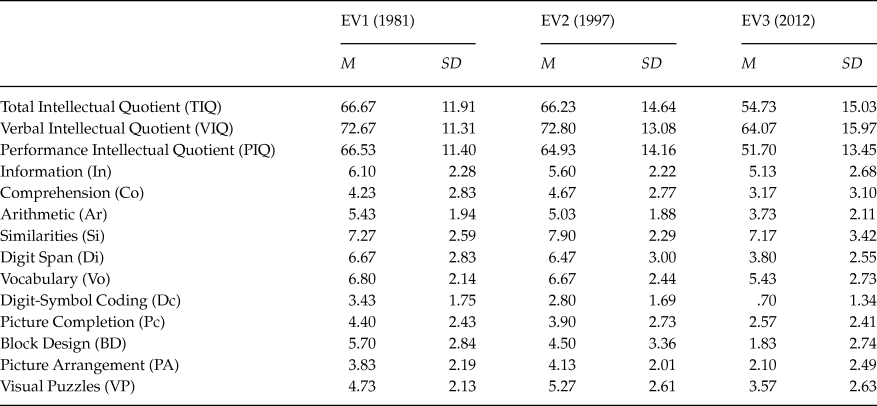
Each evaluation measured intellectual profile using the Wechsler Adult Intelligence Scale – WAIS (Wechsler, Reference Wechsler1982). Intellectual quotients and scores on all WAIS subscales (Table 1) were included in our analyses. Average scores were examined. We analyzed differences in the set of cognitive dimensions and indices equivalent to the WAIS III (Wechsler, Reference Wechsler1999), and their development over time. Some were modified to correspond to the tests on the old WAIS. The following indices were included: Verbal Comprehension (VC) – Information, Vocabulary, and Similarities (like the WAIS III); Working Memory (WM) – Digit Span and Arithmetic (without Letter-Number Sequencing from the WAIS III); Perceptual Organization (PO) - Picture Completion and Block Design (without Matrix Reasoning from the WAIS III); Processing Speed (PS) – Digit Symbol-coding (without Symbol Search from the WAIS III).
WAIS dimensions as a function of evaluation time

Note: To better understand this study’s results, one must know that standard IQ scores on the WAIS are M = 100 and SD = 15, and on its subscales M = 10 and SD = 3.
Scores were computed by summing scores on all those tests, and dividing the result by the number of tests.
Procedure
Research design
Ex post facto developmental longitudinal (Montero & León, Reference Montero and León2007), which refers to investigation of past phenomena in which the same group of participants is compared in terms of some dependent variable (DV) over time. Participants were tested using the WAIS three times: EV1 (evaluation-1, year 1981), EV2 (evaluation-2, year 1996), and EV3 (evaluation-3, year 2012). Results were compared in the form of average scores.
We conducted within-subjects analysis, also applying between-subjects considerations to divide participants into “older” and “younger.” The procedure to sort them that way at EV1 was to place the 15 aged 26 to 42 years old (younger) in one group, and 15 aged 43 to 58 years old (older) in the other. We maintained that division into younger and older groups at EV2 and EV3.
Data analysis
We applied descriptive and exploratory statistics to the different variables. A level of significance of alpha below .05 and a confidence interval (CI) of 95% were applied, along with indicators of effect size.
We employed a simple repeated-measures ANOVA, termed mixed or split-plot (Pardo & San Martín, Reference Pardo and San Martín1994). In this design, all participants are assigned to all levels of a within-subjects factor, and one level of another factor (between-subjects). Thus, we have one within-subjects factor (all levels applied to all subjects), and one between-subjects factor (one group of subjects at each level of the variable).
Our study utilized a longitudinal research design with repeated measures of a within-subjects factor, termed “evaluation time,” with three levels or points in time (EV1, EV2, EV3) applied to all subjects, and a between-subjects factor called age, with one group of participants at the “older” age level, and another at the “younger” level of the variable. In separate analyses, all the WAIS cognitive variables mentioned in the Instruments section were used as dependent variables.
To determine whether the matrix of variances was spherical or circular, we applied Mauchly’s sphericity test.
To compare main effects of different levels of the evaluation time factor on each criterion variable, we applied the Bonferroni correction.
To study the development over time (EV1, EV2, and EV3) of each cognitive variable analyzed by the WAIS, we also utilized trend-type ANOVA with within-subjects polynomial contrasts. This analysis shows whether averages on each DV (WAIS scores) at the three times examined show significant goodness of fit to a straight line (linear component), or a curve (quadratic component).
To measure effect size in ANOVA, we utilized the eta-squared statistic (η 2 ), interpreted as the proportion of variance in the DV attributed to the effect. The value of eta squared – ranging from .00 to 1.00 – was multiplied by 100 to obtain a percentage indicator of explained variance.
Results
Descriptive Analysis
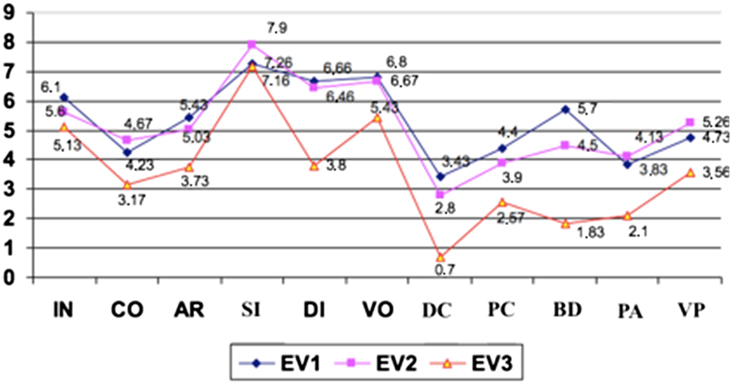
Table 1 presents average scores on WAIS tests as a function of the within-subjects factor, evaluation time. Altogether, scores fell below observed standards on the test’s various scales. Furthermore, Verbal IQ was significantly higher than Performance IQ at EV1 (t = 4.136, p = .001), EV2 (t = 5.081, p =. 001), and EV3 (t = 6.742, p = .001). Figure 1 visually represents averages on different WAIS tests as a function of when the evaluation took place.
WAIS subtests as a function of evaluation time.

Between-subjects analysis did not indicate significant differences (p < .05) as a function of placement in the older versus younger group.
Longitudinal Analysis
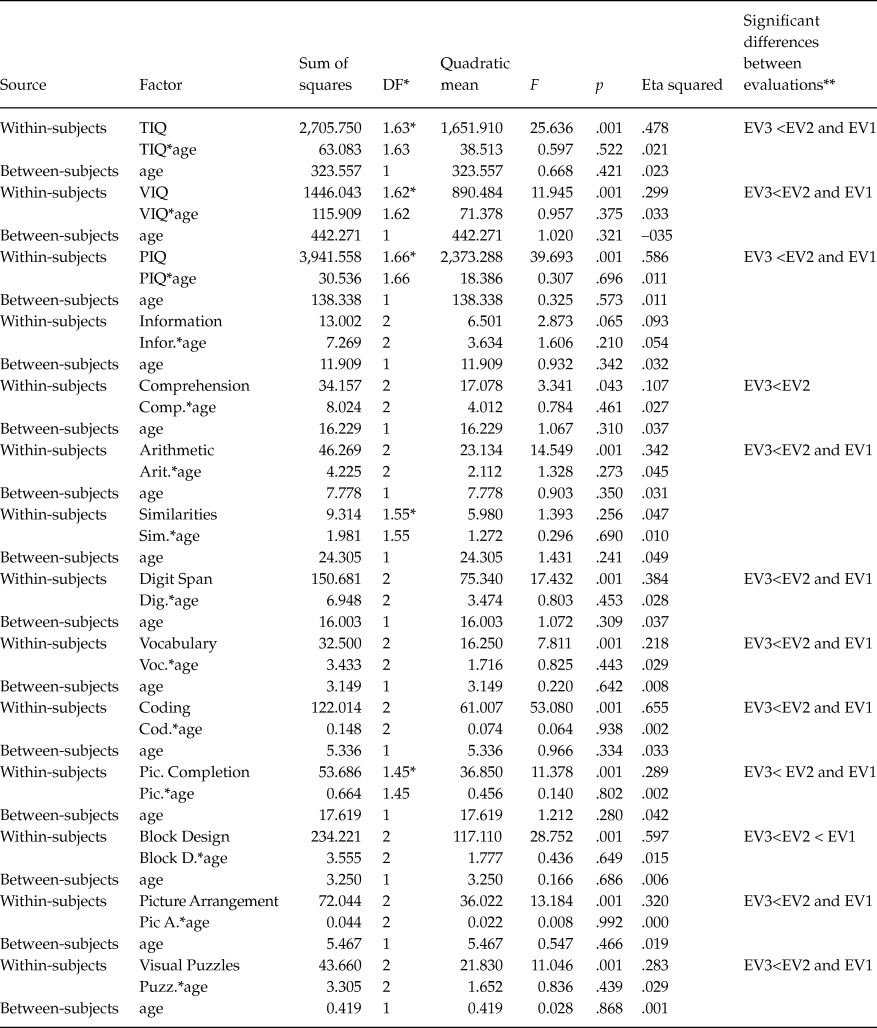
In Table 2, notice that average scores on cognitive measures taken at EV3 were significantly lower than at EV2 and EV1 in terms of Total IQ, Verbal IQ, and Performance IQ, as well as on the Arithmetic, Digit Span, Vocabulary, Digit-Symbol Coding, Block Design, Picture Completion, Picture Arrangement, and Visual Puzzles tests. No significant differences were found on the Information or Similarities tests. Comparing EV1 and EV2 yielded decreasing significant differences on Block Design scores where EV3 < EV2 < EV1. If we perform pairwise comparison of Digit-Symbol Coding scores and eliminate the Bonferroni correction, there are also significant differences in means according to the sequence EV3 < EV2 < EV1. Verbal Comprehension was significantly lower on average at EV3 than EV2, but scores on that test and Similarities progressed irregularly, actually increasing from EV1 to EV2.
Repeated measures ANOVA in three WAIS evaluations of schizophrenic patients

* Does not meet the assumption of sphericity: Greenhouse-Geisser correction. **Pairwise comparisons of evaluations with Bonferroni correction. EV3: Evaluation 3 (2012), EV2: Evaluation 2 (1996), EV1: Evaluation 1 (1981).
In terms of effect size, time elapsed between evaluations explained 58% of variance in PIQ, compared to 29% of variance in VIQ. The greatest effect size was found in Digit-Symbol Coding and Block Design in the performance area, and Digit Span and Arithmetic in the verbal area (see Table 2).
As far as direct scores, WAIS subtest results were similar to those described above.
Regarding the trajectory of each cognitive variable analyzed, a significant, linear average trend was observed (p = .001), with stability from EV1 to EV2 and a drop in score at EV3 on TIQ (F = 31, 676), VIQ (F = 13, 173), PIQ (F = 56, 830), Information (F = 5, 378), Arithmetic (F = 27, 970), Digit Span (F = 27, 470), Vocabulary (F = 9, 379), Picture Completion (F = 15, 385), Block Design (F = 47, 363), Picture Arrangement (F = 15, 128), and Visual Puzzles (F = 11, 679). Another significant linear trend was observed, with Digit-Symbol Coding (F = 86, 872) and Block Design (F = 47, 363) scores decreasing from one evaluation to the next (EV3 < EV2 < EV1).
The same trends were observed in direct scores on the various subtests.
Analysis of differences and trajectory of the WAIS construct similar to the WAIS III
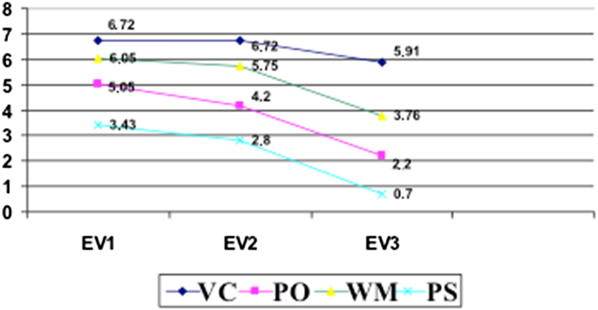
Factors equivalent to the WAIS III yielded moderate results, which appear in Figure 2. Longitudinal comparison across the three evaluations conveyed a lack of significant differences in VC, and significant differences between EV3 and EV1 or EV2 on the indices WM [F(2) = 21, 81, p = .001, η2 = .438] and PS [F(2) = 53, 08, p = .001, η2 = .655]. We observed significant differences in PO [F(2) = 29, 04, p = .001, η2 = .509] in the following sequence: EV3 < EV2 < EV1.
Equivalent WAIS III indices as a function of evaluation time.

As the graph illustrates, means were lower at EV3, and on the cross-sectional contrast, average scores on factors were ordered such that PS < PO < WM < VC at all three evaluation times. Those differences between factors were significant at EV1, EV2, and EV3 (p < .05).
Passage of time had the largest observed effect size in PS (65%), compared to PO (50%), WM (43%), and VC (12%).
As for evolution over time in the WAIS indices analyzed, a significant, decreasing linear trend was observed over the course of the three assessments on PO (F(1) = 45, 623, p = .001) and PS (F(1) = 86, 872, p = .001). On WM, a stable, significant linear average trend was observed between EV1 and EV2, decreasing at EV3 (F(1) = 32, 404, p = .001). The VC index did not show a significant decreasing trend.
Looking at individual scores, four patients’ performance was consistent with an additional diagnosis of dementia. However, given scores on the earlier evaluations, and scores in patients who performed worst at the third evaluation, there was not necessarily a decrease from the first to the second evaluation. That is, there was no apparent linear, progressive decline in performance over time.
Discussion
Our patients presented with cognitive performance one to two standard deviations below the average on the WAIS scales, which supports our first hypothesis and is consistent with earlier research findings (Garrido & Alberni, Reference Garrido and Alberni2011; Goikoetxea et al., Reference Goikoetxea, Aznar, Cortajarena, Ponte, Ugarte and Uriarte2001; Irani et al., Reference Irani, Kalkstein, Moberg and Moberg2011). Nonetheless, such low performance compels us to consider the particularities of this group, that is, mentally ill women in long-term institutional psychiatric care. Except in one study (Goldstein, Zubin, & Poge-Geile, Reference Goldstein, Zubin and Poge-Geile1991), that profile has tended to be associated with increased cognitive decline (Akiko, Eastham, & Jeste, Reference Akiko, Eastham, Jeste, Hwang and Bermanzohn2003; Ojeda et al., Reference Ojeda, Sánchez, Elizagárate, Soller, Ezcurra, Ramirez and Ballesteros2007; Selma, Reference Selma2008); and our participants’ low level of education conditions results in the same way (Kaufman & Lichtenberger, Reference Kaufman and Lichtenberger1999). In tandem, without undertaking to measure psychopathology’s influence on cognitive performance, which various authors have confirmed (Gold, Arndt, Nopoulos, O’Leary, & Andreasen, Reference Gold, Arndt, Nopoulos, O’Leary and Andreasen1999), we want to point out that most of these patients exhibit severe, chronic symptomatology practically without remission from symptoms. Another relevant factor to consider is that these participants are elderly. Age is an influential determining factor in WAIS outcomes (Kaufman & Lichtenberger, Reference Kaufman and Lichtenberger1999); even at the first evaluation, our sample’s average age was 42 years old, and some were around 60. Goldstein and Zubin (Reference Goldstein and Zubin1990) suggest aging has the same effect on the population with schizophrenia as the general population without, neurologically intact. Yet when people experience neurological impairment as well as schizophrenia, both conditions reportedly interact with aging such that age-associated cognitive decline increases. In more recent research, Goldstein, Allen, & van Kammen (Reference Goldstein, Allen and van Kammen1998) suggest the level of cognitive impact varies as a function of different types of schizophrenia. They allude to a subgroup of patients with schizophrenia for whom the cognitive impact is significantly higher, beginning in the illness’s first years of critical development.
Our study did not control for those variables. Currently, our patients are being examined using magnetic resonance and other cognitive and clinical assessments. We hope these new data will help us assess the interrelatedness of factors, and delve deeper into the features of cognitive decline in the small group of patients for whom the additional diagnosis of dementia applied the third time they were evaluated.
Apparently our second hypothesis – that there would be a pattern of selective performance – holds true given Figures 1 and 2. We observed a larger significant impact on the performance area of than the verbal. On the three evaluations we carried out, observed differences were consistent with that.
That larger drop in performance IQ than verbal is also in line with the findings of various studies about the WAIS in schizophrenia, which furthermore report a greater impact on PS and WM indices than VC and PO (Allen et al., Reference Allen, Huegel, Seaton, Goldstein, Gurklis and van Kammen1998; Goikoetxea et al., Reference Goikoetxea, Aznar, Cortajarena, Ponte, Ugarte and Uriarte2001; Goldstein et al., Reference Goldstein, Allen and van Kammen1998; Kaufman & Lichtenberger, Reference Kaufman and Lichtenberger1999; Wechsler, Reference Wechsler1999). Garrido and Alberni’s (Reference Garrido and Alberni2011) review argues that although decline is global, the dimension most affected in early schizophrenic episodes is Processing Speed, which also has repercussions on executive functioning – working memory in particular. However, our study observed that in a stable manner across all three evaluations, the differences between factors followed the sequence PS < PO < WM < VC. That reinforces PIQ < VIQ, but not a greater impact on WM than PO, which other studies have cited. On all three evaluations, our patients scored lowest on PS and PO. Again, bear in mind that these patients are elderly adults. In the general population, performance drops with age on the same measures on the scale, and especially acutely from 75 years onward, at which point Performance IQ can be considered a measure of perceptual-motor speed (Kaufman & Lichtenberger, Reference Kaufman and Lichtenberger1999), and WM and VC tend to remain stable.
Given that these patients’ performance profile more closely fits that of the general population in aging than the specific pattern of cognitive decline associated with schizophrenia, we might conclude that physiological decline was the most definitive factor in this drop in score, more so than schizophrenic pathology or the interaction of the two, considering that the measure that decreases most (PS) is highly affected by both factors. We attribute the variability we observed in Comprehension scores (remember, in the second evaluation, scores were higher than in the first) to normal variations in clinical state. That subtest involves elements that are deficient in schizophrenia, such as judgment of reality and common sense, which it specifically assesses.
A striking result took place on the Similarities subtest, where scores were highest at all three evaluations. Other studies (Goikoetxea et al., Reference Goikoetxea, Aznar, Cortajarena, Ponte, Ugarte and Uriarte2001) have shown a greater impact on that test, even a specific, age-associated impairment in abstract thinking in patients with schizophrenia (Fucetola et al., Reference Fucetola, Seidman, Kremen, Faraone, Goldstein and Tsuang2000). This result begs new questions, but these data do allow us to say the cognitive functions measured by the Verbal Comprehension index are a point of strength in chronic, severe schizophrenia, even in late life, above and beyond other cognitive domains the scale assesses.
Our third hypothesis makes us appreciate the longitudinal perspective of our study. The lack of significant differences in scores on the original scale (Total, Verbal, and Performance Intellectual Quotient) between the first and second evaluations, and the trend of significant decrease at the third evaluation, are not coherent with progressive decline, which is endorsed by the neurodegenerative hypothesis. Instead, these findings are more in line with the studies cited above in which overall performance was stable until about 65 years of age, at which point impairment appeared in people with schizophrenia.
Next, we analyzed the construct comprised of factors similar to the WAIS III, yielding similar results: longitudinally, VC did not follow a trend of significant decrease. Scores on some of its subtests in fact increased in the second assessment relative to the first. The WM index, especially affected by schizophrenic pathology, did not differ significantly across the first two evaluations; the effect appeared only at the third evaluation. PS, another index especially affected by schizophrenic pathology, did reflect a decreasing trend, with significant differences taking place at the third evaluation. Finally, the PO factor showed significant differences; there was a clear, progressive drop in performance. Results on that measure would convincingly support the neurodegenerative hypothesis of schizophrenia, if not for the fact that both PO and PS also defined the trend of declining performance over the course of normal aging, and we could not determine each one’s strength, or whether or not they interact.
This study’s results do not seem to support a linear, progressive decline in cognitive functioning except on measures where normal, age-associated physiological deficit also imposes it.
In terms of effect size, the time that transpired between evaluations explained the highest percentage of variance in decreasing PS scores (65%), followed by PO (50%), and WM (43%). We might conclude that the larger impact observed on the PS measure across the three evaluations, with significant differences from other indices, was because performance on that test is highly affected by physiological aging as well as schizophrenic pathology (Garrido & Alberni, Reference Garrido and Alberni2011; Kaufman & Lichtenberger, Reference Kaufman and Lichtenberger1999). The two factors may interact such that they are more difficult for elderly people with this illness.
Our study of institutionalized patients with severe schizophrenia showed very modest initial cognitive performance, but that does not rule out the alterations proposed by the neurodevelopment hypothesis of schizophrenia, nor a possible interaction of those and other alterations. In late life, such alterations might progress in connection with age-associated physiological decline, more in keeping with the neurodegenerative thesis. However we do believe it is compelling evidence that after 31 years, we saw no linear, progressive development to exalt the neurodegenerative hypothesis. We can say that given these results, while the group studied exhibits remarkable overall cognitive decline, it does not affect all cognitive domains equally. Verbal comprehension functions stayed more intact even in late life. We also confirmed in this group that a small number of patients, though not necessarily experiencing progressive decline, exhibited cognitive functioning consistent with a state of dementia at their last evaluation, suggesting schizophrenia can develop over time according to different patterns.
This study’s main limitations are centered on the fact that the sample was all female, and rather small, which conditioned a lack of experimental control over the subtypes and severity of schizophrenia. Also, the old WAIS was utilized to comprise certain factors.
Another limitation of this study is that it lacked an age-matched control group to compare to and see if the cognitive impairments observed in this group outweigh those associated with normal aging. In that case, they would be neurodegenerative rather than part of the normal aging process.
We also want to reflect in depth about relevant theoretical limitations to our study concerning the measurement instrument itself, and applying it over three evaluations and 31 years. Intelligence tests get updated approximately every ten years to compensate for the Flynn effect. That effect holds that world-wide, average IQ test scores increase over time such that younger generations have better results than the generations before them. This posits a difference in cognitive level between groups of the same age, but different cohorts. A recent meta-analysis on this subject (N = 14031) observed an average effect size of 2.31 IQ points per decade (Trahan, Stuebing, Fletcher, & Hiscock, Reference Trahan, Stuebing, Fletcher and Hiscock2014). The question is: how might that effect have influenced our study? Our theoretical response is if we had utilized updated standard scores in the three evaluations, we would have observed larger differences between evaluation times. It is an interesting point, and indeed, we did not control for the Flynn effect. In this study, we could not utilize updated scales to compare the first and second evaluations, and for the third, we opted to use the same measurement instrument again so our comparisons would have less instrument bias. Once again, we would argue that in this study, differences between subtests in terms of direct scores versus standard scores were equivalent, and that we compared results in a single generation or cohort across three different moments in development, using the same instrument.
This study’s main strength is that it conducted longitudinal assessment spanning 31 years, using a battery that provides data on various cognitive domains and intelligence measures, in a group of mentally ill women with schizophrenia, homogeneous in terms of severity given that institutional psychiatric care was the only remaining therapeutic option.
We conclude that these institutionalized patients suffering from severe schizophrenia exhibit a very low global cognitive level, following a differential pattern in which there is a greater impact on the performance area of IQ than the verbal. Level of cognitive development was generally stable between the first and second evaluations, then performance clearly dropped in the third. WAIS results in late life resemble a pattern of decline, but with lower performance to what is observed in the general population during aging. Our results could indicate that the cognitive dysfunction appearing in schizophrenia is not linear or progressive, but is affected considerably by physiological decline in late life.
We would like to thank Complejo Hospitalario San Luis, where the patients in this study are in treatment, for their collaboration and for allowing us to use their facilities to conduct evaluations.