

This article seeks to examine the main characteristics of China’s new corporate reorganization regime enshrined in its newly-enacted Enterprise Bankruptcy Law of 2006 (the EBL 2006). Specifically, it explores two questions. First, it asks why China’s new rescue law has not been widely used to rehabilitate troubled companies so as to save jobs and preserve going concern value.Footnote 1 Second, it asks why the administrator-in-possession approach rather than the legislated debtor-in-possession approach continues to be preferred in the majority of China’s corporate reorganizations.Footnote 2
These issues are examined through the use of empirical data collected from Zhejiang province. Zhejiang was chosen for this detailed case study for the simple reason that nearly a quarter of China’s corporate rescue cases between 2007 and 2010 were heard in this province;Footnote 3 as a result, Zhejiang offers a rich supply of data that allows generalizations about the use of China’s new reorganization procedure to be made more confidently. Moreover, Zhang conducted twenty face-to-face interviews with actors who were directly involved in Zhejiang corporate rescues.
The remainder of this article is organized as follows: Part I introduces the main features of China’s new corporate rescue law; Part II reviews the literature; Part III describes the methodology used here; Part IV sets forth the fieldwork findings; and Part V discusses the implications of these findings for debates regarding China’s new corporate rescue regime. Our conclusion is to be found in Part VI.
I. AN OVERVIEW OF CHINA’S CORPORATE REORGANIZATION REGIME
China did not enact a modern corporate rescue law until 2006, when it promulgated the EBL 2006 as its first rescue-oriented bankruptcy law.Footnote 4 While the previous law, the Enterprise Bankruptcy Law 1986 (For Trial Implementation) (EBL 1986), contained several provisions governing the reorganization of state-owned-enterprises (SOEs) in bankruptcy, these provisions were too simple to be recognized as a modern corporate rescue regime.Footnote 5 More importantly, as many Chinese bankruptcy scholars have noted,Footnote 6 the EBL 1986’s over-simplified reorganization provisions were never used to rehabilitate bankrupt SOEs.
To address these issues, China enacted the EBL 2006, which took effect on 1 June 2007. The EBL 2006 now comprehensively addresses the bankruptcy reorganization procedure.Footnote 7 Not only is it rescue-centred,Footnote 8 but many pro-rescue mechanisms derived from abroad have also been adopted. In particular, as mentioned by one of its draftsmen, Professor Zou Hailin, the EBL 2006 has given prominence to the corporate bankruptcy reorganization procedure by locating the chapter on reorganization before the chapters on conciliation and liquidation; this arguably reflects the lawmakers’ intent to use reorganization as the first option for companies in difficulty.Footnote 9 This preference for reorganization can be seen in several areas of regulation. For instance, the new law certainly makes filing for reorganization easier: Article 7 allows both debtor and creditor to file a petition with the court without advance governmental approval, while Article 70 permits the debtor company, or any shareholder holding more than ten percent of the company’s equity, to apply to the court to convert the liquidation into a reorganization procedure even after liquidation has begun.Footnote 10 Similarly, the EBL 2006 gives greater leverage to troubled companies and enables them to enter into a safe harbour and keep aggressive creditors at bay: Article 2 stipulates that a company voluntarily filing for reorganization need not be bankrupt,Footnote 11 in contrast to the bankruptcy requirements for conciliation and liquidation procedures;Footnote 12 and Articles 19 and 75 automatically impose a moratorium once the court accepts a reorganization petition, staying the debt collection actions of all creditors, including secured creditors,Footnote 13 and creating a breathing space for the troubled debtor.
With regard to control of the company during the reorganization procedure, Article 13 of the EBL 2006 authorizes the court to appoint an administrator, usually a local-government-organized liquidation committee, a law firm, an accounting firm, or a professional liquidating firm to take over the company’s affairs and properties when the reorganization procedure commences. To help ensure that creditors’ views are heeded, Article 22 allows a meeting of creditors to request the replacement of the administrator if they have evidence that the latter is not even-handed or incompetent. Article 73 allows the courts to transfer control of the company back to a debtor in certain instances; if approved, the debtor will then administer the company’s affairs and properties by itself, with the court-appointed administrator continuing to monitor the rescue process in a supervisory capacity. However, where the debtor either does not request to regain control or has his or her request rejected, the administrator will continue to control and to manage the company.Footnote 14
The reorganization is administered through an approved reorganization plan. According to Article 79, a plan should be proposed within six months, although the court has the discretion to grant an extension for a further three months. Article 80 requires that the plan be proposed by the debtor where the debtor-in-possession approach is used or by the administrator if the administrator remains in control.Footnote 15 Creditors are, surprisingly, not given a right to propose a plan. However, Article 82 grants them a right to vote on the plan, and requires the support of over half of the company’s secured, employee, revenue, and unsecured creditors, who must also represent over two-thirds of the amount of claims in each class of creditor, before it is approved.Footnote 16 Moreover, Article 85 makes clear that shareholders should also be allowed to vote on the plan if their equity is either adjusted or cancelled.Footnote 17
Once accepted by all classes of impaired parties through the vote, the plan can be sent to the court for confirmation.Footnote 18 In cases where one or more classes of impaired parties reject a plan, a “cram-down” procedure might also be requested so as to force the reluctant parties to accept the plan, provided that the court ensures that three tests are satisfied: the creditor-best-interest test, the fair and equitable test, and the feasibility test.Footnote 19 Where agreement is reached and the plan confirmed by the court, the court will then terminate the judicial reorganization procedure, and the company will be returned to the debtor who is then required to implement the plan.Footnote 20
II. A REVIEW OF PREVIOUS RESEARCH
A. Is a Company Rescue Worthwhile?
Two general criteria are recognized and used to assess whether a company deserves a rescue effort.Footnote 21 The first is a company’s going concern value. Tene has argued that for a company to be eligible for reorganization it should have going concern value that is worth preserving.Footnote 22 A company’s going concern value lies in its diverse relationships with its stakeholders, and may be destroyed in the event of a piecemeal liquidation.Footnote 23 This test, however, is not uncontroversial. For example, Baird and Rasmussen argue that the going concern value that may exist within multiple relationships between a company’s assets and its human resources will be worthless if it could not enable the company to effectively compete with its rivals in the market, so that the going concern value of a bankrupt company could not justify its reorganization if it could not be used to defeat its rivals and to generate a profit for the company.Footnote 24 Therefore, a second criterion – the distress model – is also used.
Distress can be categorized as either financial or economic in nature. While financial distress refers to the question of whether the company’s business operations are still viable and can still generate a profit after meeting operating costs, even though the company is over-indebted for various reasons and becomes bankrupt, economic distress addresses those companies whose business cannot yield a profit and continually lose money. Baird argues that only companies in financial distress are suitable for reorganization, while liquidation represents the only valid option for companies in economic distress.Footnote 25 Distinguishing companies in financial distress from those in economic distress is therefore an essential first step in the successful use of corporate reorganization. Nevertheless, there are often many problems in applying this criterion in practice. For example, a financially-distressed company may still be liquidated in practice if it can generate a profit but the profit is not as high as expected by its investors. Nor is it always easy to identify financial from economic distress. Indeed, Kahl argues that insufficient information about a company’s operations often leads to many wrong bankruptcy reorganization decisions.Footnote 26
In view of the difficulties arising from the application of these two technical criteria, some jurisdictions tend to broadly define eligibility for reorganization. For example, the UK adopts a rather broadly-defined, subjective principle to apply to any assessment of a company’s eligibility for reorganization. McCormack notes that a company that is subject to a reorganization (administration) application should have “a real prospect” of being rescued.Footnote 27 Obviously, the establishment of “a real prospect” is a subjective exercise. Similarly, while Frisby argues that “insolvency law should address the question of rescue selectively,” she offers no objective principles that could be referred to in selecting UK companies that may be appropriate for reorganization.Footnote 28 Even the Insolvency Service, an official body regulating insolvency issues in the UK, adopts a subjective view, noting that only “efficient” companies that are in trouble may avail themselves of the reorganization proceduresFootnote 29 but leaving the question about what constitutes an efficient organization unanswered. This somewhat open-ended criterion is probably intended to provide more leeway to businesses themselves, which in turn may lower the entry hurdles for companies seeking to utilize the company reorganization procedures in the UK.
In China, two prevailing views are in circulation. The first argues that whether a company can enter the formal reorganization procedure depends on whether it has a chance of surviving the distress that it is currently suffering. Upheld by scholars such as Wang,Footnote 30 this view posits that a company should face liquidation rather than reorganization if it is unlikely to survive in the future, and appears to be somewhat subjective and close to attitudes found in the UK. The second view argues that the potentially huge costs suggest that reorganizations should only be used for large companies, and that small and medium-sized companies ought to be excluded. Advocated by those such as Li,Footnote 31 this “reorganization-only-for-large-companies” standard seems to be untenable. Indeed, two empirical studies from the US, the first undermining the belief that that liquidation costs less than reorganization and should therefore be preferred,Footnote 32 the second reporting that the vast majority of US companies in reorganization are actually small to medium-sized and that only six percent of companies in rescue could be identified as large or held over $100 million in assets,Footnote 33 demonstrate the controversy behind this view. Both studies suggest that, while it may still be premature to assert that China’s infrequent use of corporate reorganizations so far is attributable to the “reorganization-only-for-large-companies” view, reorganization should be open to all companies, regardless of size.
B. Investigation into the Small Number of Corporate Reorganizations in China
Despite the new law, reorganizations remain rare in China. One source reports that China’s courts only handled about 105 corporate reorganization cases in the first three years following the implementation of the EBL 2006, citing data revealed in a Beijing lawyer’s conference presentation.Footnote 34 This figure remains questionable, as the lawyer did not disclose the source of his data, nor did the analysts go on to look more closely at the reasons for the small number of corporate reorganizations. However, other studies have also shown an awareness of the fact that the new corporate rescue law was infrequently used, usually without quantifying their assessment. Wang, for example, offers no quantitative support for his assertion that corporate reorganization is infrequently used in China, relying instead on a series of personal observations.Footnote 35 Similarly, Han and He have noted that the new rescue law has not been well implemented, but do not support their conclusion with empirical evidence.Footnote 36
Previously, we reported on a detailed empirical study regarding the number of corporate reorganizations in China, indicating that 105 enterprises entered the corporate reorganization procedure in China between June 2007 and November 2010.Footnote 37 Interestingly, this figure of 105 reorganization cases parallels the findings reported by Li and Wang. However, our earlier study did not take steps to further investigate why the new rescue law was not widely used in China. This article aims to address this gap.
C. Control in Reorganization
With respect to control in corporate reorganizations, Booth notes that there are two typical models in use worldwide: the debtor-in-possession approach (mainly used in the US) and the practitioner-in-possession approach or the administrator-in-possession approach (used in the UK and some other countries). China has adopted a hybrid approach, under which the practitioner-in-possessionFootnote 38 model serves as the default option under the EBL 2006, but which can be converted to the debtor-in-possession approach at the request of the debtor and subject to court approval.Footnote 39
As the name suggests, the debtor-in-possession model leaves the debtor in charge of the company after it has entered the formal bankruptcy reorganization procedure. In contrast, the practitioner-in-possession model requires that the debtor (especially its directors and managers) be replaced by an outside practitioner, usually a qualified insolvency professional; therefore, the practitioner-in-possession model will lead to the automatic resignation or displacement of the debtor’s management.Footnote 40
In explaining why US companies prefer the debtor-in-possession approach, Roache offers four reasons that may help to better understand this: first, the debtor’s experience and information in running the company are vital for an effective rescue; second, it is more costly to install an outside thirty party to administer the rescue process, such as an insolvency practitioner, as they are not familiar with the company; third, the debtor would be motivated to work harder in the rescue procedure because of its own interests; and finally, the debtor may be more comfortable using the reorganization law since it can remain in control of the process.Footnote 41 Importantly, the debtor-in-possession model is not guaranteed in all US corporate (Chapter 11) reorganizations, as an outside trustee may still be appointed if the company’s distress is caused by fraud.Footnote 42 Moreover, even where the debtor-in-possession model is applied, the debtor remains subject to fiduciary duties and will be under heavy scrutiny and supervision from both the court and the creditors.Footnote 43
With regard to the UK’s practitioner-in-possession approach, McCormack argues that there are a host of considerations that have led the country to choose a management-replacement regime. For example, it is widely held in Britain that failing business managers should not be allowed to continue to run failed businesses, that a group of UK qualified insolvency practitioners is better equipped to run bankrupt businesses with impartiality and integrity, and that bank-centred lending markets in the UK make debtor companies quite weak before their main creditors, such as powerful banks; he also asserts that path dependency or the force of convention might also help to explain prevailing attitudes in the UK.Footnote 44 However, the harsh treatment of debtors under the practitioner-in-possession model has given to debtors is often seen to be detrimental to effective rescue. Armour and others have used this point to argue that the UK’s corporate rescue law may eventually move more closely towards the US’s debtor-in-possession approach.Footnote 45
Ultimately, it may be overly simplistic to label the US’s Chapter 11 procedure as the debtor-in-possession approach and the UK’s administration procedure as the practitioner-in-possession approach. Finch has suggested that doing this has polarized views, and that this has resulted in a failure to fully and adequately appreciate the roles played by other parties such as creditors and directors in corporate rescues.Footnote 46 Indeed, in a process that looks more like a bargaining platform in which all interested parties table their claims and pursue their own agendas, it would seem that creditors repeatedly play a decisive role. McCormack uses this point to argue that there has in fact been a functional convergence of control in corporate rescues, as creditors in both the UK and the US are able to substantially determine the fate of troubled debtors under their respective corporate reorganization procedures.Footnote 47 In other words, regardless of whether the debtor-in-possession or the practitioner-in-possession approach is used, creditors will always have a big say regarding the outcomes of rescues.
In terms of corporate rescues in China, Wang believes that, in principle, the debtor should be allowed to remain in control after the formal rescue procedure has begun; this is both because the debtor’s experience and information is vital to ensuring that the company’s business needs are met, and because lawyer and accountant administrators lack the expertise to turn troubled companies around.Footnote 48 Wang also emphasizes that China’s version of the debtor-in-possession approach should be placed under the supervision of a court-appointed administrator, so as to fill the assumed supervision gap left by the US debtor-in-possession approach and prevent the debtor from abusing its control.Footnote 49 And he stresses that experience shows that if the administrator-in-possession approach is used, the court should consider appointing management professionals as administrators rather than lawyers or accountants, who have often been proven to be incompetent in their roles.Footnote 50
One distinctive feature of corporate rescue in China is that Article 24 of the EBL 2006 also allows the court to rely on an older method and appoint a local-government-organized liquidation committee as the administrator. However, Wang argues that debates over draft versions of the EBL 2006 in the China’s National People’s Congress show that this provision was only retained in order to deal with the bankruptcy reorganization of SOEs.Footnote 51 This view is also held by Li and Wang, who believe that the use of liquidation committees is reserved as a transitional mechanism for the “policy” bankruptcy of SOEs so as to bridge the old EBL 1986 with the new EBL 2006.Footnote 52
All this suggests that a consensus among academics seems to be emerging on the issue of control in Chinese corporate reorganizations. According to this emerging agreement, the debtor-in-possession approach will represent the norm rather than the exception, and that a third party administrator would be appointed only in cases where the debtor has committed fraud or has engaged in dishonest activities before bankruptcy. Moreover, only the reorganization of an SOE would permit the appointment of a local-government-organized liquidation committee as administrator.
D. Control of Corporate Reorganizations in China
Li and Wang note that most of the existing listed company reorganizations in China have involved the appointment of a local-government-organized liquidation committee as the administrator, and that such committees were also used in some non-listed company reorganizations;Footnote 53 while they indicate that China’s newly qualified insolvency practitioners were often not hired to do the job, they fail either to quantify the number of administrator appointments from both local-government-organized liquidation committees and from qualified insolvency practitioners or to investigate sufficiently whether and to what extent the debtor-in-possession model was subsequently used. Wang also observes that in many corporate reorganizations courts have appointed administrators from local-government-organized liquidation committees rather than qualified insolvency practitioners, but does not provide any data supporting his observation, let alone to further survey the use of the debtor-in-possession model.Footnote 54 And, again, our own 2012 paper reports the statistical results concerning the administrator appointment from liquidation committees and insolvency practitioners, as well as the use of the debtor-in-possession, but does not investigate the causes of the phenomenon.Footnote 55
To sum up, then, three main points can be made from the above review of the literature. First, given the way in which it is designed, corporate reorganization should only be open to companies that have a going concern value which is above their liquidation value and that are financially rather than economically distressed. Second, the debtor-in-possession approach is intended to be the primary control model in China’s corporate reorganization procedures. Finally, there has not been enough research into why China’s new corporate rescue law is not frequently used as well as why most of the existing corporate reorganizations have preferred to use the practitioner-in-possession instead of the expected debtor-in-possession approach. Before presenting the findings from our Zhejiang case study in this regard, the next part outlines the methodology used to collect the data on these issues.
III. METHODOLOGY
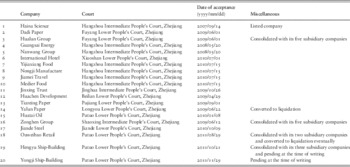
In seeking to better understand the implementation of China’s new corporate rescue law, twenty corporate reorganization casesFootnote 56 that were accepted by Zhejiang courts between 1 June 2007 and 31 December 2011 were examined; they are set out in Table 1. These twenty cases involved the rescue of the thirty-five companies, since, in some cases, several companies in a company group were consolidated into one reorganization procedure.Footnote 57
Zhejiang Corporate Reorganization Cases (Accepted between 1 June 2007 and 31 December 2011)

The data was collected in two stages. In the first, the cases were identified and drawn from the online sources publicized by newspapers and relevant legal institutions including courts and law firms. Almost all Chinese newspapers have online versions, making data collection much easier; and many law firms and courts also have their Internet websites reporting some cases that are deemed to be very valuable and important. But the difficulty arising during this stage was that the data collected was likely to be incomplete, largely because some information sought for the current analysis was not of sufficient interest to the agencies concerned; much of this missing information had to be obtained through fieldwork.
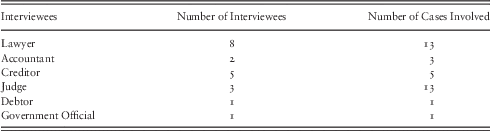
Thus, in the second stage, interviews with twenty people who were involved in seventeen out of these twenty reorganizations were conducted by Zhang in Zhejiang from January to February 2012. Not only did these interviewees help answer the unresolved questions, they also provided detailed information about the cases, as examined in greater detail in this article. In particular, the reorganization plans of sixteen reorganizations in either electronic format or hard copy were generously provided by these interviewees. As Table 2 shows, these interviewees comprised eight lawyers, two accountants, three judges, five creditors or their representatives, one debtor, and one government official.
Reorganization Interviewees in ZhejiangFootnote *
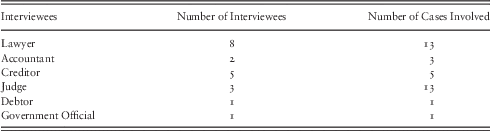
* Interviews were conducted in Zhejiang from January to February 2012
All interviews took place in the offices of the interviewees, and no electronic recorder was used. So as to better preserve confidentiality, no third party was present during the interviews. The notes initially taken by Zhang in Chinese were later translated into English.
IV. FINDINGS
A. Company Dissolution, Bankruptcy, and Reorganization Rates in Zhejiang
To gain a deeper understanding of the use of the enterprise bankruptcy law in Zhejiang, three percentages were calculated. The first was the annual company dissolution rate, which was generated by dividing the annual number of company dissolutions by the number of companies registered at the start of each year; this rate reflects market forces in culling weak businesses. The second was the annual company bankruptcy rate, which was generated by dividing the annual number of company bankruptcies (including all bankruptcy reorganization, compromise, and liquidation procedures) by the annual number of company dissolutions; this rate reflects the extent to which the corporate bankruptcy law as a whole has been applied. Lastly, the third was the annual company reorganization rate, which was calculated by dividing the number of corporate reorganizations by that of company dissolutions, and is used to determine the extent to which the bankruptcy reorganization procedure is used.
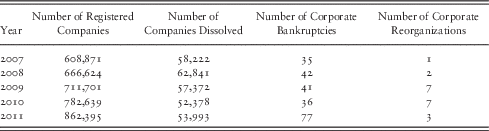
By applying the above methods to the figures reported in Table 3 below, it can be calculated that in Zhejiang the annual company dissolution rate was 9.56 percent in 2007, 9.43 percent in 2008, 8.06 percent in 2009, 6.69 percent in 2010, and 6.26 percent in 2011, with a mean company dissolution rate of 7.84 percent over the four-year period; the annual company bankruptcy rate was 0.05 percent in 2007, 0.06 percent in 2008, 0.07 percent in 2009, 0.07 percent in 2010, and 0.14 percent in 2011, with a mean company bankruptcy rate of 0.06 percent over the entire period; and the annual company reorganization rate was 0.0017 percent in 2007, 0.0032 percent in 2008, 0.0122 percent in 2009, 0.0134 percent in 2010, and 0.0056 percent in 2011, with a mean corporate reorganization rate of 0.0070 percent.
Company Dissolutions, Bankruptcies, and Reorganizations in Zhejiang (2007-2011)
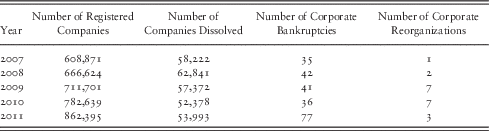
Sources: The Zhejiang Provincial Company Registration Office, The Zhejiang Supreme People’s Court, Siyuan Think-Tank, Beijing, and Zinian Zhang’s PhD Data Collection.
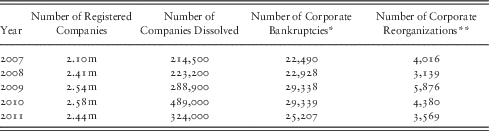
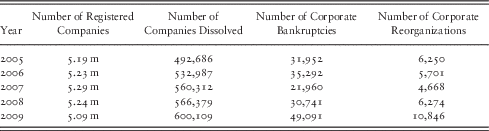
While the figures in Table 3 illustrate the situation in Zhejiang, an international comparison can identify the gaps Zhejiang may need to bridge in the future. Therefore, corresponding figures from England and Wales and the US were also obtained from official sources in each country. Table 4 gives the related statistics of England and Wales; by using the same methods, it can be determined that, during the same period between 2007 and 2011, England and Wales’ mean company dissolution rate was 12.76 percent, the mean company bankruptcy rate was 8.40 percent, and the mean company reorganization rate was 1.36 percent. In regard to figures from the US, because of the statistical interval, the US Census Bureau had not produced the national numbers of companies and dissolutions for the years 2010 and 2011 at the time of writing. To address this, the figures between 2005 and 2009 were used as substitutes; these are shown in Table 5. These numbers generated a mean company dissolution rate was 10.57 percent, a mean company bankruptcy rate was 6.14 percent, and a mean company reorganization rate was 1.23 percent.
Company Dissolutions, Bankruptcies, and Reorganizations in England and Wales (2007-2011)
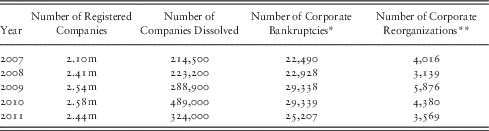
*All bankruptcy procedures under the Insolvency Act 1986. **Reorganization includes administration and company voluntary arrangement in England and Wales. Source: The UK Insolvency Service
Company Dissolutions, Bankruptcies, and Reorganizations in the US (2005-2009)Footnote *
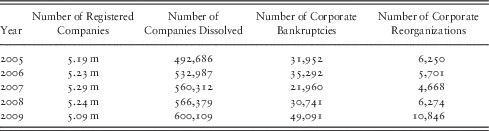
* In the US, they use the concept “firm” rather than “company”. For the sake of convenience and consistency, the concept company is used in this article. Sources: The US Census Bureau and the US Courts
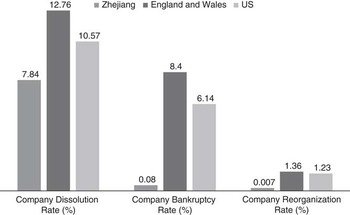
The contrast between these three jurisdictions is further illustrated and compared in Figure 1. In regard to the company dissolution rate, clearly, there is a great similarity between all these three jurisdictions – about ten percent of companies exited the market annually, indicating that market forces generally function similarly in culling inefficient companies, no matter where these companies are located. Zhejiang’s company dissolution rate of 7.84 percent is slightly lower than that in England and Wales and the US, and this might be attributed to the higher economic growth rates in China: between 2007 and 2011, China’s annual GDP growth rate was 10.54 percent, whilst the UK’s growth rate (England and Wales included) was 0.28 percent, with the US’s growth at only 0.52 percent.Footnote 58
Company Dissolution, Bankruptcy, and Reorganization Rates in Zhejiang, England and Wales, and the US.

With respect to the annual company bankruptcy and reorganization rates, however, similarities only exist between England and Wales and the US, where about five to ten percent of dissolved companies entered bankruptcy procedures, and approximately one percent of dissolved companies chose to reorganize in an effort to remain in business. Both figures contrast sharply with those from Zhejiang. While data from the US would suggest that roughly 6.14 percent of dissolved companies in Zhejiang would rely on bankruptcy procedures to tackle debt problems at a time when they were dissolved, in fact only 0.08 percent of them actually did this. Indeed, the Zhejiang courts only handled 1.30 percent of corporate bankruptcies, which are liable to be dealt with annually as a whole under the EBL 2006. In other words, the Zhejiang courts only fulfilled 1.30 percent of their corporate bankruptcy trial duties, which are legally required by the statute. Apparently, the vast majority of companies that were bankrupt did not use – or could not access – formal bankruptcy procedures in Zhejiang. The same conclusion can also be drawn in regard to the company reorganization rate: the Zhejiang courts only fulfilled 0.57 percent of the corporate reorganization trial duties imposed upon them by the EBL 2006.
One may ask whether the low company bankruptcy rate in Zhejiang is because the majority of dissolved Zhejiang companies were financially healthy and able to fully pay their debts at the time of dissolution, so that no bankruptcy procedures were needed. This assumption is unlikely to be the case. According to a report released by the Zhejiang Supreme People’s Court, we can estimate that in Zhejiang at least 20.10 percent of dissolved companies were unable to pay their debts and were financially bankrupt but did not enter bankruptcy procedures in the five-year period surveyed.Footnote 59 The real situation would probably be far worse.
Moreover, some may ask whether a higher corporate bankruptcy or reorganization rate leads to a more efficient bankruptcy system. This is probably wrong. Bankruptcy procedures must step in as far as companies are unable to pay the debts when dissolved; by this token, in theory, the bankruptcy rate must remain at zero in the situation where all companies can still fully honour their debt upon being dissolved, but this assumed situation is in reality non-existent.
This strikingly similar contrast can also be drawn if comparing Zhejiang with England and Wales regarding both the annual bankruptcy and reorganization rates, the Zhejiang courts being largely paralysed in their handling of corporate bankruptcy and reorganization cases. Therefore, it was very rare for the new Chinese corporate reorganization law to be used in Zhejiang, even though Zhejiang has clearly taken the lead in using this law when compared with other provinces in China. It is therefore legitimate to ask why the reorganization provisions of the EBL 2006 have been so little used. We will explore this question in the next section.
B. Obstacles to Entering into the Corporate Reorganization Procedure
Three major parties – court, debtor, and creditor – play decisive roles in determining the shape of corporate reorganization activity in Zhejiang. This is especially true with regard to the commencement of company reorganizations. The concerns of these three parties regarding the company reorganization procedure may largely explain the factors that hinder the use of the new law. This section reports the concerns raised by each of these three parties respectively.
1. Difficulties faced by the courts
With a provincial population of 55 million, Zhejiang has 102 law courts, including the Zhejiang Supreme People’s Court, eleven intermediate people’s courts, and ninety lower people’s courts.Footnote 60 In theory, all 102 courts can handle corporate reorganizations. But, the fact that only twenty corporate reorganizations occurred between 2007 and 2011 means that the vast majority of Zhejiang courts never accepted corporate reorganization petitions during this period.
The scarcity of corporate reorganizations can largely be attributed to the hesitation of courts in accepting reorganization filings. One judge interviewed for this research mentioned that when a corporate reorganization petition is lodged in his court, it is always treated as a very sensitive issue, and the final decision to accept it would usually be made by the court’s deputy president.Footnote 61 This pattern can be understood by reference to the context within which Chinese courts operate.
When Chinese courts face ordinary commercial litigation such as a contract dispute, it is the court’s registry which usually assesses and decides whether to accept the filing. However, in some cases deemed difficult to handle, such as an administrative litigation where a government department is sued, the registry tends to refer the filing to the director of an adjudicating chamber to assess its merits and to decide whether it can be accepted. In exceptional cases, it is the deputy president in charge of trial affairs or the court’s top decision-making body, the judicial committee, who decides whether to accept an individual case filing. Since a corporate reorganization filing is considered to be exceptional, and without a decision from the top, the registry would not accept it. In refusing to accept corporate reorganization filings, courts have their own internal concerns, which we will now turn to consider.
(a) Manpower: Asked why courts in Zhejiang were so hesitant in accepting corporate reorganization filings, nearly half of the interviewees, including lawyers and judges, said that courts do not have enough judges to deal with corporate reorganization matters if all such petitions are accepted without restrictions.Footnote 62 Indeed, most Chinese courts are known to be understaffed. As in other provinces, Zhejiang does not have special bankruptcy courts;Footnote 63 as a result, corporate bankruptcies, including reorganizations, are assigned to the second civil chambers of courts. Judges in all chambers are already saddled with too many lawsuits, and one official report states that it is not unusual for a judge in Zhejiang to handle over 200 cases a year,Footnote 64 meaning that a judge must organize and sit in at least one court hearing and write at least one verdict every working day. As a result, judges do not want to be bothered with more cases, especially time-consuming corporate bankruptcies. It should also be noted that after the EBL 2006 took effect in 2007 there was no facilitative increase in the number of judges in Zhejiang courts.
Apart from the deficiency in the number of judges, one of the judges interviewed emphasized that most existing judges are not experienced and skilled in dealing with corporate bankruptcies including reorganizations;Footnote 65 this is probably true.Footnote 66 Two factors may have contributed to this incapacity on the part of the judges. First, Zhejiang judges are not specifically trained in terms of handling corporate bankruptcy and reorganization, and no special training courses have been developed for judges in Zhejiang since the EBL 2006 came into force. Similarly, although many lawyers and accountants were officially designated as insolvency practitioners in Zhejiang in 2007, no tailored training courses or qualification exams were required.Footnote 67 Second, most Zhejiang judges have neither had prior bankruptcy cases to gain experience from nor gained relevant experience from prior legal practice. Indeed, only forty-six corporate bankruptcy cases a year are heard by Zhejiang’s 102 courts (see Table 3 above), suggesting that more than half of the Zhejiang courts have not had a single corporate bankruptcy case to gain experience from. Together, these two factors seems to create a vicious circle, where the lack of experience makes judges hesitate in handling corporate bankruptcies, while the absence of prior legal experience in practice further undermines their confidence in handling reorganization cases.
In brief, most courts in Zhejiang do not have a sufficient number of judges to deal with bankruptcy proceedings, nor do they have the expertise needed to handle corporate reorganizations properly. In other words, they are not ready – or not adequately equipped – to fulfil the duties imposed by the new reorganization law. Nevertheless, by comparison to these internal difficulties, greater challenges might have come from outside the court system.
(b) Government support: Many interviewees believed that the unwillingness of courts to accept corporate reorganizations is due to the lack of government support.Footnote 68 Unlike the handling of day-to-day cases, the court needs administrative services or cooperation from many government departments when dealing with a corporate reorganization case. For example, the revenue authorities need to agree to provide tax-approved receipts to the company if the company’s business operations continue during the reorganization procedure, and the utility authorities should not cut water and electricity supplies simply on the grounds that the company has unpaid bills. In reality, however, courts alone are unable to persuade local government departments to cooperate or to facilitate these aspects of corporate reorganization procedures.
Law courts are weak institutions in China’s present political system. One judge interviewed in this study revealed that in his experience “local government departments will not listen to us unless the local government is officially involved in an individual bankruptcy case.”Footnote 69 This judge gave an example to demonstrate the difficulties that the court faced when handling a reorganization procedure.Footnote 70 In a case supervized by him, the local police department played a key role in investigating the company’s assets, because the lawyer administrator was denied access to the company’s asset records held by banks and many government agencies; without the police investigation, it was impossible even to know the whereabouts of the company’s key assets, let alone to reorganize the company’s business. However, this judge interviewee emphasized that in that case the local police department was actively involved mainly because the police were ordered by the local government to do so and that, in this case, the deputy mayor of the city had chaired a committee in support of the reorganization process.
However, the fact is that government support is not always available to assist courts. Local governments have the discretion, and not an obligation, to back individual reorganizations handled by courts. One lawyer interviewee held a similar view.Footnote 71 This lawyer disclosed that, in the reorganization case in which he was involved, the court had asked for and received a written guarantee from the local district government promising to ensure that all government departments would provide effective and efficient administrative services if needed,Footnote 72 adding that the court was not confident in accepting the filing without the government’s guarantee.
(c) Mass petitions by employees or creditors: Most interviewees believed that courts most worry about potential mass petitions.Footnote 73 This could only be appreciated in the unique context of China, where it is well documented that most Chinese courts try to distance themselves from categories of cases that are very likely to generate protests by refusing to accept them.Footnote 74 Corporate reorganizations are highly related to mass-petitions; this article found that mass petitions occurred in at least eleven out of the twenty Zhejiang corporate reorganization cases studied here, and that in each case the mass petition had been made by unpaid employees. Assembling in large numbers, the unpaid employees laid their grievances before the local governments, probably because Article 85 of the China Labour Law 2005 holds the local government liable for enforcing the labour law and ensuring that employees are paid under their labour contracts. (Fortunately such mass petitions all took place before the commencement of these reorganizations; otherwise, the judges in charge of these cases would have faced enormous pressure.)
The problem is that, in spite of governmental support in all of these cases, the judges were still very anxious, or highly vigilant, about the reorganization procedure. This is probably out of fears about potential protests. One lawyer interviewee disclosed that about 800 riot police officers were deployed to monitor the creditors’ meeting in a case that he was involved with so as to pre-empt protests by the creditors, even though only 600 creditors or so attended the meeting.Footnote 75 Similarly, a second lawyer interviewee in another city mentioned that each creditor was physically flanked with two police officers during a meeting in which he was involved.Footnote 76 In other cities in Zhejiang, many interviewees also noted that riot police were present at the creditors’ meetings. All these measures were intentionally made to avoid or suppress any form of protests. Some creditors complained that they were in fact intimidated when attending creditors meetings.Footnote 77
2. Unwillingness of debtors to reorganize in courts
Ideally, reorganizations are more successful where they are initiated by the debtors themselves, since they have the requisite knowledge and experience gained from running their own businesses. In Zhejiang, however, it is rare to see debtors voluntarily filing for reorganization.
One interviewee explained that most debtor companies try to avoid in-court reorganizations for fear of losing control to third parties. This is because under Article 13 of the EBL 2006 the entry into the formal bankruptcy reorganization procedure leads to the automatic resignation of the debtor’s directors and management team, an unacceptable outcome for most of a company’s officers.Footnote 78 And although Article 73 of the EBL 2006 allows the debtor to regain control under the debtor-in-possession approach, this interviewee emphasized that this is more a theoretical possibility than a practical certainty, and that debtors see this as an unreasonably dangerous gamble.Footnote 79
This fear is not unreasonable. As will be reported below, in most existing reorganizations, the debtor-in-possession model has not been applied. This suggests that, for debtors, once managerial control is lost, it is more likely to be lost forever. Moreover, as observed by one accountant interviewed in this field work, at the heart of debtors’ concerns over losing control is the potential exposure of company books to a third party, as these books almost inevitably contain evidence of tax evasion.Footnote 80 This can be a real problem, especially against the backdrop of China’s tax collection system. For example, one study has shown that between twelve to thirty-seven percent of value added tax, the main business tax for China’s central government revenue, was evaded between 1995 and 2003.Footnote 81 Indeed, tax evasion is so rampant in China that no company will be comfortable surrendering its books to outsiders, let alone to hand them over in their entirety to a court-appointed administrator. For a debtor, losing control to a third party largely equals exposing its own criminal conduct to others; it is not only unacceptable but dangerous.
In addition, debtors also have few financial incentives to file for reorganization, because the absolute priority principle, according to which creditors are to be paid before shareholders, applied in the vast majority of the reorganizations (87.5 percent) in Zhejiang. Shareholders received nothing in these cases, since even unsecured creditors were not paid in full because of the bankruptcy of these companies, meaning that shareholders or shareholder-managers could not financially benefit from the formal reorganization procedure. To put it another way, in anticipation of zero distribution, instead of pursuing an in-court reorganization, most debtors would try to avoid filing for reorganization before a court.
3. The frustration of creditors with reorganizations
China’s new corporate rescue regime does not appear to be debtor-friendly. However, even in the US, where there is a pro-debtor corporate rescue regime, it has been found that most debtor-filed formal rescues are in effect commenced because of imminent liquidation pressure from creditors.Footnote 82 This means that the effective use of the corporate bankruptcy rescue regime is also dependent on a rigorous debt enforcement system in which creditors can easily choose liquidation to collect debt.
Generally speaking, creditors in Zhejiang only have one option available: namely, to collect debt through individual debt enforcement. While liquidation exists on paper, it does not in practice. And without a real threat of creditor-initiated liquidation proceedings, there is no urgency for defaulting debtors to seek the formal reorganization procedure as a safe haven to avoid aggressive creditors. This was confirmed by one lawyer interviewee, who said that it is quite naïve for a creditor to file for a debtor’s liquidation in a court by solely relying on the written rules embedded in the EBL 2006, and that lawyers who go to courts to lodge bankruptcy petitions on behalf of their creditor clients would be seen as inexperienced and could be snubbed by court officials.Footnote 83 This lawyer further lamented the fact that in order to open a corporate bankruptcy procedure, creditors must persuade the local government where the debtor is domiciled to provide support, which is almost an insurmountable task for most creditors, making such an action even more unlikely where the creditors are from a different region or outside the province.Footnote 84
These observations are supported by a typical case recently handled in Zhejiang. On 6 October 2008, Shaoxing City-based Jianglong Textile Group Limited ceased trading because it suffered a sudden illiquidity. After it was found that the chief executive officer (CEO) had previously absconded for days, a panic among creditors led to a total of 803 individual debt enforcement actions, in the form of litigation, being brought against Jianglong, most of them taking place in the Zhejiang courts. Unfortunately, however, no bankruptcy liquidation procedure was entered into, even though the debtor company was clearly bankrupt; while some creditors did submit liquidation petitions to the Shaoxing Intermediate People’s Court, which handled most of the Jianglong litigations, these petitions were simply ignored – indeed, the Court did not even bother to register them. Later, the company’s assets were auctioned to satisfy these judgement debts, but as predicted, its assets were not sufficient to meet them all. As a result, creditors who sued were paid pari passu, while creditors who did not were excluded from the distribution.Footnote 85
The above case illustrates the reality that it is unlikely for creditors to conveniently commence a corporate bankruptcy case in Zhejiang. Interestingly, some Zhejiang reorganization cases examined in this study were actually filed by company creditors. As a result, it is reasonable to ask if the odds against creditors in using the bankruptcy law have been exaggerated. On closer examination, however, it was found that they were not. In such circumstances, on the face of it, the reorganization procedure was filed by a creditor, but it soon became apparent that these creditors were insiders or related parties. For example, in the reorganization procedure of Nanwang Group Limited, the filing creditor, Sanhua Group Limited, is one of the company’s shareholders.Footnote 86 Quite often, after a local government stepped in and decided to support a court-involved reorganization effort, it was largely to fulfil the formality in choosing which party should sign a filing document. In real terms, then, it was the local government rather than a filing party that substantially initiated an in-court reorganization project.
Another lawyer interviewee said that it had been repeatedly proved in practice that the corporate bankruptcy procedure, including corporate reorganization, is unavailable to both creditors and debtors unless a local government intervenes.Footnote 87 A natural consequence is that, in China, the absence of a robust corporate bankruptcy system leads to a situation in which creditors are only protected on a first-come-first-served basis, since only individual debt enforcement in the form of litigation is practically available. Hence, a collective action between creditors could not be initiated in their interest as a whole, because of the inaction of the state, especially of its court system.
To sum up, then, while courts in Zhejiang are legally and constitutionally liable to accept corporate reorganization filings, they hesitate to do so; debtors possess information and knowledge but are unwilling to file for fear of losing control to outsiders; creditors may force defaulting debtors to enter reorganization earlier but are largely denied the most powerful legal weapon: liquidation. The combination of these factors may largely explain why there have been such a small number of reorganizations in Zhejiang. It is noteworthy in this regard that in Anglo-American jurisdictions, law courts are bound to accept bankruptcy filings, regardless of the social and political impacts of individual cases;Footnote 88 as a result, the difficulties facing Chinese law courts described above do not arise. Interestingly, the mindset of debtors in China towards the use of reorganization is similar to that of their counterparts in both the UK and the US – all try to evade reorganization in order to avoid the loss of control. But existing research also suggests that, at least in the US, debtors will voluntarily file for reorganization in the face of imminent liquidation pressures from creditors.Footnote 89 Unfortunately, the threat of liquidation used by creditors in Anglo-American jurisdictions is largely unavailable in China. This is a tough struggle for both China and Chinese businesses.Footnote 90
Nevertheless, there are still a certain number of companies entering into the reorganization procedure in Zhejiang. Therefore, one may ask what the real criteria are for a Chinese company to be allowed to use reorganization in practice. An important part of the answer to this question lies in the attitude of governments at either local or central levels. Indeed, if the continued existence of a company is significant enough to draw the government’s attention, a local court may be guided, if not manipulated, by the government to initiate a reorganization procedure to try to revive the distressed company. Otherwise, the statutory rules in the written EBL 2006 appear to be largely irrelevant to reorganization practice.
C. Control of Zhejiang Corporate Reorganizations
As noted above, while debtors are, in theory, able regain control from administrators if the debtor-in-possession model is applied, in reality there is only a small chance of this occurring. Indeed, the debtor-in-possession option was granted in only four out of fourteen reorganizations, and it is clear that even here the return of control was in name only, as the key right of proposing the reorganization plan remained in the hands of the administrators in all four cases.
Administrator control took different forms in these four cases. In the first two cases, the reorganization plan was actually proposed by the administrator,Footnote 91 while the plan was jointly proposed by the debtor and the administrator in the third case.Footnote 92 Indeed, only in the last case was the debtor-in-possession model used. This was done in order to use the debtor’s name to propose the reorganization plan;Footnote 93 however, it is apparent that the structure and content of the reorganization plan is almost identical to other administrator-proposed reorganization plans in cases of group reorganizations,Footnote 94 even though the lawyer interviewee and administrator insisted that the plan was made by the debtor.Footnote 95
As a result, it seems that the real debtor-in-possession model has yet to be used in Zhejiang. This raises the immediate question as to what the real motives behind the symbolic use of the debtor-in-possession model in these four Zhejiang cases actually were. One court document may provide a partial answer to this question. According to this internally-circulated report made by a law court which handled several reorganizations in Zhejiang, approving the debtor-in-possession model is mainly aimed at retaining the old management so as to maintain the company’s business operations where the administrator does not have the skills to do the job, in consideration of the importance of continuing the company’s normal business operations to building and maintaining creditors’ confidence in the reorganization efforts and to attracting potential buyers.Footnote 96 However, the court also clearly stated that, in this case, the administrator, a local accounting firm, must still propose the reorganization plan, in spite of already approving the debtor-in-possession model of reorganization.Footnote 97
Arguably, much could be done to improve the understanding of the debtor-in-possession model by both judges and insolvency practitioners in Zhejiang and in China as a whole. Turning to the central question as to why debtors were overwhelmingly excluded from reorganization procedures in Zhejiang, the causes are as follows.
1. The lack of sympathy for failed companies
The attitudes of stakeholders towards business failure might be one of the main factors leading to the automatic removal of debtors. Most of the interviewees considered that the main contributor to business failure is debtor mismanagement.Footnote 98 As a result, most stakeholders have little confidence in the use of the debtor-in-possession model in the formal reorganization procedure.
Apart from the perceived culpability of management, many interviewees believed that, in most of the existing reorganizations, business failure was also attributable to overexpansion by the company.Footnote 99 These companies had borrowed excessively to fund their expansion projects, and a sudden fall in liquidity led to the collapse of the companies.
Interestingly, the stakeholders interviewed seem to be ambivalent about management’s motives. When asked to what extent the company’s failure was due to the debtor’s dishonesty or fraud, all interviewees clearly replied that they did not think that this was a cause; instead they believed that it was a matter of competence rather than of dishonesty or fraud on the part of management.Footnote 100 Put differently, there may still be chances to reconcile the debtor and other stakeholders regarding the use of the debtor-in-possession model. Nevertheless, the overall situation makes the potential use of the debtor-in-possession seemingly unacceptable.
2. Where company management teams are disbanded
The absence of the debtor in most reorganizations was also a result of the management being disbanded prior to the commencement of the formal rescue procedure, thereby making resort to the debtor-in-possession model unrealistic. It was found that in at least twelve out of seventeen rescue cases the company ceased trading before its entry into formal rescue procedures, and that, to a large extent, the debtor’s management team had stopped operating or had been dissolved once trading had ceased. Importantly, it was found that the CEO reportedly absconded or was missing in at least ten out of these twenty reorganizations. Therefore, given the departure or disappearance of the debtor’s management team, it seems impractical to seek to rely on the debtor to run the company during the subsequent formal rescue process.
The disbandment of debtors’ management teams not only makes the use of the debtor-in-possession model impossible but also imposes even greater challenges for rescue efforts. One lawyer interviewee said that bringing the company’s business operations back to a working state is essential for the achievability of a rescue, but in his case nearly all the old senior managers including the CEO had left by the time he was appointed as the administrator, so that he had to hire a manager from the company’s major supplier to restore the operations in an effort to win the confidence of both the employees and creditors; in this case, this person happened to be a close friend of the former CEO and was very familiar with the company’s business.Footnote 101
In a word, in most cases, with the disappearance of the debtor’s management team, the likelihood of the debtor-in-possession model being invoked is considerably remote.
3. Business sale rescues
The exclusion of debtors from the corporate reorganization process in Zhejiang may also be due to the wide use of business sale rescues. Specifically, in fourteen out of the sixteen Zhejiang reorganizations, the rescue was conducted through a business sale.Footnote 102 The sale leaves the new owner to form a new management team to run the company, making the old team unnecessary. Indeed, in some business sale rescues, the removal of the old management team has often been a precondition to attracting buyers. One lawyer interviewee recounted how one buyer in a case he was involved in was particularly concerned over whether future control of the company would be undermined if some members of the old management team remained in office.Footnote 103
Furthermore, in the remaining two cases, which did not resort to the use of business sales, it was found that since there was no business buyer emerging, creditors had to use a debt/capital swap to carry out the rescues. This meant that it was left to the creditors to establish their own management teams to operate the companies, an event that also made the old management redundant.
4. Application of the absolute priority rule
The absolute priority rule requires that debt be paid before equity, but under Article 87 of the EBL 2006 this rule can be relaxed through a vote by creditors. Where shareholders and shareholder managers sit behind a debtor, few if any assets will remain if this rule is fully applied, given that in most cases even creditors could not be fully paid. In such circumstances, the debtor would not have any incentives to engage in a formal reorganization procedure.
This was often the case in Zhejiang. As we have seen above, the absolute priority principle was applied in fourteen out of sixteen Zhejiang corporate reorganizations, with the debtor losing everything. Arguably, in anticipation of the stringent application of the absolute priority rule, debtors may deliberately decline the debtor-in-possession offer. In general, from the point of view of creditors, granting the debtor possession seems to be too lenient for debtors, but from the point of view of debtors, it can be an empty privilege that they do not really need.
More importantly, it seems that Zhejiang judges and lawyers tend to favour the strict application of the absolute priority rule in reorganizations. Asked whether relaxing this rule can be considered in favour of the old management, especially shareholder managers, in exchange for their experience and information in running the business, almost every judge and lawyer interviewee said that this would be very unfair to creditors, and that they would not consider relaxing absolute priority.Footnote 104
To summarize, the infrequent use of the debtor-in-possession approach in Zhejiang corporate reorganizations can be attributed to the lack of sympathy for business failures, the departure of debtors’ management teams before reorganizations commenced, the wide use of business sale rescue, and the strict application of the absolute priority rule in distributing the remaining company value.
V. DISCUSSION
Over the years after the commencement of the EBL 2006, the corporate reorganization provisions have not been regularly used as expected; as shown by the data in this article, the vast majority of troubled companies were in fact denied the chance to use this law. (It is worth noting that similar reasons or obstacles have resulted in the liquidation and conciliation procedures sharing a similar fate.) From our discussion of the reasons for this, it seems that one of the root causes is China’s weak judicial system and its less-developed rule of law.
A. Judicial Independence and Accountability
Generally speaking, China’s courts have a certain degree of judicial independence, especially when handling commercial cases.Footnote 105 For commercial issues, at least in theory, there is little government intervention,Footnote 106 although it should be noted that courts may be vulnerable to pressures if well-connected parties are involved.Footnote 107 Corporate bankruptcy reorganizations fall into the category of commercial cases, since most parties are businesses. Hence, courts are assumed to accept reorganizations in the way they accept other commercial litigation.
However, one aspect of corporate reorganization makes most Chinese judges anxious – they always involve a large number of people who are either employees or creditors, which is likely to generate mass petitions or protests.Footnote 108 The real problem here is that courts and the judges in charge will be negatively assessed and may even be disciplined by local Communist-Party-controlled governments where such protests arise,Footnote 109 even if these protests are not essentially caused by judges.Footnote 110 The unwritten Chinese social stability assessment system seems to be irrationally made and enforced.Footnote 111
In reality, most Chinese courts face a dilemma. On the one hand, courts must do what the law says; in the context of the new corporate reorganization law, this means that courts must accept corporate reorganization filings if the statutory requirements are met, whether or not a large number of individuals are involved.Footnote 112 On the other hand, Chinese courts must make local Communist-Party-controlled governments happy, although what the latter impose may not be in line with what the law explicitly stipulates.Footnote 113 This lack of judicial independence from local governments reflects one of China’s deep-rooted constitutional problems and results in the courts’ refraining from handling many corporate reorganization cases.Footnote 114
Furthermore, the lack of judicial independence also raises serious concerns about the lack of judicial accountability. According to constitutional theories,Footnote 115 as public authorities courts must be held accountable if they violate the law.Footnote 116 But this does not look to be the case in China. One typical example pertains to the filing of a corporate reorganization under Article 10 of the EBL 2006. While the court must either accept or reject the filing according to the law, in reality, the court does not even register the filing in most cases,Footnote 117 let alone respond to it.Footnote 118 This is clearly a violation of this Article.Footnote 119 But while it may be shocking from the view of people in advanced jurisdictions, this practice is repeated time and again in China. And while this is arguably caused by the lack of checks on power in general and on the judiciary in particular, there are no reports of any court officials having been disciplined or prosecuted because of these failures or violations. In this way, China’s courts can be said to be both victims and offenders.
To a certain degree, this problem is unique to China. Global indicators may help capture just how severe China’s rule of law deficit actually is. According to The World Justice Project,Footnote 120 China is ranked 82nd out of all 97 surveyed countries across the world with respect to the efficiency of delivering civil justice (implementing corporate bankruptcy law can be largely included in this category) – almost at the bottom – while noting that the country’s major challenge is that law courts are not free from government intervention. Even within middle-income countries, The World Justice Project suggests that China is still ranked 27th out of a total of 30 jurisdictions,Footnote 121 clearly suggesting that it is largely China’s political system rather than its economic development that has led to the country’s stunted development of the rule of law.Footnote 122
Of course, apart from the entrenched weakness of its judicial system, Chinese law courts do have other difficulties, such as understaffing, but these difficulties could be easily overcome without resorting to institutional reforms. Reforming the Chinese judicial system is a formidable task and is beyond the scope of this article. Realistically, however, under the current legal framework, some technical issues can be improved or clarified with the aim of promoting the use of the corporate reorganization law in China.
B. Encouragement of Debtors and Creditors
1. The automatic debtor-in-possession model
To encourage more rescues, debtors should be given certainty with regard to the use of the debtor-in-possession model. As examined earlier, at the top of most debtors’ concerns is a fear of losing control to outsiders under the administrator-in-possession model if an in-court reorganization solution is sought. To incentivize debtors to use the reorganization procedure, and to make reorganizations more feasible by taking advantage of their experience and knowledge in running their businesses, it seems desirable to establish the debtor-in-possession model as the default approach in corporate reorganization. This can be done for a number of reasons.
First, according to Professor Zou Hailing, one of the EBL 2006’s draftsmen, Chinese lawmakers initially intended to set up the debtor-in-possession model as the default control structure in reorganizations.Footnote 123 However, such an intention has not been clearly embodied or demonstrated in the new law. This is partly due to flaws in the design of the EBL 2006. For example, Article 13 places both reorganization and liquidation procedures together, and both are commenced with the automatic appointment of an administrator without taking into account the differences between the two procedures. And although Article 73 allows a debtor to apply for the use of the debtor-in-possession model after the commencement of the procedure, this often seems too late, since the debtor has already lost control of the company and must face uncertainty whether the debtor-in-possession model can be granted in the meantime. All this suggests that there is a gap between what the lawmakers genuinely intended and what is actually stipulated in the EBL 2006.Footnote 124
Second, the data reported here from fieldwork interviews show that allowing debtors to remain in control seems to be socially acceptable to many stakeholders in China. It should not be forgotten that in the interviews no debtors were accused of being fraudulent or dishonest, although most business failures were perceived as the result of the debtor’s mismanagement. Thus, most debtors are probably still trustworthy, since business failures are more likely to result from mistakes. This paves the way for the use of the debtor-in-possession model in China’s corporate reorganizations.Footnote 125
Third, the lessons learnt from abroad can also convince us of the usefulness of the debtor-in-possession model in encouraging voluntary rescue filings. In the US, for example, before 1939, this model was the default control model for all debtor companies, whether they were large or small companies. However, for fear of abuses, the Chandler Act of 1939 removed the debtor-in-possession model in the reorganization procedure of large companies, which led to the situation that the new procedure for these companies immediately “fell into disuse.”Footnote 126 Decades later, in the light of the hostility of large debtor companies towards the automatic practitioner-in-possession model, the US Bankruptcy Reform Act of 1978 eventually restored the debtor-in-possession model for large companies,Footnote 127 and history suggests that this was the right approach to take. South Korea’s experience with transplanting the debtor-in-possession model of corporate reorganization also suggests the utility of leaving the debtor in control of corporate decision-making, the number of reorganization filings in South Korea soared from seventy-six in 2006 – the time South Korea adopted the model – to 670 in 2009, almost a tenfold increase over only four years.Footnote 128
Overall, the legal landscape of China’s corporate reorganization law may be remarkably improved if the debtor-in-possession model is embraced as a default option. Of course, a fair balance should be struck between debtor and creditor, with creditors empowered to challenge the debtor-in-possession in cases where fraud has been committed.
2. Empowering creditors with the threat of liquidation
Prioritizing the debtor-in-possession model is necessary but not enough to incentivize debtors to file for reorganization in a voluntary and early manner. This is especially true given that filing for a bankruptcy reorganization will, among other things, damage a debtor’s reputation.Footnote 129 Thus, consideration should also be given to empowering creditors to pressure defaulting debtors to enter reorganization earlier.
Technically, a lack of information means that most creditors are unable to pursue an in-court reorganization on behalf of the debtor. This suggests that it is better for the reorganization to be initiated by the debtor itself.Footnote 130 Of course, in exceptional instances, some long-term suppliers and bank creditors may possess sufficient information to launch a viable reorganization petition; however, bearing in mind the collective action problems faced by these creditors,Footnote 131 relying on them to bring a debtor into a complex reorganization procedure in the interest of creditors as a whole seems unrealistic.
In order to promote more feasible debtor-initiated corporate reorganizations, what creditors can do, and are really expected to do, is to use the threat of liquidation to force debtors to file for (an early) reorganization. An empirical study from the US indicates that although debtors could use the debtor-in-possession model under Chapter 11 to retain control in the corporate reorganization procedure, seventy-three percent of reorganization filings are substantially triggered by creditors threatening liquidation.Footnote 132 Without this threat of liquidation, the vast majority of debtors will continue to delay action until business conditions deteriorate past the point of no return. In China, however, equipping creditors with this powerful fulcrum remains a great challenge. For various reasons demonstrated in this article, the threat of liquidationFootnote 133 is unavailable to creditors,Footnote 134 resulting in the threat of liquidation enshrined in the EBL 2006 remaining a paper tiger.
VI. CONCLUSION
While Zhejiang has pioneered the use of the new corporate reorganization law to rehabilitate distressed local companies, the implementation of this law in a well-developed Chinese province such as Zhejiang remains far below expectations, especially when compared to other developed jurisdictions such as the UK or the US. This article has demonstrated that this failing can be linked to the lack of judicial independenceFootnote 135 and accountability,Footnote 136 as well as the hostility of debtors towards the administrator-in-possession procedure.Footnote 137 It has also suggested four reasons explaining the surprisingly limited use of the debtor-in-possession procedure in China, mostly linked to perceptions about the regime’s treatment of debtors.
Yet it should also be remembered that this process remains in its infancy, and that no formal court-supervized corporate reorganization regime existed in China before 2006. Moreover, the fact that most reorganized companies in Zhejiang were large and of economic and social importance has resulted in intense local media attention, both locally and nationally, which has raised considerable awareness of the corporate reorganization procedure among the business community and the general public and helped address concerns about the lack of information. Armed with this new information, one might well expect the number of reorganizations to increase.
In the meantime, the existing reorganizations in Zhejiang continue to raise a number of important legal questions for academic researchers. For example, in response to the reorganization procedure for company groups, some Zhejiang courts have boldly consolidated company reorganization cases, whereas some have acted more cautiously and handled them separately.Footnote 138 Given the difficulty or impracticality of separating the assets and liabilities of related companies within a group, the issue of how best to balance fairness against feasibility in group reorganizations remains.