Introduction
This revision of the genus Amomum Roxb. in Sumatra forms part of a wider project to revise the genus across its range, and will focus primarily on defining and describing the species of Amomum. Broader discussion will be limited to placing species in the context of earlier classifications.
Amomum as currently recognised is the second largest genus in the Zingiberaceae with 150–180 species (Larsen et al., Reference Larsen, Lock, Maas, Maas, Kubitzki, Huber, Rudall, Stevens and Stutzel1998; Tong, 1999 quoted in Xia et al., Reference Xia, Kress and Prince2004). It is distributed from Sri Lanka to the Himalayas, China, Southeast Asia, Malesia and northern Australia, the centre of endemism being the forests of Southeast Asia. The estimated number of species is likely to change with time, further collecting, and as the species are revised.
Amomum belongs in the tribe Alpinieae, which is defined as having the plane of distichy transverse to the rhizome, a trilocular ovary with axile placentation, and lateral staminodes that are much reduced or absent. Other genera in the Alpinieae include Alpinia and Plagiostachys, which have inflorescences terminal on the leafy shoot, and Hornstedtia, Etlingera, Elettariopsis, Elettaria, Geocharis and Geostachys, all of which have radical inflorescences. Recent phylogenetic work indicates that Amomum as it is currently circumscribed is polyphyletic (Xia et al., Reference Xia, Kress and Prince2004; Kress et al., Reference Kress, Newman, Poulsen and Specht2007) but we have chosen not to recircumscribe the genus until further research clarifies the generic structure. As revision of Amomum s.l. progresses in collaboration with other botanists, and further phylogenetic evidence becomes available, a comprehensive new classification of Amomum based on all the available information will be published. The concept of the genus as it currently stands is therefore broad, encompassing considerable variation in floral and fruit morphology. In Sumatra it may be confused with other genera that have inflorescences arising from the rhizomes on leafless stems, in particular Elettariopsis Baker, which is morphologically very similar to Amomum. Elettariopsis species usually have open bracteoles and a large, petaloid anther crest, with the laminae close together at the top of the pseudostem. The above characters are not unique to Elettariopsis, but are not found together in any species of Amomum.
Historical Context
Schumann (Reference Schumann and Engler1904) recognised nine species of Amomum from Sumatra. Of these, one has been transferred to Etlingera, and three more into synonymy of species of Hornstedtia. Since 1904, there has been no revision of Amomum in its entirety, although there have been several regional treatments (e.g. Holttum, Reference Holttum1950; Smith, Reference Smith1985; Sakai & Nagamasu, Reference Sakai and Nagamasu1998; Lamxay & Newman, Reference Lamxay and Newman2012). Newman et al. (Reference Newman, Lhuillier and Poulsen2004) compiled a checklist of the Zingiberaceae of Malesia, in which 16 species of Sumatran Amomum were listed. Twenty-four species are now known from the island and it is likely that more will be discovered with further botanical exploration. Of the Sumatran species, seven (Amomum apiculatum, A. centrocephalum, A. longipes, A. mentawaiense, A. oligophyllum, A. stenocarpum and A. tephrodelphys) are endemic to Sumatra, while several are very widespread in Southeast Asia (A. uliginosum, A. verum and A. xanthophlebium).
The Characters
Habit
Most species of Amomum are terrestrial clump-forming or creeping herbs, although some Bornean species are epiphytic. Several species have stout or slender stilt-roots, and some are stilt-rooted to 50 cm. As with all Zingiberaceae, Amomum plants are ± aromatic, often pleasantly so. The rhizome is nearly always glabrous, which can often be used to distinguish this genus from Etlingera, in which the rhizomes are generally pubescent (Poulsen, Reference Poulsen2012).
Leafy shoot
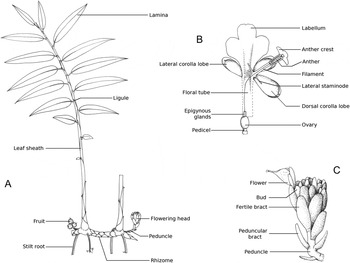
The leafy shoots, or pseudostems, are usually robust, erect or leaning at an angle, and arching over towards the apex (Fig. 1). Amomum are small or medium-sized herbs and, although a few species (e.g. A. cerasinum Ridl.) are 3–5 m tall, most are 1–3 m tall. When measuring the size of the plants, the length of the shoot (along its axis) has been recorded rather than the height of the plant when growing, as the leafy shoots often arch. The sheaths can be smooth (e.g. Amomum cylindraceum Ridl.), striate (e.g. A. gyrolophos R.M.Sm.) or ± reticulate (e.g. A. hastilabium Ridl.). The indumentum on the leafy shoot varies from glabrous (e.g. Amomum cerasinum) to ± hairy, especially below the ligule (e.g. A. gyrolophos). It may, however, be misleading to define species by the extent of hairiness, because this character may vary depending on the environmental conditions in which the plant is growing, and can also be age-dependent. For these reasons, we have chosen to concentrate largely on the presence or absence of hairs rather than the extent of hairiness, when discussing species. Distances between leafy shoots are measured by recording the distance between the middle of the base of adjacent shoots. The leaves of Zingiberaceae consist of a sheath, petiole, ligule and lamina. The leaves are distichous and alternate. The plane of distichy is always perpendicular to the direction of growth of the rhizome, although this character can only be observed on living plants. Most Amomum species have several to many (10–25) leaves per shoot. There are, however, species with only 5–6 leaves on a shoot, for example Amomum oligophyllum A.J.Droop from Sumatra, and A. calyptratum S.Sakai & Nagam. and A. paucifolium R.M.Sm. from Borneo. Typically the first lamina of any Amomum will be 0.5–1 m from the base, although, particularly in those species with very few, the first lamina may be further than a metre from the base of the leafy shoot.
Morphology and habit of Amomum Roxb. in Sumatra. A. Schematic diagram of an Amomum plant showing one leafy shoot, inflorescence and infructescence; B. Schematic diagram of a dissected flower of Amomum; C. Inflorescence of Amomum longipes Valeton.

Ligule
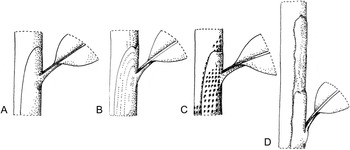
The ligule in Amomum is normally 0–15 mm long, sometimes to 35 mm long. A few species, such as Amomum dealbatum Roxb., have greatly extended ligules, to 60 mm or more. Ligules are normally entire, rounded, truncate or slightly emarginate (Fig. 2). Deeply bifid ligules are also found (e.g. Amomum dealbatum). The indumentum of the ligule also varies between species, with some ligules being hairy and others glabrous. The ligules of certain species (e.g. Amomum aculeatum Roxb.) have ciliate margins. The length of the ligule is measured from the apex of the ligule to the junction of this structure with the upper surface of the petiole.
Schematic diagram of ligule and sheath characters found in Amomum Roxb. in Sumatra. A. Sheath smooth, ligule rounded, entire; B. Sheath striate, ligule emarginate; C. Sheath reticulate, ligule truncate; D. Sheath smooth, ligule long, papery with fleshy base.

Petiole
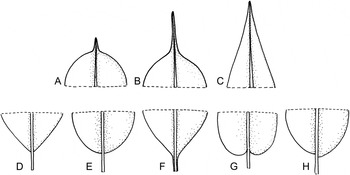
Although the ‘petiole’ of monocots is not homologous to that of dicots, because previous authors have used the word petiole, we shall continue to do so. Amomum laminae are commonly sessile or short-petiolate to 3 cm, occasionally to 5 cm or longer. The base of the leaf is sometimes (e.g. Amomum compactum Sol. ex Maton) decurrent to the petiole (see Fig. 3), and often the length of the petiole varies within a single pseudostem. The length of the petiole is calculated by measuring the length between the base of the leaf (or the lower lobe if the leaf base is asymmetrical) and the join with the ligule. The length range given in the descriptions includes petioles from laminae across the leafy shoot.
Schematic diagram of lamina characters found in Amomum Roxb. in Sumatra. A–C. Lamina apex: A. Acuminate; B. Caudate; C. Narrowing, straight-sided; D–H. Lamina base: D. Cuneate; E. Rounded; F. Decurrent to petiole; G. Cordate; H. Rounded and unequal.

Lamina
Amomum laminae are simple and usually oblong, elliptic, lanceolate or oblanceolate, and vary in thickness from very thin and almost papery in texture (e.g. A. apiculatum K.Schum.) to robust and leathery. The prominence of the secondary veins differs between species, as does the waviness of the lamina. Looking for taxonomic characters in lamina texture and waviness is, however, difficult, especially in herbarium material where inadequate information may be provided on the label. The base of the lamina is often cuneate, sometimes (as in Amomum compactum) decurrent to the petiole, but sometimes rounded and symmetrical (A. longipes Valeton), rounded and asymmetrical (A. ochreum Ridl.), or occasionally cordate (A. cerasinum). The lamina apex is acuminate to caudate, sometimes (e.g. Amomum ochreum) caudate to 8 cm, and often spiralling. Lamina base and apex characters are illustrated in Fig. 3. The indumentum of the lamina surfaces, midrib and margins also varies between species, although this character might also be affected by growing conditions or the age of the leafy shoot. The laminae generally decrease in size towards the apex of the leafy shoot.
Inflorescence
In Amomum the inflorescence is almost invariably basal (although aberrant forms with terminal inflorescences do sometimes occur), arising from the rhizome, often (but not always) close to the base of a leafy shoot. The inflorescence is usually erect, or rising at an angle, and, if the peduncle lies along the surface of the ground, the flowering head is normally erect. In most Sumatran species there is a short peduncle, up to 20 cm long, although some species (e.g. Amomum citrinum (Ridl.) Holttum) have a peduncle that can reach 40–50 cm. The length of the flowering head (or spike) is measured from the apex of the inflorescence to the lowest fertile bract; the length of the peduncle is measured from this point to the join of the peduncle to the rhizome. In Amomum, the flowering head comprises a central axis clothed ± loosely in alternating, imbricate, spirally arranged bracts. Each bract subtends a cincinnus of flowers, each subtended by a bracteole (secondary bract). In Amomum, as in several other genera, these cincinni are often reduced to a single flower, although, particularly in the case of the winged-fruited species, there are taxa with more than one flower per cincinnus. The flowering head has, rarely, an involucre of infertile bracts at the base, such as is found in Etlingera Giseke (e.g. Amomum cerasinum), and the few to many flowers open in succession either singly or several at a time. In several species the flowering head extends as it matures, sometimes (such as in the case of Amomum lappaceum Ridl.) to 30 cm or more, often with fruits developing at the base while flowers continue to open at the apex.
Fertile bracts and bracteoles
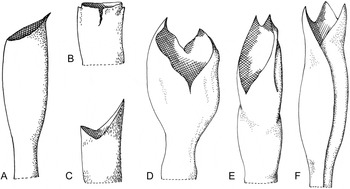
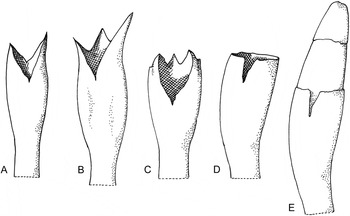
Primary, or fertile, bracts arise directly from the axis of the inflorescence and subtend a single flower in most species of Amomum in Sumatra. Bracts in Amomum are generally naviculate and ± pointed, often with a subapical mucro, although in some species (such as A. oligophyllum) they are emarginate at the apex. The bracts are often brightly coloured and the colours and shapes of the bracts can be useful in species identification. Amomum bracts also vary between species in indumentum and surface ornamentation (e.g. smooth, or striate), and either persist into fruiting or fall or disintegrate early. The bracts of some species (e.g. Amomum lappaceum) go slimy, leaving the developing fruits surrounded by a mucilaginous mass. The bracteole in Amomum is generally tubular, at least at the base, uni-, bi- or tridentate, and split unilaterally. There are, however, species (e.g. Amomum xanthophlebium Baker) in which the bracteole is open to the base and, in A. tephrodelphys K.Schum., the bracteole appears to be altogether absent. Open bracteoles are a character more normally associated with Elettariopsis, but these species differ from Elettariopsis in the non-tufted, many-bladed leafy shoots. Bracteole characters, including the length of the bracteole in relation to the calyx and the floral tube, can be very useful in distinguishing between different species of Amomum. Examples of bracteoles found in Amomum species in Sumatra are shown in Fig. 4.
Bracteole characters found in Amomum Roxb. in Sumatra. A–E. Tubular bracteoles: A. Unidentate, tooth apiculate; B. Truncate, with two subapical mucros and small tear on one side; C. Bidentate, teeth unequal; D. Inflated, bidentate, teeth unequal, pointed; E. Bidentate, teeth very small, equal, bracteole deeply split on one side; F. Bracteole open to base (not tubular), tridentate, teeth equal, pointed.

Calyx
The calyx is tubular and ± split unilaterally, usually bi- or tridentate, but rarely (e.g. Amomum hastilabium) truncate and with a small calyptra that is shed as the bud expands. The shape of the calyx and the ratio between its length and the floral tube are particularly useful for species identification in Amomum. Some examples of calyces in Amomum are given in Fig. 5.
Calyx characters found in Amomum Roxb. in Sumatra. A. Calyx bidentate; B. Calyx tridentate, teeth unequal; C. Calyx tridentate, teeth subequal with subapical mucro, calyx split unilaterally; D. Calyx truncate with short unilateral tear; E. Bud, showing truncate calyx with unilateral tear and calyptra, which will be shed as the bud expands.

Floral tube
The floral tube is ± glabrous or hairy especially towards the ovary, and sometimes it widens a little towards the join with the corolla lobes. The stamen in Amomum is not normally fused with the labellum above the level of the corolla lobes, as is the case in some other genera, including Etlingera and Curcuma, although in Amomum apiculatum there is a staminal tube of up to 1 mm long. The inner surface of the floral tube can be glabrous (e.g. Amomum calcaratum Lamxay & M.F.Newman from Laos), hairy only towards the corolla lobes (e.g. A. xanthophlebium) or hairy for the entire length and often longer-hairy towards the corolla lobes (e.g. A. hastilabium). In certain species (e.g. Amomum cerasinum) there are two swollen tubercules at the throat, which hold the style between them as it emerges from the throat.
Corolla lobes
The corolla lobes (petals) are often hooded (cucullate), the dorsal lobe being generally somewhat larger than the lateral lobes, and sometimes bearing a subapical mucro.
Labellum
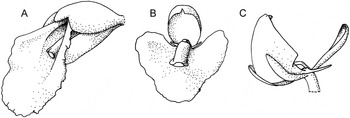
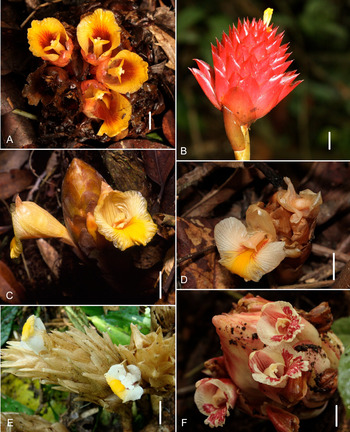
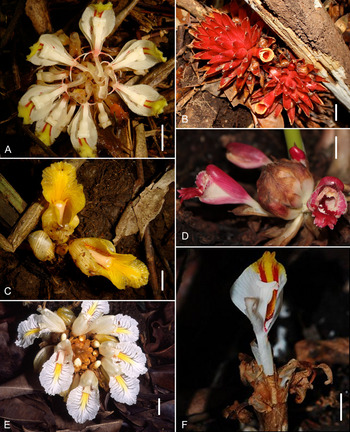
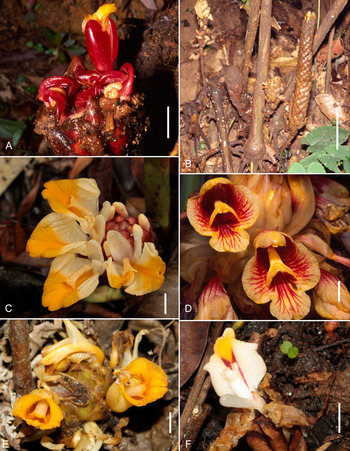
The labellum (lip) in Amomum is usually red, orange or yellow, often white at the edges with a yellow mid-band flanked with red lines or markings. In some species (e.g. Amomum cerasinum), the sides of the labellum are tucked into the corolla lobes, forming a closed, trumpet-shaped flower, corresponding to the ‘gullet’ flower type of Newman (Reference Newman1988). In certain other flowers, the sides of the labellum are free from the corolla lobes (e.g. Amomum longipes) and the labellum is spreading, corresponding to the ‘exposed’ type of Maas (Reference Maas1977) and Newman (Reference Newman1988). A third flower form has a deeply concave (saccate) labellum, the edges free from the dorsal corolla lobe (e.g. Amomum uliginosum J.Koenig). This is a form of the exposed type, called here ‘exposed saccate’. Individuals of Amomum hastilabium have been observed with exposed flowers with a spreading labellum, although the gullet form is more common. It is unclear whether this represents variation between Sumatran populations or whether it is a character that can change as the individual flowers age. Examples of flower types can be seen in Fig. 6.
Flower types found in Amomum Roxb. in Sumatra. A. Gullet flower type: sides of labellum enclosed by dorsal corolla lobe; B. Exposed flower type: labellum spreading, free from dorsal corolla lobe; C. Exposed saccate type, labellum deeply saccate and free from dorsal corolla lobe.

Lateral staminodes
Lateral staminodes in Amomum are generally absent; if present, they occur only as small swellings at the side of the base of the labellum, or are very small, 1–5 mm long, occasionally to 10 mm. In this case, they commonly take the form of small needle-like structures, sometimes with a wider base, and sometimes bifid. Occasionally (e.g. Amomum oligophyllum) the staminodes are flattened and membranous.
Stamen
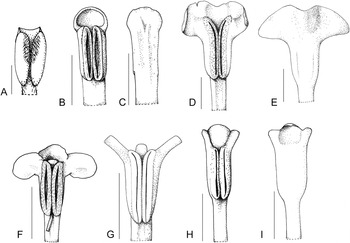
As with all Zingiberaceae, Amomum has a single fertile stamen with two pollen sacs (thecae), which clasp the style. The stigma is generally held at the apex of the thecae. In Amomum, the connective tissue between the two thecae is often extended into a crest, and variation in the forms of these crests has been used in the past to define different sections of Amomum. While phylogenetic data suggest that these sections do not reflect the genetic structure of the genus, they can still be very useful in distinguishing between species. The crest is often lobed, and can be bilobed (e.g. Amomum uliginosum), sometimes reflexed back onto the back of the anther, or trilobed. Trilobed anther crests often have the side-lobes curving around towards the adaxial side of the anther, forming a crescent-shaped structure (e.g. Amomum aculeatum). The anther crest of Amomum gyrolophos forms a rounded hood over the apex of the anther but the connective tissue between the thecae of A. apiculatum and A. tephrodelphys is not or hardly extended into a crest at all. Examples of anther crests can be found in Fig. 7. The pollen is cream or pale yellow. Kaewsri & Paisooksantivatana (Reference Kaewsri and Paisooksantivatana2007) showed that in Thai Amomum, although there is variation in the pollen structure, it is not particularly useful in species identification. Very little is known about pollination of Amomum, although bees have been observed to visit some trumpet-flowered species (e.g. A. aculeatum) and may pollinate them. It seems likely that the form of the flower may reflect the pollination.
Anther crests found in Amomum Roxb. in Sumatra. A–C. Unlobed anther crests: A. Short, truncate; B–C. Rounded hood (adaxial and abaxial views); D–I. Lobed anther crests: D–E. Bilobed (adaxial and abaxial views); F–G. Trilobed (two forms); H–I. Obscurely trilobed (adaxial and abaxial views).

Gynoecium
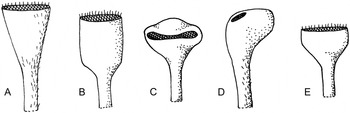
All Zingiberaceae have inferior ovaries. The ovary in Amomum is trilocular with axile placentation and many ovules in each locule. The surface of the ovary is often hairy, and can also be furnished with bumps (e.g. Amomum uliginosum) or ridges (e.g. A. dealbatum), anticipating the morphology of the fruits. The style is thread-like and clasped between the two thecae of the anther. Flexistyly has been reported in some species of Amomum but this character is largely unstudied in this genus. To the base of the style there are the epigynous glands. In Amomum of Sumatra these clasp the style, either entirely enclosing the base (as in A. cerasinum) or with a small gap between the edges (e.g. A. apiculatum). The epigynous glands are normally truncate or rounded at the apex. The form of the stigma varies widely between different species of Amomum (Fig. 8). Most species have an abruptly widening or cup-shaped stigma; in others the stigma is large (to 2 mm long) and oblong (e.g. Amomum verum Blackw., A. compactum), and in A. uliginosum the ostiole is a small round pore. The ostiole in Amomum is usually ciliate but there are species (e.g. A. uliginosum) in which it is glabrous. The morphology of the stigma has been used to differentiate between sections in Alpinia (Smith, Reference Smith1985) and it is likely that with more research it may also be important in elucidating the taxonomic structure in Amomum.
Types of stigma found in Amomum Roxb. in Sumatra. A. Cup-shaped, gradually widening; B. Oblong; C. Flattened infundibuliform with slit ostiole; D. Abruptly widening, rounded, with pore ostiole; E. Cup-shaped, abruptly widening.

Fruits
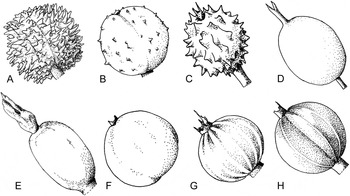
Fruit morphology in Amomum is very diverse, although all known are indehiscent. Historically, fruit morphology has been rather neglected, and several species have been described without a description of the fruits. Recent phylogenetic data (Xia et al., Reference Xia, Kress and Prince2004) suggest that fruit morphology may be an important character and could reflect the genetic structure of the genus. We have classified the fruit types after Xia et al. (Reference Xia, Kress and Prince2004) as follows: smooth, winged, echinate (spiny), lobed and ridged (see Fig. 9). The echinate group comprises several morphologies, all furnished with prickles or spines, but differing in the form, texture and spacing of these spines. The method of dispersal of the fruits is not known for most Amomum species, although the fleshy capsules and aromatic arils suggest animals may be important. The seeds in Amomum are smooth, glabrous and arillate, the aril generally being fleshy and aromatic. The number of seeds in each locule varies, from 3–4 (e.g. in Amomum ochreum) to 10–20 (A. uliginosum) and in some cases 30 (A. chinense Chun of Indochina). Seeds are 2–8 mm, rarely to 10 mm (e.g. Amomum ochreum) across and can be globose (e.g. A. cerasinum), irregularly rounded (A. longipes) or irregularly angled (A. gracile Blume).
Fruit morphology in Amomum Roxb. in Sumatra. A–C. Echinate fruits: A. Fruit spherical, spines soft, many, close together; B. Fruit globose, spines very small and widely spaced; C. Fruit ellipsoid, spines large, rigid and fleshy; D. Smooth fruit: Fruit ellipsoid, glabrous, crowned with persistent calyx; E–F. Lobed fruits: E. Fruit cylindrical, hairy, crowned with persistent calyx; F. Fruit subglobose, glabrous; G. Ridged fruit: Fruit subglobose, ribbed; H. Winged fruit: Fruit globose, winged.

Material Studied
Herbarium material from the following herbaria was studied: A, ANDA, BM, BO, E, GH, K, KRB, L, MICH, P, SING, US (herbarium codes from Index Herbariorum at http://sweetgum.nybg.org/ih/, accessed 3 June 2010), and from the herbarium at Universitas Medan in North Sumatra, which has no code yet. In the case of species which are distributed outside Sumatra, specimens have been examined but they are not cited in the account below. Type specimens at SING were examined directly but general collections were only studied from photographs. All other specimens cited have been seen unless otherwise indicated. Unless stated otherwise, the dimensions given in the descriptions are taken from fresh material for floral and vegetative characters. Floral characters in the key are taken from fresh or spirit material; vegetative characters in the key have been taken from herbarium specimens and fresh material where possible. Assessments of conservation status were carried out following IUCN guidelines (IUCN, 2000).
Systematic Treatment
Amomum Roxb., Pl. Coromandel 3: 75 (1820), nom. cons. – Type species: Amomum subulatum Roxb., Fl. Ind. 1 (1820), designated by Burtt & Smith (Reference Burtt and Smith1968).
Meistera Giseke, Prael. Ord. Nat. Pl. 205 (1792), nom. rej., vs Amomum Roxb. – Type species: Amomum koenigii J.F.Gmel.
Paludana Giseke, Prael. Ord. Nat. Pl. 207 (1792), nom. rej., vs Amomum Roxb. – Type species: Amomum globba J.F.Gmel.
Wurfbainia Giseke, Prael. Ord. Nat. Pl. 206 (1792), nom. rej., vs Amomum Roxb. – Type species: Wurfbainia uliginosa (J.Koenig) Giseke.
Geocallis Horan., Prodr. Monogr. Scitam. 33 (1862). – Type species: Geocallis fasciculata (Roscoe) Horan. (probably = Amomum aromaticum Roxb.).
Cardamomum Kuntze, Revis. Gen. Pl. 2: 685 (1891). – Type species: Cardamomum minus Kuntze.
Conamomum Ridl., J. Straits Branch Roy. Asiat. Soc. 32: 121 (1899). – Type species: Conamomum utriculosum Ridl. (= Amomum utriculosum (Ridl.) Holttum), designated by Turner (Reference Turner2000).
Paramomum S.Q.Tong, Acta Bot. Yunnan. 7: 309 (1985). – Type species: Paramomum petaloideum S.Q.Tong.
Erect, terrestrial, medium to tall aromatic herbs. Rhizome at or just below surface of ground, or supported on stilt-roots to 50 cm long, usually hairless, intervals between leafy shoots 5–70 cm. Leafy shoots several, unbranched, usually robust, swollen at base or not, 1–5 m tall; leaves usually 10–25, rarely 5–6, distichous, the lower 1/3 of leafy shoot covered with sheaths only; sheath glabrous or hairy, sometimes ciliate at margins, rarely pruinose, normally smooth, sometimes reticulate or striate. Ligule very short to long, usually 5–20 mm long, sometimes to 60 mm, broad, entire or bilobed, hairy or not. Petiole usually none or to 3 cm long, occasionally to 10 cm or more. Lamina usually linear-lanceolate or oblong, glabrous or not; base cuneate or rounded; apex acuminate or caudate. Inflorescence on a leafless shoot from rhizome, sometimes with base buried in ground. Peduncle usually 5–20 cm long, occasionally to 50 cm. Flowering head capitate, globose, ovoid or cylindrical, sometimes conical or obconical, often extending during flowering, with a succession of few to many flowers, commonly without an involucre of sterile bracts at the base, peduncle bracts grading into floral bracts. Fertile bracts all similar, open to the base, persisting until fruiting or soon disintegrating. Bracteole usually tubular, sometimes open to the base, bi- or tridentate, occasionally absent. Calyx usually trilobed, sometimes truncate. Floral tube usually about as long as calyx, sometimes longer. Corolla lobes: dorsal corolla lobe often cucullate, broadest of the three, closed with sides of labellum to form a gullet-type flower, or erect and free from labellum forming an exposed-type flower; lateral lobes narrower, usually appressed to the edges of the labellum. Labellum longer than the corolla lobes, concave or sometimes saccate, usually obovate or trilobed, widening from a narrow base, the sides erect or convolute towards the base, the apex spreading and sometimes reflexed, usually red, orange or yellow, often white at the edges with yellow mid-band flanked with red lines or markings. Lateral staminodes small or absent, if present then needle-like, bifid or flattened. Stamen usually less than 1/2 the length of the labellum, occasionally 3/4 as long, stamen free from labellum or, rarely, fused into a staminal tube to 1 mm long above the point of insertion of the corolla lobes; connective usually extended beyond apex of thecae into anther crest, crest often trilobed, with erect mid-lobe and spreading side-lobes, sometimes absent or simple and entire. Stigma usually abruptly widening, often ciliate at ostiole; style filiform. Ovary trilocular with axile placentation and many ovules. Infructescence usually in a dense head, or elongating. Fruit variable, indehiscent, a dry lobed or ridged capsule, or a smooth, ridged or aculeate fleshy berry, hairy or not; fruit stalk absent or to 4.5 cm long, pericarp dry or fleshy when ripe. Seeds several to many, angular or rounded, embedded in a fleshy, aromatic aril.
Distribution. Asia from India and Sri Lanka, southern China and the Himalayas through Southeast Asia and Malesia to New Guinea and North Australia.
The International Plant Names Index (www.ipni.org, accessed 5 June 2013) cites references to Cardamomum Noronha and Cardamomum Salisb. These are invalid names. The first valid use of the generic name Cardamomum is that of Kuntze. Cardamomum Noronha (Verh. Batav. Genootsch. Kunsten 5: article 4, p. 2 (1790)) is a nomen nudum. Cardamomum Salisb. is also a nomen nudum, even though it includes Elettaria cardamomum (L.) Maton in synonymy, because a generic name cannot be validated by a description that has already been used validly.
The International Plant Names Index and the World Checklist of Selected Plant Families (http://apps.kew.org/wcsp, accessed 5 June 2013) cite Torymenes Salisb. in synonymy under Amomum. The only species of Torymenes is T. officinalis Salisb., which is a synonym of Aframomum melegueta (Roscoe) K.Schum. so Torymenes belongs in synonymy under Aframomum.
The same sources cite Zedoaria Raf. in synonymy under Amomum. This seems to be an error. Merrill (Reference Merrill1949) identifies Zedoaria Raf. as a provisional name to be placed in synonymy under Curcuma.
Key to the species of Amomum in Sumatra
1a. Ligule > 14 mm 2
1b. Ligule ≤ 14 mm 5
2a. Ligule to 3.5 cm, membranous with robust base, petiole 5–12 cm, fruits echinate 8. A. gracile
2b. Ligule to 3.5 cm, petiole 2–5 cm, fruits smooth, slightly warty, or ridged 3
3a. Ligule bifid, inflorescence and infructescence cylindrical, fruit covered with fine longitudinal ridges and spherical 7. A. cylindraceum
3b. Ligule rounded, truncate or ± emarginate, inflorescence and infructescence not cylindrical, fruit smooth or slightly warty, globose or elongated 4
4a. Ligule truncate or ± emarginate, with no corky crust at join with petiole, lamina base cordate, often overlapping, lamina apex caudate to 3 cm, fruit globose 4. A. cerasinum
4b. Ligule simple with corky crust at join with petiole, lamina base not cordate or overlapping, lamina apex subacuminate, fruit elongated 17. A. stenocarpum
5a. Petiole > 1.5 cm 6
5b. Petiole ≤ 1.5 cm 11
6a. Plant never stilt-rooted, bracteole bi- or trilobed, anther crest bilobed and spreading, wider than the anther 7
6b. Plant stilt-rooted or not, bracteole truncate or unidentate apiculate, or bilobed anther crest obscurely trilobed or absent, not spreading 9
7a. Labellum red, and yellow or pale brownish-yellow, mid-lobe of labellum not lobulate, lateral staminodes subulate, to 1 cm 15. A. ochreum
7b. Labellum red and white, mid-lobe of labellum lobulate, lateral staminodes wide and ± bifid, to 7 mm long 8
8a. Laminae to 44 × 10.5 cm, leaf base rounded but not cordate, style thickened and with two distichous rows of hairs towards stigma, fruits echinate 14. A. mentawaiense
8b. Laminae to 67 × 21 cm, leaf base cordate, style not thickened or hairy towards stigma, fruits almost smooth, slightly warty 4. A. cerasinum
9a. Leafy shoot smooth, bracteole unidentate, apiculate, anther crest absent or to 2 mm, fruits elongated, rough 2. A. apiculatum
9b. Leafy shoot reticulate, bracteole bidentate, anther crest obscurely trilobed, fruits globose with longitudinal ridges 10
10a. Labellum clearly trilobed, thecae pale pink or cream, red around opening, leafy shoot with ≥ 10 laminae 12. A. laxesquamosum
10b. Labellum rhomboid to sub-trilobed, thecae dark brown, leafy shoot with 5–6 laminae 16. A. oligophyllum
11a. Leaf base decurrent to petiole 12
11b. Leaf base not decurrent to petiole 13
12a. Bracteole ± completely enclosing calyx, bracts soft, papery, buff-coloured 20. A. verum
12b. Bracteole significantly shorter than calyx, bracts firm-textured, buff with chocolate-brown edges 6. A. compactum
13a. Peduncle > 24 cm 5. A. citrinum
13b. Peduncle ≤ 24 cm 14
14a. Labellum largely white or cream with yellow mid-band flanked with few red markings 15
14b. Labellum entirely yellow, red or pink, or orange-yellow with red markings, or white and yellow without red markings, or white and yellow with so many red markings that the side-lobes look red 16
15a. Calyx truncate, calyptrate, labellum not saccate, fruits ridged 10. A. hastilabium
15b. Calyx trilobed, not calyptrate, labellum saccate, fruits echinate 19. A. uliginosum
16a. Anther crest lobed and spreading 17
16b. Anther crest very short or absent, or rounded, not spreading 20
17a. Bracteole open to the base, fruits ± cylindrical, without spines or ridges 21. A. xanthophlebium
17b. Bracteole tubular at least at base, fruits globose, echinate or ridged 18
18a. Edges of labellum free of corolla lobe, labellum yellow or yellow and cream, lateral staminodes absent 13. A. longipes
18b. Edges of labellum closed with dorsal corolla lobe to make a cup-shaped flower, labellum yellow or orange with red markings, lateral staminodes present 19
19a. Plant never stilt-rooted, sheath not reticulate, fruits echinate 1. A. aculeatum
19b. Plant often stilt-rooted, sheath strongly reticulate, fruits ridged 12. A. laxesquamosum
20a. Inflorescence lax, bracteole absent, labellum dark red 18. A. tephrodelphys
20b. Inflorescence compact, bracteole present, tubular, labellum yellow or pale pink without red markings 21
21a. Bracteole truncate, or bi- or tridentate, labellum trilobed, anther crest rounded 22
21b. Bracteole unidentate, labellum oblong or obovate, not trilobed, anther crest truncate or very short 23
22a. Plant not stilt-rooted, margins of sheaths membranous and papery, underside of leaf hairy, anther crest a rounded hood over the top of the anther 9. A. gyrolophos
22b. Plant stilt-rooted, margins of sheath not membranous or papery, underside of leaf glabrous except at margins, anther crest very short, rounded 11. A. lappaceum
23a. Bracts bright red, flowers clear yellow, bracteole apiculate 2. A. apiculatum
23b. Bracts dark pink or dark pinkish-red with white tips, flowers pale pink, bracteole acute 3. A. centrocephalum
1. Amomum aculeatum Roxb., Asiat. Res. 11: 344 (1810). – Cardamomum aculeatum (Roxb.) Kuntze, Revis. Gen. Pl. 2: 686 (1891). – Type: see notes below. Figs 10, 30A.
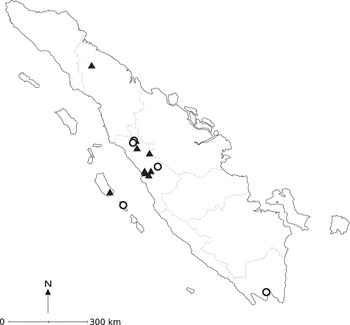
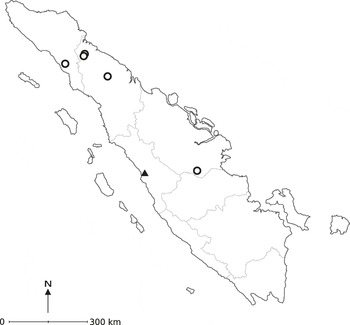
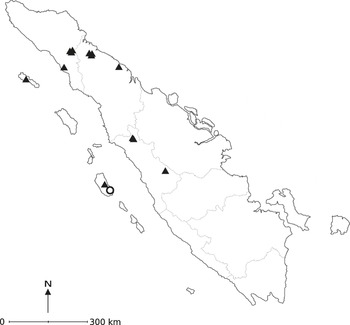
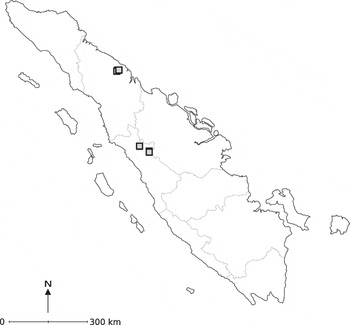
Distribution of Amomum aculeatum Roxb. (circles) and A. apiculatum K.Schum. (triangles) in Sumatra.

Rhizome subterranean, stout. Leafy shoot 3.5–5.7 m tall with up to 27 closely spaced laminae, first lamina 80–100 cm from base; sheath mid-green, sparsely hairy, bumpy, ciliate at margins, base of shoot swollen to 7.5 cm diameter, pale. Ligule 5–9 mm long, ± emarginate, short-hairy, ciliate at margin. Petiole 8–13 mm long. Lamina oblong-lanceolate, 17–49.5 × 3.6–9 cm; upper surface smooth, glabrous, bright green with wide pale straw-coloured midrib; lower surface pubescent along midrib; base rounded; apex gradually narrowing. Inflorescence arising from base of leafy shoot, (including peduncle) to 28 cm long, with up to 40 flowers. Flowers open 1–4 at a time, standing in a crown with older flowers brownish but initially keeping their shape. Peduncle stout, subterranean, 12.5–19 cm long, horizontal and white, turning vertical and brown towards inflorescence; peduncular bracts increasing in size from base to 4 × 3.7 cm, oblong with rounded apex and with or without a small subapical mucro, stiff, hairy and ciliate at margins. Flowering head ovoid, compact, extending with time. Fertile bracts 3 × 0.7 cm, thin, oblong with rounded apex, brownish, slimy and soon decaying, hairy. Bracteoles 2 cm long, tubular, slightly trilobed at apex, short-hairy, translucent pink. Flower 5–6.5 cm long, pedicel 5–6 mm long; gullet type. Calyx 2.3–2.5 cm long, tubular, trilobed and split 1 cm down one side, sparsely hairy, translucent pink and darker at ovary. Floral tube 2.2 cm long, shorter than calyx, very-short hairy, pale yellow. Corolla lobes yellowish-pink; dorsal corolla lobe to 3 × 2 cm, cucullate; lateral lobes 3 × 1 cm, ± cucullate. Labellum 4 × 4 cm when flattened, trilobed, yellow with many dark red dots and lines at centre; mid-lobe deflexed and ± emarginate, to 0.7 × 1 cm, dark yellow; trumpet-shaped, margins crinkled, pale yellow. Lateral staminodes 3 mm long, subulate, yellow with many small red dots. Stamen 2.4–2.7 cm long. Filament 14–16 × 2 mm, yellow with pink dots. Anther 1–1.1 cm long, thecae not diverging towards apex, dehiscing by slits, yellow; pollen yellow-cream; anther crest of three separate lobes; mid-lobe 2 mm long, hemispherical; side-lobes from backs of thecae, spreading, each 5 × 3 mm, yellow. Stigma bulbous with slit ostiole, pinkish-white, held 1 mm above top of thecae; style white. Ovary 5.5–7 mm long × 4 mm wide at widest, swollen towards floral tube, verrucose, short-hairy; epigynous glands 2.2–4 mm long, yellowish, clasping style. Infructescence with 2–many fruits. Fruits 1.5–3.5 × 1.3 cm, ovoid, covered with irregular spines and crowned with persistent calyx; developing fruits pink-red, maturing dark red, fruit stalk 1.4 cm long.
Distribution. Thailand, Peninsular Malaysia, Sumatra, Java.
Habitat and ecology. Rainforest or secondary forest in shade or semi-shade; 238–267 m.
Proposed IUCN conservation status. Data Deficient (DD). This is a species complex and although, as currently circumscribed, it has a very wide range and is common, it may be resolved into a number of more restricted-range species. For now it has to be assessed as Data Deficient.
Specimens examined. Sumatera. Lampung: 3 vii 1880, H.O. Forbes 1289 (SING). Sumatera Barat: Nagari Solok Ambah, 23 vii 2009, Nurainas & A. Anggara 2107 (SING); Pasaman, Lubuksikaping, Rimbo Panti, 13 viii 2009, A.J. Droop et al. 103 (BO, E); ibid., 12 viii 2009, A.J. Droop et al. 96 (ANDA, BO, E); Pulau Sipura, 24 x 1924, C. Boden Kloss 14768 (SING).
The peduncles on the types of Amomum aculeatum and A. flavum Ridl. appear to be quite short, and the protologue of A. flavum mentions a peduncle of 1.5 inches (3.8 cm). However, the peduncles of W. Kaewsri KW6 from Thailand, and A.J. Droop et al. 96 and A.J. Droop et al. 103 from Sumatra, are between 16 and 20 cm long. There is also some variation in flower colour. Those of Sumatran plants are yellow with red spots centrally, while those of W. Kaewsri KW6 from Thailand are white with a yellow central band and red spots centrally. Amomum aculeatum is similar to A. elephantorum Pierre ex Gagnep. in several respects, including the shape of the laminae, the ligule, the ovate or globose compact inflorescence and in the undivided lateral staminodes. The species differ in that Amomum elephantorum has a much broader anther crest with a much less distinct mid-lobe, very large (to 5 cm wide) bracts at the base of the inflorescence, which are absent from A. aculeatum, and glabrous laminae, whereas A. aculeatum has laminae that are hairy at least along the midrib on the lower surface. The identity of Amomum aculeatum in relation to A. echinocarpum Alston is, however, unclear. Plants from southern Thailand and Sri Lanka which superficially resemble Amomum aculeatum, but for the white labellum, may represent a variety of A. aculeatum. Further work on this complex is necessary before the identities of these two taxa can be confirmed. Research on all Roxburgh’s species of Amomum is under way to typify each name and to circumscribe the species in more detail (Droop et al., in prep.).
2. Amomum apiculatum K.Schum., Bot. Jahrb. Syst. 27(3): 315 (1899). – Type: Indonesia, Sumatra, Sumatera Barat, Padang, Ayer Mancior (Air Mancur), 360 m, viii 1878, O. Beccari 513 (lecto FI [3 sheets numbered 10679, 10679A & 10679B], designated here (images viewed only); isolecto BM, K). Figs 10–11, 30B.
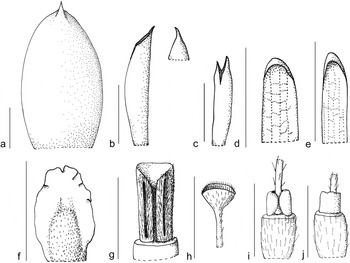
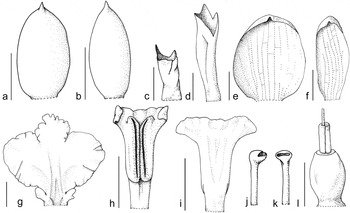
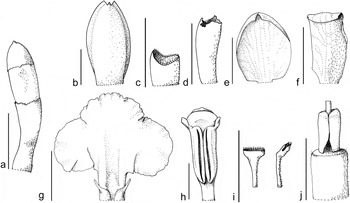
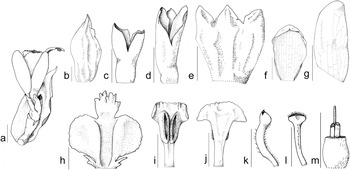
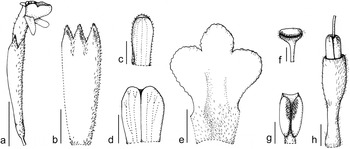
Amomum apiculatum K.Schum. a. Bract; b. Bracteole and tip of bracteole; c. Calyx; d. Dorsal corolla lobe; e. Lateral corolla lobe; f. Labellum; g. Anther; h. Stigma; i–j. Two views of epigynous glands and ovary. a–f scale bar = 1 cm; g–j scale bar = 5 mm. All drawn from A.J. Droop 72 by A.J. Droop.

Rhizome stilt-rooted to 27 cm, 4–6 cm between neighbouring leafy shoots. Leafy shoot to 1.9 m tall with up to 19 laminae, slender, drooping slightly towards tip of shoot, first lamina at 60–90 cm; sheaths smooth, hairy especially towards base of shoot and ± hairy at margins. Ligule 6–8 mm, entire, glabrous or ± hairy at margins. Petiole from 0.7 cm on young laminae to 2.5–3 cm on older laminae, very slender, hairy. Lamina elliptical, 22–27 × 6.5–8.5 cm, bright green, undulating, margins ciliate; midrib on both surfaces densely short-hairy, lamina otherwise glabrous; base rounded, slightly unequal; apex acuminate or sub-caudate, twisting. Inflorescence from base of leafy shoot, (including peduncle) to 25 cm long, with up to 60 flowers. Flowers open one at a time. Peduncle 13–17 cm long, densely hairy; peduncular bracts oblong and mucronate, stiff, hairy, greenish-pink to dark pink. Flowering head compact, globose to ovate, 6–8 × 4.5–5 cm. Fertile bracts to 4 × 2.2 cm, oblong to elliptic, sharply pointed, stiff, smooth, bright red. Bracteoles 2.3 cm long, glabrous, tubular only at base with sides wrapped around each other and overlapping, stiff, sharply pointed and curving away from calyx. Flower 4 cm long, not or hardly pedicellate. Calyx 2 cm long including ovary, tubular, bidentate and split 4 mm down one side, glabrous or with a few tiny hairs, pale pink. Floral tube 3 cm long including ovary, hairy, pale pink. Corolla lobes translucent yellow; lateral lobes 10 × 2.5 mm, dorsal lobe a little wider. Labellum 10 × 6 mm when flattened, obovate and slightly emarginate at apex, sides curved round towards throat, bright yellow; base narrow, hairy. Lateral staminodes absent. Stamen 6 mm long. Filament absent. Anther 6 × 1.5 mm, thecae held a little apart, not diverging, dehiscing by slits, densely hairy, pale yellow; anther crest absent. Stigma pale yellow, flattened globose with slit opening, densely hairy; style hairy, pale yellow. Ovary cylindrical, 3 × 1.5 mm, smooth, sparsely hairy; epigynous glands 1.5 mm long, truncate, not fully enclosing style on one side. Fruits included in persistent bracts, developing at base of fruiting head, 3 cm long, ovate, smooth, crowned with persistent calyx, dark red at apex, otherwise yellowish-pink.
Distribution. Sumatra.
Habitat and ecology. Shaded places in primary or secondary rainforest, often near water, fairly common; 20–1645 m.
Proposed IUCN conservation status. Least Concern (LC). Although this species is endemic to Sumatra it is widespread throughout two provinces and locally very common.
Specimens examined. Sumatera. 11 xii 1879, O. Beccari 518 (K). Sumatera Barat: 17 ii 2004, A.D. Poulsen et al. 2235 (E); Lembah Harau Nature Reserve, 8 viii 2009, A.J. Droop et al. 85 (ANDA, BO); Padang, 9 viii 2008, A.J. Droop et al. 5 (ANDA, E); ibid., 29 vii 2009, A.J. Droop & W.H. Ardi 72 (ANDA, BO, E); Padang, Air Sirah, 5 v 1985, de Vogel & J.J. Vermeulen 7477 (E, L); Pasaman, Lubuksikaping, Rimbo Panti, 14 viii 2009, A.J. Droop et al. 120 (BO, E); Lembah Anai, Air Mancur, A. Takano et al. 2028 (BO); Ulu Gadut, M. Hotta 25093 (BO); ibid., M. Hotta et al. 93 (BO). Pulau Siberut: 24 ii 2004, A.D. Poulsen et al. 2247 (E); ibid., 19 x 1924, C. Boden Kloss 14514 (SING). Sumatera Utara: Berastagi, 25 viii 2008, A.J. Droop et al. 42 (ANDA, BO, E).
The floral measurements for this species were taken from a single flower. This is a very strange species of Amomum, the absence of the anther crest and the stilt-roots suggesting that it may rightly belong in Hornstedtia, although the labellum and stamen remain fused for perhaps 1 mm above the join with the corolla lobes, which is a character more associated with Etlingera. Genetic evidence may help to decide where this plant belongs.
The collecting information on the type specimen differs from that in the protologue as follows: the protologue gives the collection date as April 1878 while the specimen label gives it as August 1878; the protologue gives the collection altitude as 300 m while, on the specimen label, it is 360 m. It is not possible to be sure which specimens Schumann saw so these differences cannot be explained.
3. Amomum centrocephalum A.D.Poulsen, Blumea 48(3): 524 (2003). – Geanthus echinatus Valeton, Bull. Jard. Bot. Buitenzorg, Ser. 3, 3: 143 (1921). – Type: Indonesia, Sumatera, Sumatera Barat, Gunung Talaman, 1800 m, 9 v 1917, H.A.B. Bünnemeyer 666 (holo BO). Fig. 12.
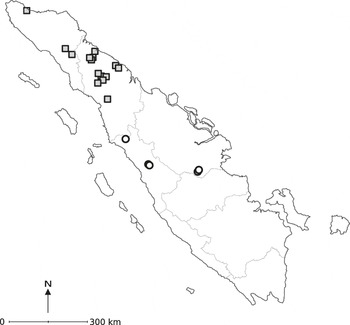
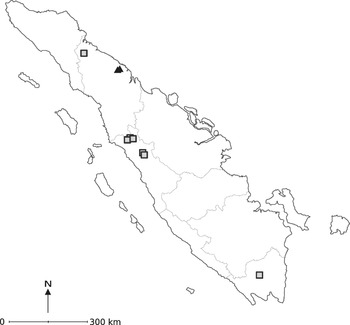
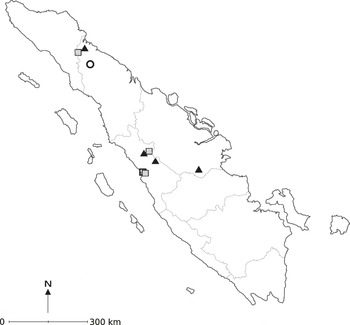
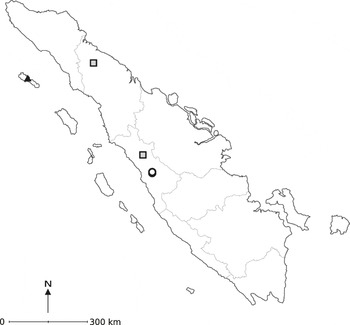
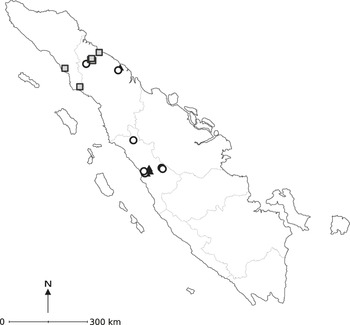
Distribution of Amomum centrocephalum A.D.Poulsen (squares) and A. cerasinum Ridl. (circles) in Sumatra.

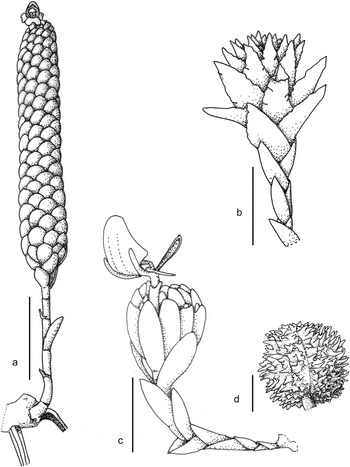
Rhizome held 9–43 cm above the surface of the ground by slender stilt-roots, densely hairy and covered with hairy, acute, striate, short scales 2.1–2.3 × 2.6–3.2 cm. Leafy shoot 1–3 (rarely to 5 m) tall, with up to 18 laminae, first lamina 30–60(–90) cm from base; smooth, glabrous or slightly hairy below ligule. Ligule 1–3 mm long, entire, rounded, glabrous or hairy. Petiole short but distinct, 0.4–1 cm long, narrow, glabrous or very-short hairy. Lamina oblong-lanceolate or almost ovate, 24–35.5 × 3.4–6.5 (rarely to 8.8) cm, smooth, glabrous on both sides and at margins; midrib prominent on both sides, straw-yellow; base rounded; apex acute, acuminate-caudate. Inflorescence from base of leafy shoot, (including peduncle) to 15.5 cm long, with numerous flowers. Flowers open one at a time. Peduncle 2.5–9.5 cm, rachis hairy, covered with closely imbricate scales; scales sheathing, short, acute with mucro at apex, stiff–leathery, to 1.6–2.8 × 1.8–2.9 cm, sparsely hairy and ciliate or not at margins, drying chestnut-brown and shiny. Flowering head compact, capitate-globose, 2.8–6 × 2.5–6.5 cm wide. Fertile bracts wide, ovate to almost orbicular, 2.1–3.2 × 1.9–2.9 cm, spiny-acuminate, concave, fleshy-leathery, stiff, sparsely hairy, dark red or dark pinkish-red with white tip. Bracteoles short spathaceous-cymbiform, acute, enclosing the short calyx. Flower 3.5 cm long, sessile, incurved, compressed, pink. Calyx tubular, split to a quarter of the way down one side, tridentate with spined lobes, lobes minute, sericeous-puberulent at first. Floral tube 2.5 cm long, enclosed by calyx. Corolla lobes oblong, subequal in length, erect, hairy; dorsal lobe 8 × 5 mm, lateral lobes 8 × 3.5 mm, cucullate. Labellum about as long as petals, 8 × 4 mm, oblong with thickened margins and bifid apex, lobes rounded and recurved in vivo, pale pink and rimmed with white; base densely velvety with soft hairs, throat narrow. Lateral staminodes subulate, 2 mm long, free but resting along margins of labellum, hairy at base, densely so along central line, otherwise glabrous. Stamen 4 mm long. Filament 2 mm. Anther 2 mm, thecae tomentose and diverging slightly towards apex; anther crest absent. Stigma obtrigonal with a subapical linear ostiole; style hairy. Ovary 3.5 × 2.5 mm, ellipsoid, smooth, hairy; epigynous glands short, 1 mm long, truncate, sub-bifid, with lobulate apex marked with numerous small depressions, connate to style. Fruit not seen.
Distribution. Sumatra.
Habitat and ecology. Evergreen forest; 15–2180 m.
Proposed IUCN conservation status. Least Concern (LC). Although this species is endemic to Sumatra, it is widespread in northern Sumatra.
Specimens examined. Sumatera. Aceh: 11 iii 2008, P. Wilkie et al. PW694 (E); Bandar Baru, J.A. Lörzing 4758 (BO); Kutacane, 22 vi 1979, W.J.J.O. de Wilde & B.E.E. de Wilde-Duyfjes 18576 (BO, L); Gunung Mamas, 24 iii 1975, W.J.J.O. de Wilde & B.E.E. de Wilde-Duyfjes 15807 (L). Sumatera Utara: Asahan, 8 x 1936 – 16 xi 1936, Rahmat Si Boeea 10325 (L, MICH); ibid., 28 x 1936, Rahmat Si Boeea 10640 (L, MICH); Asahan, Aek Liang, 15 x 1936 – 11 xi 1936, Rahmat Si Boeea 10786 (L, MICH); Danau Toba, 16 ii 1936, J.A. Lörzing 17098 (L); Danau Toba, Aek Mandosi, 1 x 1936 – 6 x 1936, Rahmat Si Boeea 10266 (L, MICH); Gunung Ketambe, 19 vii 1972, W.J.J.O. de Wilde & B.E.E. de Wilde-Duyfjes 13762 (L); Gunung Sibayak, 5 ii 1929, J.A. Lörzing 15138 (L); Sibolangit, J.A. Lörzing 7127 (BO); Parapat, 8 vii 1972, W.J.J.O. de Wilde & B.E.E. de Wilde-Duyfjes 13490 (L); ibid., 24 viii 2008, A.J. Droop et al. 29 (ANDA, BO, E); Sidikalang, Baniara, 28 iii 1954, A.H.G. Alston 14880 (L); Sipirok, Sibual-buali, 18 v 1993, J.J. Afriastini 2368 (L).
This species shares with Amomum apiculatum several characters uncommon in Amomum. The plants are stilt-rooted and have little or no anther crest, and the floral bracts are sharply and stiffly pointed. Furthermore, the small, narrow flowers have an inconspicuous labellum, and the globose flowering head is capitate, compact and stands on an erect peduncle. These two species are both endemic to Sumatra and are likely to be closely related, and the stilt-roots, lack of anther crest and small, simple labellum also suggest a relationship with Amomum angustipetalum S.Sakai & Nagam. from Borneo. Further genetic evidence is required to elucidate their exact position within Amomum and the Zingiberaceae.
The combination Amomum echinatum could not be used for this species because A. echinatum Willd. has priority so a new name was published when this Sumatran species was classified in Amomum (Poulsen, Reference Poulsen2003).
4. Amomum cerasinum Ridl., J. Straits Branch Roy. Asiat. Soc. 46: 237 (1906). – Type: Malaysia, Sarawak, Gunung Matang, ix 1904, H.N. Ridley 12421 (holo K). Figs 12–13, 30F.
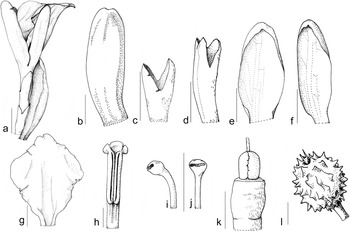
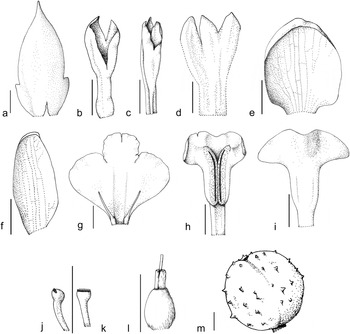
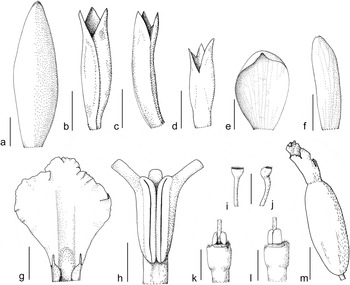
Amomum cerasinum Ridl. a. Sterile bract; b. Fertile bract; c. Bracteole; d. Calyx; e. Dorsal corolla lobe; f. Lateral corolla lobe; g. Labellum; h. Anther, adaxial view; i. Anther, abaxial view, flattened; j–k. Two views of stigma; l. Epigynous glands and ovary. a–b scale bar = 2.5 cm; c–i and l scale bar = 1 cm; j–k scale bar = 5 mm. All drawn from A.J. Droop 160 by A.J. Droop.

Rhizome subterranean, staining bright orange, neighbouring leafy shoots 15–40 cm apart. Leafy shoot to 5 m tall, first 1/3 covered with sheaths only, smooth, pale brown, glabrous and pruinose, the young shoots appearing almost white. Ligule 1.2–1.7 cm long, truncate or ± emarginate, glabrous, pruinose. Petiole 5 cm long, glabrous or sparsely hairy. Lamina oblong, large, 60–67.5 × 20–21 cm, slightly plicate with prominent secondary veins, softly hairy below and at margins; base rounded and cordate with overlapping lobes on older laminae, apex caudate to 3 cm. Inflorescence arising from near base of leafy shoot, (including peduncle) to 31 cm long, with up to 40 flowers. Flowers open 3–4 at a time; gullet type. Peduncle 14–24 cm long; peduncular bracts densely imbricate, grading into sterile bracts at base of inflorescence, pale green or pinkish, increasing in size from base, short-hairy, firm, waxy. Flowering head ovoid with pointed apex, to 7 × 6 cm; flowers extending only about 1 cm above bracts; with a ring of sterile bracts at base. Sterile bracts 7.4 × 4.2 cm, broadly oblong with pointed apex, cream with pink margins, hairy at base, otherwise very-short hairy or almost glabrous, firm, waxy and crisp. Fertile bracts 6.8 × 3.2 cm, oblong with pointed apex, smooth and somewhat hairy, cream, pink towards apex. Bracteoles 2.5 cm long, tubular, unequally tridentate, transparent white. Flower to 7.5 cm long, sessile or on pedicel to 2 mm long. Calyx 3.1–3.3 cm long including ovary, tubular, bilobed, lobes pointed, short-hairy, especially at base, white. Floral tube 2.5–2.7 cm long, shorter than calyx, white with pinkish tinge, hairy especially towards ovary. Corolla lobes: dorsal lobe 3.1–3.4 × 2.4–2.7 cm when flattened, ± lanceolate and cucullate, dark cherry-red and white at apex on convex surface, underside pale pink with dark red longitudinal lines; lateral lobes lanceolate, 2.4–2.5 × 1 cm with apex curved away from labellum, white or pale pink with dark pink longitudinal lines. Labellum 4.2 × 4.7 cm, with three distinct lobes, white on underside, upperside ± cherry-red with white markings, or white with cherry-red or pink markings from mid-band spreading into mid-lobe and top of side-lobes, hairy in middle towards throat; side-lobes curved up and forming a closed cup with the dorsal corolla lobe, mid-lobe curved downwards, apex crinkled with 6–7 lobules. Lateral staminodes 6.5–7 × 3.5 mm and flattened, unequally bifid, cherry-red with white margins or white with red dots towards base. Stamen 2.5–2.6 cm long. Filament 13 × 2.5 mm, cream with red dots, or pale pink. Anther 12–13 × 6.5 mm, creamy white, thecae not diverging, with pointed apices, glabrous except near slit, where they are very-short hairy, and apex, where the hairs are much longer; anther crest crescent-shaped, spreading, wider than long, 4 × 20 mm, red or cream-coloured. Stigma small, flattened, globose with slit ostiole, held at top of thecae, cream; style filiform, cream. Ovary very large, prolate spheroid, to 10 × 7 mm, smooth, short-hairy, white; epigynous glands clasping style and tightly closed together, 6.5 mm long, truncate, cylindrical. Infructescence to 14 cm across, and spherical with 15 or more fruits. Fruits 3.5–4 cm across, globose, smooth or slightly warty, immature fruit greenish, mature yellowish-brown. Seeds irregular, many in each locule.
Distribution. Sumatra, Borneo.
Habitat and ecology. Shaded places on damp ground or near water, scarce; 130–1088 m.
Proposed IUCN conservation status. Vulnerable (VU) B1ab(iii). Vulnerable by extent of occurrence estimated < 20,000 km2, known from < 10 localities only on Sumatra (3) and Borneo (1) in primary rainforest, and is locally uncommon. The Southeast Asian forests are suffering severe declines in quality and extent due to agriculture and population pressures.
Specimens examined. Sumatera. Riau: Bukit Tigapuluh, 17 xi 1988, J.S. Burley & Tukirin 1538 (A, BO); ibid., 30 vii 2006, A.D. Poulsen et al. 2434 (BO, E). Sumatera Barat: Gunung Malintang, 31 vii 1918, H.A.B. Bünnemeyer 4151 (BO); Solok, Simanau, 18 viii 2009, A.J. Droop et al. 154 (BO, E); ibid., 19 viii 2009, A.J. Droop et al. 160 (ANDA, BO, E).
This species is easily recognised by its large laminae with rounded overlapping bases and caudate apices, the pruinose sheath, and the white and red flowers. There is considerable variation in the flower colour of the Sumatran plants. The flowers of A.D. Poulsen et al. 2434 from Riau are much redder than those of collections from Sumatera Barat, the lobes of the labellum being almost entirely cherry-red, with only some creamy lines towards the centre at the throat, whereas the labellum of A.J. Droop et al. 160 is mostly pale with dark pink markings centrally. Furthermore, while the dorsal corolla lobe is dark reddish-pink in both A.J. Droop et al. 160 and A.D. Poulsen et al. 2434, the lateral lobes in A.J. Droop et al. 160 are pale pink with creamy stripes, whereas those on A.D. Poulsen et al. 2434 are as dark as the dorsal lobe. The plant collected from the type locality has an anther crest that is marked with small red spots; those from Sumatra have clear pale creamy-yellow crests. The protologue mentions white bracts; in all the Sumatran specimens examined the bracts are pale creamy pink, darker pink towards the margins, and with a narrow red or dark pink margin. Ridley (Reference Ridley1906) mentioned in the protologue that the bracteole was lanceolate. He may have mistaken the sterile outer bract for a floral bract, and the floral bract for the bracteole. This would explain the mysterious ‘epicalyx’ also described by Ridley, which, on the Sumatran specimens, are the short tubular bracteoles, although they have only two pointed lobes rather than the three mentioned by Ridley. It is possible to see from the type specimen that there is a short tubular bracteole, perhaps half the length of the calyx. It is not possible to see how many lobes it has but there are at least two.
5. Amomum citrinum (Ridl.) Holttum, Gard. Bull. Singapore 13(1): 207 (1950). – Conamomum citrinum Ridl., J. Straits Branch Roy. Asiat. Soc. 32: 121 (1899). – Type: Malaysia, Perak, 1891, H.N. Ridley 2959 (lecto K, designated by Turner (2000: 19)). Fig. 14.
Amomum cylindrostachys Ridl., J. Straits Branch Roy. Asiat. Soc. 61: 42 (1912). – Type: Malaysia, Selangor, iv 1911, H.N. Ridley 15614 (holo SING).
Distribution of Amomum citrinum (Ridl.) Holttum (triangles) and A. compactum Sol. ex Maton (squares) in Sumatra.

Rhizome stout, stilt-rooted. Leafy shoot smooth, glabrous. Ligule entire, to 1 cm long, glabrous. Petiole 5–7 mm long, sparsely hairy. Lamina elliptic, 38–41 × 8–11 cm, margins short-hairy on lower surface, laminae otherwise glabrous; base ± narrowly cuneate, apex rounded and with short acumen. Inflorescence and flowers not seen, but see Holttum’s description of the flowers of Malaysian plants, below (Holttum, Reference Holttum1950). Infructescence arising from near base of leafy shoot, (including peduncle) 49 cm, with many fruits. Peduncle 25–40 cm long; peduncular scales loose and barely as long as internodes between them, large and broad, to 6.5 × 1.3 cm, papery, blunt at apex, glabrous, striate. Flowering head cylindrical, to 9 × 4.5–5 cm wide. Fertile bract to 2.3 × 1.2 cm, triangular, sharply pointed at apex, persisting, thin but firm-textured, glabrous. Fruits 1.3–1.4 cm diameter, globose on very short pedicel, finely ridged especially towards apex, glabrous or with tiny short hairs.
Distribution. Peninsular Malaysia, Sumatra.
Habitat and ecology. There is no altitude or ecological information on the Sumatran specimen. Holttum (Reference Holttum1950) mentioned collections from 3500 feet (1067 m) from Peninsular Malaysia.
Proposed IUCN conservation status. Vulnerable (VU) B1ab (iii). Vulnerable by extent of occurrence estimated < 20,000 km2, known from < 10 localities only on Sumatra and Peninsular Malaysia in primary rainforest. The forests in Peninsular Malaysia and Sumatra are suffering severe declines in quality and extent due to agriculture and population pressures.
Specimens examined. Sumatera. Sumatera Utara: Asahan, 11 x 1936 – 2 xii 1936, Rahmat Si Boeea 11208 (A, L, MICH); ibid., Lumban Ria, 12 v 1934, Rahmat Si Boeea 7755 (SING).
Fresh material of this species was not available from Sumatra and the above description was made from herbarium specimens only. This is a plant originally collected from Maxwell’s Hill in Peninsular Malaysia, and we do not find it surprising that a specimen was found in Asahan in North Sumatra. It has an inflorescence that looks very like that of Amomum squarrosum Ridl., but differs in that the bracts are broader and not reflexed, and the peduncles are very long, reaching 25–40 cm. Furthermore, the petioles are significantly shorter and the laminae broader than in Amomum squarrosum, even allowing for the Sumatran plants having a slightly longer petiole (5–7 mm) than the Peninsular Malaysian plants. Holttum (Reference Holttum1950) described the species as having a yellow labellum with cream side-lobes, and anther crest that is lobed and spotted with red, the side-lobes being red, and the fertile bracts as being completely green.
6. Amomum compactum Sol. ex Maton, Trans. Linn. Soc. London 10: 251 (1811). – Zingiber compactum (Sol. ex Maton) Stokes. – Type: Indonesia, Pulau Penaitan, 11 x – 24 xii 1770, J. Banks & D.C. Solander s.n. (lecto BM, designated by A.J. Droop in Droop et al. (2013: 1293)). Figs 14, 32F.
Amomum kepulaga Sprague & Burkill, Bull. Misc. Inform. Kew 35 (1930). – Amomum cardamomum auct., non L.: Roxb., Asiat. Res. 11: 343 (1810). – Type: Pl. Coromandel 3: 21, t.227 (1819) (lecto, designated by A.J. Droop in Droop et al. (2013: 1293)).
Rhizome subterranean, with 5–10 cm between leafy shoots. Leafy shoot to 1.5 m tall with up to 16 laminae, slightly swollen at base, pale yellow-green, reddish or not at base, first lamina at 30 cm or more from base. Ligule very short, 1–2 or rarely to 5 mm long, broad. Petiole absent, or present and with basal margins of leaf decurrent along it. Lamina broadly lanceolate to ovate in lower laminae to narrowly lanceolate in upper, 41–42 × 10.5–17 cm, secondary veins prominent, surface of leaf slightly wavy; lower surface mid-green; upper surface dark green; base narrowing and decurrent to petiole; apex long-acuminate, twisting. Inflorescence arising from near base of leafy shoot, mostly buried in the earth, with only the upper part of the inflorescence showing above, (including peduncle) 10–16 cm long and extending somewhat with age, with many flowers. Flowers open 1–2 at a time. Peduncle erect, 4.5–8 cm long, peduncular bracts closely imbricating, pink, increasing in size from 2 mm at base to 3 cm at inflorescence. Flowering head cylindrical, compact, 5.5–8 × 2.5 cm, flowers extending 1.3 cm above bracts. Fertile bracts 2.4–3 × 1.5 cm at base, buff-coloured with darker brown margins, firm-textured, narrowly triangular and strongly naviculate, sometimes appearing folded down the middle, striate, with 1.5 mm long, weak hairs at margin. Bracteoles 1.8–1.9 cm long, tubular, bidentate, teeth unequal, acute, split ± 6 mm unilaterally, pale buff-coloured but pinkish or brownish at apex, sparsely hairy, more so at base. Flower sessile, to ± 3 cm long; exposed type. Calyx 2.5–2.8 cm long including ovary, protruding some way above bracteole, tridentate, teeth small and equal in size; calyx white or cream-coloured and darker at tips of teeth, sparsely short-hairy. Floral tube 2.3–2.8 cm long, ± equalling calyx, white, glabrous except at ovary. Corolla lobes translucent-white, cucullate; dorsal lobe 12–17 × 6 mm, erect, lateral lobes 10–15 × 5 mm, lying flat against labellum. Labellum 1.8–2.2 × 1.4–2.2 cm wide, widening abruptly to ovate from narrow base, strongly convex but not saccate, ± bifid at apex, margins of side-lobes recurved; white or creamy-white, with bright yellow central band flanked with thin, dark-red lines, and widening into a bright yellow apex. Lateral staminodes absent. Stamen 10–11 mm long, white. Filament 7 mm long, wide and widest (to 3 mm) in middle. Anther reflexed, 3–4 mm long, thecae parallel and held together when fresh, apart when older; anther crest white, trilobed, lobes quite separate, each about 3 × 2 mm, mid-lobe leaning back and supporting the stigma. Stigma large, to 2 × 1.5 mm, white, oblong and cup-shaped, ostiole fringed with hairs, resting on middle lobe of anther crest and held some way above apex of thecae. Ovary stout, cylindrical, 4–5 × 3.5 mm, smooth, densely hairy. Fruit subglobose, lobed, sometimes with very fine ridges appearing at apex, 1–1.2 cm across, slightly broader than long, ± hairy and enclosed by persistent bracts, pale buff-coloured or pinkish-brown. Seeds 2–3 mm across, irregularly rounded or ± angled, 6–8 per locule.
Distribution. Sumatra, Java.
Habitat and ecology. Dry secondary and degraded forests, forest gaps, and widely cultivated; 25–867 m.
Proposed IUCN conservation status. Data Deficient (DD). This species has been widely introduced for cultivation across Asia, and wild and cultivated material cannot be reliably distinguished. Hence it is impossible to assess the real range of this species.
Specimens examined. Sumatera. Lampung: Kotabumi, 1 ii 1914, H.A. Gusdorf 176 (BO). Sumatera Barat: Cultivated, 29 vii 2009, A.J. Droop & W.H. Ardi 184 (BO); Bukittinggi, 15 viii 2009, A.J. Droop et al. 139 (BO, E); Pasaman, Lubuksikaping, Rimbo Panti, 13 viii 2009, A.J. Droop et al. 109 (ANDA, BO, E); ibid., 29 vi 2007, Nurainas 2019 (ANDA, E); ibid., 12 viii 2009, A.J. Droop et al. 98 (ANDA, BO, E); Payakumbuh, 9 viii 2009, A.J. Droop et al. 90 (BO, E).
This species is morphologically very similar to several other Amomum species of Southeast Asia, in the sessile laminae with decurrent bases, inflorescences with triangular, striate, buff-coloured bracts, and inconspicuous white and yellow flowers with concave labellum. Amomum verum differs in that the bracts of this species are softer in texture and lack the darker margins of those in A. compactum, the filament is about the same length as the anther, rather than nearly twice as long, and the bracteole and calyx are roughly equal in length, whereas in A. compactum the bracteole is proportionally very short. The flowers of Amomum gracile are superficially similar but the fruits are echinate rather than lobed.
7. Amomum cylindraceum Ridl., J. Straits Branch Roy. Asiat. Soc. 32: 136 (1899); Holttum, Gard. Bull. Singapore 13: 204 (1950). – Type: Malaysia, Perak, Manjung, Teluk Sera, 1897, H.N. Ridley s.n. (lecto K, designated by Turner (2000: 15)). Figs 15, 27a, 32B.
Distribution of Amomum cylindraceum Ridl. (circles) and A. gyrolophos R.M.Sm. (triangle) in Sumatra.

Rhizome stilt-rooted to 10 cm, stout, hairy. Leafy shoot to 2.5–3 m tall, green, smooth, glabrous, margins of sheath at ligule glabrous and membranous. Ligule 2–3.5 cm long, glabrous, bifid with pointed lobes, membranous and soon becoming ragged and broken. Petiole absent from upper laminae, in lower laminae to 2.5 cm long, hairy at base. Lamina oblong at base of leafy shoot to oblanceolate at apex, plicate, to 75 × 18 cm, dark green, lower surface hairy towards margins, lamina including midrib otherwise glabrous on both surfaces; base narrowing, cuneate except in lower laminae where it is broader and more rounded; apex rather abruptly short-acuminate. Inflorescence (including peduncle) to 50 cm long, arising from rhizome, ascending to erect, with many flowers, and fruits developing at base of fruiting head. Peduncle to 20 cm long, covered with reddish tomentum; peduncular bracts firm, persistent at base of peduncle, alternating, rather widely spaced. Flowering head cylindrical, stout, compact, to 30 × 3.8 cm. Fertile bracts 2.8 × 1.5 cm, broadly ovate, smooth, short-hairy, light brown, firm-textured but thin and brittle, persisting but splitting when old. Flowers orange, sessile. Fruit globose, green, sessile, 1.4–1.5 cm diameter, smooth with fine longitudinal ribs, appressed-hairy and crowned with persistent calyx.
Distribution. Peninsular Malaysia, Sumatra.
Habitat and ecology. On wet soils in forest; 50–450 m.
Proposed IUCN conservation status. Vulnerable (VU) B1ab (iii). Vulnerable by extent of occurrence estimated < 20,000 km2, known from < 10 localities only on Sumatra and Peninsular Malaysia in primary rainforest. The Southeast Asian forests are suffering severe declines in quality and extent due to agriculture and population pressures.
Specimens examined. Sumatera. Aceh: Kloët Nature Reserve, W.J.J.O. de Wilde & B.E.E. de Wilde-Duyfjes 19683 (BO). Riau: Bukit Tigapuluh, 30 vii 2006, A.D. Poulsen et al. 2432 (BO, E). Sumatera Utara: Taratak, 20 v 2000, PBC Tapir Project A (ANDA); Bukit Lawang, Bohorok-Langkat, 16 ii 1973, Soedarsono 228 (BO, L); ibid., Soedarsono 229 (BO); Pulau Liman, 21–27 iv 1933, Rahmat si Boeea 5597 (L, MICH).
We have not seen fresh material of this species, and measurements for the description above were taken from label notes and herbarium specimens. Ridley (Reference Ridley1899) does not mention stilt-roots, and the type specimen lacks a rhizome. Robust stilt-roots are, however, present in both Sumatran specimens. In Ridley’s description the laminae are all sessile. In the Sumatran plants, the small laminae towards the apex of the leafy stem are sessile, while those laminae towards the base of the leafy stem have petioles to 2.5 cm long. The laminae of A.D. Poulsen 2432 are considerably larger than those described by either Ridley (Reference Ridley1899) or Holttum (Reference Holttum1950); however, the plant is also considerably taller so it may be that A.D. Poulsen 2432 represents an older plant. We have not seen spirit material of this species and so are unable to describe the flowers. Poulsen described them as ‘orange’. Holttum (Reference Holttum1950) described the flowers of the Peninsular Malaysian plants as follows:
Bracteole much shorter than calyx, 1.25 cm long, truncate, bifid, tubular. Calyx c.1.5 cm long, tubular, apex almost truncate, appressed-hairy outside. Floral tube 2.5 cm long, slender, pubescent. Corolla lobes orange, about 1.5 cm long, the dorsal one erect, hooded. Labellum 3-lobed, deeper orange than corolla, lobes rounded. Staminodes small, lanceolate, acuminate, narrow. Anther crest orange, oblong, with a point at each side.
8. Amomum gracile Blume, Enum. Pl. Javae 1: 49 (1827). – Type: Indonesia, Java, Tjomal, C.L.v. Blume (holo L). Fig. 31F.
Rhizome lying along surface of ground, neighbouring leafy shoots 8 cm apart. Leafy shoot to 1.5 m tall with up to 27 laminae, green, swollen and cream-coloured at base. Ligule 3.1–6 cm long, thin, dry and brown with stouter, fleshy green base, glabrous, apex acuminate. Petiole 5–12 mm long, glabrous. Lamina oblong, 42–45 × 6.8–7.3 cm, margins serrate at apex; base cuneate; apex caudate. Inflorescence (including peduncle) to 6.5 cm long, with few flowers, one flower open at a time. Peduncle 4.5 cm long; peduncular bracts increasing in size from base, tubular, to 25 × 4.5 mm, pubescent, pale brown. Flowering head subterranean, ellipsoid, 4.5 × 3.5 cm, flower extending some distance above bract. Fertile bracts 18 mm long, entire, ellipsoid, pubescent and smooth, pale brown. Bracteoles 13 mm long, tubular, shortly trilobed, pale brown, papery and pubescent at base. Flower 5 cm long, sessile, white; exposed saccate type. Calyx 1.7 cm long including ovary, tubular, trilobed, creamy white, hairy. Floral tube 3.2 cm long including ovary, longer than calyx, creamy white. Corolla lobes creamy white, translucent; dorsal lobe 11 × 3 mm, oblong with blunt apex; lateral lobes 11 mm long, oblong with rounded apex. Labellum c.15 × 12 mm, deeply concave, creamy white with yellow mid-band and apex bordered with quite thick red lines. Lateral staminodes absent. Stamen 11 mm long. Filament 7 mm long, narrower than anther. Anther 4 mm long; anther crest trilobed, central lobe reflexed. Stigma rounded, white; style sparsely pubescent; epigynous glands 3.5 mm long, oblong-truncate. Ovary c.3 × 1.5 mm, ovoid, pubescent. Fruits 1.4 cm diameter, spherical, with soft, fine spines, greenish at first, dark red when mature.
Distribution. Sumatra, Java.
Habitat and ecology. Unknown in Sumatra. In Java the species is found in lowland forest and teak plantations up to 150 m altitude.
Proposed IUCN conservation status. Data Deficient (DD). As currently circumscribed, this species is restricted to two islands in Indonesia. Only two collections are known from Sumatra, and there have been no collections from Java since 1924. This species is, however, very similar to, and may be conspecific with, Amomum longiligulare T.L.Wu, which has a wide range and is common throughout Indochina. Hence this species is listed as DD pending further clarification of the taxon with respect to Amomum longiligulare.
Specimens examined. Sumatera. P.W. Korthals 1095 (L). Cultivated: 28 v 2009, W.H. Ardi & A. J. Droop 188 (KRB), original collection Sumatera Barat: leg. ign. s.n. (KRB).
The measurements for this species were taken from a plant cultivated in the Kebun Raya in Bogor, Java; the plant was collected originally in West Sumatra. The Korthals specimen of this taxon was collected in an unknown locality in West Sumatra. This species resembles Amomum uliginosum and A. villosum Lour., but differs strikingly from these species in the very long papery ligule, and from A. uliginosum in the absence of lateral staminodes. This species is very similar to, and may be conspecific with, Amomum longiligulare, which has a wide range and is common throughout Indochina.
9. Amomum gyrolophos R.M.Sm., Notes Roy. Bot. Gard. Edinburgh 42: 305 (1985); S.Sakai & Nagam., Edinburgh J. Bot. 55: 51 (1998). – Type: Malaysia, Sarawak, Semengoh Forest Reserve, 26 vii 1967, B.L. Burtt & A.M. Martin B4756 (holo E). Figs 15–16, 32A.
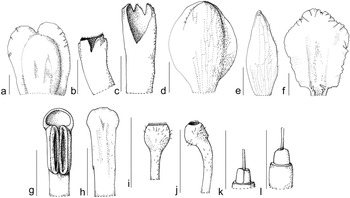
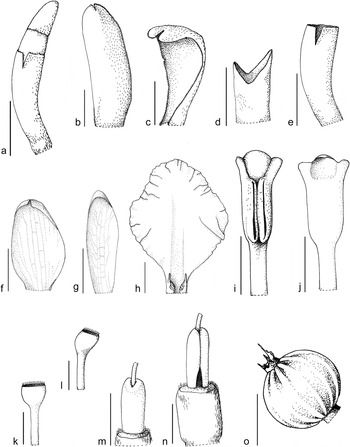
Amomum gyrolophos R.M.Sm. a. Fertile bract; b. Bracteole; c. Calyx; d. Dorsal corolla lobe; e. Lateral corolla lobe; f. Labellum; g. Anther, adaxial view; h. Anther, abaxial view; i–j. Two views of stigma; k. Epigynous glands; l. Ovary and epigynous glands. a–h scale bar = 1 cm; i–l scale bar = 5 mm. All drawn from A.D. Poulsen 2261 by A.J. Droop.

Rhizome subterranean, neighbouring leafy shoots 10 cm apart. Leafy shoot to 2.5 m tall, striate, pubescent especially below ligule and at base of shoot, margins of sheath at ligule glabrous and membranous. Ligule 6–10 mm long, truncate or slightly emarginate, densely pubescent. Petiole 3–5 mm long, pubescent. Lamina lanceolate, to 56.5 × 11 cm, dark green; lower surface and midrib short-hairy; upper surface including midrib glabrous; base narrowing, cuneate; apex attenuate-acuminate and straight-edged. Inflorescence arising from near base of leafy shoot, (including peduncle) to 25 cm long, with many flowers. Flowers opening 1–2 at a time. Peduncle 20 cm long. Flowering head obovate, compact, to 5 × 5.2 cm. Fertile bracts to 3.5 cm, brown, broad and emarginate with two rounded lobes at apex, densely hairy all over, central part of bract firm and convex, margins more membranous and flexible, becoming slimy. Bracteoles 1.4–1.5 cm long, tubular, truncate with 4 mm cleft unilaterally, densely hairy all over, with a small keel down each side terminating in a subapical mucro. Flower red and yellow, 7.5–8 cm long, pedicel 1–3 mm; gullet type. Calyx 2.5–2.6 cm long and split 1 cm down one side, trilobed, lobes triangular, about 4 mm long with subapical mucro; calyx short-hairy at base and longer-hairy towards apex. Floral tube ± 2.4 cm long, sparsely hairy especially at base, creamy-yellow. Corolla lobes bright red; dorsal lobe 3.1–3.2 × ± 2.4 cm wide, obovate from narrow base, cucullate with subapical mucro; margins flexible, densely hairy all over; lateral lobes lanceolate, 3.2 × 1.3 cm when flattened, with a central keel and subapical mucro, ciliate at edges and otherwise glabrous. Labellum yellow, c.4 × 3 cm at widest, widening abruptly from narrow base, trilobed at apex, margins wavy; central part and towards throat thickened and hairy; mid-lobe somewhat recurved. Lateral staminodes bifid, with two small, subulate structures to each side of the base of the labellum, the longer ± 3 mm long, the shorter ± 1.5 mm. Stamen 23–25 mm long, orange. Filament 12–13 × 4.5–5 mm, with a few tiny hairs. Anther 11–12 × 5 mm, thecae not diverging, densely hairy especially along opening, glabrous on reverse; anther crest a rounded hood over the top of the thecae and the stigma, ± glabrous, c.3 × 6.5 mm. Stigma cup-shaped and bulbous, ostiole fringed with cilia, otherwise covered with sparse wavy hairs; style short-hairy towards base of stigma; epigynous glands 3 mm long, truncate, entirely enveloping the style. Ovary 6 × 4 mm, cylindrical, bumpy, densely hairy. Fruit unknown.
Distribution. Sumatra, Borneo.
Habitat and ecology. In forest remnant; 700 m.
Proposed IUCN conservation status. Endangered (EN) B1ab (iii). Endangered by extent of occurrence estimated < 5000 km2, known from < 5 localities only on Sumatra and Borneo in primary rainforest. The forests in Borneo and Sumatra are suffering severe declines in quality and extent due to agriculture and population pressures.
Specimens examined. Sumatera. Sumatera Barat: 16 km E of Padang, Bukit Pinang Pinang, Ulu Gadut, 28 ii 2004, A.D. Poulsen et al. 2261 (BO, E).
Measurements for the description of this species were taken from the specimen label and herbarium material, as fresh material was not available. This is a spectacular species, the bright red corolla lobes contrasting greatly with the yellow labellum. The Sumatran plant is a good match for Amomum gyrolophos in most characters, though it differs from the Bornean type in several respects. Firstly, the type of Amomum gyrolophos has laminae with long petioles whereas those of A.D. Poulsen et al. 2261 are sessile. Furthermore, the laminae on the type specimen of Amomum gyrolophos are not cuneate at the base, and appear less angular than those of A.D. Poulsen et al. 2261. Short, bifid lateral staminodes are clearly visible on A.D. Poulsen et al. 2261, while the protologue of Amomum gyrolophos mentions that lateral staminodes are absent. We examined the type and found a structure at the base of the labellum that may be a staminode, but it is not conclusive. The peduncle of the type is cut so that we are unable to measure it. The protologue describes the peduncle as being about 7 cm long. That of the Sumatran plant (A.D. Poulsen et al. 2261) is much longer than this; closer to 20 cm long. This may represent a new species.
10. Amomum hastilabium Ridl., J. Straits Branch Roy. Asiat. Soc. 32: 137 (1899); Holttum, Gard. Bull. Singapore 13: 203 (1950). – Type: Malaysia, Perak, 91 m, v 1889, L. Wray 3476 (lecto SING, designated by Turner (2000: 16)). Figs 17–18, 30C–D.
Fig.17.Amomum hastilabium Ridl. a. Bud; b. Fertile bract; c. Bracteole; d. Calyx; e. Dorsal corolla lobe; f. Lateral corolla lobe; g. Labellum; h. Anther; i. Two views of stigma; j. Epigynous gland and ovary. a–g scale bar = 1 cm; h–j scale bar = 5 mm. All drawn from A.J. Droop 76 by A.J. Droop.
 Fig.18.
Distribution of Amomum hastilabium Ridl. (squares), A. lappaceum Ridl. (circle) and A. laxesquamosum K.Schum. (triangles) in Sumatra.
Amomum xanthoglossum Ridl., J. Fed. Malay States Mus. 10: 153 (1920). – Type: Malaysia, Kelantan, Chaning, H.N. Ridley (holo K).
Amomum holttumii Ridl., Fl. Malay Penins. 4: 264 (1924). – Type: Malaysia, Negri Sembilan, Gunung Tampin, 22 xi 1922, R.E. Holttum SFN 9559 (holo K).


Rhizome subterranean, 4.5 cm between neighbouring leafy shoots. Leafy shoot 1.5 m tall with up to 16 laminae, ± reticulate and short-hairy especially at petiole. Ligule 4.5–6 mm long, short, truncate or slightly emarginate, densely hairy. Petiole 5–8 mm long. Lamina 32.5–35.5 × 6–9.5 cm; lower laminae broad, elliptic, upper laminae narrower, margins and midrib on upper surface hairy, otherwise glabrous, lower surface glabrous to densely pubescent, dark green or with chequered pattern of light and dark green; base cuneate to somewhat rounded; apex shortly acuminate. Inflorescence arising from near base of leafy shoot, (including peduncle) to 9 cm long. Flowers open one at a time. Peduncle 2–3 cm long with base underground, pale brown and visible between peduncular bracts; peduncular bracts increasing in size from base. Flowering head ovoid with pointed apex, compact, 3–5.5 × 1.8–3 cm. Fertile bract 2.3 × 1.3 cm, broadly ovate, emarginate, with or without small apical mucro, short-hairy, mid-brown to buff with dry buff edges, stiff, not spreading. Bracteole 5–11 mm long, tubular, truncate or unequally bilobed, hairy, cream. Flower to 3.7 cm long, not or hardly pedicellate; both gullet and exposed flower types have been observed. Calyx 1–1.2 cm long, tubular, short-hairy, cream, ± truncate and with a small tear on one side, calyptrate (splitting transversely and discarding a small calyptra, leaving the truncate base). Floral tube 1.5–1.7 cm long, significantly longer than calyx, hairy, cream. Corolla lobes: dorsal lobe 1.7–1.8 × 1.1–1.2 cm, cucullate, pale yellow; lateral lobes 12 × 7 mm, decurved, pale yellow. Labellum 2.2 × 3 cm when flattened, narrow at throat to broadly trilobed with an almost semi-circular mid-lobe; mid-lobe curved downwards, bright yellow to orange, flanked with red markings towards throat; lateral lobes creamy white to pale yellow, labellum closed with dorsal corolla lobe, or free from dorsal corolla lobe, possibly becoming so as the flower ages. Lateral staminodes 2–2.5 mm long, triangular, white. Stamen 1.3–1.4 cm long. Filament c.5 × 2 mm, widening towards base of anther, white. Anther 8–9 × ± 3 mm, thecae not diverging towards apex, glabrous, pink and darker towards opening; pollen creamy white; anther crest 2.5–3 mm long, pale translucent pink with tiny red spots, trilobed, the mid-lobe broadly rounded and with a tiny point at apex, slightly recurved; side-lobes ± upright and held at 90° to mid-lobe, oblong. Stigma pale pink, flattened infundibuliform, abruptly widening and with slit ostiole rimmed with hairs, held just at the top of thecae; style white. Ovary oblong, 3.5 × 2.5 mm, smooth, densely hairy, pinkish. Infructescence not seen, but Thai and Malaysian specimens of this species have globular fruits with longitudinal ridges.
Distribution. Thailand, Peninsular Malaysia, Singapore, Sumatra.
Habitat and ecology. Primary or secondary rainforest in shade or partial sun; 330–739 m.
Proposed IUCN conservation status. Least Concern (LC). Although known from only four specimens in Sumatra, this species is widely distributed in the forests of Thailand and Peninsular Malaysia.
Specimens examined. Sumatera. Sumatera Barat: Ulu Gadut, 28 ii 2004, A.D. Poulsen et al. 2262 (BO, E); Lembah Harau Nature Reserve, 8 viii 2009, A.J. Droop et al. 76 (ANDA, E); Padang, 29 vii 2009, A.J. Droop & W.H. Ardi 183 (ANDA, BO, E). Sumatera Utara: Gunung Leuser National Park, 31 x 2009, Nurainas & Sufriyanto 2209 (ANDA n.v., SING).
This is rather a variable species, but is recognised by the very short bracteole and long floral tube, and reticulate leafy shoots. The laminae dry a pale greenish-grey in herbarium specimens, and the indumentum on the lower surface varies, with the laminae of the type being pubescent below. The base of the leafy shoot is smooth and ± striate in all the Thai specimens examined, the sheath becoming reticulate higher up the leafy shoot. A.J. Droop et al. 76 and A.D. Poulsen et al. 2262 from Sumatra are both ± reticulate from the very base. The Sumatran plants, and those from Singapore (Leong-Škorničková, pers. comm.), sometimes also have laminae that are chequered light and dark green, as does a sterile specimen from Penang; this pattern is not reported from elsewhere in Asia and neither is it mentioned by either Ridley (Reference Ridley1920, Reference Ridley1924) or Holttum (Reference Holttum1950). There is also some variation in the size of the flower parts even within Sumatra, with A.J. Droop et al. 76 having generally smaller flowers than A.D. Poulsen et al. 2262, and indeed smaller than any of the other specimens examined from Thailand or Peninsular Malaysia. Ridley (Reference Ridley1920, Reference Ridley1924) described the bracteole as being longer than the calyx, and the floral tube only a little longer than the calyx. This is certainly not the case with the specimens we have examined, and differs from Holttum’s description of Amomum hastilabium, in which the bracteole is significantly shorter than the calyx. The type (Wray 3476) is at SING. The flowers are damaged and it is not possible to tell whether Ridley was correct about the length of the bracteole. Holttum (Reference Holttum1950) examined many of the same specimens as Ridley, however, including the type and spirit material, which suggests that Ridley may have been in error. We have taken Holttum’s Reference Holttum1950 description from the type to be an amended description. The labellum of the Sumatran flowers is almost semi-circular when stretched out, but in vivo the labellum is folded and appears more the shape of an arrow-head with the side-lobes curving up and the mid-lobe reflexed. Ridley (Reference Ridley1920, Reference Ridley1924) described the lip as being ‘broadly hastate’ from a narrow base, and the mid-lobe as being ‘narrow oblong’, and Holttum (1950) wondered if Ridley saw only the dried flowers, in which the shape of the lip is distorted and appears narrow. The labellum of the Sumatran collections appears in two forms: closed with the dorsal corolla lobe and free from the dorsal corolla lobe (Figs 30C and 30D). It is unclear whether this is a developmental feature, which changes as the flower ages, or whether it represents variation within the Sumatran population.
11. Amomum lappaceum Ridl., J. Straits Branch Roy. Asiat. Soc. 32: 134 (1899); Holttum, Gard. Bull. Singapore 13: 210 (1950). – Type: Malaysia, Selangor, Ginting Peras, v 1895, H.N. Ridley 7802 (lecto SING, designated by Holttum (1950: 211)). Fig. 18.
Amomum perakense Ridl., J. Straits Branch Roy. Asiat. Soc. 32: 135 (1899). – Type: Malaysia, Perak, Maxwell’s Hill, vi 1893, H.N. Ridley s.n. (holo K).
Rhizome at or near surface of ground, stilt-rooted. Leafy shoot at least 1.7 m tall, with many laminae close together, first lamina at 40–60 cm from base; sheath smooth and glabrous, slender. Ligule to 2 mm long, ± emarginate, densely short-hairy and ciliate at margins. Petiole absent or to 2 mm long. Lamina lanceolate, to 15–42 × 3.5–6.3 cm, smooth, mid-green, hairy at margins but otherwise glabrous; midrib narrow and deeply grooved above, prominent and pale beneath; base cuneate; apex acuminate. Inflorescence (including peduncle) 8 cm long at flowering, elongating with age, erect, arising from near base of leafy shoot, with many flowers. Peduncle 5 cm long at flowering, elongating as the inflorescence matures, tomentose, covered when young with thin, closely imbricate bracts; peduncular bracts c.2 × 1.6 cm with rounded apex, ciliate at margin but otherwise glabrous, soon decaying to leave only the base. Flowering head compact, initially almost globose with pointed apex, 3 × 3 cm at base, elongating during flowering. Fertile bract 2–2.3 × 1.3–1.6 cm, broad with blunt tips, translucent brown and turning slimy with age, thin, glabrous, disintegrating early. Bracteole reported bilobed, reddish-brown towards apex. Flowers not seen. Corolla lobes reported maroon-red with yellow-green veins. Labellum reported trilobed, clear yellow. Lateral staminodes 1–1.5 mm, subulate, yellow with red bases. Anther pale yellow, thecae spreading towards apex; anther crest pale yellow, 2 mm long, rounded, not spreading. Stigma pale yellow, emerging below apex of thecae. Infructescence 9–12 × 8 cm, ovoid, with about 20–30 fruits or more developing at base and flowers still opening at apex. Fruits ellipsoid, c.2.5 × 1.5 cm when dry on stalks 1.4 cm long, covered with many spines joined at the base, pale reddish, spines with pale green tips.
Distribution. Peninsular Malaysia, Sumatra, Java.
Habitat and ecology. Forest; 1000–1500 m.
Proposed IUCN conservation status. Least Concern (LC). This species is widespread and common throughout its range.
Specimens examined. Sumatera. Sumatera Utara: Berastagi, 6 v 2005, A.D. Poulsen 2353 (E). Cultivated: 7 v 2007, M.F. Newman & J. Škorničková 2013 (E, SING), original collection A.D. Poulsen 2353 (Sumatera Utara).
We have not seen spirit material for the above specimens and the flower colour notes are taken from the specimen labels. Holttum (Reference Holttum1950) mentioned that there is a certain amount of variation in size in the floral parts within Peninsular Malaysia, although this may be due to the conditions in which the plants were growing. Holttum described the calyx as bi- or trilobed and longer than the bracteole, and the bracteole as bilobed and split on one side, hairy at base. This species has some characters in common with Amomum aculeatum – the yellow flowers and the spiny fruits – but A. lappaceum has much smaller flowers with a smaller anther crest. The original Amomum lappaceum (Ridley, Reference Ridley1899) was described as having a much elongated inflorescence, with the immature flowering head 22 cm long. The Sumatran specimens, and M.F. Newman 2527 and M.F. Newman 2530 from Java, have short, compact flowering heads which do not elongate greatly (10–12 cm). Holttum (Reference Holttum1950) also reports compact fruiting heads (12 cm) from specimens collected in the Cameron Highlands and at Brinchang in Peninsular Malaysia. Amomum lappaceum also has a shorter, broader retuse ligule than A. aculeatum, and the specimens from Sumatra and those examined by Holttum (Reference Holttum1950) from Peninsular Malaysia are stilt-rooted, although stilt-roots are not mentioned by Ridley (Reference Ridley1899).
12. Amomum laxesquamosum K.Schum., Bot. Jahrb. Syst. 27: 315 (1899); Pflanzenr. IV, 46 (Heft 20): 238 (1904) ‘laxisquamosum’; R.M.Sm., Bot. J. Linn. Soc. 85: 65, fig. 15B (1982); Notes Roy. Bot. Gard. Edinburgh 42: 305 (1985). – Type: Malaysia, Sarawak, viii 1865, O. Beccari 386 (lecto FI, designated here (image viewed only); isolecto K). Figs 18, 32E.
Rhizome resting on surface of ground, or stilt-rooted, stilt-roots stout. Leafy shoot 120–200 cm tall, strongly reticulate, hairy, especially below ligule, with many laminae, first lamina 55–60 cm from base. Ligule 4–7 mm long, bilobed or ± emarginate, ± hairy at margin. Petiole prominent, 1.2–2 cm long, hairy at least towards base. Lamina oblong to oblanceolate, 42.5–65.5 × 6.5–11 cm, dark green above and bright green below, glabrous on both surfaces except for a few hairs on the midrib on the lower surface and the densely hairy margins, especially towards apex; base broadly cuneate; apex caudate, twisting, to 3 cm long. Inflorescence emerging very close to base of leafy shoot (including peduncle) to 8 cm long, with 9–12 flowers. Flowers open 2–3 at a time. Peduncle 3.5 cm long, extending to 9–14 cm when fruiting, densely tomentose; peduncular bracts broadly ovate with blunt apex and short subapical mucro, increasing in size from base, soon breaking. Flowering head 4.5 cm long, extending to 6–8 cm long in fruiting. Fertile bract 2–3.2 × 1.8–2.2 cm when flattened, broadly ovate and bifid at apex with tiny apical mucro between lobes, brittle and soon splitting longitudinally, hairy on outer surface and ciliate at margin, pale green to brownish. Bracteole tubular, bilobed, 12–19 × 2–4 mm at widest, hairy. Flower 6–6.5 cm long, sessile; gullet type. Calyx truncate, calyptrate, calyptra lost as bud expands, 1.6–1.8 cm long, with minute hairs towards base, otherwise glabrous, creamy-white. Floral tube c.2 cm long, short-hairy, especially towards lobes, pale yellow. Corolla lobes oblong, yellow; dorsal lobe cucullate, 2.5–3 × 1–1.3 cm, lateral lobes 2.7–2.8 × 0.8–0.9 cm. Labellum 3.5–3.9 × 3–3.5 cm, trilobed with somewhat crisped apex, mid-lobe and central band dark eggyolk-yellow flanked with many spreading dark red lines and markings; side-lobes paler and curving upwards. Lateral staminodes bifid, of unequal, subulate, branches, the longer 5 mm long, the shorter 2 mm. Stamen 2.1–2.3 cm long. Filament 9–10 × c.1.5 mm, pale yellow, white towards anther. Anther 1.2–1.3 cm long, thecae pale pink or cream, dehiscing by slits, dark red around slit; anther crest trilobed, lobes c.3 mm long, upright, mid-lobe rounded, oblong, side-lobes narrower, pale yellow with tiny red dots. Stigma cup-shaped and held at top of thecae, cream-coloured. Ovary cylindrical, 3–3.5 × 1.5 mm, surface uneven or somewhat ridged, hairy; epigynous glands 4–4.5 mm long, truncate, clasping style. Infructescence with 7–12 fruits in a dense head. Fruits sessile, subglobose, 1.1–1.8 × 1–1.6 cm, with 14–16 prominent longitudinal ridges, hairy, crowned with persistent calyx, pale green. Seeds 4–5 mm across, irregular, 3–5 in each locule.
Distribution. Sumatra, Borneo.
Habitat and ecology. Tropical forest in dry places; 350–898 m.
Proposed IUCN conservation status. Least Concern (LC). Although this species is known only from four collections in Sumatra, they cover a wide area, two are from protected areas, and many more collections are known from Borneo.
Specimens examined. Sumatera. Riau: Bukit Tigapuluh, 25 xi 1988, J.S. Burley et al. 1705 (A). Sumatera Barat: Gunung Bungsu, 9 viii 2009, A.J. Droop et al. 92 (ANDA, BO, E); Sijunjung, 21 viii 2009, A.J. Droop et al. 182 (ANDA). Sumatera Utara: Langkat, 26 xi 1973, Soedarsono 369 (K).
Amomum laxesquamosum is recognised by its stilt-rooted, strongly reticulate, many-bladed leafy shoots, its orange-yellow labellum and its ridged fruits. In Sumatra it can be confused with Amomum oligophyllum, but differs in the many-bladed leafy shoot, the trilobed labellum, the flat (not cucullate) lateral corolla lobes and the flowering head, which elongates in fruiting.
In the protologue, Schumann (Reference Schumann1899) spelled the specific epithet laxesquamosum though he later adopted the spelling laxisquamosum in his monograph in Das Pflanzenreich (Schumann, Reference Schumann and Engler1904, p. 238). The spelling in the protologue must be used (McNeill et al., Reference McNeill, Barrie, Buck, Demoulin, Greuter and Hawksworth2012, Art. 60.1).
13. Amomum longipes Valeton, Bull. Inst. Bot. Buitenzorg 20: 73 (1904). – Type: Kebun Raya Bogor (cultivated, original collection from Deli, Sumatera Utara), Anon. 83 (holo KRB). Figs 19–20, 32C.
Distribution of Amomum longipes Valeton (triangles) and A. mentawaiense A.J.Droop (circle) in Sumatra.

Amomum longipes Valeton. a. Flower; b. Fertile bract; c. Bracteole; d. Calyx; e. Dorsal corolla lobe; f. Lateral corolla lobe; g. Labellum; h. Anther; i–j. Two views of stigma; k. Epigynous gland and ovary; l. Fruit. a–g and l scale bar = 1 cm; h–k scale bar = 5 mm. All drawn from A.J. Droop 107 by A.J. Droop.

Amomum mentawaiense A.J.Droop. a. Flower; b. Fertile bract; c. Bracteole; d. Calyx; e. Calyx, dissected; f. Dorsal corolla lobe; g. Lateral corolla lobe; h. Labellum; i. Anther, adaxial view; j. Anther, abaxial view, flattened; k–l. Two views of stigma; m. Ovary and epigynous glands. a–j and m scale bar = 1 cm; k–l scale bar = 0.5 cm. All drawn from A.J. Droop 189 by A.J. Droop.

Rhizome subterranean, to 40 cm between neighbouring leafy shoots, somewhat branching, pale to dirty brown. Leafy shoot to 4 m tall, more usually to 2.5 m, with laminae growing rather close together; often leaning at an angle; sheaths smooth and glabrous, or ± hairy at margins towards ligule, bright green. Ligule 7–12 mm long, entire, rounded, glabrous or with ciliate margin. Petiole 6–12 mm long, glabrous. Lamina elliptic, to 40.5 × 11 cm, smooth, glabrous or sparsely hairy at midrib on lower surface and at margins towards apex; base cuneate and narrowing rather abruptly; apex acuminate 2–2.5 cm long. Inflorescences infrequent, (including peduncle) to 22.5 cm long, radical, erect, arising from base, with up to 22 flowers. Flowers open a few at a time, sitting upright in a crown with the labellum facing outwards. Peduncle 10–14 cm long, stout, visible between scales, almost glabrous to hairy (if hairy, then becoming more densely so towards flowering head), pale green; peduncular bracts increasing in size from base, to 4 × 1.8 cm, spreading, glabrous, brown, held at c.45° from the peduncle. Flowering head obovate, compact, 8.5 × 4.5 cm, flowers extending ± 3.5 cm above bracts, length to tip of bracts 5 cm. Fertile bract 2.5–4 × 1.2–2.3 cm, oblong, cucullate, glabrous, dark red to dirty brown, fragile but not slimy. Bracteole ± 1.5 cm long, tubular at base and unequally bilobed, emerging about half-way up pedicel, short-hairy, translucent white with pink to dark red spots in places. Flower yellow, 6.5–7 cm long, pedicel 5–9 mm; exposed type. Calyx 2.6–2.8 cm long, tubular, unequally trilobed and split 1.1 cm down one side, membranous, hairy at base, translucent white with dark pink lines at centres of lobes from base to apex. Floral tube 2.5–2.7 cm long, glabrous, creamy white. Corolla lobes cream or very pale yellow-orange, cucullate; dorsal lobe 3.2–3.4 × 1.3–1.5 cm; lateral lobes c.3.5 × 0.9 cm. Labellum 3–4.5 × 2–3.7 cm when flat, roughly diamond-shaped, trilobed, pale yellow-cream with dark eggyolk-yellow mid-band and mid-lobe; apex of mid-lobe emarginate with small rounded lobes, labellum free of dorsal corolla lobe. Lateral staminodes absent. Stamen 2.4–2.9 cm without crest. Filament 1.4–1.6 × 3.5 mm wide, pale orange. Anther 10–13 × 3.5 mm, thecae diverging c.2 mm from apex, minutely hairy, cream with brown dots on back; anther crest pale orange-brown, trilobed, spreading, the mid-lobe standing to the front of and between the side-lobes; mid-lobe rounded, 4 mm long; side-lobes round-ended oblong, 2 × 3 mm. Stigma white, held 1.5 mm below tip of thecae. Ovary cylindrical or somewhat obovate, 4–5 × 3–3.5 mm, rough and hairy; epigynous glands 5 mm long, clasping the style. Infructescence globose, with up to six fruits. Fruits globose, 2.5–3.5 cm diameter, with stout, well-spaced spines, bright green when small, olive green when unripe, orange-red when mature; aril pale whitish-yellow; fruit stalk usually to 1.2–2.2 cm, sometimes to 4.5 cm long. Seeds 3–6 mm diameter, rounded or irregular, 5–6 in each locule.
Distribution. Sumatra.
Habitat and ecology. Damp or marshy, shaded areas in primary forest, scattered and uncommon; 30–500 m.
Proposed IUCN conservation status. Least Concern (LC). Although this species is endemic to Sumatra it is widespread in the north of the island.
Specimens examined. Sumatera. Aceh: Ketambe Research Station, 7 iii 2008, P. Wilkie et al. PW616 (E); ibid., P. Wilkie et al. PW629 (E); ibid., 18 v 1972, W.J.J.O. de Wilde & B.E.E. de Wilde-Duyfjes 12108 (L); Kloët Nature Reserve, 8 vii 1985, W.J.J.O. de Wilde & B.E.E. de Wilde-Duyfjes 19769 (BO, L); Pulau Simaloer, 4 xii 1919, Achmad 1539 (BO, L). Sumatera Barat: Pasaman, Lubuksikaping, Rimbo Panti, 13 viii 2009, A.J. Droop et al. 105 (ANDA, BO, E); ibid., 13 viii 2009, A.J. Droop et al. 107 (BO, E); Sijunjung, Tanjung Gadang, 21 viii 2009, A.J. Droop et al. 178 (ANDA, E). Pulau Siberut: 12 ix 1924, C.B. Kloss 13084 (K, SING). Sumatera Utara: Asahan, 15 xi 1925, H.S. Yates 1858 (BO, MICH); Sibolangit, 20 xii 1927, J.A. Lörzing 12876 (BO, K, L); ibid., 17 iii 1917, J.A. Lörzing 5045 (BO, MICH); ibid., 1917, J.A. Lörzing 5063 (BO); ibid., 6 ii 1918, J.A. Lörzing 5514 (BO, L); ibid., J.A. Lörzing 16877 (BO); ibid., 8 viii 1921, M. Nur 7255 (BO, K, SING).
This is a beautiful species with large yellow and white flowers and most parts smelling sweetly aromatic. In the protologue Valeton (Reference Valeton1904) mentioned that the labellum is yellow, and that the petals come together at the top. The fresh flowers that we have examined all have a dark yellow mid-band and apex to the labellum, the side-lobes being much paler and creamy, almost white. However, the colour does seem to darken with age and older flowers can look almost entirely dark yellow. Similarly, the petals on a fresh flower are spreading and stand clear of the lip and of each other while, in an older flower, they flop together. There is some variation in the size of the flowers, those of J.A. Lörzing 5063 measuring only 5 cm long compared with those of A.J. Droop et al. 105, which measure 7 cm. The bracts also vary a little through the range, specimens collected in Sumatera Barat having dark red bracts, and those collected from further north in the island having yellowish bracts that turn dark brown. The orange fruits of this species are unusual and the colour recalls those of Amomum ochreum, however the fruits of A. ochreum are very large and the spines few and widely spaced, and this species differs further from A. longipes in the presence of lateral staminodes and the bilobed anther crest.
The protologue contains the following specimen citation: ‘Ein Exemplar diese Art ist in vorigen Jahre an das Museum in Berlin abgeschickt worden unter der Versandt-nummer No. 83’ (a specimen of this species was sent to the Museum in Berlin the previous year with dispatch number 83). A single sheet which corresponds to this citation has been located at KRB. It was collected from accession BO XI B 211. This is the sole original material, since number 83 is the only collection cited in the protologue, and the sheet at KRB is the only one found with this number. No material has been located at B. The handwriting of Gagnepain and Valeton can be read on sheet 83 at KRB. Although Valeton did not cite this specimen as the holotype, it may be understood as such, there being no other original material. Several collections at KRB, made at different times from two living accessions in the Kebun Raya, Bogor, BO XI B 211 and BO XI B VI 144, both of which were originally collected in Deli, Sumatera Utara and may have been the same collection, are Amomum longipes, but do not bear the collection number 83 so they are not original material.
14. Amomum mentawaiense A.J.Droop, sp. nov.
A. cerasino Ridl. vaginis pruinatis et labellis trilobatis albis et rubris cum lobis centralibus lobulatis similis, sed ligulis integris, foliis minoribus basibus rotundatis, fructibus aculeis et stylis versus stigmata incrassatis et cum pilis distichis differt. – Type: Indonesia, Sumatera Barat, Siberut Island, 01°35′S, 99°12′E, 20 m, 24 ii 2004, A.D. Poulsen, D. Girmansyah & S. Darusman 2249 (holo E; iso ANDA, BO). Figs 19, 21, 31D.
Rhizome shallowly subterranean, to 20 cm between neighbouring leafy shoots. Leafy shoot to 1.7 m tall, first lamina 75–100 cm from base; sheath mid to dark green, smooth, shiny, glabrous and slightly pruinose; base to 2.5 cm diameter, pale green. Ligule c.1 cm long, entire, rounded, mid green with reddish mark at join with petiole, glabrous. Petiole 2–2.8 cm long, glabrous except at join with leaf. Lamina 36–44 × 7–10.5 cm including cauda, oblong-elliptic, yellow-green with prominent secondary veins; lower surface pubescent; upper surface glabrous except midrib; margins hairy; base rounded but not cordate; apex acuminate-caudate to 2 cm long. Inflorescence (including peduncle) to 26 cm long, with up to 35 flowers. Three flowers open at one time. Peduncle 15–20 cm long, ± horizontal; peduncular bracts dry and brown to 2.5 × 1.8 cm. Flowering head 5–6 × 3.5 cm, ovoid with pointed apex, compact, flowers extending 3 cm above bracts. Fertile bracts 3–3.2 × 1.2–1.4 cm, broadly ovate with pointed apex, smooth, short-hairy, white with purple apex, soon drying brown. Bracteole c.1.4 cm long, glabrous except at ovary, white and bilobed, lobes pointed and broadly triangular. Flower 5.5–6 cm long, pedicel 4–5 mm; gullet type. Calyx 2.5 cm long including ovary, inflated, trilobed, white but tips brownish and dry, sparsely hairy towards ovary. Floral tube 2.4 cm long, longer than calyx, sparsely hairy, white. Corolla lobes cucullate, smooth and glabrous; dorsal lobe 2.5 × 2 cm when flattened, apex emarginate, outer surface dark pink, inner surface pale pink with dark pink lines; lateral lobes 2.4 × 0.8 cm, pale pink and cream at apex. Labellum 2.8–3 × 2.7–3 cm when flattened, trilobed; central band dark red with white spots; mid-lobe 9 × 8 mm, oblong, somewhat bifid and praemorse at apex, dark red with a few white spots; side-lobes rounded, white, with pale pink spots especially towards top. Lateral staminodes bifid, subulate, the longer part to 6 mm, the shorter to 3 mm long, white and spotted at base with dark red. Stamen 2.2–2.3 cm long. Filament 1.1 cm long, cream, narrower than anther. Anther 8–9 mm long, thecae diverging slightly from base, 4 mm wide at base and 6 mm under anther crest, yellow, densely hairy all over; pollen pale yellow-cream; anther crest bilobed, crescent-shaped and spreading, cream with dark red dots, 3–4 × 16 mm when flattened. Stigma globular with slit ostiole held just between apex of thecae, glabrous but ostiole rimmed with hairs, pale pinkish-orange; style hairy, white, with two distichous rows of hairs just below stigma. Ovary globose, 2.5 mm long, white, appressed-hairy; epigynous glands 3 mm long, oblong with notched apex, clasping style. Infructescence a dense head of several fruits. Fruit globose, 4 cm diameter, spiny, green, fruit stalk to 7 mm long. Seeds to 7 × 4 mm, irregularly rounded, 20–23 in each locule.
Distribution. Siberut Island.
Habitat and ecology. Forest; 20 m.
Proposed IUCN conservation status. Near Threatened (NT). Although the species is known only from a few localities and the extent of occurrence in Siberut alone is well within the threshold for a Threatened listing, all the known collections were made within protected areas. The protected areas on Siberut have been shown to be effective in reducing the rate of deforestation.
Specimens examined. Sumatera. Sumatera Barat: Siberut Island, 24 ii 2004, A.D. Poulsen et al. 2249 (ANDA, BO, E); ibid., Nurainas s.n. (ANDA). Cultivated: 3 iii 2008, A.J. Droop 53 (E), original collection A.D. Poulsen et al. 2249 (Siberut Island).
This taxon is known only from two collections from Siberut Island in Sumatera Barat. It seems to have a strong affinity to Amomum cerasinum and A. ochreum in the broad-based caudate laminae that are densely hairy on the lower surface, the bilobed anther crests and the pruinose sheaths. Amomum cerasinum also has red and white flowers, but differs in that it is a much larger plant, the bases of the laminae tend to be cordate and the fruits are without spines. Amomum ochreum has flowers that are yellow marked with many red lines, lamina apices that are caudate to 8 cm, and large fruits (to 5 cm diameter) that have small, widely spaced spines.
15. Amomum ochreum Ridl., J. Straits Branch Roy. Asiat. Soc. 32: 135 (1899); Holttum, Gard. Bull. Singapore 13: 208 (1950). – Type: Malaysia, Selangor, Ginting Bidai, v 1895, H.N. Ridley s.n. (lecto K, designated by Holttum (1950: 209)). Figs 22, 24, 32D.
Amomum ochreum Ridl. a. Fertile bract; b. Bracteole; c. Calyx; d. Calyx, dissected; e. Dorsal corolla lobe; f. Lateral corolla lobe; g. Labellum; h. Anther, adaxial view; i. Anther, abaxial view, flattened; j–k. Two views of stigma; l. Ovary and epigynous glands; m. Fruit. a–m scale bar = 1 cm. All drawn from A.J. Droop 54 by A.J. Droop.

Rhizome subterranean, about 10 cm between neighbouring leafy shoots. Leafy shoot to 2.5 m tall with up to 25 laminae, first lamina 80–100 cm from base; shoot dark green, smooth, hairless and pruinose, the young shoots appearing almost white. Ligule 6 mm long, entire, rounded or slightly emarginate, very-short hairy. Petiole 1.8–2 cm long. Lamina oblong, to 45 × 10 cm, green; lower surface and midrib densely hairy, otherwise glabrous; base cordate, unequal; apex caudate, spiralling, to 8 cm long. Inflorescence (including peduncle) to 34 cm long, with up to 30 flowers. Flowers open several at a time. Peduncle 8–25 cm long; peduncular bracts alternating, thin, blunt, brown. Flowering head compact, 9–11 cm long, flowers extending 2.5 cm above bracts. Fertile bract 4–4.6 × 1.5–2.3 cm, entire, pointed, glabrous, smooth except for prominent veins, pale yellow to pinkish red, very thin and soon disintegrating. Bracteole c.3 cm long, glabrous, tubular at base and unequally bilobed, slightly inflated, one lobe 9 mm, the other 5 mm long, both pointed, pale yellow-cream and pinkish towards tip. Flower 7 cm long, not or hardly pedicellate; gullet type. Calyx c.3.4 cm long, tubular, trilobed and split 1.1 cm on one side, lobes 6 mm long, broad, triangular; calyx hairy towards ovary and ± glabrous towards apex, rather inflated, translucent pale yellow. Floral tube about as long as calyx, or slightly longer, sparsely hairy, pale pink at ovary, becoming darker towards lobes and with darker pink veins longitudinally. Corolla lobes: dorsal lobe to 2.9 × 2 cm when flattened, cucullate and nearly circular; lateral lobes 2.8 × 1.1 cm, bright yellow and pale orange-pink with dark red spots and lines at base. Labellum 3.7 × 3.5 cm when flattened, trilobed, widening from base, margins crinkled, forming a closed cup with the dorsal corolla lobe, yellow, marked with many dark red longitudinal lines at base; lobes bright yellow with dark red spots and lines, yellow at apex; base a little thickened but not hairy. Lateral staminodes 1 cm long, subulate with thicker bases, dark red and white with yellow tips. Stamen 2.7 cm long. Filament 15 × 1.5 mm, dark pink. Anther 12 × 6 mm, thecae diverging 3 mm from apex, densely hairy, bright yellow; pollen pale yellow-cream; anther crest bilobed, spreading, yellow with red dots, lobes arising 4 mm below apex of thecae and tapering towards tips. Stigma yellow, globose with slit on side; style pinkish-white. Ovary subglobose, 5.5–7 × 6 mm, smooth, densely hairy, pale yellow-green; epigynous glands 3 mm long, clasping, truncate. Infructescence with many fruits in dense head. Fruits spherical, 4.5–5 cm diameter, with sparse, short, blunt, fleshy spines, young fruit green; yellowish-green when older; pedicel to 7 mm long. Seeds to 1 cm long, irregular, 3–4 in each locule.
Distribution. Peninsular Malaysia, Sumatra.
Habitat and ecology. Disturbed forest; 830 m.
Proposed IUCN conservation status. Least Concern (LC). Although known from only two localities in Sumatra, this species is found in many localities throughout Peninsular Malaysia.
Specimens examined. Sumatera. Sumatera Barat: Payakumbuh, 21 viii 1957, Ismael 18 (L). Sumatera Utara: Gunung Sibayak, 10 v 2005, A.D. Poulsen 2365 (BO, E). Cultivated: 3 iii 2008, A.J. Droop 54 (E), original collection Sumatera Utara: Gunung Sibayak, 10 v 2005, A.D. Poulsen 2365 (E).
Amomum ochreum is easily recognisable from its very large, sparsely spiny fruits, glaucous stem and laminae with caudate apex and broad rounded or cordate base. It was described from a Malaysian plant, but the Malaysian specimens differ from those collected in Sumatra in that the ligule is hairless and the flower parts in general are somewhat smaller. Furthermore, mature fruits from the Malaysian plants are described as being a rusty brown colour, although it is not known whether or not the Sumatran fruits would darken in colour with age. The colour of the flower also seems to be variable across the range of the species, with a collection from Peninsular Malaysia having a labellum that is mostly red with only a narrow border of dull yellow (A.D. Poulsen, pers. comm.). A further two specimens of this species (including one pickled infructescence) are to be found in the herbarium of the Universitas Medan. Neither has locality information but they are likely to have been collected in North Sumatra near Medan, possibly in Sibolangit. This species appears to have an affinity to Amomum cerasinum Ridl., and is similar in the pruinose sheath, and the leaf and shapes of the flowering head, but A. cerasinum is a much bigger plant, the flowers are without yellow, and the fruits have no spines.
16. Amomum oligophyllum A.J.Droop, sp. nov.
A. paucifolio R.M.Sm. frondibus paucifolis, bracteolis brevibus et calycibus truncatis similis, sed vaginis valde reticulatis, bracteis emarginatis sine mucrine subapicali et labellis integris differt. – Type: Indonesia, Sumatera, Sumatera Barat, Air Busuk, 00°56′13.7″S, 100°49′37.8″E, 18 viii 2009, A.J. Droop, Nurainas & W.H. Ardi 153 (holo BO; iso ANDA, E). Figs 23–24, 31C.
Amomum oligophyllum A.J.Droop. a. Flower bud; b. Fertile bract, flattened; c. Fertile bract, natural; d. Bracteole; e. Calyx; f. Dorsal corolla lobe; g. Lateral corolla lobe; h. Labellum; i. Anther, adaxial view; j. Anther, abaxial view, flattened; k–l. Two views of stigma; m. Epigynous glands; n. Ovary and epigynous glands; o. Fruit. a–j and o scale bar = 1 cm; k–l scale bar = 2 mm; m–n scale bar = 0.5 cm. All drawn from A.J. Droop 155 by A.J. Droop.

Distribution of Amomum ochreum Ridl. (squares), A. oligophyllum A.J.Droop (circles) and A. stenocarpum Valeton (triangle) in Sumatra.

Rhizome stilt-rooted to 22 cm high with 8–10 cm between neighbouring leafy shoots, cut surface tinged purple. Leafy shoot to 1.5 m tall with 5–6 laminae, first lamina 60–130 cm from base; sheaths green, reticulate and short-hairy, especially at ligule. Ligule 12–14 mm long, bilobed and ± short-hairy. Petiole prominent, 2–3.2 cm long, hairy at least towards base. Lamina broad oblong-elliptic, 39.5–66.5 × 9.3–18 cm in largest laminae with prominent veins and wavy margins, dark green above, bright green below, glabrous except for margins especially towards apex, and midrib on both surfaces; base broadly cuneate; apex rather abruptly acuminate, to 13 mm long. Inflorescence oblong with round apex, arising from near base of leafy stem, (including peduncle) to 16 cm long, with 9–25 flowers. Flowers open 2–3 at a time. Peduncle 3.5 cm long, extending to 14 cm when fruiting, hairy, pale greenish-yellow; peduncular bracts increasing in size from base, ovate with emarginate apex and subapical mucro, to 2.3 × 2.1 cm, pale brown, stiff, short-hairy, margins ciliate. Flowering head 4–4.5 cm long, obovoid; flowers extending above bracts. Fertile bract c.3 × 2.2 cm, entire, ± emarginate at apex, with stiff, papery texture, surface striate and short-hairy, ± ciliate at margins, pale yellow to pale orange. Bracteole 7–9 mm long, tubular, bidentate, ± short-hairy or glabrous, translucent pale yellow. Flower 6.3–6.6 cm long, yellow, pedicel 3 mm; gullet type. Calyx 1.5–2.1 cm long, truncate, split 0.5 cm down one side, creamy-white, short-hairy at base, apex forming a calyptra over tip of bud which splits transversely and is shed as flower enlarges. Floral tube 1.9–2.7 cm long, longer than calyx, glabrous or short-hairy, pale yellow. Corolla lobes yellow; dorsal lobe 2.5–3.4 × 1–1.8 cm, cucullate; lateral lobes 2.8–3.2 × 0.8–0.9 cm. Labellum 4.8–5 × 3–3.4 cm when flattened, rhomboid to sub-trilobed from narrow base; apex somewhat crisped; apex and central band dark eggyolk-yellow flanked with many, spreading, dark red lines and markings; sides paler and curving upwards. Lateral staminodes 2.5 mm long, subulate, pale yellow. Stamen 2.2 cm long. Filament 15 × 2 mm, pale yellow and white towards anther. Anther 1.2 × 0.5 cm, yellow with tiny red dots; thecae not diverging, dark brown, almost facing; pollen cream; anther crest obscurely trilobed, c.5 × 10 mm, yellow with tiny red dots; mid-lobe rounded, erect; side-lobes narrower and with more acute apex, erect. Stigma cup-shaped, held a little above apex of thecae, opening fringed with stiff hairs; style colour cream. Ovary 3–4 × 3–3.5 mm at widest, smooth or slightly ridged and short-hairy; epigynous glands 5.5 mm long, truncate, clasping style. Infructescence with 11–20 fruits in dense head. Fruits 1.5 cm across, globose, shallowly ridged with about 15 longitudinal ridges, dark green when young, yellowish when older. Seeds to 4 mm across, irregular, aril white.
Distribution. Sumatra.
Habitat and ecology. Damp or dry places in disturbed or secondary forest, locally very common; 898–1081 m.
Proposed IUCN conservation status. Endangered (EN) B1ab(iii). This species is known only from one locality in Sumatera Barat and, although it is locally very common, the forests in Sumatra are under severe threat of deforestation.
Specimens examined. Sumatera. Sumatera Barat: Air Busuk, 18 viii 2009, A.J. Droop et al. 153 (ANDA, BO, E); ibid., 18 viii 2009, A.J. Droop et al. 155 (ANDA, BO, E).
This species has affinity with Amomum calyptratum from Borneo in the colour and overall shape of the flowers, and in the calyptrate calyx. However, the lip is not obovate as in Amomum calyptratum, the bracteole is tubular and not linear or open to the base, the stem is reticulate and the ligule, although bilobed, is considerably larger than the 2–3 mm mentioned for A. calyptratum. Other superficially similar species include Amomum oliganthum K.Schum., which differs in having echinate fruits, and A. somniculosum S.Sakai & Nagam., which has sessile laminae and smooth leaf sheaths. Amomum oligophyllum may also be related to A. paucifolium, which is very similar except that the labellum is bifid. Amomum laxesquamosum is also similar but has a clearly trilobed labellum. The species epithet refers to the few-bladed leafy shoots.
17. Amomum stenocarpum Valeton, Bull. Jard. Bot. Buitenzorg, Ser. 3, 2: 354 (1920). – Type: Indonesia, Sumatra, Pulau Simaloer, 16 iv 1918, Achmad 370 (holo BO; iso K, L, P (image viewed only)). Fig. 24.
Leafy shoot robust, 3 m or more tall. Ligule simple, rounded, 15–18 mm long. Petiole c.25 mm, slender, with small warts or glands, or a corky crust, at the base next to the ligule. Lamina linear-oblong, lower laminae 50–80 × 10–13 cm, upper laminae 65 × 7.5 cm, glabrous; midrib robust, base cuneate; apex subacuminate; drying red-brown. Inflorescence and flower unknown. Infructescence arising from base of leafy shoot. Peduncle short, 5 × 1.5 cm, densely imbricate with short scales. Fruiting head large, elongating to 15 × 5 cm. Fertile bract 5.5 cm long, sessile, persistent, oblong, boat-shaped, straw-coloured, glabrous. Bracteole 3.5 cm long. Fruits 25 × 8 mm on 5 mm fruit stalk, oblong-fusiform, enclosed by bract and bracteole and crowned with persistent calyx; rough; ripe fruits green.
Distribution. Pulau Simaloer.
Habitat and ecology. Unknown.
Proposed IUCN conservation status. Data Deficient (DD). This species is known only from the type collection from Pulau Simaloer in 1918. Forest cover maps and unpublished reports of Pulau Simaloer show that significant forest cover remains on the island although further mining concessions and oil palm plantations are proposed. Further collections are required from Simaloer before the presence of this plant and the threats facing it can be confirmed.
This species is described from a fruiting specimen collected in Pulau Simaloer in 1918. There have been no collections since the type and Valeton did not see flowers so the species is incompletely known. We have not seen a fresh collection and so the description and measurements above are taken from Valeton’s protologue and the type specimen. The laminae are very similar in form to those of Amomum xanthophlebium, although the petioles are a little longer than the Sumatran collections of A. xanthophlebium. It is notable that Amomum stenocarpum also has a rough, warty or corky part between the base of the petiole and the ligule. The fruits are similar in both species, and the bracts of both species are large, persistent and oblong. Valeton describes the bracts as ‘straw-coloured’. The bracts of Amomum xanthophlebium are brownish when fruiting, although they are bright red when the plant is flowering. It seems likely that Amomum stenocarpum is closely related to A. xanthophlebium but more research and further collections from Pulau Simaloer are required before its status can be confirmed.
18. Amomum tephrodelphys K.Schum., Pflanzenr. IV, 46 (Heft 20): 248 (1904). – Type: Sumatera Utara, Percut, 1891, B. Hagen (holo BO). Figs 25–26.
Amomum tephrodelphys K.Schum. a. Flower; b. Calyx; c. Dorsal corolla lobe; d. Lateral corolla lobes; e. Labellum; f. Stigma; g. Anther; h. Epigynous gland and ovary. a scale bar = 1 cm; b scale bar = 5 mm; c–e and g scale bar = 2 mm; f scale bar = 0.5 mm; h scale bar = 1 mm. All drawn from 72, ex Sumatra, cult. BO XI B 165, after Gagnepain by A.J. Droop.

Distribution of Amomum tephrodelphys K.Schum. (squares), A. uliginosum J.Koenig (circles) and A. verum Blackw. (triangles) in Sumatra.

Amomum cylindraceum Ridl., A. aff. roseisquamosum Nagam. & S.Sakai and A. uliginosum J.Koenig inflorescences. a. Amomum cylindraceum Ridl., drawn from a photograph of A.D. Poulsen 2432; b. A. aff. roseisquamosum Nagam. & S.Sakai inflorescence, drawn from de Wilde & de Wilde-Duyfjes 12763; c. A. uliginosum J.Koenig inflorescence, after Holttum; d. A. uliginosum fruit, drawn from A.J. Droop 99. All drawings by A.J. Droop. a scale bar = 10 cm; b scale bar = 5 cm; c scale bar = 2 cm; d scale bar = 1 cm.

Rhizome clump-forming, lying on surface of earth or just below it, with many shoots standing close together. Leafy shoot 1.2–3 m tall, slender, arching, with up to 13–23 laminae, laminae rather close together, first lamina at 50–100 cm from base; sheaths hairy with ciliate margins. Ligule 10–13 mm long, rounded or truncate, ± densely hairy all over, margins long-hairy. Petiole 6–15 mm long, laminae towards base of shoot having longer petioles than those at the top, somewhat hairy. Lamina usually elliptic, sometimes slender-elliptic, 13.5–31 × 3.5–7.5 cm, underside short-hairy or almost glabrous; upperside glabrous; midrib hairy above, densely so below; leaf margins glabrous; base rounded, obtuse; apex caudate-acuminate. Inflorescence arising from along rhizome, (including peduncle) to 18.5 cm long, with up to 43 flowers. Peduncle 8–12.5 cm long, thin, hairy, lying along ground and turning rather abruptly upwards at flowering head; peduncular bracts rapidly increasing in size from base to large (2.8–4 × 3.6 cm) just beneath flowering head, ovate, rounded, minutely hairy, margins ciliate. Flowering head lax, elliptical to conical, to 6.5 × 1.5–3 cm. Fertile bract 5–15 × 1.2–3 mm, oblong with pointed apex, red, ± short-hairy, apex and margins long-hairy. Bracteole absent. Flower dark scarlet to almost orange, 3 cm long, flowers extending 2.4 cm beyond bracts; pedicel 2 mm, hairy; gullet type. Calyx with sparse, short, erect hairs, 16–20.5 × 3 mm, narrowing at ovary, scarlet, tridentate, teeth elongate-triangular, 5 mm long, shortly pointed. Floral tube c.5 mm longer than calyx, weakly S-shaped, 1.5 mm wide at base, gradually widening to 3 mm wide at the top, light red, sparsely hairy with short, erect hairs. Corolla lobes ovate with rounded apex, strongly recurved and descending along the tube for about half their length, light red with a few weak hairs; dorsal lobe largest, enclosing labellum for the most part; lateral lobes somewhat smaller. Labellum dark scarlet (darker than corolla lobes) and finely spotted, c.7 mm long, only slightly longer than corolla lobes, almost equally trilobed with the edges of the lobes rolling inwards, side-lobes only a little broader; base wide and sparsely hairy. Lateral staminodes absent. Stamen 4 mm long, stout. Filament very short, with a few hairs. Anther 2–3 mm long; thecae ellipsoid, not or only very slightly diverging towards apex, hairy, especially near slit opening, creamy-white; anther crest very short, membranous, entire, 1 mm long or less, only just extending beyond apex of thecae, light brown. Stigma abruptly widened with slit ostiole fringed with stiff hairs; stigma and style otherwise glabrous. Ovary ellipsoid, 1.5–2 mm long with about 10 obscure ribs, thickly covered with erect hairs, dark ashy-grey. Fruits dark violet-grey, almost black.
Distribution. Sumatra.
Habitat and ecology. Dispersed, scattered, primary forest or cultivated, or riparian forest, in shady places; 1–500 m.
Proposed IUCN conservation status. Vulnerable (VU) B1ab (iii). Vulnerable by extent of occurrence estimated < 20,000 km2, known from < 10 localities in Sumatra. The forests in Sumatra are suffering severe decline in quality and extent owing to agriculture and population pressures.
Specimens examined. Sumatera. Aceh: Kloët Nature Reserve, 13 vii 1985, W.J.J.O. de Wilde & B.E.E. de Wilde-Duyfjes 20031 (BO, L); Kuala Kepong, 1 ix 1941, Asdat 186 (L); Wassenar, 5–7 vii 1939, A.H. Batten-Pooll s.n. (SING). Sumatera Utara: Sibolangit, 20 xii 1927, J.A. Lörzing 12871 (BO, L); ibid., 17 iii 1917, J.A. Lörzing 5050 (BO); ibid., 6 x 1920, J.A. Lörzing & S.C.J. Jochems 7381 (BO); ibid., 11 ix 1915, J.A. Lörzing 999 (BO); Percut, 1891, B. Hagen s.n. (BO).
We have not seen living specimens of this plant, neither have we been able to examine spirit material; measurements and colour notes of floral parts are taken from the excellent notes on the label of J.A. Lörzing 5050, while other measurements have been taken from the specimens. Lörzing mentioned that all parts of the plant, especially the leafy shoots, smell ‘strongly and pleasantly of ripe apples’, although sadly this does not seem to last when the specimens are dried. An aberrant form with a terminal inflorescence has also been reported from Sibolangit.
19. Amomum uliginosum J.Koenig in Retz., Observ. Bot. 3: 56 (1783); Holttum, Gard. Bull. Singapore 13: 213 (1950); M.F.Newman et al., Checkl. Vasc. Pl. Lao PDR 362 (2007); Lamxay & M.F.Newman, Edinburgh J. Bot. 69 : 187 (2012). – Cardamomum uliginosum (J.Koenig) Kuntze, Revis. Gen. Pl. 2: 687 (1891). – Type: see notes below.
Amomum ovoideum Pierre ex Gagnep., Bull. Soc. Bot. France 53: 140 (1906); Gagnepain, Fl. Indo-Chine 6: 115 (1908); Newman et al., Checkl. Vasc. Pl. Lao PDR 362 (2007). – Type: Cambodia, Kampong Spoe, Samrong Tong, 12 iv 1870, J.B.L. Pierre 542 (lecto P [barcode P00599417], designated by Lamxay & Newman (2012: 187); isolecto E, K [3 sheets], NY [2 sheets], P [4 sheets]).
Amomum robustum K.Schum., Pflanzenr. IV, 46 (Heft 20): 253 (1904). – Type: Malaysia, Perak, Gunung Larut, H. Kunstler 1839 (lecto SING, designated by Lamxay & Newman (2012: 187)). Figs 26, 27c–d, 31A.
Rhizome creeping, robust, near ground. Leafy shoot 1.1–3 m tall with up to 17 laminae, first lamina 25–60 cm from base; sheaths mid-green, reticulate, hairy at the margins. Ligule 4–6 mm long, emarginate or almost truncate, hairy, green with pinkish tinge. Petiole absent or to 4 mm long. Lamina oblong-lanceolate, to 40.5–52 × 5.5–6 cm; glabrous including midrib and leaf margins on both surfaces; base cuneate; apex caudate, to 8 cm long. Inflorescence arising from along rhizome, (including peduncle) 10–19 cm long, with up to 25 flowers. Flowers open 6–7 at a time, forming a crown of flowers around top of inflorescence. Peduncle 8–13 cm long, sparsely hairy, dark pinkish-red or tinged with green; peduncular bracts increasing in size from base to 1.9 × 1 cm, alternating, stiff, apex acute, glabrous but ciliate at margins at base of inflorescence. Flowering head obovoid or globose, small, to 2–6.5 × 3.5 cm. Fertile bract 2–2.5 × 0.3–0.6 cm, entire with rounded apex, short-hairy and ciliate at edges, brown, papery, smooth, soon disintegrating. Bracteole 1.5 cm long, short-hairy, tubular at base but deeply split on one side, bidentate, teeth pointed and close together, brown, shorter than calyx. Flower 3.5–4 cm long, pedicel 3 mm; exposed saccate type. Flowers short-lived. Calyx 1.9–2.1 cm long, tubular, trilobed, translucent white with small pink dots towards the tips of the lobes, short-hairy. Floral tube about as long as calyx, or slightly longer, sparsely hairy, white or slightly pinkish. Corolla lobes translucent white or slightly pink at margins towards base, quickly becoming brown; dorsal lobe to 1.2–1.3 × 0.3–0.5 cm, cucullate, held at c.90° to labellum; lateral lobes a little narrower. Labellum clawed, strongly concave and saccate, widening from narrow fleshy base to ovate, slightly emarginate at apex, 2.5 × 1.5 cm when flattened, white or pale cream with yellow apex; yellow apex extends to yellow median band and sometimes darkening to red-pink band at base; mid-band flanked with red lines and dots; base white, with pink or dark red markings or not. Lateral staminodes at base of lip, at 90° to margin of filament, pointed, subulate and fleshy, 3–6 mm long, white and pink at base. Filament 5–6 × 2 mm, cream and pink at base. Anther 6 × 4 mm, white or slightly pink, thecae not diverging, glabrous or slightly short-hairy abaxially; pollen white; anther crest obscurely trilobed, white; lateral lobes spreading, rounded, about 2 mm across; mid-lobe emarginate, reflexed onto back of anther, to 2.5 × 4 mm. Stigma white, rounded with round apical pore; style white. Ovary trilocular with axile placentation, 4 mm long, elliptical, rough, ± hairy; epigynous glands 2 mm long, truncate, clasping style. Infructescence with many fruits in dense rounded head. Fruits to c.2 × 1.4 cm diameter including spines, globose or ovoid, greenish when immature, maturing dark red, hairy, covered with soft slender spines, spines to 2.5 mm long. Seeds 2–3 mm, globose, 10–20 per locule.
Distribution. Laos, Cambodia, Vietnam, Thailand, Peninsular Malaysia, Sumatra.
Habitat and ecology. Shaded places in damp forest; 30–600 m.
Proposed IUCN conservation status. Least Concern (LC). This species is widespread and common throughout its range.
Specimens examined. Sumatera. Sumatera Barat: Gunung Sago, 12 ii 1956, leg. ign. 20b (L); Pasaman, Lubuksikaping, Rimbo Panti, 12 viii 2009, A.J. Droop et al. 99 (ANDA, BO, E); Sijunjung, Solok Ambah, 20 viii 2009, A.J. Droop et al. 167 (BO, E); Ulu Gadut, 12 viii 2008, A.J. Droop et al. 9 (ANDA, BO, E); Panorama Bukit Sabalah, 22 vii 2009, Nurainas & A. Anggara 2100 (SING). Sumatera Utara: Asahan, 26 vi 1923, H.S. Yates 767 (K, MICH); Laubeleng, Lörzing 11208 (BO).
Amomum uliginosum is a very widespread species and is found through much of West Sundaland. There is some variation in floral characters over this range, particularly in the shape and size of the lateral staminodes, some being long and emarginate at the end, some being shorter and almost spoon-shaped. The plants collected in Sumatra all have long, subulate staminodes. There is also some variation in the width of the lip before it is flattened, the Sumatran plants generally having a slightly less spreading lip than those elsewhere. Amomum villosum of continental Southeast Asia is superficially similar in the shape of the flowering head and the small, dark-red, prickly fruits but has fewer flowers, no lateral staminodes, a calyx with a deep split down one side and a cup-shaped stigma. Other similar taxa include Amomum gracile and A. longiligulare, which differ from the above in the long papery ligules. Koenig collected Amomum uliginosum in Peninsular Thailand but his material has been lost. A neotype will be designated as part of a revision of Amomum in the Flora of Thailand (Kaewsri et al., in prep.).
20. Amomum verum Blackw., Herb. Blackwell., t.371, 1757 [1754–1757]. – Type: Herb. Blackwell., t.371, 1757 [1754–1757]. – Epitype: Cambodia, Koh Kong, v 1870, J.B.L. Pierre 629 (epi P P00599237, designated by Lamxay & Newman (2012: 191); isoepi GH, K, P P032750).
Amomum krervanh Pierre ex Gagnep., Bull. Soc. Bot. France 53: 138 (1906), nom. illeg.; Gagnep., Fl. Indo-Chine 6: 111 (1908); M.F.Newman et al., Checkl. Vasc. Pl. Lao PDR 361 (2007). – Type: Cambodia, Koh Kong, v 1870, J.B.L. Pierre 629 (lecto P P00599237, designated by Lamxay & Newman (2012: 191); isolecto GH, K, P P032750). Figs 26, 30E.
Rhizome shallowly subterranean or stilt-rooted to 3 cm above ground, 10–15 cm between neighbouring leafy shoots. Leafy shoot 2.7–3 m tall, with up to 16 laminae, first lamina 130–150 cm from base; sheaths green, glabrous at base but hairy in upper parts, ± reticulate, especially below ligule. Ligule 5–6 mm long, robust, emarginate, densely hairy. Petiole absent. Lamina broad, oblong to elliptical, 49.5–54.5 × 8.5–12.5 cm, dull green, glabrous on both surfaces except for densely hairy margins, plicate; base attenuate; apex acuminate or caudate to 2.5 cm. Inflorescences many, with up to 40 flowers, (including peduncle) 9–17 cm long. Flowers open one at a time. Peduncle to 6 cm long, hairy; peduncular bracts broadly triangular, increasing in size from base to 2.3 × 1.8 cm, glabrous, buff. Flowering head initially globose but becoming cylindrical, 3–11 × 3 cm, compact. Fertile bract 2.5–3 × 1.1–1.3 cm, broadly triangular, striate, soft and papery, hairy at base of bract and with sparse, long, weak hairs at margins, buff-coloured. Bracteole 1.5–2 cm long, tubular, trilobed, lobes triangular, pointed; split for about half its length, hairy at least at base, white. Flower sessile, 4–5 cm long; exposed type. Calyx 1.2–1.7 cm, shorter than or equal to floral tube, tubular and bilobed, hairy especially towards ovary, white. Floral tube to 1.6–2.2 cm long, hairy, translucent white. Corolla lobes oblong-oblanceolate, cucullate, translucent white; dorsal lobe 10.5–12 × 5.5–6 mm; lateral lobes 11–12 × c.4 mm. Labellum 1.5–1.6 × c.1 cm when flattened, obovate, concave with margins slightly reflexed, apex yellow, otherwise white with central part thickened and flanked with thin, dark red stripes. Lateral staminodes absent. Stamen 9.5–12.5 mm long. Filament 5–7 × 3 mm, cream. Anther 4.5–5.5 × 3 mm, equalling or slightly shorter than filament, thecae not diverging but well-spaced, base acute, apex rounded, dehiscing by slits, hairy all over; anther crest trilobed with small, spreading, rounded lobes, each ± 1.5 mm long, white. Ovary trilocular with axile placentation, 3–4 mm long, hairy. Infructescence becoming cylindrical, fruits developing at base while still flowering at apex. Fruit 1.5 cm diameter, spherical and with three rounded lobes, appressed-hairy, crowned with persistent calyx. Seeds 3–4 mm across, angled and often almost tetrahedral, 6–8 per locule.
Distribution. China, Cambodia, Vietnam, Thailand, Sumatra.
Habitat and ecology. Lowland evergreen forest; 300–650 m.
Proposed IUCN conservation status. Data Deficient (DD). This is part of a species complex (see Lamxay & Newman, Reference Lamxay and Newman2012) and although, as currently circumscribed, it has a wide range and is common, it may be resolved into a number of less widely ranging species. Hence, for now it must be classified as DD.
Specimens examined. Sumatera. Sumatera Barat: Ladang Padi, 14 viii 2008, A.J. Droop et al. 16 (BO, E); ibid., 19 ii 2004, A.D. Poulsen et al. 2236 (E); Ulu Gadut, 12 i 1983, M. Hotta et al. 1121 (BO); ibid., 12 viii 2008, A.J. Droop et al. 10 (ANDA, BO, E). Sumatera Utara: Asahan, 28 ii 1927, Bartlett 6813 (US).
As currently circumscribed, this species is found across much of Southeast Asia, and varies somewhat through its range. Plants from Cambodia, Laos and Vietnam have bracts that are significantly hairier than those of Sumatran plants. Peduncles reaching 26 cm have also been reported from that region, for example M.F. Newman et al. 2482 from the Cardamom Mountains in Cambodia. Amomum verum is very similar to two other species occurring in Southeast Asia, A. testaceum Ridl. and A. compactum, in having sessile laminae with attenuate bases and fertile bracts that are triangular, striate and buff-coloured. Amomum verum differs from A. compactum in the bracteole, which nearly equals the floral tube, the soft texture and pale margins of the bracts and the length of the filament, which equals that of the anther. Amomum verum is, however, very similar morphologically to, and may be conspecific with, A. testaceum of southern Thailand.
21. Amomum xanthophlebium Baker, Fl. Brit. India 6: 241 (1892); Holttum, Gard. Bull. Singapore 13: 198 (1950). – Type: Malaysia, Malacca, A.C. Maingay (holo K).
Amomum stenoglossum Baker, Fl. Brit. India 6: 234 (1892). – Type: Malaysia, Perak, Lazul, vi 1881, H. Kunstler 1954 (holo K; iso SING). Figs 28–29, 31B.
Amomum xanthophlebium Baker. a. Fertile bract; b. Bracteole showing split to base; c. Bracteole, lateral view; d. Calyx; e. Dorsal corolla lobe; f. Lateral corolla lobe; g. Labellum; h. Anther; i–j. Two views of stigma; k–l. Ovary and epigynous glands; m. Fruit. a–g and m scale bar = 1 cm, h–l scale bar = 5 mm. All drawn from A.J. Droop 81 by A.J. Droop.

Distribution of Amomum xanthophlebium Baker (squares) in Sumatra.

Rhizome at or just below surface of ground, 5–10 cm between neighbouring leafy shoots. Leafy shoot 1.25–5 m tall with 10–30 laminae, flattened, reticulate at least at ligule, ± short-hairy in depressions and towards margins, green; base swollen, reddish. Ligule 3–8 mm long, apex simple, rounded, hairy or not. Petiole 2–11 mm long, short-hairy or glabrous, with corky crust at join with ligule. Lamina 44–72 × 4.5–9 cm, linear-oblong, dark green above, pinkish-green or red below, sometimes sparsely hairy on midrib on lower surface, otherwise glabrous on both surfaces including margins; base cuneate and slightly unequal; apex shortly acuminate. Inflorescences numerous, arising from base of leafy shoot, (including peduncle) to 22 cm long, with up to 40 flowers. Flowers open 1–2 at a time. Peduncle 10–15 cm long, pale pinkish green; peduncular bracts to 6 × 4 cm, oblong, apex acute, glabrous but sparsely ciliate at margins, red towards flowering head, turning brownish with age. Flowering head obconical, dense, to 11 × 12 cm, rachis densely tomentose. Fertile bract 4–6 × 1.3–2 cm, oblong or ± oblanceolate with pointed apex, spreading, outer surface appressed-hairy at least towards base, smooth and firm, bright red when young, browning with age. Bracteole c.3.7 cm long, open to base, margins overlapping especially at base, short-hairy, pinkish-orange, trilobed with lobes broadly pointed. Flower c.6 cm long, pedicel 3 mm; gullet type. Calyx 1.4–2.9 cm long, tubular, trilobed and split 1.4 cm down one side, short-hairy, pink. Floral tube c.2.3 cm long, light pink. Corolla lobes dark pink; dorsal lobe 2.7 × 1.7 cm, broadly rounded, cucullate; lateral lobes c.2.6 × 0.7 cm, oblong. Labellum c.4 × 3.6 cm wide when flattened, obovate and broadly trilobed, white, with very many red lines from the centre towards the edges, so many that the side-lobes look very red; mid-lobe with yellow between the red markings; apex yellow and reflexed; lateral lobes curving upwards. Lateral staminodes 2.5 mm long, subulate from broader base, red and white. Stamen 2.7 cm long. Filament 15 × 2.5 mm, pink and whitish towards thecae. Anther 11 × 5 mm, thecae diverging 2 mm below apex, short-hairy on back of anther, sparsely short-hairy towards slit opening, yellow; pollen cream; anther crest trilobed, lateral lobes extended into curved oblong, each 5 × 1.5 mm with emarginate apex, yellow with many pink dots towards tip; mid-lobe a small, translucent-yellow oblong held between thecae over stigma. Stigma widening abruptly, flattened, with slit ostiole fringed with stiff hairs; style pink. Ovary ovoid, 4–6 × 4 mm at widest, smooth and densely hairy; epigynous glands very small, 1–3 mm long, rounded, clasping style. Fruit 2–3 × 1–1.5 cm, brownish, ± cylindrical, short-hairy, smooth, crowned with persistent calyx. Seeds many, 3 mm long, angled, c.10 per locule.
Distribution. Peninsular Malaysia, Singapore, Sumatra, Borneo.
Habitat and ecology. Muddy, shaded areas in tropical forest, locally very common; 709–720 m.
Proposed IUCN conservation status. Least Concern (LC). This species is widespread and common throughout its range.
Specimens examined. Sumatera. Sumatera Barat: Lembah Harau Nature Reserve, 8 viii 2009, A.J. Droop et al. 80 (ANDA, BO, E); ibid., 8 viii 2009, A.J. Droop et al. 81 (BO, E); Pasaman, Lubuksikaping, Gunung Gadang, 15 vi 1953, J. v. Borssum W. 1886 (L). Sumatera Utara: Asahan, 18 x 1933 – 30 x 1933, Rahmat Si Boeea 5738 (L, MICH); ibid., 18 x 1933 – 30 x 1933, Rahmat Si Boeea 5834 (L, MICH); ibid., 16 xi 1933 – 21 xi 1933, Rahmat Si Boeea 6272 (L, MICH).
Amomum xanthophlebium is easily identified by its bright red obconical flowering heads, and bracteoles that are not tubular but rather open to the base, with the edges wrapped around each other. There is no other Sumatran Amomum with open bracteoles, although A. spiceum Ridl. from Peninsular Malaysia and a few others share this character. Holttum (Reference Holttum1950) mentioned that the bracts of Amomum xanthophlebium are very variable in size, but that mountain plants seem to have wider bracts than lowland plants. The Sumatran plants seem to have generally smaller laminae and bracts than those from Peninsular Malaysia, but we haven’t seen plants from widely differing altitudes. Amomum xanthophlebium laminae often dry pale grey-green on the upper surface and redder on the lower, with yellowish shading along the midrib on the upper surface. The bracteoles often dry a greyer brown than the reddish-brown of the dry bracts.
Incompletely Known Species
22. Amomum dealbatum Roxb., Fl. Ind. 1: 42 (1820); Wu & Larsen, Fl. China 24: 254 (2000). – Cardamomum dealbatum (Roxb.) Kuntze, Revis. Gen. Pl. 2: 686 (1891). – Type: see notes below. Fig. 31E.
Photographs of Amomum species from Sumatra 1. A. Amomum aculeatum Roxb. (A.J. Droop 10) by A.J. Droop, scale bar = 1 cm; B. A. apiculatum K.Schum. (A.J. Droop 72) by A.J. Droop, scale bar = 1 cm; C. A. hastilabium Ridl. (A.D. Poulsen 2262) by A.D. Poulsen, scale bar = 1 cm; D. A. hastilabium Ridl. (A.J. Droop 76) by A.J. Droop, scale bar = 1 cm; E. A. verum Blackw. (A.J. Droop 10) by A.J. Droop, scale bar = 0.5 cm; F. A. cerasinum Ridl. (A.J. Droop 160) by A.J. Droop, scale bar = 1 cm. (See online for a colour version of this figure.)

Photographs of Amomum species from Sumatra 2. A. Amomum uliginosum J.Koenig (A.J. Droop 9) by A.J. Droop, scale bar = 1 cm; B. A. xanthophlebium Baker (A.J. Droop 81) by A.J. Droop, scale bar = 1 cm; C. A. oligophyllum A.J.Droop (A.J. Droop 155) by A.J. Droop, scale bar = 1 cm; D. A. mentawaiense A.J.Droop (A.D. Poulsen 2249) by A.J. Droop, scale bar = 1 cm; E. A. dealbatum Roxb. Cultivated (leg. ign.) by A.D. Poulsen, scale bar = 1 cm; F. A. gracile Blume (A.J. Droop 188) by W.H. Ardi, scale bar = 0.5 cm. (See online for a colour version of this figure.)

Photographs of Amomum species from Sumatra 3. A. Amomum gyrolophos R.M.Sm. (A.D. Poulsen 2261) by A.D. Poulsen, scale bar = 2 cm; B. A. cylindraceum Ridl. (A.D. Poulsen 2432) by A.D. Poulsen, scale bar = 10 cm; C. A. longipes Valeton (A.J. Droop 105) by A.J. Droop, scale bar = 1 cm; D. A. ochreum Ridl. (A.D. Poulsen 2365) by A.D. Poulsen, scale bar = 1 cm; E. A. laxesquamosum K.Schum. (A.J. Droop 92) by A.J. Droop, scale bar = 1 cm; F. A. compactum Sol. ex Maton (A.J. Droop 139) by A.J. Droop, scale bar = 1 cm. (See online for a colour version of this figure.)

The specimen examined is incomplete, comprising only three laminae and part of an inflorescence. The description of the vegetative parts and the inflorescence and fertile bracts is taken from J.A. Lörzing 12599, and that of the flower from the photograph and drawing held in the special collection at L.
Petiole 2.5–3.6 cm, striate, ± hairy. Ligule lanceolate, bifid, 9.8–10.5 cm, membranous, ± hairy on outer surface, especially at join with petiole. Lamina 45–49 × 7.8–8.5 cm, oblanceolate, with silky hairs on lower surface, otherwise glabrous including margins; base acute, cuneate; apex shortly acuminate. Inflorescence ellipsoid. Peduncle at least 6 cm long, tomentose. Flower 7 flowers open at a time, standing in a circle; exposed type. Fertile bract 2.5–4 × c.1.5 cm, broadly lanceolate with pointed apex, striate, glabrous. Calyx transparent to pale brown. Corolla lobes transparent white, cucullate. Labellum obovate to sub-trilobed with crinkled apex, white with yellow central band flanked with red lines, and transparent venation radiating to margin, free from dorsal corolla lobe. Filament white. Anther oblong; anther crest entire, truncate, white.
Distribution. India, Bhutan, Burma, Laos, Vietnam, Thailand, Sumatra.
Habitat and ecology. Wet forest; 500 m.
Proposed IUCN conservation status. Least Concern (LC) This species is widespread and common throughout its range.
Specimens examined. Sumatera. Sumatera Utara: Sibolangit, 2 xii 1927, J.A. Lörzing 12599 (BO n.v., L).
This plant is known from Sumatra only by a drawing held in the special collection in the library of the Nationaal Herbarium Nederland in Leiden, a photograph of a cultivated plant growing in the Kebun Raya Bogor, originally collected in Sumatra, and an incomplete specimen. It is unfortunate that we were not able to find the duplicate of J.A. Lörzing 12599 held in BO, as this specimen is said to contain an extensive description. Detailed descriptions of this taxon from other parts of Asia exist, however, for example in Lamxay & Newman (Reference Lamxay and Newman2012). This species is often confused with Amomum maximum Roxb., but differs in the long bifid ligule and the truncate anther crest.
23. Amomum utriculosum (Ridl.) Holttum, Gard. Bull. Singapore 13(1): 208 (1950). – Conamomum utriculosum Ridl., J. Straits Branch Roy. Asiat. Soc. 32: 122 (1899). – Type: Malaysia, Perak, Tea Gardens, v 1890, C. Curtis 2714 (lecto K, designated by Turner (2000: 20)).
The material examined from Sumatra was insufficient to provide a description. Holttum (Reference Holttum1950) described the plants from Peninsular Malaysia as follows:
Rhizome supported on stilt-roots, stout. Leafy shoots 2–2.5 m tall. Leaves to 70 by 13 cm, glabrous, apex shortly acuminate, base narrowly cuneate; petiole 1–2 cm long, glabrous; ligule glabrous to 2.2 cm long. Peduncle 12–20 cm long, glabrous, covered with overlapping broad blunt sheaths, the largest c.4.5 cm long. Rachis of inflorescence elongating up to 40 cm (more commonly to 20 cm), stout, glabrous. Bracts 3–4.2 cm long 1.5 cm wide, acute, thin, firm, glabrous, with narrow, prominent veins; base of bract joined with pedicel of flower for c.4–5 mm. Bracteoles inflated, to nearly 3 cm long, apex unequally 3-lobed, not deeply split, glabrous. Calyx shorter than bracteole, with ovary to 2 cm long, glabrous, wide, the apex broadly lobed. Corolla tube [floral tube] hardly as long as calyx; lobes 1.5 cm long, dorsal 1 cm, laterals 6 mm wide. Lip yellow with red veins, broadly 3-lobed from a narrow base, lateral lobes broad, round, middle lobe smaller, round, slightly reflexed, total length c.2–2.5 cm. Staminodes not seen (Ridley (Reference Ridley1899) says linear). Filament red, 6 mm long; anther 6 mm long; crest red, midlobe small, rounded, lateral lobes narrow, curved, acute, 4–5 mm long. Fruit rather narrowly ellipsoid, smooth, 3 cm long.
Distribution. Peninsular Malaysia, Sumatra.
Habitat and ecology. Unknown in Sumatra. Specimens from Peninsular Malaysia are found in mountain localities up to about 1220 m.
Proposed IUCN conservation status. Data Deficient (DD). Further work is necessary to confirm the identity of this specimen before an IUCN conservation status can be assigned.
Specimens examined. Sumatera. Riau: Bengkalis, 28 i 1935, J.H. de Haan 88a (BO).
Amomum utriculosum is known in Sumatra from a single incomplete specimen from Bengkalis in Riau. The specimen comprises an inflorescence without pseudostem, laminae or rhizome. There is no spirit material and the label notes are insufficient to determine this specimen with confidence. Further collections are needed to confirm the identity of this species.
24. Amomum aff. roseisquamosum Nagam. & S.Sakai, Edinburgh J. Bot. 53: 39 (1996). – Type: Malaysia, Sarawak, Lambir Hills National Park, 23 iii 1995, S. Sakai 188 (holo KYO). Fig. 27b.
Rhizome robust, stilt-rooted to 20–50 cm. Leafy shoot slender, 50–100 cm tall, with 7–8 laminae; sheaths ± reticulate, particularly below ligule and at base of leafy shoot, somewhat hairy below ligule. Ligule entire, obtuse or rounded, to 2.3 cm, tomentose or almost glabrous. Petiole 5–8 mm long, slender, glabrous or with some matted hairs, especially at base. Lamina lanceolate, to 38 × 8 cm; glabrous on both surfaces including margins; base narrowing, acute; apex acuminate. Inflorescence (including peduncle) to 13 cm long. Peduncle 6 cm long; peduncular bracts 1–3.3 × 2 cm wide, increasing in size from rhizome, triangular with small apical mucro, glabrous or sparsely hairy and ciliate at margins. Flowering head obovate, 7 × 7 cm at widest, compact with spreading bracts. Fertile bract to 5 × 2 cm when dry, trullate, glabrous, persisting, lilac-pink or red and tipped with white. Flower not seen, reported white.
Distribution. Sumatra.
Habitat and ecology. Locally very common in primary rainforest in shade.
Proposed IUCN conservation status. Data Deficient (DD). Further work is necessary to confirm the identity of this taxon before an IUCN conservation status can be assigned.
Specimens examined. Sumatera. Aceh: Ketambe Research Station, 10 vi 1979, W.J.J.O. de Wilde & B.E.E. de Wilde-Duyfjes 18059 (BO, K, L); ibid., 9 vi 1972, W.J.J.O. de Wilde & B.E.E. de Wilde-Duyfjes 12763 (BO, K, L, US).
The small, obovate flowering head with spreading, pinkish bracts tipped with white, and white flowers suggest Amomum roseisquamosum Nagam. & S.Sakai from Borneo. The Sumatran plants differ from this in their habit: Amomum roseisquamosum is an epiphytic plant, whereas the Sumatran collections are terrestrial and stilt-rooted, sometimes to 50 cm. Furthermore, the Sumatran collections have a short petiole (to 8 mm long); that of Amomum roseisquamosum is cited as being up to 7 cm long. The Sumatran plant is therefore likely to be as yet undescribed. Unfortunately there are neither photographs nor material preserved in spirit and the notes available are far from complete. Genetic evidence and further collections are required before the status of this plant can be confirmed.
Uncertain Specimens
We have been unable to determine the following specimens to species level:
Sumatera. P.W. Korthals HLB1000 (L). Sumatera Barat: Gunung Sago, 21 i 1958, W. Meijer 7472 (SING). Sumatera Utara: Gunung Korinci, 4 iii 1954, A.H.G. Alston 14238 (A).
Excluded Species
Amomum beccarianum Kuntze = Etlingera solaris (Blume) R.M.Sm.
Amomum padangense K.Schum. = Hornstedtia
Amomum sumatrense Ridl. = Geostachys sumatrana Valeton
Amomum vestitum K.Schum. = Hornstedtia
Acknowledgements
We should like to thank the Indonesian Institute of Sciences (RISTEK) for permission to conduct research in Sumatra; the Herbarium Bogoriense and its directors and staff for logistical and other support, especially Marlina Ardiyani; Wisnu Ardi and the Kebun Raya Bogor; the staff and students of Andalas University for their help in the field, particularly Nurainas; Axel Dalberg Poulsen and David Middleton for helpful discussions; the National Parks Services of Gunung Kerinci, Bukit Barisan, Rimbo Panti, Lembah Harau, Sibolangit and Gunung Sibayak; and SYNTHESYS, The Carnegie Trust for the Universities of Scotland, The University of Aberdeen, and the James and Eve Bennett Trust for funding.