Introduction
In recent years, many studies have focused on adverse environments during pregnancy to understand how events in early life affect the risk of cardiovascular disease later in life. Reference Yu, Arah and Liew1-Reference Fox, Kitt, Leeson, Aye and Lewandowski3 It is well established that a mother’s nutritional environment both before and during pregnancy can have a considerable impact on the health of her offspring. Reference Gaillard4 As a major health burden, maternal obesity during pregnancy has been proven to result in impaired fetal systolic and diastolic cardiac function during the first trimester of pregnancy and persistently throughout gestation. Reference Ingul, Loras, Tegnander, Eik-Nes and Brantberg5,Reference Bayoumy, Habib and Abdelmageed6 Fetal cardiac dysfunction and early subclinical alterations, which manifest as alterations in cardiac blood flow dynamics, may dramatically contribute to predisposition in the offspring of obese mothers to cardiovascular disorders at advanced ages. Maternal obesity is also associated with cardiac ventricular remodeling and pathological changes in myocardial tissue of the offspring as early as the neonatal period, as reported in our previous study. Reference Zhang, Cao, Tan, Zheng and Gui7
On the basis of the concept of developmental origins of health and disease, there is a convincing theory that the environment experienced by an individual during early life can shape their long-term health via developmentally programmed effects. Reference Gluckman, Hanson and Buklijas8 Therefore, it is necessary to confirm whether the effects of fetal heart damage caused by maternal obesity, including cardiac morphology and pathological changes in function, will persist into adulthood and whether these effects will have a lifelong impact on the cardiovascular health of the offspring.
In view of this potentially serious situation, effective interventions must be implemented starting from the early stages of life to improve the long-term outcomes of offspring born to obese mothers. Reference Buffington, Di Prisco, Auchtung, Ajami, Petrosino and Costa-Mattioli9,Reference Johns, Denison, Norman and Reynolds10 Currently, treatment for maternal obesity and excessive weight gain during pregnancy is limited to managing symptoms. Reference Chiswick, Reynolds and Denison11 One of the primary reasons for this is the risk of teratogenic effects on the fetus. This highlights the need to use animal models to investigate intrauterine exposure to overnutrition and potential therapeutic targets.
The influence of dietary factors on both epigenetic patterns and phenotype provides a possible link between epigenetic marks and human metabolism. Reference Fernandez-Twinn, Hjort, Novakovic, Ozanne and Saffery12 The close relationship between excessive nutrition and oxidative stress has garnered much interest in terms of interventions for maternal obesity. Reference Tan, Norhaizan and Liew13,Reference Biobaku, Ghanim, Batra and Dandona14 The available research strongly supports that high intake of macronutrients produces reactive oxygen species (ROS) and subsequently leads to oxidative stress; this in turn contributes to inflammation via nuclear factor-kappa B-mediated cell signaling pathways Reference Tan, Norhaizan and Liew13 and stimulates the AKT-mammalian target of rapamycin (mTOR) signaling pathway, ultimately causing heart damage in the offspring with exposure to overnutrition early in life. Reference Zhang, Cao, Tan, Zheng and Gui7 Antioxidant therapy is a well-established strategy to protect cardiovascular health.
Based on this, additional studies are needed to explore whether the programmed cardiac effects on the offspring of a prenatal overnutrition persistent into adulthood, and whether the oxidant stress is the crucial issue for this pathological process and antioxidant could rescue it. Here, we investigated the long-term effects of maternal obesity in cardiac pathophysiological processes and hemodynamic changes such as cardiomyocyte hypertrophy, cardiac fibrosis, and impaired left ventricular (LV) function among adult mice. For this experiment, we used an established Western-style obesogenic diet-induced obesity mouse model that mimics endocrine and metabolic traits observed in humans. Reference Zhang, Cao, Tan, Zheng and Gui7 To further explore the role of antioxidant therapy on cardiovascular health in adult offspring with prenatal exposure to obesity, the mice were continuously exposed to maternal obesity, with or without supplementation with antioxidant N-acetylcysteine (NAC), during pregnancy and lactation, and their cardiovascular profile was subsequently assessed by transthoracic echocardiography and histological methods, then the alteration of oxidative stress was tested and identified as an important milestone to induce changes in downstream AKT-mTOR signaling pathway that ultimately lead to cardiac damage in adult offspring exposed to maternal obesity, thereby realize the goal to prevent cardiovascular diseases with antioxidants. Because the effects of maternal obesity on placental function and metabolic phenotype in offspring differ by sex, Reference Litzenburger, Huber and Dinger15,Reference Powell, Barner and Madi16 we assessed cardiac performance separately in male and female offspring in this study.
Materials and methods
Animals and procedures
Eighteen female and nine male C57/B6 mice aged 3–4 weeks were obtained from Shanghai Slaccas Experimental Animal Ltd (China). Animals were maintained at a room temperature of 22°C ± 1°C under 12-h dark–light conditions. After a week, the female mice were randomly divided into a control group (CO, n = 6), obesity group (OB, n = 6), and obesity group treated with NAC (OB/NAC, n = 6). The mice were fed ad libitum with a control diet (18.2 kcal% fat), obesogenic diet (41 kcal% fat), and obesogenic diet plus oral NAC (1 g/kg per day; A9165, Sigma) during gestation, respectively, according to our previous study. Reference Zhang, Cao, Tan, Zheng and Gui7 Two female mice were mated with one male, and the presence of a vaginal plug the following morning indicated successful mating. On postnatal day 1, the litter size was adjusted to six pups per litter (three males and three females) to ensure standardized nutrition from the dams. On postnatal day 21, we removed the dams from their cages and weaned the pups. The pups from the three groups were separated by sex and fed ad libitum with standard chow until age 4 months.
During the whole experiment, body weights of the offspring were measured using an electronic scale and body length was measured from the tip of the nose to the anus in the supine position. To determine the body mass index (BMI) of the mice, we calculated the Lee’s index using the formula [body weight (g)]1/3/body length (cm)*1000. At age 4 months, the offspring were killed. The hearts were harvested, snap-frozen, and stored at −80°C or fixed for later analyses.
Echocardiography
To assess LV mass and function, Transthoracic two-dimensional echocardiography was performed on 4-month-old offspring mice using an echocardiography imaging system (Vevo 2100; VisualSonics, Toronto, ON, Canada). The mice were anesthetized with a gas mixture of oxygen and isoflurane (2%) and were then fixed in the supine position on a pad with an integrated temperature sensor. An LV long axis view was used to obtain B-mode images and M-mode tracings. The LV internal dimension, interventricular septum, and LV posterior wall thickness at end diastole and end systole were measured, and LV mass, cardiac output, LV ejection fraction (EF) and fraction shortening (FS) were calculated using VisualSonics software.
Histological staining
The hearts of offspring mice were harvested and fixed using a 4% paraformaldehyde solution, embedded in paraffin, and then sectioned into 5-µm sections. The sections were stained with wheat germ agglutinin (W21405; Thermo Fisher Scientific) to observe cardiomyocyte cell borders, per manufacturer instructions. Myocyte areas were measured using image analysis software (Image-J; National Institutes of Health, USA). Heart sections were also stained with Picrosirius red, observed under the microscope, and analyzed as previously described. Reference Zhang, Cao, Tan, Zheng and Gui7 Total fibrosis was calculated as a percentage of tissue area using the threshold system in Image J. A fixed threshold was applied across all images and groups.
Enzyme-linked immunosorbent assay for TGF-β1
Hearts were homogenized and the lysate was centrifuged at 12,000 rpm for 15 min at 4°C; the supernatants were then collected, as described previously. Reference Zhang, Cao, Tan, Zheng and Gui7 Levels of transforming growth factor β1 (TGF-β1) in the cardiac tissue of adult offspring mice were measured using a mouse TGF-β1 enzyme-linked immunosorbent assay kit (NG-EB1061; NEWGEORGE), according to the manufacturer’s instructions.
Measurements of activity of GSH-Px, SOD, CAT, and MDA concentrations
Protein extraction from mouse hearts was performed, as described previously. Reference Zhang, Cao, Tan, Zheng and Gui7 Protein concentrations were determined using a BCA protein assay kit (P0011; Beyotime Biotechnology). We then used a glutathione peroxidase (GSH-Px) assay kit (A005; Nanjing Jiancheng Bioengineering Institute), superoxide dismutase (SOD) assay kit (S311; Dojindo), catalase (CAT) assay kit (A007-1; Nanjing Jiancheng Bioengineering Institute), and malondialdehyde (MDA) assay kit (A003-1; Nanjing Jiancheng Bioengineering Institute) to measure the activity of GSH-Px, SOD, and CAT and the level of MDA in cardiac tissues, respectively, according to the manufacturers’ instructions.
Statistical analysis
We performed statistical analysis using IBM SPSS, version 21.0 (IBM Corp., Armonk, NY, USA). Comparisons of the data between groups were conducted using a Student’s t-test or a one-way analysis of variance, followed by the Bonferroni post hoc test. The level of significance was set at 0.05, and effect sizes were reported as Cohen’s d for t-tests. In all cases, “n” indicated the number of litters in each group, with one male or female pup from a litter used for each experiment.
Results
We assessed growth and development indexes, such as body weight and length, of adult offspring mice in the control group (O-CO), obese group (O-OB), and obese group with NAC intervention during pregnancy (O-OB/NAC). The results showed that compared with the control group, the body weight and body length of both female and male mice in the O-OB group showed no significant difference (Fig. 1a–1b, 1d–1e). Moreover, the Lee’s index, an indicator of animal obesity, showed no significant difference among the offspring of each group (Fig. 1c, 1f).
Phenotype morphometry of offspring on 4 months. Body weights (a and d), Body length (b and e), Lee’s index (c and f) of 4-month-old offspring of control (O-CO), obese maternal mice (O-OB), and obese maternal mice administered NAC (O-OB/NAC). n = 9–10. A one-way analysis of variance (ANOVA) followed by Bonferroni post hoc test was performed for statistical analysis.

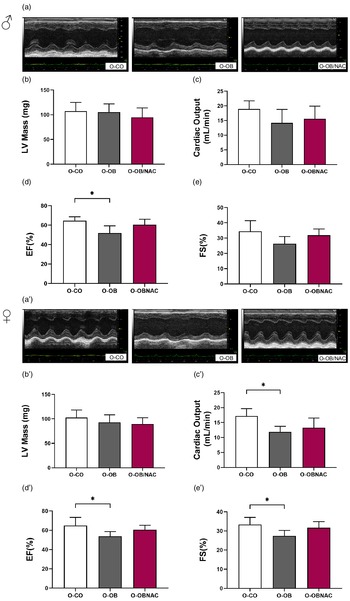
Compared with controls, although there was no significant difference in the LV mass among male and female adult offspring in the O-OB group, their LV cardiac output as well as hemodynamic parameters of LV systolic function, including LV EF and FS, were all significantly reduced, especially in female offspring. As expected, after NAC treatment, the LV EF and FS of offspring in the O-OB/NAC group were restored to a certain extent (Fig. 2). No significant difference can be seen in indices of diastolic function among the adult offspring of each group (Fig. S1).
Echocardiographic images (a and a’) and indices of cardiac systolic function (b–e and b’–e’) in 4-month male and female offspring of O-CO, O-OB, and O-OB/NAC. (b and bʼ) Left ventricular mass; (c and cʼ) cardiac output; (d and dʼ) left ventricular ejection fraction; (e and eʼ) left ventricular fraction shortening. A one-way ANOVA followed by Bonferroni post hoc test was performed for statistical analysis. *P < 0.05.

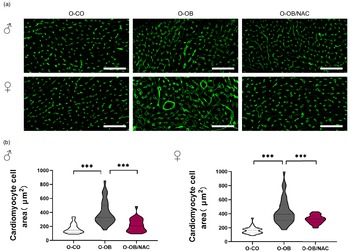
To determine whether maternal obesity induced by diet leads to pathological cardiomyocyte hypertrophy in offspring of different sexes during adulthood, we used wheat germ agglutinin staining to observe the area of cardiomyocytes. Compared with the O-CO group, the cardiomyocyte area of adult offspring in the O-OB group was significantly increased whereas myocardial cell hypertrophy was significantly attenuated in the O-OB/NAC group among both males and females (Fig. 3a, 3b).
Pathologic LV cardiomyocyte hypertrophy in 4-month-old offspring. Representative images of wheat germ agglutinin-stained mid-cardiac sections in O-CO, O-OB, and O-OB/NAC mice (a), and the distribution of relative sizes of cardiomyocytes (b) (n = 3). Bar = 50 µm. A one-way ANOVA followed by Bonferroni post hoc test was performed for statistical analysis. ***P < 0.001.

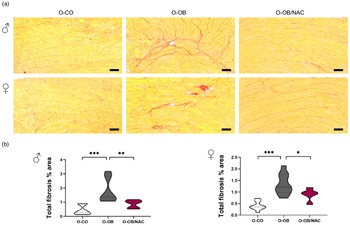
In view of the fact that myocardial interstitial fibrosis is largely accompanied by cardiac damage and that myocardial fibrosis, an important manifestation of ventricular remodeling, greatly contributes to ventricular systolic dysfunction and heart failure, we evaluated the effect of maternal obesity on cardiac fibrosis in offspring at age 4 months. Histological results showed that in both males and females, the distribution of collagen fibers in the myocardial tissue of the O-OB group was more abundant than that in the O-CO group (Fig. 4a). Quantitative analysis of collagen fibers showed that the area percentage of collagen fibers in the O-OB group was significantly higher than that in the control group (Fig. 4b). After NAC treatment, the collagen fiber composition in the myocardial tissue of adult offspring in the O-OB/NAC group was significantly decreased, especially in male offspring (Fig. 4a, 4b).
Cardiac fibrosis in 4-month-old offspring. Representative images of left ventricular mid-cardiac sections stained with picrosirius red (a), and violin plots showing the distribution of corresponding percentage of collagen in cardiac cross sections (b) (n = 3). Bar = 50 µm. A one-way ANOVA followed by Bonferroni post hoc test was performed for statistical analysis. *P < 0.05; **P < 0.01; ***P < 0.001.

Compared with the O-CO group, the expression of fibrosis-related factor TGF-β1 in the myocardial tissue of the O-OB group was significantly increased, especially in males. However, after antioxidant treatment, the expression of TGF-β1 in the cardiac tissue of the O-OB/NAC group was significantly decreased in both male and female offspring (Fig. 5).
The expression of the fibrosis-related factor TGF-β1 in cardiac tissue of adult offspring (n = 6). A one-way ANOVA followed by Bonferroni post hoc test was performed for statistical analysis. *P < 0.05; **P < 0.01; ***P < 0.001.

To determine whether oxidative stress also plays an important role in obesity programming-related cardiac damage in adult offspring, we detected the activity of important enzymatic antioxidants related to oxidative stress, as well as the content of lipid peroxidation products, in the heart tissues of offspring. Maternal obesity caused a significant decrease in GSH-Px activity in the myocardial tissue of adult offspring of both sexes (Fig. 6a, 6e). The activity of SOD in cardiac tissue from the O-OB group was significantly reduced in male adult mice (Fig. 6b), but there is no significant change in female adult mice (Fig. 6f). CAT activity showed no significant difference among the groups (Fig. 6c, 6g). Treatment with NAC significantly improved the activity of GSH-Px in the heart tissue of male offspring (Fig. 6a). In addition, compared with the O-OB group, concentrations of MDA were significantly decreased in the myocardial tissues of adult offspring in the O-OB/NAC group for both sexes (Fig. 6d, 6h).
Glutathione peroxidase (GSH-Px) activity (a and e), superoxide dismutase (SOD) activity (b and f), catalase (CAT) activity (c and g), malondialdehyde (MDA) levels (d and h) in cardiac tissue of 4-month-old offspring (n = 6–8). A one-way ANOVA followed by Bonferroni post hoc test was performed for statistical analysis. *P < 0.05;**P < 0.01;***P < 0.001.

Discussion
In recent years, a number of human studies have highlighted the association between maternal prepregnancy BMI and BMI of the offspring, Reference Heslehurst, Vieira and Akhter17,Reference Freitas, Vasques and Ribeiro18 as well as cardiovascular and metabolic diseases, Reference Razaz, Villamor, Muraca, Bonamy and Cnattingius2,Reference Persson, Razaz, Edstedt Bonamy, Villamor and Cnattingius19,Reference Eitmann, Nemeth and Hegyi20 suggesting that the time around conception may be a sensitive developmental window with long-lasting effects on the offspring. This has been further strengthened by studies in mice. Reference Han, Ren and Li21,Reference Azad, Archibald and Tomczyk22 Research efforts seek to develop effective interventions that commence prior to conception, starting from the early stages of life, with the aim to improve long-term outcomes in offspring.
In this study, offspring exposed to prenatal overnutrition developed pathological features associated with cardiomyocyte hypertrophy and hyperplasia of collagen fibers in the left ventricle. Similar to our study, adult mice exposed to a maternal high-fat diet (HFD) developed TGF-β-mediated increased extracellular matrix depot and cardiac hypertrophy in a model of developmental exposure to nutritional imbalance, which showed that maternal overnutrition induces long-term histological and molecular changes in the heart prior to the onset of overt obesity. Reference Siddeek, Mauduit and Chehade23 In addition, previous longitudinal observations in a similar mouse model of maternal obesity showed that marked cardiomyocyte hypertrophy in the juvenile offspring resolves before contractile dysfunction is observed at 12 weeks of age. Reference Blackmore, Niu, Fernandez-Twinn, Tarry-Adkins, Giussani and Ozanne24 Maternal HFD decreases the S phase and increases the G1 phase of the cellular cycle in fetal and neonatal cardiac cells, suggesting reduced cardiomyocyte proliferation and compensatory hypertrophy through intrauterine modulation of AGTR1 and AGTR2 expression via a glucocorticoid receptor-dependent mechanism. Reference Xue, Chen and Zhang25 This suggests that other potential factors, including hyperplasia of non-myocyte cells, such as fibroblasts, may contribute to cardiac remodeling. These maternal obesity-induced cardiovascular abnormalities may result from changes in the cardiac extracellular matrix, which play a crucial role in proper cardiovascular development. Reference Lockhart, Wirrig, Phelps and Wessels26 Various intracellular signaling pathways are thought to play a critical role in pathological remodeling of the heart, both independently and downstream of activated TGF-β signaling, as principal mediators of fibroblast-mediated cardiac fibrosis. Reference Khalil, Kanisicak and Prasad27,Reference Maity, Muhamed and Sarikhani28 However, the exact molecular events via which maternal obesity causes alterations in the cardiac extracellular matrix are currently unknown.
Cardiovascular diseases have become the leading cause of human death, and heart failure is the final stage in the progression of various cardiovascular diseases. A recent study proposed that cardiac dysfunction in the offspring of HFD mothers could be the result of early adverse cardiovascular remodeling. Reference Miller, Dodson and Mankouski29 Taken together, these data indicate that the ultimate outcome of pathological cardiac changes programmed by fetal overnutrition is the impairment of heart function. A large proportion of women with obesity present with hyperglycemia and their offspring show signs of cardiovascular dysfunction. In our previous study, we reported that neonatal mice born to obese mothers already displayed increased posterior wall thickness and interventricular septal thickness in early stages. Reference Zhang, Cao, Tan, Zheng and Gui7 Here, we demonstrated that maternal obesity was associated with LV systolic dysfunction in adult offspring using transthoracic echocardiography. Mice in the antioxidant treatment group had partly improved cardiac dysfunction, which was dominated by contractile function, in comparison with their O-OB counterparts. Consistent with our findings, previous animal studies showed that maternal obesity impaired fetal cardiomyocyte contractile function by reducing peak shortening and shortening/re-lengthening velocity, prolonging the time to re-lengthening, Reference Wang, Zhu and Sun30 and also reduced ventricular contractility both in vivo and ex vivo. Reference Blackmore, Niu, Fernandez-Twinn, Tarry-Adkins, Giussani and Ozanne24,Reference Loche, Blackmore and Carpenter31 In an obesogenic diet-induced maternal obese model without alteration of glucose tolerance, offspring developed mild and progressive heart dysfunction in adulthood, consistent with susceptibility to heart disease. Reference Ahmed, Liang and Chi32 In this study, we demonstrated that the offspring of obese mothers showed significant cardiac dysfunction after adulthood, although there was no remarkable impairment of ventricular function in these offspring during the newborn period in our previous study. Such phenotypic differences in offspring at different ages may be attributed to the changes in physiology of the heart in newborns and adults. Recent studies have demonstrated that neonatal mouse and human hearts have extensive regenerative capacities after myocardial infarction whereas a regenerative response is absent in the adult mammalian heart, Reference Porrello, Mahmoud and Simpson33-Reference Haubner, Schneider and Schweigmann35 and this difference may be due to the higher angiogenic potential of neonates. Reference Castellan, Vitiello and Vidmar36 In addition, the neonatal heart undergoes normal hypertrophy or compensation to complete development and adapt to increased systolic pressure. Reference Norris, Borg, Butcher, Baudino, Banerjee and Markwald37
In the current study, we also focused on investigating a mechanism by which prenatal exposure to obesity affects cardiac function in the offspring and whether these effects can be prevented. The detrimental effects of maternal obesity are widespread and affect many, if not all, organ systems. This suggests the possibility of a central causative pathway contributing to adverse effects, such as oxidative stress. Here, we demonstrated that prenatal overnutrition decreased the activity of antioxidant enzymes in the ventricular tissue of offspring, as compared with the control group. As predicted, antioxidant treatment greatly alleviated oxidative stress and mitigated oxidative damage to cardiac tissues in offspring that was caused by maternal obesity. Furthermore, levels of lipid peroxidation products were elevated in the O-OB group, providing direct evidence for increased oxidative stress, which has a role in cardiac remodeling and dysfunction by activating apoptosis and mitochondrial dysfunction. ROS, which are generated during normal cellular activity, are normally metabolized by antioxidant systems. In both cardiac hypertrophy and contractile dysfunction among patients with heart failure and in NOX5-expressing rat cardiomyocytes, as well as in the chronic remodeling process following myocardial infarction, ROS substantially contribute to cardiac damage. Reference Zhao, Zhao and Ouyang38,Reference Bugger and Pfeil39 ROS have diverse roles during different stages of cardiac differentiation, proliferation, and maturation. Therefore, detailed investigation and characterization of redox signaling will help with understanding the molecular mechanisms of ROS during different cellular processes and further contribute to cardiac regeneration and functional recovery. Reference Liang, Wu, Chen, Mai, Huang and Zhu40 Notably, the present work highlighted the increase in oxidative stress as a potential mechanistic basis linking maternal nutritional imbalance early during heart development with cardiovascular events in the future.
It is necessary to include both male and female offspring when investigating offspring outcomes. This has proven to be essential because many studies have found sex differences in the susceptibility to metabolic diseases as a result of exposure to maternal obesity, which could have important implications, especially in offspring interventional studies to ameliorate the negative effects of exposure to maternal obesity. Reference Nicholas and Ozanne41 Sex differences may contribute to this variation. In contrast with males, female offspring of obese dams exhibited more moderate cardiac interstitial fibrosis, including less distribution and less area of collagen fibers, and smaller increase in fibrosis-related factor TGF-β in our study. Therefore, female offspring appeared to be initially protected from the adverse cardiac effects of maternal obesity. In fact, some recent studies state that this metabolic and heart vulnerability tends to occur in male but not in female offspring with exposure to maternal obesity. Reference Nicholas and Ozanne41,Reference Vaughan, Rosario, Powell and Jansson42 The mechanisms driving these sex differences in perinatal programming of cardiovascular diseases are yet to be determined and deserve further study.
Recent research has demonstrated that developmental window is also critical for the embryo’s interaction with maternal nutritional factors. A cross-fostering design was used in developmental programming studies to determine the relative contribution of the pregnancy and lactation in establishing the adult offspring adverse phenotype in response to an environmental challenge. Reference Shankar, Harrell, Liu, Gilchrist, Ronis and Badger43-Reference Oben, Mouralidarane and Samuelsson45 To ensure that offspring were only affected by maternal obesity in utero environment, pups from obese mothers were cross-fostered to lean dams, and the results strongly suggested that maternal overnutrition-driven obesity at conception leads to metabolic programming of offspring. Reference Shankar, Harrell, Liu, Gilchrist, Ronis and Badger43 However, a study cross-fostered pups with no prenatal insult onto diet-induced obese dams with variable weight gain confirmed that exposure to maternal overnutrition, through the milk, was sufficient to shape offspring health outcomes. Reference Monks, Orlicky and Stefanski44 The development of dysmetabolic and nonalcoholic fatty liver disease were critically dependent on the early postnatal period, and these phenotypes were further exaggerated in the offspring exposure to maternal obesity during pregnancy and lactation than that during lactation alone. Reference Oben, Mouralidarane and Samuelsson45 Identifying the contribution of key exposure windows in overnutrition-related programming during pregnancy and lactation to increased disease susceptibility in offspring may be important for establishing effective primary prevention strategies, and more detailed assessment of this critical exposure windows are warranted.
Overall, our study findings provided novel evidence that LV remodeling and dysfunction in adult offspring induced by prenatal overnutrition are programmed in utero and may be mediated by the effects of oxidative stress. Thus, these adverse cardiovascular effects could be prevented by maternal antioxidant treatment. We speculate that such intervention could effectively decrease oxidative stress and block cardiac tissue damage-related pathways, ultimately preventing the development of cardiac dysfunction in the children of obese women. This novel finding highlights a feasible treatment in high-risk obese women of reproductive age which could contribute to public health strategies for prevention of cardiac damage of their offspring in adulthood.
Supplementary material
For supplementary material for this article, please visit https://doi.org/10.1017/S2040174422000095
Acknowledgements
We thank LetPub (www.letpub.com) for its linguistic assistance during the preparation of this manuscript.
Financial support
This work was supported by the National Natural Science Foundation of China (81873481).
Conflicts of interest
None.
Ethical standards
The authors assert that all procedures contributing to this work comply with the ethical standards of the National Institutes of Health Guide for the Care and Use of Laboratory Animals, and has been approved by the Animal Experiment Committee of the Children’s Hospital of Fudan University (No. 328-2019).