Introduction
Temporal bone fractures often result from significant force trauma and are highly morbid owing to their anatomic proximity to cranial nerves, auditory structures and vasculature.Reference Brodie and Thompson1–Reference Kanona, Anderson, Lambert, Al-Abdulwahed, O’Byrne and Vakharia8 Temporal bone fractures account for 14–22 per cent of cranial fractures.Reference Brodie and Thompson1–Reference Kanona, Anderson, Lambert, Al-Abdulwahed, O’Byrne and Vakharia8 Sequelae include facial paralysis, hearing loss, vertigo and traumatic brain injury.Reference Kanona, Anderson, Lambert, Al-Abdulwahed, O’Byrne and Vakharia8–Reference Schubl, Klein, Robitsek, Trepeta, Fretwell and Seidman11 In combination with motor vehicle accidents and assaults, falls are among the three most common causes of temporal bone fractures.Reference Schubl, Klein, Robitsek, Trepeta, Fretwell and Seidman11–Reference Ricciardiello, Mazzone, Longo, Russo, Piccirillo and Sequino14 Particularly in the elderly population, falls present a serious risk for temporal bone trauma.
As the mean age of the global population continues to increase, healthcare systems must consider the growing needs of elderly patients. Identifying patients at greater risk of morbidity and mortality or more vulnerable to chronic health complications can inform prevention and rehabilitation for this patient population. Frailty is defined as a vulnerability to adverse health outcomes due to impaired physiologic reserves and homeostatic mechanisms.Reference Sieber15, Reference Clegg, Young, Iliffe, Rikkert and Rockwood16 Frailty has been independently established as a predictor of falls, which are the leading cause of injury among adults 65 years and older and the second leading cause of unintentional injury-related death.Reference Moreland, Kakara and Henry17–Reference Kojima22 Frailty is a consequence of cumulative decline in multiple physiological systems over a lifespan and, thus, associated with the aging population. As homeostatic reserve declines, minor stressors may trigger disproportionate changes in health status.Reference Clegg, Young, Iliffe, Rikkert and Rockwood16 Frailty has been linked to higher mortality and increased complications after injuries and surgery as well as decreased functionality resulting in reduced independence for older adults.Reference González-Vaca, de la Rica-Escuín, Silva-Iglesias, Arjonilla-García, Varela-Pérez and Oliver-Carbonell23, Reference Cunha, Veronese, de Melo Borges and Ricci24
Falls may be the outcome of minor illness that reduces postural balance or the cumulative effect of the loss of several vital postural systems (vision, balance and strength), which is a core feature of frailty. In 2021 in the United States of America, 78.0 per 100,000 adults 65 years and older died from unintentional falls.Reference Kakara, Bergen, Burns and Stevens25 Falls are also closely associated with the psychological reaction of “fear of further falls,” which may contribute further to the development of impaired mobility.18 It is essential to identify frail patients who may be at higher risk of falls in order to introduce preventive strategies and reduce healthcare costs associated with potential fall outcomes including temporal bone fractures and their sequelae.
While previous studies have investigated complications following temporal bone fractures, none have comprehensively reviewed temporal bone fractures due to falls and evaluated the role of frailty in predicting sequelae. We hypothesise that patients with temporal bone fractures due to falls are frailer than those with mechanisms of injury other than falls and that frailty is an independent predictor of sequelae of falls.
Materials and Methods
Dataset
All adult patients presenting to the R Adams Cowley Shock Trauma Center at the University of Maryland Medical Center, from 1 January 2018 to 31 December 2022, with temporal bone fractures were included. Electronic health records (Epic Hyperspace, Epic Systems Corporation, Verona, WI) from emergency department, trauma centre, in-patient and out-patient office visits were reviewed. Only patients with traumatic temporal bone fractures on computed tomography (CT) confirmed by board-certified radiologists were included. Primary outcomes were House–Brackman (HB) scores and facial function as evaluated by in-patient otolaryngology services and comprehensive audiologic testing performed by certified audiologists. Patient demographics, past medical history, social history, mechanism of injury, fracture characteristics and each element of the Modified Frailty Index-5 (mFI-5) score were collected. The mFI-5 is a scoring system ranging from zero to five, with higher scores indicating greater frailty. It is based on the presence of five factors: medically managed hypertension, diabetes mellitus (DM), chronic obstructive pulmonary disease (COPD), congestive heart failure (CHF) and impaired functional health status. Other variables collected in our retrospective chart review include associated fractures and injuries; intra-cranial injury, including herniation and epidural, subdural and subarachnoid haemorrhage; management plans, including conservative and operative intervention; and post-traumatic sequelae. This study received approval from the Institutional Review Board at the University of Maryland (HP-00099871).
Statistical analysis
Descriptive statistics were calculated for the entire patient population as well as for patients with falls as the primary mechanism of temporal bone fracture. The mean (standard deviation [SD]) was used to report continuous variables. Demographics and fracture characteristics were compared using bivariate analysis between patients with and without temporal bone fracture due to falls. The Independent t-test was used to compare continuous variables. The chi-squared test was used to compare proportions. Statistical significance was set at p less than 0.05. Statistical analysis was performed using IBM SPSS 29.
Results
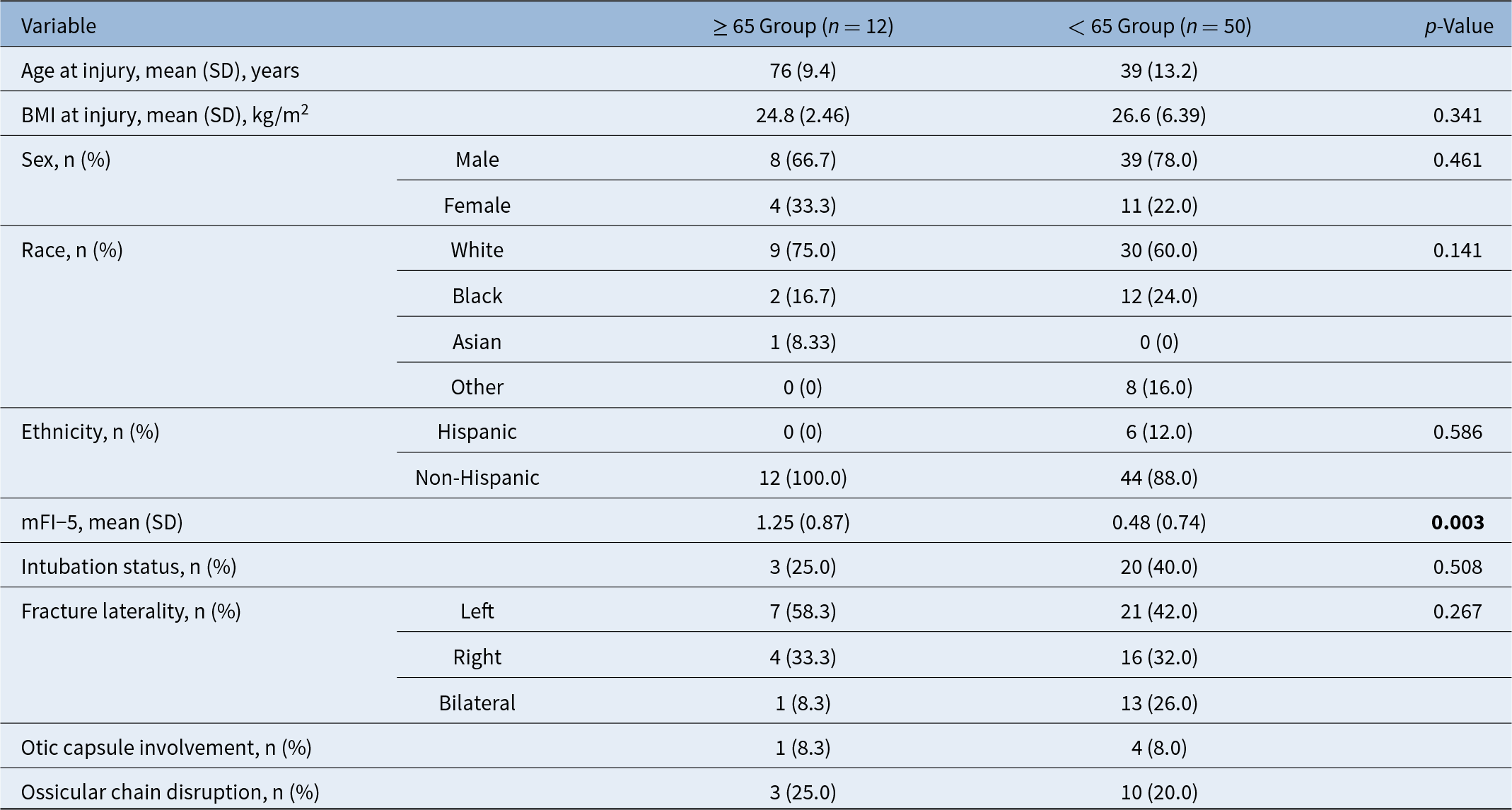
A total of 171 patients with temporal bone fractures were included in our analysis. Over one third of patients sustained temporal bone fractures secondary to falls (62; 36.3 per cent). Table 1 reflects the fall group’s demographics as compared with the group of patients who sustained temporal bone fractures via mechanisms of injury other than falls (“non-fall patients”). The mean (SD) age of fall patients was 46 (19.5) years. There were 109 (63.7 per cent) patients with temporal bone fractures due to mechanisms of injury other than falls, the most common of which were motor vehicle accidents (69; 63.3 per cent) and gunshot wounds (13; 11.9 per cent). Their mean (SD) age was 38.4 (16.1) years. Fall patients were significantly older than non-fall patients by eight years on average (46 versus 38; p = 0.0079; 95 per cent confidence interval [CI] 2.14-13.82). The majority of fall patients were male (47; 75.8 per cent) and non-Hispanic White (39; 62.9 per cent), as were non-fall patients (79; 72.5 per cent and 65; 59.6 per cent, respectively). Fall patients, regardless of age, had significantly higher mFI-5 scores than non-fall patients by 0.43 points on average (0.63 versus 0.20; p = 0.00026; 95 per cent CI 0.20-0.65). Table 2 compares demographics of fall patients 65 years and older with those younger than 65 years old. Within the fall group, mFI-5 scores of patients 65 years and older were higher by 0.77 compared with younger fall patients (p = 0.00026; 95 per cent CI 0.28-1.26). There was no significant difference in mFI-5 score between patients who fell from height (0.56) versus standing (0.71).
Patient demographics and temporal bone fracture characteristics compared between patients who sustained fractures due to falls vs those with other primary mechanisms of injury

BMI = body mass index; n = number; mFI-5 = Modified Frailty Index-5; SD = standard deviation.
* Midface: Maxilla, naso-orbito-ethmoid (NOE), zygomaticomaxillary complex (ZMC), zygoma.
** Anterior skull base: Sphenoid sinus, sphenoid clivus, cribriform.
Note: Significant p-values < 0.05 are bolded.
Patient demographics and temporal bone fracture characteristics compared between patients with temporal bone fractures due to falls ≥ 65 and < 65 years old

BMI = body mass index; n = number; mFI-5 = Modified Frailty Index-5; SD, standard deviation.
Note: Significant p-values <0.05 are bolded.
Most fall patients experienced falls from stairs (36; 58.1 per cent) and less commonly from standing (24; 38.7 per cent). Upon arrival to the hospital, 23 (37.1 per cent) fall patients were intubated as compared to more than half of non-fall patients (60; 55.0 per cent). A majority of patients suffered unilateral temporal bone fractures in both the fall (48; 77.4 per cent) and non-fall populations (86; 78.9 per cent). Bilateral fractures were also present in near equal number among fall patients (14; 22.6 per cent) and non-fall patients (23; 21.1 per cent). More than half of fall patients had concomitant maxillofacial fractures (38; 61.3 per cent), most commonly of the anterior skull base (20; 32.3 per cent) followed by the orbit (18; 29.0 per cent). The majority of patients in the non-fall population had concomitant maxillofacial fractures (82; 75.2 per cent), again most commonly of the anterior skull base (54; 49.5 per cent) and orbit (42; 38.5 per cent). Fifty (80.1 per cent) fall patients had concomitant intra-cranial injury, which was significantly associated with higher HB scores during admission as compared to fall patients without intra-cranial injury (p = 0.026; 95 per cent CI 1.06-58.84). Eighty-six (78.9 per cent) non-fall patients had concomitant intra-cranial injury.
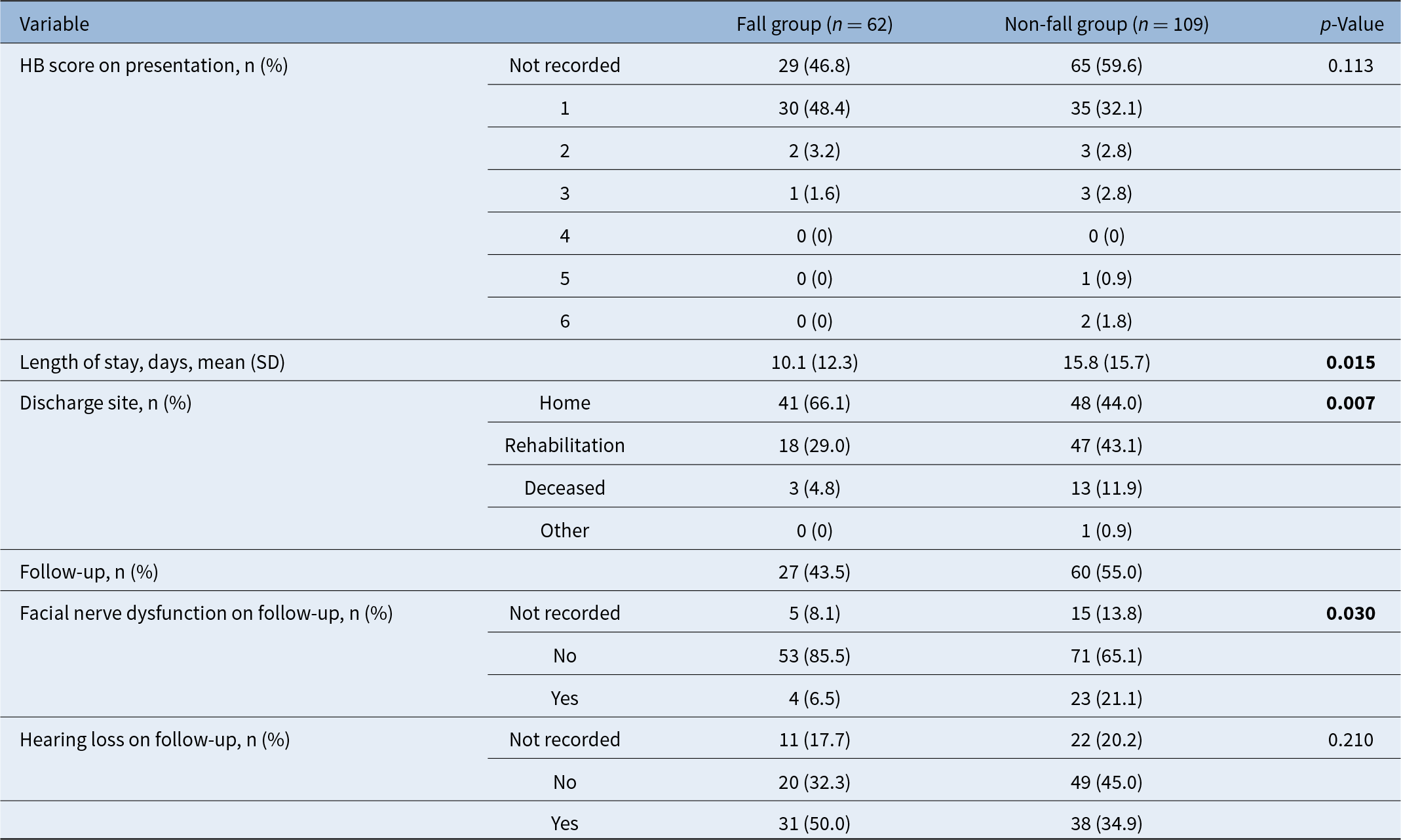
Table 3 compares pertinent findings in the evaluation and management of patients with temporal bone fractures due to falls and due to mechanisms excluding falls. The average time to inpatient otolaryngologic consultation among fall patients was 0.73 days, similar to 0.99 days for non-fall patients. HB scores on presentation were recorded in 32 fall patients and 44 non-fall patients. There was no significant difference in initial HB score between fall patients and non-fall patients, and the most common HB score was 1 in fall (29; 90.6 per cent) and non-fall patients (32; 79.5 per cent). Facial nerve weakness on initial otolaryngologic consultation was present in three of 32 (9.4 per cent) fall patients. Patients that fell from standing were more likely to be able to participate in a facial nerve exam on initial consultation compared to those who fell from any height (p = 0.0084; 95 per cent CI 1.34-17.81). Otoscopic evaluation on patient presentation was recorded in 95 non-fall patients with 56 (58.9 per cent) having abnormalities on otoscopy including otorrhea, hemotympanum and tympanic membrane perforation. Abnormal otoscopy in the fall population was present in 45 of 57 (79.0 per cent) evaluated patients. Excluding patients who died prior to definitive management, fall patients had significantly shorter lengths of hospitalisation by an average of 5 days than non-fall patients (10.1 versus 15.8; p = 0.0153; 95 per cent CI -10.24 to -1.10). Fall patients were significantly more likely to be discharged home compared with non-fall patients (41; 66.1 per cent versus 48; 44.0 per cent; p = 0.0068; 95 per cent CI 1.24-5.02). Fewer fall patients, regardless of age, were discharged to rehabilitation facilities (18; 29.0 per cent) compared with non-fall patients (47; 43.1 per cent). A minority of fall patients died before definitive management, which was not significantly different than non-fall patients (3; 4.8 per cent versus 13; 11.9 per cent).
Management of temporal bone fractures compared between patients who had temporal bone fractures due to falls vs those with other primary mechanisms of injury

HB = House–Brackmann; n = number; SD = standard deviation.
Note: Significant p-values < 0.05 are bolded.
Less than half of the fall patients followed up with otolaryngology after discharge (27; 43.5 per cent) compared to more than half of the non-fall patient population (60; 55.0 per cent). On average, fall patients were followed for 8.65 ± 10.38 months in otolaryngology clinic. Non-fall patients were followed for 11.32 plus or minus 19.46 months. Fall patients were less likely than non-fall patients to exhibit non-resolving facial nerve weakness (4 [6.5] versus 23 [21.1], p = 0.0302, odds ratio [OR] 0.21; 95 per cent CI 0.02-0.97). Of 14 fall patients with follow-up audiograms, 10 (71.4 per cent) exhibited hearing loss or vestibular complaints and 6 (60.0 per cent) of those patients required continued follow-up for hearing loss and/or benign paroxysmal positional vertigo (BPPV) management. Fall patients 65 years and older were significantly less likely to show improvement in hearing function on follow-up than fall patients younger than 65 years old (6 [50.0 per cent] versus 14 [28.0 per cent], p = 0.0496; 95 per cent CI 0.96-413.79). Of 28 non-fall patients with follow-up audiograms, 21 (75.0 per cent) exhibited hearing loss and/or vestibular complaints and 10 (47.6 per cent) of those patients required continued follow-up for hearing loss and/or BPPV management.
Discussion
Prompt identification and interdisciplinary management of temporal bone fractures is critical for optimal recovery and improvement of long-term functional outcomes, especially among frail patients. Our retrospective study characterises the distinctive subpopulation of patients with temporal bone fractures due to falls. We hope that our findings will lead to better rehabilitation of temporal bone fractures in fall patients, particularly among frail and elderly populations, which are anticipated to grow in the coming years.
In our study, fall patients were both older and more frail compared to other temporal bone fracture patients, reflecting a relationship between age, frailty, falling risk and serious complications such as temporal bone fractures. In addition, fall patients 65 years and older had significantly higher mFI-5 scores than younger patients with the same mechanism of injury. Mastoid pneumatisation has been proposed as protective of temporal bone fractures, as pneumatic cells can absorb impact force during a traumatic head injury.Reference Ilea, Butnaru, Sfrângeu, Hedeşiu, Dudescu and Berce26, Reference Kang, Ha, Oh and Sunwoo27 There is a gradual reduction in air cells throughout life with additional loss in the elderly both at the base and apex.Reference Ilea, Butnaru, Sfrângeu, Hedeşiu, Dudescu and Berce26, Reference Kang, Ha, Oh and Sunwoo27 This, possibly in conjunction with osteoporosis associated with aging, may place elderly fall patients at higher risk of temporal bone fractures. Detecting frailty as part of routine clinical practice, particularly in the primary care setting, can help mitigate potential complications such as falls through preventative measures as well as inform management of injured patients.
The aging population is rapidly accelerating. Whereas there were 461 million people over the age of 65 in 2004, this number is predicted to increase to more than 2 billion by 2050.Reference Clegg, Young, Iliffe, Rikkert and Rockwood16, Reference Kinsella and Phillips28 As such, there are profound implications for the planning and delivery of health and social care to the aging population. Our study’s rate of temporal bone fractures due to falls (36 per cent) is higher than the 18–21 per cent reported in the literature, likely reflecting the increase in aging population over the past decade alone.Reference Montava, Mancini, Masson, Collin, Chaumoitre and Lavieille13, Reference Ricciardiello, Mazzone, Longo, Russo, Piccirillo and Sequino14 As the aging population increases, so too will the rate of falls along with the risks that falls carry, including but not limited to temporal bone fractures.
Otolaryngologic intervention for temporal bone fracture patients focuses on the management of facial nerve palsy and cerebrospinal fluid leak, both of which often require multidisciplinary team input.Reference Kanona, Anderson, Lambert, Al-Abdulwahed, O’Byrne and Vakharia8 The diagnosis of temporal bone fracture must be made within hours following the trauma since prognosis of the cochleovestibular and facial nerves is dependent on time to treatment.Reference Kanona, Anderson, Lambert, Al-Abdulwahed, O’Byrne and Vakharia8, Reference Montava, Mancini, Masson, Collin, Chaumoitre and Lavieille13 Patients with temporal bone fractures, regardless of mechanism of injury, were evaluated by the otolaryngology team within the first day of admission. Barriers to otolaryngology evaluation include patient’s coma status and other severe injuries requiring intervention. Facial nerve weakness on initial otolaryngologic consultation was present in 9 of 44 (20.5 per cent) non-fall patients and in 3 of 30 (10 per cent) fall patients. Frailty was not predictive of ability to obtain a full facial nerve exam at the time of otolaryngology consultation, of immediate or delayed facial nerve dysfunction or of immediate or delayed hearing loss.
Fall height was predictive of ability to obtain facial nerve exam on initial evaluation but not of long-term facial nerve dysfunction. This is fitting, as one would expect a higher height of fall to entail more serious intra-cranial injury that may delay reliable cranial nerve exam. In our study, 16 (9.4 per cent) patients died prior to definitive management, 3 (18.8 per cent) of which suffered temporal bone fracture due to falls. This mortality rate closely resembles that in the literature, which ranges from 9.2 to 27 per cent, predominantly due to concomitant intra-cranial injuries.Reference Amin, Sayuti, Kahairi, Islah and Ahmad12, Reference Ricciardiello, Mazzone, Longo, Russo, Piccirillo and Sequino14, Reference Johnson, Semaan and Megerian29–Reference Wood, Hunt, Bergen, Carlson, Diehn and Schwartz31 Patients who sustained falls had decreased rates of in-hospital mortality, decreased rates of immediate or delayed facial nerve function and decreased length of hospital stay. These findings likely reflect the less severe nature of trauma in the overall fall population as compared to those with trauma due to other mechanisms of injury such as motor vehicle accidents and assaults. While fall patients in our study had rates similar rates of intra-cranial injury to those published in the literature, they were more likely to be discharged home than non-fall patients. This similarly likely reflects less severe intra-cranial injuries for fall patients.
Long-term sequelae of temporal bone trauma include facial paralysis, hearing loss, vertigo and intra-cranial hemorrhage.Reference Kanona, Anderson, Lambert, Al-Abdulwahed, O’Byrne and Vakharia8–Reference Schubl, Klein, Robitsek, Trepeta, Fretwell and Seidman11, Reference Ricciardiello, Mazzone, Longo, Russo, Piccirillo and Sequino14 Several prospective studies emphasise the frequency of cochleovestibular sequelae and their impact on quality of life compared to before their injury. However, most studies do not stratify impact of long-term sequelae based on mechanism of injury. Given that elderly fall patients are more likely to have prior hearing and vestibular deficits, they may be at greater risk of cochleovestibular sequelae compared to other temporal bone fracture patients.Reference Montava, Mancini, Masson, Collin, Chaumoitre and Lavieille13
A smaller proportion of fall patients who followed up exhibited hearing loss than did the overall temporal bone trauma population (10; 71.4 per cent). Six (60 per cent) patients required continued follow-up for hearing loss and/or BPPV management. The slightly lower rate of vestibulocochlear sequelae again likely reflects the less severe nature of fall injuries versus motor vehicle collisions, assaults and gunshot wounds. However, fall patients 65 years and older were significantly less likely to show improvement in hearing function on follow-up than fall patients younger than 65 years old, so we continue to advocate for the use of vestibular rehabilitation among fall patients, especially among the elderly population. We also recommend initiation early as this has been associated with a quicker course of recovery.Reference Montava, Mancini, Masson, Collin, Chaumoitre and Lavieille13, Reference Lacour and Tighilet32
In addition to management strategies of temporal bone fracture patients, this study highlights the need for focus on fall prevention strategies and mitigation of health consequences in frail patients. In the United States, nearly a third of adults over the age of 65 fell in 2014, resulting in increased morbidity, mortality and healthcare costs.Reference Hartholt, Lee, Burns and van Beeck33 The World Health Organization proposes prevention programs including stricter worker safety regulations and strength and balance training for older adults. Primary preventative strategies range from group and home-based exercise programs to medication management/adjustment to implementation of home window guards, stair rails and non-slip flooring. Secondary interventions include patient use of hip and neck protectors, furniture corner covers and exercises to strengthen bones and muscles after falls.18, Reference Gillespie, Robertson, Gillespie, Sherrington, Gates and Clemson34 Cost-effective interventions to prevent and manage falls in frail patients are imperative.
Based on our results, we recommend prompt diagnosis and multidisciplinary management of temporal bone fractures with the goal of avoiding sequelae, particularly in frail patients. We believe frail patients with temporal bone fractures warrant close otolaryngologic follow-up with timely initiation of vestibulocochlear rehabilitation. In addition, fall prevention programs are becoming exceedingly important as the global population ages.
Our study should be interpreted in light of some limitations. Firstly, temporal bone fractures identified on imaging other than craniofacial CT are not captured in our study sample. However, given the indication for craniofacial CT in trauma patients with known or suspected facial fractures, we believe that our methods likely captured most temporal bone fractures. The retrospective nature of our study is another limitation. Patient and fracture characteristics were reviewed based on radiology reports and consult notes, and any findings not documented in the electronic medical record were not captured in our study. Similarly, if patients presented to an outside hospital with complications related to their temporal bone fractures, these complications were not captured in our analysis. Few patients had comprehensive audiological evaluation following their injuries. A key strength of our study is that it not only assesses symptoms during hospitalisation but also evaluates sequelae with an average follow-up of nearly 30 months. Our findings contribute to improved patient counselling, management and follow-up, thereby optimising outcomes of patients with temporal bone fractures, particularly among frail fall patients.
• Falls, along with motor vehicle accidents and assaults, are among the top three causes of temporal bone fractures and pose a particular risk in the elderly population
• Frailty is a known predictor of falls—the leading cause of injury in adults 65 years and older and the second leading cause of unintentional injury death
• We analysed 171 patients with temporal bone fractures, 62 (36.3 per cent) of which occurred secondary to falls
• Fall patients were significantly older than non-fall patients and had higher Modified Frailty Index-5 (mFI-5) scores
• Patients with temporal bone fractures from falls are older and frailer than non-fall patients and have unique preventative and rehabilitation needs
Conclusion
Patients with temporal bone fractures due to falls appear to be both older and frailer. However, fall patients had shorter lengths of hospitalisation, were more commonly discharged home and exhibited fewer long-term sequelae than non-fall patients, regardless of age or frailty. Despite this, patients with temporal bone fractures due to falls, particularly the elderly subset of patients, have unique preventative and rehabilitation needs. Patients who sustain falls sufficiently severe to cause temporal bone fractures warrant vestibulocochlear rehabilitation. Our investigation of temporal bone fractures following falls aids in healthcare practitioners’ ability to provide anticipatory guidance to this patient population and introduces the considerations necessary to improve health outcomes for this patient population.