Introduction
In recent years, for the first time since the postwar period, there have been significant changes to the electoral geography of the area in Italy's North and Centre that has been known as the ‘zona rossa’ (‘red zone’) (Galli Reference Galli1968). Traditionally, this had been a reservoir of electoral support for the Italian Communist Party (PCI), until its dissolution, and then for the successive principal left-wing parties. The general elections of 2013 and 2018, in which the Democratic Party (PD) and other parties of the left received much reduced support, in effect wiped the red off much of the map of this part of Italy (Bordignon, Ceccarini and Diamanti Reference Bordignon, Ceccarini and Diamanti2018; Valbruzzi Reference Valbruzzi, Valbruzzi and Vignati2018). Most recently, Umbria has seen control of its regional government lost to the right, for the first time in a traditional ‘red region’ since elections to regional assemblies were instituted in 1970; the other three red regions have also become open to electoral challenge.Footnote 1 However, the seeds of this drastic reduction in the left-wing vote and the electoral contestability of all this part of Italy had been sown a long time ago. In the wake of defeat for the centre-left in 1999 in the local elections in Bologna, ‘the capital of red Italy’, scholars started to review the continuing validity and possible eclipse of the model of the ‘red regions’ (Ramella Reference Ramella2005). After the following year's regional elections, which displayed new features that included a notable increase in abstention, Floridia (Reference Floridia2000) questioned whether Tuscany was still a red region. The crisis for the red regions, and their potential disappearance, clearly relates to the waning support for Europe's left-wing parties in general, and to broader social and economic change. According to a substantial body of literature, this is also connected to the slow decline of the particular ‘territorial political subculture’ (Trigilia Reference Trigilia1981) characteristic of this part of Italy: a combination of political, cultural and socio-economic factors that moulded the development of local political institutions and fostered a distinct political tradition, ensuring continued electoral support for left-wing parties. The territorial entrenchment of the left had clearly extended well beyond the dissolution of the PCI and the appearance of new political entities that were in some measure its inheritors. This continuity resulted not just from inertia, but also from this political tradition's capacity for self-renewal and revitalisation, especially by means of its exercise of local and regional rule and related policies for development and welfare, finding new ways to retain an important segment of traditional electoral support (Floridia Reference Floridia, Baccetti, Bolgherini, D'Amico and Riccamboni2010). More recently, however, the linkage between the vote for the left and its traditional heartland has distinctly loosened (Almagisti, Baccetti and Graziano Reference Almagisti, Baccetti and Graziano2018). Analysis of patterns of voting behaviour indicates that this weakening has been especially due to the gradual fading away of the ‘voto di appartenenza’ (‘vote of belonging’): the expression of enduring identification with particular political parties, developed within families and local communities (Parisi and Pasquino Reference Parisi, Pasquino, Parisi and Pasquino1977). The vote of belonging had long been a key feature of local political subculture in the red regions (Ramella Reference Ramella2005). Phenomena then emerged that were novel for these regions, including widespread abstention and voting that varied according to the type of election; this vote-switching was in fact often practised against those local administrations that had previously been decisive factors in the reproduction of support and the enduring hegemonic role of the left.
This study employs various statistical tools to systematically address the longer-term developments that have affected the red regions, with reference both to the continuity and discontinuity of the left's territorial entrenchment and to changes in voter preference. After this introductory section, we consider some general issues relating to the context within which our research has been undertaken. The third section presents an analysis of the outcomes of general elections between 1953 and 2018 in the provinces within the red regions, in order to assess the degree of continuity in the relationship between the vote for the left and its traditional heartland and, in particular, to draw attention to the most recent trends. We then examine the changes in voting behaviour exhibited in the long term in the sphere of the left-wing electorate, studying voter transitions in detail, and highlighting the most important aspects of the progressive decline in the vote of belonging.Footnote 2 As detailed evaluations of changes in voting patterns, repeated over successive elections, are not available for the whole area under examination, this study limits itself to presenting one of the red regions, Umbria, as a case study. Here, two of this article's co-authors (Bracalente and Forcina) have consistently employed the same methodology to estimate voter transitions at the regional level over the last 20 years, the period of most marked discontinuity both in the political choices available and in voting behaviour.
The political context and the methodology for empirical analysis
After a long period of political stability and continuity in voting behaviour, the disappearances of the Christian Democratic Party (DC) and the PCI were followed by major upheavals within Italy's political system. In the 1994 elections, which marked the start of the so-called ‘Second Republic’, the first of these upheavals, particularly affecting the centre-right, came in the form of the arrivals of a ‘personal party’ (as Calise [Reference Calise2000] described it), Silvio Berlusconi's Forza Italia, and an ‘ethno-regionalist’ party (De Winter and Tursan Reference De Winter and Tursan1998), the Lega Nord (Northern League), which between them inherited much of the DC's previous support (Diamanti Reference Diamanti2009). A second serious upheaval found its expression in the collective outcome of the general elections of 2013 and 2018. The Movimento 5 Stelle (Five Star Movement: M5S) burst onto the political stage at the first and then strengthened its position at the second; the latter election also saw confirmation of the strength of the League, now transformed into a national party of the right (Passarelli and Tuorto Reference Passarelli and Tuorto2018). During this phase, Italian political developments entered a new cycle and the party system shifted from a bipolar to a tripolar configuration (Chiaramonte and De Sio Reference Chiaramonte and De Sio2014, Reference Chiaramonte and De Sio2019), while in regard to voting patterns there was unprecedented volatility among the former voters for the left (Chiaramonte and Emanuele Reference Chiaramonte, Emanuele, De Sio, Emanuele, Maggini and Paparo2013). The red zone has been especially affected by this second phase of upheaval, and with a particular intensity.
The recent shrinkage in the vote for left-wing parties in the red zone is not, of course, unrelated to the wider crises and transformations that have been affecting Europe's social democratic parties for some time (Kitschelt Reference Kitschelt1994), and which have escalated during the last 20 years. At the forefront of the many causes of this crisis are the economic and social transformations that have reduced the significance of the sectors that were traditionally represented by social democratic parties, as well as the crisis in welfare systems and resultant reduction in the role of public spending.Footnote 3 A contribution has also been made by important changes to modes of political involvement, now more personalised and focused on post-materialist values (Inglehart Reference Inglehart1990), which have partly replaced traditional social divisions.Footnote 4 Voters no longer see their electoral options as rigidly predetermined, but seem more open to a broader range of political alternatives, and thus more inclined to adjust their voting choices (Elff Reference Elff2009). In this environment of social and economic change, also marked by increasing levels of immigration and the emergence of new issues linked to this, and of changes in the models of reference for voting decisions, the social categories traditionally represented by left-wing parties have been less inclined to continue voting for them (Benedetto, Hix and Mastrorocco Reference Benedetto, Hix and Mastrorocco2019). This has been the context for the decline in the red zone's territorial political subculture, and this colour's gradual disappearance from Italy's political geography. Without spending more time on these complex issues (on which, see Ramella Reference Ramella2005; Caciagli Reference Caciagli2011 and Reference Caciagli2017; Diamanti Reference Diamanti, Baccetti, Bolgherini, D'Amico and Riccamboni2010; Floridia Reference Floridia, Baccetti, Bolgherini, D'Amico and Riccamboni2010), we can see that the factors noted above, taken together, must have at the very least diminished the importance of traditional allegiances in electoral support for the left in this part of Italy.
Empirically, the degree of persistence of this legacy and of the link with territory in the red regions has generally been assessed in terms of the regional concentration of the vote for left-wing parties, either by simply comparing the proportion of the vote won by the left across these regions as a whole (or just across the red zone) with the national average (Diamanti Reference Diamanti2009, Reference Diamanti, Baccetti, Bolgherini, D'Amico and Riccamboni2010) or, in a similar vein, by calculating statistical indicators of homogeneity for each of these regions in relation to Italy as a whole (Corbetta and Passarelli Reference Corbetta, Passarelli, Salvati and Sciolla2015).Footnote 5 In this article, however, the degree of persistence is not measured in terms of continuing or weakening divergence from an external point of reference (national voting), but in terms of the temporal continuity of territorial entrenchment inside the red regions.
In the heterogeneous world of the red regions, which despite this unifying name include territories with varying political and electoral features, continuity of territorial entrenchment would be illustrated by the vote for successive left-wing parties maintaining the same pattern of distribution, over time, between the different provinces within the area as a whole.Footnote 6 Discontinuity, conversely, would be illustrated by a progressive change in the geographical distribution of the vote within the territory, so that as one election follows another this is increasingly unlike that of the past. As a result, in statistical terms, while a positive territorial correlation can still be observed, its strength is decreasing when earlier and more recent election results for left-wing parties are compared. The subject of analysis has therefore been the long-term series of election results for the provinces within the area, and the objective has been to determine whether, to what degree, and in which time periods this exhibits features of continuity or discontinuity, in terms of the meanings just discussed.
One further method for exploring the changes that have affected the red regions is the analysis of changing voting patterns, which is a more complex empirical task. This examines the changes that occur between one election and the next, using estimates of voter transitions; if longer-term patterns are to be discerned and the moments of real discontinuity identified, the analysis has to be undertaken with thoroughness and consistency of approach. Discontinuity in voting behaviour in the red regions has been principally apparent in the decline in the vote of belonging, indicating a decrease in the loyalty of former left-wing electors to their previous parties of reference, and has translated into a growing propensity to abstain from voting, changes in voter preference benefiting other political alliances, and voting behaviour that varies according to the type of election (Ramella Reference Ramella2005; Caciagli Reference Caciagli2011). In view of the absence of systematic and consistent estimates of voter transitions for the red regions as a whole, this article presents a case study, Umbria, for which the requisite estimates are available for all the elections of almost the last 20 years, starting in 2001.
Long-term continuities and discontinuities in the red regions
Within the red regions: from divergence to convergence
Varying political environments have always coexisted within the red regions. The criterion adopted here to distinguish their different types of province is based on a comparison between the proportions of the vote won by the area's two major parties during the period 1953–87. Using this measure, provinces can be classified as one of three types: ‘red’, if the PCI was consistently the first party; ‘intermediate’, if the PCI was not consistently first or if support for the DC was not significantly lower; and ‘white’ if the DC was consistently or predominantly the first party.
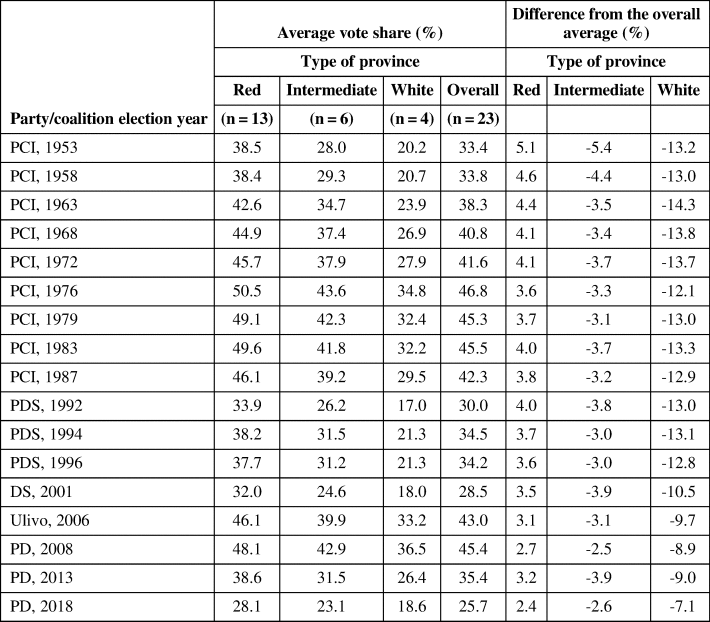
During the period analysed, 13 provinces could be classified as ‘red’, six as ‘intermediate’, and four as ‘white’ (see Table 1). In the first part of the period (the 1953 and 1958 elections), the red zone, meaning the red provinces taken together, was much smaller and had average support for the PCI at 38.5 and 38.4 per cent respectively. During this phase none of the Marche provinces were in the zone, and nor was the Umbrian province of Perugia. The red zone's broadest spread was at the time of the 1976 and 1979 elections, when average support for the PCI reached 46.8 and 45.5 per cent respectively. During this period, the DC was the first party in only three of the 23 provinces.
Vote share (%) of the main left-wing party or coalition list, averaged by type of province, at elections in the red regions, 1953–2018.

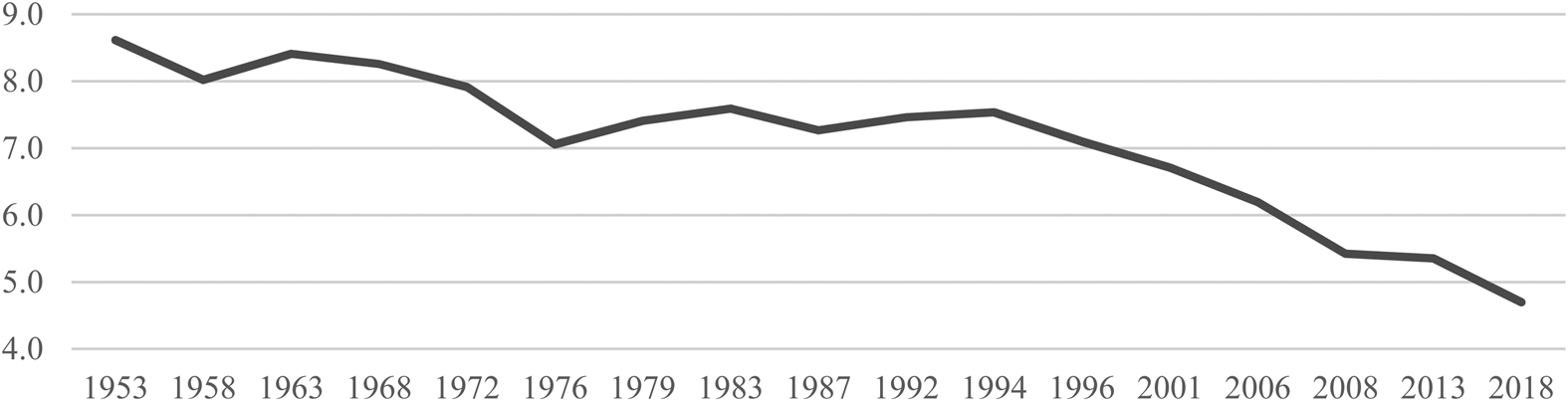
Significant changes in electoral geography within the red regions emerge from analysis of the differences over time between the average proportions of the vote achieved by the main left-wing party in the three different types of province and the overall average across all four regions. In all three groupings by type of province, this proportional support tended to move closer to the overall average, with a reduction of almost 3 per cent between 1953 and 2018 in the positive divergence recorded in the red provinces as well as reductions in the negative divergence for the intermediate and white provinces, most notably in the latter, where the divergence from the overall average reduced by 6.1 per cent. In regard to overall electoral support for successive left-wing parties in the four regions, the red zone has thus gradually lost its importance relative to the other types of province, especially the white grouping; these latter provinces have seemed increasingly less detached from the political and electoral environment in this part of Italy, particularly with the arrival of the ‘Ulivo’ (‘Olive Tree’) and, thereafter, the PD. The gradual but clear trend in voting patterns across the types of province, away from diversity and towards uniformity, can also be expressed as the decline in the standard deviation of the proportions of the vote earned by successive principal left-wing parties in the different provinces over time (see Figure 1). From these first statistical measures, we can already see clear signs of change to the left's territorial entrenchment in these regions.
Standard deviations of the vote shares (%) of successive main left-wing parties, within the provinces of the red regions, 1953–2018.

The degree of continuity in the left-wing parties’ territorial entrenchment
In general terms, we can talk about continuity in the territorial entrenchment of a party, or that of different parties that replace each other over time, when its territorial share of the vote, irrespective of its level of support, broadly replicates that of the past. In statistical terms, the data will in these circumstances generate a significant positive correlation between the electoral results of this party, or these parties, over time in this territory. When comparisons are made between situations separated by longer time periods, although the composition of the electorate may have significantly changed, it is assumed that electoral orientation tends to transfer from one generation to the next, and therefore largely survives over time as a result of the territorial political subculture (Segatti and Vezzoni Reference Segatti, Vezzoni, D'Alimonte and Chiaramonte2007; Sani Reference Sani1976) or, put in more general terms, as a result of the local context's enduring features.Footnote 7
These correlations should not be used to draw conclusions about behaviour at the individual level (by ‘ecological inference’); the aim is not, for example, to determine what proportion of those who previously voted for the PCI now vote for the PD, something that would in any case be impossible because the voters are largely not the same people, given the number of years elapsed. The relationship of interest is at the aggregate level; this is entirely valid in terms of the analytical approach, as discussed by Welzel and Inglehart (Reference Welzel, Inglehart, Boix and Stokes2007) (see also Russo Reference Russo, Fisher, Fieldhouse, Franklin, Gibson, Cantijoch and Wlezien2017). The aim is to establish the extent to which the areas (provinces, in this case) that previously had a left-wing orientation have kept alive their political subculture, and therefore their voting orientation, inasmuch as an area's residents continue to share certain values and maintain a particular local environment.
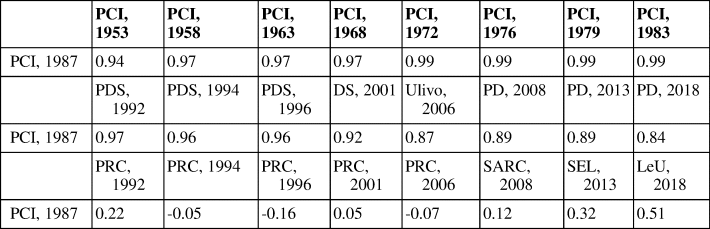
The degree of electoral continuity in the red regions is measured by the coefficient of linear correlation between the provincial levels of support achieved by the PCI and those achieved by the parties that have inherited this support, at least in part, in subsequent years.Footnote 8 The analysis therefore relates to the PCI, for the period 1953–87; the Democratic Party of the Left (PDS), for 1992–6; the Democrats of the Left (DS), in 2001; the Ulivo list, in 2006; and the Democratic Party (PD), for 2008–18. Table 2 presents these coefficients of correlation, and also those relating to the smaller parties of the far left (in the bottom line), all calculated in relation to the proportion of the vote won by the PCI in 1987, in the last elections before it was wound up.
Correlation coefficients between the vote share of the main left-wing parties, general elections 1953–2018, and the vote share of the PCI in 1987, in provinces in the red regions.

SARC = Sinistra ARCobaleno (Left-Rainbow), a left-wing party set up to contest the 2008 parliamentary elections.
SEL = Sinistra, Ecologia, Libertà (Left, Ecology and Freedom), the most important left-wing party from 2009 to 2016.
The figures in the top line of Table 2 are all close to unity (1.0), the highest possible value of this index, illustrating the almost complete stability and continuity of the PCI's territorial entrenchment in the red regions for most if not all of its existence in the postwar period. Within these regions, the party was still stronger and weaker in 1987 in the same provinces where it had been correspondingly stronger and weaker in 1953 (and in all subsequent election years). The central line, relating to the successive main left-wing parties after the PCI's dissolution, is the most important for this study. All the coefficients of correlation here are again very high and strongly significant in statistical terms (p < .0001), indicating a notable continuity between the territorial entrenchment of the PCI and that of its successors. However, it is also clear that the correlation has tended to decrease, especially from the time when the Ulivo list contested the 2006 election. This is now examined in more detail.
Prior to the general elections of 1992 and 1994, Italy's party system had been undergoing significant change. On the left, the main innovation was the establishment of the Democratic Party of the Left (PDS), whose leader Achille Occhetto had argued for the dissolution of the PCI; this had also resulted in the creation of the Partito della Rifondazione Comunista (PRC), which by contrast continued to refer back directly to the traditions of Italian Communism. The correlation between the vote shares for the PCI and the PDS are very high; this shows that the PDS, whose emergence marked the passing of the PCI, had at the point of its electoral debut retained a strong link with the PCI's territorial entrenchment, although the percentage of support for the PDS was perceptibly lower than that previously enjoyed by the PCI. This link also remained intact between 1994 and 1996, when support for the PDS in these regions rose from 30 to more than 34 per cent. The territorial correlation with the vote previously given to the PCI went down, but almost imperceptibly, at the 2001 elections, when the DS replaced the PDS after a second phase of reorganisation on the left; the level of support for the DS was distinctly lower, at 28.5 per cent.
For the 2006 elections, the two largest parties in the broader left and centre-left coalition, the DS and the Margherita, put themselves forward together as the Ulivo.Footnote 9 The correlation between the provincial levels of support achieved by the Ulivo list and previously by the PCI is still very high and statistically significant, but there is a more marked reduction. This shows that although the Ulivo was a new political option, it still had a remarkable continuity of its territorial entrenchment with that of the PCI; however, this continuity displayed early signs of weakening, the coalition having absorbed components that were alien to the Communist tradition.Footnote 10 Finally, the correlation indices for the 2008, 2013 and 2018 elections are all still very high and statistically significant, showing that the PD – the beneficiary of the new political choice offered by the Ulivo – has maintained a solid link with the left's history in this territory, although its levels of support have clearly been in decline over this ten-year period. After the PD's electoral debut in 2008, Diamanti (Reference Diamanti, Baccetti, Bolgherini, D'Amico and Riccamboni2010) described this continuity as ‘worrying’, because it showed that the newness of its political proposals was not enough to widen its support base beyond the traditional limits. However, it should be remembered that the continuity of territorial entrenchment ought not to be understood as necessarily indicating a simple ‘inertia of tradition’ (Ramella Reference Ramella2005); it might also be the effect of efforts towards renewal and revitalisation of the territorial political culture in new forms (Floridia Reference Floridia, Baccetti, Bolgherini, D'Amico and Riccamboni2010). In any case, the gradual weakening of the coefficients of correlation should be emphasised. Although this has not seemed especially marked, it is symptomatic of the latent discontinuities that have become increasingly apparent, and which indicate a trend towards a greater separation between electoral support for the left and both its traditional heartland and this territory's past political subculture.
Unlike that for the larger political groupings of the left, the data for the smaller post-Communist parties that made explicit reference to the political experience of Italian Communism does not show any significant relationship with the PCI's territorial entrenchment (see also Ramella Reference Ramella2005). The correlation coefficients in the bottom line of Table 2 are either close to zero or actually negative. Since the critical moment of 2006, however, when the Ulivo made its first election appearance, the trend has gradually reversed, and from 2013 onwards has shown a positive relationship with the previous territorial entrenchment of the Communist left. In 2018, in particular, the relationship between support for the ‘Liberi e Uguali’ list and the PCI heartland was positive and statistically significant (p < .05), and it is interesting that this happened while the latter's relationship with support for the PD was in decline.Footnote 11
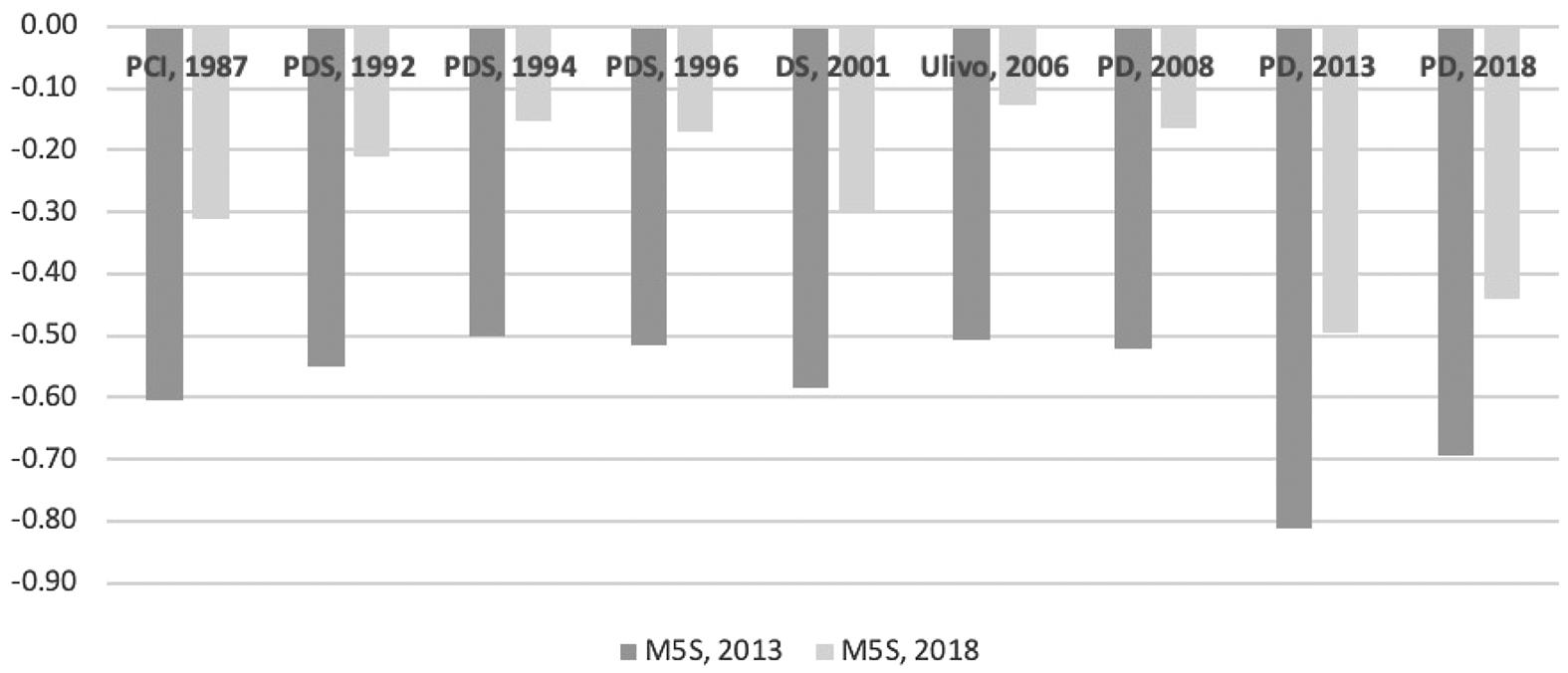
There is, on the other hand, no empirical evidence that this same relationship was also transferred to some extent to the M5S, which, although a composite entity, established itself in these regions mainly by taking votes from the PD (Corbetta and Gualmini Reference Corbetta and Gualmini2013; De Sio and Paparo Reference De Sio, Paparo, Chiaramonte and De Sio2014). The opposite proved to be the case: the M5S's electoral success was greater in the ‘white’ and ‘intermediate’ provinces, where in 2013 its average support was about 29 per cent (across both categories), as against just above 23 per cent in the ‘red’ provinces. The correlations between M5S support and the provincial levels of support for the successive main left-wing parties, across the full time span under consideration, are in consequence firmly negative (see Figure 2).Footnote 12 The territorial base of the M5S thus appears to be an inverted image of that of both the traditional left and, especially, the PD.
Correlation coefficients between the vote shares (%) of the M5S in 2013 and 2018 and those of successive main left-wing parties, within the provinces of the red regions, general elections 1987–2018.

Voter transitions and the end of the vote of belonging: the Umbrian case
Introduction
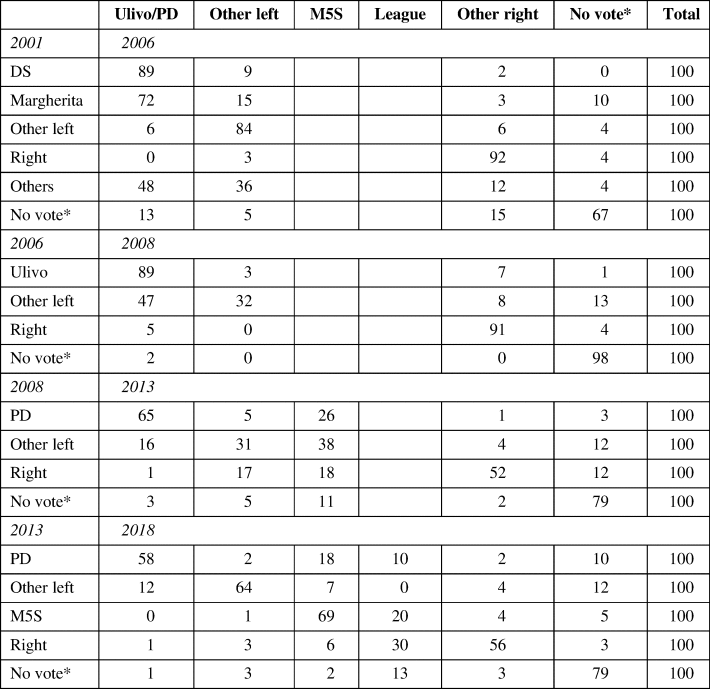
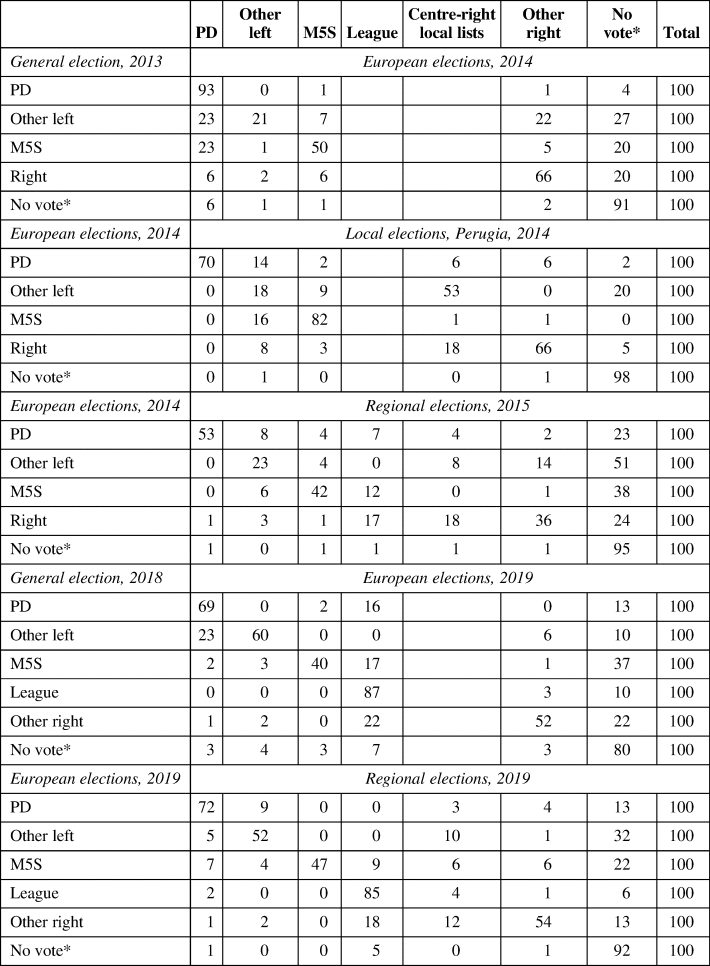
We now turn to the various phenomena that emerge from estimating voter transitions in the region of Umbria. First, we analyse the series of estimates relating to the general elections of 2001 and all subsequent general elections up to and including 2018 (see Table 3). Then, covering the more recent period, we examine estimates of voter transitions in various particularly significant second-order elections: the European elections of 2014 and 2019; the local elections in Perugia (the regional capital) in 2014; and the regional elections of 2015 and 2019 (see Table 4). As far as we know, this is the only Italian example available of an unbroken series of estimates of voter transitions at the regional level.
Estimates of voter continuity and transitions (%) from one general election (parties/coalitions shown on the left) to the next (parties/coalitions along the top), Umbria, 2001–2018.

* Abstentions and invalid ballot papers
Estimates of voter continuity and transitions (%) in relation to second-order elections, Umbria, 2014–2019

*Abstentions and invalid ballot papers. Votes cast only for presidential candidates in the regional elections of 2015 and 2019 have also been included.
This corpus of estimates allows us to construct a detailed picture of the more significant changes that have taken place within the Umbrian electorate during a particularly important period in the region's political and electoral history. Although the results cannot be seen as reliably representative of the red regions as a whole, they suggest useful ways of understanding the discontinuities in voting behaviour that are the concern of this study, particularly in regard to the gradual disappearance of the vote of belonging.
Estimates of voter transitions were made using an advanced method of ecological inference – an updated version, set out by Forcina, Gnaldi and Bracalente (Reference Forcina, Gnaldi and Bracalente2012), of the model used by Brown and Payne (Reference Brown and Payne1986) – which uses the official figures at polling station level. To minimise potential ‘ecological’ distortion, estimated transitions at the regional level were calculated by a three-stage procedure. The first stage employed ecological inference to estimate voter transitions within each of the six comuni considered to be representative of the different sub-regional contexts (Perugia, Terni, Foligno, Città di Castello, Spoleto and Orvieto; only the first four were considered for the estimates relating to the 2018 European and 2019 regional elections). In the second stage, the data was transformed into absolute values consistent with the actual votes obtained by every party at the relevant elections in each comune, using an iterative procedure (Deming and Stephan's IPFP [Reference Deming and Stephan1940]). The final stage involved summation of absolute transitions at the comune level and transformation into absolute regional transitions consistent with the known totals, using a new application of the iterative procedure. The procedure for estimating voter transitions used covariates relating to the urban and rural types of polling station and to various social and demographic features of the population, assessed at the polling station level and taken from the 2011 census, although these were only available for Perugia and Terni in the most recent period. This helped to minimise the issue of ‘ecological fallacy’, which, as Forcina and Pellegrino (Reference Forcina and Pellegrino2019) have shown, can result in a sizeable distortion of estimates in larger comuni.Footnote 13
The general elections, 2001–2018: increased abstention and changing voting patterns
The tendency towards abstention
Reduced participation in voting in the red regions, which started many years ago, has been regarded as the principal indicator of their possible decline as a political phenomenon (see, for example, Floridia Reference Floridia2000, Ramella Reference Ramella2005, and Caciagli Reference Caciagli2011). The implicit thinking was that this affected voters for the left-wing parties as well as others, although this could only be confirmed with the help of suitable estimates of voter transitions. In this regard, the estimates that relate to Umbria, presented in Table 4, offer some interesting indications. At general elections up to and including 2013, the tendency to abstain among the voters for the main political entity on the left (first the DS, then the Ulivo, and finally the PD) was actually very limited (a maximum of 3 per cent in 2013). In contrast, former voters for the smaller lists of the left and centre-left – including the Margherita, at the point when it put its candidates forward in the Ulivo joint list with the DS – exhibited a clear tendency to abstain, which had already reached 12 to 13 per cent in the general election of 2008. It was only in the general election of 2018 that this phenomenon had come to apply to all the elements within the left, including the PD, which had lost 10 per cent of its support at the preceding general election to abstention.
Regarding this important aspect of voting behaviour, a clear difference between two groups within the left and centre-left spectrum can therefore be highlighted: at least until recent times, voters for the main political entity that inherited the largest part of the PCI's vote – which was traditionally more linked to the vote of belonging – contributed very little to the growth in abstention, while voters for the other parties, from the radical to the reformist left, contributed much more.
Changing voting patterns
For the main political entity on the left in Umbria, changes in voter preference, especially towards other parties or coalitions, long remained a limited phenomenon. However, two new features emerged when the Ulivo joint list was succeeded by the PD at the elections of 2008: the drift towards the centre-right went up, to 7 per cent (although there were also simultaneous transfers in the other direction); and the new party exerted a strong attraction on the vote for the smaller left and centre-left lists, capturing almost half the votes that the latter parties had won at the 2006 elections. The vote for the smaller centre-left lists, moreover, proved to be more fluid, including a drift towards the centre-right, to which they lost 6 per cent of their support in 2006 and a further 8 per cent in 2008. All in all, with the emergence of the PD there was increased fluidity both within the range of parties on the left and between this and the array of parties on the right, but its overall electoral strength remained intact.
Voter loyalty, on the other hand, was crumbling, and for the first time there were notable changes in voter preference away from the centre-left after the sudden arrival of the M5S, to which the PD, at the 2013 elections, lost about a quarter of its vote of five years earlier.Footnote 14 Again, however, supporters of the smaller parties within the left and centre-left were the most inclined to abandon their political grouping and, at almost 40 per cent, transfer their allegiance to the new political entity. Voter loyalty crumbled further in the general election of 2018. This time, alongside the M5S, a contributory factor was the national and LePenist turn performed by the League; their policies, focusing on the issues of immigration and security, also met with unexpected success in Umbria, where ten per cent of the PD's voters demonstrated their receptiveness to this appeal. Moreover, another segment of these voters continued to be attracted by the M5S, which gained another 18 per cent of the PD's vote, after the 26 per cent of 2013. The degree of loyalty to their own side exhibited by PD voters, already low in 2013 (about 70 per cent) in relation to the general election of 2008, fell by a further ten or so percentage points; it can be estimated, very approximately, that no more than 40 per cent of the PD voters of 2008 repeated their vote for the centre-left in 2018. For the voters for other parties of the radical and reformist left, analogous estimates give even lower percentages, although these voters would seem not to have been at all attracted by the League. Finally, a politically significant shift was apparent in the 2018 elections, which saw the M5S lose 20 per cent of its vote in the previous general election to the League. This would suggest that for at least some of its original voters the M5S represented a provisional haven for discontent with the traditional parties, which was then, both in Umbria and elsewhere, to find its principal destination in the League.Footnote 15 This trend was generally confirmed by the subsequent European elections of 2019.
In conclusion, the traditional lack of flow between right and left (Natale Reference Natale, D'Alimonte and Bartolini2002) remained in large part the norm until the appearances of the M5S and then the League, whose different sorts of populist policy programmes have overturned traditional voting patterns in Umbria as elsewhere. The main difference between the PD and other elements within the left and centre-left spectrum is that the latter's voters have only been responsive to the appeal of the M5S, to which they lost almost half their support over two rounds of voting, and not to that of the League.Footnote 16
Second-order elections and the trend towards vote-switching
The general election of 2013 was followed by various important electoral events: first the European and local elections of 2014, then the regional elections of 2015, and finally the European and regional elections of 2019. When these ‘second-order’ elections (as Reif and Schmitt [1980] termed them) are analysed in conjunction with the ‘first-order’ general elections, various findings emerge, in particular increased abstention, which might be generally expected given the different nature of the elections under comparison. The main assumption of ‘second-order theory’ is that the European elections, like the regional and local contests, are seen as less important, there being less at stake, not just by the voters but also by the parties themselves and the media; as a result, in comparison to involvement in a country's general elections, many more people choose not to vote. Other outcomes from this composite analysis prove to be interesting on various fronts. We now look at two time periods, whose most important voter transitions are summarised in Table 4: the first between the general election of 2013 and the regional elections of 2015, when the left prevailed over the right by just a few percentage points; and the second between the general election of 2018 and the regional elections of 2019, when instead the right clearly prevailed and captured control of one of the red regions for the first time.
The analysis of voter transitions within the first of these cycles reveals a very interesting finding. The PD, which at the European elections in 2014 put forward a manifesto and a leadership that signalled major discontinuities with left-wing tradition, regained support from all the lists and parties within Umbrian regional politics and achieved notable electoral success, as it did elsewhere in Italy. This seemed to contradict the predictions of second-order theory, whereby the European elections would tend to penalise a country's major parties, especially those in government. The result might, instead, be explained by the theory that the European vote is mainly influenced by issues relating to the ‘national arena’ (Schmitt Reference Schmitt2005), and is therefore affected by changes at the national level in the political choices available and in the electorate's preferences (Reif and Schmitt Reference Reif and Schmitt1980). More importantly, the PD's recapture of support was principally at the cost of the M5S, which lost to it almost a quarter of the vote achieved at the general election of 2013, and more than half of the votes that had moved in the other direction on the earlier occasion.Footnote 17 This would seem to refute another recognised hypothesis, at least in the Umbrian case: that the considerable support lost to the M5S would only be regained if the PD went back to a political and ideological programme more consistent with its historical roots.
The results of various local elections in Umbria that were held at the same time as the European elections, and then those of the regional elections the following year, point to other important discontinuities in voter behaviour. In both cases, the elections revealed an unprecedented willingness of left-wing voters to switch their vote according to the type of election, penalising their parties of reference in both the local and regional contests. The elections for the local council and mayor of Perugia, Umbria's capital, produced one of the most striking results of Italy's 2014 local elections: the defeat of the sitting PD mayor by a young centre-right candidate, despite the fact that in the simultaneous European elections the PD and its coalition partners had won 55 per cent of the vote, 30 percentage points more than parties on the right.Footnote 18 Estimates of voter transitions suggest that 16 per cent of PD voters in the European elections decided to support candidates from other lists or abstained, while about 80 per cent of those who had voted for other groupings on the left pursued similar courses of action, predominantly in favour of local lists that in the second ballot supported the candidate put forward by the right.
This phenomenon developed further with the regional elections of 2015. On the one hand, the PD lost about 40 per cent of the vote it had received at the European elections: more than half of this by abstention, and otherwise by votes going to right and centre-right lists, starting with the Northern League, to which it lost 7 per cent of its support. On the other, a good three quarters of those who had voted in the European elections for other left and centre-left lists and parties, excluding the PD, changed their voting preference at the regional elections, mostly either by abstaining or by voting for right or centre-right lists, some local and some not. Taken as a whole, these developments almost resulted in the first defeat for a left-wing coalition in a red region.
The crucial change in the second time period, starting with the general election of 2018, emerged at the European elections of 2019, which saw a substantial transfer of votes give the right a strong lead; this foreshadowed the historic defeat of the PD in the subsequent regional elections, despite its alliance with the M5S. On this latter occasion the League was extraordinarily successful, gaining more than 38 per cent of the vote, partly because of the steady drift of votes from the PD and the M5S. The regional elections of 26 October 2019 had become a national test for the new PD–M5S coalition now in government; seen in relation to the European elections a few months earlier, they confirmed the strong tendency, mentioned earlier, of former left-wing voters to punish their parties in local and regional contests. This especially applied to voters for the parties allied to the PD, a third of whom actually abstained while ten per cent voted for centre-right civic lists, but also applied to PD voters themselves, with 20 per cent of them abstaining or voting for right-wing lists. This time, moreover, the phenomenon extended to voters for the M5S, the PD's new ally: more than 20 per cent decided not to vote, while a similar number chose the League or other lists on the right. Umbria thus became the first of the old red regions to find itself governed instead by the League.
Conclusion
In the red regions, prior to the Democratic Party's electoral debut in 2008, neither socio-economic change nor alterations to the features of the left's main political entity had significantly weakened the left's electoral link with its traditional heartland. During this phase, the left's share of the vote also remained more or less unchanged, despite some variations. The first faint signs that the link between the vote and its traditional heartland might be weakening emerged with the advent of the Ulivo list in 2006, within which the former Communists now found themselves alongside other political cultures including, notably, Catholics of the centre-left. This helped to extend the electoral base to areas with other political traditions – the white islands in the margins of the red regions – which as a result became less isolated within that environment. Up to and including the general election of 2008, therefore, although the red zone lost a little strength and its prominence decreased within the red regions as a whole, there was no evidence of any general decline in these regions. Overall, a natural waning of ‘the inertia of tradition’ may have been mitigated by new elements of electoral support resulting from the capacity for political renewal that the Italian left showed during this period. Moreover, the Umbrian case study shows that the indications of the red subculture's decline – in particular the erosion of the vote of belonging and the trend towards abstention – had still not seriously affected the principal political entity around which that regional system revolved.
Since 2013, the picture has markedly changed. On the one hand, the discontinuity regarding the left's traditional territorial entrenchment has become much clearer; on the other, its electoral support has dramatically decreased. During this phase, any remaining continuity seems to endure not so much due to factors that can regenerate support on new grounds, as in the previous phase, but more as a stubborn residue from the past. Estimates of voter transitions in various cities in the red regions unequivocally show that former left-wing voters have truly cut themselves loose from the rationale of the vote of belonging and exhibit great openness towards other novel features of the political spectrum: especially the Five Star Movement, but also the League. Further investigation is needed into the explanation for this seemingly sudden and unexpected outcome, and into the social mechanisms and personal networks operating in the background. One underlying common factor, however, should be looked for in the accumulated effects of the slow erosion of the territorial political subculture of this part of Italy, whose capacity to react by injecting new energy has clearly not proved sufficient.
Study of the Umbrian case confirms this voting behaviour and sheds light on the process whereby a red region has ‘disappeared’. The last ten years in Umbria, in parallel with the worsening of the sustained economic crisis (which hit this region rather worse than the other red regions and Italy generally), illustrate the various ways in which the left's vote of belonging has been crumbling. The most obvious has been the vote for the M5S, and then for the League as well, by a very substantial segment of former PD voters, first in the general elections of 2013 and 2018 and then in the European elections of 2019. The second way has been increasing abstention from voting, which proved especially decisive in the local and regional elections held between 2014 and 2019; this behaviour, analysed in relation to the European elections that took place either at the same time or just before, also provides an illustration of one specific form of the recurrent phenomenon of vote-switching. The disintegration of the traditional relationship of trust between the electorate and Umbria's left-wing political and governmental class thus became glaringly obvious; after regular defeats in the main cities, this reached its conclusion in a historic defeat that surrendered the regional government to the right and the League. This was the first such event in one of the old red regions; meanwhile, the others have all become open to conquest and will shortly have to face tough electoral tests.
Translated by Stuart Oglethorpe
Acknowledgements
We would like to thank the journal editors and the anonymous referees for their helpful comments and insightful suggestions, which significantly improved the paper. We are also grateful to Marco Damiani (University of Perugia) and Marco Valbruzzi (University of Naples – Federico II) for their valuable suggestions.
Note on contributors
Bruno Bracalente is the author of many publications on applied and economic statistics, and until 2019 was a full professor of Economic Statistics at the University of Perugia.
Davide Pellegrino holds a research post at the Interuniversity Department of Regional and Urban Studies and Planning, part of both the Polytechnic of Turin and the University of Turin. A summary of his publications is available here: https://orcid.org/0000-0002-9758-4721
Antonio Forcina was formerly a full professor of Statistics at the University of Perugia. A list of his publications is available here: https://orcid.org/0000-0001-5239-5495