Introduction
The relatively high rates of remission of positive symptoms in patients with a first episode of psychosis (FEP; Loebel et al. Reference Loebel, Lieberman, Alvir, Mayerhoff, Geisler and Szymanski1992; McGorry et al. Reference McGorry, Edwards, Mihalopoulos, Harrigan and Jackson1996; Malla et al. Reference Malla, Norman, Manchanda and Townsend2002, Reference Malla, Norman, Schmitz, Manchanda, Bechard-Evans, Takhar and Haricharan2006) are influenced by a variety of potentially malleable factors such as duration of untreated psychosis (DUP; Loebel et al. Reference Loebel, Lieberman, Alvir, Mayerhoff, Geisler and Szymanski1992), total duration of untreated illness (DUI; Keshavan et al. Reference Keshavan, Haas, Miewald, Montrose, Reddy, Schooler and Sweeney2003; Malla et al. Reference Malla, Norman, Schmitz, Manchanda, Bechard-Evans, Takhar and Haricharan2006), substance abuse (Cantor-Graae et al. Reference Cantor-Graae, Nordstrom and McNeil2001; Lambert et al. Reference Lambert, Conus, Lubman, Wade, Yuen, Moritz, Naber, McGorry and Schimmelmann2005) and adherence to medication (Harrigan et al. Reference Harrigan, McGorry and Krstev2003; Malla et al. Reference Malla, Norman, Schmitz, Manchanda, Bechard-Evans, Takhar and Haricharan2006), and non-malleable factors such as age at onset of psychosis (Malla et al. Reference Malla, Norman, Schmitz, Manchanda, Bechard-Evans, Takhar and Haricharan2006), pre-morbid adjustment (Loebel et al. Reference Loebel, Lieberman, Alvir, Mayerhoff, Geisler and Szymanski1992; Verdoux et al. Reference Verdoux, Liraud, Bergey, Assens, Abalan and van Os2001) and positive family history of psychotic disorder (Jarbin et al. Reference Jarbin, Ott and Von Knorring2003). Despite high rates of initial response to treatment, relapse rates have been reported to be as high as 50–60% in the first 2 years (Ram et al. Reference Ram, Bromet, Eaton, Pato and Schwartz1992; Robinson et al. Reference Robinson, Woerner, Alvir, Bilder, Goldman, Geisler, Koreen, Sheitman, Chakos, Mayerhoff and Lieberman1999). Increased risk of relapse has been associated with non-adherence to medication (Robinson et al. Reference Robinson, Woerner, Alvir, Bilder, Goldman, Geisler, Koreen, Sheitman, Chakos, Mayerhoff and Lieberman1999; Verdoux et al. Reference Verdoux, Lengronne, Liraud, Gonzales, Assens, Abalan and van Os2000), poor pre-morbid adjustment (Robinson et al. Reference Robinson, Woerner, Alvir, Bilder, Goldman, Geisler, Koreen, Sheitman, Chakos, Mayerhoff and Lieberman1999), high rates of substance abuse (Linszen et al. Reference Linszen, Dingemans and Lenior1994; Hides et al. Reference Hides, Dawe, Kavanagh and Young2006; Wade et al. Reference Wade, Harrigan, Edwards, Burgess, Whelan and McGorry2006) and poor insight (David et al. Reference David, van Os, Jones, Harvey, Foerster and Fahy1995). The most comprehensive study of relapse following treatment of FEP (Robinson et al. Reference Robinson, Woerner, Alvir, Bilder, Goldman, Geisler, Koreen, Sheitman, Chakos, Mayerhoff and Lieberman1999, Reference Robinson, Woerner, McMeniman, Mendelowitz and Bilder2004) demonstrated that non-adherence to medication increased the risk by more than fourfold. Despite evidence of DUP being adversely related to clinical outcome (Norman & Malla, Reference Norman and Malla2001; Marshall et al. Reference Marshall, Lewis, Lockwood, Drake, Jones and Croudace2005; Norman et al. Reference Norman, Lewis and Marshall2005; Perkins et al. Reference Perkins, Gu, Boteva and Lieberman2005), no such association with relapse has been observed (Robinson et al. Reference Robinson, Woerner, Alvir, Bilder, Goldman, Geisler, Koreen, Sheitman, Chakos, Mayerhoff and Lieberman1999).
Relatively lower rates of relapse (Linszen et al. Reference Linszen, Lenior, De Haan, Dingemans and Gersons1998; Craig et al. Reference Craig, Garety, Power, Rahaman, Colbert, Fornells-Ambrojo and Dunn2004; Petersen et al. Reference Petersen, Jeppesen, Thorup, Abel, Ohlenschlaeger, Christensen, Krarup, Jorgensen and Nordentoft2005) reported from specialized early intervention (SEI) services are probably related to greater emphasis on close monitoring of treatment and provision of psychosocial interventions. Randomized controlled studies of SEI services have confirmed greater adherence to treatment in such services compared to routine care (Craig et al. Reference Craig, Garety, Power, Rahaman, Colbert, Fornells-Ambrojo and Dunn2004; Petersen et al. Reference Petersen, Jeppesen, Thorup, Abel, Ohlenschlaeger, Christensen, Krarup, Jorgensen and Nordentoft2005). These studies have not examined which factors might influence the still considerable variation in risk of relapse following treatment of FEP. A recent study from an EI service has reported greater risk of relapse associated with substance abuse (Wade et al. Reference Wade, Harrigan, Edwards, Burgess, Whelan and McGorry2006), although not all patients included in this study were treated in the EI service and the level of pre-morbid adjustment as a risk factor was not included. When adherence to medication is improved through close monitoring and intensive case management, whether other factors such as substance abuse or less malleable factors such as pre-morbid adjustment exert a relatively greater influence on risk for relapse remains largely unexplored.
The objective of the present study was to determine whether stable factors such as gender, age at onset of psychosis and pre-morbid adjustment and more malleable factors such as DUP, substance abuse and adherence to medication influence the risk of relapse following remission of positive symptoms in FEP patients treated and followed up in an SEI service. We hypothesized that, despite high rates of adherence to medication being achieved in an SEI service, substance abuse and pre-morbid adjustment will influence risk of relapse in the first 2 years of treatment and follow-up.
Method
The present report is based on a prospective study of patients treated for FEP and followed up for 2 years in an SEI service, the Prevention and Early Intervention Program for Psychoses (PEPP, London, Ontario). This program provides assessment and treatment of all cases of FEP within a predominantly urban catchment area of 400 000. Consecutive patients admitted for treatment, as in- or out-patients between January 1998 and February 2002, were treated and followed for a period of 2 years, with data collection ending late in 2004.
Criteria for admission
Individuals living in the defined catchment area who were 16–50 years old, with symptoms that met criteria for a DSM-IV psychotic disorder and had not received antipsychotic therapy for a period greater than 1 month, were recruited in this prospective evaluation study. Patients signed an informed consent for participation after the nature of the evaluation protocol was explained to them. The study was approved by the institutional human ethics committee.
Treatment program
Upon referral from any source in the community, PEPP provides prompt assessment and treatment to individuals with a FEP, mostly in an out-patient setting or, if necessary, initially in an in-patient unit dedicated to treatment of FEP. There is no competing service in the catchment area and all acute psychiatric care had been centralized in the teaching general hospital, which included PEPP. All services provided are publicly funded.
PEPP uses a form of assertive case management modified to address the special needs of a young treatment naïve population (for details see Malla et al. Reference Malla, Norman, McLean, Scholten and Townsend2003 or www.pepp.ca). Treatment includes a flexible protocol of low-dose novel antipsychotic medications within the range recommended in the manufacturer's guidelines. Clozapine is offered generally after failure of response to two antipsychotic drugs. All patients are offered a structured family psycho-education intervention; careful monitoring of their symptoms, medication adherence, and social and personal functioning through assertive case management; group interventions directed at improving their social/personal skills and self-efficacy, and cognitive behavior therapy for post-psychotic dysphoric and residual psychotic symptoms.
Assessments
Diagnosis and ratings of remission and relapse
Primary diagnosis and co-morbid diagnosis of substance abuse were determined using the Structured Clinical Interview for DSM-IV (SCID-IV; First et al. Reference First, Spitzer, Gibbon and Williams1995) interview conducted by a trained Masters-level research psychologist, confirmed through consensus between the two senior authors (A.M. and R.N.), soon after entry to the program and repeated at the 1-year follow-up. Positive and negative symptoms of psychosis were assessed with the Scale for Assessment of Positive Symptoms (SAPS; Andreasen, Reference Andreasen1984) and the Scale for Assessment of Negative Symptoms (SANS; Andreasen, Reference Andreasen1983) respectively at baseline and repeated every 2 weeks for the first month by trained raters, monthly for 3 months and every 3 months thereafter. In addition, a weekly log, using a modified form of the Life Chart Schedule (LCS; Susser et al. Reference Susser, Finnerty, Mojtabai, Yale, Conover, Goetz and Amador2000), was completed by a trained rater who was not involved in the patient's care or the initial ratings and was based on information obtained from the above symptom ratings and weekly notes made on the preformatted program records, which were based on dimensions of symptoms (psychosis, disorganization, negative symptoms, depression and anxiety). Any ambiguities or doubts about symptoms were clarified through direct interview with the clinicians. This method has been used successfully in other studies (e.g. Craig et al. Reference Craig, Garety, Power, Rahaman, Colbert, Fornells-Ambrojo and Dunn2004; Malla et al. Reference Malla, Norman, Schmitz, Manchanda, Bechard-Evans, Takhar and Haricharan2006).
Remission of positive symptoms was defined as the absence of psychosis according to the LCS. Patients were considered to have achieved remission of positive symptoms if they showed either no evidence or a mild level of psychotic symptoms (delusions, hallucinations, thought disorder and bizarre behavior) lasting for at least 1 month, equivalent to a global rating of 2 or less on each of the global subscales on the SAPS. These criteria are similar to what has been included recently in the definition of remission, although our definition does not include the 6 months' duration or any criteria for negative symptoms proposed by the recent consensus definition (Andreasen et al. Reference Andreasen, Carpenter, Kane, Lasser, Marder and Weinberger2005).
Relapse was defined as recurrence of symptoms of psychosis (delusions, hallucinations, thought disorganization and bizarre behavior), with the severity of at least 3 rated on one or more SAPS global items resulting in an increase or change in antipsychotic medication or admission to hospital. If relapse was identified through weekly review of records and review with the responsible clinician, it was confirmed through rating of symptoms using SAPS. The patient was considered to have relapsed if the relapsed state lasted at least 1 week. These criteria are similar to those used in the study by Robinson et al. (Reference Robinson, Woerner, Alvir, Bilder, Goldman, Geisler, Koreen, Sheitman, Chakos, Mayerhoff and Lieberman1999).
Patient and illness characteristics
A semi-structured interview, conducted by a Masters-level psychologist, included administration of the Pre-morbid Adjustment Scale (Cannon-Spoor et al. Reference Cannon-Spoor, Potkin and Wyatt1982) and the Circumstances of Onset and Relapse Schedule (CORS), which includes material adapted from the Interview for Retrospective Assessment of Onset of Schizophrenia (IRAOS; Hafner et al. Reference Hafner, Riecher-Rossler, Hambrecht, Maurer, Meissner, Schmidtke, Fatkenheuer, Loffler and van der Heiden1992). The interview was conducted with the patient and the family member with the most contact with the patient. Additional information was obtained from case managers, health records and, whenever possible, school records (Malla et al. Reference Malla, Norman, Schmitz, Manchanda, Bechard-Evans, Takhar and Haricharan2006).
DUP was calculated as the period between the time of onset of psychotic symptoms that would have been judged to have reached the threshold for SCID-IV to the time of adequate treatment with antipsychotics, defined as taking antipsychotic medication for a period of 1 month or until significant response was achieved (Malla et al. Reference Malla, Norman, Manchanda and Townsend2002). DUI was defined as the period beginning with the first onset of any psychiatric symptoms to the time of adequate treatment. Such symptoms included depression, anxiety, aggressive behavior and elation, but excluded characteristics indicative of developmental disorders.
Assessments of inter-rater reliability between our raters on the symptom scales revealed agreement within one point more than 93% of the time. Inter-rater reliability for estimating DUP and DUI independently by two raters was conducted on 12 randomly selected cases and was found to be high [intra-class correlation coefficient (ICC)=0.81–0.98]. The ICCs were based on an ANOVA (Spitzer et al. Reference Spitzer, Cohen, Fleiss and Endicott1967; Bartko & Carpenter, Reference Bartko and Carpenter1976).
The Pre-morbid Adjustment Scale (PAS; Cannon-Spoor et al. Reference Cannon-Spoor, Potkin and Wyatt1982) was used to assess adjustment during childhood (up to age 11), early adolescence (11–15 years) and late adolescence (16–19 years) on social and educational dimensions. We chose to include only the childhood and early adolescence periods to avoid any possible overlap with onset of early symptoms. The total score on the PAS was calculated by adding the scores on all items and dividing by the total possible score. The final score is thus the proportion bound between 0 (best possible) and 1 (worst possible). The same procedure was used for each dimension and each period.
Adherence to medication
As part of the clinical protocol, clinical case managers, who had very frequent (on average weekly) contact with the patient and the family, both within the clinic setting and at home, were instructed to record the patient's adherence to antipsychotic medication. These assessments were based on direct questioning of the patient, review of their prescriptions and the amount consumed and often verified with the patient's family. Such ratings were made on a four-point scale [1 (0–25%), 2 (26–50%), 3 (51–75%) and 4 (76–100%)], indicating the proportion of time a patient was judged to be taking antipsychotic medication as prescribed. We have recently verified the reliability of this method through comparison with a consensus rating based on several sources including pill counting in a separate sample of 51 FEP patients and found there to be an agreement of 95% and 94% at baseline and 3 months respectively. Patients with a modal rating of 3 or lower were regarded as non-adherent, in agreement with the threshold for adherence to medication for most medical disorders (Owen et al. Reference Owen, Fischer, Booth and Cuffel1996; Kamali et al. Reference Kamali, Kelly, Gervin, Browne, Larkin and O'Callaghan2001).
It was not the objective of this study to examine differential effectiveness of individual components of treatment or the effectiveness of the model of service and hence the sample is a naturalistic epidemiological sample of FEP from an entire catchment area who were all treated within the same model of treatment with no control group established for an alternate treatment model.
Data analysis
Data were analyzed using SPSS (SPSS Inc., Chicago, IL, USA) for univariate analyses (ANOVA, correlation coefficients and test of proportions) and SAS for survival analysis (SAS PC, Version 8, Cary, NC, USA). Patients who achieved remission, as defined above, were considered at risk for relapse. Rate of, and time to, relapse were treated as outcome variables. Rate of relapse was calculated for the total period of 2 years. Association of relapse with gender, pre-morbid adjustment, DUP, DUI, co-morbid diagnosis of substance use disorder, adherence to medication and time to first remission, as putative predictor variables, was examined for relapse over the 2-year period. Data were analyzed using a contrast between patients who did or did not relapse, an ANOVA and test of proportions (χ2 tests), depending on the nature of the variable. Univariate analyses were followed by logistic regression using as covariates only those independent variables that showed a significant association in the univariate analysis at the 0.1 level or if the variables are known to influence outcome (gender and age of onset). Survival analysis was performed with time to first relapse as the outcome measure. A log negative of the log curve was plotted for time to relapse. A Cox proportional-hazards regression analysis was conducted to adjust for the effect of the same covariates, as those used in the logistic regression, on the hazard ratio. As this study was conducted in a naturalistic sample of all patients presenting for treatment of FEP, we conducted a retrospective power analysis, which suggested that a sample size of 145 achieves 80% power to detect an effect size (W) of 0.2578 using a 2 degrees of freedom (df) χ2 test with a significance level (α) of 0.05. Using the 10 observations per case rule for the logistic regression, it would appear that we had power to identify significant differences.
Results
Two hundred and seven patients who met the criteria for admission to the program over the 4-year period (January 1998–February 2002) were offered treatment and evaluations according to the protocol of this study. Eight patients refused treatment and data were incomplete for one additional patient. Thirty-five (16.9%) patients did not meet criteria for remission of positive symptoms according to the definition above. Eighteen patients (8.7%) retained a diagnosis of substance-induced psychosis at 1 year and were deleted from further analyses; however, nine patients initially diagnosed as substance-induced psychosis but, based on additional information during the follow-up, met criteria for a primary diagnosis of psychosis were included. Hence, 145 of the eligible 180 patients who achieved remission of positive symptoms were considered at risk for relapse. Following remission, patients stayed in the program for a mean of 107 (median 109) weeks. One hundred and eighteen (81%) out of the 145 remitted patients completed at least 2 years of follow-up and the median length of time between remission and end of treatment was 102 weeks (mean=95.6, s.d.=37.9, range 192 weeks).
Patient characteristics
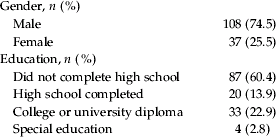
For a detailed description of the sample characteristics refer to Table 1. Repeating SCID-IV at 1 year (126 completed interviews) revealed that 103 (81.7%) patients met criteria for schizophrenia spectrum psychoses (i.e. schizophrenia paranoid type; undifferentiated type and disorganized type), 10 (7.9%) delusional disorder, brief psychosis and psychosis not otherwise specified (NOS) and 13 (10.3%) affective psychosis. For the remaining patients DSM-IV diagnoses were established based on chart reviews. The characteristics of the total sample of 180 patients initially treated for FEP were similar but are not reported here.
Sample characteristics of patients in remission (n=145)


SCID-IV, Structured Clinical Interview for DSM-IV; SSD, schizophrenia spectrum disorder; NOS, not otherwise specified; DUP, duration of untreated psychosis; DUI, duration of untreated illness from the time of onset of first psychiatric symptoms; SAPS, Scale for Assessment of Positive Symptoms; SANS, Scale for Assessment of Negative Symptoms; CDS, Calgary Depression Scale; HAS, Hamilton Anxiety Scale.
a The patients with a SCID substance-induced psychosis diagnosis at baseline included in the analysis did not retain this diagnosis at 1 year and were diagnosed with a primary psychotic disorder.
At the time of entry to the program, 94 of the 180 patients (52.8%) had no previous exposure to antipsychotic medications, with a similar proportion of drug naïve patients in those who achieved remission (n=98/145, 68%). At 1 year, 60 patients were treated with risperidone (mean daily dose 2.82 mg), 39 with olanzapine (9.87 mg), nine with quetiapine (441.7 mg), two with clozapine (637.5 mg), six with flupenthixol (23.0 mg every 2 weeks), one with haloperidol (1.0 mg) and two with ziprasidone (100 mg). Reliable information regarding the type of medication was not available for 10 patients as it had been changed several times.
Relapse rate
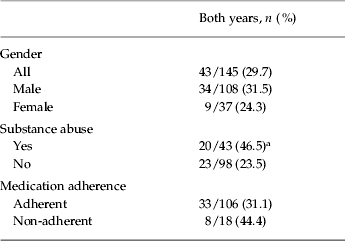
Of the 145 remitted patients regarded as being at risk for relapse, 43 (29.7%) had at least one relapse over the 2-year period. Thirty-four patients had only one relapse, eight had two and only one had three relapses. For all subsequent analyses we have included all relapses (Tables 2 and 3). There were no gender differences in rates of relapse. None of the female patients had more than one relapse.
Relapse: association with gender, substance abuse/dependence and adherence to medication

a χ2=7.49, df=1, p<0.01.
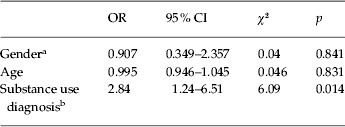
Logistic regression with relapse as outcome (both years, n=141)

OR, Odds ratio; CI, confidence interval.
a Reference: male.
b Reference: no substance abuse diagnosis.
Adherence to medication
Data on adherence to medication were available for 124 patients. Only 18 (14.5%) patients met our criteria for non-adherence. The difference in the rate of relapse between patients who were or were not adherent to medication (31% v. 44%) did not reach statistical significance. We repeated this analysis using all categories of adherence because dichotomizing the adherence variable may result in some loss of variance. The results failed to reveal any significant differences (χ2=0.58, df=3). We also examined rates of relapse in patients for whom we did not have adherence data (n=21) and found this to be even lower (9%) than in patients for whom we had complete adherence data. We also examined whether adherence to medication had had an effect on remission on this sample, as we had reported previously on a smaller sample. The respective rates of remission for adherent and non-adherent patients were 89.8% and 62.1% (χ2=13.59, df=1, p<0.001).
Co-morbid substance abuse (Table 2)
Of the 40 patients who met criteria for co-morbid diagnosis of substance abuse, the specific categories of substance abuse/dependence were as follows: 20 with cannabis abuse (n=11) or dependence (n=9), six with alcohol abuse (n=2) or dependence (n=4), and 14 with polysubstance abuse (n=5) or dependence (n=9). For all but two patients with polysubstance abuse/dependence, alcohol and cannabis were the only drugs involved. Patients with a co-morbid diagnosis of substance abuse either at baseline or during the follow-up period had a significantly higher rate of relapse compared to patients without co-morbid substance abuse. A post-hoc analysis revealed that this difference was accounted for mostly by higher rates of relapse in the second year for patients with substance abuse compared to those without.
Age at onset, pre-morbid adjustment, DUP, DUI
No differences in relapse rates were observed in relation to DUP or DUI for both years (median 23 v. 26 weeks and 167 v. 217 weeks for relapse and non-relapsed patients respectively). There were no significant differences between relapsed and non-relapsed patients on age at onset of psychosis (mean 24.2 v. 24.7 years) or on any dimension of pre-morbid adjustment.
A logistic regression (Table 3) controlling for gender and age and using diagnosis of substance abuse/dependence as an independent variable revealed that a co-morbid diagnosis of substance abuse/dependence was the only significant predictor of relapse [adjusted odds ratio (aOR) 2.84, p<0.02]. The entry criterion was set at p=0.05 and the removal criterion p value was 0.01. We also conducted sensitivity analyses based on only those subjects who completed the entire follow-up period of 2 years (n=125) following remission of positive symptoms and the results were similar (p<0.05).
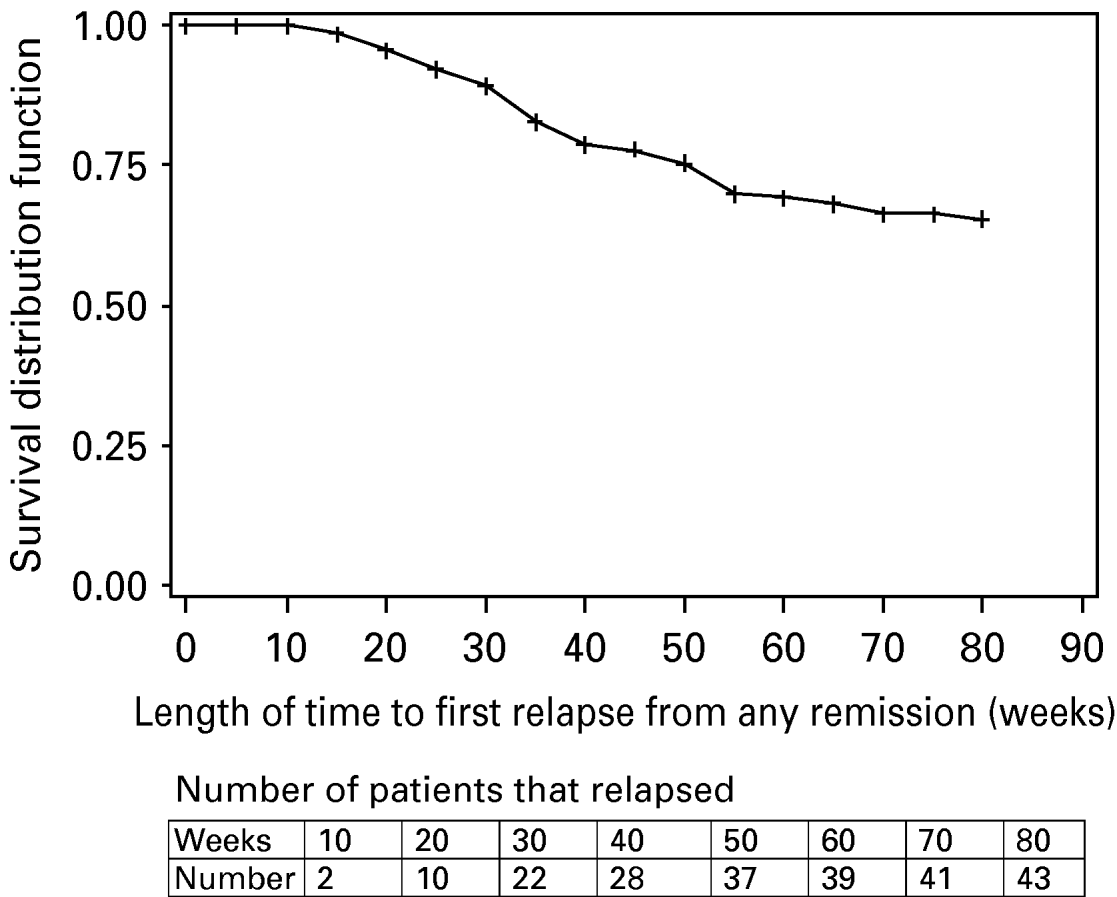
Time to relapse (Fig. 1)
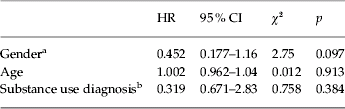
The median time to relapse was 34 weeks (range 10–87 weeks). The likelihood of relapse appeared to be greatest between 30 and 60 weeks following remission of positive symptoms. Proportional-hazards regression analysis with gender, age and secondary diagnosis of substance abuse failed to show co-morbid diagnosis of substance abuse or any other variable to have a significant effect on time to relapse (Table 4). Post-hoc comparison of time to relapse between patients with or without substance abuse revealed no difference (mean=38.15, s.d.=17.15 and mean=37.78, s.d.=18.3 weeks respectively).
Time to relapse (survival rate), n=145.

Factors predicting time to relapse: a proportional-hazards regression analysis (n=141)

HR, Hazard ratio; CI, confidence interval.
a Reference: male.
b Reference: no substance abuse diagnosis.
Discussion
Our results suggest that within the context of an SEI service, relapse rates in the first 2 years after treatment of FEP are considerably lower than have been reported when treatment is provided in the context of routine care (Robinson et al. Reference Robinson, Woerner, Alvir, Bilder, Goldman, Geisler, Koreen, Sheitman, Chakos, Mayerhoff and Lieberman1999) and confirm the relatively low relapse rates reported in recent studies carried out in EI services (Linszen et al. Reference Linszen, Lenior, De Haan, Dingemans and Gersons1998), including two randomized controlled studies (Craig et al. Reference Craig, Garety, Power, Rahaman, Colbert, Fornells-Ambrojo and Dunn2004; Petersen et al. Reference Petersen, Jeppesen, Thorup, Abel, Ohlenschlaeger, Christensen, Krarup, Jorgensen and Nordentoft2005). One-year relapse rates were also relatively low in the study by Robinson et al. (Reference Robinson, Woerner, Alvir, Bilder, Goldman, Geisler, Koreen, Sheitman, Chakos, Mayerhoff and Lieberman1999) but increased to more than 50% in the second year. This was most probably because of close monitoring of medication in the first year only. The considerably lower rates for the second year in the present report may be related to maintenance of a high degree of adherence to treatment throughout the follow-up period through an assertive case-management program. The lack of significant impact of adherence to medication on risk of relapse may also be related to a ceiling effect reached with high rates of adherence as suggested by the observation that the small number of non-adherent patients did have a higher rate of relapse but the difference did not reach statistical significance. Previously, we have reported a significant effect of medication non-adherence on rates of remission (Malla et al. Reference Malla, Norman, Schmitz, Manchanda, Bechard-Evans, Takhar and Haricharan2006) and replicated that observation on this sample as well. As only patients who remitted were included in an examination of risk for relapse, they may be able to continue their early adherence to treatment with the high level of support and intervention available through assertive case management and emphasis on family intervention provided in the SEI service. Patients who were likely to be non-adherent may have thus been excluded from this sample for any further examination of medication adherence on relapse.
We did, however, find that a diagnosis of substance abuse/dependence showed a negative impact on risk of relapse. Substance abuse has been associated with relapse and poor outcome in patients with previously treated schizophrenia (Linszen et al. Reference Linszen, Dingemans and Lenior1994; Swofford et al. Reference Swofford, Kasckow, Scheller-Gilkey and Inderbitzin1996; Cantor-Graae et al. Reference Cantor-Graae, Nordstrom and McNeil2001; Sorbara et al. Reference Sorbara, Liraud, Assens, Abalan and Verdoux2003; Wade et al. Reference Wade, Harrigan, Whelan, Burgess and McGorry2004; Lambert et al. Reference Lambert, Conus, Lubman, Wade, Yuen, Moritz, Naber, McGorry and Schimmelmann2005). A recent study also found risk of relapse to be significantly increased in FEP patients with continued substance abuse after controlling for age, gender, DUP and adherence to medication (Wade et al. Reference Wade, Harrigan, Edwards, Burgess, Whelan and McGorry2006). Another recent study has found cannabis use to be specifically associated with increased risk of relapse within the first 6 months of treatment (Hides et al. Reference Hides, Dawe, Kavanagh and Young2006). To our knowledge, the present study is the first to report the influence of substance abuse on risk of relapse following treatment of FEP in the context of very high rates of adherence to medication and after controlling for pre-morbid adjustment as well as the other previously reported predictors. These and the recent findings of other studies would suggest that specific attention to treatment of substance abuse may further reduce risk of relapse following treatment of FEP. Our failure to find a significant impact of substance abuse on time to relapse using the Cox proportional-hazards regression analysis in the context of the above findings on logistic regression for risk of relapse may be somewhat unusual. Cox regression, a more complex procedure, might be less powerful in our study because of the relatively small number of subjects, which may not have been enough to find any strong associations.
We also failed to find any effect of variations in pre-morbid adjustment on risk of relapse. The lack of impact of pre-morbid adjustment on risk of relapse in our sample may suggest that poor outcome previously reported to be associated with poor pre-morbid adjustment (Larsen et al. Reference Larsen, Moe, Vibe-Hansen and Johannessen2000; Verdoux et al. Reference Verdoux, Liraud, Bergey, Assens, Abalan and van Os2001; Malla & Payne, Reference Malla and Payne2005) was mainly expressed through lower rates of remission in our sample. Once patients remit, their risk of relapse may be influenced by other factors. Additionally, intensive psychosocial interventions aimed at community and social reintegration may have redressed some of the deficits associated with poor pre-morbid adjustment over the follow-up period.
The strength of our report is that these results are based on a large sample of consecutively admitted patients who were very well characterized, previously largely untreated (68% of the remitted patients had never received antipsychotic medications prior to entry to the treatment program and the rest for less than 30 days), probably represented a sample of all treated cases within the catchment area within a publicly funded system with no competing private or public service, and the service also operated an active community program for early identification of psychosis. The rate of completion of follow-up was similar to other FEP follow-up studies conducted in SEI services (e.g. the study OPUS; Petersen et al. Reference Petersen, Jeppesen, Thorup, Abel, Ohlenschlaeger, Christensen, Krarup, Jorgensen and Nordentoft2005), with a median length of 108 weeks, data were collected using standard measures at frequent intervals and the analyses incorporated multiple potential predictors of outcome. Our results were also confirmed using a sensitivity analysis incorporating only patients who completed the entire follow-up for 2 years.
A limitation of this study may be the lack of a quantitative measure of substance use throughout the follow-up period, which would have allowed an examination of a dose–response relationship between substance use and risk of relapse. However, our use of a SCID-IV-based diagnosis of co-morbid substance abuse and dependence was likely to have identified patients who continue to abuse substances beyond the early phase of treatment, as suggested by a greater impact of substance abuse on rates of relapse in the second year. We have previously reported that rate of and time to remission are not influenced by substance abuse assessed at the time of admission to the treatment program (Malla et al. Reference Malla, Norman, Schmitz, Manchanda, Bechard-Evans, Takhar and Haricharan2006), a finding that has been replicated recently (Wade et al. Reference Wade, Harrigan, Edwards, Burgess, Whelan and McGorry2006). The rates of substance abuse reported here are similar to those reported by others for similar patient populations (Hambrecht & Hafner, Reference Hambrecht and Hafner1996; Van Mastrigt et al. Reference Van Mastrigt, Addington and Addington2004). A second limitation may be that our remission criteria are limited to positive symptoms and do not include negative symptoms, but are similar to previous studies of relapse (e.g. Robinson et al. Reference Robinson, Woerner, Alvir, Bilder, Goldman, Geisler, Koreen, Sheitman, Chakos, Mayerhoff and Lieberman1999). It is also possible that non-adherence to medication was under-reported, although we have used assessments based on multiple sources, provided additional reliability data on using this method and a conservative criterion of 75% as the cut-off for adherence based on mode of ratings conducted at multiple time points throughout the follow-up period. Such under-reporting may have limited our ability to find a relationship between non-adherence and relapse. Using the same method, however, we previously reported a significant relationship between non-adherence and rate of and time to remission (Malla et al. Reference Malla, Norman, Schmitz, Manchanda, Bechard-Evans, Takhar and Haricharan2006) and were able to replicate that observation in this larger sample as well.
In conclusion, relatively low relapse rates observed in FEP patients treated and followed up in a specialized service may be related to significant amelioration of malleable risk factors such as adherence to medication, but patients with continued substance abuse may still be at increased risk of relapse. Although substance abuse may have no remarkable negative effect on rate of remission due to a substantial and spontaneous decrease in substance use by patients following initiation of treatment, substance abuse appears to negatively influence the risk of relapse during follow-up. Addition of specific interventions directed at reducing substance abuse throughout the follow-up period of 2 years could reduce the risk of relapse even further.
Acknowledgments
This study was conducted at the Prevention and Early Intervention Program for Psychosis (PEPP), London, Ontario, Canada. The study was supported by an operating grant from the Canadian Institutes of Health Research to Drs Malla and Norman. Dr Malla is supported by the Canada Research Chairs Program.
Declaration of Interest
None.