


Introduction
Obsessive-compulsive disorder (OCD) is a chronic and disabling condition affecting between 1.1% and 3% of the adult population in the United States (NIMH, 2000; Samuels and Nestadt, Reference Samuels and Nestadt1997) and between 0.4 and 1.0% in Europe (Wittchen and Jacobi, Reference Wittchen and Jacobi2005). It is commonly diagnosed on the basis of the patient's clinical history and its essential features, including recurrent obsessions and/or compulsions. According to the newest classification of the American Psychiatric Association, the DSM-IV-TR (American Psychiatric Association, 2000), obsessions are persistent ideas, thoughts, impulses, or images that are experienced as intrusive and inappropriate, while compulsions are repetitive behaviours (e.g. hand washing or checking) or mental acts (e.g. counting or thinking good thoughts to replace bad thoughts) that the individual feels compelled to do in response to an obsession or according to strict rules in order to reduce distress and/or prevent a dreaded event (for a recent review see also Abramowitz, Taylor and McKay, Reference Abramowitz, Taylor and McKay2009). McKay and colleagues (Reference McKay, Abramowitz, Calamari, Kyrios, Radomsky, Sookman, Taylor and Wilhelm2004) indicated that certain obsessions and compulsions tend to co-occur and form five main dimensions: (i) obsessions about being responsible for causing or failing to prevent harm, which produce checking compulsions and reassurance-seeking; (ii) symmetry obsessions that give rise to ordering and counting rituals; (iii) contamination obsessions that determine washing and cleaning rituals; (iv) repugnant obsessions concerning sex, violence and/or religion; (v) obsessions about acquiring and retaining objects associated with collecting compulsions (the so-called “hoarding”).
The diagnosis of OCD can be reliably obtained using structured clinical interviews (e.g. Structured Clinical Interview for DSM-IV Axis I Disorders − SCID-I; First and Gibbon, Reference First, Gibbon, Hisenroth and Segal2004) and clinician-rated measures (e.g. Yale-Brown Obsessive-Compulsive Scale − Y-BOCS; Goodman et al., Reference Goodman, Price, Rasmussen, Mazure, Fleischmann, Hill, Heninger and Charney1989) are widely used to assess OCD symptom severity and help with treatment planning and evaluation. Advantages of using such assessment methods include the ability to gain more detailed information about specific symptoms and idiographic OCD triggers, and the opportunity to clarify items for respondents, so that responses are consistent with item content (Grabill et al., Reference Grabill, Merlo, Duke, Harford, Keeley, Geffken and Storch2008). However, instruments faster and easier to administer and to score are needed in those contexts in which assessment time is limited or in research settings. In the last three decades, several self-report scales aiming at a comprehensive measurement of the heterogeneous clinical picture of OCD have been developed. Strengths and weaknesses of these scales have been comprehensively reviewed by Grabill et al. (Reference Grabill, Merlo, Duke, Harford, Keeley, Geffken and Storch2008). Most of these instruments have been translated into various languages and validated in other cultural contexts, thus allowing replication of research across different cultures. In Italy the available validated self-report instruments for measuring observable obsessive-compulsive behaviour are the Maudsley Obsessional Compulsive Inventory (MOCI; Hodgson and Rachman, Reference Hodgson and Rachman1977; Italian version by Bertolotti et al., Reference Bertolotti, Michielin, Sanavio, Simonetti, Vidotto and Zotti1985), the Padua Inventory (PI; Sanavio, Reference Sanavio1988) and, more recently, the Obsessive-Compulsive Inventory (OCI; Foa, Kozak, Salkovskis, Coles and Amir, Reference Foa, Kozak, Salkovskis, Coles and Amir1998; Italian version by Sica et al., Reference Sica, Ghisi, Altoè, Chiri, Franceschini, Coradeschi and Melli2009, not available at the time we performed this study). The MOCI allows the assessment of four different facets of OC behaviour (cleaning, checking, doubting/conscientiousness, and obsessional slowness) and has demonstrated sufficient internal consistency, with good criterion, convergent, and discriminant validity (e.g. Richter, Cox and Direnfeld, Reference Richter, Cox and Direnfeld1994). However, Thordarson and colleagues (Reference Thordarson, Radomsky, Rachman, Shafran, Sawchuck and Hakstian2004) and Radomsky and colleagues (Reference Radomsky, Ouimet, Ashbaugh, Lavoie, Parrish and O'Connor2006) pointed out a number of shortcomings: (1) it has a behaviourist basis and does not tap into cognitive components of OCD; (2) it allows only a limited assessment of OC phenomena like obsessions, hoarding and covert rituals; (3) there are double negatives in the wording of items; (4) it does not possess adequate sensitivity to therapeutic change (Fritzler, Hecker and Losee, Reference Fritzler, Hecker and Losee1997).
In its original version, the Padua Inventory (PI; Sanavio, Reference Sanavio1988) maps contamination, checking, mental dyscontrol and behavioural dyscontrol, but it was shown that many items were measuring worry rather than obsessions, and a revised version of the scale, the Padua Inventory – Washington State University Revision (PI-WSUR, Burns, Keortge, Formea and Sternberger, Reference Burns, Keortge, Formea and Sternberger1996) was developed to distinguish worry and obsessions. However, it does not take into account some OCD key symptoms like hoarding, which has been found to correlate with increased comorbidity and has consistently been associated with poor treatment response to both medication and cognitive behaviour therapy (Mataix-Cols, Rosario-Campos and Leckman, Reference Mataix-Cols, Rosario-Campos and Leckman2005).
A wider set of OCD cognitive and behavioural facets is assessed by the Obsessive-Compulsive Inventory (OCI; Foa et al., Reference Foa, Kozak, Salkovskis, Coles and Amir1998), but it has a long administration time since each of the 42 items has to be rated on two dimensions (frequency and distress). This drawback is crucial when dealing with OCD patients, who are known to be very slow to complete questionnaires (Rachman and Hodgson, Reference Rachman and Hodgson1980). A revised, shorter version of OCI has been developed (OCI-R; Foa et al., Reference Foa, Huppert, Leiberg, Langner, Kichic and Hajcak2002), in which the frequency scale was eliminated since it was found to be redundant with the distress scale; the Doubting subscale was also removed because it overlapped with the Checking subscale and three items per subscale were retained. Subsequent research showed that the OCI-R has adequate psychometric properties in both clinical and non-clinical samples (Fullana et al., Reference Fullana, Tortella-Feliu, Caseras, Andión, Torrubia and Mataix-Cols2005; Hajcak, Huppert, Simons and Foa, Reference Hajcak, Huppert, Simons and Foa2004; Huppert et al., Reference Huppert, Walther, Hajcak, Yadin, Foa, Simpson and Liebowitz2007; Lim et al., Reference Lim, Kim, Jeon, Cha, Park and Kim2008), but from a content validity point of view it remains questionable whether three items per scale can be considered as an adequate operationalization of the content domain they are supposed to tap into. Other drawbacks of the OCI-R are the lack of a separate severity scale, and a deeper focus on compulsions with respect to obsessions (Grabill et al., Reference Grabill, Merlo, Duke, Harford, Keeley, Geffken and Storch2008).
The Vancouver Obsessional Compulsive Inventory (VOCI, Thordarson et al., Reference Thordarson, Radomsky, Rachman, Shafran, Sawchuck and Hakstian2004) was developed to overcome the aforementioned weaknesses of available self-report measures and provide a more clinically and psychometrically sound assessment of OCD facets. The development of this inventory followed a construct-based approach through several stages, including both factor- and item-analytic strategies, and eventually lead to the present 55-item version, which taps into a wide and comprehensive range of OCD symptoms, including both cognitive and behavioural dimensions of OCD (see also Mataix-Cols et al., Reference Mataix-Cols, Rosario-Campos and Leckman2005, for a review of OC symptom structure), while being easy to administer and to score. Each item is rated on a 5-point Likert agreement scale and a total and six subscale (Checking, Contamination, Obsessions, Hoarding, Just Right, Indecisiveness) scores are provided. Evidence of internal consistency, test-retest reliability, construct and criterion validity of the VOCI has been reported (Radomsky et al., Reference Radomsky, Ouimet, Ashbaugh, Lavoie, Parrish and O'Connor2006; Thordarson et al., Reference Thordarson, Radomsky, Rachman, Shafran, Sawchuck and Hakstian2004). However, as noted by Grabill and colleagues (Reference Grabill, Merlo, Duke, Harford, Keeley, Geffken and Storch2008), these studies provided only limited support for the discriminant validity of the VOCI, since correlations in the .30s and higher were found between VOCI subscale scores (except Checking) and measures of depression, anxiety and worry, both in a clinical and in a student sample (Thordarson et al., Reference Thordarson, Radomsky, Rachman, Shafran, Sawchuck and Hakstian2004). Further studies showed the relationship between VOCI scores and dimensions of perfectionism (Moretz and McKay, Reference Moretz and McKay2009), feelings of internal dirtiness (or “mental pollution”), tendency to fuse thoughts and actions and beliefs about inflated responsibility (Cougle, Lee, Horowitz, Wolitzky-Taylor and Telch, Reference Cougle, Lee, Horowitz, Wolitzky-Taylor and Telch2008), and disgust sensitivity (Moretz and McKay, Reference Moretz and McKay2008).
Thordarson et al. (Reference Thordarson, Radomsky, Rachman, Shafran, Sawchuck and Hakstian2004) identified a six-correlated-factor structure through an unweighted least squares exploratory factor analysis on data collected in a sample of patients, but they did not investigate the factor structure of the VOCI in their student sample and concluded that “It is possible that the factor structure in non-clinical samples would be different” (p. 1310). As noted by Wu and Watson (Reference Wu and Watson2003), in the last decade a shift in OCD research involved the inclusion of participants other than patients, such as non-OCD psychiatric patients, community-dwelling adults, and college students. Such research revealed that non-clinical participants frequently endorsed the experience of OCD-like symptoms (e.g. Burns, Formea, Keortge and Sternberger, Reference Burns, Formea, Keortge and Sternberger1995), suggesting that these experiences are more common than it was expected and that structural analyses of data from both clinical and non-clinical samples yielded similar results (e.g. Sica et al., Reference Sica, Ghisi, Altoè, Chiri, Franceschini, Coradeschi and Melli2009). These findings encouraged the continued use of non-clinical samples to study obsessive-compulsive phenomena, also because they allow more powerful analyses due to larger sample sizes. However, potential differences between non-clinical OCD-like symptoms and diagnosable OCD might influence structural relations within a particular instrument (Wu and Watson, Reference Wu and Watson2003). Hence, the main purpose of this study was to address the aforementioned research question raised by Thordardson et al. (Reference Thordarson, Radomsky, Rachman, Shafran, Sawchuck and Hakstian2004) through the comparison of the goodness of fit indices of a number of measurement models as alternative structures to account for relationships among the VOCI scales and the items they included in a large non-clinical sample. It has been recently argued that a dimensional model of OCD may provide both researchers and clinicians with a more complete picture (Mataix-Cols et al., Reference Mataix-Cols, Rosario-Campos and Leckman2005). From this perspective, scores on one or more symptom dimensions can be obtained. All symptom dimensions can be conceived as manifestations of a single broad disorder, e.g. OCD, or each symptom subtype can be considered to be a separate entity, e.g. hoarding, contamination/washing, checking and symmetry/ordering, which are the most replicated OCD symptom dimensions (Mataix-Cols et al., Reference Mataix-Cols, Rosario-Campos and Leckman2005). Krueger and Piasecki (Reference Krueger and Piasecki2002) have proposed for psychiatric nosology a dimensional approach in which these two perspectives are not necessarily considered at odds, since there are probably both shared and distinct aetiological factors within the OCD. We used confirmatory factor analysis to test alternative models in which the VOCI items loaded on a single, general OCD factor (a so-called “lumping” perspective, Krueger and Piasecki, Reference Krueger and Piasecki2002), or were clustered into facets (a so-called “splitting” perspective, Krueger and Piasecki, Reference Krueger and Piasecki2002). In their turn, facets might be either uncorrelated (i.e. independent separate entities) or correlated. Were they correlated, we could assume that they might represent facets of a higher-order construct, identifiable as a general OCD factor. However, the fit of a correlated-factor model is a necessary but not sufficient evidence for the adequacy of a second-order-factor model, since some factors might be substantially correlated (thus yielding a higher model fit than an independent-factor model) while others might not. Therefore, we tested whether the facets co-vary at greater than chance levels through a correlated-factor model, and whether these tendencies toward co-occurrence could be adequately summarized by a higher-order OCD factor, which would represent the variance shared among the facets of OCD, through a second-order-factor model. This latter model (a “hierarchical-spectrum” model, Krueger and Piasecki, Reference Krueger and Piasecki2002) assumes that specific clusters of symptoms cohere to form well-defined patterns of behaviours (e.g. checking behaviours or contamination fears) which, in turn, cohere in a broader syndrome (e.g. OCD). The acceptance of this model would justify the calculation of both an overall global OCD score and six subscale scores and will provide evidence for an approach to OCD as a spectrum of potentially overlapping syndromes (Mataix-Cols et al., Reference Mataix-Cols, Rosario-Campos and Leckman2005).
To perform this study with Italian participants, we had to develop an Italian version of the VOCI. Hence, psychometric properties of the Italian adaptation of the VOCI were evaluated. We examined (a) VOCI scales’ internal consistency and test-retest reliability; (b) their pattern of association with other constructs, in order to examine their convergent and divergent validity and replicate previous findings; (c) their relationships with socio-demographical variables, i.e. age, gender and education, a research question that has not been addressed in previous studies on the VOCI.
Method
Participants
The sample was composed of 450 participants living in Florence urban and suburban areas who had responded to advertisements requesting potential volunteers for psychological studies. All subjects volunteered to participate after being presented with a detailed description of the procedure, and all were treated in accordance with the Ethical Principles of Psychologists and Code of Conduct (American Psychological Association, 2002). In order to be included in the study, subjects had to possess a level of education equal to or higher than primary school and should have never been treated for any psychiatric disorder. These criteria were selected to guarantee the correct understanding of the self-administered measures and to try and limit the inclusion of psychiatric subjects in the sample. Five subjects reported that they received an Axis I diagnosis and were therefore excluded. The final sample consisted of 445 (64.5% females) community volunteers. Ages ranged from 18 to 80 years, with a mean age of 34.26 (SD = 13.33) years. According to the Italian educational system, 43% of the participants had a medium level of education (12–13 years of education, high school degree), 33% had a high level of education (17–18 years of education, university) and the remaining 24% had a low level of education (8 years of education, secondary school license). Two hundred and six participants (46.3%) were active community workers, 157 (35.3%) were undergraduate university students, while the remaining 18.4% were housewives, unoccupied or retired.
Together with the VOCI, 89 randomly selected participants also completed a battery including the measures we employed for testing construct validity (see the next section for a description), while another 46 randomly selected participants answered the inventory twice at an 8-week interval, thus constituting the sample for test-retest reliability. These subgroups did not significantly differ from the whole sample with regard to gender, age and educational level.
Measures
Vancouver Obsessive-Compulsive Inventory (Thordarson et al., Reference Thordarson, Radomsky, Rachman, Shafran, Sawchuck and Hakstian2004). The VOCI is a 55-item self-report questionnaire that assesses a variety of symptoms and characteristics of obsessive-compulsive disorder (OCD). Items are rated on a 5-point Likert-type agreement scale (from 0 = “not at all” to 4 = “very much”). Along with a total score, the VOCI also contains 6 subscales, each assessing a specific symptom area of OCD: Contamination, Checking, Obsessions, Hoarding, Just Rightness, and Indecisiveness. The VOCI exhibited good internal consistency and good test-retest reliability within both a student sample and a sample of individuals with OCD (Radomsky et al., Reference Radomsky, Ouimet, Ashbaugh, Lavoie, Parrish and O'Connor2006; Thordarson et al., Reference Thordarson, Radomsky, Rachman, Shafran, Sawchuck and Hakstian2004). The VOCI also showed good convergent and divergent validity in both clinical and student populations (Radomsky et al., Reference Radomsky, Ouimet, Ashbaugh, Lavoie, Parrish and O'Connor2006; Thordarson et al., Reference Thordarson, Radomsky, Rachman, Shafran, Sawchuck and Hakstian2004). The Italian version of the VOCI was developed with a back-translation procedure. Two of the authors and one bilingual Italian-English psychologist independently translated the English version of the VOCI into Italian. After consensus among translators was achieved, an Italian-English person translated this preliminary version back into English. Discrepancies emerging from this back-translation were discussed with the original author. Before being used in this study, the newly developed Italian version of the VOCI was administered to 10 naïve participants in order to check understandability of the item content. All items were found to be easy to understand and to score.
Measures for assessing convergent validity
Self-report Yale-Brown Obsessive-Compulsive Scale – Severity Scale (SR-YBOCS-SS; Rosenfeld, Dar, Anderson, Kobak and Greist, Reference Rosenfeld, Dar, Anderson, Kobak and Greist1992). The SR-YBOCS-SS is the self-report version of the Yale-Brown Obsessive-Compulsive Scale (Y-BOCS, Goodman et al., Reference Goodman, Price, Rasmussen, Mazure, Fleischmann, Hill, Heninger and Charney1989; Italian version by Catalano, Sperandeo, Di Martino, Bartoli and Maj, Reference Catalano, Sperandeo, Di Martino, Bartoli and Maj1996). As in Thordarson et al. (Reference Thordarson, Radomsky, Rachman, Shafran, Sawchuck and Hakstian2004), it consisted of the definitions of obsessions and compulsions from the original Y-BOCS, space for respondents to write-in any obsessions or compulsions, and the 10 items from the original Y-BOCS rewritten in a self-report format assessing the severity of the obsessions and compulsions.
Padua Inventory (PI; Sanavio Reference Sanavio1988). The PI is a 60-item self-report instrument developed in Italy that assesses obsessive-compulsive symptoms. Each item is rated on a 5-point scale and measures the degree of disturbance caused by the thought or behaviour (0 = “not at all” to 4 = “very much”). A total score and four subscale scores (Impaired control over mental activities [PI–ICMA], Becoming contaminated [PI–BC], Checking behaviours [PI–CB], Urges and worries of losing control over motor behaviours [PI–UW]) can be obtained. In the original study (Sanavio, Reference Sanavio1988) using an Italian normative sample of 828 subjects of varying ages, the scales evidenced good psychometric properties. In the present study reliability (Cronbach's alpha) was .89 for the Total score, .87 for PI–ICMA, .73 for PI–BC, .72 for PI–CB, .77 for PI–UW.
Measures for assessing divergent validity
Penn State Worry Questionnaire (PSWQ; Meyer, Miller, Metzger and Borkovec, Reference Meyer, Miller, Metzger and Borkovec1990; Italian version by Morani, Pricci and Sanavio, Reference Morani, Pricci and Sanavio1999). The PSWQ measures the intensity and frequency of pathological worry. It is a 16-item self-report scale that evaluates the tendency to worry, the excessiveness or intensity of worry, and the tendency for the worrying to be generalized. The PSWQ does not assess the specific content of worries. Respondents rate on a 5-point Likert-type scale how “typical” each statement is of them. The PSWQ has demonstrated high reliability as well as high temporal stability and construct validity in the assessment of trait worry both in its original (Meyer et al., Reference Meyer, Miller, Metzger and Borkovec1990) and Italian (Morani et al., Reference Morani, Pricci and Sanavio1999) version. In the present study reliability (Cronbach's alpha) was .83.
Beck Depression Inventory (BDI; Beck, Rush, Shaw and Emery, Reference Beck, Rush, Shaw and Emery1979; Beck and Steer, Reference Beck and Steer1993; Italian version in Beck, Rush, Shaw and Emery, Reference Beck, Rush, Shaw and Emery1987). The BDI is a 21-item self-report inventory designed to assess the severity of the affective, cognitive, motivational, psychomotor, and vegetative components of depression, with higher scores indicating more severe depression. In the present study reliability (Cronbach's alpha) was .82.
Beck Anxiety Inventory (BAI; Beck, Epstein, Brown and Steer, Reference Beck, Epstein, Brown and Steer1988; Italian version by Sica, Coradeschi, Ghisi and Sanavio, Reference Sica, Coradeschi, Ghisi and Sanavio2006). The BAI is a 21-item self-report inventory for measuring the severity of common non-social symptoms of anxiety. Participants are asked to rate the degree to which they have been bothered by specific anxiety-related symptoms on a 4-point scale (ranging from 0 = “not at all” to 3 = “severely−I could barely stand it”). In the present study reliability (Cronbach's alpha) was .90.
Procedure
All participants were tested individually and anonymously. The scales included in the battery for testing construct validity were administered in counterbalanced fashion to control for order and sequence effects. The battery was administered in a single session at the premises of a psychotherapy institute in central Italy and took approximately 30 minutes to complete. Participants could take a 5-minute break if they felt tired and/or bored and received support from a trainee psychologist if they had questions about any item. Data analyses were performed using SPSS 13.0 and MPlus 3.0.
Results
Item descriptive statistics
Fifty-three out of 55 item means were smaller than 1, showing a large positive skewness (median skewness = 2.33, range 0.76 − 6.64). Thirty-four (61.8%) standard deviations were smaller than 0.80 (range 0.29–1.07), indicating a not negligible restriction of range. No participant endorsed rating 4 in four items (22, 26, 45, 46), whereas in item 2 (“I am often upset by my unwanted thoughts of using a sharp weapon”) the observed highest rating was 2. Also kurtosis values were far from a reasonable approximation to the normal distribution (median kurtosis = 6.10, range –0.14 – 53.83). The only two items with skewness and kurtosis falling into the –1 to +1 range recommended for maximum likelihood estimation (Muthén and Kaplan, Reference Muthén and Kaplan1985) were item 11 (“After I have decided something, I usually worry about my decision for a long time”) and item 29 (“I worry far too much that I might upset other people”). Given these results, data were considered inadequate for maximum likelihood estimation. Therefore, a mean and variance adjusted weighted least squares estimation (WLSMV, Muthén, du Toit and Spisic, Reference Muthén, du Toit and Spisic1997) was employed for confirmatory factor analyses.
Item analysis
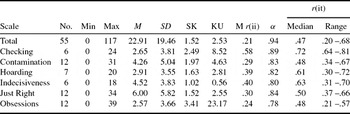
The whole item pool and the six scales derived by Thordarson et al. (Reference Thordarson, Radomsky, Rachman, Shafran, Sawchuck and Hakstian2004) in a clinical sample showed an acceptable to high level of homogeneity. Internal consistency of the total scale was high (.94) and not an artifact of item content redundancy, since mean inter-item correlation was .21. All the corrected item-total score correlations were above .20, as recommended by Nunnally and Bernstein (Reference Nunnally and Bernstein1994).
As shown in Table 1, alpha coefficients for the scales ranged from .78 to .89, with a median of .83. For all the six subscales, all the corrected item-total score correlations were above .20. Unidimensionality of VOCI scales was assessed through WLSMV exploratory and confirmatory factor analyses, which provided convincing evidence of a sound one-factor structure in each subscale: variance accounted for ranged from 45% to 74%, all factor loadings on the single factor were higher than .30 in each subscale and the Tucker-Lewis Index (TLI) and the Comparative Fit Index (CFI) values ranged from .90 to .99 and from .90 to .98, respectively (see below for more details about these indices).
Descriptive statistics of the VOCI scale scores

Notes: No. = number of items; Min = minimum; Max = maximum; M = mean; SD = standard deviation: SK = skewness; KU = kurtosis; M r(ii) = mean inter-item correlation; α = Cronbach's alpha; r(it) = corrected item-total correlation.
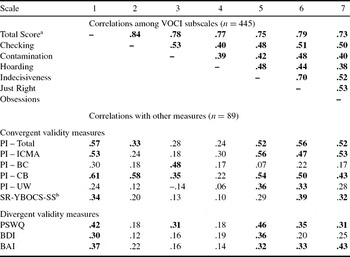
The mean subscale correlation was .48, ranging from .38 to .70 (see Table 3).
Factor structure of the VOCI
Four measurement models as alternative structures to account for relationships among the VOCI scales and the items they included were tested through WLSMV Confirmatory Factor Analysis (WLSMV-CFA). The first model (Model 1) specified that all items loaded on a single, general, first-order OCD factor (“lumping” model). A second model (Model 2) identified the six, first-order OCD factors from the original Thordarson et al.'s (Reference Thordarson, Radomsky, Rachman, Shafran, Sawchuck and Hakstian2004) exploratory factor analysis (EFA) and specified that they not be correlated, that is, correlations among the primary factors were fixed to zero (“splitting” model with uncorrelated facets). The third model (Model 4) specified that the six first-order factors be intercorrelated with no second-order structure (“splitting” model with correlated facets). Model 4 also specified the six, first-order factors from the original EFA but required further that these six factors loaded on a single second-order factor, interpretable as a latent construct representing general OCD (“hierarchical-spectrum” model). Goodness of fit was tested with a set of indices recommended by Hu and Bentler (Reference Hu and Bentler1999): the Tucker-Lewis Index (TLI; acceptable fit, TLI > .90), the Comparative Fit Index (CFI, acceptable fit, TLI > .90), the RMSEA (acceptable fit, .05 ≤ RMSEA ≤ .08) and the RMSR (acceptable fit, .05 ≤ RMSR ≤ .10). Results are shown in Table 2.
VOCI measurement models fit indices

Notes: WLSMV-χ 2: Mean and variance adjusted weighted least squares adjusted chi-square; df: model degrees of freedom; TLI: Tucker-Lewis Index; CFI: Comparative Fit Index; RMSEA: Root Mean Square Error of Approximation; RMSR = Root Mean Square Error. The degrees of freedom for WLSMV are estimated according to a formula given in the Mplus Technical Appendices (Muthén and Muthén, Reference Muthén and Muthén1998–2007). Standardized parameter estimates are available from the first author on request.
The one-general-factor and the six-uncorrelated-factor models did not show an acceptable fit, thus suggesting that models specifying a single, general OCD factor and six independent facets should be rejected. The six-correlated-factor and the second-order-factor model showed an equally acceptable fit, but a correct chi-square difference testFootnote 1 suggested that the second-order-factor model should be preferred (ΔX 2(8) = 47.14, p < .001). The fit of the second-order-factor model indicated that the pattern of associations among factor scores is consistent with the hypothesis that factors represent facets of a higher-order OCD factor: standardized factor loadings of first-order factors on this factor were .76 for Checking, .74 for Contamination, .67 for Hoarding, .82 for Indecisiveness, .89 for Just-Right and .78 for Obsessions.
Since few studies have investigated the factorial validity of the VOCI, it may be possible that other factor structures might be more optimal than those tested in this paper. Actually, the purpose of this work was to test covariance models of OCD symptom dimensions that referred to alternative theoretical models, which, in their turn, permitted an a priori specification of factor structures using a hypothesis-testing framework. Since we had no theoretical grounds for hypothesizing alternative factor structures of VOCI items, we addressed the issue performing dimensionality analyses followed by exploratory factor analyses (EFAs). Dimensionality analyses were performed on the polychoric correlation matrix through Scree-plot (Cattell, Reference Cattell1966), Parallel Analysis using marginally bootstrapped samples (PA; Lattin, Carroll and Green, Reference Lattin, Carroll and Green2003) and Minimum Average Partial Correlation statistic (MAP; Velicer, Reference Velicer1976). The Scree-plot inspection suggested a one-factor solution, while PA and MAP indicated that the optimal number of factors to extract was six and three, respectively. We thus run WLSMV-EFAs with Promax rotation setting to one, three, and six the number of factors to extract. In the one-factor solution two items had loadings smaller than .30 on the single factor; the three-factor solution did not meet the simple structure criterion, since some items did not load substantively (i.e. > .30) on any factor, while others loaded on more than one factor; in the six-factor solution all items loaded on the expected factor. These results suggest that factor structures other than those tested in this paper are unlikely to provide a better fit for the VOCI data.
Construct validity of the VOCI total and scale scores
Correlations between the VOCI total and scale scores and the other measures used in this study were calculated (see Table 3). When evaluating the strength of association between the scores, we mainly considered effect size, as suggested by Kazdin (Reference Kazdin1995). According to Cohen (Reference Cohen1988), correlation coefficients lower than .10 indicate a negligible association, from .10 to .30 a small effect size, from .30 to .50 a moderate effect size, and higher than .50 a large effect size.
Correlations among VOCI total and scale scores and the other measures employed in study study. Substantial correlations (i.e. higher than |.30|) are bolded for ease of interpretation

Notes: acorrelations between total and single scale scores were corrected for common error variance due to common items (Nunnally and Bernstein, Reference Nunnally and Bernstein1994);
bPoint-biserial correlation: the SR-YBOCS-SS score has been recoded to 0 if score equaled 0 and 1 if score was higher than 0;
PI = Padua Inventory; PI-ICMA = Impaired control over mental activities; PI-BC = Becoming contaminated; PI-CB = Checking Behaviours; PI-UW = Urges and worries of losing control over motor behaviours; SR-YBOCS-SS = Self-report Yale–Brown Obsessive–Compulsive Scale Severity Scale; PSWQ = Penn State Worry Questionnaire; BDI = Beck Depression Inventory; BAI = Beck Anxiety Inventory.
The VOCI total score was highly correlated with PI – Total (r = .57) and moderately with SR-YBOCS-SS (r = .34), PSWQ (r = .42), BAI (r = .37) and BDI (r = .30). The correlation of VOCI Total Score with measures for establishing convergent validity (PI-Total and SR-YBOCS-SS) was not statistically higher than the correlation with measures for establishing divergent validity (PSWQ, BAI, BDI) (z = 1.31, p = .09, Meng, Rosenthal and Rubin, Reference Meng, Rosenthal and Rubin1992, pp. 173–174). This result was due to the relatively low correlation of VOCI-Total Score with SR-YBOCS-SS: when we removed this variable from the analysis, the correlation of VOCI-Total score with PI-Total was significantly higher than the correlations of VOCI Total Score with the measures for establishing divergent validity (z = 2.54, p = .006). It should also be noted that most of the participants (72%) had a total score of zero on the SR-YBOCS-SS. Consistently with predictions, VOCI Checking correlated with PI – Checking Behaviours (r = .58) and, to a lesser extent, with PI – Total (r = .33), and VOCI Contamination correlated with PI – Becoming Contaminated (r = .48) and PI – Checking Behaviour (r = .35). VOCI Hoarding seemed to map an independent facet of OCD, since it slightly correlated only with PI – Impaired Control over Mental Activities (r = .30). VOCI Indecisiveness was highly correlated with PI – Total, PI – Impaired Control over Mental Activities and PI – Checking Behaviour (r = .52, r = .56 and r = .54, respectively), and the same pattern of association with convergent validity measures was observed for VOCI Just Right (r = .56, r = .47 and r = .50, respectively) and VOCI Obsessions (r = .52, r = .53 and r = .43, respectively). To a lesser extent (.20 < r < . 40), these variables correlated also with PI − Urges and Worries, but not with PI − Becoming Contaminated. However, as in Thordarson et al. (Reference Thordarson, Radomsky, Rachman, Shafran, Sawchuck and Hakstian2004), they were also moderately correlated with divergent validity measures (PSWQ, BDI and BAI).
Test-retest reliability
The test-retest coefficient (Pearson's correlation) for the total score was .75, .80 for Checking, .92 for Contamination, .51 for Hoarding, .62 for Indecisiveness, .76 for Just Right, and .69 for Obsessions.
Associations with gender, age and education
VOCI scores were only weakly correlated with age (Pearson's correlations: Checking r = .13; Indecisiveness r = −.15; Just Right r = −.11) and educationFootnote 2 (Spearman's rank correlation: Contamination rho = −.11, Hoarding r = −.13). Cohen's (Reference Cohen1988) criteria were used to evaluate the effect size of gender differences: d < .20 was defined as negligible difference, .20 < d < .50 as small effect size, .50 < d < .80 as moderate and d > .80 as large. Small gender differences, with females scoring significantly higher than males, were found in Total Score (M = 24.38, SD = 19.00 vs M = 20.25, SD = 20.04, t(443) = 2.15, p = .032, d = 0.21), Contamination (M = 4.74, SD = 5.06 vs M = 3.39, SD = 4.89, t(443) = 2.72, p = .007, d = 0.27) and Indecisiveness (M = 4.97, SD = 3.93 vs M = 3.71, SD = 3.52, t(443) = 3.35, p = .001, d = 0.34).
Discussion
This study assessed the factor structure and the psychometric properties of the Italian version of the Vancouver Obsessive Compulsive Inventory (VOCI) in a non-clinical community sample. Overall, psychometric properties were comparable to those of the English (Radomsky et al., Reference Radomsky, Ouimet, Ashbaugh, Lavoie, Parrish and O'Connor2006; Thordarson et al., Reference Thordarson, Radomsky, Rachman, Shafran, Sawchuck and Hakstian2004) and the French (Radomsky et al., Reference Radomsky, Ouimet, Ashbaugh, Lavoie, Parrish and O'Connor2006) versions. At the subscale level, the reliability as internal consistency ranged from .78 to .89. These coefficients are higher than those obtained by Thordarson et al. (Reference Thordarson, Radomsky, Rachman, Shafran, Sawchuck and Hakstian2004) in their adult sample (which, however, was quite small, n = 39), but slightly lower than the student samples of Thordarson et al. (Reference Thordarson, Radomsky, Rachman, Shafran, Sawchuck and Hakstian2004) and Radomsky et al. (Reference Radomsky, Ouimet, Ashbaugh, Lavoie, Parrish and O'Connor2006). We also performed a reliability analysis on our student subsample (n = 157), but results did not substantially change. These results seem to be consistent with previous research: Kyrios, Sanavio, Bhar and Liguori (Reference Kyrios, Sanavio, Bhar and Liguori2001) found some differences in the specific patterns of interrelations of OCD measures among Australian and Italian participants. Specifically, they observed that the overall pattern of intercorrelations was stronger for the Australian cohort, thus resulting in higher internal consistency. However, they concluded that these differences were few in number and should not prevent generalization of cognitive-behavioural formulations of OCD across these the two different cultural contexts, although idiosyncratic cultural factors may need to be considered in developing cognitive-behavioural treatments.
As predicted by Thordarson et al. (Reference Thordarson, Radomsky, Rachman, Shafran, Sawchuck and Hakstian2004), there was a not negligible range restriction in item and scale scores, presumably due to low base-rate obsessional-compulsive phenomena in non-clinical groups. This may have attenuated the estimates of test-retest correlations, which nonetheless were consistent with those of Thordarson et al.'s (Reference Thordarson, Radomsky, Rachman, Shafran, Sawchuck and Hakstian2004) student sample but not with Radomsky et al.'s (Reference Radomsky, Ouimet, Ashbaugh, Lavoie, Parrish and O'Connor2006) English- and French-speaking student samples. However, these studies used shorter test-retest intervals: 11 days (Thordarson et al., Reference Thordarson, Radomsky, Rachman, Shafran, Sawchuck and Hakstian2004), and not more than an average of 1 month (Radomsky et al., Reference Radomsky, Ouimet, Ashbaugh, Lavoie, Parrish and O'Connor2006), whereas we administered the VOCI twice at an 8-week interval, which may account for the differences, along with the aforementioned cross-cultural differences. Thordarson et al. (Reference Thordarson, Radomsky, Rachman, Shafran, Sawchuck and Hakstian2004) found a very high stability of VOCI scores in a patient sample at a 47-day interval, which suggests that VOCI scores are stable both in clinical and non-clinical populations. As pointed out by Grabill et al. (Reference Grabill, Merlo, Duke, Harford, Keeley, Geffken and Storch2008), further research is needed to address sensitivity of the specific subscales to treatment effects.
The results of the confirmatory factor analyses showed that the six-correlated-factor structure that underlies the original VOCI version in OCD patients was replicated in an adult non-clinical sample with the Italian translation. However, consistent with the hypothesis of the VOCI scales as facets of a higher-order OCD factor, a second-order-factor model showed a significantly higher fit. It is also more parsimonious, i.e. it specifies nine parameters less than the six-correlated-factor model (see footnote 1). Nevertheless, the two models are not necessarily at odds. Besides being consistent with previous research on inventories of OC symptoms, such as the OCI-R (Hajcak et al., Reference Hajcak, Huppert, Simons and Foa2004), a correlated-factor model suggests that rather than merely describing an individual as high or low scoring on distinct facets, she/he may be described by a profile across multiple facets. In their turn, these dimensions define a more general construct (i.e. OCD) that represents the variance shared among these elements (i.e. VOCI subscales). Such a hierarchical model would support a dimensional approach to psychopathology in which psychopathological variation is considered continuous and unidimensional (Krueger and Piasecki, Reference Krueger and Piasecki2002). Furthermore, the hypothesis that other factor structures might provide a better fit for the data was ruled out by means of exploratory factor analyses.
VOCI total score was substantively and consistently correlated with PI Total but only weakly correlated with SR-YBOCS-SS. Unlike the VOCI, which asks respondents to rate the degree to which each statement is true of them, the SR-YBOCS-SS is focused on symptom severity, i.e. how much obsessions interfere with the individual's social and work functioning or how much time is spent performing compulsive behaviors. If consistent patterns of endorsements can be expected in OCD patients (as shown by the high correlation among VOCI and SR-YBOCS-SS found by Thordarson et al., Reference Thordarson, Radomsky, Rachman, Shafran, Sawchuck and Hakstian2004), the same may not be true in non-clinical participants, as those of this study. In fact, they might endorse mid-scale scores like 1 (little) to 2 (some) to VOCI items while not considering the corresponding behavior as interfering with their life, as witnessed by the high proportion of participants scoring zero on the SR-YBOCS-SS. These results suggest that VOCI scores should not be considered as measures of symptom severity in a non-clinical sample. Evidence of convergent validity was obtained also for all the VOCI subscales except Hoarding, which, however, showed adequate discriminant validity since it did not correlate substantially (r < .20) with any of the measures employed for assessing this property. Fullana and co-workers (Reference Fullana, Tortella-Feliu, Caseras, Andión, Torrubia and Mataix-Cols2005) found that the Hoarding scale of the OCI-R correlated with the Saving Inventory – Revised (SI-R, Frost, Steketee and Grisham, Reference Frost, Steketee and Grisham2004), and they considered this result as evidence of construct validity of the scale. Unfortunately, at the time we performed our study no Italian adaptation of the SI-R was available.
Although the results of this study support convergent validity (i.e. large correlations between the VOCI and the PI), they seem inconclusive as to divergent validity. In some circumstances, consistently with findings by Thordarson et al. (Reference Thordarson, Radomsky, Rachman, Shafran, Sawchuck and Hakstian2004), the correlations with measures of divergent validity were as high, if not higher, than the correlation between the PI and VOCI. Moderate correlations, not substantially differing from those with the measures used to evaluate convergent validity, were found between Indecisiveness and worry, and between Obsessions and anxiety. Beyond item content similarity among the measures, this result may be due to the co-occurrence of OCD symptoms along with a variety of neurological and psychiatric conditions (Mataix-Cols et al., Reference Mataix-Cols, Rosario-Campos and Leckman2005).
We also tested the association of VOCI scores with socio-demographic variables, namely, gender, age and education, which was not investigated in previous studies on the VOCI. We found only weak associations with age and gender, and small effect sizes, though statistically significant, with respect to gender differences in Total score, Contamination and Indecisiveness, with females scoring higher than males. Studies on non-clinical samples using other self-report measures of OC (i.e. Padua Inventory, Maudsley Obsessive-Compulsive Inventory, Obsessive Compulsive Inventory-Revised) only sometimes reported gender differences, and always with men scoring higher than women, but no clear trend was found (for a review, see Fullana et al., Reference Fullana, Tortella-Feliu, Caseras, Andión, Torrubia and Mataix-Cols2005). Hence, it seems that no definite conclusions can be drawn as to gender differences.
The lack of a clinical sample could be considered the major limitation of this study. Though the psychometric properties of the Italian VOCI are near-identical to those reported in their clinical sample by Thordarson et al. (Reference Thordarson, Radomsky, Rachman, Shafran, Sawchuck and Hakstian2004) and the results of the confirmatory factor analyses provided evidence that the factor structure originally found in a clinical sample adequately fit the data of a non-clinical sample, it could be argued that our community sample might differ qualitatively from a sample of OCD patients, e.g. the factor loading of an item might be substantial in one sample and negligible in the other. Actually, the availability of patient data would have allowed testing this hypothesis by assessing the measurement invariance (MI) of the VOCI measurement models across clinical and non-clinical subjects. Through multiple-group confirmatory factor analysis (MG-CFA; see Brown, Reference Brown2006), MI tests whether scales measure the same underlying constructs across different samples. If the scale scores were measurement invariant across groups, this would mean that the scale is unbiased with respect to groups, and that group differences in scale scores can be interpreted in terms of group differences in the underlying constructs. Nonetheless, McCallum, Browne and Sugawara (Reference McCallum, Browne and Sugawara1996) showed that rigorous evaluation of fit for covariance structure models with low effect sizes (in our case, existing but small differences among clinical and non-clinical samples), requires extremely large sample sizes, which may be difficult to accomplish in respect of patients matching adequate inclusion and exclusion criteria to research purposes. Given that the VOCI has been developed for assessment purposes and that reliable cut-off scores would be of clinical utility, such evidence would be desirable.
In conclusion, our study provided evidence of reliability and validity of VOCI scores in an Italian non-clinical sample. Therefore, the VOCI appears to be a psychometrically sound instrument for the assessment of OCD-related behaviours and thoughts and can be used in cultural contexts different from the original.
Acknowledgements
The authors wish to thank Dana Thordarson for reviewing and commenting on earlier drafts of this manuscript and two anonymous reviewers whose comments greatly helped in improving the paper.




Comments
No Comments have been published for this article.