Cardiac transplantation is the optimal available therapy for end-stage congenital cardiac disease and advanced cardiac failure. The development of newer, more effective immunosuppressive agents has resulted in lower incidence of acute cellular rejection and improved survival after transplantation. The United Network of Organ Sharing is aggressively promoting public awareness about organ donation. However, the lack of availability of donor hearts remains the rate-limiting step in offering transplantation to all prospective patients, resulting in longer times on the waiting list and increased potential for higher mortality on the waiting list.Reference Taylor, Edwards and Boucek1
Although mechanical circulatory support as a bridge to cardiac transplantation, particularly with ventricular assist devices, has resulted in decreased mortality while on the waiting list, it has also resulted in higher rates of allosensitisation and complicated the ability to obtain an appropriate donor organ.Reference Velez and Johnson2, Reference Itescu, Schuster and Burke3 Allosensitised patients may be excluded from cardiac transplantation by some programmes offering transplantation, as these programmes require negative prospective cross-match for patients with high Panel Reactive Antibody. Allosensitisation before or after cardiac transplantation has been associated with negative outcomes for survival of the allograft,Reference Eckman4 hence the need for effective strategies to prevent and decrease allosensitisation in potential recipients of transplants.
In this review, we will discuss the clinical aspects, methods for determining sensitisation, risk factors for sensitisation, and the impact of sensitisation on outcomes of paediatric cardiac transplantation. We will also discuss current available desensitisation strategies, as well as treatment of antibody-mediated rejection.
Testing and clinical relevance of antibodies to Human Leukocyte Antigens
The Histocompatibility Laboratory is essential for having a successful programme of transplantation. Most of the early studies identified antibodies to Class I Human Leukocyte Antigens and antibodies to Class II Human Leukocyte Antigens with complement-dependent lymphocytotoxic techniques. In this assay, a sample of the serum from the potential recipient is mixed with lymphocytes from a population representing the most common Human Leukocyte Antigens. If the potential recipient has antibodies to Human Leukocyte Antigens against a particular donor in the panel, cells from the donor will be lysed as a result of the formation of antigen–antibody complexes and complement fixation (positive reaction). The number of positive reactions divided by the total number of cells in the panel, multiplied by 100, is calculated, resulting in a percent reactive antibody or Panel Reactive Antibody. If a patient has an elevated Panel Reactive Antibody greater than 10%, he or she is considered allosensitised or highly sensitised. The most common practice in histocompatibility laboratories at present includes the use of solid-phase assays for screening or determination specificity of antibodies to Class I Human Leukocyte Antigen and antibodies to Class II Human Leukocyte Antigen. These methods are more sensitive and specific than cytotoxicity assays because of the expression of purified Human Leukocyte Antigen molecules in solid phase-like beads. Although these assays are not quantitative, they give us a relative measurement of antibody levels using Mean Fluorescent Intensity or Molecules of Soluble Fluorescent Intensity.
The complement-dependent lymphocytotoxicity assay continues to be used in some programmes of cardiac transplantation as an initial screening method to rule out an elevated Panel Reactive Antibody and as a rapid technique of cross-match. Owing to the lack of specificity with this test, however, patients who have a Panel Reactive Antibody greater than or equal to 10% undergo further testing with the flow cytometry or antibody specificity detection using single antigen beads by Luminex® platforms. These tests not only identify high-risk antibodies to Class I or Class II Human Leukocyte Antigens, but also allow virtual cross-matching to be performed.
Jacobs et alReference Jacobs, Quintessenza and Boucek5 showed that patients with high Panel Reactive Antibody – defined as greater than 10% by complement-dependent cytotoxicity method – undergoing paediatric cardiac transplantation – during the time interval between May 21, 1995 and April 9, 2003 – had significantly reduced survival when compared with patients with a negative cross-match. Kobashigawa et alReference Kobashigawa, Sabad and Drinkwater6 also found that transplant candidates with a Panel Reactive Antibody greater than or equal to 11% detected by complement-dependent cytotoxicity had higher mortality after transplantation when compared with those with a lower Panel Reactive Antibody. More recently, Nwakanma et alReference Nwakanma, Williams, Weiss, Russell, Baumgarter and Conte7 in a large registry study, reported that a Panel Reactive Antibody greater than 25% was associated with poor survival after heart transplantation.
How do patients become sensitised?
Recognised causes of allosensitisation include
• previous surgeries using allografts or prior transplantation,
• transfusion of blood or platelets,
• mechanical circulatory support, and
• pregnancy.
The simplistic theory of allosensitisation involves sensitisation of a B-lymphocyte (CD20+) when exposed to a Human Leukocyte Antigen. Upon re-exposure, this lymphocyte divides into a memory B-cell (CD20+, CD27+) and a plasma cell (CD 138+), which produces antibodies against the sensitising antigen. These complement-fixing antibodies can bind and kill all cells bearing this Human Leukocyte Antigen. The memory B-cell remains in the circulation and is ready to respond to reintroduction of the antigen.Reference Ballew and Bergin8
With increasing popularity of the Berlin Heart Ventricular Assist Device in neonates, infants, and children, the incidence of allosensitisation is going to have a significant impact on outcomes after cardiac transplantation. The combination of non-biological and bioprosthetic materials in constant contact with circulating blood is purported to be the triggering mechanism. In patients on a ventricular assist device, activated T-lymphocytes selectively express T helper type 2 cytokines, such as Interleukin-4 and transformation growth factor β, which are responsible for B-lymphocyte hyper-reactivity, evolution into plasma cells, and auto-antibody production. These patients show elevated levels of Immunoglobulin G antibodies to Class I and Class II Human Leukocyte Antigens.Reference Velez and Johnson2, Reference Itescu, Schuster and Burke3 Polyclonal expansion of B-lymphocytes and their subsequent hyper-reactivity is associated with elevated levels of CD40 ligand, which causes activation of B-cells. Increased serum levels of CD40 ligand are associated with clinical allosensitisation detected with a complement-dependent lymphocytotoxicity assay in patients supported with a Ventricular Assist Device.Reference Velez and Johnson2, Reference Schuster, Kocher and John9
Although transfusion of platelets can also result in the development of antibodies to Human Leukocyte Class 1 Antigen, transfusion of packed red blood cells when irradiated and leukocyte-reduced does not appear to have a significant impact on the level of circulating antibodies to Human Leukocyte Antigen, owing to the lack of or low expression of Human Leukocyte Antigens on red blood cells.Reference Drakos, Stringham and Long10 This protective effect of irradiated and leukocyte-reduced packed red blood cells is not true for whole blood, which contains some white blood cells and platelets.Reference Drakos, Stringham and Long10
Some evidence suggests that the degree of sensitisation may vary between different types of Ventricular Assist Devices, being lower for devices without a textured interior surface and axial flow devices, because of a smaller area of contact between the device and bloodstream, with a lesser degree of immune activation.Reference Joyce, Southard, Torre-Amione, Noon, Land and Loebe11, Reference Baran, Gass and Galin12 The Berlin Heart Ventricular Assist Device uses pulsatile flow and may be associated with increased sensitisation, whereas several new paediatric axial flow devices currently in development as part of the National Heart, Lung, and Blood Institute PumpKIN – Pumps for Kids, Infants, and Neonates – program use continuous flow and may provide a lesser degree of immune activation.
Management of the sensitised patient
Although some centres offering transplantation may exclude highly sensitised patients from transplantation, an increasing number of centres are now using strategies of desensitisation to reduce circulating allo-antibodies in an attempt to reduce times on the waiting list and improve the acceptance of donors. With increasing use of the technique of the virtual cross-match, direct prospective cross-match for patients with high Panel Reactive Antibody is no longer necessary, although a retrospective cross-match is still recommended regardless of the results of the virtual cross-match.
The first step in managing highly sensitised transplant candidates is to avoid further exposure to Human Leukocyte Antigens by minimising the transfusion of blood products. All red cell transfusions should be irradiated and leukocyte-reduced to remove white blood cells and platelets, which carry the Human Leukocyte Antigens.
Virtual cross-match
The technique of virtual cross-match was first implemented at Duke University Medical Center in 2001. It allows cross-matching between a recipient and potential donor without geographic proximity by the comparison of donor Human Leukocyte Antigens and recipient antibodies to Human Leukocyte Antigen against the potential donor. Although virtual cross-matching has limitations on its own, it has allowed us to increase the pool of potential donors that can be considered for a highly sensitised patient. The Organ Procurement Transplant Network Histocompatibility Committee of the United Network of Organ Sharing has reported that techniques of solid-phase immunoassay provide accurate detection of antibodies to Human Leukocyte Antigen to predict cross-match outcomes,Reference Nikaein, Cherikh and Nelson13 and this strategy is now a standard of care in several major institutions such as ours. Rhee et alReference Rhee, McGee and Subacius14 showed that the incidence of cardiac allograft vasculopathy at 1 year after transplantation following a negative virtual cross-match was comparable with the incidence in non-sensitised patients.
To perform a virtual cross-match, a profile of specificities of antibodies to Human Leukocyte Antigen using a solid-phase assay is identified in a potential recipient and compared with the potential donor Human Leukocyte Antigens. For example, a recipient with high levels of antibodies against Human Leukocyte Antigens A1, A23, A24, A36, A66, B12, B45 would be considered to have a positive cross-match with a donor with Human Leukocyte Antigens A1, A3, B8, B27, B45, allowing the centre of transplantation to decline that organ. Conversely, a donor with Human Leukocyte Antigens A2, B27, B44 would be considered a negative match, allowing for acceptance of the organ without a prospective cross-match. A concurrent or retrospective cross-match should be performed regardless of the virtual cross-match results. If this same recipient was treated with plasmapheresis, immunomodulatory doses of immunoglobulins, and cyclophosphamide or Rituximab, resulting in reduction to trace levels – low Mean Fluorescent Intensity – of antibodies to Human Leukocyte Antigen, then this would allow acceptance of any donor regardless of the Human Leukocyte Antigen status of the donor.
Plasmapheresis
Pheresis can be accomplished with either plasma or 5% albumin. Plasmapheresis consists of mechanical removal of circulating antibodies and is performed in candidates for cardiac transplantation to decrease the likelihood of allograft rejection. The frequency of rejection and survival of allografts is similar between sensitised patients who undergo plasmapheresis and administration of intravenous immunoglobulin when compared with non-sensitised controls.Reference Pisani, Mullen and Malinowska15, Reference Leech, Lopez-Cepero and LeFor16 Plasmapheresis alone may achieve similar results, but requires longer treatments, and is associated with a higher rate of infectious complications. Some recipients may not tolerate plasmapheresis due to haemodynamic instability, as multiple treatments are required to achieve the desired results.
Intravenous immunoglobulin
To decrease the level of allosensitisation before cardiac transplantation, intravenous immunoglobulin has been used alone at high dose; alternatively, intravenous immunoglobulin at low dose may be used in combination with plasmapheresis.Reference Pisani, Mullen and Malinowska15 The mechanism of action of intravenous immunoglobulin is believed to be largely due to its anti-idiotypic effects. Intravenous immunoglobulin preparation contains soluble Human Leukocyte Antigen Class I molecules that bind to circulating antibodies to Human Leukocyte Antigen, effectively neutralising them. Emmi et alReference Eckman4, Reference John, Lietz and Burke17 described several other mechanisms of immune modulation by intravenous immunoglobulin, including
• modulation of complement – inhibition of complement – and production of cytokines,
• superantigen neutralisation,
• Fc receptor-mediated responses to antigen-presenting cells,
• increased catabolism of Immunoglobulin G, and
• anti-B- and T-cell activity.
The commonly reported immune modulatory paediatric dose is two grams per kilogram body weight, administered once weekly for up to four total doses. To avoid possible hypersensitivity and haemodynamic side effects, administer the above dose in two divided doses over two days.
Cyclophosphamide
Cyclophosphamide is used to cause depletion of rapidly dividing cells. It is administered in sensitised patients to inhibit selectively the proliferation of B-cells and the immune cascade.Reference Ballew and Bergin8 Cyclophosphamide non-selectively suppresses the bone marrow, predisposing the recipient to infections. It has been shown that monthly doses of intravenous pulsed cyclophosphamide are better tolerated and associated with fewer side effects due to the significantly reduced cumulative dose, compared with daily dosing.Reference Itescu, Burke and Lietz18
Mycophenolic acid mofetil
Mycophenolate inhibits lymphocyte proliferation by blocking the de novo critical pathway for purine synthesis. It is used in sensitised patients to block proliferation of B-cells, and hence production of antibodies to Human Leukocyte Antigen. It is tolerated better as a long-term strategy for immunosuppression than cyclophosphamide.
Rituximab
Rituximab, a chimeric monoclonal antibody to CD20, was initially approved for use in treating B-cell lymphomas and autoimmune disorders. Rituximab is sold under the trade names Rituxan and MabThera. It has recently been used to diminish the degree of allosensitisation in candidates for cardiac transplantation.Reference Balfour, Fiore, Graff and Knutsen19 Rituximab causes depletion of B-lymphocytes in the peripheral circulation, lymph nodes, and bone marrow, through complement-dependent cytotoxicity, antibody-dependent cytotoxicity, and induction of apoptosis, resulting in significant blunting of Immunoglobulin M and Immunoglobulin G responses. CD20 is expressed on all B-cells except pluripotent B-cells, pro B-cells, and plasma cells.Reference Balfour, Fiore, Graff and Knutsen19, Reference Becker, Samaniego-Picota and Sollinger20 In recipients of renal transplants, multiple studies suggest excellent outcomes in sensitised patients treated with Rituximab. Although memory B-cells may remain suppressed for up to 2 years after treatment, some subpopulations of B-cells, such as CD19+/CD5+ B-cells, recover to baseline levels within 6 months.Reference Sidner, Book, Agarwal, Bearden, Vieira and Pescovitz21 Infectious complications are a definite concern after B-cell ablation therapy. These patients may therefore require periodic infusions of immunoglobulins to correct low immunoglobulin levels for 6–24 months after treatment with Rituximab. In our institution, infusions of immunoglobulins to correct low immunoglobulin levels are guided by performing T- and B-cell subset assessments and immunoglobulin panel every 3 months after Rituximab therapy.
Balfour et al reported the use of Rituximab in a paediatric candidate for transplantation who had failed previous treatments with intravenous immunoglobulin, plasmapheresis, and mycophenolate mofetil. The patient was successfully transplanted after a donor was found with a negative cross-match.Reference Balfour, Fiore, Graff and Knutsen19 Owing to the fact that Rituximab has no effect on mature plasma cells, which are responsible for antibody production, it is recommended to use Rituximab in combination with intravenous immunoglobulin, mycophenolate, or cyclophosphamide.
Campath 1H (Alemtuzumab)
Campath 1H (Alemtuzumab) is a recombinant DNA-derived humanised monoclonal antibody preparation that targets CD52+ cells. CD52+ is expressed on some plasma cells, suggesting that Alemtuzumab may be helpful in decreasing production of antibodies to Human Leukocyte Antigen in some patients.Reference Teuteberg, Shullo and Zomak22 Lick et al published successful outcomes in three non-cross-matched highly sensitised adults undergoing cardiac transplantation treated with Alemtuzumab after transplantation. All three patients had a positive retrospective cross-match.Reference Lick, Vaidya and Kollar23
Bortezomib
The proteasome inhibitor, Bortezomib, was initially approved for treatment of B-cell tumours such as multiple myeloma and B-cell lymphoma. It has been used in highly sensitised patients undergoing renal transplantation to decrease antibody production by bone marrow-derived plasma cells, by causing apoptosis of plasma cells.Reference Trivedi, Terasaki and Feroz24 By also causing significant decrease in CD138+ cells, it results in a decrease in antibodies to Human Leukocyte Antigen. Bortezomib has been used successfully in two patients undergoing cardiac transplantation in combination with Rituximab and intravenous immunoglobulin to decrease levels of antibodies to Human Leukocyte Antigen before transplantation.Reference Patel, Kittelson and Reed25 Bortezomib is a promising agent in the field of transplantation, as it targets the antibody producing plasma cells.
Outcomes after transplantation in sensitised patients
Allosensitisation results in increased incidence of acute cellular rejection, antibody-mediated rejection, and cardiac allograft vasculopathy, and decreases overall survival of the allograft.Reference Jacobs, Quintessenza and Boucek5, Reference Holt, Lublin and Phelan26, Reference Wright, Fiser and Edens27
Antibody-mediated rejection
Acute antibody-mediated rejection usually occurs in the immediate period after transplantation, usually within the first 6 months. Pollock-BarZiv et alReference Pollock-BarZiv, den Hollander and Ngan28 reported antibody-mediated rejection in 9 out of 13 sensitised children within 1 month after transplantation, with four deaths. However, antibody-mediated rejection can present several months or years after transplantation. Antibody-mediated rejection is commonly associated with haemodynamic compromise or dysfunction of the graft. Some series report up to 47–68% incidence of associated dysfunction of the graft.Reference Holt, Lublin and Phelan26, Reference Rossano, Morales and Zafar29
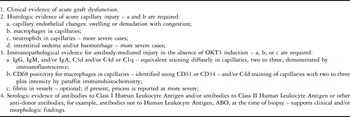
The diagnosis and recognition of antibody-mediated rejection continue to evolve. The most recent definition includes a combination of clinical, histological, and immunopathological findings, as well as demonstration of circulating donor-specific antibodies. Table 1 lists the proposed criteria for diagnosis of antibody-mediated rejection from the Pathologic and Basic Science Council of the International Society for Heart and Lung Transplantation.Reference Reed, Demetris and Hammond30
Findings in acute antibody-mediated rejection of the heart.Reference Reed, Demetris and Hammond30

Ig = Immunoglobulin
The complex pathophysiology of antibody-mediated rejection is not fully elucidated. It has been postulated to involve antibody-induced, complement-mediated activation of endothelial cells, which results in
• the release of cytokines,
• increased adherence of leukocytes to the endothelium, and
• ischaemic injury to the allograft.Reference Michaels, Espejo and Kobashigawa31
C4d, a complement split product, has been observed in the capillaries of cardiac allografts with antibody-mediated rejection, suggesting recent complement activity.Reference Smith, Brousaides and Grazette32
More recently, immunofluorescence for C4d has shown a high degree of correlation with serum antibodies to Human Leukocyte Antigen, and is therefore touted as an important diagnostic criterion.Reference Velez and Johnson2, Reference Eckman4, Reference Reed, Demetris and Hammond30 Rodriguez et alReference Rodriguez, Skojec and Tan33 evaluated 665 consecutive endomyocardial biopsies, from 165 recipients of cardiac transplantation, with immunofluorescence staining for the presence of immunoglobulin and complement deposits. The combined detection of C4d and C3d correlated well with acute antibody-mediated rejection as graft dysfunction. Antibody-mediated rejection may occur alone or in combination with acute cellular rejection.Reference Pollock-BarZiv, den Hollander and Ngan28, Reference Di Filippo, Gimita and Webber34 Di Filippo et alReference Di Filippo, Gimita and Webber34 reported on the impact of antibodies to Human Leukocyte Antigen on the outcomes of cardiac allografts in 22 children and found that acute cellular rejection was more common in the sensitised patients during the first year after transplantation.
Treatment consists of standard treatment for Acute Cellular Rejection, including
• thymoglobulin,
• pulse steroids,
• augmentation of calcineurin inhibitors,
• mycophenolic acid mofetil, and
• the addition of a proliferation signal inhibitor such as sirolimus or everolimus.
Adjunctive therapy with plasmapheresis (three to five rounds) and intravenous immunoglobulin (2 grams per kilogram) is also recommended. In patients with haemodynamic compromise, we also recommend the administration of Rituximab, 375 milligram per metre square, weekly for 4 weeks.Reference Jacobs, Asante-Korang and O'Brien35 A few case reports document successful treatment of antibody-mediated rejection with Rituximab. Balfour et alReference Balfour, Fiore, Graff and Knutsen19 reported treatment of a highly sensitised child with intravenous immunoglobulin, plasmapheresis, and Rituximab to decrease Panel Reactive Antibody, ultimately leading to a successful transplant. Garrett et al treated eight patients who had antibody-mediated rejection with weekly doses of Rituximab for 4 weeks. All patients recovered to their baseline left ventricular systolic function without significant complications.Reference Garrett, Duvall-Seaman, Helsley and Groshart36
Anti-lymphocyte therapy – anti-thymocyte globulin, lymphocyte immune globulin
Many centres successfully avoid induction immunosuppression for cardiac transplantation with no evidence of significant adverse outcomes. These centres reserve the use of anti-thymocyte preparations for highly sensitised patients and for treatment of antibody-mediated rejection.
Cardiac allograft vasculopathy
Patients with high Panel Reactive Antibody are at an increased risk of developing cardiac allograft vasculopathy. Cardiac allograft vasculopathy is a leading cause of death or re-transplantation after the first year after transplantation. In Di Filippo's series, four out of eight patients in their group with cardiac allograft vasculopathy had preformed antibodies to Human Leukocyte Antigen, compared with 8 out of 37 without cardiac allograft vasculopathy. Other paediatric series reported similar data with a higher incidence of cardiac allograft vasculopathy in sensitised patients.Reference Girnita, Webber and Zeevi37 Both T- and B-lymphocyte-mediated immunity play a role in its pathogenesis. The antibodies most frequently associated with cardiac allograft vasculopathy are those against donor Human Leukocyte Antigens, in particular to Class I antigens, which are richly expressed in human endothelial cells. Human Leukocyte Antigen Class II antigens also play a role.Reference Taylor, Yowell, Kfoury, Hammond and Renlund38 Immunoglobulin G antibodies to Human Leukocyte Antigen has been shown to stimulate the proliferation of endothelial cells, causing intimal expansion. Activation of complement can result in the release of tissue growth factors that cause endothelial proliferation and migration of fibroblasts and smooth muscle cells. The presence of fibrin on histology has been independently associated with cardiac allograft vasculopathy, allograft failure, and death.Reference Soleimani, Lechler, Hornick and George39
Newer immunosuppressive agents, particularly the Proliferation Signal Inhibitors such as sirolimus and everolimus, have shown benefits in delaying the onset of clinically evident cardiac allograft vasculopathy and have resulted in improvement of coronary artery disease in some patients.Reference Mancini, Pinney and Burkhoff40–Reference Eisen, Tuzcu and Dorent42 After the diagnosis of cardiac allograft vasculopathy is made by angiography or intravascular ultrasound, intensification of immunosuppression with these agents is recommended.Reference Costanzo, Dipchand and Starling43
Donor-specific antibodies
The advent of solid-phase techniques for determination of antibodies to Human Leukocyte Antigen represents a significant advance in the immunology of transplantation. These methods of detection of antibody are more sensitive and more specific than cytotoxic assays. The solid phase used in these assays are coated solely with Human Leukocyte Antigen, eliminating the potential for false-positive results due to binding of antibodies which are not specific for or due to Human Leukocyte Antigen. These methods also allow relative quantification of specific antibodies and enable clinicians to guide therapy based on levels of antibodies.Reference Kobashigawa, Mehra and West44 Antibodies to Human Leukocyte Antigen can develop de novo in patients who were not allosensitised before transplantation. Tambur et al showed that, in the population of adults who undergo cardiac transplantation, up to 35% of non-sensitised recipients developed antibodies to Human Leukocyte Antigen within the first year after transplantation. Antibodies against Class I Human Leukocyte Antigens were more commonly present than antibodies against Class II Human Leukocyte Antigens. Both antibodies against Class I Human Leukocyte Antigens and antibodies against Class II Human Leukocyte Antigens showed strong associations with the incidence of early acute cellular rejection.Reference Tambur, Pamboukian and Costanzo45 Xydas et al, however, showed that de novo antibodies to Class II Human Leukocyte Antigen were associated with worse outcomes in the paediatric population. They reported a fourfold increase in mortality, a fourfold increase in loss of the allograft, and a sixfold increase in cardiac allograft vasculopathy compared with patients with low levels of antibodies to Class II Human Leukocyte Antigen. In their study, antibodies to Class I Human Leukocyte Antigen were not associated with any adverse outcomes to the patients.Reference Xydas, Yang and Burke46
Conclusion
Allosensitisation before transplantation can negatively influence outcomes after transplantation. A high incidence of antibody-mediated rejection and graft vasculopathy can result in graft failure and decreased survival. Current strategies to decrease allosensitisation have helped to expand the pool of donors, improve times on the waiting list, and decrease mortality. Centres of transplantation offering desensitisation are currently using
• plasmapheresis to remove circulating antibodies,
• intravenous immunoglobulin to inactivate antibodies,
• cyclophosphamide to suppress B-cell proliferation, and
• Rituximab to deplete B-lymphocytes.
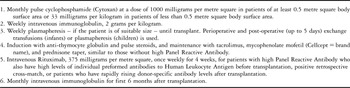
Similar approaches are also used to treat antibody-mediated rejection after transplantation with promising results. Our protocol for managing highly sensitised patients was recently published by Jacobs et al,Reference Jacobs, Asante-Korang and O'Brien35 and is summarised in Table 2.
Summary of protocol for management of sensitized patients at All Children's Hospital – The Congenital Heart Institute of Florida.

Acknowledgement
The authors wish to thank Patricia Zurek for her help preparing the manuscript.