Introduction
Epidemiological data revealed that a plethora of wild or domestic animals harboured at least one species of parasitic nematodes for prolonged periods (Grencis et al., Reference Grencis, Humphreys and Bancroft2014). In tropical and subtropical regions, Haemonchus contortus has been the primary cause of parasitic haemorrhagic gastritis in small ruminants due to its blood-feeding activity in the abomasum, particularly in sheep and goats (Besier et al., Reference Besier, Kahn, Sargison and Van Wyk2016a). Infection by H. contortus is characterized by anaemia, gastroenteritis-associated complications and significant production losses of susceptible animals. It usually induces the death of severely infected individuals with high parasite burdens. Due to the ubiquitous presence and high pathogenicity, haemonchosis has been a significant constraint on industrial livestock production and caused substantial economic loss worldwide (Besier et al., Reference Besier, Kahn, Sargison and Van Wyk2016b).
Of note, the usage of active anthelmintic groups remains the mainstay of chemical strategies in the prevention or treatment of haemonchosis. However, the control of H. contortus has been increasingly problematic due to the global emergence of anthelmintic resistance (Kotze and Prichard, Reference Kotze and Prichard2016). Hence, the development of optimal nonchemical strategies should be underpinned to enhance the resistance of the livestock to H. contortus (Emery et al., Reference Emery, Hunt and Le Jambre2016). Regardless of grazing and nutritional management, vaccination that normally elicits persistent protective immunity is a reliable and cost-effective approach targeting economically important parasitic nematodes (Bethony et al., Reference Bethony, Cole, Guo, Kamhawi, Lightowlers, Loukas, Petri, Reed, Valenzuela and Hotez2011). To underpin the rational design of vaccines for H. contortus, a substantial number of studies have focused on ascertaining parasite antigens responsible for protection from immunopathology using integrated immunogenomic, immunoproteomic and bioinformatics approaches (Kearney et al., Reference Kearney, Murray, Hoy, Hohenhaus and Kotze2016; Nisbet et al., Reference Nisbet, Meeusen, González and Piedrafita2016).
An array of native antigens or complexes derived from different developmental stages of H. contortus have been identified and demonstrated to confer efficacious immune protections to challenged sheep in preliminary trials, such as gut-derived antigens H11 (Newton and Munn, Reference Newton and Munn1999), H-gal-GP (Smith et al., Reference Smith, Newlands, Smith, Pettit and Skuce2003) and GA1 (Jasmer et al., Reference Jasmer, Perryman, Conder, Crow and McGuire1993), and third-stage larvae (L3) surface antigen Hc-sL3 (Piedrafita et al., Reference Piedrafita, de Veer, Sherrard, Kraska, Elhay and Meeusen2012). Later on, Barbervax encompassing enriched H11 and H-gal-GP antigens was authorized as the first commercially viable vaccine in Australia in 2014 with breakthroughs of antigen production and processing technology (Matthews et al., Reference Matthews, Geldhof, Tzelos and Claerebout2016). As the realization of Barbervax relies on the harvest of H. contortus worms from donor sheep, alternative strategies such as the development of recombinant subunit vaccines, which are yielded in an animal-friendly way, warrant further exploitation (Matthews et al., Reference Matthews, Geldhof, Tzelos and Claerebout2016; Nisbet et al., Reference Nisbet, Meeusen, González and Piedrafita2016).
Despite the success of native gut or cuticular surface antigens (Jasmer et al., Reference Jasmer, Perryman, Conder, Crow and McGuire1993; Newton and Munn, Reference Newton and Munn1999; Smith et al., Reference Smith, Newlands, Smith, Pettit and Skuce2003; Piedrafita et al., Reference Piedrafita, de Veer, Sherrard, Kraska, Elhay and Meeusen2012), there are few reports of their recombinant versions being protective against H. contortus in laboratory or field trials (Cachat et al., Reference Cachat, Newlands, Ekoja, McAllister and Smith2010; Roberts et al., Reference Roberts, Antonopoulos, Haslam, Dicker, McNeilly, Johnston, Dell, Knox and Britton2013; Matthews et al., Reference Matthews, Geldhof, Tzelos and Claerebout2016). Therefore, most subsequent attempts shifted to the identifications of novel candidate antigens and the development of their recombinant forms (Nisbet et al., Reference Nisbet, Meeusen, González and Piedrafita2016). In recent years, excretory–secretory (ES) proteins of parasitic nematodes have been reported to play central roles in regulating host immune responses and allowing parasite chronicity (McSorley et al., Reference McSorley, Hewitson and Maizels2013). Bearing in mind that ES antigens are a constant source of extraneous stimuli for the immune system, they might serve as protective immunogens to boost naturally acquired immunity (Harnett, Reference Harnett2014; Sorobetea et al., Reference Sorobetea, Svensson-Frej and Grencis2018). A spectrum of native ES antigen preparations has been shown to deliver exceptional levels of protection to distinct sheep breeds at varying ages, such as AC-5 (De Vries et al., Reference De Vries, Bakker, Krijgsveld, Knox, Heck and Yatsuda2009), Hc15/24 ES antigens (SCHALLIG et al., Reference Schallig, Van Leeuwen and Cornelissen1997), LDNF glycan antigen (van Stijn et al., Reference van Stijn, van den Broek, Vervelde, Alvarez, Cummings, Tefsen and van Die2010) and thiol-binding proteins (Bakker et al., Reference Bakker, Vervelde, Kanobana, Knox, Cornelissen, De Vries and Yatsuda2004). Meanwhile, the recombinant versions of ES antigens such as Hcftt-2 (Bu et al., Reference Bu, Jia, Tian, Aimulajiang, Memon, Yan, Song, Xu and Li2020), HcENO (Kalyanasundaram et al., Reference Kalyanasundaram, Jawahar, Ilangopathy, Palavesam and Raman2015) and HcTTR (Tian et al., Reference Tian, Lu, Jia, Bu, Aimulajiang, Zhang, Li, Yan, Xu and Song2020) were demonstrated to offer partial immune protection against H. contortus in preliminary trials.
The rational design of novel intervention to control H. contortus relies on understanding the cellular and molecular bases for host–parasite interactions, and ES proteins with immunomodulatory properties might serve as promising vaccine candidates (Matthews et al., Reference Matthews, Geldhof, Tzelos and Claerebout2016; Nisbet et al., Reference Nisbet, Meeusen, González and Piedrafita2016). The adhesion-regulating molecule 1 (ADRM1) is a polyubiquitin receptor engaged in the ubiquitin–proteasome pathway targeting the degradation of short-lived proteins (Husnjak et al., Reference Husnjak, Elsasser, Zhang, Chen, Randles, Shi, Hofmann, Walters, Finley and Dikic2008). In our preliminary study, H. contortus ADRM1 (HcADRM1) protein was identified from ES antigens that impaired T-cell functions by immunoproteomic approaches combined with immunological bioassays (Lu et al., Reference Lu, Tian, Yang, Wang, Tian, Li, Yan, Xu, Song and Li2020b). Besides, HcADRM1 protein expressed throughout H. contortus life cycle was then demonstrated to act as an immunomodulator that interfered with numerous host cellular events in vitro, including T-cell viability, proliferation, apoptosis, signalling and cytokine production (Lu et al., Reference Lu, Tian, Zhang, Aimulajiang, Wang, Ehsan, Li, Yan, Xu and Song2020c). Given the prophylactic potential of HcADRM1 protein, we hereby validated immune protective efficacies of HcADRM1 preparations in protecting goats against H. contortus challenge. Either active vaccination with recombinant HcADRM1 (rHcADRM1) protein or passive immunization with anti-rHcADRM1 immunoglobulin G (IgG) achieved encouraging levels of protection to control H. contortus infection.
Materials and methods
Animals and parasite
The Nanjing strain of H. contortus was isolated from the field by the Department of Parasitology, Nanjing Agricultural University (NJAU). The propagation and maintenance of H. contortus were carried out in parasite-free goats (n = 5) by serial passages. The infective L3 larvae were generated by the cultivation of eggs as previously described (Wang et al., Reference Wang, Wang, Zhang, Yuan, Yan, Song, Xu and Li2014, Reference Wang, Xu, Song, Li and Yan2016).
Healthy female Boer goats at the age of 5–6 months were acquired from Prosperous Sheep Inc. (Nantong, China). They were validated to be under worm-free conditions by fecal egg counts (FEC). The goats were housed individually in the Animal Experimental Center of NJAU using the ventilated cages. The goats were given ad libitum access to water in pens and fed dry, whole-shelled corn. The health status of the goats was monitored via daily observation and physical examination throughout the trials.
Preparation of recombinant antigen
The processing and production of rHcADRM1 proteins were carried out as described elsewhere (Zhang et al., Reference Zhang, Liu, Huang, Wang, Lu, Song, Xu, Yan and Li2016). Briefly, the reconstructed plasmid pET28a-HcADRM1 was transfected into Escherichia coli BL21 (DE3) cells, and expression of rHcADRM1 in the cells was induced by isopropyl-β-d-thiogalactopyranoside (1 mm, Sigma-Aldrich, St. Louis, MO). His-Trap HP purification columns (GE Healthcare, Piscataway, NJ) were employed to purify rHcADRM1 protein with a poly-His-tag in the supernatant of cell lysates. The purity and integrity of rHcADRM1 protein were monitored and validated via 12% sodium dodecyl sulphate-polyacrylamide gel electrophoresis (SDS-PAGE) gels. The concentration of rHcADRM1 protein was measured using a bicinchoninic acid (BCA) assay (Thermo Fisher Scientific, Rockford, IL). The removal of endotoxin in rHcADRM1 protein was carried out using the Detoxi-Gel Affinity Pak prepacked columns (Thermo Fisher Scientific). The resulting rHcADRM1 protein was dissolved in phosphate buffered saline (PBS) and preserved at −80°C.
Polyclonal antibody (pAb) production
The production of control goat pAbs or HcADRM1-specific pAbs was carried out as previously described (Lu et al., Reference Lu, Tian, Zhang, Aimulajiang, Wang, Ehsan, Li, Yan, Xu and Song2020c). In the primary immunization, goats (n = 3) were administered subcutaneously with rHcADRM1 protein (300 μg) or PBS blended with the equivalent volume of complete Freund's adjuvant (CFA; Sigma-Aldrich). Following the 14-day interval, goats were given three doses of rHcADRM1 antigen (300 μg) or PBS blend with an equal volume of incomplete Freund's adjuvant (IFA; Sigma-Aldrich) 1 week apart. Seven days after the final boost, goat peripheral venous blood samples were collected, and goat sera containing control pAbs or anti-rHcADRM1 pAbs were obtained. The indirect enzyme-linked immuno-absorbent assay (ELISA) was carried out to determine the specific antibody titre in goat anti-rHcADRM1 sera (1:220) as previously described (Bassetto et al., Reference Bassetto, Silva, Newlands, Smith and Amarante2011), and pre-vaccination sera were set as negative controls. Purified control goat IgG or anti-rHcADRM1 IgG was obtained using Pierce Protein G Agarose (Thermo Fisher Scientific) following the manufacturer's instructions. The measurement of control goat IgG or anti-rHcADRM1 IgG concentration was carried out using a BCA kit (Thermo Fisher Scientific).
Western blot
The rHcADRM1 antigens were loaded onto the SDS-PAGE gels and blotted onto nitrocellulose membranes. After three washes, the membranes were blocked with Tris-borate-saline–0.1% Tween 20 (TBST) supplied with 4% bovine serum albumin for 1 h at room temperature. The blotted membranes were next probed with primary control goat IgG or anti-rHcADRM1 IgG (1:3000 in TBST) for 12 h at 4°C. The membranes were probed with rabbit anti-goat IgG conjugated to horseradish peroxidase (HRP) (1:5000 in TBST, Sigma-Aldrich) for 1 h at 37°C following five washes in TBST. The membranes were visualized for immunoreactivity by 3,3′-diaminobenzidine (Sigma-Aldrich) after five washes in TBST. Images were captured using the ChemiDoc imaging system (Bio-Rad Laboratories, Hercules, CA).
Vaccination and challenge regime for trial 1
The experimental design of trial 1 is shown in Supplementary file 1. Goats were verified to be helminth-free by FEC prior to the trial. There were three randomly assigned groups, the unvaccinated blank group (group A), vaccinated challenge group (group B) and unvaccinated challenge group (group C), with five goats per group matched for weight. The rHcADRM1 protein (300 μg) emulsified in CFA was administered to goats in group B by subcutaneous injection on day 0. On day 14, goats in group B were injected subcutaneously with rHcADRM1 protein (300 μg) blended with IFA. As for goats in groups A and C, they were given a dose of PBS emulsified in CFA on day 0 and received the second immunization with PBS plus IFA on day 14. On day 21 of trial 1, a dose of 5000 H. contortus infective L3 was orally administered to goats in groups B and C.
Sampling regime for parasitological and immunological parameters in trial 1
FEC were performed every 2 days from the detection of egg shedding in the feces (day 43) until terminated following the modified McMaster method (Foreyt, Reference Foreyt2013) and were presented as eggs per gram (EPG) of feces. Cumulative FEC of challenged goats throughout the trial were assessed by the linear trapezoidal approach as previously described (Taylor et al., Reference Taylor, Kenny, Edgar, Ellison and Ferguson1997). On day 56, goats in all the groups were sacrificed for necropsy. The enumeration of abomasal worm burdens was carried out following standard techniques (Piedrafita et al., Reference Piedrafita, de Veer, Sherrard, Kraska, Elhay and Meeusen2012). Abomasal swab samples in all groups were taken postmortem to evaluate antibody levels in abomasal mucus as previously described (Yanming et al., Reference Yanming, Ruofeng, Muleke, Guangwei, Lixin and Xiangrui2007). In brief, abomasal mucus was collected via the scaping of the mucosal surface using sterilized microscope slides. The samples were then soaked in 3 mL of cold sterilized PBS supplied with 10 μL mL−1 of Halt™ Protease Inhibitor Cocktail (Thermo Fisher Scientific) and homogenized for 1 min on the ice. The supernatants were aliquoted and stored at −20°C after centrifugation.
Both the serum samples and peripheral venous blood were obtained by jugular venepuncture prior to the vaccination (day 0) and inoculation (day 21) and at varying time points following the inoculation (days 28, 35, 42, 49 and 56). At each sampling day, peripheral venous blood was placed into vacuum blood collection tubes supplied with K2EDTA and subjected to full blood count (FBC) analysis. Enumeration of cells was carried out to evaluate the health conditions of the goats using the BC5000 analyzer (Mindray, Shenzhen, China). In addition, goat serum samples were harvested, divided into aliquots and stored at −80°C for future use.
Immunization and challenge scheme for trial 2
The flow diagram for trial 2 is indicated in Supplementary file 1. Goats were randomly divided into the non-immunized blank group (group D), immunized challenge group (group E) and non-immunized challenge group (group F), with five goats per group, balanced for weight. On day 3 of trial 2, anti-rHcADRM1 IgG (3 mg) was given to goats in group E by intravenous injection. The protective dose (3 mg) of anti-rHcADRM1 IgG was determined to match antigen-specific antibody levels generated by vaccination with rHcADRM1 antigens in trial 1 based on the specific antibody titre in goat sera. Afterwards, a second administration of the same amount of anti-rHcADRM1 IgG was given on day 6 of trial 2. Similarly, control goat IgG (3 mg) was administered intravenously to goats in groups D and F on day 3 and day 6, respectively. On day 7 of trial 2, a dose of 5000 H. contortus infective L3 was given orally to goats in groups E and F.
Sampling regime for parasitological and immunological parameters in trial 2
Since the primary date of egg excretion (day 29), the fecal sampling to verify FEC was carried out every other day. The linear trapezoidal rule was used to calculate the cumulative FEC for each goat. At the 5th week after infection (day 42), goats were euthanized for sampling. Abomasal swab samples were obtained to determine mucosal antibody levels, as stated above. Moreover, male and female worm burdens were evaluated for each group.
Just prior to the immunization (day 0) and inoculation (day 7) and at sequential time points after the challenge (days 14, 21, 28, 35 and 42), blood samples were taken for analysis from all the goats. Peripheral venous blood was assayed for FBC analysis at every sampling day, while serum samples were obtained and stored (−80°C) to determine circulating antibody and cytokine levels.
Enzyme-linked immuno-absorbent assay
To evaluate mucosal and serum antigen-specific IgG and IgA levels in both trials 1 and 2, indirect ELISA assays were carried out as described elsewhere (Nisbet et al., Reference Nisbet, McNeilly, Wildblood, Morrison, Bartley, Bartley, Longhi, McKendrick, Palarea-Albaladejo and Matthews2013; Tian et al., Reference Tian, Lu, Jia, Bu, Aimulajiang, Zhang, Li, Yan, Xu and Song2020). Briefly, rHcADRM1 antigen at the coating concentration of 200 ng μL−1 was incubated in the ELISA microplates for 12 h at 4°C, and the plates were then washed and blocked. Goat mucosal (1:10 dilution) and serum (1:400 dilution) samples were applied to the plates (100 μL well−1) for 1 h incubation at room temperature, respectively. After five washes, HRP-conjugated rabbit anti-goat IgA (1:10 000 dilution) or rabbit anti-goat IgG (1:5000 dilution) secondary antibodies were added to the plates for 1 h incubation at room temperature. Following five washes, 3,3′,5,5′-tetramethylbenzidine (Sigma-Aldrich) substrate was applied to the plates to initiate the reaction. The microplate reader was used to read the optical density at 450 nm (OD450) after stopping the reaction.
Following the manufacturer's instructions, goat IgA, IgG and IgE ELISA assays (Mlbio, Shanghai, China) were used to evaluate circulating and mucosal total IgA, IgG and IgE levels, respectively. Besides, goat transforming growth factor-β1, tumour necrosis factor-α, interferon (IFN)-γ, interleukin (IL)-2, IL-4, IL-10 and IL-17A ELISA Kits (Mlbio) were used to assess varying serum cytokine levels following the manufacturer's protocols. The detection of target cytokines ranged in specificity from 2 to 800 μg mL−1, dependent on each ELISA kit.
Statistical analysis
GraphPad Premier 8.0 software (GraphPad Prism, San Diego, CA) was used to carry out the statistical analysis of worm burdens by the repeated measures (RM) analysis of variance (ANOVA) methods (based on general linear model) alongside the Bonferroni corrections. The generalized additive mixed model (GAMM) was used to analyse FEC data in trials 1 and 2 as previously described (Nisbet et al., Reference Nisbet, McNeilly, Wildblood, Morrison, Bartley, Bartley, Longhi, McKendrick, Palarea-Albaladejo and Matthews2013). Non-parametric Mann–Whitney tests were used to perform the statistical analysis of cumulative FEC, whereas the statistical analysis of mucosal antigen-specific antibody levels and total mucosal antibody productions was carried out using the non-parametric Kruskal–Wallis method. The RM-ANOVA methods alongside Tukey multiple comparison tests were used to run the statistical analysis for serum IgA, IgG and IgE levels, anti-rHcADRM1 IgG levels, FBC determination and serum cytokine secretion levels. The statistical significance was set at P < 0.05. The results were represented as either mean ± standard deviation (s.d.) or minimum to maximum (all points).
Results
Production of rHcADRM1 antigen and immunoblot analysis
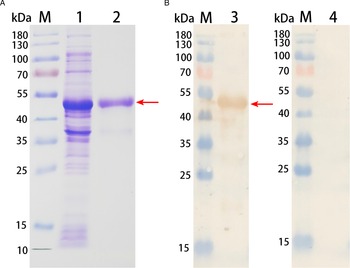
We successfully obtained and harvested the rHcADRM1 antigen from the soluble cell extracts (Fig. 1A, lane 1). The rHcADRM1 antigen was identified as an approximately 46-kDa single band on protein gels following the purification (Fig. 1A, lane 2). The specificity of the resulting anti-HcADRM1 IgG was validated using western blot. The immunoblot assays showed that the rHcADRM1 protein was specifically recognized by anti-HcADRM1 IgG as a ~46 kDa band (Fig. 1B, lane 3). In addition, the control goat IgG did not recognize the rHcADRM1 antigen (Fig. 1B, lane 4).
Expression of rHcADRM1 protein and characterization of anti-rHcADRM1 antibodies. (A) SDS-PAGE analysis of rHcADRM1 protein. Lane 1: rHcADRM1 protein in the soluble cell extracts; lane 2: the resulting rHcADRM1 protein after purification; lane M: protein ladders. (B) Immunoblot analysis for the specificity of purified anti-HcADRM1 IgG. Blots were incubated with goat anti-rHcADRM1 IgG (lane 3) and control goat IgG (lane 4), respectively. Lane M: protein ladders.

Reductions in fecal egg shedding and worm burdens
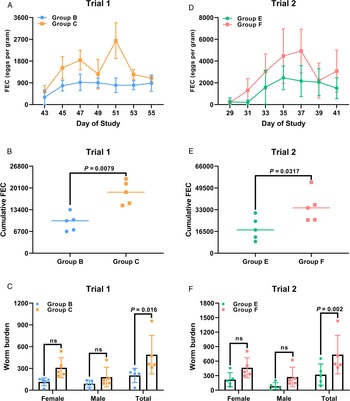
With respect to the efficacy of an effective vaccine against H. contortus, the primary considerations were the reductions in worm burdens and fecal egg shedding in the inoculated animals. We thereby monitored the kinetics of egg excretion in challenged goats throughout the study period and assessed the reductions in abomasal worm burdens at necropsy. Haemonchus contortus egg excretions in the feces of inoculated groups were first detected on day 43 of trial 1, and the variation in EPG values is shown in Fig. 2A. The egg shedding levels in group B were mounted over time and peaked at 920 ± 342.1 EPG on day 47. In addition, the highest group average FEC (2640 ± 740.3 EPG) in group C was observed on day 51 of trial 1 (Fig. 2A). GAMM analysis demonstrated the notable impacts of active immunization with rHcADRM1 protein on group average FEC across the time-course of the study, compared with the challenged controls (P < 0.001). The protective efficacies of vaccination in cumulative FEC and worm burdens were assessed relative to the challenged controls. Immunization with rHcADRM1 antigen generated considerable protection against H. contortus infection, reducing cumulative FEC and total worm burdens by 48.9% (P = 0.0079) and 58.6% (P = 0.016), respectively, compared to the challenged controls (Fig. 2B and C). However, we did not observe any notable decreases in average female and male worm burdens in group B (P = 0.122 and P = 0.887, respectively) when compared with the challenged controls (Fig. 2C).
Evaluation of parasitological parameters in trials 1 and 2. (A) The kinetics of FEC of inoculated groups in trial 1. (B) The kinetics of FEC of inoculated groups in trial 2. FEC presented as EPG were denoted as mean ± s.d. (n = 5 for each group). (C) Cumulative FEC in inoculated groups in trial 1. (D) Cumulative FEC in inoculated groups in trial 2. Cumulative FEC were calculated using the linear trapezoidal method by assessing the area under the curve, and the data were shown as minimum to maximum (group size n = 5). Non-parametric Mann–Whitney tests were used to determine P values. (E) Enumeration of abomasal male, female and total worm burdens in trial 1. (F) Enumeration of abomasal male, female and total worm burdens in trial 2. Worm burdens in each group were presented as minimum to maximum (group size n = 5). The two groups significantly differed at P < 0.05. ns, not significant.

The profile of egg shedding in trial 2 is presented in Fig. 2D. The egg excretions in the fecal samples of inoculated goats of groups E and F were initially observed around day 29 of trial 2 (Fig. 2D). For group E, group average FEC reached the peak level of 2460 ± 1090 EPG on day 35 of trial 2 (Fig. 2D). By contrast, group average FEC in group F peaked at 4920 ± 2012 EPG on day 37 (Fig. 2D). Similarly, GAMM analysis showed that passive immunization with anti-rHcADRM1 IgG had significant effects on group average FEC across the time-course of trial 2, compared to the challenged controls (P < 0.001). Simultaneously, the administration of anti-rHcADRM1 IgG yielded considerably significant protection against H. contortus infection, resulting in reductions of 46.7% (P = 0.0317) and 56.2% (P = 0.002) in cumulative FEC and total worm burdens, respectively, when compared with group F (Fig. 2E and F). Given that the preliminary work identified higher HcADRM1 mRNA expression in male worms of H. contortus than in female ones (Lu et al., Reference Lu, Tian, Zhang, Aimulajiang, Wang, Ehsan, Li, Yan, Xu and Song2020c), we anticipated the administration of HcADRM1 preparations would show a significant protection pattern against male adults. However, similar to trial 1, no notable changes in either female or male worm burdens (P = 0.051 and P = 0.161, respectively) were observed between groups E and F (Fig. 2F).
Mucosal antibody responses throughout the trials
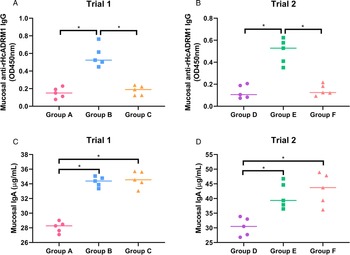
For the assessment of mucosal immune responses, we further evaluated the levels of mucosal antigen-specific antibodies and total IgA, IgE and IgG in inoculated goats. In trial 1, mucosal anti-rHcADRM1 IgG levels at necropsy were significantly higher in group B compared to groups A (P = 0.011) and C (P = 0.049) (Fig. 3A). Similarly, group E showed significantly elevated mucosal anti-rHcADRM1 IgG levels compared to groups D (P = 0.011) and F (P = 0.049) in trial 2 (Fig. 3B). In both trials, there were no significant differences in mucosal anti-rHcADRM1 IgA levels between HcADRM1 preparations-immunized and control groups (P > 0.05) (Supplementary file 2). Significantly increased mucosal total IgA levels were observed in inoculated goats in groups B (P = 0.040) and C (P = 0.014) in comparison with the unchallenged controls in trial 1 (Fig. 3C). As well, in trial 2, inoculated goats in groups E and F presented increased levels of mucosal total IgA postmortem in comparison with the uninoculated controls (P = 0.048 and P = 0.011, respectively) (Fig. 3D). Meanwhile, there were no significant differences in mucosal total IgA production between groups B and C in trial 1 (P = 0.691) (Fig. 3C) as well as between groups E and F in trial 2 (P = 0.548) (Fig. 3D). The levels of total mucosal IgG and IgE production in groups B and C had no statistically significant differences compared to group A in trial 1 (P > 0.05) (Supplementary file 2). Similarly, in trial 2, groups E and F showed no significant differences in total mucosal IgG or IgE levels in comparison with group D (P > 0.05) (Supplementary file 2). The results indicated that increased total mucosal parasite-specific IgA production was mainly induced by H. contortus infection. Simultaneously, these two HcADRM1 preparations did not act effectively to facilitate IgA-mediated protective mucosal immunity.
Mucosal antigen-specific IgG and total IgA production. (A) Mucosal anti-rHcADRM1 IgG levels in trial 1. (B) Mucosal anti-rHcADRM1 IgG levels in trial 2. (C) Total mucosal IgA productions in trial 1. (D) Total mucosal IgA productions in trial 2. The levels of mucosal antibody productions were denoted as minimum to maximum (n = 5 for each group). Statistical analysis of mucosal antibody responses was carried out using non-parametric Kruskal–Wallis tests. The asterisks indicate significant differences between groups (*P < 0.05).

Kinetics of circulating antibody levels
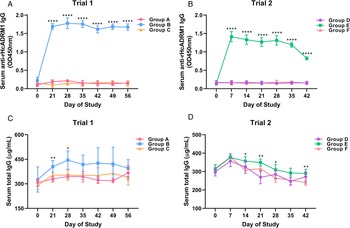
To evaluate circulating antibody responses in the goats, we collected the serum samples at sequential time points and determined the levels of serum anti-rHcADRM1 IgG, IgA, total IgG and IgE throughout the study. In trial 1, circulating anti-rHcADRM1 IgG levels in group B boosted up at the time point following the second administration of the rHcADRM1 antigen (day 21) (Fig. 4A). Vaccinated goats in group B preserved higher serum antigen-specific IgG levels than the unvaccinated challenge controls throughout all time points (P < 0.0001) (Fig. 4A). Similarly, immunized goats in group E showed significantly elevated circulating anti-rHcADRM1 IgG levels after a booster injection compared to the challenged controls throughout trial 2 (P < 0.0001) (Fig. 4B). Additionally, ELISA data demonstrated that goats in group B had significantly increased serum total IgG levels after the vaccination of rHcADRM1 protein compared to the challenged controls on day 21 (P = 0.009), peaking at the level of 445.0 ± 55.8 μg mL−1 on day 28 (P = 0.030) (Fig. 4C). In trial 2, after a second injection, relatively higher circulating total IgG levels were identified in group E compared to the challenged controls on day 14 (P = 0.018), day 21 (P = 0.003), day 28 (P = 0.030) and day 42 (P = 0.009) (Fig. 4D). Additionally, all goats in group B had no significant differences in serum IgA and IgE levels throughout all time points in trial 1 when compared with group C (P > 0.05) (Supplementary file 3). Although serum IgA and IgE levels in group E showed a similar pattern, all the data points reached no statistical significance when compared to group F in trial 2 (P > 0.05) (Supplementary file 3). As the protective efficacy of a vaccine is generally correlated with vaccine-induced antibody levels, high levels of circulating and mucosal antigen-specific IgG generated by administering two HcADRM1 preparations may contribute to the protection against H. contortus.
Circulating antibody responses in the trials. Serum samples were collected throughout all time points, and the kinetics of anti-rHcADRM1 IgG and total IgG productions in the circulation was determined in both trials 1 (A and C) and 2 (B and D). Serum antibody levels in each group (group size n = 5) were denoted as mean ± s.d. The asterisks indicate significant differences between groups B and C or groups E and F (*P < 0.05, **P < 0.01 and ****P < 0.0001).

Kinetic haematological analysis throughout the trials
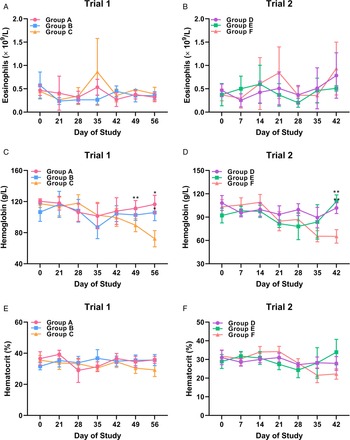
To determine the dynamic of haematological parameters throughout trials 1 and 2, peripheral venous blood obtained at sequential time points from all goats was assayed for the enumeration of blood cells. On day 35 of trial 1, eosinophils in group C remained elevated above groups A and B but not significantly (P > 0.05) (Fig. 5A). There were no significant differences observed in eosinophil values across all the groups at other time points in trial 1 (P > 0.05) (Fig. 5A). Similarly, no differences were observed in eosinophil levels among the groups in trial 2, although group F had elevated eosinophils but reaching no significance on day 21 and day 42 (P > 0.05) (Fig. 5B). Inoculated goats in group C maintained comparatively stable haemoglobin levels until day 42 of trial 1 (Fig. 5C). Group C showed significant decreases in haemoglobin levels on day 49 (P = 0.004) and day 56 (P = 0.013) compared with group A, and on day 56 compared with group B (P = 0.015) (Fig. 5C). Similarly, haemoglobin levels in group F showed a similar trend and were significantly decreased on day 42 of trial 2 when compared with group D (P = 0.009) and group F (P = 0.008) (Fig. 5D). In both trials, the administration of two HcADRM1 preparations appeared to inhibit host haemoglobin ingestion by H. contortus. The profiling of haematocrit levels in trials 1 and 2 is shown in Fig. 5E and F, respectively. Groups B and E showed considerably steady haematocrit values at all time points, whereas the haematocrit levels in group C or group F tended to decline near the end of the trials (Fig. 5E and F). However, the reductions of haematocrit values in group C on days 49 and 56 of trial 1 or group F on days 35 and 43 of trial 2 were not statistically significant compared to the unchallenged controls (P > 0.05) (Fig. 5E and F). In addition, all groups in trials 1 or 2 did not significantly differ for other haematological parameters, including red blood cells, basophils, monocytes, lymphocytes, neutrophils and white blood cells (Supplementary file 4). Given that chronic infection by H. contortus normally induces blood pathology and relevant complications (Emery et al., Reference Emery, Hunt and Le Jambre2016), the chances were that adult worms had parasitized too short in the challenged goats to impact these haematological parameters.
Evaluation of haematologic abnormalities in both trials. (A) Kinetics of peripheral blood eosinophils in trial 1. (B) Kinetics of peripheral blood eosinophils in trial 2. (C) Kinetics of haemoglobin in peripheral blood in trial 1. (D) Kinetics of haemoglobin in peripheral blood in trial 2. (E) Kinetics of haematocrit in peripheral blood in trial 1. (F) Kinetics of haematocrit in peripheral blood in trial 2. The levels of eosinophils, haemoglobin and haematocrit in each group were denoted as mean ± s.d. (group size n = 5). Data points followed by asterisks indicate significant differences compared with the challenged controls (group C or F) (*P < 0.05 and **P < 0.01).

Cytokine production profiles in the circulation
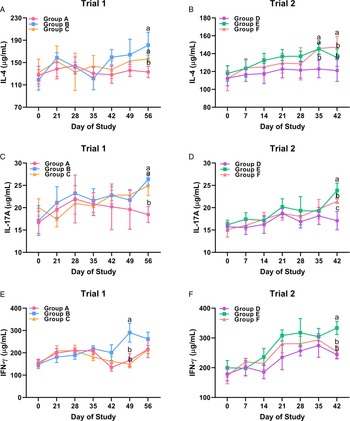
We further examined the kinetics of circulating cytokine levels in all groups throughout trials 1 and 2 as host protective immunity is correlated with the generation of a panel of cytokines during H. contortus infection (Nisbet et al., Reference Nisbet, Meeusen, González and Piedrafita2016). In both trials, all inoculated groups showed an upward trend in serum IL-4 production over time (Fig. 6A and B). Groups B and C showed significant increases in serum IL-4 levels in comparison with group A on day 56 of trial 1 (P = 0.015 and P = 0.020, respectively) (Fig. 6A). Meanwhile, serum IL-4 levels in groups E and F were significantly increased compared to group D on day 35 of trial 2 (P = 0.002 and P = 0.034, respectively) (Fig. 6B). On day 42 of trial 2, group F but not group E showed significant increases in circulating IL-4 production when compared to group A (P = 0.012 and P = 0.325, respectively) (Fig. 6B). Given that IL-17 engages in tissue repair and wound healing following helminth infections (Chen et al., Reference Chen, Liu, Wu, Rozo, Bowdridge, Millman, Van Rooijen, Urban, Wynn and Gause2012), the kinetics of serum IL-17A production was evaluated throughout all time points in trials 1 and 2. Serum IL-17A levels in groups B and C were significantly elevated above group A on day 56 of trial 1 (P = 0.007 and P = 0.013, respectively) (Fig. 6C). As well, both groups E and F had significantly increased serum IL-17A levels when compared to group D (P = 0.007 and P = 0.009, respectively) on day 42 of trial 2 (Fig. 6D). Interestingly, serum IL-17A levels in group E were simultaneously significantly higher than those in group F (P = 0.043) (Fig. 6D). In addition, group B showed significantly higher levels of serum IFN-γ productions on day 49 of trial 1 compared to groups A and C (P = 0.0002 and P = 0.011, respectively) (Fig. 6E). On day 42 of trial 2, group E had significantly higher circulating IFN-γ levels than groups D and F (P = 0.002 and P = 0.0007, respectively) (Fig. 6F). However, in both trials 1 and 2, other cytokine secretion profiles showed no significant changes across the groups throughout all time points (P > 0.05) (Supplementary file 5).
Variation in circulating cytokine levels in both trials. The kinetics of serum IL-4 (A and B), IL-17A (C and D) and IFN-γ (E and F) levels in each group were assessed throughout all time points in trials 1 and 2. Circulating IL-4, IL-17A and IFN-γ expression levels in each group were presented as mean ± s.d. (group size n = 5). The data points denoted by different letters indicate significant differences between groups (P < 0.05).

Discussion
In the current study, we evaluated the potential of the ES antigen HcADRM1 in protecting hosts against H. contortus infection. Administration of rHcADRM1 antigen elicited sufficient levels of immune protection in H. contortus-inoculated goats, resulting in 48.9 and 58.6% reductions in cumulative FEC and worm burden, respectively. As demonstrated by the protective mechanism of action for Barbervax (LeJambre et al., Reference LeJambre, Windon and Smith2008; VanHoy et al., Reference VanHoy, Carman, Habing, Lakritz, Hinds, Niehaus, Kaplan and Marsh2018), the levels of repeated immunizations-induced antigen-specific antibodies (mainly IgG) were well correlated with the protective efficacy of an anti-H. contortus vaccine. Hence, anti-rHcADRM1 IgG was employed in the parallel passive trial and was shown to confer encouraging levels of protection to inoculated goats by reducing cumulative FEC and worm burden by 46.7 and 56.2%, respectively. In this study, relatively high levels of mucosal and serum anti-rHcADRM1 IgG were present in HcADRM1 preparations-immunized goats over the time-courses of both trials 1 and 2, which might impede H. contortus larvae development given the crucial roles of HcADRM1 protein in transcriptional regulation and cell growth (Lu et al., Reference Lu, Tian, Zhang, Aimulajiang, Wang, Ehsan, Li, Yan, Xu and Song2020c). In most cases, immunization with native antigen preparations appears to induce higher levels of protective immune responses against H. contortus compared to the corresponding recombinant or synthetic forms. The latter usually retain partial or compromised protective capacity because of the absence of proper modification and folding (Murray et al., Reference Murray, Geldhof, Clark, Knox and Britton2007; Reszka et al., Reference Reszka, Rijsewijk, Zelnik, Moskwa and Bieńkowska-Szewczyk2007; Cachat et al., Reference Cachat, Newlands, Ekoja, McAllister and Smith2010). However, from the perspective of commercially viable yields, the productions of native H. contortus antigens at an industrial scale with cost-efficiency, biosafety, uniformity and quality control remain the major challenges for vaccine commercialization (Kearney et al., Reference Kearney, Murray, Hoy, Hohenhaus and Kotze2016; Nisbet et al., Reference Nisbet, Meeusen, González and Piedrafita2016). Therefore, given the commercial applicability of recombinant subunit vaccines, much research has focused on exploiting recombinant forms of novel vaccine antigens (Matthews et al., Reference Matthews, Geldhof, Tzelos and Claerebout2016). To our knowledge, this is one of the few reports of recombinant antigens being protective against H. contortus infection.
This study provides a detailed examination of the kinetics of eosinophils and IgA/IgE productions in both trials as they are associated with host resistance against H. contortus larval establishments such as the rejection of L3 larvae, the induction of hypobiosis and the regulation of L4 feeding (Lacroux et al., Reference Lacroux, Nguyen, Andreoletti, Prevot, Grisez, Bergeaud, Gruner, Brunel, Francois and Dorchies2006; Emery et al., Reference Emery, Hunt and Le Jambre2016; Nisbet et al., Reference Nisbet, Meeusen, González and Piedrafita2016). Haemonchus contortus infection normally leads to the hyperplasia of tissue eosinophils in the abomasum. Increased tissue eosinophils have been shown to mediate L3 larval killing during delayed rejection responses (Balic et al., Reference Balic, Cunningham and Meeusen2006; Kemp et al., Reference Kemp, Robinson, Meeusen and Piedrafita2009). Despite that augmented blood and tissue eosinophils were induced by repeated infections (Robinson et al., Reference Robinson, Piedrafita, Snibson, Harrison and Meeusen2010), goats with primary H. contortus infection showed no significant increase in blood eosinophils in the current study. Although the association of IgA with protective immunity against H. contortus has not been completely elucidated, local IgA that hampers L4 feeding has been identified as a major immune mediator of the host defense system in Teladorsagia circumcincta infections of sheep (Stear et al., Reference Stear, Bairden, Innocent, Mitchell, Strain and Bishop2004; Nisbet et al., Reference Nisbet, Meeusen, González and Piedrafita2016). In the current study, considerably elevated levels of mucosal IgA, but not of serum IgA, have been determined in challenged controls in both trials, indicating the critical roles of IgA in host mucosal immunity against H. contortus. However, immunizations with two HcADRM1 preparations showed no significantly stimulative effects on mucosal IgA productions in both trials 1 and 2. Parasite-specific IgE has been reported to engage in hypersensitivity responses that occurred within 2 days for the rapid rejection against the L3 stage (Balic et al., Reference Balic, Bowles and Meeusen2002; Nisbet et al., Reference Nisbet, Meeusen, González and Piedrafita2016). Hence, the profiles of serum and mucosal IgE production have been determined throughout both trials and no difference was observed in serum/mucosal IgE levels between immunized goats and the challenged controls. Given the critical roles of IgE in the immune exclusion to L3 larvae, further investigation like immunohistochemical staining of abomasum tissues may help identify the difference in mucosal IgE levels among different groups.
In the current study, we observed variable IL-4, IL-17A and IFN-γ expressions in the circulation at varying time points in both trials. In H. contortus infections of small ruminants, protective type 2 immunity is associated with augmented IL-4, IL-5 and IL-13 production, enhancing worm expulsion and impairing larval development (Nisbet et al., Reference Nisbet, Meeusen, González and Piedrafita2016; Cortés et al., Reference Cortés, Muñoz-Antoli, Esteban and Toledo2017). In both trials, increased serum IL-4 levels were identified in challenged goats compared to the unchallenged controls. Concurrently, HcADRM1 preparations-immunized goats appeared to exert elevated group mean serum IL-4 levels than the challenged controls at certain time points, although not significantly. It might imply the potential roles of HcADRM1 preparations in augmenting type 2 immune responses. IL-17 is a regulatory cytokine that contributes to immune signalling and proinflammatory responses. Compelling immunological evidence has demonstrated the pleiotropic roles of IL-17 during helminth infection, promoting acute wound healing by its initial elevation but causing tissue inflammation and damage by its prolonged production (Chen et al., Reference Chen, Liu, Wu, Rozo, Bowdridge, Millman, Van Rooijen, Urban, Wynn and Gause2012; Gonçalves-de-Albuquerque et al., Reference Gonçalves-de-Albuquerque, Pessoa-e-Silva, Trajano-Silva, de Goes, de Morais, da Oliveira, de Lorena and de Paiva-Cavalcanti2017). In both trials 1 and 2, significantly elevated serum IL-17A levels in all inoculated groups were first observed at the 5th week after infection. Intriguingly, group E showed a significant increase in serum IL-17A levels compared to group F on day 42 of trial 2. It is likely that the administration of HcADRM1 preparations contributes to the early phases of tissue repair. For H. contortus infection, susceptible animal breeds could develop Th1 responses defined by IFN-γ production that leads to chronic infection (Yazdanbakhsh et al., Reference Yazdanbakhsh, Kremsner and Van Ree2002; Zaros et al., Reference Zaros, Neves, Benvenuti, Navarro, Sider, Coutinho and Vieira2014). In this study, the challenged controls and unchallenged controls did not significantly differ in serum IFN-γ levels throughout all time points. However, elevated IFN-γ production levels were observed in HcADRM1 preparations-immunized goats at specific time points of both trials. As IFN-γ could induce the activation of macrophages that are responsible for effective tissue repair under helminth infections (Harris, Reference Harris2017), increased IFN-γ production elicited by the immunization of HcADRM1 preparations may activate a tissue repair programme mediated by macrophages. However, more detailed mechanistic networks merit further investigation.
For a vaccine study against H. contortus, adjuvant selection for vaccine antigens is tremendously crucial to augment and prolong vaccination-induced protective immunity (Britton et al., Reference Britton, Emery, McNeilly, Nisbet and Stear2020). In the preliminary study, co-administration of candidate antigens with Freund's adjuvants has been shown to facilitate durable and robust cellular and humoral immunity against H. contortus challenge. Simultaneously, no significant levels of protection were observed in the control group where goats were immunized with Freund's adjuvants alone (Yanming et al., Reference Yanming, Ruofeng, Muleke, Guangwei, Lixin and Xiangrui2007). Hence, Freund's adjuvants were employed as the immunopotentiators, and goats that received Freund's adjuvants alone served as mock controls in trial 1. Similarly, control IgG acquired from goats immunized with Freund's adjuvants was administered to groups D and F in the parallel passive trial. Given that Freund's adjuvants could induce strong local irritant effects, they may not be suitable for the exploitation of an efficacious anti-H. contortus vaccine under field conditions (Petrovsky, Reference Petrovsky2015). DEAE is a Th2-inducing adjuvant that can also facilitate antibody-mediated immune responses (HogenEsch, Reference HogenEsch2013), while Quil A is an adjuvant widely used in immunological research into veterinary applications (Reed et al., Reference Reed, Orr and Fox2013). For future characterization of rHcADRM1 antigen in field trials, adjuvants such as DEAE or Quil A would be more appropriate and warrant further investigation.
Since much research in the development of recombinant versions of promising native antigens has failed, recent vaccine studies have focused on the characterization of novel candidate antigens including their temporal/spatial expression profiles, immunomodulatory attributes, effective recombinant production and protective efficacy (Emery et al., Reference Emery, Hunt and Le Jambre2016; Matthews et al., Reference Matthews, Geldhof, Tzelos and Claerebout2016; Nisbet et al., Reference Nisbet, Meeusen, González and Piedrafita2016). In addition to the exploitation of novel protective antigens, the development of cocktail vaccines containing multiple native or recombinant antigens with prophylactic potential might be a promising strategy (Nisbet et al., Reference Nisbet, Meeusen, González and Piedrafita2016; Noon and Aroian, Reference Noon and Aroian2017; Britton et al., Reference Britton, Emery, McNeilly, Nisbet and Stear2020). The most persuasive laboratory data were provided by a vaccine study targeting T. circumcincta, reporting an immunization regime that incorporated eight recombinant T. circumcincta antigens. Importantly, these antigens were selected mainly for their immunomodulatory potentials in the parasite–host interactions (Nisbet et al., Reference Nisbet, McNeilly, Wildblood, Morrison, Bartley, Bartley, Longhi, McKendrick, Palarea-Albaladejo and Matthews2013). Much previous research has reported a variety of H. contortus ES immunomodulators such as HcABHD (Lu et al., Reference Lu, Tian, Tian, Li, Yan, Xu, Song and Li2020a), HcTTR (Tian et al., Reference Tian, Lu, Wang, Jia, Muhammad, Yan, Xu, Song and Li2019), Hc-AK (Ehsan et al., Reference Ehsan, Gao, Gadahi, Lu, Liu, Wang, Yan, Xu, Song and Li2017), Miro-1 (Wen et al., Reference Wen, Wang, Wang, Lu, Ehsan, Tian, Yan, Song, Xu and Li2017), HcSTP-1 (Ehsan et al., Reference Ehsan, Wang, Gadahi, Hasan, Lu, Wang, Liu, Haseeb, Yan and Xu2018), Hc8 (Wang et al., Reference Wang, Wang, Tian, Lu, Ehsan, Yan, Song, Xu and Li2019b) and HcA59 (Wang et al., Reference Wang, Wu, Hasan, Lu, Wang, Yan, Xu, Song and Li2019a). The recombinant subunit vaccine cocktails encompassing multiple recombinant versions of these ES antigens, alongside protective recombinant antigens such as rHcENO (Kalyanasundaram et al., Reference Kalyanasundaram, Jawahar, Ilangopathy, Palavesam and Raman2015) and rHc23 (Fawzi et al., Reference Fawzi, González-Sánchez, Corral, Alunda and Cuquerella2015), might generate a remarkably elevated level of protection to susceptible animals.
To conclude, we hereby assessed the protective efficacies of two HcADRM1 preparations, rHcADRM1 protein and anti-rHcADRM1 antibodies, in 5–6 month-old goats against H. contortus challenge. The preliminary results suggested that the effective recombinant versions of the HcADRM1 antigen might have further immunoprophylactic applications in field trials. Notably, the integration of immunological pipelines for the identification and characterization of novel vaccine antigens will provide a new perspective for the control of H. contortus via vaccination.
Supplementary material
The supplementary material for this article can be found at https://doi.org/10.1017/S0031182021001141
Data
The data supporting the findings of this study are available within the article and in its Supplementary materials. Raw data from the animal trials are available from the corresponding author (XL) upon request.
Acknowledgements
We are indebted to Dr Yaqiang Cao from National Heart Lung and Blood Institute for his assistance with the statistical analysis of the data. We thank the dedicated team of graduates and PhD candidates from the Laboratory of Veterinary Parasitology of Nanjing Agricultural University who provided technical and practical assistance during the study. We are also grateful to Dr Xing-Quan Zhu from Lanzhou Veterinary Research Institute for providing valuable and constructive suggestions.
Author contribution
ML: investigation, data curation, formal analysis, writing-original draft. XT: investigation, methodology, data curation, validation, formal analysis. WW: investigation, data curation, validation. YZ: investigation, methodology, data curation. KA: investigation, data curation. ALT: investigation, data curation. CL: supervision, validation, writing-review and editing. RY: conceptualization, funding acquisition, project administration. LX: project administration, supervision, resources. XS: funding acquisition, project administration, resources. XL: conceptualization, funding acquisition, methodology, supervision, writing-review and editing.
Financial support
This work was funded by National Key Research and Development Program of China (grant no. 2017YFD0501200), Policy Guidance Project of Jiangsu Province for International Scientific and Technological Cooperation (grant no. BZ2019013), the National Key Basic Research Program (973 Program) of P. R. China (grant no. 2015CB150300) and the Priority Academic Program Development of Jiangsu Higher Education Institutions (PAPD).
Conflict of interest
The authors declare that they have no competing interests.
Ethical standards
The animal use protocol [SYXK (SU) 2010-0005] was reviewed and approved prior to the trials. The immunization trials were conducted in compliance with the Guidelines for Animal Care and Use issued by the Chinese Animal Welfare Council. Animal observation and assessment were carried out according to a specified monitoring schedule throughout the study.