Social support refers to aspects of human relations such as personal social relationships, mutual trust, mutual awareness, and ample networking. Reference Fiore, Coppel and Becker1,Reference Gottlieb and Bergen2 It is known to positively affect individuals’ mental and physical health. Reference Broadhead, Kaplan and James3-Reference Cobb5 Natural disasters have been found to affect long-term health by directly disrupting or destroying health-care systems and social support. Reference Spiegel, Sheik and Gotway-Crawford6 Therefore, research on social support in disaster areas is important to facilitate the restoration of human health. Reduction of social support has been described previously as leading to psychological problems, such as depression, anxiety, and posttraumatic stress disorder (PTSD), Reference Bland, O’Leary and Farinaro7-Reference Koyama, Aida and Kawachi11 but the effects of social support on subjective symptoms (SS) in disaster areas remain unclear.
The Great East Japan Earthquake and resultant tsunami, which struck the coast of northeast Japan on March 11, 2011, caused overwhelming damage to the country’s Pacific coastal regions and uprooted survivors’ lives and communities. Reference Ishigaki, Higashi and Sakamoto12 Psychological stress combined with changes in the social environment after such a disaster can cause SS such as sleep difficulty, headache, and loss of appetite. Reference Kwon, Maruyama and Morimoto9 Lately, social infrastructure is being increasingly reshaped by rising health problems due to social changes such as increasing populations, aging, and globalization. Reference McMichael and Beaglehole13 Those in disaster-stricken areas have become more vulnerable because of increasingly sparse and diverse relationships. Reference Kwon, Maruyama and Morimoto9 One study reported that strong social capital reinforces reconstruction and recovery following a disaster. Reference Aldrich14 Based on this premise, it is important to clarify the relationship between health and social support in order to strengthen the resilience of those in the regions vulnerable to a range of future disasters.
Several studies have suggested that social support influences individual health and well-being. Various theoretical pathways have been postulated to account for this association, including protecting against psychological stress, Reference House15 encouraging healthy behaviors Reference Matsumoto, Yamaoka and Inoue10,Reference Eriksen, Ihlebaek and Ursin16,Reference Inoue, Matsumoto and Yamaoka17 and coping abilities, Reference Koyama, Aida and Kawachi11,Reference Betancourt and Khan18 and promoting adherence to medical regimens. Reference Lowe, Chan and Rhodes19 We have also previously suggested a correlation between social support and sleep difficulties among survivors of this disaster in Ishinomaki, Miyagi Prefecture, Japan. Reference Matsumoto, Yamaoka and Inoue20 The concept of social support encompasses its structure and function; quantitative network factors account for the structure while the function involves more qualitative aspects. The 4 defining attributes of functional social support that are most frequently used in the literature are emotional, instrumental, informational, and appraisal. Reference Norris and Kaniasty21,Reference Lindstrom22 Emotional support concerns sharing life experiences, involving the provision of empathy, love, trust, and care. Instrumental support involves the provision of tangible aid and services that may assist a person in need, such as transportation or money. Informational support incorporates provision of advice, suggestions, and information during times of stress. Appraisal support entails provision of information useful for self-evaluation rather than problem-solving. To the best of our knowledge, no study has investigated which functional aspects of social support have especially significant effects on sleeping patterns among disaster-affected populations. As previous studies have noted the differing effects of social support on men and women, Reference Okamoto and Tanaka23-Reference Putnum and Nanetti26 we further investigated the differing effects of social support on SS as determined by sex to effectively promote social support in disaster-stricken areas.
Ishinomaki, the second largest city in Miyagi, suffered massive damage from the earthquake and tsunami because of its coastal location. Of the city’s 152,250 total residents, approximately 15,000 returned to live in damaged houses while approximately 45,000 relocated to temporary/rental housing (data as of March 3, 2012, Ishinomaki city). The remaining houses were isolated amid the wreckage of uninhabited houses devastated by the tsunami. Because the disaster had disrupted their social community structure and networks, Reference Shibahara27 these residents evidently had less social support, which in turn affected their SS. Reference House15,Reference Coyle and Dugan28 Effective intervention via social support was crucial to controlling SS in Ishinomaki.
We hypothesized that insufficient individual-level social support was positively associated with SS, but that the quality and quantity of the associations differed by sex. The present study evaluated the perception of 3 dimensions of functional social support, ie, emotional, instrumental, and informational, and examined the associations between each form and SS among victims who remained at their residences. We used data from a survey conducted regarding the disaster-affected area.
METHODS
Procedures and Participants
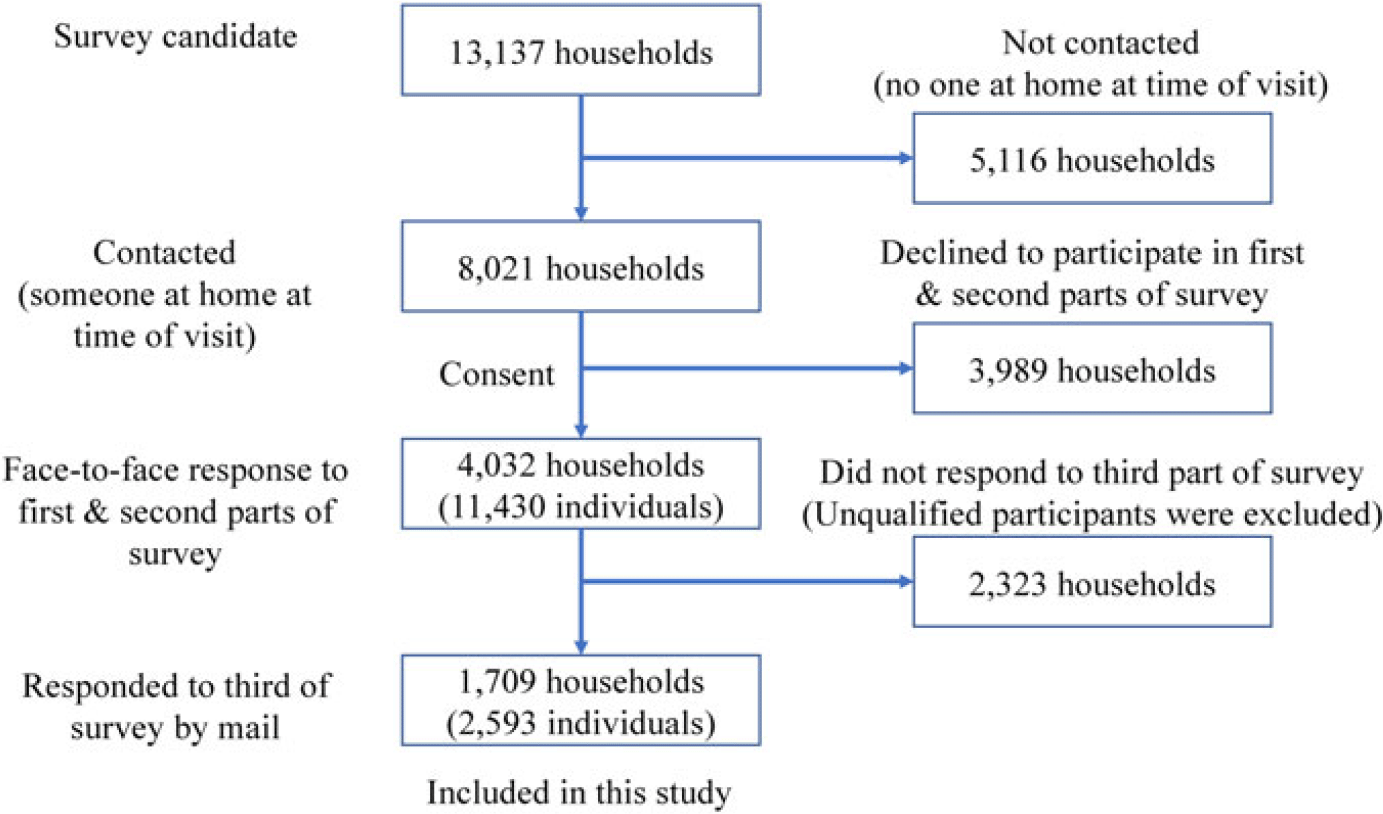
The Health and Life Revival Council of the Ishinomaki District (RCI) Reference Matsumoto, Yamaoka and Inoue10 conducted the survey between April 2012 and January 2013 (13–22 months after the disaster). Figure 1 shows the flow diagram of this study. The RCI interviewers conducted door-to-door surveys in tsunami-hit areas where houses were damaged. Candidate participants were residents who continued living in these areas despite the damage. The survey consisted of 3 parts. The first was a face-to-face survey with a representative of the household that included questions related to household demographics and the social background of household members. The second was to obtain responses from all household members at home at the time of the visit. This part mainly included questions related to the interviewees’ lifestyles. The third was a questionnaire given to each adult household member, who completed and returned it to the RCI by postal mail. Questionnaire items mainly related to the participants’ physical and psychosocial health (including the topic of prolonged sleep difficulties).
Flow Diagram of Study Participants. Number of households at each stage of this study.

Interviewers were volunteers from various backgrounds, including nurses, care workers, college students, and social workers. They were trained in advance via a video and handbook explaining how to conduct the interview. They also practiced interviewing under the supervision of trained interviewers. A semi-structured questionnaire was used consisting of 3 sections: household demographics, social background, and health conditions. All interviewers completed at least a half-day of training before independently going to conduct interviews.
Self-reported data were collected from 2593 individuals from 1709 households among 11,430 individuals from 4023 households (42.5% response rate). Responses not completed directly by the respondent were excluded as missing data. Personal information such as names and addresses of participants was excluded before data analysis. The Institutional Review Board of Teikyo University (No. 12-079) granted approval for the study.
Measurements: Outcome Variables
In a previous study, SS included headache, stomachache, neck stiffness, and a general sense of feeling unwell. Reference Eriksen, Ihlebaek and Ursin16 Our study defined participants with SS as having at least 1 of the following: back pain, neck stiffness, sleep difficulty, dizziness, heart palpitations, poor appetite, or stomachache.
Measurements: Explanatory Variables
For basic characteristics, we asked the participants’ age, sex, number of household members, and level of home damage, as well as whether participants had experienced changes in their family structure or income due to the disaster. Households with residents aged 65 years or older only were categorized as “elderly households.” Numbers of household residents were categorized into 3 groups (1, 2, or 3 or more), and the level of home damage was assessed using 5 categories of predetermined local government criteria Reference Inoue, Matsumoto and Yamaoka17 : completely destroyed, largely destroyed, half-destroyed, partially destroyed, or undamaged. In accordance with the criteria, if water reached the entire first floor of a house, the house was judged to be completely destroyed; if the water reached a level of 1 meter inside the house, the house was judged to be largely destroyed; water reaching above floor level led to a judgement of half-destroyed; and water present that had not risen to the level of the floor led to a judgement of partially destroyed. To clarify the differences in home damage for statistical analysis, we later divided the levels into 2 broader categories: completely/largely destroyed and half-destroyed/partially destroyed/undamaged.
We also measured 12 variables regarding social support. Social support was examined using questions regarding leaving the home 3 or more times per week, having someone to visit once a week, having relationship problems, being easily irritable, being reluctant to meet people, being unable to get along with others, having chances to talk with others, having someone to consult about problems, having someone who can provide information, not having a reliable person, having someone who is experienced in nursing and elderly care, and having someone who can provide financial assistance. Social support was divided into its 3 dimensions: emotional, instrumental, and informational support (Supplemental Table 1). Owing to limited interview time, this study did not assess appraisal support.
Statistical Analysis
SS prevalence was the outcome variable for the primary analyses. Chi-square tests were used to analyze the differences in the proportions of the outcome variables by participant demographics. Logistic regression analyses were used to estimate the crude odds ratios for SS. Multiple regression analyses adjusted for age, number of household members, level of damage to the house, and change in income were also performed. Missing data in these models were excluded from the analyses. Finally, to improve statistical power, we applied a multivariate model using a stepwise method for all variables.
We treated all variables except age as categorical variables (dummy-coded). All analyses were performed using SAS Enterprise Guide version 4.3 software (SAS Institute, Cary, NC, USA). Data are presented as mean ± SD, and all tests were 2-sided and considered statistically significant at P < 0.05.
RESULTS
Demographics of the Participants
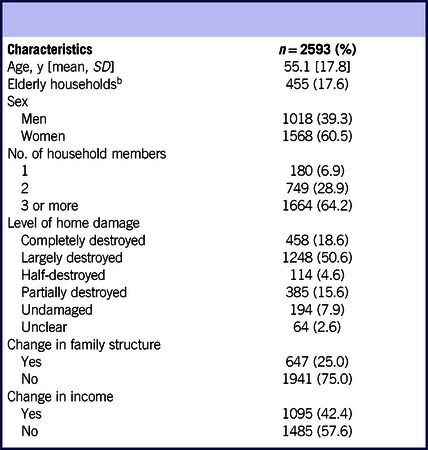
We used the data of all 2593 consenting participants. Table 1 shows their characteristics. The mean age was 55.1 (SD ± 17.8) years. Households consisting only of persons 65 years or older comprised 17.6% of participants. Roughly 2/3 of the participants were women. A total of 6.9% of participants lived alone, while 64.2% of total households had 3 or more members. Most of participants’ houses were deemed totally to partially destroyed (84.9%). Moreover, 25.0% of participants experienced a change in family structure and 42.4% a change in income due to the disaster.
Characteristics of Participantsa

a Missing data are excluded
b Households with residents aged 65 years or older only.
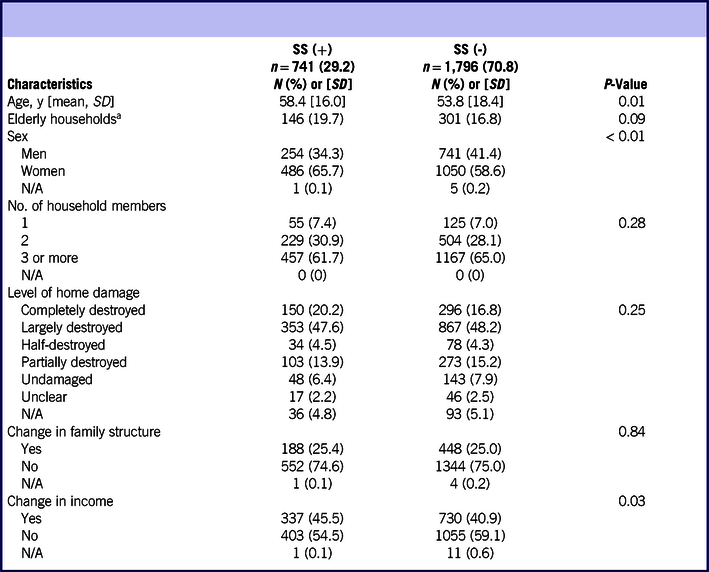
Risk of Subjective Symptoms and Participants’ Demographics
Table 2 shows the relationship between participants’ characteristics and SS proportion. The proportion of participants reporting SS was 29.2% (741), while 70.8% (1796) reported no SS. The average age was significantly higher for those with SS than for those without (P = 0.01); however, elderly persons living alone did not show an increased rate of SS. Women were more likely than men to divulge SS. Additionally, people who reported income change were more likely to have SS. Our findings showed that age, sex, income change, and their interaction effects were all statistically significant.
Characteristics of Participants and SS (n = 2537)

Abbreviation: N/A, missing data.
a Households with residents aged 65 years or older only. P-Values were determined using χ2 tests.
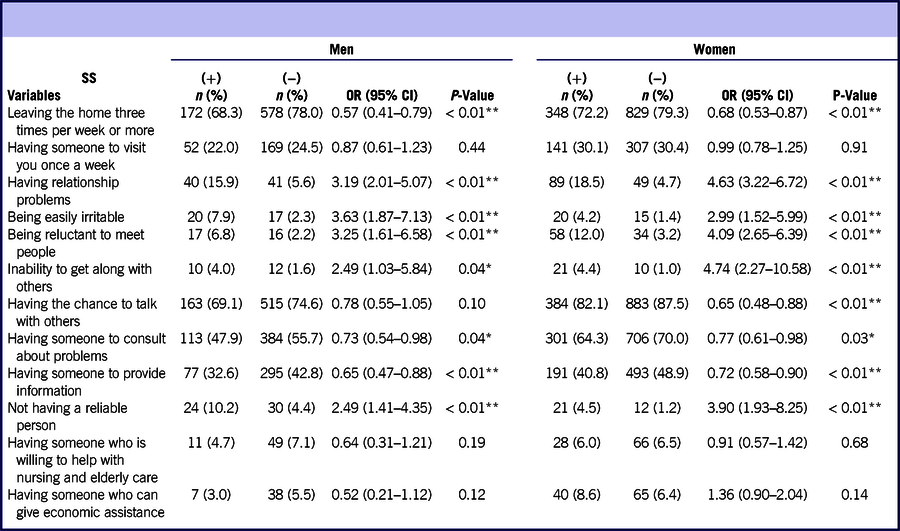
The logistic regression analysis yielded crude odds ratios of SS by 12 explanatory variables with sex stratification (Table 3). Table 3 shows that the factors of leaving the home 3 times or more per week, having someone to consult about problems, and having someone to provide information were negatively associated with having SS in both sexes. However, having relationship problems, being easily irritable, being reluctant to meet people, being unable to get along with others, and not having a reliable person were positively associated with SS in both sexes. Remarkably, having the chance to talk with others was negatively associated with SS in women (men: odds ratio [OR] = 0.78, 95% CI = 0.55–1.05; women: OR = 0.65, 95% CI = 0.48–0.88).
Logistic Regression Results: Crude ORs of SS and 95% CIs.a

a Missing data are excluded.
* P < 0.05.
** P < 0.01.
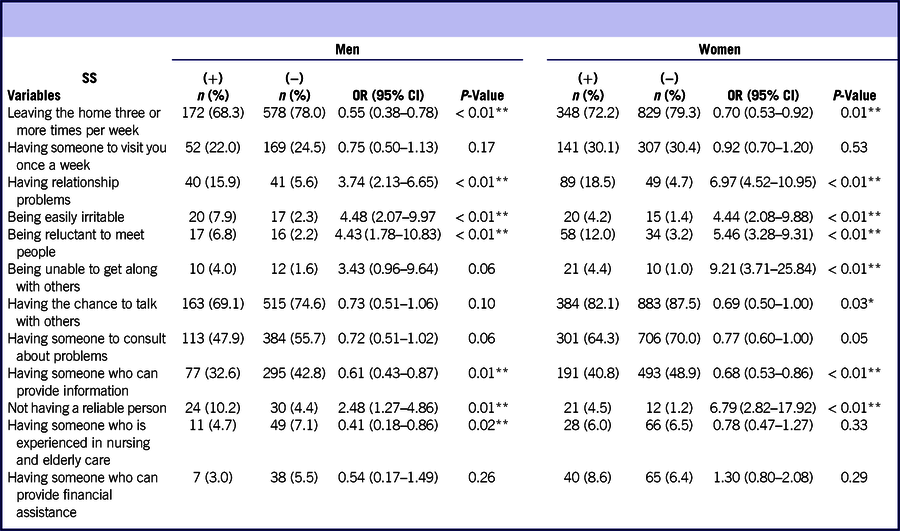
Table 4 shows the logistic regression analysis for men and women with adjustments made for age, number of household members, level of house damage, and change in income. It shows that leaving the home 3 or more times a week and having someone to provide information were negatively associated with SS. Conversely, having relationship problems, being easily irritable, being reluctant to meet people, and not having a reliable person were positively associated with SS in both sexes. Specifically, having someone willing to help with nursing and elderly care (men: OR = 0.41, 95% CI = 0.18–0.86; women: OR = 0.78, 95% CI = 0.47–1.27) was only negatively associated with SS in men. In addition, in women, being unable to get along with others (men: OR = 4.43, 95% CI = 1.78–10.83; women: OR = 5.46, 95% CI = 3.28–9.31) was positively associated with SS, and having the chance to talk with others (men: OR = 0.73, 95% CI = 0.51–1.06; women: OR = 0.69, 95% CI = 0.50–1.00) was negatively associated.
Logistic Regression Results: Adjusted ORs of SS and 95% CIs.a

a Logistic regression model adjusted by age, number of household members, level of house damage, and change in income.
* P < 0.05.
** P < 0.01.
DISCUSSION
Our study found that having less social support was associated with SS among disaster victims who remained at their residences in the studied area. Age, sex, and income change were associated with SS prevalence. Our results showed that a lack of, or difficulty in, accepting social support is potentially associated with SS prevalence in disaster-stricken areas. The findings also suggest that different forms of social support depending on sex may be important for effectively providing or building social support.
There have, in fact, been reports showing an increased prevalence of certain conditions following the Great East Japan Earthquake, including sleep difficulty, PTSD, and psychological distress, all due to a lack of social networks. Reference Kwon, Maruyama and Morimoto9-Reference Koyama, Aida and Kawachi11 It is important to build resilience among those in vulnerable areas against future disasters and to clarify the relationship between health and social support for people in disaster-stricken areas.
SS are considered a major cause of stress amid changes in one’s social environment and constitute an issue that cannot be ignored in disaster-stricken areas. Reference Thormar, Gersons and Juen29 Having social support is known to reinforce survivors against postdisaster psychological distress Reference Betancourt and Khan18,Reference Lowe, Chan and Rhodes19 and physical problems. Reference Norris and Kaniasty21 Our results suggest that a lack of, or difficulty in, accepting social support leads to SS in Ishinomaki. Therefore, social support, such as maintaining healthy relationships with others and creating opportunities for activities, should be nurtured as a key objective among disaster-affected populations.
A previous study indicated that the role of social support differs between the sexes. Reference Toni and Antonucci25,Reference Thormar, Gersons and Juen29 Our findings suggest that there are different SS-related social support factors between the sexes in postdisaster areas (Table 4). Another previous study showed that trust promotes social networking by reducing social unrest and strengthening social relationships; this suggests that social support in the form of trusting others has a similar influence on SS. Reference Lindstrom22 However, in our present study, men were negatively associated with social support involving trust in others, such as having someone willing to provide nursing or elderly care, and with SS, although women were not. Men 65 years or older showed a significant correlation (P = 0.02) between a subjective feeling of health and the support of spouses, relatives, and friends. Reference Okamoto and Tanaka23 The presence of a spouse thus appeared to decrease SS in men. However, women had a negative association between social support in terms of communication and SS. The likelihood of women raising children leads to strong dependence on neighborhood networks, and the social support related with organizational participation that provides, for instance, chances to talk with others is associated with SS.
LIMITATIONS
This study has some limitations that should be noted. First, we used a cross-sectional design; thus, we are unable to determine the order of occurrence of the lack of social support and SS. Moreover, as our survey was conducted 13–22 months after the disaster, our findings might not be immediately applicable to other postdisaster periods. Additionally, because our sample population was 1 selected city, the particular characteristics of the surveyed area may affect the results. A previous study suggested that not only individual factors but also a social group factor were related with health, Reference Putnum and Nanetti26 suggesting that it is necessary to compare group- and individual-level social support, including regional characteristics. In addition, this study did not assess sexual minorities.
Possible selection bias in this study arose because door-to-door semi-structured questionnaires pose difficulties in protecting the anonymity of participants, and thus our data might have a self-serving bias that was transmitted to the interviewers. Additionally, although we collected 42.5% of the self-reported data from the 4023 households, a lack of social support or poor health conditions may have caused some people to initially decline to participate. However, as we excluded responses by other family member as missing data, our data may show selection bias, resulting in a higher reported rate of decreased social support and SS.
The other selection bias is that arising from matching the individual original disease and symptoms. The participants in our study were also selected only from among those remaining in their damaged houses rather than constituting a random selection of all disaster victims, as there were many other types of victims living in different forms of housing.
CONCLUSIONS
Despite its limitations, this study has implications regarding social support factors related to SS arising in the wake of a disaster such as the Great East Japan Earthquake. We found that emotional, informational, and instrumental support were associated with having social support in men, while emotional and informational support were so associated in women. This finding suggests that a lack of, or difficulty in, accepting social support can be associated with SS prevalence, whereas physical and structural damage such as home damage caused directly by the disaster has no association with SS prevalence. We thus suggest that social support, such as maintaining healthy relationships and creating opportunities for activities, reduces health problems among disaster-affected populations. Our findings indicate the importance of considering different forms of support and providing or building social support to enhance the resilience of a community in disaster preparedness.
Acknowledgments
This study was conducted with memorandum of agreement between RCI and Teikyo University Graduate School of Public Health. We thank Dr. Sinsuke Muto, Ms. Ai Sonoda, and the members of RCI and all the volunteers who contributed to data collection. We also thank Dr. Takenori Inomata and Dr. Homer Chiang for their helpful scientific consultation and their assistance in writing this manuscript.
Funding
This study was financially supported by the Japanese Society of Public Health (special grant for a public health project for the Great East Japan Earthquake).
Conflicts of Interest
The authors have no financial conflict of interest.
Supplementary material
To view supplementary material for this article, please visit https://doi.org/10.1017/dmp.2019.121