Contemporary Asia commands attention once again for its rise in the global economy (Pempel, Reference Pempel and Pempel2005: 24–28; Katzenstein, Reference Katzenstein2005: 2, 6–13; Jones and Smith, Reference Jones and Smith2007: 173–177; Aggarwal and Koo, Reference Aggarwal, Koo, Aggarwal and Koo2008: 6). Security rivalries and social complexities still do not bode well for the region's integration prospects in the near future. But a thoughtful introduction to the issue suggests we have also begun to think particularly of East Asia as one regional actor – a sort of ‘1Asia’ if you will – that is projecting itself onto the world stage (Dent, Reference Dent2008: 2–6). Thus, the unevenness of economic flows, the possibilities of their reversal, and even the challenge of defining their regional scope have not deterred a number of works from moving ahead and focusing attention on whether Asia is rising, leading, integrating, or institutionalizing (Mahbubani, Reference Mahbubani2008; Acharya, Reference Acharya2008; Zakaria, Reference Zakaria2008; Munakata, Reference Munakata2006; Higgott and Timmermann, Reference Higgott, Timmermann, Timmermann and Tsuchiyama2008). Nor has the tenor of such works been dampened by continuing questions, since the late nineties, about the much-lauded basis for economic interdependence in the region, such as higher shares of intra-regional trade, the intra-regional trade-intensity index, regional market dependence, and intra-regional foreign direct investment (FDI) (Ravenhill, Reference Ravenhill2010a: 5–11). Whether factually right or wrong, cohesive or not, the perception of Asian regionalism has nevertheless become a focus in global power politics today.
In contrast to government ventures in the past, Asian regionalism has also been accompanied by a new emphasis on constructing institutions in Asia. This refers more specifically to the ways governments are attempting to institutionalize contemporary Asian economic relations, that is through the spread of formal, rule-based mechanisms for facilitating both government and business cooperation across borders. There are of course substantial controversies about whether there are any economic gains to be had from even these more formal institutional ventures, or whether they represent a desire of Asian governments merely to gain political control over institutional processes in their geographic region in particular (Pekkanen et al., Reference Pekkanen, Solis and Katada2007). But here too, whatever the differences in their activities, what is significant is that countries in the region – stretching from China, Japan, and South Korea in the Northeast to those in the Southeast and onto around India in the South – are themselves engaged in constructing institutions to safeguard their various material and political stakes.
Such Asian processes continue to fuel teleological controversies about whether the trajectories of institutional experiences elsewhere in the past, such as in Europe and North America, are relevant to Asia's institutional map of the future (Breslin et al., Reference Breslin, Higgott, Rosamond, Shaun, Hughes, Philipps and Rosamond2002; Hirashima, Reference Hirashima and Nakamura2009; Wallace, Reference Wallace, Fawcett and Hurrell1995; Acharya, Reference Acharya1997: 377–378; Jones and Smith, Reference Jones and Smith2007: 165–186; Pempel, Reference Pempel and Pempel2005: 5; Munakata, Reference Munakata2006: 3–4). They have also fueled sensational headline news around the world, especially about simmering rivalry between the dominant players in the region (Calder, Reference Calder2006).Footnote 1 There may well be many motivations and constraints on the part of Asian leaders and governments in this great new Asianism game, but from legal and institutional perspectives the countries in the region have come a very long way from the lows of the Asian financial crisis in the late 1990s. They have also carried on despite the uncertainties from the global financial shocks in the late 2000s. Perhaps the more critical fact is that their rhetorical and substantive institutional moves do suggest that one way or another they mean to go further, at least in the economic realm.
Efforts to uncover and understand these ongoing institutional changes are most evident in trade and finance. Chief among the examples on the trade side are the webs of preferential and mostly bilateral economic agreements (popularly known as Free Trade Agreements, FTAs). Their institutionalization was particularly remarkable in a region where the supply of regionalism by states had hitherto often exceeded its demand by non-state actors (Ravenhill, Reference Ravenhill and Jayasuriya2004: 65–66; Aggarwal and Urata, Reference Aggarwal and Urata2005; and Solis et al. eds., Reference Solis, Stallings and Katada2009). For many analysts, FTA-led regionalism in Asia is apparently here to stay. In May 2010, in terms of trade relations, the Asian Development Bank (ADB) noted that the East Asian region was number one worldwide in terms of FTA activity, with 45 FTAs in effect, and another 84 in various stages of preparation (Kawai and Wignaraja, Reference Kawai and Wignaraja2010). Needless to say, the activity is being led by the dominant economies in the region: Japan with 11 FTAs, China with ten, and South Korea with six, and an estimated 32 other agreements by these economies in the pipeline. Moving beyond bilateral approaches, the steady push for establishing an East Asian FTA also continues.Footnote 2
In terms of East Asian financial regionalism, there has also been considerable movement, which arose out of the turmoil of the broader Asia financial crisis in 1997 (Grimes, Reference Grimes2009; Kawai, Reference Kawai2004: 6–13; and Kawai, Reference Kawai2008: 5–8). Several venues have emerged that serve as the locus for East Asian financial cooperation, namely the Association of Southeast Asian Nations (ASEAN), ASEAN Plus Three (APT, or ASEAN+3), and the East Asia Summit (EAS). Through these venues, regional actors have at least come up with concrete goals in terms of cooperation. These include, for example: ASEAN's focus on strengthening surveillance mechanisms and developing domestic financial systems; ASEAN+3's focus on regional economic surveillance, reserve pooling, and bond market development; and EAS's interest in complementing such efforts at the regional level with a view to serving as an Asian voice at the global level.
This paper focuses on the institutional governance of investments by Asian states, which has until now remained largely ignored relative to the focus on regional trade and financial affairs (Bath and Nottage (eds.), forthcoming). The goal is to assess the causes, consequences, and especially patterns behind ‘investment regionalism’. More specifically, this means inter-governmental collaboration and top-down creation of formal institutions related to investments, but with due regard for bottom-up non-state forces as well (Ravenhill, Reference Ravenhill2001: 6; Pempel, Reference Pempel and Pempel2005: 19; Yoshimatsu, Reference Yoshimatsu2008: 6–7). In slow and uncoordinated moves over the past few decades, which have hitherto made it difficult to see the whole picture, Asian governments of all stripes, but particularly the dominant players, have emphasized the governance of investments as a key issue in their economic regionalism strategy. This so-called investment regionalism is still emerging in piecemeal fashion, but its defining institutional characteristic is its increasing formality in the precision of and obligation to, as well as delegation based on, the underlying rules (Abbott et al., Reference Abbot2000). In contrast to the past, and to both trade and financial regionalism, the new language of Asian investment regionalism is far more legal and binding than ever before, evident in a range of bilateral, trilateral, and plurilateral investment-related agreements.
This legalized institutional architecture reflects the varied interests of Asian actors – principally the governments who sign the agreements and the businesses that stand to benefit from the protections therein. Over time, two elements came together to push them toward a particular form of a legalized investment architecture: their concern with safeguarding old and new regional investment stakes, and their socialization in the checkered history of international investment governance. Although the emerging architecture is uneven in terms of its legal strength and depth at present, it stands to have both regional and international reverberations. For one, as it is being set in motion it could shape the future prospects for Asian regionalism as a whole by helping to overcome collective political and psychological roadblocks that cannot be overcome by bilateral efforts alone. For another, the spreading legal governance can push Asian governments from being mere rule-takers to also becoming assertive rule-makers in global economic governance – a process which can have consequences for their still underling positions in multilateral institutions dominated by Western countries.
The remainder of this paper expands on these themes in three sections, focusing on the causes, patterns, and consequences of Asian investment regionalism in succession. To better understand the causes, the first section briefly describes the investment realities involving Asian countries. Set against this backdrop, it is easier to understand the interests of both public and private players in safeguarding regional investment stakes. It also discusses the pathways through which the socialization of such actors in investment-related institutional endeavors at the international level has potentially affected the shift in favor of more legalized governance at the regional level. In response to such material and sociological forces, the second section sets out and assesses the actual legalized institutional endeavors that have developed in a piecemeal fashion: investment-related chapters in FTAs, expanding network of BITs, a plurilateral agreement among the middle economic powers of ASEAN (Association of Southeast Asian Nations), and a long-emerging Trilateral Investment Agreement among the dominant economic powers in the region – China, Japan, and South Korea – that has at last moved from a long history of negotiations to a consolidated draft text. Although the legalization of investment regionalism is relatively new and still emerging, the third part draws together some of its potential consequences for law and policy.
Forces behind Asian investment regionalism
Before turning to the ways in which Asian countries are legalizing investment governance, it is helpful to understand why they may be doing so. The very fact that Asian governments are moving to commit themselves through legalized agreements at this point in time suggests the relevance of many economic, political, and social considerations. But what exactly? Arguably, the combination of two historical forces has been critical to shaping the present rise and shape of legalized investment regionalism in Asia. At a material level, there are the realities of FDI over the past two decades. These have helped embed the interests of actors, particularly businesses, in production and investment networks both in and out of Asia that they then seek to safeguard in politically risky jurisdictions. At a more sociological level, there are the patterns of socialization in the checkered history of efforts to govern foreign investments across numerous multilateral and bilateral institutions worldwide. This has led particularly, but not only, public actors to also favor similar and far more legalistic governance of foreign investment across and within their borders. These points are taken up in succession below.
Material FDI stakes
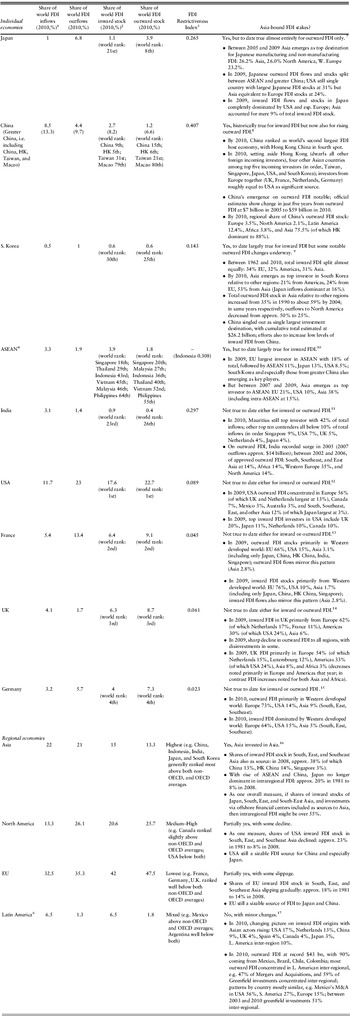
First, the material spread and upgrading of FDI involving Asian countries over time is a useful departure point for understanding the push toward governance structures in investments, because it advantages existing and/or prospective business stakeholders across countries. The term investment used here is taken to mean an emphasis on the direct ‘transfer of funds or materials from one country (home State) … to another country (host State) … to be used in the conduct of an enterprise (investor) in that country in return for a direct or indirect participation in the earnings of the enterprise’ (Amarashinha and Kokott, Reference Amarasinha, Kokott, Muchlinski, Ortino and Schreuer2008: 120). Although it would be ideal to have aggregate statistical illustrations of the direct investment patterns across the region, there are significant problems in the lack, consistency, and/or even accuracy of inward and outward FDI longitudinal data in the region (Wu et al., Reference Wu, Siaw, Sia and Keong2002; Hamanaka, Reference Hamanaka2011: 4; Salidjanova, Reference Salidjanova2011: 2–3). Any kind of aggregate combination and analysis are made more problematic still by differences in government compilation methodologies, government and corporate reporting discrepancies/delays, as well as gaps in time series data. To compensate, Appendix Table A1 sets out the FDI stakes of the principal Asian players of interest in their aggregate and individual realities, as well as their regional and global context.
At the aggregate level, both outside sources as well as regional government reporting suggest the following reality: the Asian region is moving toward higher intra-regional investments. In 2010, UNCTAD reported summarily that FDI recovery was robust, and that industrial upgrading was spreading to more industries and countries in the Asian region.Footnote 3 Boosted by regional economic integration, UNCTAD stated that intra-regional FDI now accounted for about 40% (possibly up to 50% if investments via offshore financial centers are included) of the region's total FDI stock.Footnote 4 The ADB's Asian Regional Integration Center (ARIC) estimates that its 47 members together comprise about 79% of the intra-regional FDI flows from the region.Footnote 5 In this sense, although ups and downs especially for FDI flows are always possible, it is plausible to speak of Asian investment regionalism as a whole.
At the individual country level, there are some sobering realities that should be kept in mind. While the aggregate aspects of the intra-Asian FDI are striking, the actual patterns are lopsided in terms of the number of pivotal players as well as their geographical concentration. First, in terms of players, the overall picture of investment integration in Asia is one where trends are being shaped mostly by two powers to date: Japan (mostly on the outflow side) and now also China (mostly on the inflow side, though changes on the outflow side, largely to Hong Kong, are also rapidly emerging). In comparison, other Asian players, namely South Korea, ASEAN countries, and India, still lag behind in absolute amounts of investment inflows and outflows, whether at the global or regional level. Second, in terms of geography, investment integration also appears to be more a phenomenon involving East and Southeast Asian countries. India's outward investments are geographically divided between the Western and developing world, and, within the latter category, at present are almost equally split between East/Southeast Asia and Africa (Athukorala, Reference Athukorala2009: 135). Any optimistic projections about Asian investment integration also have to contend with the fact that even East Asia is fragmented into national markets with different industrial standards and technical regulations, factors that mitigate against seamless production across the region (Marukawa, Reference Marukawa and Nakamura2009).
While Asian investment integration is not on a seamless upward trend, the motivations of the existing and prospective investors who operate across borders within Asia are pivotal to the construction of an institutional architecture. Here the OECD's FDI Restrictiveness Index, also shown in Appendix Table A1, is instructive. Asian countries are ranked topmost in terms of the world's most restrictive investment regulatory regimes – China, for example, is ranked second, Japan sixth, Indonesia and India fourth and fifth respectively, and South Korea eleventh. Thus the more important evolutionary point is that even existing and potential stakeholders in the regional investment system still continue to confront restrictive investment realties, and can expect to do so in the near future. In short, there are genuine bottlenecks and problems. The concerns of the relevant investment stakeholders can be easily understood at a general level. At base, once public, private, or even hybrid public–private economic interests acquire stakes in cross-regional operations, they need, among other things, to stabilize market access, ensure favorable investment environments, shelter direct and indirect assets and personnel, reduce discriminatory treatment, and generally protect against the arbitrary whims of foreign governments, actors, and jurisdictions.
The diplomatic search and provision for such investment protections through, say, FTAs, BITs, or plurilateral agreements are what brings regional governments into the game. Looking ahead, they calculate that institutionalization can constrain the actions and conduct of public and private interests in different jurisdictions, provide a binding rules-based framework for dealing with trade partners, help support business operations across borders, secure the momentum and speed of regional economic integration, and potentially boost national economic welfare over the long term (Pekkanen, Reference Pekkanen, Curtis, Kokubun and Wang2010: 204). It would be foolish to claim that, as elsewhere, Asian states do not also have a host of diplomatic, strategic, competitive, and reputational interests as they set about designing investment-related institutions in response to such stakeholder concerns (Franck, Reference Franck2007: 341). In this sense, there may well be a political domino logic at work, whether motivated by concerns about being excluded in the worldwide FTA game or the need to improve intra-regional diplomatic relations (Ravenhill, Reference Ravenhill2010b: 199–200).
These are all reasonable explanations. However, the interests of private and public actors do not by themselves explain the particular form of legalization that has come to characterize investment regionalism in the region. To understand that requires looking also at the socialization of the key actors in related international institutions.
Socialized interests
Supplementing rationalist explanations that emphasize the role of public and private material interests for Asian stakeholders is also the fact that these very same actors have also been socialized in the realities of investment governance worldwide. By socialization is meant here, at the ideal end point, the internationalization of new roles or norms, and specifically in this case those roles and norms found in the governance of investments (Checkel, Reference Checkel2005: 803). The focus here is to only briefly sketch the historical processes by which such socialization has occurred and affected more legalistic preferences on the part of Asian actors. To a considerable degree, Asian actors have internalized the harder legalization norms in investment governance worldwide as indicated, at least by one measure, in the increasingly hard and similar legalization with which they have subsequently also chosen to govern investments across and within their borders. To understand the potential sources of Asian socialization requires a brief detour to the global realities.
The WTO Agreement on Trade-Related Investment Measures (TRIMs) is a rudimentary one, the opening article of which makes clear that it extends only to trade in goods; and the preamble as well as contents show a focus on investment measures (investment itself is not defined) that can cause restrictive, distorting, and adverse effects on the flow of trade in terms of exports and imports rather than on the protection of investors or investments within sovereign borders.Footnote 6 In contrast, with respect to trade in services, one of the four modes in the General Agreement on Trade in Services (GATS) identifies the supply of services through ‘commercial presence’ in the territory of another member, which is taken to mean direct investment in services such as branches of financial institutions.Footnote 7
Efforts to advance multilateral rules on investment have been stymied under the auspices of both the Organization of Economic Cooperation and Development (OECD) initially and the WTO subsequently (Amarasinha and Kokott, Reference Amarasinha, Kokott, Muchlinski, Ortino and Schreuer2008). As of 2010, there has been no further progress. In 1994, the OECD began preparations for a Multilateral Agreement on Investment (MAI), a freestanding treaty to provide comprehensive standards for the treatment, protection, and liberalization of investment.Footnote 8 The negotiating group (comprising all OECD members, the European Communities, and a few others) was chaired by the Netherlands, with the United States and Japan as vice-chairmen. From Asia, South Korea went on to participate as an OECD member and Hong Kong China participated as an observer from an early stage.Footnote 9 Although a draft text emerged, the prospects for an actual treaty were scuttled by 1998 due to criticisms by civil society groups, and then disinterest on the part of both OECD governments and dominant business groups. A similar outcome prevailed at the WTO.Footnote 10 In 1996, a Ministerial Declaration focused on trade and investment as part of the so-called Singapore issues quartet. But over the course of negotiations, the developed and developing world clashed on the protections desirable for cross-border investments. By 2004, the WTO General Council adopted a decision that no negotiations or work on the investment issue would take place during the then ongoing Doha Round.
While efforts by government and business interests to advance multilateral rules on investment to date have been a failure, from an evolutionary legal perspective their socialization in these ventures has nevertheless been critical. The governance of investments worldwide continues to take place through a hybrid and overlapping system, comprising national laws and regulations, as well as preferential, plurilateral, or sector-specific agreements, and, increasingly prominent, BITs. Asian countries have also kept pace with these trends. The shift from being mere rule-takers in multilateral venues to also becoming rule-makers at the bilateral and regional levels with similar norms/rules partly also reflects a progression toward the internalization of norms/rules in international investment law by public and private actors in Asia (Pekkanen, Reference Pekkanen2011). The norms include, for example, the evolving ones on fair and equitable treatment, and full protection and security; the rules include, among others, those on expropriation and compensation, and state–state along with the controversial investor–state dispute settlement procedures. As they embedded themselves ever more in the global economy and were socialized in legalistic transnational settings (irrespective of whether it/they failed or succeeded), they began to internalize, utilize, and build upon their accumulated socialization. Their efforts across multiple fronts suggest that they have moved beyond just instrumental role-playing or strategic calculations; instead they have begun to see the legitimizing value of rule making in their own foreign economic interactions and the institutional design of their own region (Pekkanen et al., Reference Pekkanen, Gao and Ahn2009).
There are several plausible sources for their socialization. First, the WTO TRIMS rules, rudimentary as they may be, continue to bind the conduct of all Asian WTO members, and can subject them to the WTO's formal dispute settlement system (Article 8). As of June 2011, the WTO points to 27 cases that have cited the TRIMs Agreement in the request for consultations (irrespective of whether it is the same matter). Roughly half implicate Asian countries as defendants (China, Philippines, Indonesia, and India) in matters related most often to the automobile sector; and only Japan has appeared as a complainant thus far.Footnote 11 Among the most significant TRIMs-related disputes at the WTO include those brought by co-complainant Japan against Indonesia and Canada, which went through full panel procedures, as well as against Brazil which did not.Footnote 12 Whether Asian countries prevail in disputes is less important than their continuing involvement in a rule-based system; this is what deepens their internalization of the rules, norms, and procedures governing cross-border investments.
Second, their efforts to date on negotiating or constructing their own legal and institutional investment system increasingly mirror those found in global and extra-regional settings. Neither the OECD nor the WTO proved able to handle restrictive rules that are of more practical concern to businesses worldwide as appearing, for example, in the draft MAI text and which directly affect operational realities: local employment, local financing ratios, exports, and technology transfers, expropriation and compensation, repatriation of profits, foreign exchange guarantees, investor–state dispute settlement procedures, and so on. But, as in any international rule-making venture, socialization in the system of prior norms/rules clearly affected the design of subsequent ones. This is especially evident in the governance structures (either existing or planned) of the main FDI players in the region. Clarification of these rules was raised by Japan in multilateral fora before the negotiating tide turned away from them altogether; they are now part and parcel of Japan's rule-making ventures on investments via other fora (Pekkanen, Reference Pekkanen2008: 252–267). China, which joined the WTO only in 2001, has tentatively emerged as the lead target of TRIMs-related complaints in the dispute settlement system; as such, even in the limited multilateral scope of investment-related rules in the WTO, China is continuing to be socialized in law and legal processes. As the world's second largest signer of (126) BITs, China has also begun to gravitate toward emerging global norms/rules as reflected more in its newer generation of BITs since 1998, and as even jurisprudentially implied under older ones (Shen, Reference Shen2011: 55–56, 80, 90–91; Smith, Reference Smith2010). In its formal communication with others in the WTO Working Group on the Relationship between Trade and Investment in 2003 (the year its own BIT with Japan had just gone into effect), South Korea helped draw explicit attention to the fact that prior familiarity in negotiating norms and rules would prove to be useful in negotiating multilateral ones.Footnote 13 After roughly a 20-year effort, ASEAN governments have also formally legalized investment flows and stocks more in line with international norms/rules than before.Footnote 14 These patterns are detailed in the next section.
Patterns in the legalization of investment regionalism in Asia
To be sure, old (supposedly non-legalistic) norms die hard and can be grafted onto the new. But at least for investment governance involving Asian actors, there is already an uneven but nevertheless remarkable convergence with much harder global and extra-regional norms/rules that answers to the FDI stakes and international socialization themes above. This section focuses on the legal investment cooperation that has quietly changed the prospects for the institutional landscape of Asian regionalism. Legalized cooperation in investment issues has not made headline news, but for well over a decade it has been consistently high on the agenda of Asian leaders and, importantly, also business interests anchored across the region. This has been evident not just in the formal moves by ASEAN but now also by the dominant economic powers in the region, namely China, Japan, and South Korea. Japan was a critical and possibly the first seeker of such cooperation within the region, given the expanding and dominant role of its multinationals in the aftermath of the Yen appreciation following the Plaza Accord of 1985 (Pekkanen, Reference Pekkanen2008: 225–272; Hatch and Yamamura Reference Hatch and Yamamura1996: 20, 182). But in terms of regional investment cooperation it is now unequivocally one player among three, the other two being China and South Korea. Their activities in one of the most remarkable regions of the world have collectively taken Asian countries from being mere rule-takers to becoming significant rule-makers in the regional and global economy.
Thus far, in keeping with global trends, the endeavors of Asian states have resulted in investment chapters in the rapidly proliferating FTAs and other broader economic framework agreements, as well as BITs. But there are also new and region-wide initiatives by both the middle and dominant economies in the region that deserve close attention; there is the ASEAN Comprehensive Investment Treaty (ACIA) which has gone into force; and more consequential from the perspective of the region's future is a little-known Trilateral Investment Agreement among China, Japan, and South Korea (CJK) that has been in the making for over a decade. These are detailed next, leaving the issue of their legal effectiveness and policy implications to the final section.
Investment chapters in FTAs and BITs
As described below, much of the progress in legal protections for investments has come through investment-related chapters in FTAs and BITs.
In terms of PTAs, the worldwide move toward negotiating free trade and other economic partnership agreements is now well known. Approximately 474 Regional Trade Agreements were notified to the WTO in July 2010, and 283 of these were in force.Footnote 15 In terms of numbers, the ADB estimates that about 179 bilateral FTAs involving Asian countries were at play in 2010, involving their direct agreements with either Asian or non-Asian countries.Footnote 16 Also according to the ADB, as of 2010, the most active Asian countries in terms of proposing, negotiating, or concluding FTAs are Singapore (35), India (33), South Korea (27), Pakistan (26), China (25), Thailand (24), and Japan (22). More to the point, for our purposes, is the fact that, unlike in the past and in line with global standards, most of the newer agreements being signed by these countries also have chapters that specify the principles and scope of investments, as well as the obligations of governments and investors with respect to each other in the case of related disputes (Kumar, Reference Kumar2007).
One example of such innovations is the ASEAN–China Investment Agreement, signed in August 2009, which is one of three agreements signed under the 2002 ASEAN–China Framework Agreement on Comprehensive Economic Cooperation.Footnote 17 The Japan–Vietnam Economic Partnership Agreement, also an example, incorporates the provisions of the 2003 BIT between the two countries.Footnote 18 In line with standard investment agreements, these are also designed to ensure non-discriminatory as well as fair and equitable protection of investment. Although there continue to be controversies about convergence between the provisions of such chapters and actual BITs, investment-related chapters constitute a trend that is not likely to disappear, whether in Asia or elsewhere. In part, this is because there appear to be at least no legal difficulty (though there are political and policy considerations) in incorporating an investment chapter into an FTA or even broader economic framework agreement (Lo, Reference Lo2008).Footnote 19 For the most part, one sample survey suggests that other Asia-related FTAs have the same standard investment protections as BITs, such as overall treatment standards, expropriation clauses, transfer of capital provisions, compensation requirements, and so on (Sauve, Reference Sauve2007: 27–64, esp. 41, Table 3, Table 7, Table 8).
The more remarkable phenomenon at present in the governance of investments is actually the BITs themselves (Elkins et al., Reference Elkins, Guzman and Simmons2006; Tobin and Busch, Reference Tobin and Busch2010). Historically, the first BIT ever signed was between an Asian country, Pakistan, and Germany; Germany is now the world's top signatory of BITs (Newcombe and Paradell, Reference Newcombe and Paradell2009: 42). Starting in the late 1990s, there has been a rapid proliferation of BITs worldwide though they are now being signed at a slower rate at the close of the 2000s. At the end of 2009, UNCTAD reported that there were an estimated total 2,750 BITs already signed.Footnote 20 Among the top ten BIT signatories worldwide at the start of 2009, China held the second spot, South Korea held tenth place.Footnote 21 Additionally, UNCTAD pointed out that at the end of 2008, Asia (along with Oceania) accounted for 41% of all BITs signed worldwide. While their much greater proliferation relative to their coming into effect worldwide might be a problem, one indicator suggests that that is less of a concern in the Asian region. In 2004, close to 70% of intra-regional BITs in Asia and Oceania were actually in force; in comparison to other regions, Asia altogether had among the highest ratios of BITs in force.Footnote 22 As elsewhere these BITs continue to have typical provisions – such as the scope and definition of investments, pre- and post-establishment provisions, national and MFN treatment, fair and equitable treatment, free repatriation of monies, guarantees to offset expropriations, and now also political strife, possibly transparency, and, most well-known, a whole set of dispute settlement mechanisms for both state–state and investor–state disputes.
ASEAN Comprehensive Investment Agreement (ACIA)
There are at least two plurilateral investment treaties that deserve attention with respect to subsets of Asian countries. The first is a non-regional and sector-specific one in which a limited number of Asian countries are involved, namely the 1994 Energy Charter Treaty (ECT) that entered into force in April 1998.Footnote 23 This treaty, as the name suggests, is designed to promote cooperation and security in the energy sector.Footnote 24 As of the end of 2009, the ECT remains largely dominated by European countries; the United States is not a formal member; and only Japan, Mongolia, and the Central Asian states have ratified the treaty. South Korea, Indonesia, Pakistan, and China are the only other Asian governments with observer status in the Energy Charter Conference; and the Association for Southeast Asian Nations (ASEAN) is the only other Asia-centered organization with observer status in the same. While certainly mindful of concerns such as sovereignty over energy resources as well as their environmental impacts, the provisions and history of the ECT leave little doubt that it is designed to promote a stable milieu for investors and their investments.Footnote 25 The significance of the narrow base of the ECT is less in rule-making or dispute settlement for Asian countries.Footnote 26 Instead, in line with earlier themes, it lies more in the way it has potentially socialized these few Asian countries in legalized investment governance related particularly to energy resources that are of vital economic and security interest to all players across Asia. These include, for example, the treatment of investors that calls for fair and equitable treatment, most constant protection and security, and no impairment by unreasonable and discriminatory measures (Article 10.1); in addition, there are rules detailing limits on direct and indirect expropriation (Article 13), and investor–state arbitration (Slater, Reference Slater2009: 6–18).
The second, more consequential development from the perspective of Asian countries' involvement, is related to the ASEAN countries. More specifically, this means the work by the ASEAN Investment (AIA) Council, which identifies the free flow of investments as one of the five core elements of an ASEAN single market.Footnote 27 ASEAN cooperation on investment has been in the making for over 20 years, and is designed to protect and promote FDI inflows, which increased from around US$23 billion in 1998 to around $60 billion in 2009. Over time, the cooperation has been formalized in ever-more legally formal agreements that replicate the language of formal norms/rules in precisely the global and extra-regional frameworks in which these countries have been socialized. The 1987 ASEAN Agreement for the Promotion and Protection of Investments (APPI, also known as the ASEAN Investment Guarantee Agreement, IGA) encouraged a broader definition of investment (Article 1), called for non-discrimination as well as fair and equitable treatment on an MFN basis (Article IV), dealt with issues of expropriations and compensation (Article VI), encouraged repatriation of capital and earnings (Article VII), provided for diplomatic settlement of disputes (Article IX), and, failing that, also for international Arbitration through a range of venues for investor–state disputes.Footnote 28
The 1998 Framework Agreement on the ASEAN Investment Area (AIA) carried on this work, showing how MFN could be extended to ASEAN investors at both the admission and establishment stages, while excluding sensitive industries and matters on a temporary basis (Article 8). Reviews of these agreements began in 2007, and in February 2009 the new and improved ASEAN Comprehensive Investment Agreement (ACIA) was signed. As its guiding principles make clear, it is focused on both the protection and liberalization of investments for all investors and their investments in ASEAN (Article 2). It is also concerned with upholding national treatment and MFN treatment (Articles 5–6), albeit with some allowable reservations (Article 9) and distinctions between juridical persons from non-member states with little substantive business operations in member states (Article 19). In line with increasingly accepted provisions worldwide, investments in the ACIA too, for example, are to be treated under fair and equitable clauses, as well as accorded full protection and security (Article 11). In contrast to the past, the investor–state dispute settlement provisions are far clearer and precise from conditions regarding the submission of claims to the venue for arbitration and enforcement of awards (Section B).
The Trilateral Investment Agreement among China, Japan, and South Korea
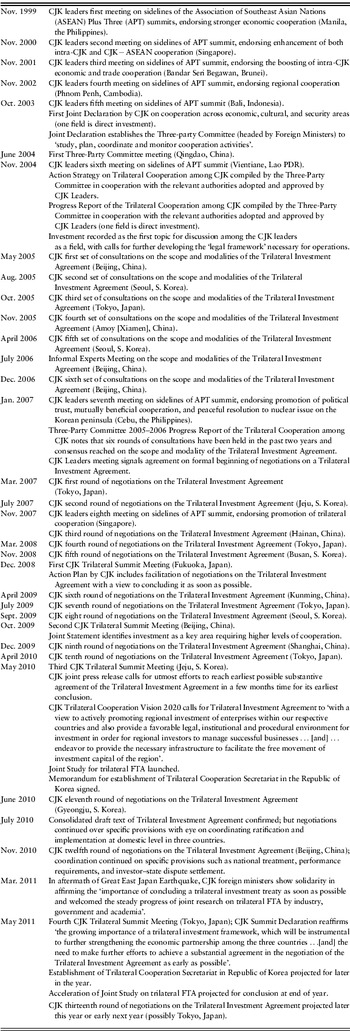
Despite the friction, that often makes headline news around the world, the leaders of China, Japan, and South Korea (CJK, alphabetically) have been quietly and gradually making progress regarding the governance of regional investments. Little is actually known about CJK efforts to build a regional community, which is developing from a long-standing process of dialogue between their political leaders (Iida, Reference Iida2010; Sato, Reference Sato and Söderberg2011). As Appendix Table A2 shows, whatever the tepid origins of the political maneuvers that brought the leaders together in the late 1990s, the fact is that over time the nature of the soft cooperative rhetoric began change. After about a decade, the efforts of CJK moved from the sidelines of other summits, principally those held under the auspices of the APT processes, to the spotlight in regional institutional efforts. In December 2008, for the first time, they emerged together on the world stage in the form of the CJK Trilateral Summit meetings. From their inception these meetings were notable for the ways in which both economic and security concerns could be subsumed under the same institutional framework.
Particularly notable in this evolving history was the increasingly hard legalization concerning the investment field. Given the economic issues at stake, particularly for Japan and now also for China, in the FDI flows and stocks in Asia, as discussed earlier, it is not an exaggeration to say that concerns about securing investments have been critical to the CJK discourse virtually from the start. Unlike other fields, such as finance, which has also been high on the political agenda, the CJK focus on investment crystallized into the formation of a legal investment pact very early on. Indeed, as Appendix Table A2 again shows, by the time the first CJK Trilateral Summit actually took place, not only had negotiators from the three countries already met in the form of six consultation rounds to hammer out the provisions, but they had also concluded five solid rounds of negotiations – all spanning a period of about three years. These concerted efforts, of consultation and negotiation, prior to high-profile moves appear to have survived some of the worst political relations between especially China and Japan starting in 2005, and even when the APT processes themselves ground to a halt.
When the three countries were able to get together for their seventh APT-based meeting in January 2007 after the hiatus, progress on the Trilateral Investment Agreement had top billing. The meeting gave the green light for the start of the formal negotiations on the pact, as consensus had already been reached on the scope and modalities of the agreement through extensive consultations well beforehand. Within two years of the launch of the historic CJK Trilateral Summit in 2008, the full draft of the Trilateral Investment Agreement was actually in hand. By all accounts, one of the main reasons for this concrete legal approach and focus, as analyzed above, was the tremendous and consistent push by private investors. These are stakeholders who are concerned with securing their investments at both the entry and establishment stages in the volatile Asian region.Footnote 29 Given their weight in shaping regional investment realities thus far, much of this push has come from the Japanese corporate sector and, if regional FDI trends stay the course, will also advantage the South Korean business world. China too cannot be a disinterested player, whether for the purposes of its private investors or perhaps even for its state–investment vehicles. As a result of its reported ‘go global’ policy, China's FDI outflows have already doubled from $26.5 billion in 2007 to $52.5 billion in 2008, and there are no signs that they will be letting up anytime soon.Footnote 30 If anything, given the emerging stakes, China may well be poised to take up the legal banner on behalf of its investments abroad far more than other Asian countries.
In keeping with their earlier socialization in other BITs and investment-related chapters, the CJK negotiators have worked hard to ensure that the consolidated text of the Trilateral Investment Agreement also contains the key standards of investment treatment that are of interest to private stakeholders in Asia as in the rest of the world. These include: post-establishment national treatment, most-favored-nation treatment at both the pre- and post-establishment phases, prohibition on local contents or performance requirements, fair and equitable treatment, transparency, free remittance, respect for contracts, protection of intellectual property, investor–state arbitration mechanisms, and so on.Footnote 31 In November 2010, from Japan's perspective it appeared that China had raised some concerns on the consolidated text, specifically with respect to national treatment provisions, performance requirements, and investor–state dispute settlement procedures. All sides are aware of the importance of this agreement for their own economic interests. This is especially true for China, which has emerged as a leading beneficiary of FDI flows to date, and is emerging as a rapidly rising player on the outward FDI side as well. Given the centrality of this narrow agreement to any kind of future more expansive CJK economic ventures, particularly an East Asian FTA, these concerns are scheduled to be addressed in the next round of negotiations. Indeed, the ongoing assumption is that if CJK efforts fail on this narrower negotiating turf, then achieving a more expansive and meaningful East Asia FTA anytime in the foreseeable future is unrealistic.Footnote 32
Assessing implications for law and policy
There is little question that Asian states are involved in legalizing investment regionalism as never before, meaning evermore adherence to the precision, obligation, and delegation based on formal rules. The particular shape of this slowly accumulating change is best seen as coming out of combined strands of history: long-standing concerns of public and private actors with the protection of material FDI stakes, and their continuing socialization in investment rule-making ventures worldwide. But of what consequence is this shift across Asia, whether in terms of law or policy? Although the manifestations of Asian investment regionalism as detailed above are either relatively new or emerging, the more fundamental point is that Asian actors are setting the trends. Thus it is important to gauge their significance as potential turning points for law and policy more generally in Asia through a set of questions that often rise to the fore.
Law in and across Asia
The legalization of investments across Asia is a process that is being drawn out over time and across experiences; this disjointed course, among other things, makes it difficult to analyze and predict. There are other concerns. Even allowing for the above analysis, first and foremost are we looking at anything more than just paper legalization? After all, there are serious concerns about the uneven quality of the emerging legalization, such as definitional and treatment inconsistencies, and differing levels of investment protections and liberalization. Nevertheless, the answer is potentially yes, because, as noted far and wide, one of the distinguishing characteristics of investment governance is its creation of investor rights vis-à-vis host economies. This affects the fortunes of private stakeholders involved in inward and outward FDI, which may be more critical in the long run for embedding the language of (investor) rights in the economy and for thus making legalization more concrete (Shen, Reference Shen2011: 90). This view must of course be tempered by how the increasingly controversial balance of public and private rights works out in the governance of investment realities worldwide. This is especially important in a region where a dominant explanation in comparative law has focused on ‘state-legalism’ (Jayasuriya, Reference Jayasuriya1999: 1–27). Still the presence of private investors and the importance of credibly attracting their investments for development purposes make it difficult to see the legalization turned back anytime soon.
But, if legalization is progressing, then second are Asian actors likely to become more litigious under the expanding framework of investment rules? It is reasonable to ask whether or not all this rule making is having an impact on the activities of stakeholders, such as businesses and investors. In 2009, of 281 claims under ISCSID Rules or ISCSID Additional Facility Rules, Asian states accounted for only about 8% (if all countries are included) to 10% (if Argentina and Mexico are excluded) (Nottage and Weeramantry, Reference Nottage and Weeramantry2009: 1–2, Appendix B).Footnote 33 This comparative gap or lag when compared with other countries may shrink as, among other things, FDI stakes and socialization both increase in investment governance worldwide. Although at low levels, the evidence to date suggests that such stakeholders are slowly being socialized into and reinforcing a rule-based investment regime involving Asian actors.
Some reported case developments here are instructive, and from an evolutionary legal perspective they are not so much about whether participants are winning or losing, but rather about whether they are using rules to defend their turf (Alexandrov, Moroney, and Porges, Reference Alexandrov, Moroney and Porges2009): In 2004, a Singapore investor, Cemex Asia Holdings, used the 1987 ASEAN Agreement to bring a $400 million suit for damages against the Indonesian government for blocking its investments in an Indonesian firm, and ended up settling the case. In the same year, a Malaysian company, MTD Equity, used the Chile–Malaysia BIT to prevail in a case against the Chilean government. In 2007, a Chinese investor, Tza Yap Shum, used the China–Peru BIT to satisfactorily allege $20 million worth of expropriation damages, making it the first time a known claim was brought under a Chinese BIT. Nor should the universe of such cases be limited only to agreements signed by the home countries of Asian investors spread out across the globe. In 2001, Saluka, the Dutch-incorporated subsidiary of a Japanese investor (Nomura Group), prevailed partially against the Czech government under a Netherlands–Czech Republic BIT; in so doing it showed that, by structuring their corporate organizations strategically, private investors with grievances are not just limited to the known universe of their home country BITs whether in or out of Asia.Footnote 34
So, finally, does all this then mean that Asia is heading for the rule of law? It is tempting to conclude so, and others have pointed out the mechanisms more generally in the investment field (Franck, Reference Franck2007: 365–372). The region has certainly come a long way from one characterized as being explicitly averse to or favoring low legalization particularly in this field (Kahler, Reference Kahler2000). There is even a possibility that investor–state disputes may become more aggressively legal in the East Asian context (Nakagawa, Reference Nakagawa2007: 840–841). With the pathways of economic interests and socialization working even disjointedly across regional borders, this can help kick off both positive and negative feedback effects that then push legal and institutional evolution forward.
It is, however, helpful to remember that the progression of any system of law is not straightforward. Moreover, the investment field is a narrow base on which to make such grandiose pronouncements about the evolution of law in economic regionalism, much less trans-Asian relations as a whole. If by rule of law is meant loosely that Asian states and especially private actors across societies in Asia continue to be socialized in the discursive making and workings of rule-based systems, then that reality is unfolding. By extension, it may also affect the evolution of legal and institutional processes in other areas and thus have an impact on law in Asian societies more broadly. In short, if it more or less stays the course, the rule of investment law being put in motion by Asian actors will help anchor the language of law in and across Asian societies.
Policy turns by and for Asia
Whether for the purpose of facilitating litigation, transactions, or even diplomacy in economic settings, however, the rules themselves have to be set to begin with. Asian states, from the middle to the dominant powers, have certainly shown themselves willing to be bound by legalization that can strike at the very heart of their sovereign economic and regulatory powers. But, as so very aptly put by a leading legal scholar, there can be ‘no understanding of the law without some sort of prior understanding of the policy issues that it seeks to deal with’ – an issue of particular importance in the historical controversies related to the international law of foreign investments (Muchlinkski, Reference Muchlinkski, Muchlinski, Ortino and Schreuer2008: 4). In ending, then, there are three policy issues that must be appreciated in the historical and political contexts in which Asian investment regionalism exists.
First, from a political standpoint, what is the real bottleneck in the region that this investment regionalism is meant to overcome? Here it is important to begin by appreciating that not all investment rule-making ventures are equal. Certainly none is as diplomatically critical to the region's institutional future as the already consolidated text of the CJK Trilateral Investment Agreement that remains to be signed. China, Japan, and South Korea already comprise an estimated 70% of the regional economy and 20% of the global economy; unsurprisingly, calls have long been heard for greater economic trilateralism between them, but progress has been limited to date.Footnote 35 The CJK Trilateral Investment Agreement has the backing of the top leadership in China, Japan, and South Korea; if the agreement is signed in the very near future, it will represent a historic turning point in cooperative ventures between these dominant economies.
As this leadership knows, there are political costs to this policy venture. If effectuated, it helps dissipate the importance attached to Japan's historical aggression, the ultimate diplomatic card that can also serve domestic political ends for both the Chinese and South Korean leadership. Moreover, as it will also do in China and South Korea, it exposes at least formal Japanese policies and laws that have kept Japan from becoming even a modestly respectable investment location compared to other economic powers of its rank. Thus what CJK governments do and how they do it matters not just for the region's economic future as a whole, but also for its institutional standing in the world. In the long run, if it comes into effect, this particular CJK Agreement will be remembered less for its formal legal niceties in promulgating some kind of a rule of investment law; instead, it will be noted far more for its symbolic value in uplifting processes of Asian regionalism that have hitherto been stuck in a competitive bilateral mode (Ravenhill, Reference Ravenhill2010b: 201–202). If it fails to materialize for whatever reasons of rivalry, it will reverberate disappointingly as a limited historical test of the idea of Asian regionalism at this stage.
Second, what do these trends mean for Asia's engagement with existing global multilateral institutions? The CJK Agreement in particular, again if effectuated, may well over time reverberate outwards to affect these countries' individual and collective relations with other powers in the world, and it will also affect the centrality of the WTO to their economic well-being. For WTO analysts as well as non-Asia specialists, it may be difficult to appreciate just how far beyond the WTO multilateral trading system Asian countries have moved in terms of designing institutions. Even a cursory examination of the institutional engineering underway in the region reveals that the GATT/WTO system is no longer considered central by the dominant and emerging economies within it, whether for purposes of trade liberalization or especially investment. Indeed, if the problem before was the paucity of regional institutions, the opposite is now more pressingly true (Haggard, Reference Haggard2009). Debates focus instead on whether the economic way forward for the region is based on ASEAN+3 (China, Japan, South Korea) or ASEAN+6 (China, Japan, South Korea, Australia, New Zealand, and India) schemes, or even more ambitious ones such as the Trans-Pacific Partnership (TPP) which go so far as to involve extra-regional players such as the United States, Chile, and Peru (Kawai and Wignaraja, Reference Kawai and Wignaraja2007).Footnote 36 Put politely, even the United States is going Asian.
The impact of such machinations on the future relevance of the WTO system is likely to be even more negative for the so-called ‘WTO-plus’ issues like investment as covered here. Since the WTO rules on point are rudimentary, and since investment was identified among the Singapore issues but later dropped from negotiations in the Doha Round altogether, the WTO has been cast aside on this rule-making front. Altogether, absent some leadership miracle or meaningful policy reversals, it is difficult to foresee a return to the WTO fold on the part of Asian countries anytime soon. But it is already foreseeable that there will be legal, institutional, and economic transactions costs for public and private actors even just in the investment rule making that is proliferating heedlessly around the world. As governments, including now Asian ones, construct ever-more preferential rules and regulations, there will undoubtedly be arguments about protectionist costs in the investment area just as in the trade one (Bhagwati, Reference Bhagwati2008). At some point these rules may well have to come together, and a multilateral institution like the WTO may be the place to be. If so, at that point, in contrast to the past, Asian countries may be positioned to influence rule-making in international institutions founded and dominated by Western countries thus far.
Finally, what does all this mean for the future of Asian economic regionalism more broadly? The institutional moves by the middle or smaller powers in the region are important, and are likely to be amplified if the CJK Agreement is effectuated. Only something on that scale will help redefine the expectations, realities, and progress of designing economic regionalism in the Asian region as a whole, particularly by other individual or institutional players such as ASEAN. Nobody is suggesting that Asia will turn the institutional course of its economic integration toward the European or even the NAFTA way anytime soon. But even the fact that those possibilities are now being raised says something. Viewed through the lens of Asian countries that appear to have survived the earlier and present financial crises however, the legal and economic narratives are perhaps not the only important ones that deserve attention. The processes in play are also intensely political.
This means that there is a certain geographical regional logic in Europe and North America as there is now in Asia: by securing and locking in their economic interests within the region, and making it clear for all to see, Asian states get to control the design of their regional economic institutionalization, decide who will be in or out of regional schemes (Pekkanen et al., Reference Pekkanen, Solis and Katada2007). There is little question that economic regionalism in Asia designed by and for CJK confers upon the region-wide processes a certain kind of genuine legitimacy that cannot be had through their continuing battles for their individual, bilateral, or even trilateral place in the world economy. No matter what their weight, a Japan or China acting alone cannot achieve this within the region. The long and winding history of cooperation by CJK in constructing investment regionalism offers a pathway to a viable economic future for Asia as a whole. That is where Asia is today, and where it goes turns upon what the three choose to do together.
Appendix
Comparative FDI realities of key Asian actors

Notes: − Indicates data/information unavailable.
1 Shares (rounded) for FDI inflows and outflows (based on magnitude of 2009 flows) are from UNCTAD (2010a: 167–171 (Annex Table 1)).
2 Shares (rounded) for FDI home and foreign FDI stocks (based on magnitude of 2009 flows) are from UNCTAD (2010a: 167–171 (Annex Table 2)). Rankings for FDI stocks at home and abroad is from the US Central Intelligence Agency (CIA), The World Factbook.
3 Rankings for the FDI Restrictiveness Index to gauge a country's restrictiveness of FDI rules (with 1=closed; and 0=Open) is from the Organization for Economic Cooperation and Development (OECD), and is based on four types of statutory restrictions on FDI in 48 countries (i.e. foreign equity limitations, screening or approval mechanisms, restrictions on the employment of foreigners as key personnel, operational restrictions (branching, capital repatriation, land ownership), available online at www.oecd.org (accessed 12 June 2011). Qualitative estimations for regional economies based on illustration of 2010 FDI Restrictiveness Index of individual economies at said official website.
4 Association of South East Asian Nations (ASEAN) Members include Brunei Darussalam, Cambodia, Indonesia, Lao PDR, Malaysia, Myanmar, Philippines, Singapore, Thailand, and Vietnam. Calculations and rankings reflect only those ASEAN countries that actually appear in the sources listed above. UNCTAD includes Timor-Leste in its Southeast Asia category.
5 Using UNCTAD's categorization refers to South, East, and Southeast Asia (which also includes Oceania) in total, as well as Japan which is classified under developed economies but is added here as an East Asian country.
6 Using UNCTAD's categorization refers to South and Central America only and excludes Caribbean countries.
7 For information related to Japan in this section, see the historical data on FDI flow and stock from Japan External Trade Organization (JETRO), ‘Japanese Trade and Investment Statistics’; and also Hamanaka (Reference Hamanaka2011: 5–6).
8 For information related to China in this section, see UNCTAD (2010a: 4 (Figure I.4), 6 (Figure I.5)); Salidjanova (Reference Salidjanova2011: 1–5); Zhao (Reference Zhao2011: 12–14 (esp. Table 1)); Ministry of Commerce (MOFCOM) (2011a, 2011b, 2011c).
9 For information related to South Korea in this section, see Ministry of Foreign Affairs and Trade (MOFAT) ‘Countries and Regions’ with focus on China, Japan, ASEAN, and the United States; Invest Korea M&A (2010); Kim and Mah (Reference Kim and Mah2006: 888–889 (Figure 3)); and Ministry of Knowledge Economy (MKE) (2010).
10 For information related to ASEAN in this section, see ASEAN (2010).
11 For information related to India in this section see Ministry of Commerce and Industry (2011); UNCTAD (2010c); Athukorala (Reference Athukorala2009: esp. 130–135); and generally Murthy (Reference Murthy2011).
12 For information related to the USA in this section, see data on inward and outward FDI by the US Bureau of Economic Analysis (BEA), ‘International economic Accounts: International Investment Position’, and Ibarra-Caton (Reference Ibarra-Caton2010: 21–22 (Chart 2), 26 (Chart 4)).
13 For information related to France in this section see Banque de France (2009: 35, 73–74 (STAT_2.3, STAT_2.4), 86–86 (STAT_4.5, STAT_4.6)).
14 For information related to the UK in this section, see Office for National Statistics (2010: 1–10 (Table 2, 5)).
15 For information related to Germany in this section, see Deutsche Bundesbank (2006: 45–46, 2011a: 14–16, 28–30, 2011b); and Germany Trade and Invest, Investment Agency of the Federal Republic of Germany, ‘FDI Data’.
16 Unless otherwise indicated, for information related to intra-regional FDI trends for all regions in this section, see UNCTAD (2010a: 39–42 (esp. Table II.6)). UNCTAD urges its data should be used with caution as it covers only a handful and uneven number of countries across the years. For that reason, assessments of intra-regional FDI statistics are combined with earlier information in the table to give a more balanced view of the Asia-bound investment trends. Another supplement is from Hattari and Rajan (Reference Hattari and Rajan2008: 1–4), who examine averaged bilateral FDI inflows to Asia at roughly five-year periods between 1990 and 2004 (Figure 1). They find that sources of FDI inflows to Asia between 2000 and 2004 averaged as follows, putting them roughly in line with the snapshot results here: USA 8.9%, EU-5 (France, Germany, Italy, Netherlands, UK) 12.1%, Developing Asia (NIEs, ASEAN-4, China, India, and other Asia) 31.6%, and Japan 16.9%. Although they caution that due allowances should be made for round-tripping between China and Hong Kong China which significantly inflates the amount of FDI from China, their findings suggest also that if Developing Asia and Japan are combined, they average roughly 50% of the sources of FDI inflows to Asia during that time.
17 For information on the Latin American region, see UN Economic Commission for Latin America and the Caribbean (ECLAC) (2010: 54 (I.11), 62–74).
Key events in the construction of the Trilateral Investment Agreement

Source: Timeline constructed based on interviews with officials in the Ministry of Economy, Trade and Industry (METI), Tokyo, 15 July 2010 and 6 September 2010; and also Ministry of Foreign Affairs (MOFA), Tokyo, Japan, 6 September 2010, 23 May 2011, and 25 May 2011. Additional details on CJK cooperation is from MOFA (2011) and Xinhua (2010, 2011).