Introduction
Many Western countries have adopted a widely supported policy of ‘ageing in place’ (Lui et al. Reference Lui, Everingham, Cuthill and Bartlett2009; Means Reference Means2007; Sixsmith and Sixsmith Reference Sixsmith and Sixsmith2008). Although driven predominantly by financial imperatives to limit health and social care costs, older people also prefer to age in place (Gitlin Reference Gitlin2003; Heywood, Oldman and Means Reference Heywood, Oldman and Means2002). Research supports the importance of the residential environment, showing that neighbourhood characteristics significantly influence the health (Day Reference Day2007; Muramatsu, Yin and Hedeker Reference Muramatsu, Yin and Hedeker2010; Young, Russell and Powers Reference Young, Russell and Powers2004) and wellbeing (Cramm, van Dijk and Nieboer Reference Cramm, van Dijk and Nieboer2012) of older people, who spend large proportions of their lives in their neighbourhoods (Phillips et al. Reference Phillips, Siu, Yeh, Cheng, Andrews and Phillips2005). Moreover, mobility limitations (Shaw et al. Reference Shaw, Krause, Liang and Bennett2007) and smaller social networks (McPherson, Smith-Loving and Brashears Reference McPherson, Smith-Loving and Brashears2006; Oh and Kim Reference Oh and Kim2009) increase their dependence on the neighbourhood. Thus, neighbourhood characteristics are expected to affect older people's ability to continue living independently (Cagney and Cornwell Reference Cagney and Cornwell2010; Peace, Holland and Kellaher Reference Peace, Holland and Kellaher2006; Wiles et al. Reference Wiles, Leibing, Guberman, Reeve and Allen2011). The need for supportive neighbourhoods further increases with the growing number of community-dwelling older people (Sheets and Liebig Reference Sheets and Liebig2005).
Theoretical framework
In 2007, the World Health Organization (WHO) published a Global Age-friendly Cities guide. Based on 158 focus groups with 1,485 older people, care-givers and service providers in 33 cities in developed and developing countries, this guide identified important aspects in eight domains: outdoor spaces and buildings, transportation, housing, social participation, respect and social approval, civic participation, communication and information, and community support and health services. Although the framework was developed to encourage cities to promote ‘active ageing’ (i.e. ‘to optimize opportunities for health, participation, and security in order to enhance quality of life as people age’) (WHO 2007: 1), we propose that these aspects are also prerequisites for ageing in place. Therefore, and because of its wide scope and extensive design, we used this model to define neighbourhood characteristics enabling older people to age in place.
Outdoor spaces and buildings
Much research on the physical environment has examined physical activity levels and health issues among older people (Li et al. Reference Li, Fisher, Brownson and Bosworth2005; van Lenthe, Brug and Mackenbach Reference van Lenthe, Brug and Mackenbach2005; Wilcox et al. Reference Wilcox, Bopp, Oberrecht, Kammermann and McElmurray2003), identifying important attributes such as sufficient green spaces (Li et al. Reference Li, Fisher, Brownson and Bosworth2005; Sugiyama and Ward Thompson Reference Sugiyama and Ward Thompson2008), accessible buildings (WHO 2007), and age-friendly streets and crossings (Burton and Mitchell Reference Burton and Mitchell2006; Wennberg, Ståhl and Hydén Reference Wennberg, Ståhl and Hydén2009). Furthermore, older people have consistently stressed the importance of neighbourhood security in outdoor spaces (De Donder et al. Reference De Donder, Buffel, Verté, De Witte and Katsas2009; van Lenthe, Brug and Mackenbach Reference van Lenthe, Brug and Mackenbach2005; Wilcox et al. Reference Wilcox, Bopp, Oberrecht, Kammermann and McElmurray2003). Insecurity impinges on older people's sense of control and ability to walk around in neighbourhoods, especially at night (Gilroy Reference Gilroy2007). Recent research demonstrates that physical features such as road safety and distance to services contribute to feelings of security (De Donder et al. Reference De Donder, Buffel, Dury, De Witte and Verté2013).
Transportation
The availability of convenient transportation is important for ageing in place, profoundly impacting older people's independence (Coughlin Reference Coughlin2001; Kostyniuk and Shope Reference Kostyniuk and Shope2003) and ability to retain contact with the community (Cvitkovich and Wister Reference Cvitkovich and Wister2001; Feldman and Oberlink Reference Feldman and Oberlink2003). Access to (private and public) transport is associated with higher quality of life (Gilhooly et al. Reference Gilhooly, Hamilton, O'Neil, Gow, Webster and Pike2003). Older people value driving or being driven by car, which avoids barriers associated with public transport (e.g. security issues, vehicle unsuitability) (Coughlin Reference Coughlin2001; Fiedler Reference Fiedler2007; Gilhooly et al. Reference Gilhooly, Hamilton, O'Neil, Gow, Webster and Pike2003; Kostyniuk and Shope Reference Kostyniuk and Shope2003).
Housing
The home has special significance for older people, who spend approximately 80 per cent of daytime hours there (Baltes et al. Reference Baltes, Maas, Wilms, Borchelt, Baltes and Mayer1999) and identify it with comfort and familiarity (Wahl and Gitlin Reference Wahl, Gitlin and Birren2007; Wiles et al. Reference Wiles, Allen, Palmer, Hayman, Keeling and Kerse2009). To avoid institutionalisation and ensure continuing independence in daily activities, housing should accommodate older people's functional needs; new housing must adhere to high access standards (Brewerton and Darton Reference Brewerton and Darton1997) and older housing must be adapted (Means Reference Means2007). Home modifications (e.g. stair lifts, ramps, automatic door openers) enable older people to continue their routines, accommodating their needs for accessibility, safety and comfort (Petersson et al. 2008; Tanner, Tilse and de Jonge Reference Tanner, Tilse and de Jonge2008). Moreover, the affordability of age-friendly housing is clearly crucial for ageing in place (Libson Reference Libson2007).
Social participation
In the context of active ageing, the promotion of older people's social participation has received much attention. Social participation mitigates loneliness (Victor et al. Reference Victor, Scambler, Bowling and Bondt2005) and benefits older people's health (Avlund et al. Reference Avlund, Lund, Holstein, Due, Sakari and Heikkinen2004; Glass et al. Reference Glass, Mendes de Leon, Bassuk and Berkman2006) and quality of life (Bowling et al. Reference Bowling, Banister, Sutton, Evans and Windsor2002; Gabriel and Bowling Reference Gabriel and Bowling2004). We thus expect social participation to increase older people's ability to age in place, which seems to rely on the affordability and accessibility of social activities and the presence of social interaction sites (Baum and Palmer Reference Baum and Palmer2002; Bowling and Stafford Reference Bowling and Stafford2007; WHO 2007).
Respect and social approval
With advancing age, the neighbourhood may become an important source of social approval and identity (Burns, Lavoie and Rose Reference Burns, Lavoie and Rose2012). Older people value good social bonds with neighbours (Gabriel and Bowling Reference Gabriel and Bowling2004; Gardner Reference Gardner2011; van Dijk, Cramm and Nieboer Reference van Dijk, Cramm and Nieboer2013), which contribute to neighbourhood satisfaction (Scharf et al. Reference Scharf, Phillipson, Smith and Kingston2002). Due to their familiarity and accessibility, neighbours may provide critical support, enabling older people to age in place (Gardner Reference Gardner2011). Moreover, ethnic and age homogeneity in neighbourhoods contribute to social inclusion, although some studies found that older people prefer age heterogeneity (Gabriel and Bowling Reference Gabriel and Bowling2004).
Civic participation
Engagement in civic activities is considered an essential element of ageing in place, enabling older people to maintain social contacts and continue involvement in neighbourhood events and politics (Burr, Caro and Moorhead Reference Burr, Caro and Moorhead2002; van der Meer Reference van der Meer2008). Although civic engagement encompasses diverse activities (e.g. voting, attending community meetings, involvement in public affairs), most research on older people has focused on volunteering (Martinson and Minkler Reference Martinson and Minkler2006). Volunteering among older people may meet service needs and improve health and wellbeing (Morrow-Howell et al. Reference Morrow-Howell, Hinterlong, Rozario and Tang2003; Musick and Wilson Reference Musick and Wilson2003). However, various barriers – practical (e.g. financial, mobility), policy (e.g. maximum age, narrow activity range) and attitudinal (e.g. lack of knowledge/experienced expertise) – are found to hinder volunteering among older people (Rochester and Hitchison Reference Rochester and Hitchison2002).
Communication and information
Adequate information provision is an overarching theme of ageing in place, as it enables older people to stay connected with the community and manage their lives (Menec et al. Reference Menec, Means, Keating, Parkhurst and Eales2011; WHO 2007). Older people especially appreciate the accessibility of relevant information at the local level, such as local media and newspapers, widely visited locations in the neighbourhood, public posters and direct mailing (Barrett Reference Barrett2005; Everingham et al. Reference Everingham, Petriwskyj, Warburton, Cuthill and Bartlett2009; WHO 2007). Furthermore, everyday social interactions with neighbours enable the acquisition of personal, word-of-mouth information (Barrett Reference Barrett2005; Fisher, Durrance and Hinton Reference Fisher, Durrance and Hinton2004). Finally, older people increasingly use the internet to obtain information and communicate with distant family members (Russell, Campbell and Hughes Reference Russell, Campbell and Hughes2008), although affordability issues and lack of familiarity and confidence hinder its accessibility (Selwyn Reference Selwyn2004; WHO 2007).
Community support and health services
The importance of health and social services in the neighbourhood increases with illness and disability in advancing age (Rogero-Garcia, Prieto-Flores and Rosenberg Reference Rogero-Garcia, Prieto-Flores and Rosenberg2008). Home- and community-based services contribute to physical and mental health (Albert et al. Reference Albert, Simone, Brassard, Stern and Mayeux2005) and delay institutionalisation (Gaugler et al. Reference Gaugler, Kane, Kane and Newcomer2005). However, frail older people's ability to perceive their service needs for ageing in place is limited (Tang and Lee Reference Tang and Lee2010). Several barriers, such as lack of service awareness (Casado, van Vulpen and Davis Reference Casado, van Vulpen and Davis2011; Strain and Blandford Reference Strain and Blandford2002) and affordability (Casado, van Vulpen and Davis Reference Casado, van Vulpen and Davis2011; Li Reference Li2006), may hinder home- and community-based service utilisation. Service accessibility (proximity to home) is also important, given older people's declining mobility (Michael, Green and Farquhar Reference Michael, Green and Farquhar2006; Walker and Hiller Reference Walker and Hiller2007).
Frailty and ageing in place
Based on the recognition that community-dwelling older people have varying preferences, needs and resources, the WHO advocated cities to accommodate this heterogeneity by ‘adapting its structures and services to be accessible to and inclusive of older people with varying needs and capacities’ (WHO 2007: 1). Previous research (Eales, Keefe and Keating Reference Eales, Keefe, Keating and Keating2008; Keating, Eales and Phillips Reference Keating, Eales and Phillips2013; Menec et al. Reference Menec, Means, Keating, Parkhurst and Eales2011) suggests that the level of age-friendliness can best be understood by the ‘person–environment fit’, i.e. the fit or congruence between the needs and resources of older people and environmental conditions. Demographic changes and a widely supported policy of ageing in place lead to a growing concern about person–environment fit in later life (Peace, Holland and Kellaher Reference Peace, Holland and Kellaher2011), especially because cities are urged to meet the needs of increasing numbers of older people with complex and multi-dimensional needs. Current research indicates that nearly half of community-dwelling people aged ⩾70 years are frail (Cramm and Nieboer Reference Cramm and Nieboer2012). Although definitions of frailty abound, there is now growing consensus that frailty is not simply an equivalent of (physical) disability (Fried et al. Reference Fried, Ferrucci, Darer, Williamson and Anderson2004) but should be understood as a multi-dimensional concept (Gobbens et al. Reference Gobbens, Luijkx, Wijnen-Sponselee and Schols2010; Nieboer, Koolman and Stolk Reference Nieboer, Koolman and Stolk2010; Schuurmans et al. Reference Schuurmans, Steverink, Lindenberg, Frieswijk and Slaets2004). Gobbens et al. (2010: 85) define frailty as ‘a dynamic state affecting an individual who experiences losses in one or more domains of human functioning (physical, psychological, social)’, increasing the risk of adverse outcomes, such as falls, hospitalisation and mortality (Fried et al. Reference Fried, Ferrucci, Darer, Williamson and Anderson2004; Markle-Reid and Browne Reference Markle-Reid and Browne2003). Older people must compensate for such losses to fulfil their needs and live independently; the availability of various resources dictates the extent to which they can do so (Nieboer and Lindenberg Reference Nieboer, Lindenberg, Gullone and Cummins2002). The neighbourhood is likely to become increasingly important in providing resources to maintain wellbeing; for example, loss of affection caused by friends’ deaths may be compensated by intensifying neighbour contact (Steverink Reference Steverink2001). Likewise, older people may attach greater value to accessible and proximate facilities once they are confronted with mobility loss (Menec et al. Reference Menec, Means, Keating, Parkhurst and Eales2011). In line with previous research (Keating, Eales and Phillips Reference Keating, Eales and Phillips2013; Menec et al. Reference Menec, Means, Keating, Parkhurst and Eales2011), we thus suggest that person–environment fit is not static, given that both communities and older people change. We argue that the diversity among older people should be accounted for when examining the importance of neighbourhood characteristics. As frailty captures the complex interplay of physical, psychological and social factors among older people (Gobbens et al. Reference Gobbens, Luijkx, Wijnen-Sponselee and Schols2010; Markle-Reid and Browne Reference Markle-Reid and Browne2003), we will study whether older people's neighbourhood needs may vary according to frailty. To our knowledge, we are the first to examine the preferences of frail and non-frail older people regarding their ideal neighbourhood for ageing in place.
Study aim
Previous studies identified many neighbourhood characteristics that are important for older people's health and wellbeing. However, their comparative importance for ageing in place remains unknown and we lack insight into frail and non-frail older people's views and their possible divergence (Burton and Mitchell Reference Burton and Mitchell2006; Glass and Balfour Reference Glass, Balfour, Kawachi and Berkman2003). Thus, this study examined frail and non-frail older people's perceptions of the relative importance of ideal neighbourhood characteristics for ageing in place.
Methods
Q-methodology (Cross Reference Cross2005; Watts and Stenner Reference Watts and Stenner2012), increasingly used and established in socio-medical sciences (e.g. Cramm et al. Reference Cramm, Finkenflügel, Kuijsten and van Exel2009; Kreuger, van Exel and Nieboer Reference Kreuger, van Exel and Nieboer2008; Robinson, Gustafson and Popovich Reference Robinson, Gustafson and Popovich2008; van Exel, de Graaf and Brouwer Reference van Exel, de Graaf and Brouwer2006), combines qualitative and quantitative methodologies to study people's viewpoints, attitudes or beliefs on a specific topic. A Q-study's main aim is to describe a population of viewpoints, rather than people (Risdon et al. Reference Risdon, Eccleston, Crombez and McCracken2003). Participants are asked to rank a set of statements according to their perspectives on a certain subject. Assuming that correlation among individual statement rankings reflects similar viewpoints, by-person factor analysis of the correlation matrix identifies a limited number of ranking patterns. These patterns are interpreted and described as viewpoints on the topic: frail and non-frail older people's viewpoints on the ideal neighbourhood for ageing in place.
Q-statements
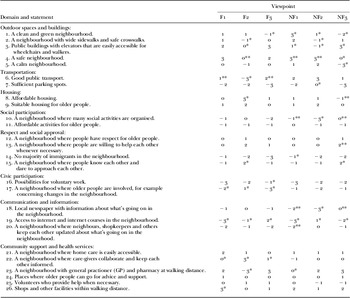
First, we developed statements utilising the WHO (2007) framework for age-friendly cities. We complemented the model by searching the literature on important neighbourhood aspects for older people, accounting for aspects relevant in the Netherlands. Then, three researchers separately constructed statements from the model; after iterated comparison and discussion, 30 statements were developed. Statement comprehensiveness and unambiguity were tested in four pilot interviews with older people. All authors collaboratively excluded or rephrased overlapping statements, yielding a final set of 26 statements (Table 1).
Idealized Q-sorts

Note: F: frail. N: non-frail.
Significance levels (significant difference in ranking within group): * p<0.05, ** p<0.01.
Participants
The sample we used for this study was part of a larger evaluation study of an integrated neighbourhood approach for community-dwelling older people (a detailed description of our study design can be found in our study protocol; Cramm et al. Reference Cramm, van Dijk, Lotters, van Exel and Nieboer2011). Respondents from this sample previously took part in survey research for this evaluation study. We therefore had information on respondents’ age, gender, ethnic background, educational level and level of (physical, mental and social) frailty (measured by the Tilburg Frailty Indicator; Gobbens et al. Reference Gobbens, Luijkx, Wijnen-Sponselee and Schols2010). We approached older people of this sample by telephone and asked for their willingness to participate in this Q-study. To ensure wide representation of viewpoints, we used purposive sampling to recruit an even number of frail and non-frail participants aged ⩾70 years in socio-economically disadvantaged and advantaged neighbourhoods in Rotterdam (population >600,000). In total, 16 frail and 16 non-frail older people took part in this study, which is considered an appropriate sample size in Q-studies (Watts and Stenner Reference Watts and Stenner2012: 73). The first author conducted face-to-face interviews (60–90 minutes) in participants’ homes. All interviews were audio-taped (with participants’ permission) and transcribed.
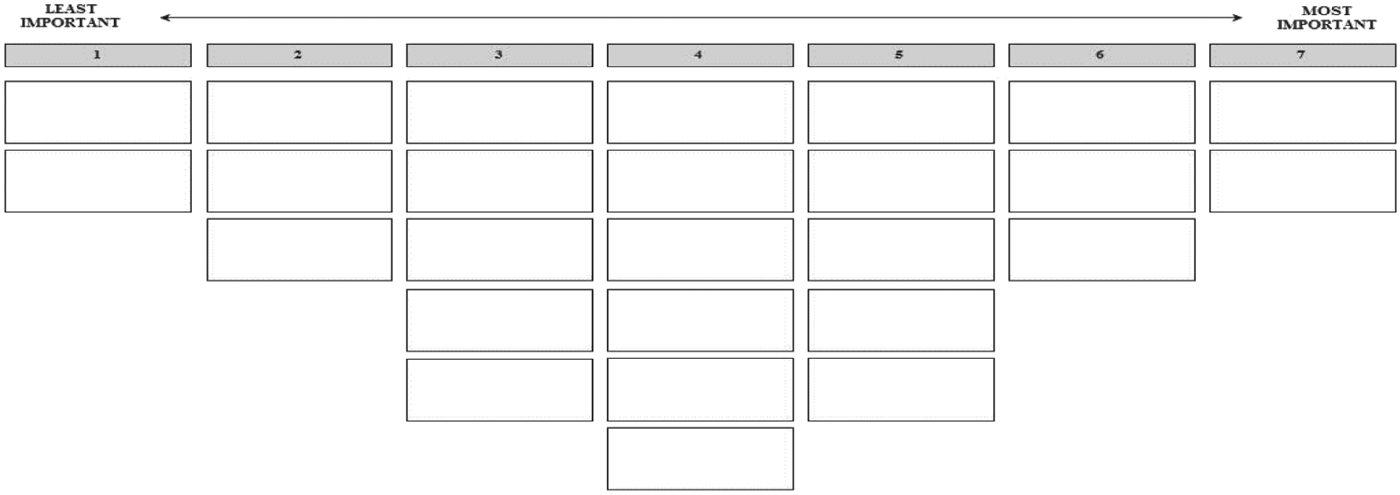
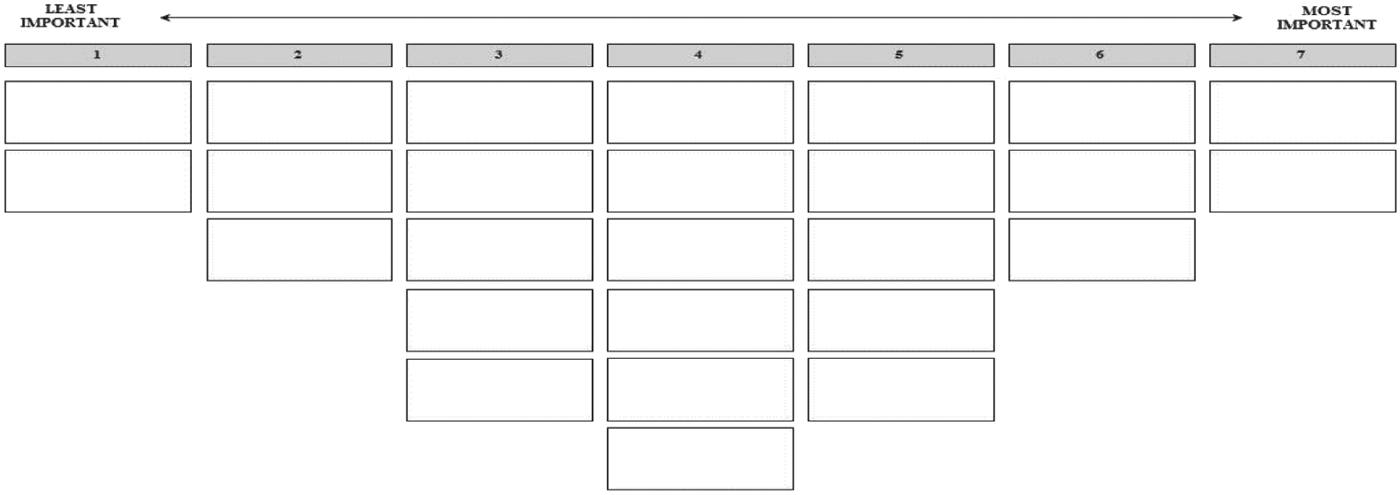
During interviews, respondents were first instructed to sort the statements into three piles: (relatively) important and unimportant for their ideal neighbourhood for ageing in place, and undecided. Then, they were asked to rank-order the statements using a quasi-normal distribution (Figure 1), and to elaborate on their ordering. The interviewer focused on the ten outermost statements and considered remarks made during sorting. Finally, we solicited background information (gender, age, marital status, ethnic background, educational level, home ownership, years of residence).
Ranking format.
Analysis
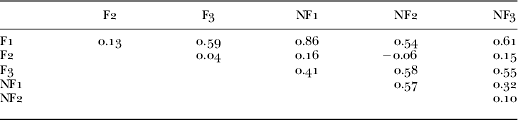
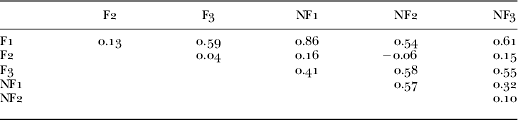
Q-sorts of frail and non-frail older people were separately subjected to by-person factor analysis (centroid extraction, varimax rotation) to identify corresponding statement rankings (factors). Both qualitative and quantitative criteria determined the amount of factors within both groups; the statistics indicated the maximum number of views that could be identified and the qualitative interpretation led to the selection of the factor solution that provided the most comprehensible account of the views expressed through the Q-sorts. Next, an idealized Q-sort was computed for each factor based on rankings of individual participants’ loading, weighted by the correlation coefficient. This idealised Q-sort reflects how a person with a 100 per cent loading on a factor would rank the statements (Table 1). The statements that are ranked at the extreme ends (+3, +2, −2, −3) of the idealised Q-sort, the characterising statements, provide a first description of a viewpoint. To analyse the differences and commonalities between factors, the statement scores on each factor are normalised to Z-scores (with a mean of 0 and a standard deviation of 1) and standard statistical tests and cut-off p-values are used to identify distinguishing (those with a score that differs significantly from those of other factors) and consensus (those with a score that is not statistically significantly different between any pair of factors) statements. Moreover, we used the post-Q-sort interviews of the participants loading on a factor to gain further insight into the viewpoint represented by that factor. In the description of viewpoints in the Results section, we will include references to the characterising and distinguishing statements for a viewpoint in parentheses, indicated by the statements’ number and followed by its rank score. For instance, (26; +3) at the end of a sentence indicates that the finding described in that sentence is based on statement 26 receiving a rank score of +3 in the idealised Q-sort of that viewpoint. The rank scores of all statements in each viewpoint can be found in Table 1. Distinguishing statements will be indicated with * (p<0.05) or ** (p<0.01). Last, we will present a factor analysis that was applied to compare idealised Q-sorts of frail and non-frail participants’ viewpoints in a second-order analysis (Table 2). Data were analysed using PQMethod 2.11 (Schmolck and Atkinson Reference Schmolck and Atkinson2002).
Results
This study included 32 participants (16 frail, 16 non-frail; 18 women, 14 men; average age 81 years). Four participants had foreign ethnic backgrounds. At the time of the interview, seven participants lived with spouses, one with his son, and 75 per cent lived alone. Participants had resided at their current addresses for an average of 18.6 (range 2–50) years. Q-factor analysis revealed three distinct viewpoints each among frail (F1–F3) and non-frail (NF1–NF3) older people.
Frail older peoples’ viewpoints
F1: A secure neighbourhood with facilities nearby
These older people, who become increasingly frail and fear institutionalisation, largely depend on the neighbourhood to provide the necessities of life. They value a neighbourhood where they can buy groceries (26; +3*; see Table 1) and visit doctors, pharmacies and other public buildings (3; +2, 23; +2). These frail and relatively old (mean=87.5 years) participants prioritised a neighbourhood enabling them to preserve minimal independence in what they remain able to do: ‘Previously, I took gym lessons. But after a while, I had to sit on my chair half the lesson. It made me aware of reality: another thing I'm not capable of anymore … the fact that I was still able to bring my neighbours’ groceries [before she died], I found it so enjoyable’. They feel ‘too old’ for active participation in society (16; −3, 17; −2*, 19; −3*) and spend most time at home; thus, they value a neighbourhood where they feel safe (4) and comfortable at home, driven by previous experiences of harassment at their doors. Their explanations of enjoying a clean and green neighbourhood (1; +1) also reflected time spent indoors: ‘I like to sit on that chair and watch children play outside’. As these people gradually draw back from society, their greatest concerns are retaining control and preventing institutionalisation: ‘I don't want to end up as a wreck, being dependent on the help of others’. Although they struggled with burdening others, especially their children, who ‘already had a life of their own’, they concurrently commented on the critical roles of specific persons. As their friends and close neighbours often passed away, these participants mostly had to depend on the support of one person (in most cases a child or home help) that enabled them to age in place: ‘I feel quite privileged with my son. If I didn't have him … it would be much more difficult’; ‘The most important thing I have at the moment is my home nurse’.
F2: A neighbourhood with adequate housing and a supportive network
Rather than abundant (physical) facilities (2; −1*, 3; 0*, 6; −3*, 23; −3*), participants with this viewpoint prefer strong social ties among neighbours (13; +2, 15; +2*) and professionals (22; +3*) in their ideal neighbourhood. Concerned about current health and social care savings, these participants emphasised the importance of formal and informal support networks (22; +3*, 13; +2, 25; +1). Neighbours are crucial in this respect (13; +2, 15; +2*): ‘In my ideal neighbourhood, neighbours chat with each other regularly and knock on each other's door when they haven't seen someone for a while … Because if something's wrong over here, neighbours wouldn't notice’; ‘There are a lot of neighbours who call her [a supportive neighbour of the participant] … For example, I had a hard time losing my neighbour next door. So we talked about it together … she really helped me through it’. These older people also value a well-functioning formal support network (22; +3*) that continues to provide necessary care: ‘Currently, my knee strikes up, then I wonder: will I receive the care and therapy we previously received? It frightens me’. Participants feared a lack of affordable (8; +3*), suitable (9; +2) housing for older people, which they deemed an important precondition for ageing in place. They expressed a desire for involvement in such neighbourhood issues (17; +1*), arguing that their contributions could benefit the neighbourhood.
F3: An accessible neighbourhood
Among frail participants, those with this viewpoint expressed the strongest preference for a neighbourhood enabling them to remain active (6; +2**, 16; −1*, 19; +2*), despite their physical frailty (e.g. walking difficulties). They primarily require an accessible neighbourhood that allows them to be outside and undertake activities, with accessible buildings (3; +3), (health-care) facilities within walking distance (23; +3) and good public transport (6; +2**) permitting them to visit friends and favourite places: ‘When I visited the Christmas market with my friend, I couldn't bring along my walker. It truly was a gruelling experience’; ‘From here, I can take the tram, the subway … If you can't walk properly, that becomes really important’. Like public transport, the internet (19; +2*) enables them to maintain networks and remain active, preventing social isolation: ‘I'm on Facebook quite a lot, I like it. It keeps you going and keeps you mixed with the people’. People with this viewpoint maintain contacts independently and proactively, and do not depend on social (10; −2) or civic (17; −3*) neighbourhood activities.
Consensus statements
Despite discrepancies among factors, some statements were ranked similarly. Frail participants agreed that community support and health services were important, appreciating readily available home care (21) and volunteers’ support (25). They explained that these services enabled them to live independently and avoid institutionalisation. Moreover, they often enjoyed the company of home helpers: ‘When she arrives in the morning, we first drink a cup of tea together. Then, I share my concerns with her and she [the home help] is able to do that as well’. Frail older people also valued neighbours’ mutual assistance (25) and monitoring, such as checking each other's curtains, exchanging keys and visiting lonely older people. At the same time, frail participants expressed needs for autonomy and privacy; for example, they did not prefer a neighbourhood where neighbours, shopkeepers and others keep each other updated (20) or with organised social activities (10, 11).
Non-frail older people's viewpoints
NF1: A well-kept neighbourhood with people to whom you can relate
Participants with this viewpoint value a neighbourhood where they feel safe (4; +3**; see Table 1) and at home, and where social and physical deterioration do not occur (1; +3*, 2; +2): ‘It's the appearance of the neighbourhood, if someone comes by and the neighbourhood seems clean and proper, then you reside in a good environment’. Apart from proper outdoor spaces (1; +3*, 4; +3**) and nearby shops (26; +2), they prefer a neighbourhood with people to whom they can relate; among participants, they objected most to an immigrant-majority neighbourhood (14; −1*). The language barrier and immigrants’ values and habits alienate these participants: ‘We used to live with four Dutch people on this floor … we really got along with each other. And then a Moroccan woman came and there were cigarette-ends lying in the hall … At a certain point you think: I wouldn't step aside for an immigrant … We sometimes consider moving to Zeeland or Drenthe [rural Dutch communities associated with friendliness]’. Although participants appreciated good social ties among neighbours, they did not desire excessive neighbour contact: ‘It's good to be friendly and help one another when necessary, but it shouldn't be too intrusive’. As 80 per cent of these participants lived with partners, they had access to support and affection that other (mostly single) older people lacked and drew from the neighbourhood (16; −3, 18; −2**, 19; −3*). Participants explained that they tried to distance themselves from older people who perceived the neighbourhood as a primary source of entertainment and information exchange (20; −2**), which they associated with social control and gossiping: ‘That's what their life revolves around, what happens at someone else's place. That's their television, their entertainment. Because they know an awful lot about everybody’.
NF2: A calm neighbourhood with good facilities
Participants with this viewpoint prefer to live an independent and calm (5; +2) life, demonstrating low neighbourhood attachment (10; −3*, 17; −2, 18; −3*). They mainly perceived the neighbourhood as a place to fulfil basic needs (e.g. eating, sleeping), relying on their own resources to satisfy social needs: ‘I'm better served by my own environment, my own friends and my own club, than joining social activities in the neighbourhood’. Accordingly, participants valued a safe neighbourhood (4; 3**) accessible by car and public transport (6; +3, 7; 0*). Unlike other participants, who often mentioned pragmatic reasons for using public transport (e.g. going to the doctor or shops), these people regularly provided social reasons (e.g. going to the theatre or visiting grandchildren). Moreover, they commonly used the internet (+1*; +1) for social contact and information: ‘I can't live without it. Then I would be forced to handle my business elsewhere and I wouldn't be able to establish contacts’. These people, who appeared more resourceful and in better physical condition than other participants, often expressed aversion towards ‘older’ people: ‘Older people … it won't bring you much. They don't have a future, that's the thing’, preferring to surround themselves with younger people: ‘I just prefer to hang around with younger people … you always end up in the past with the oldies, how good those days were. But I don't live in the past, I live in the present’. However, these people were aware of their relatively good physical condition, and mentioned that they might rank social (10; −3*) and physical (2; −1*, 3; −1*) statements differently when they became frail and more reliant on the neighbourhood.
NF3: A lively and engaged neighbourhood
People with this viewpoint clearly perceived a good social dynamic, rather than the appearance of outdoor spaces (1; −2*, 4; 0*, 5; −3*), as the most essential part of an ideal neighbourhood (13; +2**, 15; +2*, 10; 0**). They particularly appreciated close ties and mutual assistance among neighbours (13; +2**, 15; +2*) (‘That's what you do’), mentioning ‘doing the groceries, repairing a broken radio, installing the television or accompanying someone to the doctor’. Participants remarked that mutual support among neighbours may be particularly crucial for older people, especially those without (nearby) family, who increasingly face cognitive and physical impairments: ‘I found it very important. It's your first line of aid right?’ Moreover, they favoured a dynamic, lively neighbourhood atmosphere (5; −3*): ‘I like the neighbourhood to be dynamic. I'm already quite old myself … So I don't want the neighbourhood to be calm as well’, best achieved by an age mix: ‘it's what makes the neighbourhood cheerful and interesting’. Among non-frail participants, they attached most value to neighbourhood social activities (10; 0**), believing that being active benefits one's health: ‘I think it's important, people should remain active … I do have geraniums, but I'm not sitting behind them [a Dutch expression for inactive (often older) people]. That's what I noticed during my voluntary work in the nursing home. The way people sat in their chair, they looked paralysed. But when I joined them and talked to them, they literally came up in their chair’. Accordingly, these people stated that the proximity of care facilities (23; +3) and availability of accessible public buildings (3; +3*) are important preconditions enabling older (disabled) people's participation in society: ‘Of course these [public buildings] should be accessible. They should allow you to go anywhere with them. They may be disabled, but that doesn't mean you should write them off’.
Consensus statements
Good public transport (6), enabling continued visitation of favourite people and places, was a common preference among non-frail participants. Many appreciated public transport within walking distance of their homes. The proximity of shops and other facilities (26) was also important, as buying one's own groceries contributes to a sense of independence. Like frail participants, they valued readily available home care (21). They did not value engagement in civic activities (16, 17), perceiving voluntary work (16, 25) as a way to reduce public spending and commenting on volunteers’ heavy burdens. They remarked that only flexible and – truly – voluntary work would be successful for older people. Non-frail participants agreed on the relative unimportance of a neighbourhood where people are involved in neighbourhood decisions (17), mentioning that they often got involved too late, felt unheard and considered neighbourhood decision making a matter for younger people.
Comparison of frail and non-frail older people's viewpoints
Some patterns of consensus in frail and non-frail participants’ viewpoints emerged. Viewpoints F1 and NF1 were highly correlated (0.86), due mainly to the common desire for a safe neighbourhood with abundant facilities (Table 2). However, post-Q-sort interviews revealed distinct considerations underlying the rankings; frail participants referred mainly to safety at home, whereas non-frail participants referred to outdoor safety. Furthermore, viewpoints F3 and NF3 were correlated (0.55), primarily based on the importance of remaining active through one's social network (F3) or the neighbourhood (NF3). Moreover, participants with viewpoints F3 and NF2 (0.58) did not rely on the neighbourhood to fulfil social needs, but on their own social networks and the internet. Viewpoint F2 was distinctive, demonstrating no strong correlation with any other statement.
Discussion and conclusion
With increasing numbers of community-dwelling older people, interest in supportive neighbourhoods that allow (frail) older people to age in place is growing. Although previous research has already identified a large number of important neighbourhood characteristics (WHO 2007), we lack insight into the relative importance of these characteristics. In this Q-methodological study, we asked frail and non-frail older people to rank neighbourhood characteristics according to their view of the ideal neighbourhood for ageing in place. We thereby respond to the previously highlighted need to identify ‘leverage points’ that are particularly relevant in enabling older people to age in place (Menec et al. Reference Menec, Means, Keating, Parkhurst and Eales2011; Stokols Reference Stokols1996).
We identified three viewpoints in each group. Although participants’ perceptions of the ideal neighbourhood differed, all emphasised the importance of maintaining independence. In line with previous research (Peace, Holland and Kellaher Reference Peace, Holland and Kellaher2011), older people seem to evaluate important neighbourhood characteristics in terms of the extent to which they contribute to retaining a sense of control and autonomy, taking account of both past experiences and future expectations. Frail participants often expressed preferences reflecting their conditions, whereas non-frail participants were influenced more by previous experiences with physical and/or mental impairment (e.g. due to a fall, ailing partner) or imagined future impairments. The ‘outdoor spaces and buildings’, ‘transportation’, ‘housing’ and ‘community support and health services’ domains of the WHO's ‘Global Age-friendly Cities’ framework (2007) appeared to be most essential to older people. Participants indicated that living in close proximity to services enabled them to meet necessities, such as buying groceries and visiting the doctor. In the same way, an accessible neighbourhood, public transport and safety were perceived as prerequisites for independence.
Safety is an important meta-goal to avoid older people's (further) loss of social and physical wellbeing (Nieboer, Koolman and Stolk Reference Nieboer, Koolman and Stolk2010; van Bruggen Reference van Bruggen2004). Being caught in a so-called loss frame is particularly damaging for wellbeing (Nieboer Reference Nieboer1997). Feelings of insecurity affect older people's willingness to take risks: ‘if something goes wrong, is there someone who can help us? But when you're young, you don't reflect upon those matters … But now we do … a safe neighbourhood, that's what you care for … previously, if someone harassed you, you could run, but that's not the case anymore’.
In line with previous research (Menec et al. Reference Menec, Means, Keating, Parkhurst and Eales2011; Novek and Menec Reference Novek and Menec2013; Walker and Hiller Reference Walker and Hiller2007), physical and social neighbourhood aspects were closely related. For example, participants associated a safe neighbourhood with close ties among neighbours and a sense of familiarity. When commenting on the importance of nearby grocery stores, participants concurrently mentioned that these facilities connected them with neighbours: ‘When I'm buying my groceries, I always encounter someone I chat with. If you're able to talk with someone – albeit superficial – it benefits your day’. Such – seemingly – small everyday interactions often underpin strong senses of support and belonging; one participant proudly commented on the importance of being noticed: ‘When I'm walking in the town, you should see how many people wave at me’. All participants valued neighbour contact (in relation to their needs), although the desired degree of such contact ranged from low-level everyday interactions to strong social and emotional bonds. Many participants, however, controlled the amount of neighbour contact to safeguard their privacy, which was also reflected by moderate rankings of statements in the ‘respect and social approval’ domain. Thus, participants highlighted the critical tension between appreciating neighbour contact as a key source of support and preventing it from becoming too constricting. Likewise, most participants did not desire active social or civic participation, perceiving it as (relatively) unimportant for wellbeing, despite policy makers’ promotion of such participation among older people. Whereas frail participants often indicated that they were consumed with daily activities and the challenges of ageing, non-frail participants (excepting those with viewpoint NF3) preferred to rely on their own social networks, which had formerly met their social needs. Moreover, participants regularly associated civic engagement with the shifting of responsibilities to the community, mainly to enable cutbacks in health and social care (see also Martinson and Minkler Reference Martinson and Minkler2006).
This Q-study provided insight into older people's preferences for ageing in place. Participants appreciated the opportunity to express their views concretely about a relevant and vital theme. Face-to-face Q-interviews, rather than self-administered Q-sorts, were highly beneficial in this group because we could further clarify the procedure during ranking. Moreover, the interviews allowed us to gain impressions of older people's living situations and insights into motives underlying rankings. For example, consistent with previous findings (Peace, Holland and Kellaher Reference Peace, Holland and Kellaher2011), frail and non-frail participants repeatedly highlighted their wish to age in place and displayed deep attachment to their ability to make decisions about where to live. Some participants felt ignored by others (e.g. family members, doctors) who tried to convince them to move to a nursing home, as they perceived their homes as ideal for ageing in place. This finding stresses the need to enable (frail) older people to reside continuously in their ‘own’ neighbourhoods and support them in their capability of finding ways to maintain their routines and manage themselves in their own homes (Peace, Holland and Kellaher Reference Peace, Holland and Kellaher2011). Another recurrent theme in interviews was the presence of immigrants in the neighbourhood. Although some participants objected to an immigrant-majority neighbourhood in interviews, arguing that immigrants’ habits and values impeded on their sense of ‘home’, they simultaneously felt uncomfortable about explicitly ranking the corresponding statement (14) as ‘important’, possibly resulting in socially desirable responses. Because only this statement was affected in this way and we extracted participants’ views on this theme in interviews, we do not believe that our results were affected considerably.
Some other methodological issues merit further discussion. First, although this study provides insight into older people's main views about their ideal neighbourhood for ageing in place, surveys are needed to examine the prevalence of these views in a wider population. Second, although participants were instructed to rank statements according to their views of the ideal neighbourhood, (unsatisfactory aspects of) their own neighbourhoods may have influenced preferences. However, we repeatedly emphasised our search for the ideal neighbourhood in face-to-face interviews.
As in previous research, frail and non-frail older people strongly desired a neighbourhood enabling them to age in place; however, we identified divergent views on such a neighbourhood. This study demonstrated that older people's dependence on the neighbourhood is not static, but affected by changing social and physical conditions and levels of frailty. In line with previous research (Peace, Holland and Kellaher Reference Peace, Holland and Kellaher2011), the ‘fit’ between the needs and resources of older people and environmental conditions thus should be considered as a dynamic process, incorporating changes over time in both neighbourhoods and people. Although frail and non-frail participants highlighted similar themes, such as their common desires for independence, security and belonging, the meanings of these themes differed (e.g. Wiles et al. Reference Wiles, Leibing, Guberman, Reeve and Allen2011). Both groups, for example, were attached to a safe neighbourhood, but whereas frail older people mainly referred to safety within the house, non-frail older people mentioned examples of outdoor safety. Likewise, frail older people may feel independent through the support of a home help, whereas non-frail older people may derive independence from their ability to clean their house by themselves. Moreover, this study provided evidence for the argument that different neighbourhood characteristics often interact with each other, which highlights the need to consider physical and social neighbourhood characteristics simultaneously.
In building neighbourhoods that support independent living, the dynamic interplay between the varying needs of frail and non-frail older people and environmental conditions must be recognised. Supportive neighbourhoods may play a crucial role in providing older people with resources to compensate social and physical losses as they age, and to live independently and age in place as long as possible.
Acknowledgements
This research was supported by a grant provided by the Netherlands Organization for Health Research and Development (ZonMw project number 314030201). Ethical approval was provided by the ethics committee of the Erasmus University Medical Centre of Rotterdam in June 2011.The views expressed in the paper are those of the authors. We would like to thank all the older people who shared their thoughts and experiences with us.