Implications
In Portugal, the production of differentiated beef (PDO and IGP) is a tool to develop less-favoured areas, to promote development in the rural regions and to decrease social desertification of such rural areas enlarging niche markets on the basis of the added value of autochthonous beef breeds. These production systems can represent an income to the producers; however, it must also meet consumer demand for a high-quality product (nutritional and sensorial). Being less intensive than regular beef production they have the advantage of being environmental and animal-friendly with less greenhouse gas production decreasing the carbon footprint.
Introduction
Palatability is one of the most important factors in beef quality; however, it is influenced by many factors such as differences in intrinsic productive (breed, gender, age, slaughter weight or diet) and technological factors (management, refrigeration and specially the ageing time; Monsón et al., Reference Monsón, Sañudo and Sierra2005). Hence, optimizing palatability attributes is an important factor in maintaining consumer demand for beef (Polkinghorne et al., Reference Polkinghorne, Thompson, Watson, Gee and Porter2008). It is well accepted in the literature that texture (tenderness) is the major palatability characteristic of beef and defines its commercial value (Jeremiah et al., Reference Jeremiah, Dugan, Aalhus and Gibson2003). At the point of sale, the colour of fresh meat is of utmost importance, as it is the first quality attribute judged by the consumer who uses it as an indication of freshness and wholesomeness (Troy and Kerry, Reference Troy and Kerry2010).
Consumers are more self-conscientious and prefer meat from animals raised on pasture, as they consider it as healthier and to have a more animal and environment-friendly production system (Hocquette et al., Reference Hocquette, Botreau, Picard, Jacquet, Pethick and Scollan2012). However, meat from the cattle slaughtered directly from pasture is considered to have poor organoleptic characteristics (French et al., Reference French, O’Riordan, Monahan, Caffrey, Vidal, Mooney, Troy and Moloney2000), and a finishing period has been recommended to improve carcass characteristics and meat quality (Camfield et al., Reference Camfield, Brown, Lewis, Rakes and Johnson1997; French et al., Reference French, O’Riordan, Monahan, Caffrey, Vidal, Mooney, Troy and Moloney2000).
Beef production in Portugal is mainly based on intact males. Accordingly, the proportion of steers slaughtered in 2010 in the European Union (EU27) was much lower (9.6%) relative to bulls. However, the values in countries such as Ireland and UK are as higher as 42.2% and 40.5%, respectively (Eurostat, 2011). Meat from intact males has been considered having lower quality, in particular tenderness, despite exhibiting higher growth rates and feed efficiencies, dressing percentages and meat yields (Field, Reference Field1971). Information comparing bulls and steers with the same degree of fatness is scarce, and show consistently large differences between genders in carcass and/or intramuscular fat percentage. The differences found by other authors could be a result of the differences in the carcass fatness rather than a gender effect per se.
Therefore, the aim of this study was to compare the physicochemical characteristics of bulls and steers along time-on-feed. Moreover, we intended to ascertain a length finishing period suitable to improve carcass and meat quality.
Material and methods
Animals
Twenty-four Mertolenga calves were used in a trial carried out in ‘Unidade de Investigação em Produção Animal’, INIAV. At weaning (8 months of age), 12 of the 24 animals were randomly castrated and afterwards assigned to the treatment groups: castrate (n=12) and intact males (n=12). Castration was carried out with a bloodless Burdizzo-type emasculator under sedation with xylazine (Rompun, Bayer HealthCare AG, Germany).
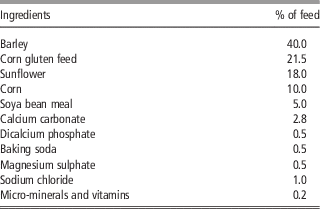
All animals grazed on ryegrass pasture for 1 year subsequent to weaning being supplemented with poor-quality hay during periods of low grass availability. After the grazing period, animals were allocated in pens, separated by gender, three in each pen, being fed a finishing diet based on straw and concentrate (Table 1). Feed was distributed ad libitum in two daily meals. At the beginning of the finishing period (day 0) animals’ age ranged between 20 and 22 months. Twelve animals of each gender were serially slaughtered at 0 (pasture only), 50, 100 and 150 days of finishing (concentrate feeding), three of each gender per period.
Composition of the concentrate fed to steers and bulls during the finishing period

Animals were slaughtered and dressed in an officially approved slaughterhouse, according to standard methods. Carcass weight (CW) was registered before chilling. Classification of conformation and fatness degree was assessed by trained and experienced evaluators using the SEUROP system. Carcass conformation was based on visual assessment of muscle mass development (S=superior, E=excellent, U=very good, R=good, O=fair; P=poor), and the fatness degree was based on the amount and distribution of subcutaneous fat and a higher number indicates the thickest fat cover (1=poor, 2=slight, 3=average, 4=high, 5=very high).
The fat thickness was measured with a calliper after chilling, and the value considered was the mean value of three points between the 12th and 13th ribs over the longissimus muscle. The dressing-out percentage was defined as the ratio of the CW to live weight before slaughter. The total carcass fat weight was determined after dissection of the left half-carcass, not considering the kidney knob channel fat and testis fat values (multiplied by two corresponding to the left plus right halves of the carcass). The carcass fatness (% CW) was calculated as the relation between total carcass fat weight and the CW multiplied by 100.
Carcasses were kept at 10°C to 12°C for 5 h and then were chilled at 0°C to 2°C.
Seven days after slaughter, samples of the longissimus lumborum muscle (around 700 g) were collected from the left half of the carcass between the first and third lumbar vertebrae for chemical and physical analysis.
Physicochemical analysis
The colour, pH and water-holding capacity (WHC) measurements were determined before samples for chemical analysis were minced, vacuum packaged and frozen at −18°C. A 2.5 cm thick steak was removed for cooking losses and Warner–Bratzler shear force (WBSF) determinations, vacuum packaged and frozen at −18°C.
Colour measurements were taken on a freshly cut surface after 1 hour of blooming at 4°C. The measurements of L*, a*, b*, chroma (C*) and hue angle (h*) were carried out with a colorimeter (Minolta CR 300, Konica Minolta Holdings Inc., Tokyo, Japan) with a C illuminant and a 2° standard observer in the CIELAB space (Larraín et al., Reference Larraín, Schaeffer and Reed2008). C* and h* were calculated from a* and b* values according to the device specifications.
Three muscle pH measurements were taken with a Hanna portable meter (HI 99163, Hanna Instruments, Rhode Island, USA), equipped with a penetration electrode. For WHC measurement, a meat sample with 0.3 g was placed on a piece of filter paper (Whatman N0. 1), and afterwards placed between two Plexiglas plates and subjected to a mechanical force of 3.518 kg. WHC was calculated by differences in filter paper weight, before and after 5 min of compression, in percentage, meaning the relative uptake of water by the filter paper (Santos-Silva et al., Reference Santos-Silva, Bessa and Santos-Silva2002).
Total pigment content was determined on two replicates, through the quantification of the cyanometmyoglobin and cyanomethemoglobin, by the method described by Wierbicki et al. (Reference Wierbiki, Cahill, Kunkle, Klosterman and Deatherage1955) and expressed as dry matter percentage (%DM). The intramuscular fat content was measured according to the AOAC official method 945.16 (AOAC, 2000) without acid hydrolysis, corresponding only to the free fat portion of the intramuscular fat depot. The extraction was made with petroleum–ether for 6 h and the final value expressed as % DM.
The total collagen concentration was determined through hidroxiproline quantification according to the AOAC official method 990.26 (AOAC, 2000) adapted by Silva et al. (Reference Silva, Patarata and Martins1999) and expressed as %DM. The collagen solubility was determined by the method described by Silva et al. (Reference Silva, Patarata and Martins1999); however, the dilution steps were altered. Briefly, after hydrolysis (16 h at 105°C), and the volume adjusted to 100 and 150 ml for soluble and insoluble collagen, respectively, aliquots of 25 ml (soluble collagen) and 10 ml (insoluble collagen) of the solutions were transferred to graduated tubes; after that the volume was adjusted to 50 ml in both cases. The total collagen was the sum of the soluble and insoluble fractions. The collagen solubility was expressed as total collagen percentage.
The myofibrillar fragmentation index (MFI) was determined as described by Silva et al. (Reference Silva, Patarata and Martins1999). The sample’s protein concentration was standardized for 0.5 g of protein/ml with MFI solution. Absorbance readings were multiplied by a 200 factor.
Steaks 2.5 cm thick were used for WBSF determination being thawed at 4°C for 24 h. Afterwards the steaks were weighed, grilled (Kronus 6570 FTES grill) until reaching 70°C of internal temperature and weighed again for cooking loss determination. The steaks were cooled to room temperature and WBSF (TA-tx2i Texture Analyzer, Stable Micro Systems, Surrey, UK) determinations were made in 1 cm2 section cores, removed parallel to the muscle fibre orientation. WBSF for each cut was recorded as a mean of at least 8 cores. The beef sample resistance to shearing was recorded in a force-deformation plot. The maximum shear force in kg corresponded to the highest peak of the curve.
Statistical analysis
Data processing was carried out by ANOVA using the GLM procedure of SAS (2004). The model included the fixed effects of gender (bulls and steers), time-on-feed (0, 50, 100 and 150 days of finishing) and the interaction gender×time-on-feed. The interaction gender×time-on-feed was included in the model only when significant interactions were detected.
Principal component analysis (PCA) was performed using meat-quality variables after standardization with PRINCOMP by SAS (2004). Statistical significance was set up at the P<0.05 level. The measurements and PC are interpreted according to the correlations between each parameter and each PC; thus, measurements close to each other are positively correlated, whereas measurements separated by 180° are negatively correlated. When separated by 90° they are independent.
Results
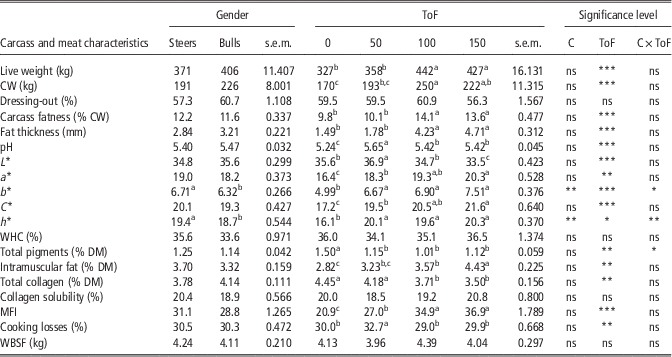
The effects of gender and time-on-feed on carcass and meat-quality characteristics are presented on Table 2. Bulls and steers had similar levels of live weight, CW, carcass fatness and carcass fat thickness, which increased with time-on-feed (Table 2). Dressing-out percentage was similar between genders remaining also similar along time-on-feed. In both the genders, 33% of the carcasses were classified as O1 and 67% as O2. All the carcasses from animals finished for 100 and 150 days were classified as O2, whereas around 67% of the carcasses from the animals finished for 0 and 50 days were classified as O1 and only 33% as O2. pH was not affected by gender, but was affected by time-on-feed, increasing until 50 days of time-on-feed and decreasing afterwards.
Effect of Castration (C) and ToF on carcass characteristics and meat quality of Mertolenga breed
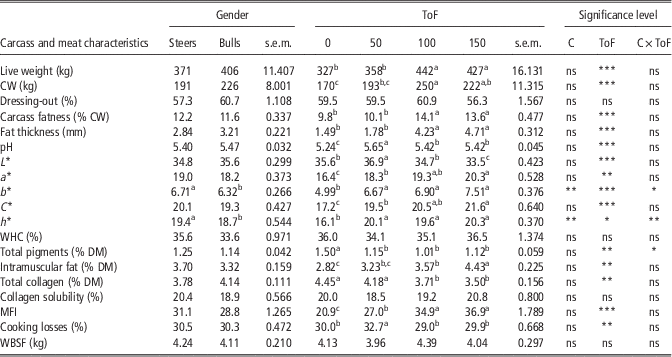
ToF=time-on-feed; s.e.m.=standard error of means; ns=not significant; CW=carcass weight; WHC=water holding capacity; DM=dry matter; MFI=myofibrillar fragmentation index; WBSF=Warner–Bratzler shear force.
*P<0.05; **P<0.01; ***P<0.001; a,b,c=means in the same row with different subscripts are significantly different.
Colour parameters were poorly affected by gender, with b* and h* being the only parameters affected, presenting steers the highest values. An interaction between gender and time-on-feed on b* and h* parameters was also observed. Whereas in steers, b* value remained constant and h* value slightly decreased, in bulls these variables had a great increase through time-on-feed. At day 0, the b* and h* values were lower, whereas at day 150 they were higher in bulls than in steers.
L* parameter increased until 50 days time-on-feed and decreased afterwards, whereas a* and C* parameters increased along time-on-feed. Pigment content decreased in the first 50 days of time-on-feed and presented a gender×time-on-feed interaction. This variable presented a quadratic evolution over time-on-feed. Steers had a slight variation, whereas bulls’ pigment content diminished until 100 days of time-on-feed and slightly increased afterwards.
Intramuscular fat content and MFI increased, whereas total collagen content decreased along time-on-feed.
Cooking losses increased in the first 50 days on feed and decreased afterwards. However, the final value was statistically similar to the initial one.
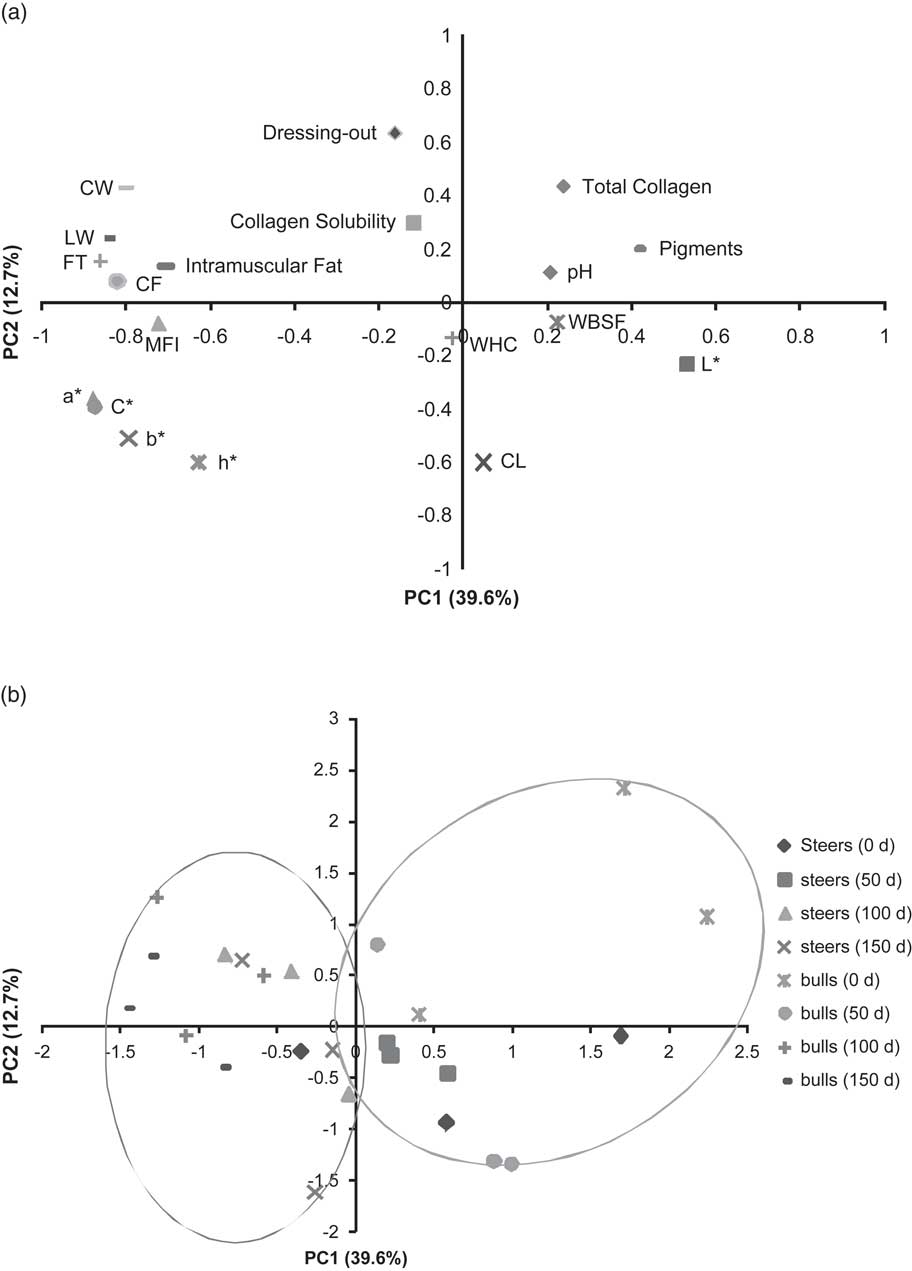
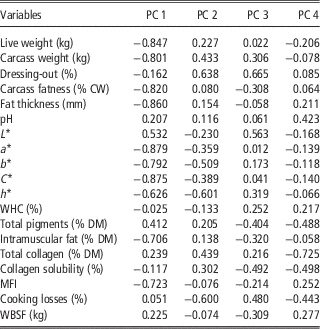
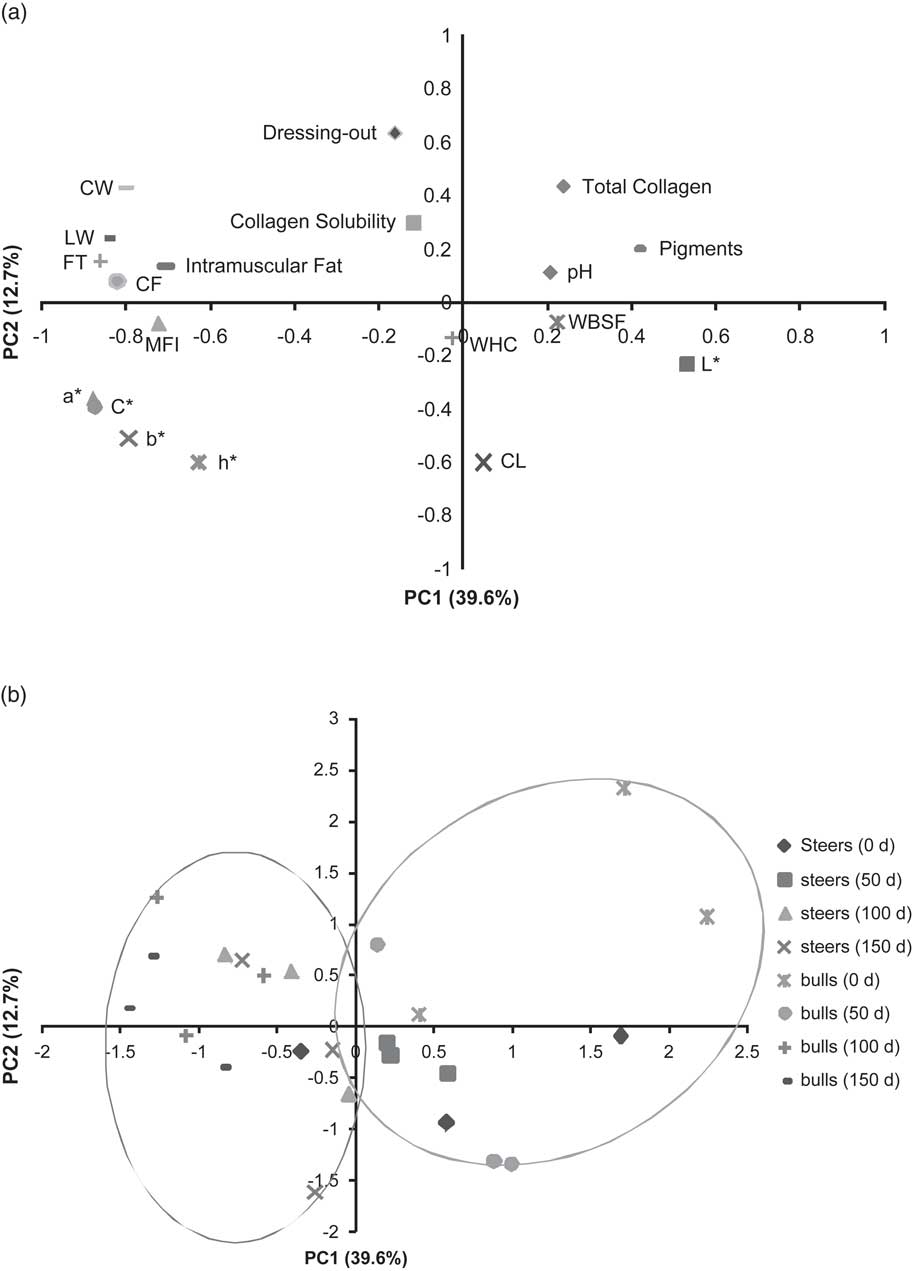
The coefficients for the first four PC of carcass characteristics and meat quality are shown in Table 3. In Figure 1a, the results of the two PCs that accounted for 52.3% of the total variation of meat quality are plotted. The first PC axis (39.6% of the total variance) included colour variables a*, b* and C*, and carcass fatness, fat thickness, CW and live weight, and with lower loadings MFI and intramuscular fat. The second PC axis (12.7% of the total variance) included the h* parameter of colour, and cooking losses with negative loadings and dressing-out with positive loadings. The third PC axis is defined by dressing-out, cooking losses and L* parameter of colour with positive loadings and in the opposite position by pigment content and collagen solubility. The fourth PC axis is defined by pH with positive loadings and total collagen content and solubility, as well as by pigment content with negative loadings.
(a) Variable distribution in the plot according to the first two principal components; (b) distribution of the meat samples of bulls and steers from the four different periods of time-on-feed in the plot defined by the two principal components. CF=carcass fatness; CL=cooking losses; CW=carcass weight; FT=fat thickness; LW=live weight; MFI=myofibrillar fragmentation index; WHC=water-holding capacity; WBSF=Warner–Bratzler shear force.
Principal component loadings from carcass and meat-quality characteristics of Mertolenga breed
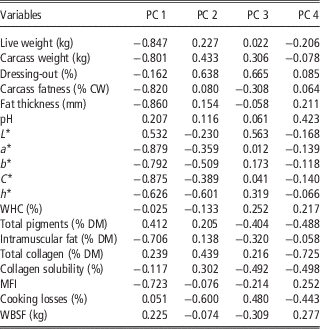
CW=carcass weight; WHC=water-holding capacity; DM=dry matter; MFI=myofibrillar fragmentation index; WBSF=Warner–Bratzler shear force.
The first two periods of feeding (0 and 50 days) are characterized by WHC, pH and WBSF. On the contrary, the two latter time-on-feed periods are described by the variables of the first PC, which include colour variables a*, b* and C*, and live weight, as well as carcass characteristics: CW, fat thickness and carcass fatness. The aforementioned groups of variables are in the opposite position to L*, cooking losses and WBSF, and pigment content pH and total collagen, respectively.
Discussion
Carcass characteristics
Time-on-feed had a major effect on carcass characteristics, which is not surprising as it is expected that animals increase weight and fatness with a longer period of feeding. It was necessary 100 days of time-on-feed for differences be noticed, that is, a finishing period of 100 days seems to improve carcass quality (CW, carcass fatness and fat thickness), and no improve was added with more 50 days on feed.
Carcass composition determines the commercial value of carcasses in meat-producing animals, and carcass fatness is one of the main criteria used to judge its commercial value. In several European countries, carcass fat is seen as waste fat. However, in carcasses with a very low fat content as it is usual in Portugal, higher carcass fatness can be an advantage to avoid cold shortening and protecting against moisture loss (Dolezal et al., Reference Dolezal, Smith, Savell and Carpenter1982). In addition, carcasses classified with fat grade 2 (as the majority of carcasses from days 100 and 150 of time-on-feed) are better paid than carcasses classified with fat grade 1 (as the majority of the carcasses from days 0 and 50 of time-on-feed).
Physicochemical characteristics of meat
Our results suggested that gender had a slight effect on physicochemical characteristics of beef, as steers only differ from bulls in two of the 14 variables compared. This is in agreement with other authors’ results, who did not observe differences between steers and bulls neither in pH value (Mach et al., Reference Mach, Bach, Realini, Font, Furnols, Velarde and Devant2009) nor in meat colour (Monin, Reference Monin1991). In a review concerning beef quality, Field (Reference Field1971) also concluded that gender had no effect in meat colour judged by a panel. Differences in muscle pH are generally attributed to the fact that bulls are predisposed, owing to their male status, to physical contest for social dominance, particularly in mixed penning with unfamiliar counterparts, what may lead to glycogen depletion (Tarrant, Reference Tarrant1989). In addition, long-distance transportation to the slaughter house increases glycogen depletion with consequential increased muscle pH postmortem.
The fact that the animals in the present study were allocated at a short distance from the slaughterhouse and the transportation has been made with a minimum of stress partially explain the minor differences found in meat colour parameters between genders in our study. The similar L* value could result from the similar pH and amount of pigment content between genders.
The interaction obtained between steers and bulls in the b* and h* parameters of colour could result from different deposition of carotenes between genders along time-on-feed. Pigment content was also affected by a gender×time-on-feed interaction. Meat colour parameter results could be a consequence of the pigment concentration decreased observed in bulls, as negative correlations between pigment content and b* and h* values were observed (data not shown). A lower myoglobin concentration has been observed in concentrate-fed animals, owing to the fact that these diets promote anaerobic muscle metabolism rather than oxidative (Vestergaard et al., Reference Vestergaard, Oksbjerg and Henckel2000), which can explain the decrease in pigment content along time-on-fed in bulls. The colour parameters suggest that meat colour became slightly darker through time-on-feed, which is in agreement with other authors (Keane and Allen, Reference Keane and Allen1998); however, the values presented by the two beef types are within the colour range considered acceptable by the Portuguese consumer (Monteiro, Reference Monteiro2012).
Texture characteristics
Tenderness is the most important attribute of eating quality and it is related to the rates of postmortem degradation of the myofibrillar network linked to the biochemical proteolysis and the amount and nature of collagen present around and between the fibres (Sami et al., Reference Sami, Augustini and Schwartz2004). Moreover, intramuscular fat increases as it is linked to an increase in tenderness (Savell and Cross, Reference Savell and Cross1988; Hocquette et al., Reference Hocquette, Gondret, Baéza, Médale, Jurie and Pethick2010). We analysed collagen content and solubility, MFI and intramuscular fat, as well as their correlation with instrumental measurement of tenderness (WBSF; data not shown). However, our study showed that at the same age and degree of fatness there was no gender effect on collagen content, collagen solubility, MFI and, consequently, on WBSF. Accordingly, several authors did not find any difference between genders in collagen content (Morgan et al., Reference Morgan, Wheeler, Koohmaraie, Savell and Crouse1993; Monteiro et al., Reference Monteiro, Navas and Lemos2005; Schreurs et al., Reference Schreurs, Garcia, Jurie, Agabriel, Micol, Bauchart, Listrat and Picard2008) and solubility (Monteiro et al., Reference Monteiro, Navas and Lemos2005; Schreurs et al., Reference Schreurs, Garcia, Jurie, Agabriel, Micol, Bauchart, Listrat and Picard2008) or realized that it disappeared after carcass fat content adjustment (Crouse et al., Reference Crouse, Cross and Seideman1985; Moloney et al., Reference Moloney, Mooney, Kerry and Troy2001).
It is important to notice that both genders had a high-quality grade concerning WBSF value, as about 70% of the samples presented a WBSF value equal to or lower than 4.5. These results indicate that Mertolenga–PDO beef presented a great percentage of samples with a tenderness value that makes it highly acceptable by Portuguese consumers (Simões and Lemos, Reference Simões and Lemos2005). Moreover, only 8% of the samples presented very high WBSF value (>8); the other 22% of the samples presented WBSF value between 5 and 6. The value presented by Mertolenga–PDO beef is below the value (60 N/cm2 or 6.12 kg) suggested by Shackelford et al. (Reference Shackelford, Wheeler and Koohmaraie1997) as the limit value separating tender and tough meat.
Intramuscular fat content increased during time-on-feed (2.82 v. 4.43 in day 0 and day 150, respectively), which is in agreement with the fat carcass increase (Table 2) and the generality of the authors. Collagen content decreased, whereas MFI increased along time-on-feed, suggesting a decrease in WBSF. However, WBSF did not change along time-on-feed (French et al., Reference French, O’Riordan, Monahan, Caffrey, Vidal, Mooney, Troy and Moloney2000; Cerdeño et al., Reference Cerdeño, Vieira, Serrano, Lavín and Mantecón2006), indicating that the variation in this variable was not enough to decrease WBSF. These results are in line with other studies reporting that the collagen content is neither related to WBSF nor to taste panel tenderness (Hunsley et al., Reference Hunsley, Vetter, Kline and Burroughs1971; Christensen, et al., Reference Christensen, Ertbjerg, Failla, Sañudo, Richardson, Nute, Olleta, Panea, Albertí, Juárez, Hocquette and Williams2011), as muscles with low collagen content, such as the longissimus dorsi, might provide a limited contribution to background toughness (Ngapo et al., Reference Ngapo, Berge, Culioli, Dransfield, De Smet and Claeys2002). Monteiro et al. (Reference Monteiro, Gomes, Barreto, Silva, Fontes, Bessa and Lemos2013) found an MFI value in Mertolenga–PDO beef lower (23) than the values presented here for steers and bulls. However, in the aforementioned authors’ study, beef samples had lower ageing period. The variation of MFI value over the time-on-feed has been overlooked in the literature. Nevertheless, Vestergaard et al. (Reference Vestergaard, Oksbjerg and Henckel2000) pointed out a mean value of 31.8, which is quite similar to the values presented in this study for both the genders (31.1 for steers and 28.8 for bulls).
Results on WBSF along time-on-feed are controversial as other authors have observed an increase in some breeds, but a decrease in others (McKeith et al., Reference McKeith, Savell and Smith1985). Despite the WBSF having not changed along time-on-feed, our results indicate that a 100-day finishing period is enough to increase MFI and to decrease the total collagen content. However, intramuscular fat content continues to increase significantly until 150 days of the finishing period.
PCA
The relationship between meat quality traits were further exploited by PCA. The first four PCs explained 72.04% of the total variation, which is in accordance with Destefanis et al. (Reference Destefanis, Barge, Brugiapaglia and Tassone2000) and Cañeque et al. (Reference Cañeque, Pérez, Velasco, Díaz, Lauzurica, Álvarez, Huidobro, Onega and De la Fuente2004).
Meat colour parameters, except L*, are in the opposite position, relatively to its pigment content, whereas WBSF is opposite to most of the carcass characteristics, which means that measurements that are separated by 180° are inversely correlated. We could speculate that, as carcass characteristics are in opposition to WBSF in the score plot, the greater the CW and the carcass fat content the lower the WBSF, which in the case of CW is an odd result. Thus, as CW and fatness increase, we would expect a decrease in WBSF along time-on-feed, which did not happen. Figure 1b shows the component score vectors in the plot. It can be seen that scores of the two meats studied (bull v. steers beef), analysed by PCA, are mixed; no clear differentiation between groups can be seen.
The results from this statistical approach reinforce the differences previously described between the two smaller periods of feeding (0 and 50 days) and the two longer (100 and 150 days) ones, as can be seen in the circles represented in the score plot. However, the proximity between variables observed within the smaller feeding period group is not as clear as after 100 days of time-on-feed.
Conclusion
The results reported here indicate that beef-quality differences between bulls and steers were minimal. We concluded that in this case both genders had a high-quality grade concerning WBSF value. Moreover, this quality is achieved with a relatively low intramuscular fat content, which is desirable from the consumers’ point of view.
Along the finishing period the longissimus lumborum muscle became darker, however, in a colour range with great acceptability by the Portuguese consumer. Carcass-quality differences occur only after a minimum of 100 days finishing period, when a significant increase in live weight, CW, carcass fatness and fat thickness was observed, which could avoid cold shortening in carcasses with a low total fat content, and is economically advantageous because of carcass valorization. The time-on-feed only had a slight effect on meat characteristics. MFI was improved and total collagen content decreased after 100 days of time-on-feed, suggesting this could be the finishing period necessary to improve beef quality. However, despite the aforementioned differences along time-on-feed, tenderness/hardness did not improve. The PC analysis confirms the lack of differences between bulls and steers and indicates a differentiation of the first two (0 and 50 days) periods of feeding from the two latter (100 and 150 days) periods of feeding.
Acknowledgement
This research was financed by PIDDAC 819/99 project.