1 Introduction
Living in the shadow of monumental edifices like the pyramids, temples, and large palatial cities, it is unsurprising that the ancient nomadic cultures of the Nile basin are not a frequently explored topic. In almost all corners of Northeast Africa’s deserts away from the Nile, there were in the past, as in the present, groups of peoples who practised lifestyles based on movement and the herd – a life of nomadism. These nomads, being outside the Nile Valley, are not usually considered a central part of the scholarly study of ancient Egypt and Nubia (Egyptology and Nubiology). But for the ancient inhabitants of the entire Nile Valley, they would have been a common sight and a regular feature of daily life. From the Libyans in the west, to the Medjay or Blemmyes in the east, to the Sahelian cultures of western Nubia, Northeast Africa and the Nile basin are one of the world’s most diverse nomadic zones.
In general, nomads are a somewhat uncomfortable topic in a world characterized by ancient agricultural and urban states. Demographically a minority, and living in marginalized and peripheral regions, nomads have been much maligned by the literate urban and agricultural centres that characterize one of the ancient world’s ‘primary civilizations’. This pattern is not unique to ancient Egypt either. From China to India and the Persian worlds, nomads have always been cast and framed in opposition to urban states and empires, especially fertile centres of riverine agriculture. This predilection is by no means merely ‘historical’ – nomads continue to suffer from policy missteps across many modern nation-states.
1.1 What Is Nomadism?
Nomadism in its most basic form simply refers to people that move as part of their lifestyle, used always in distinction to sedentary peoples who by virtue of their agricultural subsistence need localized dwellings to support this lifestyle. Definitions based on language differ subtly: The English word nomad stems ultimately from Greek nomás ‘roaming, find pasture’, the nearest Arabic equivalent badawiy approximates many similar characteristics, while the ancient Egyptian ḥrw-šꜤ ‘those who are upon the sand’ perhaps more prosaically describes the nomadic situation. Within this extraordinarily broad definition based on movement, anthropologists, historians, ecologists, and archaeologists have developed a huge vocabulary for various sub-types of nomadism and nomadic groups: semi-nomads, tethered nomads, enclosed nomads, agropastoralism, and many more terms (Khazanov Reference Khazanov1994; Wendrich & Barnard Reference Wendrich, Barnard, Wendrich and Barnard2008; Szuchman Reference Szuchman and Szuchman2009). Peoples who practised hunter-gatherer subsistence patterns are frequently categorized as ‘nomadic’ (Smith Reference Smith2005: 23), and many societies had set professions such as merchants or blacksmiths who could be cited as ‘nomadic’ in that their profession required constant movement (Childe Reference Childe1930).
In world history and archaeology, most scholarly conversations surrounding nomads privilege a specific type of nomadism, ‘pastoral nomadism’ or ‘livestock nomadism’. The reasons for this are manifold – the impact of pastoral nomads on world history in the case of groups such as the Mongols, Turks, Touareg, or Arabs is significant. As with the introduction of agriculture, the Neolithic Revolution also bequeathed the key livestock that would be central to pastoral nomadism, transforming many previous hunter-gatherer societies across the world. It is partly simplistic to posit a linear progression of hunter-gatherer to pastoral nomad, as there were many ‘sub-steps’ in between comprising mixed-resource strategies or ‘multisubsistence’ (Honeychurch & Makarewicz Reference Honeychurch and Makarewicz2016; Salvatori & Usai Reference Salvatori and Usai2019). However, many ecological niches in the Nile basin that could support livestock pastoralism eventually made this shift to this new subsistence pattern.
Pastoral nomadism would eventually become the dominant subsistence lifestyle of the regions outside the Nile Valley and western oases. The expansion of agriculturists and nomads would successively transform the Nile basin so that by modernity only a tiny proportion of peoples, such as the Kujarge of southern Darfur (Hammarström Reference Hammarström and Gülderman2018), could be said to live a hunter-gatherer lifestyle. Linguists call these dryland areas of nomadic domination across African drylands ‘spread zones’ (Dimmendaal et al. Reference Dimmendaal, Crevels, Muysken, Crevels and Muysken2020), areas where nomads or agropastoralists ‘spread’ across broadly homogenous environments that did not provide significant geographic barriers to movement, eventually decreasing the linguistic diversity in a given area.
At essence in all these conversations is movement of people and their herds, and the reasons for movement across nomadic societies are incredibly varied, although ecological factors are generally considered the primary cause and influencer. Pastoral nomadism, the herding of animals in marginal environments, necessitates movement as a quotient of ecological carrying capacity, pressures on local water resources, and other reasons such as access to specialist economic ventures (markets, trade, raiding, employment, and resource access). This seasonal movement is often called transhumance. Some scholars use this term exclusively for vertical transhumance, the seasonal movement between montane summer pastures and lowland winter pastures. Increasingly, scholars also use the term with a broader meaning, including so-called horizontal transhumance (Bradley Reference Bradley1992; Wendrich & Barnard Reference Wendrich, Barnard, Wendrich and Barnard2008). Partly, these terminological distinctions ignore the complex admixture of these movement types in actual case studies, with the basic goal being the exploitation of different seasonal ecologies and maintenance of the herd. Accordingly, this Element places its focus on these transhumant people who kept herds.
Another aspect of ancient nomadic studies that has created difficulties for scholars has been the uncomfortable equation of linking textual evidence mentioning nomads with archaeological evidence of nomads arising from surveys and excavations. This is a much greater theoretical problem in archaeological description and elucidation as applied to all ancient societies (Jones Reference Jones2002; Matić Reference 90Matić2020), but it takes on a new significance in nomadic societies which rarely have their own textual traditions. How comfortable are scholars equating set material assemblages with the ethnic categories presented by foreigners in ancient texts? Can we speak of such things as ‘Shasu camps’ or ‘Blemmyean pottery’? Generally, scholars are careful to separate these evidence categories, so material assemblages remain typologically distinct from an ethnic label, such as ‘Sheikh Muftah Culture’ or ‘Handessi Horizon’ (Sections 2.4.–2.5). On the other hand, some material assemblages can justifiably be connected broadly to ethnic umbrellas – it would be a provocative approach to deny the link between the pottery type called ‘Eastern Desert Ware’ and the historical Blemmyes (see Section 4.5.5). These uncertainties mean that scholars can rarely marshal the same evidentiary certainties to create narratives of nomadic groups as they would for urban cultures of Egypt or Nubia.
1.2 Dryland Nomadism and Pastoralism
Northeast Africa and the Nile basin are characterized by extremely dry climates with low rainfall, with urbanized communities situated along riverbanks or artesian oases. Outside this specific and geographically limited riverine environment, almost all human populations are partly nomadic or ascribable to highly itinerant trades, such as merchants, hunters, or miners. This simple geographic fact means that while nomads in Northeast Africa were a demographic minority, they occupied a majority of the space across the region. From the Red Sea and Mediterranean coasts to the mountains of the Sinai and the Sahelian savannas of Kordofan, nomads dominated the landscape. These ‘para-Nilotic’ people filled every wedge of desert that offered the ecological possibility of supporting people and their herds.
Dryland or ‘arid’ nomadism (Dahl & Hjort Reference Dahl and Hjort1976; Manger Reference Manger and Manger1996: 20–21) can be considered a specific adaptation of peoples to living in desert and arid climes, with the main foodways and subsistence patterns relating to livestock. There is no universally agreed-upon ecological definition for the amount of annual rainfall which constitutes dryland nomadism (Beaumont Reference Beaumont2014). This is especially problematic in contexts where unique hydrological settings may sustain surface or accessible water for many months after rain – but in general figures below 400–600 mm of annual rainfall seem common (Fre Reference Fre2018: 35; Manger Reference Manger and Manger1996: 20–21). Furthermore, in no part of Northeast Africa is rainfall regular or evenly proportioned across the landscape, creating boom and bust cycles in local ecologies and thus correspondingly affecting the health and size of nomadic herds (Hjort & Dahl Reference 86Hjort and Dahl1991: 7; Behnke Reference 78Behnke2000).
In these drylands, nomads and their herds can survive on extraordinarily low annual rainfall, with some societies surviving on rainfall as low as an annual average of 10 mm in the case of the Maʿaza of the Lower Egyptian Eastern Desert (Hobbs Reference Hobbs1989). On the other end of the scale, rainfall that is too high provided challenges to the widespread practice of pastoral nomadism through competition over land with agriculturalists and also creating forest ecologies non-conducive to herding. In the African context, the tsetse fly, as the carrier of trypanosomiasis (Dahl & Hjort Reference Dahl and Hjort1976: 221; Marshall et al. Reference Marshall, Grillo, Arco, Miller, Moore and Ryan2011: 51–52), made it difficult for livestock to expand rapidly beyond the Sahelian savanna to the south, although pastoral nomadism dominates much of the dryland East African seaboard in Somalia, Kenya, and parts of Tanzania. Other factors such as encroachment of bush on grasslands and the negative effect of humidity on camels provide further limits on pastoral expansion.
While livestock in general seems to be the most important aspect of this adaptation, and this is further supported by social studies on nomads’ consideration of their own identity, all nomadic societies were ‘multi-resource’. Where favourable, they also engaged in hunting, fishing, gathering, and trade in agricultural products, or indeed grew crops themselves. Just how dependent individual nomadic groups were on the agricultural ‘outside’ for food sources is a continually debated proposition in studies on nomadic societies. Some models (Sadr Reference Sadr1991) consider the possibility that pastoral nomadic societies were symbiotic with urban societies, and emerged only in proximity to such urban societies.
1.3 Northeast African Drylands
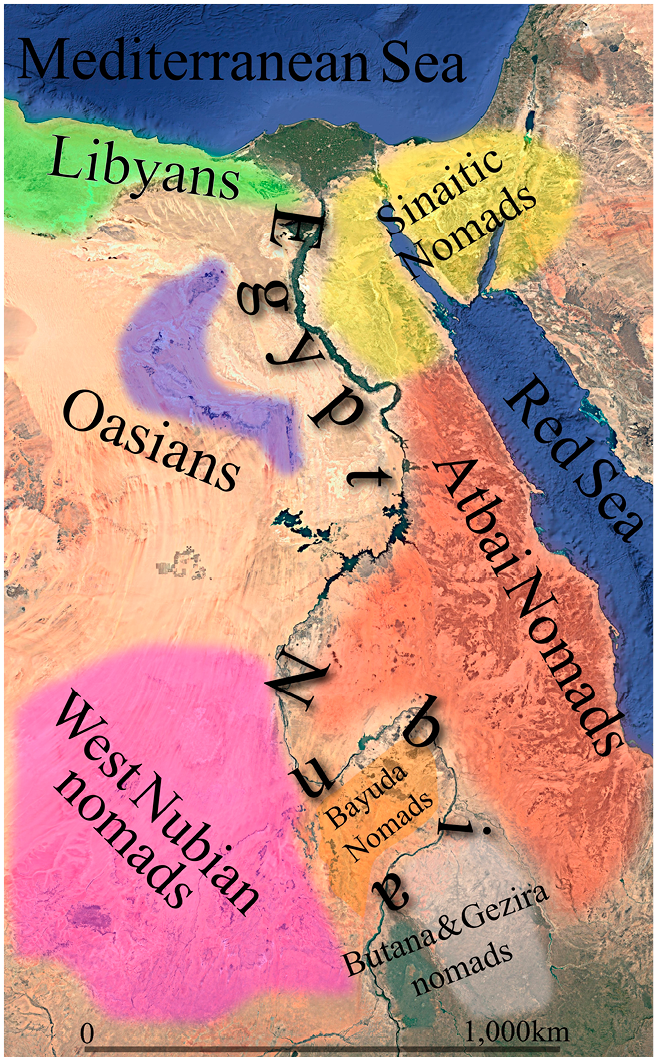
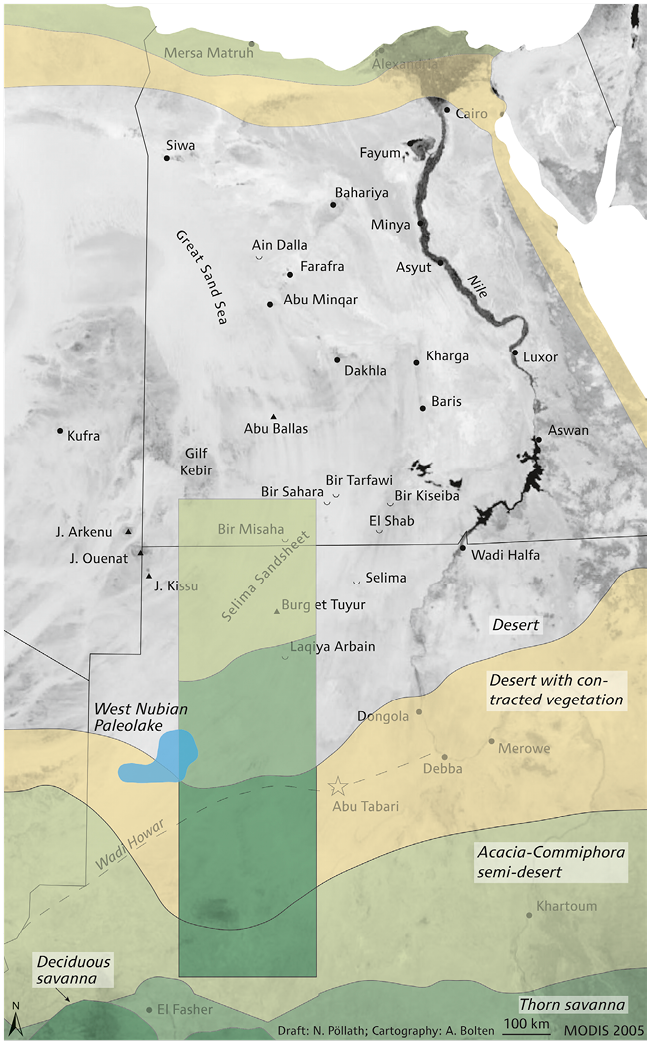
The common thread of nomadism in Northeast Africa, beyond the dryland settings and herding, is a connection to the Nile River (Figure 1). As is witnessed in the archaeological record, even those nomads in distant regions of the Western Desert or Red Sea hinterlands (Förster Reference Förster2015; Cooper Reference Cooper2021c) were affected by the regimes and exchange circuits of the distant Nile; there was no such thing as a ‘nomadic island’ or autarky. This Nile magnetism had a significant bearing on the nomadism practised in Northeast Africa, with all nomadic peoples being proximal to a super-dense agricultural population on the Nile in the form of Egypt and Nubia. For nomads, while the Nile and its states were not a territorial home in most instances, they provided a constant source of trade, pasture, and refuge, as well as agricultural wealth. Regular seasonal movements could involve the Nile Valley itself, as in the case of the Beja on the Nubian Nile in ancient and premodern times (Vantini Reference Vantini1975: 161; Crawford Reference Crawford1951: 89) or the Libyans on the Western Delta periphery (Moreno Garcia Reference Moreno García2014).
Nomadic cultural-ecological zones of the Nile basin.
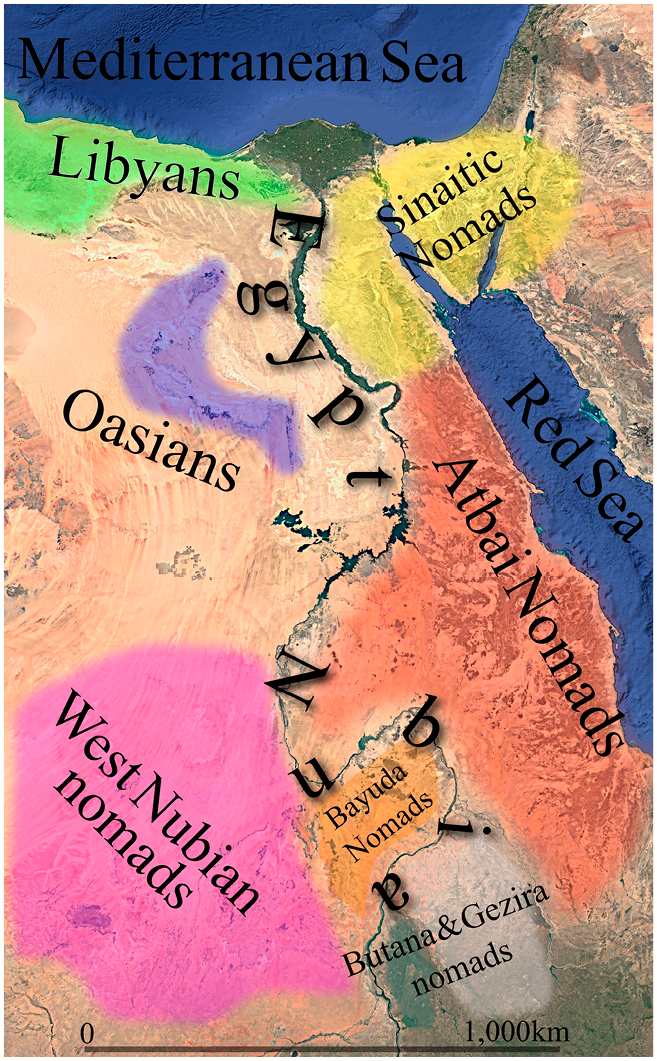
Local ecologies in the regions immediately adjacent to the Egyptian Nile were generally hyperarid and not conducive to high-density nomadism, especially so in the Western Desert. The exceptionally mountainous topography of the Eastern Desert has always provided a home to nomadic populations since the Neolithic, although the ecological profiles differ massively from the drier wastes of the northern Khushman deserts of Lower Egypt (Tregenza Reference Tregenza1955) to the fertile acacia forests and steppe of ‘east Nubia’ or the Atbai (Andersen et al. Reference Andersen, Krzywinski, Talib, Saadallah, Hobbs and Pierce2014; Manzo Reference Manzo2017). This led to very different demographic settings and historical trajectories for the ‘north’ and ‘south’ regions of the Eastern Desert (Cooper Reference Cooper and Cuvigny2022b). The artesian basins of the Egyptian oases (Ricketts Reference Ricketts, Warfe, Gill, Hamilton, Pettman and Stewart2020; Jeuthe Reference Jeuthe2021) provided a haven for pastoralists throughout the ages, although the surrounding deserts seem to have been abandoned since the Neolithic. Further north, the Mediterranean littoral constitutes an altogether more conducive climate pattern for pastoralists, with rainfed winter pastures on the entire coastal littoral west of the Delta (Vetter et al. Reference Vetter, Rieger, Möller, Förster and Riemer2013). Likewise, the Sinai desert corridor towards the Levant provided similar profiles, with the mountainous south of the peninsula being especially conducive to sustaining pastoralists and even opportunistic agriculture in the narrow ravines (Rosen Reference Rosen1988).
1.4 The Herd
Given the multi-millennial existence of nomadism in Northeast Africa, it is perhaps surprising that the basic composition of herds changed very little and nomads more or less inherited the package of Neolithic domesticates that had arisen in the Near East (Smith Reference Smith2005). Goat, sheep, and cattle were the first animals to be domesticated in Northeast Africa, a historical event that ushered in the first lifeways and subsistence trajectories that we might label as ‘pastoral nomadic’. There are still significant debates as to the date of the domestication of these animals, with key sites in the early Neolithic such as Nabta Playa having difficult stratigraphic settings from which to elucidate dates (Brass Reference Brass2018; Dubosson Reference Dubosson, Emberling and Williams2021). There are also significant questions surrounding the proposal of independent cattle domestication in Africa separate from a Near Eastern introduction (Stock & Gifford-Gonzalez Reference Stock and Gifford-Gonzalez2013; Osypinska et al. Reference Osypińska, Osypiński, Wiktorowicz, Chłodnicki, Łopaciuk, Bobrowski, Cendrowska, Kokolus and Madani2025). Goats and sheep were domesticated somewhat earlier than cattle in the Eastern Sahara, for which the first dates are around the seventh millennium bce in Nabta Playa and c. 6000 bce in Upper Nubia, with a significant margin of error for both these dates (Vermeersch et al. Reference Vermeersch, Linseele, Marinova, Van Neer, Moeyersons and Rethemeyer2015; Brass Reference Brass2018; Garcea Reference Garcea2020: 111).
The humble donkey, the most useful pack and riding animal until the arrival of the horse and camel, presents a different story altogether, with current scholarship suggesting a Northeast African domestication episode c. 5000 bce (Mitchell Reference Mitchell2018; Paprocki Reference Paprocki2019: 62–63; Rossel et al. Reference Rossel, Marshall, Peters, Pilgram, Adams and O’Connor2008). Well suited to drylands, the donkey is still an immensely useful animal for nomadic pastoralists; it is able to carry up to 50 kg loads and only needs to be watered every second day (Paprocki Reference Paprocki2019: 62–63). In some ways it is more versatile than the much more celebrated camel in that it can navigate rocky slopes and uneven terrain. Together with sheep, goats, and cattle, these animals provide much of the food and wealth of pastoralist societies, namely meat and milk, and a slew of other useful animal products such as skins, wool, and horns.
This incoming repertoire of Neolithic domesticates materialized at a fortunate time for dryland inhabitants. North Africa was in the midst of a climatic phase known as the African Humid Period, providing the maximum amount of pasture and water across the region that would not be replicated. While nomadic domesticates could expand into various ecological niches, due to the incoming drying period c. 3500 bce, the actual terrain that could support dryland nomadism was progressively shrinking (Section 1.5). Another important debate surrounding the incoming domesticates is whether they arrived alongside crops from the Near East – the so-called ‘cattle before crops’ proposition (Marshall & Hildebrand Reference Marshall and Hildebrand2002). This distinction in Northeast Africa partly means that nomadism, or some form thereof, likely a low-mobility herding practised alongside foraging of wild grasses, hunting, and fishing, predates intensive and settled agriculture in the region (Gatto & Zerboni Reference Gatto and Zerboni2015: 317).
Almost all scholars who have studied herds in ancient Northeast Africa, from Nubia to Egypt and the deserts, have noted the esteemed position of cattle in ancient societies. This evidence comes from the rock art record, observations of bodily modification, interments in burials, and also later religious and mythological cycles (di Lernia Reference di Lernia2006; Dubosson Reference Dubosson and Honegger2018). It is difficult to concretely ascertain what motivated these widespread cattle traditions. Some have noted cattle’s prominence in funerary feasting or ceremonies (di Lernia Reference di Lernia2006), while ethnographic analogies might suggest perceived psychological and familial closeness or a ‘favourite’ status (Dubosson Reference Dubosson and Honegger2018) of cattle to the social-herding unit.
This latter point is certainly relevant to present-day cattle cultures in Southern Sudan and Ethiopia. The ethnographers Seligman and Seligman (Reference Seligman1932: 169) explained: ‘it is difficult to describe their importance to their masters or the love and care the latter have for their beasts, but it is surely no exaggeration to say that it amounts to what psychologists would term “identification”’. While cattle seem to be unusually prominent in symbolic culture compared with other domesticates, faunal analysis (Bangsgaard Reference Bangsgaard2013) reveals actual herd composition weighed heavily on ‘small stock’ such as goats. This agrees well with modern studies of dryland pastoralism, where cattle and large stock are generally in the minority in a mixed herd mainly comprising sheep and goat (Dahl & Hjort Reference Dahl and Hjort1976; Khazanov Reference Khazanov1994: 27).
The impact of the horse on nomadic societies in the region is very little studied compared to the topic of its introduction to Egypt c. 1500 bce. Generally ill-suited to the drylands of Northeast Africa, the horse was conceivably impactful on nomadic societies occupying Sahelian grasslands or the Mediterranean coast. The horse is attested in ancient Libyan society and especially among the Garamantes of the Fezzan (Bates Reference Bates1914: 96–97; Mattingly et al. Reference Mattingly, Gatto, Sterry, Ray, Gatto, Mattingly, Ray and Sterry2019). Elsewhere, medieval Arab geographers spoke of the Balliyyin, a people on the Nubia–Ethiopian borderlands who were known for their raids on horseback (Vantini Reference Vantini1975: 276). The horse is well known in medieval Darfur and Kordofan (Balfour-Paul Reference Balfour-Paul1955), where extensive grasslands and watering were suitable for its herding, although the date of its arrival and impact in the region is wholly uncertain. Kushite horses were renowned in the early first millennium bce (Heidorn Reference Heidorn1997), but this seems confined to pastures on the Nile Valley in Upper Nubia. There does not seem to be any indication of the type of widespread horse-based pastoralism one finds in Inner Asia, where raiding equestrian nomads used the animal to create large and expansive polities. For this kind of power and impact, Northeast Africa was transformed by a different ruminant altogether, the dromedary.
Two events changed herd composition across the Nile Basin irrevocably, and both should be considered revolutions in nomadic history. The first of these is the end of the African Humid Period (Shanahan et al. Reference 95Shanahan, McKay, Hughen, Overpeck, Otto-Bliesner, Heil, King, Scholz and Peck2015), a latitudinally progressive (north to south) collapse of the summer monsoon, which resulted in the growth of hyperarid deserts and the retreat of pastoralists. In northerly climes, the slow drying of the Sahara was manifested in the local abandonment of water-needy cattle for the hardier goat or wholesale population exodus (Bobrowski Reference Bobrowski, Jórdeczka, Kobusiewicz, Chłodnicki and Kusiak2013; Jesse et al. Reference Jesse, Kröpelin, Lange, Pöllath and Berke2004). It is even possible that domesticates themselves exacerbated desertification in this period (Zerboni & Nicoll Reference Zerboni and Nicoll2019), with large herds of hoofed animals contributing to erosion and ecological change.
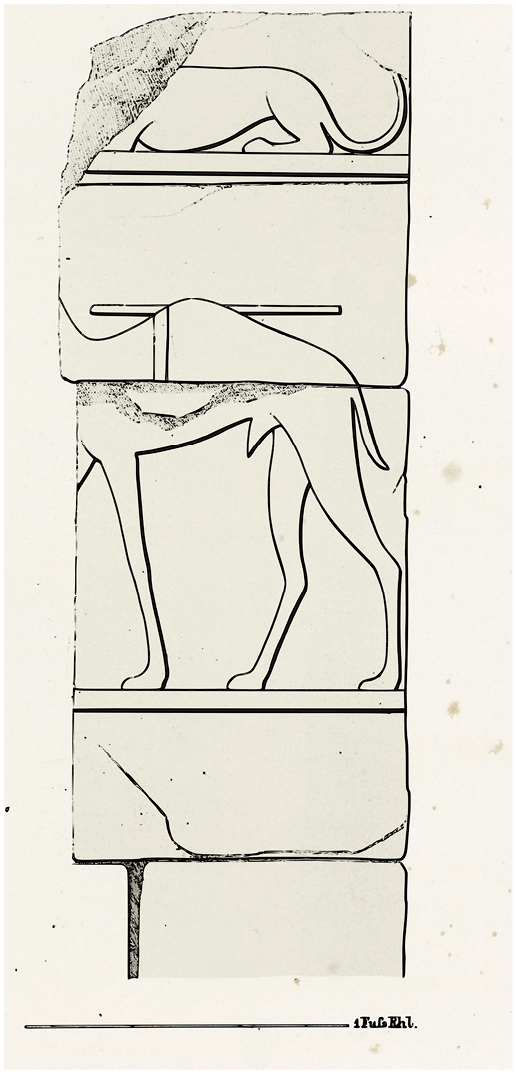
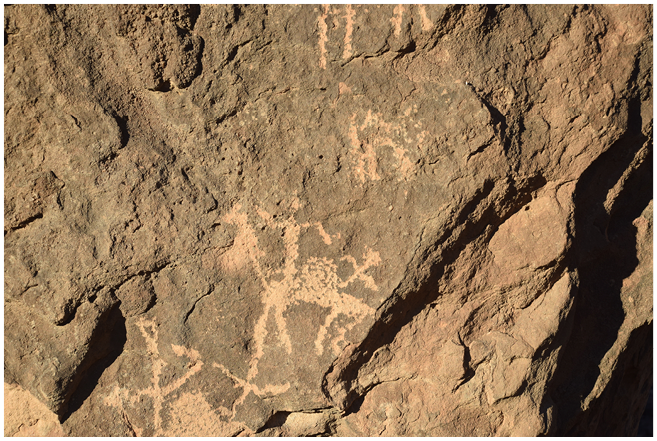
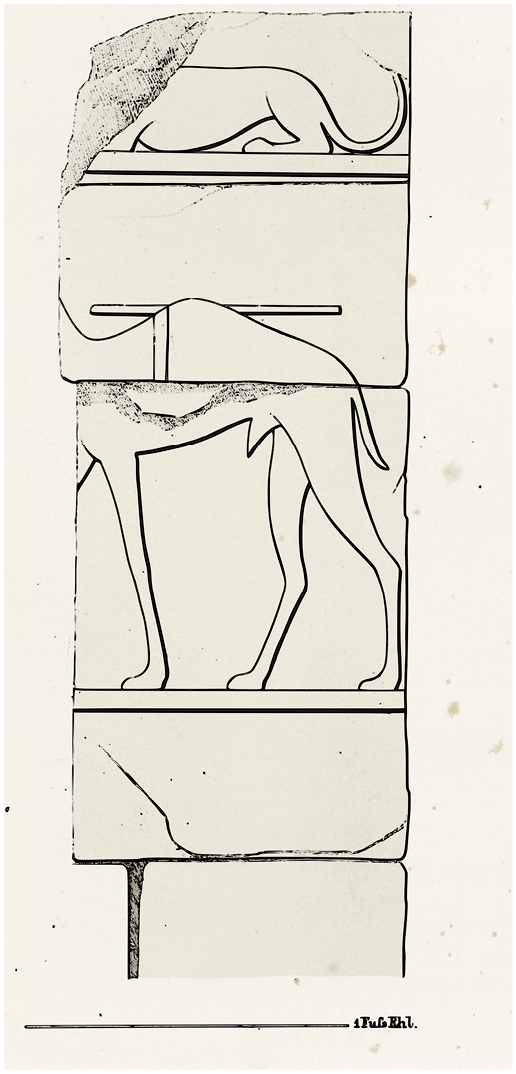
The other major transition is the advent of camel domestication in Northeast Africa, a supra-regional development in the late first millennium bce or early first millennium ce that forever changed the composition of nomadic herds. The exact date and manner of arrival is the subject of significant debate, with multiple dates and routes discussed for migration from Arabia, namely the Sinai land bridge or a direct route over the Red Sea or the Horn of Africa (Bulliet Reference Bulliet1975: 28–56; Paprocki Reference Paprocki2019: 68). Generally, it has been observed that the camel becomes commonplace in Egypt in the late first millennium bce, and in Nubia somewhat later, c. the first century ce (Welsby Reference Welsby1996: 155) (Figure 2). These debates over camel domestication are very confused by the interpretation of archaeological finds of camels in urban contexts and desert roads as signs of local domestication amongst nomadic pastoralists. The camel was ill suited to humid and riverine conditions and its impact was bound to be greater on desert nomads, even if it did have a transformative impact on desert caravan routes and land transport in urban economies (Bulliet Reference Bulliet1975). The much more difficult and meaningful topic for the history of nomadism is the question of when exactly desert pastoralists began to incorporate camels into their herds.
Camels in Kush: a depiction of a camel on a royal pyramid at Meroe (N.15), approximately the second century bce.
It seems that the camel came to be widely adopted by desert nomads in the early Roman period, with some limited evidence of earlier domestication in the Ptolemaic Eastern Desert (Manzo Reference Manzo2004; Cuvigny Reference Cuvigny, Agut-Labordère and Redon2020). Local camel domestication expanded nomadic transhumance into drier areas and also caused the demographic expansion of nomads in general, as it provided a new source of milk, meat, and skins, as well as beasts of burden and weapons of war (Cooper Reference Cooper2021c). Whatever the manner of arrival, the adoption of camel by nomads transformed pastoralist societies and eventually shifted the balances of power away from sedentary regimes towards nomadic ones. Native to the similar climes of southern Arabia, the camel was perfectly suited to dryland Northeast Africa, forever changing nomadic economies, subsistence strategies, mobility, and general historical trajectories.
1.5 Managing a Herd
Herd composition and management strategies are highly variable from group to group, as is the size of the herd itself (Khazanov Reference Khazanov1980; Dahl & Hjort Reference Dahl and Hjort1976). Distinctions are made between livestock in terms of grazers, predominantly feeding on grasses, and browsers, stock which can consume shoots and leaves, as well as woody and scrubby plants. Sheep and cattle are grazers, while goats, camels, and donkeys can fall into both categories (Manger Reference Manger and Manger1996; Wilson Reference Wilson1984: 105). The camel in particular can capitalize on an amazing diversity of desert vegetation in different settings, consuming, for example, grasses (Aristida pungens, Cyperus congolmeratus, Leptadenia pyrotechnica, and Panicum turgidum) as well as trees and shrubs (Acacia sp., Ziziphus, Capparis decidua, Maerua crassifolia, Sueda fruticosa, Balanites aegyptiaca, and Tamarix sp.) (Wilson Reference Wilson1984: 104). There is hardly a desert ecology that did not offer some of these species, making the camel the desert expert par excellence. Some herding strategies segmented camels into ‘breeds’ based on the varying vegetation in which they are led to and primarily feed upon, leading to different characteristics and thus uses of camels, alternatively for transport, milk, or speed (Hjort & Dahl Reference 86Hjort and Dahl1991: 129). Cattle herding was markedly different. Due to higher watering and grazing requirements, it usually involved a smaller ‘herding radius’, with constant movement having negative effects on body weight and milk yield (Coppolillo Reference Coppolillo2000; Fre Reference Fre2018). The provision of fodder can ameliorate poor access to pasture and is particularly suited to agropastoralist environments where crop residues can supply herds.
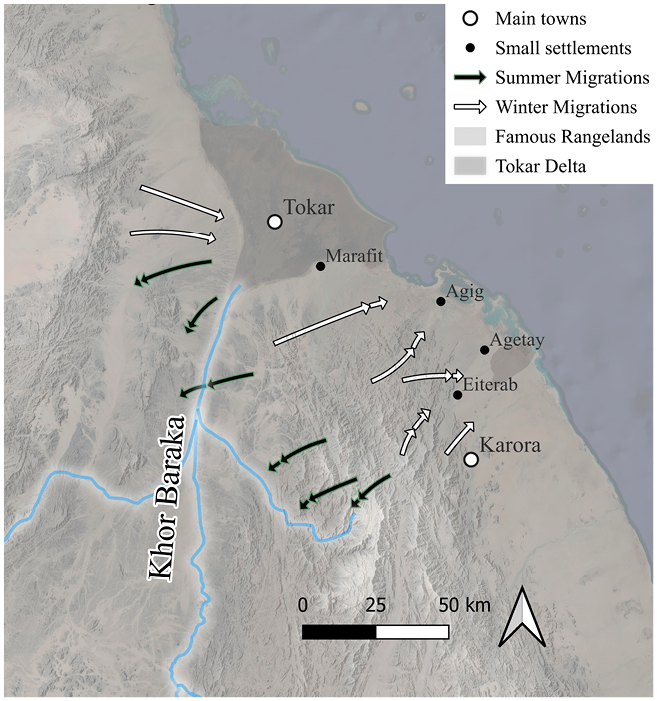
There are many limiting factors on herds and herders with respect to movement and mobility, and it is not possible to simply move an entire mixed herd anywhere for a slew of environmental and social reasons. Movement of families, herd, and camp is carefully considered and coordinated due to the limited carrying capacity of marginal environments, with animals needing to be regularly driven to water and pasture so as not to extinguish local resources. Viewed most basically at a macro level, movements take advantage of different ecological and seasonal profiles across the landscape to maximize pasture and water (Figure 3). Small-scale movements are always much more complex than these ‘linear migrations’ presented on maps would suggest. Different animals have different capacities for daily travel and water intake, meaning that herding and herd composition need to be specialized and carefully managed. Sometimes different animals needed to be herded separately within a single family unit (Dahl & Hjort Reference Dahl and Hjort1976). Generally, a mixed herd is desired for subsistence so as to have some contingency, with different animals consuming different vegetation, in addition to the different uses of animals for milk, meat, and skins. A surprising limiting factor on herd size is the number of available herders themselves (Khazanov Reference Khazanov1980: 11), while most works also cite the carrying capacity of the environment itself.
An example of long-distance nomadic seasonal migrations amongst the Beni Amer in the Tokar region.
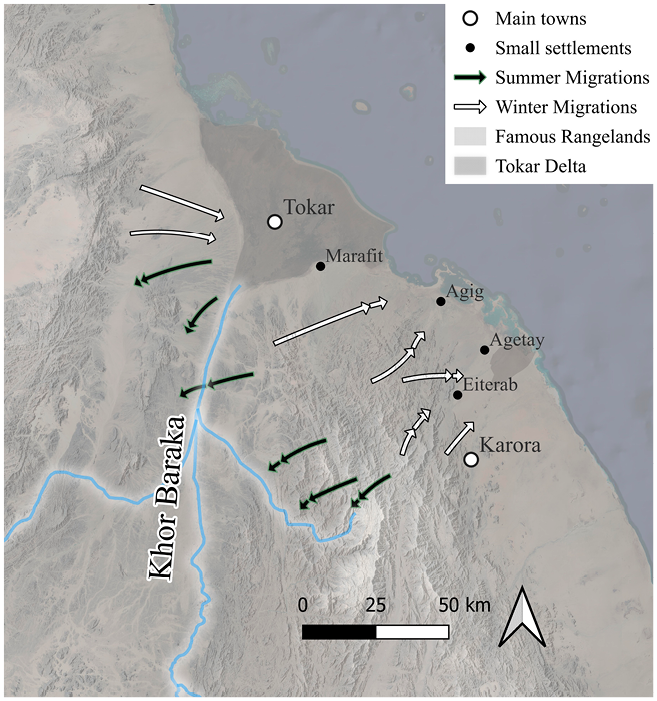
Livestock ratios and herd sizes are highly variable and usually considered in terms of small stock (sheep or goats) and large stock (camel or cattle). The maintenance of milking animals is usually desired for dryland pastoralists, while other animals can be used for slaughter, sale at markets, and herd growth (Dahl & Hjort Reference Dahl and Hjort1976). All of our exact data for herd size hail from modern ethnographies, and the introduction of the camel makes it difficult to ‘retroject’ modern data on the pre-camel antique past before the first millennium bce. In some cases, families separated herds according to their herding management profiles and mobility, with goat and sheep pastoralism practised in an agropastoralist or sedentary setting, and cattle and camels taken on long-distance transhumant migrations (Tsegay & Fre Reference 97Tsegay and Fre2013), as with the Beni Amer of the Eritrea–Sudan borderlands.
Cribb (Reference Cribb1991: 35) gives a minimum subsistence figure of between 50 and 100 goat and sheep per household in Near Eastern nomadic contexts that do not support cattle, which is largely consistent with modern figures in similar settings. In the Beja deserts, one study in Halaib found an average of 6.8 camels, 19 goats, 17.5 sheep, and 0.5 donkeys per household (Abbas & Tilley Reference Abbas and Tilley1991), but further south at Sinkat it was 1–2 camels, 10 goats/sheep, and 1 donkey (Manger Reference Manger and Manger1996: 123). The Kababish in western Sudan report that 20 camels and 40 sheep are sufficient for a single herd (Khazanov Reference Khazanov1980). Estimates are quite different in wetter ecologies favouring cattle pastoralism. The Beni Amer often speak of a herd of 60–100 cattle per household (Fre Reference Fre2018: 74), and cattle herders in the agropastoralist Butana kept 45 cattle, 49 sheep/goats, 2 donkeys, and 2 camels (Musa et al. Reference Musa, Peters and Ahmed2006). Dahl and Hjort (Reference Dahl and Hjort1976) tried to estimate a ‘minimum herd size’ but found difficulties in finding a meaningful average after assessing different pastoral settings and groups. To generalize, it appears that goat and sheep were the mainstays of many herds, offset by much smaller numbers of cattle and camel depending on aridity. As the basic requirements of the herd were to provide subsistence, these figures from (pre-)modernity seem to be generally relevant when reconstructing ancient herd compositions.
Within this schema, there are also the social aspects of livestock production – what the nomads want and desire from their herd. Subsistence from meat and milk is an obvious factor, but different animals always have varied utility within a society and in a wider exchange network. Factors such as social prestige, exchange value, and the ‘storing of wealth’ in livestock all play a part in the choices of pastoralists. Branding (Arabic wasm) of large stock (camel and cattle) for the purpose of property marking is commonplace today (MacMichael Reference MacMichael1913) and also attested in the ancient past (de Jong Reference de Jong, Bouderbala, Denoix and Malczycki2017: 16–17; Cooper Reference Cooper2020a: 11–12). The resilience of the Northeast African mixed herd, both in its pre- and post-camel forms, expresses a very suitable and profitable adaptation of people to dryland environments. Just as farmers had harnessed the Nile floods to create an agricultural surplus, nomads carefully experimented with different livestock, livestock ratios, transhumant systems, and exchange networks to create optimum conditions for wealth and subsistence, all while ‘mitigating risk’ through mobility.
1.6 Agropastoralism
Frequently, archaeological and anthropological scholarship has been surprised to find that peoples who are squarely described as being ‘nomadic’ have regularly engaged in the seasonal growing of crops, where the outward expectation of peoples living outside the Nile Valley has been an almost total reliance on the herding of animals for subsistence in their desert climes. The term most commonly employed for a mixed practice of pastoral nomadism and farming is ‘agropastoralism’ (Sadr 1991; Khazanov Reference Khazanov1994), a catch-all label that can refer to communities that maintain combined practices of pastoral herding mixed with agriculture. Within this schema, actual agropastoralist practices differ extraordinarily, and the term is partly redundant as the frequency and exchange of livestock raising for farming and coexistence of both could be quite common, complex, and fluid.
Often agropastoralism has a seasonal overlay with particular seasons promoting expansion of pasture and thus livestock mobility. Sometimes tribes or families would segment according to this mode. Manger (Reference Manger and Manger1996: 96–97) describes the Bishariab branch of the Hadendowa as divided into a nomadic section who moved their herds to the coast in winter and a sedentary population who cultivated crops in the more fertile wadis. With newer research illustrating that even small rainfall events in <100 mm isohyets could lead to opportunistic agriculture (Krzywinski & Pierce Reference Krzywinski and Pierce2001: 50–51; Biagetti et al. Reference Biagetti, Lancelotti, Zerboni, Usai and Madella2018), our models for nomadic peoples in the region must allow for regular and opportunistic ‘mixed resource’ strategies and the quick adoption or abandonment of different modes of production.
Subsistence strategies in drylands do not seem to be static, and there were always historical ebbs and flows moving a given group in one direction on the continuum between pastoral nomadism and agricultural sedentism. Various regions have witnessed phases of nomadization or sedentarization (Haaland Reference Haaland and Barth1969, Reference Haaland1972) in response to a highly complex milieu of climatic, economic, or socio-political factors. Analyses of faunal deposits and domestic sites over long periods in the Kassala region have demonstrated various phases of nomadization and sedentarization (Manzo Reference Manzo2017). Reconstructions of mid first-millennium ce Lower Nubia have posited nomadization of the Lower Nubian riverine space under the aegis of the Eastern Desert Blemmyes (Obłuski Reference Obłuski2014). The Sinai deserts have likewise been witness to complex phases shifting from one subsistence practice to the other (Finkelstein & Perevolotsky Reference Finkelstein and Perevolotsky1990).
Reconstructions of the subsistence of the Libyan–Mediterranean littoral demonstrate agropastoralist tendencies in most periods (Rieger et al. Reference Rieger, Vetter, Möller, Barnard and Duistermaat2012; Vetter et al. Reference Vetter, Rieger and Nicolay2014), with local populations keeping herds but also engaging in seasonal agriculture in coastal wadis, with the growing season commencing after winter rains. The medieval writer Ibn Ḥawqal spoke of ‘sedentary Beja’ in the Eastern Desert of Sudan (Vantini Reference Vantini1975: 160) who grew crops near the more fertile seasonal rivers, unlike the rest of the Beja, who were transhumant nomads. Perhaps the most celebrated case study of agropastoralism is the Butana deserts or the ‘isle of Meroe’, the heartland of the Meroitic kingdom where the Kushites built major dams called hafirs that aided pastoralist populations (Bradley Reference Bradley1992). Constructing these hafirs next to monumental temples of the Kushite state was a deliberate agropastoralist state project unlike any other.
Even in cases where nomads did not ‘grow crops’, they were always connected to the agricultural world through trade and other activities. These relationships are sometimes imagined as a ‘triangle’ of interdependencies between nomads, village agriculturalists, and urban centres (Anfinset Reference Anfinset2010: 86). Nomadic peoples often have special enzymes and diets suited for the consumption of meat and milk (Smith Reference Smith2005: 145) but still require cereal foodstuffs and carbohydrates, creating symbiotic dependencies between herder and farmer (Sadr 1991; di Cosmo Reference di Cosmo2002: 156). For this reason, some archaeologists investigating prehistoric Northeast Africa suppose that true pastoral nomadism as an adaptive subsistence strategy was only possible in response to and in proximity to the existence of agricultural centres (Sadr 1991; Brass Reference Brass2015). Such definitions may, however, preclude earlier ‘mixed resource’ strategies, especially from the Neolithic, as being typologically classified as ‘true’ nomads. There are, of course, many gradations and sub-types of practices within this schema, with some nomadic groups moving into agricultural areas as part of their seasonal cycles and other groups having lesser reliance on exchange. In practice, no nomadic group is completely isolated. For example, the Tubu, one of the more geographically distant nomadic groups in the region who occupy the hyperarid deserts of northern Chad, still practise concerted trade with urban centres (Beck & Huard Reference Beck and Huard1969).
1.7 Climate, Ecology, and Transhumance
Nomadic pastoralist climes are what ecologists call ‘marginal’. The rainfall across nomadic ecologies is enough to recharge water trapped in wadi basins, create seasonal grasses, and sustain hardy trees such as acacia and tamarisk as well as a host of other useful grazing bushes and scrubs – sometimes even creating periodic rivers such as the Atbara, Gash, or Baraka. But the rainfall is erratic, unreliable, and not evenly distributed across the landscape, making transhumance patterns unpredictable. Where the rainfall averages zero and there is no conducive surface water, nomadism is non-existent. Such deserts as the Egyptian Western Desert south of the Mediterranean littoral are generally witness only to other activities connected with trading caravans or mineral exploitation (Förster Reference Förster2015), at least since the change in climate at the end of the Neolithic.
In many regions rainfall is strongly seasonal, which necessitates corresponding movements to maximize herding rangelands and not place undue pressure on one single area. This movement also has the benefit of allowing communities to engage in different economic activities beyond subsistence herding, such as trade or mining (Liszka Reference Liszka2024). In the Mediterranean littoral, rain falls on the coast in winter, meaning that seasonal crops must be grown at this time, and correspondingly it is likely the season when nomads stayed nearest the coast (Rieger et al. Reference Rieger, Vetter, Möller, Barnard and Duistermaat2012), allowing them also to participate in maritime international exchange circuits. In the Beja deserts of the Atbai, winter rainfall is on the Red Sea coast, with the western slopes of the Red Sea Hills receiving rain in summer (Andersen et al. Reference Andersen, Krzywinski, Talib, Saadallah, Hobbs and Pierce2014), a cycle that also gave them access to different maritime resources and trade networks in different seasons.
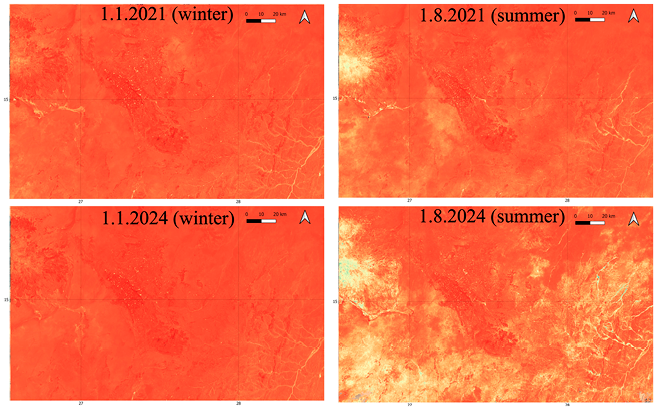
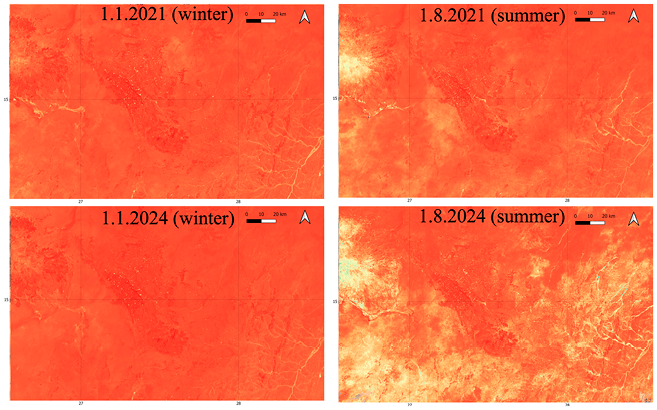
Such dryland ecologies are incredibly sensitive to climate oscillations, and dryland climes rarely receive evenly apportioned rainfall year on year, giving each precise landscape a non-uniform appearance and utility (Figure 4). Ecologists sometimes characterize drylands as ‘non-equilibrium ecosystems’ (Behnke et al. Reference Behnke, Scoones and Kerven1993), unstable ‘non-balancing’ ecologies with high variation in vegetation and carrying capacity, often with external forces driving rapid ecological change (weather, population, disease, etc.). This sort of ecology obviously produces flow-on effects for nomads, favouring high-mobility lifestyles and opportunism (Marshall et al. Reference Marshall, Grillo, Arco, Miller, Moore and Ryan2011: 46). This fact remains one of the reasons why nomadic herding and seasonal transhumance are never identical across or even within nomadic societies. Part of any strategy of livestock herding in drylands involves chasing the rain for water and seeking out new pasture according to opportunity rather than predictable movements (Paul Reference Paul1954: 14); however, in most settings there is a larger overlay or trend of summer and winter movements.
Inter- and intra-annual variability in vegetation in a region characterized by summer monsoon (Jebel Meidob and Wadi el-Milk, Darfur-Kordofan), observed through mean the Normalized Difference Vegetation Index.
Droughts, sometimes years in length, are a regular occurrence and can decimate herds. Dahl and Hjort (Reference Dahl and Hjort1976: 161) report stock losses of up to 90 per cent in the 1984–1986 drought in Eastern Sudan, for example, accelerating processes of urbanization for Beja, who sought out employment opportunities in cities. The 1980s droughts in agropastoralist northern Darfur resulted in many societal changes, with stock losses in cattle being followed by the purchase of hardier goats, introduction of foddering measures, and mass migration to urban centres (Tobert Reference Tobert1985). Difficulties in appropriating mediums of exchange put further pressure on households to adapt and sell livestock, something that surely occurred in the past in times of stress.
Any herding strategy must involve contingencies for ‘major’ events, such as movement to new pastures, reliance on trading or raiding for foodstuffs, and the substitution of different livestock. This includes the abandonment of the thirsty cattle in deteriorating climates, or most radically, sedentarization to riverine areas. Uniquely in world history, the Nile provided an obvious refuge for desert nomads in all periods, an oasis ribbon snaking through the nomadic drylands of Northeast Africa. This ‘Nile node’ feature partly explains why the Egyptian and Nubian worlds received constant exchange and diaspora formation with respect to the nomads of the desert world. It was an enduringly reliable source of water and pasture.
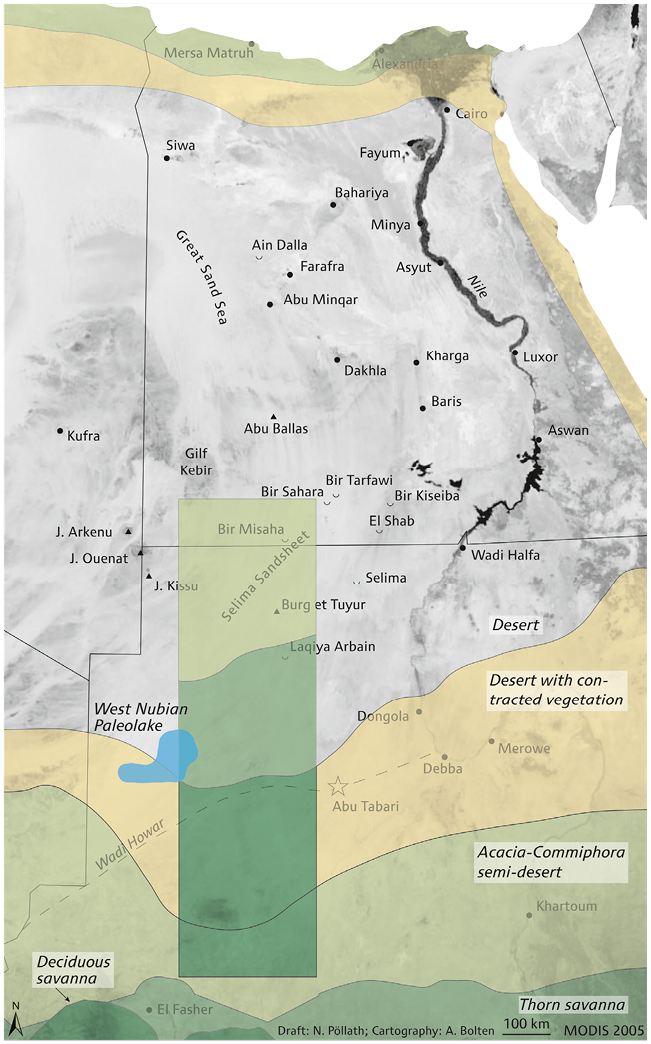
The nomadic world is always inbuilt with seasonal climate flux, but then there are also macro-climatic shifts that affect all societies, which have a tremendous effect on the composition of herds and the migration of nomads. By far the most important event in this discussion is the gradual termination of the African Humid Period c. 5500 years ago (Figure 5) (Shanahan et al. Reference 95Shanahan, McKay, Hughen, Overpeck, Otto-Bliesner, Heil, King, Scholz and Peck2015). In fact, it can be considered an opportunistic fluke of history that Neolithic livestock had arrived from the Near East in Africa in this period before c. 6000 bce (Brass Reference Brass2018), at a time when rainfall patterns and ecologies were most conducive to domestication. The end of this drying phase, variably dated from 4000 to 2000 bce based on latitude, constituted one of the largest demographic changes in the African continent until pre-modern times (Ménot et al. Reference Ménot, Pivot, Bouloubassi, Davtian, Hennekam, Bosch, Ducassou, Bard, Migeon and Revel2020). Country-sized parts of the Sahara became unliveable, and nomads retreated to refugia on the river or sought savanna further south in the newly located Sahel or, alternatively, exchanged cattle for more water-efficient ruminants such as goats (Bobrowski et al. Reference Bobrowski, Jórdeczka, Kobusiewicz, Chłodnicki and Kusiak2013; Cooper & Vanhulle Reference Cooper and Vanhulle2023).
Mapping ecological zones in the present Sahara with the climatic zones in the climate optimum in the African Humid Period in the inset.
The termination of the African Humid Period is perhaps the most dramatic climatic shift in the region, but smaller-scale climatic events continued in later periods. All of these oscillations would have affected nomadic climes in complex ways but are far less studied. The well-known ‘4.2k event’, a rapid drying event roughly coeval with the end of the Egyptian Old Kingdom, surely affected these local drylands, although no study has been able to measure this concretely in the archaeological record, with some observations suggesting it may have transformed pastoralism in the Sinai (cf. Rosen Reference 94Rosen2011: 10). Even later, wetter conditions than today are reported in Red Sea Hills in the early first millennium ce (Mawson & Williams Reference Mawson and Williams1984). That these climatic changes occurred is beyond dispute, but almost nothing is known of their direct impact on nomadic pastoralists.
1.8 Nomadic ‘Tribes’
If the types of nomadism and herding practices provide difficulties for historians and ethnographers, even more thorny are the problems of defining their social organization. One scholar has even claimed that this difficulty in labelling nomadic social organization is the reason ‘historians dislike nomads’ (Lindner Reference Lindner1982). At the centre of this discussion is the common tendency amongst pastoral nomads to instil or express identity not in a territorially bound political institution or unit, ‘the territorial state’ or ‘kingdom’ (Yoffee Reference Yoffee2005).
Where Egyptian or Nubian territorial states invested their identity on their shared geography and (implied) membership to the institution of these territorial entities ruled over by a divine king, nomadic societies organized themselves into groups based on shared or espoused kinship (genealogies), travelling together throughout the landscape in smaller family units. This definition of tribes based on kinship, descent, and ancestry is sometimes overstated in scholarship on pastoralist societies (Sneath Reference Sneath2007; Manz Reference Manz2021), but the axiom is generally resilient in this regional context. While tribes still had territory, customary law systems usually allowed for mutual travel, trade, and watering (Morton Reference Morton1989; Rosen Reference Rosen2017). As social units they seem flexible, reorganizing, amalgamating, and reforming over time (Sneath Reference Sneath2007; Manz Reference Manz2021: 7–9). Problematically, most of the anthropological theories discussing the tribal unit have their case studies in South Sudan, the Middle East, or Central Asia, thus leaving a certain gap in the literature in dryland Northeast Africa.
For lack of a better word, this social unit is commonly called the ‘tribe’ although many other terms exist in each society to specify segments of a nomadic society. The term ‘tribe’ has suffered from severe judgemental and unhelpful appropriations stemming from colonial-era scholarship, which modelled many societies of ‘lesser complexity’ as being ‘tribal’, often using this word for any non-state society in Africa to distinguish them from centralized territorial kingdoms (Parkinson Reference Parkinson and Parkinson2002: 4–7). This also includes its evolutionary and ‘teleological’ usages to define a medial stage of socio-political complexity (tribal society).
Despite these inadequacies, getting rid of the word ‘tribe’ as a label for segments of nomadic pastoralist groups hardly assists in the task of understanding these institutions (Manz Reference Manz2021: 7–9) and even produces new difficulties and awkward expressions. Phrases such as ‘segmentary lineage group’, while seemingly accurate, further separate us from the societies we study and provide complex anthropological jargon that cannot help communicate generally understood concepts. Similar words or translations of ‘tribe’ often exist within nomadic societies to describe segments of their wider group (Arabic qabila ‘tribe’; Beja adat ‘branch’) (Morton Reference Morton1989).
Tribes all have names, often have a perceived common ancestor, frequently have a leader or ruling family group, and it is the tribe where expressions of self-identity often rest. It should be stressed here that a tribal name sits within the wider ethno-linguistic group, for example, ‘Quraysh’ versus ‘Arab’ or ‘Meshwesh’ versus ‘Libyan’. In the ancient past, tribal names are sometimes recorded, although with the exception of Ramesside enumerations of Libyan tribes (Grandet Reference Grandet1994: 251–252), it is only in Graeco-Roman and Arab sources that we have records for tribal lineages and names. Diverse ranges of Greek sources reference tribal names such as the Asarri, Bolgioi, and Abylloi in the Eastern Desert (Pierce Reference Pierce, Barnard and Duistermaat2012; Cooper Reference Cooper and Cuvigny2022b). Libyan tribes are known from authors such as Herodotus and Ptolemy (Bates Reference Bates1914), and North Arabian groups such as the Beni Djaifour (Arabs?) or Autaei (Nabataeans) are mentioned across diverse sources (Cooper Reference Cooper and Cuvigny2022b: 25; Winnicki Reference Winnicki2009). Medieval Arab geographers such as Ibn Ḥawqal and al-Yaʿqūbı̄ cite many of the still-present Beja tribal confederations such as the Arteiga and Amarar (Zaborski Reference Zaborski1965). There was also an etic ‘stereotyping’ tradition or labelling pastoralists after cultural proclivities such as ‘Fish-Eaters’ or ‘Elephant hunters’, not so helpful beyond conveying the urban views of nomadic life.
Tribal organization of a specific nomadic group can differ radically, and within this organization there are multiple levels of identification, larger ‘maximal’ or smaller ‘minimal’ lineages, with the latter usually corresponding to extended family households (Cribb Reference Cribb1991: 56). While language as a marker of identity commonly rests with the larger ethno-linguistic group (‘Libyan’, ‘Beja’, ‘Arabic’, etc.), tribal identification is much more localized and is often the more important institution, where territorial rights, alliances, and legal arrangements rest. Tribes own pasturing rights and water sources. Anthropological works frequently focus on the smaller segments of the tribe, such as family or household, as a unit of study (Tobert Reference Tobert1988; Prussin Reference Prussin1995), and this concords well with the realities of dryland pastoralism, where population densities are restricted.
Tribes within these larger groups are not always equal in terms of size, and hierarchies of prestige and subordinate tribes often exist – shattering any image of an egalitarian nomadic society. The situation of the pre-modern Beni Amer agropastoralists of Eritrea-Sudan is particularly germane to this view, with a minority and endogamous ruling caste, the Nabtab, presiding over serfs (Crawford Reference Crawford1951: 112–113). Hierarchical castes were also present in the medieval Beja, who controlled a subservient tribe called the Zanafig (Cooper Reference Cooper2020a). Chiefs or sheikhs rule over tribes, but egalitarian tendencies of councils place emphasis on consensus politics too (cf. McIntosh Reference McIntosh and McIntosh1999; Cribb Reference Cribb1991: 34). The Blemmyes of the mid first millennium ce, for example, had lesser chieftains co-sign the edicts of their king (Cooper Reference Cooper2020a). Castes according to specialist occupations are also present, such as potters or metalsmiths, as with the present-day Zaghawa (Mohamed-Salih Reference Mohamed-Salih1988).
All these observations on the tribal institution are broad generalizations. In ancient nomadic societies where no written records from neighbouring realms exist to reconstruct the internal political institutions in such societies, our inferences must rest on ethnographic analogies from traditional pre-modern nomadic practices (Section 4.6). An interesting question based on archaeological data would be whether ancient cemetery spatial distributions and burial sizes (Brass Reference Brass2019; Gonzalez-Ruibal et al. Reference González-Ruibal, Aparicio, Barrio, Simón, Fernández, de Torres Rodríguez, de León Juberías, Osman, Youssouf and Encinar2025) correlate to tribal lineages, hierarchies, and elites, something that seems very likely but difficult to prove with certainty.
2 The Nomadic Regions
The names and terms that ancient societies and modern scholars gave nomadic groups across dryland Northeast Africa are manifold, massively complicated by the common issue as to whether to label these groups by (presumed) ethno-linguistic correlates or geographic blocs on the one hand (‘ancestral Beja’, ‘Asiatics’), or archaeologically oriented material horizons (‘Pan-Grave’, ‘Sheikh Muftah’, etc.) on the other. A brief enumeration of the different nomadic pastoralists that existed across the Nile basin and adjacent regions is given in Cooper (Reference Cooper2022a) and Szuchman (Reference Szuchman and Szuchman2009). In prehistoric periods, material horizons or archaeological cultures remain the normative label for defining groups, whereas in later periods fairly recognizable historical terms such as ‘Libyans’, ‘Blemmyes’, ‘Noba’, or ‘Asiatics’ are commonly preferred in the scholarship.
2.1 The Sinai and Eastern Desert
Some form of ‘herder-gathering’ existed in the Sinai since the seventh millennium bce (Rosen Reference Rosen2017). The earliest Egyptian records speak of nomads occupying the adjacent Sinai Peninsula and its land bridge to the Levant, with some evidence for these groups also crossing the Gulf of Suez into the adjacent Lower Egyptian deserts (Cooper Reference Cooper2020b: 74; Tallet Reference Tallet2009). In most Egyptological literature, these people are termed ‘Asiatics’, also labelled by the enigmatic ancient Egyptian words Iuntiu (I͗wntw) or Aamu (ꜤꜢmw) (Diego Espinel Reference Diego Espinel2011). They can be archaeologically identified at least since the Early Bronze Age (3300–2000 bce) in surveyed camps across the entire Sinai (Sebbane et al. Reference Sebbane, Ilan, Avner and Ilan1993). These nomads shared undoubted connections with pastoralists further north in the Negev and Canaan. As time wore on, this population became more archaeologically enigmatic and mainly known through textual sources at Egyptian mining centres at Serabit el-Khadem (Goldwasser Reference Goldwasser2014; Bietak Reference Bietak, Buchez, Grimal, Tristant, Briois, Enany, Rochecouste, Lepreux-Midant and Bravi-Midant2021), but undoubtedly pastoralists continued to roam the wider region in the Middle and Late Bronze Age even if ill-defined in field surveys. Whether the Hyksos constituted part of this southern Levantine nomadic continuum or absorbed it is an incredibly complicated and open question (Mourad Reference Mourad2015).
The Shasu of New Kingdom (c. 1550–1050 bce) records are surely the geographic successors of this early Levantine nomadic continuum, attested throughout the southern Levant, the Sinai, and the Lower Egyptian deserts (Cooper Reference Cooper2020b: 93–98). As with the earlier Aamu, Shasu personal names recorded in Egyptian documents demonstrate that they spoke a Semitic language (Schneider Reference Schneider2003; Cooper Reference Cooper2020b: 73–76). Later records from the Graeco-Roman period would label these people as the ‘Saracens’ and then ‘Arabs’ (de Jong Reference de Jong, Bouderbala, Denoix and Malczycki2017), and by the period of Arab hegemony in Egypt we even hear of individual tribal lineages in the Nubian deserts like the Rabı̄ʿa (Vantini Reference Vantini1975). While the Sinai provided numerous watering opportunities and even the possibility of horticulture and agriculture in its fertile and steep ravines, the Lower Egyptian deserts were some of the driest across Northeast Africa. Ethnographies of the modern Maʿaza people in the Lower Egyptian desert demonstrate the high-mobility strategies of nomads in this region (Tregenza Reference Tregenza1955), nowadays based chiefly on goat and camel herding.
2.2 The Atbai
The Eastern Desert of Upper Egypt and Nubia, the Atbai, was the abode of a large pastoralist cultural horizon. Egyptian records would subsume these people under the general term ‘Nehesy’, but more specifically as Medjay by about 2300 bce (Liszka Reference Liszka2012). These Medjay were no doubt the heirs to a Neolithic tradition in the region, which had adopted cattle, sheep, and goat, and roamed the wide deserts and ranges of the Red Sea Hills (Bobrowski et al. Reference Bobrowski, Jórdeczka, Kobusiewicz, Chłodnicki and Kusiak2013; Cooper & Vanhulle Reference Cooper and Vanhulle2023; Osypinski et al. Reference 92Osypiński, Osypińska and Zych2021). One of the greatest debates concerning Atbai pastoralists is whether the Pan-Grave culture (c. 1800–1550 bce), an intrusive Nubian-aligned culture spread throughout Egyptian and Nubian Nile valleys, is the material manifestation of these groups, or some other transformation or entanglement of nomad diasporas (Näser Reference Näser, Barnard and Duistermaat2012; de Souza Reference de Souza2019). Unquestionably, this ‘Nile diaspora’ exhibited a material culture that aligned them with Nubian pastoralists. The Jebel Mokram culture of the Kassala region is likewise a possible manifestation of this same Atbai pastoralist continuum further south (Manzo Reference Manzo2025). As far back as 2000 bce, the language of these nomads can be associated with a predecessor of the later Beja language (Cooper Reference Cooper2021b), a Cushitic language still spoken across the same area.
The newfound interest that Graeco-Roman regimes exhibited in the Eastern Desert and Red Sea ports provides a range of historical data on these nomads. These authors mention a group called ‘Trogodytes’ (Eide et al. Reference Eide, Hägg, Pierce and Török1994–1998: III, nos. 189, 198; Cooper Reference Cooper and Cuvigny2022b), followed by a much clearer picture of the ‘Blemmyes’, chiefly known in the first half of the first millennium ce. Economically supercharged by the arrival of the camel, the Blemmyes dominated the entire desert space from Coptos to Kassala and even controlled sections of the river around Lower Nubia and Moʿalla in Upper Egypt (Cooper Reference Cooper2020a). They were also instrumental in facilitating Red Sea coastal ports and trade routes (Cobb Reference Cobb2021). Surveys have given a clear conception of the Blemmyes from their camps and cemeteries and distinctive ceramic repertoire ‘Eastern Desert Ware’ (Barnard Reference Barnard2008; Lassányi Reference Lassányi, Godlewski and Łajtar2010; Cooper Reference Cooper2021c). By the Arab period, the moniker ‘Beja’ replaces ‘Blemmyes’. Viewed over successive epochs, there appears to be a good degree of cultural continuity in the region.
2.3 Butana, Bayuda, and Gezira
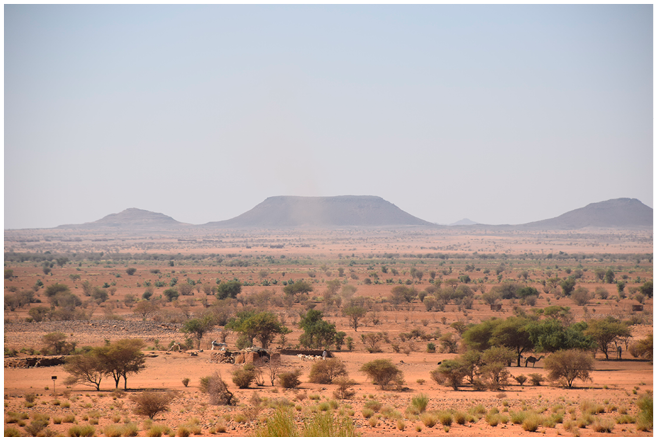
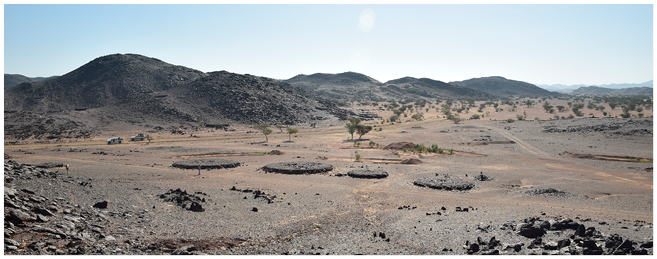
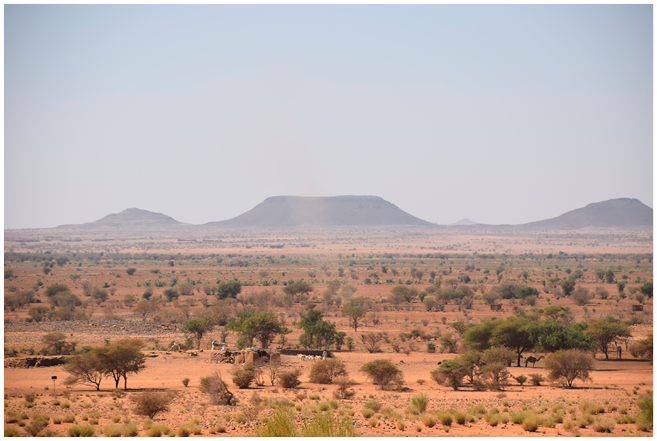
The bends of the Upper Nubian Nile and the neighbouring Atbara river created ‘tongues’ of desert in the bends of the river, with plentiful grasses and acacia forests conducive for pastoralists (Bradley Reference Bradley1992; Karberg & Lohwasser Reference Karberg, Lohwasser, Paner, Masojć and Obłuski2021) (Figure 6). This fertility coincides with the northerly reaches of the African monsoon, and thus these deserts were seasonally charged with grasses. In archaeological terms, the Neolithic is represented by the Butana Group (3500–3000 bce), a horizon of probable agropastoralists which spread southwards as far as Kassala (Bradley Reference Bradley1992; Manzo Reference Manzo2017: 22–27). Neolithic occupations are also well-documented in the Bayuda, both cemeteries and habitation sites (Karberg & Lohwasser Reference Karberg, Lohwasser, Paner, Masojć and Obłuski2021: 28–30).
The acacia savanna of the Butana desert.
These regions always exhibited a unique and intimate geopolitical relationship with Nubian riverine polities, who seemed to have variably controlled them or at the very least exerted a strong influence over these deserts. The Kerma culture, centred in the Nile around Dongola Reach, extended into the Bayuda deserts (Paner Reference Paner, Lohwasser, Karberg and Auenmüller2018), although it is difficult to assert whether this was an extension of the Kerma culture (or polity?) from the Nile or rather a material diffusion of Kerma funerary traditions into the deserts. Despite being an obvious dryland zone, the Butana in particular was integrated into the Kushite state in its Meroitic phase (c. 300 bce–400 ce). Earlier hypotheses that the Bayuda may have been dominated by Kushite trade routes and desert paths have given way to an uncertain status for this region in the geopolitics of the Middle Nile (Karberg & Lohwasser Reference Karberg, Lohwasser, Paner, Masojć and Obłuski2021: 82).
In the Butana, an extensive programme of temple towns was constructed throughout this savanna (Wolf Reference Wolf and Raue2019), the famous ‘Isle of Meroe’ of classical authors. Celebrated examples of these temples include Musawwarat es-Sufra and Naqa, massive stone complexes which must have been central nodes for pastoral activity and likewise summer farming, making this savanna landscape a vast agropastoralist zone. Such were the watering opportunities in this desert that the Kushites developed a hydrological engineering programme, creating large hafir dams (Hinkel Reference Hinkel2015) and channelling pastoralists’ transhumance activities towards these urban temple sites. In such settings so intertwined with the Nubian Nile, it is difficult to isolate separate material horizons from those on the river, although it must be assumed that the inhabitants of these deserts practised a partly transhumant living based on cattle pastoralism (Karberg Reference Karberg, Lohwasser and Wolf2014).
South of Khartoum is the triangle of land between the Blue and White Niles, the so-called Gezira (Ar. ‘island’). Well-known archaeologically thanks to the excavations of a large pastoralist cemetery at Jebel Moya (Brass Reference Brass2016), this first millennium ce cemetery was an important landmark in a vast grassland steppe. Nearby nodes of cultivation on the Nile such as Abu Geili point to constant interaction between cattle grazers and river cultivators, both possibly situated at the southern fringe of the Kushite state.
2.4 West Nubia
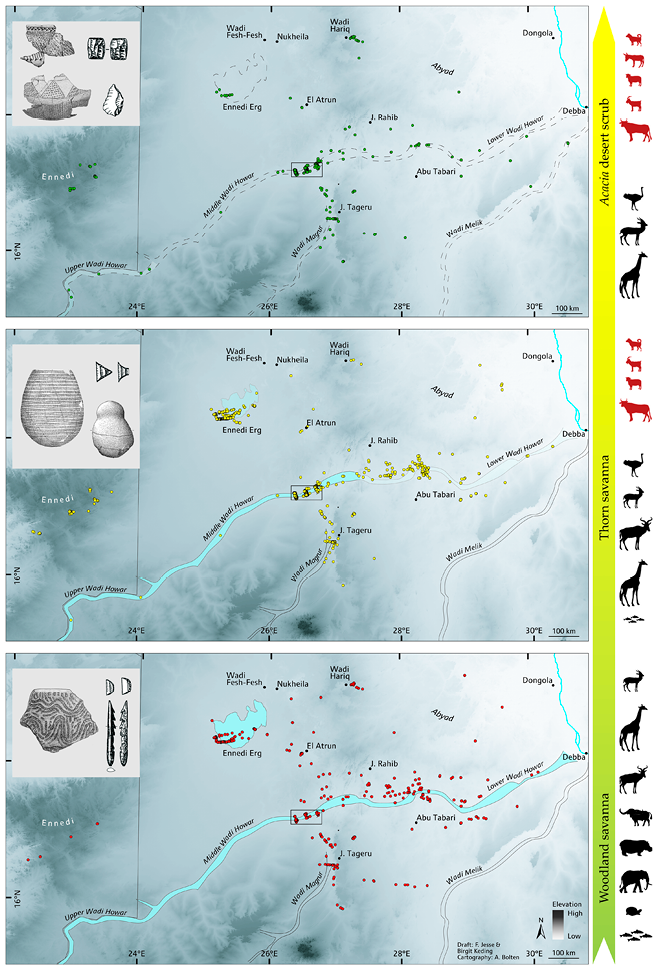
The vast deserts of west Nubia, modern Kordofan and Darfur, and the deserts further north witnessed a drastic transformation with the termination of the African Humid Period. Before this time, pastoralists roamed across the playas and large wadi catchments like Wadi Howar, an ancient Nile tributary extending from Chad to the Nile near Dongola. The north witnessed a nomadic depopulation. With the cessation of rainfall during the fourth and third millennia bce, nomadic rangelands became much more restricted. Successive pastoralist complexes termed by their associated ceramic typologies, Leiterband (4000–2200 bce) and finally Handessi (2200–1100 bce) characterize much of the west Nubian desert (Jesse et al. Reference Jesse, Kröpelin, Lange, Pöllath and Berke2004). Large stock became much less common by the Handessi Horizon with the deteriorating summer monsoon, and thereafter the only occupations in the northerly deserts seem to have been the most highly mobile groups or Kushite expeditions that constructed fortresses on trade corridors (Jesse Reference Jesse and Raue2019).
Later populations and developments in the southerly climes have not been subject to as much research. Excavations at Jebel Zankor have revealed long traditions of pastoralist occupations (Gratien Reference Gratien2013), while the medieval Christian Nubian kingdoms exercised some suzerainty over this area as evinced by the church settlement at Jebel el-Ain on the dominating watercourse of the Wadi el-Milk (Eger Reference Eger2011). It is from Kordofan and the Nuba Mountains, possibly also the Bayuda, that the Noba peoples are assumed to have had their home before emerging on the Upper Nile valley – the origin of our modern term ‘Nubians’. Classical historians have described the Noba as a nomadic ethnic group that migrated to the Nile in the late first millennium bce (Rilly Reference Rilly, Godlewski and Łajtar2008). By 400 ce, in the context of the political vacuum left by the fall of Meroe, the Noba had replaced the Kushites as overlords of the Middle Nile, crystallizing as the kingdoms of Nobatia, Maquria, and Alwa (Obłuski Reference Obłuski2014). The archaeological reality is much messier than this narrative, with no clear ‘break’ in the material record to demonstrate a pastoralist influx from the west (Edwards Reference Edwards, Dijkstra and Fisher2014). Further work is required to model pastoralist groups, mobilities, and identities across this space, as well as the utilization of fertile wadi basins west of the Nile such as Wadi Howar, Wadi el-Milk, and Wadi Muqqadam for seasonal agriculture.
2.5 Libya
The area termed ‘Libya’ in the relevant scholarship of ancient Northeast Africa does not correspond directly with the modern Libyan nation-state but is rather vaguely employed for all regions west of the Egyptian Nile, most notably the coastal littoral of the Marmarica and Cyrenaica of classical records (from the Delta to Tobruk). It has proven difficult to isolate and characterize earlier third and second millennium bce populations in this desert archaeologically, even if Egyptian records describe a succession of peoples from the Tjehenu (Ṯḥnw) and Tjemehu (Ṯmḥw) to the Libu (Lbw) and a constellation of associated tribes such as the Meshwesh (Bates Reference Bates1914; Hulin Reference Hulin, Bloxam and Shaw2020). Archaeological prospections have identified some earlier Libyan sites, even with suggestions of agropastoralists on the coast (Nielsen Reference Nielsen2017). Identifying the western Nubian deserts with this broad concept of ‘Libya’ should be avoided for a gamut of geographic and cultural reasons.
The resolution, both from archaeological and historical evidence, of historical Libya increases exponentially in the Ramesside Period (c. 1292–1077 bce), when Egyptian rulers established an ambitious series of fortresses extending hundreds of kilometres along the Marmarica coast (Snape & Wilson Reference Snape and Wilson2007). This newfound activity is mirrored by Egyptian war records, which speak of successive campaigning against encroaching Libyan groups (Ritner Reference Ritner and Szuchman2009). Eventually these groups, particularly the Meshwesh or Ma, would form something of an intrusive aristocracy in the Delta and become the ancestors to the ‘Libyan kings’ of Egypt in the Third Intermediate Period.
The other very different geographic setting in this ‘Libyan’ zone, a central part of the nomadic pastoralist activity, is the western oases of Kharga, Dakhla, Farafra, and Bahariya, as well as the more distant Siwa. Around Kharga and Dakhla, the Epipalaeolithic and Neolithic Bashendi A and B cultures (6500–3900 bce) gave way to the Sheikh Muftah Culture c. 3000–2200 bce (McDonald Reference McDonald2002), a culture that is frequently described as practising transhumance around Dakhla Oasis. Egyptian suzerainty expanded to the oases (except Siwa), creating a culturally entangled and colonized oasian region. Thereafter, the oases c. 2200 bce seem to no longer host an easily discernible indigenous pastoralist horizon (Ricketts Reference Ricketts, Warfe, Gill, Hamilton, Pettman and Stewart2020). This key zone of pastoralist activity was mainly suited to agropastoralism, with significant opportunities for agriculture within the oasis depressions.
2.6 Nile Pastoralists
Few of the nomads in Northeast Africa could be described as ‘Egyptian’ under any logical sense of their identity and were alien to Egypt in terms of linguistic, social, or political membership. Egyptian textual sources concord with this nomad-othering (Section 3.1). However, certain documents demonstrate that within Egyptian riverine society there existed people termed ‘nomads’ who were Egyptian. The exemplar here is the taxation gazette of the Gebelein Papyrus, an Old Kingdom document which lists all the members of a settlement by their profession. One of these people, with the very Egyptian name of Nefret, is labelled by the profession of ḥr.w-šꜤ ‘nomad’ (Posener-Kriéger Reference 93Posener-Kriéger2004: pl. 30, rto. 17). The simplest explanation is that Nefret was a ‘nomad by profession’, a herder or pastoralist whose job description routinely took him along marginal pastures in the low desert and distant playas (Arabic nuqʿ) in order to sustain herds (Darnell & Darnell Reference Darnell, Darnell, Raue, Seidlmayer and Speiser2013).
That there existed a job description of ‘herder’ or ‘nomad’ within Egyptian urban society should not be surprising. While the valley was known for its bounty in crops, enormous amounts of cattle were herded on the floodplain. New Kingdom records give 421,362 heads of livestock (Muhs Reference Muhs2016: 110), with another estimate giving 928,200 animals in the Old Kingdom, with roughly half that number comprising goat and sheep (Redding Reference Redding2024: 55). There is even evidence of Egyptian herders leading their livestock to the deserts in the case of the distant Wadi Allaqi (Cooper Reference Cooper and Cuvigny2022b: 30), and one might accordingly wonder whether there was some sort of enduring system of employing foreign herdsmen to look after livestock within and beyond the Egyptian floodplain (cf. Staubli Reference Staubli1991: 26–35; Winnicki Reference Winnicki2009: 51, 66, 499). This sort of peripatetic (travelling place to place) Nile pastoralism is wholly different in every meaningful form to the societies who identify as pastoral nomads and practise transhumant living in a desert homeland and who belong to a different linguistic group (see Section 5.2).
In Nubia, where the floodplain is much less conducive to intensive settled agriculture than the fertile expanse of the Egyptian Nile, the co-living of herders and agriculturists is generally characterized as a salient characteristic of Nubian subsistence and culture throughout the longue durée (Emberling Reference Emberling2014). Entire rocky sections of the Nubian Nile, such as the Second Cataract, the Fourth Cataract, or the Sixth Cataract, are simply not favourable to the large agricultural surpluses that characterize much of the Egyptian Nile. Analysis of livestock isotopes at Kerma demonstrates herds which utilized marginal grazelands (Chaix et al. Reference Chaix, Dubosson and Honegger2012). C-Group and Pan-Grave burial assemblages exhibit faunal remains of cattle, goat, and sheep, indicating the social importance of these animals in Nubian society (Bangsgaard Reference Bangsgaard2013). Much later, the writer Juba mentions a region south of the Second Cataract as inhabited by ‘nomads who live in tents’ (Eide et al. Reference Eide, Hägg, Pierce and Török1994–1998: III, 805). Likewise, pre-modern descriptions of the Abu Hamed and Atbara regions of Nubia have characterized them as enclaves for desert nomads on the Nile (Crawford Reference Crawford1951: 51, 88, 108).
There is significant debate as to the exact quotient and ultimate reliance that Nile-bound Nubian societies placed on herding and animals vis-à-vis cereal agriculture (Salvatori & Usai Reference Salvatori and Usai2019). Whatever the case, significant portions of Nubian society on the riverbanks should be described as agropastoralist, but this did not mean that there was not massive local variability. It is no accident, for example, that the various capitals of Nubian polities of Kerma, Napata, and Meroe were located in specific regions with exceptionally wide floodplains and thus agricultural potential.
3 Urban Approaches
3.1 Egyptian and Nubian Cultural Attitudes to Nomadism
Beyond the complex specific ethnic vocabulary for individual groups such as Medjay or Libyans, the ancient Egyptian language coined a few specific phrases for nomads. ‘Those who are upon the sand’ (ḥrw-šꜤ) is encountered in the earliest periods and needs no explanation, likewise for nmi͗w-šꜤ ‘sand traversers’ or even ḫꜢsty ‘ones of the hill-country’ (Erman & Grapow Reference Erman and Grapow1926–1953: 2, 265; 3, 135, 236). An eloquent Egyptian scribe coined the phrase ‘children of the desert’ (msıʾw dšrt) on a rock inscription in the Eastern Desert (Couyat & Montet Reference Couyat and Montet1912: 83) to refer to local nomads who accompanied an Egyptian expedition c. 2000 bce. The word Shasu, most enduringly connected with the nomads of the Sinai and southern Levant in the Egyptian New Kingdom (c. 1550–1050 bce), literally means ‘roamers’ from the verb šꜢs (Erman & Grapow Reference Erman and Grapow1926–1953: 4, 412). Spectacularly unhelpful have been traditional philological translations of ethnic terms such as Iʾwntw and Mnṯw as ‘nomads’ or ‘bedouin’, when these terms have much more geographic and genre-specific uses. They certainly did not refer to ‘nomads’ in any semantic sense (Diego Espinel Reference Diego Espinel2006: 129–141).
We are unfamiliar with any similar Nubian or Kushite vocabulary and imaginations for nomadic cultures beyond their names of their desert enemies such as Mdd or Rhrhs, groups with whom they engaged in regular conflict (Török Reference Török1997: 38–42). Undeciphered Meroitic and extant Old Nubian literature do not provide cultural treatises of neighbouring nomadic societies. The only snippet of a cultural attitude might come from the Old Nubian word medjoy (ⲙⲉⲇⳝⲟⲩ) ‘servant’ (van Gerven Oei Reference van Gerven Oei2021: 21) possibly originating from the earlier Eastern Desert ethnic designation Medjay (MḏꜢy), thus maligning the nomads of the Eastern Desert as of lower status than Nubian speakers on the Nile.
Ancient Egyptian elite culture exhibited a general aspersion to all foreign cultures, of which nomadic pastoralists represented a particularly reviled category due to their lifestyles being incompatible with regular Egyptian urban life. The texts that include this negative assessment of foreigners have been categorized in literary studies under the term topos (Loprieno Reference Loprieno1988). On the other end of the scale there is mimesis, a more realistic and profane picture of foreigners. Complex literary representations aside, there is a massive disjuncture in the view of nomads in the textual record, a view of nomads constructed by foreigners. Elite-driven ideological texts (topos) exhibit an othering or vilification of nomads. Mimesis, here broadly concordant with documentary texts (letters, economic documents, and reports), illustrates a reality of nomads as part of the regular life on the Nile Valley. These texts give an appreciation of people who were part of the everyday economic and social life of Egypt and Nubia. Underlying the negative topos of nomads was probably a Realpolitik of nomads regularly challenging Egyptian suzerainty and imperialism in the deserts.
Egyptian texts are rarely explicitly geographical in genre, and thus societal descriptions of nomads in the manner of classical or Arab geographies are not ever their express purpose, likewise for extant Kushite textual genres in Nubia. The longest cultural discussion of nomadism, couched in very ideological language, is present in the literary instruction of King Merikare, c. 2000 bce. In lamenting the dangers to Egypt from abroad, the narrator explains (Simpson Reference Simpson2003: 161):
The text is specific to the ꜤꜢmw-people, generically translated in Egyptological parlance as ‘Asiatic’, but similar language applied to other nomads demonstrates that this worldview was not unique to them but equally applicable to all foreign nomads. The association of their specific desert geography with their life of lacking and deficiency antedates many of the modern stereotypical assessments of nomadic life as being miserable and poor (cf. Khazanov Reference Khazanov1981). The cloaked references to never-ending conflict and ‘not announcing’ the fighting is suggestive of nomadic raiding (Section 5.6) and perhaps internecine warfare as practised by pastoralist societies who come into conflict over grazing and territorial competition (Cooper Reference Cooper2021a: 15–16).
Even Egyptian religious orderings of the cosmos sought to other nomadic societies. In the temple of Esna, a unique text explains that Khnum and Tatenen, creator gods, fashioned the lands of Egypt and also foreign lands. The important distinction is that these gods endowed the foreign deserts only with the basest of foodstuffs for their sustenance: ‘He (Khnum) created the wonderful-things in their lands (foreign-lands)… Their father, Tatenen, he formed them, and caused that everything that exists comes into being on their earth, so that they may make food in the form of the people of the land of Ibhat, in order to nourish their bodies as well as their children’s’ (adapted from Klotz Reference Klotz2025: Column 7).
The desert lands of Ibhat (Cooper Reference Cooper2020b: 125–129) were considered by Egyptians to possess food that was only capable of nourishment and not satisfaction, in other words, food to be reviled by Egyptians (Sauneron Reference Sauneron1959). Ancient Egypt’s topos and worldview had integrated peripheral nomadic societies at the edge of creation.
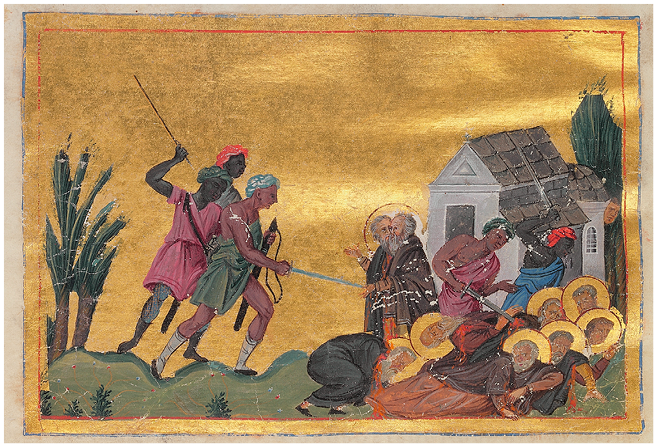
It was not only Egyptians, Graeco-Romans, Arabs, or Nubians that shared these negative views of nomads. The Aksumites of the Ethiopian Highlands also had their own ‘nomad problem’. In the fourth century ce, King Ezana resettled 4400 Beja nomads from the northern borderlands of their empire, relocating six Beja rulers and their tribes into the Ethiopian Highlands (Bernand Reference Bernand1982). The designs of urban empires on nomadic lands are an enduring bias in our textual source base, and only rarely could we consider these texts as providing detailed and objective information of indigenous nomadic lives and practices. The Egyptian, Nubian, Graeco-Roman, or even Aksumite views of nomads in this region, while informative of nomad-state relations and general attitudes, are not the most informative documents if our goal is to reconstruct nomadic lives and institutions.
A vital source for discerning some sort of internal administration and power groupings in desert societies in earlier Pharaonic history are the Execration Texts (c. 1750 bce), magical incantations appearing on figurines and bowls. While certainly not geographic in purpose, the Middle Kingdom Execration texts, in delineating the names of polities and rulers of foreigners would threaten Egypt, can be used to reconstruct lineages of nomad rulers in the Eastern Desert (Williams Reference Williams, Emberling and Williams2020). The Medjay lists pertaining to the Atbai are very informative (Cooper Reference Cooper2021a), providing the names of three generations of nomad rulers who presided over two desert polities. Some of the named individuals have dual indigenous-Egyptian names speaking to some level of cordiality with Egypt, and there is evidence of intermixing of dynastic families across the desert space, with the same ancestor for the polities of Webat-Sepet and Ausheq.
Literary geographies are a well-known genre in Classical Greek traditions, a tradition which endures in the writings of early Medieval Arab geographers such as Yaʿqūbı̄ or al-Masʿūdı̄. For nomadic Northeast Africa, one of the most information-rich Classical descriptions of nomads comes from Agatharchides (c. second century bce) On the Red Sea (Burstein Reference Burstein1989). This is a regionally specific geographical treatise which describes the indigenous nomads of the Red Sea region and the local activities of contemporary Ptolemaic Dynasty, from gold mining to elephant hunting. Agatharchides societal information is instrumental, describing migration patterns, subsistence strategies, tent dwellings, nomad-state interactions, and some form of local political organization (‘tyrannies’, i.e. tribes ruled by a single leader). Importantly, when Agatharchides is writing (second century bce), none of the nomads on the western shores of the Red Sea possess the camel, in stark distinction to the situation on the Arabian shores where it is frequently mentioned. This positions African pastoralists as late adopters of the camel.
Medieval Arab geographical traditions provide extremely rich descriptions of the nomadic world of Northeast Africa (El Daly Reference 84El Daly2005; Vantini Reference Vantini1975). This is partially influenced by the fact that the new Arab travellers and merchants criss-crossed the deserts as part of new trade corridors and Hajj routes. Nomadic groups such as the Beja and Zaghawa are richly described, from their socio-political organization to subsistence patterns (Vantini Reference Vantini1975). These treatises also describe the arrival of nomadic Arabs in the distant deserts, a new wave of immigrants which would forever change the makeup of the deserts and begin the slow integration of these nomads into Arab-Islamic culture and religion.
A specific literary mode of history appearing in Coptic traditions is the genre of hagiographies (Saints’ lives). With Egyptian monastic communities subject to raiding at the hands of Saracens, Noba, and Blemmyes (Dijkstra Reference Dijkstra2008), these stories often provide some information on local nomadic raids, couched in a narrative of a hero-Saint. The story of the famous monk Shenoute tells of his heroism in a Blemmyean raid north of Ptolemais (modern Sohag) (Eide et al. Reference Eide, Hägg, Pierce and Török1994–1998: III, no. 301). After these ‘barbarians’ raided monasteries and cities and took hostages, Shenoute followed the Blemmyes back to their haunt and magically stiffened their arms so they could not kill him with their spears. Making the sign of the cross, he released their arms, and the Blemmyean king freed Shenoute’s Egyptian countrymen.
Documentary texts, unsurprisingly, provide a much more objective and detailed picture of nomadic lives. These are far too many and varied to encapsulate here, but when combined, they point to a commonplace banality of contact between the nomadic and Egypto-Nubian worlds. Some exemplars include papyrus Boulaq 18 (c. 1750 bce), an account of register of the Egyptian palace, including regular visits by Medjay families from the Eastern Desert, each of whom received a payment (or rations?) of beer and bread from Egyptian authorities (Scharff Reference Scharff1922). Similar accounts and letters mention Medjay as temple personnel, mercenaries, or merely regular emigrés to the Lower Nubian frontier (Liszka Reference Liszka2012). A letter describing a New Kingdom gold-mining expedition mentions a mercenary contingent of nomads from the Atbai protecting the miners against Shasu nomads (Helck Reference Helck1967).
By the Graeco-Roman period, when our documentary corpus of Demotic and Greek papyri and ostraca is plentiful, such nomad encounters paint a picture of a valley teeming with pastoralists and a mosaic of complex desert borderlands. Blemmyes of the Atbai are described as living in many towns of Upper Egypt, even making diasporic distinctions such as mentioning a ‘Blemmye born in Egypt’ (Manning Reference Manning1997: 63). Fortress documents show small-scale conflicts and co-option of nomads in the infrastructure of Red Sea-desert trade routes (Cuvigny Reference Cuvigny, Dijkstra and Fisher2014). Such documents also illustrate complex interdependencies between desert nomads and fortress communities, for example, Arabs supplying fresh fish to the fortresses operated by the Roman administration (Cuvigny Reference Cuvigny, Dijkstra and Fisher2014: 179). Like the Blemmyes, Arabs and Saracens were part of village life in Egypt, attested in various roles such as camel drivers, mercenaries, and regular members of the community paying taxes (Winnicki Reference Winnicki2009; de Jong Reference de Jong, Bouderbala, Denoix and Malczycki2017). A common pattern to all these documents is the existence of nomadic communities on the Nile, leading one to suspect that seasonality or satellite communities (diasporas) functioned eternally as part of the regular nomad-Nile interaction.
3.2 Nomads in Visual Representations
Directly mirroring attitudes of textual records, Egyptian and Kushite records depict foreign pastoral nomads in a generally negative and stereotyping manner. The repertoire of Egyptian depictions of foreigners is encyclopaedic, extending from temple reliefs to tomb scenes and palace decorations. Only rarely do we have enough contextual information to identify the foreigners specifically as nomads rather than generic foreigners from urban and non-urban contexts in Nubia and the Levant. In the cases where Libyans and Eastern Desert people are depicted, we are rather on firmer ground that the representations do indeed represent nomads by the logic of pastoral nomadism being a universal subsistence strategy in these areas.
Egyptians created enduring stereotypes of all foreigners bordering their world, often canonized under the rubric of ‘the nine bows’, the titular enemies of Egypt. Libyans, the ‘Tjehenu’ in earlier Egyptian texts, are frequently depicted with a pointed beard, a feather, and don either chest-straps or elaborate tunics as well as a penis sheath and tattoos. Old Kingdom reliefs show the Libyans with long hair like Egyptians and with chest-straps (Bates Reference Bates1914: 118–122) (Figure 7). Images of the Medjay from the Eastern Desert are much rarer and show wide variation. They are uniquely depicted in the Eighth Dynasty tomb of Shemay near Coptos (Meurer Reference Meurer, Emberling and Williams2020). The Medjay ‘retainers’ on the coffin of Aashayet don short hairstyles and garb in the manner of Egyptians, with the artist depicting the Medjay in a much darker skin tone than Egyptians (Liszka Reference Liszka2018). New Kingdom Medjay appear sometimes indifferent from Egyptians (Liszka Reference Liszka2012), perhaps mirroring a cultural situation where Medjay had acculturated to Egyptian customs of dress and formed a diaspora within the Nile Valley.
A glazed tile of a Libyan from Tell el-Yahudiya (EA12337).
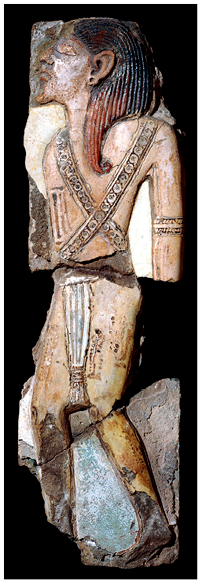
An enduring motif in Old and Middle Kingdom tombs is the depiction of herders which appear characteristically un-Egyptian. These have been interpreted to represent nomads or even more specifically Beja populations of the Eastern Desert due to their distinctive hairstyles (Staubli Reference Staubli1991: 26–29; Diego Espinel Reference 83Diego Espinel, Piacentini and Castelli2019). There is a single depiction of an individual that can be connected with the Pan-Grave culture (c. 1800–1500 bce), an axe- and throw-stick-wielding man painted on a cattle bucranium (Cooper & Barnard Reference Cooper and Barnard2017). This unique image (Figure 8), a production by the Pan-Grave peoples themselves, demonstrates that while there was a canon of stereotypes attributed to Egyptian ideology, there was a very different mode of indigenous representation that rarely surfaces in our records.
A decorated Pan-Grave skull from the cemetery of Mostageddah, showing an axe- and stick-wielding figure with a hieroglyphic label.
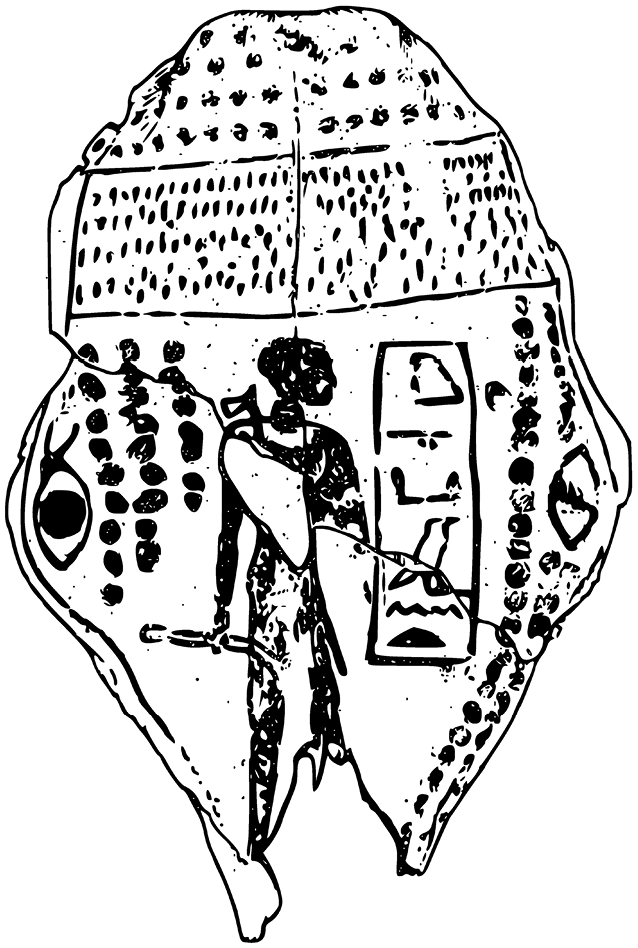
In the context of the representation of nomads, perhaps the most familiar depiction discussed by scholars is the ‘Asiatics’ from the Middle Kingdom tomb of Khnumhotep II Beni Hassan (Figure 9). It must be stated that there is nothing specifically in favour or against the interpretation of this group as nomads, especially as the moniker ‘Asiatics’ (ꜤꜢmw) could include both populations from urban and nomadic contexts. The text states that thirty-seven nomads were bringing galena to Egypt and that they hailed from a place called Shu (Mourad Reference Mourad2015: 86–87). The later Shasu of the southern Levant are depicted somewhat similarly to Asiatics and are recorded in a number of tombs as well as the famous battle scenes of Seti I at Karnak Temple (Giveon Reference Giveon1971: pl. 1–19) (Figure 10).
Aamu (Asiatics) in the Tomb of Khnumhotep II at Beni Hassan.

Shasu enemies depicted in Seti I’s campaign in the north Sinai.
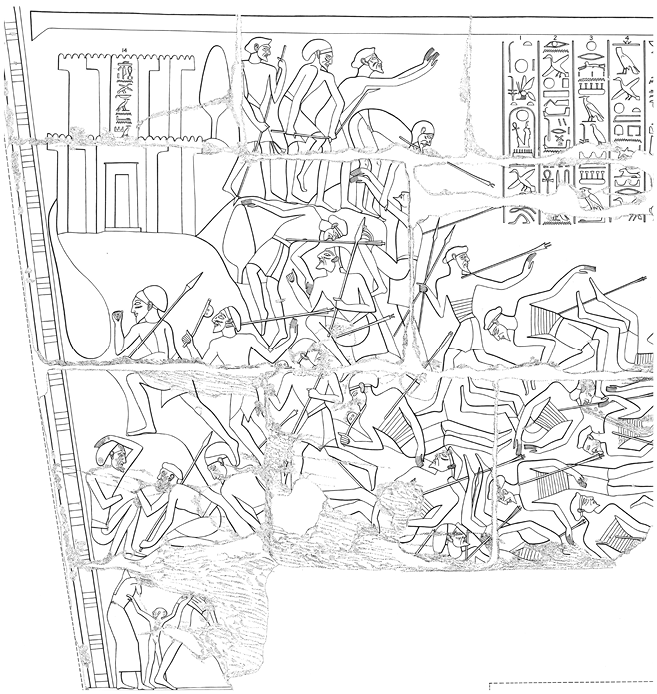
Like Egyptians, the Kushites negatively displayed all foreigners as captives and subjugated enemies in their formal representations (Drici Reference Drici2022), which included nomadic foreigners. These suffer from similar interpretative problems of the Egyptian depictions as the foreigners are never labelled (Török Reference Török, Donadoni and Wenig1989), so their attribution to nomadic populations is uncertain. The only example that has some sort of definitiveness is the depiction of a Noba enemy of the Kushites (Figure 11), which is glossed as such in the Kushite language ‘This is the king of the Noba’ (Rilly Reference Rilly, Godlewski and Łajtar2008). In this period (first century bce), the Noba ethnic group are generally considered to be pastoralists occupying the deserts west of the Sudanese Nile such as Kordofan or Wadi Howar. The boundary inscription at King Shorakaror at Gebel Qeili, possibly marking the southern frontier of the Kushite kingdom (Török Reference Török1997: 466–467), depicts a slew of vanquished foreigners which likely included local pastoralists of the southern Butana desert. The sheer number of different ethnica in Kushite depictions means that some of these must have designated neighbouring dryland pastoralists east and west of the Nile.
A copper alloy figure of a bound Noba enemy, found at Meroe (EA65222).
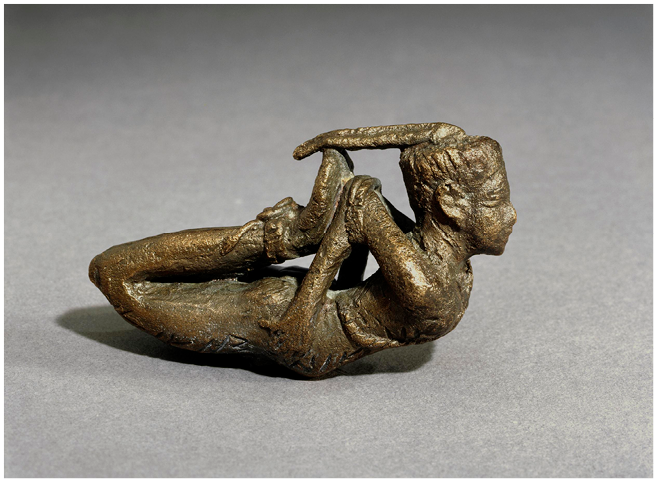
Depictions of pastoralist camps possibly occur. Perhaps the most well-known but ignored in the context of nomadic studies are the Puntite landscapes from Hatshepsut’s reliefs at Deir el-Bahri (Figure 12), which according to most hypotheses of Punt should include an African landscape of the southern Red Sea (Diego Espinel Reference Diego Espinel2011; Breyer Reference Breyer2016; Cooper Reference Cooper2020b: 297–311). Very few scholars have given due attention to the likelihood that in depicting a Puntite settlement the Egyptians were reproducing an agropastoralist encampment. Cattle take prime place in the depictions of the Puntite landscape, and thus the Egyptians were portraying, anthropologically speaking, a local cattle pastoralist encampment. Note should be made of the almost universal condition of the Red Sea coast being monopolized by pastoralists in the ancient past much as it is today. The specific vernacular architecture exhibited in the reliefs, a raised conical hut, is a fairly consistent architectural type across Sudan, Eritrea, and Ethiopia (cf. Herzog Reference Herzog1968: pl. 3–6; Breyer Reference Breyer2016: 235–239), especially common in flooding areas. This is unlikely to represent a high-mobility transhumant camp due to the significant investment it would take to erect the stilt houses. Elsewhere, a pastoralist camp brimming with cattle and what seems to be straw huts is depicted on a decorated Kushite bowl from Karanog (Figure 13), but this seems likely to be a depiction of a standard Nile-bound pastoralist settlement rather than anything specifically desert or nomadic in character.
The Puntite encampment encountered by the Egyptians on Hatshepsut’s Punt voyage.
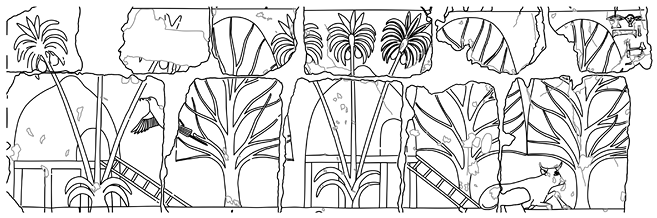
A depiction of a pastoral camp on a Kushite bronze bowl from Karanog (JE41017).
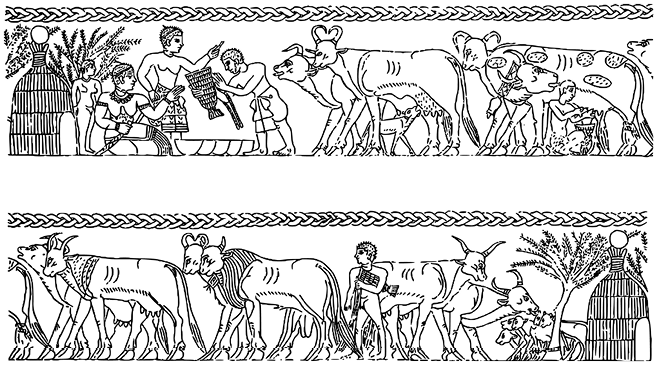
Later representations of nomads are not easy to come by either. The Blemmyes are depicted in an illustrated Byzantine manuscript, the Menologion of Basil II (c. 1000 ce), where they are attacking a monastery in the Sinai (Christides Reference Christides2016) (Figure 14). There might be some doubts here as to whether this overtly Christianizing document is an accurate presentation of Blemmyes or rather a general depiction of Byzantine views of ‘nomadic’ peoples, perhaps interlaced with the more familiar image of nomadic Saracens. But it does enshrine a real view of Blemmyes as marauders of monasteries, a pattern which is confirmed in documentary papyri and other literary accounts (Dijkstra Reference Dijkstra2008; Cooper Reference Cooper2020a).
Blemmyes attacking a monastery in the Sinai.
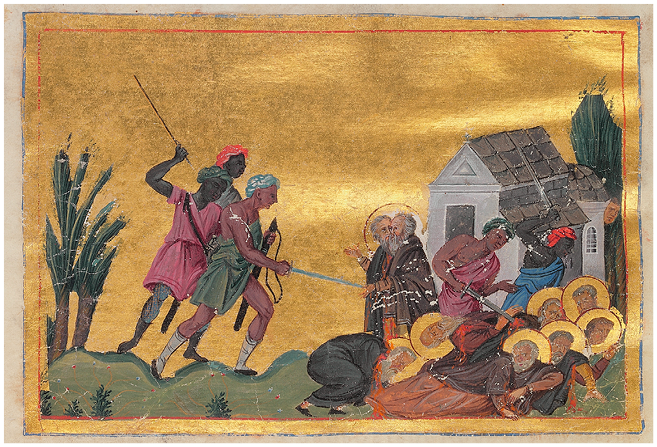
Something altogether different is the representational data arising from the indigenous desert contexts, which mainly consists of local rock art productions. The question of whether rock art depictions include depictions of autochtonous desert dwellers is a matter of interpretation, but it would seem contrarian to not attribute some of the local human depictions to desert dwellers. Winkler (Reference Winkler1938) ascribed various rock art chrono-stylistic groupings to nomadic peoples, such as the ‘autochthonous mountain dwellers’ and the ‘Blemmyes’. One of the difficulties here is that, in terms of style, form, action, and nature of execution, depictions of humans in desert rock art do not seem to differ so greatly from productions on the Nile (Cooper Reference Cooper2024), an issue complicated by the obvious fact that nomadic peoples frequently moved to the Nile Valley and could thus contribute to local productions in urban settings (Varadzinová Reference Varadzinová2017: 247–248). These interpretative difficulties may be partly attributed to ideas of common styles on a similar rock medium. There definitely seems to be a Northeast African common stylistic standard for rock art that pervades well beyond any cultural or ethnic boundaries (Polkowski Reference Polkowski2024).
There are some depictions that unequivocally depict local nomads. Images of camel-riders almost certainly belong to local desert dwellers (Figure 15), with most authorities citing a date in the first millennium ce for the new dromedary imagery (Paner Reference Paner, Emberling and Williams2020). Bowmen are an extremely common theme at desert sites, perhaps to be linked to hunting activities. Herders, that is, anthropomorphs associated with livestock in a single image, are also very common, especially in a pastoral Neolithic phase. Domesticates in general are a sign of pastoralist preoccupation and are ubiquitous at desert rock art sites (Polkowski Reference Polkowski, Paner, Masojć and Obłuski2021; Cooper & Vanhulle Reference Cooper and Vanhulle2023). Perhaps more crucial for linking nomadism to rock art is not so much the content of the rock art itself but the presence of rock art at particular sites, such as rock shelters, caves, and water sources (Section 4.3).
Nomads depicting nomads? Camel riders in the rock art of the Atbai desert.
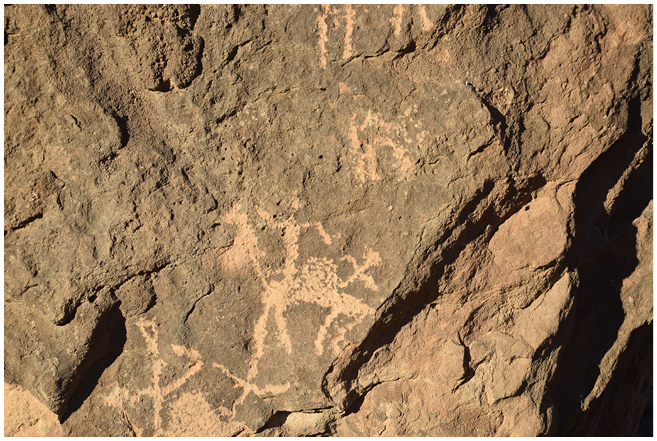
4 Nomads in the Archaeological Record
Nomadism as a subsistence pattern provides great challenges to traditional archaeological methods (Bradley Reference Bradley1992; Cribb Reference Cribb1991; Rosen Reference Rosen2017; Ben-Yosef & Thomas Reference Ben-Yosef and Thomas2024). The lives of ancient nomads give us very little in the way of physical traces compared to the remains or urban agriculturists, with generally ephemeral material scattered in a delicate stratigraphic setting, often near the surface. Archaeological methods must adapt to this reality if they are to maximally utilize the extant record. Deflation, erosion by wind-blown sand, often leaves larger and imperishable objects such as lithics and ceramics behind but might destroy brittle remains of post-holes or fireplaces constructed in ancient camps. Violent flash-flooding is endemic throughout the whole region, washing away delicate contexts of camps. Nomadic domestic sites are perhaps the most difficult to identify and adduce, with tents and artefact debitage or scatters providing very little traces except in the most undisturbed environments. Where nomads construct stone burials or pits, especially with superstructures such as tumuli, this might alleviate our view of nomadic landscapes and provide a glimpse of funerary life where domestic life is otherwise elusive.
The itinerant and transhumant nature of nomadism has meant that their elucidation is much better suited to horizontally wide survey methods, rather than methods designed around ‘vertical stratigraphy’ and excavation, although both methods are always required to fully elucidate nomadic sites (Sadr 1991: 20–21). This transhumant and extensive pattern of nomadism has meant that many projects taking place in nomadic environments have oriented their methodologies to larger regional surveys. This has proved to be both a blessing and a curse for our records and our narratives of nomadic life. While this has given scholars a resourceful model of land- and resource-use by ancient pastoralist societies, it has meant that stories of a local nature, such as camp extents, animal penning areas, and dedicated production areas, among other facets of daily life, have sometimes remained hidden.
4.1 Campsites
Nomads move frequently, providing an altogether different profile for a domestic dwelling compared to an urban archaeology. Quintessentially, this means the movement or recreation of a temporary structure, such as a hut or tent. The architectural solutions for mobile living differ greatly based on specific environments and resource availability and sometimes deviate along cultural lines (Prussin Reference Prussin1995). Tents could be made with a variety of materials, such as palm matting, animal skins, sticks or branches, and textiles, often held together with a lattice or pole. One classical author even mentions whale-bone tents on the Red Sea coast (Cooper Reference Cooper and Cuvigny2022b: 10). Sometimes semi-permanent structures could be established, especially where a camp could be used for longer periods, with tents or dwellings re-erected on the same stone foundation (Tobert Reference Tobert1988: 3–17; Prussin Reference Prussin1995). Dry-stone architecture is particularly prominent throughout the region, either as a low ring of stones as a base for a roof made from perishable materials or as an open air ‘wind-break’ (Borcowski & Welsby Reference Borcowski, Welsby and Wotzka2012). Open sleeping would have occurred in the past just as it does today in nomadic societies.
The exact remains exhibited at campsites vary hugely, but common remains include post-holes or stone rings from tent emplacements, lithics and pottery, faunal remains, hearths and fireplaces, middens, rock art (more rarely), as well as tethering stones (Riemer Reference Riemer2011; Jeuthe Reference Jeuthe2021; Karberg & Lohwasser Reference 87Karberg, Lohwasser, Lohwasser, Karberg and Auenmüller2018; Manzo Reference Manzo2017). Post-holes or ‘negative features’ are particularly sought after by archaeologists, giving some indication as to the layout and arrangement of a camp or tent. As particularly ephemeral and difficult-to-detect features, there can be no guarantee that excavation methods will furnish evidence of tent-dwellings.
Central features of campsites such as stick-fences or livestock enclosures and commonly used organic artefacts such as gourds, basketry, or skins may simply not survive. Particularly notable in such analyses are archaeologists’ overdependence on durable ceramics and lithics to identify and classify sites, something which provides issues for assessments of societies which may have employed a slew of perishable storage mechanisms such as gourds and baskets instead of heavy ceramic jars and containers (Grillo Reference Grillo2012). Some nomadic material horizons seem to exhibit no confirmed or very few ceramics in their assemblages (Barnard Reference Barnard, Barnard and Duistermaat2012: 14).
One manner of grouping nomadic temporary settlements, or ‘camps(ites)’, has been to rank them in hierarchies based on artefact densities, which is thought to correlate to the length of habitation or revisitation by ancient nomads. Sadr’s (1991: 20–21) study of the southern Atbai included a simple three-rank typology of campsites based on artefact density, <25 sherds per square metre, 25–100 per square metre, or >100 per square metre, the logic being that these densities would reflect different uses of sites, such as temporary camps, return sites, and seasonal sites. Bradley’s (Reference Bradley1992: 210) analysis in the agropastoralist Butana developed an extensive model of seven site types: (1) large sedentary site; (2) medium sedentary site; (3) small sedentary site with no durable structures; (4) nomads’ dry season clusters; (5) nomads’ rain-pool campsites; (6) cemeteries used by nomads; (7) water points used by nomads; (7a) water points used by nomads with a public structure.
Another model, which linked ecological setting with camp size or density, was that created for the Sheikh Muftah culture of the oases (Riemer Reference Riemer2011: 291). This consisted of three ranks: Zone 1 – large camps near waterpoints in the oases; Zone 2 – medium-sized camps on the desert plateau; and Zone 3 – small occasional camps in the further deserts to the north and south of Dakhla. Such models have not been transplanted outside the regions which they were specifically created, giving the impression that campsite patterns are highly specific to local landscapes and transhumant patterns. Specific sites within these zones could also fall outside any logical hierarchies and typologies and be exceptional in nature, for example, some camps might be specialized for lithic production or hunting (Manzo Reference Manzo2017: 27). The general supposition is that sites with greater artefact densities correlate to longer periods of habitation, while sites with low artefact densities or few architectural features accord to highly transient camps.
4.2 Burials
Where campsites have proven difficult to identify in the landscape, cemeteries usually provide a much more obvious profile for study, especially where above-ground tumuli are the normal burial architecture. Large circular dry-stone burial structures called nawamis are typical of the fourth millennium bce Sinai (Bar Yosef et al. Reference Bar-Yosef, Belfer-Cohen, Goren, Hershkovitz, Ilan, Mienis and Sass1986) and must have been an important visible feature in the landscape for local communities. Burials of the indigenous nomads in the Libyan littoral have proved elusive, despite extensive surveys in the coastal region and interior plateau (Rieger et al. Reference Rieger, Vetter, Möller, Barnard and Duistermaat2012). So too with respect to the indigenous oasian cultures of the Sheikh Muftah horizon, where only sparse burial activity has been documented (McDonald Reference McDonald2002: 118). A long tradition of pastoralist burials has been identified in the Atbai Desert, from Neolithic burial pits to later Middle Nubian burials (c. 1800–1550 bce) similar to the Kerma type, to the disc-shaped tumuli of the first millennium ce called akerataheils (Figure 16). The latter type are truly numerous across the entire Red Sea Hills from the Upper Egyptian deserts to Kassala (Krzywinski Reference Krzywinski, Barnard and Duistermaat2012; Lassányi Reference Lassányi, Godlewski and Łajtar2010; Cooper Reference Cooper2020a). In this case, the burials of the Atbai desert are an important indicator of just where nomadic communities were living and pasturing, especially in a landscape where nomadic camps are seldom found.
First millennium ce Blemmyean burials, so-called Akerataheils.
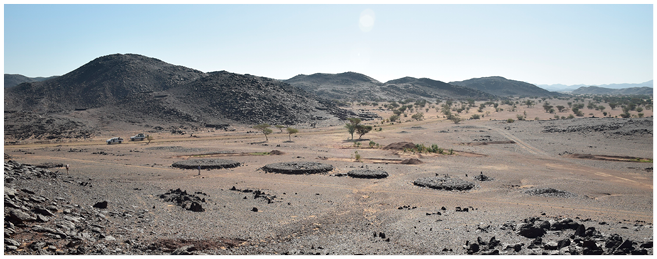
The transhumance of nomads might suggest that burials were constructed haphazardly so as to not disrupt life on the move, but nomadic communities invested significantly in their burial architecture and rites. At Khor Nubt in Eastern Sudan, the local cemetery contains tumuli up to 20 metres in diameter and has over a thousand burials across the site (Krzywinski et al. Reference Krzywinski, Andersen, Pierce, Mæhle, Ravnå and Seland2020). In some cases, the burials of pastoralists are truly monumental, for example, in the case of Atbai Enclosure Burials of the fourth millennium bce, which consisted of a collective burial structure with individual internments for an ‘original’ individual as well as burial compartments for livestock (cattle and ovicaprids) (Cooper et al. Reference Cooper, Bourgeois, Crepy and Gattoforthcoming; Osypinski et al. Reference 92Osypiński, Osypińska and Zych2021). This type of burial points to significant investment of the community in one cemetery area, returning to the same spot to bury their dead. Centralized cemeteries constituted important symbolic places for local communities, places for group assembly, and ritual behaviour, which also served to mark-out territorial rights. With the exception of Strouhal’s (Reference Strouhal, Varadzinová and Havelková2020) work on the Blemmyean cemetery at Wadi Qitna, systematic bioarchaeological work on nomadic human remains is rare.
4.3 Rock Art
Despite the common acknowledgement that the rock art produced in nomadic zones is the indigenous product of nomadic peoples, the link between rock art and nomadic life is very poorly elucidated. Rock art sites are frequently found in caves or shelters, suggesting that these locales were useful places for habitation (Winkler Reference Winkler1938; Varadzinová Reference Varadzinová2017; Cooper & Vanhulle Reference Cooper and Vanhulle2023; Polkowski Reference Polkowski2024). Other rock art sites are found on prominent landmarks, especially along desert tracks or roads (Cooper & Vanhulle Reference Cooper and Vanhulle2023). With comprehensive mapping and surveys in specific regions (cf. Polkowski Reference Polkowski2024), we may be able to glimpse the passage of pastoralists across the landscape and link rock art sites with mobility. In exceptional cases, rock art sites have been directly linked with the archaeological record for nomadic pastoralists. Perhaps one of the best case studies is the site of Bir Minayh (Luft Reference Luft2010), where extensive rock art productions situated around a local well can be associated with a Blemmyean occupation featuring a settlement and burials. In fact, where camps or burials are sometimes invisible, rock art remains a key evidence class for establishing the location of nomadic habitation and movements of nomadic peoples. The problem of dating and interpretation of rock art symbolism, however, provides significant impediments to integrating rock art in reconstructions of nomadic lives.
4.4 Environmental Archaeology and Palaeoclimatology
In almost all surveys of nomadic landscapes, it has proved essential to analyse local topography, ecology, and every factor of the physical environment to predict and model ancient nomadic behaviour. In some respects this is simply archaeological best practice applied equally to urban environments, but the study of the environment in nomadic landscapes takes on a special significance for its ability to predict nomadic habitation, subsistence, and watering – vital aspects of nomadic behaviour.
Some features of these studies are obvious. In drylands, access to surface or artesian water is the best predictor of nomadic activity, and thus analysis of contemporary and palaeohydrology is essential to understand where nomads can and did live. At its most basic in dryland Northeast Africa, it is essential to identify wells, reservoirs (or hafirs), springs, and other hydrological features to identify where nomadic communities were living (Crépy & Redon Reference Crépy, Redon, Durand, Marchand and Schneider2022). The recent discovery of an extensive and unique rock art panel featuring painted cattle directly adjacent to an active qalt (rain-fed reservoir in a wadi-bed) (Abdel Hadi & Ikram Reference Abdel Hadi and Ikram2024) demonstrates the strong connection between pastoralist activity and watering opportunities. In Sudanese climes, the identification and analysis of hafirs (artificial dams in wadi-beds; Hinkel Reference Hinkel2015) provides an indicator for landscape engineering to ease pastoralist life. This demonstrates forward planning and management with respect to herding life and transhumance corridors. An understudied type of evidence is the ancient tracks used by pastoralists, which in many cases are still present on the desert surface and can be easily traced using satellite imagery (Bourgeois et al. Reference Bourgeois, Crépy and Gatto2024).
Ecological reconstructions are essential for reconstructing grazelands. The climate of dryland Northeast Africa was constantly in flux, so it is crucial where possible that palaeoclimatological or geomorphological studies can attempt to recreate past conditions – this is especially the case with chronological horizons coeval with the African Humid Period. Unfortunately, the methods for conducting such analyses, chiefly aided by lake cores, optically stimulated luminescence (OSL) analysis of sediments, and other scientific techniques, are costly and not generally possible in the Republic of Egypt, which does not allow for the export of scientific samples. Other methods are perhaps simpler and require direct observation and ‘proxy’ methods. For example, the presence of cattle in rock art or faunal assemblages in what are now hyperarid landscapes speaks to wetter climates even without the direct measuring of climatic or environmental data (Bobrowski et al. Reference Bobrowski, Jórdeczka, Kobusiewicz, Chłodnicki and Kusiak2013; Cooper & Vanhulle Reference Cooper and Vanhulle2023). Botanical studies can likewise achieve the same goal, reconstructing ‘wetter’ conditions where these plants are now unable to grow. Investigations in the Wadi Howar (Nussbaum et al. Reference Nussbaum, Kröpelin, Darius, Darius, Bubenzer and Bolten2007) have revealed veritable forests in what is now hyperarid deserts through the identification of charcoal in local deposits.
4.5 Surveying and Excavating Nomadic Societies: Case Studies
Increasingly, archaeological projects taking place outside the Nile Valley have taken nomadic societies as their investigative focus. The exact methods, survey techniques, and results of these projects have differed radically, partly based on different regional profiles and research foci. What seems paramount across these projects is the necessity of linking nomadic habitations with environmental data, so that basic land-use, pasturing, and watering can be reconstructed. Another common element is the need to create adaptive excavation and survey strategies according to specific geomorphological contexts. Where one project may be able to excavate dry-stone domestic structures, another project might only be able to reconstruct camps from artefact scatters. What follows is a brief conspectus of some effective projects analysing nomads in Northeast Africa.
4.5.1 Surveys in the Wadi Howar Basin and West Nubia
The environment west of the Nubian Nile in the Wadi Howar basin is now a hyperarid desert completely devoid of human occupation. Only small playas and artesian opportunities north of the Wadi Howar such as Selima Oasis provide plausible conditions for subsistence. Successive projects from the University of Cologne (Bubenzer et al. Reference Bubenzer, Bolten and Darius2007; Jesse et al. Reference Jesse, Kröpelin, Lange, Pöllath and Berke2004; Jesse & Keding Reference Jesse, Keding, Darius, Bubenzer and Bolten2007) have been able to reconstruct a long timeline of pastoralist occupation of this environment by conducting surveys over an extremely wide area, a project methodology which has created a huge windfall of evidence across a desert that was otherwise missing from narratives of nomadism and the foreign contacts of Egypt and Nubia.
The surveys in the Wadi Howar basin have been able to identify an extraordinary number of nomadic sites (n = 2650), mainly identifiable by artefact scatters on the surface (Figure 17). Diagnostic artefacts in the form of lithics and pottery allow the sites to be seriated in three main phases based on their pottery characteristics: Dotted-Wavy Line (c. 5000–4000 bce), Leiterband (4000–2200 bce), and finally Handessi Horizon (2200–1100 bce) (Jesse & Keding Reference Jesse, Keding, Darius, Bubenzer and Bolten2007). The Leiterband and Handessi periods exhibit domesticates and thus represent pastoral nomadic populations. After the Handessi period, final aridification eventuates in the termination of most pastoralist habitations. The palaeoecological setting in these ancient nomadic phases is consistent with a much wetter climate than today, according to an acacia-savanna environment.
Mapping three successive cultural phases of hunter-gatherers and pastoral nomads across west Nubia and the Wadi Howar.
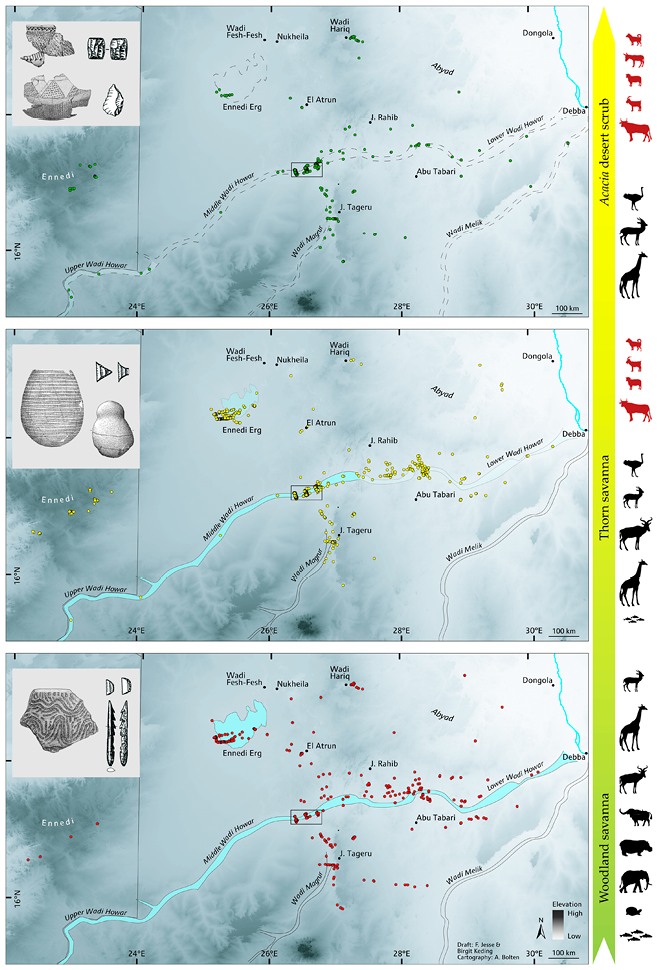
Sites in the Wadi Howar exhibit deflation, leaving most artefacts (pottery, bones, lithics) on the desert surface over large areas (Jesse et al. Reference Jesse, Kröpelin, Lange, Pöllath and Berke2004). Domestic dwellings were not commonly identified, but pits and stone circles as well as fireplaces or hearths were found. The artefacts alone provides a good deal of evidence from which to evaluate the pastoralists of the region. Linking distinctive decorative patterns on the pottery with carbon dates from charcoal and bone allowed many surface sites to be correspondingly dated. Faunal remains indicate the presence of donkeys, goats, sheep, and cattle, while wild species such as addax, gazelle, giraffe, and oryx were also documented. Ostrich eggshells were frequently encountered, sometimes in the form of beads. Seed impressions in the pottery (Jesse et al. Reference Jesse, Kröpelin, Lange, Pöllath and Berke2004) may also indicate the possible consumption of wild grasses, and hunting and gathering continued as part of the subsistence strategies of local nomads.
Thanks to precise geomorphological studies, it has been possible to reconstruct the ancient hydrology of the region. Most distinctive are the massive palaeolakes that dotted the region (Hoelzmann et al. Reference Hoelzmann, Keding, Berke, Kröpelin and Kruse2001), with the lakeshores being a focus for human activity. Varying with latitude, surface water was present in the earlier periods but later dwindled into smaller seasonal pools or marshes, disappearing altogether around 2100 bce (Jesse et al. Reference Jesse, Kröpelin, Lange, Pöllath and Berke2004) in the Wadi Hariq (north) but holding out in the southerly Wadi Howar. Artificial wells were probably necessary to sustain herds and human life, especially in the dry season.
In this region, the study of nomadic peoples and their exodus has a huge bearing on the peopling of the Nile and Northeast Africa more generally. This slow depopulation of the nomads has been linked to the linguistic expansion of Northern East Sudanic peoples, an expansion that would eventually bring languages such as Meroitic and ‘Nile Nubian’ to the Sudanese Nile Valley and beyond (Dimmendaal Reference Dimmendaal2007; Rilly Reference Rilly2016; Section 5.1).
4.5.2 Prospections in Kordofan
Owing to unstable political conditions, it has proven difficult to conduct comprehensive assessments of nomadic sites in the regions further west of Upper Nile, namely Kordofan and Darfur. Earlier studies were focused on urban sites or the cultural presence of Kushite or medieval Nubian material from the Nile Valley rather than modelling nomadic habitations (Mohammed Reference 91Mohammed1986; Chlebowski & Drzewiecki Reference Chlebowski, Drzewiecki and Raue2019). With varied environments from volcanic highlands and large plateau littered with wells, as well as fertile hills such as the Nuba Mountains, there is no shortage of watering opportunities and conducive environments for the practice of nomadism or agropastoralism.
Notable amongst recent archaeological projects in the region are the surveys at Abou Sofyan and Gebel Zankor, two sites 220 kilometres apart, in the modern territory of the Kababish Arabs (Gratien Reference Gratien2013; Chlebowski & Drzewiecki Reference Chlebowski, Drzewiecki and Raue2019). Abou Sofyan is within a hyperarid desert, while Gebel Zankor is situated at the northern edge of the rainbelt, where grass is more plentiful. The surveys in the region uncovered multiple periods of occupation across 420 sites, with pronounced episodes of occupation in the terminal second millennium bce and first half of the first millennium bce. A later period of even higher density occupation occurred in the first millennium ce, again with stone-circular huts as well as a cemetery of flat tumuli. Settlements are situated on the slopes of jebels. Typical of the archaeology in this region and period, especially at Zankor, were dry-stone circles delineating domestic dwellings. A very large settlement dating to the first millennium ce was constructed at the foot of Jebel Zankor (Figure 18), near a hafir.
The large settlement at Jebel Zankor (Gratien Reference Gratien2013: pl. 47).
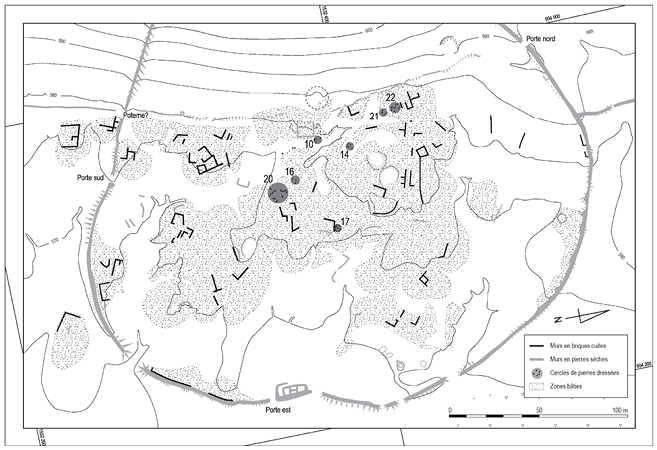
It is difficult to exactly define the social organization and subsistence patterns of the ancient cultures in Kordofan. Agriculture is practised in the region today, especially millet and sorghum farming, so there is a likelihood that the southern settlements at least represent an agropastoralist society. The large size of the settlement at Gebel Zankor (Gratien Reference Gratien2013: 53–58), with an extensive perimeter wall, suggests a society that was able to pool significant resources from the local area of the Wadi el-Milk and thus exhibited some elements of urbanism. In the words of the excavators, this settlement denoted a ‘powerful political power’. The large number of tumuli dotted throughout the jebels of Wadi el-Milk must denote a culture that practised some form of low-density extensive transhumance, perhaps with pronounced or semi-permanents occupations at sites with hafirs or advantageous hydrological conditions.
4.5.3 Excavating a Shasu Camp?
Nomads corresponding to Asiatics or Semitic speakers are well-attested in the excavations of Bronze Age and Iron Age sites in the southern Levant and Sinai (Finkelstein Reference Finkelstein1984; Sebbane et al. Reference Sebbane, Ilan, Avner and Ilan1993; Rosen Reference Rosen2017). One of the most well-known ‘Asiatic’ groups is the ‘Shasu’ of Egyptian textual records, first encountered in the New Kingdom c. 1550 bce. They were known to have troubled the Egyptian Sinai frontier militarily and attacked the border fortresses ‘the Ways of Horus’ (Morris Reference Morris2001) (see also Figure 10). Well-known textually on Egypt’s Sinai frontier, they have proven to be elusive in the local archaeological record.
Excavations at one fortress site, Tell el-Borg, have revealed the possible remains of a nomad camp and tantalizingly a material picture of what might be a Shasu occupation (Hoffmeier et al. Reference Hoffmeier, Davis and Hummel2016; Davis Reference Davis and Hoffmeier2019). This excavation, focused on a site typified by an otherwise ‘Egyptian’ monumental mudbrick fortress, reveals the possibilities of identifying nomads as a satellite community, encamped as part of a multicultural setting. The setting, which reveals the remains of nomadic architecture, comes from the excavations in ‘Field VI’, a deflated surface on one of the highest areas of the tell site, which has partially been destroyed by the ravages of modern conflict.
In Area I, the excavators, in carefully excavating an otherwise sand-filled context, encountered darker-coloured charcoal-flecked soil (‘stains’) in lines across the excavation unit (Davis Reference Davis and Hoffmeier2019). As the excavation expanded, it revealed that these darker stains were clearly the outline of structures, many associated with fire-pits (Figure 19). These stains were thus the vestiges of burnt fences and carbonized reeds. The surrounding contexts contained materials such as sherds, lithics (pounders, querns), metal tools, a fragment of lead, and a bead as well as a fire-pit feature. The sieving of the surrounding material revealed vital information from reeds, grasses and seeds. The ‘stains’ were so delicate that the excavators remarked that some disappeared immediately when exposed to the elements, giving an indication of just how brittle ‘nomad archaeology’ can be. Complicating the interpretation is the identification of two phases of occupation, an earlier phase roughly in the seventeenth century bce and a ‘main phase’ in the fifteenth century bce. The earlier phase exhibited fences but no huts, while the main phase exhibited bona fide domestic dwellings.
Excavating an ephemeral camp-structure after the work of Davis (Reference Davis and Hoffmeier2019: Figs. 7.25–26).
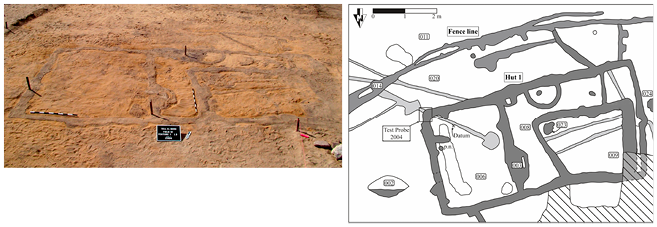
The outline of these stains points to a series of reed huts and fences, ephemeral architectural units, with the largest structure measuring 7.5×3.75 metres (Davis Reference Davis and Hoffmeier2019). There are plenty of ethnographic parallels on the Nile Valley for reed architecture, and with this site situated in the eastern Delta region, it would have been a useful vernacular building material. In the assessment of the excavators, the most likely inhabitants of these dwellings were local nomads, the Shasu. There is no specific archaeological material to indicate a foreign ethnicity in this sector; rather, this interpretation arises from the nature of the domestic site itself as an ‘encampment’ outside the fortress and thus represents a different group. Such careful excavations, while not clinching, raise the prospect of identifying nomadic habitations within and around Egyptian townships, something that should be definitely sought out in other contexts on the Egyptian Nile Valley known to exhibit nomadic diasporas (Winnicki Reference Winnicki2009).
4.5.4 The Southern Atbai Steppe
Unlike the generally hyperarid climes of the northern Atbai, the southern Atbai exhibits seasonal rivers (Gash, Atbara, and Baraka) and a flat grassland steppe after rainfall. This is a perfect environment for ruminants and now consists of grazelands for Beja, Beni Amer, and Sudanese Arabs (Salih Reference Salih1976). This region has been subject to concentrated archaeological survey and excavation from separate archaeological projects (Sadr 1991; Manzo Reference Manzo2017). Alongside excavations at the urban centre of Mahal Teglinos on the Gash River, these surveys revealed a long chronology of occupation. There is some debate as to just when a dedicated ‘pastoral nomadic’ horizon emerged in this setting, but excavators generally cite the second millennium bce as the origin of pastoral nomadism, although there was certainly transhumant herding taking place in earlier periods since the fourth millennium bce (Manzo Reference Manzo2017: 7).
The first phase of interest here is the Jebel Mokram group, a material horizon roughly corresponding to other Middle Nubian horizons such as the C-Group or Middle Kerma c. 1800–1550 bce (Manzo Reference Manzo2025). Apart from the distinctive handmade pottery, Mokram-type sites exhibited lithics and some foreign materials such as obsidian from Eritrea and C-Group pottery from Lower Nubia. The identification of Mokram sites has mainly proceeded from surface collections between the Atbara and Gash rivers and a few sites with shallow excavations. The larger sites are situated closer to the Gash River, possibly meaning that the ‘steppe’ sites were seasonal encampments. At one site (UA 53), the remains of a domestic structure were found, consisting of a series of post-holes oriented in a circular shape (Manzo Reference Manzo2017: 46) (Figure 20). Sadr interpreted earthen platforms in the steppe zone as livestock corrals, identifying forty-seven of such structures across thirty-six Mokram-type sites (Sadr Reference Sadr1990: 73).
Gebel Mokram period domestic architecture, a hut delineated by stones and post-holes at site UA53.
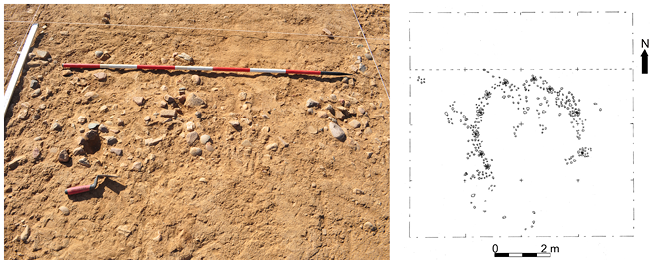
No burial structures have been identified for the Jebel Mokram horizon, in stark contrast to the Pan-Grave and other Middle Nubian cultures, which are known primarily through their burial assemblages. Botanical remains from Mokram sites demonstrate wild millet and sorghum, while herding was present through goat, sheep, and cattle. Faunal analysis reveals an increase in the quotient of domesticated livestock at Mokram-type sites compared to the previous Gash group phase in the region (Manzo Reference Manzo2017: 25–26: 47), speaking to some form of nomadization.
If the Mokram group signifies some sort of transhumant lifestyle, successive phases of the Hagiz and especially Khatmiya groups (c. 100–500 ce) in the southern Atbai indicate even greater nomadic adaptations (Manzo Reference Manzo2017) – with the Khatmiya group likely being the southerly correlate of Blemmyean culture (see Section 4.5.5). The extensive number of these sites and low-density artefact spreads suggest a highly mobile lifestyle, although some sort of agropastoralism must have continued given the likelihood of agriculture at those sites near the seasonal Gash River (Manzo Reference Manzo2017: 58). The tumuli of the Khatmiya group are scattered on the hillsides of the northern Gash (Manzo Reference Manzo, Lohwasser and Wolf2014), revealing a horizontally extensive mobile pastoral culture. This period is coincident with the local domestication of the camel (Manzo Reference Manzo2017: 67), a transformation that likely increased the seasonal movements and mobility of local pastoralists. As with the Wadi Howar region, sites in the southern Atbai reveal a long continuum of nomadic occupation, but generally in agropastoralist settings, illuminating a culture in constant contact with the Red Sea, Nubian Nile, Ethiopian Highlands, and more peripherally Egypt.
4.5.5 Blemmyean Archaeology of the Atbai
The archaeology of the central and northern Atbai, corresponding to the Nubian Eastern Desert, undergoes a revolution in the first millennium ce. Due to the surveys from various projects (Castiglioni et al. Reference 80Castiglioni, Castiglioni, Sadr, Castiglioni, Castiglioni and Vercoutter1998; Sidebotham et al. Reference Sidebotham, Barnard and Pyke2002; Lassányi Reference Lassányi, Godlewski and Łajtar2010; Luft Reference Luft2010; Krzywinski et al. Reference Krzywinski, Andersen, Pierce, Mæhle, Ravnå and Seland2020; Cooper Reference Cooper2021c), the local inhabitants, the Blemmyes, are now known with greater detail than most nomadic groups in Northeast Africa. In a roughly coeval period, several archaeological phenomena appear in the desert; a new ceramic called Eastern Desert Ware, a new settlement type consisting of dry-stone rectilinear hut bases, and a pervasive ‘disc tumulus’ burial architecture, numbering in the thousands at sites such as Khor Nubt (Krzywinski et al. Reference Krzywinski, Andersen, Pierce, Mæhle, Ravnå and Seland2020). It is likely that underpinning all these archaeological developments was a demographic and economic explosion, brought on by the advent of camel domestication and a power vacuum associated with the downfall of the Kushite state.
Perhaps the strangest and most distinctive feature of this period of the central Atbai is the emergence of veritable town-like establishments in the Upper Egyptian and Sudanese desert. These are mainly similar in plan, with a loose arrangement of rectilinear structures situated up and down a narrow wadi ravine, or sometimes arranged as a circular nucleus of huts in an open plain (Lassányi Reference Lassányi, Barnard and Duistermaat2012; Sidebotham et al. Reference Sidebotham, Barnard and Pyke2002). The Sudanese sites have not been well studied (Magid Reference Magid and Wenig2004; Cooper Reference Cooper2021c), but appear to be located on very fertile wadis of the Wadi Amur basins, which contain a great deal of water draining from western slopes of the Red Sea Hills (Figure 21). The known Blemmyean ‘towns’ in this region are Nubt, Kalibai, Tabot, Alitiatib, Jebel Gurad, and possibly Techol West.
Blemmyean urbanism? The settlement of Alitiatib in the upper Wadi Amur.
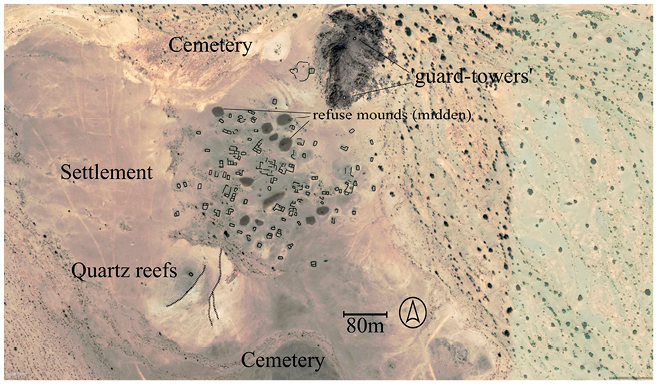
This reason for this new Blemmyean semi-urbanism in a desert previously devoid of nucleated settlements is uncertain, as is their precise function in terms of economic activity. Where excavation data allows, it is clear that they were used in herding and also long-distance exchange (Magid Reference Magid and Wenig2004; Cooper Reference Cooper2021c). The northern towns appear alongside Egyptian trade routes to the Red Sea or areas near the Nile where Blemmyes exercised some political control so might indicate nomadic camps doubly functioning as trade stations, something that is known also from the texts (Cuvigny Reference Cuvigny, Dijkstra and Fisher2014; Darnell et al. Reference Darnell, Darnell, Urcia, Warfe, Gill, Hamilton, Pettman and Stewart2020). The southerly Sudanese desert towns, on the other hand, are located in fertile wadis offering agricultural potential, raising the possibility that the Blemmyes deliberately established agricultural settlements. This Blemmyean agropastoralism is possibly analogous to the contemporary agricultural practices of the Beja, who erect sand dams across fertile wadis in order to plant crops in years of favourable rainfall (Krzywinski & Pierce Reference Krzywinski and Pierce2001: 50–51). These sites demonstrate that nomadic settlement patterns are hardly stagnant and everlasting, and could transform due to a range of economic, political, and social variables – not limited to the climatic and deterministic variables that are much discussed in the literature. The Blemmyes chose to adapt and create new settlements across their drylands in a specific period of the mid first millennium ce.
4.5.6 Oasian Pastoralists
The existence of ancient nomads or agropastoralists around the Western Desert oases is clear enough, but only recently has data arisen where we can reconstruct the camps of these groups. Two separate projects on sites of the Sheikh Muftah Culture (3000–2200 bce) at Dakhla Oasis, at El Kharafish (Riemer Reference Riemer2011), and Balat (Jeuthe Reference Jeuthe2021), have given us a great of new information on the lives of local pastoralists. These sites are in very different settings, El Kharafish is situated just beyond the northern edge of the oasis depression on the escarpment, with the Balat site situated in the central oasis depression close to watering opportunities.
Excavation of the Balat Sheikh Muftah site proceeded from the identification of surface features not far to the north of a well-studied Pharaonic site ‘Balat North’ (Jeuthe Reference Jeuthe2021). Trial trenches exposed the remains of a camp, with careful sieving and stratigraphic work able to identify different occupation areas within the site. These areas were segmented based on relative concentrations of artefacts of ceramics, flints (lithics), bone fragments, metal tools, and ostrich eggshell beads. Careful excavation allowed some summation of the arrangement of the site, with zones of relatively high artefact concentration being the basis for identifying individual ‘camps’. Fireplaces, post-holes, dwelling pits, and enigmatic ‘mud-ridges’ were identified across the site, confirming its function as a camp.
Faunal evidence included the bones of fish, goats, sheep, and wild animals such as gazelle. The majority of animals at the site appeared to be goats, consistent with dryland herding, although the excavators noted that cattle were absent but possibly present amongst poorly preserved faunal samples (Linseele & Lesur Reference Linseele, Lesure and Jeuthe2021). This provided an interesting dilemma and the possibility that the camp was a specialized one and not related to cattle pastoralism as is usually considered characteristic for the Sheikh Muftah Culture.
The most exciting element of this research is the resolution at which the ancient camp structures were able to be reconstructed, something made possible only with exceedingly careful excavation techniques (Jeuthe Reference Jeuthe2021: 167–207). These structures were isolated as ‘dwelling pits’, partly set into the desert floor, some as large as 6.2 metres in diameter. A central post-hole would have supported a roof structure (Figure 22). Burnt organic remains have been interpreted as the reed walls of the dwellings. These domestic structures could be further spatially divided for the individual activities that took place inside the structure (cooking, storage, butchery, lithic preparation, skin-working, wood-working, etc.).
Reconstruction of a Sheikh Muftah dwelling at Balat.
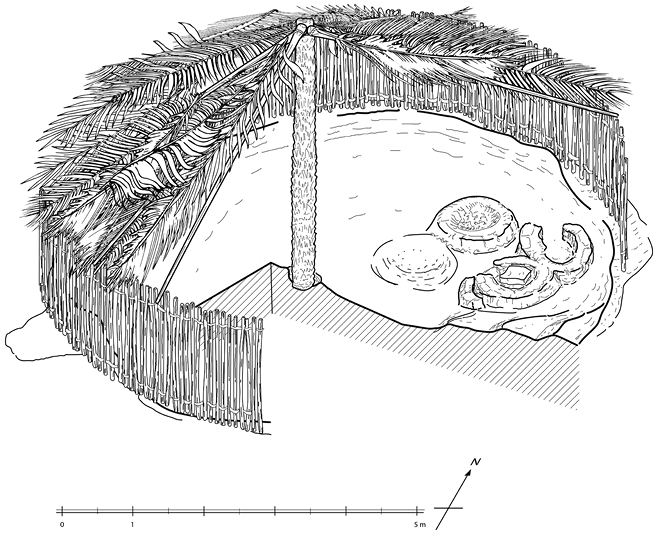
Some of these structures have been interpreted as more or less ‘permanent’, with year-round occupations (Jeuthe Reference Jeuthe2021: 217–219). Good quality local water sources and vegetation meant that the area was suitable for pastoralist herding, and perhaps also hunting and gathering of wild plants. Transhumance remains an open question with regard to the Balat camp. Due to continual occupations of the dwellings, it was the interpretation of the excavators (Jeuthe Reference Jeuthe2021: 224) that the community exhibited low levels of mobility. Balat then constitutes a continually occupied camp of small family groups. This does not mean that this community or a part thereof was not highly mobile with respect to herding. This seems to be the case with respect to the location of other Sheikh Muftah sites on the desert plateau, which show a strong seasonal profile (Riemer Reference Riemer2011: 270). A lesson here might be that it is difficult to generalize mobility patterns across a nomadic material horizon, and as with modern nomads, segments of a society could display idiomatic and specialized subsistence and mobility patterns.
4.6 The Analogy of Ethnography
A survey of any literature on ancient nomadism shows the heavy dependency that scholarship has on modern ethnographic research to reconstruct past nomadic societies, a methodology sometimes labelled as ethnoarchaeology, although the term has extended usages. Usually, this research is used to recreate the lives of ancient nomads where our ancient archaeological or textual evidence is too poor to create a holistic picture of nomadic lives (Cribb Reference Cribb1991: 4–6; Porter Reference Porter2012: 9–11).
In many cases, the method of analogy or inference is simple. Recording the layout and arrangement of still used nomadic camps informs how we identify and reconstruct similar structures in the archaeological record of post-holes or dry-stone huts (Figure 23). Modern pastoralists practise seasonal transhumance in almost every geographic setting, so we may infer some form of similar (but not identical!) transhumance in past nomadic societies. The analogies extend to abstract phenomena too. Modern ethnographies stress the pervasive symbiosis of nomads, agropastoralists, and urban farmers, so we may suspect such patterns in past societies (Tobert Reference Tobert1988; Betts Reference Betts, Wendrich and Barnard2008: 36). The dependency on ethnography is not just present in material constructions but is arguably more necessary for reconstructing pastoralist social structures (cf. Sneath Reference Sneath2007), which are difficult to reconstruct from the archaeological or textual record alone. Ethnography, then, is incredibly useful and perhaps even essential to the study of ancient nomads.
Ethnoarchaeology at work, recording abandoned nomadic camps and houses in Dar Zaghawa, Darfur.
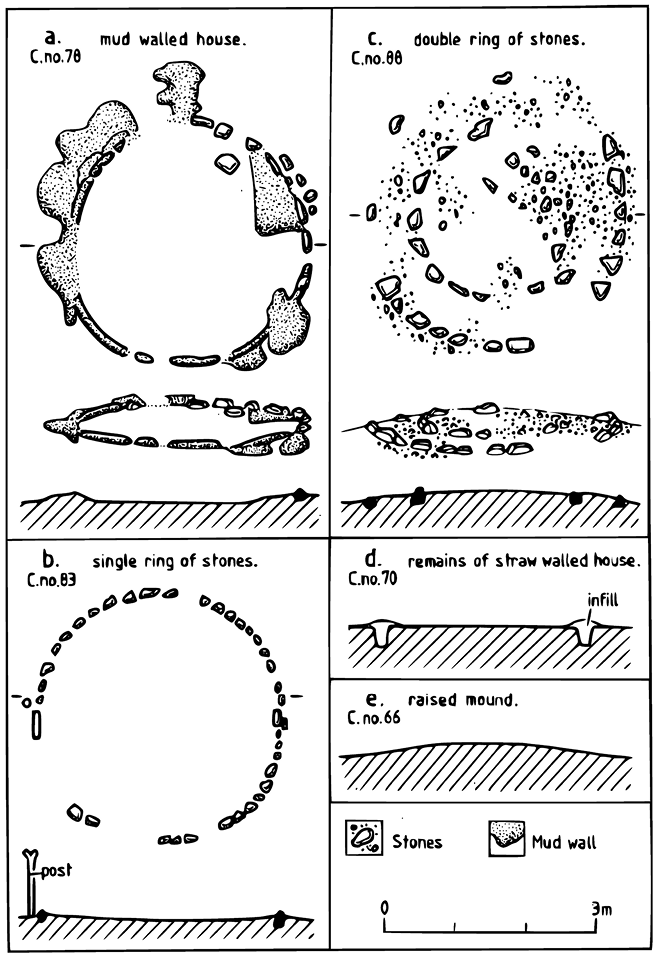
While such methods are commonly employed, the practice of analogy is also prone to reduction and essentializing. Applied uncritically without methodological reflection, this method is certainly open to criticism (Lane Reference Lane, David and Thomas2016). Ethnographic analogy is necessarily selective, in that the scholar chooses to identify a particular commonality between a modern and ancient material subject, situation, or class of evidence – not the totality of a society. This selective process provides an element of randomness in application: ‘One more often encounters anecdotal citations from one or the other present tribe that lives in the same subregion of the Near East as the archaeological mobile group’ (Bernbeck Reference Bernbeck, Wendrich and Barnard2008: 46).
An easy criticism of ethnographic analogy is that formally all societies have undergone so much change between past and present that while subsistence practices or social organization may seem similar, there are pronounced differences. This is not limited to newly adopted domesticates and includes the pervasive influence of Arab-Islamic culture in the region with respect to social and ideological structures; increased mobility made possible by roads and vehicles; encroachment of the administrative states into nomad lands; demographic changes; modern medicine; and many other factors. Another criticism might be levelled at the accuracy of the ethnographic research in the first instance, especially in regard to social organization of pastoralists, which is typically complex, hard to define, changes from group to group and is constant flux, making ethnographic description a difficult task (McIntosh Reference McIntosh and McIntosh1999; Sneath Reference Sneath2007). Despite these shortcomings, it seems impossible to proceed in research on ancient nomadic societies without some recourse to ethnographic literature and modern analogy. When executed across case studies with demonstrable cultural continuity, for example, one can ‘justify the use of specific analogies’ (Lane Reference 88Lane and Stahl2005: 42).
5 Nomads and the State
5.1 From Herders to Pharaohs? Neolithic Nomads and the Saharan Origin of Egypt
While the nature of Neolithic subsistence patterns as typologically belonging to our classical image of nomadic pastoralism rather than some sort of low-mobility mixed resource lifestyle is open to debate, there has been an almost tacit acceptance of a broad narrative that positions the cultures of riverine Egypt and Nubia in the late fourth millennium bce as the product of the ‘pastoralist Sahara’. Sometimes this is termed less accurately and reductively as ‘the Saharan origins of Egyptian civilization’. The reasons for this view are numerous but are not so linear or easily understood as to be easily sketched out in discrete steps. Rather what seems to be the case are a series of slow-moving cultural entanglements (cf. Gatto Reference Gatto2014) that took place on the prehistoric Nile Valley that shows clear influence of the pastoralist Sahara. Some have tried to envelop this in such terms a ‘primary pastoral community’ as a matter of cultural convergence in the Neolithic Nile basin (Wengrow et al. Reference Wengrow, Dee, Foster, Stevenson and Ramsey2014). The directionality of these transformations is not at all clear, rather more so the end-result in shared pastoralist Neolithic origins and traditions.
One of the reasons for this is the commonality of cattle ideology, given to be a product of pastoralist-oriented cultures (Section 1.3). From Saharan desert pastoralists with their rock art and cattle burials, Kerma burials with interred bucrania in Nubia, and likewise Early Dynastic Egypt (Kuper & Riemer Reference Kuper, Riemer, Bollig, Schnegg and Wotzka2013), it seems that all cultures of the Nile basin shared a common respect for cattle. Adding to this is the proclivity of cattle cults in Egypt and even the use of cattle symbolism in the formation of the hieroglyphic script. It therefore seems logical to presume that Egyptian culture was somehow the product of a Neolithic pastoral complex. The other reason to stress this ‘pastoralist origin’ seems to be the de-peopling of the deserts at the termination of the African Humid Period, an exodus c. fourth millennium bce that is given to stimulate urban communities and settlement on the Nile Valley (Kuper & Riemer Reference Kuper, Riemer, Bollig, Schnegg and Wotzka2013; Smith Reference Smith, Bács, Bollók and Vida2018; Manzo Reference Manzo2022). This event thus provides the demographic and cultural ingredients for the formation of complex polities in Egypt and Nubia, particularly in the Naqada, A-Group, and Pre-Kerma cultures.
5.2 Nomadic Pastoralism on the Nile: Seasonality and Diasporas
Most of the pastoral nomadism described in this discussion relates to drylands outside the Nile Valley. In a number of situations (see also Section 2.6), it is clear that nomadic pastoralists lived in or around the river itself for a prolonged period, integrating and entangling with Egyptian or Nubian urban communities. In other cases, ‘nomads on the Nile’ may have constituted ephemeral seasonal communities linked to transhumance. This is of course a continuum, and there may be historical episodes with greater or less nomadic infiltration on the Nile Valley according to a host of variables. Where nomadic identity is maintained in sedentary settings, it might be suitable to call such peoples ‘urban nomads’ (Porter Reference Porter and Nicole2004).
A case study for nomads on the Nile is the Pan-Grave culture, a culture whose sites are located within the Egyptian or Lower Nubian Nile valleys. Pan-Grave sites are only known in the form of cemeteries, generally situated in the low desert (Näser Reference Näser, Barnard and Duistermaat2012; de Souza Reference de Souza2019; Gatto & Gallorini Reference Gatto, Gallorini and Sigl2022). Burials are generally shallow burial pits, often containing distinctive eponymous ‘Pan-Grave ceramics’, a crucial element in identifying this culture. Other burial goods consisted of Egyptian pottery, beads, jewellery, and weapons. Distinctive ‘offering pits’ of animal skulls – goats, sheep, gazelle, and cattle – mark out the Pan-Grave people as pastoral-oriented and align its burial practices with Kerma to the south (Bangsgaard Reference Bangsgaard2013). Ignoring the thorny debate of their equivalence with the Medjay of textual records, the nature of Pan-Grave society seems to manifest a Nubian pastoralist community living within the Egyptian Nile Valley (Näser Reference Näser, Barnard and Duistermaat2012; de Souza Reference de Souza2019). An argument might be made that these communities represent emigrés to the Nile from the Eastern Desert, but hardly that they all constitute seasonal cemeteries of desert pastoralists given how far north they extend away from Nubian lands. The breadth of Pan-Grave cemeteries argues for some sort of symbiotic relationship between these pastoralists and the Egyptian state, with the community evidently integrating to an extent in the agricultural life of the Nile while also maintaining their core herd and pastoralist Nubian traditions.
In the case of ‘seasonal Nile’ communities, these are exceptionally difficult to detect. We have seen a case study of what might be a Shasu community living next to an Egyptian fortress (Section 4.5.3). A fortress reportage from the New Kingdom mentions nomadic transhumance to the Delta, permitting Shasu to cross the Sinai-Egyptian frontier to ‘sustain their flocks’ around local pools (Gardiner Reference Gardiner1937: 76). One might wonder whether the reporting of itinerant Medjay in the Middle Kingdom Semna dispatches (Smither Reference Smither1945) also describes what were actually seasonal migrations that involved herding corridors between the desert and the Nile. Elsewhere, Kushite annals mentioning skirmishes with Eastern Desert peoples might well be interpreted as seasonal infiltrations on the Nile, as they all occur at similar times of year in the season of peret (Török Reference Török1997: 385–386), the dry season for desert nomads.
Part of this nomadic interaction is the formation of what may be called ‘nomad diasporas’ (Cooper Reference Cooper2022a, Reference Cooper and Cuvigny2022b) on the Nile Valley. These cases are numerous when measured over space and time but are difficult to define in the sense of just what these communities comprise. The Pan-Grave people created a series of sustained communities in the Nile Valley, partially separate to Egyptian life. In other epochs, the textual record shows clearly that nomadic pastoralists from various areas were living within Egyptian communities for prolonged periods of time. Levantine pastoralists, glossed in Egyptian texts as ‘Aamu’, are so plentiful across myriad parts of Egypt (Mourad Reference Mourad2015) that they must have been a regular feature of Egyptian settlements. The taxation gazetteer of Papyrus Wilbour, listing agricultural settlements in the Middle Egyptian floodplain, shows a number of settlements christened by nomads: ‘Medjay’, ‘Shasu’, and ‘Hillmen’ (Cooper Reference Cooper and Cuvigny2022b: 24).
In the Graeco-Roman period, Blemmyes are found in many Upper Egyptian cities such as Coptos, Edfu, and Aswan (Cooper Reference Cooper and Cuvigny2022b), especially in employment roles. This makes a highly itinerant seasonal overlay for their being on the Nile unlikely. Coptos likewise had an ‘Arab quarter’, probably a trading community using the well-known Red Sea routes (Winnicki Reference Winnicki2009: 318, 330). In archaeological terms, the presence of pastoralist ceramics in Egyptian settlements, such as Pan-Grave ceramics in Elephantine (de Souza Reference de Souza2019: 99–100) or Eastern Desert Ware at Upper Nubian settlements (Barnard Reference Barnard2008: 127), might further this record of nomad diasporas in Egypt and Nubia.
These snapshots of Nile life show that nomads regularly made their home amongst Egyptians and Nubians, a symbiosis perhaps based on specialist employment opportunities such as herders or patrolmen, or simply being attracted by the diverse economic opportunities of urban settings. These kinds of opportunities allowed desert pastoralists to diversify their economies beyond livestock subsistence and mineral extraction, securing an extra stream of profit from urban life and employment.
5.3 Nomadic Identity
The discussion of nomads in urban settings raises an important issue as to whether a nomad in an urban setting is still a nomad. This consideration may be partly based on the maintenance or lack thereof of nomadic herding. However, this etic and typological view of a nomad as a subsistence type very much ignores the emic view and concerns of ‘nomadic identity’ or a ‘cultural nomad’ – whether a nomad chooses to identify as a nomad. Modern contexts demonstrate that peoples of nomadic heritage in urban settings, living sedentary lives, still very much maintained a concept of expressing nomadic identity and heritage (Hobbs Reference Hobbs1989: 8–11). Analysing the interactions of the agriculturist Fur and nomadic Baggara in Darfur, Haaland (Reference Haaland1972) demonstrates cases of Fur selectively nomadizing and adopting an erstwhile ‘Baggara’ identity. Beyond identifying from a particular tribe, the nomad may cultivate their ‘nomadism’ in urban settings to maintain difference from a sedentary majority (Boesen et al. Reference Boesen, Marfaing and de Bruijn2014).
This nomadic expression seems highly relevant when we consider the maintenance of pastoralist features on the urban Nile. Pan-Grave cemeteries in Upper Egypt (de Souza Reference de Souza2019) or the Blemmyean cemeteries in Lower Nubia (Strouhal Reference Strouhal1984) reveal a general maintenance of desert-pastoralist burial traditions and material life in riverine settings. The Libyan rulers who adopted all manner of Egyptian regalia maintained a cultural link to their tribal nomadic origins in using their pervasive title ‘Chiefs of the Ma’ (Section 5.7). Nomadism then was partly a matter of self-expression, not just movement and herding.
5.4 Exchange, Trade, and Access
The discussion of nomads on the Nile raises a key debate and topic in nomad studies across global history, the nature of the interdependency of nomads on urban regimes (Khazanov Reference Khazanov1994; Sadr 1991; Anfinset Reference Anfinset2010). Typically, the relationship may be viewed as symbiotic and co-dependent, at least in economic terms. Nomads raise livestock and therefore are in short supply of agricultural goods, excepting where seasonal crops in agropastoralist settings are possible. Sedentary regimes may require more livestock than can be easily herded on their arable land, especially in the case of the camel which requires large rangelands. Different goods produced by sedentary and nomadic settings create mutually beneficial trading relationships. Beyond these generalities, modes of economic and political relationships are as numerous as there are situations.
Nomads have a special place in the trade and exchange lives of nearby urban regimes in Northeast Africa. Every strategic desert trade route leaving the Nile Valley crosses nomadic lands. Prominent routes across the Eastern Desert or Western Deserts (Cuvigny Reference Cuvigny2003; Förster Reference Förster2015; Manière et al. Reference Manière, Crépy and Redon2021) and also the north Sinai corridor, the so-called ‘Ways of Horus’ (Morris Reference Morris2001), created conditions for constant and pronounced nomad-state interactions. Local pastoralists were also active on the Red Sea coast, interacting either cooperatively or violently with Egyptian maritime and mining expeditions (Cooper Reference Cooper2020b; Cooper Reference Cooper and Cuvigny2022b). It was generally impossible to leave Egypt or Nubia without traversing ‘nomad land’.
The enduring expeditionary apparatus of the Egyptian state in trade and mineral exploitation created a unique social setting of constant nomadic interactions. Nomads were attracted to desert routes and expeditions, and desert specialists joined expeditions as guides or logistic specialists. Unspecified nomadic groups both escorted and harassed expeditions to quarries and harbours in the deserts east of Coptos c. 2000 bce (Cooper Reference Cooper and Cuvigny2022b: 12–14). The Blemmyes were definitely active in the fortress apparatus erected by the Roman administration to connect Egypt to the harbour of Berenike (Cuvigny Reference Cuvigny, Dijkstra and Fisher2014), sometimes coming into conflict with Roman garrisons and at other times assisting the road network. Shasu of the New Kingdom seem to have likewise lived and marauded the chain of waystations connecting Egypt with the Levant (Morris Reference Morris2001).
Viewed in this manner, Egyptian or Nubian desert trade routes acted as a lightning rod for concentrated nomad-state relations, providing significant opportunities for economic cooperation and alternatively violent transgression in cases of disagreement. In rare cases, distant nomads from the Near East such as the Nabataeans and Palmyrenes made their presence felt in Egypt’s deserts (Seland Reference Seland2016), usually in the form of caravaners functioning as part of trading diasporas. Red Sea ports in all periods depended on local nomads for logistics, foodstuffs, and transport in what were extremely harsh environments far away from Nile supply centres (Power Reference Power2012; Sidebotham Reference Sidebotham2011; Cobb Reference Cobb2021). In many cases nomads and urban regimes created local power- or profit-sharing arrangements to assure an enduringly peaceful operation of international trade in their lands.
Beyond the routes themselves, nomads were specially situated to provide access to key resources. Livestock and its derivatives (skins, horns, milk, and meat) are an obvious export of nomadic regimes, but other key resources in this region include desert minerals as well as aromatics (Cooper Reference Cooper and Cuvigny2022b: 13, 34). Explicit evidence of ancient nomadic livestock trade is difficult to identify in our archaeological or textual evidence (cf. Horwitz Reference Horwitz, Adams and Roux2022), but judging from ethnographic modelling (Morton Reference Morton1989; Fre Reference Fre2018), it must have been prominent. Mineral extraction is a particularly socially complicated case study of nomad-state relations (Mourad Reference Mourad2015: 135–142; Cooper Reference Cooper2020a, Reference Cooper and Cuvigny2022b; Liszka Reference Liszka2024). Varying according to site from the Sinai to the Atbai, nomads in some cases were participating in the extraction itself. The Annals of Amenemhat II (c. 1900 bce) reveal that Medjay polities themselves were engaged in trading gold, copper, and aromatics from their lands (Altenmüller Reference Altenmüller2015: 34–35), so it cannot have been that nomads did not have their own designs over resource extraction separate from Egyptian or Nubian control. Nomads and urban states were constantly undergoing struggles of resource access, territorial transgression, and profit sharing – some of the earliest cases in world history of resource-based conflict.
5.5 Dominion and Subjugation
Egyptological scholarship, echoing ideological constructions of the ‘nine-bows’ and subservience of foreign peoples, has typically viewed the ancient Egyptian state as having dominated proximal nomadic groups. This may have been the case in specific regions and periods, but there are enough examples to illustrate that urban regimes struggled to control the deserts and nomads. In some cases the Egyptians or Nubians clearly suffered predations from nomads through raiding or outright annexation of their lands (Cooper Reference Cooper2020a, Reference Cooper2022a), while in other cases it is clear that the Egyptian or Kushite states extended enough power into the deserts so as to form something of an extractive hinterland, providing unrestricted access to tribute and resources from nomadic lands.
An early example of Egyptian expansion into nomad lands is evident in their expansion into the southern Sinai in the Early Dynastic (c. 3100–2700 bce), oriented to securing local mineral wealth in turquoise and copper. This expansion and subjugation is manifested textually and artistically by local Egyptian rock inscriptions depicting the pharaoh smiting the Iuntiu (Tallet & Laisney Reference Tallet and Laisney2012) and also from the archaeological surveys, which witness the cessation of Early Bronze Age ‘Asiatic’ camps (Haiman Reference Haiman1996) in the southern Sinai, only for occupations to continue unabated to the north. This evidence suggests that the nascent Egyptian state in its embryonic form had attempted to dominate desert lands.
Territorial domination of nomadic lands might be considered a hallmark of New Kingdom foreign policy (c. 1550–1050 bce). Egyptian gold-mining parties freely roamed the Eastern Desert lands and transgressed nomadic boundaries (Helck Reference Helck1967; Klemm & Klemm Reference Klemm and Klemm2013; Davies Reference Davies, Davies and Welsby2020; Cooper Reference Cooper and Cuvigny2022b). From the hinterlands east of Coptos to the central Atbai, Egyptian mining officials (‘overseers of gold’) and military expeditions attempted to secure this vital trade good through force, co-opting local nomads or coming into direct conflict with them. Elsewhere, Egyptians directly interfered in the desert homeland of the Libyans on the Marmarica coast, extending their fortifications to well within the nomadic homelands of the Libyans (Snape Reference Snape, Förster and Riemer2013). Egyptian imperialism likewise turned towards the Shasu of the southern Levant, securing copper resources from Timna and perhaps elsewhere in the Wadi Arabah (Rothenberg Reference Rothenberg1979; Hasel Reference Hasel1998; Cooper Reference Cooper2020b: 248, 390–392).
The pattern here seems to be that the New Kingdom state spent significant resources securing vital trade routes and access to precious resources in nomadic landscapes and also attempted to control movements and local populations through fortress building and regular desert expeditions. It did not, however, attempt to permanently annex desert regions to the Egyptian state, and actual Egyptian objectives seem limited to resources and access, not population control. Similar arguments may be made vis-à-vis the ‘nomadic policy’ of Graeco-Roman regimes in Egypt, where direct control of the nomadic hinterlands was limited to guarding trade routes and access to harbours and mineral sites (Boozer Reference Boozer2013; Cuvigny Reference Cuvigny2021). Kushite designs on nomadic spheres are difficult to adduce but seems largely to concord with the Egyptian models with the exception of their hafir-building programme in the Butana (Section 2.3), which speaks to a much more coordinated policy of integrating an agropastoralist semi-desert to the Kushite state. In other regions, the securing of trade routes, such as through fortresses on the Wadi Howar, seems to mirror the previously described Egyptian model (Jesse Reference Jesse and Raue2019).
The other model of nomads dominating urban territories does occur, although the cases are fairly limited in the Nile Valley when compared to other settings in world history such as Inner Asia or Anatolia (Cooper Reference Cooper2022a). The exemplar here is the Libyan infiltration of the Nile Valley and Delta, although the sequence of events that would take place here and the nature of this domination make it unclear whether the ‘Delta Libyans’ remained to be nomadic pastoralists after making the Nile valley their home (Snape Reference Snape, O’Connor and Quirke2003; O’Connor Reference O’Connor and Leahy1990; Ritner Reference Ritner and Szuchman2009). It is difficult to argue that there was much ‘nomadic’ about the earlier Hyksos domination of the Delta (cf. Mourad Reference Mourad2015: 216–218), although later ideological commentaries certainly framed the Hyksos as shepherds and pastoralists (Redford Reference Redford1970), probably to vilify and separate them from Egyptian urban norms.
Much later in history, the Blemmyes seized two regions of the Nile Valley in sub-century-long interludes, Lower Nubia in the early fifth century ce and portions of Upper Egypt between Edfu and Gebelein in the sixth century ce. Both of these territorial annexations are reflected in local administrative documents or epigraphy as well as archaeological traces of Blemmyean settlement and burials on the Nile Valley (Cooper Reference Cooper2020a). The Noba ‘phenomenon’ and the emergence of Nubian-speaking polities in the former territories of the Kushite empire have sometimes been framed as a nomadic domination, but most now frame the Noba as already living within the borderlands of Kushite Nubia (Obłuski Reference Obłuski2014; Section 2.4).
Important in the historiography of the power relations between nomads and the state in the Roman period is the concept of foederati (federates). This term comes from Roman administrative-diplomatic parlance which established vassal or ally relationships with groups beyond the frontier (Stickler Reference 96Stickler and Erdkamp2007). At various points, Arab-Saracens, the Blemmyes, and the agropastoralist Noba are mentioned as Roman foederati or argued to be such by scholarly interpretations (Obłuski Reference Obłuski2014; Graf Reference Graf2019). Essentially, this would position these groups as somehow being (temporarily) bestowed a special status and being bound to the Roman Empire by treaty. A complicating factor here is whether federate status was bestowed upon entire nomadic nations or only upon sub-tribes; a Roman account of Blemmyean dissidents seems to suggest that the Romans exploited factions and supported Blemmyean turncoats (Eide et al. Reference Eide, Hägg, Pierce and Török1994–1998: III, no. 295).
It is entirely unclear, however, what federate status means in terms of realities of diplomatic exchange and power dynamics (cf. Cobb Reference Cobb2021), and whether such admonitions of this status in the sources are reliable. It does not appear that federate status (or lack thereof) much influenced power relationships. Treaties, trade, raids, and war could be conducted within and without federate status. The Blemmyes continued to raid Roman Egypt even if they enjoyed federate status as is suggested in the sources (Dijkstra Reference Dijkstra2008: 157, 164). Nomadic groups’ power relations with Rome were always renegotiated and in flux, and these troughs and peaks in bilateral relations cannot always be correlated to federate status. In this respect, the Arab Caliphates were much more successful at infiltrating nomadic lands (Power Reference Power2012). While not conquering the deserts by any means, they successfully engendered new trading and mining colonies, co-opted local elites, and struck favourable diplomatic treaties.
5.6 Raiding and Nomadic Pastoralism
A common type of relationship in nomad-state relations across the world is the dynamic whereby nomads raid urban areas. Not surprisingly, this has been much discussed in the literature of Inner Asia and even modern anthropological ethnographies in Africa, but not in relation to ancient Northeast Africa. This pattern or behaviour has been distinctively linked with the mobility of pastoralists and fluctuating environmental (and thus economic) conditions in dryland settings (Sweet Reference Sweet1965; McCabe Reference McCabe2010; Scheele Reference Scheele, Mattingly, Leitch, Duckworth, Cuénod, Sterry and Cole2017). Raiding often involved theft of goods, people, or livestock and could become entrenched as part of a regular nomad economy.
Ignoring for a moment inter-ethnic livestock raiding, there seem to be typologically at least two types of raiding behaviours evident in ancient Northeast Africa, (1) limited or opportunistic nomadic raids and (2) an unambiguous pattern of cultural raiding, with recurrent or seasonal raids taking place directed at the Nile settlements. Type 1 was opportunistic and could be directed at mining parties, settlements, and fortresses haphazardly. There are plentiful records of this in the pharaonic period till the medieval times, such as predation of mining parties or attacks on border settlements and fortresses (Helck Reference Helck1967; Cuvigny Reference Cuvigny, Dijkstra and Fisher2014; Cooper Reference Cooper and Cuvigny2022b). This usually entails small-scale robbing and not a significant level of organization or pooling of resources, but rather taking advantage of insecurity on dynamic desert frontiers. Type 2 really seems to only be common in the first millennium ce, thus distinguishing this behaviour as somewhat specially conditioned by the adoption of the camel in nomadic societies. Blemmyean raids from late antiquity and the early Arab period are the exemplar here, where evidence of recurrent raiding from documentary and literary texts speaks to severe insecurity in Upper Egypt (Dijkstra Reference Dijkstra2008; Cooper Reference Cooper2020a). Saracen (southern Levantine) raids seem to follow a similar pattern (Mayerson Reference Mayerson1986; Graf Reference Graf2019) but are slightly tangential to our story here in the Nile basin.
The status of a Libyan ‘raiding culture’ is uncertain and has been seldom commented on, although the Libyan Wars of the Ramesside Period as well as the Egyptian response of fortress-building certainly make one suspect that these pastoralists were a significant threat to Egyptian security and interests (Snape Reference Snape, O’Connor and Quirke2003: 94; Manassa Reference Manassa2003). Texts relating to the Libyan Wars also speak of Egyptians’ capturing horses (Manassa Reference Manassa2003: 90), so one could well reconstruct ancient Marmarica as exhibiting an equestrian raiding culture, with this animal well suited to the grasslands of the Mediterranean coast (Bates Reference Bates1914: 97). Libyans also enacted low-level raids on the Theban region from the desert, c. 1050 bce (Haring Reference Haring, Demarée and Egberts1992).
Anthropological literature has shown the high-level of organization needed to conduct ‘Type 2’ raids, requiring significant inter-tribal organization and pooling of resources over sustained periods (Scheele Reference Scheele, Mattingly, Leitch, Duckworth, Cuénod, Sterry and Cole2017). Some large raids seem to attain legendary status in the sources, such as the multi-year invasion of Coptos by the Blemmyes in 280 ce (Eide et al. Reference Eide, Hägg, Pierce and Török1994–1998: III, no. 284), or the raids on monasteries in the Sinai which created a martyrdom motif in Christian literature (Christides Reference Christides2016). So entrenched was raiding in Blemmyean and Beja culture that it was announced by priestly oracles who foretold its success (Vantini Reference Vantini1975: 631). Blemmyean conflicts were even the basis of a Greek epic poem (Eide et al. Reference Eide, Hägg, Pierce and Török1994–1998: III, no. 284). Raiding was thus situated as a culturally accepted wealth-building apparatus, accelerating economic inequality in nomadic societies.
It is difficult to assert whether ‘slave raiding’ was an established cultural pattern in these ancient societies. The capture of prisoners of war as slaves was a general practice of regimes in Egypt with respect to war prisoners (Muhs Reference Muhs2016). Some sources also indicate that slaves were the express purpose of pastoralist raids. The Beja are said to have raided Nubians on the Nile by the Arab historian al-Masʿūdı̄ (Vantini Reference Vantini1975: 131), and the Blemmyes took captives according to the hagiography of Shenoute (Eide et al. Reference Eide, Hägg, Pierce and Török1994–1998: III, no. 301), although in the latter case these persons may have been captured for ransom.
Livestock were also a common target of raids and had obvious utility in nomadic societies for subsistence and ‘movable capital’. Ethnographic literature has frequently commented on the presence of livestock raiding amongst nomadic pastoralists in the Sahel and Horn of Africa (McCabe Reference McCabe2010), partly motivated by the desire to alleviate shortfalls in non-equilibrium ecologies. The Greek historian Agatharchides alludes to inter-ethnic raiding when he states the Trogodytes of the Eastern Desert fight over ‘pasture’ (Burstein Reference Burstein1989: 110).
5.7 Nomadic Political Organization
Nomadic pastoralists exhibited differing forms of socio-political organization than sedentary or urban political units (Section 1.6). From family units, inter-tribal cooperation, and various forms of confederations, hierarchies, and tribal-territorial institutions, the nomadic space is indeed socio-politically dynamic and complex. Furthermore, nomadic polities or political units have the frustrating characteristic of being resistant to static and generally true models. These institutions were constantly reshaping, reforming, and changing across each society and place (Honeychurch Reference Honeychurch2014). With respect to the ancient past, it is extremely difficult to glimpse inside the socio-political units of nomadic pastoralists. With indigenous literature from such societies being uncommon, we are left with biased ‘outside’ voices on nomads’ political organization.
In some cases, archaeological work and modelling might supply inferences of sustained nomadic hierarchies or polities. This can be achieved, for example, through the identification of nomad elites in monumental burials by mapping cemetery distributions and burial sizes, thus pointing to a vertical hierarchy of rulers or elites (Gonzalez-Ruibal et al. Reference González-Ruibal, Aparicio, Barrio, Simón, Fernández, de Torres Rodríguez, de León Juberías, Osman, Youssouf and Encinar2025). In fact, the identification of a set ‘nomad elite’ in burials remains one of the most common methods for establishing set socio-political units in nomadic landscapes (Brass Reference Brass2019). Common and growing material horizons across drylands might also reveal expanding or centralizing political power (Cooper Reference Cooper2020a; Manzo Reference Manzo2017). We thus have signposts of political units, not direct proofs.
With these difficulties in evidence, there is a significant and ongoing debate in the literature as to just what we should term nomadic political entities. It was once commonplace to designate nomadic societies as comprising a ‘tribal society’ or ‘chiefdoms’ (McIntosh Reference McIntosh and McIntosh1999; Yoffee Reference Yoffee2005). These anthropological terms are now generally considered unsuitable in that they emphasize these societies as being on a teleological evolutionary ladder towards full ‘statehood’, positioning it as less complex than a state and perhaps could become one if it fulfils further criteria. Filling this void, anthropologically minded literature prefers the term ‘polity’ (Khazanov Reference Khazanov1994: 167), a much safer label which has the advantage of saying the nomadic political unit exists without having to define what exactly it is.
Where nomadic societies convey significant organization, the term ‘nomadic state’ or ‘pastoral state’ has been used (Honeychurch Reference Honeychurch2014), with the important proviso that a nomadic state is wholly different in character to an ancient urban territorial state. The label ‘nomadic empire’ is commonplace in the literature of Inner Asia (Barfield Reference Barfield, Alcock, D’Altroy, Morrison and Sinopoli2001), but there are hardly any unproblematic cases of such political units in the Nile basin (cf. Cooper Reference Cooper2022a). These definitional debates may seem unnecessary when it comes to researching or defining a specific nomadic society’s political structure but are important as soon as we want to compare any two or more nomadic political units across history.
5.8 Nomads Forming Polities
In the Nile basin, nomadic polities probably existed in every corner of dryland Northeast Africa where nomads lived – there is no reason to believe that in each desert the nomads would have exhibited no political institution or sense of community membership and complex alliances. Genuine cases of nomads forming overt and testable political units are much harder to come by, however. The Medjay of the Atbai c. 1800–1700 bce were known to have at least two territorial units with established dynasties, named Ausheq and Webat-Sepet (Cooper Reference Cooper2021a). Elsewhere, Egyptians interacted with the trading circuits of Punt, which likely constituted multiple sets of agropastoralist polities on the Sudanese-Eritrean coast and hinterland (Section 3.2). The Hatshepsut Punt records (c. 1450 bce) demonstrate a successfully executed trade mission with the named ruling couple, Parehu and Atiye (Breyer Reference Breyer2016: 334; Cooper Reference Cooper2020b: 99–101, 547).
Ancient nomads formed territorial confederations and systematic alliances, although again our source base seldom allows for their specific reconstruction. The best example is the Libyan confederations or coalition of the Ramesside period. Here, Egyptian textual records indicate that a group of tribes, with names such as Seped, Libu, Meshwesh, Has, Keykesh, and Qeheq acted in concert against Egyptian interests (Bates Reference Bates1914: 47–48; Manassa Reference Manassa2003; Winnicki Reference Winnicki2009: 31). With myriad tribal units, a model of some sort of centripetal unifying force that brought these groups together might be proposed. Scholars have called this newfound Libyan alliance a ‘confederation’ or even a ‘nomadic state’ (O’Connor Reference O’Connor and Leahy1990), but almost nothing is known of its internal socio-political configuration. It is only known that these Libyan groups waged war against Egypt and successfully infiltrated the western Delta frontier.
In the first millennium ce there is explicit evidence for nomadic political configurations on the edge of the Egyptian world, whose emergence may be structurally linked with the aforementioned advent of camel nomadism in these dryland contexts. The Blemmyes formed a territorial unit of a large size encompassing their desert homeland and selective chunks of riverine Egypt and Nubia (Cooper Reference Cooper2020a), with a capital in the central Atbai at Khor Nubt. Their administrative archives show that this entity was ruled by a single king, underneath whom were a number of tribal rulers who deputized his decisions, called phylarchs in the documents. Arab groups of the southern Levant and north Arabia formed a number of political entities in the southern Levant such as the Nabataean kingdom. From its centre in the Transjordan, this territory sometimes extended to the boundaries of Egypt and included the Sinai (Graf Reference 85Graf2004).
A special type of nomad political unit exists in world history where nomads expand beyond their homelands to construct new political units incorporating urban centres and dispossessing local dynasts. This has been called ‘post-nomadic’ entities in the scholarship of Inner Asia (Wink Reference Wink, Bang and Bayly2011; Cooper Reference Cooper2022a). There are a few cases in the Nile basin worthy of mention, but all somewhat problematic as ‘nomadic invasions’ or ‘post-nomadic’ dynasties in different ways.
The first is the Libyan domination of the Delta and Egypt in the Third Intermediate Period, where Libyan groups infiltrate the Delta territory and replace Egyptians as dynastic overlords in the twenty-second to twenty-fourth dynasties (c. 950–720 bce). This is often called the ‘Libyan Period’ to mark this dynastic change. The issue with this period with respect to nomadic studies is whether these Libyan groups remained nomadic after their settlement in Egypt and also whether they continued to control territory or tribes in the Libyan deserts west of the Nile, such as Marmarica or Cyrenaica. The Libyan infiltration into Egypt was slow and seems to have undergone successive phases from the initial conflicts c. 1150 bce to slow infiltration and settlement in the agriculturally rich Delta region (Snape Reference Snape, O’Connor and Quirke2003: 100). By the time of their hegemony, the new overlords seem incredibly Egyptianized and integrated into Pharaonic norms of display (Hulin Reference Hulin, Bloxam and Shaw2020), but with the new and enduring title of ‘Chiefs of the Ma (or Meshwesh)’ which signalled a continued Libyan heritage, along with their linguistically Libyan royal names such as ‘Sheshonq’.
Hyksos or Noba domination of the Nile might also fall in this category in that peoples of pastoralist origins replaced ruling dynasties on the Nile Valley, but in both cases their specific nomadic heritage is open to question (Sections 2.1, 2.4). Yet another plausible case study of nomadic replacement is the Arab invasion of Egypt (639–642 ce) (Sijpesteijn Reference Sijpesteijn and Bagnall2007), but this is similarly complicated by the fact that the conquering army consisted of both nomadic Arab ‘bedouin’ and urban Arabs from North Arabia and Syria (Manz Reference Manz2021: 48). This invasion did open a new chapter of Arab infiltration into Egypt and eventually Sudan, much of which consisted of nomads who found new homes on the Nile and deserts (Hassan Reference Hassan1967; de Jong Reference de Jong, Bouderbala, Denoix and Malczycki2017). It was not, however, simply a nomadic replacement of urban overlords.
In all of the previously described cases of territorial and political expansion, there seems to be poorly understood triggers for transformative political change in nomads’ desert homelands. In many cases scholars have proposed climate change as an almost deterministic factor in any change in nomadic societies, especially those witnessed at a geopolitical level, making this something of a historiographic fashion or cliché (Carey Reference Carey2012). It is crucial that social elements, in particular factors occurring within nomadic societies, are also considered. Many possible influencers are ignored in these reconstructions of nomadic ascendency. Topics as diverse as demographic change, new wealth-making apparatuses (trade, raiding, etc.), new domesticates, social developments in the elite or warrior class, newfound mobilities, or even ideological systems all might play an equal role in climate change as explanations of nomadic change and ascendancy.
6 Conclusion and Afterword
Nomadic pastoralists were and are a pervasive social unit across the Nile basin and Northeast Africa. While their presence is everlasting, most particulars regarding ancient nomadic societies evade easy classification and description. Even the date of the emergence of pastoral nomadism is open to question, but we can at least say it was a continual process that began with livestock domestication in the Neolithic. Significant events in the history of the Nile basin such as climate catastrophes, new domesticates, and changing geopolitical configurations placed just as much transformation on nomadic peoples as it did states in Egypt and Nubia. In fact, nomadic climes were perhaps more sensitive to climate oscillations, sparking various migrations, changes to herding and transhumant practices, and wholesale societal reconfigurations that constituted veritable nomad revolutions.
Creating complex societies in their dryland homes, nomads always had a dynamic relationship with nearby urban states in Egypt and Nubia, and adjacent worlds to this story such as Aksumite Ethiopia, the southern Levant, and central Sahara. In fact, a defining feature of the ancient Nile basin is the coexistence of riverine farmers with desert nomads. Egyptians and Nubians living in agricultural villages shared their wider world with groups of people for whom herding and tent-living were daily existence. These two worlds, while appearing different in every way, evolved alongside one another for millennia. It is unthinkable to have a functioning trading system across Northeast Africa without nomads. Part of Egypt and Nubia’s origin stories is their formation out of pastoral societies.
Nomadism in the ancient Nile basin has quite a different pattern and flavour from better-studied cases of nomadism in the Middle Eastern or Inner Asia. In the Middle East, there are distinctive continuums and interdependencies created between nomads and the urban regimes, fully integrating nomads in ancient states and their societies. This is partly a result of the enclosed geographies where nomadism thrived in such settings as the Syrian Desert or the Hejaz, which were always in close proximity to fertile ecologies of rivers and oases. It was possible to be a nomadic Arab (bedouin) and also an urban Arab (Retso Reference Retsö2003: 1–4), ‘Bedouin are Arabs, but not all Arabs are Bedouin’. Northeast African nomadism, while still on a sliding continuum and exhibiting trading diasporas, had sharper boundaries. The rival worlds of river and desert meant the nomadic character always remained independent of urban regimes.
Comparisons with Inner or Central Asia are diagnostically important for political modelling and nomad-state relations, but the geographies are so distinct as to produce vastly different historical outcomes. Vast steppe zones engendered huge nomadic constellations and empires that repeatedly transformed China, the Turko-Persian world, and the Pontic Steppe. Comparisons between Northeast Africa and the nomadic worlds of the Western Sahel might be far more lucrative, especially in the cases of the Niger River and Lake Chad. Here, nomads roamed deserts and savanna, also finding conducive riverine corridors or urban farmers and regimes with whom to conduct trade (Conte Reference Conte, Galaty and Bonte1991; McIntosh Reference McIntosh, Sterry and Mattingly2020). Identical Sahelian environments to Nubia created familiar nomad-state patterns, and strong urban centres in the Chad basin and Niger river created pull-factors bringing nomads to island oases and riverine refugia in the midst of the Sahara.
The future of nomadic studies in Northeast Africa is transforming in generally positive directions. Archaeological projects dedicated to nomadic societies are now much more common, aiming to elucidate the role of nomads in a multi-polar world. There is increasing acknowledgement that the Nile world constituted both urban Egypt and Nubia as well as a patchwork of desert nomadic peoples, creating a comprehensive setting and foundation for our narratives of ancient Northeast Africa. Theoretical and anthropological literature is becoming part of the regular discourse on nomadic societies, offering unique models and ways forward to reconstruct nomadic societies where the problem of ‘absence of evidence’ still looms large. New scientific methods relating to faunal or geomorphological analyses are becoming commonplace, allowing for exceptional resolution in our reconstructions of ancient nomadic environments and economies.
At the same time, some old problems persist, and there are some new threats to the study of nomadism in the region. The disciplines of Egyptology or Nubiology are generally oriented to the cultures of the Nile, and debates over their ‘disciplinary boundaries’ sometimes make studying nomads difficult, with extended justifications and debates as to whether these studies constitute a worthy element of study. Nomads should be part of the proverbial textbook of these disciplines. This is not unique to this field and is something mirrored vis-à-vis the disciplinary boundaries of nomadic Inner Asia with respect to ‘urban’ Sinology. Perhaps more pressingly is the fact that our archaeological evidence base consists of delicate contexts. Nomadic archaeological profiles are exceptionally fragile (Section 4), and recent decades have witnessed the rapid urban and agricultural development of desert regions.
Ending on a positive note, this author has found that the discourse of nomadic societies is entering the mainstream, with continued interest in popular media and the academy in past nomadic societies. Contemporary nomadic groups across Northeast Africa are becoming increasingly integrated in heritage projects, formerly the purview of scientists and heritage specialists. In our study of these peoples, we open a path to learning about environmental adaptation, socio-political transformation and flexibility, societal symbiosis, and a myriad of other human lessons with future application. With growing urbanism across the world, the study of ancient nomads provides a distinctive vision on how past human adaptations can inform the present.
Acknowledgement
Over time, this research was sequentially supported by two separate funding bodies, the Nomadic Empires European Research Council Project at Oxford University (grant number 615040) and the Australian Research Council grant Rescuing Pharaoh’s Gold Mines (FT230100067).
I thank the editors, in particular Gianluca Miniaci, for the invitation to contribute to the Elements series. I wish to thank Maël Crépy, Marie Bourgeois, Matthew Cobb, Aaron de Souza, Yegbor Grebnev, Jessica Rawson, Knut Krzywinski, Gidske Andersen, and Mohamed Talib, as well as the members of the projects Nomadic Empires and Nomades et nomadismes au Sahara oriental for their enduring intellectual conversations and support. Finally, I would like to dedicate this work to the Egyptian and Sudanese people; without their hospitality, friendship, and support, I would not be able to research the desert, شكراً جزيلاً.
Gianluca Miniaci
University of Pisa
Gianluca Miniaci is Associate Professor in Egyptology at the University of Pisa, Honorary Researcher at the Institute of Archaeology, UCL – London, and Chercheur associé at the École Pratique des Hautes Études, Paris. He is currently co-director of the archaeological mission at Zawyet Sultan (Menya, Egypt). His main research interest focuses on the social history and the dynamics of material culture in the Middle Bronze Age Egypt and its interconnections between the Levant, Aegean, and Nubia.
Juan Carlos Moreno García
CNRS, Paris
Juan Carlos Moreno García (PhD in Egyptology, 1995) is a CNRS senior researcher at Sorbonne University, as well as lecturer on social and economic history of ancient Egypt at the École des Hautes Études en Sciences Sociales (EHESS) in Paris. He has published extensively on the administration, socio-economic history, and landscape organization of ancient Egypt, usually in a comparative perspective with other civilizations of the ancient world, and has organized several conferences on these topics.
Anna Stevens
University of Cambridge and Monash University
Anna Stevens is a research archaeologist with a particular interest in how material culture and urban space can shed light on the lives of the non-elite in ancient Egypt. She is Senior Research Associate at the McDonald Institute for Archaeological Research and Assistant Director of the Amarna Project (both University of Cambridge).
About the Series
The aim of this Elements series is to offer authoritative but accessible overviews of foundational and emerging topics in the study of ancient Egypt, along with comparative analyses, translated into a language comprehensible to non-specialists. Its authors will take a step back and connect ancient Egypt to the world around, bringing ancient Egypt to the attention of the broader humanities community and leading Egyptology in new directions.