INTRODUCTION
Archaeological investigations in northern Belize began with the early and notable efforts of Gann (Reference Gann1897, Reference Gann1900, Reference Gann1918:59–105, Reference Gann1943; Gann and Gann Reference Gann and Gann1939) at sites such as Santa Rita Corozal, Nohmul, and Louisville, working between 1896 and 1936 (Chase Reference Chase, Chase and Rice1985; Hammond Reference Hammond and Hammond1973). A focus on controlled excavation in the area did not develop until the 1960s. Since that time, a considerable amount of investigation has taken place at a variety of sites, but much remains to be discovered and better understood. Perhaps the most distinctive feature of the region is the length of its occupation, which extended uninterrupted from at least the Middle Preclassic to the early Colonial period (Awe Reference Awe2013; Graham et al. Reference Graham, Pendergast and Jones1989; Pendergast Reference Pendergast1993). Although this region holds great promise, the glyphic texts that provide accounts of specific historical events and actors have, for the most part, been overlooked.
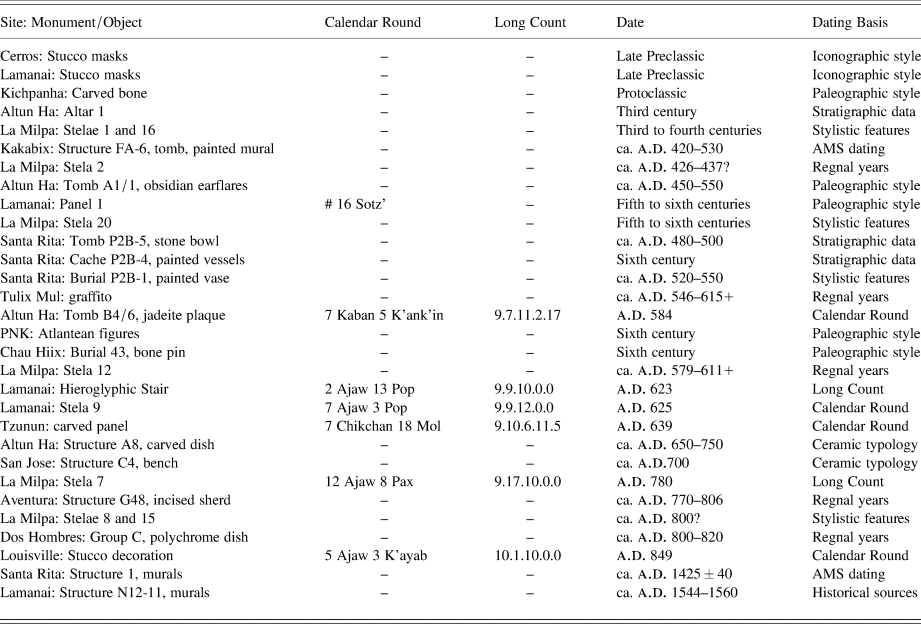
The one monument that is persistently featured is Stela 9 from Lamanai (Closs Reference Closs1988; Pendergast Reference Pendergast1988; Reents-Budet Reference Reents-Budet1988), which is highlighted to such an extent in both the academic and touristic literature that one might reasonably conclude that it is the only historical source for the region as a whole. In fact, however, numerous sites throughout the region have yielded glyphic texts that attest to charismatic kings and influential courts during the course of Maya history. What has been lacking is a coherent synthesis of all of the materials into a global overview that considers the historical context and sociopolitical processes of neighboring polities in adjoining parts of the eastern lowlands. This paper was formulated in order to integrate the more salient texts in a diachronic sequence, thereby providing an approximation of history (Table 1).
Chronology of dated hieroglyphic texts on carved stone monuments and portable objects in Northern Belize. AMS, accelerator mass spectrometry.

This study builds on earlier syntheses of epigraphic sources for Southern (Prager Reference Prager2013; Wanyerka Reference Wanyerka2003) and Central Belize (Beetz and Satterthwaite Reference Beetz and Satterthwaite1981; Helmke Reference Helmke2019a; Helmke and Awe Reference Helmke and Awe2008). Salient for its omission is a comparable treatment of the epigraphic corpus for northern Belize, which is precisely what this present study aims to redress.
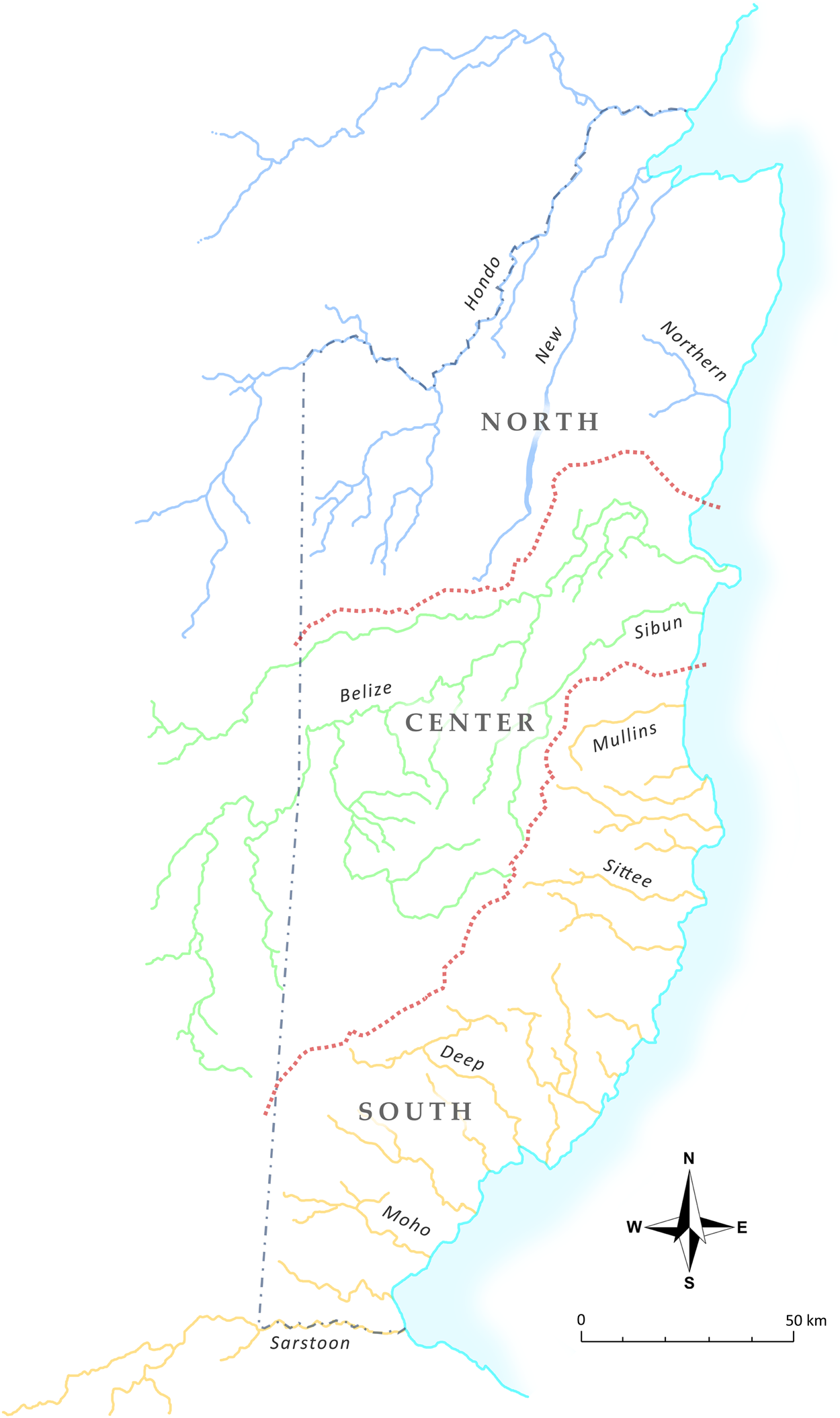
Northern Belize as a cultural region is here defined—and set in opposition to central and southern Belize—by hydrology and watersheds. This is in keeping with an earlier study of the epigraphy of central Belize (Helmke Reference Helmke2019a). Each of the three regions is internally more uniform, both geologically and physiographically, with prominent topography and marshy lowlands delineating and separating these as ridgelines, and larger waterways that defined major arteries of travel as well as transport in antiquity. The dry, tropical region of northern Belize can be defined by the watershed formed by Freshwater Creek, Río Hondo, the New River, and the Northern River, as well as the many tributaries of these waterways (Figure 1). In much the same way, the two largest rivers, the Belize and the Sibun, define the central Belize region, whereas southern Belize is defined by the Sarstoon, Temash, Moho, and Río Grande in (wet, tropical) Toledo, as well as the many smaller rivers draining off the Maya Mountains in the Bladen and the Cockscomb in (moist, tropical) Stann Creek, from the Golden Stream at the south to the Mullins River in the north. This division of Belize defines three major archaeological zones in the country, each of which roughly encompasses two of the administrative districts of the country. According to this scheme, we can see Toledo and Stann Creek districts in the south, Cayo and Belize districts in the center, and Orange Walk and Corozal in the north.
The three archaeological regions of Belize, hydrologically defined according to contiguous watersheds, with drainage divides marked by dotted lines. Map by the author.

CORPORA
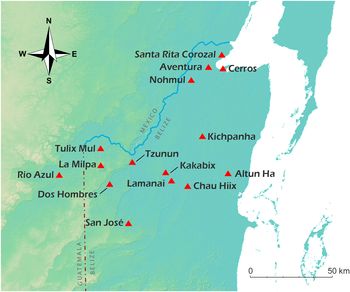
The corpus of glyphic texts from northern Belize consists of a series of carved monuments as well as text-bearing objects from a variety of sites and contexts (Figure 2). The largest assemblage of carved monuments is that found at the large primary center of La Milpa, with 21 stelae in the monumental epicenter, nearly half of which preserve evidence of carving (Grube Reference Grube1994a; Hammond Reference Hammond2001; Hammond and Bobo Reference Hammond and Bobo1994; Hammond et al. Reference Hammond, Heller, Houk and Gair Tourtellot2014). The largest known site in northern Belize is Lamanai, and a diverse assemblage of monuments has also been found there, although this is a little-known fact since Stela 9 is typically the only featured monument (Closs Reference Closs1988; Pendergast Reference Pendergast1988; Reents-Budet Reference Reents-Budet1988). Based on present count, Lamanai exhibits a corpus of at least 10 stelae (of which at least half preserve evidence of carving), as well as two carved altars, one ballcourt marker, an early carved panel, and a series of large, monolithic risers that once formed part of a hieroglyphic stair (Helmke Reference Helmke and Graham2018a). Owing to its variety and importance, the corpus of Lamanai is the subject of a separate study by Helmke and Pendergast. The relatively large corpora of monuments from these two large centers is in part a reflection of the size and importance of the sites, as there is a rather unsophisticated correlation between the size of a site and the number of monuments encountered (Andres et al. Reference Andres, Helmke, Morton, Wrobel and González2014:Table 1; Houk Reference Houk2015:242–246).
Map of northern Belize, showing the location of major archaeological sites where glyphic texts have been found. Map by the author.

Aside from the corpora from these two major sites, an important carved stone panel has recently been discovered in the vicinity of the minor center of Tzunun in northwestern Belize (Hanratty et al. Reference Hanratty, Love, Guenter and Guderjan2016; Stuart Reference Stuart2017). In addition, relatively small numbers of uncarved stelae (and a few plain altars) are also known from Chan Chich (one), Chau Hiix (one), Cuello (one), Kaxil Uinic (one), Sarteneja (one), San José (one), Aventura (two), Blue Creek (two), Chanchen (two), Gallon Jug (three), Dos Hombres (three), and Tikin Ha (four; Guderjan Reference Guderjan2004:241–243; Hammond Reference Hammond1982; Houk Reference Houk2015:182, 191, 195; Sidrys Reference Sidrys1983:23, 82, 114–123, 169–171; Thompson Reference Thompson1939:9). Of these, the stela of Kaxil Uinic and one of the stelae of Tikin Ha preserve faint traces of carving, despite extensive erosion (Brett Houk, personal communication 2019). Their relative scarcity aside, the monuments attest to the commemoration of periodic calendrical rituals from the Late Preclassic through to the end of the Classic. Peculiar lacunae are the sites of Nohmul, notwithstanding its relatively large size, where no monuments have been found, and Altun Ha, where only two carved altars are known, stelae being altogether unknown, despite the economic and political importance of the site during the Classic period (Helmke et al. Reference Helmke, Guenter and Wanyerka2018). Yet once more, this may be a product of site size, for Altun Ha is one of the smallest primary centers not only in northern Belize, but also in Belize as a whole (Helmke and Awe Reference Helmke and Awe2008:69; Houk Reference Houk2015:235–237).
All the other glyphic texts reported in northern Belize form either part of architectural decorations including stucco and painting, or adorn portable objects, including polychrome ceramics, and more unique artifacts such as a carved bones and jades, a set of unique and exquisitely ground and polished obsidian earflares, and a travertine bowl. One fascinating example of an incised graffito also merits consideration because it bears on alliances and intersite relations at the juncture between the sixth and seventh centuries (Helmke et al. Reference Helmke, Hammond, Guderjan, Greaves and Hanratty2019).
LATE PRECLASSIC (100 b.c.–a.d. 200)
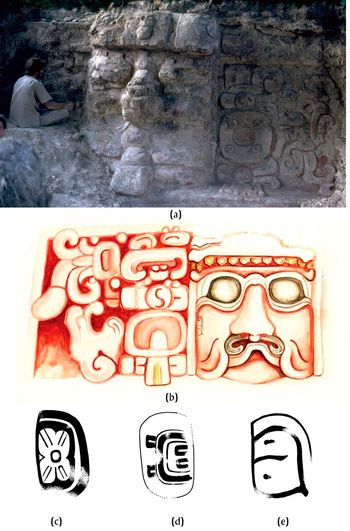
The earliest evidence for glyphic writing in northern Belize consists of the isolated painted glyphs that adorn the intricate stucco masks of Cerros and Lamanai. The former masks are better known and have been the subject of several important studies (Freidel Reference Freidel, Fields and Reents-Budet2005; Schele and Freidel Reference Schele and Freidel1988, Reference Schele and Freidel1990:103–119), yet it is the evidence from Lamanai that demonstrates the integrity, wider geographic distribution, and regional coherence of this practice of adorning stucco masks with glyphs. The architectural core of substructural platforms at Lamanai does not generally lend itself to tunneling, since these consist predominantly of loose, dry-laid core, with the exception of some of the earlier phases of Structure N9-56, which were built of masonry aggregate core (David Pendergast, personal communication 2001). Tunneling investigations along the northern, upper terrace of N9-56 partially uncovered large, stucco masks of the Late Preclassic (Pendergast Reference Pendergast1981:39). The masks are depictions of supernatural entities with pronounced crullers around the orbits and squared solar eyes that suggest that these are precursors to the Jaguar God of the Underworld, a nocturnal aspect of the sun (Figure 3b; Karl Taube, personal communication 2018). The masks were embellished with painted features and decorations, and close inspection reveals early examples of the logogram AK'AB ~ ahk'ab, “darkness,” painted onto the cheeks of these entities (Figure 3e). This is a feature that marks nocturnal entities as well as creatures of darkness (Stone and Zender Reference Stone and Zender2011:144–145) in alignment with the felid features of the personified nocturnal sun.
Late Preclassic stucco masks. (a) Structure 5C-2nd at Cerros. Photograph by Linda Schele. (b) Structure N9-56 at Lamanai. Drawing by Louise Bélanger. Examples of the glyphs painted on these masks, including (c) k'in, “sun,” (d) yax, “blue-green,” and (e) ahk'ab, “darkness.” Drawings by the author.

At Cerros, the four stucco masks of Structure 5C-2nd adorn the two superimposed lateral outsets on either side of a broad stair (Figure 3a). Although there is still a considerable amount of debate surrounding the details and definite identifications of elements and entities, an approximation can be provided here. Each mask represents a supernatural entity, as indicated by the serpentine forms that demarcate the lateral sides and the jaw-like elements that define the upper frame, within a celestial environment. The entities defining the upper tier have pronounced and rounded beaks, and are shown wearing the distinctive trilobate headdress of royalty—representing the personification of paper (Stuart Reference Stuart2012). Based on the squared eyes and the diagnostic yax, “blue-green,” markings, these are best identified as depictions of the great celestial bird of mythology, usually referred to as the Principal Bird Deity (Bardawil Reference Bardawil and Robertson1976; Nielsen and Helmke Reference Nielsen and Helmke2015; Taube et al. Reference Taube, Saturno, Stuart and Hurst2010). This great bird was of pivotal importance in the foundational stories of ancient Maya royalty because their mythic forebears are said to have defeated this false sun to pave the way for the creation of humanity (Christenson Reference Christenson2007). Ancient Maya depictions of this myth go on to relate the fashioning of the headdress from the bird's decapitated skull and the making of regalia from the tail feathers and abdomen of the bird, which were used thereafter as part of the first royal accession (Helmke and Nielsen Reference Helmke and Nielsen2015:36, 42, Figure 7; Nielsen and Helmke Reference Nielsen and Helmke2015:3, 6, 8, Figure 4; Taube et al. Reference Taube, Saturno, Stuart and Hurst2010:35). The lower tiers depict entities with squared eyes and prominent headdresses, their cheeks marked with the glyph K'IN ~ k'in, “sun” (Figure 3c). As such, there can be little doubt that these are early depictions of the solar deity K'inich Ajaw, “The Radiant Lord” (Taube Reference Taube1992:50–56). Taken together, the stucco masks of Lamanai and Cerros demonstrate the existence and usage of a glyphic writing system at this early date, contemporaneous with the earliest dated examples from San Bartolo, in Guatemala (Saturno et al. Reference Saturno, Stuart and Beltrán2006). In a form distinct from later usage, early glyphs appear to have been preferentially used as semantic determinatives, to denote specific features and attributes of the supernatural entities depicted.
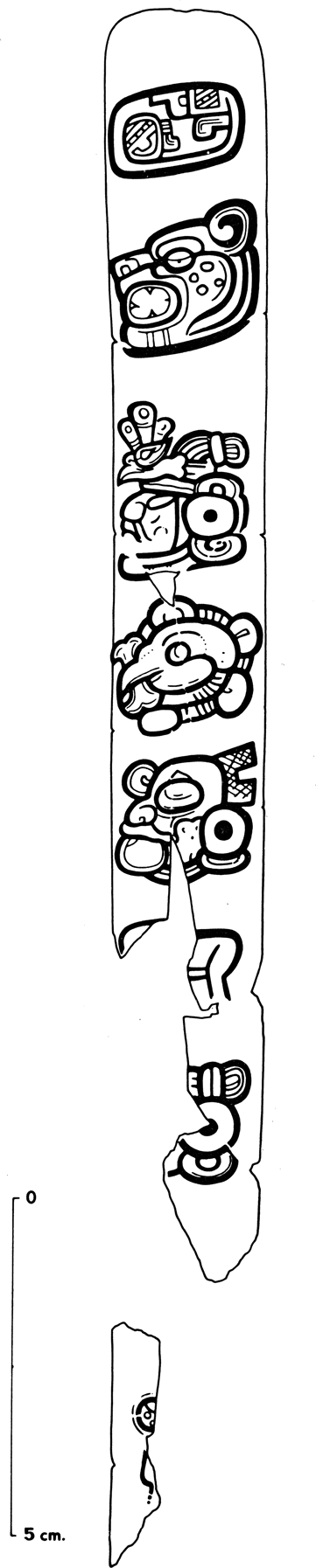
The first linear text of northern Belize is among the earliest glyphic inscriptions from Belize and the entire Maya lowlands as a whole. The text in question was found in Burial 6, in a partly bulldozed mound near the middle of the settlement at the site of Kichpanha (Figure 4). The multiple burials included the remains of at least six individuals, with a primary burial accompanied by secondary burials and apparently also by isolated crania (Gibson et al. Reference Gibson, Shaw and Finamore1986:6–9). A range of funerary objects, including a tetrapod dish, a miniature olla, a bivalve pendant, and the carved bone bearing the glyphic text, were found in association with the primary skeletal remains (Gibson et al. Reference Gibson, Shaw and Finamore1986:9). Based on stratigraphy and the associated ceramics, the burial can be dated to the Late Preclassic to Protoclassic transition, ca. 100 b.c. to a.d. 150 (Gibson et al. Reference Gibson, Shaw and Finamore1986:11). This temporal assignation broadly matches the stylistic features of the glyphic text, which suggest a second- or third-century a.d. date of manufacture (Houston Reference Houston1989:21). The text was carved into the rib of a manatee (Trichechus manatus) and, whereas the upper portion of the text is well preserved, the distal end of the rib is broken and fragmentary, and the final section of the text is missing. Despite uncertainty regarding the dating of the object, we can see that it shares a number of features with early texts, including its single-column format and the exclusive use of large and intricate head variants, one with a distinctively early cloven head, and glyphs without phonetic complements and at the detriment of phonetic collocations. This greatly impedes reading the text, and although some elements can be isolated and identified (e.g., the feline head with the k'in glyph in its gape), a complete reading is not possible, although it may record the name of the original owner.
The carved bone found in Burial 6 of Operation 3003 at Kichpanha, Belize. Drawing by Peter Mathews.

EARLY CLASSIC (a.d. 200–500)
The rise to power of so many centers in northern Belize, evidenced by the size and intricacy of monumental architecture in the Late Preclassic, was followed by continued development at a series of sites, judging by the early carved monuments and the initial appearance of royal tombs. Owing to the fact that all the earliest known royal tombs in northern Belize date to the Early Classic, it is evident that this period saw the increasing centralization of power in the figure of the king and the development of incipient divinization (Houk et al. Reference Houk, Robichaux and Valdez2010).
Monuments
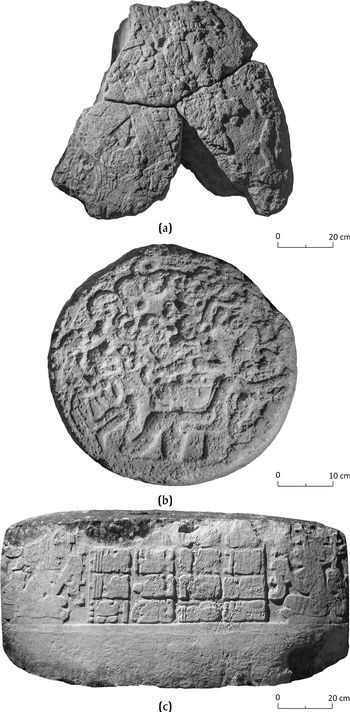
The earliest carved monuments in the region are the stelae of La Milpa, particularly the lower portion of Stela 1, Stela 16, and the fragmentary Stela 20, which are all clearly Early Classic, with characteristic elements of regalia that suggest Tzakol 1–2 dates for the first two stelae, and a fifth-century date for Stela 20 (Figure 5a; Grube Reference Grube1994a:219–220; Hammond Reference Hammond2001). As preserved, Stelae 1 and 16 can be dated to sometime between a.d. 317 (8.14.0.0.0) and a.d. 514 (9.4.0.0.0) on the basis of stylistic traits, which makes them some of the earliest carved monuments in Belize, along with Stela 1 at Blackman Eddy (a.d. 381–382), Stela 20 at Caracol (a.d. 400), Stela 23 at Uxbenka (ca. a.d. 455), and Stela 6 at Pacbitun (a.d. 485; Helmke Reference Helmke2019a; Prufer and Wanyerka Reference Prufer and Wanyerka2005). Interestingly, the faintly preserved caption at the base of Stela 2 at La Milpa may record the name K'uk’ Mo’ (Norman Hammond, personal communication 2018; see Grube Reference Grube1994a:Figure 8) and, given the contemporaneity of this monument with the dynastic founder of Copan (R. a.d. 426–437), one is left to wonder if this refers to that same individual or to a namesake.
Early Classic carved monuments. (a) Stela 20 from La Milpa. Photograph by the author. (b) Circular altar from Altun Ha. Photograph by the author. (c) Panel 1 from Lamanai. Photograph by Stuart Laidlaw.

At Altun Ha, one of the two carved altars depicts a seated ruler on a small circular stone, found redeposited in the core of Structure A3-1st (Pendergast Reference Pendergast1979:145–146), dating to the Mol phase (i.e., before a.d. 250; Pendergast Reference Pendergast1979:160). [The other is probably Late Postclassic, and has been described as a pecked slab, found at the centre of Stone Group 1, near Structure F1 (Pendergast Reference Pendergast1979:145, Reference Pendergast1990:254, Plate 29).] Unfortunately, the altar is heavily eroded or abraded, and only the broadest of outlines can be made out (Figure 5b), but the pose of the ruler and the seated depiction is analogous to the iconography of Stela 6 at Pacbitun (Helmke et al. Reference Helmke, Grube, Awe and Healy2006:72). The iconography of that stela may represent the enthronement of the king and the same may be true of the altar found at Altun Ha. Based on comparisons with other early monuments and given the stratigraphic context of the find at Altun Ha, Altar 1 can be broadly ascribed to the third century.
At Lamanai, the little-known Panel 1, which was removed from its original setting and placed on the primary axis as part of a Postclassic giant-riser stair added to the Classic-period Structure N10-36, testifies to the Early Classic vitality of the dynasty at the site. The panel records a broad text of 16 glyph blocks, framed on either side by depictions of seated rulers (Figure 5c). Based on comparisons to similar compositions elsewhere, including the Motmot marker at Copan, Stela 22 at Caracol, and the so-called Po Panel from the Bonampak region, it is likely that one of these figures represents the king who raised this monument, whereas the other is the dynastic founder. Unfortunately, the text has suffered a fair deal of erosion, although parts of dates can be discerned (A2–A3), as can the name of a structure that can be read as Chan Kal Naah (A4; “Four Opening House,” possibly a reference to the dedication of Structure N10-36 in the Early Classic). Apart from these limited segments, few details remain. The text as a whole is closed by a demonstrative (D4), functioning as a discourse marker. This syntactical placement is shared by early texts of Caracol (Stela 16) and Dzibanche (the wooden lintels of Structure 6), demonstrating that Lamanai was part of the same dialect area as the other two sites, at least during the sixth century (Helmke Reference Helmke, Cicero and Helmke2017:122–123). Of note is the possible reference to a territorial division, written 7-tzu[ku] (D2), read huk tzuk, “Seven Division,” the name of a larger region centered on Naranjo that once encompassed the sites of Holmul, Yaxha, Nakum and Motul de San José (Beliaev Reference Beliaev, Colas, Delvendahl, Kuhnert and Schubart2000; Helmke et al. Reference Helmke, Awe, Morton and Iannone2015b:26–28; Tokovinine Reference Tokovinine2013:98–104). This type of territorial division is usually used exonimically to refer to sites and opponents from other provinces. Hence, Dos Pilas referred to Tikal as 13 tzuk (HS2, Step 3), Tikal referred to Holmul as 7 tzuk (Altar 8), in much the same way that Caracol referred to Naranjo as 7 tzuk (Stela 22). This implies that Lamanai was not part of this province and suggests that the text on Panel 1 either refers to an individual from, or to an event that transpired in, that foreign tzuk to the southwest.
Tombs
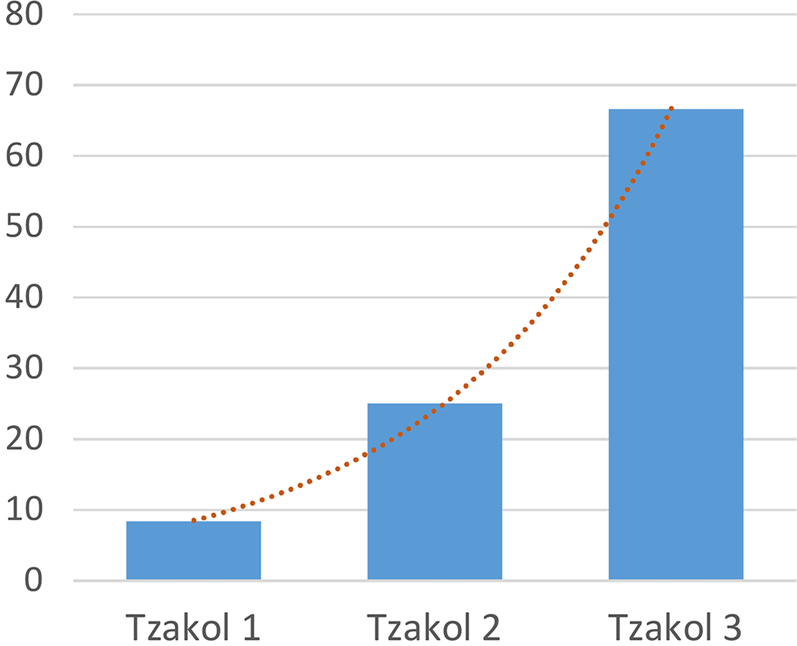
As the final resting place of kings, the royal tombs of northern Belize attest to the strength, vigor, and affluence of a series of dynasties in the region. These are known from Altun Ha (Pendergast Reference Pendergast1979:61–79, Reference Pendergast1990:263–272), Santa Rita Corozal (Chase and Chase Reference Chase and Chase1988:31–35, Reference Chase and Chase2005), La Milpa (Hammond et al. Reference Hammond, Tourtellot, Donaghey and Clark1996:89–91), Dos Hombres (Houk Reference Houk, Robichaux and Valdez2010), Kakabix (Haines and Helmke Reference Haines and Helmke2016), and the two only tombs discovered at Lamanai also date to the latter facet of the period (Pendergast Reference Pendergast1981:38–39). The many tombs encountered in northern Belize that date to the Early Classic demonstrate that this was a period of great strength and autonomy for the dynasties of the region and also for parts of the adjoining Peten, given the large number of Early Classic tombs documented at Río Azul (Hall Reference Hall and Adams1986, Reference Hall and Adams1987; Houk et al. Reference Houk, Robichaux and Valdez2010:Table 2). By number, the greatest proliferation has been found at Río Azul, with incidence following an incremental pattern: two dated to Tzakol 1 (ca. a.d. 250–350; Tombs 29 and 30), six to Tzakol 2 (ca. a.d. 350–450; Tombs 5, 7, 24, 28, 31, and 32), and 14 dated to Tzakol 3 (ca. a.d. 450–550; Tombs 1–4, 6, 8–10, 12, 13, 17, 18, 23, and 25). The same exponential distribution can be observed in the temporal distribution of northern Belizean tombs; the majority date to Tzakol 3, with only one in three precursors dated to Tzakol 2 (Figure 6).
Relative frequency distribution of dated Early Classic royal tombs in northern Belize (N = 12). These tombs have been found at Altun Ha, Dos Hombres, Kakabix, Lamanai, La Milpa, and Santa Rita Corozal. The exponential growth curve is defined by the equation y = 3.00e 1.04x. Graph by the author.

Among the tombs that have been found at Altun Ha, Tomb 1 of Structure A1 is remarkable in many respects. Tomb A-1/1 is one of the most opulent royal tombs at the site. In addition to more than 100 carved and uncarved jades, it contained a series of ceramic vessels that could be assigned to the Ceh phase, and was probably sealed at some point around a.d. 550 (Pendergast Reference Pendergast1979:61–79). Among the unique artifacts is a pair of finely ground and polished obsidian earflares, bearing a continuous glyphic text between them, which on paleographic grounds can be dated to the preceding century (Figure 7; Helmke Reference Helmke1999:13–17; Pendergast Reference Pendergast1979:61, Figures 18e–d).Footnote 1 The flares were initially studied by Mathews (Reference Mathews and Pendergast1979), who provided a succinct but insightful study, remarking that the text is self-referential and provides a name-tag. As such, the text begins by naming the objects themselves, in a possessive construction as u-tuup, “her earflares” (A1), and then goes on to name the original owner. She is named as part of a title of origin as IX (B1) tzo?-[lo]HUN-NAL? (C1), possibly read as ix-tzol hun-naal. This means that the initial element is a female agentive prefix ix-, followed by a toponym that specifies her origin, in place of a personal name. This is composed of what seems to be a toponym Tzol-Huun (“Ordered-Paper, Headband”), involving a rare syllabogram tzo (Stuart Reference Stuart2008) and closed by a suffix -naal, marking demonyms. This may be an expanded and more transparent form of the main element employed in the Emblem Glyph of Ek Balam (Lacadena García-Gallo Reference Lacadena García-Gallo2003:96–97). The text continues on the second earflare, where she is named as the “mother of” (D1) an individual who is designated with two titles. The first is written BAH-TUN ~ bah-tuun, (literally “head-stone”) and, although the figurative meaning of this compound is uncertain, it is used as a title during the Classic (Boot Reference Boot, de Voogt and Finkel2010:274–277; Houston Reference Houston2008). The final title of her child is 13-K'UH ~ uxlajuun k'uh, and may refer to a pattern of territorial organization according to thirteen subdivisions, of which her son was ruler of one such part (Helmke et al. Reference Helmke, Guenter and Wanyerka2018:126; Tokovinine Reference Tokovinine2013:106–107). The earflares may not be those of the individual with whom they were interred, in view of the identification of the skeletal remains as those of a male and the fact that the texts predate the closing of the tomb by nearly a century on paleographic grounds (Helmke Reference Helmke1999:13). As a result, one is left to wonder if it is not the son of the Lady of Tzolhuun who was buried in the tomb, and whether the kings of Altun Ha had consanguineal ties to the Early Classic dynasts of the Yucatan. As we will see, the rulers of Altun Ha appear to have maintained close relations with sites in the northern part of Quintana Roo in the centuries to follow, and these early ties may be part of the explanation.
The obsidian earflares found in Tomb A1/1 at Altun Ha and the associated glyphs. Photographs and drawings by the author.

At the site of Kakabix, located just 10 km northwest of Lamanai, we also see the appearance of tombs to house the royal deceased. Based on relative proximity and size, it is assumed that Kakabix served as a secondary center within the greater Lamanai polity. Owing to looting, no artifacts were recovered to assist in dating the tomb, but radiometric assays of the carbon recovered from the vault beams of the tomb, as well as from the floor area, provided Accelerator Mass Spectrometry dates of cal. a.d. 416–533 and a.d. 435–528, suggesting that the tomb was constructed during the latter part of the fifth or early sixth century a.d. (Haines and Helmke Reference Haines and Helmke2016:121). Whereas the vaulted tomb was heavily affected by looting, enough remained to indicate that the walls had been treated in an orange pigment, decorated with dark-red, painted glyphs (Haines and Helmke Reference Haines and Helmke2016). Although very little of the original text remains, it appears to make reference to a death statement and may name the deceased who was interred in the tomb (Haines and Helmke Reference Haines and Helmke2016:121, 123–124). This is significant because the application of painted glyphs on the walls of tombs is a feature that is best known from the archaeological site of Río Azul in northeastern Guatemala, located 47 km to the west. The dated examples of such tombs at Río Azul can be assigned to a.d. 417–450, with most examples dating to the latter end of that range (Acuña Reference Acuña2016; Hall Reference Hall and Adams1986, Reference Hall and Adams1987). The Kakabix tomb thereby shows not only connections to the site of Río Azul in the latter part of the Early Classic, but also that it is an integral part of the same greater regional tradition of tombs with painted walls (Houk et al. Reference Houk, Robichaux and Valdez2010).
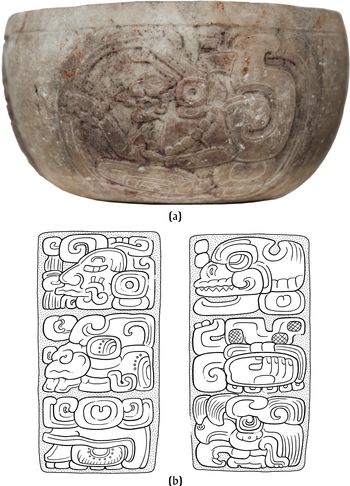
At Santa Rita Corozal, the best evidence for the Early Classic comes from Structure 7, the tallest temple at the site, which forms part of a small group of structures around a raised platform. One of the early versions of the structure, the vaulted Structure 7-3rd, was adorned with intricate stucco decorations on the exterior and a partial roof comb, and enclosing three tandem and two lateral end rooms (Chase and Chase Reference Chase and Chase2005:Figure 1). Placed beneath the floor of the front room of Structure 7-3rd was an imposing tomb (P2B-5) that contained the remains of an adult male, richly provided for the afterlife. Funerary offerings included eight ceramic vessels, jadeite and shell artifacts, a selection of marine shells, three turtles, flint spear points (ominously found at the pelvic area), an imposing chert macrolith (which might have served as a ceremonial bar), a carved travertine bowl, and extensively eroded perishable objects of wood and stucco, including a codex (Chase and Chase Reference Chase and Chase1988:33, 2005:114–115, Figures 6 and 7; Stemp et al. Reference Stemp, Awe and Helmke2014). All of the objects and their occurrence in the large tomb imply that this was the final resting place of an important Early Classic ruler of Santa Rita Corozal. It is the finely carved stone bowl that preserves a text, incised in two vertical panels that flank exquisite renditions of the aged God N, each depicted as a wise man emerging from a marine gastropod (Figure 8; Chase and Chase Reference Chase and Chase2005:114, Figure 7a; Stemp et al. Reference Stemp, Awe and Helmke2014:147). The glyphs state that the bowl was a yuk'ib, or “drinking implement,” intended for kakaw and that it was named Ixiim Witz (“Maize Mountain”). The text goes on to relate that it was owned by someone named K'ahk’ Uneh Chij Xook (“Fire Is the tail of the Deer-Shark”).Footnote 2 No other examples of this name are known in the written corpus but, considering the context and the contemporaneity of the ceramics in the tomb with the paleographic features of glyphs, one might reasonably conclude that the name identifies the occupant of the tomb as the king of Santa Rita Corozal.
The travertine bowl found in Tomb P2B-5 at Santa Rita. (a) One of the iconographic panels showing a seated, aged, male deity emerging from the conch shell. (b) The two glyphic panels. Photograph and drawings by the author.

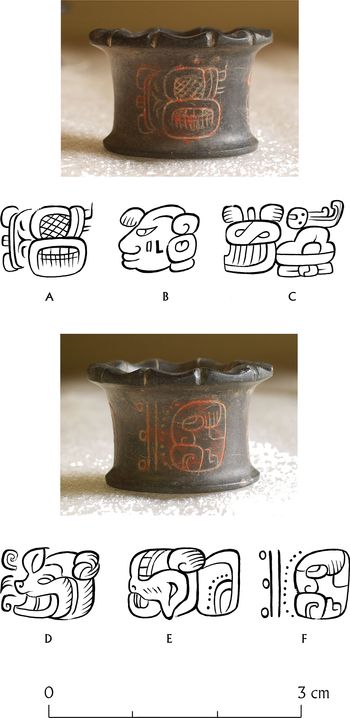
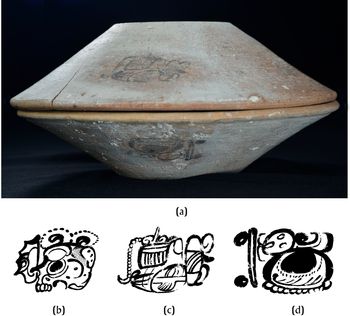
Deposited in the core, directly above the tomb, and serving as a dedicatory cache to the subsequent phase of construction of Structure 7-2nd, was an assemblage of three cache vessels (P2B-4). These simple, unslipped, and graceful everted dishes are the archetype of offering vessels, deposited in three lip-to-lip pairs (Figure 9a; Chase and Chase Reference Chase and Chase2005:115). The upper dishes, were each embellished with a single, black-painted glyph, elegantly rendered in wispy brushstrokes. Together these provide a reference to a supernatural toponym as well as royal names, presumably those of the ruler who oversaw the deposition of the offering and the construction project as a whole, and naming the locality as an emulation of a mythic precedent (Stemp et al. Reference Stemp, Awe and Helmke2014:147). The names can be read as Yax Tok Jo'l (“Green Is the Cloud Skull”), and Tay el Chan K'inich (“Radiant One Who Consumes(?) the Heavens”), and the mythic toponym is Huk-ha’-nal (“Seven-Water-Place;” Figures 9c and 9d), which is known to be the place of the Maize God's demise in Classic Maya mythology (Helmke and Kupprat Reference Helmke and Kupprat2017:106). Considering the contextual and spatial association of the cache with the tomb below, one might conjecture that the vessels name the successor to the entombed king, and that the tomb was a namesake of the fabled locale where the Maize God perished.
The inscribed cache pots of P2B-4, Structure 7-2nd at Santa Rita. (a) Two of the vessels disposed lip-to-lip, one atop the other. Photograph by Richard Holder. The individual glyphs painted on the dishes: (b) Yax Tok Jo'l, (c) Tayel Chan K'inich, and (d) Huk Ha'nal. Drawings by the author.

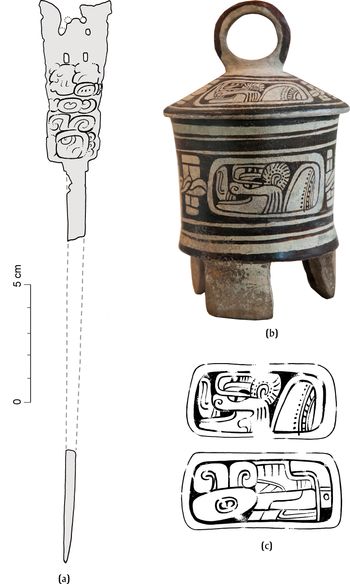
Among the last special deposits in this structure was a funerary cist cut into the core of Structure 7-2nd (P2B-1). Although the sex of the skeleton could not be satisfactorily established, the remains may be those of a woman who was accompanied by a wide array of offerings that included nine ceramic vessels, a small stone vessel, jadeite and shell beads, and a range of artifacts made of shell and bone (Chase and Chase Reference Chase and Chase2005:116–117, Figures 10–11). Among the bone artifacts is a series of intricately carved pins, which may have served as weaving implements. The flattened heads of the pins are decorated with supernatural entities, snake heads, perched quetzal birds, and one side of these pins also bears a small glyphic label (Chase and Chase Reference Chase and Chase1988:Figure 13). Although eroded, the label may name the occupant of the burial as a female, possibly from a locality dubbed “Split Earth” or “Sprouting Earth” in the epigraphic literature (Figure 10a; Martin and Grube Reference Martin and Grube2000:111; Stuart Reference Stuart2005:116–117). In regard to the ceramics, one dish represents a jaguar and a deer, one is the skeuomorph of a calabash, another is a two-part effigy of a stout coati, and a fourth is a slender, black-on-cream tripod vase, with matching lid, and finely painted decorations (Figure 10b; Chase and Chase Reference Chase and Chase2005:Figure 11). This vase is significant for the two glyphic medallions rendered on its sides and repeated on the lid. The first is the same bah-tuun title that we saw earlier on the earflares from Altun Ha. Although the second medallion exhibits some idiosyncratic features, it may record part of a toponym, including the so-called “chi-Bent Kawak” sign, preceded by sak, “white.” Interestingly, this toponym may be recorded on a partial monument (Fragment 2) at Dzibanche (Velásquez García Reference Velásquez García2019; see also Grube Reference Grube and Nalda2004a) and highly similar tripod vases with comparable glyphic medallions have been found at sites in southern Quintana Roo, notably at Kohunlich (Arlen Chase, personal communication 2019; Balanzario and Nalda Reference Balanzario and Nalda2009:Figure 9). As such, it may be that such vases were produced at Dzibanche only to be distributed to allied sites. It may therefore be that the occupant of the cist was originally from Dzibanche or its environs, and isotopic testing of the remains may be helpful in this regard.
Inscribed artifacts of Burial P2B-1 at Santa Rita Corozal. (a) Inscribed bone pin. Drawing by the author after photographs and drawings by Diane Chase. (b) Bichrome tripod vase. (c) Glyphic medallions adorning the same vase, prior to restoration. Photograph and drawings by the author.

Whatever the details, the vessel demonstrates connections between Naranjo and sites in northern Belize during the latter half of the fifth century.Footnote 3 These connections may well stem from the fact that the Río Hondo served as a major artery for transport and trade in antiquity, providing a link via the Bay of Chetumal to the Caribbean in the north, and to sites in the eastern central lowlands via the Río Azul and the Holmul Valley to the south. That the corridor was one of the preferred terrestrial routes during the Classic period is suggested by the glyphic texts at Naj Tunich (in Guatemala), which contain references to individuals from El Palmar (in Quintana Roo), and the recently discovered hieroglyphic stair at that site recounts a journey made to Copan in a.d. 726 along precisely this corridor (Helmke et al. Reference Helmke, Hammond, Guderjan, Greaves and Hanratty2019; MacLeod and Stone Reference MacLeod, Stone and Stone1995; Tsukamoto and Esparza Olguín Reference Tsukamoto and Esparza Olguín2014).
MIDDLE CLASSIC (a.d. 500–600)
Whereas the Late Preclassic and Early Classic evidence testifies to the growing development of important centers of dynastic influence in northern Belize, the second half of the sixth century saw the integration of these centers into ever-increasing networks of alliances and involvement in the affairs of other more distant sites.
One of the remarkable finds in this regard is an incised graffito at the site of Tulix Mul that represents a royal palanquin, presumably one that was sighted as a procession paused on a royal progress through the area. What makes this remarkable is that sufficient features survive to allow comparison of the depiction with other known examples and thereby identify the palanquin with a specific king, namely that of Ajasaaj Chan K'inich (R. a.d. 546–615+), the long-reigning monarch of Naranjo (Helmke et al. Reference Helmke, Hammond, Guderjan, Greaves and Hanratty2019). Based on the glyphic texts of Naranjo, we know that Ajasaaj Chan K'inich was a dedicated vassal of the Snake kings of Kanu'l, as his accession in a.d. 546 took place under the aegis of Tuun K'ab Hix (Martin and Grube Reference Martin and Grube2000:72). Owing to the length of his reign, he went on to outlive at least four consecutive overlords, spanning from Tuun K'ab Hix to Scroll Serpent (Martin and Beliaev Reference Martin and Beliaev2017:4–5). Given the location of Tulix Mul, approximately 91 kilometers north-northwest of Naranjo, and the overall bearing of travel, we can conclude that this graffito bespeaks a royal progress that may have been on its way to the court of the Kanu'l kings, who at the time were established at Dzibanche, located another 83 km farther north. The journey could have taken place as part of an audience either at the enthronement of Ajasaaj Chan K'inich himself, or the accession of one of his overlords, since vassals were on occasion in attendance at such ceremonies (Helmke et al. Reference Helmke, Hammond, Guderjan, Greaves and Hanratty2019).
It is also during the Middle Classic that we begin to see references to the Water Scroll Emblem Glyph in the written corpus. The earliest example occurs on the large jadeite plaque, found in Tomb 6 in Structure B4, the so-called Temple of the Masonry Altars at Altun Ha (Figure 11; Pendergast Reference Pendergast1982:84–91). The prefatory study of this text by Mathews and Pendergast (Reference Mathews and Pendergast1979) placed the associated Calendar Round dates to a.d. 569 and 584. The earlier date refers to a warfare event undertaken by a figure named K'inich Chak Pax(iil), and the later date records the accession of a king bearing the regnal name of Til Man K'inich (Helmke Reference Helmke1999; Helmke et al. Reference Helmke, Guenter and Wanyerka2018:116–118).Footnote 4 This text provides Til Man K'inich with a clear Water Scroll Emblem Glyph, and based on the context of discovery, Mathews was the first to suggest that the glyph may be the royal title of the dynasty established at Altun Ha in the sixth century, a conclusion that has since gained some traction (Helmke et al. Reference Helmke, Guenter and Wanyerka2018). In many respects, Til Man K'inich was the most important historical figure of northern Belize, and several other mentions of him are known. One is found on a pair of limestone statuettes depicting aged Atlantean figures, typically subsumed under the label of God N, and another appears on a carved weaving pin found in a burial at the site of Chau Hiix (Figures 11b–11d; Helmke et al. Reference Helmke, Guenter and Wanyerka2018:118–121). In both of these latter examples the king bears the exalted title of Elk'in Kalo'mte’, which is difficult to interpret but can be roughly translated as “Eastern Emperor” and appears to assign him dominion over the eastern quadrant of the Maya world (Helmke et al. Reference Helmke, Guenter and Wanyerka2018:119–120, 123–124). It is just a decade after the accession of Til Man K'inich, in a.d. 595, that mention is made to the same Water Scroll in the texts of Pusilha (in Southern Belize), in reference to martial events resulting in the splintering of stelae and the toppling of the local king (Helmke et al. Reference Helmke, Guenter and Wanyerka2018:121–122; Prager Reference Prager2013; Wanyerka Reference Wanyerka2003). This may be a record of long-distance attack and interference by Altun Ha against a Southern Belizean site, which is unexpected given the distance involved and the relatively small size of Altun Ha, but the reach of the site was enabled by its strategic position, on the Caribbean coast. At the same time we see what may be specific mention of Til Man K'inich on Panel D at Coba, in a context that suggests connection between the two dynasties (Guenter Reference Guenter and Stanton2014:412). The references at Coba and Pusilha demonstrate the power and influence of Til Man K'inich and the economic importance of Altun Ha at this time, which may account in part of for the material wealth of the site and especially the abundance of jadeite by number and sheer mass (Pendergast Reference Pendergast1979, Reference Pendergast1982).
(a) The reverse of the jadeite plaque of Altun Ha referring to events in a.d. 569 and 584. Drawing by David Findlay, after Mathews and Pendergast (Reference Pendergast1979:Figure 2). Examples of the name of Til Man K'inich as recorded on (b) the jadeite plaque, (c) limestone statuettes, and (d) a carved bone pin found at Chau Hiix. Drawings by the author.

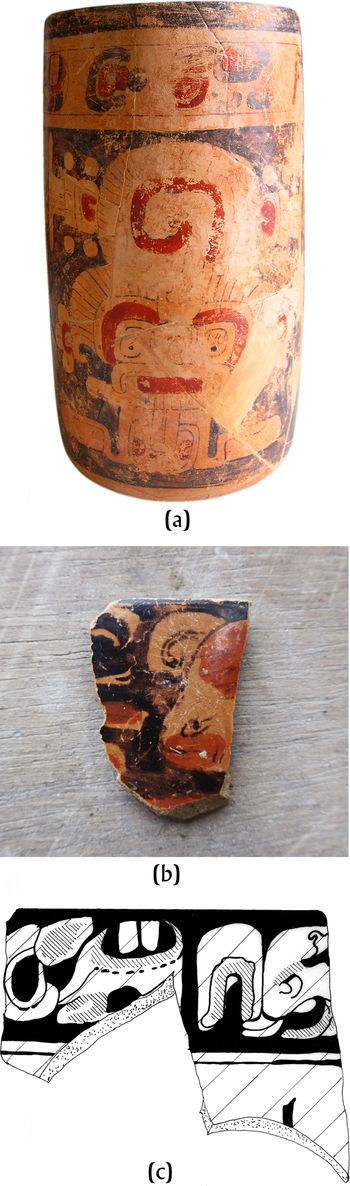
It is not coincidental that the distribution of Petkanche Orange-polychrome ceramics in large measure duplicates the sphere of influence of Til Man K'inich, with salient specimens found at Copan, Pusilha, Becan, and Coba, without mentioning the profusion of the type at Altun Ha and select northern Belizean sites, including sites on Ambergris Caye (Figure 12; Ball Reference Ball, Sabloff and Henderson1993:260–261; Helmke et al. Reference Helmke, Guenter and Wanyerka2018:127, Figure 13; Reents-Budet et al. Reference Reents-Budet, Bishop, MacLeod and Reents-Budet1994:198–204). Therefore, just as so-called “Holmul Style” cream-polychrome ceramics produced at royal workshops at Naranjo and its satellites serve as evidence for alliances between sites in the Late Classic (Helmke Reference Helmke2019a; Houston et al. Reference Houston, Stuart, Taube and Kerr1992; Reents-Budet et al. Reference Reents-Budet, Bishop, MacLeod and Reents-Budet1994:179–186) so too does the appearance of Petkanche Orange-polychrome vessels attest to ties with Altun Ha during the sixth and early seventh centuries. Sherds of this type found in the Ottawa Group, the royal palatial complex at Lamanai (Figure 12b), and specimens found at Río Hondo, Santa Rita, Sarteneja, Aventura, Nohmul (Figure 12c), Caye Coco, Colha, and El Pozito may all suggest alliances between these sites, judging by the relative ubiquity of this type at Altun Ha and the rarity of specimens at recipient sites (Ball Reference Ball, Sabloff and Henderson1993:260–261; Blom Reference Blom1950; Gann Reference Gann1918:111, Plate 19a). This is made all the more significant, by the presence of Petkanche ceramics as far afield as Copan, Becan, Tancah, Coba, and Actun Tacbi Ha, a cave in northern Quintana Roo (see Rissolo Reference Rissolo2003:119, Figure 5.57; Reents-Budet et al. Reference Reents-Budet, Bishop, MacLeod and Reents-Budet1994:179–186), in contrast with the complete absence of the type from sites on the escarpment north of the Río Bravo (Laura Kosakowsky, personal communication 2019).
(a) Petkanche vase from Altun Ha, Structure E-7, Burial 2 [RP192/1]. Photograph by the author. (b) Petkanche sherd found in the palatial Ottawa Group at Lamanai. Photograph by Karen Pierce. (c) Petkanche sherd found at Nohmul. Drawing by Edward Gimmi.

LATE AND TERMINAL CLASSIC (a.d. 600–850)
Monuments
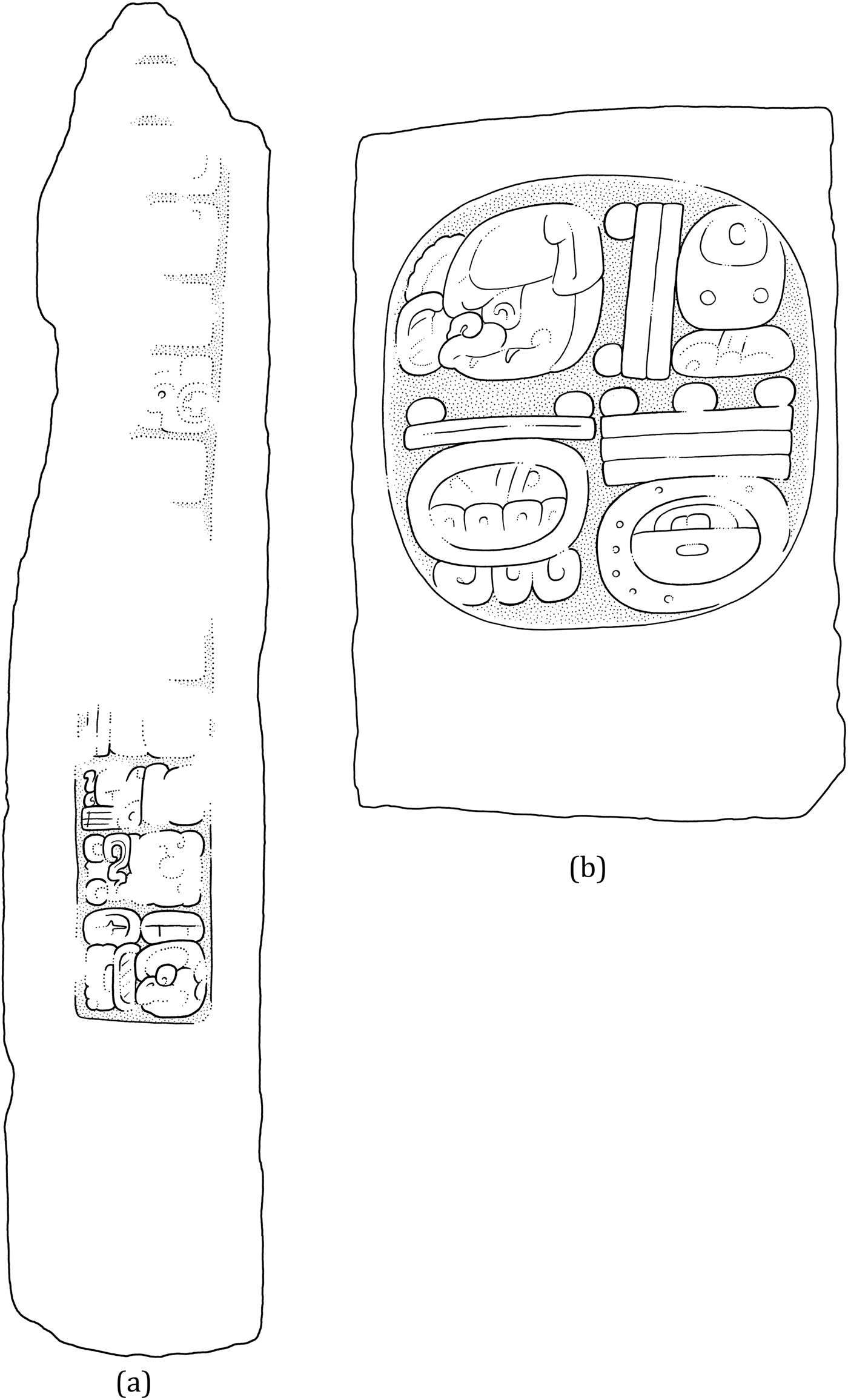
That northern Belizean sites were firmly integrated into sociopolitical and economic networks that tied them to each other as well as to polities in the greater Maya world is perhaps made most evident in the events that transpired during the second half of the sixth century. One form of evidence for the influence and interference of Kanu'l kings is made evident by the glyphic text of Stela 12 at La Milpa that mentions the Snake kings by their distinctive Emblem Glyph (Figure 13a; Grube Reference Grube1994a:221). The outline of the regnal name that appears before the Emblem Glyph resembles that of Scroll Serpent, the ruler of the Kanu'l dynasty who ruled from his accession in a.d. 579 until at least 611 (Martin Reference Martin, Kerr and Kerr1997:861; Martin and Grube Reference Martin and Grube2000:105–106). The faint traces that remain are consonant with a record of his accession, suggesting that Stela 12 is the record of his vassal, perhaps raised to commemorate the period ending of 9.8.0.0.0 in a.d. 593. The monarch of La Milpa is portrayed on the front, brandishing a very distinctive knotted and bicephalic lance, which, based on other well-dated examples, can be broadly assigned to the same time span (Helmke and Nielsen Reference Helmke, Nielsen, Knub, Helmke and Nielsen2014:19–21).
Late Classic carved monuments of Northern Belize that make mention to Kanu'l monarchs. (a) Lateral text of Stela 12 at La Milpa. (b) Tzunun panel. Drawings by the author.

The recent discovery of a carved panel at the site of Tzunun in northwestern Belize provides similar evidence (Figure 13b; Hanratty et al. Reference Hanratty, Love, Guenter and Guderjan2016). Although the precise context remains unclear because the panel is a single riser of what was once a larger hieroglyphic stair, the panel makes similar reference to a Kanu'l king by his Emblem Glyph.
The recent discovery of glyphic panels at Xunantunich that once formed part of the grand hieroglyphic stair raised by Caracol's king, K'an II, in a.d. 642, complete this riveting account and flesh out important details. Thanks to these panels it is now known that the incumbent of the Kanu'l throne at Dzibanche was a ruler named Waxaklajuun Ubaah Kan, who may have acceded to power in a.d. 630, only to be put to the knife in a.d. 640 (Helmke and Awe Reference Helmke and Awe2016a, Reference Helmke and Awe2016b). His adversary was Yuhkno'm “Head” (possibly a pre-regnal name of Yuhkno'm Ch'een the Great; Martin Reference Martin2005:7, n9), presumably a half-brother and anti-king, vying for the throne of the Kanu'l. This conflict led to a fissioning of the dynastic line, with the cadet line under Yuhkno'm eventually installing itself at Calakmul, while Dzibanche was stripped of the trappings of a monarchical seat (Martin Reference Martin2005; Martin and Velásquez García Reference Martin and García2016).
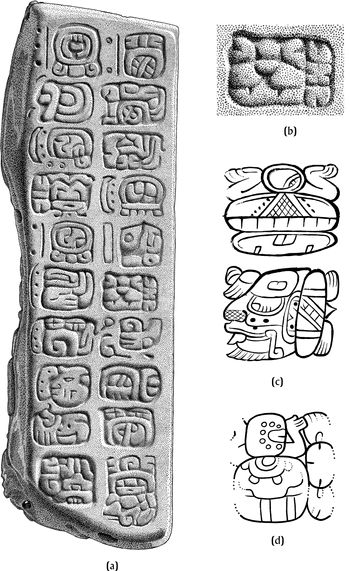
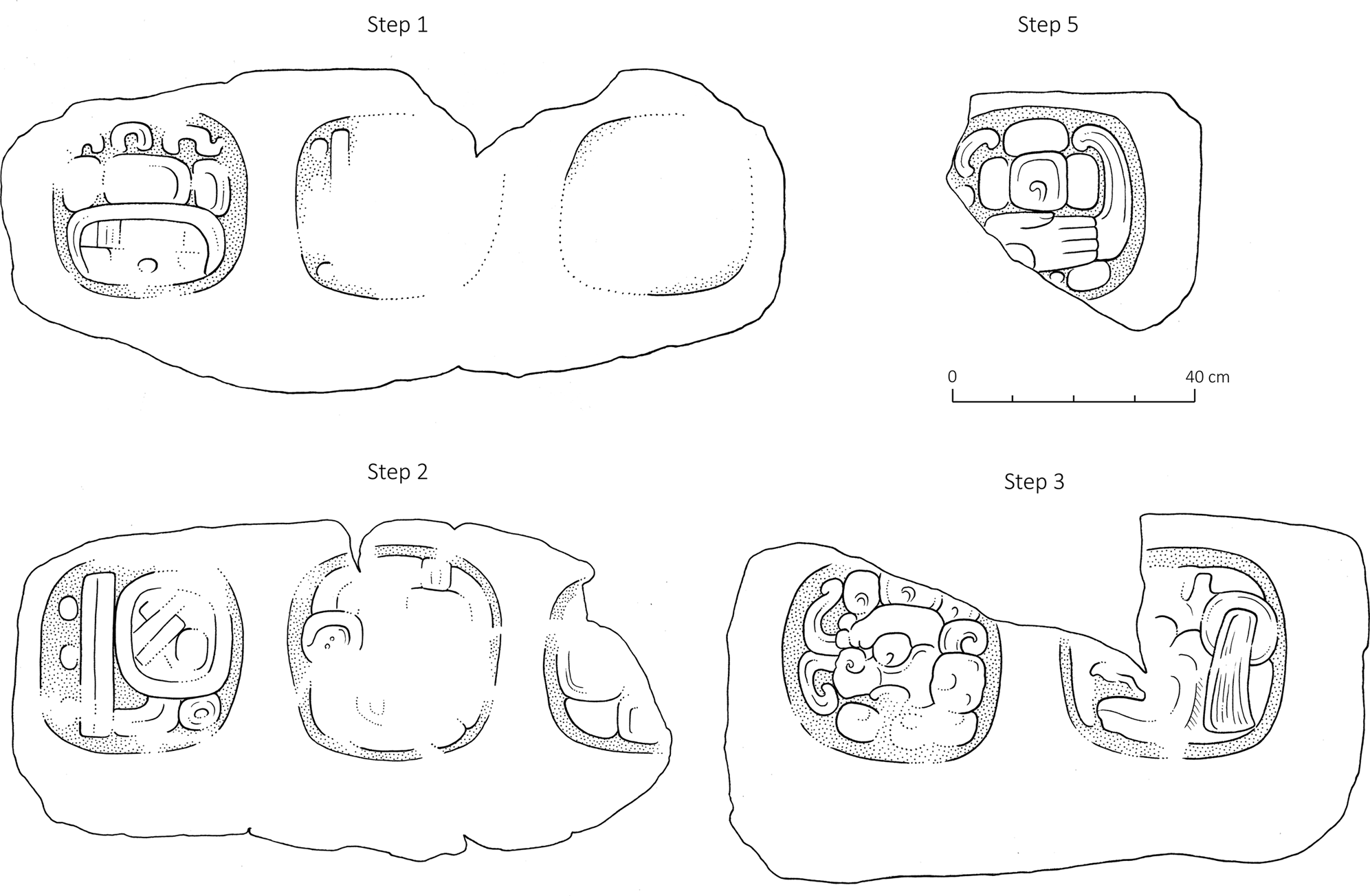
During these decades of upheaval and civil war, the Kanu'l did not maintain a firm grip on their vassals, a failing that allowed them greater autonomy and the means of asserting their authority. At Tzunun or a site in the vicinity, we see the erection of a hieroglyphic stair that detailed the fate of their overlords at some point after a.d. 639 (the only date that can be discerned at present; see Stuart Reference Stuart2017). At Lamanai, this is made all the more explicit by the raising of the finely detailed and majestic Stela 9 in a.d. 625 (Closs Reference Closs1988), commemorating the deeds of the king with the lengthy bipartite names K'ahk’ Yipiiy Chan Yopaaht (“Yopaaht Who Has Strengthened Fire in the Sky”) and K'ahk’ Ujo'l Yopaaht (“Fire Is the Skull of Yopaaht”). At around the same time, the same king also erected a hieroglyphic stair, of which parts of five risers are known today (Steps 1–5), but which would have been at least twice as long (Figure 14; Helmke Reference Helmke and Graham2018a:4–6). A partial date is preserved at the onset—reading “13 Pop,” part of the 9.9.10.0.0 Long Count date (Steps 1, 2, and 5), as is the second of his regnal names, K'ahk’ Ujo'l Yopaaht (Step 3). The raising of hieroglyphic stairs at Lamanai (a.d. 623), Tzunun (ca. a.d. 639), and Caracol (a.d. 642), just years apart in the first half of the seventh century, all suggest adherence to a wider pattern of allegiances, as monuments of this type were preferentially raised at sites under the influence of the Kanu'l kings (Helmke et al. Reference Helmke, Andres, Morton and Wrobel2015a:21–25). It is far from coincidental that the raising of hieroglyphic stairs and stela at Lamanai marks precisely the decades during which the Kanu'l kings were at their weakest, a time in which there was a waning of centralized control and the assumption of autonomy on the part of erstwhile vassals (Guenter Reference Guenter2016).
A selection of risers of the hieroglyphic stair dedicated at Lamanai in a.d. 623. Drawings by the author.

Artifacts
Aside from these highly significant sources, the monumental corpora in northern Belize ceases, for the most part, after this short flourishing in the mid-seventh century with the reassertion of power of the Kanu'l kings at their new capital, Calakmul. This is all the more remarkable when we consider the marked reversal that the Kanu'l kings suffered with the defeat of the armies of Yich'aak K'ahk’ (R. a.d. 686–697), by Tikal's Jasaw Chan K'awiil I (R. a.d. 682–734) in a.d. 692. The Snake kings established at Calakmul never really recovered from the decisive blow and, although their dynasty endured, the ties of vassalage of a great many polities were either shaken or entirely dissolved at this time.
The main exception to this pattern is La Milpa, where we see the erection of Stela 7 in a.d. 780 (9.17.10.0.0) followed shortly thereafter by Stela 8, monuments that represent the local dynasty bearing all the most exalted titles including Emblem Glyphs and the title Baahkab, “Chief of the Land” (Grube Reference Grube1994a:221–224). Although the dating of Stela 15 remains unclear, it was likely raised during the Late-to-Terminal Classic (Grube Reference Grube1994a:224–225), showing a century of continued vitality and vigour in the royal dynasty established at La Milpa in the wake of Calakmul's waning power following the crushing defeat of a.d. 692.
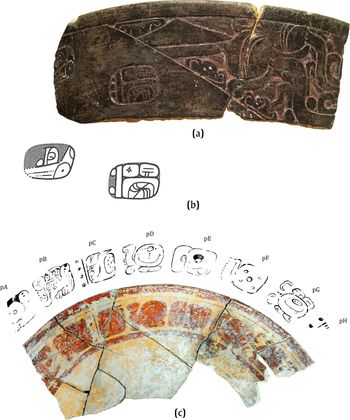
It is during this time of upheaval that we see a growing number of inscribed objects at a variety of sites that bear name-tags or possessive statements that provide the names of individuals. The objects include a fragmentary text from Altun Ha incised on a blackware dish (Figures 15a and 15b), found in a refuse deposit associated with Structure A8, which was part of the palatial group of the site (Pendergast Reference Pendergast1982:127–138). This deposit contained a wide array of decorated serving vessels, including polychrome vases and bowls, which indicate a date in the Kankin phase (a.d. 650–750). The blackware dish in question has everted sides and was excised after slipping to produce a large decorative panel representing aquatic motifs including water lilies and a serpentine form that probably represents the personification of still bodies of fresh water (Helmke Reference Helmke1999:31; Pendergast Reference Pendergast1982:134). Dividing the iconographic program were two diagonal bands of which one remains, carrying two small glyphs in circular medallions. The first reads ch'am-k'awiil, “k'awiil is grasped,” and the second huk tz'ak ajaw, “the seventh king” (Helmke Reference Helmke1999:31–33). The first medallion provides the verbal action that this dish commemorates, recording a well-known expression for royal accession, wherein the king literally takes the scepter in the shape of the deity K'awiil. In more figurative terms, the king can be said to take “power,” one of the secondary meanings of k'awiil in the Classic period (Helmke and Awe Reference Helmke and Awe2016b:14–15). What is significant here is that the dish may record the accession of a Late Classic king of Altun Ha, the seventh in the dynastic sequence. Applying the average length of reigns for the Classic Maya of 30 years (with means ranging between 23 and 36 years; Grube Reference Grube, Tiesler and Cucina2004b:237–240), this would place the inauguration of the founder of the Altun Ha dynasty just over two centuries earlier, at some point around a.d. 540. This date accords well with the available dynastic information, because the accession of Til Man K'inich took place in a.d. 584, which could make his father—named on the jadeite plaque found in Tomb B4/6—the founder of the dynasty (Helmke et al. Reference Helmke, Guenter and Wanyerka2018:117–118; Mathews and Pendergast Reference Mathews and Pendergast1979:203–204).
(a) Section of a blackware dish associated with the palatial Structure A8 at Altun Ha (b) commemorating the accession of seventh king [RP 595/157]. Photograph and drawing by the author after Helmke (Reference Helmke1999:Figure 11). (c) The polychromatic plate found in the palatial Group C at Dos Hombres with its partial text. Photograph and drawing by the author.

Farther afield, it is possible to see renewed mentions of the Water Scroll Emblem Glyph in the context of foreign sites. The first reference to the Emblem Glyph appears on carved bones found in the tomb of Jasaw Chan K'awiil I, which was sealed sometime around a.d. 733. In that context, the Water Scroll is referred to in connection with a quadrilateral division of the Maya lowlands, wherein Tikal assumes the central position and Altun Ha is ascribed as the eastern realm (Helmke et al. Reference Helmke, Guenter and Wanyerka2018:122–124). This is followed by a ritual action in a.d. 726 at Naranjo, wherein a series of lords witnessed the preparations for the erection of a stela at the ensuing period ending (Martin et al. Reference Martin, Tokovinine, Treffel, Fialko, Arroyo, Salinas and Álvarez2017). At the Southern Belizean site of Nim li Punit, there is another mention as part of the accession of the local ruler in a.d. 738, at which the king of Altun Ha is said to have been present (Wanyerka Reference Wanyerka2003:489). Although not an outright declaration of overlordship and aegis, the statement does imply some form of adherence to the old power structures established under the reign of Til Man K'inich (Helmke et al. Reference Helmke, Guenter and Wanyerka2018:128). This is followed by two mentions at Naj Tunich of a repeat pilgrimage undertaken in a.d. 744 and 745 by the Altun Ha king Muyal Chaahk (“Cloud Chaahk”), and a larger retinue of individuals that included his younger brother, Ajchak Maax (Helmke et al. Reference Helmke, Guenter and Wanyerka2018:128–130; MacLeod and Stone Reference MacLeod, Stone and Stone1995:163, 165–167). The references are remarkable because they attest the continued importance of the Water Scroll kings, even at this fairly late date and at sites relatively far afield.
At Dos Hombres, the edge of a polychrome serving vessel preserves part of a glyphic text (Robichaux and Houk Reference Robichaux and Houk2005). Only a small section of what was once a much larger vessel remains, which was found in the palatial complex of Group C. The text is significant for the names, titles and toponyms that it records (Figure 15c; Helmke Reference Helmke and Helmke2019b). For one, it records part of the name of the person who appears to have been the original owner of the vessel as Ajmuwaan (pB1). This individual is tied to the toponym Witzil Mul-nib, “Mountainous Hill-Place” (pD1–pF1), using the toponymic suffix -nib (see Helmke Reference Helmke, Kettunen, López, Kupprat, Lorenzo, Cosme and Ponce de León2018b). Assuming that the text mentions a local ruler, it may well provide the ancient name for Dos Hombres or a location in its environs. The same individual is also styled as 9-tzu[ku], or baluun tzuk (pC1), or as being of the “ninth province” (Helmke Reference Helmke and Helmke2019b:153–156). This again uses the same type of territorial designation that we saw earlier in connection with Panel 1 of Lamanai, although in this case we may be seeing an endonymic reference to the territorial division that encompassed northern Belize (Helmke et al. Reference Helmke, Awe, Morton and Iannone2015b:26–27, Figure 19). Most startlingly, the nomino-titular section is closed by a statement of vassalage, read yajaw, which means that the person named was the “vassal,” or “king of” another superordinate lord (pG1). Only traces of the name of the overlord survive, but enough remains to allow identification of the numeral 18 (pH1). Considering the date of the vessel, assigned on typological grounds to Tepeu 2–3 (Robichaux and Houk Reference Robichaux and Houk2005:5), the last-known king of Naranjo, Waxaklajun Ubah K'awil, emerges as the most likely contender.
Very little is known of the Naranjo ruler, except that he may have been born in a.d. 800 (Savchenko Reference Savchenko2015:37), that he was enthroned in a.d. 814 (Martin and Grube Reference Martin and Grube2000:83), that he participated in a palanquin event in a.d. 819, wherein he journeyed to Ucanal to meet with the warlord Papamalil (Grube Reference Grube, Chase and Chase1994b:95–96; Helmke et al. Reference Helmke, Hammond, Guderjan, Greaves and Hanratty2019), and that he celebrated the period ending of a.d. 820, perhaps not at Naranjo, but possibly at Xunantunich, by performing a ritual dance with his local ally (Helmke et al. Reference Helmke, Awe, Grube, LeCount and Yaeger2010:107–110). His ties with the kings of Baking Pot are made clear by the presence of a barrel-shaped vase that bears his name and titles and also makes reference to the period endings of a.d. 810 and 820 that he celebrated (Helmke Reference Helmke2019a). Taken together, the weight of the evidence suggests that Waxaklajun Ubah K'awil was eager to foster ties with allies, and journeyed to Ucanal and Xunantunich for meetings and rituals, as well as continuing the age-old practice of presenting highly decorated ceramics to cement alliances. It is in this regard that the dish found at Dos Hombres is significant, because it may be a tangible expression of such allegiances, in precisely the same manner as the vase found at Baking Pot. At this late date it may be that the kings of Naranjo continued to maintain a tacit grasp on sites in northwestern Belize, building on the foundations laid centuries earlier by Ajasaaj Chan K'inich.
Stucco Decorations
An additional source of glyphic texts is found in the stucco decoration of buildings that are found at a number of sites, especially at San José, Lamanai, and Louisville. At San José a linear text adorns the front of a masonry bench in Room B of Structure C4, undoubtedly the reception hall of the patriarch of the group (Thompson Reference Thompson1939:30, 32; Plate 6). Based on architectural stratigraphy and associated ceramics, Thompson (Reference Thompson1939:44) suggested that this phase of construction dates to the San Jose IV phase, which is to say to a.d. 700 and later. Initially composed of 17 glyph blocks, the text is not entirely clear in all its details, and several glyphs are missing in key sections. Despite the ambiguities, the text records a dedicatory statement that commemorates the initiation of the “bench” (labelled as a teem) and the “room” as a whole (designated as way; Helmke et al. Reference Helmke, Awe and Kettunen2004; Thompson Reference Thompson1939:Plate 6e). The text originally continued with a record of the name and titles of the individual who owned the room and the bench within, but most of these segments had already spalled off at the time of discovery and the nominal segments were only preserved in small portions (Thompson Reference Thompson1939:Plate 6c).
At Lamanai, the bulk of the stucco decorations recovered once adorned the upper zone of the façade of Structure N10-28 in the palatial Ottawa Group (Shelby Reference Shelby2000). The stucco was recovered from the core of the overlying construction phase, which replaced the original masonry superstructure with a smaller one of perishable materials. Most of the stucco is figurative and was brightly painted in vivid colors. Based on style and context, the stucco can be dated to the Late-to-Terminal Classic (ca. a.d. 750–800). Among the decorative elements, in addition to a wide array of regalia, feathers, and items of personal adornment, there are representations of a series of elite figures, possible captives, as well as deities (including K'awiil and the solar deity K'inich), suggesting that the façade was embellished with a large and complex scene, perhaps one meshing historical individuals into a mythic narrative. The few glyphic elements that remain may qualify the backdrop or milieu of at least part of the scene as a mountainous one, based on small elements of the logogram witz, “mountain,” as well as partial calendrical cartouches (Shelby Reference Shelby2000). Together these may also have named the structure and provided the date of its dedication.
At the subsidiary center of Louisville, a series of stucco decorations has also been found that may date to much the same period as the comparable decorations at Lamanai (Gann Reference Gann1943; Runggaldier Reference Runggaldier2004). Again, much of the decoration consists of figurative elements, the heads of individuals, and items of regalia. One intriguing fragment may preserve part of a Tzolk'in date, which has been interpreted as 5-AJAW (Hammond and Runggaldier Reference Hammond and Runggaldier2000:494; Runggaldier Reference Runggaldier2004). This may well refer to the period ending of 10.1.0.0.0 or a.d. 849, which neatly defines the median of the stylistic range of a.d. 800–900 assigned to these stucco by Hammond and Runggaldier (Reference Hammond and Runggaldier2000:493).Footnote 5 This would make it one of the very latest glyphic references, dating squarely to the Terminal Classic and being roughly contemporary with the last monuments of Central Belize (Helmke Reference Helmke2019a; Helmke et al. Reference Helmke, Awe, Grube, LeCount and Yaeger2010:113–120). Yet, unlike the record of Central Belize, which is silent after the close of the ninth century, in northern Belize the fascinating murals of Santa Rita Corozal and Lamanai are the last hurrah.
LATE POSTCLASSIC (CA. a.d. 1450–1544)
The last and, by many measures, the most astounding evidence for glyphic texts in northern Belize consists of the polychrome murals of Santa Rita Corozal and Lamanai. These exhibit a range of stylistic features that testify to increasing participation in networks of commerce with centers in the Yucatan via ports along the Caribbean coast.
Santa Rita Corozal
When Gann (Reference Gann1900:663) discovered the murals adorning the walls of Structure 1 in 1896, he reported on the vagaries of documenting these given that “there was no tracing paper to be had” in the colony. After some time, this hurdle was eventually overcome with a “very imperfect substitute” (Gann Reference Gann1900:663). Unfortunately, during this delay, one of the remaining portions of the eastern wall was irreparably damaged, whether by deliberate action or carelessness is unknown. This was greatly lamented by Gann (Reference Gann1900:663, 665), as he reported that precisely this portion was covered, over the entire height of the wall, by “a number of hieroglyphics were massed together.” Despite this gutting lacuna, the murals of Santa Rita Corozal were admirably documented in Gann's initial study (Reference Gann1900:Plates 29–31, 663–673), for which we can be thankful, given that the murals have not survived to this day. Follow-up excavations in the late 1970s under Sidrys (Reference Sidrys1976:332–344) recovered a carbon sample from Structure 1 and recovery of comparable mural fragments at the nearby Structure 77, together provide a date of a.d. 1425 ± 40 (Chase and Chase Reference Chase and Chase1988:80–81; Taube Reference Taube, Vail and Hernández2010).
As recorded, the polychromatic murals were preserved on the western and eastern walls, but especially the northern wall of a structure with walls preserved to a height of 2.74 m (Figure 16a). The width of the northern wall was preserved over its entirety and measured 10.87 m (east-west), pierced in its center by a doorway 0.9 m wide, whereas the western wall measured over three meters (north-south). The eastern wall was poorly preserved and only the outlines of the iconography were recognizable in the central portion (Gann Reference Gann1900:665–666). The southern wall had been partially dismantled in pre-Columbian times and covered with core to prepare for the ensuing terminal phase of construction (Chase and Chase Reference Chase and Chase1988:80). Whereas much of the murals were preserved when Gann uncovered them, the majority of the plastering on the lower portions of the walls had not survived, presumably owing to the accumulation of humidity. It is thereby that the upper portions of the walls were best preserved, with the murals of the north and west walls being the most complete.
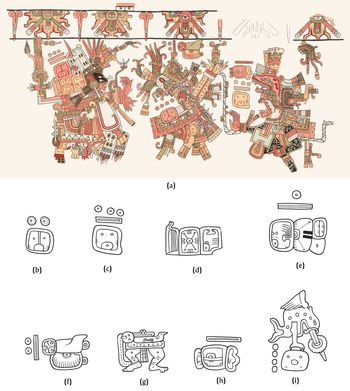
The Late Postclassic murals at Santa Rita. (a) A section of the northeastern wall, showing three deities. Drawing by the author showing three deities, after Gann (Reference Gann1900:Plate 29). A selection of glyphs associated with depictions of the supernatural entities: (b and c) Dates 2 Ajaw and 8 Ajaw; (d) cardinal direction chikin, “west”; (e) supernatural epithet wak mihnal ajaw. Mythic toponyms: (f) Huk Ha'nal, (g) K'ul Óok'ot?-Naal, and (h) Nah Ho’ Ka'an. The name (i) Kan Beh Tz'unu'un. Drawings by the author.

The murals depict a series of supernatural entities, or deities, many of which appear to occur in pairs with one of such a set bound in ropes. This motif is prevalent in the murals and must convey an overarching theme. In large measure it is the style of the murals that has attracted the attention of scholars, as Gann (Reference Gann1900:672) already noted the close connections to the iconography of central Mexico. Recent scholars have labelled the murals as an example of the distinctive Mixteca-Puebla style that predominated in western Oaxaca and adjoining Puebla during the Late Postclassic (Miller Reference Miller1982; Quirarte Reference Quirarte1975, Reference Quirarte1982; Thompson Reference Thompson, Wauchope and Willey1965:348). Yet, the occurrence of this style so far afield at Santa Rita Corozal, and the presence of comparable murals at Tulum and related sites in northern Quintana Roo, has urged art historians to relabel and rethink this as an “International Postclassic” style that is perhaps more an expression of shared representational canons rather than the distinctive style of one or a set of closely related cultures (Chase and Chase Reference Chase and Chase1988:80–82; Robertson Reference Robertson1970). Regardless of the label assigned, the hybridity of these murals do exhibit many iconographic features of western Mesoamerican iconography and the presence of these traits at Maya sites during the Postclassic is ultimately what is significant. Despite the apparent exotic quality of the paintings, there is no reason to assume that these murals were not the product of local artisans for the consumption of the local Maya elite. In fact, there are several shared stylistic and thematic features with the many ceramic figurines found at the site, which substantiates the assertions (Chase and Chase Reference Chase and Chase1988:82; Gann Reference Gann1900:673–674). What most strikingly resolves the nature of these murals, however, is the fact that they represent supernatural entities drawn from the Maya pantheon, and the iconography is amply furnished with Maya glyphic captions. The identity of the glyphs was noted from the outset by Gann, but that these testify to an early form of Yukatek Maya has not heretofore been made plain.
These glyphs are not preserved in their totality, but the ones that remain indicate that they were laid out in a regular pattern, with one set recording a date, and the other a toponym. The dates are all truncated Calendar Rounds, providing only the initial Tzolkin date, all recording dates involving the twentieth day, Ajaw, and its commensurate numeral coefficient. The sequence of the numerical coefficients of these dates, starting on the north wall and continuing onto the west wall (in counterclockwise manner, from east to west) is: 12, 8, 4, 13, 9, …, 1, … 2, 11, … 7, 8. This sequence makes a strong case that these represent abbreviated short-count dates, presenting individually named years, in sequence and thereby providing a tun count—or count of years (Long Reference Long1919; Love Reference Love1994:33–43; Thompson Reference Thompson1950:22, 33, 198, 1965:349).Footnote 6 The dates therefore provide an anchor for each figure and allow us to gain an overview of different supernatural actors and the events involved in mythic times. What is significant are the toponymic labels that accompany the deities, for they provide a reference to the locality in which the supernatural entities are depicted or preferentially tied, thereby assisting in their identification.
For instance, figure 7 on the northeast wall (Gann Reference Gann1900:Plate 29) is labelled as Nah-Ho’-Ka'an, “First-Five-Skies” (Figure 16h), a place name that is preferentially associated with the Paddler Deities, and considering the feline headdress, this must be a representation of the Jaguar Paddler (Stone and Zender Reference Stone and Zender2011:50–51; Vail and Hernández Reference Vail, Hernández, Fort, Gardiol, Matteo and Helmke2009:92–93, 95). The paddler holds a rope that is bound to the adjacent figure, who is labelled with the toponym Huk-Ha’-Nal, “Seven-Water-Place” (Figure 16f), which, as we have seen earlier, is known as the place of the Maize God's demise, and the cob-shaped head of the individual is sufficient to identify him as the personification of maize. The Paddlers also ferried the deceased Maize God into the underworld in their dugout canoe (Stone and Zender Reference Stone and Zender2011:51), which explains the juxtaposition of the figures and the reason why it is the Jaguar Paddler that holds the rope to the bound Maize God. Similar explanations can be made for the other figures, but it is the mythical character of the murals that is fascinating, combining as it does the features of a tun almanac with dated elements drawn from mythic narratives.
The many deities of the Maya pantheon rendered in the murals include the black God M (west, figure 1), the solar God G (west, figure 2), the underworld God L (northeast, figure 1), a youthful wind deity (northeast, figure 4), and possibly the aged God N with a pair of diving quetzals (northeast, figure 9), as well as the great terrestrial crocodile Itzam Kab Ayiin (Taube Reference Taube1992:37, 79, 91–92, 140, 2010; Vail and Hernández Reference Vail, Hernández, Fort, Gardiol, Matteo and Helmke2009:93). The supreme deity Itzamna is also represented (northwest, figure 8), dressed as a priest with a conical miter and shaking a rattlesnake aspergillum (Taube Reference Taube1992:34). In addition to the date, this deity is also accompanied by a glyphic label that can be read as wak mih-[nal] ajaw, “Six Nothing-place Lord,” a caption that provides a titular designation to the underworld aspect of the deity, as patron of tun 11 Ajaw (Thompson Reference Thompson1950:224J; see also Stuart et al. Reference Stuart, Canuto, Barrientos and González2018:8–9). The representation of K'awiil (northeast, figure 3) shows him grasping a bound figure labelled with the toponym K'ul Óok'ot?-Naal, or “Godly Dancing-Person” (northeast, figures 2 and 16), whereas the black figure is labelled simply as chik'in, “west” (northeast, figure 5), which reveals that the language of the glyphs at Santa Rita Corozal is Yukatek and not Ch'olan.
In addition to the presence of Yukatek in the glyphic captions, what is remarkable is how close the glyphs represented in the murals are in paleographic terms to those recorded in Diego de Landa's Relación de las cosas de Yucatán, which can be dated to ca. a.d. 1566 (Lacadena García-Gallo Reference Lacadena García-Gallo1995:315–363; Stuart Reference Stuart1988). This corroborates the late date of the murals, and the combination of Maya deities and glyphs substantiates the distinctly Maya character of the astounding mythic annal, which is unique not only for Belize, but for the Maya area as a whole.
Lamanai
Less well-known are the Postclassic murals of Lamanai. Evidence for these has been recovered through excavations of the first visita church established, not long after the arrival of Spaniards at the site in 1544. As an archaeological structure the church has been designated as Structure N12-11, but is generally known as YDL I (Graham Reference Graham2008). The remains of a small Tulum-style temple were found at the end of the nave, in what may be regarded the crossing of the church. Following a practice widespread in the Americas, the priests ordered construction of the first Christian church where the last pre-Columbian place of worship stood. Demolition of the building to floor level was the initial step in construction of the church, and the builders used some of the resultant rubble, including fragments of the interior plaster, as core for the platform of the resultant church (Pendergast Reference Pendergast and Thomas1991:341). Portions of the plaster document the presence of elaborate polychrome mural decoration on at least the penultimate resurfacing of the walls, and possibly on the preceding three coatings.
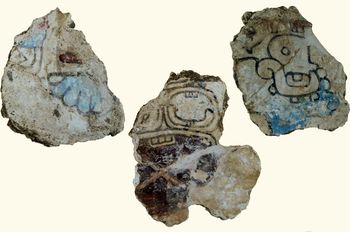
Three fragments in particular stand out for their evocative decorations (Figure 17). One represents a blue-painted foot in a style reminiscent of the so-called International Style observed at Tulum and also in the murals of Santa Rita Corozal. The other exhibits a distinctive cruller that frames the eye of a deity with blue body paint, much as representations of the rain deity Cháak in the Madrid Codex or even other aged deities in the Dresden Codex. Incidentally, precisely the same type of cruller is seen on several examples of ceramic figurines found at the site, indicating that this conforms to local patterns of representing a particular category of supernatural entities. The third represents a black bowl that is stacked with offerings, with one represented with the commensurate glyph waaj, “tamale,” in a style and format that is highly evocative of the Dresden Codex. The combination of stylistic traits exhibited in these murals is highly interesting for the shared attributes that they exhibit with some of the very latest examples of pre-Columbian iconography and epigraphy, on the eve of the Spanish Conquest. As such, whereas the codical sources are usually placed much farther north in the Yucatan, we can see that in the decades prior to the arrival of the Spanish Lamanai was one of the centers that actively participated in the same artistic and scriptural canons.
Fragments of the Late Postclassic murals of Lamanai, recovered from the core of Structure N12-11. Photograph by David Pendergast.

CONCLUSION
In drawing together the glyphic texts of northern Belize, it becomes apparent that these constitute an important source of historical data. Unfortunately, the richness of the preserved texts must be counterbalanced by the acknowledgement that the texts are sparsely distributed and that many holes are left to be filled if the epigraphic data of the region are to be presented in one cohesive synthesis. Nevertheless, I hope that this diachronic presentation will make it possible to begin to appreciate the rudiments of history in the glyphic data. In this overview, certain sites emerge as dominant centers in successive periods, as the courts of prominent and charismatic rulers. We can also see that the glyphic data differ from period to period, starting with the incipience of kingship in the Late Preclassic associated with extensively decorated monumental construction featuring mythic and supernatural motifs as the backdrop for royal performance. In the Early Classic, with the solidification of the institution of kingship, continued monumental construction and the raising of carved monuments also saw the exponential appearance of royal tombs, markers of flowering dynastic activity with increasing focus on the named king as the sole source of power. The material culture contained in the tombs reveals the power and autonomy of local rulers, as well as ties with polities in the region and even the influence of foreign courts. As aggregates, these interactions, and the allegiances that these bespeak, resulted in long-range interactions across the eastern Maya lowlands, up and down the Caribbean coast, and all the way to what are now Honduras and Quintana Roo. During the Late Classic, the role and presence of the Kanu'l can also be discerned, either through explicit statements or through the relatively sudden appearance of monuments, that revealed increasing local autonomy in the wake of weakened networks of vassalage. Furthermore, the presence of hieroglyphic stairs at a number of sites in the north speaks of participation in networks of allegiance connected to the Kanu'l (Helmke et al. Reference Helmke, Andres, Morton and Wrobel2015a). In sum, the glyphic texts of northern Belize are significant not only for their long span, their diversity, and the historical information that they preserve, but also for the fact that they make the role and place of the polities in that region all the more significant. Together these serve to underscore the importance of northern Belize as a region, and its pivotal role through time in terms of interregional connections evidenced in the inscriptions, which demonstrate these wider geopolitical spheres.
RESUMEN
Los textos jeroglíficos del norte de Belice son notables por su longevidad, que abarca desde el preclásico tardío hasta el posclásico tardío (c. 100 a.C.–1544 d.C.). En su totalidad, estos textos constituyen una valiosa fuente de información, que hasta la fecha se han ignorados en su mayoridad y no se han integrados en síntesis más amplias de la región. Este contribución sirve para proporcionar una revisión diacrónica de los textos glíficos del norte de Belice, intregandolos en los procesos históricos más amplios de las tierras bajas mayas orientales. Después de definir la región del norte de Belice, el corpus de los monumentos se describen al igual que las fuentes escritas sobre objetos portátiles. En conjunto, esto proporciona una reseña histórica del norte de Belice desde la incipiencia de la realeza hasta la víspera de la conquista española.
ACKNOWLEDGMENTS
Many thanks to John Morris for encouraging me to prepare this historical review of the epigraphic evidence of northern Belize. For comments on the epigraphy of northern Belize, I wish to acknowledge the insights of Nikolai Grube, Stanley Guenter, Felix Kupprat, Bruce Love, Simon Martin, David Stuart, and Karl Taube. Many thanks to Joseph Ball, Laura Kosakowsky, and Dorie Reents-Budet for their comments on the Petkanche Orange-polychrome type and its distribution. To Sandra Balanzario and Arlen Chase, my thanks for commenting on the Early Classic ceramics of Dzibanche, Kohunlich, and Santa Rita Corozal. I owe a debt of gratitude to all the principal investigators working in northern Belize who have welcomed me on their projects and given me the opportunity to work on their materials as well as for their comments on earlier drafts of this paper, including Diane Chase, Elizabeth Graham, Tom Guderjan, Helen Haines, Norman Hammond, Brett Houk, David Pendergast, Anne Pyburn, Cynthia Robin, Rissa Trachman, and Fred Valdez, Jr. Many thanks to Jaime Awe and Jorge Can for assisting me with materials recovered as part of the Tourism Development Project (2000–2004) as well as ensuing interventions at Cerros (2005) and Lamanai (2006) subsidized by the Ambassador's Fund for Cultural Preservation of the U.S. State Department. Thanks to Bruce Love, Nikolai Grube, Laura Kosakowsky, Richard Holder, Peter Mathews, David Pendergast, Karen Pierce, and Stuart Laidlaw for sharing with me their excellent photographs and drawings. Thanks to the editors of Ancient Mesoamerica and to the three anonymous reviewers for their insightful comments and suggestions. A special thanks also to the Royal Ontario Museum in Toronto for permission to study the Altun Ha glyphic materials. Finally, my sincere thanks to the Belize Institute of Archaeology, to its director and staff for supporting my research over the years.