INTRODUCTION
Piroplasmoses are tick-borne diseases caused by protistan parasites of the genera Theileria and Babesia. For equine piroplasmosis two species are responsible, namely Theileria equi and Babesia caballi, and both are transmitted by several tick species belonging to the genera Hyalomma, Rhipicephalus and Dermacentor (De Waal, Reference De Waal1992). Clinically, equine babesiosis and theileriosis vary, but symptoms of both diseases include fever, anaemia, inappetence, oedema and increased respiratory and heart rate (Brüning, Reference Brüning1996; Zobba et al. Reference Zobba, Ardu, Niccolini, Chessa, Manna, Cocco and Parpaglia2008). Diagnosis of the acute phase of the infections in equids is traditionally based on clinical symptoms, confirmed by detection of the intraerythrocytic parasites in Giemsa-stained blood smears (Shkap et al. Reference Shkap, Cohen, Leibovitz, Savitsky, Avni, Shofer, Giger, Kappmeyer and Knowles1998). However, diagnosis of the latent infection, characterized by low parasitaemia, represents a major limitation for intervention in endemic areas (Kumar et al. Reference Kumar, Kumar, Gupta and Dwivedi2008).
Application of highly sensitive PCR-based molecular diagnosis not only overcomes the constraints of low parasitaemia during latent infections, but also permits the identification of genetic variants and cryptic species. Various genes have been used as targets for the diagnosis of T. equi and B. caballi including the genes encoding EMA (Battsetseg et al. Reference Battsetseg, Lucero, Xuan, Claveria, Inoue, Alhassan, Kanno, Igarashi, Nagasawa, Mikami and Fujisaki2002), β-tubulin (Cacciò et al. Reference Cacciò, Cammà, Onuma and Severini2000) and the 18S rRNA (Bashiruddin et al. Reference Bashiruddin, Cammà and Rebêlo1999; Alhassan et al. Reference Alhassan, Pumidonming, Okamura, Hirata, Battsetseg, Fujisaki, Yokoyama and Igarashi2005; Sloboda et al. Reference Sloboda, Jirků, Lukešová, Qablan, Batsukh, Fiala, Hořín, Modrý and Lukeš2011). Due to its low substitution rate, constrained and conserved function and occurrence in multiple copies, the 18S rRNA gene represents the most suitable genetic marker for both diagnosis and phylogenetic studies of piroplasmids (Allsopp and Allsopp, Reference Allsopp and Allsopp2006; Hunfeld et al. Reference Hunfeld, Hildebrandt and Gray2008). Neither Babesia nor Theileria is considered as a separated monophyletic taxonomic unit and previously it has been known that piroplasmids include five major clades (Criado-Fornelio et al. Reference Criado-Fornelio, Martinez-Marcos, Buling-Sarana and Barba-Carretero2003; Allsopp and Allsopp, Reference Allsopp and Allsopp2006; Lack et al. Reference Lack, Reichard and Van Den Bussche2012). However, recent studies by Lack et al. (Reference Lack, Reichard and Van Den Bussche2012) and Schnittger et al. (Reference Schnittger, Rodriguez, Florin-Christensen and Morrison2012) pointed out that piroplasmids include eight clades and six major monophyletic lineages, respectively. The results by Lack et al. (Reference Lack, Reichard and Van Den Bussche2012) and Schnittger et al. (Reference Schnittger, Rodriguez, Florin-Christensen and Morrison2012) support the placement of T. equi and B. bicornis in a separated monophyletic group that does not fit in either Babesia sensu strictu or Theileria sensu strictu groups. Previous 18S rRNA-based phylogenetic analyses indicated a noticeable degree of variation within and among B. caballi and T. equi isolates from different geographical regions (Bhoora et al. Reference Bhoora, Franssen, Oosthuizen, Guthrie, Zweygarth, Penzhorn, Jongejan and Collins2009; Salim et al. Reference Salim, Bakheit, Kamau, Nakamura and Sugimoto2010; Qablan et al. Reference Qablan, Sloboda, Jirků, Oborník, Dwairi, Amr, Hořín, Lukeš and Modrý2012b).
The current distribution of these protists depends on the presence of permissive vectors and was probably also influenced by a long and complex history of translocations of horses since their domestication. Infections with T. equi and B. caballi are endemic in tropical and subtropical zones, with the former piroplasmid being more widespread (De Waal, Reference De Waal1992). In Jordan, it is estimated that the number of horses and donkeys are about 2500 and 19 000, respectively (Starkey and Starkey, Reference Starkey, Starkey, Starkey and Fielding2000). So far, only T. equi has been reported from equids in Jordan (Hailat et al. Reference Hailat, Lafi, Al-Darraji and Al-Ani1997; Abutarbush et al. Reference Abutarbush, Alqawasmeh, Mukbel and Al-Majali2011). However, very recently, both T. equi and B. caballi were detected in camels and dogs (Qablan et al. Reference Qablan, Kubelová, Široký, Modrý and Amr2012a, Reference Qablan, Sloboda, Jirků, Oborník, Dwairi, Amr, Hořín, Lukeš and Modrýb). The aim of this study was to survey the distribution of piroplasmid parasites in Jordanian equids and to evaluate their interspecific genetic diversity.
MATERIALS AND METHODS
Study site and sampling
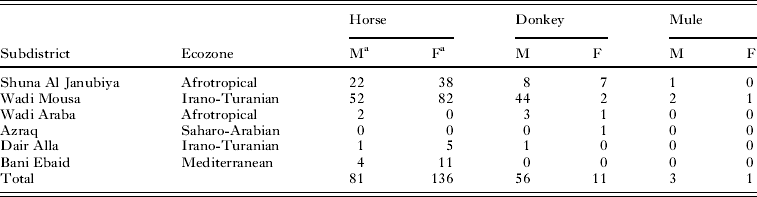
Between 2007 and 2009, a total of 288 equids (217 horses, 67 donkeys and 4 mules) were sampled from the following localities within six subdistricts of Jordan: Shuna Al Janubiya (Suwaymah, Baptism site/Almaghtas, Al Kafrayn), Wadi Mousa (Petra, Um Sayhoon), Wadi Araba (Ghor Al Safi and Ar Rishah), Azraq, Dair Alla and Bani Ebaid (Nu'ayyimah) (Table 1). The age of the inspected animals ranged from 3 months to 20 years. During the last sampling period in 2009, a total of seven and four animals from Petra and Almaghtas, respectively were re-examined. Information about sex, age, locality and host species was obtained using bilingual questionnaires. Blood was collected by puncture of the jugular vein using Hemos H-01 collecting tubes containing EDTA (Gama Group, Czech Republic) equipped with 18G needles. Two thin blood smears were made from each sample; smears were methanol-fixed in the laboratory within the same day. Blood smears were stained with Giemsa solution (Merck, Germany) and examined using light microscopy (Olympus AX 70).
Numbers and origin of sampled animal
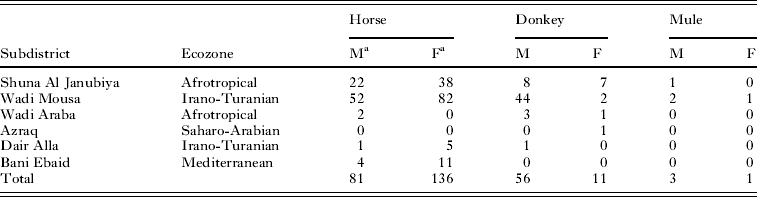
a M,males; F,females.
DNA isolation and PCR assay
Blood was preserved in plastic tubes containing 10 mm EDTA, frozen and analysed upon transport to the laboratory, whereas total DNA extracted using the DNAeasy blood and tissue kit (Qiagen, Germany) was subject to two diagnostic PCR-assays. Detailed information about methodology and primer design has been published elsewhere (Sloboda et al. Reference Sloboda, Jirků, Lukešová, Qablan, Batsukh, Fiala, Hořín, Modrý and Lukeš2011). The first PCR reaction aimed to identify the animals positive for all possible Babesia and Theileria species using the universal ‘catch-all’ primers TB-F (5′-CTTCAGCACCTTGAGAGAAAT-3′) and TB-R (5′-TCDATCCCCRWCACGATGCRBAC-3′), amplifying 496 bp region of 18S rRNA. To distinguish between T. equi and B. caballi, a single multiplex PCR reaction targeting 18S rRNA employed a mixture of primers composed of a single forward primer (TBM; 5′-CTTCAGCACCTTGAGAGAAATC-3′), and two reverse primers (Equi-R; 5′-TGCCTTAAACTTCCTTGCGAT-3′ and BC-R; 5′-GATTCGTCGGTTTT GCCTTGG-3′) with expected 360 bp- and 650 bp-long amplicons for T. equi and B. caballi, respectively (Sloboda et al. Reference Sloboda, Jirků, Lukešová, Qablan, Batsukh, Fiala, Hořín, Modrý and Lukeš2011). PCR reactions were conducted in a total volume of 25 μL, composed of 12·5 μL of commercial Master Mix (TopBio, Slovakia), 10 μ m of each primer and ∼20 ng of genomic DNA. Genomic DNA isolated from a donkey naturally infected with T. equi and B. caballi in Italy, with microscopically detected parasites and which exhibited clinical symptoms, was used as a positive control. DNA isolated from the blood of a piroplasmid-free horse maintained at the clinic at the University of Veterinary and Pharmaceutical Sciences was used as a negative control. The amplified PCR products were subjected to 1·5% agarose gel electrophoresis stained with Gold-View and documented using the Vilber Lourmat system (France).
Sequencing and phylogenetic analyses
Amplicons from the PCR with ‘catch-all’ primers were purified using Qiaquick Gel Extraction kit (Qiagen, Germany) and sequenced in both directions by Macrogen (South Korea). The obtained sequences were aligned separately for each species with homologues available in the GenBank™ using Kalign (Lassmann and Sonnhammer, Reference Lassmann and Sonnhammer2005) and consequently manually edited in Bioedit (Hall, Reference Hall1999). Phylogenetic trees were constructed by maximum likelihood (ML) with the GTR model for nucleotide substitutions and discrete gamma distribution in four categories (PhyML; Guindon and Gascuel, Reference Guindon and Gascuel2003) and maximum parsimony (MP) as implemented in PAUP* 4b10 (Swofford, Reference Swofford2002).
Statistical analyses
We fitted several general linear models (GLMs) with binomial distribution in order to explore the effect of ‘host species’, ‘sex’, ‘age’ and ‘locality’ on the occurrence of (i) piroplasmids (T. equi and B. caballi tandemly detected by universal primers), (ii) T. equi and (iii) B. caballi. For the analyses, data from 253 animals with complete information regarding all the examined criteria were used. Animals were classified into groups by host species (horses, donkeys), sex (males, females) and subdistricts (Shuna Al Janubiya, Wadi Mousa, Wadi Araba and Bani Ebaid). The age of each animal was used as a numerical explanatory variable. Due to low number of examined animals, the data obtained from horses from two subdistricts (Azraq and Dair Alla) and from mules were excluded. In the case of re-examined animals, only one sample from each animal was analysed. Moreover, only one interaction (sex × age) into the all-maximum model was included. Using model simplification, from each maximum model the least significant terms were gradually removed to obtain a minimal adequate model (Crawley, Reference Crawley2007).
RESULTS
Prevalence and distribution of T. equi and B. caballi
Although we recorded various health disorders, such as laminitis, external wounds or general weakness, no clinical signs usually associated with piroplasmoses were observed. Microscopic examination of blood smears did not reveal any erythrocytic stages typical for Babesia or Theileria species.
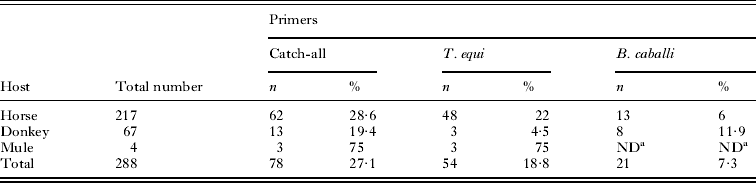
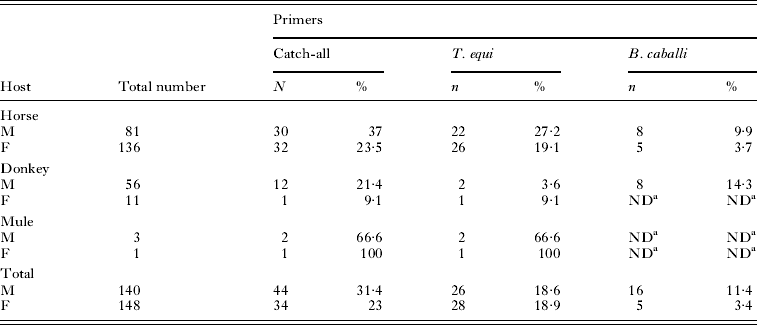
The PCR results with ‘catch-all’ primers revealed that 78 out of 288 animals (27·1%) were positive for piroplasmids. The highest prevalence was detected among mules followed by horses and donkeys (Table 2). The prevalence of T. equi and B. caballi was 18·8 and 7·3%, respectively. T. equi was more prevalent in horses and mules, while donkeys were more frequent hosts of B. caballi (Table 2). From the group of re-sampled animals only a single horse was infected with T. equi, being positive in 2 consecutive years. The infection was detected in three out of six subdistricts; Wadi Mousa, Shuna Al-Janubiya and Bani Ebaid with prevalences of 20·4%, 5·9% and 0·7%, respectively. Although in all these localities both piroplasmid species occurred, no mixed infections were detected. The total prevalence of piroplasmids, established with the ‘catch-all’ primers, was higher among males than among females (31·4% vs 23%) (Table 3). A similar trend was revealed with multiplex primers for both T. equi and B. caballi (Table 3).
Prevalence of piroplasmids in equines as revealed by the ‘catch all’ and multiplex PCR assays
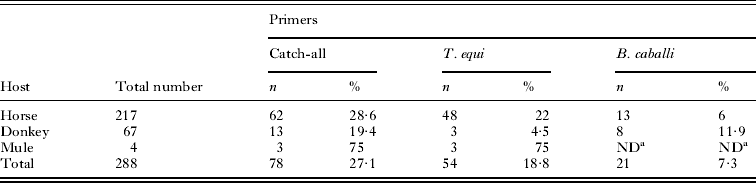
a ND,not determined.
Prevalence of piroplasmids in males (M) and females (F) based on PCR assay results
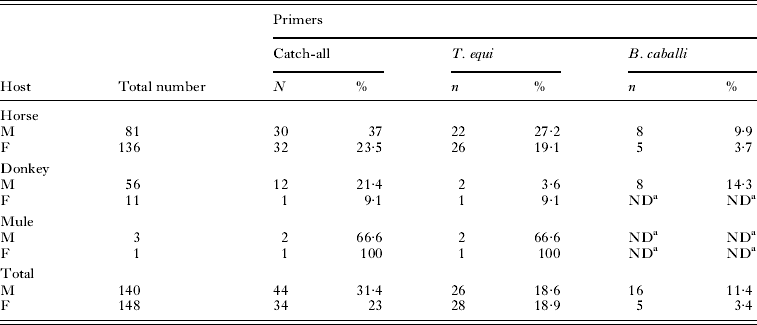
a ND,not determined.
Data analyses
The minimal adequate model that fits the occurrence of piroplasmids included the significant factors, of age (χ 2=18·084; P<<0·001), species (χ 2=5·792; P=0·016) and sex (χ 2=4·753; P=0·029). Piroplasmids were more prevalent in horses and males and the prevalence increased with the age of the animal. For T. equi, the minimal adequate model included species (χ 2=12·612, P<<0·001) and age (χ 2=13·673, P<<0·001), whilst the minimal adequate model for B. caballi included a single significant factor – sex (χ 2=4·447, P=0·034). The prevalence of T. equi increased with age, and the infection was more prevalent in horses. More males were infected by B. caballi than females.
Phylogenetic analyses
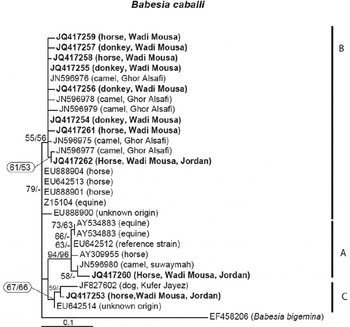
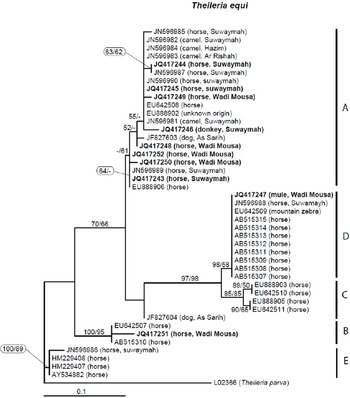
In total, 58 amplicons obtained with the PCR ‘catch-all’ primers were sequenced (T. equi=45 and B. caballi=13). Ten sequences of T. equi and 10 sequences of B. caballi, representing the obtained sequence variability, were indexed in the GenBank™ (JQ417242-61) and subsequently used for phylogenetic analyses. Alignments containing 442 and 453 nt positions of the 18S rRNA genes of T. equi and B. caballi, respectively, were analysed using ML and MP. Both methods resulted in virtually identical topologies. The tree topology of B. caballi (Fig. 1) shows the known two genotypes A and B. One of the newly identified sequences (JQ417253) clusters together with sequences JF827602 from a Jordanian dog and EU642514 of unknown origin from South Africa, forming a separate clade referred to here as novel genotype C (Fig. 1). The tree of T. equi shows five major clades representing the known genotypes of T. equi (Fig. 2). With the exception of genotypes C and E, all other T. equi genotypes were found in the present study, although genotypes B and D were represented by single sequences (JQ417251 from a horse and JQ417247 from a mule). At the same time, genotypes C and D appear to be closely related. The clustering of T. equi isolates revealed the existence of three genetically distinct groups represented by clade (A), clades (C and D) and clades (E and B).
Phylogenetic tree of Babesia caballi as inferred from partial sequences of the 18S rRNA gene. The numbers above branches indicate maximum likelihood/maximum parsimony bootstrap supports (1000/1000 replicates). Sequences in bold refer to those obtained in this study. Hosts and localities are in parentheses. A, B and C denote genotypes.

Phylogenetic tree of Theileria equi as inferred from partial sequences of the 18S rRNA gene. The numbers above branches indicate maximum likelihood/maximum parsimony bootstrap supports (1000/1000 replicates). Sequences in bold refer to those obtained in this study. Hosts and localities are in parentheses. A, B, C, D and E denote genotypes.

DISCUSSION
Equine theileriosis was previously reported from Jordan based on blood smear microscopy and serology (Hailat et al. Reference Hailat, Lafi, Al-Darraji and Al-Ani1997; Abutarbush et al. Reference Abutarbush, Alqawasmeh, Mukbel and Al-Majali2011). PCR-based diagnosis followed by sequencing reported herein proved the wide occurrence of T. equi, and also documented the presence of B. caballi in Jordanian equines for the first time. In general, the prevalence of T. equi is usually higher than that of B. caballi (Shkap et al. Reference Shkap, Cohen, Leibovitz, Savitsky, Avni, Shofer, Giger, Kappmeyer and Knowles1998; Rüegg et al. Reference Rüegg, Torgerson, Deplazes and Mathis2007; Bhoora et al. Reference Bhoora, Franssen, Oosthuizen, Guthrie, Zweygarth, Penzhorn, Jongejan and Collins2009; Kouam et al. Reference Kouam, Kantzoura, Masouka, Gajadhar and Theodoropoulos2010b; Abutarbush et al. Reference Abutarbush, Alqawasmeh, Mukbel and Al-Majali2011). The lower rate of B. caballi infections in studies based on microscopic diagnosis has been ascribed to low parasitaemia during the chronic phase (Kumar et al. Reference Kumar, Kumar, Gupta and Dwivedi2008). However, since PCR-based detection should overcome these constraints, the different prevalence of B. caballi and T. equi is likely to be a consequence of the more efficient elimination of B. caballi by the host immune system, in contrast to the life-long persistence of T. equi (Brüning, Reference Brüning1996). Recently, 14·6% seropositivity for T. equi among horses in Jordan was reported, yet the authors were unable to detect the piroplasmid DNA (Abutarbush et al. Reference Abutarbush, Alqawasmeh, Mukbel and Al-Majali2011). This was likely a technical issue, since PCR-based diagnosis of both species appears to be relatively straightforward (Qablan et al. Reference Qablan, Kubelová, Široký, Modrý and Amr2012a, Reference Qablan, Sloboda, Jirků, Oborník, Dwairi, Amr, Hořín, Lukeš and Modrýb; this work). The overall prevalence of the infection established with the ‘catch-all’ primers was rather high (27%). However, all cases were apparently asymptomatic, which is typical for endemic areas (De Waal, Reference De Waal1992; Brüning, Reference Brüning1996).
Jordan is located within the eastern Mediterranean climate zone with moderately rainy winters and hot summers. Biogeographically, the country is divided into four major ecozones; the Mediterranean, Irano-Turanian, Saharo-Arabian and Afrotropical (Al-Eisawi, Reference Al-Eisawi and Hadidi1985). Most sampling sites in this study were from the densely inhabited western part of the country where the borders between ecozones are narrow and affected by altitude and humidity. In this study, the T. equi and B. caballi infections were identified in equids from the Mediterranean, Irano-Turanian and Afrotropical ecozones, while previously we have also detected T. equi in camels from the Saharo-Arabian ecozone (Qablan et al. Reference Qablan, Sloboda, Jirků, Oborník, Dwairi, Amr, Hořín, Lukeš and Modrý2012b). Our results are in agreement with previous seroprevalence data reported from Jordan (Abutarbush et al. Reference Abutarbush, Alqawasmeh, Mukbel and Al-Majali2011). Apparently, equine piroplasmids are enzootic in Jordan and their distribution pattern is likely affected by the presence and densities of suitable hosts rather than by ecological conditions, which is in accordance with a recent study of these pathogens from Greece (Kouam et al. Reference Kouam, Kantzoura, Gajadhar, Theis, Papadopoulos and Theodoropoulos2010a).
Using the results of ‘catch-all’ PCR, host species, age and sex were consistently recognized as significant risk factors for piroplasmid infection. Analogous analyses computed for both species separately indicate that only host species and age have a significant effect on the distribution of T. equi. In our dataset, horses appear to be more susceptible to T. equi, which is in agreement with serological studies from Turkey (Balkaya et al. Reference Balkaya, Utuki and Piskin2010) and relative scarcity of the infections in donkeys (Pearson et al. Reference Pearson, Nengomasha, Krecek, Starkey and Fielding2000). Interestingly, mules were found to be the most susceptible hosts in Greece (Kouam et al. Reference Kouam, Kantzoura, Gajadhar, Theis, Papadopoulos and Theodoropoulos2010a) and Brazil (Dos Santos et al. Reference Dos Santos, Roier, Santos, Pires, Vilela, Moraes, Almeida, Baldani, Machado and Massard2011) and also in our study we found three out of four animals to be positive for T. equi. However, due to the low number examined, mules have been excluded from the statistical analyses. No influence of host species was proven for B. caballi.
Horses usually reach sexual maturity at the age of three years. While some serological surveys show that age is a significant factor for T. equi infection (Kouam et al. Reference Kouam, Kantzoura, Gajadhar, Theis, Papadopoulos and Theodoropoulos2010a; Grandi et al. Reference Grandi, Molinari, Tittarelli, Sassera and Kramer2011), others suggest the opposite (Shkap et al. Reference Shkap, Cohen, Leibovitz, Savitsky, Avni, Shofer, Giger, Kappmeyer and Knowles1998). To our knowledge, so far only two studies have used PCR-diagnosis data to evaluate the effect of age on the T. equi and B. caballi infections (Rüegg et al. Reference Rüegg, Torgerson, Deplazes and Mathis2007; Grandi et al. Reference Grandi, Molinari, Tittarelli, Sassera and Kramer2011). While Rüegg et al. (Reference Rüegg, Torgerson, Deplazes and Mathis2007) reported positive and negative correlations between host age and T. equi and B. caballi, respectively, Grandi et al. (Reference Grandi, Molinari, Tittarelli, Sassera and Kramer2011) found no such correlation. However, we observed a significant effect of age on the prevalence of B. caballi, with adults having higher risk of infection. A similar relationship with age was reported for Babesia bovis, whereby, under experimental conditions young, animals were more resistant to the parasite (Chauvin et al. Reference Chauvin, Moreau, Bonnet, Plantard and Malandrin2009).
The different susceptibilities of males and females to protozoan infections observed in many species, including humans, has been attributed to levels of sex hormones and activity patterns (Roberts et al. Reference Roberts, Walker and Alexander2001). Data in the literature are contradictory in the case of piroplasmoses, as in some studies sex had a significant effect on the infection (Shkap et al. Reference Shkap, Cohen, Leibovitz, Savitsky, Avni, Shofer, Giger, Kappmeyer and Knowles1998; Moretti et al. Reference Moretti, Mangili, Salvatori, Maresca, Scoccia, Alessandra, Moretta, Gabrielli, Tampieri and Pietrobelli2010; Grandi et al. Reference Grandi, Molinari, Tittarelli, Sassera and Kramer2011), while others failed to see such a correlation (Rüegg et al. Reference Rüegg, Torgerson, Deplazes and Mathis2007; Karatepe et al. Reference Karatepe, Karatepe, Cakmak, Karaer and Ergun2009; Kouam et al. Reference Kouam, Kantzoura, Gajadhar, Theis, Papadopoulos and Theodoropoulos2010a; Dos Santos et al. Reference Dos Santos, Roier, Santos, Pires, Vilela, Moraes, Almeida, Baldani, Machado and Massard2011). In our study, some effect of sex was proven for the B. caballi infections, as males were more frequently infected.
We used two PCR assays, the ‘catch-all’ primers that permit the detection of piroplasmid infection in general and multiplex PCR that permits distinction between T. equi and B. caballi (and mixed infection) in a single reaction with both PCR strategies, showing almost identical sensitivity. Sequencing of amplicons obtained by the former PCR assay permits the identification of piroplasmids other than B. caballi and T. equi, while multiplex PCR is particularly suitable to detect mixed infections. In contrast to previous studies (Boldbaatar et al. Reference Boldbaatar, Xuan, Battsetseg, Igarashi, Battur, Batsukh, Bayambaa and Fujisaki2005; Kouam et al. Reference Kouam, Kantzoura, Masouka, Gajadhar and Theodoropoulos2010b; Sloboda et al. Reference Sloboda, Jirků, Lukešová, Qablan, Batsukh, Fiala, Hořín, Modrý and Lukeš2011), the mixed infections were absent in our samples.
The 18S rRNA gene is widely used for phylogenetic analyses of piroplasmids (Allsopp and Allsopp, Reference Allsopp and Allsopp2006). Two genotypes were originally proposed within both species (Nagore et al. Reference Nagore, García-Sanmartín, García-Pérez, Juste and Hurtado2004), but later studies from South Africa (Bhoora et al. Reference Bhoora, Franssen, Oosthuizen, Guthrie, Zweygarth, Penzhorn, Jongejan and Collins2009), Sudan (Salim et al. Reference Salim, Bakheit, Kamau, Nakamura and Sugimoto2010) and Jordan (Qablan et al. Reference Qablan, Sloboda, Jirků, Oborník, Dwairi, Amr, Hořín, Lukeš and Modrý2012b), added three additional genotypes of T. equi. The intraspecific diversity of T. equi and B. caballi is likely to further increase with the addition of sequences from so far unexplored geographical regions. Our phylogenetic analyses show that both parasites exhibited an overlapping occurrence of different genotypes within the same population of equids. We identified a novel genotype C of B. caballi; apparently, this genotype results from the splitting of genotype A as a result of addition of new sequences from horses (this study) and from Jordanian dog (Qablan et al. Reference Qablan, Sloboda, Jirků, Oborník, Dwairi, Amr, Hořín, Lukeš and Modrý2012b). Although the majority of sequences of B. caballi in our dataset belong to genotype B, our analysis does not strongly support further division of this genotype into two subgroups as proposed previously (Bhoora et al. Reference Bhoora, Franssen, Oosthuizen, Guthrie, Zweygarth, Penzhorn, Jongejan and Collins2009), probably a consequence of differences in the length of the gene fragment used in both studies.
Analysis of T. equi 18S rRNA sequences indicates the occurrence, in our dataset, of all previously known genotypes except genotypes E and C, with only one sequence belonging to the newly assigned genotype E (Qablan et al. Reference Qablan, Sloboda, Jirků, Oborník, Dwairi, Amr, Hořín, Lukeš and Modrý2012b). Interestingly, genotype E corresponds to T. equi-like parasites previously detected (Nagore et al. Reference Nagore, García-Sanmartín, García-Pérez, Juste and Hurtado2004; Kouam et al. Reference Kouam, Kantzoura, Masouka, Gajadhar and Theodoropoulos2010b) from lethal cases of equine theileriosis in Greece and Spain, respectively. The clustering of T. equi genotypes and the length of branches may suggest the existence of one or even more new species. However, in order to make such a conclusion, not only an extended set of genetic markers has to be evaluated, but also a better knowledge of the vectors will be necessary.
ACKNOWLEDGEMENTS
We thank Dr Mourad El-Farajat and the staff of Brook Clinic in Petra-Wadi Mousa for help during the field study. We are pleased to acknowledge the support by the National Center for Research and Development/Badia Research Program and the Badia Center for Ecological Education. The help of the Safawi field staff during the field sampling in the Eastern Desert is appreciated. We also appreciate the administrative assistance of the Ministry of Agriculture Amman Jordan represented by Dr Nasser Eddin Al-Hawamdeh.
FINANCIAL SUPPORT
This work was supported by the project ‘CEITEC-Central European Institute of Technology’ from the European Regional Development Fund (CZ.1·05/1·1·00/02·0068) and the Grant Agency of the Czech Republic (523/09/1972) to P. H., the Institute of Parasitology project (Z60220518) to M. O. and J. L., and the Praemium Academiae award to J. L., who is also a Fellow of the Canadian Institute for Advanced Research.