INTRODUCTION
Corals are a diverse group of organisms belonging to the phylum Cnidaria previously known as Coelenterata. These organisms generally build a hard skeleton of calcium carbonate or lime (Bermert & Ormond, Reference Bemert and Ormond1982). Corals and coral reefs are the most complex marine ecosystem supporting rich biological diversity. Pakistan is located on the northern part of the Arabian Sea. The seasonal migration of the intertropical convergence zone dominates weather affecting the marine climate of the Arabian Sea. A unique feature of the Arabian Sea is the strong reversal of the monsoon. During the southwest monsoon the wind blows warm surface water offshore due to the Ekman effect which leads to an upwelling of deep cold and nutrient rich ocean water. The upwelled nutrients rich water supports phytoplankton growth making the Arabian Sea highly productive (Sheppard et al., Reference Sheppard, Price and Roberts1992). Usually, corals are scarce along the shores of the Arabian Sea mainly due to upwelling that leads to large temperature fluctuations and intense macroalgal growth fuelled by nutrients. Moreover, in some areas high salinity or turbidity is a major cause of decline in coral growth (Sheppard & Sheppard, Reference Sheppard, Sheppard, Buettiker and Krupp1991). According to Coles (Reference Coles2003) in some areas competition with macroalgae is clearly restricting coral growth, while at other locations there is a lack of hard substrate for coral settlement.
The coastline of Pakistan (1050 km) stretches along Sindh and Balochistan provinces. The Balochistan or Makran coast (800 km) is tectonically active and runs from the Hub River to Jiwani towards the west (Haq, Reference Haq, Thompson and Tirmizi1988; Ali & Memon, Reference Ali, Memon, Thompson and Tirmizi1995), while the 250 km long Sindh coast starts from Karachi and runs to Sir Creek near the border of India, and is flat and with numerous creeks (Ali & Memon, Reference Ali, Memon, Thompson and Tirmizi1995). The coast is influenced by the repeated reversal of monsoon (north-east (winter) and south-west (summer)), which causes deep convective mixing (particularly during the north-east monsoon) bringing nutrient rich water to the surface supporting high productivity in the Arabian Sea (Wiggert et al., Reference Wiggert, Jones, Dickey, Brink, Weller, Marra and Codispoti2000; Mara & Barber, Reference Mara and Barber2005). Intertidal flats, sandy and rocky beaches, headlands, creeks and deltas are the main features of the coast. These habitats support considerable biodiversity in intertidal areas and offshore waters. Substantial information is available regarding the fauna and flora of intertidal areas, but information regarding the distribution and diversity of corals in the coastal waters of Pakistan is clearly lacking. Wilkinson (Reference Wilkinson2004) reported that patches of corals are present along the Makran (Balochistan) coast and the area occupied by them is not more than 50 km2. Kazmi & Kazmi (Reference Kazmi, Kazmi and Vineeta1998) and Ishaq et al. (Reference Ishaq, Amjad and Chaudhri2003) reported the existence of patches of corals along the Balochistan coast at Astola Island, and around Churna Island along the Sindh coast, but no further data on abundance, distribution and taxonomic details were provided. Therefore, the present study was undertaken to assess the distribution, diversity and abundance of corals in Pakistani waters.
MATERIALS AND METHODS
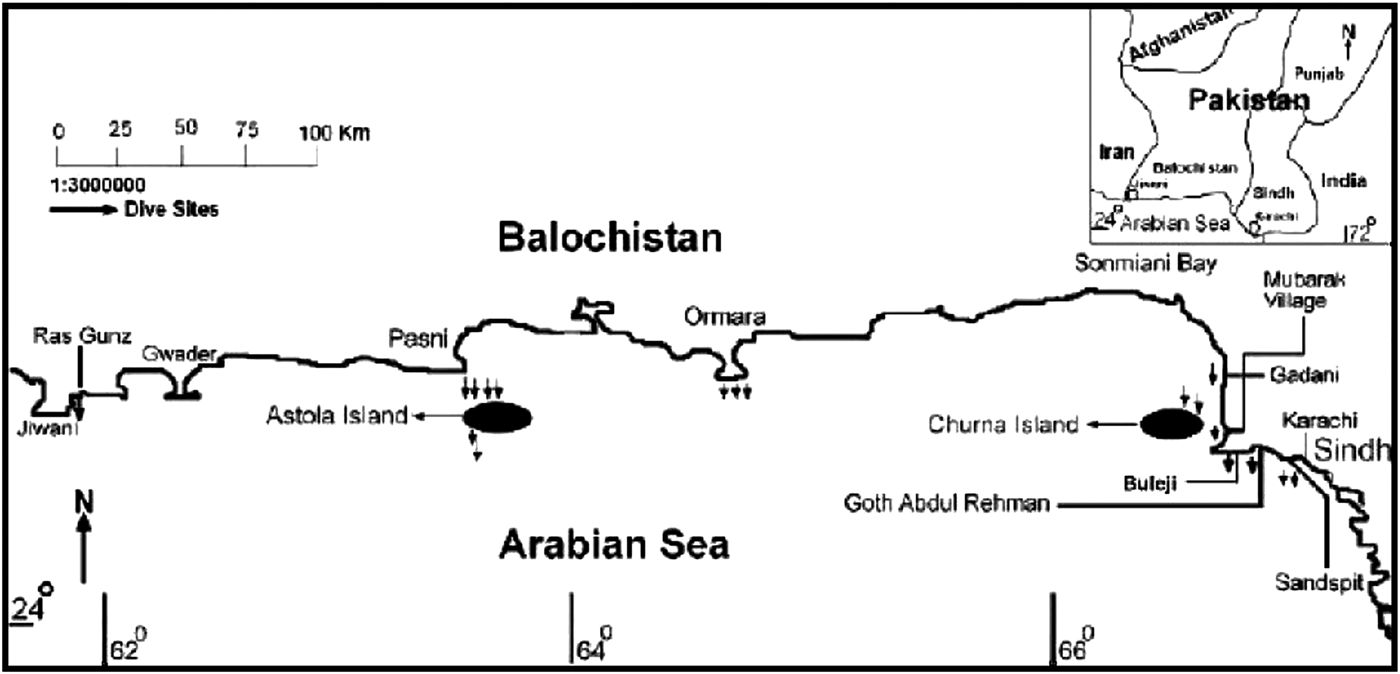
The surveys were undertaken during December 2004, January 2006 and February 2007 along the Balochistan coast (Gadani, Kuchiani), Roadrigues Shoals (Khuand Riam) off the coast of Ormara, Astola Island and Jiwani). On the Sindh coast surveys were made at Churna Island in December 2004; and at other sites including Mubarak Village, Buleji, Sandspit and Goth Abdul Rehman in November and December 2006 (Figure 1).
Map of Pakistan coast showing dive sites.

SCUBA diving was conducted at 18 dive sites from where small pieces of hard corals were collected for taxonomic assessment in the laboratory, and general observations for the abundance of corals were made and recorded semi-quantitatively using the DACFOR numerical (1–6) scale (6 = Dominant: up to 500 individuals, 5 =Abundant: up to 100 individuals, 4 = Common: up to 50 individuals, 3 = Frequent: up to 10 individuals, 2 = Occasional: up to 3 individuals, and 1 = Rare: 1 individual). At each dive site GPS position and general underwater habitat description were noted. Percentage of coral cover was estimated visually. Photographs of live samples were taken in situ using a digital camera in a waterproof housing. The samples were brought to the laboratory, cleaned to recover the skeleton and archived at the Centre of Excellence in Marine Biology, University of Karachi, for future record. Identification of coral species was done according to descriptions given by Veron (Reference Veron2000) for hard corals, and Fabricius & Alderslade (Reference Fabricius and Alderslade2001) for soft corals.
Data analysis
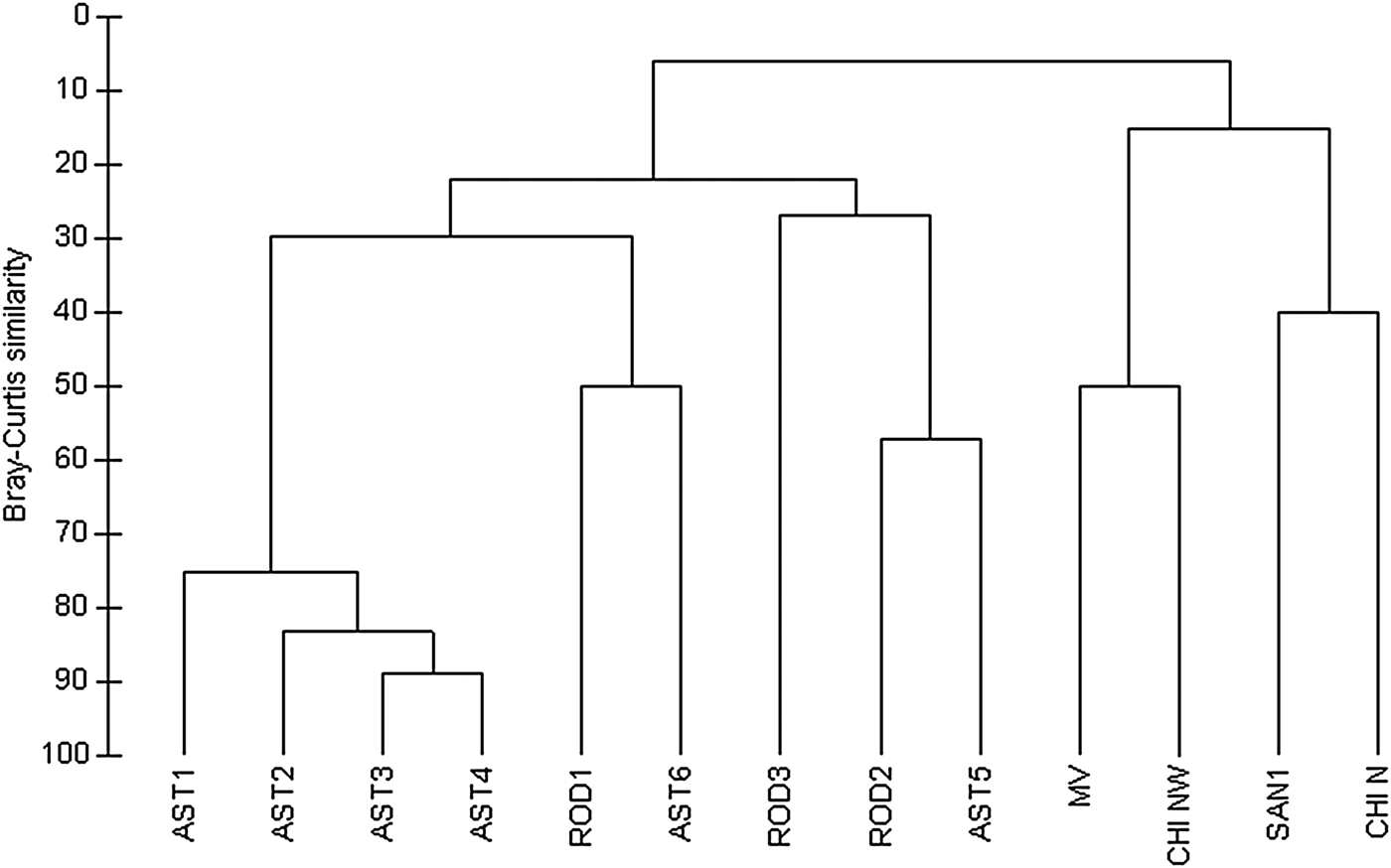
Multivariate analysis of hard coral communities was carried out based on presence/absence data (Clarke & Warwick, Reference Clarke and Warwick2001). To investigate relationships between sites, cluster analysis was conducted using the hierarchical method based on the Bray–Curtis similarity index (Bray & Curtis, Reference Bray and Curtis1957) and complete average linkage techniques (Clarke, Reference Clarke1993). To compare the hard coral communities at species and genus level with communities from the Gulf of Kutch (Pillai & Patel, Reference Pillai and Patel1988), Oman (Sheppard & Salm, Reference Sheppard and Salm1988; Salm, Reference Salm1993), the southern Arabian Gulf (Riegl, Reference Riegl1999) and Yemen (Turak et al., Reference Turak, Brodie and DeVantier2007), Sorensen's similarity coefficient was calculated using the following equation:
 $$Cs=2a/\lpar 2a+b+c\rpar$$
where a = number of species at both sites, b = number of species at site B but not A, c = species at site A but not B. Statistical analyses were made using PRIMER (Plymouth Routines in Multivariate Ecological Research) v.6 software package (Clarke & Gorely, Reference Clarke and Gorely2006).
RESULTS
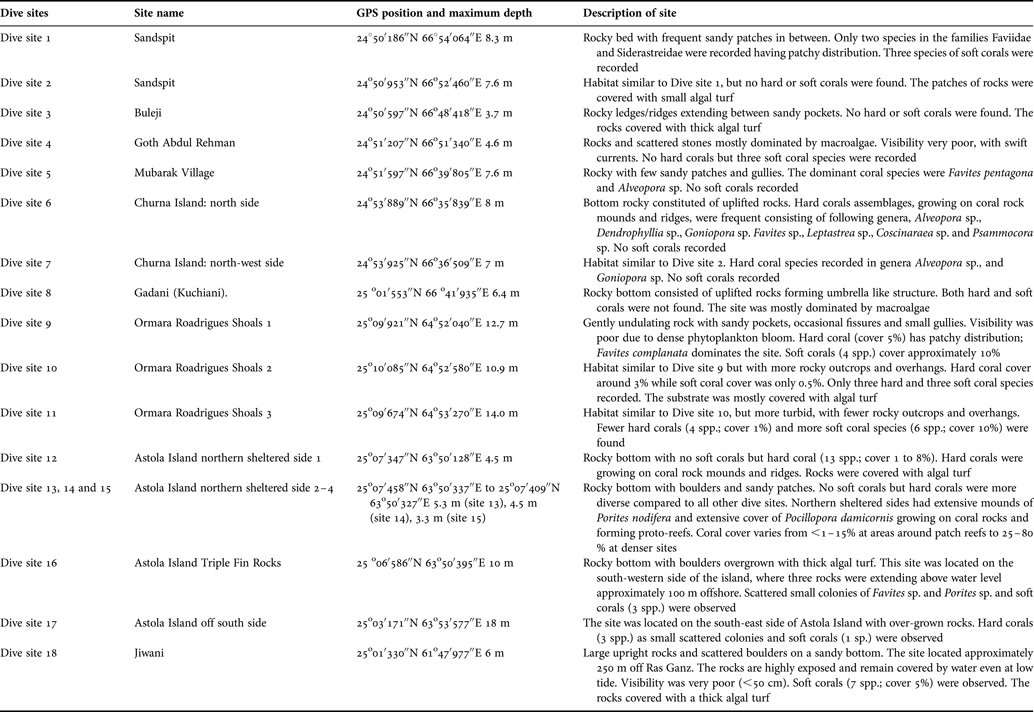
Observations made at each dive site regarding GPS position, depth, habitat type, general comments on coral distribution are given in Table 1. On the whole, with respect to hard corals, the sheltered sides of Astola Island had the most diverse and abundant distribution. Soft corals were observed at exposed sites, with the highest diversity at Ormara (Roadrigues Shoals) and Jiwani.
Details of 18 dive sites along the coast of Pakistan.
Hard and black coral communities
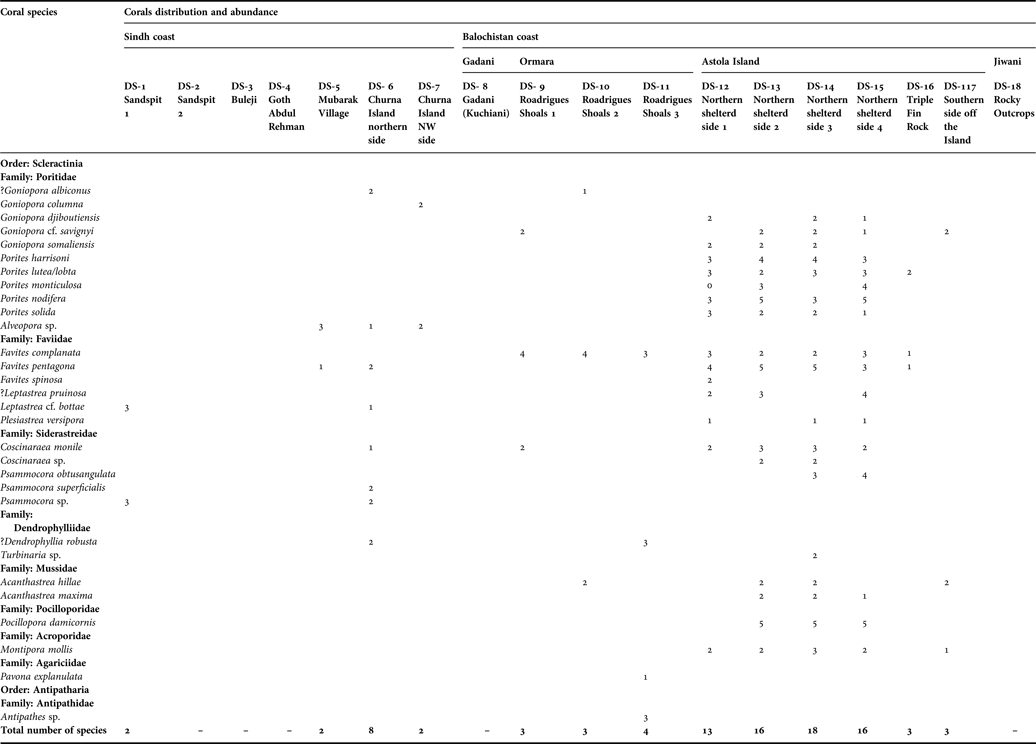
A total of 29 species of hard corals and one species of black coral were recorded, belonging to two orders, nine families and 15 genera. Relative abundance of different coral species at each dive site is set out in Figures 2 and 3, and Table 2. Of these hard coral species 19 were identified with certainty, whereas six species were with some doubts and four were identified only up to genus level. Black coral species was identified in genus Antipathes (family: Antipathidae). Favites complanata, was the most dominant species found, followed by Favites pentagona, Coscinaraea monile and Porites nodifera, respectively. Although the distribution of species at different sites was variable and no single species was common at all sites, Favites complanata was recorded from about 50% of the dive sites. Porites nodifera and Pocillopora damicornis and, to a lesser extent, Porities harrisoni, Leptastrea pruinosa and Psammocora obtusangulata formed large single-species stands. Abundance and diversity of corals was highest at the northern sheltered side (at shallow depths of around 4–6 m) compared to the other more exposed and deeper sites of Astola Island, Churna Island and other exposed sites along the Sindh coast. High coral diversity and abundance at this northern sheltered side coincided with good visibility and hence good light availability for coral growth. The Balochistan coast harbours rich coral fauna compared to the Sindh coast. Churna Island had fairly abundant coral diversity, whereas at the rest of the sites along the Sindh coast coral distribution was poor (Sandspit and Mubarak Village) or coral were absent (Goth Abdul Rehman, Buleji and Gadani (Kuchiani)).
Diversity of hard coral species collected from coastal waters of Pakistan: (A) ?Goniopora albiconus; (B) Goniopora columna; (C) Goniopora djiboutiensis; (D) Goniopora cf. savignyi; (E) Goniopora somaliensis; (F) Porites harrisoni; (G) Porites lutea/lobata; (H) Porites monticulosa; (I) Porites nodifera; (J) Porites solida; (K) Alveopora sp.; (L) Favites complanata; (M) Favites pentagona; (N) Favites spinosa; (O) ?Leptastrea pruinosa.
Diversity of coral species collected from coastal waters of Pakistan. Hard coral species: (A) Leptastrea cf. bottae; (B) Plesiastrea versipora; (C) Coscinaraea monile; (D) Coscinaraea sp.; (E) Psammocora obtusangulata; (F) Psammocora superficialis; (G) Psammocora sp.; (H) ?Dendrophyllia robusta; (I) Turbinaria sp.; (J) Acanthastrea hillae; (K) Acanthastrea maxima; (L) Pocillopora damicornis; (M) Montipora mollis; (N) Pavona explanulata; and black coral species: (O) Antipathes sp.
Abundance and distribution of hard and black coral species collected from 18 dive sites (DS) located along the Pakistan coast. Values of coral abundance are according to DACFOR numerical (1–6) scale: 6 = Dominant: up to 500 individuals; 5 = Abundant: up to 100 individuals; 4 = Common: up to 50 individuals; 3 = Frequent: up to 10 individuals; 2 = Occasional: up to 3 individuals; 1 = Rare: 1 individual.
Soft coral (sea fans and sea plumes) communities
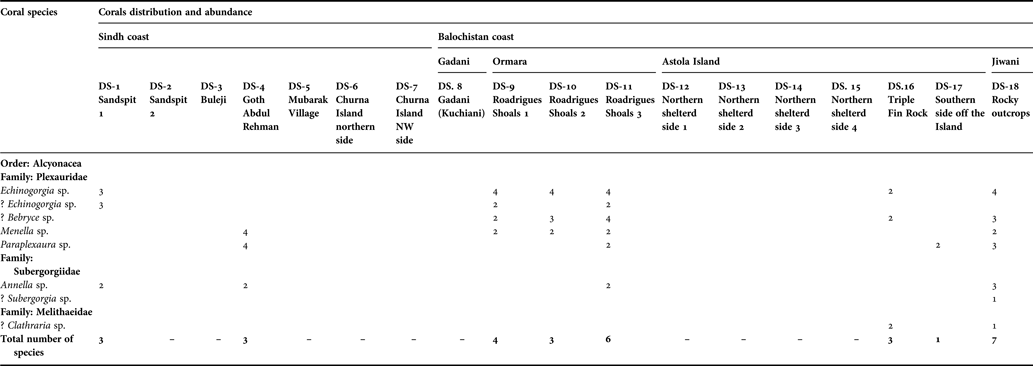
Soft corals were identified only up to genus level, indicating the occurrence of eight species, in three families and seven genera (Figure 4; Table 3). They were not sampled, but rather identified from photographs taken in situ. So, for some genera, little trust can be placed in identification. The results of observed abundance and recorded depths at each dive site indicate that soft corals were generally more abundant at deeper and more exposed sites with stronger currents (Sandspit 1, Goth Abdul Rehman, Ormara (Roadrigues Shoals), Jiwani) and, with some exceptions, no soft corals were observed on the sheltered and shallow northern side of Astola Island. Echinogorgia sp. 1 was more wide spread and abundant at six sites followed in decreasing order by Bebryce sp. and Menella sp. (five sites), Annella sp. and Paraplexaura sp. (four sites), Echinogorgia sp. 2 (three sites), and Subergorgia sp. and Clathraria sp. (one site).
Diversity of soft coral species collected from coastal waters of Pakistan: (A) Echinogorgia sp.; (B) ?Echinogorgia sp.; (C) ?Bebryce sp.; (D) Menella sp.; (E) Paraplexaura sp.; (F) Annella sp.; (G) ?Subergorgia sp.; (H) ?Clathraria sp.
Abundance and distribution of soft coral species collected from 18 dive sites (DS) located along the Pakistan coast. Values of coral abundance are according to DACFOR numerical (1–6) scale: 6 = Dominant: up to 500 individuals; 5 = Abundant: up to 100 individuals; 4 = Common: up to 50 individuals; 3 = Frequent: up to 10 individuals; 2 = Occasional: up to 3 individuals; 1 = Rare: 1 individual. Species with question mark not identified with certainty.
A cluster analysis of the above mentioned hard coral communities (Figure 5) at 13 sites, excluding sites where no coral species was recorded, showed that the northern sheltered sites (1–4) at the Astola Island formed a well-defined cluster on a similarity level of about 80%, where as the exposed sites (1 and 2) at Roadrigues Shoals (Ormara) formed the cluster with exposed sites of Astola Island (6, 5) on 50 and 55% similarly level. The Roadrigues Shoals 3 formed a separate cluster at 25% similarity level. Sorensen's similarity coefficient analysis showed generally higher similarity at genus level as opposed to species for the hard coral communities in Pakistan compared with regional data. Sorensen's species similarity coefficient was 0.21 for the Gulf of Kutch, 0.28 for Oman, 0.25 for the southern Arabian Gulf and 0.15 for communities from Yemen. Sorensen's genera similarity coefficients were 0.57, 0.56, 0.53 and 0.38, calculated for the Gulf of Kutch, Oman, the southern Arabian Gulf and Yemen, respectively.
Cluster analysis for hard corals using presence–absence data and Bray–Curtis similarities at 13 sites, excluding Sandspit 2, Buleji, Goth Abdul Rehman, Gadani (Kuchiani) and Jiwani dive sites. SAN 1: Sandspit 1, MV: Mubarak Village, CHIN: Churna Island north side, CHINW: Churna Island north-west side, ROD 1–3: Roadrigues Shoals dive sites 1, 2 and 3, AST 1–6: Astola Island dive sites 1–6.
DISCUSSION
A survey of 18 sites along the Sindh and Balochistan coasts indicated that at most sites corals were growing on base rock, but at Astola Island there is some degree of reef formation. Hard coral growth was extremely poor at the few sites investigated along the coast, including Mubarak Village and Sandspit, where coral colonies were rarely found, and Goth Abdul Rehman, Gadani (Kuchiani), Buleji and Jiwani with no hard corals distribution. Poor distribution and low diversity of corals at these sites could be due to the high nutrient load, which allows phytoplankton and seaweed growth, the latter being a competitor of corals for space (Tanner, Reference Tanner1995; Jompa & McCook, Reference Jompa and McCook2002). Dense growth of phytoplankton appears to attenuate light and also add to the suspended load in the water column. Shading would restrict photosynthesis in the endosymbionts (zooxanthellae) of hermatypic corals (Philipp & Fabricius, Reference Philipp and Fabricius2003). High wave action at the exposed sites is also responsible for resuspending sediment causing an increase in the sediment load. The polyps of hard corals easily become clogged by sediments and are not well adapted to survive in highly turbid environments (Rogers, Reference Rogers1990; Fabricius, Reference Fabricius2005). This is evident from the fact that, with increasing distance from the shore, and provided that suitable hard substrate is available for attachment, coral communities become more diverse and abundant, probably because of less turbid waters.
The dominance of soft corals at exposed sites (for example, on exposed sites at Ormara, Jiwani, Astola Island and Goth Abdul Rehman) is probably favoured by relatively swift water currents, as soft corals are known to flourish at locations where water movements are strong, since they rely heavily on planktonic food (Fabricius & Alderslade, Reference Fabricius and Alderslade2001).
Astola Island, with high coral diversity and comparatively rich distribution (with up to 80% cover) particularly on the sheltered northern side, resembles a true reef, but may be more appropriately regarded as simple ‘coral on coral’ aggregations or proto-reefs. The proto-reef formation may be due to the fact that sheltered locations and less severe environmental conditions support hard coral growth (Sheppard et al., Reference Sheppard, Price and Roberts1992). Formation of significant single species stands by two species, Porites nodifera and Pocillopora damicornis, were prominent, possibly for the reason that these two species are known to be adapted to harsh environmental conditions including temperature fluctuations (Sheppard et al., Reference Sheppard, Price and Roberts1992), and that the branching corals are able to shed sediment more easily and hence are more tolerant to turbid conditions (Rogers, Reference Rogers1990).
Other common coral species along the Balochistan coast included Favites complanata, Favites pentagona and Coscinaraea monile. Favites complanata is also common in the Gulf of Kutch (Pillai & Patel, Reference Pillai and Patel1988). Similarly, Favites pentagona and Coscinaraea monile are prevalent in the Oman region (Sheppard & Salm, Reference Sheppard and Salm1988). Faviidae and Poritidae were over-represented corals on the Balochistan and Sindh coasts, a fact that is also recorded from other locations bordering the northern Arabian Sea (Wilkinson, Reference Wilkinson2004), probably due to the fact that these families can tolerate highly turbid water conditions compared to Acroporidae (Riegl, Reference Riegl1999). This may be seen in the case of the Gulf of Oman, where corals in the families Faviidae, Siderastreidae and Dendrophylliidae, for example, are dominant, as opposed to Acroporidae (Coles, Reference Coles2003). The turbidity tolerance is positively correlated with the size of the calyx; species with larger calices (>10 mm), such as species in the family Faviidae, are more tolerant than species with smaller calices (Stafford-Smith & Ormond, Reference Stafford-Smith and Ormond1993).
Most coral species in Pakistan appear to grow in sheltered areas (Astola and Churna Islands), but sheltered hard substratum are generally lacking along the coast. Sorensen's similarity coefficient analysis shows that the hard coral communities described here have high resemblance to the communities found in Oman, and comparatively low similarity with the southern Arabian Gulf and the Gulf of Kutch, India. All genera reported from Pakistan are also found in Oman, but five genera (Pocillopora, Goniopora, Dendrophyllia, Alveopora, Montipora and Pavona) found in Pakistan are not reported from the southern Arabian Gulf region (Riegl, Reference Riegl1999). In these regions coral growth is mainly limited by turbidity caused by stirring of water due to monsoonal processes, competition with macroalgae and temperature fluctuations due to upwelling (Pillai et al., Reference Pillai, Rajagopalan and Vargehees1980; Pillai & Patel, Reference Pillai and Patel1988; Sheppard, Reference Sheppard, Choat, Barres, Borowitzka, Call, Davies, Flood, Hatcher, Hopley, Hutchings, Kinsey, Orne, Pichon, Sale, Sammarco, Wallace, Wilkinson, Wolanski and Bellwood1988; Sheppard & Salm, Reference Sheppard and Salm1988; Coles, Reference Coles2001). However, diverse coral communities occurs, for example, in Dhofar, Oman, in areas or embayments where turbidity is reduced due to less wave action, and because of its location near the Red Sea, which supports a rich and diverse coral population (Salm, Reference Salm1993; Coles, Reference Coles2001). Coral distribution in the region shows variation in the diversity of corals, for example, reported from the Gulf of Kutch (37 species in 24 genera) (Pillai & Patel, Reference Pillai and Patel1988), Oman (91 species in 47 genera) (Sheppard & Salm, Reference Sheppard and Salm1988), Bahrain (28 species) (Sheppard, Reference Sheppard, Choat, Barres, Borowitzka, Call, Davies, Flood, Hatcher, Hopley, Hutchings, Kinsey, Orne, Pichon, Sale, Sammarco, Wallace, Wilkinson, Wolanski and Bellwood1988), the Red Sea (220 species) (Sheppard, Reference Sheppard1987) and the entire Indo-Pacific (656 species in 109 genera) (Coles, Reference Coles2003). Comparing coral diversity observed in Pakistan (29 species of hard, one species of black and eight species of soft corals) with other locations in the region suggests that Pakistan's coral fauna is comparatively poor. This is mainly due to its exposed coastline that is subject to strong monsoon winds and has an abundance of resuspended sediments causing high level of turbidity. Considering that the data collected in the present report are based on limited surveys, and that the fossil coral records from the uplifted costal belt of Balochistan show species which are currently not observed (Siddiqui et al., Reference Siddiqui, Ali, Bromfield, Iqbal and Shoaib2011), there are considerable chances of discovering additional species of corals if further underwater surveys at sheltered sites along the Balochistan coast are conducted.
FINANCIAL SUPPORT
The authors highly acknowledge the financial assistance to P.J.A.S. from HEC Islamabad under Joint Higher Education Link programme through the British Council Karachi and DFID's DelPHE project (#82). The authors also wish to thank WWF Pakistan and Ministry of Environment's Pakistan Wetland Project for supporting field expeditions to Astola Island and other parts of Balochistan (Makran) coast.