INTRODUCTION
The Lumbrineridae Schmarda, Reference Schmarda1861 are polychaetes with simple body shape and reduced number of external morphological characters (Carrera-Parra, Reference Carrera-Parra2001; Martins et al., Reference Martins, Carrera-Parra, Quintino and Rodrigues2012). The emphasis in the systematics of this family has shifted considerably in the last 25 years (Orensanz, Reference Orensanz1990; Carrera-Parra & Orensanz, Reference Carrera-Parra and Orensanz2002; Carrera-Parra, Reference Carrera-Parra2006a). In the past, the identification was based on readily accessible, but confusing external characters (e.g. shape of the prostomium and the parapodial lobes; type, size, shape and body arrangement of the hooded hooks). Now, the identification of lumbrinerids is mostly based on a combination of unique, reliable and size independent characters, focused in the maxillary apparatus and some key external features (Orensanz, Reference Orensanz1990; Carrera-Parra & Orensanz, Reference Carrera-Parra and Orensanz2002; Carrera-Parra, Reference Carrera-Parra2006a, Reference Carrera-Parrab). This approach has led to the description of several new taxa (both species and genera) and to taxonomic rearrangements (e.g. resurrecting genera, synonymizing or re-assigning species). Thus, more than 200 species belonging to 19 genera are currently recognized worldwide (Carrera-Parra, Reference Carrera-Parra2006a, Reference Carrera-Parrab). In the Mediterranean Sea, a total of 10 genera are recorded so far (D'Alessandro et al., Reference D'Alessandro, Romeo, Castriota, Cosentino, Perzia and Martins2016), of which eight are reported for the Eastern Mediterranean (Kurt-Sahin et al., Reference Kurt-Sahin, Cinar and Gonulal2016). These are Augeneria Monro, Reference Monro1930; Lumbrineris de Blainville, Reference de Blainville and Leuvrant1828; Lumbricalus Frame, Reference Frame1992; Lumbrinerides Orensanz, Reference Orensanz1973; Lumbrineriopsis Orensanz, Reference Orensanz1973; Scoletoma de Blainville, Reference de Blainville and Leuvrant1828; Ninoe Kinberg, Reference Kinberg1865 and Hilbigneris Carrera-Parra, Reference Carrera-Parra2006a.
Highlighting the importance of several maxillary features, Carrera-Parra (Reference Carrera-Parra2006a) erected four new genera that together with Augeneria, have in common four pairs of maxillae and Maxillae IV with whitish central area. Among them, Gallardoneris is mainly distinguished by the absence of prostomial antennae and attachment lamellae in Maxillae I and Maxillae II (present in Augeneria), presence of composite and simple multidentate hooded hooks (Helmutneris and Gesaneris only have simple multidentate hooks), mandibles totally fused and maxillary carriers joined to the entire base of Maxillae I (mandibles partially fused and carriers joined to half of base of Maxillae I in Loboneris).
Gallardoneris originally consisted of two species, G. shinoii (Gallardo, Reference Gallardo1968) and G. thailandensis Carrera-Parra, Reference Carrera-Parra2006a, both of which occur in the Western Pacific. Recently, Martins et al. (Reference Martins, Carrera-Parra, Quintino and Rodrigues2012) described Gallardoneris iberica from specimens collected in the Portuguese continental shelf. The composite multidentate hooded hooks of G. iberica have short hoods and they are present up to chaetiger 9, whereas the hoods are long in G. shinoii and present up to chaetiger 16 in G. thailandensis. In anterior body, after 6–7 first chaetigers and until chaetigers 14–17, prechaetal lobes are ovoid, in comparison to G. thailandensis where they are rounded with digitiform extension. In posterior body, prechaetal lobes are longer than postchaetal lobes, instead of similar size in G. shinoii. Since then, G. iberica has been recorded from a number of sites along the Adriatic Sea (Bertasi et al., Reference Bertasi, Lomiri, Vani, Trabucco and Lamberti2014; Mikac, Reference Mikac2015), in the west-central Mediterranean Sea (D'Alessandro et al., Reference D'Alessandro, Romeo, Castriota, Cosentino, Perzia and Martins2016; García Gómez et al., Reference García Gómez, Carrera-Parra, Mas, Freitas and Martins2016) and on the south-western Spanish Atlantic coast (García Gómez et al., Reference García Gómez, Carrera-Parra, Mas, Freitas and Martins2016), on the basis of the detailed description of jaw morphology and external characteristics. In addition, one specimen of the genus Gallardoneris (identified as Gallardoneris sp.) has been recently recorded in Malta, although further study is required to determine whether this could be an undescribed species or not (Langeneck et al., Reference Langeneck, Busoni, Aliani and Castelli2017).
Up-to-date taxonomic keys, species lists and geographic occurrences are highly interesting for taxonomists and ecologists, but they are also very important for environmental conservation policies, where identification of benthic macrofauna is required (e.g. EU Water Framework Directive; EU Marine Strategy Framework Directive; EU Habitats Directive; EU Biodiversity Strategy). In fact, there is an evident need for easy-to-use keys (and descriptions), which are addressed to end-users with less experience than expert taxonomists and must be freely available in a collective worldwide database. The present study contributes to the above needs, by showing the results of an extensive survey conducted throughout the Greek and Cypriot coasts which include the taxonomy, geographic distribution and ecological preferences of G. iberica. Additionally, a comparison with other species of the same genus and a worldwide key is provided, as well as the species widespread distribution is discussed.
MATERIALS AND METHODS
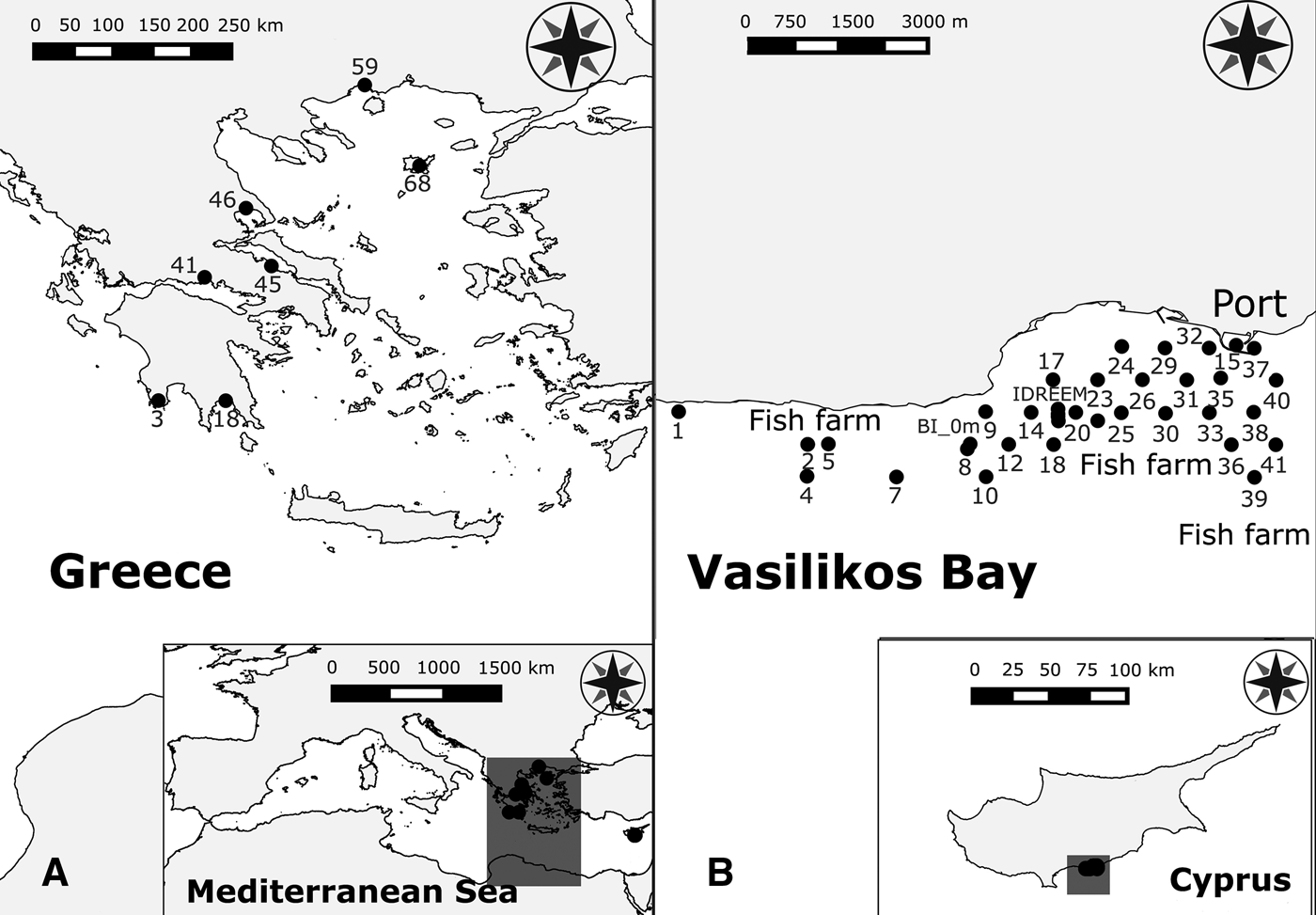
Specimens of Gallardoneris iberica were collected from seven coastal sites in Greece (Ionian Sea and Aegean Sea) as part of the Water Framework Directive National Monitoring and from 35 sites off Vasilikos Bay and an inshore area in southern Cyprus, as part of two research projects (Figure 1). In total, four sampling surveys were carried out: in May 2012 and March 2013 in Greece, and in late June/early July and August 2013 in Cyprus. The water depth of the sampling sites ranged from 6 to 59 m. All sites were sampled with a 0.1 m2 grab, for sedimentary and macrofauna analysis. Macrofauna samples were sieved using a mesh size of 0.5 mm (Cyprus; samples with prefix VAS) or 1 mm (Greece; samples with prefix WFD), fixed with 10% solution of formalin with seawater and coloured with Rose Bengal.
Sampling stations where G. iberica has been found in the East Mediterranean. (A) Samples from Greece; (B) Samples from Vasilikos Bay and southern Cyprus. Sites under human pressures are labelled as ‘fish farm’ or ‘port’.

At the HCMR laboratory in Greece, sediment samples for grain-size analysis were divided between sand and mud fractions by wet sieving through a 63 µm mesh. Size distribution of the fine-grained subsamples were determined by X-ray attenuation analyser (Sedigraph Micrometrics 5000 ET). Results were used to classify the substrates according to Folk (Reference Folk1954). At the laboratory of MER in Cyprus, grain-size analysis was carried out in dried sediment by using the Endecotts Octagon Digital sieve shaker and sieves. Sediment types were automatically determined by GRADISTAT™ v8 (Blott & Pye, Reference Blott and Pye2001). Organic matter (OM) was determined by loss on ignition in the MER laboratory, following the procedure outlined in CEN/TC 292 (2007). Total organic carbon (TOC) was determined with CHN elemental analyser (EA-1108, Fisons Instruments) according to Verardo et al. (Reference Verardo, Froelich and McIntyre1990) in HCMR laboratory. Biological samples were rinsed with fresh water, sorted, identified up to species level, wherever possible and preserved in 70% ethanol.
Herein, we are following the terminology and abbreviations proposed by Carrera-Parra (Reference Carrera-Parra2006a). These abbreviations stand for the simple multidentate hooded hooks (SMHH), the composite multidentate hooded hooks (CMHH), ventral limbate (VL), dorsal limbate setae (DL) and maxillae (M). For a total of 22 individuals of G. iberica (10 from Cyprus, 10 from Greece, 2 from Spain) the following morphometric characters were measured: L T, total length; Nb, number of chaetigers (ch.); L 10, length from prostomium tip to the 10th ch.; W 10, width of ch. 10, excluding parapodia; P L: prostomium length; P W: prostomium width; CMHH (blade size, number of teeth, last ch. presence); SMHH (size, number of teeth, first ch. presence); aciculae number (anterior, middle, posterior body); VL (last ch.); DL (last ch.); number of teeth in maxillae. For analysing relevant morphological features, the following equipment was used: stereoscopes (OLYMPUS SZE and SZX7), microscopes (OLYMPUS BZ43 and CX41), digital cameras (Luminera and Q-Imaging Micropublisher 5.0RTV) and Image Analysis Pro Plus™ software for biometric measurements.
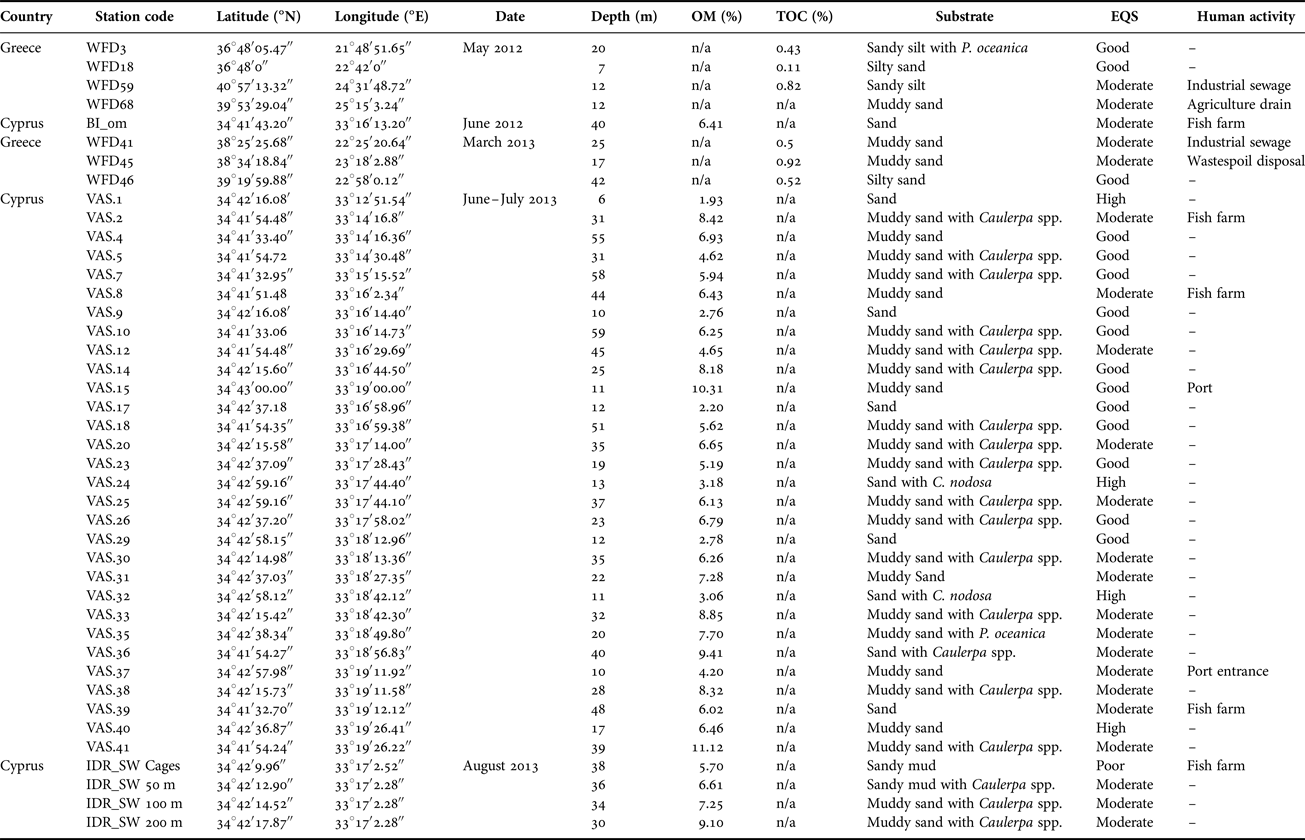
Sensitivity of G. iberica to disturbance was estimated according to the methodology of Rosenberg et al. (Reference Rosenberg, Blomqvist, Nilsson, Cederwall and Dimming2004), modified later by Leonardsson et al. (Reference Leonardsson, Blomqvist and Rosenberg2009). Habitat type of the stations was also described. Finally, the Ecological Quality Status for each station was determined using the Bentix index (Simboura & Zenetos, Reference Simboura and Zenetos2002) and the anthropogenic activities associated directly with the investigated stations were noted. Table 1 lists the environmental characteristics of each station and the human activities taking place.
Environmental characteristics of the sampling sites.

OM, organic matter (in % sediment); TOC, total organic carbon (in % sediment); EQS, ecological quality status; n/a, not available data; –, No relevant activity recorded.
The two individuals collected from Spain were loaned from DBUA – Department of Biology, University of Aveiro (Biological Research Collection). A set of well-preserved G. iberica specimens was deposited in the Natural History Museum of Crete, Irakleio (NHMC). The remaining specimens were deposited in the formal collection of Hellenic Centre for Marine Research (Athens, Greece); Museum of Zoology of the Department of Biology, University of Thessaloniki (Greece); Polychaeta collection of the Department of Biology, University of Pisa (Italy) and in the reference collection of Marine & Environmental Research Ltd (Limassol, Cyprus).
SYSTEMATICS
Class POLYCHAETA Grube, Reference Grube1850
Order EUNICIDA Dales, Reference Dales1962
Family LUMBRINERIDAE Schmarda, Reference Schmarda1861
Genus Gallardoneris Carrera-Parra, Reference Carrera-Parra2006a
Gallardoneris iberica Martins, Carrera-Parra, Quintino & Rodrigues, Reference Martins, Carrera-Parra, Quintino and Rodrigues2012
(Figures 1–4, Tables 1 and 2)
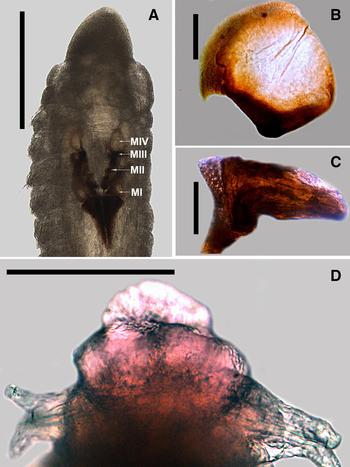
Gallardoneris iberica Martins, Carrera-Parra, Quintino & Rodrigues, Reference Martins, Carrera-Parra, Quintino and Rodrigues2012: (A) Maxillary apparatus view without dissection (WFD3 2012); (B) MIV (BI_0m 2012); (C) MIII (BI_0m 2012); (D) Pygidium (VAS.32 2013). M: Maxillae. Scale bars: A, 400 µm; B–C, 50 µm; D: 300 µm.

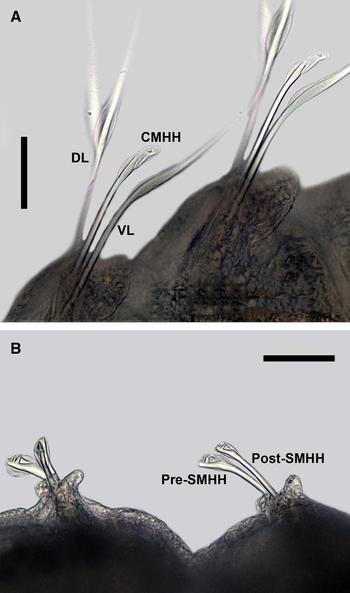
Gallardoneris iberica Martins, Carrera-Parra, Quintino & Rodrigues, Reference Martins, Carrera-Parra, Quintino and Rodrigues2012 (WFD3 2012): (A) Dorsal limbates (DL), post-acicular composite multidentate hooded hooks (CMHH) and ventral limbates (VL) from chaetigers 3–4; (B) Pre-acicular (Pre-SMHH) and post-acicular simple multidentate hooded hooks (Post-SMHH) from chaetigers 47–48. Scale bars: A–B, 50 µm.

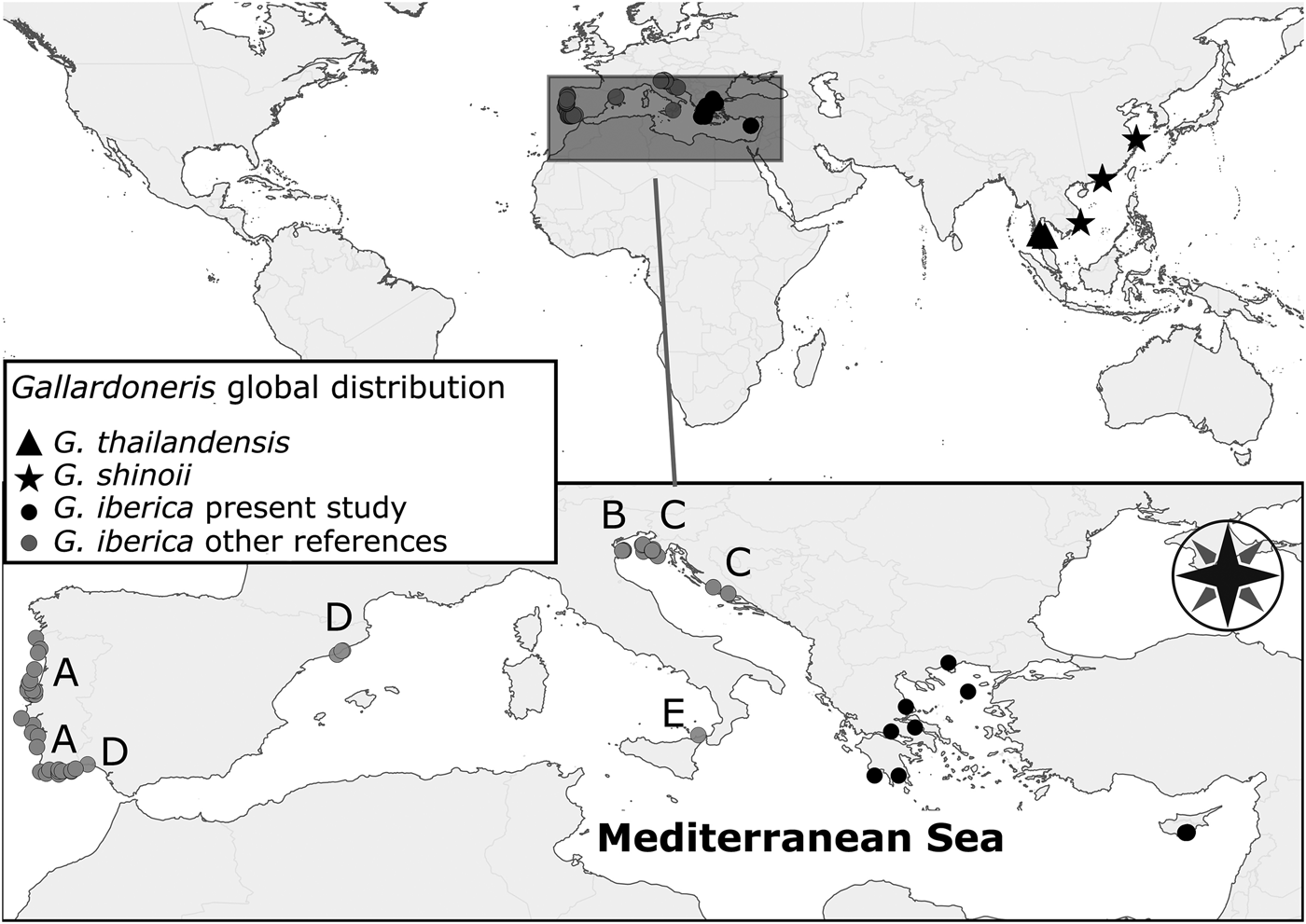
Worldwide distribution of Gallardoneris species. Black dots represent the geographic distribution of G. iberica according to present findings, while grey dots represent previous records in European waters, according to Martins et al. (Reference Martins, Carrera-Parra, Quintino and Rodrigues2012) (A), Bertasi et al. (Reference Bertasi, Lomiri, Vani, Trabucco and Lamberti2014) (B), Mikac (Reference Mikac2015) (C), García-Gómez et al. (Reference García Gómez, Carrera-Parra, Mas, Freitas and Martins2016) (D) and D'Alessandro et al. (Reference D'Alessandro, Romeo, Castriota, Cosentino, Perzia and Martins2016) (E).

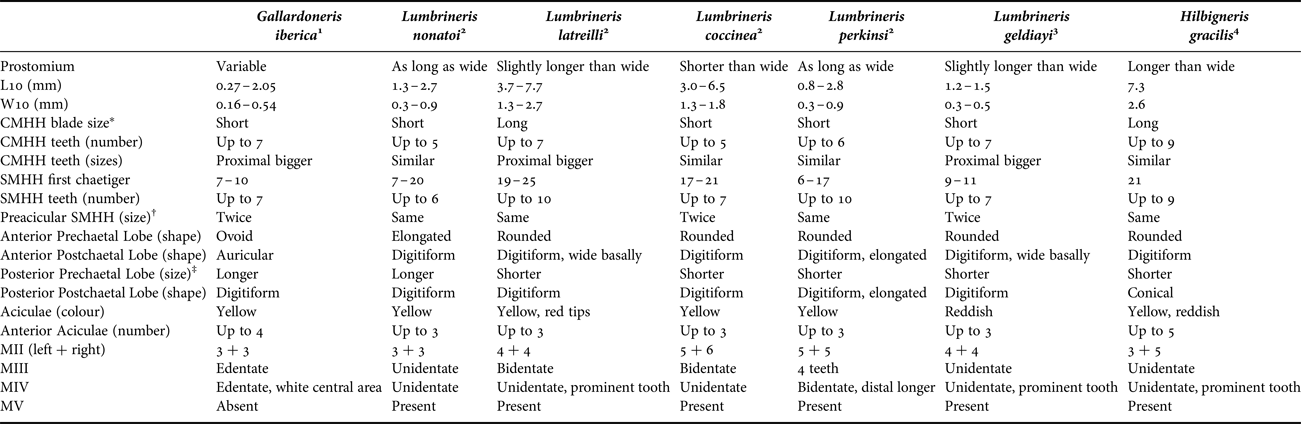
Comparison of characters among species possibly confused with G. iberica in East Mediterranean.

Data were based on the following references 1: Present study; 2: Carrera-Parra (Reference Carrera-Parra2006b); 3: Carrera-Parra et al. (Reference Carrera-Parra, Cinar and Dagli2011); 4: Carrera-Parra (Reference Carrera-Parra2006a).
* Carrera-Parra (Reference Carrera-Parra2006b) has defined the proportions of this subjective character: short as ~5 times longer than wide; long as ~11 times longer than wide.
† Compared to post-acicular SMHH.
‡ Compared to post-chaetal lobe.
Gallardoneris iberica Martins et al., Reference Martins, Carrera-Parra, Quintino and Rodrigues2012, p. 6, Figure 2 – Bertasi et al., Reference Bertasi, Lomiri, Vani, Trabucco and Lamberti2014, p. 2, Figures 2–4; Mikac, Reference Mikac2015, p. 46. García Gómez et al., Reference García Gómez, Carrera-Parra, Mas, Freitas and Martins2016, p. 4, Figure 3A; D'Alessandro et al., Reference D'Alessandro, Romeo, Castriota, Cosentino, Perzia and Martins2016, p. 4, Figure 4.
MATERIAL EXAMINED
NHMC 61.5, 2 specimens, VAS.37; NHMC 61.6, 1 specimen, VAS.32; NHMC 61.7, 4 specimens, VAS.17; Collection of Hellenic Centre for Marine Research: VAS.24, 1 specimen complete, LT = 6.6 mm, L10: 1.05 mm, W10: 0.30 mm, 59 chaetigers; WFD3 2012, 4 specimens; WFD18 2012, 1 specimen; WFD59 2012, 3 specimen; WFD68 2012, 1 specimen; WFD41 2013, 2 specimens; WFD45 2013, 2 specimens; WFD46 2013, 2 specimens. Collection of the University of the Thessaloniki: VAS.5, 14 specimens; VAS.14, 16 specimens; VAS.31, 9 specimens; Collection of the University of Pisa: VAS.20, 9 specimens; VAS.41, 3 specimens; Reference collection of Marine & Environmental Research Lab Ltd: VAS.1, 1 specimen; VAS.2, 16 specimens; VAS.4, 9 specimens; VAS.5, 3 specimens; VAS.7, 9 specimens; VAS.8, 1 specimen; VAS.9, 1 specimen; VAS.10, 2 specimens; VAS.12, 3 specimens; VAS.14, 7 specimens; VAS.15, 1 specimen; VAS.17, 3 specimens, VAS.18, 4 specimens; VAS.20, 3 specimens; VAS.23, 4 specimens; VAS.24, 4 specimen; VAS.25 3 specimens; VAS.26, 3 specimens; VAS.29, 4 specimens; VAS.30, 27 specimens; VAS.31, 9 specimens; VAS.32, 4 specimens; VAS.33, 36 specimens; VAS.35, 1 specimen complete, LT = 11.75 mm, L10: 1.75 mm, W10: 0.44 mm, 82 chaetigers; VAS.35, 6 specimens; VAS.36, 15 specimens; VAS.37, 14 specimens; VAS.38, 14 specimens; VAS.39, 5 specimens; VAS.40, 9 specimens; VAS.41, 11 specimens; IDR SW Cages, 1 specimen; IDR SW 50 m, 8 specimens; IDR SW 100 m, 14 specimens; IDR SW 200 m, 8 specimens; BI_0 m, 1 specimen.
COMPARATIVE MATERIAL EXAMINED
DBUA001457.02, 2 specimens, site: Barcelona, NE Spain, coordinates: 41°23′27.14′′N 02°12′56.48′′E, water depth: 21 m, sediment type: muddy sand.
DESCRIPTION
Longest complete specimen had a total length of 11.75 mm with 82 chaetigers. Material examined varied in L10 from 0.27 to 2.05 mm and in W10 from 0.16 to 0.54 mm.
Prostomium conical (Figure 2A), with variable size, in terms of length and width. Prechaetal lobe smaller than acicular lobe in anterior parapodia; ovoid, as long as acicular lobe or slightly shorter after about ch. 7; and then digitiform, longer than postchaetal lobe in posterior parapodia. Postchaetal lobe auricular, longer than acicular and prechaetal lobes in anterior parapodia, as long as acicular and prechaetal lobes or slightly longer after ch. 7–10 (until at least ch. 66; only two complete individuals), then shorter than prechaetal lobe in posterior parapodia. CMHH present from ch. 1 up to 6–9, with up to 7 teeth, proximal tooth larger (Figure 3A). SMHH from ch. 7–10, with up to 7 teeth, proximal tooth larger, preacicular hook larger than postacicular hook, present from ch. 19 (Figure 3B). Dorsal limbates present from ch. 1 up to 17–22, ventral limbates from ch. 1 up to 7–9 (Figure 3A). Aciculae yellow, 3–4 in most anterior parapodia, 2 after ch. 4–7. Maxillary apparatus with four pairs of maxillae (Figure 2A), MI forceps-like, MII with 3 smooth teeth, MIII edentate (Figure 2C), MIV edentate, with white central area (Figure 2A, B). Pygidium without anal cirri (Figure 2D).
REPRODUCTION
A mature female specimen was found in June, as seen in the Atlantic specimens (Martins et al., Reference Martins, Carrera-Parra, Quintino and Rodrigues2012). The gametes are globular with diameter ranging from 130 µm to 144 µm. These were located on parapodium 10, the last segment of the incomplete individual (material VAS.38).
REMARKS
Gallardoneris iberica can be mostly distinguished from other lumbrinerids in the Mediterranean Sea by the presence of MIV with whitish central area and longer pre-chaetal lobes than post-chaetal lobes in posterior segments. In addition, the absence of small antennae and the absence of limbate SMHH distinguish it from other species in the area having MIV with whitish central area or peculiar shape. Our material was similar to Adriatic material (Bertasi et al., Reference Bertasi, Lomiri, Vani, Trabucco and Lamberti2014) by (i) having pre-acicular SMHH larger than post-acicular SMHH after ch. 19, and (ii) having 3–4 aciculae present in anterior body and 2 in mid-body. The above characters diverged from the original description since the pre-acicular and post-acicular hooks were reported as having similar size and just 1 and 2 aciculae were found in anterior and posterior body, respectively (Martins et al., Reference Martins, Carrera-Parra, Quintino and Rodrigues2012). However, examination of Portuguese material by Bertasi et al. (Reference Bertasi, Lomiri, Vani, Trabucco and Lamberti2014) revealed the same aciculae distribution with the Mediterranean material and the use of methyl green staining was suggested for a more accurate counting of all aciculae. Our material was different to the material from Sicily (D'Alessandro et al., Reference D'Alessandro, Romeo, Castriota, Cosentino, Perzia and Martins2016) in having CMHH up to chaetiger 9, instead of chaetiger 11. Specimens from this study were different from G. shinoii in the shape and distribution of the CMHH (long hood and up to ch. 18 in the latter) and in size of pre-chaetal lobes compared with post-chaetal in posterior chaetigers (shorter in G. shinoii).
DISTRIBUTION
North-eastern Atlantic Ocean: Portuguese continental shelf (Martins et al., Reference Martins, Carrera-Parra, Quintino and Rodrigues2012), Huelva (Gulf of Cadiz; García Gómez et al., Reference García Gómez, Carrera-Parra, Mas, Freitas and Martins2016), Mediterranean Sea: Ebro Estuary (Gulf of Valencia; García Gómez et al., Reference García Gómez, Carrera-Parra, Mas, Freitas and Martins2016), Gulf of Milazzo (Southern Tyrrhenian Sea; D'Alessandro et al., Reference D'Alessandro, Romeo, Castriota, Cosentino, Perzia and Martins2016) Gulf of Venice (Bertasi et al., Reference Bertasi, Lomiri, Vani, Trabucco and Lamberti2014; Mikac, Reference Mikac2015), Rovinj (several locations), Lim Channel, off Istrian Peninsula, Pula Harbour, Krka Estuary, Split Harbour, Jadro Estuary, Bracko-Splitski Canal, Ploce Harbour (Adriatic Sea; Mikac, Reference Mikac2015), Methoni (South Ionian Sea; this study), Lakonikos Gulf (this study), Itea (Korinthiakos Gulf; this study), Larymna (Evoikos Gulf; this study), Volos (Pagasitikos Gulf; this study), Kavala, Moudros (North Aegean Sea; this study), Vasilikos Bay (this study) and southern near-shore coastal area (Cyprus Basin; this study).
ECOLOGY
A total of 338 G. iberica individuals were found in samples from Cyprus (323 individuals) and Greece (15 individuals). Water depth ranged from 6 to 59 m, which sets a shallower limit to the known bathymetric distribution (18 to 180 m) from the Portuguese continental shelf and the central and western Mediterranean records. The species was mostly found in infralittoral muddy sands (62% of sites), but also finer sediments (9%) and coarser sands (12%). The above substrates were either bare, or in association with Caulerpa spp. (C. prolifera (Forsskal) Lamouroux, 1809 and C. cylindracea Sonder, 1845). Other recorded habitats were beds of Cymodocea nodosa (Ucria) Ascherson, 1870, or Posidonia oceanica (Linnaeus) Delile, 1813 (10%) and circalittoral detritic bottoms (7%). Sites showed a variable amount of organic matter, namely 0.11–0.92% TOC in Greece and from 1.93–11.12% OM in Cyprus.
The relative contribution of G. iberica to the total macrofauna abundance in each sampling site was always lower than 2%. The mean density of the species was higher in substrates with Caulerpa spp. (39.1 m−2), co-occurring with the following dominating species: Melinna palmata Grube, 1870, Aphelochaeta filiformis (Keferstein, 1862), Notomastus spp. and Cirrophorus sp. In seagrass beds, the mean density was 19.1 m−2 and the dominating species were Pseudoleiocapitella fauveli Harmelin, 1964, Notomastus spp., Hilbigneris gracilis (Ehlers, 1868) and Abra spp. In infralittoral bare sediments, the mean abundance was 18.9 m−2 and dominating species were A. filiformis, M. palmata, H. gracilis, P. fauveli and Abra spp. In detritic bottoms the mean abundance was 18.1 m−2 and the dominant species were A. filiformis, Protodorvillea kefersteini (McIntosh, 1869), Aponuphis brementi (Fauvel, 1916) and Notomastus spp.
The species was mostly recorded in sampling sites with ‘Moderate’ ecological status, although it was also found in ‘Poor’, ‘Good’ and ‘High’ status sites. Gallardoneris iberica was also found close to industrial waste disposal locations in Greece and under open-sea fish farms in Cyprus, as well as in undisturbed sites. The species sensitivity value has been estimated to be 19.54 (see discussion below).
DISCUSSION
The present study revealed a wide distribution of Gallardoneris iberica in the Eastern Mediterranean (seven sites scattered around Greek coasts; 35 in Cyprus basin; Figure 1), extending its range of distribution across the Mediterranean (Figure 4). The oldest specimens of the material in the present study were collected in 2012. However, the original description was based on material collected during 2007 and 2008 (Martins et al., Reference Martins, Carrera-Parra, Quintino and Rodrigues2012); the oldest Adriatic material, which was later re-identified, was also collected in the same period (Bertasi et al., Reference Bertasi, Lomiri, Vani, Trabucco and Lamberti2014; Mikac, Reference Mikac2015). Therefore, a recent introduction in the area is improbable and its presence so far must have been overlooked since this species was recently described and the genus was recently erected (Carrera-Parra, Reference Carrera-Parra2006a).
The problem of past misidentifications of Lumbrineridae in the region had already been stressed by Papadopoulou et al. (Reference Papadopoulou, Dounas and Smith1994), due to difficulties in the dissection and the observation of maxillary morphology in all specimens. Gallardoneris iberica specimens are small (0.16–0.54 mm W10) which indeed leads to difficulties in dissection. In addition, confusing and overlapping jaw descriptions can be found in past keys. Table 2 summarizes comparisons of the external and the basic jaw features between G. iberica and the most common lumbrinerids in the East Mediterranean (Lumbrineris spp. and Hilbigneris gracilis). It is probable that G. iberica was confused in the past with one of these species, since it shares several similar external features, especially with Lumbrinereis nonatoi Ramos, Reference Ramos1976, as Bertasi et al. (Reference Bertasi, Lomiri, Vani, Trabucco and Lamberti2014) suggested. Lumbrineris nonatoi was not recorded in the samples of the present study. However, the latter is the only species that has the same number of teeth in MII and prechaetal lobe longer than postchaetal in posterior body, a character highlighted in the original description of the species (Ramos, Reference Ramos1976). Lumbrineris nonatoi has been previously recorded both in the northern Aegean Sea and in Crete (Simboura & Nicolaidou, Reference Simboura and Nicolaidou2001). Additionally, both species share similar ecological preferences, namely bathymetry (10–190 m in the case of L. nonatoi; Karakassis, Reference Karakassis1991; Papadopoulou et al., Reference Papadopoulou, Dounas and Smith1994), habitat preferences (Karakassis, Reference Karakassis1991; Dounas & Koukouras, Reference Dounas and Koukouras1992; Tselepides, Reference Tselepides1992; Papadopoulou et al., Reference Papadopoulou, Dounas and Smith1994; Labrune et al., Reference Labrune, Gremare, Amouroux, Sarda, Gil and Taboada2007; Mikac, Reference Mikac2015) and tolerance to contaminants and organic carbon (e.g. Karakassis, Reference Karakassis1991; Ros & Cardell, Reference Ros, Cardell, Colombo, Ferrari, Ceccherelli and Rossi1992). Lumbrineris nonatoi is reported to have occasionally high and dominating abundances (e.g. Karakassis, Reference Karakassis1991; Tselepides, Reference Tselepides1992; Papadopoulou et al., Reference Papadopoulou, Dounas and Smith1994), which is not the case for G. iberica.
Habitat preferences of G. iberica seem to follow a similar pattern in all Atlantic and Mediterranean records, which mainly include finer sediments with biogenic detritus and organic matter (Martins et al., Reference Martins, Carrera-Parra, Quintino and Rodrigues2012; Bertasi et al., Reference Bertasi, Lomiri, Vani, Trabucco and Lamberti2014; D'Alessandro et al., Reference D'Alessandro, Romeo, Castriota, Cosentino, Perzia and Martins2016; García Gómez et al., Reference García Gómez, Carrera-Parra, Mas, Freitas and Martins2016), coastal terrigenous muds (Bertasi et al., Reference Bertasi, Lomiri, Vani, Trabucco and Lamberti2014; García Gómez et al., Reference García Gómez, Carrera-Parra, Mas, Freitas and Martins2016), mixed sediments and sands (Mikac, Reference Mikac2015), but also coastal estuaries (during summer; Mikac, Reference Mikac2015; García Gómez et al., Reference García Gómez, Carrera-Parra, Mas, Freitas and Martins2016). Its presence in harbours (Rovinj, Pula, Split and Ploce, Mikac, Reference Mikac2015; nearby Milazzo, D'Alessandro et al., Reference D'Alessandro, Romeo, Castriota, Cosentino, Perzia and Martins2016), close to wastewater outfalls (Mikac, Reference Mikac2015) and oil refining docking platforms was also confirmed (D'Alessandro et al., Reference D'Alessandro, Romeo, Castriota, Cosentino, Perzia and Martins2016).
According to Leonardsson et al. (Reference Leonardsson, Blomqvist and Rosenberg2009), the Hurlbert's diversity index ES50 per site can be used to estimate the sensitivity value of a given species which is inversely proportional to disturbance. Based on this methodology, the sensitivity value of G. iberica was estimated to be 19.54 which may be related to the fact that the species was found in a wide variety of environmental quality levels (Poor, Moderate, Good and High ecological status). This value agrees with the sensitivity of Lumbrineridae species from the eastern Mediterranean Sea where values range between 7.22 and 31.11 (Dimitriou et al., Reference Dimitriou, Apostolaki, Papageorgiou, Reizopoulou, Simboura, Arvanitidis and Karakassis2012; Supplementary Material). The above value for G. iberica is similar to the values of Lumbrineriopsis paradoxa (Saint-Joseph, 1888) (19.82), Scoletoma funchalensis (Kinberg, Reference Kinberg1865) (19.38) and L. nonatoi (18.38). It is important to note that the sensitivity value is highly variable with a small number of samples and extensive datasets are required for a reliable classification of a given species to a tolerance group (Leonardsson et al., Reference Leonardsson, Blomqvist and Rosenberg2009). Therefore, the present value is merely indicative and could be modified with increasing sampling effort.
The geographic distribution of the three valid species of genus Gallardoneris is depicted in Figure 4. As far as it is documented, G. iberica is the most widespread species of the genus. Gallardoneris thailandensis is only known from Thailand (Carrera-Parra, Reference Carrera-Parra2006a) while Gallardoneris shinoii is recognized in Nha Trang, Vietnam (Gallardo, Reference Gallardo1968; Carrera-Parra, Reference Carrera-Parra2006a), Hong Kong (Shin, Reference Shin1977; as Lumbrineris shinoii) and Shanghai (Shou et al., Reference Shou, Zeng, Liao, Xu, Gao, Chen and Yang2013; from synonym); being among the most dominant species in West Hong Kong (Shin & Thompson, Reference Shin and Thompson1982; from synonym). While there is very little information available about the ecological characteristics of G. thailandensis, the tolerance to disturbance of G. shinoii is demonstrated from several sources. The latter was present in natural disturbance (Shin, Reference Shin1989), in high sedimentation rate in the Yangtze River estuary (Shou et al., Reference Shou, Zeng, Liao, Xu, Gao, Chen and Yang2013), in the harbour of Tolo (Shin, Reference Shin, Morton and Cheng1982) and intermediate sites (100 m distance) to fish farms at Kau Sai Bay (Gao et al., Reference Gao, Shin, Xu and Cheung2008). However, G. shinoii was also present in undisturbed sites of muddy bottoms, relatively low in organic carbon (Shin, Reference Shin1989; Gao et al., Reference Gao, Cheung, Cheung and Shin2005). It should also be highlighted that the most recent record of a single individual named as Gallardoneris sp. (Langeneck et al., Reference Langeneck, Busoni, Aliani and Castelli2017) was found in a deep-sea muddy environment at 1800 m water depth (Baldrighi et al., Reference Baldrighi, Aliani, Conversi, Lavaleye, Borghini and Manini2013).
KEY TO SPECIES OF GALLARDONERIS
1. Posterior parapodia with prechaetal and postchaetal lobes of similar size; CMHH with long hood … G. shinoii
- Posterior parapodia with prechaetal lobes longer than postchaetal lobes; CMHH with short hood … 2
2 Anterior parapodia with prechaetal lobe ovoid, no digitiform extension at the dorsal end; CMHH present up to chaetiger 9… G. iberica
- Anterior parapodia with prechaetal lobe rounded, with digitiform extension at the dorsal end; CHMM present up to chaetiger 16 … G. thailandensis
Note: this key does not include the most recent record of Gallardoneris sp. due to the absence of taxonomic details of this individual.
ACKNOWLEDGEMENTS
We would like to thank the anonymous reviewers for the detailed comments. We are also grateful to F.C. Küpper (Aberdeen University) for a critical revision of the manuscript. In addition, we would like to thank MER's staff (A. Loucaides, D. Kletou, F. Georgiou, P. Kleitou and S. Lau) for sampling and sorting the benthic macrofauna samples and for carrying out the sediment analysis of the Cypriot projects.
FINANCIAL SUPPORT
Greek samples were obtained from the National Water Framework Directive Monitoring Project of Greece, assigned to the Hellenic Centre for Marine Research by the Hellenic Ministry of Environment and Energy, Special Secretary of Water and financed by the European Union Funds through the National Strategic Reference Framework (NSRF). Cypriot samples were obtained by Marine & Environmental Research (MER) from two research projects: (i) the ‘Α holistic approach for the evaluation of ecological status of coastal areas: the case of Vasiliko Bay’, that was co-funded by the Research Promotion Foundation of Cyprus and the European Regional Development Fund (grant agreement SMES/Product/0609/74) and (ii) the IDREEM project (Increasing Industrial Resource Efficiency in European Mariculture, http://www.idreem.eu) that was funded by the European Union's Seventh Framework Program (FP7/2007–2013) grant agreement no. 308571. BI specimens were collected from MER Lab Ltd as part of the environmental monitoring of the aquaculture company Blue Island Plc. Roberto Martins benefitted from a Post-Doctoral grant (SFRH/BPD/93225/2013) awarded by the Portuguese Science Foundation (FCT), funded by the Human Potential Operational Programme (POPH) through QREN and European Social Fund (ESF) and by national funds through the Portuguese Ministry of Education and Science. CESAM is funded by FCT/MEC national funds and FEDER, within the PT2020 Partnership Agreement and Compete 2020 (UID/AMB/50017).