


Levels of the macular xanthophylls lutein, zeaxanthin and meso-zeaxanthin have been associated with slower progression of age-related macular degeneration( Reference Ma, Dou and Wu 1 ), potentially through their action in quenching reactive oxygen species, scavenging blue light and thereby protecting the eye from photo-oxidative damage( Reference Schmidl, Garhofer and Schmetterer 2 ). Carotenoids are not synthesised de novo in humans( Reference del Rocío Gómez-García and Ochoa-Alejo 3 ) and we therefore depend on dietary intake and efficacy of absorption for their action. Reduced absorption capacity in the small bowel secondary to surgical resection could thereby put these patients at risk for malabsorption of carotenoids relevant for visual health. In addition, underlying conditions, which influence intestinal mucosa integrity, transport capacity, availability of lipids for carotenoid solubilisation and gastric passage time, are expected to be important parameters for carotenoid absorption capacity( Reference Bohn, Desmarchelier and Dragsted 4 ). The severity of malabsorption is expected to reflect among other underlying diseases, area of resection, length, and health of the remaining tissue( Reference Matarese 5 ). There is little scientific information, however, about serum levels of non-essential fat-soluble components such as carotenoids and their clinical correlates in patients with altered gut absorption.
The aim of the present study was, through exploratory measures, to investigate levels of serum carotenoids and optical density of the macular pigment in a case cohort of patients with intestinal resection and healthy subjects.
Subjects and methods
Subjects and study design
The recruitment methodology is described in detail in the study by JN Eriksen et al. (unpublished results) and in the Supplementary material. In brief, we recruited twelve healthy subjects and ten patients with intestinal resections (140–350 cm small intestine left) from a pool of volunteers and from the Department of Gastroenterology of the Rigshospitalet, respectively, to participate in a cross-over study of carotenoid supplementation. The data presented here are from the baseline examination. Subjects were matched by age (±5 years) and sex.
Ethical approval
The study was approved by The Danish National Committee on Health Research Ethics (study no. H-3-2014-112) and registered at clinicaltrial.gov (study no. NCT02450227).
Carotenoid dietary intake
Intake of lutein and zeaxanthin was calculated as crude estimates (lutein/zeaxanthin score) and categorised into three groups using a lutein/zeaxanthin screening tool based on intake and relative bioavailability in four food groups (eggs, broccoli, maize, and dark leafy vegetables)( Reference Moran, Johnson and Stack 6 ).
Blood sampling, carotenoid extraction and quantification
Methodologies for blood sampling, carotenoid extraction and quantification have been described by Eriksen et al. ( Reference Eriksen, Madsen and Dragsted 7 ).
Vision study
Macular pigment optical density (MPOD) was assessed from blue light autofluorescence (BAF) fundus images from both eyes of each subject and analysed using Corel Paint Shop Pro (Corel Corporation). BAF images and optical coherence tomography scans of the retina and structures of the posterior pole of the eye were obtained by scanning laser ophthalmoscope (Heidelberg Spectralis HRA; Heidelberg Engineering GmbH). MPOD was calculated as the density of the fovea relative to the average of two reference areas on the nasal and temporal side of the foveal zone of xanthophyll pigmentation.
Data analysis
Data processing and statistical analysis were conducted in GraphPad Prism version 6.03 (GraphPad Software Inc., 2013) and R version 3.1.1. (R Core Team, 2013). Continuous variables were checked by the Shapiro–Wilk test for normality. For differences between baseline variables in the two groups, Student's t test, the Mann–Whitney non-parametric test and Fisher's exact test were applied. Linear regression models were constructed to test for association between the dependent variables lutein, zeaxanthin, β-carotene and MPOD, and the independent variables bowel length or study group (healthy/intestinal resection). Multiple linear regression models were applied to adjust for confounding variables found to be associated with the dependent variable or if a physiological relationship was found established in the literature. Age was always included in the adjustment.
Results and discussion
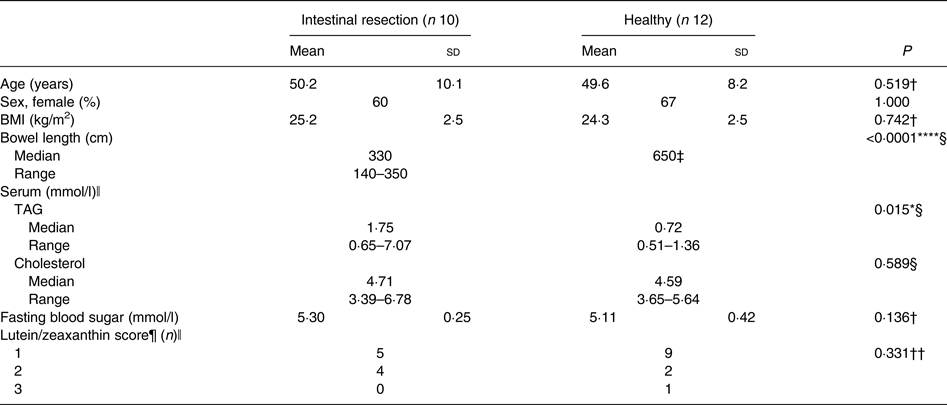
The two study groups, patients with intestinal resection and healthy subjects, were of comparable age and sex distribution (Table 1). The patients with intestinal resection had roughly half the bowel length (140–350 cm, comprising jejunostomy and ileostomy, P < 0·0001) and twice the serum TAG level (P < 0·05) of the healthy subjects. Patients with intestinal resection were the result of surgical resection for ulcerative colitis (n 1), Crohn's disease (n 8) and radiation enteropathy (n 1). All patients with intestinal resection used oral vitamin supplements and two received intravenous fluid therapy.
Baseline covariates in the two study groups
(Mean values and standard deviations; percentages; medians and ranges; numbers of subjects)
* P < 0·05, **** P < 0·0001.
† Student's t test.
‡ Theoretical value.
§ Mann–Whitney non-parametric test.
ǁ n 9 for intestinal resection group.
¶ Score calculated based on intake and relative bioavailability in four food groups.
†† Fisher's exact test.
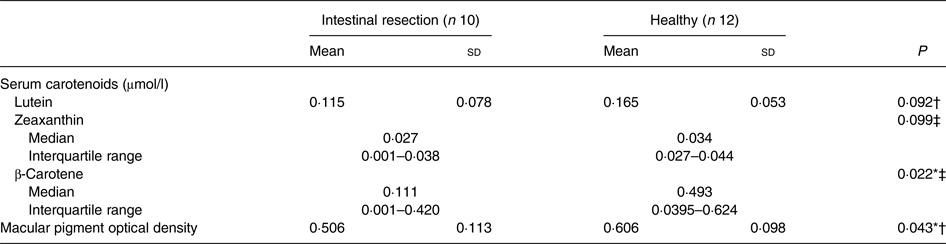
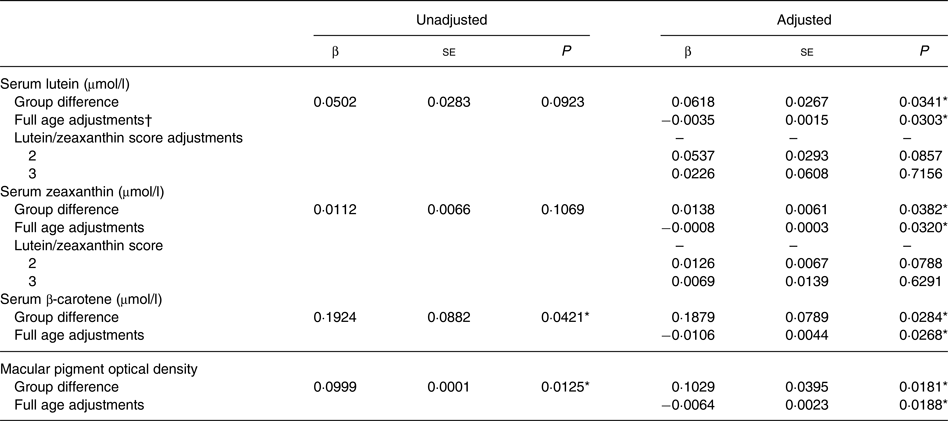
Differences in serum lutein, zeaxanthin and β-carotene between the two groups are presented in Tables 2 and 3. Circulating levels of carotenoids are expected to reflect carotenoid intake, bioavailability and here also absorption capacity. The three carotenoids lutein, zeaxanthin and β-carotene were higher (P < 0·05) in healthy subjects than in patients with intestinal resection (P < 0·05, adjusted for age and, in the case of lutein and zeaxanthin, for dietary intake of these two carotenoids). Serum carotenoids and MPOD were also found associated with the continuous variable bowel length (data not presented). The mean (or median) serum concentrations of lutein, zeaxanthin and β-carotene were 0·165, 0·034 and 0·493 µmol/l, respectively, in healthy subjects and 0·115, 0·027 and 0·111, respectively, in patients with intestinal resection (Table 2). Comparable studies in patients with intestinal resection are to our knowledge limited to studies investigating the relationship with underlying disease including ulcerative colitis( Reference Geerling, Badart-Smook and Stockbrugger 8 ) and Crohn's disease( Reference Drai, Borel and Faure 9 ).
Baseline characteristics of study participants
(Mean values and standard deviations; medians and interquartile ranges)
* P < 0·05.
† Student's t test.
‡ Mann–Whitney test.
Cross-sectional associations for difference in serum carotenoids (μmol/l) and macular pigment optical density between short-bowel patients and age (± 5 years)- and sex-matched controls
(β-Coefficients and standard errors)
* P < 0·05.
† Age-matching was performed in a broad interval and these adjustments correct for residual age differences arising from unequal group size.
Serum carotenoids may affect visual health in several ways. β-Carotene is associated with visual health through its role as a pro-vitamin A carotenoid, whereas lutein and zeaxanthin are found as pigments in the macula lutea. MPOD levels were significantly lower in patients with intestinal resection compared with healthy controls (Tables 2 and 3; P < 0·05). Comparable studies have to our knowledge not been published at the present time and evidence on visual complications secondary to malabsorption of vitamin A and carotenoids in related patient groups is limited to a few case studies( Reference Renner, Dietrich-Ntoukas and Jagle 10 , Reference da Rocha Lima, Pichi and Lowder 11 ). Supporting evidence can, however, be found in publications investigating serum carotenoid levels, MPOD and objective measures of visual function in cystic fibrosis patients. It has been suggested that absorption of carotenoids in this patient group could be hampered by pancreatic insufficiency not fully substituted by enzyme replacement therapy. Two small studies with nine and ten cystic fibrosis patients showed lower serum carotenoids and lower MPOD, but did not find a significant effect on visual acuity( Reference Schupp, Olano-Martin and Gerth 12 , Reference Shi, Morrissey and Durbin-Johnson 13 ). Evidence is, however, still lacking for the effect of long-term decrease in macula pigments and the risk of later visual complications.
The present study is limited in sample size and inter-correlation between absorption capacity, serum levels, and the functional markers of vision, MPOD, makes analyses challenging. Future studies should focus on the physiological effect of reduced circulating carotenoid levels on MPOD in patient groups with malabsorption, potentially with additional measurements of other fat-soluble vitamins.
Conclusion
The present study found lower serum carotenoids and lower macular pigment optical densities in patients with intestinal resection than in healthy subjects. While there is no certain knowledge about the effects of having low serum carotenoid levels, there are important indications that low retinal carotenoid levels may have a deleterious effect on retinal health. Our findings suggest that patients with intestinal resection or even short bowel disease should be examined, in a scientific context, for signs of poor retinal health. Our results should be validated in larger studies.
Supplementary material
The supplementary material for this article can be found at https://doi.org/10.1017/jns.2017.71
Acknowledgements
The authors thank the subjects enrolled in the study for their contribution to our research. Additionally, we would like to thank the Herta Messerli Stiftung for financial support and positive feedback. Furthermore, we thank the technical staff at Rigshopitalet (Dorte Christensen, Birgitte Schou and Jette Christiansen) and at NEXS (Department of Nutrition, Exercise and Sports, University of Copenhagen; Pia Madsen and Cecilie Appeldorff) for technical support conducting the study and ultra-HPLC analyses. Lastly, we would like to thank optometrist Hajer Ahmad for valuable contributions to the clinical eye examinations, and Dr Elizabeth Johnson who so generously let us use the lutein/zeaxanthin screener.
The study was initiated by J. N. E., L. O. D., M. L., P. B. J. and E. A. The research question was formulated and the study designed by the initiating group. The study was carried out by J. N. E., M. L., P. B. J., A. P. P. and M. K. F. Data were analysed and the paper drafted by J. N. E. Each of the listed authors reviewed and commented on the paper draft before submission.
There were no conflicts of interest.


 Open access

