Introduction
Post-traumatic stress disorder (PTSD) is associated with high levels of impairment, which is often underdiagnosed (Ahmed, Reference Ahmed2007) and frequently comorbid with other disorders (Kessler et al. Reference Kessler, Chiu, Demler, Merikangas and Walters2005). By definition, PTSD symptoms occur after the experience of a traumatic event (TE) and a diagnosis of PTSD therefore requires the presence of a TE.
Experience of a TE is a common phenomenon. Several epidemiological studies have reported high lifetime prevalence of traumas, such as 51% for women and 61% for men in the National Comorbidity Survey (NCS) (Kessler et al. Reference Kessler, Sonnega, Bromet, Hughes and Nelson1995), 64.5% for men and 49.5% for women in the Australian National Survey (Creamer et al. Reference Creamer, Burgess and McFarlane2001), and going as high as 89.6% in the Detroit Area Survey of Trauma (Breslau et al. Reference Breslau, Kessler, Chilcoat, Schultz, Davis and Andreski1998). The conditional probability of PTSD after a trauma has occurred depends on, among other things, the type of trauma. The NCS revealed that the trauma most likely to be associated with PTSD was rape, both in men and women (Kessler et al. Reference Kessler, Sonnega, Bromet, Hughes and Nelson1995). Similarly, in the Australian National Survey of Mental Health and Well-being, rape and sexual molestation were the TEs with the greatest probability of being associated with PTSD (Creamer et al. Reference Creamer, Burgess and McFarlane2001). Most recently, Darves-Bornoz et al. (Reference Darves-Bornoz, Alonso, de Girolamo, de Graaf, Haro, Kovess-Masfety, Lepine, Nachbaur, Negre-Pages, Vilagut and Gasquet2008) found in the European Study of the Epidemiology of Mental Disorders (ESEMeD) that having a child with a serious illness, being raped, being stalked and being beaten by a caregiver were the TEs associated with the highest conditional risk of PTSD.
Most of the research on between-TE variation in conditional risk of PTSD can be faulted, however, on at least two grounds. First, as co-occurrence of multiple TEs is common (Carey et al. Reference Carey, Stein, Zungu-Dirwayi and Seedat2003), drawing a direct line from a specific TE to PTSD is difficult. Second, due to the fact that many people in the general population experience a large number of TEs in their life, most of the past assessments of TE-specific PTSD risk have been carried out by asking respondents in community epidemiological surveys to select the worst TE from among all those they ever experienced and then assessing PTSD only for that particular TE (Kessler et al. Reference Kessler, Sonnega, Bromet, Hughes and Nelson1995; Creamer et al. Reference Creamer, Burgess and McFarlane2001; Darves-Bornoz et al. Reference Darves-Bornoz, Alonso, de Girolamo, de Graaf, Haro, Kovess-Masfety, Lepine, Nachbaur, Negre-Pages, Vilagut and Gasquet2008). However, using the worst trauma to determine the conditional risk of PTSD given exposure could result in a spuriously strong association between trauma and PTSD because those traumas resulting in greater psychological distress are more likely to be selected as the worst (Breslau et al. Reference Breslau, Kessler, Chilcoat, Schultz, Davis and Andreski1998). Alternatively, using the randomly selected trauma among all those experienced would produce unbiased estimates of conditional risk of PTSD (Kessler et al. Reference Kessler, Sonnega, Bromet, Hughes and Nelson1995; Breslau et al. Reference Breslau, Kessler, Chilcoat, Schultz, Davis and Andreski1998; Norris et al. Reference Norris, Foster, Weisshaar, Kimerling, Ouimette and Wolfe2003a ).
In order to assess the societal burden of particular TEs it is necessary to assess not only conditional PTSD risks associated with different types of TE but also the prevalence of each type of TE, as it is the conjunction of frequency of exposure and conditional risk of PTSD once exposed that accounts for the number of cases of PTSD associated with each TE. Some events, such as those involving assault on personal freedom and human rights, are associated with higher rates of PTSD (Sabin et al. Reference Sabin, Lopes Cardozo, Nackerud, Kaiser and Varese2003) but are very rare in the general population, leading to them accounting for only a relatively small proportion of all cases of PTSD in the population. Other events, such as experiencing a life-threatening illness, are much more common but less likely to lead to PTSD (Darves-Bornoz et al. Reference Darves-Bornoz, Alonso, de Girolamo, de Graaf, Haro, Kovess-Masfety, Lepine, Nachbaur, Negre-Pages, Vilagut and Gasquet2008) and might, nonetheless, account for a higher proportion of all PTSD cases in the population than TEs that have greater impact due to their higher prevalence. Therefore, study of the burden associated with a specific TE depends not only on the conditional probability of developing PTSD after the exposure but also on the prevalence of the TE. This distinction between differential prevalence and differential impact has not always been clear in previous research on the relative importance of different TEs in accounting for PTSD. Determining the proportion of PTSD burden associated with a specific TE can help in the adaptation or design of public health programmes to reduce this burden, in particular through programmes focusing on specific target populations.
Not all people are equally exposed to TEs. Nor are all people equally likely to experience PTSD after exposure to a particular TE. A number of risk factors associated with TE exposure have been documented in the literature (Breslau et al. Reference Breslau, Kessler, Chilcoat, Schultz, Davis and Andreski1998; Perkonigg et al. Reference Perkonigg, Kessler, Storz and Wittchen2000; Creamer et al. Reference Creamer, Burgess and McFarlane2001; Frans et al. Reference Frans, Rimmo, Aberg and Fredrikson2005; Darves-Bornoz et al. Reference Darves-Bornoz, Alonso, de Girolamo, de Graaf, Haro, Kovess-Masfety, Lepine, Nachbaur, Negre-Pages, Vilagut and Gasquet2008), although much more extensive literature exists on risk factors for PTSD after exposure to a particular type of TE (Kessler et al. Reference Kessler, Sonnega, Bromet, Hughes and Nelson1995; Breslau et al. Reference Breslau, Kessler, Chilcoat, Schultz, Davis and Andreski1998, Reference Breslau, Peterson, Poisson, Schultz and Lucia2004; Perkonigg et al. Reference Perkonigg, Kessler, Storz and Wittchen2000; Stein et al. Reference Stein, Walker and Forde2000; Creamer et al. Reference Creamer, Burgess and McFarlane2001; Frans et al. Reference Frans, Rimmo, Aberg and Fredrikson2005; Darves-Bornoz et al. Reference Darves-Bornoz, Alonso, de Girolamo, de Graaf, Haro, Kovess-Masfety, Lepine, Nachbaur, Negre-Pages, Vilagut and Gasquet2008; Bronner et al. Reference Bronner, Peek, Vries, Bronner, Last and Grootenhuis2009). Some research suggests that women are less likely than men to be exposed to TEs but more likely than men to develop PTSD once exposed (Brewin et al. Reference Brewin, Andrews and Valentine2000; Norris et al. Reference Norris, Murphy, Baker, Perilla, Rodriguez and Rodriguez Jde2003b ; Frans et al. Reference Frans, Rimmo, Aberg and Fredrikson2005). Low socio-economic status, lower education, and being divorced, widowed or unemployed have also been associated with a higher risk of TE exposure (Ahmed, Reference Ahmed2007). Caution is needed in interpreting such results, however, as they are largely based on analyses that were limited in the ways described previously in studying the differential risk of PTSD after TE exposure.
The present study aims to determine the association between a wide range of self-reported TEs and the presence of PTSD in a representative community sample of the Spanish adult population. This could be useful to evaluate whether there are cross-cultural differences in the association between TEs and subsequent PTSD, by comparing with previous epidemiological studies carried out in different countries. The specific objectives of this study were: (1) to describe the prevalence of a wide range of TEs in Spain; (2) to determine the conditional risk of PTSD in relation to these different TEs; (3) to establish which TEs account for the largest proportion of PTSD at the population level in Spain as a joint function of differential occurrence and differential PTSD risk after occurrence; and (4) to investigate the importance of basic socio-demographic variables in TE exposure, lifetime PTSD and 12-month PTSD after exposure.
Method
Sample
The ESEMeD-Spain study was a part of the World Health Organization (WHO) World Mental Health (WMH) Survey initiative. It was a cross-sectional, face-to-face household interview survey based on a probability sample representative of the Spanish, non-institutionalized, adult population. Stratified multistage probability sampling was used to ensure the representativeness of the population. The sampling frame was a register of households (Haro et al. Reference Haro, Palacin, Vilagut, Romera, Codony, Autonell, Ferrer, Ramos, Kessler and Alonso2003). The final sample consisted of 5473 respondents, and the final response rate was 78.6%. The ESEMeD-Spain recruitment and consent procedures were approved by the ethics committee at Parc Sanitari Sant Joan de Déu. All subjects gave informed consent prior to their inclusion in the study.
The WHO Composite International Diagnostic Interview (CIDI) version 3.0 was used to assess psychiatric disorders based on the Diagnostic and Statistical Manual of Mental Disorders (DSM-IV) criteria (Kessler & Ustun, Reference Kessler and Ustun2004). The Computer-Assisted Personal Interviewing (CAPI) version was administered by interviewers with no clinical experience but comprehensively trained in fieldwork protocol. The psychometric properties of the CIDI have been demonstrated (Haro et al. Reference Haro, Arbabzadeh-Bouchez, Brugha, de Girolamo, Guyer, Jin, Lepine, Mazzi, Reneses, Vilagut, Sampson and Kessler2006). In order to reduce respondent burden, interview cost and average duration, the survey was divided into two parts. All respondents (N = 5473) completed Part 1, which included socio-demographic information, suicide attempts, and depressive, anxiety and alcohol disorders. Those participants at high risk of any lifetime depressive or anxiety disorder, plus a 25% random selection from the rest, were administered Part 2, which included an in-depth interview about additional mental disorders (including PTSD), self-reported chronic physical conditions and risk factors. Analyses in the present study are based on the Part 2 subsample (N = 2121), which was weighted to account for the different probabilities of selection for Part 2. Additional weights were used to adjust for differential probabilities of selection within households, and post-stratification weights to match the samples to population socio-demographic distributions. Data collection was carried out between 2001 and 2002. Further information on the methodology of this study can be obtained from Alonso et al. (Reference Alonso, Angermeyer, Bernert, Bruffaerts, Brugha, Bryson, de Girolamo, Graaf, Demyttenaere, Gasquet, Haro, Katz, Kessler, Kovess, Lepine, Ormel, Polidori, Russo, Vilagut, Almansa, Arbabzadeh-Bouchez, Autonell, Bernal, Buist-Bouwman, Codony, Domingo-Salvany, Ferrer, Joo, Martinez-Alonso, Matschinger, Mazzi, Morgan, Morosini, Palacin, Romera, Taub and Vollebergh2004).
The demographic characteristics of the sample (N = 2121) have also been described previously (Pinto-Meza et al. Reference Pinto-Meza, Haro, Palacin, Torres, Ochoa, Vilagut, Martinez-Alonso, Codony and Alonso2007) and are only summarized here. Weighted data showed that 51.3% of the sample were women, 60.1% were aged 18–49 years old, 19.5% were aged 50–64 and 20.4% were older than 64. Some 65.3% were married, 50.4% were employed and 18.1% retired. The sample's socio-demographic characteristics were similar to those in the Spanish population according to the 2001 census.
Instruments
Exposure to TE
TEs exposure were self-reported by the respondent and assessed as a part of the CIDI PTSD module. A total of 28 lifetime TEs were assessed and grouped into seven classes: war events (including combat experience, relief worker in a war zone, civilian in a war zone, civilian in a region of terror, refugee, being purposely injured or tortured, having killed someone or being a witness to atrocities); physical violence (including being kidnapped, beaten up by a caregiver, beaten up by the spouse or romantic partner, beaten up by someone else and mugged or threatened with a weapon); sexual violence (being raped, sexually assaulted and stalked); accident (toxic chemical exposure, road accident, other life threatening accident, natural disaster, man-made disaster and life-threatening illness); death (unexpected death of someone close); events related to others (including serious illness or injury to a child, TE that happened to a loved one, witnessing death, seeing a dead body or someone badly injured, doing something that accidentally led to the serious injury or death of another person and witnessing a physical fight at home) and other events (some other extremely traumatic or life-threatening event not mentioned and private events which the respondent did not want to talk about). Respondents were also asked about how old they were when these events happened, how long they were exposed to them and how frequently.
TE attribution for individuals with PTSD
PTSD was assessed in relation to two types of TE, one nominated by the respondent as the worst lifetime TE and the other TE randomly selected from among the other lifetime TEs reported by the respondent. Data for the randomly selected TE were weighted by the number of lifetime TEs in order to adjust for the differential probability of selection of any given TE among respondents that differ in number of TEs experienced, resulting in a weighted dataset that represents all TEs that ever occurred to all respondents. This weighting method avoids the bias in estimating conditional risk of PTSD that would occur if we focused exclusively on worst TEs (Breslau et al. Reference Breslau, Kessler, Chilcoat, Schultz, Davis and Andreski1998).
Lifetime and 12-month prevalence of PTSD were obtained with the CIDI 3.0, using DSM-IV criteria. PTSD was assessed for each selected TE with no skipped questions. Criterion A2 was met if the respondent endorsed any of the three questions about whether, at the time of TE exposure, he or she felt terrified or very frightened, helpless and shocked or horrified. Afterwards, questions about re-experiencing (criterion B), avoidance-numbing (criterion C), arousal (criterion D), duration (criterion E) and clinically significant distress or impairment (criterion F) were asked.
Socio-demographic characteristics
The socio-demographic factors included in the present study were: gender, age (categorized as 18–29, 30–44, 45–59 and 60 or older), marital status (married, previously married and never married), educational level (low, low-average, high-average and high) and employment (working, student, homemaker and retired). Educational level was classified according to the number of years of formal schooling in Spain: low (none-primary school incomplete), low-average (primary complete-secondary incomplete), high-average (secondary complete-university studies incomplete) and high (university complete). Variables with multiple categories were coded as dummy variables for analytical purposes (reference groups included 60+, married, high educational level and working).
Statistical analysis
Lifetime prevalence of TE exposure and conditional prevalence of PTSD given TE exposure were examined using cross-tabulations. The contribution of a class or type of TE to PTSD was determined, first, by the frequency of the TE, and second, by the conditional probability of PTSD if this TE is experienced (Kessler et al. Reference Kessler, Sonnega, Bromet, Hughes and Nelson1995). Differences between classes of events and individual TEs were tested with Wald χ 2 tests. Multivariate logistic regression models were used to determine the socio-demographic correlates of lifetime TE exposure, lifetime PTSD and 12-month PTSD prevalence. First, the association between socio-demographic factors (included simultaneously in the model) and lifetime exposure to TE was explored. A second model explored the socio-demographic correlates of lifetime PTSD in the subsample of respondents with lifetime trauma exposure and controlled for differences in the types of traumas. The third model evaluated correlates of 12-month PTSD in the subsample of respondents with lifetime exposure to trauma and controlled for different types of trauma. The logistic regressions’ coefficients and their standard errors (s.e.) were exponentiated to obtain odds-ratio (OR) and their 95% confidence intervals (CIs).
To adjust for weights and complex sampling design, s.e. and confidence intervals were estimated using the Taylor series method (Wolter, Reference Wolter1985) implemented through the SUDAAN software system (SUDAAN 9.0.2, 2005). Calculations of the Wald tests were based on design-corrected coefficient variance–covariance matrices. Statistical significance was evaluated using 0.05 level two-sided tests.
Results
Lifetime exposure to TE in the Spain ESEMeD study
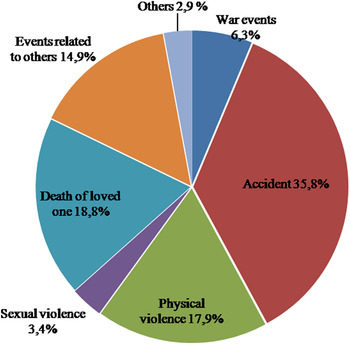
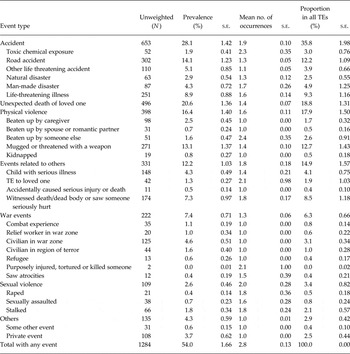
More than half (54%) of the sample reported being exposed to at least one lifetime TE, with a mean of 2.8 TEs among those people exposed to any TE (see Table 1). The TE class with the highest lifetime prevalence in the total sample was having an accident (28.1%), followed by unexpected death of someone close (20.6%) and physical violence (16.4%). Mean occurrence of events among respondents with a particular TE varied significantly across the seven TE classes (χ 6 = 179.0, p < 0.001); sexual violence was the event associated with the highest mean number of occurrences (mean = 2.0, s.e. = 0.28), followed by accident (mean = 1.90, s.e. = 0.10). Mean number of occurrences also varied significantly across the individual trauma events (χ 16 = 84.0, p < 0.001), having been beaten up by someone being the TE with the highest mean number of occurrences (mean = 2.4, s.e. = 0.35). Having an accident contributed the largest proportion of all TEs (35.8%), followed by unexpected death of a loved one (18.8%). Sexual violence (3.4%) and others (2.9%) contributed the smallest proportion of all the TEs reported by participants (Fig. 1).
Traumatic events as percentage of all traumatic events.

Prevalence of lifetime TE exposure in the ESEMeD-Spain study (N = 2121)

s.e., standard error.
Note: Mean number of TE occurrences vary significantly when comparing the seven classes of trauma exposures (χ 6 = 179.0, p < 0.001) as well as when comparing the 28 individual TE types (χ 16 = 84.0, p < 0.001).
Conditional risk of PTSD
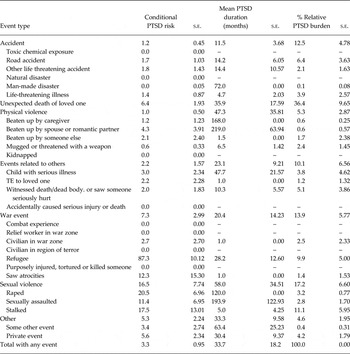
The prevalence of lifetime PTSD was 2.2% (s.e. = 0.4) and the prevalence of 12-month PTSD was 0.6% (s.e. = 0.8). The conditional risk of PTSD was estimated based on the randomly selected TEs (Table 2). The overall conditional risk of PTSD after exposure was 3.3% (s.e. = 0.95). Among the classes of TE, sexual violence was the one with the highest risk of leading to PTSD among those people who experienced it (16.5%, s.e. = 7.74). Physical violence was associated with the lowest risk (1%, s.e. = 0.50). The conditional risk of PTSD varied significantly across the seven classes of events (χ 6 = 4.8, p = 0.001). The conditional risk of PTSD also varied significantly across the individual TEs (χ 27 = 4.6, p < 0.001). Being a refugee was associated with the highest probability of PTSD, with 87.3% (s.e. = 10.12) of people who had suffered this event experiencing PTSD, while 20.5% (s.e. = 6.96) of people who reported being rape experienced PTSD.
Conditional risk of PTSD by traumatic exposure, mean duration and relative PTSD burden associated with trauma exposure in the ESEMeD-Spain study (N = 2121)

s.e., Standard error
Note: Conditional risk of PTSD varies significantly across the seven main types of trauma exposures (χ 6 = 4.8, p = 0.001) and across the 28 TE types (χ 27 = 4.6, p < 0.001). Mean duration of PTSD (in months) does not vary across the seven main types of trauma exposures (χ 6 = 9.7, p = 0.136), whereas it varies significantly across the 28 TE types (χ 12 = 58.5, p < 0.001).
Distribution of types of TE among people with PTSD
The percentages of all PTSD cases due to the TE or class of TE are presented in Table 2. The most important classes of TE as causes of PTSD were the unexpected death of a loved one and sexual violence with 36.4% (s.e. = 9.65) and 17.2% (s.e. = 6.60) of all PTSD attributable to them, respectively. ‘Other events’ was the class of TE which accounted for the smallest proportion of PTSD cases (4.6%, s.e. = 1.95). Despite the low conditional risk of PTSD associated with the death of a loved one (only 6.4% of people reporting it developed a PTSD episode), the high relative burden associated with it reflects the fact that it is a common event (lifetime prevalence of 20.6%). Sexual violence, on the other hand, is an uncommon event (lifetime prevalence of 2.6%) but with a high probability of PTSD (16.5%). Among individual TEs, man-made disaster accounted for the lowest proportion of all PTSD cases (0.1%, s.e. = 0.08) and being stalked accounted for the highest proportion (11.1%, s.e. = 5.95). Despite the low lifetime prevalence of being stalked (1.8%), its high conditional PTSD (17.5%) makes this individual TE the one that contributes most to the total PTSD burden.
Socio-demographic correlates of lifetime exposure to trauma and PTSD
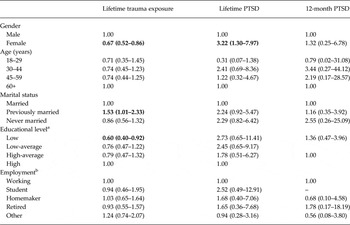
Table 3 shows the associations of socio-demographic variables with lifetime exposure to TE, lifetime PTSD and 12-month PTSD. Multivariate logistic regression models showed that being female (OR = 0.67, 95% CI = 0.52–0.86) and having a low educational level (compared with high) (OR = 0.60, 95% CI = 0.40–0.92) were significantly associated with less risk of lifetime TE exposure, whereas being previously married was significantly related to a higher risk of being exposed to TE (OR = 1.53, 95% CI = 1.01–2.33). The second model corresponds to the association of socio-demographic factors with lifetime PTSD in a subsample of respondents exposed to at least one TE, controlling for differences in type of traumas. Only being female was significantly associated with higher risk of lifetime PTSD (OR = 3.22, 95% CI = 1.30–7.97). Model 3 represents socio-demographic correlates of 12-month PTSD in a subsample of respondents with lifetime exposure to TE and after controlling for differences in types of trauma. No socio-demographic variables appeared as risk factors of 12-month PTSD.
Association of socio-demographic factors with lifetime trauma exposure and PTSD in the ESEMeD-Spain study (N = 2121)

Note: Odds ratio (OR) with the 95% confidence interval; in bold, statistically significant (p < 0.05).
aFor the 12-month PTSD model, ‘low or low-average’ category was compared with ‘high-average or high’ category (reference).
b‘Other’ category included unemployed. For the 12-month model, ‘student’ category was also included in the ‘other’ category.
Discussion
Compared with other countries, the lifetime and 12-month prevalence of PTSD in this sample are lower. In the USA or Australia, the lifetime prevalence ranged from 5 to 10%, while the current prevalence ranged from 1 to 5% in the adult population (Resnick et al. Reference Resnick, Kilpatrick, Dansky, Saunders and Best1993; Kessler et al. Reference Kessler, Sonnega, Bromet, Hughes and Nelson1995, Reference Kessler, Chiu, Demler, Merikangas and Walters2005; Breslau et al. Reference Breslau, Kessler, Chilcoat, Schultz, Davis and Andreski1998). In Spain, we found 2.2% lifetime PTSD prevalence and 0.6% current PTSD prevalence. Results from European studies are closer to those found in our study. In a general German sample of 14–24-year-old participants, lifetime prevalence was 1.3% and 12-month prevalence was 0.7%; similar to that reported in the present study (Perkonigg et al. Reference Perkonigg, Kessler, Storz and Wittchen2000). The overall lifetime prevalence of PTSD was reported to be 2.5% in the ESEMeD survey (Alonso et al. Reference Alonso and Lepine2007) and the 12-month prevalence was 1.1%; Spain being the country with the lowest current PTSD prevalence (Darves-Bornoz et al. Reference Darves-Bornoz, Alonso, de Girolamo, de Graaf, Haro, Kovess-Masfety, Lepine, Nachbaur, Negre-Pages, Vilagut and Gasquet2008). It is unclear why PTSD rates in Spain are lower than in other cultural settings. Methodological variability may be involved (Weathers & Keane, Reference Weathers and Keane2007), such as a wider or narrower definition of TE or the procedure for choosing traumas on which PTSD is assessed. However, the TEs assessed in the ESEMeD-Spain are the same as in other ESEMeD surveys, and span a wide range of TEs. While some authors have suggested that a broader definition of TE can result in an increased prevalence of PTSD (Breslau & Kessler, Reference Breslau and Kessler2001), this does not appear to be the case in our study. Another possible explanation of lower rates of PTSD in the Spanish general population could reflect different rates of TE exposure. However, the rates of TE exposure in Spain and other Western countries are similar. Approximately half of the sample reported having been exposed to at least one TE in their lives. This is similar to a Dutch study where they reported 52% (Bronner et al. Reference Bronner, Peek, Vries, Bronner, Last and Grootenhuis2009) and the NCS study, with 61% of men and 51% of women reporting at least one TE (Kessler et al. Reference Kessler, Sonnega, Bromet, Hughes and Nelson1995). The association between TE and PTSD may depend not only on the type of TE but also on cultural factors. For example, the risk of developing PTSD following exposure to trauma was considerably lower in Australia or Europe than in the USA (Kessler et al. Reference Kessler, Sonnega, Bromet, Hughes and Nelson1995; Creamer et al. Reference Creamer, Burgess and McFarlane2001; Darves-Bornoz et al. Reference Darves-Bornoz, Alonso, de Girolamo, de Graaf, Haro, Kovess-Masfety, Lepine, Nachbaur, Negre-Pages, Vilagut and Gasquet2008). Although numerous methodological difficulties could explain these discrepancies, including differences across studies in the definition of trauma, in the assessment of the TE, and in the inclusion of other predisposing factors (Jeon et al. Reference Jeon, Hong, Lee, Kim, Han and Min2005; Hollifield et al. Reference Hollifield, Warner, Jenkins, Sinclair-Lian, Krakow, Eckert, Karadaghi and Westermeyer2006), some authors argue that the variability in the conditional probability may simply reflect true cultural differences in vulnerability to PTSD (Hinton & Lewis-Fernandez, Reference Hinton and Lewis-Fernandez2011). The subjective response to the TE (e.g., Criteria A2 ‘if the person's response involved intense fear, helplessness or horror’), how respondents appraise trauma symptoms or differences in the endorsement of PTSD symptoms could be causing these differences in prevalence among countries (Hinton & Lewis-Fernandez, Reference Hinton and Lewis-Fernandez2011). Further research is needed to disentangle the roles of risk and protective factors in PTSD from a cross-cultural perspective.
Of all the TEs, having an accident accounted for one-third of all those reported. Road accidents are very common in Spain and constitute the third leading cause of death for individuals less than 25 years of age (Mladovsky et al. Reference Mladovsky, Allin, Masseria, Hernández-Quevedo, McDaid and Mossialos2009). Moreover, road accidents have a great physical and psychological impact on the victims (Brom et al. Reference Brom, Kleber and Hofman1993). Despite accidents being a highly prevalent trauma, the PTSD conditional risk associated with them was found to be quite low (1.2%).
The overall conditional risk of PSTD following the occurrence of a TE was found to be 3.3%. This is low compared with other studies that used the randomly selected trauma method, such as the study conducted in Detroit with people aged 18–45 years old, where the conditional risk of PTSD was 9.3% (Breslau et al. Reference Breslau, Kessler, Chilcoat, Schultz, Davis and Andreski1998). Discrepancies could be due to actual differences in victimization rates between geographical areas (in the Detroit survey, the prevalence of lifetime TE was 89.6%, whereas in Spain it was 54%).
One striking result is the high PTSD conditional risk of ‘being a refugee’ (87%). This is not so surprising if it is taken into account that the ESEMeD-Spain study was based on an adult population including people aged 60+, many of whom may well have experienced refugee status. Those participants from a certain age (i.e., aged 70+), were exposed, to a certain extent, to the civil war which took place from 1936 to 1939 and its consequences. PTSD after the Spanish Civil War is well documented (López-Ibor, Reference López-Ibor1942; Villasante, Reference Villasante2010). Man-made disasters are thought to have more severe clinical impairments compared with natural disasters, and could also produce lack of trust in others and in the community (Amaddeo & Tansella, Reference Amaddeo and Tansella2012; Sederer, Reference Sederer2012). Moreover, other traumas are common during and after a civil war, such as being a refugee, witnessing atrocities or seeing dead bodies. Refugees experience several stressors, including the process of migration, loss of social role, difficulties with acculturation, change of social status, isolation and lack of knowledge about the new culture (Ahmed, Reference Ahmed2007). These stressors might increase vulnerability to PTSD. After being a refugee, being raped and stalked were the specific events most highly associated with PTSD. Research has consistently shown that sexual violence is one of the TEs most likely to lead to PTSD (Creamer et al. Reference Creamer, Burgess and McFarlane2001; Baker et al. Reference Baker, Norris, Diaz, Perilla, Murphy and Hill2005; Bronner et al. Reference Bronner, Peek, Vries, Bronner, Last and Grootenhuis2009).
The unexpected death of someone close contributed to the largest proportion of PTSD cases (36.4%) in the ESEMeD-Spain survey. Similarly, Breslau et al. (Reference Breslau, Kessler, Chilcoat, Schultz, Davis and Andreski1998) also concluded that the unexpected death of a loved one was the single most important cause of PTSD. The second type of TE, accounting for 17% of the total PTSD burden, is sexual violence, a low prevalent event (2.6%) with high conditional PTSD risk (16.5%). Among the specific TEs, being stalked was found to be the event accounting for the highest PTSD burden. However, assaultive violence was identified as the category which accounted for the highest PTSD burden in the Detroit study (Breslau et al. Reference Breslau, Kessler, Chilcoat, Schultz, Davis and Andreski1998). Sexual violence, rape and stalking represent an attack on a person's privacy, and might be accompanied by feelings of shame, blame and stigma (World Health Organization, 2007), leaving the person highly vulnerable to PTSD.
As stated previously (Brewin et al. Reference Brewin, Andrews and Valentine2000; Perkonigg et al. Reference Perkonigg, Kessler, Storz and Wittchen2000; Norris et al. Reference Norris, Murphy, Baker, Perilla, Rodriguez and Rodriguez Jde2003b ; Bronner et al. Reference Bronner, Peek, Vries, Bronner, Last and Grootenhuis2009), men are more likely to report having been exposed to TEs than women, although women are more likely to develop PTSD after exposure to the TE. Some authors have postulated that the gender variance may be due to different rates or types of trauma (Saxe and Wolfe, Reference Saxe, Wolfe, Saigh and Bremner1999; Cusack et al. Reference Cusack, Falsetti, Arellano, Kimerling, Ouimette and Wolfe2003; Pimlott-Kubiak & Cortina, Reference Pimlott-Kubiak and Cortina2003). For instance, sexual trauma is more frequently reported by women (Stein et al. Reference Stein, Walker and Forde2000). In the present study, after controlling for the type of trauma, the association between female and lifetime prevalence of PTSD remained significant. This would indicate that the difference between men and women in terms of PTSD cannot only be explained by exposure to the TE, and would suggest different vulnerability to the effects of traumas (Breslau & Davis, Reference Breslau and Davis1992; Breslau et al. Reference Breslau, Chilcoat, Kessler and Davis1999; Holbrook et al. Reference Holbrook, Hoyt, Stein and Sieber2002).
Contrary to what was expected (Breslau et al. Reference Breslau, Kessler, Chilcoat, Schultz, Davis and Andreski1998; Hatch & Dohrenwend, Reference Hatch and Dohrenwend2007), participants with a low educational level, compared with the high level, showed significantly less risk of being exposed to any TE during their lives. Low social status is thought to be more associated with some types of traumas, such as physical violence (Breslau et al. Reference Breslau, Kessler, Chilcoat, Schultz, Davis and Andreski1998). Why these contradictory results are found is unclear, although one could speculate that people with a low educational level might underreport TE due to resistance to reporting certain embarrassing events; mostly those related to family or privacy issues. In common with other studies (Kessler et al. Reference Kessler, Sonnega, Bromet, Hughes and Nelson1995; Creamer et al. Reference Creamer, Burgess and McFarlane2001), being previously married was found to be associated with higher risk of TE exposure. Although the reason is unknown, it is possible that people who are divorced or widowed might have been exposed more frequently to traumas such as intimate partner violence or the unexpected death of someone close.
Some limitations need to be taken into account when analysing these results. First, reports of both lifetime prevalence of PTSD symptoms and TEs are based on retrospective recall. Accuracy of recall of past events might be compromised, particularly the recall of TEs (Rothschild, Reference Rothschild2000). However, it has been suggested that memories of personally significant TEs could be more consistent and vivid than other positive events (Porter & Peace, Reference Porter and Peace2007). Second, TE exposure was self-reported and could lead to an underestimation of the frequency of trauma. Trauma could be repressed or simply forgotten, and the victims of trauma may feel ashamed and not prepared to disclose them (Hepp et al. Reference Hepp, Gamma, Milos, Eich, Ajdacic-Gross, Rössler, Angst and Schnyder2006). Third, it is also important to note that people interviewed at home may not answer in a completely reliable way when faced with very sensitive questions. With this regard the context of the interview can be of great importance. Some respondents may find it difficult to answer questions about TEs in front of an unknown interviewer. Even in the context of a therapy, a therapeutic alliance should be established before the patient discloses traumas, especially those related to interpersonal victimization and childhood sexual abuse (Hepp et al. Reference Hepp, Gamma, Milos, Eich, Ajdacic-Gross, Rössler, Angst and Schnyder2006). The presence of the spouse in the room during the interview may also contribute to underreporting of some TEs, such as marital violence. In our study, 44% of interviews were conducted in the presence of someone else (49.2% were the spouse, 22.7% were the parents, 11.5% children and 16.6% other adults). However, this effect could be attenuated, provided that there were no apparent secondary gains if good interviewing techniques and high-quality questionnaires were employed (Hardt & Rutter, Reference Hardt and Rutter2004). Fourth, PTSD diagnosis is based on fully computerized interviews conducted by trained lay interviewers, which might show some variance compared with diagnoses made by clinicians (Haro et al. Reference Haro, Arbabzadeh-Bouchez, Brugha, de Girolamo, Guyer, Jin, Lepine, Mazzi, Reneses, Vilagut, Sampson and Kessler2006). Finally, long-term institutionalized people or those who do not speak a local language fluently were not included in the sample. It is possible that the rates of PTSD are different in these groups.
Despite these limitations, this study has demonstrated the importance of certain TEs in Spain, and their contribution to the PTSD burden, using a methodology which partly overcomes the limitation of using only the worst event method. In this sense, even though accidents are very common among the TEs reported, it is the death of a loved one and sexual violence, which are the TEs contributing most to the national PTSD burden. Prevention programmes should be designed to reduce the incidence of PTSD among persons exposed to these TEs. However, targeting all trauma-exposed individuals may be particularly costly (Feldner et al. Reference Feldner, Monson and Friedman2007). For an infrequent trauma with a high conditional risk of PTSD, such as sexual violence, the strategy could be to deliver interventions to people exposed to that TE, regardless of symptoms of PTSD. When a trauma is common but only a relatively small percentage develops PTSD, as with the unexpected death of someone close, then interventions targeted at those people exposed to the trauma with higher risk of developing PTSD could be useful. Future research should take into account the effectiveness of these preventive programmes. There is also a need for continued research on risk and protective factors contributing to the vulnerability to PTSD from a cultural perspective.
Acknowledgements
The ESEMeD is carried out in conjunction with the World Health Organization World Mental Health (WMH) Survey Initiative which is supported by the National Institute of Mental Health (NIMH; R01 MH070884 and R01 MH093612-01), the John D. and Catherine T. MacArthur Foundation, the Pfizer Foundation, the US Public Health Service (R13-MH066849, R01-MH069864, and R01 DA016558), the Fogarty International Center (FIRCA R03-TW006481), the Pan American Health Organization, Eli Lilly and Company, Ortho-McNeil Pharmaceutical, GlaxoSmithKline, and Bristol-Myers Squibb. We thank the staff of the WMH Data Collection and Data Analysis Coordination Centres for assistance with instrumentation, fieldwork and consultation on data analysis. None of the funders had any role in the design, analysis, interpretation of results or preparation of this paper. A complete list of all within-country and cross-national WMH publications can be found at http://www.hcp.med.harvard.edu/wmh/.
Financial Support
The ESEMeD project is funded by the European Commission (Contracts QLG5-1999-01042; SANCO 2004123 and EAHC 20081308), the Piedmont Region (Italy), Fondo de Investigación Sanitaria, Instituto de Salud Carlos III, Spain (FIS 00/0028), Ministerio de Ciencia y Tecnología, Spain (SAF 2000-158-CE), Departament de Salut, Generalitat de Catalunya, Spain, Instituto de Salud Carlos III (CIBER CB06/02/0046, RETICS RD06/0011 REM-TAP), and other local agencies and by an unrestricted educational grant from GlaxoSmithKline. B.O. is grateful to the Sara Borrell postdoctoral programme (reference no. CD12/00429) supported by the Instituto de Salud Carlos III, Spain.
Conflict of Interest
Dr. Kessler has been a consultant for AstraZeneca, Analysis Group, Bristol-Myers Squibb, Cerner-Galt Associates, Eli Lilly & Company, GlaxoSmithKline Inc., HealthCore Inc., Health Dialog, Hoffman-LaRoche, Inc., Integrated Benefits Institute, John Snow Inc., Kaiser Permanente, Matria Inc., Mensante, Merck & Co, Inc., Ortho-McNeil Janssen Scientific Affairs, Pfizer Inc., Primary Care Network, Research Triangle Institute, Sanofi-Aventis Groupe, Shire US Inc., SRA International, Inc., Takeda Global Research & Development, Transcept Pharmaceuticals Inc., and Wyeth-Ayerst. Dr. Kessler has served on advisory boards for Appliance Computing II, Eli Lilly & Company, Mindsite, Ortho-McNeil Janssen Scientific Affairs, Johnson & Johnson, Plus One Health Management and Wyeth-Ayerst. Dr. Kessler has had research support for his epidemiological studies from Analysis Group Inc., Bristol-Myers Squibb, Eli Lilly & Company, EPI-Q, GlaxoSmithKline, Johnson & Johnson Pharmaceuticals, Ortho-McNeil Janssen Scientific Affairs., Pfizer Inc., Sanofi-Aventis Groupe, Shire US, Inc., and Walgreens Co. Dr. Kessler owns 25% share in DataStat, Inc. The rest of authors declare no conflict of interests.
Ethical Standard
The authors assert that all procedures contributing to this work comply with the ethical standards of the relevant national and institutional committees on human experimentation and with the Helsinki Declaration of 1975, as revised in 2008.