Introduction
Mobility, social networks and activity are all key aspects of ageing well. They are included, to varying degrees, in both the ‘successful ageing’ paradigm, which has identified the conditions of optimal ageing (Rowe and Kahn Reference Rowe and Kahn1987), and the ‘active ageing’ perspective, which calls for the implementation of policies that promote quality of life in older age (World Health Organization 2002). Empirical research has examined the extent to which each of these factors – mobility, social networks and activity – are related to such outcomes as wellbeing and life satisfaction. There is much less investigation into the inter-relationship between these very factors themselves, and almost no research on how the first two of the noted factors, namely mobility and social networks, are inter-related in their association with activity.
The current study examines the interaction between mobility and social networks in relation to activity in later life. The inquiry makes use of a major longitudinal database of older European adults to examine the association of physical functioning, social networks and the inter-relationship between the two, with the degree of activity at an initial point in time and its level two years later, controlling for a host of potential confounders. As such, it seeks to shed light on the role of social networks in relation to social activity participation among older people who have different levels of physical functioning. The inquiry is designed to answer the question as to whether social networks are, indeed, related to social activity participation in late life, whether they enhance (or restrain) the extent of activity and whether they do so differentially for older persons who are impaired and those who are not.
Literature review
The paradigm of successful ageing posits the presence of three overlapping life domains – avoidance of disease and disability, maintenance of high physical and cognitive functioning, and engagement with life – as requisites for optimal ageing (Rowe and Kahn Reference Rowe and Kahn1997). The last of these domains – engagement with life – reflects two related spheres, namely embeddedness in social networks and engagement in meaningful and productive activity. Each of the three domains is said to contribute individually to ageing well, while their cumulative effect is understood to enhance the propensity of enjoying a good old age.
Looking at the third domain specifically, research underscores the association between engagement in life and a range of outcomes that are indicative of successful ageing. Thus, for example, Netuveli et al. (Reference Netuveli, Wiggins, Hildon, Montgomery and Blane2006) found support in the data from the English Longitudinal Study of Ageing for the assertion that trusting relations with family and friends, as well as frequency of friend contacts, improved quality of life. Fratiglioni, Paillard-Borg and Winblad (Reference Fratiglioni, Paillard-Borg and Winblad2004) found that having an ‘active and socially integrated lifestyle’ protected against dementia in Stockholm. Data from the MacArthur Studies of Successful Aging revealed that emotional support from the social network contributed to better physical performance among older Americans (Seeman et al. Reference Seeman, Berkman, Charpentier, Blazer, Albert and Tinetti1995). Moreover, a recent systematic review of the literature underscores that ‘being part of a strong and supportive social network was positively associated with health and longevity among older adults’ (Annear et al. Reference Annear, Keeling, Wilkinson, Cushman, Gidlow and Hopkins2014: 601).
Engagement in productive activity is also seen to contribute to successful ageing. We note a few examples from the literature. Menec (Reference Menec2003) found in a longitudinal analysis of a Canadian sample of older adults that greater overall activity was associated with happiness and function, as well as with lower mortality. Looking at several activity domains in Sweden, Silverstein and Parker (Reference Silverstein and Parker2002) found that increasing activity across the domains was what accounted for a perceived improvement in life conditions, among other variables. Glei et al. (Reference Glei, Landau, Goldman, Chuang, Rodriguez and Weinstein2005) found that engagement in social activities outside the family over time was related to better cognitive function among elderly Taiwanese people. Finally, analysis of data from the Survey of Health, Ageing and Retirement in Europe (SHARE) discovered that cognitively stimulating leisure activity was associated with better cognitive function at follow-up, two years later (Litwin, Schwartz and Damri Reference Litwin, Schwartz and Damri2016).
However, the inter-relationship between the respective components of the third domain of the successful ageing paradigm – social networks and activity participation – has been examined to a lesser degree. One cross-sectional study using SHARE data revealed that activity diversity was somewhat more associated with wellbeing than was the score on a comprehensive measure of social network, although both were significant (Litwin and Stoeckel Reference Litwin and Stoeckel2014). That same study also found that the effect of activity on wellbeing decreased as social connectedness increased, suggesting that social networks are a significant resource for successful ageing in their own right.
It should be stressed, moreover, that the successful ageing paradigm sees all the domains in the model as interrelated. Therefore, one cannot examine the respective associations of social network and activity with successful ageing without taking into account the functional capacity of the individual in question, or vice versa. It has been found, for instance, that the nature of the association between social network and wellbeing varies among people as a function of illness or disability (e.g. Litwin, Stoeckel and Schwartz Reference Litwin, Stoeckel and Schwartz2015). In addition, frequency of contact with the social network is positively associated with various wellbeing outcome measures among well older adults, but not necessarily associated (or even negatively associated) among older adults with disability (Litwin and Stoeckel Reference Litwin and Stoeckel2013a, Reference Litwin and Stoeckel2013b). Correspondingly, a study in California underscored that those ageing successfully had not only higher community involvement but also better physical activity and mental health (Strawbridge et al. Reference Strawbridge, Cohen, Shema and Kaplan1996). Huxhold, Fiori and Windsor (Reference Huxhold, Fiori and Windsor2013) found, in a sample of older Germans, that levels of social engagement and emotional support equally predicted changes in functional health and life satisfaction. Rosso et al. (Reference Rosso, Taylor, Tabb and Michael2013) revealed in a cross-sectional analysis of older adults in Philadelphia that low mobility was associated with less engagement in general, even in the absence of disability.
A recent series of analyses documents the associations between health status and social engagement among older Europeans. For example, drawing on SHARE data, Principi et al. (Reference Principi, Galenkamp, Papa, Socci, Suanet, Schmidt, Schulmann, Golinowska, Sowa, Moreira and Deeg2016) found that variables associated with volunteer participation partially differed between respondents, depending on their health status. An analysis of formal learning activities using the same database revealed that the average participation of those with multi-morbidity was nearly 50 percent lower than those with good health (Golinowska et al. Reference Golinowska, Sowa, Deeg, Socci, Principi, Rodrigues, Ilinca and Galenkamp2016). In contrast, another analysis found that religious activity occurred more frequently among older people with multi-morbidity (Sowa et al. Reference Sowa, Golinowska, Deeg, Principi, Casanova, Schulman, Stephania, Rodrigues, Moreira and Gelenkamp2016). The explanation was that such activity might be driven by the need for comfort and compensation at a time of distress. A different study that used data from the European Project on Osteoarthritis revealed that fewer older people with multi-morbidity participated in social leisure activities than older persons without multi-morbidity, and their frequency of participation was also lower (Galenkamp et al. Reference Galenkamp, Gagliardi, Principi, Golinowska, Moreira, Schmidt, Winkelmann, Sowa, van der Pas and Deeg2016). While the above-mentioned studies offer important insights, it should be noted, nevertheless, that they all were cross-sectional.
Interestingly, although activity, in general, and leisure activity, in particular, is a potential predictor of successful ageing, examination of activity as an outcome in empirical research is not abundant, and longitudinal study of activity participation is rare. This may be due to the lack of agreement that exists regarding the measurement of the activity variable (Fallahpour et al. Reference Fallahpour, Borell, Luborsky and Nygard2016). In an early study, Zimmer, Hickey and Searle (Reference Zimmer, Hickey and Searle1997) found that older Americans with arthritis were more likely to experience changes to their activity regimen than were those without arthritis. Sabbath et al. (Reference Sabbath, Lubben, Goldberg, Zins and Berkman2015) found, more recently, that time in retirement increased organisational involvement but decreased volunteering. Serrat, Villar and Celdran (Reference Serrat, Villar and Celdran2015) found, in contrast, that engagement in leisure activities, learning activities and volunteering were associated with membership in political organisations. Paillard-Borg et al. (Reference Paillard-Borg, Wang, Winblad and Fratiglioni2009) revealed that decreased activity engagement among elderly residents of Stockholm correlated with physical limitation, as well as with older age, female gender, low education, limited social network and poor mental health. Finally, Anaby et al. (Reference Anaby, Miller, Eng, Jarus and Noreau2009) concluded that three factors – mobility, balance confidence and gender – were the primary predictors of activity participation among older Canadians with chronic conditions.
It is worth pointing out that the systematic literature review cited earlier in the article maintains that relatively few studies have considered the association between social environment and active ageing. The authors of that review also contend that there is little research that addresses the interaction between specific aspects of the environment and activity participation by older adults. They note that few studies ‘have examined all of the component behaviors of the active ageing concept’ (Annear et al. Reference Annear, Keeling, Wilkinson, Cushman, Gidlow and Hopkins2014: 603–4).
Given this gap in the literature, there is no single theory that can guide the formulation of specific hypotheses about the association of mobility limitation and social networks in relation to late-life activity. Consequently, we consider a number of research questions in the present analysis. First, are mobility and social network both related to activity participation after controlling for other relevant confounders? Second, do these associations hold over time? Third, is social network related to activity participation independently of mobility level, or alternatively, does mobility level moderate the relationship between network and activity?
Data and methods
The current study is based on two waves of data from SHARE, a panel of persons aged 50 and older that began in 2004 with respondents from 11 countries and, in 2013, numbered some 20 countries. The survey collects data in a wide range of areas, including health, social relations and economics, thus allowing multi-disciplinary analysis of the process of ageing (Börsch-Supan et al. Reference Börsch-Supan, Brandt, Hunkler, Kneip, Korbmacher, Malter, Schaan, Stuck and Zuber2013). The fourth wave of the survey, which took place in 2011, served as the baseline in the present inquiry. The fifth wave, executed in 2013, provided the follow-up data. Respondents from 13 countries participated in both of these waves (Austria, Belgium, Czech Republic, Denmark, Estonia, France, Germany, Italy, The Netherlands, Slovenia, Spain, Sweden and Switzerland), and they constitute the analytic sample in the present inquiry.
The samples drawn in each country in the SHARE project are based upon probability sampling. Methods vary from the use of population registers to random selection of statistical areas and canvassing of residences in the chosen areas. Each country's sampling plan is approved in advance by the central SHARE team at the Munich Institute for the Economics of Ageing.
The SHARE database was deemed appropriate for the current analysis for a number of reasons. First, it is the largest gerontological panel database currently in Europe. It, thus, provides sufficient numbers of respondents to investigate multiple associations among a wide range of relevant variables. Second, as a multidisciplinary effort, it has a wide breadth of variables that can be employed in the analysis. This allows controlling for confounders from several areas. Third, SHARE implemented a unique module for the measurement of social network in its fourth wave (Litwin and Stoeckel Reference Litwin and Stoeckel2014). The inventory employed a name generator for the identification of significant confidants in the lives of the respondents in the previous 12 months, and gathered specific information regarding each of these social ties, including frequency of contact, emotional closeness, and so on.
The analytical sample in the present study was limited to respondents aged 60 and above in order to focus on the age group when most older Europeans have retired from paid employment. This age criterion was selected in order to sensitise the findings to the relationship between the main variables in this inquiry, namely voluntary (i.e. non-paid) activity, social network and mobility limitations. We excluded respondents for whom a proxy answered questions on social network ties, which were not intended for a proxy response (N = 456). Also excluded were respondents who were missing data on any of the key study variables (N = 2,750). The final analytic sample thus numbered 23,985 respondents aged 60 and older who participated in both of the waves and answered all the relevant questions. The data were gathered by means of computer-assisted personal interviews that were uniformly conducted in the homes of the respondents. The questionnaires are available on the SHARE project website (http://www.share-project.org/).
The excluded respondents (N = 3,206) were compared to those in the final analytical sample. The latter were younger and included a greater proportion of females and persons who were married and employed, respectively. Those in the analytical sample also were more highly educated, had more income, fewer mobility limitations, better memory, more resourceful social networks and greater wellbeing. In addition, they reported a larger extent of activity participation both at baseline and at follow-up. Specific results of the comparison are available upon request.
Study variables
The dependent variable of interest – activity participation – was based on the activities the respondent was asked about taking part in over the previous 12 months. These involvements included social, physical and intellectual undertakings which are highlighted in the late-life activity literature, as reviewed in the previous section. We examined specifically: (a) voluntary work, (b) educational courses, (c) sports or social clubs, (d) activities of religious organisations, (e) political or community organisations, (f) reading, (g) word or number games, and (h) sedentary games involving others. Preliminary analyses revealed that the distribution of responses did not aggregate into meaningful groupings by activity type. This is likely due to the fact that activities of different kinds provide a range of overlapping benefits, such as social contact, cognitive stimulation, engagement, and so on. Accordingly, we employed a count across all the activity types.
The SHARE questionnaire asks about the frequency of involvement in each activity indicated. In order to focus on significant activity involvement as opposed, for example, to passive membership of an organisation, we focused on those activities that were engaged in ‘almost every week’ or more frequently. Activities that were undertaken ‘less often’ (or not at all), were given a score of 0. The resultant activity count variable ranged from 0 to 8, with higher scores representing a greater breadth of activities in which the respondent was engaged.
The independent variables included mobility limitations and a measure of social network. Mobility limitations relate to functional status and indicate the difficulties that the respondent reported having experienced in each of ten functions such as walking 100 metres, climbing one flight of stairs without resting and lifting or carrying weights over ten pounds/five kilograms. The ten functions addressed in the SHARE questionnaire reflect those most commonly addressed in the research literature in this realm. The current analysis employed a cumulative count of mobility limitations. This continuous measure ranged from 0 to 10, with each additional point reflecting an additional limitation.
The measure of social network used a newly constructed summary scale which is based on the data that were collected in the SHARE social network module that was mentioned earlier. The development of this scale is described in detail elsewhere (Litwin and Stoeckel Reference Litwin and Stoeckel2014). For its understanding in the current analysis, suffice it to say that the scale combines the five main characteristics of social network within a single index: size, geographic proximity, contact frequency, emotional closeness and type of relationship. The scale score was higher for respondents with a larger network, more people in the network living within 25 kilometres, more people in the network contacted weekly or more often, more people in the network cited as very or extremely close emotionally (support), and more diverse networks, i.e. a greater range of relationship types. The original scale produced values ranging from 0 to 20, which were subsequently calibrated to five levels (0–4). Respondents who did not name any social network members were given a score of 0, by default.
In the final part of the analysis, we added an interaction term to capture the interrelations of the independent variables – mobility limitations and social network – in relation to activity participation. The interaction term was created by multiplying the (continuous) mobility limitations variable and the (ordinal) social network scale. A positive effect of the interaction term would indicate that for each mobility limitation, greater social network resources are associated with more activity participation. Conversely, a negative effect would mean that for each mobility limitation, having more social network resources is associated with less activity participation.
Several control variables were taken into account as well. Socio-demographic background variables included age, gender, marital status, education, work status, income and country of residence. Age was grouped into three categories: 60–69, 70–79 and 80, and older. For gender, a dichotomous variable was used (females = 1; males = 0). Relationship status was also indicated by a dichotomous variable (married or partnered = 1; never married, divorced or widowed = 0). Work status reflected being employed or self-employed (1), in comparison to those retired, unemployed, permanently sick or disabled, and home-makers (0). Education was measured according to the highest level of education attained using the standardised coding of the International Standard Classification of Education (ISCED-97). The responses were grouped into three categories: primary education (or less), secondary and post-secondary. Income was measured according to quintiles. The respective quintile cut-off points were calculated for each country separately, based on declared income of the sample, and then combined into dummy variables indicating five overall quintile categories. Country of residence was entered as a series of dummy variables.
Health variables were also controlled and they included measurements of cognitive function and wellbeing. Cognitive function was based on the combined scores of two memory tests – immediate and delayed word recall – based on a list of ten words, which the respondent was asked to recall immediately and again after a few minutes (score = 0–20). Wellbeing was measured using the CASP-12 scale which captures control, autonomy, self-realisation and pleasure (Hyde et al. Reference Hyde, Wiggins, Higgs and Blane2003). The CASP scale items were rated from 0 to 4 and were summed to create an overall score (12–48).
Statistical analysis
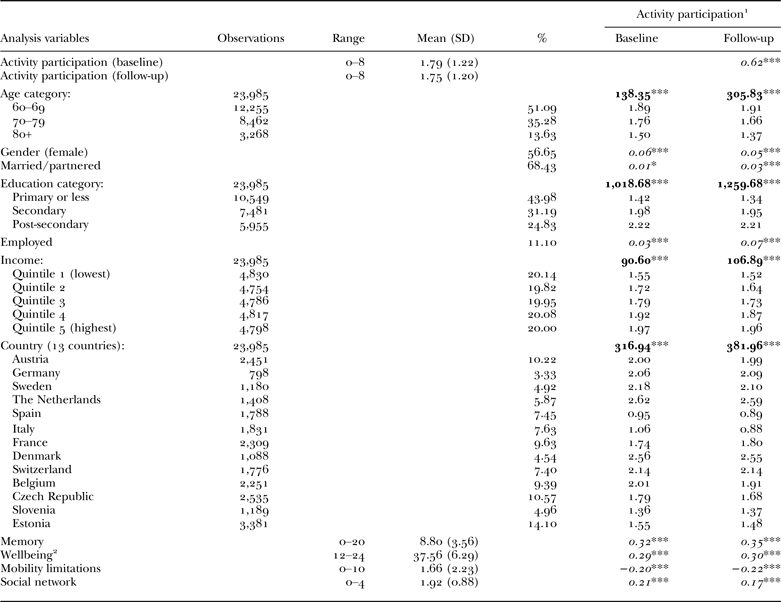
The first part of the analysis presents the univariate descriptions of the study variables. This is followed by bivariate analysis of the associations between the independent and control variables, on the one hand, and the dependent variables (activity participation in each wave), on the other. Table 1 shows the bivariate associations in terms of Pearson correlations for the dummy and continuous variables. The associations of the categorical variables (age group, education, income and country) were considered by one-way analysis of variance (F scores). The table also presents the mean of the outcome variable in each category.
Activity participation, mobility limitations, social network and control variables: descriptive statistics and bivariate analysis of Europeans, aged 60 and older

Notes: N = 23,985. 1. Values in italics are R, values in bold are F scores (analysis of variance) and the regular values are means. 2. Wellbeing was measured using the CASP-12 scale which captures control, autonomy, self-realisation and pleasure. SD: standard deviation.
Significance levels: * p < 0.05, *** p < 0.001.
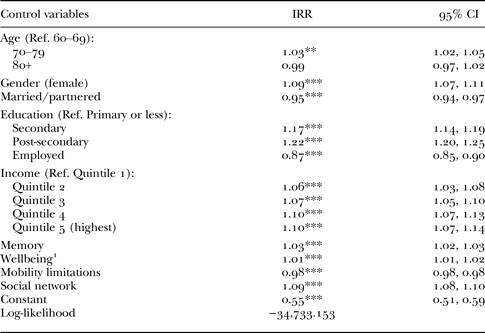
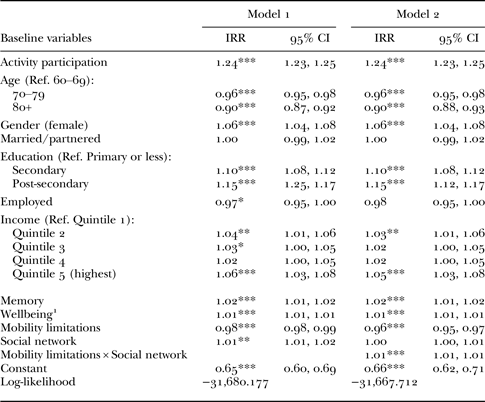
The first multivariate analysis regressed the baseline activity participation score (Wave 4) on the study variables. We then regressed Wave 5 activity scores on the respective study variables, controlling for Wave 4 activity as well. In the second step of the second regression, we also entered the interaction between mobility limitations and social network. All the multivariate analyses utilised generalised Poisson regression since the dependent variable is a count variable and is under-dispersed (that is, the mean of activities in Wave 5 was 1.75, and the variance was 1.20). Tables 2 and 3 show the generalised Poisson regression statistics in terms of Incidence Rate Ratios (IRR).
Activity participation, mobility limitations and social network: cross-sectional baseline analysis (Wave 4), Poisson regression

Notes: N = 23,985. IRR: Incidence Rate Ratios. CI: confidence interval. Ref.: reference category. The analysis is adjusted for country, results available upon request. 1. Wellbeing was measured using the CASP-12 scale which captures control, autonomy, self-realisation and pleasure.
Significance levels: ** p < 0.01, *** p < 0.001.
Activity participation, mobility limitations and social network: longitudinal analysis, Poisson regression

Notes: N = 23,985. IRR: Incidence Rate Ratios. CI: confidence interval. Ref.: reference category. The analysis is adjusted for country, results available upon request. 1. Wellbeing was measured using the CASP-12 scale which captures control, autonomy, self-realisation and pleasure.
Significance levels: * p < 0.05, ** p < 0.01, *** p < 0.001.
Results
The univariate descriptive statistics are presented in Table 1. As can be seen, more than half the sample was 60–69 years old at baseline, while the 70–79-year-old group comprised about a third and some 14 per cent were 80 years old and above. The mean age in the sample was 70.3 (standard deviation = 7.4). The sample had a majority of women (56.6%) and an even greater majority of married or partnered respondents (68.4%). Some 44 per cent of respondents had a primary-level education or less, about a third had secondary-level schooling and a quarter reported post-secondary education. Only about 11 per cent were employed at the time of the survey, including self-employed.
As for the mental health of the respondents, the mean number of words recalled in the memory measurement was 8.8 (range = 0–20). The mean score on the CASP index was 37.6 (range = 12–48). Regarding mobility limitations, the mean number of limitations was 1.7 (range = 0–10). The social network scale had a mean score of about 1.9 (range = 0–4). The dependent variable, activity participation, had a mean of almost 1.8 at baseline (Wave 4) and 1.7 at follow-up (Wave 5, range = 0–8).
The bivariate analysis is also presented in Table 1. All the control variables correlated with activity participation at baseline and at follow-up. Age was negatively associated. Women were more active, as were employed and to a lesser degree married or partnered respondents. Education was positively related to activity at baseline and at follow-up, as was income. Country of residence was also related. As may be seen, activity was lower in Southern and Eastern European countries. As for the health variables, memory and wellbeing were both positively related to activity at baseline and at follow-up. Turning to the independent variables, mobility limitations were negatively correlated with activity and social network was positively correlated. Finally, baseline activity level was highly correlated with activity at follow-up. Additional multiple-comparison tests using Bonferroni for age and education groups and for income quintiles showed similar results (not shown).
The multivariate results are presented, as noted earlier, in terms of IRR. These ratios display the probability of an increase or decrease in the dependent variable, in a way that is similar to odds ratios in logistic models. For example, the IRR of 0.98 for mobility limitations in the cross-sectional baseline analysis predicts a slightly lower likelihood for engaging in activity participation at baseline, and the IRR of 1.09 for social network predicts a 9 per cent increase in activity participation at baseline.
The first multivariate analysis (Table 2), which regressed the baseline activity score on the study variables, upheld the bivariate findings for the independent variables. That is, mobility limitations were negatively related to activity at baseline, and social network was positively related. The analysis also confirmed the correlations with almost all of the control variables. However, when the effects of health were controlled, the oldest age category lost its negative bivariate association.
The longitudinal analysis, which regressed activity at follow-up on the study variables, is displayed in Table 3. Model 1 showed that activity participation at baseline had the strongest association with the activity participation outcome at follow-up (IRR = 1.24). The independent variables – mobility limitations and social network – were also significant, although the strength of the associations diminished. In addition, several control variables (age, gender, education and employment) kept their prior associations, but others (marital status and income) lost their effect. The indicators of memory and wellbeing were also related to the activity outcome at follow-up, but to a lesser degree than they were previously.
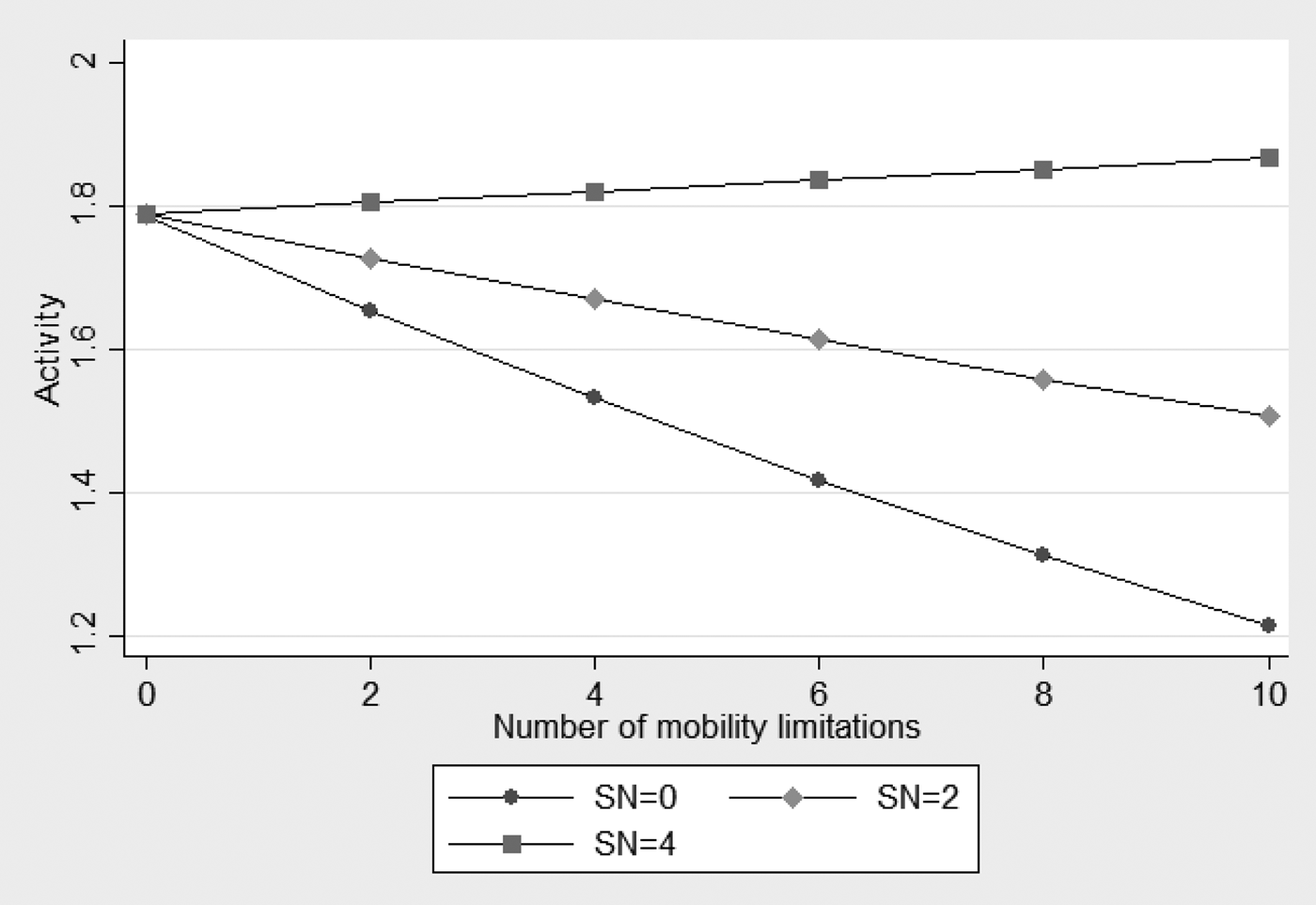
These same associations were evident, mostly, when the mobility limitation/social network interaction term was entered into the analysis (Model 2). Moreover, the interaction term was positive (IRR = 1.01), indicating that with each additional mobility limitation, greater social network resources were associated with more activity participation. Looking at the main effect underscores the negative effect of having mobility limitations at baseline on activity at follow-up (among those with no social network). The association of this main effect doubled in intensity (IRR = 0.96). The main effect of social network, on the other hand, was not significant (IRR = 1.00), suggesting that social network resources were not related to the extent of activity at follow-up among those with no mobility limitations at baseline.
Figure 1 presents a graph of the interactions. As may be seen, the extent of social network connectedness mitigates the decrease in activities at follow-up that is associated with mobility limitations. Among those with multiple mobility limitations, moreover, the interaction with the social network scale is much more apparent. It shows that activity increased as social network connectedness increased.
The interaction of mobility limitation and social network in relation to activity.

Discussion
The aim of this inquiry was to clarify the role of social networks in relation to late-life activity, taking into account mobility limitations. The study was based upon data from two waves of the SHARE project. As will be elaborated upon shortly, the initial analyses underscored previous findings that have appeared in the literature, namely that social networks enhance activity while mobility limitations restrain activity (Paillard-Borg et al. Reference Paillard-Borg, Wang, Winblad and Fratiglioni2009). However, examination of the interaction between social network and mobility showed a unique, and perhaps unexpected, association with activity at follow-up.
In the cross-sectional part of the study, social network resources at baseline were found to be positively and independently related to activity level measured at the same point in time, reinforcing the general assumption that social capital is an important resource in older age (Forsman and Nyqvist Reference Forsman and Nyqvist2015). Stated differently, the cross-sectional findings suggest that social ties might increase social activity (although it might equally be inferred that social activity augments social ties). The cross-sectional analysis also pointed to the negative association of mobility limitations with activity level, again at baseline, meaning that persons who were more functionally challenged were also less active (Galenkamp et al. Reference Galenkamp, Gagliardi, Principi, Golinowska, Moreira, Schmidt, Winkelmann, Sowa, van der Pas and Deeg2016; Golinowska et al. Reference Golinowska, Sowa, Deeg, Socci, Principi, Rodrigues, Ilinca and Galenkamp2016). This can be stated with some degree of confidence, insofar as it is less likely that the extent of activity was what led to the mobility limitation.
As recalled, the inquiry also considered the factors associated with activity level at follow-up, two years later. In essence, this part of the analysis examined short-term activity change because the procedure looked at extent of activity at follow-up after controlling for the effect of baseline activity-level scores. The study thus sheds light on the factors associated with change in activity over a short period. Activity change (and particularly activity decline) is an important topic in gerontology insofar as short-term changes in activity in late life may presage more serious subsequent declines in other areas and because such changes, if indicative of decline, may have negative implications for quality of life.
The initial analysis of activity at follow-up (Model 1) provided further support to the cross-sectional analysis. Mobility limitations were negatively associated with activity at follow-up, all else considered, and social network was positively related, albeit rather weakly. The entry of the interaction term in Model 2 changed the picture substantially, however. The full analysis showed that the interaction was significant. It also clarified that social network had a positive effect on activity primarily among those with mobility limitations. The effect of social network among those with no mobility limitations, on the other hand, was negligible. Stated differently, the study found that among those respondents who were limited in mobility, with more than half of the sample reporting at least one mobility limitation, having had greater social network resources at baseline made a difference in the level of activity some two years later. It can be tentatively claimed, therefore, that social network resources did indeed contribute to increased activity, but mainly among those who were functionally challenged.
The fact that social networks were not facilitative of activity in this study among those with no mobility restrictions reinforces previous findings which hint that these two domains are not necessarily related or cumulative. That is, greater social networks do not always correlate with greater activity and greater activity does not always correlate with greater social networks. This is because the one domain may function as an alternative to the other, rather than as a complement. This notion corresponds with previous findings that activity participation's positive association with wellbeing is negatively correlated with the degree of social network, such that the former contributes more to wellbeing when the latter is lower (Litwin and Stoeckel Reference Litwin and Stoeckel2014).
Specifically, older people with sufficient and satisfying social ties may not need additional activity in order to feel content. Conversely, older persons who engage in much activity may not sense the lack of other interpersonal contacts (or they might be engaging in activity to compensate for the very lack of ties in their lives). This might explain why the successful ageing paradigm placed these two realms within the same domain (Rowe and Kahn Reference Rowe and Kahn1997). Either one can be seen to further wellbeing and ageing well, while the simultaneous presence of both is not required.
We should note a few limitations of the present analysis. First, it might be the case that older persons with mobility limitations are more unstable in their social activities compared to those without mobility limitations, and this is what the activity change measure might be reflecting (Jivraj, Nazroo and Barnes Reference Jivraj, Nazroo and Barnes2016). Further analysis in this realm is, therefore, warranted. Second is the question of possible endogeneity between the two variables: social network and social activity. We wish to clarify, in this regard, that the social network score in this analysis is derived from a name-generating mechanism that elicits the names of confidants and then asks specific additional information about each of them. The activity score, in turn, measures the breadth of activities engaged in relatively frequently. Given the different foci of the two variables, the concern for endogeneity is minimised. Moreover, study limitations notwithstanding, we believe that the strengths of the database outweigh the possible concerns.
In sum, the findings from this analysis show that social networks seem to affect activity levels among those who are limited in terms of mobility. The effect, moreover, is positive; the greater one's network resources, the greater the extent of activity and activity change. This finding has both positive and negative implications.
On the positive side, it can be asserted that social networks are important, after all, because they enhance activity among vulnerable older adults. This means that resourceful social networks may help impaired older persons to increase levels of engagement despite their physical decline. The importance of the social network in overcoming physical decline which is related to age has been noted by Seeman et al. (Reference Seeman, Berkman, Charpentier, Blazer, Albert and Tinetti1995), who observed this association among high-functioning older adults, and by Strawbridge et al. (Reference Strawbridge, Cohen, Shema and Kaplan1996) and by Huxhold, Fiori and Windsor (Reference Huxhold, Fiori and Windsor2013) who observed this association among a diverse group. That research hints at and illuminates the mechanism that may be at work in the present analysis, as well, albeit in a group of older adults who were challenged by mobility limitations. The current analysis suggests that the positive interaction of social network and mobility limitations enhances activity participation, principally among older adults who are in greater need.
The negative implication of this same finding is that those without a resourceful social network and who suffer from mobility limitation are at double jeopardy. Not only must they deal with the challenges of disability, they must contend with lesser activity as well. This accentuates their risk of beginning a downward spiral that may propel them towards yet greater decline.
It is in this context that the active ageing perspective becomes particularly relevant (Foster and Walker Reference Foster and Walker2013, Reference Foster and Walker2015). If it is the aim of societies to promote active ageing among their eldest members, as a matter of public policy, it must be recognised that a key trigger for engagement in activity among those facing mobility limitations is their informal social network. Proponents of active ageing as a policy goal need to pay attention, therefore, to the growing proportion of older adults who are subject to mobility limitations, on the one hand, and who lack a sufficient social network to help them compensate for their physical decline, on the other hand. That is, the promotion of active ageing cannot be left entirely to the families, friends and neighbours of persons who are challenged mobility wise, because there are many older adults who lack the necessary social network ties that help to keep them socially engaged.
Whether public social services can effectively intervene in the informal social networks of older adults and, indeed, whether they should, and through what methods, is a topic that requires further attention. Some literature suggests that the entry of formal services into the domain of the private interpersonal milieu leads the network to cease functioning rather than encouraging it to continue (Pickard Reference Pickard2012). Other studies raise doubt as to this conclusion (Penning Reference Penning2002) or hint that a functional complementarity between the two domains can exist (Litwin and Attias-Donfut Reference Litwin and Attias-Donfut2009). While this is an important issue, it is beyond the scope of the present analysis.
In conclusion, the main contribution of the current study is twofold. First, it underscores that social networks are especially important in the promotion of activity participation among older adults with mobility limitations. Second, it sensitises us to the risk and, indeed, to the double jeopardy that mobility-restricted older adults who are not embedded in resourceful social networks face. This latter group should, therefore, have high priority in efforts to increase active ageing.
Acknowledgements
The SHARE data collection has been funded by the European Commission through the 5th Framework Programme (project QLK6-CT-2001-00360 in the thematic programme Quality of Life). Further support by the European Commission through the 6th Framework Programme (projects SHARE-I3, RII-CT-2006-062193, as an Integrated Infrastructure Initiative, COMPARE, CIT5-CT-2005-028857, as a project in Priority 7, Citizens and Governance in a Knowledge Based Society, and SHARE-LIFE (CIT4-CT-2006-028812)), through the 7th Framework Programme (SHARE-PREP (Number 211909), SHARE-LEAP (Number 227822) and M4 (Number 261982), and through Horizon 2020 (SHAREDEV3 (Number 676536 and SERISS (Number 654221) is gratefully acknowledged. The paper contains secondary analysis of publicly accessible data. Ethical approval was not required.