One of my most painful memories as a newly minted assistant professor was of giving a talk at a U.S. Agency for International Development (USAID) meeting on democratization in Africa, during which senior Africanist political scientists (Americans) continued their private discussions while I tried to deliver a paper on women and democratization in Africa. My voice carried weakly over the din. I was too intent on getting through my prepared talk in the allotted time to do what I should have done, which was to stop until I got their full attention. I remember thinking at the time that I had something very important to say that they needed to hear, and they were missing this opportunity. That was 1994.1
Workshop on “Civil Society, Democracy and Development in Africa,” sponsored by the Africa Bureau of USAID, Washington, DC, June 9–10, 1994.
A decade later, these same men are now listening to me and are asking for my input. There are a few more of us working on gender and politics in Africa. In fact, one of the most exciting new developments in political science in the United States over the past decade has been the expansion of the subfield of gender and comparative politics. But even given the newness of the field, comparative politics has changed very little with respect to gender perspectives. Some scholars have added gender-related chapters to their edited volumes. A few are even writing about women or incorporating gender perspectives into their work. Yet still only a few have sought to incorporate gender perspectives into their teaching.
To return to my example, I am still stunned by the fact that most scholars of democratization, and those working on Africa, in particular, have gone out of their way to ignore the role of women in African democratization efforts to the detriment of their own studies. Academics (with few exceptions from Africa) have seemingly been intent on sidestepping the role of women, even when they have been central to processes of change. One scholar managed to write about the role of retailers' associations in democratization processes in West Africa without ever mentioning that the organizations he was studying were made up entirely of women! Another wrote about women engaging the legal system as individuals to safeguard their property rights in a region where women as a collectivity were being discriminated against with respect to their access to property. Scholars from the region told me they were amazed that gender relations and the power dynamics embedded within them could be so easily disregarded by this scholar.
Although rarely if ever mentioned in studies of democratization in Africa, women's movements actively sought to participate in the political reform movements of the 1990s. They openly resisted corruption and repressive regimes through public demonstrations and other militant action. In Kenya in the early 1990s, women were at the forefront of protests defending imprisoned human rights activists and found themselves in violent clashes with police. Wangari Maathai, Nobel Peace Prize winner in 2004 and leader of the Greenbelt Movement, had already been leading many of these struggles for some time. In Mali, thousands of demonstrating women and children were shot at by forces of President Moussa Traoré in a series of events that led to his downfall. More recently in Togo in April 2005, women, including many powerful businesswomen, were among the first out in the streets to protest the presidential “win” of the son of Togo's late dictator. Even old women did not escape being beaten by soldiers in the deadly street clashes that ensued. In Sierra Leone, women were the only group that openly defied soldiers as they demonstrated to demand that free elections be held when rumors began to circulate that the military might postpone the February 1996 elections. Female peace activists were central to Ellen Johnson-Sirleaf's successful 2005 bid for the presidency in Liberia, ushering in the first hope the country has had in decades for stability and democratization.
After the late 1990s, women were central to the constitution-making process in Kenya. The head of the Constitution of Kenya Review Commission, Yash Ghai, recently referred to Kenyan women as the most active civil society group within the constitution-making process.2
“The Constitution Making Process in Kenya,” African Politics Colloquium, University of Wisconsin-Madison, October 11, 2005.
Women who have run for president in countries like Kenya (Charity Ngilu and Wangari Maathai) and Sierra Leone (Ellen Johnson-Sirleaf) have done so on platforms eschewing tribalism, which has often set women apart from their male politician counterparts in many parts of Africa. These are just a few snapshots of ways in which women have collectively participated in democratizing processes within the continent.
Most comparativists in the United States have written about these processes of democratization in Africa as if women were of no consequence, and they have done so to the detriment of their scholarship (e.g., Bratton and van de Walle 1997; Clark and Gardinier 1997; Joseph 1999; Ottaway 1997, just to cite a few of the widely read books and edited collections on democratization in Africa). Not only have they ignored the realities on the ground, but they have also ignored the scholarship of well-respected male academics from Africa, such as Joe Oloka-Onyango (Uganda), Chris Maina Peter (Tanzania), Stephen Ndegwa (Kenya), and Kole Ahmed Shettima (Nigeria), who have highlighted the political roles of women. Moreover, they have sidestepped the highly acclaimed scholarship of feminists like Sylvia Tamale (Uganda), Maria Nzomo (Kenya), Amina Mama (Nigeria), Shireen Hassim and Sheila Meintjes (South Africa), Ruth Meena (Tanzania), and Nina Mba (Nigeria), just to name a few.
These examples with respect to the democratization literature are not peculiar to scholarship on Africa. They speak to several problems in comparative scholarship in the United States:
- There is too little scholarship focusing on gender and on women from a comparative perspective for us to have a significant impact in our field. The data is thin and the theorizing is even thinner. Even cross-national studies suffer from a lack of data from major swaths of the world, making these studies incomplete and unrepresentative of global trends and regional differences. Part of this deficit, though by no means all, arises from some of the practical difficulties of doing fieldwork, especially for women who are mothers.
- We are not publishing in journals that would give us greater visibility.
- We have not adequately made the case for the need to “engender” comparative politics.
- The new methodologically driven trends in political science have lessened the interest in country-based fieldwork that would produce the kind of research that would elicit more in-depth understanding of gender processes.
- There is insufficient collaboration and exchange with scholars abroad, with the exception of linkages across the Atlantic. The focus of comparative politics gender research is still too focused on Europe and North America, and therefore by definition incomplete.
Too Few for Impact
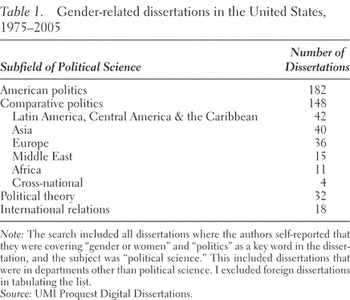
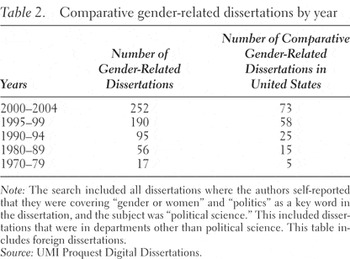
There are still too few comparative political dissertations concerning women and gender (see Table 1). As it is, a large proportion of the dissertations about comparative politics and gender are written by nonpolitical scientists, especially historians and sociologists. Even today, much, perhaps most, of the work on the impact of welfare state policies on women has been carried out by sociologists like Ann Shola Orloff, Diane Sainsbury, Barbara Hobson, and Helga Hernes, to name but a few. If one takes regional literatures, like the literature on women and politics in Africa, for example, it is only recently that political scientists have started writing on the subject. The literature on women and politics in precolonial and colonial Africa extending into the nationalist period was almost entirely the domain of historians and anthropologists like Shirley Ardener, Bolanle Awe, Janet Bujra, LaRay Denzer, Susan Geiger, Jean Hay, Caroline Ifeka-Moller, Nancy Leis, Nina Mba, Jane Parpart, Sylvia Leith-Ross, Filomina Steady, Margaret Strobel, and Audrey Wipper, just to cite a few scholars. Even contemporary women and politics themes in Africa continue to interest sociologists (Kathleen Fallon, Gwendolyn Mikell, Gay Seidman) and anthropologists (Gisela Geisler, Sondra Hale), who have produced some of the most important work in this area. Although there has been an increase in gender-related dissertations across the decades since 1970, in fact, the number has been steadily decreasing since it peaked in 2000 at 69 (see Table 2). The number of comparative gender-related dissertations in the United States has similarly decreased by 50% from 22 in 2000 to 11 in 2004. Many graduate students I have spoken with still avoid working on gender-related topics for fear that they will fare poorly in the job market.
Gender-related dissertations in the United States, 1975–2005

Comparative gender-related dissertations by year

In Ph.D.-generating departments, there are few professors qualified to train people in this area. In the top 20 political science departments in the country, there are only two comparativists working on gender (Pippa Norris and myself). Three others have done work on gender-related topics but do not list themselves as gender specialists on their Web pages.
One of the major constraints keeping scholars—especially women but increasingly also men—from doing more comparative work is the difficulty of carrying out fieldwork if one has children. The challenges are often formidable and sometimes insurmountable. Mary Ann Mason and Marc Goulden at the University of California–Berkeley found that women who had children in the five years after receiving their doctorates were 30% less likely to obtain tenure than women who did not have children.3
Robin Wilson, “How Babies Alter Careers for Academics,” Chronicle of Higher Education, 5 December 2003, p. A1.
These days, however, the pressures of dual-career marriages have meant that it is rare to find a woman bringing her spouse along to “the field” to help with the children, unless the husband is also involved in his own fieldwork project in the same locale. Women are more likely to bring children with them, leaving their partners behind. Male researchers are more likely to bring a spouse to help them with the children. For women doing fieldwork, this raises a host of challenges related to single parenting in a foreign country. Elsewhere I have written on some of these challenges and have identified some coping strategies (Tripp 2002).
In no way are women's private arrangements for doing international research trivial: They affect the content, subject, scope, and quality of their research. Academic expectations and norms were not established with academic mothers in mind, nor have they been sufficiently modified as more women have entered academia. To the contrary, while the competitiveness of academia has made it difficult for male scholars who are involved in raising children to do fieldwork, it has become exponentially harder for academic mothers and, in particular, mothers who do foreign field research. Domestic responsibilities and considerations still, unfortunately, affect women's careers to a greater extent than those of men.
Academic norms and expectations, especially for graduate students and junior faculty, are not compatible with active parenting, let alone doing international research at the same time. The challenges are numerous. It is expensive to bring children to the field because insurance, airfare, and school fees are generally not covered by granting agencies. Scholars may encounter difficulties negotiating with a spouse or in taking children to faraway lands. Moreover, women guilt-trip themselves about doing it. Friends and family may not be especially sympathetic. The supports within departments and academic institutions for parents in the field are virtually nonexistent.
One part of the changes necessary to increase the opportunities for women to undertake gendered comparative political research and fieldwork must come from within academia and from funding agencies. The other part of the battle still has to be waged within households, where women need to learn to become better at negotiating with their partners, and where greater equality in decision making and sacrifice needs to be encouraged (Tripp 2002).
Why Is Our Work Not More Visible?
Those of us who do work in this field are not publishing in the top 10 political science journals ranked most highly for impact, in which comparativists are most likely to publish.4
These include Journal of Democracy, World Politics, Comparative Political Studies, International Affairs, Journal of Conflict Resolution. Legislative Studies Quarterly, Journal of Politics, American Journal of Political Science, Comparative Politics, American Political Science Review, Political Science Quarterly, and Journal of Peace Research.
Of the 3,510 articles listed in JSTOR, the Scholarly Journal Archive, for these same top political science journals over the past decade, 2.5% (90) had “gender” or “women” in the title, while 21 articles were gender related with a comparative focus (0.5%). Of all the political science journals listed in JSTOR for the past decade (18,730), 2% of the articles (391) were gender related.
The lack of interest in gender is reflected in the boards of comparative political science journals. Few if any board members do work on gender issues.5
In terms of gender balance, World Politics has 1 woman out of 17 members; Comparative Politics, 1 of 7; Comparative Political Studies, 4 women of 34; the Journal of Peace Research, 1 of 30; the Journal of Human Rights, 3 of 29; and the Journal of Democracy, 5 of 40.
So where are comparativist political scientists publishing on women and gender? Based on 313 records of gender-related articles in 2004 listed in Worldwide Political Science Abstracts and on an examination of the curriculum vita of prominent comparativists working in this field, my research found that comparative political scientists working on gender are publishing in women's studies journals, such as International Feminist Journal of Politics, Differences, Gender and Development, Feminist Economics, Feminist Review, Signs, and Women's Studies International Forum. They are publishing in area studies journals and in single-issue journals, such as Development and Change, World Development, Forced Migration Review, and Human Rights Quarterly. They are also publishing in second-tier political science journals, in journals of other disciplines (e.g., Gender and Society, Social Politics, Contemporary Sociology, Politics and Society), and in political science journals abroad.
More importantly, comparative politics and gender scholars are publishing books. In 2004, of all books on women and politics reviewed in Women's Review of Books, half (35 out of 66) were comparative, although not all were by political scientists. The publishers printing the most gender-related comparative politics books in 2004 included Routledge (11), Rowman & Littlefield (7), and Palgrave (5). Of the university presses—Johns Hopkins, Rutgers, Duke, and Cambridge—all published three books each in this area in 2004, while Indiana, Michigan, Pittsburgh, and Oxford each published only one.
Why are so few comparative gender and politics scholars publishing in political science journals and in top political science journals? In part, we are not submitting enough to these journals. Lee Sigelman, editor of American Political Science Review (APSR), told me that he simply did not have submissions in this area.6
Discussion at APSA meeting, August 31, 2005.
The challenge is, in part, to do a better job of explaining what it is we are doing and why it is important: why good comparativists need to understand women's movements to understand social movements; why they need to understand women's mobilization to understand civil society; why women's rights are human rights; why one cannot understand democratization without understanding gender exclusions; and how gender is central to the construction of ethnic identity. We have much more work to do than conventional political scientists in order to explain the “so what” question, that is, questions about the relevance of our work. It often seems unfair that others do not bother to learn more about gender as it relates to their work and scholarly interests when it is so abundantly evident that it is central to what they are trying to explain. Yet we are required to know the broader context of our fields. That is a reality with which we have to contend. We need to connect the dots for others and to demonstrate the relevance of gender to their concerns. Until we put it into their language and in their terms, it will continue to be trivialized.
We also need to do more to network and to promote one another's work outside of the women and politics circles. In the American Political Science Association, almost none of the book or paper awards outside of the Women and Politics Reserach Section have gone to people working on women in comparative politics. One-quarter of the papers winning awards in the Women and Politics Research Section have comparative themes. Similarly, one-fifth (5 out of the 25) of the books winning the APSA Victoria Schuck Award for the Best Book on Women and Politics have gone to comparativists, and half of all dissertation prizes awarded by the APSA Women and Politics Research Section were given to comparativists (6 of 12).
Challenges Posed by Methodologically Driven Research Trends
Methodological trends in research may also be serving to stifle research in this area, even as the needs remain great for more quantitative studies related to gender. The Perestroika movement within political science has bemoaned the lack of methodological and intellectual pluralism in the discipline. The movement has railed against methodologically driven research. Perestroika activists have rightly argued that politics should be taken as a starting point and that methods should be adopted to suit the questions being generated about politics itself.
Peregrine Schwartz-Shea (2005) found that in the top 57 doctoral programs, 66% had quantitative methods requirements, while only 16% had foreign language requirements. This trend is also reflected in publications; for example, between 1991 and 2000, the American Political Science Review published 225 articles using statistical methods and 88 articles employing mathematical modeling, while only five articles in this same period used empirical qualitative methods. Comparativists are publishing in the APSR in proportion to their presence in the field (22%); however, only certain types of comparative research have been published there. Similarly, between 1985 and 2001, approximately 90% of all the articles published in the American Journal of Political Science involved statistical analysis and mathematical modeling (Kasza 2005, 421). This creates a built-in bias in major journals toward cross-national studies in comparative politics. Although there is important cross-national work being done in politics and gender, much of it is focused on those parts of the world where the data is the strongest (e.g., Europe and North America). This situation also creates disincentives in the field for those who do the painstaking and challenging field research that requires historical knowledge, command of languages, and more contextual understanding of the politics of particular countries. Without that work on the ground, the cross-national comparative theories can potentially remain stale, uninformed, and thin. The in-depth case studies explain the mechanisms of processes uncovered in cross-national studies; they can help develop theories that can be tested more generally and assist in making sense of quantitative findings. In short, we need both types of studies.
The fact that many comparativist gender and politics scholars often use ethnographic methodologies, in-depth interviews, snowball surveys, and/or focus groups, and focus on individual countries, means that they are at a disadvantage in terms of the range of journals in which they can publish. They often adopt interdisciplinary approaches, which take a lot of time to develop and involve a lot of self-training. This does not always sit well with others in the discipline. It may be easier for those with joint appointments to adopt a broader range of methods, but not so easy for those working on gender and politics solely within their departments.
Even those doing statistical cross-national studies run into difficulties when they move outside of the advanced industrialized countries, because the data just are not there. Ronald Inglehart and Pippa Norris's pathbreaking 2003 study, Rising Tide: Gender Equality and Cultural Change Around the World, is missing 110 cases, all of which are developing countries. Surely they would have been included had the data been available. Databases are incomplete at best and, for many categories, the data simply do not exist.
Thus, it is no surprise that the majority of studies explaining women's legislative representation have concentrated on Western Europe and North America, where explanations focusing on electoral systems, district and party magnitude, and the ideological orientation of political parties have been well established. Cross-national studies and a few regional studies have begun to refine our understanding of what factors hinder and facilitate a greater presence of women in legislatures globally (Htun and Jones 1996; Inglehart and Norris 2003; Jones 1998; Kenworthy and Malami 1999, Paxton 1997; Reynolds 1999). It has only been very recently that electoral quotas for women have begun to attract attention, especially for those studying Latin America, Africa, and the Middle East and, historically, the former Soviet Union and Eastern Europe. When quotas are incorporated in cross-national studies, they fundamentally change the explanations that account for female legislative representation today. Moreover, regional differences become more important in the way we think about representation (Tripp and Kang 2006).
The European and North American focus of existing comparative work also poses other limitations that are more conceptual. Concepts that have evolved in one context do not always travel well or would need their meanings expanded to be of comparative use. Take, for example, the literature on state feminism, which has evolved primarily in the context of North American and European democracies. Dorothy McBride Stetson and Amy Mazur (1995) found in their comparative study of North America, Europe, and Australia that women's policy machineries had considerable impact when the state was defined as a site of social justice and had the institutional capacity to respond to new demands for equality. They have focused on the role of feminist organizations working both within and outside of unions and parties (Stetson 2001; Stetson and Mazur 1995). Stetson found in comparative studies of abortion policy in Europe and North America that women's movements had the most policy impact when left-wing parties were in power and when the movements were closely aligned to the leftist parties. It was also necessary that women's movements were unified around their demands and placed those demands high on their agenda. Even when left-wing parties were not in power, if feminists within the state agencies intervened, they could also be responsive to women's movements by bringing about substantive policy changes (Stetson 2001).
Within the Latin American context, the debates were different but the framework remained a democratic one. Democratization in Latin America brought to the fore a conflict between those who called themselves “institutionales,” who worked within the system, and the “autónomas,” who sought to preserve the movement. Much of the debate dealt with the role of state feminism and femocrats, a debate that ironically was a product of some of the successes of the women's movement in institutionalizing their objectives (Baldez 2002, Rios Tobar 2003, Waylen 1996). Studies of state feminism within democracies have assumed that society was interested in engaging the state because the state had the will and the capacity to respond to societal pressures.
How then do we understand state feminism as we shift to nondemocratic contexts? Why do semiauthoritarian and authoritarian states adopt female-friendly policies (e.g., creating national machineries for women, introducing maternity leave with full pay, giving women one-third to half of the parliamentary seats, signing and ratifying the Convention on the Elimination of All Forms of Discrimination Against Women), when they could just as easily ignore popular demands or where there are no particular popular pressures to adopt such policies? Why do they adopt seemingly pro-women policies, particularly when they are not especially interested in promoting other civil, political, and human rights? These questions challenge the meaning and purpose of state feminism that has arisen in democratic contexts, but these policies in nondemocratic states cannot be easily dismissed.
Sometimes these policies have served symbolic purposes to signal the political sympathies of the establishment or ruling party in the context of an Islamicist challenge. In other cases, the policies have been used to obtain women's votes, to create new patronage networks, or to curry support on a world stage. They have also served the purposes of state legitimation. Yet these motivations need to be accounted for in the same way that state feminism has been discussed as fulfilling various objectives of welfare states that have both enhanced and detracted from women's status.
Finally, despite today's easy Internet access and e-mail communication, the links between scholars in the global North and South seem to be fairly weak. The research networks and linkages around gender issues are stronger across the Atlantic and within Europe, but much weaker across other continents. The lack of connectedness and mutual exchange impedes comparative analysis above all. The weakness of truly global research collaborations makes it difficult to obtain different perspectives and to learn from alternative analyses, share literature, collect data, and collaborate in research. The paucity of alternative global perspectives confines the scope of our understanding of analytical concepts to the North American and European context. Phenomena almost always look different up close. It is not sufficient for any of us scholars the world over simply to ponder from afar. Thus, our work and that of our colleagues abroad, both empirically and theoretically, is incomplete and much thinner than it need be.
The existence of new and older diasporas in the United States facilitates some of these linkages, but more needs to be done to pressure foundations and government funding agencies and universities to facilitate more exchange and global dialogue. We will all be the better for it.
Teaching Gender
Although one might expect limited progress in the area of teaching, comparativists have a dismal record overall. In googling the first 20 syllabi to appear when typing in the terms “comparative politics syllabus,” I found only one that had any readings explicitly relating to women or gender, and this was a former student of mine (Timothy Longman)! It is no comfort that the other subfields do little better. The first 20 international relations, American politics, and political theory syllabi each had three references to gender/women in a similar Google search. My findings are further supported by a more detailed study of the contents of comparative politics syllabi for undergraduates carried out by Patrick Fagan in July 2005.7
He found one reference to three articles and one book in an analysis of 183 comparative politics syllabi.Conclusion
This is one of the most exciting times to be doing comparative gender studies. The field is wide open. We have only begun to scratch the surface in answering very central questions in the field and in contributing to the general literature on state building, the role of ethnicity, democracy, economic development, conflict, parties, legislatures, social movements, civil society, and many other topics of interest. But there are many challenges in bringing greater credibility to the subfield.
There is no one solution to the dilemmas we face. We need to encourage more students to go into the study of comparative gender political science, and we need to get as many as possible placed in universities that train doctoral students. We need to find ways to facilitate the work of students and junior faculty who do research abroad and to be more attentive to their particular needs and pressures. We need to encourage deans, departmental chairs, foundation program officers, and other institutional representatives to do the same. We should encourage one another to publish in top political science and comparative politics journals and to reward one another for work well done in political science association sections other than (and in addition to) the Women and Politics Research Section. We need to encourage the new trends toward greater methodological pluralism within the discipline. We should support efforts to make our work truly comparative beyond Europe and North America and to incorporate cases, data, and perspectives from the global South. This requires more collaborations, networking, and exchanges with the aim of mutually strengthening our capacity for comparison.