


1 Introduction
In group theory, many subgroups have their antipodes, that is, subgroups with diametrically opposed properties with respect to the original. For instance, recall that a subgroup H of a group G is said to be contranormal if it is not contained in any proper normal subgroup of G, that is, if
$H^G=G$
 , and H is said to be self-normalising if the normaliser
$N_G(H)=H$
 . However, if H is a normal subgroup of G, clearly
$H^G=H$
 and
$N_G(H)=G$
 ; therefore, both contranormal and self-normalising subgroups are antipodes to normal subgroups.
The problem of characterising groups with only two types of subgroups has received limited attention; however, over the years, a significant focus has been placed on cases where these two types of subgroups are antipodes to each other. Groups with only normal or contranormal subgroups were studied by Subbotin [Reference Subbotin19] and later, this class of groups was extended by De Falco et al. [Reference De Falco, Kurdachenko and Subbotin7]. That paper provides a description of groups with only subnormal or contranomal subgroups; analysis of groups in which every subgroup is either abnormal or subnormal can also be found there. Recall that a subgroup K of a group G is said to be abnormal in G if g belongs to the subgroup
$\langle K, K^g \rangle $
 , for each element g in G. Clearly, abnormal subgroups are another example of subgroups whose properties are diametrically opposite to those of normal subgroups. Finite groups in which all subgroups are normal or abnormal have been completely characterised by Fattahi [Reference Fattahi11], while the infinite case can be found in [Reference Subbotin19]. Finite groups in which each subgroup is either subnormal or abnormal have been investigated by Bauman and Ebert [Reference Ebert and Bauman10], while, the infinite case, has been explored by Kurdachenko and Subbotin [Reference Kurdachenko and Subbotin12]. Another relevant example of groups with only two types of subgroups that are antipodes to each other is provided by the class of groups in which each subgroup is either contranormal or almost normal; recall that a subgroup H of a group G is almost normal in G if the normaliser
$N_G(H)$
 has finite index in G. This latter class of groups has been investigated by Kurdachenko et al. [Reference Kurdachenko, Subbotin and Velichko13].
In addition to subnormal and almost normal subgroups, nearly normal subgroups provide another significant extension of normal subgroups. By definition, a subgroup H of a group G is nearly normal in G if and only if H has finite index in its normal closure
$H^G$
 . A well-known result of B. H. Neumann [Reference Neumann14] states that all subgroups of a group G are nearly normal if and only if the commutator subgroup
$G'$
 is finite.
Building on the previous idea, this paper is devoted to the study of groups whose subgroups are either nearly normal or contranormal. Groups satisfying this property will be called NNC-groups. The first main result of this paper provides a full description of not-perfect NNC-groups.
Theorem 2.4. Let G be a group such that
$G \not = G'$
 . Then, G is an NNC-group if and only if one the following conditions holds:
-
(i) every subgroup H of G is nearly normal in G;
-
(ii) $G=G' \langle x \rangle $
 for some
$x \in G$
, and there exists a prime number p such that all subgroups of
$G' \langle x^p \rangle $
are nearly normal in G and
$\langle x^n \rangle $
is contranormal in G for every integer n which is not divisible by p.


A group G is said to have finite (Prüfer) rank r if every finitely generated subgroup of G can be generated by at most r elements and r is the least positive integer with this property; if such an integer r does not exist, we will say that the group G has infinite rank. The investigation of the influence on a (generalised) soluble group of the behaviour of its subgroups of infinite rank has been developed by many authors (see [Reference De Falco, de Giovanni and Musella3] for a full list of references on this topic). It turns out that in a group of infinite rank, the behaviour of the subgroups of finite rank is strongly conditioned by that of the subgroups of infinite rank. In light of these considerations, it is natural to inquire whether the same property holds for groups with only two types of subgroups of infinite rank whose properties are diametrically opposite. The case of groups whose subgroups of infinite rank are either normal or contranormal has already been studied by De Luca and Di Grazia [Reference De Luca and Di Grazia9], leading to a complete description of groups with only subnormal or contranormal subgroups of infinite rank.
Along similar lines, in the second part of this paper, groups of infinite rank in which every subgroup of infinite rank is either nearly normal or contranormal are investigated. These groups will be denoted by the symbol
${\textit {NNC}}_{\infty }$
 . Here, we will work within the universe of periodic generalised radical groups, that is, groups with an ascending series whose factors are either locally finite or locally nilpotent and in which every element has finite order. We will prove the following result.
Theorem 3.2. Let G be a periodic generalised radical
$NNC_{\infty }$
 -group which is also locally soluble. Then, either G has finite rank or it is an
$NNC$
 -group.
Results similar to the one quoted above suggest that the behaviour of small subgroups in a large group can be neglected, at least for the right choice of the definition of largeness and within a suitable universe of groups. This point of view has been widely adopted over the years (see, for instance, [Reference De Falco, de Giovanni, Heineken and Musella1, Reference De Falco, de Giovanni and Musella4, Reference De Falco, Evans, de Giovanni and Musella6, Reference Sabatino17]); in those papers, we can find the study of uncountable groups whose subgroups of the same cardinality satisfy a fixed embedding property. The main obstacle here is the existence of uncountable groups of cardinality
$\aleph $
 , say, in which all proper subgroups have cardinality strictly smaller that
$\aleph $
 , that is, the so-called Jònsson groups. Significant examples of Jònsson groups of cardinality
$\aleph _1$
 have been constructed by Shelah [Reference Shelah18] and Obraztsov [Reference Obraztsov15]. To avoid similar obstructions, we will use the additional requirement that the group has no simple homomorphic images of cardinality
$\aleph $
 (see [Reference de Giovanni and Trombetti8, Corollary 2.6]), a condition which is obviously satisfied in the case of locally soluble groups.
In the last part of this paper, we provide a further contribution to this topic. Throughout the paper,
$\aleph $
 will denote an uncountable regular cardinal number. If G is a group of cardinality
$\aleph $
 , a subgroup H will be called large if it has cardinality
$\aleph $
 and small otherwise. In Section 4, we analyse uncountable groups whose large subgroups are either contranormal or satisfy a fixed normality condition. Most of the notation used in this paper is standard and can be found in [Reference Robinson16].
2 General properties of NNC-groups
Recall that a group G is an
${\textit {FC}}$
 -
$group$
 if and only if it is equal to its
${\textit {FC}}$
 -
$centre$
 , that is, the set consisting of all elements of G with finitely many conjugates.
Proposition 2.1. Let G be an NNC-group and let N be a proper normal subgroup of G. Then, N is contained in the
$FC$
 -centre of G.
Proof. Let H be any subgroup of N. If H is contranormal in G, then
$H^G=G$
 , which is a contradiction. Thus, every subgroup of N is nearly normal in G; in particular, for every element
$x \in N$
 , it follows that
$| \langle x\rangle ^G : \langle x \rangle |$
 is finite, so there exists a positive integer n such that
$(\langle x\rangle ^G)^n$
 is contained in
$\langle x \rangle $
 . Thus, the quotient
$G/C_G(\langle x \rangle ^G/(\langle x\rangle ^G)^n)$
 is finite and, hence,
$N_G(\langle x\rangle )$
 has finite index in G. Consequently,
$C_G(x)$
 has finite index in G and, therefore, x is contained in the
${\textit {FC}}$
 -centre of G.
Proposition 2.2. Let G be a group such that the
${\textit {FC}}$
 -centre of G is properly contained in G. Then, G is an NNC-group if and only if it contains a largest proper normal subgroup N and all subgroups of N are nearly normal in G.
Proof. Let N be the
${\textit {FC}}$
 -centre of G. If H is any proper normal subgroup of G, then
$H \leq N$
 by Proposition 2.1, and every subgroup of N is nearly normal in G, since it is a proper normal subgroup of G.
Conversely, let H be any subgroup of G such that
$H^G \not = G$
 . By hypothesis,
$H^G \leq N$
 and clearly H is nearly normal in G.
Recall that a group G has the
${\textit {FC}}$
 -property if and only if every cyclic subgroup of G is nearly normal. The next proposition shows that in an
${\textit {FC}}$
 -group G, with the additional assumption that G has the
${\textit {NNC}}$
 -property, an even stronger condition holds: in this case, it can be proved that every subgroup of G is nearly normal.
Proposition 2.3. Let G be an
${\textit {FC}}$
 -group. If G has the
${\textit {NNC}}$
 -property, then
$G'$
 is finite.
Proof. If G is not finite-by-abelian, there exists an element x of G such that
$C_G(x)$
 is proper in G. Moreover,
$C_G(x)$
 has finite index in G, so that
$L=(C_G(x))_G$
 is a proper normal subgroup of G such that
$G/L$
 is finite. Clearly, every subgroup of L is nearly normal in G, so
$L'$
 is finite and hence
$G'$
 is finite, which is a contradiction.
Clearly, if G is an
${\textit {NNC}}$
 -group such that
$G'\not =G$
 , then
$G"$
 is finite. Next, we provide a complete characterisation of not-perfect
$NNC$
 -groups.
Theorem 2.4. Let G be a group such that
$G \not = G'$
 . Then, G is an
${\textit {NNC}}$
 -group if and only if one the following conditions holds:
-
(i) every subgroup H of G is nearly normal in G;
-
(ii) $G=G' \langle x \rangle $
for some
$x \in G$
, and there exists a prime number p such that all subgroups of
$G' \langle x^p \rangle $
are nearly normal (in G) and
$\langle x^n \rangle $
is contranormal in G for every integer n which is not divisible by p.


Proof. Assume first that G is an
${\textit {NNC}}$
 -group which is not of type (i), so that it contains a proper contranormal subgroup B and
$G=G'B$
 . Put
$\bar B = B/ (B \cap G')$
 and suppose that
$\bar B$
 is generated by two proper subgroups
$\bar X$
 and
$\bar Y$
 ; it follows from the Dedekind modular law that
$XG'$
 and
$YG'$
 are properly contained in G, and hence, X and Y are both nearly normal in G. Then, also
$B=\langle X, Y \rangle $
 is nearly normal in G, which is a contradiction. So,
$\bar B$
 cannot be generated by two proper subgroups and, hence, it is either a group of type
$p^{\infty }$
 or a cyclic p group for some prime p.
If
$\bar B$
 is a group of type
$p^{\infty }$
 , then
$G/G'$
 is likewise a group of type
$p^{\infty }$
 . By hypothesis,
$G'$
 is a proper normal subgroup of G, so that all its subgroups are nearly normal in G. Moreover, if
$\langle x \rangle $
 is any cyclic subgroup of G which is not contained in
$G'$
 , then
$\langle x \rangle G'$
 is a proper normal subgroup of G, so that
$\langle x \rangle $
 is nearly normal in G and, hence, G is an
${\textit {FC}}$
 -group. By Proposition 2.3,
$G'$
 is finite and, hence, every subgroup of G is nearly normal in G, which is a contradiction. Therefore,
$\bar B$
 must be a cyclic p-group; in this case, also
$G/G'$
 is a cyclic p-group and clearly G is a group of type (ii).
Conversely, suppose that G satisfies one of the conditions (i) or (ii). If condition (i) holds, then clearly G has the
${\textit {NNC}}$
 -property. Assume that G satisfies condition (ii) and let H be a subgroup of G. If
$G=G'H$
 , then H is contranormal in G; if
$G \not = G'H$
 , then
$G'H$
 is contained in
$G' \langle x^p \rangle $
 , so that H is nearly normal in G and the result follows.
3 Groups in which every subgroup of infinite rank is either nearly normal or contranormal
As in many problems concerning groups of infinite rank, the existence of a proper normal subgroup of infinite rank plays an important role.
Lemma 3.1. Let G be a periodic generalised radical
${NNC}_{\infty }$
 -group and let A be a proper normal subgroup of infinite rank of G. Then, every subgroup of A is nearly normal in G.
Proof. Clearly, every subgroup of infinite rank of A is nearly normal in G so
$A'$
 is finite (see [Reference De Falco, de Giovanni and Musella2, Theorem B]) and, replacing A by the factor group
$A/A'$
 , it can be assumed without loss of generality that A is an abelian subgroup of G. Obviously, the socle S of A is a normal subgroup of infinite rank of G and it is a direct product of subgroups of prime order. Now, let X be any subgroup of finite rank of A. There exists a subgroup
$S_0$
 of S such that

It follows that
$S_0$
 has infinite rank and it has finite index in its normal closure
$N=S_0 ^G$
 , since each subgroup of infinite rank of A cannot be contranormal in G. If follows that the intersection
$X \cap N$
 is finite and clearly there exist two subgroups
$U,V$
 of infinite rank of N such that

Put
$H=U^G$
 and
$K=V^G$
 . Then, the intersection
$H \cap K$
 is finite, since U and V are nearly normal in G and
$U\cap V=X \cap N$
 is finite. Thus,

and it follows that the index
$| XH \cap XK : X|$
 is finite (see [Reference De Falco, de Giovanni, Musella and Trabelsi5, Lemma 1]). However,
$XH$
 and
$XK$
 are subgroups of infinite rank of A, so they are both nearly normal in G and it follows easily that X is also nearly normal in G.
Theorem 3.2. Let G be a periodic generalised radical
${NNC}_{\infty }$
 -group which is also locally (soluble-by-finite). If G contains a proper normal subgroup of infinite rank, then it is an
$NNC$
 -group.
Proof. Let X be any subgroup of finite rank of G such that
$X^G$
 is properly contained in G. If
$X^G$
 has infinite rank, it follows from Lemma 3.1 that each subgroup of
$X^G$
 is nearly normal in G and so is X. Suppose now that
$X^G$
 has finite rank. Let N be a proper normal subgroup of infinite rank of G; since N is a generalised radical locally (soluble-by-finite) group of infinite rank, it contains an abelian subgroup A of infinite rank (see [Reference De Falco, de Giovanni and Musella2, Lemma 4]). Thus, there exists a subgroup B of A such that B has infinite rank and
$X^G B$
 is a proper subgroup of G (see [Reference De Luca and Di Grazia9, Lemma 2.3]). Clearly, B is nearly normal in G, so also the product
$X^G B$
 has a finite index in its normal closure
${(X^GB)^G=H}$
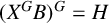 . If H is a proper subgroup of G, then X is nearly normal in G by Lemma 3.1; if
$H=G$
 , then the core
$(X^GB)_G$
 has finite index in G, so it is a proper normal subgroup of infinite rank of G and the statement follows again by Lemma 3.1.
Corollary 3.3. Let G be a periodic generalised radical
${NNC}_{\infty }$
 -group which is also locally soluble. Then, either G has finite rank or it is an
$NNC$
 -group.
Proof. Assume that G has infinite rank. Since G is locally soluble, it contains a proper normal subgroup of infinite rank (see [Reference De Luca and Di Grazia9, Lemma 2.2]). Hence, G is an
${\textit {NNC}}$
 -group by Theorem 3.2.
The last result of this section shows that, with the same hypotheses as in Corollary 3.3, the additional requirement that the group G has the
${\textit {FC}}$
 -property yields a stronger conclusion.
Corollary 3.4. Let G be a periodic generalised radical
${\textit {NNC}}_{\infty }$
 -group which is also locally soluble. If G has infinite rank and if it is an
${\textit {FC}}$
 -group, then
$G'$
 is finite.

4 Uncountable groups whose large subgroups are either normal or contranormal
In the following sections, the case of uncountable groups with only two types of large subgroups that are antipodes to each other is explored. Since this topic has not received relevant attention yet, the analysis begins with the consideration of uncountable groups of cardinality
$\aleph $
 whose large subgroups are either normal or contranormal. Such groups will be denoted by the symbol
$\mathcal {AN}_{\aleph }$
 , in analogy with the symbol
$\mathcal {AN}$
 used to denote the class of groups in which each not-normal subgroup is contranormal.
First, we make a brief aside regarding the extreme cases. As the problem of uncountable groups whose large subgroups satisfy normality conditions has already been studied (see [Reference De Falco, de Giovanni, Heineken and Musella1, Reference De Falco, de Giovanni and Musella4]), it is natural to investigate the case of uncountable groups whose large subgroups are contranormal. It can be shown with a short argument that such groups exist only in the perfect case: indeed, let G be an uncountable group whose large subgroups are contranormal; if
$G'\not =G$
 , then
$G/G'$
 is a large abelian section, which is a contradiction.
Lemma 4.1. Let G be an uncountable group of cardinality
$\aleph $
 containing a large abelian subgroup A and let X be a subgroup of G such that
$X^G$
 is a small subgroup. Then, there exists a large subgroup B of A such that
$X^G B$
 is properly contained in G.
Proof. Let x be an element of
$G\backslash X^G$
 . Since
$X^G\langle x \rangle $
 is a small subgroup of G, there exists a large subgroup B of A such that
$X^G \langle x \rangle \cap B= \{1\}$
 and, hence,

so that
$x \notin X^G B$
 .
Lemma 4.2. Let G be an uncountable
$\mathcal {AN}_{\aleph }$
 -group and let N be a proper normal subgroup of G. If N contains a large abelian subgroup, then every subgroup of N is normal in G.
Proof. Let A be a large abelian subgroup of N. Since N is properly contained in G, each large subgroup of N is normal in G, so N is a Dedekind group (see [Reference De Falco, de Giovanni and Musella4, Lemma 2.1]). Now, let H be any small subgroup of N. Clearly, there exist two large subgroups
$A_1$
 and
$A_2$
 of A such that
$H \cap (A_1 \times A_2 )= \{1\}$
 . Thus, both
$HA_1$
 and
$HA_2$
 are normal in G, so that
$H=HA_1 \cap HA_2$
 is also normal in G.
Theorem 4.3. Let G be an uncountable
$\mathcal {AN}_{\aleph }$
 group such that
$G' \not = G$
 . If G contains a large abelian subgroup, then G is an
$\mathcal {AN}$
 -group.
Proof. Let A be a large abelian subgroup of G. If
$A \cap G'$
 is large, then it is a normal subgroup of G, since
$G'$
 is proper in G and so each large subgroup of
$G'$
 cannot be contranormal in G. If
$A \cap G'$
 is small, there exists a proper large subgroup B of A which contains
$A \cap G'$
 ; if B is not normal in G, it is contranormal in G by hypothesis, so
$G=G'B$
 . By the Dedekind modular law,

which is a contradiction. This argument shows that, without loss of generality, we can assume that A is normal in G.
Now, let H be any small subgroup of G such that
$H^G$
 is properly contained in G. If
$H^GA$
 is properly contained in G, then the result follows easily by Lemma 4.2. So, we can assume that
$H^G A=G$
 . If
$H^G$
 is large, then its own large subgroups are normal in G, so that
$H^G$
 is nilpotent and G is likewise nilpotent, and hence, it is a Dedekind group (see [Reference De Falco, de Giovanni and Musella4, Lemma 2.1]). If
$H^G$
 is small, by Lemma 4.1, there exists a large subgroup B of A such that
$H^G B$
 is properly contained in G. Clearly, B is normal in G, so the product
$H^G B$
 is also normal in G. It follows again by Lemma 4.2 that H is normal in G.
5 Uncountable groups whose large subgroups are either subnormal or contranormal
Let k be a positive integer. Throughout this section,
$\mathcal {SC}_{k \,\aleph }$
 will denote the class of uncountable groups of cardinality
$\aleph $
 whose large subgroups are either subnormal of defect at most k or contranormal, in analogy with the symbol
$\mathcal {SC}$
 which denotes the class of group whose subgroups are either subnormal or contranormal.
Lemma 5.1. Let k be a positive integer and let G be an uncountable
$\mathcal {SC}_{k \,\aleph }$
 -group. Let N be a proper subnormal subgroup of G. If N contains a large abelian subgroup, then every subgroup of N is subnormal in G.
Proof. Since every large subgroup of N is subnormal in G of bounded defect, N is nilpotent (see [Reference De Falco, de Giovanni, Heineken and Musella1, Theorem 2.5]). Therefore, every subgroup of N is subnormal in G.
Theorem 5.2. Let G be an uncountable
$\mathcal {SC}_{k \, \aleph }$
 -group such that
$G' \not = G$
 . If G contains a large abelian subgroup, then G is an
$\mathcal {SC}$
 -group.
Proof. First, let A be a large abelian subgroup of G and assume that
$A^G=G$
 . If
${A \cap G'}$
 is large, then it is subnormal in G, since
$G'$
 cannot contain large contranormal subgroups, so we can suppose that
$A\cap G'$
 is a small subgroup of G. In this case, there exists a large proper subgroup B of A which properly contains
$A\cap G'$
 . Thus, if B is contranormal in G, then
$G=G'B$
 and by the Dedekind modular law

which is a contradiction. This short argument shows that, without loss of generality, we may assume that A is subnormal in G. Let H be any small subgroup of G such that
$H^G$
 is properly contained in G and assume that the intersection
$A \cap H^G$
 is large. Then, the normal closure
$H^G$
 is also a large subgroup of G and the statement easily follows by Lemma 5.1. Assume now that
$A \cap H^G$
 is a small subgroup of G; clearly, there exists a large proper subgroup B of A which contains
$A\cap H^G$
 . If the product
$H^GB =G$
 , then again by the Dedekind modular law,

which is a contradiction. It follows that the product
$H^G B$
 is a proper subnormal subgroup of G, since B is a large proper subnormal subgroup of G, so H is subnormal in G by Lemma 5.1 again.
6 Uncountable groups whose large subgroups are either nearly normal or contranormal
In this section,
${\textit {NNC}}_{\aleph }$
 will denote the class of uncountable groups of cardinality
$\aleph $
 whose large subgroups are either nearly normal or contranormal.
Lemma 6.1. Let G be an uncountable periodic
${NNC}_{\aleph }$
 -group and let N be a proper normal large subgroup of G. If N contains a large
$FC$
 -subgroup, then every subgroup of N is nearly normal in G.
Proof. Clearly, every large subgroup of N is nearly normal in G, so
$N'$
 is finite (see [Reference De Falco, de Giovanni and Musella4, Theorem 3.6]) and it can be assumed without loss of generality that N is abelian. The result follows by an argument similar to that in Lemma 3.1.
Theorem 6.2. Let G be an uncountable periodic
${NNC} _{\aleph }$
 -group such that
$G' \not = G$
 . If G contains a large abelian subgroup, then G is an
$NNC$
 -group.
Proof. Let A be a large abelian subgroup of G and assume first that
$A^G\not = G$
 ; by hypothesis, A has finite index in its normal closure
$A^G$
 and, hence,
$A^G$
 contains an abelian characteristic subgroup of finite index, which is large and normal in G. Assume now that
$A^G=G$
 . If
$A \cap G'$
 is large, then it is nearly normal in G, since large subgroups of
$G'$
 cannot be contranormal in G, so
$(A \cap G')^G$
 is abelian-by-finite and, similar to the previous case, it contains a large abelian subgroup which is normal in G. If
$A \cap G'$
 is small, there exists a large proper subgroup B of A such that
$A \cap G'$
 is properly contained in B. Suppose that B is contranormal in G. Then,
$G=G' B$
 and by the Dedekind modular law,

which is a contradiction. This argument shows that, without loss of generality, we can assume that A is normal in G.
Let H be any small subgroup of G such that
$H^G$
 is properly contained in G. If the intersection
$A \cap H^G$
 is large, then
$H^G$
 is likewise a large proper subgroup of G and the statement easily follows by Lemma 6.1. Assume now that
$A \cap H^G$
 is a small subgroup of G; clearly, there exists a large proper subgroup B of A which contains
$A\cap H^G$
 . If the product
$H^GB =G$
 , then again by the Dedekind modular law,

which contradicts our assumption. It follows that the product
$H^G B$
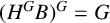
 is a proper nearly normal subgroup of G, since B is a large proper subgroup of A. Now, if
$(H^GB)^G$
 is a proper subgroup of G, then H is nearly normal in G by Lemma 6.1, so it can be assumed that
$(H^GB)^G=G$
 . In this case,
$H^GB$
 has finite index in G, so also the core
$(H^GB)_G$
 has finite index in G and, hence, it is a large proper normal subgroup of G. Since the intersection
$A \cap (H^GB)_G$
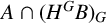 is a large abelian subgroup, by Lemma 6.1 again, every subgroup of
$(H^GB)_G$
 is nearly normal in G and so is H. The statement is proved.


