When Richard S. Scott failed to show up at his desk on Tuesday, June 2, 1885, the managers of the Manhattan Bank immediately grew alarmed. Scott had worked as a paying teller at the bank for more than twenty years, and his supervisors considered him trustworthy, but his unexplained absence could only mean one thing. The bank's president called an emergency meeting and ordered the clerks to check the books. By that afternoon, their suspicions were confirmed: $160,000 in greenbacks was missing.Footnote 1 No one needed to ask where Scott had gone with the money. Surely, everyone assumed, he must already be in Canada.Footnote 2
In an interview two years later, Scott confirmed his coworkers' speculations. After leaving work on Monday evening, pockets stuffed with cash, he went straight to New York's Grand Central station and caught the 6:30 train to Montreal. It arrived at 8 o'clock the next morning, before anyone at the Manhattan Bank even realized Scott was gone. On the journey, he shaved off his moustache and changed his clothes, but his efforts at disguise were unnecessary.Footnote 3 Under the extradition treaty in effect between the United States and Great Britain, which continued to direct Canada's foreign affairs after confederation in 1867, embezzlement was not an extraditable offense.Footnote 4 As long as Scott remained on Canadian soil, he was a free man.
Scott was one of roughly 2,000 fugitive Americans who fled to Canada in the 1880s.Footnote 5 Most were white-collar bureaucrats who committed a financial crime or fraud—bank tellers who speculated with borrowed funds, government clerks who emptied the city coffers, local aldermen who accepted bribes. What set these exiles apart from other fugitives was not just their prevalence, but also their conspicuousness. They generally made no secret of their identities, brought their families north to live with them, and even granted interviews to American newspaper reporters. These fugitives were given many names in the press, but most commonly, they were simply called boodlers.Footnote 6 Thought to derive from the Dutch boedel, meaning property or goods, “boodle” was a popular nineteenth-century American slang term for any type of ill-gotten gain. By the 1880s, the label “boodler” signified not only corruption, but also international flight.Footnote 7
It would be easy to dismiss the boodlers as merely a colorful, quirky variant of Gilded Age corruption, but I argue that they were symptomatic of a larger social tension in the United States: a crisis of mobility.Footnote 8 Nineteenth-century America was a society on the move, uprooted from many of its traditional moorings—a condition that generated new cultural anxieties and opportunities for crime. In the 1880s, this crisis took on an international dimension, as new transportation networks and the stabilization of the greenback made it easier than ever before for both people and capital to cross borders. Although there had been complaints about the mobility and anonymity of society for close to a century, the crisis of the 1880s was peculiarly transnational, reflecting the incorporation of the United States into a larger, interconnected global economy.Footnote 9
The boodler phenomenon provides a window onto the ways that Americans thought about their international borders in the late nineteenth and early twentieth centuries. The boodler crisis arose when technological advances and the cultural shift to a new economy threw once-stable boundaries out of alignment, as laws failed to keep pace with changing social and economic conditions. Between the early 1880s, when the boodler phenomenon began, and 1890, when the United States and Britain signed a new extradition treaty, many Americans began to view the guarding of the border as critical to the maintenance of domestic order.
A group of embezzlers who fled to Canada might seem an unusual window onto the evolution of American borders, as most contemporary attention is focused on the U.S.–Mexico boundary and the issue of immigration. However, it is important to consider American borders as they evolved historically, not just with today's hindsight. In the late nineteenth century, the Mexican border was immediately important to Texans and Arizonans, but for most other Americans, the Canadian border was the international line of significance. After all, it was closer geographically and linked more tightly through rail networks to the major cities of the Northeast and Midwest. Between the end of the Texas Indian Wars in 1875 and the start of the Mexican Revolution in 1910, the Canadian border garnered more attention in Washington; indeed, even when the U.S. Border Patrol was formed in 1924, more agents were stationed on the Canadian than the Mexican line.Footnote 10 The long history of disputes along the forty-ninth parallel involved not only a line on a map, but also issues of national pride, security, trade, and shared resources.Footnote 11 Questions about borders—what they meant legally, who and what should be permitted to cross, and how they should be guarded—were first contemplated with an eye to the north.
New types of mobility altered the way that Americans living in cities hundreds of miles from the international line defined their relationship with the border. Direct international rail lines, which were faster and easier than those in the 1860s, had an unintended effect on law enforcement: they essentially turned the major commercial centers of the U.S. Northeast and Midwest into border towns.Footnote 12 Communities in close geographic proximity to the international border faced the challenge of transnational crime on a daily basis; the fugitive who crossed international lines to evade the law was a familiar figure in northern Vermont and along the Rio Grande. Now, cities like New York and Chicago suddenly faced similar problems—but without the decades of experience in informal, binational cooperation.Footnote 13 In an era before passports and border patrols, American law enforcers were already grappling with the challenge of applying national laws to increasingly transnational populations.
The boodlers brought the border close to home. International relations became tied up in issues of local law enforcement; ordinary policing became internationalized. Questions of who could cross the border, how they could cross the border, and which laws could be enforced across the border emerged as pressing and local issues throughout the nation. For moral reformers, lawmakers, and the interests of capital, the border between the United States and Canada represented a threat to order by offering freedom to thieves, temptation to ordinary clerks, and a refuge to scoundrels. However, firming up physical boundaries was only one facet of their challenge. The other was to confirm the morality of remaining within one's proper social boundaries: play by the rules, be content with your lot, and do not steal from the rich, even if they are effectively stealing from you. The firming of physical borders helped redraw the moral borders of the new social order.
The Rise of the Boodler Phenomenon
The second half of the nineteenth century was an era of unprecedented mobility. Certainly there was a great deal of geographical movement: from Europe to the United States, from the East Coast to the West, from rural to urban areas. American society also saw new forms of mobility in the fluidity of capital, the increasing flexibility of one's social station, and the rapid spread of information.Footnote 14 This revolution in mobility was essential to the growth of American corporate and finance capitalism during the Gilded Age.Footnote 15 Ironically, however, the very mobility that allowed this economic system to grow also undermined it, by producing new opportunities for crime and escape. The boodler crisis arose when mid-nineteenth-century laws failed to keep up with these rapidly changing conditions.
In 1842, the United States and Great Britain had inserted an extradition clause into the Webster-Ashburton Treaty. The treaty's primary purpose was to resolve lingering boundary disputes and end tensions along the U.S.–Canadian border, and the extradition provision furthered the goal of peaceful, orderly relations along the shared boundary. Article 10 specified seven extraditable offenses: murder, assault with intent to commit murder, piracy, arson, robbery, forgery, and the utterance of forged paper.Footnote 16 This list was carefully constructed so as not to allow for the surrender of fugitive slaves, at Britain's insistence, or political prisoners.Footnote 17 Both signatories felt optimistic, however, that the brief list was comprehensive enough to suppress the most serious and common crimes along the border, particularly cross-border raids. Edward Everett, Daniel Webster's successor as secretary of state, later extolled the “happiest consequences” that came from the treaty's extradition provision. “No more was heard of border forays . . . or violences offered or retaliated across the line,” he marveled. “The mild, but certain influence of law imposed a restraint, which even costly and formidable military means had not found entirely adequate to produce.”Footnote 18
By the 1870s, however, the seven enumerated offenses that once served the border so well began to appear insufficient. New offenses had become pervasive, some of which had not even been criminalized in 1842. When three members of William M. “Boss” Tweed's Tammany Ring fled to Canada in 1871, charged with taking more than $100 million of city funds, the New York District Attorney discovered that he was unable to demand their extradition on either embezzlement or bribery charges, as neither offence was listed in the treaty.Footnote 19 In 1876, legal scholar David Dudley Field proposed the addition of more than a dozen additional crimes to the U.S.–British extradition agreement, among them bigamy, kidnapping, counterfeiting, and various acts of fraud.Footnote 20
The crimes that Field targeted shared a common characteristic: they were all dependent on modern means of mobility. Each of these acts required the ability to resettle, to change one's identity, to fabricate one's past. Because so many migrants and immigrants were far away from their homes and families, uprooted from tightly organized communities, swindlers could show up in new locales without arousing suspicion. Everyone was on the move; everyone was a stranger.Footnote 21
Embezzlement, in particular, was frequently cited as an offense that ought to be added to the extradition treaty. Though its statutory roots traced back to eighteenth-century England, embezzlement was very much a crime of the Gilded Age, nourished by the rapid growth of cities, the rise of corporate and finance capitalism, the expansion of the national banking system, and particularly the birth of the urban managerial class.Footnote 22 Distinguishing it from larceny or robbery, the 1864 New York criminal code defined embezzlement as “the fraudulent appropriation of property by a person to whom it has been entrusted.”Footnote 23 Embezzlement was the crime of the paper-pushers: the clerks, managers, cashiers, and bureaucrats assigned to balance company books and handle other people's money.Footnote 24 With the growth of corporations, banks, and government agencies in the decades after the Civil War, the demand for these office workers swelled. Between 1870 and 1900, the number of clerical workers in the United States increased by roughly 300 percent.Footnote 25
Embezzlement and urbanization grew simultaneously. As more wealth concentrated in cities, clerical workers had access to ever larger sums of money. Like Herman Melville's Bartleby, these clerks often wielded immense power in the day-to-day affairs of the office, with almost complete responsibility over the books and finances.Footnote 26 An 1882 article in Century magazine warned about the different ways bank cashiers might steal funds: They could dip into the safe, steal checks and bonds, falsify the ledgers, or bury their withdrawals deep within convoluted columns of double-entry bookkeeping.Footnote 27 A sign of its frequency, the crime of embezzlement went by a variety of popular monikers—defalcation, peculation, default, hypothecation.
Embezzlement rates soared in the early 1880s. In 1880, U.S. banks reported twenty-nine embezzlements, adding up to $1,481,472; by 1885, there were sixty-six reported cases, totaling $3,477,536. The official numbers represented only a portion of the actual totals; most banks tried to keep embezzlements secret, so as not to disturb public confidence and trigger a run of withdrawals. Businesses and financial establishments experimented with new ways of monitoring funds: external audits, rotating duties, fidelity bonds insuring the honesty of employees. In 1883, Ohioan James Ritty patented the first cash register, designed to prevent cashier fraud.Footnote 28 Despite these precautions, the amount of money stolen by employees more than doubled in the first half of the 1880s, while the sums recovered went down.Footnote 29 Fugitives had started to take the money across the international border, out of the reach of U.S. law enforcers.
In part, American embezzlers started fleeing to Canada in the early 1880s because it had recently become much faster and easier to get there. Improvements in transportation slashed the travel time between major American and Canadian cities, allowing greater commercial interaction but also more opportunities for criminal escape. The Grand Trunk Railway's “Great International Route” between New York and Montreal began operation in 1882, cutting travel time between the two cities in half. Previously, the journey took more than twenty-four hours and required a transfer, and often a long wait, in St. Albans, Vermont, or Portland, Maine. Now, passengers and goods could make a direct trip between New York and Montreal overnight, in less than thirteen hours. Direct railway lines also reduced the travel time between Chicago and Toronto, and Boston and Quebec.Footnote 30
Not all financial fugitives chose to make their escape to Canada. Many tried to disappear into the cities of the West, others fled to Europe, and some looked south to Mexico or beyond. Despite the presence of international railway lines to Mexico, however, it never came close to Canada's popularity as a destination for boodlers. Canada was closer to the major financial centers of the Northeast and presented less of a linguistic and cultural shock. More significant, Mexico extradited. Written more than twenty years after the Webster-Ashburton Treaty, the U.S.–Mexico extradition treaty included more modern crimes such as embezzlement. Moreover, even in questionable cases, Mexican president Porfirio Díaz usually cooperated with U.S. extradition requests, eager to demonstrate the strength of law and order in his country so as to attract foreign investment.Footnote 31 The only notable boodler traffic to Mexico was on the ferry from New Orleans to Veracruz. In central Mexico, where there was less communication between U.S. and Mexican law enforcers than in the border region, a boodler might manage to go unnoticed. In general, though, even Texas boodlers went to Canada.Footnote 32
Another trigger for the boodler phenomenon was the stabilization of the U.S. greenback.Footnote 33 This, too, was a double-edged sword: greater capital mobility allowed for the expansion of American investment abroad, but it also created opportunities for illicit capital flows. On a purely practical level, the lightness of paper currency made it possible for individuals to transport large sums of money. In gold, the $160,000 taken by Richard S. Scott, the Manhattan Bank teller, would have weighed 483 pounds. Before the 1880s, however, it was difficult to spend U.S. greenbacks abroad because the notes were not backed by specie. American traveler Gilbert Haven had trouble finding a single Canadian merchant who would accept his bank notes in 1878.Footnote 34 The U.S. Treasury returned to a gold standard in 1879, guaranteeing that greenbacks were redeemable for payments in gold. By 1891, the Canadian Guide-Book assured tourists that “the traveler who is well supplied with American bank-notes will find no difficulty with the currency. American bills are good all over Canada.”Footnote 35
Beyond the opportunity and means, there was also a rise in knowledge about the asylum Canada inadvertently offered. Prior to the 1880s, many Americans simply did not realize the limitations of the law. After all, Canada frequently extradited Americans charged with murder, forgery, arson, and robbery. As late as 1881, G. A. W. Stuart, a defaulter from Brooklyn, found it necessary to consult multiple lawyers to confirm that he could not be extradited from Canada for embezzlement.Footnote 36
However, a series of high-profile cases in the mid-1880s informed the public of how much U.S.–British extradition law lagged behind social change. The most notorious case was that of John Chester Eno, the thirty-three-year-old president of the Second National Bank of New York. Between 1881 and 1884, Eno lost more than four million dollars of bank deposits in speculative ventures, mainly in the stock market and railroads. Each time he made a withdrawal, Eno falsely recorded it in the bank's books as a legitimate loan. The more money he lost, the riskier the next investment he chose, in the hopes of recouping his losses. In May 1884, when Eno realized that the Second National's safe was almost empty, he wrote a bank check to himself for the remaining $95,000, cashed it, and got on a train to Quebec.Footnote 37
Eno's defection received extensive attention, thanks to the rapid spread of information through telegraph lines and a much-expanded press.Footnote 38 This media scrutiny was in part due to his family's prominence; his father, Amos, was a wealthy real estate investor who built Manhattan's Fifth Avenue Hotel. Mostly, though, Eno's actions made headlines because of their widespread, serious repercussions. The week before, two shocks had undermined the stability of New York banking: the collapse of the Marine National Bank, which held deposits of $4.5 million, and the failure of the brokerage firm of Grant and Ward, co-founded by the former U.S. president. The news of Eno's embezzlement was the final straw, sparking a heavy run on New York banks. “The wildest kind of panic raged,” reported the Commercial and Financial Chronicle, “and securities were thrown overboard regardless of price.” Stock prices collapsed, and the Metropolitan Bank and six brokerage houses were forced to close.Footnote 39 Events in New York had financial repercussions around the country. The panic of May 14, 1884, was the nation's largest financial disaster since 1873, and it demonstrated just how much damage a boodler could cause. The stability of American banking and finance was at stake, yet Eno was safe in Canada.
Hoping to set an example, New York District Attorney Peter B. Olney urged the State Department to request Eno's extradition, not for embezzlement but instead on the charge of forgery. The strategy was clearly a long shot, but it was the only apparent way to deter future boodlers. Canada could not act on the basis of comity, voluntarily handing Eno over, as both U.S. and British authorities held that a judge's power to extradite was strictly limited to the terms of the treaty.Footnote 40 After a lengthy hearing, however, the Superior Court of Quebec ruled that the false records Eno had entered into the Second National's books did not constitute the common law crime of forgery. Denying the State Department's request, Judge Louis-Bonaventure Caron ordered Eno's release. As long as Eno remained in Canada, he was a free man.Footnote 41
Judge Caron did not reject the request out of sympathy for Eno. Many Canadians were eager to rid their country of American fugitives and hoped for access to the handful of Canadian boodlers living in the United States. The boodler phenomenon did not go in one direction only. Canadian embezzlers took refuge in the United States as well, yet their numbers were much smaller, and Canada never made a serious effort to recover them. Even disappointed American jurists, however, conceded that Judge Caron had made the correct legal decision.Footnote 42 Neither the United States nor Canada wanted the boodlers to find an asylum, but the extradition treaty tied everyone's hands. Banks and corporations that wanted to go after fugitives like Eno were dependent on judicial procedures.
Ironically, Eno's hearing provided the American public with a thorough education in the limits of extradition law. Newspapers carefully explained why Eno was safe in Canada and listed which offenses were and were not covered under the treaty. In the months after Eno's trial, the papers reported a sharp spike in the number of embezzlers fleeing to Canada. By 1885, scores of American fugitives lived openly and visibly in the Dominion. Many brought their families to live with them and did not change their names or hide their whereabouts. Melville Stone fancied himself a “detective journalist” when he decided to track down Chicago embezzler Avery Moore, but his search required little detective work. Stone easily found Moore in the border town of Sarnia, Ontario, registered at a hotel under his own name.Footnote 43
The Eno case demonstrated just how much the law lagged behind social realities, especially when a crime involved crossing international borders. In the domestic realm, the U.S. Constitution specified that the different states had a duty to deliver all fugitives to each other.Footnote 44 However, international flight was harder to combat, and revising extradition treaties was a slow, difficult process. Extradition was meant to affirm a state's sovereignty and bolster its international law enforcement capabilities. Instead of empowering the United States and Canada, however, the extradition laws were paralyzing them.
Boodlers were often accused of “laughing at the law” and having nothing but disregard for legality.Footnote 45 In fact, they acted with a careful consideration of the law and a deep confidence in it. For the boodlers to show themselves so openly, when the United States desperately wanted them and Canada wanted to be rid of them, they had to truly believe that both states had no choice but to acquiesce to the dictates of the extradition treaty. Beyond demonstrating a profound faith in the rule of law, the boodlers also highlighted the dialectical relationship between law and lawlessness. Although extradition law was meant to bring order to the international border, it inadvertently inspired and encouraged new crimes. The boodlers did not represent the breakdown of law at the U.S.–Canadian border; rather, they exposed the drawbacks of rigid adherence to legal codes that could not keep pace with social transformations. The boodler problem did not exist independent from extradition law; it was actually created by the law, in the gray area at the meeting point of two sovereign powers.
So Near, Yet So Far: The Border as Temptation
At the 1885 convention of the American Bankers' Association, a top item on the agenda was the alarming rise in defalcations over the previous three years. In one of six papers on the subject, Wharton business professor Albert S. Bolles explained that the problem was not lax monitoring practices, but the lure of temptation. To this end, he recommended dismissing employees who showed a fondness for gambling, horse races, or fancy clothes. However, the biggest temptation, and the hardest to remove, was the looming presence of the Canadian border. “The chances for escape . . . by running away,” Bolles complained, “are so great that persons with an evil intent do not fear of feeling the power of the States.” He cursed the example set by the embezzler in Canada, who resided “almost within sight of the scene of his crime, where he can look at his victims and mock at them, and yet live in security.”Footnote 46 Canadian asylum not only prevented punishment, but actually seemed to encourage crime.
Bolles's widely reprinted speech reiterated a common theme: that international mobility could cause domestic instability. The border was a convenient scapegoat for fears and anxieties about a lack of social order. One of the characteristic elements of the Progressive Era was reformers' use of state and federal laws to control behavior.Footnote 47 The purpose of the law is to maintain a particular social and moral order by sanctioning some acts as acceptable and condemning others as criminal. Still, laws are inherently limited by jurisdictional boundaries, with the international border as the ultimate legal barrier. For those who held sway in deciding which acts should be criminalized, the international border posed a threat for a simple reason: laws could not cross, but people could. The boodlers demonstrated just how easy it was to undermine American law, and the social order it supported, simply by crossing the international border. In fact, people could cross more easily than ever before, while legislation remained stymied at the international line.
The theme of the border's allure was common among those most alarmed by the possible repercussions of boodlers' transgressions: banks and corporations, the insurance companies that covered these institutions' losses, and moral reformers. Though their motives for concern differed, representatives of capital and religion diagnosed the boodler epidemic in similar ways. Boodlers not only threatened the stability of financial markets, they also challenged the class boundaries of the capitalist system. Ordinary clerks were not supposed to rapidly accumulate vast fortunes; they were expected to slowly, patiently work their way up over time. Getting rich quick was not a proper American dream. Rather than questioning the economic or social status quo, elites blamed the crime wave on the ease of escape across the international border. The promise of asylum just over the Canadian line “constantly holds out a temptation that is often too strong for even tried and trusted men,” stated an editorial in the Chicago Tribune, looking at the issue from an employer's perspective.Footnote 48The Independent, a liberal religious weekly from New York, agreed. The “facility of escape” to Canada “has been a standing encouragement to crime,” it lamented. “This condition of things makes criminals.”Footnote 49
Part of the border's seduction arose from its proximity. Fugitives could reach the Canadian line from the major American commercial centers in only a few hours. The Independent called half-past six in the evening the most dangerous hour of the day, as that was the time the train for Montreal departed from New York. “The paying teller of any of the large banks could by that train convey himself to Canada, with a million or two of the bank's funds,” the author imagined. And his trip could not be easier or more comfortable. After taking an early dinner, the boodler would enjoy an undisturbed sleep in his Pullman car and reach Montreal in time for breakfast.Footnote 50 In Chicago, the hour was 8:30 p.m., and the line was the Michigan Central. Though the timetables varied, the results were the same. Banker George H. Adams lamented, “It is now known to every office boy . . . that in a single night he may forever distance pursuit; when the time of detection is near, the bank teller knows he may close the bank at the usual hour, and be in Canada long before the hour of opening on the next morning.”Footnote 51
The temptation of the Canadian border drove the plot of short stories, dime novels, and even literary works by authors such as William Dean Howells and Theodore Dreiser.Footnote 52 In Dreiser's Sister Carrie, the long moral decline of the character of George Hurstwood begins when he steals money from his employer's safe and runs off with his lover, Carrie, to Canada. This incident was based on the actual experiences of Dreiser's sister, Emma, who eloped in 1886 with a Chicago clerk who had just taken $3,500 from his employers' vault.Footnote 53 Hurstwood is not a hardened criminal; he does not plan this crime ahead of time. Rather, he finds the safe open by chance, and even then hesitates to take the money—until he discovers that he and Carrie can safely reach Canada before his employers begin their pursuit. The facility of crossing the border is the deciding factor for Hurstwood as he succumbs to temptation.
Modern transportation also eased boodlers' feelings of psychological distance from home. An editorial in the Boston Globe questioned whether Americans in Canada even felt homesick. “The nearness of the shores of Canada has been a temptation to crime,” the author claimed. “The exile there felt that he was not far from his own land; only a narrow river or an imaginary line separated him from it.”Footnote 54 Many received regular visits from friends and family who lived in the United States. In a single month in the summer of 1884, John Chester Eno was visited in Quebec by his brother, sister, assorted in-laws, and close friend James F. Pierce, a state senator from New York.Footnote 55 Boodlers read American newspapers, chatted with American tourists, and debated American politics. Occasionally, they even snuck across the border for a quick trip to visit a sick family member in the United States.Footnote 56
Although improved transportation created a sense of proximity between the United States and Canada, the limits to extradition fostered a feeling of distance. Legally, the boodlers were as safe in Canada as if they had traveled to the farthest reaches of the globe. The U.S.–Canadian border produced a paradoxical sense of proximity and distance, of transparency and impermeability. American fugitives, along with their loot, could pass with ease, but American law could not. This condition was eminently frustrating to those who stood powerless on its southern side.
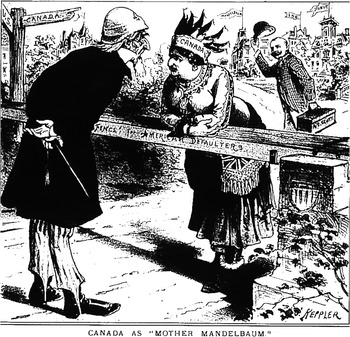
Two editorial cartoons in the humor magazine Puck reflect this sense of the border's simultaneous proximity and distance. On the cover of the June 17, 1885 issue, entitled “Canada as ‘Mother Mandelbaum’” (Figure 1), editor and illustrator Joseph Keppler emphasized the inability of American law to reach the boodler by drawing the border as a fence. Canada, serving as gatekeeper, only admits the ruffians; she refuses to let through Uncle Sam, the upright constable.
Joseph Keppler, “Canada as ‘Mother Mandelbaum,’” Cover of Puck, June 17, 1885.

Nevertheless, the fence that traps Uncle Sam on the U.S. side is frustratingly low: he can clearly see the fleeing boodler on the Canadian side, flaunting his freedom with the tip of a hat, and the mansions of other famous boodlers. Fredericka “Mother” Mandelbaum, one of the few female boodlers, was an infamous “fence,” or receiver of stolen goods. In Keppler's illustration, Canada serves as a fence in a double sense: She is a barrier to free passage, and she also receives the illicit boodlers, as well as their stolen money. In an article accompanying this cartoon, Keppler explained, “When the strong arm of the United States law reaches out after the thieves, Canada leans gently over the boundary line and says: ‘I have them and you can't get them.’”Footnote 57
The idea of a fence at the border was purely metaphorical. On the actual borderline, there were no physical impediments. In the 1880s, passengers on trains and ferries could cross without hindrance; neither passports, nor identification documents, nor physical examinations were required. A customs agent on the Canadian side examined luggage in search of dutiable goods; however, the 1891 Canadian Guide Book assured travelers that “the search is not severe if the traveler shows a disposition to facilitate it.”Footnote 58 Moreover, bags full of cash may have looked suspicious, but they were not dutiable.
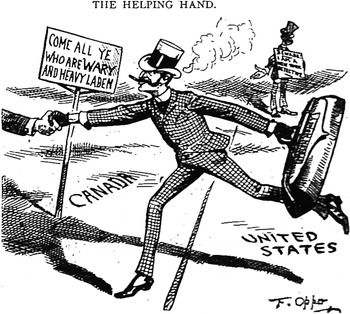
While Keppler emphasized the inability of law to cross the border, cartoonist Frederick Burr Opper highlighted this ease with which fugitive persons and capital could escape across the international line (Figure 2). Rather than an impermeable fence, Opper represented the border as a mere scratch on the ground, an invisible line that presents no physical obstacle. The boodler, with his oversized carpetbag, leaps gracefully from the United States to Canada. Opper goes farther than Keppler in his accusations of Canadian complicity, accusing Canada not only of offering a haven but of actively encouraging and assisting boodlers, presumably to benefit from their “stolen money.” The words on the sign mock Matthew 11:28: “Then Jesus said, ‘Come all ye who are weary and heavy-laden, and I will give you rest.’” Canada, instead, beckons those who are “wary” of law enforcement and heavy-laden with loot. Meanwhile, American law is still thwarted. A barely discernable detective in the upper-right corner stands with his feet firmly planted on the U.S. side, wholly disregarded by the boodler and unable to stop his escape into Canada. The boodler may find the border ethereal, but it still bars the detective. The inability of U.S. law to penetrate the Canadian border was all the more frustrating because of the ease with which U.S. capital flowed across.Footnote 59
Frederick Burr Opper, “The Helping Hand,” Puck, August 12, 1884, 379.

This was not the only U.S. capital crossing the northern border during the 1880s. American investments in Canada grew rapidly in the last decades of the nineteenth century, in areas such as railroads, mining, and logging. Large American corporations like Singer, General Electric, and Westinghouse established plants in Canada; Western Union and Bell Telephone operated through Canadian subsidiaries; and Standard Oil bought up rivals in the Canadian petroleum market. Corporations also lobbied to tear down tariff walls and open up freer trade.Footnote 60 Using the same metaphor as frustrated law enforcers, Erastus Wiman, an advocate of commercial union between the United States and Canada, condemned the customs line between the neighboring countries as “a barbed wire fence.”Footnote 61
For American companies concerned with freeing up capital flows across the border, drawing a distinction between their licit and the boodlers’ illicit capital was crucial. However, from the Canadian perspective, this distinction was not always so clear-cut. Some of the boodlers invested in Canadian business ventures and even ended up on the boards of Canadian corporations. John Chester Eno invested heavily in Quebec's Lower Laurentian Railway and served as the company's treasurer from 1891 to 1895. (Though entrusting its finances to a known embezzler might seem improbable, the company owed its life to Eno, who convinced his wealthy friends in New York to buy stock in the venture.Footnote 62) John Keenan, another American exile, invested in mining and real estate around Montreal.Footnote 63 In a joke printed in Life magazine, a teacher asks, “What is the capital of Canada?” and a student answers, “The money taken there by United States financiers and boodlers.”Footnote 64 In many ways, the boodlers' loot was simply one more form of American capital helping to build Canada; once across the border, the authorized and unauthorized flows were both legal tender.
The inability to distinguish between legal and illegal capital thwarted one of the earliest efforts by the American Surety Company to trap the boodlers. The insurance company pushed for the boodlers' arrest under the Canadian law against bringing stolen property into the Dominion. This law had previously been used to target Métis and native peoples who conducted raiding expeditions across the border.Footnote 65 Unlike a branded cow or a clearly identifiable horse, however, fungible U.S. greenbacks could not readily be distinguished from each other. American Surety ultimately deemed the Canadian statute unhelpful “because it relates only to the identical property stolen, and there is no identity in money; hence, strictly legal proof that the fleeing thief has brought into Canada the precise property stolen can rarely be produced.”Footnote 66
If capitalists complained that the border seemed to turn bad money good, religious reformers bemoaned that fugitives were no longer considered criminals once they crossed into Canada. The humor magazine Puck poked fun at the idea of a border-crossing baptism cleansing boodlers of their sins, joking that “the waters of the St. Lawrence . . . wash the embezzler as white as snow.”Footnote 67 Still, there was another comparison that reformers almost never invoked, most likely for fear of evoking sympathy: the fugitive slave. Crossing the Canadian border into a new sovereign jurisdiction had once changed the legal status of African Americans as well, from slaves to free people. Most boodlers were white; African Americans generally lacked access to large pools of employers' money and were often restricted in their ability to travel. However, at least one boodler was of Chinese origin: Chu Fong, a cashier in New York's Chinatown.Footnote 68
The boodlers' compulsion to get rich quick indicated the same sort of moral failing assigned to gamblers in the late nineteenth century.Footnote 69 In fact, religious publications explicitly labeled the boodler a species of gambler.Footnote 70 For decades, moralists had preached that the only path to success and happiness was via the virtues of hard work, thrift, prudence, and abstention. Games of chance and risk, trying to get much for little, led to misery and ruin. The border seemed to subvert this moral order by eliminating the element of risk. The legal loophole in the extradition treaty eliminated the fear of punishment, which in turn encouraged vice. “Embezzlement is the great financial crime of the century, yet a defaulter who leaves New York twelve hours ahead of the officers of the law, is absolutely safe if he takes a train for Canada,” the Reverand Henry A. Riley reflected in the pages of Zion's Herald. “What a temptation to crime this certainty of exemption from punishment produces.”Footnote 71
Financial and religious reformers also feared that the popular press would make boodlers appear attractive and appealing, an alternative model of how to achieve wealth and happiness. Tabloids made a business of sensationalizing the boodlers and dramatizing their lavish lifestyles. A new genre of crime reporting was born, in which the ordinary lives of fugitives could be sensationalized long after their initial misdeeds. Previously, the media's focus had been the crime itself. Embezzlement was a one-time story; the theft, not the thief, was the news. But by 1885, the popular press had begun to publish frequent updates on the whereabouts, lifestyles, and financial conditions of American defaulters living in Canada. Typically, these lengthy features took up an entire page, bore enormous headlines, and profiled the exploits of upwards of twenty separate boodlers.Footnote 72
John Chester Eno, for instance, continued to make headlines long after Judge Caron refused his extradition. Reporters followed him in Canada, sending home news of his every move. “Mr. Eno is enjoying a fine time in Quebec, and is well pleased with his treatments in that quaint old city on the mountain side,” reported the New York World, and it was clear why. Over the next few months, readers learned that Eno had moved into the best country house in Quebec, won a gold medal in a billiards tournament, owned the finest horses and sleigh in town, and brought his wife to a society ball “glittering in diamonds.”Footnote 73
From these stories, the boodler became classified as a type.Footnote 74 The yellow press characterized boodlers as wildly rich and carefree, “enjoying themselves as inclination and purse permit.” They reportedly lived together in “boodler colonies,” along with their families, and enjoyed active social lives. “In Montreal,” reported the Boston Daily Globe, “boodlers may be seen in stores driving fashionable turnouts, at the theatres, on the principal thoroughfares, in the fashionable gambling dens of St. Lawrence, Main and St. James streets. They are mostly club men, dine and spend their evenings with the upper ton of society at fashionable establishments, and are often seen at balls given by leaders of society.”Footnote 75 In these stories, exile in Canada seemed a privilege rather than a sacrifice. Eno claimed to “like the people better, and feel better” in Quebec than in New York. Abner Benyon, formerly of the Pacific National Bank of Boston, professed that he had never felt healthier.Footnote 76 The appeal of Canada could appear so threatening that, when Century Illustrated Magazine published a standard travel feature entitled “Canada as a Winter Resort” in February 1886, a reader sent in an angry letter accusing the magazine of encouraging defalcations.Footnote 77
Much of what the papers reported was inaccurate. The boodlers were spread out across Canada, and few of them socialized together. They were a diverse lot, ranging in status from former bank presidents to the lowest-level clerks and cashiers. Many were practically broke, having fled the United States after losing company funds, rather than embezzling money to bring with them. Nevertheless, as a composite figure in the popular press, the quintessential boodler was characterized above all by his transgression of class boundaries. A Robin Hood among robber barons, he subverted the established economic and political order by stealing from the rich.Footnote 78
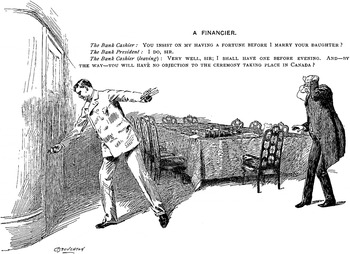
Thanks to this transgression, the boodler took on a sympathetic, almost heroic quality in the popular press. While the sensationalized stories never actually praised the boodlers' crimes, neither did they condemn them. Boodlers were no worse than the capitalists they stole from. “Some of the millionaires of our current census obtained their fortunes by means scarcely, if any, more reputable than that resorted to by the embezzler who rifles the safe which he is paid to guard,” commented Frank Leslie's Illustrated Newspaper. Footnote 79 Jokes about the clever boodler turning the tables on his boss were ubiquitous. The Life magazine cartoon “A Financier” (Figure 3) exemplifies this portrayal of the boodler as a witty trickster.
C. Broughton, “A Financier,” Life, June 16, 1892, 371.
The Bank Cashier: You insist on my having a fortune before I marry your daughter?
The Bank President: I do, sir.
The Bank Cashier (leaving): Very well, sir; I shall have one before evening. And—by the way—you will have no objection to the ceremony taking place in Canada?

The idealized boodler challenged a social order in which a handful of capitalists wielded immense wealth and power, and middling managers found their dreams of “getting up the ladder” nearly impossible to achieve. By the end of the nineteenth century, historian Scott Sandage explains, middle-class Americans defined success as an “unceasing increase” of money, deal making, and prestige. Failure was signified not only by calamity or collapse, but also stasis and stagnation. A life of mundane inertia was considered a loss of freedom, a “confine[ment] not in a damp, dark prison but in a dull, dead office.”Footnote 80 The boodler protested his dead-end job and inability to move up in the capitalist workplace by actively fashioning a new life with all the trappings of success. The words commonly used to describe Canada's relationship to the boodler—refuge, asylum, freedom, liberty—underscored a sense of liberation. He lived out the American dream of becoming a self-made man—but to do so, he had to go to Canada.
An 1886 anecdote indicated that some members of the working class viewed the boodlers with a sense of solidarity. On the train to Montreal, a New York Times reporter realized that the railroad staff mistook him for a boodler. Describing his journey in the third person, he wrote:
When he is received on board the train by the conductor and porter he knows that he is an object of interest, and that they feel like conspirators in permitting him to shake the dust of New-York City from his feet. They take every possible occasion to say something cheerful to him when the train is in motion, and seem anxious to keep him fully posted about the country through which the train is speedily being drawn. When he reaches the border line between the United States and Canada they break out into a laugh which seems to say, “Well, he's all right now.”Footnote 81
Bankers and moral reformers urgently felt the need to directly challenge the positive image of the boodler. They tried to construct an alternative narrative, one that focused not on the outer trappings of boodlers' high living, but on their loneliness, regret, and inner spiritual desolation. In January 1886, the New York Evangelist began printing its own updates about American fugitives in Canada: “Silas E. Cheek of Clinton, Mo., having embezzled a large sum from the bank of which he was cashier, has gone to Canada, leaving this schedule of assets for his creditors: ‘I am a thief and a scoundrel, knave and a liar.’”Footnote 82 Other stories focused on the victims of embezzlements, not the capitalists but the suffering widows and orphans whose savings were lost. The American Surety Company released a report in 1887 claiming that boodler jokes lowered public morals by “familiarizing our maturing youth with flippant treatment of the subject of crime.”Footnote 83 Others challenged the appeal of crossing the border. The usually humorous columnist Bill Nye took a somber turn when writing about an American he met in Canada, who described himself as “the man without a country. People think I am over here having a good time with the large sum of money I am supposed to have. I am not having a good time.”Footnote 84
Ultimately, however, challenging the boodlers' image was merely a partial fix. Bankers and moral reformers realized that to deter future embezzlements, it was necessary to catch and punish boodlers; the unrestrained mobility that fugitives enjoyed needed to be contained. Nevertheless, there were multiple, sometimes conflicting, ideas about how to control international border crossings. The boodlers had to be apprehended, but the method for capturing them was contested.
The Long Arm of the Pinkertons
Law was just one of many responses to the problem of international mobility, and not necessarily the most effective. Banks and insurance companies frequently turned to privately hired agents, particularly Pinkerton detectives, to pursue fugitives, thus bypassing both a dependence on the state to act and the obligation to respect Canadian sovereignty. The various attempts to stop the boodlers can be grouped into two categories: those that impeded them from crossing the border in the first place, and those in which the long arm of the law reached across the border. In other words, one solution weakened the legal significance of the border, thus making it easier for law enforcement to reach to the other side; the other solution made the border more like a fence, restricting fugitives' movement across the line.
Amending the extradition treaty was the most commonly suggested solution to the boodler crisis, but it was far from simple or speedy. It meant entering the sluggish realm of international relations: months or even years of diplomatic negotiations, followed by lengthy debates in the British Parliament and U.S. Senate that were often inflamed by party politics. Moreover, when it came to Canada, extradition was not the most pressing diplomatic issue. Throughout the 1880s, the United States and Britain argued over American rights to use Canadian fishing grounds, and in 1886, 1887, and 1889, the United States seized Canadian ships in the Bering Sea in a dispute over the lucrative fur seal trade.Footnote 85
In June 1886, after two years of negotiations, a new extradition convention was finally drafted. The Phelps-Rosebery treaty—named after Edward John Phelps, the U.S. envoy to Britain, and Lord Rosebery, the British foreign secretary—added four new offenses: manslaughter, burglary, embezzlement, and “malicious injuries to property whereby the life of any person shall be endangered.” This last offense turned the otherwise uncontroversial document into a firestorm. It clearly targeted members of two radical Irish nationalist organizations operating from the United States, the Fenian Brotherhood and the Clan na Gael. As a tactic to pressure Britain to withdraw from Ireland, these groups attacked English government buildings with dynamite and made periodic raids into Canada.Footnote 86 Both Democratic and Republican Senators feared alienating the Irish vote, and they managed to delay consideration of the Phelps-Rosebery treaty for nearly three years.Footnote 87 The treaty's most vocal opponents portrayed it as a devil's bargain. “I wouldn't give up one decent Irishman to England for a hundred boodle Aldermen!” declared Virginia senator Harrison Riddleberger. On February 1, 1889, the Senate finally rejected the treaty by a vote of 15 to 38.Footnote 88
This situation was intolerable for the banks, insurance companies, and corporations with a financial stake in stopping the boodlers. The American Bankers' Association passed resolutions calling for an amendment to the extradition treaty at its annual meetings in 1885, 1886, and 1887.Footnote 89 The vice president of the American Surety Company, which insured the largest banks in New York against defalcations by their employees, appeared before the Senate Committee on Foreign Relations in January 1889. Urging treaty revision, H. D. Lyman listed fifty-three embezzlers who took a total of $3,840,570 to Canada during the Senate's first year of delay on the Phelps-Rosebery treaty.Footnote 90
Rather than waiting for the Senate to act, these interested parties turned to private methods of law enforcement to stem the unauthorized flow of capital across the border. Many hired detective agencies, especially Pinkerton's National Detective Agency, to track down defalcators, retrieve their money, and set an example to deter employees in the future. The American Bankers' Association even contracted Pinkerton's to handle all cases involving its member banks.Footnote 91
The Pinkertons had a long history as agents of capital. Founded by Allan Pinkerton in 1850, the agency was routinely hired to infiltrate unions, break strikes, and provide background checks for credit reports. Although they were not representatives of the state, they wielded a quasi-police power that included the ability to make arrests. However, they also acted in ways that official police departments could not, thanks to their highly coordinated network of offices around the United States, as well as their willingness to employ techniques of questionable legality. Sometimes their actions were blatant violations of the law, but more often they acted in a gray area that had not yet been designated as legal or illegal—what might be called the extralegal realm.Footnote 92
Ideally, detectives would catch embezzlers before they crossed into Canada. The capture of Clasen Graham in 1885 illustrates the system working with its most ruthless efficiency. Graham, a clerk for the oil brokers Spencer, Trask and Company in New York City, was bonded by his company for his honesty. A detective hired by the guaranty company to periodically monitor employees noticed that Graham was staying out late and spending more money than his salary justified. He started to watch Graham more closely and one evening spotted him boarding the train for Montreal. The detective immediately telegraphed the guaranty company that he was getting on the train too and would look for orders at Springfield, Massachusetts, the first stop. The insurers contacted Spencer, Trask and Company who only then discovered that Graham had embezzled $20,000. Word was wired to Springfield, where the detective arrested Graham. Only four hours had elapsed between Graham's misdeed and his arrest; the speed of modern technology could work in the detective's favor as well as the boodler's.Footnote 93
Pursuits did not always proceed this smoothly, though. The Pinkertons prided themselves on catching career criminals who struck more than once, like train robbers, sneak thieves, and counterfeiters. Allan Pinkerton and Thomas Byrnes, the New York chief of police from 1880 to 1895, boasted collections of thousands of photographs of known criminals, called the Rogues' Gallery.Footnote 94 The identification of past criminals was not helpful when it came to stopping embezzlers, however, who generally had clean criminal records and sometimes acted on spur-of-the-moment impulses. Pinkerton himself lamented that “in the case of embezzlers without criminal records, and who were not under suspicion of surveillance, it was practically impossible to intercept the fugitive between the time of his starting for and reaching Canada.”Footnote 95 Boodlers were especially dangerous criminals in this respect: they were people who were utterly trusted but turned out to be devious and dishonest. Thus, they represented a far greater threat than a garden-variety thief.
Detectives began devising new and more aggressive tactics to prevent boodlers from crossing into Canada, essentially amounting to a makeshift form of border patrol. The official U.S. Border Patrol was not created until 1924, nearly forty years later; these local constables and private detectives were improvising a type of border policing whose only precedent was the Texas Rangers' Indian campaigns along the Mexican boundary.Footnote 96 They stationed themselves at the most popular border-crossing points and monitored Canada-bound trains, searching for suspicious-looking people. The Detroit-Windsor ferry depot was watched particularly closely, and the routes out of Chicago were patrolled so heavily that Illinois State Attorney Julius Grinnell boasted, “[Boodlers] can't get away from here. The road to Canada is not wide enough . . . to travel without bumping up against one or two detectives.”Footnote 97 The strategy was simply to observe a passenger's appearance and demeanor. Some detectives claimed that they could recognize a fugitive from justice at sight, leading the St. Louis Globe-Democrat to wonder just what “the precise facial characteristics of a boodler” were.Footnote 98 It was not uncommon to find stories of detectives accosting an innocent man.
American detectives did not limit their efforts to patrolling the U.S. side; they also breached the border in their pursuits. Technically, following a boodler across the line was acceptable under international law, but making arrests in Canada and transporting a prisoner back to the United States were violations of Canadian sovereignty. Still, Canadian sovereignty itself was an ambiguous concept, given that Great Britain still controlled its foreign affairs. Following the letter, if not the spirit, of international practice, American detectives set up patrols in Windsor, Ontario, hoping to seize boodlers before they stepped off incoming ferries and trains onto Canadian soil.Footnote 99 They also tracked boodlers down at their Canadian residences—not a difficult task, because so few disguised their identities—and bullied them into handing over whatever stolen money remained. In both William Dean Howells's novel The Quality of Mercy and Theodore Dreiser's Sister Carrie, American detectives trail the embezzling protagonists into Canada and guilt them into returning to the United States. Without overstepping their legal bounds, these detectives made life in Canada uncomfortable—a constant reminder to the boodler that he was a fugitive and that his life in Canada was based on a crime. Pinkertons continued to follow John Chester Eno in eight-hour shifts for months, even after it was determined that he could not be extradited.Footnote 100 For different reasons, both detectives and reporters tracked Eno's every move.
Other actions by American detectives more closely skirted the line of sovereignty. One tactic, pioneered by Allan Pinkerton, was known as “procurement”—using trickery to lure a boodler across the border and arresting him as soon as he stepped foot in the United States. Detectives generally employed one of three strategies, alterations of the methods that the Pinkertons used to infiltrate labor unions. The first involved befriending a boodler, usually claiming to be a fellow fugitive. Soon the detective would invite his new friend on a fishing or boating expedition on the Niagara River or one of the Great Lakes and would row him over to the American side.Footnote 101 The second strategy involved a more complicated ruse. The boodler would be hired for a phony job and given an important assignment in a border town. When he arrived, a detective posing as a driver would offer to take him to the boss's office, just a little farther on. Former bank clerk Albert Lange fell for this ruse; after a detective drove him from St. Armand, Quebec, to St. Albans, Vermont, Lange blamed his capture on his “want of geographical knowledge.”Footnote 102 The third strategy was the simplest and the most common. A detective would hire an attractive woman to seduce the boodler and draw him across the border. Sometimes the woman would invite the boodler on a boat or train ride; if he lived in a border town, she might offer an invitation to her room just across the line.Footnote 103
Hiring a procurer was expensive. Detective James L. Brown followed Indiana bank clerk William Schreiber to Windsor, Ontario, “secured the services of a beautiful woman with whom Schreiber was known to be smitten,” and arrested him when she lured him to Detroit. Brown sent the First National Bank of Columbus a bill for $37,000.Footnote 104 “This is costly service,” pointed out one editorial, “but when a man has gone to Canada with $100,000 or more of a company's money the company does not draw its purse strings very tight in making expenditures for his capture, not only to recover the money stolen, but to prevent peculation by its other employees, through the force of the moral influence arrest and punishment never fails to exert.”Footnote 105 Procurers were able to bypass Canadian law enforcers—something state actors would not have been able to do—but they still respected the border as a jurisdictional boundary: they did not lay a hand on the fugitive until his feet touched U.S. soil.
Other detectives, however, wholly disregarded the border as a line of sovereignty. Some were so bold as to kidnap a boodler and forcibly transport him to the United States. The abduction of Lawrence Brainerd in September 1885 was one of the first kidnap cases to receive extensive scrutiny. Brainerd had embezzled several thousand dollars from the St. Albans Savings Bank in 1884 and then fled to Winnipeg with his wife. The next year, a detective from the Boston agency of Wiggins & Wood tracked Brainerd down and befriended him, claiming also to be a “crook who had skipped across the line.” While duck hunting on the prairie, they were met by two of the detective's associates. Telling Brainerd that they would take him “by fair means or foul,” the three men overpowered the fugitive, bound him, and drove him across the American border, sixty miles away.Footnote 106
In some cases, American detectives operated in cooperation with local Canadian law enforcers, who looked the other way or even provided assistance when strong-arm tactics were used. After all, many Canadians also wanted the boodlers returned to the United States. “It is a great nuisance to us to be made the receptacle for all your runaway defaulters and embezzlers,” Canadian prime minister Sir John A. Macdonald told an American correspondent in 1887. “You may rest assured that the Canadian people are not anxious to harbor these men.”Footnote 107 A particularly close relationship formed between A. P. Sherwood, head of the Dominion Police, and William Pinkerton, who took over the agency after his father Allan's death in 1884. The two of them maintained a regular correspondence and frequently called on each other for help in locating wanted persons.Footnote 108
When cooperation broke down, it was usually because local authorities with fierce territorial pride got involved. Upon learning about Brainerd's abduction, outraged Winnipeg officials unsuccessfully attempted to intercept his kidnapers before they crossed the border. Calling the capture a violation of Canadian sovereignty, they threatened to take legal steps to enforce Brainerd's return to Canada and procure the arrest of the detectives involved.Footnote 109 Before they could make any headway, Brainerd escaped from American custody and returned to Canada. His case, however, brought to the foreground the issue of the legality of the detectives' actions. Dueling editorials in American newspapers revealed a highly contested, split opinion about whether kidnapping was justified.Footnote 110
Two habeas corpus cases in 1886 tested the legality of detectives' tactics. The first, before the New York Superior Court, concerned Daniel Brown, who was tricked into crossing the border. While sharing a paddleboat on the Niagara River, a detective persuaded Brown to enter the United States by telling him that they were actually on the “Grand River” and that Canada still lay on the other side. (In fact, it was New York.) Brown's attorney argued that this constituted fraud, and therefore Brown's subsequent arrest and detention were unjustified.Footnote 111 The second case, before the U.S. Supreme Court, involved Frederick Ker, a Chicago embezzler who was kidnapped by a Pinkerton agent in Peru and forcibly returned to the United States. Although this case did not involve Canada, it was clear that Ker v. Illinois would set a precedent pertinent to the boodlers there. “There is a little colony in Canada which will watch with interest the proceedings,” noted the periodical The North American.Footnote 112
Both courts gave sanction to the Pinkertons' extralegal tactics by refusing to disqualify the fruits of their labor. The ruling in the two cases was the same. The means by which the prisoner entered the United States was irrelevant. If he was physically located on U.S. territory, he was subject to arrest and prosecution. Neither Brown nor Ker could claim any violation of their rights under the Constitution for acts of fraud or assault that occurred abroad.Footnote 113
The threat of abduction already had a chilling effect on boodlers, but after the Ker decision, the fear altered their behavior even more. “They dare not walk out alone at night for fear of being seized from behind, bound, gagged and whirled away toward Sing Sing,” the Washington Post reported. After a series of kidnap attempts, anxious boodlers living near the border made a point to stay away from the river or moved to towns farther north.Footnote 114 More of them began to disguise their identities. Rumors circulated that some detectives were blackmailing boodlers, asking up to $1,000 to protect the “quaking fugitives” from kidnappers.Footnote 115
In one sense, the Pinkertons reinforced the reification of the border as an absolute jurisdictional divide. The boodlers had taken advantage of the sovereignty inscribed in the border to escape punishment; now, the Pinkertons used it toward the opposite end. If boodlers were safe the moment they stepped foot into Canada, they were also trapped as soon as they touched U.S. soil, whether or not by their own volition. At the same time, though, the border was being broken down as an absolute line of authority. Kidnappings meant that boodlers were vulnerable even on Canadian soil; the border no longer protected them. They had to move farther and farther into Canada, or beyond, to feel safe, creating a buffer zone that symbolically pushed the border outward. As non-state actors, detectives also broke down the divide by working on both sides of the line.
Not all Americans felt comfortable with the idea of the Pinkertons crossing the line and breaching Canadian sovereignty. Some newspaper editorials pointed to a converse method of approaching the border. Rather than making it easier for law enforcers to traverse, they proposed solutions that made it harder for fugitives to cross. Invoking the detectives who patrolled Canada-bound trains and the Detroit-Windsor ferry, an 1887 editorial in the St. Louis Globe-Democrat called for an even more stringent monitoring of the border. It proposed that travelers be required to show identification and submit to questioning before receiving permission to cross. “Would it be unconstitutional to take [such] precautions at stations on the Canadian frontier, at any rate until extradition is a little less of a sham than it is now?” it asked.Footnote 116
In a departure from the freedom of movement assumed by Americans through most of the nineteenth century, these proposals anticipated the gatekeeping regime that would soon arise at the U.S.–Mexico and U.S.–Canada borders.Footnote 117 In the wake of the Chinese Exclusion Act of 1882, the problem of Chinese “leaking” into the United States was just starting to be seen as a national crisis in the late 1880s.Footnote 118 Over the next two decades, the United States would turn to aggressive monitoring tactics on both its borders.Footnote 119 This next phase would be led by the state, acting in the name of its own sovereignty, rather than the Pinkertons acting in the name of capital. However, the use of aggressive techniques to control the flow of people across the border was developed—and familiarized to Americans—during the era of the boodler.
The Decline and Fall of the Boodler
The cross-border activities of the Pinkertons and other private detectives had a chilling effect. Although extralegal actors may have stemmed the flow to Canada, it took an act of state before the boodler phenomenon was finally declared dead. By the end of the 1880s, newspapers reported rumors that boodlers were starting to flee to places other than Canada, and in 1890 a new extradition treaty was finally ratified.Footnote 120 Nevertheless, the subsequent rise in embezzlement rates demonstrated that the problem was not the Canadian border; it was the continued inability of the law to keep up with ever-expanding international mobility. When Canada ceased to provide an asylum, fugitives simply reached farther out to find a sanctuary. U.S. law, it seemed, could not truly be effective unless it covered the entire globe.
Canadians had been dismayed by the U.S. Senate's rejection of the Phelps-Rosebery treaty in February 1889. Despite Americans' persistent accusations that Canada welcomed the boodlers' money, moralistic Canadian politicians had begun to campaign on an anti-boodler platform, vowing to remove the American exiles from Canadian soil. Richard Chapman Weldon, a Conservative member of Parliament and well-known jurist, introduced a bill before the House of Commons the following month. The Weldon Extradition Bill called for Canada to unilaterally surrender all fugitives whose extradition was not provided for under existing treaties. Weldon hoped to bypass the pitfalls of international diplomacy and solve the boodler problem by statute rather than treaty. Explaining his rationale in penning the bill, he told Parliament:
I, as well as every respectable man in the Dominion, am suffering from the facility with which a thief, or blackmailer, or briber, or embezzler can find a refuge here. I go to a hotel, and the chances are that my name on the register is preceded by that of some well-known American boodler or defaulter. In the dining-room the chances are that I am put at the same table with this thief. I ride beside him on railroad cars; he sits in the gallery of this house and mixes with my family and friends. . . . He is a social Pariah, a national disgrace, a menace to our institutions, and a temptation to our clerks, our business-men, our cashiers, our bank officials, and our children to do wrong and live in luxury on the other side of the line, safe from pursuit and punishment.Footnote 121
Like American religious reformers, Weldon challenged the view that the border changed fugitives' legal status. Instead, he contended that boodlers were still criminals after they crossed into Canada and should be treated as such. He also expressed a sentiment that would often be heard in the future: Americans were corrupting Canadian life.
Weldon's motives were mired in party politics. The Conservative Party had been wracked by corruption scandals for more than a decade; in fact, in Canada, the word “boodler” referred to Tory politicians as well as American fugitives.Footnote 122 The Weldon Bill gave the Conservatives a chance to reinvent themselves as moralists by speaking out against American vice and to distance themselves from corruption by portraying the menace as coming from south of the border. Liberal newspapers like the Toronto Globe and the Montreal Herald pointed out the hypocrisy of a Conservative leading the charge against corruption.Footnote 123
The boodlers, who had never formed the close-knit community that the yellow press generally portrayed, finally lived up to their reputation. John Chester Eno and John Keenan headed up the effort to lobby against the Weldon Bill. Eno and Keenan traveled across the Dominion, seeking contributions from fellow boodlers, and raised a fund of nearly $100,000. They hired a lawyer to challenge the bill's legality and then proceeded to Ottawa to lobby members of Parliament. Their lobbying, many American newspapers suspected, merely amounted to the offering of bribes.Footnote 124
Canadians were not all of one mind about whether they should shelter boodlers. When the bill went up for debate in the House of Commons, the division was less along party lines than geographical ones. The members of Parliament who defended the boodlers came from the areas that had most benefited from their influx of money. MPs from Montreal, Quebec, and Toronto—areas where many boodlers settled and invested—testified to personal acquaintances for whom the Weldon Bill would create an “extreme hardship.” “On the faith of our laws a man comes to this country believing that he will find an asylum here,” explained Joseph Lavergne, MP from Quebec. “He settles down and becomes a good citizen . . . his family becomes connected very often with respectable families; and it would be most unfair, it would be an infringement of acquired rights, for a person from a foreign country to come and accomplish his arrest and his extradition.”Footnote 125 Unlike Weldon, Lavergne portrayed the border as a redemptive force that caused fugitives to reform their ways; indeed, receiving a fresh start transformed them into the most illustrious of citizens.
The boodlers and Weldon each won a half-victory. On April 23, 1889, the House of Commons passed the bill, but the Quebec MPs managed to strike out the clause that would have made the statute retroactive. Those Americans already in Canada were safe, but future fugitives would not receive asylum.Footnote 126 The Extradition Act's true force was in its message, however, as it was never actually implemented. England barred its execution, claiming that it constituted extraterritorial legislation and therefore overstepped the authority of the Canadian Parliament.
The next year, U.S. secretary of state James Blaine presented yet another extradition convention to Congress, but this time the Senate approved it almost immediately. The ten new offenses in the treaty included embezzlement, but none targeted dynamiters. Irish American groups expressed their wholehearted approval. Negotiated under a new presidential administration, as well as a newly appointed British envoy to the United States, the 1890 treaty suggested the dawning of an era of cooperation and understanding in U.S.–British diplomacy.Footnote 127
But did it stop the boodlers? On November 18, 1890, Charles Pscherhofer of New York became the first person extradited from Canada to the United States on charges of embezzlement. Over the next year, four more accused embezzlers were extradited.Footnote 128 Journalists joked about where the boodlers would run next: South America? Cuba? China?Footnote 129 Within less than a year, stories about boodlers—even the word boodler—had vanished from the papers. By 1895, the New York Times observed that “people hereabout have almost forgotten by this time the flock of New-York ‘boodlers’ that fled to Montreal about ten years ago.”Footnote 130 Nevertheless, the rate of embezzlements in the United States continued to increase steadily during the 1890s.Footnote 131 Examining the statistics, an 1891 editorial in the Washington Post praised the end of the mass exodus to Canada but wondered whether the 1890 extradition treaty could truly be called a success: “The reform that will remove the temptation to get rich in a hurry will be the most effective that can be adopted; but, unfortunately, it has not yet been discovered.”Footnote 132
The increasing crime rates convinced reformers that the problem had not been Canada per se, but the breadth and flexibility of new types of mobility. Over the next two decades, American fugitives continued to flee to international asylums, particularly Honduras, Costa Rica, Brazil, and other stops along the steamship route down the Atlantic coast of Central and South America. This exodus propelled American agents, public and private, to extend the reach of their policing even farther beyond the nation's borders. In his 1903 Message to Congress, President Theodore Roosevelt declared, “It should be the policy of the United States to leave no place on earth where a corrupt man fleeing from this country can rest in peace.”Footnote 133
An extradition treaty had been an acceptable solution with Britain, a great power with the resources to apprehend American fugitives. Extradition was a bilateral solution with reciprocal obligations, enabling cross-border law enforcement while at the same time maintaining a respect for each nation's sovereign boundaries. However, when dealing with smaller and weaker countries, American agents frequently breached lines of sovereignty, turning to the unilateral solutions like procurement and abduction that had been sanctioned in the 1880s.
Over time, the two tactics envisioned to apprehend the boodlers—border guarding and international policing—took divergent paths in Americans' national and global imaginations. Border guarding took on an insular focus: patrols and fences were created to protect the nation from perceived external dangers like illegal immigrants and contraband. International policing, on the other hand, became part of an expansionist U.S. foreign policy. The simultaneous existence of these inward-looking and outward-reaching policies might appear contradictory, even hypocritical. However, by exploring their common origins in the late nineteenth and early twentieth centuries—in the boodler crisis and other incidents—we can understand both as reactions to a newly mobile society that was both exciting and terrifying in its destabilizing power.