Neonatal aortic thrombosis is a potentially life-threatening condition with significant morbidity and mortality if undiagnosed and untreated.Reference Schmidt and Andrew 1 The most common location of arterial thrombosis in neonates is in the abdominal aorta and is associated with umbilical artery catheterisation.Reference Schmidt and Andrew 1 There are only a few previous reports of thrombosis in the ascending aorta.Reference Das, Sahoo and Ivy 2 , Reference Francis, Monagle, Hope and Sehgal 3 We describe a case of ascending aortic thrombosis in a neonate who underwent successful thrombolytic therapy.
Case report
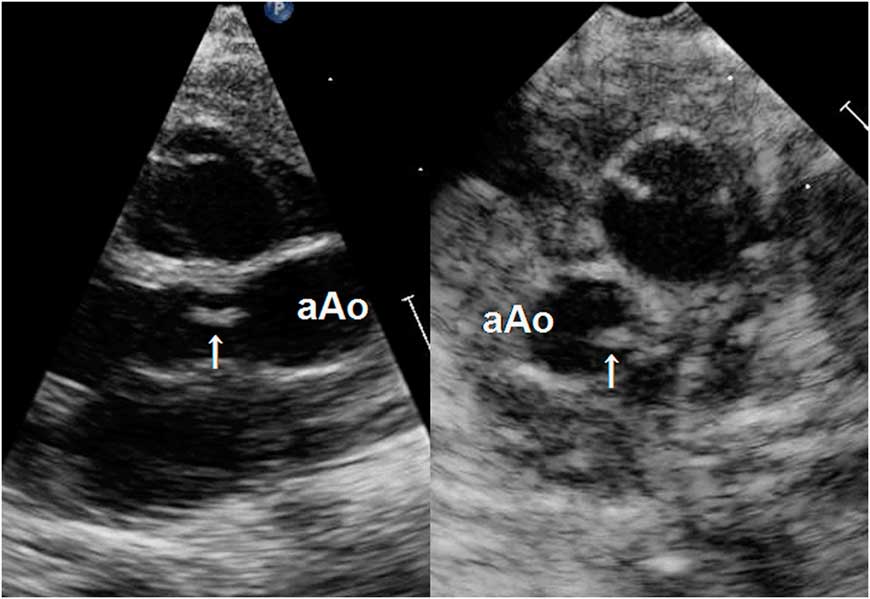
A male infant was born at 39 weeks’ gestation weighing 2650 grams with Apgar scores 1 and 5 at 1 and 5 minutes, respectively. The baby had foetal bradycardia 5 minutes before delivery and his umbilical cord was wrapped around his leg. At delivery, he was noted to be limp, asystolic, and had gasping respirations. He was intubated because of hypoxia and started on inhaled nitric oxide with significant improvement. He was weaned off inhaled nitric oxide the same day and extubated. Initial cardiac echocardiogram suggested persistent pulmonary hypertension of the newborn with questionable decreased cardiac function. On day 1, the patient had worsening respiratory distress and an increased oxygen requirement, and thus he was reintubated and restarted on inhaled nitric oxide, as well as dobutamine and milrinone drips for hypotension. Repeat echocardiogram revealed significant left ventricular dysfunction (ejection fraction <40%), a 6.7-millimetre mobile echogenic structure in the left sinus of Valsalva with question of thrombus into the left coronary artery (Figure 1, Supplementary Video S1), and severely increased right ventricular pressure. There was no finding of pulmonary thromboembolism in the echocardiogram. There was no family history or maternal risk factor. His thrombophilic studies including antithrombin III, protein S, and protein C were within the low normal range.
Echocardiogram of the ascending aorta (aAo) showed mobile thrombus (arrow) at the left sinus of Valsalva.

On the basis of a multi-disciplinary discussion, systemic thrombolysis was decided as the treatment of choice. Fresh frozen plasma was given before starting thrombolytic therapy. His fibrinogen level was normal during the clinical course. He was started on continuous tissue plasminogen activator at a rate of 0.06 mg/kg per hour without heparin.Reference Wang, Hays and Balasa 4 After 6 hours, a follow-up echocardiogram showed that the mobile part of the aortic thrombus was no longer present. Tissue plasminogen activator was discontinued and unfractionated heparin was started with activated partial thromboplastin time goal between 60 and 85 seconds. After 5 days on this regimen, the patient was switched to subcutaneous enoxaparin sodium 1.5 mg/kg every 12 hours. Multiple follow-up echocardiograms showed moderately depressed left ventricular function, but complete resolution of the thrombus. Cranial ultrasound showed no abnormalities. The patient was discharged home on enoxaparin injections for 6 weeks, and his ejection fraction of the left ventricle improved to 65%.
Discussion
Neonatal aortic thrombosis, although rare, has been associated with umbilical artery catheters, asphyxia, sepsis, diabetic mothers, dehydration, cytomegalovirus infection, and thrombophilic disorders.Reference Nowak-Gottle, von Kries and Gobel 5 , Reference Klinger, Hellmann and Daneman 6 Most reported cases of aortic thrombus in the newborn are located infrarenally – as high as 86% reported by Klinger et alReference Klinger, Hellmann and Daneman 6 – and among these umbilical artery catheters and peripheral arterial catheters were the predominant risk factors. Our patient had no thrombogenic risk factors, but did have an umbilical artery catheter placed when he first became symptomatic. The aetiology of his thrombus still remains unclear.
There are guidelines for thromboembolic treatment in the neonate population;Reference Monagle, Chalmers and Chan 7 , Reference Monagle, Michelson, Bovil and Andrew 8 however, treatment options are largely based on the adult literature and centre-specific preferences. Owing to the fact that he was symptomatic and in critical condition, the therapeutic options were anticoagulation, thrombolytic therapy, or surgical thrombectomy. Thrombolytic therapy was chosen on the basis of clinical status, potential improvement of left ventricular dysfunction, and prevention of acute obstruction of the left main coronary artery. Previous studies have cited the incidence of bleeding secondary to thrombolytic agents as high as 20% in the paediatric population.Reference Greenway, Massicotte and Monagle 9 In a separate review, the incidence of intracranial haemorrhage in 83 term neonates who received thrombolytic therapy was 1.2%.Reference Zenz, Arlt, Sodia and Berghold 10 There is no consensus on the bleeding risk of thrombolytic therapy in neonates, but current recommendations reserve the use of thrombolytic therapy for newborns with life-, organ-, or limb-threatening conditions.Reference Monagle, Chalmers and Chan 7 , Reference Monagle, Michelson, Bovil and Andrew 8 On the basis of these studies, the risk was outweighed by the potential benefits our patient could expect.
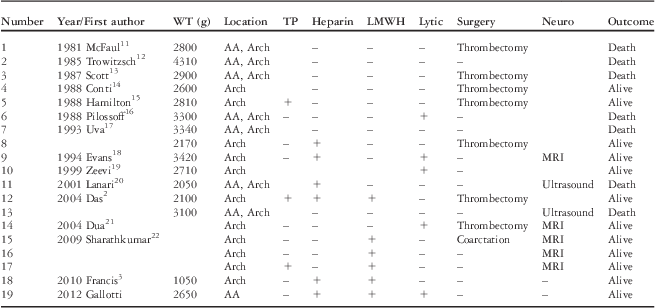
Table 1 shows the literature review of aortic thrombosis at the ascending aorta or aortic arch in neonates. Thoracic aortic thrombosis is more challenging, especially both in the ascending aorta and aortic arch. Neurological abnormal findings are common in these patients. Surgical intervention risks peripheral embolism from aortic cannulation, and requires the use of cardiopulmonary bypass, possibly using deep hypothermic circulatory arrest. Das et alReference Das, Sahoo and Ivy 2 reported surgical thrombectomy for arch thrombosis, and Francis et alReference Francis, Monagle, Hope and Sehgal 3 reported anticoagulation therapy. Although our patient had good outcome after the medical management, this case highlights the lack of understanding with regard to the aetiology, diagnostic approach, and optimal therapy when treating thoracic aortic thromboses in the neonate population. Further investigation will be needed to elucidate some of these questions.
Aortic thrombosis at the ascending aorta/aortic arch in neonates: literature review.

AA = ascending aorta; Arch = aortic arch; LMWH = low-molecular-weight heparin; Lytic = thrombolytic therapy; MRI = magnetic resonance imaging; Neuro = neurological examination positive; TP = thrombophilic studies; WT = weight