INTRODUCTION
Global food production needs to increase by 100–110% by 2050 over 2005 levels (Tilman et al. Reference Tilman, Balzer, Hill and Befort2011). Overall, it is estimated that some 0·8 of future increases in crop production in developing countries will have to come from intensification: higher yields, increased multiple cropping and replacement of fallow periods (FAO 2002). Sustainable agricultural intensification is recognized as a major thrust of research aiming to feed humanity towards 2030 (FAO 2002) and 2050 (Lichtfouse et al. Reference Lichtfouse, Navarrete, Debaeke, Souchère, Alberola and Ménassieu2009; Chartres & Noble Reference Chartres and Noble2015).
The Eastern Gangetic Plain (EGP), which includes West Bengal, Bihar, Jharkhand and eastern Uttar Pradesh in India, and western Bangladesh, is one of the most densely populated and intensively farmed regions in the world. Rainfed and irrigated agriculture coexist in most of the EGP, where cropping is dominated by a monsoon (kharif) crop followed by a winter (rabi) rainfed crop in the absence of irrigation, giving two rainfed crops per year. In this region, legumes are commonly grown in a rainfed monsoon rice-rabi system during the dryer months, November to April, where irrigation is unavailable (Awadhwal et al. Reference Awadhwal, Gowda, Chauhan, Pande, Flower, Haware, Rego, Saxena, Shanower and Johansen2001). Large-scale river/canal irrigation has been available to substantial areas of the Western Gangetic Plain for over 50 years (Kahlon & Kapur Reference Kahlon and Kapur1968), and only in the 1980s did the use of irrigation become widespread in the Eastern belt (Mandal & Parker Reference Mandal and Parker1995). Subsequently, crop production has risen in the EGP through the use of irrigation on a winter crop, replacing rainfed winter crops (i.e. rabi crops) such as food legumes with crops such as irrigated spring rice (boro) to feed growing populations. This rotation of rainfed monsoon rice with irrigated spring rice has become the dominant cropping pattern in Bangladesh used by ~0·4 of rice growers on 1·8 million ha (Ahmed Reference Ahmed2016) with a brief winter fallow between the rice crops (Gumma et al. Reference Gumma, Thenkabail, Teluguntla, Rao, Mohammed and Whitbread2016). Although the replacement of rabi pulses with boro did not increase the cropping intensity beyond two crops per year, the substitution of a rainfed crop with an irrigated replacement increased food production overall. In Bangladesh, the displacement of winter legumes is evidenced by their reduction in area from 791 800 ha in 1984 to 282 409 ha by 2013, along with 50% lower production (FAO 2014). Nevertheless, the demand for dhal – a rich protein source – for the national dish of rice and dhal has fuelled the need for expensive pulse imports, which reached 804 000 t during 2013 (FAO 2014).
Winter crops, such as maize (Zea mays L.), potato (Solanum tuberosum L.), vegetables (i.e. Brassica oleracea L.) and oilseeds (Brassica rapa L., B. juncea L. and B. carinata A.Br.) can also replace the fallow. But they are mostly of an excessively long crop duration that does not allow timely transplanting in early February of a subsequent crop of boro rice. However, the exception is mustard (B. campestris var. toria), which is suitable for the rainfed rice–mustard–irrigated spring rice cropping pattern due to its short growing period in Bangladesh – albeit with a low yield (Karim et al. Reference Karim, Siddika, Tonu, Delwar, Hossain, Meah, Kawanabe, Fujimoto and Okazaki2014). In Nepal, intercropping pea with wheat yielded greater economic return over intercropping B. campestris var. toria with wheat (Subedi Reference Subedi1997). In India, rice–wheat cropping systems have been intensified with different vegetable and oilseed crops (Singh et al. Reference Singh, Sah, Singh, Singh and Hasan2010).
The current double rice system in the EGP comprises rainfed monsoon rice (Aman) transplanted in July/August and harvested in November/December followed by irrigated spring rice (boro) grown from February/March to April/May. There is a brief fallow period (~90 d) between the rice crops, extending from November to the end of January. The timing of sowing/transplanting and/or the use of short season v. long-season cultivars can impact on crop duration, potentially resulting in a yield penalty for rice (Hossain et al. Reference Hossain, Jaim, Alam and Rahman2013; Mannan et al. Reference Mannan, Bhuiya, Akhand, Rana and Zahan2013; lentil, Malik et al. Reference Malik, Ali, Zaman, Flower, Rahman and Erskine2016). Therefore, it is a major challenge to plant/sow at the optimal time for each crop in the rotation in order to achieve an economically viable cropping system. To date, cropping system intensification has focused mainly on single rice in the crop rotation with wheat/maize and different legume/vegetable crops (Timsina & Connor Reference Timsina and Connor2001). The aim of the current research was to test the feasibility to increase cropping intensity of rice and legume cultivars of differing maturity in the rice–fallow–rice system.
MATERIALS AND METHODS
The current study comprised crop sequence trials on a research station over three cropping cycles and an evaluation of the best sequence against farmers’ practice on three farmers’ fields. The experimental strategy – in common with that of farmers – was to maintain total rice production using farmers’ practices without incurring a yield penalty from the inclusion of a legume. The experiments were designed to ensure that the component crops in a sequence were transplanted at an optimum date for rainfed monsoon rice (1 August), and irrigated spring rice (1 February).
Experimental site, soil and climate
The experiments were conducted within the Bangladesh Rice Research Institute (BRRI) regional station at Rajshahi (24°22′N; 89°36′E; 23 m a.s.l.), which is in a major pulse-growing region. The soil at the BRRI station was clay loam with pH of 7·9 (1 : 5 soil and water suspension), containing 18–22 g/kg organic matter (Walkley & Black Reference Walkley and Black1934), 12·5 mg nitrogen (N)/kg (Bremner & Mulvaney Reference Bremner, Mulvaney, Page, Miller and Keeney1982), available phosphorus (P) 12 mg/kg (Olsen & Sommers Reference Olsen, Sommers, Page, Miller and Keeney1982), available sulphur (S) 15 mg/kg (Fox et al. Reference Fox, Olsen and Rhoades1964), exchangeable potassium (K) 46·8 mg/kg soil (Knudsen et al. Reference Knudsen, Petterson, Pratt, Page, Miller and Keeney1982) and available zinc (Zn) 0·50 mg/kg (Lindsay & Norvell Reference Lindsay and Norvell1978). Rainfall and temperature records for the duration of the experiment were collected from the nearest weather station (~1 km).
Field preparation and management
Land preparation was carried out by tractor or power tiller ploughing for rice, pea and lentil cultivation. The fertilizer applied for rainfed monsoon rice was (kg/ha) 90 N, 38 P, 46 K, 12 S and 2·6 Zn; for irrigated spring rice was 124 N, 46 P, 58 K, 15 S and 4 Zn; and for field pea and lentil was 19 N, 20 P, 30 K, 10 S and 1·5 boron (B). Nitrogen was in the form of urea, P as triple superphosphate, K as muriate of potash, S as gypsum, Zn as zinc sulphate (ZnSO4) and B as boric acid. At transplantation and thereafter, rainfed monsoon rice was irrigated four times to maintain optimum flooded conditions to achieve uniform establishment; however, irrigated spring rice received irrigation 14 times during the growing period, and for each irrigation the water level was raised to approximately 100 mm above the soil surface. Lentil and pea received irrigation once, 30 d after sowing, for optimum crop establishment. Weeding was carried out manually, when necessary, after crop establishment to maintain the plots weed-free. Rhizobial inoculation was not undertaken in the trials, but good nodulation was observed.
For disease control, pea seeds were treated with Bavistin® (active substance (a.s.) carbendazim) at 2 g/kg seed before sowing; and Secure® (a.s. mancozeb + fenamidone) was applied three times starting at 50% flowering and thereafter at 10 d intervals to control Stemphylium blight (Stemphylium sp.) of lentil.
Experimental layout and design
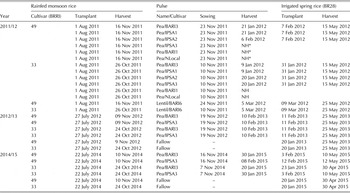
Four experiments were conducted over three seasons from July 2011 to May 2013 and July 2014 to May 2015. All experiments consisted of a sequence of crops including rainfed monsoon rice, then legume followed by irrigated spring rice. One field pea and one lentil experiment were conducted in the first season (2011/12) (Table 1). The remaining two experiments were conducted with the two best field pea cultivars from the first season and a fallow (control) in 2012/13 and in 2014/15 (Table 2).
Transplant/sowing and harvest date of rainfed monsoon rice (BR49, BR33), different pulses (pea and lentil) and irrigated spring rice in crop sequence trials at Bangladesh Rice Research Institute (BRRI) Rajshahi during 2011/12, 2012/13 and 2014/15

NH, not harvested (uprooted as they did not mature, see Fig. 2).
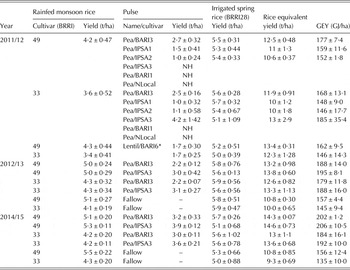
Yields of rainfed monsoon rice (BR49, BR33), different pulses (pea and lentil) and irrigated spring rice (BR28) in crop sequence trials at Bangladesh Rice Research Institute (BRRI) Rajshahi during 2011/12, 2012/13 and 2014/15

NH, not harvested (uprooted as they did not mature, see Fig. 2).
* Lentil = dry weight of seed.
Values are the means of three replicates, (±s.e., n = 3).
Crop sequence cycle 1 (Cycle 1) (June 2011–May 2012)
Pea experiment
The trial comprised the factorial combination of two rainfed monsoon rice cultivars – long duration BRRIdhan49 (BR49) and short duration BRRIdhan33 (BR33) followed by six released pea cultivars as the next crop (Table 1). Then, irrigated rice cultivar, BRRIdhan28 (BR28), was hand transplanted at the 5-leaf stage (growth stage (GS) 15, Zadoks et al. Reference Zadoks, Chang and Konzak1974) after pea harvest (Table 1). A randomized complete block design was used with three replicates and plots were 9 × 4 m. Rice cultivars BR49 and BR33 were hand-transplanted on the same date (Table 1) at the 5-leaf stage (GS 15) at line-to-line and hill-to-hill spacings of 25 and 15 cm, respectively. Following rice harvest, six field pea cultivars were hand-sown on two different dates (Table 1) at 70 kg/ha at 40 × 10 cm spacing.
Lentil experiment
The trial comprised two treatments comparing rainfed monsoon rice cultivars – long duration BR49 and short duration BR33 (Table 1). Lentil cultivar BARI masur6 seed was broadcast by hand at 30 kg/ha after rice harvest at two different dates (Table 1) depending on the prior rice crop harvest. Then, irrigated rice cultivar, BRRIdhan28 (BR28), was hand transplanted at the 5-leaf stage (GS 15) after lentil harvest (Table 1). The same trial design and plot size as the pea trial was used.
Cycle 2 (June 2012–May 2013) and Cycle 3 (June 2014–May 2015)
In Cycles 2 and 3, pea trials comprised the factorial combination of the same contrasting rainfed monsoon rice cultivars (BR49 & BR33) followed by three treatments: two pea cultivars (BARI3 & IPSA3) compared with fallow (Table 1). The same experimental design and plot size as the pea trial in 2011/12 was used. Rainfed monsoon rice cultivars were hand-transplanted. Following harvest of the rice two pea cultivars were hand-sown on two different dates, and spring rice cultivar BR28 was hand transplanted after peas were harvested (Table 1) as described for Cycle 1.
Evaluation of cropping sequence on farmers’ fields
An evaluation of the new cropping sequence with pea to replace the fallow was conducted from June 2014 to May 2015 on three farmers’ fields (Jhikargacha 23°6′N; 89°8′E; Manirampur 23°1′N; 89°14′E; and Kaliganj 23°24′N; 89°8′E) in Jessore district. The existing cropping pattern of rainfed monsoon rice–fallow–irrigated spring rice was compared with the new sequence, wherein fallow was replaced by pea. The sites were selected with farmers using a fallow between rainfed monsoon rice and irrigated spring rice. The plot size at each location was 0·13 ha, with no replications within site. Popular rainfed monsoon rice cultivars (i.e. BRRIdhan39, Dhanigold and Gutiswarna) were transplanted between 18 and 26 July. BARI motorsuti3 (BARI3) pea was broadcast sown at 200 kg/ha between 8 and 17 November following rice harvest. Irrigated spring rice cultivars (BR28, Mini kit and Shuvollota) were transplanted between 1 to 10 February. Crop management for pea was conducted by the farmers as described earlier and assisted by research staff.
Harvest and data analysis
Rice and lentil were harvested by hand at maturity. Peas were harvested as a green vegetable (i.e. green pods) twice and then up-rooted and removed to make the field available for the next crop. The harvested area was 4 × 3 m for all crops. Rice was harvested with a sickle, leaving ~10 cm straw, and lentil plants were harvested whole. Rice and lentil were dried in the sun and threshed manually. Rice was weighed with husks on and lentil seeds were threshed before weighing and both reported to 15% moisture. Pea pods were weighed fresh. Rice equivalent yield was calculated to estimate farm economic output, and grain energy yield (GEY) was calculated to estimate energy output. Rice equivalent yield for on-station experiments was calculated with market prices averaged for 2011 and 2012 (US$1 = 78 Taka (Tk), pea = 46 Tk/kg, lentil 97 Tk/kg and rice 43 Tk/kg); and farmers’ field trials were calculated using farm gate price for 2014 (pea = 35 Tk/kg, and rice 17 Tk/kg) as follows:
 $$\eqalign {{\rm Rice}\;{\rm equivalent}\;{\rm yield\;} \;{\rm (REY)\;} \;{\rm of}\;{\rm the}\;{\rm crop} \cr = \displaystyle{{{\rm (Yield\; \times \; market}\;{\rm price)}} \over {{\rm Market}\;{\rm price}\;{\rm of}\;{\rm rice}\;{\rm (currency}\,{\rm unit/kg)}}}}.$$
Grain energy yield (GJ/ha) was calculated for on-station experiments only, as described by Ladha et al. (Reference Ladha, Rao, Raman, Padre, Dobermann, Gathala, Kumar, Saharawat, Sharma, Piepho, Alam, Liak, Rajendran, Reddy, Parsad, Sharma, Singh, Saha and Noor2016). The GEY (output) in GJ/ha is the energy attained from the crop in harvested yield and was calculated by multiplying the GY (grain yield) achieved in the field by crop grain energy conversion (on a dry weight basis) factor (rice = 14·5 MJ/kg and pea = 14 MJ/kg).
Statistical analyses
Data were analysed by ANOVA (analysis of variance) where appropriate using GenStat (version 15.0) for windows statistical software (VSN International, UK). For the three cycles on station, cultivars of rice and legume were fixed effects. On farmers’ fields the two crop sequences were fixed effects. Means were considered significantly different at the P ⩽ 0·05 level.
RESULTS
Seasonal weather conditions
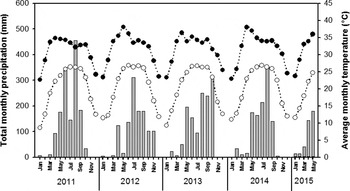
Total seasonal rainfall during the different cropping cycles was relatively similar with 1180 mm received in 2011/12, 1303 mm in 2012/13 and 1380 mm in 2014/15. This masks the differences within seasons, as the pulse growing seasons had very different rainfall totals. There was only 7 and 28 mm winter rainfall (November to February) during 2011/12 and 2014/15, respectively, compared with 125 mm in early November in 2012/13 (Fig. 1).
Monthly rainfall (bars) (mm) maximum (closed circles) and minimum (open circles) temperature (C) during the experimental period from 2011 to 2015 for Rajshahi, Bangladesh.

Rainfed monsoon rice
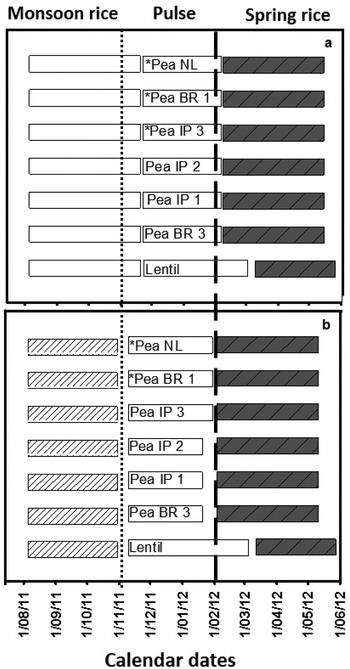
The long-duration monsoon rice cultivar BR49 took 107, 105 and 111 days from transplanting to maturity in 2011, 2012 and 2014, respectively; and was harvested by mid-November (Fig. 2(a), Table 1). In contrast, the short-duration rice cultivar BR33, which is photoperiod-insensitive (http://www.knowledgebank-brri.org), matured in significantly less time, 86, 89 and 94 days during 2011, 2012 and 2014, respectively, and was harvested an average of 18 days earlier (Table 1, Fig. 2(b)).
Crop duration for monsoon rice, pulse and irrigated spring rice during 2011/12 season. Horizontal length of bars represents duration of crop – clear denote rice cultivar BRRI49 (full season) (a), clear hash denotes rice cultivar BRRI33 (short-season) (b), dark hash denotes irrigated spring rice BRRI28. Pea cultivar NL, Natore local; BR, BARI; IP, IPSA. *Up-rooted before harvest to make land available for timely transplant of irrigated rice. Dotted line represents optimum sowing time for pulse and dashed line represents optimum transplant time for irrigated spring rice.

Long-duration rice cultivar BR49 yielded more than the short-duration rice cultivar BR33 in all seasons (Table 2). The average for the long-season rice over the three cropping cycles was significantly (P < 0·05) (22%) higher at 4·9 t/ha compared with 4·1 t/ha for the short-duration rice.
Legume – pea
During Cycle 1, pea cultivars BARI3, IPSA1 and IPSA2 had reached the green-pod stage of development following the harvest of both the long-duration rice cultivar BR49 and short-duration cultivar BR33 by 6 February (Figs 2(a) and (b), Table 1). Pea cultivar IPSA3 reached a similar developmental stage on 30 January, only following the harvest of short-duration rice cultivar BR33 (Fig. 2(b) and Table 1). The other pea cultivars, NLocal and BARI1, did not achieve timely pod maturity and were up-rooted, as farmers prefer rice over all other crops (Table 2).
During Cycle 1, the yield of pea cultivars varied significantly (P < 0·001). Modern pea cultivar BARI3 yielded an average of 2·6 t/ha green-pods. Pea cultivars IPSA1 and IPSA2 were low-yielding. Pea cultivar IPSA3 yielded well (4·2 t/ha) but only following an early-harvested rice crop (cultivar BR33). To confirm these findings, pea cultivars BARI3 and IPSA3 were selected for inclusion in Cycle 2 and 3 trials.
In Cycle 2, following unseasonal late rain (Fig. 1), pea cultivars BARI3 and IPSA3 were sown on the same date following both long- and short-duration rice, and were harvested on the same date (Table 1). Consequently, the irrigated spring rice (cultivar BR28) was transplanted on 11 February – late by approximately 2 weeks (Table 1). By contrast, during Cycle 3, pea cultivars were sown and subsequently harvested 9 days earlier following short-duration rice cultivar BR33 compared with long-duration rice cultivar BR49 (Table 1). However, pea cultivar BARI3 reached the mature green pod stage 10 d earlier than in Cycle 1 (Fig. 2(b), Table 1).
During Cycle 2 and Cycle 3, the yield of pea cultivar IPSA3 was consistently higher than modern pea cultivar BARI3 as demonstrated in Cycle 1 (Table 2). However, the IPSA3 consistently took longer to reach the green pod stage (Table 1).
Legume – lentil
During Cycle 1, lentil cultivar BARI masur6 was late-sown following rice cultivar BR49 and early-sown following rice cultivar BR33 (Fig. 2); however, both matured at the same time (5 March) with an economic yield of 1·4–1·9 t/ha. Irrigated spring rice transplantation was delayed by the lentil's late maturation (Fig. 2(a) and ( b ); Table 1) and yielded 5·1 t/ha, which was 10% lower compared with rice transplanted on the optimal date (i.e. by the first week of February, Table 1). Delayed transplanting of irrigated spring rice affects farm productivity by significant yield reduction (Table 2) as demonstrated during Cycle 3.
Assessment of cropping sequences
The REY and GEY were used to compare the productivity of cropping sequences from economic and energy output perspectives (Table 2). Fallow replacement by a pea crop gave significantly (P < 0·001) higher productivity for both parameters. During Cycle 2, REY increased by 15–36% when fallow was replaced by a pea cultivar and during Cycle 3, it increased by 30–46% (Table 2). When fallow was replaced by a pea cultivar, GEY increased by 29 to 37% during Cycle 2 and by 27–41% in Cycle 3 (Table 2), indicating economic benefits from including a legume in the sequence.
In Cycle 1, the short-duration monsoon rice (BR33) followed by pea IPSA3 had the highest REY (13·2 t/ha) and GEY (184·6 GJ/ha); however, it took a longer time to maturity (10 d more compared with pea cultivar BARI3). For the long-duration monsoon rice (BR49) in the same year, the pea cultivar BARI3 had the highest values of 12·5 t/ha and 176·8 GJ/ha; moreover, this also allowed farmers sufficient time to prepare land for irrigated spring rice.
In Cycles 2 and 3, the values were highest with the long-duration monsoon rice (BR49) followed by pea IPSA3, with REY 13·8 and 14·6 t/ha and GEY of 195·3 and 205·6 GJ/ha, respectively. The on-station experiments highlighted that pea green pod can replace the short fallow between rainfed monsoon rice and irrigated spring rice.
Cropping sequence comparison in farmers’ fields
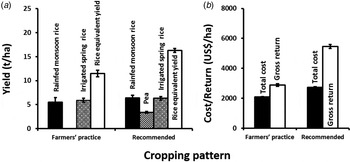
At the three on-farm locations, rainfed monsoon rice was transplanted from 18 to 26 July, reached maturity in 83–120 days, and was harvested on 10 November. Rainfed monsoon rice yielded from 5·4 to 6·6 t/ha. Following monsoon rice harvest, pea cultivar BARI3 was sown from 8 to 17 November and by 29 January, green-pod harvest was completed. Pea cultivar BARI 3 yielded 3·0–3·6 t/ha (Fig. 3(a)). Irrigated spring rice was transplanted within the window of optimum transplanting date (1–10 Feb.) and yielded 5·6–7·0 t/ha (Fig. 3(a)).
Rainfed monsoon rice, pulse and irrigated spring rice and rice equivalent rice yield (a) and total cost and gross income (US$) (b) of farmers’ practice and recommended cropping sequence. Values are the means of three locations with standard errors.

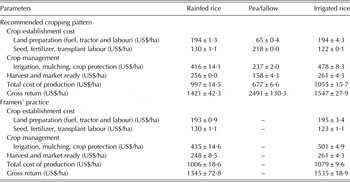
Total on-farm rice production (i.e. rainfed monsoon rice + irrigated spring rice) averaged 11·5 t/ha (Fig. 3(a)) where there was a fallow period between two rice crops. By contrast, replacing the fallow with modern pea cultivar BARI3 gave rice equivalent yield of 16·3 t/ha, increasing farm productivity by 1.4-fold. This higher productivity gave more than a fourfold increase in net return when farmers invested an extra US$ 636 (with green pod-picking as the major expenditure) over the usual cost of US$ 2084 to raise two rice crops (Fig. 3(b), Table 3).
Economics of green pea as replacement of fallow between rainfed rice and irrigated spring rice

Values are the means three replicates, (±s.e., n = 3).
DISCUSSION
Prospects for intensification of the key crops rice, maize, wheat and soybean to feed global populations to 2050 have been analysed and the greatest opportunity to increase farm yields identified as closing the yield gap (Fischer et al. Reference Fischer, Byerlee and Edmeades2014). These crops form the base of the most important cropping systems globally and major scope also exists to intensify within cropping systems. However, growing populations and intensification of land-use in these areas have prompted a need for viable alternatives to fallow and cereal mono-cropping systems (Christiansen et al. Reference Christiansen, Ryan, Singh, Ates, Bahhady, Mohamed, Youssef and Loss2015; Malik et al. Reference Malik, Ali, Zaman, Flower, Rahman and Erskine2016). Successful replacement of fallow from cereal–fallow rotation to form a cereal–legume system has been demonstrated in Anatolian plateau of Turkey (i.e. cereal–chickpea or lentil), in irrigated systems in Punjab of Pakistan (i.e. cereal–mung bean), in rainfed cereal systems in northern Karnataka, India (i.e. cereal–pigeon pea) and in Ghana, West Africa (i.e. cereal–cowpea) (Byerlee & White Reference Byerlee, White and Knight2000). In the EGP the rice–fallow–rice system predominates, where rainfed rice is followed by irrigated spring rice. However, compared with double rice systems in EGP and to the summer fallow–wheat system in semi-arid zones, intensified and legume-inclusive no-till cropping systems produce greater benefit (the current study; lentil, O'Dea et al. Reference O'Dea, Jones, Zabinski, Miller and Keren2015; Malik et al. Reference Malik, Ali, Zaman, Flower, Rahman and Erskine2016).
The current research highlighted that pea as green pod vegetable was the best option tested to intensify the rice cropping system and also maintain rice production. The approach in 2011/12 was to identify pea cultivars to replace the short fallow between rainfed monsoon rice and irrigated spring rice. Such cultivars were selected for experimentation in subsequent cropping cycles (2012/13 and 2014/15) on-station. Extending to farmers’ fields, the comparison of green vegetable pea with fallow showed a massive fourfold increase in net return. To the authors’ knowledge, this the first study to intensify the dominant rainfed monsoon rice–fallow–irrigated spring rice cropping system with a winter legume (pea/lentil). The results from a research station and confirmatory on-farm trials in Western Bangladesh clearly show the extrapolation zone for these results as Western Bangladesh, where rice is grown two times in a year with a fallow in between. It is likely that the results are extendable to this cropping system in the Eastern Indo-Gangetic Plain, but this is uncertain without further research.
Several current pea cultivars did not reach maturity in time for irrigated spring rice to be transplanted by the first week of February. When sown after long-duration rice (cultivar BR49), there was sufficient time for green pod development and harvest prior to timely transplanting of irrigated spring rice following pea cultivar BARI3, but not following IPSA3. This confirmed the suitability of the growth duration of the early pea cultivar BARI3 to replace fallow after long duration rainfed monsoon rice. Highest farm productivity (i.e. rice equivalent yield) was achieved with the inclusion of IPSA3; however, IPSA3 allows little time for land preparation for optimum sowing time for spring irrigated rice. As a result, participating farmers became enthusiastic about pea cultivar BARI3; some of whom allowed part of their pea crop to reach maturity and are now selling seed of pea cultivar BARI3 to their neighbours. The novel strategy towards intensification with green vegetable pea suggests other avenues for investigation to shorten the crop turnaround time after monsoon rice, such as relay sowing of pea and zero tillage planting, and also the use of minimum tillage unpuddled transplanting of spring irrigated rice.
Lentil is the most favoured legume in Bangladesh. However, its crop duration in Bangladesh (Malik et al. Reference Malik, Ali, Zaman, Flower, Rahman and Erskine2016) only allows harvest in the first week of March. Lentil was included in the experiment (i.e. Cycle 1) to investigate the farm productivity in the dominant cropping sequence. Inclusion of lentil in the cropping sequence increased the productivity as demonstrated by increased REY. However, the dominant cropping pattern could not be practiced as a March harvest was considered too late to transplant irrigated spring rice and resulted in 10% lower yield (the current experiment; Ahmed et al. Reference Ahmed, Biswas, Roy, Rahman, Islam, Mahbub and Biswas2006; Mannan et al. Reference Mannan, Bhuiya, Akhand, Rana and Zahan2013). Furthermore, it also increases the production cost for irrigated spring rice, as extra irrigation is required with delayed sowing due to warmer temperatures during crop establishment/growth. Thus, it was concluded that lentil was not an option to replace fallow between rainfed monsoon rice and irrigated spring rice. Nevertheless, lentil can be grown in a different cropping sequence (Malik et al. Reference Malik, Ali, Zaman, Flower, Rahman and Erskine2016).
While the main focus of the current work was on legume options, different rice possibilities were also examined in order to assess farm productivity. In the current experiments, cultivar BR49 took less time (9 to 13 d) to mature than in other reports (Rana et al. Reference Rana, Mamun, Zahan, Ahmed and Mridha2014), with the difference presumably due to the use of older rice seedling (5 d) transplants in the current experiment and also different climatic conditions. However, long-duration rainfed monsoon rice cultivar BR49 produced higher yield than the short-duration rainfed monsoon rice cultivar BR33 and contributed to both higher REY and GEY from the cropping sequence with the control fallow period. However, there are other short-duration rice varieties compared with BR33 that could potentially close the yield gap between BR49 and BR33 in the current experiment (Joshi et al. Reference Joshi, Musa, Johansen, Gyawali, Harris and Witcombe2007). Although a similar yield penalty with short-duration cultivars was found by Hossain et al. (Reference Hossain, Jaim, Alam and Rahman2013), the average yield penalty of short-duration rice cultivar BR33 in the current work was 44 kg/ha/day (calculated from Tables 1 and 2) over long-duration cultivar BR49. Yet, the early harvest of short-duration rainfed monsoon rice cultivars (such as cultivar BR33) allowed a longer gap for land preparation for legume cultivation compared with the longer duration rice cultivar BR49. In some areas, farmers prefer intermediate- and late-maturing cultivars for rainfed monsoon rice due to their high yield, palatability and established management practice (Krupnik et al. Reference Krupnik, Ahmed, Timsina, Shahjahan, Kurishi, Miah, Rahman, Gathala and McDonald2015).
The long-term increasing trend for post-monsoon rain (i.e. during November) is an issue for crop production (Hossain et al. Reference Hossain, Roy and Datta2014). Over 3 years of the current experiment, one such event was experienced during Cycle 2. Following monsoon rice harvest, farmers require a ‘gap period’ of 2–3 weeks for soil drying and cultivation prior to legume sowing. Any delay from unseasonal rains leads to a knock-on effect of late sowing/transplant. To avoid the risk of late sowing from post-monsoon rain, a short duration rainfed monsoon rice would allow sufficient time for land preparation and for the soil to drain sufficiently to become unsaturated, while incurring a rice yield penalty. Thus, rice breeding should aim to shorten the crop duration but also consider farmers’ preference, when aiming for an intensified cropping system as suggested by Joshi et al. (Reference Joshi, Musa, Johansen, Gyawali, Harris and Witcombe2007).
Cropping patterns are highly dynamic in Bangladesh. Of the 1·8 million ha of land under the dominant rotation (monsoon rice–fallow–irrigated spring rice) in Bangladesh (Ahmed Reference Ahmed2016), an estimated 5–7% or ~100 000 ha has upland soil suited for pea production. A market system for vegetable green peas already exists in western Bangladesh (i.e. major pea growing area) from crops which are insufficiently early to maturity to be followed in the rotation by spring irrigated rice. The possibility of extending the shelf-life of vegetable peas through industrial processing should be investigated. Vegetable peas have a ready market in nearby metropolitan Dhaka which has a population of ~17 million.
CONCLUSIONS
Sustainable intensification of rice-based cropping is recognized as a way toward future food security. Cropping system intensification so far has mostly focused on rice cropping technologies (i.e. high-yielding cultivars, high-inputs fertilizer and irrigation) and with wheat/maize in a crop rotation where only one rice crop was included. In the current study, successful intensification of rice-based cropping was demonstrated both on-station and on farmers’ fields by replacing a short fallow between two rice crops in a rotation with a green vegetable pea. A short-season pea cultivar BARI3 was identified that matured in time to allow irrigated spring rice to be transplanted in the experimental field leaving sufficient time for land preparation for rice. The inclusion of an extra crop, pea as green pod vegetable, increased farm productivity by 1·4-fold over the dominant cropping sequence (rice–fallow–rice), farm net income by fourfold, and also GEY.
The authors wish to gratefully acknowledge the financial support of the Australian Centre for International Agricultural Research in project CIM 2009-038. A.I.M. also thanks Australia Award Endeavour Research fellowship. They also thank Dr. Ilias Hossain, Principal Scientific Officer for providing weather data.