1 Reporting clauses and quotative inversion
In Present-day English (PDE), a quotation may be introduced into the discourse in various ways. Numerous studies of English reporting structures show the relatively recent development of innovative quotatives such as be like or this is me/him (e.g. Buchstaller Reference Buchstaller2013; Lampert Reference Lampert2013; Barbieri Reference Barbieri2005; Tagliamonte & D'Arcy Reference Tagliamonte and D'Arcy2004), as in (1) and (2).
(1) I was like, ‘But I won't’ (Tagliamonte & D'Arcy Reference Tagliamonte and D'Arcy2004: 493)
(2) this is me ‘what. . .what's your . . . what's your problem?’ (Cheshire & Fox Reference Cheshire and Fox2008)
Nonetheless, traditional quotatives in the form of reporting clauses (i.e. clauses with a verb of saying whose function is to introduce direct speech) are still the dominant strategy in written English and in more formal registers. Such a reporting clause may precede the quoted message, as in (3), it may follow it, as in (4), or be placed within the quotation, as in (5). The last two contexts (henceforth referred to as ‘parenthetical reporting clauses’ or ‘the parenthetical reporting construction’ abbreviated as ‘PRC’) are especially interesting from a syntactic point of view because they often display the so-called quotative inversion, i.e. subject–verb inversion in reporting clauses.Footnote 1
(3) She said: ‘Elderly people often have smaller groups of friends and family to support them’ (NEWS)
(4) ‘That's the whole trouble,’ said Gwen, laughing slightly. (FICT)
(5) Sketching, says Uderzo, is a fast process. (NEWS)
(Biber et al. Reference Biber, Johansson, Leech, Conrad and Finegan1999: 921–2)
Quotative inversion may only occur if the verb is in the simple present or simple past and it is ‘most common when the verb is said, the subject is not a pronoun, and the reporting clause is medial’ (Quirk et al. Reference Quirk, Greenbaum, Leech and Svartvik1985: 1022). When the subject is a personal pronoun as in (6), the verb phrase is complex as in (7), or the clause shows expansion to the right with specification of the addressee as in (8), subject-verb order ‘is virtually the rule’ (Biber et al. Reference Biber, Johansson, Leech, Conrad and Finegan1999: 922).
(6) ‘The safety record at Stansted is first class,’ he said. (NEWS)
(7) ‘Konrad Schneider is the only one who matters,’ Reinhold had answered. (FICT)
(8) There's so much to living that I did not know before, Jackie had told her happily. (FICT)
(Biber et al. Reference Biber, Johansson, Leech, Conrad and Finegan1999: 922)
Pronominal subjects show inversion very infrequently and the pattern illustrated in (9) is said to be archaic (Quirk et al. Reference Quirk, Greenbaum, Leech and Svartvik1985: 1022; Huddleston & Pullum Reference Huddleston and Pullum2002: 1027).
(9) ‘We may all be famous, then,’ said he (FICT) (Biber et al. Reference Biber, Johansson, Leech, Conrad and Finegan1999: 922)
Moreover, the fixed combination says I is used by some speakers to report a conversation, as in (10); the theoretically more proper form say I is never used in this context (Biber et al. Reference Biber, Johansson, Leech, Conrad and Finegan1999: 922). Quirk et al. (Reference Quirk, Greenbaum, Leech and Svartvik1985: 1024, fn. b) report that the non-standard structure shown in (10) is used in ‘old-fashioned speech’.Footnote 2
(10) I said I think something's gone wrong with the auto bank machine, says I (CONV)
(Biber et al. Reference Biber, Johansson, Leech, Conrad and Finegan1999: 922)
Thus, PDE quotative inversion is virtually restricted to nominal subjects, but even when such subjects are accompanied by simple verb forms with no specification of the addressee, they follow the non-inverted order quite regularly, as in (11).
(11) ‘In those days,’ Sue admitted, ‘we were heavily in debt.’
(Huddleston & Pullum Reference Huddleston and Pullum2002: 1027)
The variation between SV as in (11) and VS as in (4) and (5) is also influenced by genre: in fiction both orders are attested, though ‘with a slight preference for the regular SV order’, while in news inversion ‘is strongly preferred’ (Biber et al. Reference Biber, Johansson, Leech, Conrad and Finegan1999: 923).
As far as the structural analysis of reporting clauses with quotative inversion is concerned, they are treated as ambiguous between V-initial and V-second because the reported message may (but does not have to) be interpreted as the object of the reporting clause (Biber et al. Reference Biber, Johansson, Leech, Conrad and Finegan1999: 921). As discussed by Quirk et al. (Reference Quirk, Greenbaum, Leech and Svartvik1985: 1022), ‘the structural relationship between the reporting clause and the direct speech poses some analytical problems’. In formal accounts, quotative inversion is separated from other types of inversion still attested in PDE though the analysis of the structure is a controversial issue (Collins & Branigan Reference Collins and Branigan1997 vs Bruening Reference Bruening2016). Nonetheless, it is suggested that English quotative inversion ‘may derive from the verb-second construction’ (Los Reference Los2009), which was attested in Old English (OE) and was ‘largely lost during the late Middle English period’ (Fischer et al. Reference Fischer, van Kemenade, Koopman and van der Wurff2000: 105). Rohrbacher (Reference Rohrbacher1994: fn. 3) notes that since quotative inversion is restricted to the written register, it is possible ‘that it reflects an earlier stage of English and cannot be analyzed in purely synchronic terms’.
Scholars working on early English tend not to treat quotative inversion as a part of the V-2 rule. In various analyses of Middle English (ME) syntax focusing on the loss of the V-2 order, quotative inversion is mentioned but only to state that it would not be included in the investigation because of its distinct discourse characteristics (Los Reference Los2009; Westergaard Reference Westergaard2007) and structural ambiguity, which make it different from typical V-2. Haeberli (Reference Haeberli, Zwart and Abraham2002) excludes such clauses from his investigation, giving the following example:
(12) ‘Syre,’ seide Moises, ‘ʒif men aske how men clepeþ ʒow, what schal I seye?’
‘“Lord,” said Moses, “if somebody asks what you are called, what should I say?”’ (Vices, 101.88)
According to Haeberli, the status of quotative inversion is not on a par with other V-2 clauses he analyses in his study because ‘[a]t the surface, [it] looks like a parenthetical V-1 clause rather than like a genuine example in which subject-verb inversion occurs due to the fronting of a non-operator’ (Haeberli Reference Haeberli, Zwart and Abraham2002: 271). A similar view is expressed by Bech in the context of OE syntax: ‘It is therefore not obvious that the syntax of constructions containing direct speech has the integrated structure that enables syntactic-typological reasoning; it is closer to a text structure containing a sequence of two main clauses’ (Bech Reference Bech2017: 12). Therefore, scholars working on OE usually regard clauses such as (13) as instances of the rare V-1 order (which is said to be particularly well attested in clauses with verbs of saying) (Calle-Martín & Miranda-García Reference Calle-Martín and Miranda-García2010; Mitchell Reference Mitchell1985: §3930) and not as examples of V-2.
(13)


On the other hand, some scholars see PDE quotative inversion as ‘apparently a residue of earlier English where V2 was much more pervasive’ (Zwart Reference Zwart, den Dikken and Tortora2005: 19). In modern Germanic V-2 languages it is obligatory and associated with the V-2 phenomenon (Zwart Reference Zwart, den Dikken and Tortora2005: 18–19; Griffiths Reference Griffiths, Schneider, Glikman and Azanzi2015) or considered as a structure which is indistinguishable from other types of V-2 (Harbert Reference Harbert2007: 414), even though obligatory or optional quotative inversion is also attested in other, non-V-2 languages such as Hungarian (Gärtner & Gyuris Reference Gärtner and Gyuris2014), Spanish (Suñer Reference Suñer2000; Matos Reference Matos2013), Portuguese (Ambar Reference Ambar1992; Matos Reference Matos2013), French (Bonami & Godard Reference Bonami, Godard and Müller2008) and Russian (Bailyn Reference Bailyn2012: 318).
The aim of this study is to investigate the development of parenthetical reporting clauses throughout the history of English, with a special focus on the variation between SV and VS patterns and on the factors influencing it in particular stages of English. Section 2 describes the methodology of the study. In section 3, general quantitative results are presented for each period separately. Sections 4 and 5 focus on two main verbs used in the parenthetical reporting construction, quoth and say, showing their diachronic development. Section 6 is an account of the development of the investigated construction within the diachronic construction grammar framework, while section 7 presents the conclusions.
2 Methodology
The study was conducted on the basis of the York–Toronto–Helsinki Parsed Corpus of Old English Prose (YCOE, c. 1.5 million words; Taylor et al. Reference Taylor, Warner, Pintzuk and Beths2003), the Penn–Helsinki Parsed Corpus of Middle English (PPCME2, c. 1.2 million words; Kroch & Taylor Reference Kroch and Taylor2000), the Penn–Helsinki Parsed Corpus of Early Modern English (PPCEModE, c. 1.7 million words; Kroch et al. Reference Kroch, Santorini and Delfs2004) and the Penn Parsed Corpus of Modern British English (PPCMBE2, c. 2.8 million words; Kroch et al. Reference Kroch, Santorini and Diertani2016) searched by means of the CorpusSearch 2 application (Randall et al. Reference Randall, Kroch and Taylor2005–13).Footnote 3 In order to identify reporting clauses, first all parenthetical clauses with a lexical verb were extracted from the corpora (the query: *PRN* iDoms VB*; all reporting clauses, both clause-medial and clause-final, are annotated in the corpora as parenthetical). Since the corpora are not lemmatised, it was necessary to go through the results manually and find parenthetical clauses containing reporting verbs. All clauses with a verb of saying and an overt subject were initially included in the sample, both with and without inversion, and also with some additional clause elements, mostly objects and adverbials. Punctuation marks were not taken into consideration in the analysis since their use in various editions of early English texts is inconsistent and cannot be treated as a reliable guide for identifying instances of direct speech; see (13) where no quotation marks are used. At this stage, some of the examples extracted from the corpora could be interpreted as comment clauses containing verbs of saying, i.e. clauses whose function is to emphasise the importance of the statement rather than to quote (Brinton Reference Brinton2008: 84–8), as in (14).
(14) What is that Paper, I say? (STEVENS-1745-1,36.443)
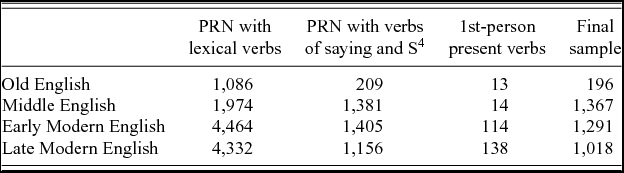
The borderline between a reporting clause and a comment clause is not clear-cut so the latter were not easily identifiable. However, the division between reporting clauses and comment clauses was operationalised in the study by means of tense and subject. On the basis of the Penn corpora annotation, the clauses were divided according to tense (past or present verb form) and subject (pronominal or nominal); pronominal subjects were also divided according to person. As shown, for example, by Griffiths (Reference Griffiths, Schneider, Glikman and Azanzi2015), comment clauses are typically in the simple present and have a first-person subject.Footnote 5 Therefore, clauses with first-person subjects and present verbs were treated as ambiguous and excluded from the quantitative part of the analysis presented in section 3. Table 1 shows the number of clauses rendered by the queries and finally taken into consideration.
The composition of the final study sample

In th e analysis presented in section 3, the collostructional strength of various reporting verbs and the parenthetical reporting construction is checked. The method applied for this purpose is the collexeme analysis. Its aim is to assess the collostructional strength of selected lexical items and the investigated construction, i.e. the degree of mutual attraction between the construction and the lexical element (Stefanowitsch & Gries Reference Stefanowitsch and Gries2003). The calculations were performed by means of Coll.analysis 3.2a (Gries Reference Gries2007), a script working in R (2014). In order to calculate collostructional strength, it was necessary to establish the overall frequency of all reporting verbs. First, a list of all the verbs which could be used to report speech was prepared for each period on the basis of existing studies (the verbs are listed in relevant fragments of section 3). Next, all finite forms of these verbs were extracted from the corpora by means of the queries such as (VBPI|VBDI|VBP|VBD iDoms sai*|say*|Sai*|Say*). Various morphological and spelling variants of each verb in each period were identified in the corpora by means of the lexicon function (make_lexicon: t pos_labels: VB*). Then, a .csv file with the data was prepared for each period (an example of such a dataset is presented in table 2). Finally, the files were fed into Coll.analysis 3.2a, which calculated the collostructional strength for each verb in each period.
Example of raw data for Coll.analysis (Middle English)

Moreover, all the results from sections 3.1–3.4 are summarised in section 3.5 in the form of a decision tree. The data were fed into the Weka implementation (Hall et al. Reference Hall, Frank, Holmes, Pfahringer, Reutemann and Witten2009) of the C4.5 decision tree algorithm (Quinlan Reference Quinlan1993). The tree shows which of the variables included in the data analysis are most useful to model the choice between SV and VS patterns in parenthetical reporting clauses from all stages of English.
Finally, it should be noted that in sections 3.1–3.4 clause-medial and clause-final reporting clauses are presented together without subdivision because the only period in which this factor has any observable impact on the data is Late Modern English (LModE) (as indicated in section 3.5), and the clause-final placement of reporting clauses is generally very rare in all the periods.
3 General results
This section presents the general development of the parenthetical reporting construction from Old English, through Middle English and Early Modern English (EModE) to Late Modern English, identifying the main tendencies in inversion rates, showing changes in the use of reporting verbs and the strength of association of particular verbs with the analysed construction.
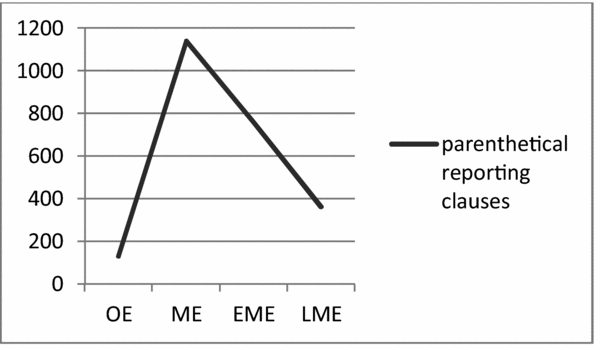
The normalised frequency of the parenthetical reporting construction is different in each period, as illustrated by figure 1, with a relatively low frequency of occurrence in OE, a sudden peak in ME and a steady decrease through EModE to LModE. This development is to some extent shaped by the composition of the corpora and the growing proportion of non-narrative texts, where quoting speech is by nature less frequent, though it also reflects the change in proportions between clause-initial and clause-medial/final placement of reporting clauses in various periods, as explored below.
The use of parenthetical reporting clauses in all stages of English (normalised frequencies per 1 million words)

3.1 Old English
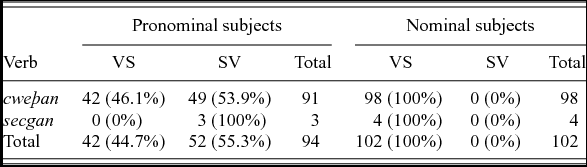
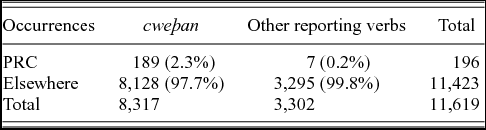
As shown in table 3, the whole YCOE corpus (1.5 million words) contains only 196 reporting clauses placed after or in the middle of the reported message, as in (15). None of these clauses shows expansion (i.e. they consist of the subject and the reporting verb only).
(15)

OE parenthetical reporting clauses

Table 3 shows that inversion always takes place with nominal subjects, as in (15), but there is variation between SV and VS with pronominal subjects, as in (16) and (17).
(16)
(17)


This variation is restricted to the main OE reporting verb cweþan (‘say’), which is used in 189 out of 196 occurrences of the parenthetical reporting construction (96 per cent). The use of the other reporting verb (secgan, the ancestor of say) is very limited (7 instances), and the choice between SV and VS in the case of this verb is clearly based on subject type (nominal ones show inversion, pronominal ones do not).
In order to check whether the high frequency of cweþan in this particular construction is a result of its high frequency in the YCOE corpus, a collexeme analysis was performed and the results are presented in table 4. The verbs included in the calculation as ‘other reporting verbs’ are: secgan (‘say’), andswarian (‘answer’), frignan (‘ask’) and ascian (‘ask’).
Collostructional strength of cweþan in the parenthetical reporting construction in OE

It turns out that cweþan is the only OE reporting verb attracted to the PRC; despite its overall high frequency, cweþan appears in the construction more frequently than expected (attraction, CollStr=19.15, p<0.001). However, direct speech in OE tended to be introduced by reporting clauses placed before a quotation, and the parenthetical construction was a minority pattern. When cweþan (or any other reporting verb) introduced direct speech in OE, clause-initial placement of the reporting clause, as in (18), was most common.
(18)

3.2 Middle English
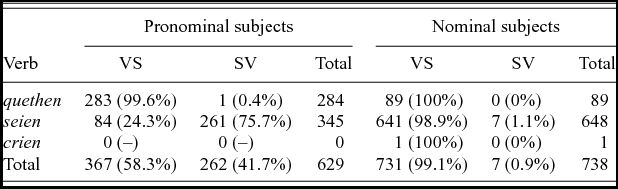
As signalled by figure 1, in ME parenthetical reporting clauses become relatively numerous (1,367 instances). However, table 5 shows that the inversion rates of pronominal and nominal subjects are close to the ones identified for OE, though the behaviour of subject pronouns in the ME data depends on the reporting verb.
ME parenthetical reporting clauses

There are two verbs used regularly in the investigated construction: quethen and seien. The verb quethen, which is a direct descendant of OE cweþan, regularly inverts all subjects regardless of their type, as in (19) and (20).
(19)
(20)


In the case of seien, derived from OE secgan, variation between SV and VS may be observed. Nominal subjects predominantly undergo inversion, as in (21), while non-inversion prevails with pronominal subjects (76 per cent), as in (22). (21) also shows that clauses with expansion regularly co-occur with the VS order (unlike in PDE).
(21)
(22)


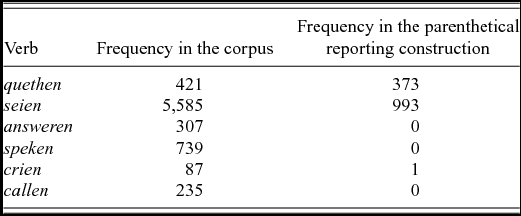
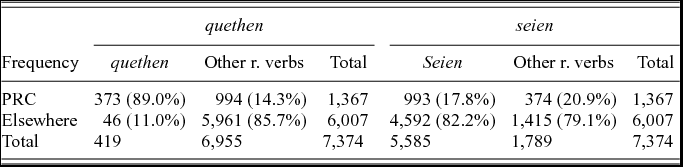
In order to check the strength of association between quethen and the parenthetical reporting construction, and to investigate whether seien became attracted to the construction, a collexeme analysis was performed (table 6). Other reporting verbs included in the calculation were: answeren, speken, crien, callen (after Moore Reference Moore, Aendholz, Bublitz and Kirner-Lundwig2015: 258).
Collostructional strength of quethen and seien in the parenthetical reporting construction in ME

The analysis reveals that quethen is strongly attracted to the construction (attraction, Coll.Strength = 232.78, p<0.001), but seien is not (repulsion, Coll.Strength=2.73, p<0.01), even though parenthetical reporting clauses with seien outnumber those containing quethen (993 vs 373). The dataset is dominated by seien (76 per cent share of all the investigated verbs), which replaced quethen as the most frequent and diverse reporting verb, used in a variety of contexts, the reporting parenthetical construction being just one of them, see (23).
(23)

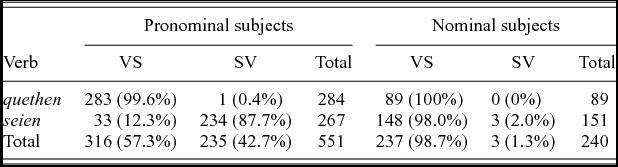
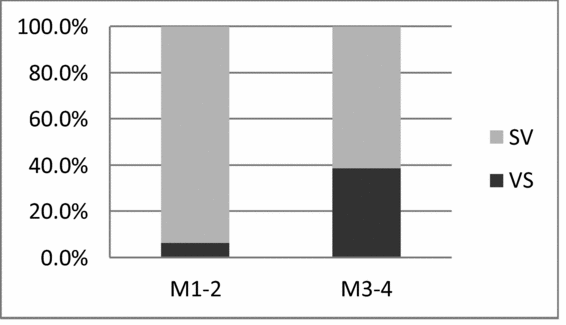
However, the proportions between seien and quethen are to some extent shaped by intertextual differences: as many as 576 parenthetical reporting clauses extracted from the corpus come from a single text from late ME, namely Malory's Le Morte D'Arthur; all of them (except a single occurrence of crien) contain the verb seien. Table 7 shows what happens to the ME data if Le Morte D'Arthur is taken out of the study sample. It turns out that the tendency towards non-inversion of pronominal subjects with seien is further strengthened, but the overall tendencies are confirmed. However, the fact that inversion of subject pronouns with seien is more common in Malory (51 out of 78 subject pronouns are inverted, 65 per cent of VS) than in other texts from PPCME2 (12 per cent of VS) is a reflection of a diachronic trend, illustrated in figure 2.
ME parenthetical reporting clauses (excluding Malory)

Reporting clauses with seien and pronominal subjects in ME6

As shown in the figure, the less frequent inverted pattern, which is hardly present in early ME, reaches almost 40 per cent in late ME; the change is statistically significant (chi-square = 48.53, p-value<0.0001) and it shows that the tendency to invert subject pronouns with seien is strengthened during the ME period.
3.3 Early Modern English
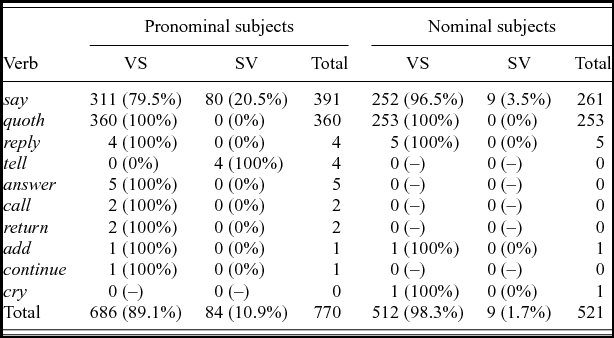
In EModE, illustrated in table 8, nominal subjects are still regularly inverted (like in OE and ME) and the overall rate of inversion of pronominal subjects rises to 89 per cent (from 58 per cent in the previous period), which means that the diachronic trend identified in the ME corpus is continued. (24) is an example of the dominant VS pattern.
(24) but pray, says he, do not tell my Mistress of it (LISLE–E3–P2,4.119.414)
EModE parenthetical clauses with verbs of saying

Non-inversion of nominal subjects is still very rare and observed only with say, as in (25); inversion illustrated with (26) is predominant.
(25) But only he would be mayster of his horsses, the Scripture sayeth
(LATIMER–E1–H,32L.240)
(26) ‘Alas!’ sayth this good wyfe, ‘he is to stronge for you all.’ (HARMAN–E1–H,71.293)
Table 8 shows that say retains its position as the dominant reporting verb, and the frequency of the non-inflected form quoth, which according to the Oxford English Dictionary became a fixed quotation marker used for all persons and only in its past form by the end of the sixteenth century, is still very high; VS shown in (27) is the only pattern co-occurring with this verb. As can be seen, specification of the addressee has no impact on inversion, which is obligatory.
(27) And what is your name quoth the Constable to Meg? (PENNY–E3–P1,52.327)
What is more, some new reporting verbs appear in the corpus; examples are shown in (28)–(30).
(28) But in good faith added the Cobler I am resolved to be merry with you. . .
(PENNY–E3–P1,28.108)
(29) ‘So he was,’ answered I (RICH–E2–P1,1.3,172.23)
(30) I well perceived that, returned she, when with silence and attention thou didst receive my Words (BOETHPR–E3–P2,92.9)
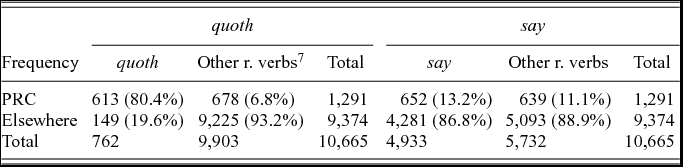
The statistical analysis presented in table 9 shows that quoth is extremely attracted to the construction (attraction, Coll.Strength is infinite, p<0.001) since it appears in the corpus mainly as a part of it, which constitutes a significant difference between quoth and other reporting verbs (80 vs 7 per cent). The strength of association between say and the construction is lower (attraction, Coll.Strength=3.21, p<0.001), but unlike in OE and ME the verb is attracted to the construction. None of the other reporting verbs included in the analyses shows a strong association with the parenthetical construction.
Collostructional strength of quoth and say in the parenthetical reporting construction in EModE

3.4 Late Modern English
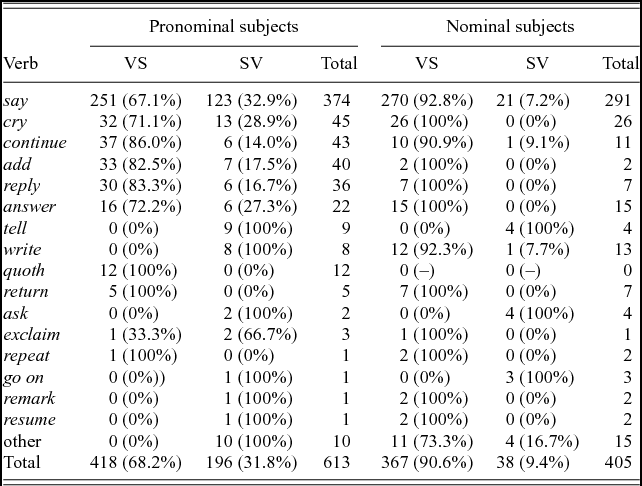
In LModE, compared to EModE, the frequency of quotative inversion falls both for nominal and pronominal subjects, though the inversion rate is still relatively high for the former, as shown in table 10. The dominant reporting verb is say, which shows variation between VS and SV with pronominal subjects, as in (31) and (32), while nominal subjects are mostly inverted as in (33).
(31) ‘It had worn him down,’ he said (SOUTHEY–1813–1,184.202)
(32) ‘O,’ said he, ‘how much I would give to hear some of your private conversations!’
(BURNEY–1768–2,1,30.665)
(33) my dear youth, said sir Philip, no apology is necessary (REEVE–1777–1,13.312)
LModE parenthetical clauses with verbs of saying

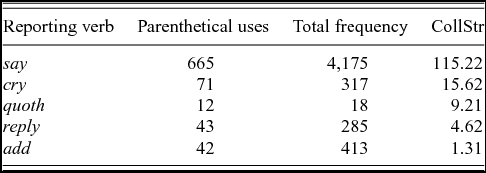
Another change compared to the earlier period is the repertoire of reporting verbs, which rises substantially in the LModE period: quoth is hardly ever used (only 12 occurrences, all of them with pronominal subjects), but there are as many as 38 various reporting verbs attested in the corpus, though only some of them have a relatively high frequency, as shown in table 10. The more frequent verbs show a tendency for inversion of all subject types, e.g. cry in (34), add in (35) and reply in (36), while the less frequent ones rarely cause inversion of subject pronouns.
(34) ‘I wish the ladies would put themselves under my care,’ cried Morrice, ‘and take a turn round the park.’ (BURNEY–1782–2,1,139.575)
(35) And, adds he, Tho’ I hate his Principles, yet I would not have him fall into their Hands (DEFOE–1719–1,199.109)
(36) It was never my intention, replied she, to entertain you with delusions. (BOETHRI– 1785–2,131.903)
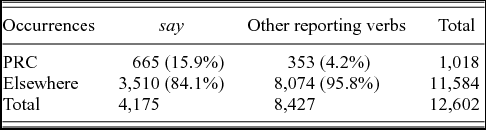
The strength of association between say and the analysed construction is illustrated by table 11. While other reporting verbs appear in the parenthetical reporting construction in only 4 per cent of cases, say co-occurs with it in 16 per cent of its uses. However, new verbs are also attracted to the construction, as illustrated in table 12. The one which is most strongly associated with the analysed structure is say (attraction, Coll.Str=115.22, p<0.001), but cry, reply and add also start to co-occur with it with a significant frequency.
Collostructional strength of say in the parenthetical reporting construction in LModE

Reporting verbs attracted to the parenthetical reporting construction in LModE

3.5 Summary
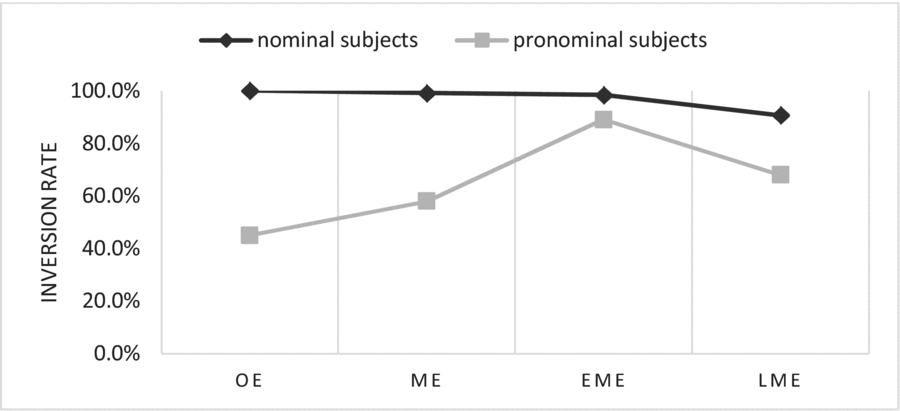
The general diachronic analysis reveals a few interesting developments. First of all, there is a steady increase in the association between the parenthetical reporting construction and two main reporting verbs: say and quoth. Moreover, the corpus analysis shows a growing type-frequency of verbs co-occurring with the construction (from two in OE to 38 in LModE) and verbs attracted to the construction (from a single verb in OE to five verbs in LModE), as well as a sudden increase in token-frequency in the ME period (see figure 1). Next, figure 3 shows that quotative inversion with nominal subjects is the norm in all the historical periods, though the frequency of the inverted pattern starts to fall in the LModE period.
Frequency of the VS pattern in reporting parentheticals from OE to LModE

What is more, variation between the inverted and the non-inverted pattern with pronominal subjects is attested in all the periods, though the development is not regular because the frequency of inversion shows a steady growth from OE to EModE and then falls in LModE, which suggests that it could have been influenced by a variety of factors. In order to highlight the variables which have the strongest impact on the choice between SV and VS in reporting parenthetical clauses, a decision tree has been generated for the whole diachronic dataset.
Subject type = nominal: VS (1763/50)
Subject type = pronominal
| Verb = quoth
| | Period = OE: SV (91/42)
| | Period = ME: VS (285/1)
| | Period = EModE: VS (360)
| | Period = LModE: VS (12)
| Verb = say
| | Period = OE: SV (2)
| | Period = ME: SV (359/85)
| | Period = EModE: VS (391/79)
| | Period = LModE
| | | Position = medial: VS (350/102)
| | | Position = final: SV (24/3)
| Verb = other
| | Expansion = no: VS (205/49)
| | Expansion = yes: SV (42/14)Footnote 8
Quite unsurprisingly, it turns out that the main variable underlying the variation is subject type (which causes the primary split), with nominal subjects strongly preferring the VS pattern in all the periods. Within the set of clauses with pronominal subjects, the tree splits between particular verbs, with quoth favouring the inverted pattern in all the periods except OE, and say moving from SV in OE and ME, through VS in EModE and a position-based variation between SV and VS in LModE (clause-medial reporting clauses showing more VS, which confirms Quirk et al.’s observation for PDE (Reference Quirk, Greenbaum, Leech and Svartvik1985: 1022), and clause-final ones being more prone to SV, though their frequency is very low). Other reporting verbs are the only group in which expansion of the clause has an impact on inversion, leading to more regular SV with subject pronouns. There is no split into periods in the case of ‘other’ verbs, but it should be borne in mind that quoth and say are the only reporting verbs used in OE and ME, and they dominate in EModE, so this result is of importance for LModE only.
All in all, it turns out that the identified patterns should be analysed for each reporting verb separately since they show very distinct behaviour in the historical data, especially with respect to pronominal subjects. Hence, in order to understand the mechanisms behind the identified trends, the development of quoth and say is analysed in sections 4 and 5 respectively, while the overall changes in the analysed construction are summarised and presented in section 6.
4 The story of quoth, the oldest English parenthetical reporting verb
As shown in the previous section, OE reporting parentheticals predominantly contain the verb cweþan (the ancestor of quoth). It is found in 96 per cent of clauses with nominal subjects (where VS is the only attested pattern) and it is the only verb co-occurring with inverted subject pronouns, though SV is also noted (see table 3). Harbert reports that in OE ‘pronominal subjects always followed the verb when the latter was the quotative verb cweþan and the sentence-initial position was occupied by (all or part of) its quotative complement’ (Reference Harbert2007: 414). His analysis, however, is based only on Bede's Historia Ecclesiastica where the pattern he cwæð is never used. A more comprehensive analysis reveals that cweþan shows regular quotative inversion but only with nominal subjects, while subject pronouns exhibit text-based variation between VS and SV. As noticed by Mitchell (Reference Mitchell1985: §1949), there are two competing patterns of parenthetic insertion with subject pronouns in OE: cwæð he used in Bede, as in (37), and he cwæð used in the Homilies of Wulfstan, as in (38).
(37)
(38)


This study shows that the variation is not limited to these two texts because both patterns are attested in other sources as well, with (39) and (40) as relevant examples. It turns out that 36 out of 49 non-inverted subject pronouns (69 per cent) come from Wulfstan's texts, while 20 out of 42 inverted ones (48 per cent) are from Bede. Moreover, both texts are consistent because there is not a single instance of SV in Bede or VS in Wulfstan.
(39)
(40)


A similar consistency (though with a lower number of instances) may be observed in Euphrosine (VS), Margaret (C) (VS), Orosius (VS), the Heptateuch (VS), as well as Cura Pastoralis (SV) and the Blickling Homilies (SV).Footnote 9 What is more, individual preference may also be observed in the use of cweþan with nominal subjects. Out of 98 occurrences of the structure, 47 (48 per cent) come from the OE version of Historia adversus paganos by Orosius, and 46 of these have exactly the same, lexically recurrent form cwæð Orosius illustrated in (41).Footnote 10 This, however, has no impact on inversion rates; if a reporting clause with a nominal subject is used parenthetically, inversion is the only available option.
(41)

Moreover, it is quite remarkable that while according to the OED quoth became an invariant quotative marker used for all persons and with no present time reference in EModE, its use in the present tense is already limited in the OE period. There are only two parenthetical uses of cweþan in the present form and they both co-occur with the first-person pronoun ic (‘I’) and follow the SV pattern, as in (42) (they were excluded from the study sample according to the methodology described in section 2).
(42)

The example resembles a comment clause rather than a typical reporting structure, but such a use of cweþan in OE is clearly exceptional. What is more, among the 189 occurrences of cweþan in the parenthetical reporting construction (which are all in the past tense), only one, shown in (43), has a plural ending.
(43)

This means that in 99 per cent of the instances, the verb has the fixed past form cwæþ, used in the first and third person singular according to the rules of OE grammar, as in (44) and (45).
(44)
(45)


Therefore, it is plausible to assume that the process of constructionalisation of quoth as an invariant quotation marker started already in OE, where the morphologically fixed form was dominant, though it had not spread to the plural paradigm yet.
In the ME period, quethen becomes a part of a syntactically fixed VS quotative construction used for both subject types, as shown in table 7. What is more, already in ME it is used only in its past form quod/quoþ and among 373 occurrences of the verb in the investigated structure, only two as in (46) have the plural ending -en and only one other shown in (47) does not follow the VS pattern. (None of the analysed examples is interpretable as a comment clause; their function is clearly to introduce quotations.)
(46)
(47)


These untypical examples come from the earliest part of the corpus (M1), so their presence is most likely a remnant of the patterns existing in the OE period. The fact that the plural form is used only twice does not mean, however, that the subjects of reporting clauses in ME are all singular, see (48).
(48)

The presence of such clauses (4 instances of quod they, all from the M3 period) shows that quod/quoth became a morphologically fixed quotation marker irrespective of person and number already in the ME period, so earlier than the OED suggests.
What is more, in the ME period the verb quethen, or rather its most frequent form quod/quoþ, undergoes spelling reduction and appears in its abbreviated form qð as in (49) 76 times (20 per cent). As suggested by Moore (Reference Moore, Aendholz, Bublitz and Kirner-Lundwig2015: 260), the reduction of quod to a symbol looking like a punctuation mark rather than a fully fledged word is analogous to the phonetic reduction observed in speech when grammaticalisation takes place.
(49)

In the EModE period, the tendencies identified in the ME data are continued. The verb appears only in the past tense and without plural marking, as in (50). Inversion is obligatory but spelling reduction is visible in only 32 examples (out of 613, 5 per cent),Footnote 11 as illustrated by (51).
(50) Why, haue you no more? quoth they (HARMAN–E1–P2,54.328)
(51) Yes sir qd. Simon if she be as willing as I (PENNY–E3–P1,127.569)
In LModE, the frequency of quoth falls drastically and the verb becomes obsolete, thus giving way to new reporting verbs, which start to appear in LModE with a growing frequency.
5 The development of say-parentheticals
In PDE, say is the most frequent reporting verb, but in early English its position was much weaker. As shown in table 3, the frequency of its OE ancestor secgan (‘say’) in parenthetical reporting clauses is very low. In ME, the frequency of seien soars. It becomes the main reporting verb and its use in the parenthetical construction grows (though section 3.2 shows that it is not attracted to the construction yet). Section 4 demonstrates that at that time quod/quoþ was already a fixed quotation marker used only in the past tense and without plural marking, so it is plausible that there was a need for a new reporting verb which would be more flexible and show a full set of grammatical properties (number, person and tense). It turns out that c. 26 per cent of reporting clauses with say in ME (255 out of 993) are in the present tense. Thus, the fact that quethen could no longer appear in certain grammatical contexts may have opened up the floor for seien, which took up the functions that quethen could not perform and gradually started to push quethen out of the system.
The inverting influence of seien is weaker compared to quethen, especially in early ME, as shown in section 3.2, though the difference is hardly visible in the case of nominal subjects. In late ME, subject pronouns start to invert with say more regularly, and in EModE the VS pattern becomes dominant. It may be considered surprising since this development goes against the PDE tendency for non-inversion of pronominal subjects in parenthetical clauses. There are two plausible (and possibly complementary) reasons for this unexpected change: (i) analogy, with the high frequency of quod/quoþ parentheticals in ME functioning as a general model for the VS pattern used in reporting clauses irrespective of subject type, and (ii) the development of a competing parenthetical construction, namely a comment clause with say. The earliest (rare) examples of this structure are found already in ME, illustrated in (52), but it does not become relatively frequent until EModE, as in (53).Footnote 12
(52) Thus, I say, Thomas seruet God deuotly (CMMIRK–M34,41.1176)
(53) Therefore take heede, I saye, for Christes sake (THROCKM–E1–H,I,76.C2.727)
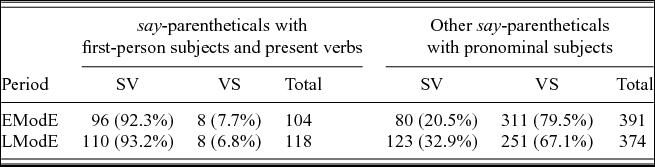
The function of comment clauses is to emphasise the importance of the statement (Brinton Reference Brinton2008: 84–8; Traugott Reference Traugott, Bergs and Brinton2012: 471) rather than to report someone's words or thoughts. Table 13 shows that say-clauses with a potentially commenting function show a clear tendency for the SV order, as in (52)–(53).
Difference in inversion rates between two groups of say-parentheticals

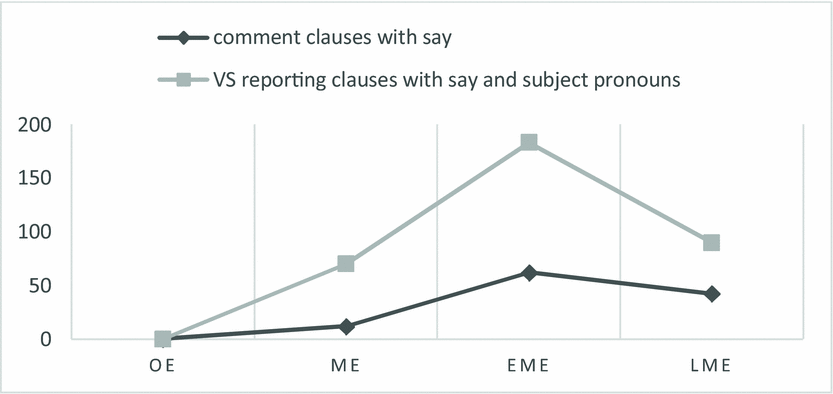
Thus, it is evident that if say was used with a reporting function, inversion was the preferred pattern, and SV was the default order of the comment clause (which is still used today, see Griffiths Reference Griffiths, Schneider, Glikman and Azanzi2015). This development may be traced back to EModE, when the number of comment clauses with say started to grow, and there was an overlap between reporting and commenting parentheticals with say. Figure 4 shows that these two developments co-occur.
The development of say in comment clauses and VS parenthetical reporting clauses with subject pronouns (normalised frequencies per 1 million words)

A similar tendency may be observed for the variation between he says/said vs says/said he. In the latter case, the clauses are all clearly reporting, as in (54). In the former, however, they are often parentheticals inserted in the middle of a long fragment which is a story narrated from someone's perspective in a free indirect style rather than a direct quote as in (55).
(54) Are you my uncle? sayes hee againe. (ARMIN–E2–H,43.299)
(55) After this, master Lieutenant, cominge into his chamber to visite him, rehearced the benefittes and freindshipp that he had many waies receaved at his handes, and howe much bounden he was therefore freindly to intertayne him, and make him good cheare; which, since the case standing as it did, he could not do without the kinges indignation, he trusted, he said, he wold accepte his good will, and suche poore cheare as he had. (ROPER–E1–P2,77.83)
Thus, it seems that in EModE inversion started to be a form strongly associated with quoting speech,Footnote 13 and the non-inverted patterns may be interpreted as non-reporting (mostly comment) clauses which are more loosely connected to the content of the main clause. It transpires that it is function, and not subject type, which was the factor underlying the choice between VS and SV in parenthetical clauses with say in EModE.
Another interesting phenomenon related to the development of say-parentheticals is the emergence of the invariant singular present form says I/he. As shown in table 13, among the clauses excluded from the study sample (with present tense verbs and first-person subjects), there are some isolated cases of VS. In the EModE data there are fiveFootnote 14 instances of the sequence say I, which is not attested in PDE (Biber et al. Reference Biber, Johansson, Leech, Conrad and Finegan1999: 922); there are no examples of the non-standard form says I in this period. Four out of these five uses come from the same fragment of the same text, as shown in (56). The clause say I appears in a sequence of quoted utterances, and its function is clearly reporting.
(56) Who is this (sayth one) sir Launcelot du lake?
Who is this, greate Guy of Warwike, sayth an other;
No (say I) it is the thirteenth Hercules brother.
Who is this; noble Hector of Troy, sayth the thirde;
No, but of the same nest (say I) it is a birde.
Who is this; greate Goliah, Sampson, or Colbrande?
No (say I) but it is a brute of the Alie lande.
Who is this; greate Alexander? Or Charle le Maigne?
No, it is the tenth Worthie, say I to them agayne:
I knowe not if I sayd well. (UDALL–E1–H,L.165.61-71)
The form says/saith I appears for the first time in the LModE corpus with five occurrences of the pattern illustrated in (57), though the form say I shown in (58) is also attested. What is more, the -s ending is also used with the pronoun you, as in (59).
(57) Mr. Layer he look'd at me, he was really a perfect Stranger to me, for I did not know him again; saith he, Is not your Name Plunkett? Yes, saith I. Was there not one with you t'other Night, one James Plunkett? Yes, Sir, says I. Where did he desire you to go? said he. I answer'd, He desired me to go to the Italian Coffee-house in Russel-Court. Saith he, ’Tis well enough: Do you not know me? No, saith I (LAYER–1723–2,57.2321-2332)
(58) Hastings: Damn your pig, I say. Marlow: And damn your prune sauce, say I. (GOLDSMITH–1773–1,28.255-256)
(59) On a sultry day, when both the sun and the enemy had set us in a glow, your groom was milling with your canteen; you came to me – Warmans, says you, have you any thing to drink? – I reached my flask – you drank – did you not? (JOHNSTONE–1786–2,44.744-748)
The examples in (57)–(58) were excluded from the analysis presented in section 3. However, the function of all the instances of saith/says I shown in (57) is clearly reporting, and so is says you in (59), while (58) functions as a comment clause (an expression of emphasis), used facetiously by Marlow as a reaction to Hastings’ I say (and with contrastive focus on the inverted subject). It is difficult to make generalisations on the basis of such a low number of instances, but it seems that in LModE inversion or its lack was not a clear enough marker of function and the invariant pattern says + pronoun started to be generalised as a LModE reporting formula. The reason for its emergence may have been phonological (to avoid hiatus between two diphthongs in say I). However, it could also be viewed as the beginning of a morphological reduction. The fact that singular third person subjects are predominant in reporting clauses made says/saith a majority pattern and the fact that clauses such as says/saith I start to appear in LModE suggests that say may have been on its way to undergo a similar grammaticalisation process as quoth (though with two separate tense forms: said and says/saith.). This process was most probably hindered by prescriptive pressure, but since says I is reported to be used in PDE conversations (Biber et al. Reference Biber, Johansson, Leech, Conrad and Finegan1999: 922), it may have survived in spoken English, though (as mentioned in section 1) apparently with an archaic flavour. The few examples of the pattern that I was able to extract from COCAFootnote 15 represent speech in written sources, i.e. dialogues in fiction as in (60).
(60) It's your plant,’ says I. I gave it to you.
(COCA, 1997, Literary Review, Philip Davidson)
What is more, COCA contains 675 instances of the string I says, as in (61), and in the spoken component of the BNC there are 908 occurrences, as in (62), which has both patterns used within the same utterance. This shows that in PDE the third-person ending may be used as a quotation marker regardless of inversion.Footnote 16 Thus, for some of the LModE and PDE data it is not really inversion which is decisive for the functional interpretation of the clause (as it is in EModE), but the use of the ending, generalised to all persons and numbers, as illustrated by (63).
(61) ‘Yes, Jack,’ I says (COCA, 2001, The Death of Jack Hamilton, Stephen King)
(62) Oh, says I, aye, I says, you could stay in the village. (Spokes BNC, Oral history project: interview)
(63) Won't tolerate babblin’, they says. (COCA, 1994, Thief of the Hearts, Teresa Medeiros)
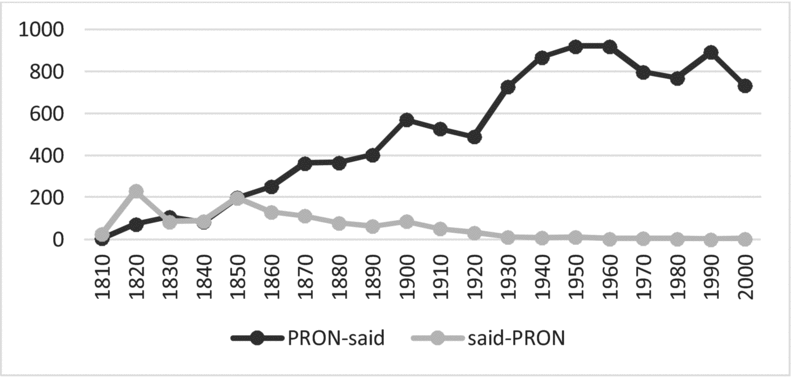
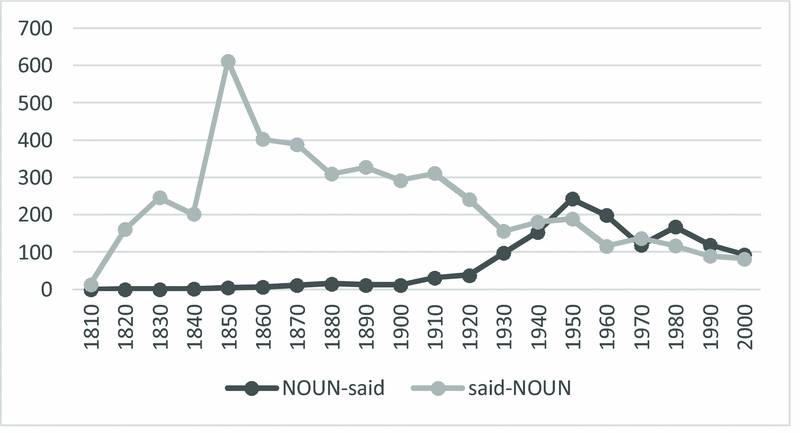
The fact that I says outnumbers says I in contemporary data is related to the fact that the tendency towards inversion of pronominal subjects with say in reporting clauses, which was so widespread in EModE and relatively well attested in LModE, is no longer visible in PDE. The predominance of the SV pattern in reporting clauses with subject pronouns is a recent development. Figure 5 shows the changes in the frequency of both patterns in the Corpus of Historical American English (COHA).Footnote 17 It turns out that non-inversion starts to dominate in the latter half of the nineteenth century, while the frequency of the VS pattern with subject pronouns becomes low in the 1930s. This result is especially interesting considering the fact that at around the same time the frequency of non-inversion with nominal subjectsFootnote 18 started to grow, as shown in figure 6.Footnote 19
The development of VS and SV parentheticals with said and subject pronouns in COHA (normalised frequencies per 1 million words)

The development of VS and SV parentheticals with said and nominal subjects in COHA (normalised frequencies per 1 million words)

It is certainly puzzling why the robust VS pattern started to lose ground in the late nineteenth century, first with pronominal, and then with nominal subjects. A possible mechanism is related to the growing frequency of new reporting verbs and information structure. The pragmatic motivation for the choice between VS and SV in reporting clauses is quite simple: what comes second is more prominent (Biber et al. Reference Biber, Johansson, Leech, Conrad and Finegan1999: 922). Placing focus on the verb made little sense if the reporting verb gave no additional information as to the manner or intention of speaking. Therefore, nominal subjects always had a higher information value than say or quoth, and this may be the pragmatic reason why quotative inversion with nominal subjects was so regularly observed in earlier English. When the subject was pronominal, its information value was as low as that of the reporting verb, so the variation between VS and SV could not depend on information structure (though the choice of the pattern depended on function: reporting preferred VS while commenting was associated with SV). However, in LModE, when new reporting verbs appeared, their clause-final placement could be caused by information structure since the meaning of the verb was often more fine-grained and related to the manner of speaking (whisper, murmur, exclaim, etc.). Thus, their information value was higher than that of pronominal and discourse-old nominal subjects. The results presented in table 10 show that new low-frequency reporting verbs rarely show inversion with pronominal subjects in LModE, which would confirm this tendency. Quirk et al. (Reference Quirk, Greenbaum, Leech and Svartvik1985: 1022) report that quotative inversion in PDE is most frequent when the verb is said. Since say is the simplest reporting verb, its information value is relatively low and the subject is given more prominence by the use of the VS pattern. What is more, non-inversion is reported to be more frequent in fiction (Biber et al. Reference Biber, Johansson, Leech, Conrad and Finegan1999: 923), where style and authors’ creativity may lead to an increased variety of reporting verbs and strengthen the tendency towards the use of SV. A full analysis of the influence of information structure on the rates of quotative inversion is beyond the scope of this study, but it seems quite plausible that the emergence of new reporting verbs did have an impact on the growing proportion of SV quotative structures in LModE and PDE, with say partly joining this general SV pattern in the nineteenth century, by analogy to other verbs with higher information value, and with the -s ending generalised to all grammatical contexts (though with the morphological reduction blocked in formal registers by prescriptive pressure).
6 The development of the parenthetical reporting construction
According to Traugott & Trousdale (Reference Traugott and Trousdale2013), new constructions, defined as pairings of form and meaning organised in a network (Goldberg Reference Goldberg2006), emerge as a result of constructionalisation. With time, existing constructions undergo modifications pertaining to their meaning, function, collocational constraints, syntax or morphophonology. In the usage-based approach, a developing construction is said to undergo an increase in productivity and schematicity, and a decrease in compositionality (Traugott & Trousdale Reference Traugott and Trousdale2013: 113–22). Productivity is understood as both token-frequency (the overall number of forms sanctioned by the construction) and type-frequency (the collocational range of the construction). Schematicity is related to the ‘extensibility’ of the schema (the schema being the highest level of abstraction of a given set of constructions, defined primarily in terms of function), which results in the growing number of micro-constructions integrated into the general schema (Barðdal Reference Barðdal2008: 31, quoted in Traugott & Trousdale Reference Traugott and Trousdale2013: 116). A decrease in compositionality is related to the diminishing transparency (and analysability) of the match between the meaning of the construction parts and its form (or syntax). This section aims to account for the development of the reporting parenthetical construction in English within the diachronic construction grammar framework.
The data presented in sections 3–5 show that the parenthetical reporting construction in the form of a quoted message followed by a reporting clause existed already in OE. At first it was neither token-productive (only 130 occurrences per 1 million words) nor type-productive (only two reporting verbs, cweþan and secgan), and not fully conventionalised because its distribution among various OE texts is uneven. There was also only one verb, cweþan, which was attracted to the construction, but the string was fully analysable, without any signs of morphological reduction. However, the fact that cweþan was used virtually only in the past tense and with singular subjects led to the predominance of the form cwæþ, creating a favourable context for such a reduction, which took place in ME. ME is also the period in which the parenthetical construction with quoth started to appear with the fixed VS order, while in OE there was variation between he cwæþ and cwæþ he patterns. The fact that this variation was clearly text-based suggests that OE speakers could have made different decisions as to the analysis of ‘quotation + reporting verb’ strings. Some speakers may have analysed such sequences as a part of the V-2 construction, which in OE involved inversion of nominal subjects and non-inversion of subject pronouns (Fischer et al. Reference Fischer, van Kemenade, Koopman and van der Wurff2000; Ringe & Taylor Reference Ringe and Taylor2014), so clauses such as (64) and (65), as well as all the parenthetical reporting clauses with secgan, are consistent with it.
(64)
(65)


However, reporting clauses with inverted pronominal subjects such as (66) do not pattern with OE V-2 clauses because according to the OE V-2 rule only a closed group of short adverbs, especially þa ‘then’ and þonne ‘then’, as well as the negative particle ne, could cause inversion of subject pronouns (Pintzuk Reference Pintzuk1999: 91; Cichosz Reference Cichosz2017a).
(66)

It is difficult to argue that the quoted message could form a coherent group with these lexical elements (treated as ‘operators’ in formal accounts of OE syntax), especially given that the inversion mechanism is not consistently applied in all the texts. What is more, Bech (Reference Bech2001) shows that inversion after ‘non-operators’ is more common when nominal subjects are new; given subjects usually stay non-inverted, so the fact that 100 per cent of nominal subjects in OE reporting clauses are inverted is also quite unexpected from the point of view of the OE V-2 because the speakers referred to in reporting clauses are rarely discourse-new.
Another possible interpretation of (64) and (66) would be to analyse them as instances of V-1 (as in Calle-Martín & Miranda-García Reference Calle-Martín and Miranda-García2010). However, this interpretation is not unproblematic because V-1 main declarative clauses are used in OE for a number of pragmatic reasons: such clauses mark transition to a new action, summarise the discussion, introduce a new/contrasting character/type and open a new story/paragraph (Ohkado Reference Ohkado2004). Reporting parenthetical clauses fulfil none of these functions so their treatment as representatives of V-1 declaratives is unconvincing; from a pragmatic point of view, V-1 was a different construction.Footnote 20
In sum, (64) and (65) may be analysed as instances of V-2, whereas (64) and (66) are sometimes analysed as V-1, but neither of these interpretations explains the existence of all three closely related and functionally equivalent patterns shown in (64)–(66). However, we need to remember that (65) and (66) do not co-occur in the same texts. This suggests that while for some OE speakers (64) and (65) could be linked to the V-2 construction, for other speakers (e.g. the Bede translator), strings such as (64) and (66) were part of a different construction (‘quotation + cweþan + subject’), which had a different function than the OE V-2 (or V-1), was not a part of the V-2 schema and thus followed its own syntax. Therefore, we could explain the variation between SV and VS observed in OE by the ongoing constructionalisation process of the VS parenthetical reporting construction, which was reanalysed by some speakers as having no subject-type constraints, while others still linked it with the V-2 construction in which the difference in the behaviour of pronominal and nominal subjects was observed.
In ME, the token-frequency of the parenthetical reporting construction undergoes a considerable increase. The central lexeme co-occurring with the construction is still quethen, whose association with the construction is strengthened and the verb undergoes morphological reduction, thus making quod/quoþ less analysable and leading to the decreased compositionality of the string quod/quoþ + subject. Moreover, seien outnumbers quethen in the construction, though as a generally frequent verb it does not show a clear preference for parenthetical use. In this period, the difference in the behaviour of nominal and pronominal subjects is non-existent with quethen and gradually disappearing with seien, which shows that more and more speakers were linking both reporting verbs to the VS parenthetical reporting construction. The early ME cases of SV with seien may be seen as a continuation of the pattern identified in OE for cweþan, i.e. the still existing link between reporting parenthetical clauses and the V-2 construction.
In EModE, the collocability of the construction rises, with new reporting verbs joining the pattern. What is more, say becomes attracted to the construction, though quoth still shows the strongest association with it. The tendency towards inversion is increased and generalised to all subject types, leading to a significant increase in inversion rates with subject pronouns, most probably resulting from a reorganisation and split of the parenthetical construction with verbs of saying into the reporting construction (with quotative inversion) and the comment construction (following the SV pattern), as shown in section 6. In this period, inversion was a clear sign of the function of parenthetical clauses, with no link between quotative inversion and V-2 (which was ‘largely lost during the late Middle English period’ (Fischer et al. Reference Fischer, van Kemenade, Koopman and van der Wurff2000: 105)).
In LModE, the type-frequency of the construction is considerably increased. The most attracted lexical item is say (quoth is marginalised and becomes obsolete), but there are more new verbs associated with it, so we may conclude that the construction keeps extending its collocational range. However, the EModE generalisation of quotative inversion as a marker of reporting function is no longer observed; both the VS and the SV pattern exist within the parenthetical reporting construction (the schema is extended). The speakers reanalyse SV parenthethicals with say as reporting especially when the invariant -s ending is used for present reference (and -ed for past reference, but in this context no functional overlap with comment clauses was possible), while comment clauses show the standard endings (I say). This reanalysis is not fully reflected in written data because in LModE, when English grammar was already standardised, the prescriptive pressure to use standard endings was too strong for full morphological reduction to take place (unlike in ME, when quethen could undergo such a process in relatively unrestrained conditions).
7 Conclusion
The analysis presented in this article shows that the parenthetical reporting construction has been used in English since the OE period, and it has followed its own constructionalisation path, with various constructional changes including growing productivity and collocability as well as morphological reduction of quoth and (partly) say. The investigation also shows that clauses with quotative inversion, regardless of some superficial similarity and a partial structural overlap, pattern neither with clauses following the V-2 rule nor with V-1 declaratives. This confirms the assumptions of Los (Reference Los2009) and Haeberli (Reference Haeberli, Zwart and Abraham2002) that such clauses should not be included in studies of the V-2 rule. What is more, the analysis presented above suggests that the parenthetical reporting construction did not emerge from the V-2 construction. In OE and ME both constructions existed alongside each other (and interacted with each other, as shown in section 6), while in EModE the V-2 rule was lost while quotative inversion became generalised as the main pattern for the parenthetical reporting clauses with no subject type constraints. The fact that PDE shows variation between SV and VS is a recent development, and the analysis suggests that it may have been triggered by the increase in the number of reporting verbs used in the construction and their high information value, though a comprehensive study of nineteenth- and twentieth-century English is needed to confirm this hypothesis.