On 24 September 1793, a fire at Cowdray House, Sussex, caused extensive damage to the building, destroying most of the celebrated Tudor works of art. These included wall paintings commissioned in 1547–8 by Henry viii's Master of Horse, Sir Anthony Browne, the owner of the house at that time. The murals depicted events from Henry viii's wars against the French in 1544–5 and the procession that took place prior to Edward vi's coronation in 1547. Richard Gough, then Director of the Society of Antiquaries, visited Cowdray House a month after the fire and reported that ‘the historical paintings on the walls of the dining parlour on the East side of the Court were involved in the devastation and the stucco on which they were painted itself flaked off from the walls’. He admitted grudgingly that their loss ‘is to some degree moderated by the exertions of the Society in causing them to be engraved’,Footnote 1 for he had been one of the many Fellows who had opposed the publication of the engraving a few years earlier on the grounds of the expense.
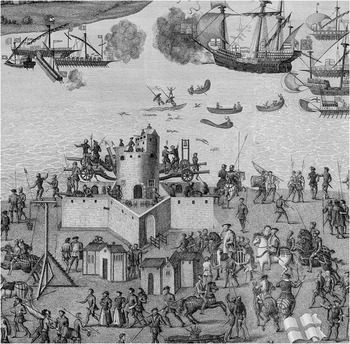
Sections of the original wall paintings might well have been preserved after the fire, for John Carter found part of one depicting a bagpiper on The Siege of Boulogne, of 1544, ‘in tolerable condition’ when he visited in 1802.Footnote 2 Nothing remains now, however, and the only record of these paintings as a whole are the five black-and-white engravings published by the Society between 1778 and 1788 and some preliminary drawings, all reduced to about one-third of the original size. Three of these, drawn and published in outline only, depicted the three parts of a painting originally on the south wall of the parlour concerning the English invasion of France in 1544: The Departure of Henry VIII from Calais, The Encampment of Henry VIII at Marquison and The Siege of Boulogne. The two scenes on the north wall showed The Encampment of the English Forces near Portsmouth, including the sinking of the Mary Rose in 1545 (fig 1),Footnote 3 and The Coronation Procession of Edward VI, depicting central London in 1547.Footnote 4 The second of these two was engraved by Basire in full relief based on S H Grimm's original watercolour, the original of which survives in the Society's collection. The first was engraved by Basire from a drawing made by the Sherwin brothers.
The Encampment of the English Forces near Portsmouth: detail showing the sinking of the Mary Rose. Engraving: James Basire, 1778; Society of Antiquaries of London

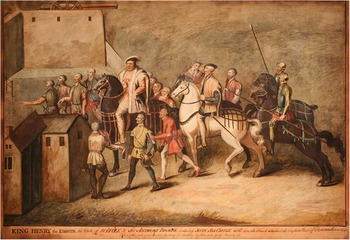
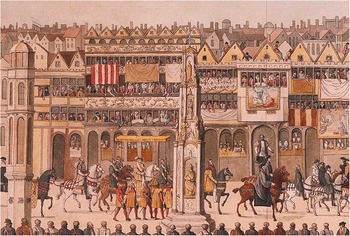
That drawing is now lost, but a watercolour by the same artists (fig 2) was sold at Christie's Althorp Attic Sale in 2010 and later purchased by the British Library. The newly discovered work shows a detail from The Encampment of the English Forces near Portsmouth, and is significant because it is the only known same-size full colour copy of any of the original Cowdray wall paintings. These can be dated fairly closely to the period between Edward vi's coronation procession of February 1547 and the death of Sir Anthony Browne in May 1548. Henry viii himself had died on 28 January 1547, and the watercolour is remarkable for its record of the king as he would have appeared at the end of his life – overweight, prematurely aged and in poor health. Such an image is not found in any other paintings made in his lifetime, and this one appears not to be exaggerated, unlike the highly stylized representation of the king in the engraving of 1544 by Cornelis Matsys.Footnote 5 In the fullest description we have of the original wall painting before its destruction, Sir Joseph Ayloffe noted that: ‘his [the king's] countenance appears serene and sedate. All the features of his face are highly finished, and the portrait hath by good judges been esteemed to be the greatest likeness of that monarch, in the decline of his age’.Footnote 6 Also depicted in the watercolour is Sir Anthony Browne, prominently placed on a white horse behind Henry viii, just as he is behind Edward vi in The Coronation Procession of Edward VI (fig 3), two very similar images deliberately juxtaposed. His appearance here appears to fit Thomas Cromwell's description of Browne in 1538 as a ‘vain old beau’.Footnote 7
Henry viii, the duke of Suffolk and Sir Anthony Browne entering South Sea Castle. Watercolour: John Keyse Sherwin and George Sherwin, 1774; BL, Department of Maps, CC.7.a.30 (photograph courtesy of Abbott and Holder)

Sir Anthony Browne on horseback (the figure to the furthest left). Image: from the watercolour copy by S H Grimm of The Coronation Procession of Edward VI , 1785; Society of Antiquaries of London

The three paintings depicting Henry viii's invasion of France bear many similarities to four large panel paintings in the Royal Collection and with other pictures at Cowdray thought to have been painted a few years before for the previous owner, the earl of Southampton, Sir Anthony Browne's half-brother.Footnote 8 It has also been suggested that they were close copies of lost paintings commissioned by Henry viii for Whitehall Palace.Footnote 9 A painting of the Siege of Boulogne is listed there in the inventory compiled after Henry viii's death,Footnote 10 and another work showing the king's voyage to Boulogne was seen by Pepys in Whitehall in 1662.Footnote 11 However, Sir Anthony Browne can only be identified with any certainty in one, and each had short headings labelling specific locations or describing the events.Footnote 12 No references have been traced to the Portsmouth scene or to Edward vi's coronation procession being at Whitehall. In these two, there were no headings, Sir Anthony Browne takes centre stage next to the king in both and they were likely to have been original commissions by him for his own house.
Although in the eighteenth century the Cowdray wall paintings were often attributed to Holbein, he died in 1543, and no other artist has been identified with any certainty. Some Fellows who visited the house in the eighteenth century thought the wall paintings had little artistic merit, but were valuable as a record of the times. The most detailed comments were those of George Vertue, who reported twice to the Society on his observations. His account of the ancient framed pictures at Cowdray, given on 9 November 1732, was entered into the Society's Commonplace Book and mistakenly attributed to William Stukeley by Richard Gough.Footnote 13 In 1751, Vertue's companion, William Hanbury, reported to the Society on their visit of 27 May and Vertue recorded the wall paintings, including their dimensions, in his notebook, as follows:
No. 1. the Antient paintings on the wall above the wainscot – Representing the Meeting of K. Hen 8 by Sr. Antony Browne Kt on the Hill between Calis and Morguison – all these paintings being in hight 5. foot 9 Inches – near 6 foot – this peece of painting – is 10 foot 6 Inches in length the line of division is a Speare erect between each painting–
No. 2. the Encamping of the King at Marguison – Tents &c. in height 5 .f. 9. length of this 5 foot 2 Inches devided as before–
No 3. Sr. Anthony Brownes Camp at the Siege of Boulogne … the legnth [sic] of this part. 18-foot-6. Inches.
these three peeces fill up one side of this room
No 4. The procession of K Ed. 6 to his Coronation … in height 5 f. 9. in length 12 foot 6. Inch
No. 5 a View of the Isle of Wight and Portsmouth when K. Hen 8. reviewd the New forticfications [sic]. in height as the others. in length. 21 foot.
these two peices [sic] fills up this side of the Room.
No. 6. on one side of the Window is one of the FitzWilliams family standing in Armor–
all these paintings are said to be done by H. Holben. but I doubt it much, the rules of art. perspective and proportion such as he well understood. are very defective here. it may be the principal figures might in some of these paintings be done by him & so in length of Time be altogether attributed to him – There are many pictures in this house. small & large very like–Holbens–small paintings over the doors if these painting were drawn to be grav'd–2 Inches to a foot–in height and breadth–
… these excursions & observations–intended for the use of the Society of Antiquarys LondonFootnote 14
Vertue may have been tempted to consider engraving the paintings but must have realized that much of the detail would have been lost if reduced by one-sixth to a single plate of conventional size. The impetus to publish came in the 1760s and was driven initially by Philip, second Earl Hardwicke (1720–90). Hardwicke was the wealthy son of the Lord Chancellor, an important figure in Whig circles, but more interested in literary and antiquarian pursuits than politics. Elected a Fellow in 1744, as Viscount Royston, he edited Miscellaneous State Papers from 1501–1726 (1778) and was on close terms with Sir Joseph Ayloffe (1710–81), Commissioner in the State Paper Office and Vice-President of the Society. In 1767, Council was informed by Lord Hardwicke that ‘there is a curious Painting in the little Parlour belonging to Lord Montagu, at Cowdray, of the Procession at the Coronation of K.Edward vi which, if deemed a proper Subject for the Council to engage in, & make a Drawing & Print of for the use of the Society, he would readily give any Assistance, & contribute to the Expense’.Footnote 15 Council adjourned discussion of the proposal but Ayloffe took up the idea with enthusiasm. He wrote to Hardwicke saying that he agreed with him ‘that the common run of engravings in Vetusta Monumenta [the Society's only publication at the time] are taken from originals of little consequence and less amusement’ and ‘will inculcate the necessity of Council adopting your Lordship's idea of engraving such historical paintings as commemorate some remarkable event … in our national history … many pictures at Cowdray, Windsor and elsewhere illustrate our national history and deserve to be engraved’.Footnote 16
Over the next six years, considerable effort and expense was devoted to publishing an engraving of the Tudor painting of The Field of Cloth of Gold, then in a private apartment at Windsor Castle, and which Ayloffe told Hardwicke was ‘undisputably the most capital Antiquarian picture now extant’.Footnote 17 The historical painter Edward Edwards was commissioned in 1771 to make a watercolour copy reduced from about 144 inches wide to 44 inches; the task took him 160 days, for which he was paid £115. James Basire, the Society's engraver, took two years to engrave the copperplate and was paid £200. A new size of paper – the largest manufactured at the time and afterwards called ‘Antiquarian’ – was made by James Whatman so that the image could fit on to one sheet. Edward's watercolour was presented to George iii and 500 copies were printed. About 230 were distributed to Fellows in February 1775, with a description by Ayloffe; the rest were kept for sale to the public.
Meanwhile Sir Joseph Ayloffe had assembled a group of antiquaries (Gustavus Brander, Thomas Astle and Richard Blyke with Thomas Chowne, of Alfriston, Sussex) to visit Cowdray House in the summer of 1772, courtesy of the owner, Viscount Montagu. Neither Montagu nor Chowne were Fellows then, but both were elected in the autumn session. Ayloffe read a paper on their findings in 1773, emphasizing the value of the wall paintings as a historical record.Footnote 18 It was perhaps therefore no coincidence that, in 1774, two local artists from nearby East Dean – John Keyse Sherwin and one of his brothers – made sketches and a complete drawing of the largest painting, The Encampment of the English Forces near Portsmouth. The following February, just after the print of The Field of Cloth of Gold was distributed to Fellows, one of Ayloffe's party, Richard Blyke, another Crown official working in the Treasury in Whitehall, exhibited the Sherwins’ coloured drawing for Council to consider having it engraved. The drawing was reported as ‘made by Messrs Sherwin (under the direction of Wm Mitford Esq of Pitts Hall, near Petworth, in Sussex)’.Footnote 19 The proposal proved highly controversial. Because the drawing had not been commissioned by the Society, its size (21 feet reduced to 6) meant it would require two plates and be very expensive. Council felt it was being put under pressure by new members elected for the purpose. The Sherwins’ patron was either William Mitford (1700–77), a Treasury official and Receiver-General for Sussex, or his son, also William Mitford (1748–1824), a Treasury clerk from 1765, who took over his father's official positions and was elected a Fellow a week after the drawing was exhibited.Footnote 20
The artistic talents of John Keyse Sherwin (bapt 1751, d 1790) were discovered in 1769 while he was working on the Mitford estate as a woodcutter. He was one of nine children born to a carpenter, Francis Sherwin (bapt 1719, d 1818) and his wife, Martha Norell (bapt 1726, d 1774), several of whose children showed an aptitude for drawing at a young age. A surviving sketchbook of c 1769–c 1774 has examples of the work of three younger brothers and a sister.Footnote 21 John Keyse Sherwin was admitted to the Royal Academy Schools on 7 December 1770 and for a period trained as an engraver under Francis Bartolozzi, the royal engraver. Such was his success that Sherwin had been appointed ‘Engraver to the King in the manner of red chalk’ by 1784.Footnote 22 Following the death of William Woollett in May 1785, he succeeded him, in June 1785, as ‘Historical Engraver to the King’.Footnote 23 Bartolozzi is said to have declared that he possessed more genius and talent than any pupil he had ever instructed, and one of Sherwin's own apprentices, J T Smith, later Keeper of Prints at the British Museum, claimed that he had ‘a most wonderful faculty in delineating the human form’.Footnote 24 In 1774, J K Sherwin left Bartolozzi ‘full of impudent assurance’,Footnote 25 but also said to be in poor health and possibly badly affected by his mother's death on 6 May, at the age of forty-eight. On the reverse of one of his sketches are several drafts for her memorial.Footnote 26 He was recommended to spend the summer in the country and Mitford obtained the permission of Lord Montagu for him to copy paintings at Cowdray.Footnote 27
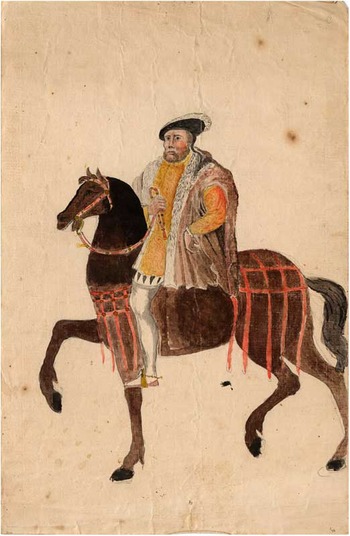
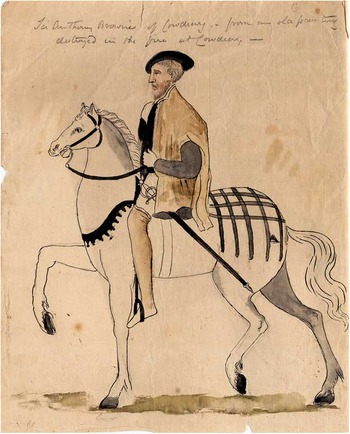
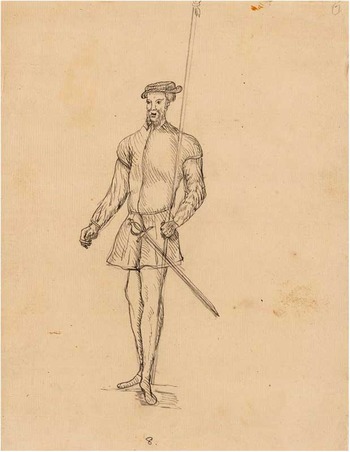
In addition to the newly found British Library watercolour, eighteen further figure studies survive in the Mitford archives copied from The Encampment of the English Forces near Portsmouth, mostly in pencil with a little colouring. They represent actual-size copies of figures from the wall painting (figs 4, 5 and 6), and though they are not signed or dated, the skill with which they are carried out suggests the work of John Keyse Sherwin, into whose sketchbook of c 1769–74 they have been inserted loose.Footnote 28 There are significant differences in detail from the same figures in the British Library watercolour, which would appear to have been worked up later to incorporate further observations from the original. The face of Henry viii, for example, shows hair covering the upper lip, while red has been added to the jacket and both reins are held above the right hand.
Henry viii on horseback. Watercolour sketch: John Keyse Sherwin, 1774; WSRO, Mitford MPD 1a/4, reproduced by kind permission of West Sussex Record Office

Sir Anthony Browne on horseback. Pen, ink and wash sketch: John Keyse Sherwin, 1774; WSRO, Mitford MPD 1a/3, reproduced by kind permission of West Sussex Record Office

Pikeman standing. Pencil sketch: John Keyse Sherwin, 1774; WSRO, Mitford MPD 1a/7, reproduced by kind permission of West Sussex Record Office

It has been assumed that John's assistant in this work was Charles (bapt 1757, d 1794) who, although only seventeen at the time, later came to London to work for his brother and succeeded him as ‘Historical Engraver in the red chalk manner’ to George iii in 1785.Footnote 29 However, the inscription on the mount of the watercolour attributes it to John and George Sherwin. George was older than Charles (baptized in 1753) and some very competent drawings of buildings by him, although employing very short lines, are included in J K Sherwin's sketchbook.Footnote 30 One is inscribed ‘drawings by George Sherwin aged 18 in 1771. He has lost his right hand, & has never had any instruction’.Footnote 31 The entry in the burial register, recording his burial at the age of twenty-six in 1778, notes his occupation as an engraver, so it is quite possible that he assisted his eldest brother before Charles.Footnote 32
George Steevens, the Shakespeare scholar, who knew John Keyse Sherwin well, gave a different account in a letter of 5 February 1776 to Richard Gough. He claimed that J K Sherwin needed the money because of ‘misfortunes … in Sherwin's family’ and that the reduced drawing exhibited at the Society in February 1775 was the work of his brother (without saying which one): ‘Mr Sherwin, the elder assured me, above ten months ago, that his friends had promised that he should positively receive the price he had fixed upon his brother's labour; and that this was long before the affair had been so much as mentioned in Chancery Lane’ [the premises then of the Society].Footnote 33 That drawing has not been traced, but the detail on the resulting engraving is substantial and it would have taken one person a considerable amount of time to copy the original. J K Sherwin was in Winchester by 6 September, drawing the tomb of William of Wykeham for engraving,Footnote 34 so it is probable that both brothers worked on the copy, George possibly working on the topographical features and the shipping, with J K Sherwin adding the figures.
The proposal to engrave the reduced drawing was initially agreed by Council as ‘a desirable object’, but discussion was deferred until the President could be present.Footnote 35 However, it was reported in May that Mr Sherwin insisted on the Society purchasing the drawing for £100 if it was going to be engraved, as engraving would greatly lessen the value of the original and prejudice a future sale. Basire estimated the cost of engraving on two plates, 36 by 21½ inches, at 260 guineas, and, with additional expenses, the Director estimated that the final bill was likely to be £443. No criticisms were made of the quality of the copy and Lord Hardwicke and supporters had raised 50 guineas towards the costs, but Council refused to sanction the expenditure by a majority of eight to six.Footnote 36 Gough, as Director (the Society's Officer responsible for publications), had been effective in campaigning against it. His letter to George Steevens prior to the Council meeting had set out the costs and Steevens replied that ‘he would do all in his power to prevent the Society from being drawn in to fulfil engagements of others at so great an expense’.Footnote 37
There matters might have ended had not Ayloffe been determined to take the proposal to an ordinary meeting open to all members the following January. Gough again wrote to Steevens for his support, but this time Steevens was less sure. He still hoped ‘the Society at large will not be drawn in to fulfil an engagement entered into by a very small party’, had been astonished when the Secretary told him that the chief of Sherwin's friends – ‘our godfathers’ [sic: probably a reference to William Mitford Jnr] – had not even been a Fellow at the time of the original proposal, and said that Richard Blyke, who had died the previous summer, had acknowledged the ‘irregularity of the whole proceeding’. However, he then referred to misfortunes in Sherwin's family as a possible reason for not intervening, as he did not want to prevent him receiving the money ‘which he knows so well how to employ’.Footnote 38 The misfortunes may have related to the death of Sherwin's younger brother, Henry, in September 1775, a year after the death of his mother.Footnote 39
The motion was finally put to a crowded meeting held on 22 February 1776, attended by about a third of the Fellowship and from which visitors were excluded. The Treasurer reported on the healthy state of the Society's finances, with a balance of £511 12s 1d, and Ayloffe read again the relevant part of his earlier paper on the Cowdray paintings. He explained that the event recorded was ‘so ruinous … to the affairs of Francis the 1st & fortunate & honourable to this Nation … and is faithfully copied in the Drawing’. An amendment proposing instead that an etching be produced of the outline of a part of the drawing was only defeated by one vote (40 to 39). It was finally agreed by forty-two votes to twelve, after 11pm, when many of the opponents appear to have given up and left, that the drawing should ‘be etched or engraved in such manner as the President and Council shall think proper’.Footnote 40
It is possible that the part of the drawing referred to in the defeated amendment was the British Library's actual-size watercolour of the principal figures, which measures about 20 inches by 30. It may also have been used by Basire to produce two sketches exhibited at the following Council: ‘one of an Outline, the other with relief, of some of the principal figures in the said drawing’. Council decided on the cheapest option of etching the whole with a little relief at a cost of 150 instead of 260 guineas for the two plates.Footnote 41 The news reached Horace Walpole from his correspondent, William Cole: ‘the members were much agitated and divided about it, and it is now finally determined to have a slight etching of it, not an engraving’.Footnote 42 However, Basire had other ideas and spent two years producing the copperplate and adding a considerable amount of shading. When Council saw the finished print in 1778, he was allowed an extra 20 guineas as he had ‘executed the said print in a Taste and Manner superior to the proposals given’. Lord Montagu was presented with six copies,Footnote 43 and if the usual number of copies were ordered, 500 would have been printed, with about half of these being issued to Fellows with Ayloffe's description. The remainder were set aside for public sale, but it would appear that not many were taken up, for Council recommended the following year that it be advertised again ‘and strongly’.Footnote 44 The Sherwin brothers’ drawing was ordered to be framed.Footnote 45
The series of historical prints was generally judged a success and was especially useful in raising the profile of the Society when negotiating for premises in Somerset House with the Royal Society and the Royal Academy. The following year, S H Grimm was commissioned to copy the painting in the Royal Collection depicting Henry VIII's Embarkation at Dover, thought to be the companion piece to The Field of Cloth of Gold. In 1785, he was sent to Cowdray to copy The Coronation Procession of Edward VI. The Society still has both of these watercolours, which were engraved in full relief by Basire. When Grimm had finished, Council discussed paying Basire to engrave it ‘in his best manner’ and asking Grimm to copy the three wall paintings on the south wall just in outline for a total cost of 60 guineas. However, Edward King, the former President, objected and both proposals had to go to an ordinary meeting, where they were accepted by the members present.Footnote 46 Thus all of the wall paintings at Cowdray had been copied by the end of 1786. Lord Hardwicke was informed that his suggestion of twenty years earlier had finally been brought to completion and within the next two years the remaining engravings were published.Footnote 47
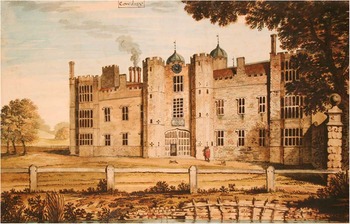
The Sherwin brothers’ watercolour of the principal figures, now in the British Library, appears to have been acquired by Lord Montagu. Along with some of the paintings and many of the Cowdray archives, it escaped damage in the fire of 1793. In 1840, the Cowdray estate passed to three sisters, one of whom, Georgina Elizabeth Poyntz, married Frederick Spencer, who became the fourth Earl Spencer in 1845. When the Cowdray estate was sold in 1843, Georgina is said to have taken some of the possessions to Spencer House, in London; several of the Cowdray portraits were found in the attics there in 1890.Footnote 48 In the 1930s, a collection of Sussex deeds from Cowdray were recorded in the Spencers’ house at Althorp (Northamptonshire), and papers relating to the Montagu family of Cowdray are among the Althorp papers deposited in the British Library in 1984–5.Footnote 49 The watercolour was sold at Christie's in 2010 in the Althorp Attic Sale with another of the exterior of Cowdray House signed ‘J Sherwin’ (fig 7).Footnote 50 As a record of the remarkable detail and colouring of the original wall paintings, the Sherwin brothers’ work shows how much of visual importance to Tudor history was lost from Cowdray in 1793.
Cowdray House, Sussex. Watercolour: John Keyse Sherwin, c 1774; private collection (photograph courtesy of Abbott and Holder)

Acknowledgements
I am especially grateful to Peter Barber for alerting me to this recent acquisition by the British Library and information on historical painting in the reign of Henry viii. Dr Dominic Fontana and Karen Hearn also gave valuable assistance.
ABBREVIATIONS AND BIBLIOGRAPHY
- Abbreviations
- BL
-
British Library. London
- SAL
-
Society of Antiquaries of London
- WSRO
-
West Sussex Record Office, Chichester