Introduction
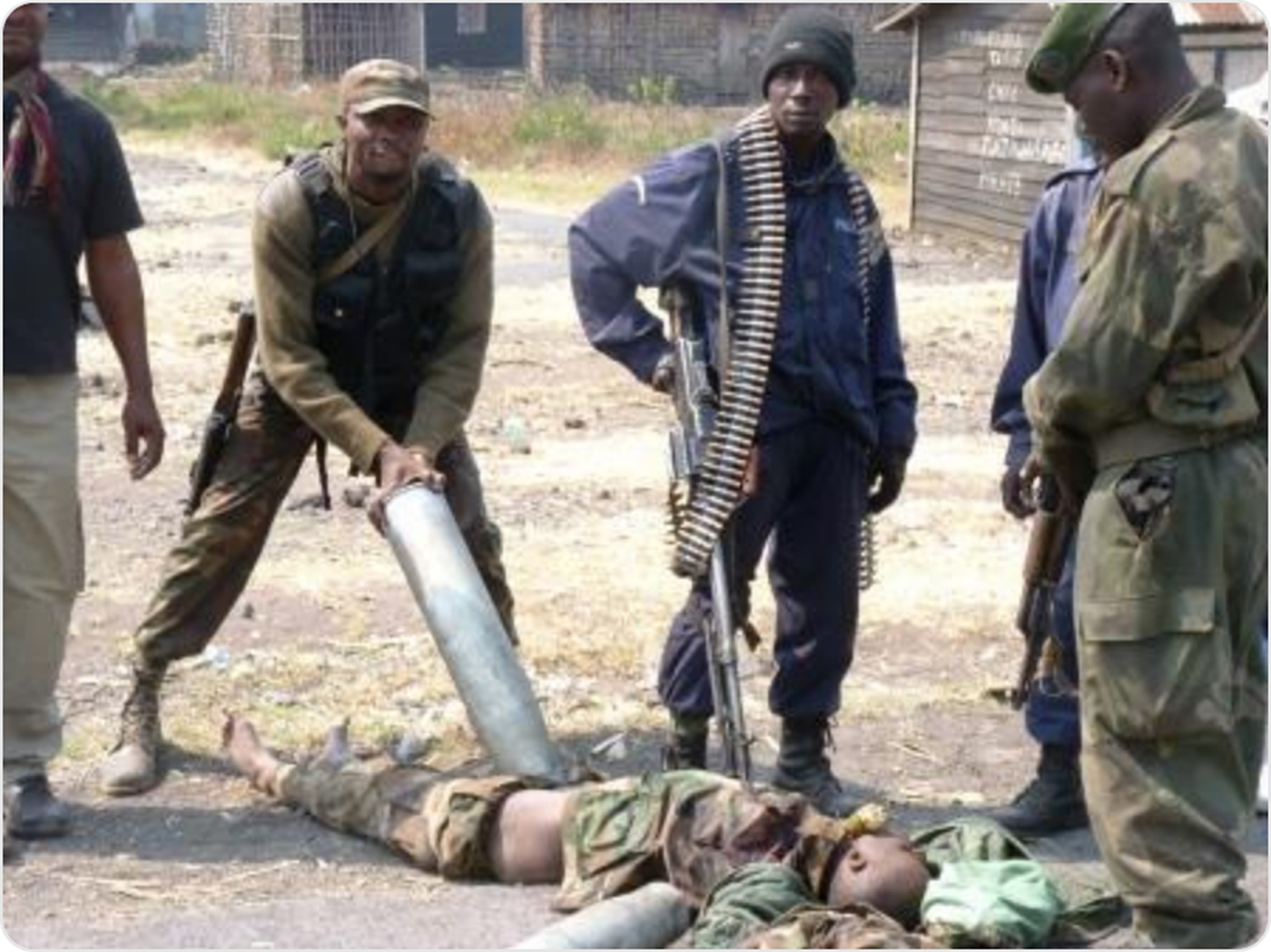
On 16 July 2013, Simone Schlindwein, a German journalist, used her BlackBerry mobile phone to photograph an image that later put her life at risk and incited riots in the city of Goma in the eastern Democratic Republic of the Congo (DRC). The photograph shows a soldier of the Congolese army (Forces Armées de la République Démocratique du Congo or FARDC) pushing a spent artillery shell into the crotch of a dead rebel combatant in the company of four other individuals. Without leaving the scene, Simone uploaded the photograph to her Twitter account and kicked off a series of controversies.Footnote 1 At an unprecedented speed, the photograph came to involve the national and international communities in Goma, the United Nations (UN), members of the Congolese diaspora, the press secretary for the FARDC, and even the M23 (Mouvement de 23 Mars) rebel army propaganda office. As the image whipped through the social media and online journalism world, it became the centre of a network of actors, accusations and actions that played out in the real-time, physical space of Goma. As a result, both the photographer and the photographic subject found themselves under threat; Simone escaped from the DRC and sheltered in Uganda, while Lieutenant (Lt) Solomo Bangala – the subject at the centre of the photograph – was jailed and put on trial for a war crime. By the time I arrived in Goma for fieldwork focused on the politics of photography (August 2013 to August 2014),Footnote 2 talk of this image was impossible to avoid. Retellings of how Simone's by-then-iconic photograph had been created, and what had happened afterwards, permeated conversations about journalism, photography, the war, and the new UN organization – the Force Intervention Brigade (FIB).
In this article, I engage Simone's 16 July 2013 mobile-phone photograph as an ethnographic case study of the slippery ambiguity and power of the digitally disseminated image. I explore this highly mobile photograph and the attention it garnered from a wide range of influential actors. In so doing, I argue that this digital photograph sat at the centre of a ‘perfect storm’ of factors that resulted in retaliatory responses directed at both major parties who interacted to create it – the photographic subject and the photographer. I contend that central components of this storm included: (1) the regional and international politics that it both depicted and with which it became entangled; (2) the volatile ambiguity and instability of the photograph as its interpretations vacillated equally between a documentary depiction and a studio-like performance; and (3) its rapid circulation through social media and journalistic sites as well as within the region's radio trottoir rumour mill. Taken together, these factors combined in an already tense socio-political context and spurred spectators’ deep-seated desires to harness the narrative of the photograph to their political will, or to undermine its power.
Additionally, I tackle how the stakes of this perfect storm provoked a problematic polarization of the photographic narrative. Despite the wide range of individuals who viewed this photograph, the narrative descriptions of Simone's image tended to fall into one of two camps: it was cast as either objective journalistic evidence (‘It shows abuse of a cadaver!’) or subjective engagement of studio-like norms (‘It was play for the camera!’). As I unpack these positions and how they were mobilized, I engage their lingering popular relevance despite the longstanding move in anthropology and studies of photography to analyse the photograph beyond an object showing objective evidence or subjective creation – which Campbell (Reference Campbell2015) considers to be two sides of the same coin. Rather than attempting to engage the photograph beyond these dualistic categories of interpretation, my research dives into the often dangerous priority that such positions inhabit in the field. In so doing, this article addresses both sides of Campbell's visual coin, holding the objective–subjective binary in what I argue is an important and uncomfortable balance.
In attending to what I engage as the ‘objective’ side of the visual binary, I draw out the prioritization of viewers’ interpretation of the image as documentary evidence of abuse (Sontag Reference Sontag1977; Tagg Reference Tagg1988; Reference Tagg2009; Linfield Reference Linfield2010). In relation to the ‘subjective’ interpretation of this image as visual play for the camera, I attend to viewers’ interpretations of Simone's photograph as an interactive process in which she actively participated, and through which meaning was shaped inexorably by the context of photographic production (Pinney Reference Pinney1997; Kratz Reference Kratz2002; Azoulay Reference Azoulay, Mazali and Ruvik2008; Reference Azoulay2012). Pulling these oppositional visual ‘truths’ together, I show how such often oversimplified objective–subjective interpretations of a mobile-phone photograph published on a social media site remain not just theoretically interesting but powerfully relevant within the socio-political context of eastern DRC. Ultimately, as I work through the digital travels of Simone's photograph and the social and physical implications of those movements, I show not only how this singular image brought the charged photographic environment and politics in eastern DRC to light, but how it also exposed the challenge of controlling the photograph in simultaneously physical and online spaces.
The image
Simone's image contains two Congolese police officers, two FARDC soldiers and a partially featured civilian standing around a soldier's dead body (Figure 1). The male body lies in the bottom of the photograph, with the man's face positioned away from the camera; his abdomen is exposed, his trousers ride low, and his arms lie above his head. The living soldier centred in the frame is Lt Bangala; he pushes a spent artillery shell into the crotch of the deceased, barefoot man. Lt Bangala looks up from the body to gaze at the camera; the bandolier-wrapped, well-armed policeman to his left does the same. The other soldier looks at the body; it is unclear where the second policeman and the civilian are looking, since a clear view of their faces is cropped out of the photographic frame. Visible in the image is another artillery shell casing, a few wooden buildings with white writing on them in the background, and the general context of the tidy, open space which may be a town square, a schoolyard or the middle of a road.
Photograph by Simone Schlindwein, 16 July 2013.

Even now, four years on, the confirmable ‘facts’ about Simone's photo are few. It is known that when she took the photograph, Simone Schlindwein, a then thirty-three-year-old German journalist, was working for Die Tageszeitung, a news source based in Berlin. Simone had lived in the DRC for a year and a half and had been researching an investigative journalism piece about the FDLR rebel group (the Democratic Forces for the Liberation of Rwanda). In and around Goma, she ran with a small band of experienced journalists who were well connected in eastern DRC. Unlike many more temporary journalists, her familiarity and connections meant that Simone did not require the government or UN support to get to the ‘front’ – the front lines of the conflict. On 16 July 2013, she rode with her close contact Colonel Mamadou Ndala to ground zero of the recent clashes with the M23.Footnote 3 That day, as the Congolese army soldiers celebrated a gain of four kilometres of territory, Simone composed the mobile-phone photograph that both came to threaten her security and brought the politics of photography crashing into lives of the Congolese both inside and outside Goma.
Importantly, it is also known that, unlike her careful investigative journalism that was channelled first through her editors at Die Tageszeitung, Simone published this photograph directly on Twitter. As she clicked ‘publish’ from the front lines, she set the image into the fast-paced circulation of the internet with only the accompanying 136 characters: ‘#FARDC soldiers playing around with dead #M23 bodies on the frontline. is this acc to the code of conduct [sic]?’ In the entanglement of text and image, Simone harkens to broader legal structures to frame the action her image exposes. Her text summons Article 16 in the second paragraph of the 1949 Geneva Convention IV, which states: ‘As far as military considerations allow, each party to the conflict shall facilitate the steps taken … to protect [the dead] against … ill-treatment.’ The International Criminal Court (ICC) corroborates this rule: ‘Pursuant to Article 8(2)(b)(xxi) and (c)(ii) of the 1998 ICC Statute, committing outrages upon personal dignity constitutes a war crime in both international and non-international armed conflicts’ (ICRC 2016). However, while she queries the international legal structures governing the rules of warfare in her text, her image expands beyond the caption and provokes innumerable questions concerning what exactly is taking place – and what was taking place – before she toggled her BlackBerry into camera function, snapped the image, and unleashed it on the World Wide Web. Speaking to me via Skype a little over a year later, Simone explained:
There was a big backstory in that picture … The people consuming that photo had no idea of the mess Congo was in [then]. That was only clear for people in the army – the people who were at the scene … I'm not a photographer – but I do investigative journalism … I am necessarily involved around dirty stuff … That day, I saw more than I could publish.Footnote 4
It remains unclear exactly what ‘mess’ and ‘dirty stuff’ she is referencing, or what she had seen that day that she could not publish. However, for better or worse, she did publish this photograph, and in doing so via Twitter perhaps, like many who employ social media as a form of advocacy and news, she may have ‘traded speed for accuracy’ (Newman Reference Newman2009). By publishing the image through a social media channel, she initiated a slippage between personal, journalistic and political realms. Instead of following her usual diligent protocols, this image arrived on the net in the form of ‘citizen journalism’, made powerful due to its eyewitness nature (Allan Reference Allan2013; Reference Allan2015; Agbo Reference Agbo2019). Since the early years of the twenty-first century, citizen journalism has grown as a means of generating news content for both social media and reputable journalistic sources. Allan attributes the growth in citizen journalism to the ubiquity of digital photographic devices, including mobile phones. He further argues:
For varied reasons, priorities and motivations, so-called ‘accidental photojournalists’ – be they victims, bystanders, first responders, officials, law enforcement, combatants, activists or the like – feel compelled to bear witness with their cameras, actively engaging in diverse forms of photo-reportage to capture and relay what they see unfold before them. Here the resources of sites such as Twitter, Facebook, Path, Flickr, Instagram, Tumblr, Reddit and YouTube are regularly mobilised to considerable journalistic advantage, much to the alarm of some professionals. (Allan Reference Allan2015: 457)
Despite her journalist job, ethics and training, Simone's choice to publish this image and its limited, yet framing, text on Twitter imbued the photograph with a particularly powerful eyewitness value and far-reaching mobility. Moreover, she situated the image within a space imbued with the expectation and power of denouncing human rights abuses (Joseph Reference Joseph2012; Joyce Reference Joyce2013). By moving first through social media, the image may have been intended – as Sarah Joseph argues that many such images are – to ‘penetrate the veils of secrecy thrown up by repressive regimes’ (Reference Joseph2012: 153). In this case, Simone's photograph offered a visual document of abuse to the wider world that could not, and would not, be ignored by those entangled in eastern DRC's social and political web.
A ‘mess that Congo was’
For just over two decades, eastern DRC has been embroiled in some of the most complex violence the world has known. Two wars (the First and Second Congo Wars in 1996–97 and 1998–2002) positioned the DRC as a theatre of international warfare, as the deadly conflicts involved more than a dozen African nations.Footnote 5 Since the peace accords in 2002, violence and volatility have remained. Years later, more than fifty rebel groups continue to be active in the east (Rosen Reference Rosen2015), tensions remain high across the Congo–Rwanda border, and the loss of life from war-related causes continues to grow. Recent figures estimate that, since 1998, upwards of 6 million lives have been lost – making the conflicts in the DRC the cause of the greatest conflict-related loss of life since World War Two. Such upheaval and state infrastructural collapse have provoked associated humanitarian crises, including widespread disease, mass displacement and some of the highest incidences of sexual violence in the world (Kelly Reference Kelly2009; Büscher and Vlassenroot Reference Büscher and Vlassenroot2010; Autesserre Reference Autesserre2012; Graham Reference Graham2014; Reference Graham2016). As a result, the region has been inundated with humanitarian interventions and UN action. From 2013 to 2014, Goma alone hosted more than 100 international aid agencies, more than 300 partner organizations, and thirteen UN departments (Graham Reference Graham2016). Included in this mix is the largest peacekeeping force on earth – the UN Organization Stabilization Mission in the Democratic Republic of the Congo, known colloquially as MONUSCO.Footnote 6
In short, the complex ongoing conflict in eastern DRC has drawn innumerable actors and their politics into the fray. In this space, soldiers from various provinces, countries and continents cross paths with humanitarians, businesspeople, arms dealers, market vendors, UN officials, rebel operatives, and, of course, journalists. While no time would be optimal for such a photograph to surface, Simone uploaded her image into this volatile context at a highly precarious political moment when the M23 rebel group was fighting for control of the territory in the hills above Goma, and the UN and the Congolese army were brokering a hotly contested alliance.
The M23 rebel group came into existence on 4 April 2012 as 300 former rebel soldiers defected from the Congolese army, regrouped, and armed themselves in the Masisi hills. Funded and equipped in part by Rwanda (UN Group of Experts 2014), the M23 notably dragged potential regional instability with it to the front lines. The group largely comprised Congolese and Rwandan Tutsi soldiers, many of whom had once fought for the previously powerful rebel group the CNDP, solidified control over territory in Masisi and Rutshuru, and built ‘La République des Volcans’. They levied taxes, provided receipts, and operated roadblocks and checkpoints through which foot, vehicle and aid agency traffic was required to cross. At the height of their campaign, the M23 sacked Goma in November 2012, only to retreat in exchange for international political legitimacy two weeks later. When peace talks in Kampala broke down in mid-2013, they returned to the offensive, again capturing territory towards Goma. By the time Simone took her photograph in July 2013, the M23 had successfully established a secure territorial holding and had amassed between 1,500 and 2,000 soldiers. During the M23's reign from April 2012 to when they were overthrown in November 2013, the fighting led to the displacement of approximately half a million individualsFootnote 7 and heightened tensions on both sides of the Congo–Rwanda border.Footnote 8
The threat that the M23 posed to Congolese and regional stability was so difficult to ignore that the UN engaged its new aggressive task force – the FIB. In July 2013, the FIB came to expand beyond MONUSCO's peacekeeping mandate. It became an active combat arm of the UN on a mission to ‘neutralize and disarm Congolese Rebels’ (UN 2013). The FIB broke with the standard vision of peacekeeping, which allowed the UN to fire only when fired upon. Rather, with three infantry battalions, special artillery forces and reconnaissance units whose ranks were filled by some of Tanzania's, South Africa's and Guinea's finest, the FIB was well poised to end the M23 conflict. To do so, it had to work in partnership with the FARDC and their often dubious human rights record. Both nationally and internationally, the FARDC has earned its record of corruption, disorganization and perpetration of insecurity and sexual violence.Footnote 9 Commonly underpaid and poorly trained, the FARDC has its auspicious origins in Mobutu Sese Seko's fear of his army. He had ruled them through a form of Article 15 – Se débrouiller (just get by). For the FARDC, this translated to Mobutu's famous statement: ‘You have guns; you don't need a salary’ (Stearns Reference Stearns2011: 116). While many FARDC soldiers are honest, hardworking individuals, nonetheless, decades after the end of Mobutu's rule, the legacy of his engagement with his army lives on in their ongoing incidences of human rights abuses, corruption and poor organization. Ultimately, the coalition that comprised the UN's FIB and the FARDC produced a historical and precarious situation for the UN: peace through active aggression. Simone's social media publication followed directly on the heels of the signed agreement in which those involved staked their respective reputations on this cooperative venture in rebel eradication.
An entanglement of literalist reactions
Positioned at this precarious political moment, Simone's photograph was ‘read’ online and then operationalized on the ground initially through the often oversimplified, problematic lenses of objective visual evidence and later as a complex subjective interaction with the photographer. The photograph became both what it appears to be (abuse) and also not what it appears to be (not abuse). This section begins with the preliminary interpretation, in which individuals coded and re-coded (Hall Reference Hall1993; Pinney and Peterson Reference Pinney and Peterson2003) the photograph in line with their own politics, insecurities and concerns. Caught up in eastern Congo's network of actors, organizations and alliances, Simone's photograph was commonly cast within the visual narrative that prioritized the image as documentary evidence of a human rights abuse.
‘Everyone is a literalist when it comes to photographs,’ argued media critic Susan Sontag, as she contended that the work done by photographs is ‘not to evoke but to show … that is why photographs, unlike handmade images, can count as evidence’ (Reference Sontag2004: 47). Like Sontag, John Tagg (Reference Tagg1988; Reference Tagg2009) understands the camera as a violent form of technology that – through its images – shapes complex claims to evidence and powerfully reifies societal power dynamics. Relying on Foucault's theorization of surveillance (Reference Foucault and Sheridan1977), Tagg argues that photography and the notion of visual evidence became bound together in the second half of the nineteenth century due to connections and usages within ‘new institutions [e.g. prisons and courtrooms] and new practices of observation and record-keeping … [The resulting] production of new knowledges released new effects of power’ (Reference Tagg1988: 5). Such power, he argues, is derived from the politics of the documentary as connected to the particular history that the photograph indexes:
Documentary transformed the flat rhetoric of evidence into an emotionalized drama of experience that worked to effect an imaginary identification of viewer and image, reader and representation, which would suppress difference and seal them into paternalistic relations of domination and subordination on which documentary truth effects depended. (Tagg Reference Tagg1988: 12)
Within Tagg's framework, the power of the documentary image relies on a hierarchy of power – the dominant viewer/photographer and the subjugated photographic subject – to produce a regime of truth in which the subject has little to no say in the knowledge derived from the image (Tagg Reference Tagg1988). What is viewed in the image is believed to represent a history that is at once evidentiary, objective and true. And through such a mode of viewing and photographing, the documentary photograph gained a reputation for witnessing human rights abuses and providing hard-to-question proof of wrongdoing (Sontag Reference Sontag1977; Tagg Reference Tagg1988; Linfield Reference Linfield2010; Batchen et al. Reference Batchen, Gidley, Miller and Prosser2012; Joyce Reference Joyce2013).
During the second half of the twentieth century, however, the concept of the reality-relaying objective photograph became the subject of heated academic debate and critique as anthropologists, historians and media critics, among others, contended that the photograph was a complex, intersubjective creation that often raises more questions than it answers (Sekula Reference Sekula1986; Caldarola Reference Caldarola1988; Pinney Reference Pinney1997; Kratz Reference Kratz2002; Edwards et al. Reference Edwards, Gosden and Phillips2002; Reference Edwards, Gosden and Phillips2012). As Sekula notes: ‘The only objective truth that photographs offer is the assertion that somebody or something … was somewhere and took a picture. Everything else beyond the imprinting of a trace is up for grabs’ (Reference Sekula1984: 57). And to grab at the photograph is to interpret it – to cast it knowingly, or unknowingly, into a tendentious narrative that renders the represented visual content comprehensible within one's frame of reference.
Engaged both locally and internationally through this content-as-truth lens, Simone's image began its circulation through the rapid highways of social media carrying a narrative of proof that a Congolese soldier had abused a fallen rebel combatant. Her Twitter followers viewed the image, with many commenting on it to the tune of ‘shame on the FARDC’, while another seventy retweeted the photograph to their own followers. While the evidentiary read drew outrage and also confirmed existing assumptions about the Congolese army (that they rape and murder and are cowards, for instance), the responses on the ground were not dissimilar. For instance, Jean, a Congolese employee at a local non-governmental organization (NGO), explained passionately: ‘It's a disgraceful thing to do that – one must bury bodies! That's all! One does not mutilate them. One does not touch them – even if they are the enemy. It is detestable what that man there [Lt Bangala] had done.’ For him, Simone's photograph was a documentary act that captured the ‘decisive moment’ (Cartier-Bresson Reference Cartier-Bresson1952) within a situation of abuse or mutilation. For Jean, Simone witnessed the essence of an event and froze the depiction as ‘life offered it up’ (ibid.) – mid-action. His interpretation of the image intertwined with his sense of morality with regard to what one does and does not do with the deceased; his position was founded on his acceptance of the image as a depiction of abuse – of an act, of reality without interference.
Momentum carried the evidentiary read forward as Simone's photograph transitioned from publication in a personal social media account to republication within a news source. France 24 acquired Simone's photograph from her Twitter feed, removed the ‘?’ at the end of her caption and republished it, in a move of dubious journalistic ethics, declaratively stating: ‘Congolese soldiers desecrate rebel corpses’.Footnote 10 As the photograph moved through the social media and journalistic spheres, it made waves on the ground. Elite UN officials and the FARDC swung into damage-control mode; the evidence furnished by the photograph threatened their reputations and the alliance itself. Ban Ki-moon, Secretary-General of the UN, issued the following statement:
The Secretary-General is deeply concerned about reports of alleged mistreatment of M23 detainees and desecration of corpses of M23 combatants by the Congolese armed forces. The United Nations Organization Stabilization Mission in the Democratic Republic of the Congo (MONUSCO) has raised this matter at the highest level with the FARDC and welcomes steps by the Congolese army to investigate these claims and to hold the perpetrators of these acts accountable. In line with the United Nations Human Rights Due Diligence Policy, MONUSCO has launched the process of reviewing its support to FARDC units suspected of being involved in these incidents.Footnote 11
With the image circulating the globe and critique arising from the UN, it was not long before the FARDC arrested Lt Bangala and initiated his trial by military tribunal. The photograph-as-documentary representation carried its own form of agency – it demanded (re)action beyond shock or disgust; it demanded that someone must be held accountable.
Moreover, when interpreted as incontrovertible evidence of FARDC abuse, the power of Simone's photograph drew ever more actors into its web of viewer interpretation and individual as well as institutional response. The image not only destabilized the UN–FARDC alliance; it also raised questions about the ethics and actions of the Congolese army in general. As such, it became useful in the hands of the M23 rebels, who were in the process of clamouring for international approval. A member of the UN Group of Experts noted: ‘the M23 was delighted about the photo … [I]t lends them credibility while the FARDC was furious. The picture is good propaganda for them [M23] … Their [M23] propaganda team has always been better than ours [FARDC].’ As the image continued its national and international circulation, it provoked interpretations that entangled the image content with a range of high-stakes politics set within Tagg's expected power dynamic of powerful viewers and powerless subjects – and, in this case, the subject's affiliated organization: the Congolese army. Ultimately, the image became proof of the FARDC's loss of integrity that was both redressed by supporters and operationalized by detractors.
In addition to the political and institutional responses, Simone's photograph also fuelled explosive gossip, despite the likely reality that more Congo residents had heard about the image than had seen it. As the rumours associated with the photograph whipped through eastern Congo during its first twenty-four hours of publication, the tension in Goma rose quickly to fever pitch. Most notably, the region's notorious radio trottoir (sidewalk radio) spread allegations that, due to this photograph of ‘one soldier's abuse of a cadaver’,Footnote 12 Colonel Mamadou had been called to Kinshasa and would be court-martialled. Without denying the evidentiary quality of the photograph to document abuse, individuals often affiliated with the FARDC strove to minimize the situation to simply an aberrance – abuse committed by a singular soldier. ‘It was an isolated act,’ explained the press secretary for the FARDC, Colonel Olivier Amouli. ‘Officers did not give orders to mutilate cadavers.’ Such accounts strove not only to recast the narrative for Lt Bangala but also to protect their colonel from international scrutiny and punitive measures. As a result, the volatility of the region was soon exposed as the city exploded into a series of heated ‘manifestations’ (protests that included marches and roadblocks, and that commonly ended up as riots). At the blockades, tyres smouldered and civilians stoned UN vehicles as they protested against the presumptive – though misguided – belief that their beloved colonel had been arrested as a response to the photograph's visual content.
Looking past the abuse
While the photograph continued to make waves online, the major events surrounding the image sat squarely in the off-line realm. Indeed, Colonel Mamadou never faced trial for his role in this photograph, but in the trial that did ensue, Lt Bangala faced a minimum sentence of twenty years in prison and a maximum sentence of the death penalty. Simone's photograph held true to Sontag's and Tagg's claims about the image's evidentiary abilities; the prosecution employed it as the primary objective proof that Lt Bangala had committed a war crime. The defence, however, argued for a more intersubjective read. In his argument, Lt Bangala's lawyer claimed that his client suffered from an utter lack of human rights training and was only ‘playing’ for the camera. The argument hinged on the belief that had the journalist not been there – had Simone not raised her mobile phone to take a picture – the featured abuse would not have happened. In court, the image was mobilized, suspended between the interpretations of which ‘truth’ the photograph held: that of abuse or of play. And on those dichotomous visual narratives and the decisions they influenced hung the life and livelihood of an individual.
With Goma as the theatre of debate, a similar discursive battle was waged that pitted the agency and dialectical interactions of the photographic subject and the photographer against the notion of the image as unquestionable truth of abuse. A discussion with press secretary Olivier Amouli drew out a key concern in this debate. He explained the situation as follows: ‘A man found a shell, pointed it at the crotch of the dead to “faire un scenario” [play out a scene]. But it wasn't mutilation.’ His explanation exposes the instability and ambiguity of the photograph, where the represented content hung in a tension between ‘found’ photograph created at a ‘decisive moment’ that could be evidence of violation and a scenario enacted for the camera. Importantly, the ‘play for the camera’ trope became so prominent that it drew a variety of descriptions and even re-enactments. Aimé, a young expat entrepreneur, for instance, speculated:
I think they [the soldiers] wouldn't have done it – and it wasn't mutilation – if the cameras were not there going ‘click click click click’ [he jumps to his feet and pretends to photograph theatrically] that wouldn't have happened. I think they were performing – and when you get a bunch of them [photographers and journalists], then you [the subject] naturally perform for the camera. I don't know much about Simone's situation, but yeah, it was only happening because the journalists were there – without them, I don't think it would have happened.Footnote 13
Such an interpretation of the image positioned Lt Bangala not as abusing a cadaver, but as someone who engaged the space of photographic creation as a place of play and performance. These terms became recurring ways of discussing the photograph without actually addressing the content. It becomes a way of doing what Pinney and Peterson (Reference Pinney and Peterson2003) call ‘looking past’ – engaging the image beyond the indexed photographic content (here the abuse) and reshaping the narrative. This ability to look past the disturbing content of the picture suggests that images are:
a complexity of perspectival positions of a multiplicity of layers that endow photographs with an enormously greater complexity than that which they are usually credited. The photograph ceases to be a univocal, flat, and uncontestable indexical trace of what was, and becomes instead a complexly textured artifact concealing many different depths. (Pinney and Peterson Reference Pinney and Peterson2003: 5)
The interactive notions of photographic play, performance or faire un scenario enabled the uncoupling of the image content from a human rights abuse.
Such play and performance regularly shape quotidian engagements with the camera and its photographer in eastern DRC, as individuals use the camera to craft a vision of themselves that playfully reflects the present but will memorialize aspects of the self and one's context for the future. Studio photography and studio-like photography (a form of photography that borrows the studio tropes and interactions outside the studio's confines (Graham Reference Graham2016)) comprise what is arguably the most common form of photography in the region. In such visual encounters, a photographer's goal is to praise the subject. The subject is provided with a creative space geared towards the engagement of an intentional self (see, for example, Pinney Reference Pinney1997; Werner Reference Werner2001; Buckley Reference Buckley2000; Reference Buckley, Edwards, Gosden and Phillips2006; Behrend Reference Behrend1998; Reference Behrend, Pinney and Peterson2003; Mustafa Reference Mustafa, Landau and Kaspin2002; Geary Reference Geary2003; Sprague Reference Sprague, Pinney and Peterson2003 [1978]; Brieilmaier Reference Brieilmaier, Peffer and Cameron2013; Peffer and Cameron Reference Peffer and Cameron2013; Graham Reference Graham2016). In eastern DRC's studio/studio-like photography, play and dialectic interaction between the photographic subject and the photographer are so common that objective, candid depictions of reality are rarely desired, nor commonly engaged by studio photographers or their photographic subjects. Rather, photographs are intentional constructions that shape subjects into ‘just a little bit more than one really is’ (Pinney Reference Pinney1997: 178). During the creation of the photograph, subjects and photographers interact to craft a desired depiction through a careful choreography of props, pose, friends, family and backgrounds. The combinations of photographic elements create mise en scène performances that use touch and gaze to connect subjects with others, props and contexts and ultimately define a glorifying narrative of the featured individual (Graham Reference Graham2016).
For instance, individuals in North Kivu regularly engage the camera with particular studio-like intentions. ‘Take this picture – I want to show prestige,’ claimed a man named Japan just outside Beni town, as he pulled a crisp US$10 bill from his wallet and placed it in front of his face – clearly linking himself with the money and his desired narrative. Similarly, Fahida, a Goma resident and manager of a local restaurant, explained that, for a picture, ‘I want to show that I have food, that I'm doing well.’ She enacted a clear mise en scène as she pulled a portion of chicken from her plate and bit into it, pausing for the camera to click before actually tearing any flesh from the bone. Touch created connection, exposed desire, and allowed for the assumption of ownership.
Simone's photograph, many argued, was no different from such studio-like images. Even when the camera was only a BlackBerry phone, it held the potential to ‘give breathing space to an aspect of the imagination’ (Buckley Reference Buckley2000: 89). The act of photography may have opened up a space for glorifying one's soldier identity through a mise en scène narrative that left no question as to who was powerful – who was the victor of the day. In fact, when viewed through that blasé entry point, one sees four men enacting a gesture that appears frozen for the camera and in which the touch of objects and pose convey a chosen narrative. The gaze directed at the photographer could appear to ask, like Fahida's, ‘Did you get the photo?’ Momentarily setting aside the fact that the props engaged here are both an artillery shell and a fallen soldier, when addressed through the lens of performance, the image is not entirely dissimilar from a range of studio-style posed military portraits of conquest and power that soldiers have desired throughout history. Soldiers often posed together with their weapons, at times creating mises en scène featuring the subject poised mid-action as they pretended to shoot or as they employed touch and association to craft narratives. Acutely aware of the camera, subjects address the space of photographic creation – including the photographer and bystanders – in a situation of simultaneous documentation and performance.
Thus, Simone's image potentially speaks to the intersecting desires of the photographer to provide evidence, and the desires of the subject to enact a grander than usual sense of self in the present for a projected future. Simone's photograph – like so many images – was far from stable. Rather, the tangled translations of objective evidence or subjective play production created a volatile representation. This image became an example of what Mead (Reference Mead and Hocking1975) termed the ‘danger of the visual’, for it is ‘too open to misinterpretation, and too seductive’ (quoted in MacDougall and Taylor Reference MacDougall and Taylor1998: 68). Through its narrative, the image could be manipulated without ever altering the representation. It was actively twisted and parsed apart as the viewer saw fit, ultimately implicating not only the FARDC and the UN, but also both the photographer and the subject. Whether play, performance or abuse, the clearest aspect of the image was not what it represented but its unwavering ambiguity and its ability to be coded and recoded within individual interpretations and broad economies of consumption that shoehorned the photographic content into objective or subjective analysis. The result, in this case, was that the photograph drew into its scope all who gazed upon it. With a certain violence it demanded the viewer to judge it as being representative of either side of Campbell's visual coin, and, all too often, to act based on that particular assessment.
A photographer who should have known better
As the photograph travelled through the social media spheres and the internet pages, it stirred the political pot, drew in an increasing range of concerned individuals and their politics, and ultimately had on-the-ground implications. For the FARDC, and by extension the Congolese government, the UN and numerous citizens of eastern DRC and beyond, the photograph posed a threat to both stability and credibility. Where the subjective interpretation of ‘play’ was not enough to undermine or cajole a ‘looking past’ of the implications of the photographic content, discrediting or attacking its makers became a viable, and repeated, response. Lt Bangala remained fixed in a legal debate concerning ‘what actually was happening when that image was taken’. As individuals attempted to corral the meaning of the photograph, rumours circled that Lt Bangala was going to be ‘sacrificed’ for the UN and as a means to silence the visual controversy. Facing the death sentence, his trial dragged on.
In the midst of this, the image also maintained its credibility because Simone remained a viable journalist in the region. Still, she was not impervious to critique and attack. ‘And me,’ said Simone, explaining the fallout from the photograph during a Skype interview, ‘suddenly I became the focus. The photo literally falls out of the picture – it became all about me, not about the picture itself – who did that picture? Well, they say, it [Simone] has to go.’ Somewhere in the melee, a high-ranking FARDC friend of Simone's called her with a not-so-subtle warning: ‘It will be ending badly for you if you do not leave the country right now.’ Not twenty-four hours after photographing and publishing the image, Simone found herself hunkered down in an armoured convoy, bound for the Congo–Rwanda border, while her photograph gained a wide array of clicks, likes, attacking comments and retweets across the global social media sphere.
The danger she faced as the photographer of such an implicated and volatile image was no surprise to many researchers and journalists in the region. A common refrain simply posited: ‘She should have known better.’ Johnny, a Congolese journalist who knew Simone well, explained more clearly what that ‘knowing better’ meant within the political situation in eastern DRC:
You have to be prudent if you want to keep living here. People here know me. I have worked here for a long time, and my life and family are in this city. If I want to keep being able to do my job for the press, I have to be smart and think about the future when I take images. They have to be journalistic – documentary – the things that you find.Footnote 14
Then he tracked back to his interpretation of what he saw as the problem with Simone's photograph:
I do not take pictures of things that are staged or created for me – that was Simone's problem. She asked the FARDC for a picture – and then they started to play for the camera, they acted for her, and it wasn't smart, and she wasn't thinking about the future. She had a good job here. Now she has nothing here – but it wasn't good journalism either. There are simply pictures you cannot take: never take anything ‘qui laisse une mauvaise gout’ [that will leave a bad taste in one's mouth]. One needs to be prudent, and if one finds the photos, one can take them – me, I have photos of dead M23, and FARDC cadavers, but I found them in the field.Footnote 15
Johnny reaffirmed the regional ethics underpinning how proper journalism should function regarding its production of images, but perhaps more importantly what a viable photographic subject could be within the tense region of eastern DRC. A good photograph must be ‘found’. More importantly, it must also not upset the authorities. From his position as a journalist who must continue to work inside eastern DRC, photographs were not something one attempted to control after the fact; the control needed to occur when a photographer chose to photograph or not. His abstinence in delicate situations spoke to that knowledge and an awareness of the power of the image to slide from one's grip.
The threat Simone faced, however, did not end as she fled across the Congo–Rwanda border. Like her image, which circulated unfettered by international borders, Simone's insecurity did not come to an abrupt halt at that political frontier. Simone soon moved to Uganda and started to take stock of what had happened. Then she got a call from her boss. Simone continued her account during our online conversation:
My boss said, ‘Something is happening related to that photo on Twitter.’ I looked and saw that people had written, we ‘have to kill her’, ‘collateral damage’, ‘she won't survive’; ‘I have your name on the bullet’ … Someone on Facebook was like – ‘She's likely living in Kampala.’ The [Congolese] diaspora is close and is informally connected to my home [in Uganda] – my night guard is Congolese – my whole life is Congolese. If someone looks, they will find me quickly. So I ran away. I left on that day – on 3 August and got on a flight to Germany. I didn't come back to Africa for four months … all those tweets that called me ‘Kagame's girlfriend’ or a ‘Tutsi whore and prostitute’. [She paused] … How pictures create damage! It was a snapshot, and it created a lot of harm. I can't – I know that I would not survive if they were to lose [the war]. I can't redirect the attention back to the picture because for them, the problem was never the picture. It was Simone.Footnote 16
Like the subjective interpretation that encouraged individuals to look past the photographed abuse to see interactive play for the camera – and perhaps for Simone – the rising narratives of threat and collusion with the enemy functioned similarly. Interpretations of the image that placed Simone at the centre enabled individuals to gaze through the image and unravel its damage to the FARDC's reputation by defaming its photographer, spinning her ever more tightly into the region's volatile political web. The social media aspect of this image expanded its network and reach, and also provided a platform for attack from afar. Pertinent to this, Simone was operating in a field dominated by men. In eastern DRC, the vast majority of journalists and nearly all studio photographers are men. Within the international combat journalism scene, there are indeed a handful of women who have fought for their position and equal treatment. However, they still face discrimination and outright misogyny. For Simone, being labelled a Tutsi ‘whore’ and a ‘prostitute’ follows general internet trends as well as those of the region. Researchers including Ellen Spertus (Reference Spertus2002) and Pamela Turton-Turner (Reference Turton-Turner2013) have long noted that the internet is a difficult place for women to engage equally. Bartlett et al. argue that, ‘while the Internet was seen as a utopian platform for free speech and equality when it began to become popularly used in the 1990s, it was evident from the very start that the inequalities that structured “real-world” society had been transferred online’ (Reference Bartlett, Norrie, Patel, Rumpel and Wibberley2014: 3). Their research shows that women are more subjected to bullying, abuse and hate speech than men. By undermining Simone's position through political sexualization premised upon her gender, her internet stalkers took general misogyny and twisted it intimately into regional dynamics.
By painting Simone as sympathetic to Rwandan and Tutsi ties – and therefore to the M23 – her online attackers strove to undermine the evidence of her journalistic image by presenting it as one grounded in propaganda for the enemy. The comments that labelled her as ‘Kagame's girlfriend’ or a ‘Tutsi prostitute’ connected Simone respectively with the president of Rwanda (Paul Kagame) and to the region's socio-political tensions around autochthony formed through a complex history of migration and conflict over the last century (Jackson Reference Jackson2006; Geschiere and Jackson Reference Geschiere and Jackson2006; Bøås and Dunn Reference Bøås and Dunn2014). Vlassenroot and Büscher insightfully note that in Goma:
Processes of identification and the mental construction of the self and the other have been given a new dimension since the start of the conflict. Questions about citizenship and belonging have been sharpened and identities further politicized. Contestation over national identity and debates about inclusion and exclusion still has a strong impact on Goma's urban society … Identifying oneself as ‘Congolese’ in Goma is often the same as simply identifying oneself as not being Rwandan. (Vlassenroot and Büscher Reference Vlassenroot and Büscher2013: 3179)
Furthermore, by specifying what ethnicity of Rwandan she might be colluding with (Tutsi), they connected her directly with the power structure of the M23, and by extension with the ruling power in Rwanda. This positioned her plainly against the Congolese state as it currently exists. By attempting to trace the locations of the online aggressors, Simone and her editor came to believe that the attacks originated from the Congolese diaspora, as the accusations and intimidation arose from shadowy, unnamed online accounts and IP addresses predominantly in Europe and the US.
In other circumstances, the online threats might not have been empty. Speaking later from a more secure location in Germany, she confessed, ‘I knew that if they [the Congolese army] did not win the war [against the M23], I would never be able to go back [to Congo].’ She believed firmly that her image would be implicated in the army's downfall – and therefore she would be held accountable. But, with the help of the UN in the form of the FIB, the FARDC did win and eventually her photograph faded from view. Even with the wide network of individuals and organizations wrapped up in its implications, the photograph too lost its urgency for a response. At the end of the war, and the FIB coalition against the M23 specifically, Lt Bangala's trial took a recess and began to proceed more slowly and with less drama. Gone were the international implications, and, with them, the rumours of the death sentence disappeared, and eventually the need for him to remain in prison also dissolved.
Conclusion
As Simone's Twitter photograph traversed social media and online spaces, it became a visible representation that both depicted and was implicated within often invisible local and international politics of eastern DRC. Due to its internet-based circulation and explosive content, a wide range of actors were drawn into interaction with the image and its potentialities. Further, its extraordinarily powerful representation demanded that it be not just gazed upon online, but also responded to in the on-the-ground location in which it was created. However, the complex ambiguity of the photograph and its interpretations undermined a unitary response that could address the question of war crimes that Simone raised in her caption. Rather, responses to the image distilled into the polarizing camps of objective proof or subjective construction as individuals attempted to understand what exactly was happening when the shutter snapped. How the photographic narrative was cast depended on a number of factors, centred around not just whom (or what organization) spectators wished to condemn or to free from blame, but what future they imagined the image would lead to – for better or worse.
In relation to Africa's photographic futures, this photograph also twisted the notion of a future tethered to a digital representation. The range of objective and subjective interpretations of the photograph drew from the past, related to present individual positions within the social hierarchies of the region, and reflected the fears and ambitions for the future. Such a future looked towards what would become of Simone and Lt Bangala, the FARDC and eastern DRC as a whole, as well as to the future of conflict on the continent and UN involvement. Here, local photographic displays of modernity and depictions of individuals expanded beyond common displays of wealth, technology or food to articulate with global institutions, processes, figures, and even shadowy online trolls. While never explicitly described in relation to the photograph, anxieties about what would come – what could come – impacted each interpretation and action beginning with the image's very inception, and they continue as I write this article.
As a result, despite the move beyond the simple objective–subjective binary within academic analyses of the photograph, this case in eastern DRC exposes the connection between the online movement and the firmly grounded and consistently acted-upon reality of such anxiety-aligned interpretations. Ultimately, the responses this image elicited as it moved through physical and online universes show the power of the photograph to draw both virtual and flesh-and-blood persons into its network of political and social implication. By exposing the articulations between the digital image and the region's politics, as well as its ambiguity and slippery openness to various subjective or objective interpretations, I have shown how it drew a wide range of actors into its scope. Taken altogether, Simone's photograph became enormously powerful – an uncontainable force of nature – an unwieldy image whose content and timing spurred its operationalization for innumerable agendas and purposes. It also became an image demanding to be controlled for precisely those same reasons. Ultimately, Simone's fateful photography of 16 July 2013 rose in a particular political moment as the instigator of a perfect visual storm, which not only made the image temporarily iconic, but also loaded it with regionally significant consequence.
Acknowledgements
Thanks are due to Peter Little, Corinne Kratz, Anna Grimshaw, Lora McDonald, Leslie Witz, the Emory Department of Anthropology and the Visual Scholarship Initiative. Deep gratitude is due to Simone Schlindwein. Thank you to my friends and informants in Goma, as well as to Patricia Hayes and the Centre for Humanities Research and the South African Research Chair Initiative in Visual History and Theory. To Walker, thanks for always waiting for me to finish writing – good dog.