I have an urgent plea for help. [Our] farmers' market currently has no produce except berries, and has no farmers planning to bring produce until late July or (more likely) early August … . I know there must be some farmers out there with lettuce and other vegetables. I'm getting desperate. We have customers asking every week ‘where are the vegetables?’ and lots of folks in our community have the WIC and Senior coupons to spend at the market. It's very frustrating being in a farming community and not having any farmers at the market!
(Farmers' market e-mail discussion list posting, 2002).This appeal epitomizes a farmers' market in distress. Despite laudable efforts by its organizers, this market closed permanently a few months later.
The rapid expansion of farmers' markets in Oregon and throughout the United States obscures the little known fact that a disturbing number of them fail. Between 1994 and 2005, a period for which there are reliable inventories, the number of farmers' markets in Oregon increased from 18 to 68. Nationally, farmers' markets have increased at a similar pace numbering over 4385 as of 2006, an addition of over 2600 markets in 12 years1. These are both net changes. A closer examination of individual Oregon farmers' markets reveals that during that period many markets closed. This fragility of individual farmers' markets even during a period of rapid expansion is both a cause for concern and a motivation for this study.
The topic of farmers' market failure is rarely addressed in the literature. The research reported here provides an important first examination of the issue offering a clearer but still incomplete picture of market failure. Although the focus is on one area in the US, the findings have broad application. This paper describes the dynamics of farmers' market startups and closures. It focuses on two important resources—administrative revenue and management personnel—used by farmers' markets. Data for a sample of markets that failed are examined along with factors associated with market failure. Lastly, areas of risk and recommendations to enhance market success are offered.
Economists associated with the United State Department of Agriculture (USDA) periodically inventory, analyze and report on farmers' markets in the United States. Several such reports have been published during the period of growth of US farmers' markets from the 1990s to the presentReference Johnson and Bragg2–Reference Payne5. These reports documented a significant expansion in the number of farmers' markets nationwide. Although they largely focused on the growth of farmers' market numbers, the authors also recognized that there were other processes taking place. Burns and JohnsonReference Burns and Johnson3 noted, ‘Not all farmers’ markets are successful and only anecdotal information exists on why some have failed' (p. 12). Later, PayneReference Payne5 pointed out, ‘While farmers’ markets have shown that they are beneficial to farmers, customers and local communities, many areas of study remain. One of the most important areas that merits further study is why markets fail' (p. 9).
Farmers' markets link small farmers with consumers in a unique social gathering and serve a key role in local food systems. Local food systems integrate production, processing, distribution and consumption to enhance the economic, environmental and social health of communitiesReference Feenstra6. A useful term for describing this still emerging form of food system is ‘civic agriculture’Reference Lyson7. Civic agriculture describes a system made up of economic and personal relationships within a community. The concept emphasizes economic development balanced against the social and environmental objectives of a community. Regarding farmers' markets, Lyson points out:
As social institutions and social organizations, farmers' markets can be important components of civic agriculture. They embody what is unique and special about local communities and help to differentiate one community from anotherReference Lyson7 (p. 93).
As important components of local food systems, farmers' markets are valuable venues for small farmers. For instance, a North Carolina study that examined the use of direct marketing channels by small organic farmers revealed over 40% of the farmers relied on farmers' markets for nearly their entire annual incomeReference Andreatta8. A California study found smaller farms were more dependent on farm direct marketing and farmers' markets were the predominant channel used with 80% of the participants employing it and 54% employing it exclusivelyReference Kambara and Shelley9. In addition, the researchers observed, ‘a large percentage of small direct marketers believed that they really had no choice but to market directly to consumers if they wanted their farm to survive’Reference Kambara and Shelley9 (p. 18).
Farmers' markets serve pivotal roles for small farmers and local food systems and the success of each is closely tied to the other. An understanding of how and why markets fail is an important step in improving the viability of farmers' markets and therefore, maintaining and expanding a marketing channel for small farms and enhancing local food systems.
Methods
The data presented here are one segment of a larger research project that examined farmers' market viability in the northwest region of the USReference Stephenson, Lev and Brewer10. The data were collected between 2002 and 2005. Both quantitative and qualitative research methods were used including a survey questionnaire administered by telephone, interviews and focus groups.
The data collection employed a participatory approach that included built-in protocols for participants to offer guidance and review findings. A key feature was a project advisory committee consisting of three research participants. This group provided guidance and input throughout the project. This approach ‘informed’ the research process at crucial stages maintaining a grounding and problem-orientation to the research project. Approaching research in this manner includes the participants as intellectual partners and allows them to set the research agenda and contribute local knowledgeReference Wuest, McCool, Miller and Veseth11. The use of committees to guide research projects is noted by van de Fliert and BraunReference van de Fliert and Braun12 as among many sound participatory approaches.
To obtain information from individual farmers' markets for a full season of operation, the survey questionnaire concentrated on the 53 farmers' markets operating in Oregon during 2002 that had operated during the 2001 season. Creation of the survey questionnaire was carried out during meetings with the project advisory committee. Fifty of the 53 eligible farmers' markets participated in the survey. The 94% response rate strengthens the validity of a research study drawn from a numerically small population.
Following a preliminary analysis of the quantitative and qualitative data, six focus groups of farmers' market managers were organized and conducted on a regional basis during 2004. A total of 29 managers participated representing 33 farmers' markets. The focus groups were two-way conduits for information exchange between researchers and practitioners and added important data to the market failure segment of the project.
Directories of Oregon farmers' markets for 1998–200513–20 were used as an important secondary data source. The directories are published by the Oregon Farmers' Market Association (OFMA) and the Oregon Department of Agriculture (ODA) and have been produced annually since 1998. The OFMA/ODA directories list the markets operating for each year of the publication, their location, contact information and other information. These directories were used to identify the year markets began and ceased operating and to track manager turnover. Survey and interview data enhanced the accuracy of the directories since markets did not always appear in the directories the specific year they began operating.
A key aspect of this paper is an examination of a small sample of farmers' markets that closed. Nine markets that were operating at the time of the 2002 survey of market managers closed sometime after the survey was conducted and prior to 2005. The 2002 survey of market managers includes data on seven of these nine farmers' markets that closed (two markets did not participate in the survey). The OFMA/ODA farmers' market directories provide limited but important information on all nine of the closed markets. Interviews with farmers' market managers and three managers of closed markets enhanced the survey and the secondary data.
Quantitative data from the survey questionnaire were organized and analyzed using Statistical Package for the Social Sciences (SPSS) version 11.5. Statistical analysis was conducted with consultative support from the Survey Research Center at Oregon State University.
Farmers' Market Dynamics
BrownReference Brown21 documented the growth and decline in numbers of farmers' markets in the US during the 20th century identifying the 1990s as the beginning of a period of growth. This period of growth continues and Oregon market numbers are consistent with this national trend. Here, a more complete picture of Oregon farmers' markets numbers for this period is provided. Row 3 of Table 1 presents the total number of farmers' markets in Oregon for the years 1998–2005 based on the OFMA/ODA directories. It shows a relatively steady increase in the number of markets from 38 in 1998 to 68 in 2005. This type of information is commonly presented by researchers for this period of growth in the number of farmers' markets. For instance, Thilmany and WatsonReference Thilmany and Watson22 used USDA data to document that between 1994 and 2002 the growth of western states farmers markets was 168% outpacing the national increase of 79%.
Growth in number of Oregon markets by year and markets that opened or did not re-open.

1 Exact date of closure is unknown (during a season, after a season, or just prior to the next season).
2 Text refers to nine closed markets in 2003–2004. The tenth market shown here had just opened in 2002 and was ineligible for participation in the survey.
Rows 1 and 2 of Table 1 present the number of new markets that opened each year and the number of markets that had operated the previous year that did not reopen. For example, between the end of the 1998 season and the beginning of the 1999 season, 11 new markets opened and 6 markets that had previously operated did not reopen. Over the entire period from 1998 to 2005, 62 new markets opened and 32 closed. This is a more complex picture than is presented by just examining net growth. Remember, this relatively high rate of failure of markets occurred during a period of overall growth in the number of farmers' markets—a time when the farmers' market sector was portrayed as booming.
Market Resources Influence Success and Failure
Organizers of farmers' markets make many highly individualized decisions that may contribute to the ultimate success or failure of their markets. However, all markets must obtain and use revenue and personnel resources to provide an environment for sound decisions and long-term sustainability. This is particularly crucial for the overwhelming majority of markets that depend on vendor fees for operation. Markets vary greatly in both revenue and personnel resources. Local supplies of customers and products play a role in what revenue may be generated by a farmers' market. Market revenues are often used to pay for personnel to manage market operations. When these tasks are carried out effectively they sustain the market by continuing the cycle of attracting customers and farmers.
Farmers' market size categories
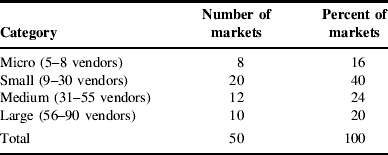
Four market size categories were developed as a step in analyzing the relationship of market scale to revenue, personnel employed and market failure. The 2002 farmers' market survey showed that markets ranged in size from 5 to 90 vendors. Table 2 presents the size categories Micro, Small, Medium, and Large, along with the number of vendors associated with each category, the number and percentage of markets in each size category and a footnote describing how the categories were created. The categories include all types of vendors participating in the market (farmers and craft vendors) because all vendors have an impact on market management (only 26% of Oregon farmers' markets do not allow craft vendors; other markets enforce a ratio of craft vendors to farmers to maintain a significant farmer presence or allow craft vendors without restrictions). These size categories are intended to be guidelines and the boundaries between categories should be seen as transitions rather than as hard divisions.
Size categories of Oregon farmers' markets (2002)Footnote 1.
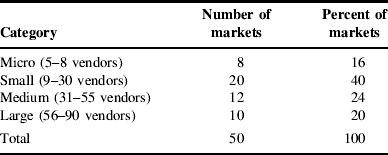
1 The farmers' market categories integrate both quantitative and qualitative data. Categories formulated from the frequency distribution for market size and research participant input were examined statistically using analysis of variance (ANOVA) and Tukey's (HSD) test for honestly significant difference. Tukey's HSD revealed that the categories were significantly different for small, medium, and large markets (P<0.05). It was not significantly different between micro and small markets (P>0.05), however. Notwithstanding, there are sufficient qualitative differences between micro and small markets in terms of type of site, management structures and other factors that the category is useful. The market size categories were reviewed and validated during manager focus group sessions.
Revenue resources
The value of revenue generated, in most instances, shapes the type and sophistication of the management organization of a farmers' market. Nearly all markets surveyed (92%) collect stall fees from vendors. These fees are the primary source of revenue for markets. Other sources of revenue for some markets include annual membership fees, promotional items, fundraising events, sponsorships, donations and grants.
Haves and have nots
When USDA researchers inventoried farmers' markets during the mid-1990s, 84% of markets were described as ‘self-sustaining’ but that term was not defined16. A later USDA study indicated that a similar number (81%) were ‘self supporting’, which is defined as ‘market income sufficient to pay for all costs associated with operating the market’Reference Payne5 (p. 4). The more detailed data presented here call into question whether such a high percentage of Oregon markets can truly be called ‘self-sustaining’ or ‘self supporting’. Many Oregon farmers' markets struggle to survive within the confines of a very limited budget for operating a farmers' market.
For the 50 farmers' markets that participated in the 2002 survey, the sum of all sources of revenue received by market administrators (stall fees, sponsorships, etc.) totaled nearly $1 million (US) for the 2001 season (the total based on manager survey responses is $991,969; some markets estimated their gross revenue so this figure should also be considered to be an estimate).
For clarity, this sum is administrative revenue, the financial resources used for operating the market. It is not vendor sales, which would be substantially higher. This $1 million figure is unevenly distributed among markets with most markets operating on very limited revenues.
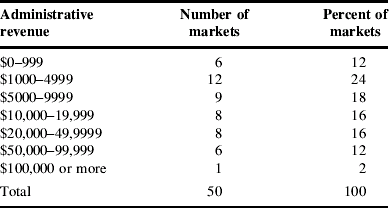
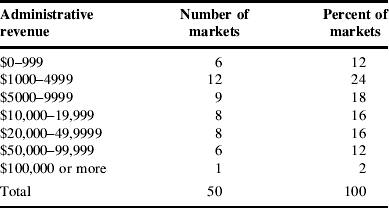
Examining the markets on an individual basis offers a clear picture of the uneven distribution of administrative revenue. The annual administrative revenue for individual markets ranged from $0 to 111,000 (Table 3). Six markets (12%) generated less than $1000. In contrast, seven markets (14%) each generated more than $50,000 with one collecting more than $100,000. As a group these seven markets accounted for nearly half ($482,641) of the administrative revenue generated by all 50 farmers' markets. It is not surprising all seven were in the large market size category.
Administrative revenue for individual Oregon markets (2002).
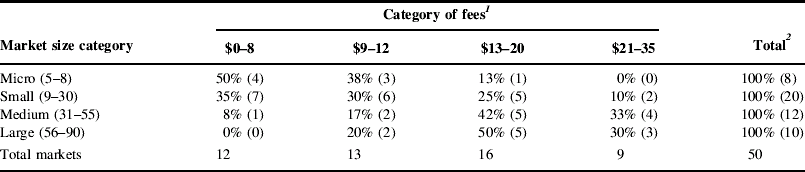
Larger markets generate more revenue than smaller markets for two reasons: they have more vendors paying stall fees than small markets and they also charge higher stall fees (r (50)=0.502, P<0.01). To illustrate this, Table 4 shows that 88% of markets in the micro market size category and 65% of markets in the small market size category charge $0–12 per stall. Conversely, 80% of markets in the large market size category and 75% of markets in the medium market size category charge $13–35 per stall. Thus smaller markets face two challenges to generating market administrative revenue: fewer vendors from whom to collect fees and lower stall fees.
Larger Oregon markets charge higher stall fees (2002).
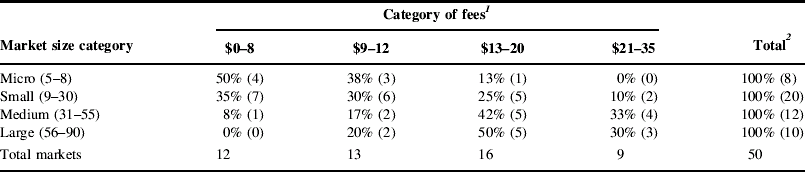
1 Fee categories are arranged to approximate quartiles.
2 Percentages are rounded to nearest whole number.
It is important to recognize that many farmers' market organizers do not seek to maximize market administration revenue. Most markets also focus on providing service to their customers, a venue for vendors to earn income and improved nutrition, food security and social enhancement of their communities. That said, the level of administrative revenue influences the ability of the market to access important resources. The major enhancement that can be provided by adequate administrative revenue is paid personnel to handle overall market operations.
Management and personnel resources
All farmers' markets must handle both simple and highly complex tasks in order to operate during the market season and to maintain their management operations during the off-season. All Oregon farmers' markets have someone who functions in the role of coordinator or manager. Whether a manager is paid, as well as the level of pay are linked to how much administrative revenue a market generates.
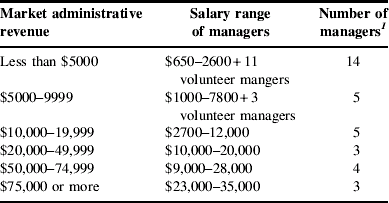
Table 5 shows categories of administrative revenue for farmers' markets with corresponding salary ranges for managers. It illustrates two points: that volunteer managers are associated with markets that generate lower revenues and, more broadly, the manager's salary level is correlated with the administrative revenue a market generates. Markets with higher or lower administrative revenue compensate managers at higher or lower levels.
Administrative revenue and salary of Oregon managers (2002)Footnote 1.
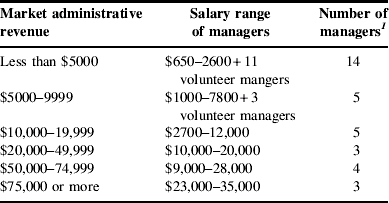
1 These figures are for farmers' market organizations and include organizations that manage multiple markets. There are a total of 40 individuals managing 50 farmer's markets. Six managers are compensated by government or civic entities and are not included here.
PayneReference Payne5 conducted a national study of US farmers' markets that provides additional information on the link between revenue and use of volunteer or paid managers. Using total revenue to vendors from sales, he observed that only 11% of markets with $10,000 or less in total sales had paid managers. In contrast, 75% of markets with vendor sales above $500,000 had paid managers.
The term ‘paid manager’ is relative. The range of manager salaries in 2002 was $650–35,000. Four managers made less than $1500, placing them close to volunteer status. Four managers making $20,000–35,000 approach what might have been considered a living wage at that time. To some degree, the compensation reflects the number of hours a manager works, as smaller, less management-intensive markets tend to require less effort. There are exceptions to this. Of concern to this analysis are situations in which a high level of effort is required to manage a market (such as when it is starting up or navigating through a crisis) but the market administrative revenue is insufficient to pay an adequate salary.
In sum, administrative revenue and management personnel are part of the foundation of most markets. Since the amount of market administrative revenue and the personnel resources it can provide are closely tied to the size of farmers' markets, smaller markets are at an immediate disadvantage. Smaller markets may find themselves in a downward spiral that starts with low vendor numbers resulting in low administrative revenue. The lack of revenue affects whether and how much the market can pay a manager. This, in turn, affects how much time and effort can be expended managing the market a task which includes recruiting vendors and customers.
Some General Areas of Concern Related to Market Failure
Analysis of the aggregate data revealed several general areas of concern related to market failure. These areas of concern are the short life span of markets that close, a lack of market management experience of managers associated with newer markets, a threshold for the maximum number of hours worked by volunteer managers, and the high turnover rate of market managers.
Life span of markets that close
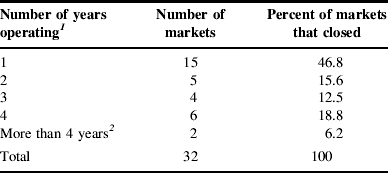
Of the 32 markets that closed between 1998 and 2005, the overwhelming majority had short life spans (Table 6). Fifteen of the 32 markets (nearly 47%) closed following their first season. Moreover, 30 of the 32 markets (94%) that closed were less than four years old.
Life span of Oregon markets that closed 1998–2005.
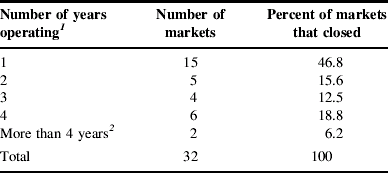
1 For six markets, the exact number of years of operation was unknown. They are listed here as operating the number of years known. Four are recorded as 1 year, one is recorded as 3 years, and one is recorded as 4 years.
2 These markets operated for 11 and 22 years.
Although there is a high failure rate for younger markets, the rest of the story is the drop in the rate of failure after four years. Only two of the 32 markets that failed were older markets (11 and 22 years respectively). While this indicates that market failure is not an issue exclusive to younger markets, the rate of failure for older markets is remarkably lower.
Years of manager experience and age of market
The 2002 survey of market managers indicated that the number of years of experience of market managers ranged from 1 to 20 years. Thirty-seven percent of market managers had only one year of experience and nearly half (47%) had two or fewer years of experience. While this may reflect the growth in numbers of markets in recent years, it is also a cause for trepidation. Although a farmers' market could suffer under an experienced but ineffective manager, a study by Oberholtzer and GrowReference Oberholtzer and Grow23 expressed concern with the correlation between experience levels of the market managers and years of operation for the market: ‘Thus, in many cases, younger markets—those that could benefit a great deal from market manager experience—lack this amenity for farmers’ (p. 24).
The 2002 survey data also reveal a correlation between manager experience and age of markets for Oregon. Newer markets have less experienced managers and older markets have more experienced managers (r (50)=0.387, P<0.01). Fifteen of the 16 markets that were 3 or fewer years old were managed by managers with 3 or fewer years of experience. The ten managers who had six or more years of experience were associated with markets that had been operating six or more years. Seven of the 10 managers with six or more years of experience were associated with markets that had been operating more than 10 years.
Effort thresholds for volunteer managers
The 2002 survey of farmers' market managers showed 28% of markets use volunteer managers and 72% of markets employ paid managers. There is a clear relationship between the size of markets and the status of the manager. Volunteer managers are associated with smaller markets and paid managers are associated with larger markets (t (48)=−4.917, P<0.0001). Table 7 shows the size categories of markets and the number and percentage that are managed by volunteer or paid managers. It is very significant that there are no medium or large markets managed by volunteers.
Manager compensation and Oregon market size (2002).

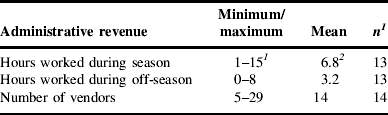
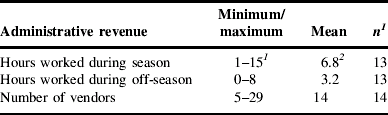
One implication is that volunteers reach a limit in the level of effort they are able or willing to provide. This issue was examined by analyzing effort for the volunteer managers in terms of number of hours worked. Volunteer managers average 6.8 hours per week during the market season, ranging from 1 to 15 hours per week (Table 8). Ten of the volunteer managers (77%) work 10 or fewer hours per week during the season. Off-season effort for volunteer managers averages 3.2 hours per week, ranging from 0 to 8 hours per week. Nine of the volunteer managers (69%) work three or fewer hours per week during the off-season.
Hours worked by Oregon volunteer managers during and off-season (2002).
1 Data for hours worked are available for 13 of the 14 volunteer managers. Data for market size are available for all 14 markets.
2 One outlier of 30 h has been dropped from this analysis.
The volunteers managed markets that ranged in size from 5 to 29 vendors with an average size of 14 vendors. Although five volunteer managers (36%) managed markets of 20 vendors or more, nine volunteer managers (64%) managed markets of 16 or fewer vendors. All of these markets fall into the micro and small categories.
There are no extensive data documenting what happens as a market grows beyond what a volunteer can manage relative to the market size and number of hours worked, so it is unclear whether they become overwhelmed or the quality of work declines. These data simply illustrate current practices. Based on these observations, it appears the threshold for volunteer managers is with markets that are approaching the mid-teens in numbers of vendors and when the manager's workload exceeds seven hours per week during the market season.
Market manager turnover
Farmers' markets also experience high rates of manager turnover. Using data from the OFMA/ODA directories, the number of farmers' markets operating under a new manager is listed in Table 9 by year for the period 1999–2005. These figures represent the number of existing markets that began a season with a change in manager from the previous season and do not include new managers of new markets. For each year, a significant number of existing markets, ranging from 11 to 19, changed managers. The total for the eight seasons is 101 manager changes for a weighted annual average 30% turnover rate in managers of existing markets.
Number of existing Oregon markets operating under a new manager.

1 Rounded to whole numbers.
Manager turnover is not necessarily negative. A change may improve a market or reflect a better opportunity for a manager. But, clearly, the high rate of turnover documented here cannot be all positive. Even under the best of conditions, a change in manager produces some stress for a market organization. The experiential literature from the non-profit sector notes that during gaps in leadership, ‘Board members who are volunteers serving during their ‘free’ time, aren't prepared to manage critical challenges … . Inattention to day-to-day management or poor decision-making during the interim can wreak organizational havoc. The board will find itself pulled into serving as surrogate staff without adequate time or training, leaving its more important board duties under-attended' (p. 11)Reference Knight24.
Some Insights into Markets that Fail
This section presents data on a small sample of markets that failed and identifies five interrelated factors associated with failure. Then, managers of markets that failed offer their perspectives, revealing a greater level of complexity to the process of failure.
Five factors associated with farmers' market that fail
The analysis so far has explored market failure on an aggregate basis. Here, the focus is specifically on the nine markets that were operating at the time of the 2002 survey of market managers but closed sometime after the survey was conducted and prior to 2005. This is a small sample of markets but the analysis sheds some light on the phenomenon of market closures.
As a group, eight of the nine markets that closed were operated as local not-for-profit and non-government community organizations. The ninth market was sponsored by a business that provided space for vendors but did not collect fees and provided only a basic level of management. Two of the community-based markets were associated with market organizations that managed more than one market. In these instances the markets closed but the market organizations continued operating and managing other markets.
Factor 1: Small size
Five of the markets that closed were in the micro size category and four markets were in the small size category. Survey data indicate the number of vendors for total market size (including craft vendors) ranged from 5 to 20 and the number of farmer vendors (source of food products) was 4–13. Because the survey was conducted during 2002 (based on vendor numbers from the 2001 season) and the markets closed sometime between that year and 2005, the actual number of vendors participating during the final season of the market is not known. As is discussed below, one aspect of a market's decline is a loss of vendors. Thus, some of these markets may have been even smaller just prior to closing.
Factor 2: Need for products (lack of farmer vendors)
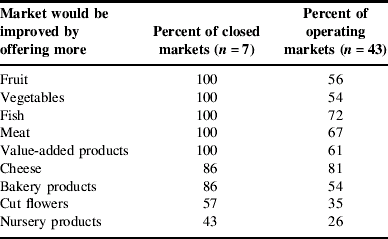
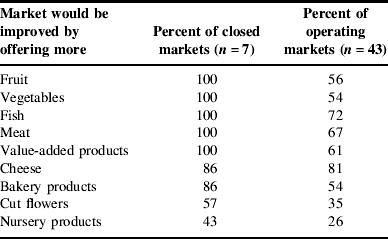
One question in the 2002 manager survey asked managers whether their markets would be improved by offering more of any of nine product categories commonly sold at farmers' markets. Table 10 presents the nine product categories with the percent of closed and operating farmers' markets answering YES. These affirmative responses indicate a shortage of products or a lack of diversity in the markets' offerings. All of the markets that subsequently closed indicated a need for more fruits and vegetables, products considered basic to farmers' markets. More than half of these markets indicated that the addition of eight of the nine product categories would improve the market. In all instances, the markets that closed expressed a higher percentage of need for products than the markets that did not close. This situation is directly connected to the small size of the markets in terms of the number of vendors noted in factor 1.
Percent of Oregon markets (closed and operating) responding that more of designated products would improve market (2002)Footnote 1.
1 The 2002 survey of market managers includes data on seven of nine farmers' markets that were operating at the time of the survey but closed sometime after the survey was conducted.
Factor 3: Administrative revenue ‘have-nots’
The markets that closed were among the administrative revenue ‘have-nots.’ Five of the seven markets that participated in the survey collected less than $3400 per year in administrative revenue. The range in administrative revenue without temporary grants was $0–8000. With grants included, one market's total administrative revenue was $20,000. This situation was temporary, and the market was forced to close when the grant ran out and the market was not sustainable based on vendor fees alone.
Factor 4: Manager was volunteer or paid a low salary
As noted previously, for the majority of markets there is a connection between the amount of money the market collects as administrative revenue and the amount spent on personnel to support the market. Given the situation described as factor 3, it follows that the markets that closed are often those that depend on volunteer managers or paid the manager a low salary.
Four of the seven managers were volunteers or were paid low wages. Of these four managers, two were volunteers and two were paid between $1040 and 2000 per year. One manager associated with a market organization that managed three markets was paid $20,000. One manager was compensated by the private business that sponsored the market. One manager was paid $12,000 per year through grant funds. Again, this market was not self-sustaining when grant funds were no longer available.
Factor 5: High manager turnover
As indicated, there is a high turnover rate among market managers in general (ranging annually from 21 to 44% with a weighted average of 30%). Even higher rates of manager turnover are associated with markets that close. Table 11 indicates the number of markets with new or returning managers between 2001 and 2005. All nine markets were operating in 2001 and all had closed by 2005. The percent manager turnover for each year ranges from 11 to 80% for a weighted annual average of 46%, overall considerably higher rates than the rate for all markets. The nine markets experienced 12 manager changes during the 5-year period, in fact five of the nine markets changed managers the majority of the years they operated. Significantly, seven of the nine markets began their final season with a new manager.
Manager turnover among failed Oregon markets 2001–2005.

1 Rounded to whole numbers.
Manager perspectives on markets that fail
Interviews with managers of markets that failed and other managers provide qualitative information that helps flesh out the quantitative data presented in this paper and by other researchers. The manager accounts note challenges achieving a positive balance between vendors and customers, integrating into communities and gaining community support, and problems within the market organization. They indicate a complexity of issues that swirl within markets and between markets and communities. These issues are rich areas for further inquiry.
Farmers' markets must manage a complex relationship between supply (vendors) and demand (customers). This relationship is different for farmers' markets than for most retail outlets. A viable farmers' market must have enough farmer vendors to attract customers and it must have enough customers to be attractive to farmer vendors. If the market is out of balance it may enter a downward spiral. Burns and JohnsonReference Burns and Johnson3 describe this situation:
Farmers' markets, unlike retail stores, operate both on the supply side, with the farmers, and on the demand side, with the consumers. However, the overall retail marketing dynamic is operative. Consumers wish to have certain preconceptions met when selecting a retail site. If they are not met, the consumers will stop coming. Farmers will go to markets where they are guaranteed selling space and have exposure to enough customers to allow them to sell the majority of their product in an allotted time. When farmer … and customer expectations are not met, both farmers and customers will look for alternative markets (p. 12).
All market managers are concerned with managing vendor and customer expectations to maintain a healthy balance. But many smaller markets seem to be particularly challenged by a general shortage of farm vendors, especially ‘anchor vendors,’ those farmers who can provide adequate quantities of a diverse array of products for an entire season. One manager commented on the issue of not having enough farmers and customers at her market:
Farmer shortage is definitely our most critical issue. And when we do get farmers, often they don't stay for more than a week or two because of the minimal customer numbers. I'd like to consider other market dates, but I'm just not sure that it would solve our problems. I think the demand could be there, but without the farmers and produce to draw in the customers, we have been running in circles for the past four years trying to get the farmers, who'll bring in the customers, who'll bring in the farmers, etc.
Researchers have remarked on the issue of balancing customer and vendor numbers. Burns and JohnsonReference Burns and Johnson3 note, ‘managers measure the success of their markets by their ability to attract and retain farmer and customer participation’ (p. 14). Oberholtzer and GrowReference Oberholtzer and Grow23 observed that markets with fewer vendors also had fewer customers. Hughes and MattsonReference Hughes and Mattson25 summarized the relationship between customers, vendors and labor resources for one market: ‘More customers result in more vendors, who generate more market fees to pay a coordinator, advertising and other expenses’. They concluded ‘This allowed greater input of energy by the coordinator into the market in dealing with vendor issues and market promotion’ (p. 8).
Part of the ability to attract customers and vendors rests with the personnel resources the market has. For smaller markets, these resources are minimal. As one market manager inquired:
Do markets need to reach a sort of tipping point at which the market is doing well enough to support management that then can work to further stabilize the market? And, if so why do some markets reach that point and go on to success while others never reach that point? Also, why do some markets seem to linger in a ‘limbo’ state for a few years—not growing very much but managing to survive? What causes a market to either make the jump out of ‘limbo’ or to finally just shut down?
As markets increase in size, they draw both vendors and customers from a larger geographic area—success breeds more success. Burns and JohnsonReference Burns and Johnson3 observed, ‘it appears that as the size of the market increases, the market becomes more attractive to farmers from a wider geographic area and the retail (customer) trading area also increases’ (p. 16). This has implications for smaller markets. As larger markets draw farmers from a larger area, this process may also draw farmers away from markets they perceive as less profitable. As one market manager recounted:
I heard from several customers that the prices were high, while I heard from several former vendors that customers weren't willing to spend money at the market. This perception on the part of vendors—that there was little money to be made at the market—combined with the reality of the large number of other markets in the Portland area … made it difficult to attract vendors.
This market manager describes the final season of a western Oregon farmers' market. The market manager participated in the 2002 survey and, at that time, listed the size of the market as 20 vendors.
The market was located downtown and took place on [a weekday] evening. There were parking problems and tensions with nearby businesses. It was an evening market so it required picking and selling in the heat of the day. Then there was no profit for vendors. Where I would make $120 on Saturday I would only make $30 to $40 [at this market]. The market dropped down to three to four vendors then just stopped.
This account identifies some of the multiple problems this market confronted that led to its eventual closure—lack of parking for customers, tension with local businesses and choice of market day and time. These problems may have reduced customer numbers, which reduced vendor sales, which in turn reduced vendor numbers. In addition, and importantly, the closing of a medium or large size market is rare but we could assume that the number of vendors participating will drop off until the market becomes a smaller size just prior to its failure. This situation is illustrated here with the market dropping from 20 vendors to just three or four vendors prior to closing permanently. It had been a small size market that became a micro size market.
Integration into and support by communities is another theme. This account highlights one market's struggle integrating into a rural community dominated by large commodity-oriented farms:
In our area row crops predominate, orchards are few and gardens are grown only to meet owner needs and to give produce to neighbors. Our region is totally dependent on irrigation. The oppressive heat which lasts from late June to mid-September doesn't help an outdoor market. It looks pretty bleak. Next year will be the third and last year to attempt a farmers' market.
This market manager describes a lack of community support as a factor in the eventual closing of a market:
Early in my involvement with the market, I held a meeting for community members. My goal was to find some volunteers who would help out in various aspects of the market. Despite advertising the meeting only 1 potential volunteer showed up. This proved to be symptomatic of the community's lack of direct support for the market. Although many people professed to appreciating having a local farmers' market, hardly anyone except the existing board members were willing to lend any time or support to the market.
Internal issues within a market may distract market organizers from the business of managing the market. For instance, during focus group discussions one manager commented that issues within the market affect its mood:
When there is stress between the manager and the board, all the manager's energy goes there. It defines the tone. The customers will know if the governance of the market is distressed.
Lastly, a market manager recounted the inertia among market organizers that contributed to the market closing permanently:
In the end, I grew frustrated with the lack of support and I could see that the market's problems were not going to be solvable without some fairly substantial changes which the board was unwilling to make.
The quantitative data related to markets that fail describes a downward spiral of interrelated factors of small market size, inadequate product, low revenues, poorly compensated managers and high manager turnover that are seemingly impossible to correct once past a particular point. The accounts from managers of failed markets describe a complex and nuanced background of issues internal and external to the individual market that ultimately lead to or trigger the downward spiral.
Summary, Discussion and Recommendations
It is important for market organizers, vendors and the food advocates and academics that support them to recognize that markets—especially new markets—are more fragile than many have assumed. The analysis suggests a sequence of market decline and failure. Failing markets are small, already at a disadvantage in terms of revenue and personnel resources due to their size. Causes leading to the market's decline appear to be individualized, complex issues that are internal and/or external to the market. These markets enter a downward spiral of declining numbers of customers and vendors, intensifying the problem of inadequate product and leading to even fewer customers. With limits to how much effort volunteers are able to provide before burning-out, the low revenues to the market interfere with its ability to use paid personnel to stabilize the market. All this occurs in a short period of time; in as little as one year and less than four years for the vast majority of markets that fail.
Success and failure should be viewed as a continuum rather than an either/or condition. Along the continuum between the extremes are markets that are under-performing but have not failed. Some of these markets may have thrived at one time and have not been able to adapt to changing conditions or have encountered a crisis. Other markets may not ever have thrived and continue to exist in the state of ‘limbo’ described by one manager. Can these markets be revitalized? The accounts from managers of markets that failed suggest there are combinations of issues unique to each of the markets that increased their vulnerability. More examination of the very complex interactions within communities and markets that lead to farmers' market success or failure is needed.
Areas of risk
There are two areas of risk associated with characteristics of markets and market managers. Market organizers should be concerned about these areas of risk particularly if they are present in combinations. These areas of risk reiterate the connection between market administrative revenue and the ability to hire paid personnel to manage market operations.
Small markets, markets becoming smaller and new markets
Smaller markets are more at risk of failure than larger markets. Since they have fewer vendors, smaller markets are vulnerable to descending quickly into a crisis by a drop in vendor numbers and thus, suffering the repercussions of a lack of products, fewer customers and low administrative revenue. In addition to having fewer fee-paying vendors, these markets also charge lower stall fees than larger markets and thus face two challenges to generating administrative revenue. Markets that fail may have been small to begin with or may have been larger but have become smaller through a period of decline. Therefore, any market that is progressively declining in size should be of concern. These markets will also be collecting less money from vendors and will have a difficult time maintaining management staff. As a separate but related issue, new markets face a higher probability of failure. This is particularly true in their first year and up to their fourth year. Although older markets are not entirely safe from failure, their failure rate is low.
Over-worked managers, under-compensated managers, inexperienced managers
Manager turnover on an annual basis is high among markets in general at 30% and higher among markets that fail at 46%. Some areas of concern associated with farmers' markets in general include whether and how much managers are paid, thresholds for volunteer manager effort and size of market, new markets and inexperienced managers and manager turnover. Most managers of markets that failed were volunteers or were paid a low salary. These managers are more commonly associated with smaller markets. In fact, there are no volunteer managers associated with medium or large size markets. This likely indicates a limit to the capacity for volunteers to manage markets over a specific size. There is also a correlation between new markets and inexperienced managers, a potentially risky combination.
Recommendations
Based on the analysis above, here are two broad recommendations for market managers, boards of directors, vendors and the food advocates and academics that work with them. The recommendations are supported by the research findings and can be implemented at the local community or individual market level.
Recommendation 1: Plan new markets carefully to assure success
Market organizers should spend considerable time deciding whether and how to open a new market. Better planning and promoting before a new market is opened may help with some of the issues that arise during the critical first year of operation. An important part of the planning process is setting a goal for market size in general or a goal by year so that cash flow can match the scale of the market and appropriate management can be provided. Planning for size is the first step in creating a viable organization that will endure the challenges and conflicts that occur with growth. Organizers should concentrate on making well-informed decisions on market organization and, most importantly, garner community support in order to avoid the issues identified by managers of markets that failed.
Market size will be influenced by community population density, population subculture (interest in purchasing local food and the experience of an open air market), and other factors that influence the scale of a market from the demand side. From the supply side, local farm settlement pattern (number and type of small farms), agro-ecozone (soils, climate, etc.) and other factors influence the size of the market, as well. Organizers should carefully assess whether there is sufficient population to support a market and whether there are sufficient farmers to support a market.
Training programs for new managers and boards of directors may reduce the number of markets that close after a brief life and reduce manager turnover in operating markets. In some instances, volunteers can substitute for paid staff resulting in lower operating expense for the market. There are limitations to what volunteer managers can achieve. A good recommendation for organizers is to have a plan in place for the transition of a volunteer to a paid manager position as market size approaches the mid-teens in numbers of vendors and requires the manager to work more than seven hours per week during the market season. Consistent, well-trained or experienced management that matches the scale of the market and is fairly compensated may prevent the kind of problems that weaken a market and lead to a downward spiral.
Recommendation 2: Some markets should pursue community financial support
Some smaller markets will always have difficulty generating sufficient administrative revenue to support a paid manager and other important market functions. These markets may be viable only through financial or labor resources provided through other civic or government entities. There are precedents for this in Oregon. The Oregon market manager survey indicated that in 2002 six markets were connected with government and non-government organizations. These organizations support their farmers' markets by providing a salaried staff member for management and other amenities. Since farmers' markets have been shown to be an important part of a local economy and an enhancement to the quality of community life, there is ample justification for government and economic development sector support.
Faith, environmental and health organizations are other potential community sponsors. Many faith groups are involved in food security and social justice issues that link well with developing local food economies. Many environmental organizations point to locally produced food as good for the environment but likely are not directly involved in the financial support of individual farmers' markets. There are instances of health care providers offering sponsorship or start up support for farmers' markets. This offers a model for private sector support that holds some potential for providing markets in some communities.
Access to financial and other resources is a national policy-related issue with significant impacts on farmers' markets, particularly small markets. Public funds support commodity agricultural production and the global trade of food products, but similar resources are not made available to support local agricultural markets. These circumstances are the result of political decisions at the national level. As LangReference Lang26 points out, food systems are the outcome of policy and political choices. Should future national political decisions benefit local markets, the course of agricultural development in the US could be significantly altered.
Acknowledgements
This research was supported by funds from the Initiative for the Future of Agriculture and Food Systems grant number 2000-52101-9692 through United States Department of Agriculture, Cooperative State Research, Education and Extension Service. Additional support as provided by the Extension Agriculture Program of the College of Agricultural Sciences, Oregon State University. The authors thank the anonymous reviewers for their time and valuable comments.