




No CrossRef data available.
Article contents
- Abstract
- Retail Unionism
- Suburbanization and the Retail Marketplace
- Methods and Goals of the Three Suburban Drives
- The 1954–1955 Drive
- The 1955–1956 Drive
- The 1956–1958 Drive
- Evaluation: Suburbs and the Context of Suburbanization
- The Legal Context: A New NLRB
- Bureaucratization and Union Mobilization
- Paternalism, Politics, and the Gendered Labor Market
- Suburban Space and Suburban Culture
- Conclusion
Labor Conflict in the Suburbs: Organizing Retail in Metropolitan New York, 1954–1958
Published online by Cambridge University Press: 01 October 2003
Article contents
- Abstract
- Retail Unionism
- Suburbanization and the Retail Marketplace
- Methods and Goals of the Three Suburban Drives
- The 1954–1955 Drive
- The 1955–1956 Drive
- The 1956–1958 Drive
- Evaluation: Suburbs and the Context of Suburbanization
- The Legal Context: A New NLRB
- Bureaucratization and Union Mobilization
- Paternalism, Politics, and the Gendered Labor Market
- Suburban Space and Suburban Culture
- Conclusion
Abstract
From 1954 to 1958, District 65 of the Retail, Wholesale, and Department Store Union (RWDSU), engaged in several campaigns to organize the new branch department stores opening in the suburbs of New York City. These department stores were a significant aspect of the post-World War Two suburban boom, significantly reshaping commercial space. The organizing drive was also an important, if neglected, part of the economic transformation of the suburbs in the US in the 1950s. Rather than contribute to the union's apathy, suburbanization sparked District 65's largest organizing drive of the decade. In branching out beyond New York City, District 65 adapted its organizing strategies, de-emphasizing its militant past and reaching out to women workers. By and large, District 65's efforts were unsuccessful, due to both challenges posed by the suburbs as well as the larger political and economic context of the US in the 1950s.
Information
- Type
- Research Article
- Information
- Copyright
- © 2003 The International Labor and Working-Class History Society
On a bright August day in 1955, three men and a woman, all members of District 65 of the Retail, Wholesale, and Department Store Union (RWDSU) traveled from New York City out to Nassau County to the new Stern Brothers department store in Great Neck. They did not go to shop, however. Instead, they picketed in front of a store window that declared full-time and part-time positions available in stock, clerical, and sales. They wore sandwich signs that said: “To the Public: Sterns Great Neck is unfair to Organized Labor by discriminating against union members in hiring.” Other signs condemned Stern's for “refusing to transfer to this store local residents now employed in the New York store because of their union membership.”1
Negative £14288, District 65-UAW Photograph Collection, Robert F. Wagner Labor Archives, New York University, New York, NY. All District 65 materials referred to in this are article are held by the Wagner Archives unless otherwise noted.
Between 1954 and 1958 District 65 engaged in several drives to organize suburban department stores. In addition to the kind of informational picketing that the Stern's workers engaged in, the drives entailed leafleting, home visits, and even structural reorganization within in the union. In a few cases, especially when organizers were fired, 65ers engaged in strikes. By deploying these strategies, union leaders responded to what they believed to be the unique characteristics of suburban workers and to the larger political and economic shifts of the early Cold-War period.
Suburbanization is very much a part of the narrative of postwar US labor history. Following World War Two, so the story goes, workers traded their power and militancy for a house, a boat, a car, and a pension plan. By 1950, suburbanization and its attendant prosperity quelled what in 1946 had seemed like a prolonged, unprecedented resurgence of labor activism.2
See for example: George Lipsitz, Rainbow at Midnight: Labor and Culture in the 1940s (Urbana and Chicago, 1994), 240–47; Elizabeth Fones-Wolf, Selling Free Enterprise: The Business Assault on Labor and Liberalism, 1945–60 (Urbana and Chicago, 1994), 89–96; Nelson Lichtenstein, “From Corporatism to Collective Bargaining: Organized Labor and the Eclipse of Social Democracy in the Postwar Era,” in Steve Fraser and Gary Gerstle (eds.), The Rise and Fall of the New Deal Order (Princeton, 1989), 142–3; and Elaine Tyler May, Homeward Bound: American Families in the Cold War (New York, 1988), 164–65.
The organizing drive described here did not emerge organically from the suburban context. Like the department stores themselves, it was an urban export. The union attempted to apply organizing methods that had served well in the city to this new context, but the different arrangement of commercial spaces posed serious challenges. In addition, while District 65 organizers believed that they could bring a worker consciousness to the suburbs, they also believed the suburban workers to be different from current members. Therefore, the union moderated its traditionally aggressive recruiting tactics and focused on the practical needs of women workers.
Following World War Two, department stores sought to recruit young married women to work at their stores, luring them with promises of employee discounts, extra spending money, and an escape from domestic ennui.3
“The Bachelor and the Bride,” Union Voice (June 6, 1948): 11. The Union Voice was District 65's newspaper until June 1954.
Retail Unionism
District 65, known until 1950 as Local 65, was founded in 1933 by Arthur Osman and a group of Jewish warehouse workers on New York City's Lower East Side. Through the late 1940s, it was at the center of a group of Communist-influenced New York City locals of the United Retail, Wholesale, and Department Store Employees of America (URWDSEA, the precursor of the RWDSU), many of which represented major New York City department stores. Local 65 merged with the several of the department store locals in 1950, forming District 65. David Livingston, Osman's right-hand man since the founding of the old Local 65 served as president, and Bill Michelson led the department store section.
The locals that made up the department store section of District 65 also formed in the mid-1930s. Local 1250 organized Hearn's and a number of smaller department stores in the spring of 1937. The men and women of Hearn's then organized other major department stores, but they were chartered as locals of the CIO's (Congress of Industrial Organizations) Department Store Organizing Committee: Macy's was Local 1-S, Gimbels and later Saks 34th Street were Local 2, Bloomingdale's was Local 3, and Stern's was Local 5.4
George G Kirstein, Stores and Unions: A Study of the Growth of Unionism in Dry Goods and Department Stores (New York, 1950), 77–78; and Nick Carnes, interviewed by David Paskin, 1 March 1982, District 65-UAW Oral History Collection.
Macy's Local 1-S did not join District 65, but Locals 2, 3, 5, and 1250 did.
The department store locals adopted the same union structure as Local 65 following the merger. Groups of about twenty workers, called crews, elected from their number a steward who would represent their interests both in the shop and the union. Crews were then grouped into divisions based on industry or location, and each division had a set of officers. There were also union-wide officers and paid organizers. The stewards, officers, and organizers comprised the General Council, District 65's primary decisionmaking body. The General Council, which comprised about one thousand people by the 1950s, met monthly and operated by majority rule.
District 65's tactics in its early decades depended on the spatial organization of industries in New York City. Because shops handling the same kinds of goods or involved in the same industry tended to cluster together, union members had regular contact with workers in nonunion shops. For example, garment district jobbers were located within blocks of each other, and a large number of millinery shops clustered in a single building.6
Joshua B. Freeman, Working-Class New York: Life and Labor Since World War II (New York, 2000), 9.
65ers relied on this unique arrangement in their campaigns to “organize the shop next door.” It allowed rank-and-file 65ers to establish personal relationships with unorganized workers and to talk with them about the advantages of being a part of the union. This strategy enabled Local 65 to organize nearly seven thousand workers in seven months in 1941.
District 65 never matched the accomplishments of that “Seven in Seven” drive. Political changes and new labor legislation in the 1940s and 1950s reversed the pro-labor climate that had contributed to the wave of department store organization in the late 1930s. The 1947 Taft-Hartley Act made the National Labor Relations Board (NLRB) less sympathetic to union organizing, while political and business leaders attacked alleged Communist influence in the labor movement and even in the NLRB itself.7
James A. Gross, Broken Promise: The Subversion of U.S. Labor Relations Policy, 1947–1994 (Philadelphia, 1995), 92, 129–30.
Suburbanization and the Retail Marketplace
Following World War Two, many urban areas witnessed declines in population, income, and jobs. While New York City continued to grow, it grew much more slowly than the metropolitan area as a whole. Between 1940 and 1950, the growth rate for the city proper was less than a sixth of the average for the nearest suburban counties. Counties such as Nassau, Suffolk, Rockland, and Westchester far outstripped the city in population growth and median income.8
Department of Commerce, Bureau of the Census, County and City Data Book, 1952 (Washington, DC, 1953), 50, 252–62.
During the same period, retail began to shift from the central business districts to outlying areas. In 1954, sales volume increases in metropolitan areas outstripped those of the area's central business districts. Manhattan's share of the metropolitan area's retail sales shrank from 16.9 percent in 1948 to 14.2 percent in 1954. Brooklyn's central business district also lost ground.9
Department of Commerce, Bureau of the Census, Census of Business, 1954 (Washington, DC, 1957),1:10–13, 6.19
Edgar M. Hoover and Raymond Vernon, Anatomy of a Metropolis: The Changing Distribution of People and Jobs Within the New York Metropolitan Region (Cambridge, MA, 1959), 120.
Census of Business, 1954, 2:32.6–32.15.
Between 1952 and 1957, eight New York City department stores shut down, putting thousands out of work. Between October 1953 and July 1962, District 65's department store section lost 617 downtown jobs and gained only 211 in the suburbs.12
Robert Rogow, “Relationships Among the Environment, Policies, and Government of a Labor Union: A Study of District 65, Retail, Wholesale, and Department Store Union, AFL-CIO” (Ph.D. diss., New York University, 1965), 114.
Bernard Stephens, “Independent Stores Folding as Chains Boom,” RWDSU-CIO Record (March 3, 1957):9; “Namm-Loeser's to Close Store, Brooklyn Landmark Since 1886,” New York Times (February 13, 1957):1, 51; and “Old Stores Die if They Stay Old,” New York Times (February 17, 1957): 3:1, 8. See also Mark Stevens, “Like No Other Store in the World”: The Inside History of Bloomingdale's (New York, 1979), 45; Ida Torres, interview with author, 13 September 1999, in author's possession. Beginning in June 1954, the RWDSU-CIO Record became District 65's newspaper.
While many urban stores closed, suburban shops were on the rise. Retail had already started moving away from downtown areas as early as the 1920s, when shopping centers were built on the outskirts of cities or in older suburbs. However, the 1950s shift was on a larger scale. Developers designed the mid-1950s shopping centers with abundant parking and facilities to serve community and commercial needs. Private security companies ensured patron safety, while air conditioning and covered outdoor walkways ensured their comfort. Some shopping centers also had auditoriums and meeting rooms that were made available to local community groups.14
Lizabeth Cohen, “From Town Center to Shopping Center: The Reconfiguration of Community Marketplaces in Postwar America,” American Historical Review 101 (1996):1052; and Lizabeth Cohen, A Consumers' Republic: The Politics of Mass Consumption in Postwar America (New York, 2003), 263.
Bernard Stephens, “Independent Stores Folding as Chains Boom,” RWDSU-CIO Record (March 3, 1957):9; and “Namm-Loeser's to Close Store, Brooklyn Landmark Since 1886,” New York Times (February 13, 1957):1, 51.
Cohen, “Town Center to Shopping Center,” 1067.
Robert Dobbs, “Store 65ers Face-up to Growing Job Threat,” Union Voice (April 4, 1954):M7.
Department stores underwent structural as well as locational changes. As stores relocated to the suburbs, they tended to put into place new selling and personnel methods that employed smaller work forces. Most significant was the shift to a self-service format on the selling floor. The stock was displayed on the sales floor, and customers browsed and selected for themselves rather than rely on a salesperson to bring merchandise to them. Instead of a sales staff, the store required only cashiers to ring up the purchases. Stores switching to self-service often cut their work forces in half. The remaining workers took serious pay cuts since they were “attendants” rather than “salespeople.”18
Carl Andren, “Strike at Hearn's Looming,” Union Voice (March 8, 1953):3; Bill Michelson, “Organization Report,” General Council Meeting, June 10, 1953, District 65-UAW Minutes; and “Hearn Dept. Stores v. Livingston,” Labor Relations Reference Manual, 32:2332.
These changes posed numerous challenges to labor. Even though the new suburban shopping centers concentrated workers in a particular area, organizing malls was difficult: organizers were often arrested for trespassing on private property. Urban stores were located on public streets where people had clear rights to free speech and assembly within the constraints of the law. It was not clear that these same rights applied to shopping malls which were private property even though they functioned in many ways like a public space. Beginning in the 1960s, the courts sought to resolve the tension between rights of free speech and of private property. In the 1950s, however, these issues were still emerging.19
Michael Harrington, The Retail Clerks (New York, 1962), 3; Cohen, A Consumers' Republic, 274.
District 65 leaders understood that in order to keep previous gains in urban department stores, they needed to get suburban branches under contract. The RWDSU Record noted, “The importance of suburban branch stores to organized department store employees has been underscored in recent years by the extent to which the trend to move out of metropolitan centers has grown.”20
“Bloomingdale's Branches Targets of ’65' Drive,” RWDSU-CIO Record (August 1, 1954):6.
“Biggest Meetings Mark Store Security Drive,” Union Voice (March 21, 1954):3.
By 1954, Bloomingdale's had already laid off workers at the 59th Street flagship store while the suburban branches, located in New Rochelle, Westchester County; Stamford, CT; and the outlying Queens neighborhood of Fresh Meadows, made new hires. However, the openings at the suburban stores did not mean job opportunities for those laid off. A rug department worker with years of seniority was laid off from 59th Street while a branch store manager hired an inexperienced worker for a comparable position. Management refused the union's request to transfer the older worker to the suburban store. Union members were seldom granted such transfers, but Bloomingdale's often transferred nonunion workers to the new stores.22
Ibid.
All of District 65's department store locals addressed these issues in their 1954 contract talks. They asked for transfers for 65ers in the older stores to the branches in the suburbs without loss of seniority. They also demanded union recognition for a suburban branch once a majority of the workers there signed District 65 union cards (what today US unionists call “card check” and often seek as a way of avoiding drawn-out elections). John Meegan told the Local 2 membership that extending the union to the suburbs was of “extreme importance” as layoffs increased because the branch stores would provide more jobs for the membership. More importantly, “having the branch stores under contract would guarantee that in the future, should we ever be faced with difficulty with management, or a strike situation, branch store workers could not be used against us, but rather fight alongside us.”23
23 Ibid.; “Report on Membership Mobilization,” Joint General Council Meeting, March 3, 1954, District 65-UAW Minutes; John Meegan, “Collective Bargaining Report,” Local 2 General Membership Meeting, March 31, 1954, District 65-UAW Minutes—Department Store Locals.
“Biggest Meetings.”
By March 31, Gimbels had agreed to an accretion clause: any suburban stores that it opened in the future would be covered by the union contract. Union workers at the 33rd Street Manhattan store could transfer to the new store in Yonkers and keep their union membership.25
“Gimbels Settlement Reported Near,” Union Voice (April 4, 1954):3; “Store Workers Hail Pension at Gimbels,” Union Voice (April 18, 1954):3.
Bill Michelson, “Report on Special Organizing Drive,” General Council Meeting, August 4, 1954, District 65-UAW Minutes.
“Pensions Won in Saks-34th Dept. Store Pact,” RWDSU-CIO Record (October 31, 1954):6; “Wanamaker Closing Seen Proving Branch Drive Need,” RWDSU-CIO Record (October 31, 1954):1-A.
Union leaders attributed the victories to rank-and-file militancy. Gimbels and Stern's workers got accretion clauses in their contracts because “the membership was ready to make sacrifices in order to bring the benefits of union membership to the workers.”28
Torres, ibid.
Nick Carnes, interviewed by David Paskin, March 9, 1982, District 65-UAW Oral History Collection.
Bloomingdale's, however, remained steadfastly opposed to having its branch stores organized.30
“Membership Mobilization Report,” Joint General Council Meeting, April 7, 1954, District 65-UAW Minutes.
“Open ’Brass-Tack' Talks at B'dale,” RWDSU-CIO Record (August 1, 1954):1-A.
Methods and Goals of the Three Suburban Drives
Between 1954 and 1957, District 65 launched three attempts to organize the suburban department stores. The first drive focused on Bloomingdale's branches. The second expanded into a larger department store drive, and the third targeted retail and wholesale shops in general. These drives combined old and new strategies. Storefront picketing and conversations with unorganized workers remained important parts of the strategy, even though they were harder to execute at suburban stores. Still, there was a sense among the leadership that the suburban workers, most of whom were women, would not respond readily to the old aggressive tactics, and the union attempted to get the rank and file to reach out to them in new ways.
Political, economic, and legal developments exacerbated the spatial and social challenges that suburbia presented to the union. With a few exceptions, the drives did not get very far, and ultimately the leadership turned its attention instead to difficult negotiations in the stores already under contract. The most lasting victories, those at Gimbels and Saks 34th Street, were secured by collective bargaining and strike threats by the urban rank and file, not by galvanizing suburban workers. However, the 2287 new workers that came into 65 as part of the department store effort constituted a quarter of the union's new organization between January 1954 and July 1962.32
Rogow, “Relationships,” 354.
The 1954–1955 Drive
The General Council approved District 65's first major organizing drive of suburban stores on August 4, 1954. It focused on the 1200 workers at the three Bloomingdale's branch stores: Fresh Meadows, New Rochelle, and Stamford. Bill Michelson, who led the drive, argued that even though Gimbels and Stern's had already agreed to have their suburban stores organized, a Bloomingdale's holdout could put that all in jeopardy.33
“Bloomingdale's Branches Targets of ’65' Drive,” RWDSU-CIO Record (August 1, 1954): 6; Bill Michelson, “Report on Special Organizing Drive,” General Council Meeting, August 4, 1954, District 65-UAW Minutes.
Location posed a major challenge to organizing the branch stores. The suburban locations lay outside 65's traditional turf, so organizers lacked their accustomed community and workplace networks. The General Council sought out members who lived near the branch stores to assist with the organizing efforts, and the union leased headquarters near each of the branches. Bloomingdale workers were assigned to help out at particular headquarters. Andren led the effort in Stamford, the largest of the branches; Stanley Lavalle took New Rochelle; and John O'Neill took Fresh Meadows. All were former Bloomingdale employees with a great deal of seniority. The day after Labor Day, 65ers greeted arriving workers with pamphlets outlining reasons to join the union. Rank-and-filers from the 59th Street store went out to the suburbs to help with the organizing.34
Bill Michelson, “Report on Special Organizing Drive,” August 4, 1954, District 65-UAW Minutes; “B'dale Suburban Campaign Set,” RWDSU-CIO Record (August 29, 1954):1-A; and “Suburban Store Drive Begun by ’65',” RWDSU-CIO Record (September 12, 1954):5.
Although the union had used these face-to-face tactics since the 1930s, Local 3 leaders also called for a “new approach” in making contact with the suburban workers. They would downplay the militant reputation of District 65 while promoting the union's past gains achieved through negotiation. 65ers had been known for their aggressive organizing style, even piling reluctant unorganized workers into cabs after work and dragging them to the union hall. They believed that would not work in Cold-War era New Rochelle: “Strong arm tactics are a thing of the past and we should advise them in leaflet form that [Local 3] never had a strike and that we always had good relations with management.” In all their encounters, the union members mentioned the special benefits it offered women: up to twelve months for maternity leave, eight weeks maternity disability pay, and an earlier retirement age than men. These provisions appealed to women not as consumers who passed their leisure time behind the counter, but as workers concerned about job security and income.
Organizational picketing began in November in response to management threats against suburban workers who joined the union. The Stamford Teamsters local promised to respect 65 picket lines and help with organization. The Connecticut State Court of Appeals ruled that an employer could not interfere with peaceful organizational picketing, and Bloomingdale's agreed that Manhattan workers who picketed at the suburban stores would not be violating their contracts. However, distance took a toll. In the city, 65ers at neighboring shops would picket before and after work and on lunch hours, but that was not feasible at a shop in Connecticut. The department store section did most of the picketing, but all 65ers were encouraged to help out on weekends.
The union newspaper continually exhorted 65ers to support the drive. A full-page ad in the Record declared: “The fearsome movement of department store sales volume to the suburbs bear [the drive's importance] out daily; the mushrooming of branch stores in every conceivable location around the fringes of New York City poses the problem in unmistakable fashion.” The image of “mushrooming” stores, sprouting up fully formed and without warning, stressed the need for 65ers to be vigilant and to take the issue seriously, lest it get beyond their control. Picketing was necessary because management had been badmouthing the union to employees for years. Union members' presence on picket lines would show that workers had nothing to fear in joining a union, because the unity of the membership would be behind them. The following issue carried photos of the drive at Fresh Meadows. One showed two men carrying signs asking customers not to patronize the store. The other showed three men. This was hardly the mass picketing of an earlier era. The accompanying text praised the picketers' dedication and encouraged all to be involved.35
“Bloomingdale's Pact Scores Gains; Picketing Begins at Branches,” RWDSU-CIO Record (November 28, 1954):1; “Call to 65ers: You're Needed in B'dale Drive,” RWDSU-CIO Record (November 28, 1954):2-A; [photographs] RWDSU-CIO Record, District 65 edition (December 21, 1954):2-A.
The newspaper also reached out to women. It profiled Ann McMahon, who worked at the A&S in Hempstead, Long Island, as an ideal image for the suburban struggle. An “attractive young mother” of teenagers, she came from a union family. Her father and husband were both CIO members, and her son was working in an AFL shop. An Irish Catholic active in her church, she mentioned her heritage of fighting injustice. She said she was not afraid to organize, because it was her right and because the union was behind her. McMahon represented a combination of domesticity and working-class consciousness. She was not the militant labor heroine of the early days of the union. She needed neither to prove her respectability, nor to present credentials of patriotism. They were givens. Her union heritage and sympathies were not givens, however, so that is what the article emphasized.36
Robert Dobbs, “Ann McMahon of A&S Tells: ’Why We Need to Organize,'” RWDSU-CIO Record (May 1, 1955):13.
Union efforts paid off for a little while, but the victory was short-lived. Thirty Stamford workers joined the union during the Christmas season and put together a group of six organizers who signed a petition urging other workers to join. The two women organizers were fired. The store managers sent a letter to all of the Stamford employees about the firing, management's first acknowledgment of the union's presence in Stamford. In January 1955, the General Council voted to change the organizational pickets to strike pickets. The union filed for mediation with the Connecticut state labor and mediation boards and the Stamford Citizen's Labor Management Committee to reinstate the workers but to no avail. Bloomingdale's asked to turn the matter over to the NLRB, but District 65 declined because that course of action would hinder further union efforts. The union would not be allowed to picket or take other action in the matter while the NLRB reviewed the case, which could take up to a year.37
“Organizational Report,” General Council Meeting, January 12, 1955, District 65-UAW Minutes; and John Meegan, “Organizational Report,” Local 2 General Membership Meeting, February 15, 1955, District 65-UAW Minutes—Department Store Locals.
The organizing drive continued through September 1955, but without major gains. A wage drive, which affected nearly twenty thousand workers in over a thousand shops, took up more of the attention of the union staff, as did a lengthy strike at one of the direct mail shops which the union represented. Meanwhile, organizers at Bloomingdale's continued to make periodic reports to the General Council, and the newspaper exhorted members to support the effort. The department store workers assessed themselves one dollar per month to support the drive and voted to picket on their days off, but some locals allowed members to chose one or the other. By the end of May, Ben Berman, who was organizing Bloomingdale's in New Rochelle, reported a first breakthrough with the selling employees. Still, as of June 1, none of the department stores already under contract with 65 had settled their 1955 wage negotiations, which was a cause for greater concern for the Department Store leadership and rank and file than the status of the organizing drive. Furthermore, the suburban drive was costing twice as much as the one-dollar assessment, and the rank and file were not supporting it. Too many department store workers had chosen to pay the assessment rather than picket, and the General Council considered abandoning the effort.38
“District 65 Reports Progress in Wage Talks, A&S Drive,” RWDSU-CIO Record (March 20, 1955): 5; “'65 Moves Ahead at A&S, B'dale Branches,” RWDSU-CIO Record (May 29, 1955): 5; “Department Store Report,” General Council Meeting, 1 June 1955, District 65-UAW Minutes; [Report on Arbitrations and Negotiations], Local 3 Executive Board Meeting, 14 September 1955, District 65-UAW Minutes—Department Store Locals.
Moreover, by the middle of 1955, District 65 was having trouble holding on to the gains it had made at Stern's and Gimbels. Stern's bought a Wanamaker's in Great Neck but did not extend the union contract there. The firm refused to transfer workers, many of whom lived near Great Neck, from the 42nd Street Manhattan store to the new location.39
“Collective Bargaining, Organization, and Strike Report,” General Council Meeting, August 10, 1955, District 65-UAW Minutes; “Pres. Greenberg Asks Locals to Support ’65' in Stern's Fight,” RWDSU-CIO Record (August 21, 1955):5.
The Bloomingdale's drive also spawned another drive in March at A&S in Brooklyn and Hempstead. The drive went well until a 65er was fired from the Long Island store for union activity. Picketing began for his reinstatement. By May, the union had signed up a number of senior workers at both the A&S stores and the warehouse as picketing continued in Hempstead. Even though the Bloomingdale's drive had not produced victory, it signaled the possibility of a wider organizational effort in the department store field.40
“Collective Bargaining Report,” General Council Meeting, March 2, 1955, District 65-UAW Minutes; “Dist. 65 Opens A&S Drive,” RWDSU-CIO Record (March 6,1955):3; “'65 Moves Ahead at A&S, B'dale Branches,” RWDSU-CIO Record (May 29, 1955):5.
The 1955–1956 Drive
Once the wage drive ended in early September 1955, 65 turned its attention again towards the department store organizing drive. By this time, the union was organizing at three Bloomingdale's branches, two A&S stores, and the Stern's in Great Neck. It decided to expand the Bloomingdale's drive to a general department store drive. Michelson pointed out that union organizing in suburban department stores was crucial to the union: the Gimbels victory brought in six hundred new members to 65 from the Westchester County store alone. Department store staffers insisted that they were making progress. Renee Cohen, an organizer at Bloomingdale's-Stamford, announced advances in reaching out across many of the departments. After a year of hard work, many suburban workers began to realize that they needed to organize. As a result, despite concerns about disruptions in the other sections of the union, the General Council approved moving organizers from other divisions to the department stores. Rank-and-filers would take over the duties of those organizers on a full-time basis.41
[Minutes], General Council Meeting, September 7, 1955, District 65-UAW Minutes.
District 65's new strategy seemed to pay off. Organization picked up at A&S in Brooklyn, especially in the warehouses. 65 asked Stern's to negotiate a contract for the employees organized there while continuing to sign up more workers. Unorganized workers welcomed the 65ers that visited their homes. Workers at some urban independent department stores contacted District 65 for help organizing. The drive actually expanded from the suburbs to the city as the union targeted exclusive Fifth Avenue stores such as Lord & Taylor, Saks Fifth Avenue, and Bonwit-Teller.42
“Department Store Organizing Drive,” General Council Meeting, October 5, 1955, District 65-UAW Minutes; “Organization Report,” General Council Meeting, November 2, 1955, District 65-UAW Minutes; “Breakthrough at A&S and Stern's Great Neck: ’65' Dept Store Drive Scoring,” RWDSU-CIO Record (November 27, 1955):3; Milton Reverby, interview with author, 25 October 1999, in author's possession.
By the winter, however, the second drive had lost steam. Michelson attributed the difficulties to resistance from employers and lack of union consciousness among the employees. Still, the District 65 leadership believed that mobilization of the existing rank and file could overcome all of these barriers. In February 1956, the General Council approved a new initiative that asked all members to volunteer four hours of their time between then and May 1. The members could choose to help either with organizing or with running the locals. Organizing volunteers picketed A&S and Bloomingdale's stores, distributed leaflets, and visited unorganized workers at home, in the stores, and at meetings. Volunteers also took up the slack in administration created by the reallocation of organizers to the various drives. Rank-and-filers conducted collective bargaining research, kept dues records and minutes, scheduled meetings, and handled day-to-day operations of the security plan, hiring hall, and credit union.43
“To Build ’65,'” General Council Meeting, January 11, 1956, District 65-UAW Minutes.
The 1956–1958 Drive
At its seventh biennial convention in May 1956, District 65 appropriated $300,000 for a “widespread and challenging” organizing campaign. This drive continued to target department stores, but it expanded its focus to include all retail and wholesale shops in metropolitan New York. Suburban branches of Bloomingdale's, A&S, and Stern's remained the primary targets of the drive. The union's most experienced leaders left their administrative positions in the locals and set up camp as organizing teams in Brooklyn, Northern New Jersey, Long Island, Westchester County, and Connecticut.44
“District 65 Maps Great Organizing Campaign,” RWDSU-CIO Record (May 27, 1956):5; “Organization Report,” General Council Meeting, June 6, 1956, District 65-UAW Minutes.
Just a few months later, however, union leaders wondered if their goals were realistic. Cards were not coming in as quickly as hoped. The drive, which ended in the early part of 1958, did not make much more progress in the department stores than previous ones. Picketing at the suburban Bloomingdale's stores ended in January 1957 without any gains.45
“Report on Contracts,” General Council Meeting, January 30, 1957, District 65-UAW Minutes; “Collective Bargaining Strikes, and Organization,” General Council Meeting, August 7, 1957, District 65-UAW Minutes.
“Collective Barganing and Organization,” General Council Meeting—Part IV, November 6, 1957, District 65-UAW Minutes; “Sterns Strike Looms March 1; Full Labor Backing Pledged,” RWDSU-CIO Record (February 16, 1958:5.
Evaluation: Suburbs and the Context of Suburbanization
Despite some small victories along the way, District 65's attempts to organize the suburbs failed. Even at Gimbels, where the union won an accretion clause, it constantly struggled to make sure that management brought each new store in under contract. When Gimbels resisted including a Valley Stream, Long Island, branch in 1956, Local 2 settled for only modest wage increases to get the store in. When the third organizing drive petered out in 1958, union leaders blamed themselves. They failed to mobilize the rank and file, to explain the issues clearly, to lead democratically, so the drive was doomed. These admissions of responsibility were almost routine parts of meetings. Organizers, stewards, and local officers often rose to claim responsibility for apathy among the membership, attributing it to their failure either to explain adequately the decisions of the General Council or to represent honestly the membership at meetings. Lack of membership involvement was an issue. Union photographs from the drives generally showed only a handful of 65ers coming out to picket. Wednesdays were Local 5's day to picket Bloomingdale's-Stamford during the first drive. The union provided bus transportation, but the bus was far from full. Local 5 could not even get significant numbers to picket the Stern's branch in Great Neck.47
Negative £s: 14118–14120, 14122, 14288, District 65-UAW Photograph Collection.
The Legal Context: A New NLRB
By the late 1950s, rather than encouraging organization and collective bargaining, the NLRB served as a stalling technique for management. District 65 organizers at Stern's-Great Neck signed a majority of the full and part-time workers there in August 1956. Local 5 applied with the NLRB for an election, but Stern's challenged on the grounds that the bargaining unit excluded contingent and Thursday/Saturday workers. The appeal process took a year and a half, giving management enough time to flood employee rolls. The NLRB finally found in the store's favor. Since the union had not submitted cards for contingent workers, they did not have the required 30 percent of the larger bargaining unit, and the petition for election was denied. As it happened, the union had additional cards that it hadn't submitted because it wanted to exclude contingents from the election. The union appealed the decision on the grounds that they had a sufficient showing of interest, and the NLRB allowed an election. However, the delay and the larger voting group took their toll, and the union lost the election. Local 5 officials criticized the NLRB because “students, executive's wives and children, people who work one day a month to one day in six months were eligible to vote against the union.” When Local 5 attempted to organize the Stern's branch in Paramus, it included students and on-call employees. The union lost that election 449 to 206.48
“’65' Over Majority at Stern's in Great Neck,” RWDSU-CIO Record (August 19, 1956):5; “Union Drive Speeds at Stern's Store in Jersey,” RWDSU-CIO Record (July 5, 1959):5; “Stern Brothers and Local 5, District 65, RWDSU, AFL-CIO,” Decisions of the National Labor Relations Board, 118:910–911; John Meegan, “Organizational Report,” Local 2 General Membership Meeting, June 27, 1956, District 65-UAW Minutes—Department Store Locals; Dean Zavattaro, “Stern's Paramus Report,” Local 5 Membership Meeting, June 24, 1959, District 65-UAW Minutes—Department Store Locals; John Meegan, “Department Store Negotiations,” General Council Meeting, April 6, 1960, District 65-UAW Minutes.
Bureaucratization and Union Mobilization
While the new NLRB hindered timely elections at suburban stores and created unwieldy bargaining units, the union's strategy also contributed to the failures, especially at Bloomingdale's. Unlike Local 2 and Local 5, the members of Local 3 were unwilling to sacrifice wage gains to get accretion clauses in their contracts. Union leaders often bemoaned the loss of militancy in the union in general. Since the early days of the union, the leadership believed that all battles could be won if the membership mobilized, but by 1956 that mobilization had become more bureaucratically focused.
The bureaucracy of the larger District 65 did not undercut the union's militancy by severing the rank and file from decisionmaking and front-line fights. Rather, it refocused part of that energy to running the many union departments. The leadership argued that organizing the unorganized and running the union were both militant activities: “We're showing the employers the same kind of unity and solidarity that strengthens the union's position in collective bargaining, and thus helps all of us to win the things we want and need.”49
Zavattaro, “Stern's Paramus Report,” June 24 1959, District 65-UAW Minutes—Department Store Locals.
Other leaders suggested that the union had too many internal problems to successfully mount a large-scale drive. At an August 1956 General Council meeting, a senior officer blamed the membership for not helping out enough, and suggested that the leadership was asking too much of them. The union had expanded to new areas and brought in many new members. “We should,” he argued, “therefore, be devoting more of our time to organizing the newly organized and the disorganized rather than the unorganized.” Many stewards admitted that they had not realized what the impact of taking organizers out of the locals would be. They and the local officers were unprepared to deal with the business of running the union.50
“Organizing and Collective Bargaining Report,” General Council Meeting, August 15, 1956, District 65-UAW Minutes.
Paternalism, Politics, and the Gendered Labor Market
District 65's few victories demonstrate that success was possible despite these internal difficulties: other obstacles got in the way. Management was one such obstacle, especially at Bloomingdale's. The Bloomingdale's management skillfully used paternalism to discredit the union. They undercut the union by giving branch stores benefits better than other suburban workers had and comparable to union benefits. District 65's department store workers had their own security plan, administered jointly by the union and management representatives, that covered disability and death benefits, as well as health insurance. Bloomingdale's workers did not participate in this plan. Instead they had a profit-sharing plan administered completely by Bloomingdale's that gave them a vested interest in the company and tied them to management. They identified with the firm, so “it was hard to talk strike to them.”51
Milton Reverby, interview with author, October 20, 1999, in author's possession.
Carl Andren, “Report on Organization,” Local 3 Membership Meeting, September 13, 1954, District 65-UAW Minutes—Department Store Locals.
Gross, Broken Promises, 106. In 1953, the NLRB reversed previous decisions and allowed management to make preelection speeches on company time and premises without a union response.
Zavattaro, “Stern's Paramus Report,” June 14, 1959, District 65-UAW Minutes—Department Store Locals.
Gender-based segmentation of the department store labor force also worked to management's advantage. Wages in all department stores, even the unionized ones, remained “criminally low,” so workers went on to better-paying jobs as soon as they could. With low wages and little opportunity for advancement, the many women working at the stores saw little advantage to remaining at the store after marriage or childbirth, so they left if they could afford to. Management fed many of these women into the growing ranks of part-time and contingent employees, creating a work force with high turnover and hence little stake in long-term gains. The women's spotty hours and “home responsibilities constitute[d] great organizational difficulties,” and the lack of stability in the workforce made it difficult to establish union leadership within the stores.55
Bill Michelson, “Organizational Report,” General Council Meeting, February 8, 1956, District 65-UAW Minutes.
Milton Reverby, interview with author, 25 October 1999.
Suburban Space and Suburban Culture
Paternalism and the practice of part-time employment were not by themselves insurmountable obstacles. Paternalistic department stores had been organized since before World War Two. Stores certainly used part-time workers more in suburban branches than they had in the original stores, but 65ers proved themselves able to organize contingent workers at the 59th Street Bloomingdale's.57
“Groups of 750 Bloomingdale Contingents Signed in Lightening Organization Campaign,” RWDSU-CIO Record, (October 10, 1954):2; “Bloomingdale's Pact Scores Gains; Picketing Begins at Branches,” RWDSU-CIO Record, (November 28, 1954):1; and “Collective Bargaining Report,” General Council Meeting, December 1, 1954, District 65-UAW Minutes.
District 65's attitudes towards the suburbs were complex. Organizers recognized that suburban women worked for the same reasons as urban women: economic necessity. They believed that maternity benefits and pension plans would make a difference to them. Very often, they were right. But 65ers also understood the suburban worker and the suburban context as different. Suburban workers were seen as less experienced with and inclined towards unions. They viewed the suburbs as unfamiliar with and hostile to labor conflict and struggle. Michelson noted:
We have started our campaign from scratch. Nowhere else in the labor movement has organization on such a mass scale been undertaken. Work in this industry has been particularly ignored and avoided. The workers, by and large, with no previous industrial experience, don't have even the slightest information as to what a Union is, and why a Union is required.58
Bill Michelson, “Organizational Report,” February 8, 1956, District 65-UAW Minutes.
Such attitudes were seen as common among customers as well as workers. Local 3 could count on the patrons of the 59th street store not to cross picket lines. That was not the case in the suburbs, especially as Bloomingdale's became more upscale.59
Torres, ibid.
A Local 3 organizer believed that suburban women had a different attitude about work. “The ball game in '54,” she recalled, “was you never admitted that your husband couldn't support you. And you worked for pin money, and that's what everybody believed, even though many of these women worked when their husbands were laid off or ended up disabled or ended up with lousy-paying jobs.” Women in Stamford felt this pressure more than women in New York City, because Stamford was comparatively more “homogeneous” and engaged in the culture of affluence. People “felt the same, talked the same, did the same, hid the same.”60
Ibid.
Still, the union tried to reach out to suburban women. Home visits, a necessity since most department stores did not allow union solicitation on the selling floor, were intended to allow organizers to speak with women workers in an environment where the women were safe from the prying ears of management. Home visits had worked well in the city and had long been an important strategy for 65. However, this strategy assumed a preexisting community-based activism that was well-entrenched in many working-class neighborhoods of New York City but that was less developed in the newer communities.
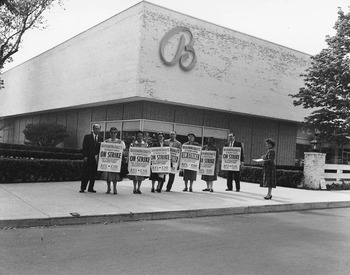
In response to perceived suburban sensibilites, and the need to distance itself from its allegedly subversive past, District 65 eschewed the militant recruiting tactics that had been their hallmark since the 1930s. While leaders encouraged strong turnout on the picket lines, they held no mass rallies or demonstrations. The arrangement of the suburban stores with their multiple entrances, lack of casual foot traffic, and location on private property made mass actions impractical. The suburban stores were generally freestanding structures set well back from the street. The Stamford Bloomingdale's was low-rise but took up a large area. It sat on a sidewalk far from the street and behind a parking area. The Fresh Meadows store had a similar arrangement, as did Stern's-Great Neck.
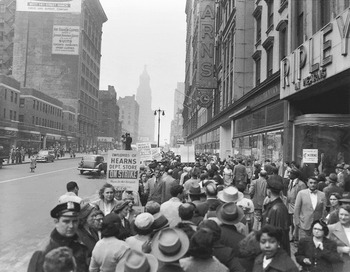
In picket-line shots, union photographers generally tried to show people walking past a store and not entering. None of the union's photographs of the stores or the picketers showed any passers by. That suggests very little foot traffic outside of these stores, as opposed to the city stores that were on busy corners or sometimes shared the block with other establishments. When picketing stores in Manhattan, the union members could easily form a line that both informed passers by and hindered access to the store, often at significant cost to the management.
In the suburbs, 65ers picketed to inform and to show solidarity with the workers who were organizing, but they never impacted the stores' daily operations. No one came by who was not planning on shopping, so it was harder for the picketers to get their message out to sympathetic ears, especially since the organizing drive and picketers got almost no newspaper coverage.61
Negative £s: 14118–14120, 14288, 10787, District 65-UAW Photograph Collection; [photographs] RWDSU-CIO Record, District 65 edition, (December 12, 1954):2-A.

1. District 65ers picketing the Bloomingdale's in Stamford, CT.) Robert F. Wagner Labor Archives, New York University. District 65-UAW Photograph Collection

2. Picketers crowd Union Square in 1953. Robert F. Wagner Labor Archives, New York University. District 65-UAW Photograph Collection
Conclusion
District 65's suburban organizing drive was as much a part of the narrative of suburbanization as the stores it sought to organize. It raised issues that scholars have long linked with the post-World War Two suburban expansion: consumerism, gender, and the organization of the retail marketplace. Department stores were not the only workplaces moving to the suburbs in the 1950s. Factories, warehouses, and offices also relocated with hopes of finding a readily accessible, docile workforce to draw from. District's 65 story suggests that unions and labor issues belong in the suburban narrative. It reminds us that suburbanization took place in a larger political and economic context, and that context directly impacted how the suburbs developed. In the US, anticommunism, changes in labor law, and even changes in union structures worked to impede union activity in both cities and suburbs. The additional challenges suburbia presented made unionization there even more fragile.
Robert F. Wagner Labor Archives, New York University. District 65-UAW Photograph Collection
Robert F. Wagner Labor Archives, New York University. District 65-UAW Photograph Collection
 You have Access