Introduction
Older people with confusion – either as a consequence of dementia or delirium – are frequently found on non psychiatric hospital wards. Typically, in a U.K. general hospital, two-thirds of beds will be occupied by older people and, of these, approximately half will be troubled by cognitive impairment (Royal College of Psychiatrists, 2005). Furthermore, it is known that the severity of dementia independently predicts hospitalization (Albert et al., Reference Albert, Costa, Merchant, Small, Jenders and Stern1999) and that older people with delirium have greater rates of complications, including infection, restraint and neuroleptic use (Holden et al., Reference Holden, Jayathissa and Young2008), as well as worsening functional ability and mortality (Feldman et al., Reference Feldman, Yaretzky, Kaizimov, Alterman and Vigder1999, Marcantonio et al., Reference Marcantonio, Simon, Bergmann, Jones, Murphy and Morris2003). Thus, not surprisingly, older patients with confusion are disproportionately represented on general hospital wards.
Unfortunately, not only is cognitive impairment frequently under-detected by hospital staff with delirium being missed in up to two-thirds of cases (Kales et al., Reference Kales, Kamholz, Visnic and Blow2003), but the care received by confused patients often falls short of the expected standard (National Audit Office, 2007). Increasingly it is recognized that deficiencies in the knowledge, skills and attitudes of all healthcare professionals are significant contributing factors towards the suboptimal care of older hospitalized patients with confusion. Recently, the U.K. National Dementia Strategy has made developing an effective workforce one of its three priority areas (Department of Health, 2009), with particular attention being drawn to the training of hospital staff.
Although training can be delivered by various agencies and staff (e.g. qualified educational trainers), for the purpose of this review we will focus on the role of Liaison Old Age Psychiatry teams as facilitators of learning. These teams include doctors and nurses with a psychiatric background, whose remit is to improve the mental health of older hospital inpatients. Acknowledging the importance of liaison in the education process, the National Institute for Clinical Excellence guidelines for dementia state that liaison teams should deliver “regular training for healthcare professionals in acute hospitals who provide care for people with dementia” (National Institute for Health and Clinical Excellence, 2006). We have previously suggested that, despite the multidisciplinary composition and ongoing presence of liaison teams in the acute setting, the evidence for this role needs to be further developed (Teodorczuk et al., Reference Teodorczuk, Welfare, Corbett and Mukaetova-Ladinska2009). If resources are to be expended on improving the capacity of such teams, it is vitally important that they are underpinned by sound research findings. Though many studies have looked at education and dementia care or delirium management, the literature is deficient in studies which specifically explore how liaison teams could facilitate learning amongst hospital staff.
The purpose of this review is to determine: (i) what is known about educational approaches to help hospital staff managing older patients with confusion; (ii) develop an understanding of what the learning needs of hospital staff are; and (iii) to suggest how liaison teams could facilitate them. Learning needs can be defined as, “the gap between actual and desired practice” (Lockyer, Reference Lockyer1998). Evidence suggests that educational interventions derived from assessing learning needs and targeting this gap are effective in changing behavior (Davis et al., Reference Davis, Thomson, Oxman and Haynes1995). The research question is: what are the learning needs of health professionals on general hospital wards in caring for older persons with confusion and how can they be addressed by a liaison team?
Methods
In order to develop an understanding of potentially effective educational approaches, a broad review of the literature was undertaken. Initially we searched medical and educational databases using the terms “dementia,” “delirium,” “confusion,” “education,” “training,” “learning needs,” “hospital” and “liaison.” Terms were used in combination. Databases searched included Medline, Eric, SCOPUS, Psychinfo, Web of Knowledge, Embase and CINAHL. The reference lists of key articles were screened for further studies relating to the research question. Searches were completed in December 2008 by AT.
Abstracts were screened and articles were selected for further analysis if they fulfilled the following criteria: (1) primary focus is educational either in the form of (a) a description of taught educational intervention or (b) an explicit focus on the knowledge, skills or attitudes which could inform educational planning; (2) acute setting involving hospital staff; and (3) publication in an English language journal. For the purpose of this review, we did not include studies which involved critically ill patients (e.g. in intensive care units). Studies were then further divided according to whether they involved evaluating an educational intervention (experimental) or exploring “more specific or general issues as they occur” (naturalistic) (Hutchinson, Reference Hutchinson1999).
Experimental studies
We evaluated the impact of the intervention according to Kirkpatrick's model (Kirkpatrick, Reference Kirkpatrick1994). This is a practical framework which is widely used to determine the “effectiveness of an intervention” (Aylward et al., Reference Aylward, Stolee, Keat and Johncox2003, Carpenter and Dickinson, Reference Carpenter and Dickinson2008). Impact is evaluated at four levels: reaction, learning, behavior and results (Table 1). The underlying principle is that for successful transfer of knowledge to take place there should be a positive reaction to the event followed by an improvement in knowledge and attitudes, leading to a change in behavior and ultimately impact on patient's health. For the purpose of this review we examined the reported results of the educational intervention and assigned them to one of the four levels. To enhance reliability, impact was evaluated independently by two of the researchers (AT and MW). Cases of disagreement with allocation were discussed until consensus was achieved.
Kirkpatrick's model of learning outcomes

Naturalistic studies
Studies which did not involve an educational intervention were reviewed on the basis of the sample, data collection method, phenomenon being explored and key findings. In order to understand learning needs in relation to managing the older person with confusion, the principal findings were mapped using the software program, Concept Draw MINDMAP (Odessa Inc.). This consisted of a two-stage process. Initially, all the studies were mapped out according to study design and findings. The findings were then reviewed by AT and placed on a “learning needs synthesis” map to determine how they clustered together. Key themes in relation to the research question emerged as a result of this process.
Results
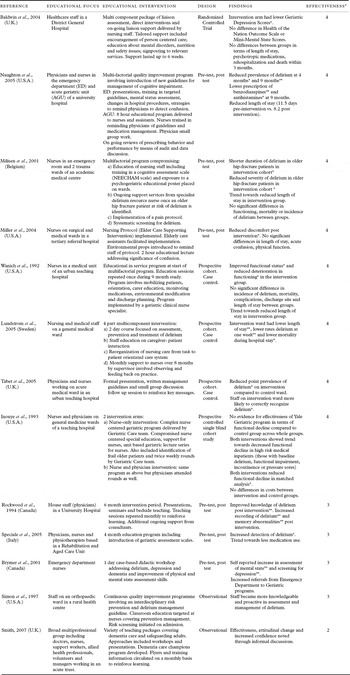
We found 36 studies which met our inclusion criteria, 13 of which investigated the impact of an educational intervention (shown in Table 2).
Studies investigating impact of educational interventions

* = P < 0.05.
** = P < 0.01.
aAccording to Kirkpatrick's evaluation classification (Kirkpatrick, Reference Kirkpatrick1994).
Twenty-three naturalistic studies were found. For full details of these studies see Table S1 published as supplementary material online attached to the electronic version of this paper at http://www.journals.cambridge.org/ipg. Thirteen studies were set in the U.K., 12 in the U.S.A., four in Scandinavia, three in Canada, one in Australia, one in Belgium, one in Italy and one in Ireland.
Experimental studies
Interventions ranged from a one-day workshop (Brymer et al., Reference Brymer, Cavanagh, Denomy, Wells and Cook2001) to an eight-month guided support program for nurses (Lundstrom et al., Reference Lundstrom, Edlund, Karlsson, Brannstrom, Bucht and Gustafson2005). Eight out of the 13 studies had an interprofessional focus, the most frequent mix being that of nurses and physicians. Of the evaluation studies, there was one randomized control trial, six were pre-test/post-test in design, four prospective cohorts comparing outcomes in intervention and non intervention arms, and two were observational.
Eight studies were evaluated as having maximum effectiveness (Kirkpatrick level 4) (Wanich et al., Reference Wanich, Sullivan-Marx, Gottlieb and Johnson1992; Inouye et al., Reference Inouye, Acampora, Miller, Fulmer, Hurst and Cooney1993; Milisen et al., Reference Milisen2001; Baldwin et al., Reference Baldwin, Pratt, Goring, Marriott and Roberts2004; Miller et al., Reference Miller, Campbell, Moore and Schofield2004; Lundstrom et al., Reference Lundstrom, Edlund, Karlsson, Brannstrom, Bucht and Gustafson2005; Naughton et al., Reference Naughton, Saltzman, Ramadan, Chadha, Priore and Mylotte2005; Tabet et al., Reference Tabet, Hudson, Sweeney, Sauer, Bryant, Macdonald and Howard2005), four studies demonstrated changes in behavior (Kirkpatrick level 3) (Rockwood et al., Reference Rockwood, Cosway, Stolee, Kydd, Carver, Jarrett and O'Brien1994; Simon et al., Reference Simon, Jewell and Brokel1997; Brymer et al., Reference Brymer, Cavanagh, Denomy, Wells and Cook2001; Speciale et al., Reference Speciale, Bellelli and Trabucchi2005) and one showed a change in learning only (Kirkpatrick level 2) (Smith, Reference Smith2007). Important health outcomes (level 4) that improved included rates of delirium, length of stay, functional decline, prescribing habits and severity of delirium. Changes in practice (level 3) included detection of delirium, improved assessments of mental state and referral patterns. Level 2 impact included changes in knowledge and attitudes.
In relation to the research question, only the randomized control study by Baldwin et al. (2004) specifically investigated whether a nurse-led liaison team could reduce psychiatric morbidity on hospital wards. This six-week multifactorial intervention comprised knowledge transmission concerning mental disorders, nutrition and safety, delivery within a package of liaison assessment and ongoing support to reinforce learning. Education was estimated to take up half of the nurses’ time. Though perhaps too underpowered to detect an effect, the results suggested that targeted interventions may prove successful. However, the intervention only significantly reduced scores on the Geriatric Depression Scale, with no improvements in cognitive or other health outcomes.
Naturalistic studies
Of the 23 naturalistic studies, six were surveys (Berkowitz, Reference Berkowitz1981; Somerfield et al., Reference Somerfield, Weisman, Ury, Chase and Folstein1991; Armstrong-Esther et al., Reference Armstrong-Esther, Browne and McAffee1999; Hobson et al., Reference Hobson, Coyle, Leeds and Meara2001; Dunnion and Kelly, Reference Dunnion and Kelly2005; Pulsford et al., Reference Pulsford, Hope and Thompson2007), three were case vignettes (Normann et al., Reference Normann, Asplund and Norberg1999; Fessey, Reference Fessey2007; Fick et al., Reference Fick, Hodo, Lawrence and Inouye2007), four were case reviews (McCartney and Palmateer, Reference McCartney and Palmateer1985; Palmateer and McCartney, Reference Palmateer and McCartney1985; Ryan et al., Reference Ryan, Blackburn, Lawley, Ellis, Musil and Kendrick1995; Armstrong et al., Reference Armstrong, Cozza and Watanabe1997), three were mixed methods (Ekman et al., Reference Ekman, Norberg, Viitanen and Winblad1991; Tolson et al., Reference Tolson, Smith and Knight1999; McCarthy, Reference McCarthy2003b), four were interviews (Eriksson and Saveman, Reference Eriksson and Saveman2002; Borbasi et al., Reference Borbasi, Jones, Lockwood and Emden2006; Nolan, Reference Nolan2007; Harding et al., Reference Harding, Martin and Holmes2008), one was a focus group (Atkin et al., Reference Atkin, Holmes and Martin2005), one a Q-sort (Jewell et al., Reference Jewell, Turpie, Patterson, Lewis and Baxter2003) and one was prospective in design (Inouye et al., Reference Inouye, Foreman, Mion, Katz and Cooney2001). Interestingly, two studies involved exploring the patient's perspective (Tolson et al., Reference Tolson, Smith and Knight1999; Harding et al., Reference Harding, Martin and Holmes2008).
Themes concerning the learning needs of hospital staff in relation to managing the older person with confusion were clustered using the mind map software, Concept Draw. Five themes emerged focusing on the skills, attitudes, knowledge, nurses’ experiences and training of healthcare professionals.
Knowledge
Understanding of confusion varied across the healthcare spectrum. Nurses, social workers and those working within the therapy professions were found to have a lower understanding of Alzheimer's disease in comparison to medical professions (Hobson et al., Reference Hobson, Coyle, Leeds and Meara2001). Among the medical professions, physicians tended to have a greater knowledge of organic brain disease than surgeons (Berkowitz, Reference Berkowitz1981). The literature was divided concerning the general level of knowledge of nurses; Armstrong-Esther et al. (Reference Armstrong-Esther, Browne and McAffee1999) described their knowledge as “good”, whereas Ekman et al. (Reference Ekman, Norberg, Viitanen and Winblad1991) reported it to be deficient. In the U.K. a comprehensive review of prequalifying curricula revealed knowledge gaps in relation to diversity, the younger person with dementia and physical health care (Pulsford et al., Reference Pulsford, Hope and Thompson2007). Other deficiencies described in the literature include a lack of understanding of person-centered care amongst hospital nursing staff (Fessey, Reference Fessey2007). Crucially, this study also showed that application of knowledge in practice was heavily influenced by the care environment.
Skills
The majority of studies addressing skills tended to focus either on the behaviors of nurses or doctors. Four studies explored the diagnostic behavior of physicians. McCartney and Palmateer (Reference McCartney and Palmateer1985) found that cognitive problems were under-detected by hospital staff in nearly 80% of case records examined. Furthermore, poor recording was noted as a significant problem. Common diagnostic errors included attributing cognitive impairment to depression in women (Armstrong et al., Reference Armstrong, Cozza and Watanabe1997). In contrast, men were less likely to receive a diagnosis of delirium in this survey study. Finally, deficiencies in the use of diagnostic criteria for dementia and under-use of cognitive tests were identified as an important contributor to poor diagnostic skills amongst hospital physicians (Somerfield et al., Reference Somerfield, Weisman, Ury, Chase and Folstein1991).
Nurses were also found to under-detect cognitive impairment (Palmateer and McCartney, Reference Palmateer and McCartney1985), especially hypoactive delirium and delirium in people with dementia (Fick et al., Reference Fick, Hodo, Lawrence and Inouye2007). Older people on hospital wards who have either severe cognitive impairment or none at all are most likely to be recognized by nursing staff (Tolson et al., Reference Tolson, Smith and Knight1999). In line with these findings, Inouye et al. (Reference Inouye, Foreman, Mion, Katz and Cooney2001) determined that the factors associated with the under-detection of delirium included hypoactive delirium, the patient being aged over 80, visual impairment and dementia. Other contributing factors to under-diagnosis included lack of time and the perception that medical colleagues would not “believe” their assessments (Palmateer and McCartney, Reference Palmateer and McCartney1985). In general, nurses were found to have low sensitivity but high specificity for diagnosing delirium (Inouye et al., Reference Inouye, Foreman, Mion, Katz and Cooney2001). As with physician behavior, the documentation of confusion was found to be suboptimal, rarely going beyond a simple label of “confusion” or “disorientation” (Palmateer and McCartney, Reference Palmateer and McCartney1985).
Wide variation was reported concerning the skills displayed by nurses. These were attributed to personal philosophies of aging (McCarthy, Reference McCarthy2003a), ward environment, sociocultural issues and time factors (Borbasi et al., Reference Borbasi, Jones, Lockwood and Emden2006; Nolan, Reference Nolan2007). Care was provided according to routines rather than patient needs (Ekman et al., Reference Ekman, Norberg, Viitanen and Winblad1991), and Borbasi et al. (Reference Borbasi, Jones, Lockwood and Emden2006) specifically called for a shift in thinking towards more patient-centered care.
Attitudes
The literature was divided in terms of the attitudes held by nurses towards the older confused patient. Positive attitudes were reported in a survey study of nurses (Armstrong-Esther et al., Reference Armstrong-Esther, Browne and McAffee1999). More in-depth interview studies, however, revealed negative attitudes of staff towards the “demented” patient with communication problems (Ekman et al., Reference Ekman, Norberg, Viitanen and Winblad1991). Furthermore, both staff and patients felt uneasy about talking about delirium (Harding et al., Reference Harding, Martin and Holmes2008). Variations in attitude were noted according to the hospital (Armstrong-Esther et al., Reference Armstrong-Esther, Browne and McAffee1999) and patient. In general, staff felt more comfortable with non-agitated patients (Nolan, Reference Nolan2007). Lastly, staff appeared motivated to develop expertise in order to improve practice (Atkin et al., Reference Atkin, Holmes and Martin2005).
Experiences of caring for the older person with confusion
Many studies explored the nurse's experience of caring for the older hospitalized confused person. A common theme that emerged was of the powerlessness that staff felt. By means of a mixed method study, Tolson et al. (Reference Tolson, Smith and Knight1999) found that staff were concerned about the “suboptimal care” they provided and suggested that special attention needed to be paid to those with dementia. Staff perceived themselves as having low levels of knowledge (Ekman et al., Reference Ekman, Norberg, Viitanen and Winblad1991) and skills (Atkin et al., Reference Atkin, Holmes and Martin2005) in the management of confusion. Comparing the care of the patient with dementia to the cognitively intact patient, nurses felt that the care they were able to provide was not only of a lower standard (Atkin et al., Reference Atkin, Holmes and Martin2005) but also too brief to do the patient justice (Ekman et al., Reference Ekman, Norberg, Viitanen and Winblad1991). Particular areas identified by nursing staff as problematic included caring for patients with challenging behaviors, treating patients against their will and managing organizational demands to decrease the amount of time caring (Eriksson and Saveman, Reference Eriksson and Saveman2002).
Training issues
Nurses welcomed training and specifically identified preferences towards ongoing ward-based education with an element of role modeling (Atkin et al., Reference Atkin, Holmes and Martin2005). Identified training needs included improved communication around discharge planning (Dunnion and Kelly, Reference Dunnion and Kelly2005) and management of dementia and risk (Jewell et al., Reference Jewell, Turpie, Patterson, Lewis and Baxter2003).
The relationship between previous training and levels of knowledge and skills was explored in several studies. Interestingly, levels of training were associated neither with knowledge levels amongst physicians of organic brain syndrome (Berkowitz, Reference Berkowitz1981) nor recognition of delirium by nurses (Fick et al., Reference Fick, Hodo, Lawrence and Inouye2007). Furthermore, Ekman et al. (Reference Ekman, Norberg, Viitanen and Winblad1991) found that the less training a nurse underwent, the more time he or she was likely to devote towards direct patient care. In contrast, Normann et al. (Reference Normann, Asplund and Norberg1999) found that the greater the level of post-basic training nurses had, the more likely they were to utilize a patient-centered approach.
Discussion
Main findings
The principal finding of the review of intervention studies is that educational strategies targeted at improving the management of confusion in the hospitalized older adult can be delivered effectively across a wide variety of healthcare settings. However, in some cases, although statistical significance was achieved, the strength of effect was weak and it was unclear to what extent the interventions were clinically significant. For example, the study by Milisen et al. (Reference Milisen2001) in older hip fracture patients showed a significant reduction in duration and severity of delirium, but yet no difference in terms of functioning or mortality.
A further finding was that most of the interventions incorporated not only transmission of knowledge (e.g. presentations), but also enabling factors (e.g. protocols and reorganization of care) and reinforcing factors (e.g. reminders) (Davis et al., Reference Davis, Thomson, Oxman and Haynes1992). In view of the multifactorial design it is difficult to determine the extent to which education of the staff per se, rather than organizational change, was the active ingredient. Furthermore, the majority of the interventions targeted delirium prevention and management (e.g. by early recognition and risk factor modification). This is hardly surprising given the widespread notion that delirium is a reversible cause of confusion whereas dementia is irreversible in nature.
In relation to the original research question, the learning needs of hospital staff concerning the management of the confused patient were not described in any depth by these experimental studies. One study, however, investigated liaison teams facilitating the educational intervention (Baldwin et al., Reference Baldwin, Pratt, Goring, Marriott and Roberts2004).
Finally, given the well established benefits of interprofessional education in terms of “amplifying the heterogeneity of professions in order to enhance the learning experience” (Freeth, Reference Freeth2007), it was refreshing that over half the interventions were targeted at more than one learning group. However it is unclear the extent to which these approaches were indeed interprofessional rather than multiprofessional.
Findings from naturalistic studies suggest that diagnostic behaviors of both doctors and nurses remain a barrier to the successful management of the confused older patient. Furthermore, a lack of understanding concerning patient-centered care may hinder nursing approaches. As expected, variation exists concerning both knowledge and skills which can be attributed to the complex interplay between external factors, such as ward environments and time constraints, and intrinsic learner-centered factors, such as their own philosophy of aging and their professional background. In-depth interviews revealed more negative attitudes towards the older patient with dementia. In general, staff are aware of deficiencies in their practice and are keen to address them, but they reported feeling somewhat powerless. Unfortunately, other than role modeling, very little is mentioned about the form of education that learners value. The finding that those caregivers with the shortest training tended to devote the most time to direct patient care (Ekman et al., Reference Ekman, Norberg, Viitanen and Winblad1991) suggests that we should be investing more time in training those who will be spending most time with patients. Our explanation for the relationship is that it is likely to be associative rather than causal, and due to the nature of training programs aimed at different caregiver levels. Finally, we were unable to find any studies which specifically address the educational role of a Liaison Old Age Psychiatry team.
In summary, in relation to the original research question, naturalistic studies appear to shed more light on what the learning needs of hospital staff are while the experimental studies help direct the form that these interventions could take.
To our knowledge this is the first review specifically examining the role of education in relation to confusion and liaison teams. Our findings, however, build on Rockwood's previous review of education and delirium (Rockwood, Reference Rockwood1999). The key message of the latter review was that few educational interventions were underpinned by the principles of adult learning theory (i.e. approaches which were relevant, integrated and incorporated feedback). Most interventions targeted nurses and physicians, there were no studies specifically examining learning needs and, lastly, when assessed against clinically relevant end points, there was little to “convince the skeptic that a more educated approach will produce better outcomes.” Our findings suggest that more integrated and relevant approaches involving reinforcing and enabling factors are being evaluated and shown to be effective. Although approaches are still largely targeted at nurses and physicians, interdisciplinary approaches are increasingly being evaluated.
Theoretical considerations
It is well known that developing a sound curriculum underpins effective education initiatives (Schiro, Reference Schiro2008). The educational literature suggests that curricula can be divided into three broad categories: a content curriculum, an instrumental curriculum and a developmental curriculum (Kelly, Reference Kelly2004):
1. A content curriculum is focused on delivering knowledge and assumes that improving levels of knowledge will lead to an improvement in practice behavior.
2. An instrumental curriculum is directed at improving skills and achieving competencies. The major assumption is that achieving these competencies will lead to a more competent practitioner.
3. A developmental curriculum plans the curriculum around people and their intrinsic learning needs. The assumption is that there is no “one” way to deliver a curriculum; rather, curricula should be adapted to individuals and focused on processes which lead to individual development.
In theoretical terms, we propose that the studies we have reviewed are rich in findings informing a content-based or instrumental curriculum, but deficient in findings which can potentially build a developmental curriculum. This review highlights key deficiencies in diagnostic criteria, awareness of the features of delirium and dementia and an understanding of the person-centered care approach which could inform the syllabus of a content curriculum. Equally, the literature reviewed can inform an instrumental curriculum potentially focused on improving the skills of cognitive assessment for doctors, documentation and time management in relation to patient care for nurses. However, the available literature is sparse in developing an understanding of intrinsic learning needs and identifying the opportunities and barriers to educational processes. Previously, we have argued that the most effective educational approaches by liaison teams should ideally be underpinned by a developmental curriculum (Teodorczuk et al., Reference Teodorczuk, Welfare, Corbett and Mukaetova-Ladinska2009). The key premise for this argument is that implementation of other arguably more “top down” curricula will be hindered by attitudes of hospital staff and organizational barriers to learning. Owing to the complex social nature of education, what works in one setting may not work in another with different learners, teachers and contextual factors.
Situated learning
Conspicuous by its absence in our review is mention of potential education theories beyond adult learning theory. Educationalists often argue that there is “nothing more practical than theory” (Kaufmann, Reference Kaufmann and Cantillon2003) and one theory with a high degree of applicability is “situated learning” (Lave and Wenger, Reference Lave and Wenger1991).
Situated learning views learning as a consequence of the social discourse that occurs within the work place as opposed to the more traditional transmission of knowledge or acquisition of skills. Much of the theory derives from observational studies within “communities of practice” in which teaching was not apparent but learning occurred to a high degree (e.g. the Yutac community of midwives). Key to this is the concept of “transformational learning,” which occurs as a result of developing a strong identity through social discourse within the context of the work place and legitimately moving as a newcomer from a peripheral position to a central one, thereby achieving mastery.
Though criticized for being too dismissive of teaching and too simplistic for the real world (Fuller et al., Reference Fuller, Hodkinson, Hodkinson and Unwin2005), situated learning presents a refreshing new standpoint from which to view learning. In particular, there are important implications in terms of liaison teams becoming accepted within communities of practice within hospitals in order to achieve effective transformational learning. A central difficulty with hospital staff and older persons with confusion relates to ownership (Marshall, Reference Marshall1999). A focus on an integrated approach involving becoming “accepted within hospital communities” will be key to the success of any educational endeavor. Furthermore, liaison teams will be in a stronger position to help develop the identity of the non psychiatric staff members to accept the challenge of engaging in a therapeutic, rather than custodial, relationship with the older confused patient. Attitudes present the greatest barrier to translating knowledge into practice and an educational approach focused on context with guided support from liaison teams is most likely to be effective in bringing about change in the workplace (Billett, Reference Billett1996).
Educational recommendations
Potentially, liaison teams could complete their own needs assessments, guided by the findings of this review. Needs could be assessed by interviews, focus groups, event analyses or surveys. In particular, the teams could consider the key messages from the naturalistic and experimental studies (Box 1). Based on these, they could design their own curricula. Following delivery of these interventions we would recommend a process of evaluation in order to determine how they can be made more successful. This evaluation could potentially form another needs assessment and hence we would recommend that education is delivered in a structured cyclical fashion.
Box 1: Main messages from the reviewed studies
• Key learning needs relate to the practice of person-centered care and detecting cognitive impairment
• Successful educational approaches include enabling and reinforcing factors in addition to knowledge transmission
• Staff feel powerless but willing to change practice
• Preference for ward-based training with role modeling
Strengths and weaknesses
The findings from our review must be considered within the limitations of the study. First, though we attempted a comprehensive review this is not a systematic review. Rather, the review is more narrative in nature, presenting an argument. It is possible that some studies may have been omitted and as such we propose that this initial review of the literature be followed up by a more rigorous systematic review. Secondly, it is possible that another group of researchers may have assigned the interventions to different Kirkpatrick levels; however, to increase reliability in this study, two independent co-authors evaluated the impact. Lastly, on a theoretical level it could be argued that educational approaches on their own are unlikely to bring about change without concurrent organizational interventions. Thus, a system needs assessment, in addition to a learning needs assessment, is equally warranted to bring about effective change in the workplace.
The strengths of the study are the fact that we looked broadly at confusion rather than restricting ourselves to a narrower disease-based strategy focused on either delirium or dementia. Arguably the more pragmatic symptom approach mirrors the day-to-day approach that occurs in a general hospital. Moreover, the diseases often co-exist and symptoms are frequently shared. An additional strength is the use of Concept Draw to map the findings and draw together themes from a large number of studies. Furthermore, we would recommend the use of a mind map package to visualize the needs of the learners and build continuously as part of the educational planning process for liaison teams.
Future research
Further research should be directed at exploring developmental curricula for liaison teams focused on empowering staff. Importantly the learning needs of all healthcare professionals, including health care assistants, therapists, clerical staff, security staff and managers as well as nurses and doctors, should be considered in order to inform interprofessional interventions. Research should also be directed at the diverse barriers and opportunities for learning within the workplace. Further, we recommend close working with educationalists to help inform liaison curriculum designers of developments in applicable education and curricular theories.
Conflict of interest
None.
Description of authors' roles
Dr. Teodorczuk wrote the review. All authors contributed to the design of the study, and reviewed drafts of the manuscript.
Acknowledgments
We would like to thank the library staff at North Tyneside Hospital for their assistance. We are grateful to Dr Jim George for helpful comments on an earlier draft and Mrs Alyson Goldwater for secretarial support.