Introduction
Healthy sleep is an essential part of a healthy life. Respiratory disorders such as primary snoring and obstructive sleep apnoea (OSA) are serious health problems that disrupt healthy sleep. Obstructive sleep apnoea causes unhealthy and sleep-disordered open-mouth breathing, which in turn can negatively affect oral and dental health. Oral and dental health is an important public health issue and is affected by factors such as age, gender, education and socio-economic status. To date, various indexes have been defined to measure and compare the dental health of communities,Reference Petersen and Ogawa1 including the decayed, missing and filled teeth index, which is one of the principal measures used in assessing oral and dental heath.Reference Petersen and Ogawa1, Reference Behram, Lofça and Efes2
The most important aetiological factor in oral and dental health decline is microbial dental plaque formation.Reference Güngör, Tüter and Bal3 The accumulation of dental plaque on the surface of teeth, and the inability to effectively remove it, causes oral health problems due to the toxic by-products of the micro-organisms involved in plaque formation.Reference Källestål and Matsson4 Interestingly, a dry mouth, which may be related to dental plaque formation and tooth decay, is a condition that obstructive sleep apnoea syndrome (OSAS) patients frequently complain about. In fact, during sleep, salivary flow almost completely ceases and the frequency of swallowing decreases.Reference Castiglione, Emde, Armstrong, Schneider, Bauerfeind and Stacher5 Considering that saliva has protective properties against the formation of dental plaque – for instance, by neutralising intraoral acidic pHReference Stookey6 – a decrease in the amount or flow of saliva might cause an increase in tooth decay.
Oral appliances are commonly used for the treatment of OSAS. The efficiency of oral appliances in the treatment of OSAS has been discussed in several studies.Reference Bloch, Iseli, Zhang, Xie, Stoeckli and Russi7 As non-invasive procedures, treatment using oral appliances has become a desirable alternative for patients rejecting continuous positive airway pressure treatment or surgery.
The American Board of Dental Sleep Medicine has indicated that for the use of oral appliances in the treatment of primary snoring or OSAS, patients should be examined in terms of dental health, soft palate and intraoral structures, and periodontal tissue and temporomandibular joint.Reference Lowe, Dement, Kryger and Roth8 To use oral appliances, a certain number of teeth must be present, thus making dental health even more important in OSAS patients.
Considering that OSAS can lead to unhealthy open-mouth breathing, which can be a precursor for oral and dental problems, in this study, we aimed to investigate the possible effect of OSAS on dental health as defined by the decayed, missing and filled teeth index and other clinical parameters that affect oral health.
Materials and methods
Study design and population characteristics
This prospective, case-controlled study was approved by the Ethics Committee of the Eskişehir Osmangazi University School of Medicine, Turkey. All study subjects gave their signed, informed consent before participating in the study. All study procedures were conducted in accordance with the Helsinki Declaration and local regulation.
The study group was composed of 291 patients referred to the ENT clinic at Yunus Emre State Hospital, Eskişehir between January 2010 and October 2012, who presented with sleep-related complaints such as snoring, witnessed apnoea and daytime somnolence, and indication for polysomnography. According to the apnoea–hypopnoea index (AHI), we divided patients into primary snoring (control group, n = 41) and OSAS (study group, n = 250) groups.
Snoring causes open-mouth breathing and open-mouth breathing negatively affects oral health due to the decrease in salivary flow. Beside the effects of open-mouth breathing, we aimed to evaluate the effect of OSAS on oral and dental health. This is why we chose our control group among primary snorers to compare OSAS cases with mouth breathers.
We also recorded the demographic information of subjects in both groups, including age, gender, body mass index, duration of snoring, education and socio-economic status.
Obstructive sleep apnoea syndrome diagnosis
Diagnosis of OSAS is usually based on polysomnography.9 Polysomnography was recorded for all the subjects during spontaneous sleep under the supervision of technicians in a single room in our sleep centre. The AHI values obtained by polysomnography were calculated as the ratio of the total number of apnoeas and hypopnoeas per hour of nocturnal sleep.
According to the AHI values, patients were categorised into two groups: primary snoring (AHI ≤ 5) and OSAS (AHI > 5). Obstructive sleep apnoea syndrome patients were further grouped as follows: AHI = 5–15, mild OSAS; AHI = 16–30, moderate OSAS; and AHI > 30, severe OSAS. To gather the polysomnography data, all subjects were manually scored by the same specialist (MA), who holds a certificate in sleep disorders. The same dentist (IT) examined all patients and recorded and scored tooth decay, missing teeth due to decay, and tooth fillings using the decayed, missing and filled teeth index.
Factors affecting oral and dental health
For the evaluation of oral and dental health, we calculated the decayed, missing and filled teeth index for all subjects.Reference Behram, Lofça and Efes2 In order to define the effect of OSAS on oral and dental health, we compared the decayed, missing and filled teeth indexes of the control and OSAS groups. Additionally, we investigated the effects of the following clinical factors on the decayed, missing and filled teeth index: age, body mass index, income, education, duration of snoring, AHI, snoring rate and sleep time with oxygen saturation lower than 90 per cent.
Results
Statistical analysis
We summarised the study data using descriptive statistics (e.g. mean, median, standard deviation, interquartile range, min/max, frequency, percentage). We used the Shapiro–Wilk test to investigate whether the data had a normal distribution. For comparisons between groups, we used the independent samples t-test and one-way analysis of variance (ANOVA) test followed by Tukey's test as the post-hoc test for normally distributed variables; we used the Mann–Whitney U and Kruskal–Wallis tests followed by the Dunn's test as the post-hoc test for non-normally distributed variables. For the analysis of categorical variables, we used the chi-square test. We presented the correlation between different factors and the decayed, missing and filled teeth index using Spearman's rank correlation coefficients (r). We used two commercially available software programs – SPSS, version 20.0 (SPSS Inc., Chicago, Illinois, USA) and SigmaStat, version 3.5 (Systat Inc., San Jose, California, USA) – for the statistical analysis. We set the statistical level of significance to p < 0.05.
Study population
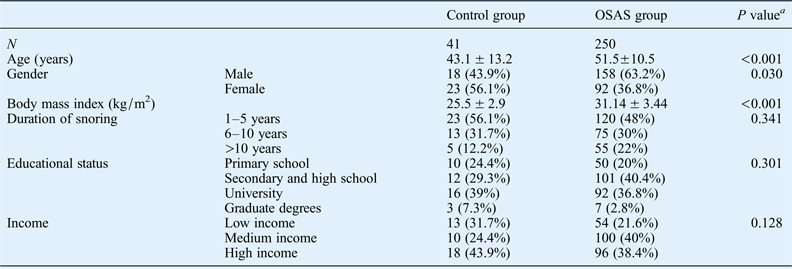
We included a total of 291 patients (176 males, 115 females; mean age, 50.8 ± 10.4 years; age range, 20–70 years) with sleep-related complaints in the study. According to the AHI, 41 patients (mean age, 43.1 ± 13.2 years; age range, 20–65 years) were diagnosed with primary snoring (control group) and 250 patients (mean age, 51.5 ± 10.5 years; age range, 32–70 years) presented with OSAS (study group). Of the patients in the study group, 41 (16.4 per cent) had mild OSAS, 70 (28 per cent) had moderate OSAS and 139 (55.6 per cent) had severe OSAS. The median (interquartile range) AHI values were 4 (2–5), 13 (10.7–14), 23 (21–26) and 54 (38.2–74), for the control, mild, moderate and severe OSAS groups, respectively (p < 0.001, Kruskal–Wallis ANOVA). The clinical characteristics of the patients in our cohort are shown in Table I.
Clinical characteristics of the study cohort*

OSAS = obstructive sleep apnoea syndrome; *Data are given as mean ± standard deviation or n (%). aStatistical comparisons were performed by independent samples t-test for continuous variables and chi-square test for categorical variables.
Correlation between obstructive sleep apnoea syndrome and dental health
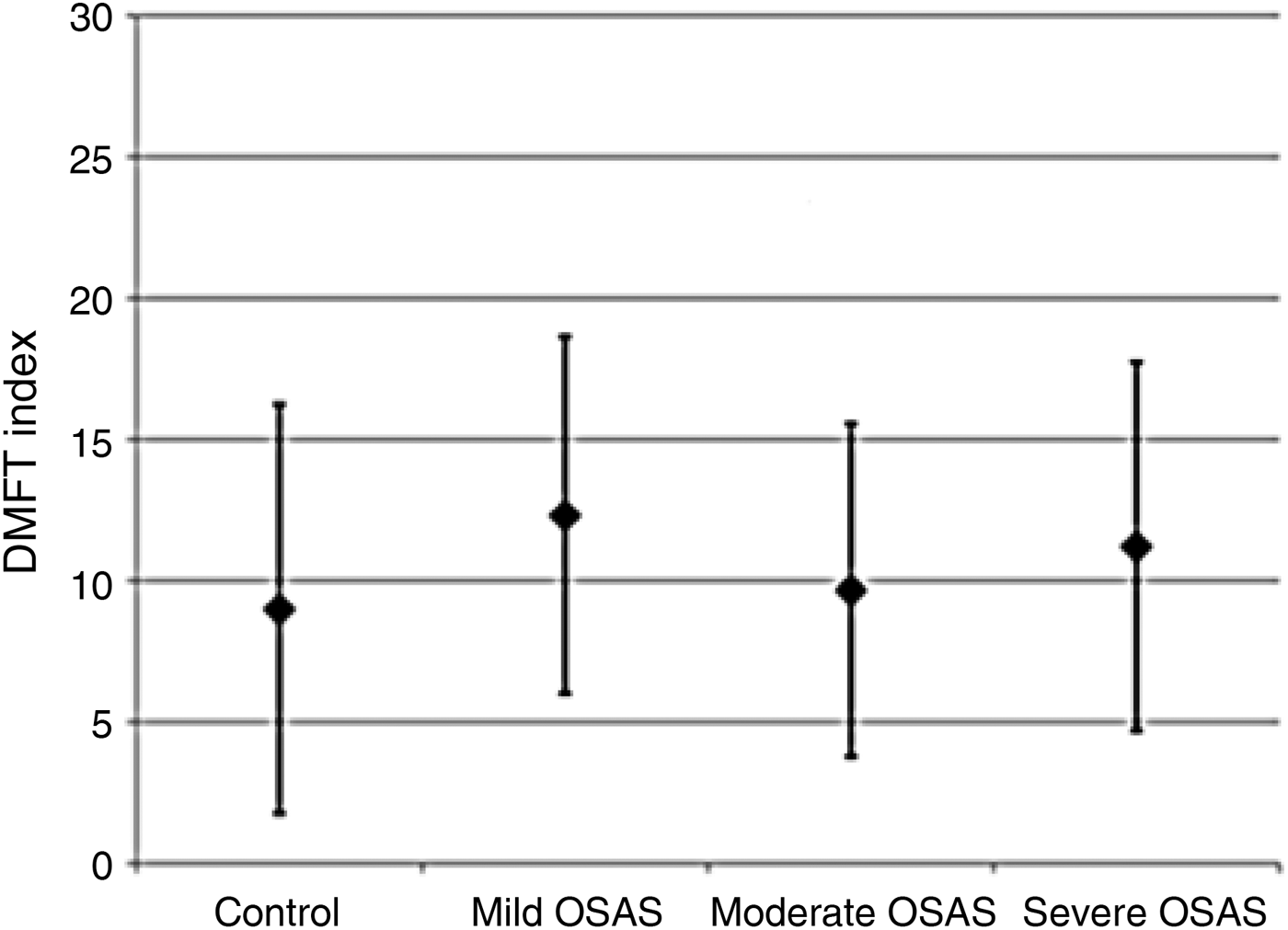
To investigate the relationship between OSAS and dental health, we compared the decayed, missing and filled teeth indexes of patients in the control and OSAS diagnostic groups. The decayed, missing and filled teeth index scores varied from 0 to 28 with an average of 10.6 ± 6.50. The decayed, missing and filled teeth index scores were 9.0 ± 7.24, 12.32 ± 6.31, 9.67 ± 5.89 and 11.22 ± 6.52, respectively. We found no correlation between OSAS severity and the decayed, missing and filled teeth index (p = 0.057, ANOVA). The mean decayed, missing and filled teeth index scores of the control and OSAS groups are shown in Figure 1.
Mean DMFT index scores of the control and OSAS groups. We found no statistically significant difference between the two groups (p = 0.057). The error bars represent the standard deviation. DMFT = decayed, missing and filled teeth; OSAS = obstructive sleep apnoea syndrome
Other factors affecting dental health
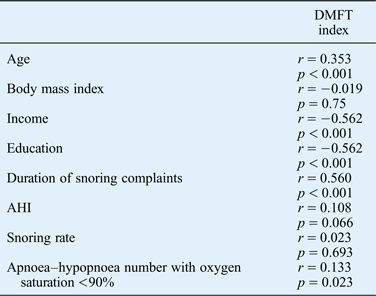
To investigate the factors affecting dental health, we calculated the Spearman's rank correlation between these factors and the decayed, missing and filled teeth index scores of patients in both groups (Table II). We observed a statistically significant and positive correlation between age and the decayed, missing and filled teeth index (r = 0.353, p < 0.001). Our findings suggest that older patients have higher decayed, missing and filled teeth index scores, indicating deteriorating dental health with age in both control and OSAS groups. We found a positive correlation between the duration of snoring complaints and the decayed, missing and filled teeth index (r = 0.560; p < 0.001). We found a strong and negative correlation between educational status and the decayed, missing and filled teeth index (r = −0.562, p < 0.001). Patients with a better education had improved (i.e. lower) decayed, missing and filled teeth index scores. Higher income levels indicated improved (lower) decayed, missing and filled teeth index scores, with a strong negative correlation between income level and decayed, missing and filled teeth index (r = −0.562, p < 0.001). Gender had no effect on the decayed, missing and filled teeth index scores (10.06 ± 6.12 for women, 11.10 ± 6.73 for men, p = 0.18). The decayed, missing and filled teeth index also had no correlation with the AHI (r = 0.108, p = 0.066), body mass index and snoring rate (p > 0.05).
Correlation between the decayed, missing and filled teeth index and the study variables
DMFT = decayed, missing and filled teeth; AHI: apnoea–hypopnoea index
Discussion
Oral and dental health is an important public health issue that varies according to country and region. It is also affected by various factors such as saliva production, nutrition, and educational and socio-economic status. Dry mouth, a condition that contributes to poor oral and dental health, is frequently observed in patients with snoring and sleep apnoea. Various factors can cause dry mouth, such as decreased saliva production, decreased salivary flow and increased desiccation of existing saliva due to chronic open-mouth breathing. Interestingly, changes in salivary flow rate have been shown to increase tooth decay.Reference Storhaug and Holst10 Also, Alexander reported that the self-cleaning ability of the oral cavity is decreased due to a dry mouth, consequently causing the impairment of oral and dental health.Reference Alexander11 Similarly, a reduction in the protective effects of saliva due to decreased salivary flow increases the risk of tooth decay.Reference Dawes12
Previously, Banderas-Tarabay et al.Reference Banderas-Tarabay, Zacarías-D'Oleire, Garduño-Estrada, Aceves-Luna and González-Begné13 established a statistically significant, positive correlation between the amount of saliva and salivary proteins, and decayed, missing and filled teeth index scores; decreasing amounts of saliva and salivary proteins correlated with increased decayed, missing and filled teeth index scores. Although patients diagnosed with primary snoring and OSAS frequently complained about dry mouth, we did not observe any negative effects of OSAS on dental health. However, we identified a significant and positive correlation between the duration of snoring complaints and the decayed, missing and filled teeth index; the longer the duration of snoring complaints, the higher the decayed, missing and filled teeth index score. This result suggests that prolonged duration of snoring complaints might be related to increased exposure time to a dry mouth, which causes a worsening of dental health in accordance with previously published results.Reference Lenander-Lumikari and Loimaranta14–Reference Scully and Felix16
In an extensive study, Gökalp et al.Reference Gökalp, Güçiz Doğan, Tekçiçek, Berberoğlu and Ünlüer17 found that the average decayed, missing and filled teeth index scores were between 9.8 and 25.8. We also found decayed, missing and filled teeth index values within this range (mean: 10.69 ± 6.50; range: 0–28). We found no significant difference between the control and OSAS groups in terms of decayed, missing and filled teeth index scores. Furthermore, we found no significant correlation between the AHI showing OSAS severity and the decayed, missing and filled teeth index scores.
Behram et al.Reference Behram, Lofça and Efes2 examined the relationship between educational level and the decayed, missing and filled teeth index; they observed the highest decayed, missing and filled teeth index score in primary school graduates, and the lowest decayed, missing and filled teeth index score in university graduates. Similarly, Güngör et al.Reference Güngör, Tüter and Bal3 established that the importance an individual gives to oral health increases in parallel with the increase in the individual's educational level. Indeed, with an increase in educational level, the number of tooth fillings increase, indicating an increase in visits to the dentist and dental treatment frequency. Another reason for the reduction of tooth decay among educated people is improved nutritional habits in terms of dental health.Reference Sheiham, Watt, Murray, Nunn and Steele18 In agreement with these previous studies, we observed a significant and negative correlation between educational status and decayed, missing and filled teeth index score; increased educational levels correlated with decreased decayed, missing and filled teeth index scores.
• Open-mouth breathing is known to have a negative effect on oral and dental health
• Open-mouth breathing is one of the most common complaints of patients presenting with obstructive sleep apnoea syndrome (OSAS)
• We investigated the effect of the severity of OSAS on oral and dental health
• Our study showed that the severity of OSAS did not have a significant effect on oral and dental health
In an investigation involving 300 children, Ravera et al.Reference Ravera, Sanchez, Squassi and Bordoni19 determined that dental and gingival diseases were more common in the children of low-income families. Similar studies reported that dental health and tooth decay varied according to the level of education and income; as educational and income levels decreased, the frequency of tooth decay increased.Reference Cleaton-Jones, Chosack, Hargreaves and Fatti20, Reference Slade, Spencer, Davies and Stewart21 In agreement with these findings, we found that as the income levels of our patients increased, their decayed, missing and filled teeth index scores also decreased.
Many symptoms, including snoring, witnessed apnoea, daytime somnolence, morning headache, dry mouth, anxiety, depression, accidents while at work, and high blood pressure are related to OSAS according to several studies.Reference Veis22, Reference Padma, Ramakrishnan and Narayanan23 However, our study is the first to investigate the relationship between OSAS/snoring and oral and dental health. We did not determine a correlation, positive or negative, between OSAS and dental health status as judged by the decayed, missing and filled teeth index scores. However, our results revealed a statistically significant and positive correlation between the duration of snoring complaints and oral and dental health.
In conclusion, the findings of this prospective, case-controlled study suggest that OSAS diagnosis and severity do not have an effect on oral and dental health, but the frequency of tooth decay increases as the duration of snoring complaints increases.