Introduction
The state's role as a categoriser and classifier of people has a long history that is intricately linked to the bureaucratic practices of modern government. Foucault's (Reference Foucault1970, Reference Foucault and Gordon1980) focus on the role of the modern organisation as a producer of both information and collective identities has been taken up by Hacking (Reference Hacking, Heller, Sosna and Wellbery1986) who speaks of ‘kinds of people’ brought into being by the social processes of labelling. Jenkins (Reference Jenkins1996), too, finds that ‘the categorisation of individuals and populations that is the stock in trade of the social sciences is also one of the ways in which humans are constituted as objects of government and subjects of the state via censuses, etc’.
These invented yet authoritative categories also framed the identification of individuals in the ‘colonial mission civilisatrice’ (Appiah, Reference Appiah2005: 221). In her study of colonial rule, Stoler (Reference Stoler2002: 83) carefully examines the cultural framing of political categories and the nuanced meanings that attached to sexuality, gender and race in the creation of racial identities: ‘Discourses of metissage expressed more pervasive if inchoate dilemmas of colonial rule and a fundamental contradiction of imperial domination: the tension between a form of authority simultaneously predicated on incorporating and distancing. Some metis were candidates for incorporation. Others were categorically denied. In either case, the decision to grant citizenship or subject status could not be made on the basis of race alone as all metis shared some degree of European descent by definition.’ Indeed, Robert Young (Reference Young1995: 28) sees a worrying resonance with this legacy or of us being ‘trapped in our history’, as Foucault (Reference Foucault1982: 210) puts it: ‘Hybridity in particular shows the connections between the racial categories of the past and cultural contemporary discourse.’
Since the late twentieth century these processes of collective identity formation have become more complex. The state continues to be an interested party, creating and using social categories for processes of administrative allocation. At the same time preoccupation with diversity and identity politics has empowered social groups themselves in a clamour for recognition. As Jenkins (Reference Jenkins1996: 169) has written: ‘Identification and allocation are mutually and reciprocally entailed in each other. Identity is consequential in terms of allocation: how you are identified may influence what, and how much, you get.’ In the public sphere such processes are determinants of the large-scale allocation of resources and can have important consequences for people's lives. Nowhere is this more true than in census processes of categorising the ethnicity/race of individuals and, consequently, populations. Out of this common ground, where the role of the state as provider meets the claims of identity groups for resources, has emerged various brands of multiculturalism, such as the ‘differential citizenship’ of Iris Young (Reference Young2000).
The rhetoric of cultural diversity has also risen and been driven by demographic changes in the population, notably the increasing rates of exogamy in some ethnic groups. For the first time in the national census round of 2000/2001, statistical/census agencies in a number of western countries have offered options for people who, by virtue of their parentage or more distant ancestry, wished to declare a ‘mixed race’ identity in questions on race and population or ethnic group (Aspinall, Reference Aspinall2003a). Until this time, official classifications had maintained a structure of discrete, mutually exclusive racial/ethnic groups, only one of which could be selected by the respondent.
In reality, the ‘mixed race’ or ‘multiracial’ population in Britain, North America and Western Europe has been growing steadily in the last few decades. This important trend has led to an increased interest in the racial identifications of ‘mixed race’ people, as well as the factors which shape and constrain the choices that ‘mixed race’ people make (Song, Reference Song2003). A very sizeable literature (especially in the USA) about the diversity of multiracial experience has shown that many factors influence how and why multiracial people describe themselves (and are described or categorised by others) in particular ways (cf. Rockquemore and Brunsma, Reference Rockquemore and Brunsma2002; Parker and Song, Reference Parker and Song2001).
The notion of multiple allegiances – the idea that the selection of a single category could not adequately describe a person's racial/ethnic identity – had been acknowledged by officialdom in the 1980s and 1990s (McKenney and Bennett, Reference McKenney and Bennett1994) in the presence of an increasing number (but small overall prevalence: estimated at 1.3 per cent for Great Britain in 1991 and 2.8 per cent for England in 2001 (Berrington, Reference Berrington, Coleman and Salt1996; Mackintosh, Reference Mackintosh2005)) of inter-ethnic/racial unions. However, the desire of modern states to see their populations as composed of bounded and clearly defined identity groups exerted a downward pressure on change: indeed, some census agencies continued to argue that persons of mixed race were content to identify with a single group (Sillitoe and White, Reference Sillitoe and White1992). As Anderson then put it, ‘The fiction of the census is that everyone is in it, and that everyone has one – and only one – extremely clear place. No fractions’ (Anderson, Reference Anderson1991).
That this approach was no longer tenable gained recognition in the census development programmes of the 1990s and expression through a variety of question formats: an option to multi-tick across categories (in the US 2000 Census and Canadian, Australian and New Zealand 2001 Censuses), to select from a range of predesignated dual category options (in England and Wales 2001 Census) and to utilise an open response category only (Northern Ireland and Scotland 2001 Censuses). Against a demographic shift towards greater inter-racial partnering (Berrington, Reference Berrington, Coleman and Salt1996; Model and Fisher, Reference Model and Fisher2002), a changed approach that captured this growing diversity in the population was inevitable. However, it was facilitated – most strongly in the USA – by the emergence of a politics of identity, encompassing both the mobilisation by elites of political group opinion as to what they should be called and the rise of so-called ‘agent autonomy’ (‘agency’) in how identity choices are made at the individual level. This had been made possible by various challenges to the ‘one drop rule’ (e.g. Funderburg, 1994), the rise of a black middle class, and the development of a governance based on the recognition of both group and individual civil rights. The consequent weakening of the ‘melting pot’ paradigm and its replacement by an unofficial politics of multiculturalism favoured the concept of diversity and ‘multiplicity’, that easily translated into officialdom's ‘two or more races population’ (Jones and Smith, Reference Jones and Smith2001). In Britain, where the issues of structural constraint and power in inter-ethnic relations have been so different and the semantic ethnicisation of racialised groups has been widely accepted, multiplicity has lost out to an articulation of dual heritage or mixed parentage, a fashioning of racial categories that maintains both a degree of order and homage to the traditional asymmetries of race relations.
The role of the state as categoriser
The state's role in official categorisation of ethnic/racial groups has a long tradition in many countries and is now the strongest source of collective external definition or social categorisation. That role is operationalised in the UK though the Office for National Statistics (ONS), a government department that operates with a substantial degree of autonomy, and the devolved administrations of the home countries. The ethnicity classifications developed for the decennial national censuses have been adopted by government for all data collection, thereby becoming the national ‘gold standard’ and the source of ethnic/racial vocabulary in wider policy settings. Thus, how such categories are decided and the extent to which they have validity and utility is highly consequential for the formulation of social policy and the delivery of public services.
The process of category development by officialdom now converges on a common approach of cognitive research, small-scale tests and major census trials within broader national programmes. Undoubtedly, the establishment of such categories upon the basis of phenomenal distinctions judged appropriate by a community of scientific and other observers is an integral part of the process, their adequacy being ‘ultimately a matter of the extent to which they contribute to the construction of cross-culturally testable hypotheses and theories’ (Harris et al., Reference Harris, Consorte, Lang and Byrne1993). However, while such coherence is needed to yield meaningful data, it is moderated by issues of acceptance by the members of the community thus described by the labels. Like the mutual implication of the collectivities of ‘group identity’ and ‘social category’ (Jenkins, Reference Jenkins1996), the knowledge bases relating to both inform the processes of category determination. However, the extent to which this happens differs somewhat across the Atlantic divide. The US has invested greater efforts in research to establish what are salient terms or descriptors amongst large population-based samples (around 60,000), thereby yielding generalisable data and strategies that are defensible with respect to sensitivity to group identities (Tucker et al., Reference Tucker, McKay, Kojetin, Harrison, de la Puente, Stinson and Robison1996). In Britain, such exploratory investigation of saliency has been much more limited, often to small cognitive research exercises involving a few dozen people. Here, the process has been essentially reactive, the census agencies devising classifications that are then tested for public reaction.
However, the development of census classifications is essentially consultative and collaborative, informed by specialist advisory groups and community representation, and might therefore be said to be locally grounded. This has not always characterised the state's role. For example, the term ‘Hispanic’ was a construction of the US Census Bureau and, more through inadvertence than intent, the overarching category of ‘Asian and Pacific Islander’ (API) entered the lexicon in the 1990s. Scholars have spoken of the process of official categorisation (when it is not so grounded) as potentially that of ‘nominating into existence’ (Goldberg, Reference Goldberg1997), ‘making up people’ (Hacking, Reference Hacking, Heller, Sosna and Wellbery1986), or creating ‘new kinds of persons for individuals to be’ (Brubaker et al., Reference Brubaker, Loveman and Stamatov2004), ‘fictive unities’ as they have been called (Werbner, Reference Werbner1990). Now the nature of the process of question development provides a bulwark against such naming.
The failure of officialdom to recognise certain groups – rather than the inscribing of collectivities that lack real meaning – is probably a greater shortcoming: the candidacy of the ‘Irish’ and ‘Mixed’ groups in the British 1991 Census was unacknowledged and an ‘Arab’ category omitted in all recent UK and US censuses. As public policy links census categorisation to government recognition and largesse at the group level, inclusion in the census is consequential and its lack invites challenges of differential treatment. What Charles Taylor has called the ‘politics of recognition’ (Taylor, Reference Taylor and Gutmann1994) has now insinuated itself into Census development programmes, especially through powerful group lobbying in the US, contributing to a levelling with respect to officialdom's nominations for category status.
This paper attempts to look at the evolution of the ‘Mixed’ categories in the UK Censuses – and the consequences of this categorisation for social policy and public service delivery – within the broader context of officialdom's exercise of statistical and racial governmentality. Consequences may be of two kinds. Firstly, categories and groups feed back upon each other, the former having the capability to create the latter. Indeed, Peterson has suggested that ‘few things facilitate a category's coalescence into a group so readily as its designation by an official body’ (Peterson, Reference Peterson, Alonso and Starr1987). In similar vein, Brubaker et al. (Reference Brubaker, Loveman and Stamatov2004) argue that ‘even when census categories are initially remote from prevailing self-understandings, they may be taken up by cultural and political entrepreneurs and eventually reshape lines of identification’. Secondly, ethnic/racial categories are working tools, the basis for policy formulation, data gathering and social accounting: they are now central to the business end of government.
The evolution of the ‘Mixed’ category and what the question yielded
Categorisation to capture persons of ‘mixed race’ in the decennial census was first developed in the UK during the 1990s, a process led by ONS's Census Division via a process of extensive consultation, cognitive research and question testing, and culminating in the 1997 Census Test and 1999 Census Rehearsal. From the beginning of the programme in 1994–5, there was unanimous support for including a ‘Mixed’ category, primarily based on the recognition that this was a sizeable and growing group: 230,000 persons had indicated that they were ‘mixed’ in the two open response options in the 1991 Census (Aspinall, Reference Aspinall1995). However, unlike the USA, the dynamics of the process was not led by the ‘mixed race’ group. There was no mixed race movement in the UK that lobbied the census agencies for the change: the impetus came from users of census data in local and national government. It is, perhaps, necessary, too, to acknowledge that the mixed race movement in the USA was not a grass roots movement amongst the mixed race population but was strongly shaped by class, many of those driving the movement possessing elite educational qualifications and professional occupations (Small Reference Small, Parker and Song2001).
Focus group discussions and cognitive research undertaken in 1996/97 established that a ‘mixed’ group was acceptable amongst such participants, so long as there was provision for the different mixes. ‘Mixed’ options (open response in the 1997 Test and categories in the 1999 Rehearsal) were successfully tested. In the 2001 Census in England and Wales, ‘Mixed’ was captured by the four cultural background groups of ‘White and Black Caribbean’, ‘White and Black African’, ‘White and Asian’ and a free-text ‘Any other Mixed background’. This Census enumerated a total of 661,034 ‘Mixed’ persons: the largest category was ‘White and Black Caribbean’ (35.9 per cent), followed by ‘White and Asian’ (28.6 per cent), ‘Other Mixed background’ (23.6 per cent) and ‘White and Black African’ (11.9 per cent). The ‘Mixed’ group accounted for 1.3 per cent of the total population or 14.6 per cent of that in groups other than ‘White’.
The conceptual base of the Census ‘Mixed’ options
In the 1991 and 2001 Censuses and preceding census tests and trials in the 1980s (Sillitoe and White Reference Sillitoe and White1992), the UK Census agencies have consistently favoured a conceptual basis of self-ascribed ethnic group identity in the terminology employed: ‘ethnic group’ in 1991 and ‘cultural background’ embedded within ‘ethnic group’ in 2001. In the latter, ‘ethnic group’ defined the five pan-ethnicities (‘White’, ‘Mixed’, ‘Asian or Asian British’, ‘Black or Black British’ and ‘Chinese or other ethnic group’) and ‘cultural background’ the more specific groups (like ‘Indian’, ‘Caribbean’, etc.) which were, indeed, termed ‘ethnic groups’ in 1991. This hybrid conceptual base is a peculiarly British compromise. While Canada and the USA have traditionally had two questions on race/ethnicity in their decennial censuses – ‘race’ (USA) and ‘population group’ or ‘visible minority group’ (Canada), on the one hand, and ‘ancestry or ethnic origin’ (USA) and ‘origins of the person's ancestors’ (Canada), on the other – Britain has got by with one question in 1991 and 2001 and, indeed, will do so in the upcoming 2011 Census. With regard to equivalence in the measurement of the ‘Mixed’ group, the British ‘cultural background’ groups are similar to the US and Canadian ‘race’ and ‘population groups’. ‘Ancestry or ethnic origin’ questions measure both complex ethnicity (multiple responses frequently encompassing the host country/country of residence and country of origin) and population mixing. Indeed, the proportion of ‘multiple ethnic origins’ responses very substantially exceeds that of multiple population groups: in Canada, for example, 12 per cent of the population reported multiple origins in 1981, increasing to 28 per cent in 1986, 29 per cent in 1991, 36 per cent in 1996 and 38 per cent in 2001 (Statistics Canada 2004).
The British approach – of focussing on ethnic identity alone – makes for some uneasy alliances. While the ‘Mixed’ options in the England and Wales question undoubtedly access wider societal interpretations of ‘mixed race’ (in their focus on combinations of broad groups that include ‘White’), they are clearly unsustainable as ‘cultural background’ options. The use of the heterogeneous ‘White’ pan-ethnicity and the subsumption of ‘Indian’, ‘Pakistani’ and ‘Bangladeshi’ cultural backgrounds in the ‘Asian’ collectivity contrast with the retention of ‘Black Caribbean’ and ‘Black African’ in the ‘Mixed’ options. While this might be defensible in terms of broader understandings of ‘mixed race’ (that is, mixtures of racialised pan-ethnicities), it reifies the ‘White and Asian’ mixes. Earlier data have revealed important differences in the prevalence of inter-ethnic unions in the various South Asian groups and also in gender differences in the propensity of ethnic minority individuals to be in a union with a ‘White’ partner. For example, both Smith et al. (Reference Smith, McDonald, Forster and Berrington1996) and Coleman (Reference Coleman1985) found fewer than expected unions of Pakistani women and ‘White’ men and ‘White’ women and ‘Other Asian’ men and greater than expected number of unions of ‘Pakistani’ men and ‘White’ women and ‘White’ men and ‘Other Asian’ women.
Clearly, there are complex trade-offs in the design and development of any ethnicity question. While a focus on ethnic identity is vulnerable to the criticism that the responses are subject to selective attribution (in that someone who has mixed parentage may elect to identify with a single group for a range of personal, political and strategic reasons or switch choices depending on situation and context), the use of highly prescriptive options (like ‘White and Black Caribbean’) may well propel respondents with such parentage to utilise such choices – because they are so specific – rather than other options. Other conceptual bases have been used in government social surveys, notably, ‘family origins’, which provides an explicit focus on geographical origins rather than identity. The Policy Studies Institute's 1994 Fourth National Survey (FNS) asked this, as well as perceived ethnic group, although the response profiles were very similar (Nazroo, Reference Nazroo1997). ‘Family origins’ was also asked in the 1999 and 2004 Health Survey for England, the latter including an additional question on ‘natural mother's . . .’ and ‘natural father's cultural background’. An even more discriminating question, proposed for the 2001 Census by Berthoud, asks for the ethnic origins of the respondent's mother's family and father's family (Berthoud, Reference Berthoud1998). The information yielded by such questions has been characterised as capturing a Weberian measure of status group rather than ethnic group (Smith, Reference Smith2002) and the Office for National Statistics has eschewed such approaches.
However, they merit further consideration in the context of ‘mixed race’. ‘Mixed race’ arises through population mixing, that is via inheritance or descent. The process of ethnic self-identification or self-nomination mediates the extent to which those of mixed parentage (or other mixed ancestry) choose an identity that acknowledges their mixedness. There is no authentic claim to ‘mixed race’ in the other direction, that is via cultural affiliation but without prior inheritance. There are, then, two putative measures: one based on self-nomination and the other on descent. Berthoud (Reference Berthoud1998) has argued that the unstable nature of ‘ethnic group’ that arises from its subjective nature makes it unsuitable for a census and that the conceptual base should be one of descent. However, protagonists of the ONS approach counter that ethnic group is fundamentally a measure of self-attribution, where the respondent is the final arbiter. By its very nature, descent permits the derivation of accurate measures of mixedness that are amenable to quantification. Yet such approaches are redolent of the terms used in a number of US Censuses, notably that for 1890: ‘Black’, ‘Mulatto’, ‘Quadroon’ and ‘Octoroon’. Instructions for Census enumerators specified: ‘Be particularly careful to distinguish between blacks, mulattoes, quadroons and octoroons. The word “black” should be used to describe those persons who have three-quarters or more black blood; “mulatto”, those persons who have from three-eighths to five-eighths black blood; “quadroon”, those persons who have one quarter black blood; and “octoroon”, those persons who have one-eighth or any trace of black blood’ (Yanow Reference Yanow2002). An approach based on descent facilitates the modelling of population projections for this group and may be advantageous in assessing certain types of health risks. What a person considers themselves to be, independently of descent, may also have relevance for certain kinds of public policy analyses. Clearly, these different approaches require evaluation based on criteria such as utility.
The Census ‘Mixed’ options: issues of validity, reliability and utility
Given the late arrival of the 2001 Census options for ‘mixed race’ (the 1999 Census Rehearsal), they remained to some extent an unknown quantity up to the enumeration. An early assessment of their face validity – the extent to which they subjectively appear to be measuring what they were supposed to measure – raised several concerns (Aspinall, Reference Aspinall2003a). Firstly, there is no mixed minority option, by way of example, for those with such mixes. The content and layout of the question – the naming of two groups in each option and the duplex write-in box – suggest dual heritage (or mixed parentage) rather than more complex mixedness, incorporating, for example, mixed parentage parent(s). The use of ‘Asian’ in the classification is problematic, given that it is variously interpreted by the public as referring to people who have origins in the Indian subcontinent and continental Asia. Those who are mixed Chinese and White (which did not have a category) may have ticked ‘White and Asian’ or the open response ‘Any other Mixed background’. Further, while cultural background categories were privileged for the mixed ‘White’ and ‘Black’ options, those of ‘Indian’, ‘Pakistani’ and ‘Bangladeshi’ were subsumed under the ‘Asian’ label, possibly because of the smaller numbers. Finally, ONS's location of the ‘White’ co-identity as the first named group may have been interpreted as a perception by officialdom that this was the primary identity. It, may, too, have reinforced associations with white hegemonic culture – the notion of multiracial identity having been inextricably linked to the ideas of white supremacy in the past (Christian, Reference Christian2000) – and the asymmetry of race relations.
Similar judgements about the face validity of the categories have been made by government and other census users over the last half dozen years . . . in the naming of the categories as ‘Dual Heritage’, ‘Mixed Parentage’ and ‘Joint Ethnicity’ and the reversing of the order of the dual groups. Also, extended codes have been issued for discretionary use, including ‘White and Chinese’ and used on some local authority standard forms, the Adoption Register for England and Wales’, ‘Child Referral Form’ and the ‘Pilot National Reporting Requirements for Elder Abuse’ form.
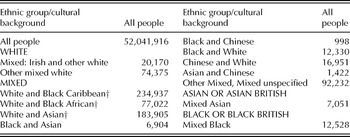
A more robust assessment is that of content validity, based on how the category options actually performed. Firstly, an analysis of the write-in answers to the ‘Any other Mixed background’ category provides insight into those form-fillers who eschewed the predesignated categories as inappropriate for them. Besides ‘Other Mixed’, the largest group concealed in this count is the ‘Chinese and White’ group (n = 16,951), although there is no way of establishing how many ticked ‘White and Asian’ (table 1). The second largest group, ‘Black and White’ (n = 12,330) were likely to be respondents who found the terms ‘Black African’ and ‘Black Caribbean’ unacceptable, perhaps because of their colonial associations or, for those with nativity in Britain, an irrelevance to their situation. These data reveal that over 9,300 respondents identified as belonging to mixed minority groups and possibly many others concealed in the ‘Other Mixed, Mixed unspecified’ group (n = 92,232). The official Census count of ‘Mixed’ excluded those declaring mixed origins within the ‘White’ (n = 94,545), ‘Asian or Asian British’ (n = 7,051) and ‘Black or Black British’ (n = 12,528) free text fields.
Detailed ethnic group write-ins, England and Wales 2001 Census

Notes: Commissioned Table M221b created on 11 November 2004: Ethnic Group (Detailed categories based on ethnic write-in). The counts in this table are those for write-ins for the open response options for question 8 of the Census form – ‘What is your ethnic group?’. The counts for the three predesignated ‘Mixed’ options are also shown in this table as †. With respect to the counting base, written responses supersede the ticked boxes.
Source: 2001 Census. © Crown Copyright 2004.
Secondly, the category options can be assessed against country of birth. The two mixed ‘White’ and ‘Black’ categories are consistent with this measure (with respect to nativity in the UK or the Caribbean/Africa). The ‘White and Asian’ group (which ONS intended to be ‘White and Indian sub-continent’, according to its full coding list) reveals a more complex picture. Again, the majority of the 189,016 were born in the UK (n = 144,465, 76.4 per cent). However, of the next largest country of birth group, Asia (n = 30,729, 16.3 per cent), the main contributor countries were South Asia (n = 12,898), the Far East (including China) (n = 9,691) and the Middle East (sometimes known as West Asian) (n = 8,140). This suggests that some respondents interpreted ‘Asian’ as relating to continental Asia. The ‘Other Mixed’ category (n = 155,690) was much more heterogeneous, only two-thirds being born in the UK and the remainder in the Middle East, Far East, Africa, North America and South America.
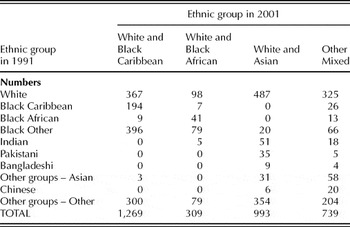
A third measure of content validity is provided by a mapping between 1991 and 2001 Census categories of ethnic assignment for the same individuals recorded in the ONS Longitudinal Study (LS), based on record linkage. 1991 Census records have been identified for 1,269 cohort members identifying as ‘White and Black Caribbean’, 309 as ‘White and Black African’, 993 as ‘White and Asian’ and 739 as ‘Other Mixed’ in the 2001 Census. The transitions in ethnic group between the two censuses are shown in Table 2.
Transition matrix – ethnic group in 1991 and 2001 for 2001 Census ‘Mixed’ groups

Source: Extracted from table 2, Platt et al. (Reference Platt, Akinwale and Simpson2005) based on their analysis of the ONS Longitudinal Study.
What is immediately apparent from this table is the diversity of assignments in 1991 for each of the 2001 ‘Mixed’ groups. In addition, with the exception of ‘White and Black Caribbean’, the largest proportion in each of the 2001 Census ‘Mixed’ groups identified as ‘White’ in 1991: 29 per cent of ‘White and Black Caribbean’ but 32 per cent of ‘White and Black African’, 49 per cent of ‘White and Asian’ and 44 per cent of ‘Other Mixed’. Also notable is the low proportion of ‘White and Asian’ respondents who identified as ‘Asian’ in 1991: 5.1 per cent as ‘Indian’, 3.5 per cent as ‘Pakistani’ and 3.1 per cent as ‘Other groups – Asian’ (mainly Far East). These data confirm some emerging trends: the heterogeneity of the ‘White and Asian’ group and the concealment in the ‘Other Mixed’ group of a significant proportion (8.9 per cent) who utilised the ‘Black Other’ field in 1991 (likely to be people for whom the labels ‘Black Caribbean’ and ‘Black African’ in the 2001 Census ‘Mixed’ options were unacceptable).
A third type of validity that can be tested is that of criterion validity: does the measure relate to other manifestations of the construct that it is supposed to be measuring? The 2001 Census ethnic group question was designed to capture respondents’ self-ascriptions. Inevitably, any ethnic group question is inherently reductionist as it constrains respondents’ preferred identifications to a set of pre-designated and free text category options. The open response ‘Mixed’ ethnic group options used in the 2001 Northern Ireland and Scotland Censuses were used exclusively to categorise ‘Mixed’. What these data reveal is the sheer heterogeneity of the ‘Mixed’ group when no structure of predesignated options is imposed. In Northern Ireland, amongst the discrete mixed groups that could be identified in the total of 3,314 ‘mixed ethnicity’ people, the largest was ‘Mixed Chinese and White’ (numbering 340 including cross-category assignments), ‘Mixed White and Black’ (which could not be more specifically assigned) and ‘Mixed Arab’. In Scotland a significant proportion of the 12,764 persons who identified as ‘Mixed’ in free text were coded as ‘Other Mixed’ or ‘Mixed Other’, these comprising four of the five largest categories or 45 per cent of all responses. Again, ‘Chinese and White’ is the largest outside the categories identified in the England and Wales Census question. Totally uncoded ‘Other Mixed’ responses in survey data (the London Borough of Newham's Children and Young People Scrutiny Commission: Jones, Reference Jones2006) reveal the inadequacy of pan-ethnic labels like ‘White’ and ‘Black’, the use by some of mixed minority descriptions and mixes within pan-ethnicities (like ‘Pakistani and Bangladeshi’), the unacceptability of broad terms like ‘Caribbean’ and ‘African’, and the constraints of dual identities for those with more complex ‘mixed race’.
Evidence on the attribute of stability reliability (sometimes called test re-test reliability) – the extent to which the measure yields the same result on repeated tests or trials – is very limited. There was no post-census validation survey for the 2001 Census (as there was post-1991) that sought to examine the stability of responses using test−retest methodologies. Amongst the only data available, Georghiou and Thorlby (Reference Georghiou and Thorlby2007) showed in an analysis of patients with more than one spell in hospital episode statistics for the years 2003/04 to 2005/06 that the ‘Mixed’ group was particularly unstable. For example, for patients coded to ‘White and Black African Mixed’, there was only a 70 per cent chance that a following admission would be coded in the same way, compared with 95 per cent with the ‘White British’ group. In a further research study, Aspinall (Reference Aspinall2003b) showed that a ‘tick all that apply’ method to capture mixed heritage performed much better than an open response ancestry or ethnic/family origins question in a test−retest exercise (overall error rate, 1: 8.3). Thus, there remains some uncertainty about the reliability of the ‘Mixed’ categories, that is: How stable are statistical estimates of group size differences? How meaningful and predictive are the categories with respect to the ascertainment of risk, health status and trends in the socio-economic position of the group? Similarly, with respect to the ‘two or more races’ population in the USA, the US Department of Health and Human Services’ National Committee on Vital and Health Statistics has asked (Lumpkin, Reference Lumpkin2001): ‘Is the quality of the data derived from the multiple race tabulations equal to that for single race groups?’ In the USA variations in the reporting of more than one race differ geographically and by individual sociodemographic characteristics, such as education, age and income, and, indeed, by method of tabulation used for reporting. Finally, the extent to which the reporting of racial/ethnic identity in the ‘Mixed’ population is, intrinsically, fluid and not stable, independently of the method of capture, is difficult to measure.
The utility of the data and its use by public services
Finally, given the extent to which user needs now drive question development and classifications, an important evaluative criterion is the utility of the data for public services. Thus far, we have assessed the categorisation on its own terms. However, there is some limited data against which to measure the performance of the question in demographic terms. Firstly, the 1991 and 2001 Censuses and some surveys provide information on the prevalence of inter-ethnic unions as ethnicity is not collected at marriage registration. The most recent data on the prevalence of inter-ethnic unions is that of the 2001 Census (Mackintosh, Reference Mackintosh2005). ‘White British and Black Caribbean’ was the largest group (n = 37,266), although significant numbers were recorded for ‘White British and Indian’ (n = 26,271), ‘White British and Chinese’ (n = 15,842), ‘White British and Black African’ (n = 12,755) and ‘White British and Pakistani’ (n = 9,037). Other less coherent mixes also figure prominently, including ‘White British and Other’ and mixes involving White British and one of the Mixed categories.
Perhaps one of the most significant findings is that the number of ‘White British and Chinese’ unions is notable, exceeding, for example, ‘White British and Black African’ unions. Moreover, of the people in unions by ethnic group, the percentage in inter-ethnic unions was high in the ‘Chinese’ group (25.1 per cent), above ‘Black Africans’ (22.4 per cent) and Indians (10.2 per cent) but below ‘Other Black’ (70.1 per cent) and ‘Black Caribbean’ (34.1 per cent) groups. Moreover, the percentage of males and females in the ‘Chinese’ group who were in inter-ethnic unions differed markedly (16.7 per cent vs 31.9 per cent). A second drawback revealed by these data is the concealed heterogeneity in the ‘White and Asian’ Census category. This category is likely to be dominated by the offspring of ‘White British and Indian’ unions (which outnumber ‘White and Pakistani’ unions almost threefold), making it difficult to interpret data (such as that for educational attainment) in a public policy context. Further ‘White British and Other Asian’ unions are significant numerically (n = 12,334) and also show an important gender asymmetry.
While the ‘predesignated categories’ approach adopted by ONS identifies the offspring of some of these inter-ethnic unions, the option of multi-ticking across all the predesignated categories would result in a much larger number of putative combinations but avoid the need to interpret idiosyncratic responses that result in the open response format. This approach would also avoid the use of a heterogeneous ‘Other’ residual category which is of limited analytical value. Clearly, with the UK methods, there are a set of trade-offs to be resolved: with open response, statistics stratified by a myriad of small categories are of questionable utility, while those aggregated into large and sometimes heterogeneous categories are of questionable validity. Multi-ticking appears to maximise both types of benefit.
The case for disutility arising from concealed heterogeneity in the current classification is difficult to make empirically as the evidence is not available for more refined categorisation. More detailed ‘Mixed’ categories have only been found in reports on the use of the Mental Health Act in some NHS trusts and in one government survey, the 2004 Health Survey for England (using the ‘Mixed’ categories of ‘White and Black Caribbean’; ‘. . . Black African’; ‘. . . Indian’; ‘. . . Pakistani’; ‘. . . Bangladeshi’; ‘. . . Indian Caribbean’; ‘. . . African-Indian’; ‘. . . Chinese’; and ‘Any other Mixed cultural background’). However, the ‘White and Asian’ group does emerge as unsatisfactory as ‘Asian’ is an aggregate of three very different groups and numerically dominated by the Indian component. For example, standardised ratios for ‘not good’ health and percentage of 15-year-old pupils achieving GCSE/GNCQ (5A*-C) for the ‘White and Asian’ group are closest to ‘Indian’ and substantially different from those for ‘Bangladeshis’ and ‘Pakistanis’ which are worse (Jacobson et al., Reference Jacobson, Fitzpatrick and Aspinall2005). This drawback will be even greater in 2011 Census data as the ‘Chinese’ category has been relocated to the ‘Asian or Asian British’ set, leading respondents to interpret the ‘White and Asian’ category as encompassing continental Asian origins.
Are there better options for categorising the mixed race population: A small-scale survey amongst ‘mixed race’ persons was undertaken in 2005–6 to evaluate options (Aspinall et al., Reference Aspinall, Song and Hashem2006). Three variants of the 2001 Census ethnicity question for capturing ‘mixed race’ were developed: pre-designated categories (as in the England and Wales 2001 Census); an open response version (as in the Scotland and Northern Ireland 2001 Censuses); and a tick all that apply option (similar to the instruction used in the 2000 US and 2001 Canadian and New Zealand Census questions on ethnicity). All offered minimal change to the full 2001 Census classification and therefore substantially preserved comparability. An overwhelming majority of the 51 respondents found the Census pre-designated categories easiest to complete and the ‘tick all that apply’ option most difficult. Almost equal numbers found the 2001 Census question and the ‘open response’ option best enabled them to describe their racial/ethnic identity. In addition two numeric quality measures – based on an assessment of the respondent's understanding of the question and the information content yielded for each response – showed that the 2001 Census question scored best and that there were significant quality problems with the tick all option.
The survey also asked respondents to self-assign using a fourth classification (unrelated to the 2001 Census question), which asked for family origins (of mother's and father's family) using selected 1991 Census categories (Berthoud, Reference Berthoud1998). This question – offered to ONS for the 2001 Census but eschewed – undoubtedly provided the highest information content. However, its complexity would rule it out as a census question. Moreover, it offers an operational definition of mixed race, against one of identity favoured by ONS.
Conclusion
How sustainable the current ‘Mixed’ categories are as a way of capturing the mixed race population is likely to depend on a broader set of issues. Firstly, it is unclear how long the UK census agencies will hold the line on the colour-based pan-ethnicities (‘White’ and ‘Black or Black British’ in England and Wales), these pan-ethnicities providing much of the ‘Mixed’ cultural background categorisation in terms like ‘White and Black Caribbean’. The General Register Office in Scotland (GRO(S)) eschewed colour terms in a new and innovative ethnic group question in the Scotland 2006 Census Test, but has since abandoned this approach. This classification shifted the conceptual base from colour terms to ‘ethnic background or culture’ based mainly on geographical referents (‘European’, ‘Multiple ethnic groups’, ‘Asian’, ‘Arab’, ‘African or Caribbean’ and ‘Other ethnic group’). A focus on multiplicity seemed to be the precipitant (as well as the product) of the change, the number of cultural/ethnic background categories increasing from 9 to 14 in 1991–2001, and then almost doubling to 27 in this test. Now both ONS and GRO(S) have pursued a strategy of minimum change in their recommendations for the upcoming 2011 Census, the categorisation (besides the movement of ‘Chinese’ into the ‘Asian or Asian British’ set) continuing to support the 2001 Census ‘Mixed’ categories in England and Wales and open response remaining the option in Scotland. The likelihood is that the hitherto uncounted ‘White and Chinese’ group will, again, be invisibly distributed across categories.
The most significant rupture in the substantially harmonised questions across Britain would have been the abandonment of colour in Scotland. If the Scotland ‘model’ had asserted itself, the predesignated ‘Mixed’ categories in England and Wales would have become unsustainable. Indeed, recent correspondence between Ligali (an African Organisation) and the National Statistician reveals community pressure to abandon terms like ‘Black’. However, there is no indication of a move in the direction of US and Canadian practices in asking about ethnic origin or ancestry. Moreover, that, in itself, would not help in capturing the ‘mixed race’ group, as multiple assignment in this question frequently reflects complex ethnicity rather than descent or ancestry.
A future endorsement of culture groups (rather than the contemporary meld of colour, national origins and geography) would be likely to force open the door to multi-ticking across census options as predesignated categories like ‘European and African’ would lack coherence as ‘mixed race’ groupings. Indeed, multi-ticking has a clarity and conceptual elegance that would make it a powerful tool to capture ‘mixed race’. In spite of the findings of the small-scale study, respondents appear to have an affinity with this approach to category selection. In the 2001 Census in England and Wales, for example, around 2 per cent of respondents ticked more than one answer to the ethnic group question, despite the instruction to tick one box only, these being reallocated to a single ethnic category during the data-processing stage.
Yet one of the functions of the census is to provide data that is relatively stable and has utility for the purposes of the modern state. We know that the way people think of themselves in ethnic/racial terms is fluid and dependent on context and situation. How people answer the ethnic group question on official forms may be different to the way they describe themselves to their peers. Given that mixed ethnicity/race frequently invokes multiple affiliations or allegiances, these problems of stability may be expected to be greater in the mixed race population. Indeed, only two out of five non-Hispanic persons who reported two or more races in the US 2000 Census also reported two or more races in the post-census quality survey (Bentley et al., Reference Bentley, Mattingly, Hough and Bennett2003), raising serious concerns about the quality of the data and how meaningful it is as a basis for resource allocation. These trade-offs between validity, the ability to identify multiple groups, and utility, the need for data that meets the bureaucratic requirements of the state, nicely capture the way identities need to be organised in the modern state.
There would appear to be little future in the census for an operational question focussing on ‘family origins’, whatever its appeal from a stability perspective and its neatness in ‘typing’ descent-based combinations of ethnic groupings. ‘Identity’ is on the ascendancy in government discourse on diversity and the addition of a ‘national identity’ question to the upcoming 2011 Census attests to this. While managerial regimes (and how data are organised within them), changing approaches to statistical governance, the limitations of information technology and moves towards an Integrated Population Statistics System might all suggest that relatively fixed categories would have a selective advantage, the direction of movement in the cultural question set has been towards consumer sovereignty and sensitivity towards more finely granulated measurement of identity. This would suggest that in the next decade or so multi-ticking will win out.