


On Genesis
The term genetic as a method of scientific study of the emergence, development or change of a phenomenon or an organism has a long history that can be traced back to the writings of presocratics like Anaximander and Heraclitus where one can identify the interest in the study of a changing world as a process rather than as a collection of static objects. Aristotle also believed that we cannot really understand something unless we understand its development (Kaplan, Reference Kaplan1967). Nevertheless, a first clear vision of the genetic method as the study of the development of an organism can be located in the work of Goethe, who articulated an organismic theory of development, which was the key inspiration for the seminal work of the 20th-century developmental psychologist Heinz Werner (Wagoner, Reference Wagoner2024).
The more recent and direct predecessors of the theoretical framework being developed here can be found in Jean Piaget’s genetic epistemology, Lucien Goldmann’s genetic structuralism, Serge Moscovici’s genetic model of social influence and, more recently, Gerard Duveen, who was working in Cambridge until his untimely passing in 2008 towards a genetic social psychology, greatly inspired by the vision of his first PhD supervisor Hans Furth, for an integrative social developmental psychology situated in historical time.
There is a common thread that binds all the aforementioned thinkers together, specifically the grasp of the totality of an object of study through an investigation of its development through time. This dialectic of genesis and structure refers directly to some of the more fundamental epistemological questions with which not only classical philosophy but also the modern philosophy of Kant, Hegel and Marx engaged. Indeed, by returning to the philosophical roots of these ideas when disciplinary boundaries were not as sharply defined as today one realises that the dimension of historical change is inextricably intertwined with what is proposed here. While it is very ambitious indeed to be proposing an interdisciplinary field of study that merges social and developmental psychology with history, we do believe that such a new discipline is what can help psychology out of what Valsiner (Reference Valsiner, Moscovici, Jovchelovitch and Wagoner2013) described as its deep crisis, caused by its success in amassing large quantities of empirical evidence while rarely addressing the question ‘what for?’
Indeed, the value of such accumulation of empirical evidence for the generalising power of science is specifically questioned by Valsiner (Reference Valsiner, Moscovici, Jovchelovitch and Wagoner2013, p. ix), who highlights the life work of the late Gerard Duveen as ‘a good illustration of what kind of scholarship could bring psychology out of its crisis of limited generalization value’ and explicitly describes Duveen’s life project of genetic social psychology as ‘the idea that will live’; hence the optimistic and future-oriented subtitle of Part I of this book, ‘a once and future discipline’.
Vygotsky and Piaget in Context
From an epistemological point of view one can go back to the enlightenment ideas and Kant to get a clear sense of the limits of human knowledge because of its constrained nature through both sensations and deductive thinking. However, for Kant sensations are worked on and given form by the a priori categories (space, time, etc.), and in that sense these categories themselves were not constructed but given. True dialectical thinking, as argued by Lucien Goldmann (Reference Goldmann1959, Reference Goldmann1967, Reference Goldmann, Cohen and Wartofsky1969), can only be found in the more sociological and historical thinking of Hegel and Marx, who offer the tools to understand the socially constructed nature of these categories themselves. Moving from philosophy to psychology, the elaboration of this dynamic and transformative view of genesis and structure is later taken on by Piaget, Vygotsky, Moscovici, and Duveen in the 20th century. Genesis relates to the Greek word γέννησις and γίγνεσθαι, the first meaning the process of being born or created and the second the process of change and transformation. In that sense it refers to the beginning of something new and its tranformation. But, of course, nothing is completely new; new structures are built on old structures, and in that sense there is also continuity. As pointed out by Piaget, there is no genesis without structure and no structure without genesis. The main research interest then becomes the study of how structure A transforms into structure B.
In the psychological field Vygotsky (Reference Vygotsky1962, Reference Vygotsky1978) dealt with a similar problem of the emergence of higher psychological functions and scientific concepts, but his formula of the general genetic law of cultural development – the Janet–Vygotsky law according to Valsiner (Reference Valsiner2000, p. 40) – was somewhat different from Piaget’s. Vygotsky proposed a clearer directional sociogenetic view compared to Piaget’s interactivist view. Whilst Vygotsky’s emphasis was on mediation by signs and sign systems, for Piaget knowledge was built through the subject’s action on objects. The internalisation formula offered by Vygotsky from social speech to thought was, according to Moscovici (Reference Moscovici, Duveen and Lloyd1990, p. 179), ‘too good to be true’, and Duveen (Reference Duveen, Smith, Tomlinson and Dockerell1997) argued it failed to grasp the mediating role of social identity.
There is an open debate about how Marxist Vygotsky really was (Kozulin, Reference Kozulin1990; Elhammoumi, Reference Elhammoumi2002; Sève, Reference Sève2018), but what has become clear by now is that there is a Western reading of Vygotsky that attempted to sanitise Vygotsky from Marx so that his writings could be more easily accepted in the West during the Cold War era. Piaget also fell victim to an individualist reading of his work, especially in his reception in the United States (Hsueh, Reference Hsueh, Müller, Carpendale and Smith2009). These kinds of processes of sociogenetic transformation of a theory in their reception in a new context is easily rendered intelligible through a reading of the second part of Moscovici’s (Reference Moscovici1976/Reference Moscovici2008) book on psychoanalysis, where he describes the way any new ideas are domesticated in a local setting. In his case it was the study of the reception of the scientific theory of psychoanalysis by different interest groups and ideologies (liberal press, church and the communist party) in French society in the latter part of the 1950s.
In fact, it can be shown that both Piaget and Vygotsky proposed a thoroughly dialectical theory, where logic and consciousness emerge from the activity of the psychological subject in his/her social and historical environment. However, the universalist overtones of Piaget’s theory relegate the role of sociocultural variations to a secondary role of acceleration or deceleration of cognitive and moral development through a single path from sensorimotor, through pre-operational and concrete operational, to formal operational thinking. We do believe in the universality of the distinction between social relations of constraint and co-operation as the prototype of relations between child–adult (constraint/unilateral respect) and child–child (peer/mutual respect) dyads. In any society of this world such relations are present and have predictable consequences for the cognitive and moral development of the child. Their manifestation in both one-on-one interpersonal relations and part–whole relations (the way individuals are embedded in groups), we claim, introduces most of the variability in ways of thinking, values and morality observed in different geographies and historical points in human evolution systematised recently by Harvard Professor Joseph Henrich (Reference Henrich2016, Reference Henrich2020).
Henrich synthesised many findings from anthropology, economics and human and cultural evolution, which cry out for the existence of this important distinction and its consequences in various societies. Although he has not a single citation to Piaget’s work and his social psychology, the historical processes Henrich identified (urbanisation, forms of religiosity, kin-based society organisation and political economy, etc.) relating to cultural evolution can all be considered distal predictors of outcomes (cognitive and moral development) identified by Piaget. Henrich is, however, missing the mediating and crucial role of relations of constraint and co-operation (Psaltis, Reference Psaltis, Sammut, Andreouli, Gaskell and Valsiner2015a, Reference Psaltis, Psaltis, Gillespie and Perret-Clermont2015b; Psaltis et al., Reference Psaltis, Gillespie and Perret-Clermont2015; Psaltis & Zapiti, Reference Psaltis and Zapiti2014). Such relations are essential to ontogenesis, though in a more messy and complex way than the one foreseen by Piaget (Reference Piaget1932, 1995) where varieties of conflicting asymmetries can still create conditions of equilibration and re-equilibration (Psaltis & Duveen, Reference Psaltis and Duveen2006, Reference Psaltis and Duveen2007) and the coordination of perspectives through a process of true engagement of the subject and participation in the co-construction of knowledge.
The crucial role of social relations of co-operation in leading thinking to gradually becoming less and less dependent on content as later structures emerge through reflection on the psychological actions of the subject towards the object, rather than the object itself, is key here. At the same time, it is clear from reading Piaget’s Psychogenesis (Garcia & Piaget, Reference Garcia and Piaget1989) that these structures (e.g. mathematics) are not historically unchanged universals but are also the result of historical evolution. Vygotsky’s cultural historical theory, strongly influenced by Marxist theory, lays fewer universalist claims but is rather weak in formulating the role of social relations in human development. This is something rather unexpected from a Marxist (see Psaltis & Zapiti, Reference Psaltis and Zapiti2014) and recognised as one of the weakest points of Vygotskian theorising by Marxist psychologists and philosophers also (Seve, Reference Sève2018; Wartkofsky, Reference Wartofsky, Kessel and Siegel1984). It requires rectification in the form of future efforts to build psychology’s own capital (Elhamoummi, Reference Elhammoumi2002). Despite developments of the post-Vygotskian tradition in the three generations of cultural historical activity theory (CHAT) (Engerström, Reference Engeström2008) that expanded the purview of our understanding of human development as embedded in interacting activity systems, this theoretical expansion clearly failed to capitalise on the strong epistemological foundations of Piaget’s theory as well as the theorisation of the role of social relations of power asymmetries in these activity systems.
For Piaget the genetic process of the transformation of structure A to structure B entails a process of disequilibrium and re-equilibration of cognitive structures. Equilibrium is the idea that makes possible the synthesis between genesis and structure. In a discussion that took place in a symposium on 26 July 1959 on genesis and structure with Derrida, Goldmann and Gadillac (Gandillac, Goldman & Piaget, Reference Gandillac, Goldmann and Piaget1965), Piaget gave the example of transition from pre-operational to operational thinking on the conservation of mass, suggesting that conflict of centrations (focusing on only one aspect of a situation at one time) on different dimensions of clay (length, thickness) under transformation is the reason for transition from structure A to structure B. As rightly pointed out by Duveen (Reference Duveen2002), this is one of the weakest parts of Piaget’s theory, and the reason for this is that it carries too much of an idealist-Hegelian overtone of consciousness being in a position to fix its own inconsistencies by reflection within the same structures of a self-regulated system (that is, conflicting cognitive schemes resolving their inconsistencies within the cognitive system). However, in the same discussion Piaget importantly makes a clear linkage between equilibrated structures and the agency of the child. Piaget’s own words are instructive here:
The equilibrium thus defined is not something passive, but on the contrary something mostly active. It takes an activity that is all the greater as the balance is greater. It is very difficult to maintain a balance of mental point of view. The moral balance of a person presupposes a strength of character to resist disturbances, to preserve values we care about, etc. Balance here is synonymous with activity.
Knowing Piaget’s social psychology and methodology in clinical interviews, one would expect to see some linkage between the capacity to resist an adult’s counter-suggestion and its cultivation through relations of co-operation, but Piaget does not make this link in his example here.
Such a link could relate to Piaget’s distaste for authorities, ideologies or institutions imposing their views on people and the negative implications stemming from relations of constraint for both the cognitive and moral development of the person. The weakness seen by Duveen in Piaget here is created from Piaget’s hesitation to create a closer link between his relations of co-operation and equilibration as a process of co-construction with others and not simply an autoregulation of one’s own structures. This is one of the manifestations of the ‘social’ occupying an unstable element in Piaget’s thinking (see Duveen & Psaltis, Reference Duveen, Psaltis, Mueller, Carpendale, Budwig and Sokol2008). There is an interplay between self-regulation and other-regulation that Piaget’s interest in the epistemic subject did not allow to be empirically investigated. The linkage can be rendered intelligible by the embedding of the epistemic subject in group life and a network of social interactions, where the positions held by an individual for an object are intertwined with the representations of the other and self in the subject–object–other triad in both symmetrical and asymmetrical relationships.
Knowledge and Social Structures
From an epistemological point of view, any genetic theory needs to be able to distinguish between surface and depth knowledge. In the Marxist tradition (although Marx never elaborated any epistemological framework himself), the proletariat are those who act on objects, and consciousness is formed by action in the world. This is why the Piagetian notion is compatible with Marxism, and one can see here why Goldmann was so keen on pointing out the similarities between Piagetian genetic epistemology and Marxism on various occasions (Goldmann, 1966; Zimmerman, Reference Zimmerman1978). Ultimate knowledge of seemingly hidden realities, essences behind appearances such as Kant’s elusive ‘thing-in-itself’ was given only to those who had created that reality (in the way an artist can understand the work he or she has created). Only they could overcome the analytic contradiction of surface and depth dialectically. This distinction between depth and surface knowledge is crucial in Piaget, who proposed a distinction between empirical and reflective abstraction. It is also found in his distinction between relations of constraint and relations of co-operation, where he relates forms of knowing with different qualities of social relations. It is again later found in Moscovici’s (Reference Moscovici1976) dual genetic model of social influence, as well as in the work of Social Genevans (Doise, Mugny & Perret-Clermont, Reference Doise, Mugny and Perret-Clermont1975; Doise & Mugny, Reference Doise and Mugny1984) who discussed two ways of resolving socio-cognitive conflict (epistemic/constructivist versus relational), further deepening the original insights of Piaget (Reference Piaget1932) in his Moral Judgment of the Child and his Sociological Studies (Piaget, 1995) in this direction.
In the work of other genetic theorists more sociologically and critically minded than Piaget, such as Moscovici and the Social Genevans (Doise et al., Reference Doise, Mugny and Perret-Clermont1975), the consequences of symmetrical or asymmetrical forms of social relations on consciousness also became the target of empirical study. The Social Genevans made a distinction between two ways of resolving socio-cognitive conflict: relational regulation, which looked like conformity and did not lead to real cognitive change; and epistemic regulation, which looked like the reconstruction of knowledge in Piagetian terms towards more equilibrated structures. There is a parallel here with Lucien Goldmann’s description of how the subject–other relationship can be downgraded into a subject–object relation through processes of objectification, reification or alienation. Similar ideas can be found in the field of the study of intergroup relations today with dehumanisation or infrahumanisation where out-group members in an antagonistic context often lead in forms of non-recognition of others as thinking subjects or even, in worst cases (linked to genocidal tendencies), denigrating them as non-humans.
This strong sense of a dual process of social influence is found more recently in the work of Gerard Duveen, who was convinced that there are two opposing ways in which representations change. In viewing social representations theory as a genetic theory, Duveen and Lloyd (Reference Duveen, Lloyd, Duveen and Lloyd1990) argue that a genetic perspective is implied in the conception of social representations, in the sense that the structure of any particular social representation is a construction, and thus the outcome of some developmental process. Three types of transformations, associated with social representation as a process, are proposed: sociogenesis, which concerns the construction and transformation of the social representations of social groups about specific objects in historical time; ontogenesis, which concerns the development of individuals in relation to social representations during a lifetime; and microgenesis, which concerns the evocation and (re)construction of social representations in social interaction in micro-time.
A careful reading of the oeuvre of Duveen’s first PhD supervisor Hans G. Furth leaves no doubt that Duveen’s vision of integrating social and developmental psychology came from him. Furth was born in 1920 in Austria and was well known for his significant contributions to our understanding of cognitive development. His early work was deeply influenced by Piaget’s theory and focused on the cognitive abilities of deaf children and, later on, the role of language and social interaction in cognitive development (Furth, Baur & Smith, Reference Furth, Baur and Smith1976). He was also a psychoanalyst, and he tried to marry Piagetian ideas with Freud’s theory. His early life was significantly impacted by the political upheaval of the time as he fled Austria after the Anschluss with Nazi Germany in 1938 at the formative age of 18, eventually making his way to the United States after spending years in displacement in Croatia, Switzerland and the United Kingdom. This experience of displacement and adaptation to new cultures and languages would later influence his professional work and perspectives. He also served for about a decade as a monk in the Carthusian order until his departure to Canada where he got a master’s degree in clinical psychology from the University of Ottawa in 1954. He later received a doctorate in psychology from Portland State University in the United States in 1960 and that same year became a professor of psychology at the Catholic University of America in Washington, DC. In the mid-1960s he worked while on sabbatical at the University of Geneva with Piaget. In 1973–1974 Furth spent time at the University of Sussex in the UK where he crossed paths with Duveen (Jovchelovitch, Reference Jovchelovitch2010; Lloyd, Reference Lloyd2010).
It was a period when Furth began to integrate more complex societal elements into his analysis of cognitive development (Furth et al., Reference Furth, Baur and Smith1976). He started to examine how children’s understanding of social structures, such as family dynamics, racial categories and gender roles, emerged and evolved. This period marked a shift from focusing solely on individual cognitive processes to a more holistic view that included the impact of societal factors. Furth’s work on symbol formation (Furth, Reference Furth1987), particularly in relation to Freud and Piaget, also influenced Duveen. This work highlighted his interest in how children use symbols to make sense of the world. This was a crucial part of Furth’s theory, as it linked cognitive development with cultural and societal influences. He argued that children form symbols not only to understand their immediate environment but also to navigate and make sense of larger societal constructs. In this process of symbol formation, the affective domain and desire occupied a key position. The perception of society and history is constituted by social significations as something new, qualitatively different from preceding forms of social reality. Piaget’s symbol competency is, for Furth, precisely the organ to create this newness in evolution: an understanding of human society and history. In brief, according to Furth, children around the age of two, along with a first glimmer of historical time and of social categories such as sex, ‘race’ and generations, develop the symbolic competency to create signifiers. Here the emphasis is on the active child who assimilates a given society-culture with a framework the child has developed from within. In this respect the child is able to bring novelty to the given social reality.
As Sandra Jovchelovitch (Reference Jovchelovitch2010, p. xvii) wrote about Duveen’s connection to Hans Furth,
But in line with his teacher and early supervisor, Hans Furth, Duveen problematised this agency [of the child] by introducing the dynamic of desire in the constitution of the epistemic subject. To know-my-object is also to want-my-object. This insight probed a long-term commitment to the deep psychology of Freud, which was never too far from Duveen’s thinking and way of seeing the world. In writing about the development of representation and culture in the pretend-play of young children he goes back to the links between knowledge and desire to show how the drive that moves the child to create and construct the world as innovator is not far from libidinal organisation.
In Furth’s last book, Desire for Society (Reference Furth1996), he explores more complex themes, such as how children’s cognitive development is affected by the political and economic structures of society, which includes examining how children understand and internalise societal norms, values and beliefs. In this work Furth also shows his admiration for the work of Cornelius Castoriadis and his notion of the ‘radical imaginary’, in this way pointing to the role of social scientists in not only studying societies but also transforming them in the direction of more equal and peaceful ones. The last chapter can be seen as his legacy to the future generation of social scientists (Furth died three years after the book’s publication). It is titled ‘Postlude: The nightmare of history’, and it starts with the words of Walter Benjamin: ‘There has never been a document of culture which was not at the same time a document of barbarism.’ In this chapter Furth claims that humanity needs to be guided by the memory of two historical events, Auschwitz and Hiroshima, corresponding to a condemnation of the morality of total annihilation which was made possible by nuclear weapons. The historical consciousness that connects these two historical events with the imagination of destroyed earth in the future, he proposes, can guide humanity towards the creation of a peaceful future. The notion of historical consciousness and historical thinking is crucial for the development of the current theoretical framework that wants to understand processes of ethnic conflict transformation and change, and we will have a lot more to say about this in what follows.
From Learning and Cognitive Development to Ethnic Conflict
Under the influence of his second supervisor, Barbara Lloyd, Duveen took it on himself to explore the ontogenesis of social representations of gender in childhood in the years after his PhD (Lloyd & Duveen, Reference Lloyd and Duveen1992). His personal friendship with Serge Moscovici offered him an unparalleled understanding of the theory of social representations, and his developmental take on this theory was truly original. Since 2000, under the supervision of Duveen at Cambridge, we began to explore the role of social representations of gender and social interaction in learning and cognitive development in the educational context. This work in epistemological terms could be described as moving from the study of the epistemic subject in Piaget towards the study of the social psychological subject (Moscovici, Jovchelovitch & Wagoner, Reference Moscovici, Jovchelovitch and Wagoner2013), introducing a study of the role of social identity and gender asymmetry dynamics into the co-construction of knowledge around cognitive tasks. This work was later extended at the University of Cyprus as one strand of the ‘third generation of research in peer interaction and cognitive development’ (Leman & Duveen, Reference Leman and Duveen1999; Psaltis, Reference Psaltis2005a; Psaltis & Duveen, Reference Psaltis and Duveen2006, Reference Psaltis and Duveen2007; Duveen & Psaltis, Reference Duveen, Psaltis, Mueller, Carpendale, Budwig and Sokol2008; Psaltis, Duveen & Perret-Clermont, Reference Psaltis, Duveen and Perret-Clermont2009; Psaltis, 2011, Reference Psaltis, Marková and Gillespie2012a, Reference Psaltis2012b; Psaltis & Zapiti, Reference Psaltis and Zapiti2014). In this chapter it will be further extended into a study of the articulation of microgenetic, ontogenetic and sociogenetic processes (Psaltis, 2015), through the study of intergroup relations between Greek Cypriots and Turkish Cypriots in the 20-year period from 2003 to 2023, which is a second line of research we have been working on since 2005 at the Oxford Centre for the Study of Intergroup Conflict.
In the first line of research, we observed peer interaction in the educational context of collaborative problem solving in 6–7-year-olds in Cyprus. These social interactive processes were connected to the sociocultural and historical context of social representations of gender related to asymmetrical structures of patriarchy and with the culture of honour that favours a passive femininity, allowing males more space in the public space and control over objects whilst retaining the strengths of a structural analysis of Piagetian constructivism. These series of studies explored the interplay of representations and identities through the articulation of intrapersonal with interpersonal, intergroup and ideological/social representational dynamics (Perret-Clermont, Reference Perret-Clermont1980; Doise, Reference Doise1986), building on Piagetian insights into the role of social relations in cognitive development (Piaget, Reference Piaget1932) and functionalist-structuralist reading of Piaget and his social psychology (Kitchener, Reference Kitchener and Smith2002, Reference Kitchener, Müller, Carpendale and Smith2009, Reference Kitchener, Carpendale and Müller2014), together with the empirical work of the social Genevans on peer interaction and cognitive development (Doise, Mugny & Perret-Clermont, Reference Doise, Mugny and Perret-Clermont1975; Perret-Clermont, Reference Perret-Clermont1980).
Some critical engagement with the initial ideas we developed with Duveen came from another scholar influenced in his work by both Piaget and Moscovici – Antonio Castorina in Buenos Aires. Castorina proposed a similar model to the one presented here that he calls revised genetic psychology; however, he is sceptical of the merging of the disciplines of social and developmental psychology, not because of epistemological incompatibility, but out of respect for their own traditions, methodologies, theories and questions posed.
Castorina made his positive yet critical and constructive expositions in two papers. In the first (Castorina, Reference Castorina2010) – a tribute to Duveen shortly after the former’s untimely death – Castorina outlines the points he seems to appreciate in Duveen’s work. He writes, ‘The leitmotif of Duveen’s work has been the process through which children assimilate the beliefs of their communities and thus acquire their social identity, which in turn enables them to become social actors’ (p. 18.1). Duveen, according to Castorina, (1) elucidates the dialectical process of the development of representations, (2) acknowledges Vygotsky’s contribution to the Theory of Social Representations while questioning some aspects of his concept of culture, (3) shows the correlative construction of subject and object in the dialectics of knowledge and (4) establishes the conditions for social representations to be accepted by developmental psychologists.
In this commentary Castorina wrote something that both we and Patrick Leman (Reference Leman2010) found objectionable in his rendering of Duveen’s work, namely ‘the significance of some of [Duveen’s] empirical studies which link psychological development to social identity’ as describing a process of individuation in social psychology. I believe there is no place in genetic social psychology for individuation (which I take here as meaning social representations forming a sense of individuality). There are at least two reasons for this: (1) Duveen was describing the process of ontogenesis of social representations as the emergence of the social actor and the internalisation of a social identity, not a personal or ego identity; (2) Duveen was interested in the social psychological and not the psychological subject.
Even in the original genetic psychology of Piaget the epistemic subject, the study of which was Piaget’s research interest, is not an individual subject but a mere abstraction dealing with the coordination of actions irrespective of whether these take place intra- or interpersonally. Already in his PhD thesis (Duveen, Reference Duveen1983) on a discussion of the epistemic subject Duveen makes clear that the epistemic subject is not an individual subject. Piaget used the example of two individuals building a bridge as an example of co-operation, and Duveen cited the example of two individuals moving a piano that Lucien Goldmann gave to discuss the trans-individual subject, a unit that cannot be reduced to one or the other psychological subject but characterises the dyad. Still, what the epistemic subject was missing (given that it is an abstraction), according to Duveen, was valorisation and resistance, which appear on the scene once we bring into play the subjects belonging to the social group where one shares social representations about an object. This is why, later on, we suggested the idea of operativity in context (Psaltis, Duveen & Perret-Clermont, Reference Psaltis, Duveen and Perret-Clermont2009), and I think we have demonstrated this through the dynamics of social interaction in our own work (Psaltis & Duveen, Reference Psaltis and Duveen2006, Reference Psaltis and Duveen2007) in an Fm dyad (a dyad where the female was a conserver interacting with a male that was a non-conserver) and how it facilitates a conflict of asymmetries that creates the space for the construction of true novelty. In that sense the social gender identity dynamics are co-constructed and do not characterise any individual property.
This brings us to the second criticism voiced by Castorina (Reference Castorina2017). In this paper we see both points of agreement and disagreement between Castorina’s revised genetic psychology and what is proposed here as genetic social psychology. On the one hand, we agree with Castorina that there is epistemological compatibility between Moscovici’s social representations theory and Piaget’s genetic psychology, which goes against the position of Ivana Marková (Reference Marková2010) who argued that the two approaches are epistemologically incompatible. Nevertheless, even within a social constructivist epistemology there is still an issue of how much similarity or difference one sees between the construction of scientific knowledge and the construction of understanding and representations of social objects such as gender, ethnicity, a social problem and so forth.
Castorina makes too strong a distinction when he is stating that above all, social representations are inherently evaluative and shaped through social discourse, not limited by the argumentative logic of concepts. Duveen would certainly accept that in the case of scientific knowledge, we have the construction of what Leslie Smith (Reference Smith, Tryphon and Vonèche2013) called ‘necessary knowledge’ – a kind of knowledge that has a logical necessity absent in the case of representations discussed in this chapter. I feel Castorina is overstretching the differences between genetic psychology and social representations. On this point Duveen talks about relative autonomy and never fails to remind his readers that Moscovici was inspired the notion of representations from his reading of Piaget’s The Child’s Construction of the World. We argued for the embedding of the epistemic subject in the social psychological subject, which means that operative structures can still be found in social representations. Social representations, however, will not be exhausted by them. For example, the binary distinction of gender or race relations in early childhood do appear to be regulated by cognitive developmental constraints of the pre-operational stage. But in older children we see that there is an interplay between the cognitive and the social that cannot be empirically disentangled, as for example when the part–whole relationships become a prerequisite for the understanding of relations between Cypriots and the other community, Greece and Turkey, that of course do not necessarily relate to positive or negative attitudes towards these groups.
Castorina claims that values cannot be organised in the logical sequence that could be given precisely by the structure of a research conducted within developmental psychology, which is true. Still, in the ontogenesis of social representations that Duveen studied (Gender, Friendships, Economy) there was a clear developmental path that was largely defined by two orientations, the practical and the reflective, directly related to the transition from the pre-operational to operational thinking. So, in terms of content, we do agree that there is no evaluative criterion to judge one value over another. However, in terms of structure, there is a clear developmental course suggested by theorising in genetic social psychology.
Castorina in his Reference Castorina2017 paper also states that the claim that genetic social psychology does not differ from developmental psychology, or that the latter always implies the former, is debatable. While, according to Castorina, introducing social representations in developmental psychology can reformulate genetic psychology itself when studying children’s social ideas, it is not acceptable to claim that ‘the operating Piagetian structures, as Duveen states (Reference Duveen, Smith, Tomlinson and Dockerell1997) and following Moscovici (1989/Reference Moscovici2000) could actually be understood as social representations’ (Psaltis & Zapiti, Reference Psaltis and Zapiti2014, p. 38).
Regarding the first statement by Castorina, I think that we never intended to make such a claim, especially when so many varieties of developmental psychology exist. But on the second point I feel that I need to defend our position in Psaltis and Zapiti (Reference Psaltis and Zapiti2014).
I think that here we see a re-emergence of the individual–social antinomy that I discussed earlier on the issue of individuation under a different guise. In his ‘Psychological Development as a Social Process,’ Duveen (Reference Duveen, Smith, Tomlinson and Dockerell1997), citing Guida de Abreau’s work on social representations of mathematics, writes: ‘[W]e do not usually think of children’s internalization of representations of mathematics as being linked to specific social identities, but this can indeed be the case’ (p. 55). He goes on to give the work of Carugati (Reference Carugati, Duveen and Lloyd1990) on the study of social representations of intelligence as another example. In this way he wanted to show that valorisation, the symbolic value of social representations and social stakes are inextricably interlinked with the development of operative structures. The process of ‘socially representing’ is at play when children co-construct their operational structures. Duveen’s favourite example was the work of Doise and Mugny (Reference Doise and Mugny1984) on social interaction and cognitive development that offered for him the most convincing evidence in this direction. This is the work that we extended in our work with Duveen in Cambridge and later expanded with Anna Zapiti at the University of Cyprus. This was the culmination of work ‘which condensed many years of experimental and ethnographic research in Geneva, Sussex and Cambridge on how the construction of the mental is not only permeated by social interaction but dependent on it’ (Jovchelovitch & Wagoner, Reference Jovchelovitch, Wagoner, Moscovici, Jovchelovitch and Wagoner2013).
Having already explored the contours of a model of transition from pre-operational to operational thought in children through the study of varying forms of communication, such processes could be expanded to a more general model of the role of social relations and communicative forms (Duveen, Reference Duveen2002; cf. Castorina, Reference Castorina2010; Jovchelovitch, Reference Jovchelovitch2010; Leman, Reference Leman2010) in the transition from representations of belief to representations of knowledge in the public sphere (see Duveen, Reference Duveen2008; Moscovici, Reference Moscovici2000) and sociogenetic processes (Wagner, Reference Wagner1994) if scaled up.Footnote 1 One field of research that affords the exploration of sociogenetic processes in historical time is that of conflict transformation in societies and changing representations of conflict and its roots. In this sense the Cypriot context of a divided and post-conflict society is an ideal setting for the expansion of these ideas to an exploration of sociogenetic processes beyond what Henrich (Reference Henrich2020) calls WEIRD societies (Western, Educated, Industrial, Rich, Democratic). Drawing more on conflict and post-conflict settings in such synthetic efforts as the one by Henrich will allow more decentring from a WEIRD way of looking at systems of values, ideas and practices in historical time and cultural evolution.
In our first line of research we did not have the opportunity to study sociogenetic processes. We instead concentrated on the links between microgenesis and ontogenesis in childhood, exploring the interplay between social representations of gender and the co-construction of new knowledge around cognitive Piagetian tasks in 6–7 and 9–10 years age groups. The lack of emphasis on sociogenetic processes in our first line of research left us open to criticism raised by Nicolopoulou and Weintraub (Reference Nicolopoulou and Weintraub2009) that the third generation of research in peer interaction and cognitive development did not yet offer a comprehensive sociocultural framework for the study of human development. In what follows we aim at opening a window to the study of sociogenetic processes through the study of longer-term changes that take place in historical time complementing recent formulations of cultural evolution by Henrich (Reference Henrich2016, Reference Henrich2020).
Thus, more recent work in our Genetic Social Psychology Lab at the University of Cyprus has as its main aim the articulation of the three processes of genesis (microgenesis, ontogenesis, sociogenesis) (Psaltis, 2015). Our main research interest (intergroup contact between the two communities in Cyprus) was initiated at the Oxford Centre for the Study of Intergroup Conflict in 2005, but the theoretical articulation offered below is a direct continuation of the work at Cambridge. It explores the role of social interaction in the reduction of prejudice based on Allport’s (Reference Allport1954) contact hypothesis and its recent developments. Here, we have been exploring the effects of social interaction, termed intergroup contact in mainstream social psychology (Allport, Reference Allport1954), between Turkish Cypriots and Greek Cypriots on the reduction of prejudice and promotion of trust at different ages (Psaltis, Reference Psaltis, Marková and Gillespie2012a; Tausch, Hewstone, Kenworthy, Psaltis, Schmid, Popan, Cairns & Hughes, Reference Tausch, Hewstone, Kenworthy, Psaltis, Schmid, Popan and Hughes2010). More recently we have also embarked on interdisciplinary work with history educators and historians exploring the interplay between representations of history and social psychological theories of intergroup relations (Psaltis, Reference Psaltis, Marková and Gillespie2012a; Psaltis, Lytras & Costache, Reference Psaltis, Lytras and Costache2011; Lytras & Psaltis, Reference Lytras and Psaltis2011; Psaltis, Carretero & Cehajic-Clancy, Reference Psaltis, Carretero and Cehajic-Clancy2017) as well as deepening the exploration of the internal heterogeneity of social identity positions within conflicting societies as they produce and represent cultural artefacts valorised as symbols (Psaltis, Beydola, Filippou & Vrachimis, Reference Psaltis, Beydola, Filippou, Vrachimis, Dezalia and Moeshcberger2014) or structure their oral historical accounts about life in formerly mixed villages in Cyprus (Psaltis, Cabrera, Lytras, Filippou, Cakal & Makriyianni, Reference Psaltis, Cabrera, Lytra, Filippou, Cakal, Makriyianni and Briel2014; Kende, Psaltis, Reiter, Fousiani, Cakal & Green, 2022).
The transition from the study of social representations of gender to the study of social representations of ethnic conflict clarified for me the developmental dimension of what is often argued by feminist writings in the field of peace and conflict studies (Hadjipavlou & Mertan, Reference Hadjipavlou and Mertan2010, Reference Hadjipavlou and Mertan2019; Demetriou & Hadjipavlou, Reference Demetriou, Hadjipavlou, Byrne and McCulloch2021) when they approach militarism and nationalism as dimensions of patriarchy. The ‘womb’ of asymmetrical social relations of constraint is not only relations between children and adults but also relations between girls and boys in early childhood. The first instances of microgenetic marginalisation of girls from boys take place in early childhood (Duveen & Lloyd, Reference Duveen, Lloyd, Duveen and Lloyd1990), and variations of this marginalisation are later found in hierarchical institutions related to the reproduction of the nation and traditional culture (army, church, political parties). The issue of the marginalisation and sidelining of women from decision-making processes is a phenomenon that can be traced back to the social interaction of students as young as 6–7 years in Cyprus, as we found. Traditional perspectives or honour cultures (Uskul et al., Reference Uskul, Kirchner-Häusler, Vignoles, Rodriguez-Bailon, Castillo, Cross and Uchida2023) oppose the political/public sphere to that of the domestic or personal and equate the first with men and the second with women. Such perspectives have long been superseded by both feminist thought and democratic precepts. The public–private distinction has been shown to perpetuate militarism and sexism, making gender inequalities appear ‘natural’. In both cases of gender and ethnic asymmetries the position of submission is that which ends up in marginal or non-existent participation by the subject, leading to the transmission of a superficial layer of beliefs that minimises the possibilities for knowledge construction and overcoming of asymmetries.
Engagement with the issue of ethnic conflict made more imperative the theoretical understanding of processes of power and the political dimension of party politics, especially as they relate to sociogenetic changes in the social representations of the Cyprus issue when attempting an understanding of sociogenetic changes in the period since the opening of the checkpoints in 2003. In this sense, the articulations between Doise’s intergroup and ideological level of analysis concern not only intergroup relations between the two communities in Cyprus but also intragroup political processes, policies and ideologies relating to the valorisation of bicommunal relations and the solution of the Cyprus problem. This has also led us to interdisciplinary work with political scientists and sociologists (Psaltis, Cakal, Loizides & Kuşçu-Bonnenfant, Reference Psaltis, Cakal, Loizides and Kuşçu Bonnenfant2020) exploring the views of the internally displaced persons (IDPs) in the two communities as well as policy implications of our work for the negotiation of a settlement and decision-making processes on a referendum for the solution of the Cyprus issue (Loizides et al., Reference Loizides, Psaltis, Morgan-Jones, Sudulich, Popp and Baykiz2022). In this research we revealed not only the feeling of loss by IDPs but also their marginalisation from ongoing discussion to resolve the problem and the feeling of injustice in their own community.
In theoretical terms, the broad vision of Furth, the theoretical and methodological sociological insights of Goldmann – one of Duveen’s favourite sociologists – and our recent work on historical thinking and historical consciousness in this extension of the theory are crucial. The work of Goldmann is key not only because he applied Piagetian insights to sociological theorising but also because his sociological outlook brings to our attention the significant structures that constrain the agency of the individual as he/she is embedded in the transindividual subject (dyads, groups, social classes) and the understanding of the role of social relationships more generally in the formation of consciousness.
Lucien Goldmann’s Genetic Structuralism
Goldmann (Reference Goldmann1959, Reference Goldmann1967, Reference Goldmann, Cohen and Wartofsky1969) criticised Marxist interpretations that reduced explanations of societal consciousness to the economy and relations to the means of production. He offered the crucial insight that the predominance of relations to the means of production is only a recent symptom of late capitalism through processes of reification, and that we should be seeing such relations only as one of various expressions of social relations that generally have always been at the centre of the production of societal consciousness throughout humanity’s history. This is a politically crucial insight because it suggests that any social critique that concentrates solely on relations through the means of production would be playing strictly in the field of capitalism and not offering a truly critical theory that would manage to transform society at its core. Similarly, Serge Moscovici emphasised the importance of social psychological theorising beyond the monopoly of social class to the study of the relations between various minorities in the context of the conflict with dominant ideologies and views. This broadening of view beyond the narrow focus on social class calls for an understanding of intergroup relations, asymmetries of power and phenomena that have been at the epicentre of study in social psychology after the Second World War. We find the same broadening of the study of social relations in the work of Duveen where he explored beyond the ontogenesis of the representations of social relations of production and the economy to include the ontogenesis of social representations of friendships and gender. In all of these works his emphasis was on the transition from pre-operational to operational understandings of social relationships. One of the main problems caused by asymmetrical social relations is that of reification as shown by Lukacs and later by Goldmann (Reference Goldmann1967). Thus, a critique of the situation we are currently living in should be performed through an analysis of how reification (in its various forms) works in the formation of consciousness.
According to Petrovic (Reference Petrovic, Bottomore, Harris, Kiernan and Miliband1991), reification in the Marxists tradition is
the act (or result of the act) of transforming human properties, relations and actions into properties, relations and actions of man-produced things which have become independent (and which are imagined as originally independent) of man and govern his life. Also transformation of human beings into thing-like beings which do not behave in a human way but according to the laws of the thing-world. Reification is a ‘special’ case of alienation, its most radical and widespread form characteristic of modern capitalist society.
These, however, are not the only possible subject–object distortions. Both anthropologists and Piaget identified different mentalities in ontogenetic and historical lines of development. One characteristic form of mentality is the one described by Levy-Bruhl as guided by the logic of participation and by Piaget as magical thinking. In this connection the link between magical thinking and existential anxieties is clear. Non-differentiation between subject and object is a specific structure that serves a specific function of soothing existential anxieties. This totality between structure and function was central in both Piaget’s and Goldmann’s genetic theorising. Egocentric thinking was one of the manifestations of subject–object non-differentiation and the difficulties in overcoming egocentrism in Piaget related to asymmetrical relations of constraint, whilst on the contrary, relations of co-operation (based on mutual respect) help to overcome egocentrism through decentration. Duveen (Reference Duveen2002) also suggested that ‘belief’ is a certain form of understanding that is sustained by relations of constraint. On the contrary, ‘knowledge’ (a more flexible and less rigid form of understanding) is sustained by relations of co-operation. In his studies of the ontogenesis of representations of friendship, economy and gender (see Duveen’s essays in Moscovici, Jovchelovitch & Wagoner, Reference Moscovici, Jovchelovitch and Wagoner2013) he identified a number of structural differences between two orientations that broadly overlapped with Piaget’s stages of pre-operational and operational thinking.
For example, in friendships he identified an action-oriented understanding in younger children and a conceptual understanding in older children. In terms of understanding of time and what could be described as early forms of historical consciousness, younger children were trapped in the here and now: a friend was the one who was playing with them. In the older children there was differentiation of time with friendships attaining a history and a move of knowledge from the ‘periphery to the centre’ which entailed a more complex understanding of the subjective characteristics of friends (traits, characteristics) and of their intentions, thus differentiating action from its meaning.
Duveen also believed that the genetic study of the development of representations should entail the effort to articulate Doise’s (Reference Doise1986) four levels of analysis. He criticised the social cognition paradigm for only exploring the intrapersonal level of analysis. In his work on friendships it was clear that he suggested the study of the subjective understandings of social relations by children but also an understanding of the possible structures of social relationships in social interaction. He considered this dual emphasis necessary because of the lack of a clear endpoint of development that was there for Piaget in his effort to understand the development of scientific thinking but could not be established in the case of the understanding of social relations causing a methodological recursivity problem. This was also done by Piaget (Reference Piaget1923) himself in his first book on thought and language but also suggested as the key to understanding society as comprised of various forms of social relations and the rules of their transformations (Piaget, 1995). In my own work with Duveen (Psaltis & Duveen, Reference Psaltis and Duveen2006, Reference Psaltis and Duveen2007) we moved further in this direction by identifying varying types of conversation as a microgenetic process that we related with various forms of social recognition and cognitive change, in an effort to typify these forms of social interaction and articulate all four levels of analysis suggested by Doise (Reference Doise1986).
As I will show later, the original work of Piaget and Weil (Reference Piaget and Weil1951) offers a broad framework for synthesising many of the theories and empirical findings about the development of prejudice in childhood and for understanding the totality of interethnic relations and consciousness beyond the narrow focus of prejudice and prejudice reduction that has become mainstream (see relevant critique by Dixon & Levine, Reference Dixon and Levine2012). The use of the iceberg metaphor for the system of values ideas and practices as a position of an individual in the representational field employed by Duveen and Lloyd (Reference Duveen, Lloyd, Duveen and Lloyd1990) and Daniel Bar-Tal in his idea of the ethos of conflict in the context of interethnic conflict in Israel is useful here: We are interested not only in the tip of the iceberg in this system of thinking, which could be a single isolated attitude or feeling towards an out-group (e.g. prejudice), but in the greater, submerged part of the iceberg that is comprised by values, ideas and practices (threats, stereotypes, identifications, perspective taking, trust, representations of the past) of a group or the transindividual subject in Goldmann’s terms that sustains positive or negative emotions towards an out-group. This position in the representational field also extends in time as it refers to past, present and future and as such, it is a form of historical consciousness.
Historical consciousness is a concept that deals with people’s understanding of the relation between the past, present and future, and it has become central recently in history as a discipline, and researchers from across the world deploy the concept in a variety of approaches to history didactical research (Thorp, Reference Thorp2014). Historical consciousness is becoming influential in policymaking too. In Sweden, the Netherlands and a number of states of the German Federation, for instance, (Grever & Adriaansen, Reference Grever and Adriaansen2019), the history curricula state that the primary aim of teaching history in schools is to develop the historical consciousness of pupils, since it influences their identities and conceptions of morality. However, this field of study has rarely made links to the literature discussed here. Indirectly one could bring up some theoretical links in the work of Rüsen (Reference Rüsen and Seixas2004) who theorises about the way narrations of history exhibit different forms of historical consciousness through different uses of history that can be placed on a developmental ladder. First, a traditional narration makes use of history to maintain or uphold tradition. Second, an exemplary narration uses history to generate rules of conduct so that history teaches us how to lead our lives. Third, the critical narration uses the historical example to criticise historical and contemporary societies and cultures. Finally, the genetic narration uses history to explain continuity and change in historical and contemporary societies and cultures. One can easily recognise in Rüsen’s theorising the links with Piaget’s social psychology.
Historical Thinking, Historical Culture and Transformative History Teaching
The development of historical thinking through history teaching is expected to influence the significant structure of Goldmann or what we call the position in the representational field, because, as stated by various researchers (e.g. Lee, Reference Lee, Perikleous and Shemilt2011; Shemilt, Reference Shemilt, Perikleous and Shemilt2011; Seixas, Reference Seixas, Carretero, Berger and Grever2017), progression in historical thinking is transformative in the way it changes how people see the world, the present and future. But genetic social psychology proposes a more powerful, broader and more enriched conception of history teaching which goes well beyond traditional descriptions of the disciplinary approach. It not only proposes the merging of the historical thinking literature with the historical consciousness literature, as recently proposed by Seixas (Reference Seixas, Carretero, Berger and Grever2017), but it also suggests the transformation of history teaching into an interdisciplinary endeavour that we called transformative history teaching (Psaltis, Carretero & Cehajic-Clancy, Reference Psaltis, Carretero and Cehajic-Clancy2017). This entails the study of all processes of genetic change (microgenesis, ontogenesis and sociogenesis) and particularly the change in time of the system of representations of the past, which is very similar to what was described by Mario Carretero (Reference Carretero, Psaltis, Carretero and Čehajić-Clancy2017) as historical culture being the result of influences from three different fields: history teaching, academic history and popular history.
What is discussed as social representations of the past by Liu and Hilton (Reference Liu and Hilton2005) and Psaltis (Reference Psaltis2016) is also examined within the social sciences under the concept of ‘historical culture’ (Carretero, Reference Carretero, Psaltis, Carretero and Čehajić-Clancy2017). This term offers a different perspective on how various groups emotionally and effectively engage with their history. The term ‘culture’ in this context is better seen as a system of social representations (Duveen, Reference Duveen2007; Psaltis Reference Psaltis2012b), steering clear of any static, rigid or essentialist implications often associated with ‘culture’. The way the past is represented is not static but a living process of public and internal dialogue. This involves sharing, negotiating and discussing interpretations of the past from various angles, including academic, educational and public history, as seen in monuments, commemorations, museums, films and historical novels (Papadakis, Reference Papadakis2008; Carretero, Reference Carretero, Psaltis, Carretero and Čehajić-Clancy2017). In post-ethnic conflict settings like Cyprus or, for that matter, any context where conflict along any other line of categorisation exists, transformative history teaching becomes essential, as it facilitates the change of social representations of the past. These changes can take the form of what has been described by Barreiro and Castorina (Reference Barreiro and Castorina2017) as dialectical inferences in the ontogenesis of social representations or the more disciplinary approaches of the progression of historical thinking (Seixas, Reference Seixas, Carretero, Berger and Grever2017).
Genetic social psychology emphasises the importance of different actors involved in conflict transformation – such as policymakers, educators, civil society and grassroots organisations – to actively reconstruct their perceptions of the past. This reconstruction should not simply replace one dominant narrative with another overly simplistic or strategically essentialist narrative. Instead, there’s a need for a more epistemologically sophisticated approach to history teaching. This approach should transcend collective memory or history taught merely as heritage (Lowenthal, Reference Lowenthal1998; Makriyianni & Psaltis, Reference Makriyianni and Psaltis2007). It should embrace more decentred and multi-perspective knowledge forms, as suggested by Piaget’s genetic epistemology, which are more advanced than one-sided victimisation narratives. Additionally, fostering historical literacy and an epistemological understanding of history (Nasie et al., Reference Nasie, Diamond and Bar-Tal2016) enables a more informed, critical and reflective view on various historical interpretations and representations. The key message here is the shift from disciplinary to interdisciplinary history teaching. History teachers, equipped with knowledge of social psychological theories, can engage more effectively with historical texts and concepts such as historical significance, continuity and change, cause and consequence, as well as the ethical dimensions of historical interpretations outlined by Seixas (Reference Seixas2005). This enhanced approach to teaching expands the concept of historical literacy to include the study of historical culture (Grever & Stuurman, Reference Grever and Stuurman2007) and historical consciousness (Rüsen, Reference Rüsen and Seixas2004) in the classroom. This inclusion enables students to reflect on the role of collective memory and history teaching in conflict transformation and to understand how various forms of historical consciousness link the past, present and future (Van Alphen & Carretero, Reference Van Alphen and Carretero2015; Psaltis, Reference Psaltis2016). It involves understanding how attributions of past wrongdoings (Doosje & Branscombe, Reference Doosje and Branscombe2003) are connected to processes like moral disengagement, apology, guilt, shame or regret (Imhoff et al., Reference Imhoff, Bilewicz and Erb2012); how realistic and symbolic threats can hinder prejudice reduction, confidence building and reconciliation; and how intergroup contact can lead to reconciliation. This type of history teaching, which is interdisciplinary and transformative, not only promotes historical thinking but also aids in conflict transformation.
Actual and Potential Consciousness: Utopias, Imagination, Hope and Historical Consciousness
To return to Goldmann and his theorising of totality, one of the most important insights was his distinction between actual and potential consciousness. Actual consciousness refers to the consciousness of the transindividual subject (groups, classes, etc.) which is structured and reflects the everyday world view of a group. In contrast, potential consciousness is captured by an articulated philosophy, ideology or work of art or literature that crystallises in the clearest way possible the structural part–whole relations of the world view of the transindividual subject. In that sense it could be argued that potential consciousness is an orientation towards an ideal world view. In terms of social representations theory, we could say that the actual consciousness is expressed in the messy and polyphasic, sometimes inconsistent everyday practices of individuals as an expression of values and ideas that is context dependent, whilst in sociological or social psychological analyses or works of art or literature, the potential consciousness is expressed in its clearest way as a structured abstraction of those values, ideas and practices and a clear consistent and coherent world view. Both forms of actual and potential consciousness contain various types of narration as proposed by Rüsen (Reference Rüsen and Seixas2004). In particular, the two lower levels of historical consciousness (traditional and exemplary) are forms of reification where human constructions (historical narratives) come to dominate the life of the person and where the past dominates the present, forming a relation of constraint with the representation of the past in the dominant role. In contrast, the two higher forms, the critical and the exemplary, free the person from the constraints of the past either through a critical stance on hegemonic narratives or a better grasp of both continuity and change. Thus, one could see how the two higher forms of historical consciousness directly relate to future utopias and the hope (Leshem, Reference Leshem2017, Reference Leshem2019) for a better future, whilst the former two are past oriented and conservative in which the past becomes sacred, filled with nationalist symbols and heroes (Psaltis et al., Reference Psaltis, Beydola, Filippou, Vrachimis, Dezalia and Moeshcberger2014) and a rising sense of collective threat and existential anxieties through the cultivation of collective victimhood (Psaltis, Reference Psaltis2016; Smeekes, McKeown & Psaltis, Reference Smeekes, McKeown and Psaltis2017). In this way positions in the representational field include in themselves the seed of either conservation or change in sociogenetic processes. The motor of change is the process of microgenesis in social interaction, and in the case of war or civil conflict it takes the form of intergroup contact (Allport, Reference Allport1954) or semantic forms of contact (Gillespie, Reference Gillespie2020) that refer to various ways of coming into contact with the perspective and ideas of the out-group even if this does not happen through direct physical contact.
Intergroup Contact and Its Varieties as a Microgenetic Process
The origins of the idea of microgenesis can be traced in the German context of the 1920s and 1930s with the work on Aktualgenese by Sander, Krueger and Werner (Catan, Reference Catán1986; Psaltis, 2015; Valsiner & Van Der Veer, Reference Valsiner and Van der Veer2000; Wagoner, Reference Wagoner, Valsiner, Molenaar, Lyra and Chaudhary2009). Werner was actually the first to use the term ‘microgenesis’ in the English language in 1956 as an approximate translation of the German term Aktualgenese, although the concept as a method informed his work since the 1920s (Catán, Reference Catán1986). For Werner microgenesis referred to ‘any human activity such as perceiving, thinking, acting etc. as an unfolding process, and this unfolding or “microgenesis” whether it takes seconds or hours or days occurs in developmental sequence’ (Werner, Reference Werner1956, p. 347). In his 1926 book The Comparative Psychology of Mental Development, he presented the microgenetic method as a way of uniting the contents and methods of experimental and developmental psychology as a means of overcoming the dualism between experimental psychology and Volkerpsychology promoted by Wundt. Werner was interested in formulating general developmental laws that would apply to phenomena on all developmental levels (e.g. ontogenesis, ethnogenesis), and he was clearly inspired by Goethe’s insights about the importance of the study of genetic processes and his organismic theory (Wagoner, Reference Wagoner2024).
Closer to the theoretical model developed here, the microgenetic process is the evocation of social representations in social interaction as well as the process of socio-cognitive conflict of perspectives which emerges in social interaction that creates a rupture in the taken-for-granted and introduces doubt (Duveen & Lloyd, Reference Duveen, Lloyd, Duveen and Lloyd1990; Duveen, Reference Duveen2002) in the thinking or consciousness of the individual. The way of resolving this socio-cognitive conflict (superficial conformity to the other or reconstructive coordination of perspectives) is of crucial importance, as it might or might not lead to change depending on the degree of experience and elaboration of this conflict. Thus, the motor of any change in the transindividual subject (subject–other–object triad), the significant structure of Goldmann, is microgenesis. This is the changing triad that comprises the basic epistemological unit of analysis in the social constructivist framework of genetic social psychology.
People communicate through social interaction, and thus social representations are evoked through the social identities asserted in the activity of individuals. A process of negotiation and (re)construction of both social representations and identities is also taking place within social interaction. From the genetic point of view, microgenesis thus holds a privileged and central position, as it is the motor for ontogenesis and sociogenesis of social representations (Duveen & Lloyd, Reference Duveen, Lloyd, Duveen and Lloyd1990). Microgenesis is defined as ‘the genetic process in all social interaction in which particular social identities and the social representations on which they are based are elaborated and negotiated’ (Duveen & Lloyd, Reference Duveen, Lloyd, Duveen and Lloyd1990, p. 8).
As shown in our previous collaboration with Duveen, such configurations create asymmetrical expectations of control in the triad. In that sense the triad metaphor (see Figure 1.1) (Zittoun et al., Reference Zittoun, Cornish, Gillespie and Psaltis2007) is not a symmetrical but an asymmetrical triad imbued with power relations. In this triad any discussion about an object of representation is a socio-cognitive process implicating coordinations of actions and operations by both subject and other as well as pragmatic moves (through the use of words, gestures and actions) that position the psychological subject vis-a-vis the other. Thus, in the subject–object–other triad social interactive microgenetic moments are moments of potential change of all three points in the triangle as well as their relationship. This position is always suggestive of forms of social recognition, and in our past work we have identified recognition of the other as a thinking subject but also instrumental recognition (Psaltis & Duveen, Reference Psaltis and Duveen2007). These forms of recognition regulate the participation and engagement of subject and other in less or more symmetrical social relationships as originally described by Piaget (Reference Piaget1932) as social relations of constraint (asymmetrical-based on unilateral respect) and relations of co-operation (symmetrical-based on mutual respect) (see Figure 1.1). In our work exploring the effects of intergroup contact on prejudice reduction, trust building and political positions on a compromise solution when measuring the quality of contact we have always included measurements directly related to the notion of relations of co-operation as positive quality of contact (‘when meeting with a member of the other community, I feel that this is based on mutual respect’) to facilitate theoretical links between our two lines of research.
The processes to be studied by genetic social psychology.
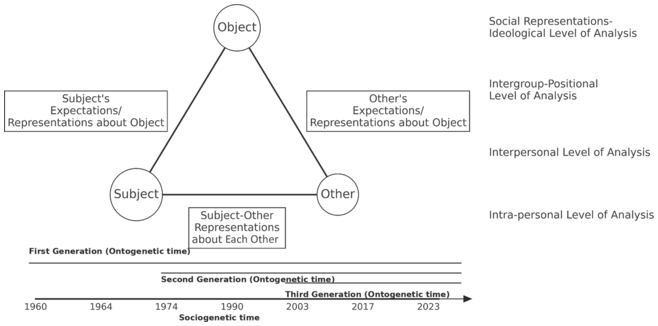
Figure 1.1 Long description
A chart displays a triangle with the sides labelled as follows. Between Object and Subject lies Subject's Expectations or Representations about the Object. Between the Object and the Other lies Others' Expectations or Representations about the Object. Between Subject and Other lies Subject-Other Representations about Each Other. Positioned to the right of the triangle, four levels of analysis are listed vertically from the top downward as social representations, ideological level of analysis, next, intergroup positional level of analysis, next, interpersonal level of analysis, and finally, intra-personal level of analysis. Below the triangle, a timeline labelled Sociogenetic Time, spans from 1960 to 2023, divided into three generational periods, First Generation, Ontogenetic time, from 1960 to 1974; Second Generation, Ontogenetic time, from 1974 to 2003; and Third Generation, Ontogenetic time, from 2003 to 2023.
The definition by Duveen and Lloyd (Reference Duveen, Lloyd, Duveen and Lloyd1990) is focused on change as a form of construction through socio-cognitive conflict in social interaction, but it is unique because it implicates in this process social identity and social representations as they are enacted. According to this perspective, the evocation of social representations in social interaction occurs in the ways in which individuals construct an understanding of the situation and position themselves and their interlocutors as social subjects in the field of social representations. This process can run smoothly along the lines of the ‘taken for granted’, but it can also lead to ruptures (see Zittoun, Gillespie, Duveen, Ivinson & Psaltis, Reference Zittoun, Duveen, Gillespie, Ivinson and Psaltis2003). The opening of the checkpoints in 2003 in Cyprus was exactly such a critical historical juncture or rupture point, as we will see in later chapters, that made possible a different form of microgenetic processes taking not only the usual form of intragroup social interaction but making possible intergroup social interactions.
However, this potential for change also comes from indirect forms of contact when, for example, a member of one group does not have an out-group friend but his or her best in-group friend does (Zhou et al., Reference Zhou, Page-Gould, Aron, Moyer and Hewstone2019). Beyond this extended form of friendship there is now a burgeoning literature about other indirect forms of contact (Harwood, Reference Harwood2017). Indirect contact covers a broad array of possibilities, which can be subdivided in the following forms: (1) vicarious contact which occurs when we observe contact between an in-group and an out-group member but do not participate in it; (2) mediated contact which is when some of the contact process occurs via a technologically mediated channel (e.g. computer based such as email, texting, conferencing, social media, or TV based such as parasocial contact with an out-group actor in a TV series); and (3) imagined contact which refers to mental visualisations or simulations of contact to operate in similar ways to ‘real’ contact (Miles & Crisp, Reference Miles and Crisp2014). The mechanisms often identified as mediating the prejudice reduction effects are increase of trust, empathy, perspective taking, self-disclosure, recognition of out-group heterogeneity and decrease of inter-group anxiety, realistic and symbolic threats, and stereotypes. Sometimes such mediating processes are also related to collective identity recategorisation processes (Aberson, Reference Aberson2019; Pettigrew et al., Reference Pettigrew, Tropp, Wagner and Christ2011).
From the perspective of genetic social psychology, the aforementioned processes only touch upon a part of the significant structure of the subject–object–other triad (see Figure 1.1). They are mostly focused on the subject–other relationship and its quality but have much less to say about the subject–object and the other–object relationship as well as about the role of intragroup contacts and communication. Kadianaki and Gillespie (Reference Kadianaki and Gillespie2015) have also identified a crucial role for self-reflection as a motor for the microgenetic transformation of social representations through the emergence of doubt (Duveen, Reference Duveen2002) in the subject. The meeting with alterity is key in creating self-reflection and can take the following forms: (1) rupture with the physical world (alterity in action), (2) social contact (alterity in other), (3) movement between contexts (alterity in self) and (4) semiotic dialogicality (alterity in the structure of knowledge).
The work of Gillespie (Reference Gillespie2008, Reference Gillespie2020) on semantic contact also points to the way others (both in-group and out-group members) often propose disruptive and disagreeable views of the world (alternative representations of the object) that go against the dominant representations of a society. In this case there is often the phenomenon of resistance (Duveen, Reference Duveen, Deaux and Philogène2001) by dominant groups who attempt to raise defensive mechanisms against possible change of the representation of the object by the subject. Gillespie (Reference Gillespie2020) identifies three layers of defence that take the form of semantic barriers: avoiding, delegitimising and limiting. Semantic barriers are meanings used to reinforce the semantic boundary between the self’s views and the views of others, thus protecting the self’s universe of meaning from being destabilised. The first layer of semantic barriers avoids acknowledgement of the motives, beliefs or feelings of the out-group. The second layer of semantic barriers acknowledges the existence of the out-group’s perspective but works to delegitimise that perspective to such an extent that it can be dismissed. The final and deeper layer of defence acknowledges to some extent the legitimacy of the out-group perspective but works to limit its destabilising impact.
Thus, microgenetic processes of change in social representations need to be seen as potentially engaging all parts of the triad in the significant structure of a position in the representational field, and it concerns a process of possible resistance or reorganisation towards a holistic structure with a certain coherence that involves changes in how self is understood (identity), changes in the subject–other relationship, changes in the representation of the other (e.g. deconstruction of negative stereotypes) and changes in representations about a conflict itself (e.g. an ethnic conflict and its history). Such processes of microgenesis can take the form of intragroup social interaction but also the form of intergroup contact and are shaped by sociogenetic processes of public and mass-mediated communication within and across groups (Wagner, Reference Wagner1994). Of course, one of the main lessons of the first line of research at Cambridge was that the depth of such change varies and directly relates to the quality of social interaction or contact. In that sense not all microgenetic processes lead to ontogenetic or sociogenetic change. In this book we are mostly interested with the articulation of microgenesis with ontogenesis (Chapter 2) and sociogenesis (Chapter 3) at different levels of analysis (Psaltis, 2015) as they relate to the representation of the Cyprus issue identifying instances of rupture and change but also of continuity.
Ontogenesis of Prejudice
Ontogenesis is the process of change of the representations of a single individual through their life course. The main influential figures in shaping our understanding of this process are Jean Piaget, Hans Furth and Gerard Duveen. This process is a process influenced by microgenetic processes but also by the cognitive developmental level of the individual, the influence of norms of the in-group, and the changing role of relations of constraint and relations of co-operation beyond any maturational or biological factors.
Various theories exist that attempt to explain the development of prejudice in childhood (Aboud, Reference Aboud1988, Reference Aboud, Quintana and McKown2008; Nesdale, Reference Nesdale, Augoustinos and Reynolds2001, Reference Nesdale, Bennett and Sani2004; Bar-Tal & Teichman, Reference Bar-Tal and Teichman2005; Nasie et al., Reference Nasie, Reifen Tagar and Bar‐Tal2021), and they have all contributed a lot to our understanding of how prejudice develops from early childhood to adolescence. Nevertheless, the narrow focus of most of the mainstream social cognition models on the single outcome of prejudice with the exception of the rich and multilevel framework proposed by Bar-Tal (Reference Bar-Tal2023) and his colleagues in Israel fails to explore what lies beyond the tip of the iceberg in the representations of an interethnic conflict and its transformation in historical time as mentioned earlier. Additionally, there is an intricate tension between the emerging agency and developing potential of the human mind on the one hand to grasp complexity and avoid stereotypical thinking, and on the other to form a collective identity or follow group norms that puts on the developing child contrasting orientations and creates tensions and conflict between various norms, commitments and values that have not been totally understood until today. The genetic social psychological framework can contribute to capturing some of this complexity in a way that goes beyond just the measurement of prejudice indices.
Developmental Theories of Prejudice
Most prejudice development theory and research has concentrated on the childhood years (4–12 years of age) with a particular focus on the role of social-cognitive developmental (Aboud, Reference Aboud1988, Reference Aboud, Quintana and McKown2008) and motivational processes (Nesdale, Reference Nesdale, Bennett and Sani2004), but a proper synthesis of the empirical basis of these theoretical approaches has not yet taken place.
According to Doyle and Aboud (Reference Doyle and Aboud1995), who have been influenced by Piaget’s work on children’s cognitive development, feelings of prejudice and biased attitudes in children, peak at the age of five to seven years and then decline as they grew up. Aboud and Amato (Reference Aboud, Amato, Brown and Gaertner2003) claim that the emergence of cognitive abilities during the concrete operational stage, such as the cognitive ability of multiple classification skills, relates to the reduction of prejudice. In particular, past the age of seven years, the greater attribution of importance to individual traits and characteristics rather than collective ones when assessing other individuals allows children to start recognising that both in-group and out-group members can have both positive and negative traits. This more flexible way of thinking is less stereotypical, thus leading to a gradual reduction of prejudice in late childhood.
On the contrary the motivational social identity development theory (SIDT) (Nesdale, Reference Nesdale, Bennett and Sani2004, Reference Nesdale, Rutland, Nesdale and Brown2017) predicts that children before six to seven years of age usually exhibit only in-group favouritism without out-group derogation. Prejudice can emerge after this age, but its emergence depends (1) on the extent to which children identify with their social group, (2) on whether prejudice is a norm held by the members of the child’s social group, and/or (3) on whether the in-group members believe that their group is threatened in some way by members of the out-group.
A meta-analysis by Raabe and Beelmann (Reference Raabe and Beelmann2011) shed more light on the issue of the developmental trajectory of prejudice. It included 121 cross-sectional and 7 longitudinal studies from 18 different countries and examined age differences in racial, national and ethnic prejudice from childhood to late adolescence. They found that there was a significant mean-level increase in prejudiced attitudes from early to middle childhood, thus supporting Aboud’s (Reference Aboud, Quintana and McKown2008) proposition. However, this was only true for prejudice towards low-status groups. In the case of prejudice towards national out-groups and high-status groups, this was not the case. This shows that there is indeed a cognitive developmental shift around the age six to eight years that makes possible the reduction of prejudice, as suggested by Aboud, but only if the social context contains in-group norms and social representations about the inappropriateness of the marginalisation of minorities. They also found evidence of more heterogeneity in prejudiced attitudes in adolescence, suggesting that the role of the sociocultural context and environmental factors becomes more central as children grow older. More recent research supports the same conclusion (Barret & Oppenheimer, Reference Barrett and Oppenheimer2011; Miklikowska, Reference Miklikowska2017; Miklikowska, Thijs & Hjerm, Reference Miklikowska, Thijs and Hjerm2019), especially in post-conflict settings where social identity in adolescence gains a prominent role in the context of ethnic antagonisms (Bar-Tal & Teichman, Reference Bar-Tal and Teichman2005; Nasie et al., 2019; Teichman, Reference Teichman, Sharvit and Halperin2016).
Such findings can be explained by the genetic social psychology framework in that the thought of children in early childhood could be characterised as a process of agentic internalisation of social representations of various categories (first gender and then racial, ethnic, national, etc.) and meanings attached to these categories either because children obtain personal experience of coming into contact with members of these categories or because they hear or read stories about these categories. By the age of two years, children start forming representations and symbols that revolve around a figurative core of simple binary oppositions as shown in the work of Duveen for the case of gender. As both Furth and Duveen show, however, behind every binary opposition there is an asymmetry of power. Clearly the social representations of each group (ethnic, national, racial, etc.) would carry their own meanings and norms that would be expected to create varied prejudice developmental paths through social influence in microgenetic processes, and one should not expect a universal process of ontogenetic increase or decrease of prejudice. The specific trajectory of a single group will always depend on the specific socio-historical context. It is clear that militarism and nationalism are one of the ways that children do gender through commemorations and national celebrations in the school context, even starting from the kindergarten (Nasie & Bar-Tal, Reference Nasie and Bar‐Tal2020). Therefore, gender and national identities are intertwined, and patriarchy should be seen as supporting both militarism and nationalism generally and honour culture in traditional and rural societies through religion (Hadjipavlou & Mertan, Reference Hadjipavlou and Mertan2019).
Nevertheless, what all these theoretical frameworks failed to capture is an understanding of the role of the quality of social relations in the development of prejudice as originally proposed by Piaget (Reference Piaget1932) as well as to explore more generally the representations about ‘otherness’ and historical consciousness which of course incorporates a richer set of meanings than the narrow focus on prejudice and adds historical depth to the analysis. The core question then that should be studied is the following: How do children interact with significant in-group others (parents, peers, teachers) about otherness and represent otherness itself, and how do they interact with members of various outgroups? The two axes of this proposal are represented in Figure 2.1.
The what and how axes of family and school socialisation.
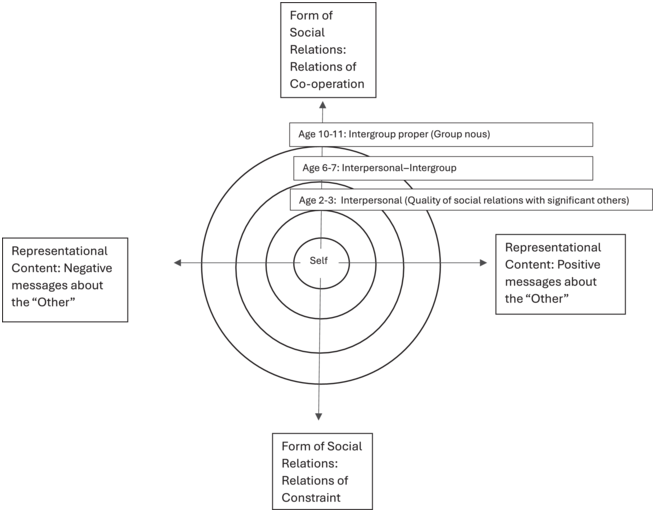
Figure 2.1 Long description
The central focus is Self, surrounded by three concentric layers denoting different developmental stages. Ages 2 to 3 categorised under Interpersonal, highlights the quality of social relations with significant others. Age 6 to 7 under Interpersonal to Intergroup, indicates the transition between personal and group-based interactions. Ages 10 to 11 under Intergroup proper, reflects Group nous. Four directional arrows from the Self point in 4 different directions. An upward arrow points to a box labelled Form of Social Relations, Relations of Cooperation, a downward arrow points to a box labelled Form of Social Relations, Relations of Constraint, a leftward arrow points to a box labelled Representational Content, Negative messages about the Other, and a rightward arrow points to a box labelled Representational Content, Positive messages about the Other.
Both processes could be seen as different facets of the process of social representing the ‘other’. Whether children often find themselves embedded in social relations of constraint or co-operation (Piaget, Reference Piaget1932) with significant others (e.g. parents, teachers) would be expected to make a difference, but changes in prejudice levels would also be expected by the content of what they discuss about otherness, mediated by such cultural artefacts as history texbooks or popular history, commemorations or other various symbolic resources that make reference to the outgroup. Even more impactful could be direct intergroup contact experiences with otherness, especially if what is usually being discussed within group with significant others carries negative overtones or in a context of geographical separation like Cyprus, which offers little opportunities for intergroup contact.
From our perspective, however, the effectiveness of intergroup contact would depend on children’s developmental level. It would be wrong, for example, to expect children in the pre-operational level who have not yet mastered part–whole relations to generalise any positive intergroup encounters from the single case to all members of the out-group. Indeed recent reviews of the role of intergroup contact in prejudice reduction in childhood points towards this limitation for young children under six to seven years of age (Aboud & Spears-Brown, Reference Aboud and Spears-Brown2013). Still, it is possible for otherness related to skin colour, which is visible from early childhood and does not necessitate an understanding of part–whole relations, to still get the beneficial effects of intergroup contact in this younger age group.
In this connection, relevant to our focus on interethnic relations and the development of social representations of the Cyprus issue in Cyprus, is the notion of sociocentrism which Piaget talks about but only once explored in any detail in his work with Weil (Piaget & Weil, Reference Piaget and Weil1951) on the ontogenesis of the idea of homeland in children. Even though Piaget’s work was written 70 years ago, it is more nuanced in capturing links between form and content than recent work and could perfectly explain the findings of a recent meta-analysis (Raabe & Beelmann, Reference Raabe and Beelmann2011), since it offers a more holistic understanding of representations than the narrow focus of prejudice reduction.
First, it helps to understand why one should not expect strong statistical relationships between intelligence and prejudice levels but only small to moderate as we would expect between intelligence and wisdom (only at about r = 0.30), as suggested by Demetriou et al. (Reference Demetriou, Liakos and Kizilyürek2021) when they propose their own historical/developmental framework of raising Mandelas by cultivating wisdom. This is because prejudice can be sustained by various and diverse forms of thinking which depends on not only cognitive ability but also in-group norms. For example, some cognitive developmental skills in older children or adolescents make possible an understanding of part–whole relationships. However, these part–whole relations should not necessarily be inclusive of all out-groups because they might selectively or strategically keep some groups out of the definition of a superordinate in-group category depending on the sociocultural or historical context. Second, Piaget’s work suggests that both cognitive structuring and the content of the representations of the group (positive or negative) can influence prejudice in childhood, and he essentially supports the idea that both prejudiced and non-prejudiced views could be sustained by in-group norms in late childhood and early adolescence. However, with every developing stage, their application would concern a wider group (or one could talk of an expanding ethical or moral horizon) that can be seen in Figure 2.1. First, there is the here and now of the egocentric child in the pre-operational stage, then the possibility of submission to family or decentration from family views and values in the concrete operational stage, and finally comes the submission or emancipation through reciprocity and decentration from wider societal views and values in the formal operational stage. The hallmark of deep and not superficial tolerant views for Piaget would be the development of reciprocity where the process of co-operative interaction and norms of mutual respect align with the positive content of representations about any ‘other’, thus forming a universalising attitude. Of course, given the emerging socialisation of various in-group norms that exclude otherness (religion, ethnic or gender related), this is rarely achieved indeed.
For example, positive norms about collaboration with in-group strangers (co-religionists) can be promoted by a powerful institution like religion, people in authority or the school without this necessitating acceptance of individuals from other religious or ethnic groups. In this sense the moral horizon does exclude specific others. However, in periods of positive political developments in a conflict transformation process the ethical horizon can be expanded by the will of powerful institutions. In our later chapter analysing the Cyprus case in the period from 2015 to 2017 we will see an example of this for bicommunal relations in Cyprus. In the case of conformity pressures towards a positive anti-discriminatory policy, the normative context of the in-group could be leading to lower expression of prejudice. From the perspective of genetic social psychology, this would not necessarily entail the reconstruction of knowledge but a superficial layer of beliefs (‘I should not sound prejudiced’) which might be enough to reduce the expression of prejudice but not the presence of prejudiced feelings (the lower right quadrant in Figure 2.1) in the mind of many individuals unless such policy shifts are accompanied by opportunities for real co-operative contact with out-group members (the upper right quadrant in Figure 2.1). Discussions between equal peers can also entail negative stereotypes about otherness. Given the increasing role of in-group peer norms in adolescence, for example, we might expect to find peer negative norms of the upper left quadrant in Figure 2.1 that might conflict with positive in-group norms at the school level represented in the lower right quadrant and lead to resistance to school positive norms. From the same perspective the lower left quadrant of Figure 2.1 is very problematic, since dominant and hierarchical institutions or authorities promote negative representations of out-groups that is usually the case in hot intergroup conflicts. Here the various forms of threats, prejudice, distrust, intergroup anxiety and lack of contact are expected at high levels, further supporting hierarchical institutions, traditional, security values and conformity largely described in the work of Bar-Tal (Reference Bar-Tal2023) as the “ethos of conflict.”
Thus, processes relating to the quality of social relations directly relate to varieties of social influence as in the genetic model of social influence in Moscovici (Reference Moscovici1976) who discussed both majority and minority influence as two different routes to social influence with distinct qualitative characteristics. Between these two processes there seems to be a third process with somewhat ambivalent characteristics, according to Moscovici (Reference Moscovici1976), which relates to processes of normalisation and norm formation as explored originally by Muzafer Sheriff in the context of small groups. As Moscovici (Reference Moscovici1991) shows in an insightful paper where he discusses the work of Sherif and Asch in the context of Sherif’s experiments, two qualitatively different reactions were observed once participants to the experiments were interviewed. There are those who, when faced with a majority, simply comply publicly, in front of others, without actually changing their internal knowledge, belief or representation of the world or reality. However, there are also those who, when faced with a majority, might actually start doubting their beliefs, knowledge or representation of the world, and in that sense it is possible that a numerical majority can also put in motion a process of deeper, real change depending on the mode of resolution of socio-cognitive conflict that will take place. This is likened by Moscovici to a process of informational influence or cognitive validation whilst the former is likened to a process of normative influence or social comparison which results in public compliance but no real internal change. From our perspective, small group settings can take both forms depending on the conversation types that evolve between subject and other in these settings and specifically whether they take the form of mutual respect (co-operation) or unilateral respect, submission or coercion (relations of constraint). Efforts to coerce can cause resistance and even reaction towards the opposite direction that the source of influence demands as we know from classic social psychological work.
The role of in-group norms in prejudice reduction in childhood has been recently explored in the context of social identity development theory (Nesdale, Reference Nesdale, Rutland, Nesdale and Brown2017), and a series of studies indicate that in-group norms in childhood have a powerful influence on the expression of prejudice by children, but these researchers have not really examined how deep the change is as a result of normative influences. Their findings indeed suggest that the influence of in-group peer norms becomes bigger in late childhood and early adolescence compared to adult in-group norms that influence children more in early childhood (Aboud & Spears-Brown, Reference Aboud and Spears-Brown2013). However, findings about in-group norms also show some interesting competing effects from group norms from smaller and larger groupings (e.g. friend’s group vs school norms) with norms of larger groups being in a better position to influence older compared to younger children. This of course brings to the picture the ‘ethical horizon’ of the group which could expand with age and greater opportunities for intergroup contact (Allport, Reference Allport1954) outside the smaller interpersonal bubble of the student.
Such an interest in the role of interpersonal social relations and part–whole relations in groups was also found in the context of western Marxism in the work of Adorno who was also largely influenced by the affective and emotive component of Freud’s work and is unique in his social developmental theorisation. He suggested that punitive and strict parenting would lead to the formation of the authoritarian personality (Adorno, 1950/Reference Adorno2019). Such parenting in Piagetian terms would be characterised by relations of constraint, as they lack the element of mutual respect and put the psychological subject in a position of passivity in relation to others (interpersonal orientation) or the group (part–whole relations). In the later work of Altemeyer (Reference Altemeyer1988, Reference Altemeyer and Zanna1998) there were indeed significant statistical relations identified between harsh parenting and prejudice levels.
More recently John Duckit (Reference Duckitt2001), following the steps of Altemeyer, made further distinctions within the idea of authoritarianism or within Piaget’s social relations of constraint: an orientation of submission, likening it with social conformity; and an orientation of domination, likening it with Machiavellian ways of thinking about weaker others. He also brings convincing empirical evidence that the first orientation is related to the development of right-wing authoritarianism (RWA) and the second with social dominance orientation (SDO) that both predict prejudice but through different paths. Interestingly, he finds that in younger adolescents the link between RWA and SDO is less strong, but as adolescents become more politically socialised in later adolescence and especially in sociocultural contexts of strong left wing–right wing differentiation, the links become stronger. A crucial distinction between RWA and SDO seems to be the level of agency involved in the two positions. Whilst RWA minimises agency through submission to authority and tradition, SDO takes agency to the opposite end in an orientation of controlling, cold and calculating manipulation and domination of others. Very interesting social developmental research by Guidetti, Carraro and Castelli (Reference Guidetti, Carraro and Castelli2017) explored the links between parental RWA and SDO and their preschoolers epistemic (preference for order in stimuli), relational (conformity to peer pressure in an Asch-like task) and existential (threat sensitivity) orientations. They found that parents’ RWA and SDO scores appeared to have opposite effects on children’s relational needs: children’s conformity increased at increasing levels of mothers’ RWA and decreased at increasing levels of fathers’ SDO. Also, higher mother RWA scores were related to greater sensitivity to threatening stimuli by the preschoolers. An interesting link with traditional or sexist representations of gender was noted by the authors, since the findings point to an influential path from an ‘anxious’ mother and a ‘domineering or calculating, powerful’ father influencing RWA and SDO correspondingly in their sample of preschoolers.
Toward a Triadic Model of Prejudice
From the clinical psychology point of view in terms of well-being, the development of agency away from a position of submission and helplessness is important. Piaget’s relations of co-operation (Piaget, Reference Piaget1932) and his principle of mutual respect are again the third way between the two extremes of submission and domination. The microgenetic processes that strengthen a RWA and SDO view are obviously asymmetrical relations of constraint (unilateral respect). This relates to forms of recognition in microgenetic processes that we have identified in previous work (Psaltis & Duveen, Reference Psaltis and Duveen2006, Reference Psaltis and Duveen2007) as the defining element of the quality of social relations. On the one hand there is instrumental recognition which downgrades the subject to an object that serves the aims of another person or institution and diminishes agency. This was seen in our conversation type of no resistance where the subject passively accepted other’s views or perspectives. On the other end of the spectrum of instrumental recognition was the non-conserving type where original non-conservers (less developmentally advanced children) dogmatically supported their own view without taking into consideration or ignoring the conflicting position of the other. But there was also the middle way of recognition as a thinking subject (Psaltis & Duveen, Reference Psaltis and Duveen2007), which is promoting the agency of the subject who is being recognised whilst at the same time recognising others as thinking subjects. In our previous work we have identified conversation types that facilitated the establishment of a social relation of co-operation as ‘explicit recognition’ which was the type of conversation that entailed mutual respect (Psaltis & Duveen, Reference Psaltis and Duveen2007) and, importantly, an intersubjectivity structure where both partners know that the others know what they know (Psaltis, Reference Psaltis2005; Duveen & Psaltis, Reference Duveen, Psaltis, Mueller, Carpendale, Budwig and Sokol2008).
Agency is also discussed by Gillespie (Reference Gillespie2012) as the development of the ability for distancing oneself from the immediate situation. Gillespie gives the example of the research subject in Milgram’s experiment that resists the directives of an authority to harm another individual as a good example of agency. In this sense resistance to authorities and group norms would be another example of the exercise of agency as also suggested by Piaget (Reference Piaget1932). But how does agency develop? Gillespie (Reference Gillespie2012) shows this process to be dependent on the process of position exchange that allows the integration of first- and third-order perspectives. Agency entails identification with another person’s pain in Milgram’s experiment and taking the perspective of others onto self as someone who is causing pain (thus the self becomes observable from another perspective), and it is this positioning that is resisted by the subject as an expression of resistance and agency. The triad of the subject–object–other depicted in Figure 2.1 is the significant structure to be studied; it is the unit of analysis of genetic social psychology. The triad should be conceptualised as both an activity structure and a configuration of expectations about who (in-group or out-group) should or is controlling the ‘object’ (property, land, power, etc.), which makes triadic expectations asymmetrical and dependent on power structures. Domestic tensions extend to regional and global through geopolitical interests of great powers.
The structure and configuration of the triad (symmetrical or asymmetrical) depend on both cognitive developmental and ideological constraints. From the cognitive developmental perspective, the triad in early childhood should be seen as undifferentiated. Subject–object and subject–other are undifferentiated before symbol formation in the child around the end of the first year of life (Furth, Reference Furth1996) (see Figure 2.1), but after this age we have the emergence of the triad through a differentiation process. The process of human development can be seen as a process of gradual differentiation and coordination of perspectives. The knowledge of the child in his or her early years is constrained by the here and now and is driven by the figurative aspects of knowing. In Piagetian terms, the representations stay at the ‘periphery’ of subject–object interaction. Any ‘prejudice’ in these years of early childhood (before six to seven years old) should be seen as the result of having heard from significant others that other groups or countries ‘are like that (usually negative trait)’ or ‘grabbed something from us’ or from visible cues of difference (gender, colour, etc.). The more hierarchical the relations between subject–other (with parents or friends), the less subject–other differentiation will be observed, which will have epistemological consequences because it will hinder the movement from the periphery to the centre of knowledge and constrain the development of agency. This will facilitate a more holistic (relational) way of thinking and less analytic (abstract/categorical) way of thinking (cf. Henrich, Reference Henrich2020). This has a parallel in the genetic model of social influence of Serge Moscovici, where he described majority influence as setting in motion a social comparison process and conformity, whereas a minority as the source of influence was setting in motion a process of cognitive validation and a conversion process in the mind of the target of influence. Hierarchical relations of constraint supported by higher religiosity in the family will also contribute to a fixation in the periphery of knowledge and less analytical thinking. Traditional and conformity values (Schwartz, Reference Schwartz2021) as well as honour and face values will be expected to form close links with religiosity that supports hierarchical representations of gender (sexist beliefs, machismo, etc.) and a more interdependent self-construal or understanding of self. The role of cultural values is key. For example, honor values (Uskul et al., Reference Uskul, Kirchner-Häusler, Vignoles, Rodriguez-Bailon, Castillo, Cross and Uchida2023) could support both positions of submission (usually women and LGBTQI+ or minorities) and domination (machismo, bravado, retaliation, overconfidence, egocentrism, sociocentrism, assimilation over accommodation). Domination would be a position more often taken by males compared to females. This would explain, for example, why SDO is often higher in males than females.
Children, before six to seven years of age have no understanding of part–whole relations, and this would be expected to have consequences for the role of intergroup contact in the generalisation effects of prejudice reduction from an individual out-grouper to the whole out-group. Even if they have positive intergroup contact from their perspective, generalisation of positive feelings from the individual to the whole group would be difficult. At this age binary distinctions of a figurative nature would work as organising principles (gender, skin colour, etc.) and would make difficult any differentiations within groups. Children in middle and late childhood between ages of 6–7 and 10–11 years (Figure 2.1) develop their cognitive capacity to a great extent, and for them subject–object–other relations become differentiated and the move from ‘periphery to centre’ starts to take place. Children master part–whole relations as well as begin to make internal differentiations between out-group members on the basis of individual or trait characteristics of persons. This stereotypical thinking can be reduced but its actual reduction depends on the prevailing in-group norms and opportunities for intergroup contact whose importance increases in this period for prejudice reduction. In this period from 6–7 to 10–11 years old the role of social relations of constraint and co-operation is also important as the ethical horizon of childhood is largely exhausted in interpersonal relationships with significant others but links between the interpersonal and the intergroup sphere are beginning to emerge with children that often find themselves in positions of submission (with both peers and adults) developing a sense of threatened identity that is also projected to feelings about out-groups. In this sense this is the period that we have the beginnings of the formation of a rudimentary consciousness of RWA and SDO (Cadamuro et al., 2021), which seems to suggest a transition that entails the broadening of horizon from the interpersonal to the intergroup in a more reflective way. In this period we also have the emergence of resistance to unfair treatment as children become reflective of equality and inequality in their interpersonal relationships (Killen, Reference Killen2018). Emerging agency and empathy (both emotional and cognitive) in this age period are key. Even biological or genetic factors known in the literature as primary psychopathy could play a role here. In Figure 2.1, for example, an egocentric, narcissistic or Machiavellian position, high on callous unemotional traits (Fanti & Lordos, Reference Fanti and Lordos2022) that lack empathy, could constrain the individual into the narrower ethical horizon in terms of out-group inclusion. But even if biological factors play no role, in-group norms relating to the attitude towards out-groups will certainly play an important role here. Such a constriction or narrowing of the ethical horizon could have various consequences for not being interested in the social and political life of their community, ending up apolitical being both indifferent and negative towards out-groups by conforming to a thin layer of negative stereotypes.
Table 2.1 thus further separates the ontogenetic outcomes depending on the triadic significant structure (the submerged part of the iceberg in our metaphor) into three enduring patterns of organisation of the thought and behaviour of the social psychological subject. A relation of constraint is further subdivided into the position on either the one or the other pole of a relation of constraint (submission vs domination), although it should be recognised that children and adults depending on the ‘other’ they have to deal with can often take either of the two positions. The structure that makes taking the one or the other end of the relation of constraint less likely is the development of relations of co-operation (mutual respect). It should also be recognised that in the case of members of minority groups, the SDO correlation structure in the middle of Table 2.1 could not actually work in the predicted direction, since legitimating inequality between groups automatically entails legitimising a structure that disfavours their in-group and self-image. An important element of the table below is values and their articulation with sociogenetic changes in historical time is key for genetic social psychology, and the table should be completed with the role of values (last column in Table 2.1), which is the topic of the next chapter.
Values in Social Representations and in Value Theories
Values are core and definitional characteristics of social representations as a ‘system of values, ideas and practices’ (Moscovici, Reference Moscovici, Israel and Tajfel1972), but they have rarely been given proper attention by researchers working in the social representations paradigm with the exception of some recent work that made some connections between the notion of ‘worldviews’, ‘social axioms’, ‘symbolic universes’, ‘moral frameworks’ and ‘deep stories’ (Misfed & Sammut, Reference Mifsud and Sammut2023). This is surprising given the burgeoning literature on human values, processes of their formation and historical change since the classic work of social psychologist Milton Rockeach. Rokeach (Reference Rokeach1973) listed 18 terminal values which refer to desirable end-states of existence (peace, family security, freedom, equality, self-respect, happiness, wisdom, national security, salvation, true friendship, accomplishment, inner harmony, comfortable life, mature love, beauty, pleasure, social recognition and exciting life) and 18 instrumental values as preferable modes of behavior, or means of achieving the terminal values (cheerfulness, ambition, love, cleanliness, self-control, capability, courage, politeness, honesty, imagination, independence, intellect, broad-mindedness, logic, obedience, helpfulness, responsibility and forgiveness).
In more recent years many social scientists turned to the study of values. Political scientists Inglehart and Welzel (Inglehard, Reference Inglehart2018) propose two dimensions of cross-cultural variation around the world: (1) Traditional values versus secular-rational values (traditional values emphasise religiosity, national pride, respect for authority, obedience and marriage). Secular-rational values emphasize the opposite on each of these accounts). (2) Survival values versus self-expression values (survival values involve a priority of security over liberty, non-acceptance of homosexuality, abstinence from political action, distrust in outsiders and a weak sense of happiness). Based on these two axes countries (that can be grouped by religion and geographical area) can be plotted from findings of comparative world-wide research like the World Values Survey (WVS) (see Figure 3.1).
Positions of cultural groups on Values based on WVS findings.
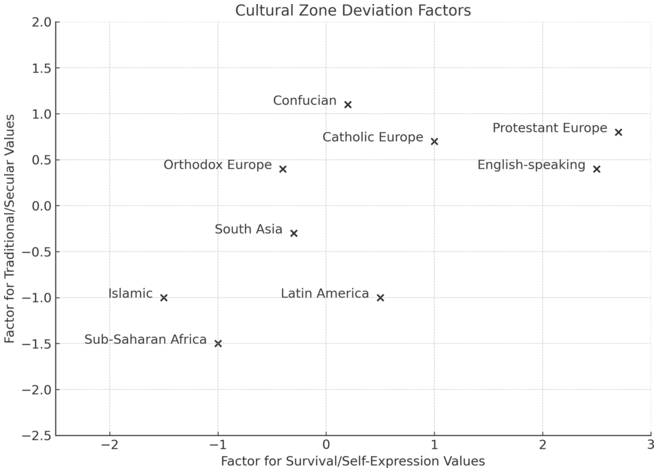
Figure 3.1 Long description
The scatterplot is titled Cultural Zone Deviation Factors. The X-axis, labelled Factor for Survival or Self-Expression Values, ranges from negative 1.00 to positive 1 in increments of 0.25 units. The Y-axis, labelled Factor for Traditional or Secular Values, ranges from negative 1.5 to 1.5 in increments of 0.5 units. Confucian zone is at approximately (negative 0.50, 1.25), strongly leaning toward traditional and secular values and survival. The Orthodox Europe is at (negative 0.50, 0.40), and Islamic is at (negative 0.70, negative 0.50), with a high traditional and survival orientation. South Asia is near (negative 0.30, negative 0.45), and Sub-Saharan Africa is at (negative 0.40, negative 0.95). Latin America is at (negative 0.05, negative 0.5), and Catholic Europe is near (0.00, negative 0.10). Protestant Europe is located at (0.60, 0.60), with stronger self-expression and secular values. English-speaking is at (0.60, negative 0.75), combining strong self-expression with more traditional values.
This approach emphasises national values as the unit of analysis and is rooted in a revision of the idea of modernisation in the classical works of Marx, Weber and Durkheim, which refers to the transition from agrarian-based societies to industrial and then post-industrial, knowledge-based societies. This transition is marked by economic growth, technological advancement and increased levels of education. Importantly for their revised modernisation theory, the transition from agrarian-based societies to industrial societies is expected to lead to progress on the traditional versus secular values axis, whereas transition from industrial to post-industrial and knowledge societies is expected to lead to progress on the survival vs self-expression values.
One of the most widely used theories of human values in social psychology is Shalom Schwartz’s (Reference Schwartz2021) theory of basic human values. It identifies 10 basic values, which are shown to be universal across cultures, although priorities of these values change among individuals and among countries and cultures. These values represent core principles that guide human behavior, and Schwartz posits that they are rooted in one or more of three universal requirements of human existence: needs of individuals as biological organisms; requisites of coordinated social interaction; and survival and welfare needs of groups.
The 10 basic values identified by Schwartz are:
Power (PO): Emphasising social status, control or dominance over people and resources.
Achievement (AC): Valuing personal success through demonstrating competence according to social standards.
Hedonism (HE): Seeking pleasure and sensuous gratification for oneself.
Stimulation (ST): Valuing excitement, novelty and challenge in life.
Self-Direction (SD): Valuing independent thought and action – choosing, creating, exploring.
Universalism (UN): Understanding, appreciation, tolerance, and protection for the welfare of all people and for nature.
Benevolence (BE): Preserving and enhancing the welfare of those with whom one is in frequent personal contact (the ‘in-group’).
Tradition (TR): Respect, commitment and acceptance of the customs and ideas that traditional culture or religion provide.
Conformity (CO): Restraint of actions, inclinations,and impulses likely to upset or harm others and violate social expectations or norms.
Security (SE): Valuing safety, harmony and stability of society, of relationships and of self.
Schwartz’s theory also discusses the dynamic nature of values, suggesting that they are structured in a circular manner, reflecting a continuum of related motivations (see Figure 3.2). Values that are adjacent to each other on the circle are more compatible, while values on opposite sides are in conflict. For example, the pursuit of power conflicts with the value of benevolence. This structure helps to explain individual differences in value priorities and the conflicts that arise when trying to pursue or balance different values.
Shalom Schwartz circumplex model of values.
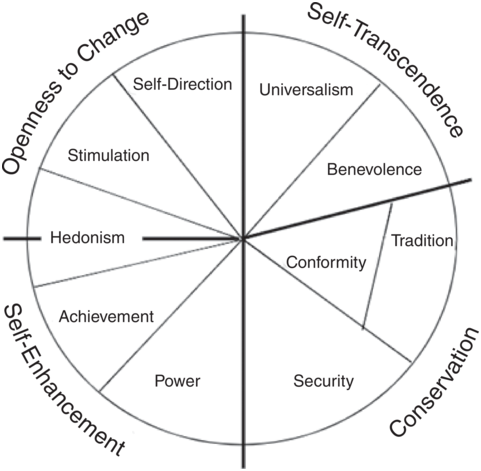
Figure 3.2 Long description
Openness to Change includes Self-Direction and Stimulation. Self-Transcendence includes Universalism and Benevolence. Conservation includes Conformity, Tradition, and Security. Self-Enhancement includes Achievement, and Power. Hedonism forms the boundary between Openness to Change and Self-Enhancement.
The 10 values can also be grouped into higher-order values (Conservation vs Openness to change and Self-enhancement vs Self transcendence) as shown in Table 3.1.
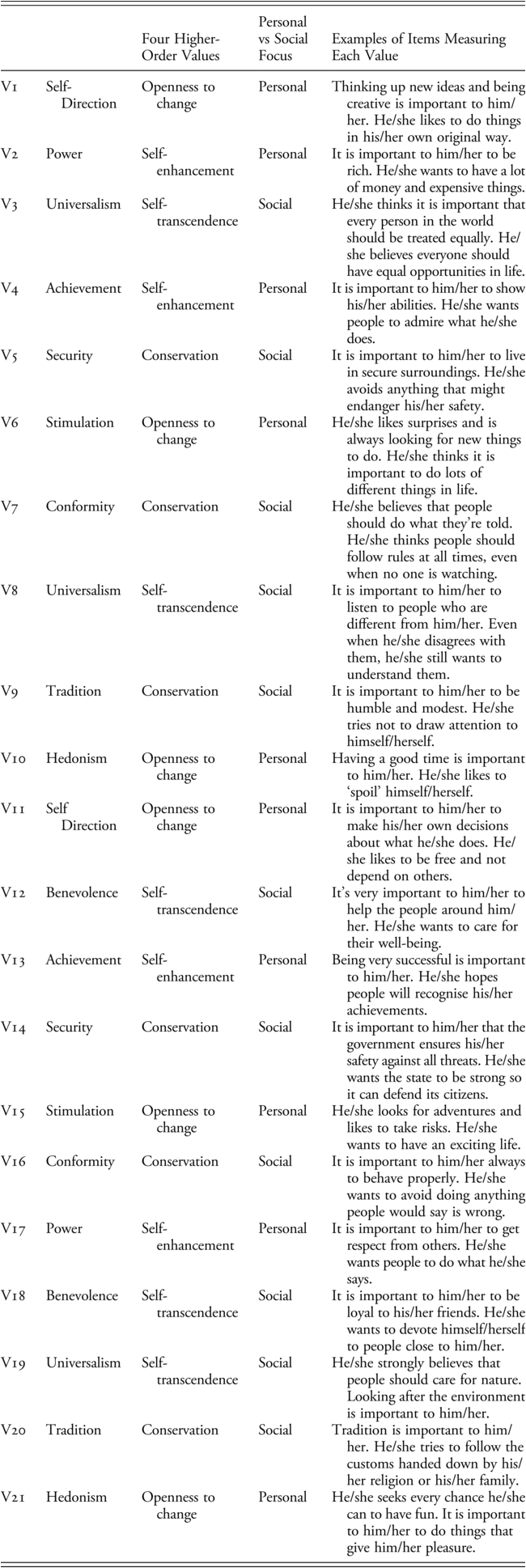
Table 3.1 Long description
The table has five columns titled Blank. Blank. Four Higher-Order Values. Personal versus Social Focus. Examples of Items Measuring
Each Value.
Row 1 column 1 reads. V 1.
Row 1 column 2 reads. Self-Direction.
Row 1 column 3 reads. Openness to change.
Row 1 column 4 reads. Personal.
Row 1 column 5 reads. Thinking up new ideas and being creative is important to him or her. He or she likes to do things in his or her own original way.
Row 2 column 1 reads. V 2.
Row 2 column 2 reads. Power.
Row 2 column 3 reads. Self-enhancement.
Row 2 column 4 reads. Personal.
Row 2 column 5 reads. It is important to him/her to be rich. He or she wants to have a lot of money and expensive things.
Row 3 column 1 reads. V 3.
Row 3 column 2 reads. Universalism.
Row 3 column 3 reads. Self-transcendence.
Row 3 column 4 reads. Social.
Row 3 column 5 reads. He or she thinks it is important that every person in the world should be treated equally. He or she believes everyone should have equal opportunities in life.
Row 4 column 1 reads. V 4.
Row 4 column 2 reads. Achievement.
Row 4 column 3 reads. Self-enhancement.
Row 4 column 4 reads. Personal.
Row 4 column 5 reads. It is important to him/her to show his or her abilities. He or she wants people to admire what he/she does.
Row 5 column 1 reads. V 5.
Row 5 column 2 reads. Security.
Row 5 column 3 reads. Conservation.
Row 5 column 4 reads. Social.
Row 5 column 5 reads. It is important to him or her to live in secure surroundings. He or she avoids anything that might endanger his or her safety.
Row 6 column 1 reads. V 6.
Row 6 column 2 reads. Stimulation.
Row 6 column 3 reads. Openness to change.
Row 6 column 4 reads. Personal.
Row 6 column 5 reads. He or she likes surprises and is always looking for new things to do. He or she thinks it is important to do lots of different things in life.
Row 7 column 1 reads. V 7.
Row 7 column 2 reads. Conformity.
Row 7 column 3 reads. Conservation.
Row 7 column 4 reads. Social.
Row 7 column 5 reads. He or she believes that people should do what they’re told. He or she thinks people should follow rules at all times, even when no one is watching.
Row 8 column 1 reads. V 8.
Row 8 column 2 reads. Universalism.
Row 8 column 3 reads. Self-transcendence.
Row 8 column 4 reads. Social.
Row 8 column 5 reads. It is important to him or her to listen to people who are different from him or her. Even when he or she disagrees with them, he or she still wants to understand them.
Row 9 column 1 reads. V 9.
Row 9 column 2 reads. Tradition.
Row 9 column 3 reads. Conservation.
Row 9 column 4 reads. Social.
Row 9 column 5 reads. It is important to him/her to be humble and modest. He or she tries not to draw attention to himself or herself.
Row 10 column 1 reads. V 10.
Row 10 column 2 reads. Hedonism.
Row 10 column 3 reads. Openness to change.
Row 10 column 4 reads. Personal.
Row 10 column 5 reads. Having a good time is important to him or her. He or she likes to spoil himself or herself.
Row 11 column 1 reads. V 11.
Row 11 column 2 reads. Self Direction.
Row 11 column 3 reads. Openness to change.
Row 11 column 4 reads. Personal.
Row 11 column 5 reads. It is important to him or her to make his or her own decisions about what he or she does. He or she likes to be free and not depend on others.
Row 12 column 1 reads. V 12.
Row 12 column 2 reads. Benevolence.
Row 12 column 3 reads. Self-transcendence.
Row 12 column 4 reads. Social.
Row 12 column 5 reads. It’s very important to him or her to help the people around him or her. He or she wants to care for their well-being.
Row 13 column 1 reads. V 13.
Row 13 column 2 reads. Achievement.
Row 13 column 3 reads. Self-enhancement.
Row 13 column 4 reads. Personal.
Row 13 column 5 reads. Being very successful is important to him or her. He or she hopes people will recognise his or her achievements.
Row 14 column 1 reads. V 14.
Row 14 column 2 reads. Security.
Row 14 column 3 reads. Conservation.
Row 14 column 4 reads. Social.
Row 14 column 5 reads. It is important to him or her that the government ensures his or her safety against all threats. He or she wants the state to be strong so it can defend its citizens.
Row 15 column 1 reads. V 15.
Row 15 column 2 reads. Stimulation.
Row 15 column 3 reads. Openness to change.
Row 15 column 4 reads. Personal.
Row 15 column 5 reads. He or she looks for adventures and likes to take risks. He or she wants to have an exciting life.
Row 16 column 1 reads. V 16.
Row 16 column 2 reads. Conformity.
Row 16 column 3 reads. Conservation.
Row 16 column 4 reads. Social.
Row 16 column 5 reads. It is important to him or her always to behave properly. He or she wants to avoid doing anything people would say is wrong.
Row 17 column 1 reads. V 17.
Row 17 column 2 reads. Power.
Row 17 column 3 reads. Self-enhancement.
Row 17 column 4 reads. Personal.
Row 17 column 5 reads. It is important to him or her to get respect from others. He or she wants people to do what he or she says.
Row 18 column 1 reads. V 18.
Row 18 column 2 reads. Benevolence.
Row 18 column 3 reads. Self-transcendence.
Row 18 column 4 reads. Social.
Row 18 column 5 reads. It is important to him or her to be loyal to his or her friends. He or she wants to devote himself or herself to people close to him or her.
Row 19 column 1 reads. V 19.
Row 19 column 2 reads. Universalism.
Row 19 column 3 reads. Self-transcendence.
Row 19 column 4 reads. Social.
Row 19 column 5 reads. He or she strongly believes that people should care for nature. Looking after the environment is important to him or her.
Row 20 column 1 reads. V 20.
Row 20 column 2 reads. Tradition.
Row 20 column 3 reads. Conservation.
Row 20 column 4 reads. Social.
Row 20 column 5 reads. Tradition is important to him or her. He or she tries to follow the customs handed down by his/her religion or his or her family.
Row 21 column 1 reads. V 21.
Row 21 column 2 reads. Hedonism.
Row 21 column 3 reads. Openness to change.
Row 21 column 4 reads. Personal.
Row 21 column 5 reads. He or she seeks every chance he or she can to have fun. It is important to him or her to do things that give him or her pleasure.
From the perspective of genetic social psychology, the relative priority of personal values can act as organising principles of social representations in the sense that they regulate both the process of their formation and content. For example, a representation of the opening of checkpoints in 2003 in Cyprus for an individual that gives priority to openness to change and not conservation is one that represents this opening as an opportunity for learning new things about the other community and other part of the island (stimulation), exploring new ideas beyond the controlled environment of their communally separated education along ethnic lines, and creating new friendships (self-direction). On the contrary, an individual who gives priority to Conservation values over values of Openness to change might experience the opening of the checkpoints as a threat to the in-group (security) or religious tradition becoming a source of intergroup anxiety and concern about losing one’s national or religious identity. Importantly, the close relationship of tradition with conformity values suggests some important links between the form and content of representations, because traditional values are formed through social influence processes of conformity to norms of values of the in-group, thus enacting relations of constraint that limit the expansion of the ethical horizon of the individual and the developing child. On the contrary, favouring intergroup contact between the two communities enacts a relation of co-operation that expands the individual’s ethical horizon in a universalising direction.
The value priorities of individuals vary by geography and time, and therefore the study of the sociogenesis of social representations through historical time and cultural evolution can be greatly enhanced by an understanding of this change. Here international comparative studies that measure the 10 values mentioned earlier, such as the European Social Survey (ESS), European Values Survey (EVS) and WVS, can offer valuable insights about the direction and rate of change in various countries, revealing more general patterns in other European countries, including those culturally very different to Cyprus.
Cultural Evolution and Values
Broader discussions about cultural evolution from various disciplines at a global level can add considerable historical depth to genetic social psychology, as they offer an analysis of sociogenetic processes of changing values through millennia. In an impressive research programme Henrich (Reference Henrich2015, Reference Henrich2020) has recently synthesised findings from anthropology, evolutionary biology, economics, history and social and developmental psychology into a dual inheritance theory of culture–gene co-evolution, offering ample evidence of cultural evolution patterns of change not only in values but also in cognitive and perceptual skills, morality, social cohesion and societal norms with direct implications for politics, changing democratic cultures and economic development at the country level. One of the biggest and most influential contributions of his work is the introduction of the critique of the false universalistic claims based on research with samples from a thin slice of humanity which he calls WEIRD societies.
In his historical account Henrich documents the crucial role played by religious institutions in this process of cultural evolution. First came a policy by the Roman Catholic Church that broke down large traditional kinship-based social networks through a family planning policy from around 500–1500 AD in western Europe that led to the end of polygamy and polygeny and a strengthening of the nuclear family. Belief in the Roman Catholic doctrine also facilitated trade with strangers (albeit only co-religionists) beyond the close circle of those who individual subjects knew personally. All these changes also led to more co-operation with in-groupers. Then followed the Protestant Reformation in parts of western Europe, which brought a more direct relationship with God without the mediation of church as an institution and its hierarchies with the sola scriptura, which brought significant increase in literacy levels, public education and a new work ethic as we know from the classic work of Weber. This long-term historical shift eventually led to more individualist values in these areas. Henrich (Reference Henrich2020) also argues these shifts slowly changed the brains (not the genes) of people – cognitive abilities in domains of memory, facial recognition, visual processing, numerical exactness and problem solving. For Henrich, higher literacy levels of Protestantism are likened to innovative ideas and technological acceleration. During the Enlightenment new historical phenomena were added in accelerating change around the idea Henrich calls the emergence of the ‘collective mind’ which has to do with (1) apprenticeship institutions, (2) urbanisation and impersonal markets, (3) transregional monastic orders, (4) universities, (5) the Republic of letters (transnational scientific societies), including new religious faiths (e.g. Huguenots) that not only promoted literacy and schooling but also made industriousness, scientific insights and pragmatic achievement sacred.
Heinrich’s (Reference Henrich2020) historical account ends around that time, and he would probably state that the rest is history in how the West became successful. However, it could be argued that some crucial questions arise relating to the history of the 20th and 21st centuries having to do with the failure of the universalising potential of the enlightenment ideas, enduring racism, colonialism and post-colonialism, the rise of nationalism, fascism, Nazism, two world wars, the Holocaust and the Cold War, nuclear threat, increasing inequality and climate change that pose some pertinent questions to the social scientists interested in cultural evolution about how humanity (the successful West included) came to the brink of its own self-extinction.
In this sense, it could thus be argued that the 20th century is actually not the end but the beginning of the story for understanding how humanity can hope for any future. The contribution of genetic social psychology in rendering this conflict-ridden part of the story intelligible is key. I would argue that it is essential for social scientists to explore in depth intergroup ethnic conflicts that undo socio-economic development, and the central role of public education from its first steps in humanity until today in promoting religion and nationalism through hierarchical, ethnocentric and traditional teaching approaches in both WEIRD and non-WEIRD societies. This effort should be put at the heart of our endeavours in the pursuit for an understanding of the formation of historical consciousness and in-group norms promoted by the nation state through the articulation of microgenetic, ontogenetic and sociogenetic processes of change.
To overcome WEIRD biases, comparative work in non-WEIRD settings is of crucial importance, particularly comparisons with Christian Orthodox and Islamic settings. Henrich (Reference Henrich2020) covers some distance in this direction when he explores pro-social behaviour, helping strangers and the difference between in-group and out-group trust from the findings of WVS. He notes that pro-social behaviour and helping strangers are higher in both Catholic and Protestant Christian countries compared to Eastern Orthodox Christian and Islamic countries. Similarly, the difference between in-group trust and out-group trust is also higher in the Orthodox Christian and Islamic countries. Further data collection from countries around the Mediterranean and the Middle East is also of great importance here because most of the cross-cultural psychological comparisons are usually comparing the West to the East, leaving the important geographical middle between them largely unexplored. In some of our recent work with colleagues we explored the existence of honour, face and dignity values in various Mediterranean countries and compared them with Asian and other Western cultures (Uskul et al., Reference Uskul, Kirchner-Häusler, Vignoles, Rodriguez-Bailon, Castillo, Cross and Uchida2023). In this work we discovered that honour values are closely related to religion and traditional values in Cyprus. Given that honour values support traditional asymmetrical masculine and feminine roles, the study of adherence to honour values allows an in-depth exploration of the interanimation of social representations of conflict with social representations of gender.
Despite the impressive and very promising research programme of Henrich (Reference Henrich2015, Reference Henrich2020), which in many ways is compatible with the vision of genetic social psychology for a historical psychology (Muthukrishna, Henrich & Slingerland, Reference Muthukrishna, Henrich and Slingerland2021), there seems to be great reliance on a social transmission metaphor (processes of social learning and imitation) and definition of co-operation as pro-sociality (helping, altruism, etc.) (Henrich & Muthukrishna, Reference Henrich and Muthukrishna2021) that comes mainly through the influence of the work of Michael Tomasello (Reference Tomasello2020). Tomasello’s recent work on the emergence of obligation is certainly relevant to our discussion in the previous section about the ontogenesis of prejudice, as he discusses how at the age of about two to three years a commitment to a shared ‘we’ emerges from shared interpersonal intentionality. The potential of scaling up this ‘we’ and the expansion of the ethical horizon of the child in ontogenesis is also recognised as a possibility, but no discussion of conflicting norms, asymmetries and power can be found anywhere in his theorisation. This is probably due to the fact that his notion of cooperation is different from Piaget’s (Reference Piaget1932) definition of co-operation where it is a relation between equals in status that implies the absence of conformity towards more powerful others; It is also the presence of conflicting representations of the world that become co-ordinated into more powerful knowledge that overcomes one-sided perspectives through decentration. It is important to understand that the quality of co-operative social relations based on mutual respect can be found in adult–child relationships as well. In a similar way, relations of constraint (unilateral respect) can also be located in relations between peers. This was, in fact, one of the major findings from our first line of research with Gerard Duveen (Psaltis & Duveen, Reference Psaltis and Duveen2006, Reference Psaltis and Duveen2007). One could even extend the idea of mutual respect in very early parent–child relationships as suggested by Carpendale and Lewis (Reference Carpendale and Lewis2020), thereby relating this framework with attachment styles in the sensorimotor stage of cognitive development (see the first column in Table 2.1). A lack of mutual respect – for example, of a mother towards her newborn – could be non-responding to the child’s needs appropriately for whatever reason.
But in the work of Henrich ( Reference Henrich2015, Reference Henrich2020) there is not a single citing of either Piaget’s or Vygotsky’s work, which is rather strange for a social scientist who draws so much from the developmental literature. In the study of sociogenetic changes in the West in the 18th century, a period covered by Henrich, greater attention should be given to Jean-Jacques Rousseau, a prominent 18th-century philosopher well known for his contributions to political philosophy, education and literature. His ideas about the importance of the study of nature also influenced Goethe’s organismic model (Wagoner, Reference Wagoner2024). His critiques of various aspects of society and religion were influential in the Enlightenment period, shaping modern political and educational thought as well as the secularist ideals of the French Revolution. Rousseau was critical of both organised forms of Protestant religion (Lutheranism and Calvinism). He was born in Geneva, which was one of the most prominent centres of Calvinism, and he openly criticised (1) the theological Calvinist ideas of predestination (which asserts that God has already chosen who will be saved and who will be damned); (2) the authoritarian involvement of Calvinism in the political life of Geneva, advocating for a separation between church and state; and (3) social inequality, which he saw as being perpetuated by institutions, including religious ones. He believed that Calvinism, like other organised religions, could be used to justify and maintain social hierarchies. Piaget not only was the director of the Jean-Jacques Rousseau Institute in Geneva, but it could be argued that his social psychology of social relations of constraint and co-operation (Piaget, Reference Piaget1932) transferred the same criticisms of suppressive part–whole relations in developmental psychology and epistemology, becoming one of the most influential intellectual figures of the 20th century in the Western world. The human relationship of mutual respect and decentration that he was proposing as the ideal in promoting both cognitive and moral development was also applied in the promotion of international dialogue among educational systems of nation states and the promotion of internationalist ideals through the work of the International Bureau of Education (IBE), which later became part of UNESCO (Psaltis & Zapiti, Reference Psaltis and Zapiti2014). Despite Rousseau’s influence on Piaget, we can see that Piaget surpasses one of the problematic aspects of Rousseau’s thinking when he created a master narrative of the history of humanity as starting from a benign nature that is corrupted by society. For Piaget, society could take the form of either social relations of constraint or co-operation, and in that sense there is nothing inherently good or bad about society. It is the way we formulate our social relations with others that could lead to benign or negative outcomes. In this sense, Piaget can thus be seen as an early critic of Rousseau, whose grand narrative of human evolution has recently been deconstructed by the work of Graeber and Wengrow (Reference Graeber and Wengrow2021).
In fact, Piaget’s social psychology can offer the missing mechanism in Henrich’s work that forms the ‘dark matter’ of the significant structure of the iceberg metaphor that holds together different social representations that lead to in-group norms and the establishment of institutions. Piaget showed that analytic and dispositional thinking can only emerge through unconstrained dialogue or communication with any oppressive authority (God, teachers, parents). We believe this is a universal mechanism, and it is the failure or success of the application of these relations and norms of mutual respect that leads to cross-cultural variation. Thus, existence (or absence) of traditional kinship networks described by Henrich (Reference Henrich2020), urbanisation and adherence to various religions are only distal predictors of the proximal causal factors which is social relational quality at an interpersonal level and part–whole relations relating to the way individuals are embedded in groups. Similarly, values are also predicted by Greenfield (Reference Greenfield2009) to have a mediating role in her theory connecting societal change (urbanisation, formal education, economic development) to human development and the development of more abstract thinking. In her approach the shift from collectivistic to more individualistic values will lead to more abstract thinking. It is important to note here that in some of her findings in Mexico where she compared children’s level of cooperation in 1967 and 2017, importantly defined as a coordination game similar the one used by Doise and Mugny (Reference Doise and Mugny1984) between children on a common goal, she found a decrease in co-operation that she attributed to rising individualist values in this period. Thus, how co-operation is defined in each study is of crucial importance, as this finding reveals that departing from collectivist values could indeed also lead to unproductive forms of individualism. The weakening of traditional, kin-based communities could entail both the reduction in conformity values, thus weakening the developmental pathway or significant structure we describe in Table 2.1, and it could mean an increase in values of rugged individualism, narcissism or Machiavellianism that we describe as the second developmental pathway. Both would make the co-operative path described by Piaget and in our Table 2.1 as the pathway in the third row less likely.
To offer clarity on this point, we believe that exploration of values attached to patterns of thinking is of crucial importance. Thus, we expect the position of submission to tradition to be related with high priority on Conformity (CO) and Tradition (TR) values but low priority on Achievement (AC), Hedonism (HE) and Power (PO) values. Given that religion can also be linked to the idea of helping others but maybe not (depending on the sociocultural context) we cannot make a prediction on Benevolence (BE) and Universalism (UN) values, since they will vary depending on the type of religion people adhere to in each context. On the contrary, we expect the domination position to be related to high Achievement (AC), Hedonism (HE) and Power (PO) Values. We also expect this position to be low on Benevolence (BE) and Universalism (UN), as it would be related to less religious adherence but overinflate the self at the expense of others (self-enhancement).
The third pathway or structure of co-operation would be expected to be related with low Conformity (CO), Tradition (TR) and Hedonism (HE) but high Universalism (UN), as it would be expected to expand the ethical horizon of the individual beyond the ingroup. It should also relate to higher Self-Direction (SD) due to an increasing sense of agency.
Protracted Conflict and Values
Perhaps, one of the most important and complicated contexts for the study of the role of values and their internalisation through social relations of co-operation or constraint and the development of prejudice is in countries where ethnic conflicts are either protracted or frozen. This could, in fact, present a significant departure from the narrow study of values and prejudice solely on its racial dimension in Western countries and mainly the United States. Coleman (Reference Coleman, Coleman, Deutsch and Marcus2014) maintains that protracted or intractable conflicts are characterised by their persistence, a history of failed attempts to resolve the conflict and their centrality in the lives of the communities involved in the conflict influencing all aspects of social life like media, cultural production, films, school and family and peer context often captured by the notion of ethos of conflict (Bar-Tal, Reference Bar-Tal2013; Bar-Tal & Teichman, Reference Bar-Tal and Teichman2009). Bar-Tal (Reference Bar-Tal2013) defines the ethos of conflict as a configuration of central, shared societal beliefs that provide a particular dominant orientation to a society and give meaning to societal life under conditions of intractable conflict. The ethos of conflict, as he found, is organised around eight themes: the justness of one’s own goals, opponent delegitimisation, self-victimhood, positive self-image, security, patriotism, unity and peace. Elements of ethos of conflict have been found in various other conflicts beyond the Israel–Palestine one in which the idea was developed. For example in Cyprus, Hadjipavlou (Reference Hadjipavlou2007) identified widespread beliefs of delegitimisation of the other group and victimisation in both communities of Cyprus. This configuration of beliefs is very similar to what we described in Table 2.1 in the first row as the significant structure of submission or victimisation closely related to traditional values and religiosity and the fact that patriotism and the goals of the group are often sacralised, becoming non-negotiable. But we would argue that there could be elements of ethos of conflict (e.g. threats or lack of empathy) that could be accompanied by a more individualist set of values as the one we describe in the second row of Table 2.1 where we could expect lower levels of ethos of conflict due to lower embeddedness in part–whole relations but still significantly lacking the co-operative potential of conflict transformation that we identify in the third row of Table 2.1.
We would claim that the major reason for this kind of variation of developmental paths relates both to different ontogenetic trajectories and historical socio-economic change. Protracted or intractable conflicts have tremendous negative consequences concerning the social and economic aspects of group life (see Coleman, Reference Coleman, Coleman, Deutsch and Marcus2014), but we should recognise the opposite direction of influence which raises interesting questions. How could conflict transformation evolve in a context of rugged individualism or capitalism that could be different from a context of widespread traditional values? This calls for a broader understanding of political socialisation in the broader socio-economic context of conflict. It is generally accepted that in countries where a protracted conflict is taking place, such as Cyprus and the Middle East, the development of prejudice with increasing age is increasingly influenced by political socialisation. According to Nasie et al. (Reference Nasie, Diamond and Bar-Tal2016), political socialisation is described as the ensemble of activities occurring in a social setting, thus contributing to the emergence of social representations and beliefs concerning political issues. Moreover, they claim that teenagers’ political beliefs and opinions are considerably affected by significant others (parents, educators and peers) (Raabe & Beelmann, Reference Raabe and Beelmann2011). But in the case of conflict and post-conflict settings, political socialisation also involves political parties and their influence through youth organisations, which sometimes extends to actors beyond the specific country. As we will see in the case of Cyprus in the next chapter, the involvement of other countries, regional organisations, regional powers and superpowers in influencing foreign policy options often directly impacts domestic policy and the direction of the educational system. These are issues never discussed by Henrich (Reference Henrich2020) in his recent discussion of cross-cultural variability in values and their historical development but are clearly of crucial importance for our understanding of continuity and change in the study of the articulation of processes of microgenesis, ontogenesis and sociogenesis.
Microgenetic and ontogenetic changes in prejudice should thus be seen as being embedded or canalised by institutional, socio-economic and ideological structures, material and symbolic resources in a process of overdetermination of meaning (Valsiner, Reference Valsiner2000). Overdetermination of meaning comes from the influence of various sources such as mass-mediated processes of historical change of social representations of the other and history of the conflict itself. These are instances of a long-term sociogenetic process of change that takes various forms (e.g. intergenerational transmission of trauma, generational replacement, collective memory). In the case of the Greek Cypriot community, this overdetermination of meaning, as we will see, revolves around the cultural trauma of 1974 (Roudometof & Christou, Reference Roudometof, Christou, Eyerman, Alexander and Breese2015), resulting primarily from the policies of the ministry of education adopting problematic ways of extrapolating sociopolitical processes of dealing with trauma from a limited subset of personal and subjective experiences of trauma (Kansteiner, Reference Kansteiner2004). Usually ones that keep the subject in a mourning and depressing situation. For example, one political socialisation path could be a traditional-religious right-wing orientation, but another could be again a right-wing but neo-liberal and individualist orientation which keeps distance from religion but is more interested in power and making money. In the case of Cyprus, like in Greece, the first would follow the triptych of sacralised values of Greek nationalism: patris, thriskeia, oikogeneia (homeland, religion, family) (Roudometof, Reference Roudometof2014), but the second could only be seeing competition from Turkish Cypriots in the market for jobs and financial resources in a Machiavellian way without the full package of the ethos of conflict. Genetic social psychology can render intelligible these nuanced variations of undermining co-operative conflict transformation.
Moscovici (Reference Moscovici, Duveen and Lloyd1990) suggested that the research strategy to understand the genesis or emergence of more complex representations from the study of simpler ones could be done either ontogenetically (Piaget and Vygotsky’s way) or by a comparison of the representations of various groups (which he called Bartlett’s way). He chose to do the second, although he understood the need for both in a more integrated social developmental psychology. The work of Bartlett (1932/Reference Bartlett1995) on remembering is directly relevant to this discussion, since in the case of post-conflict and divided societies like Cyprus, the past weighs on the present and future of the island through the collective memory of different cultural or chosen traumas (Volkan, Reference Volkan, Hamburger, Hancheva and Volkan2021) in the two communities, with formal and informal education being key actors in this process.
Bartlett studied the reconstructive nature of memory in its social context (Wagoner, Reference Wagoner2017). Whilst he agreed with sociologists like Durkheim and Halbwachs on the social nature of memory, he disagreed with them that the group itself has memories (Wagoner, Reference Wagoner, Sammut, Andreouli, Gaskell and Valsiner2015), hence avoiding sociological holism. His approach is compatible with the call of Moscovici for a genetic social psychology (Reference Moscovici, Israel and Tajfel1972, Reference Moscovici, Duveen and Lloyd1990), where the individual is not lost in the group but where individuality and agency itself are a function of the social relationships of the subject in the subject–object–other triad. Moscovici’s idea of turning the unfamiliar and unfamiliarity into familiar and objectification relates directly to Bartlett’s process of conventionalisation where representations get transformed as they pass from one group to another in historical time in a way that they converge with the values and orientations of the receiving group. Described as such, the study of intergroup contact could be reinterpreted through Bartlett’s work: the broader process of the sociogenesis of social representations can be articulated to widen our view beyond mainstream theorising about the role of intergroup contact in prejudice reduction (Allport, Reference Allport1954). This would be aligned with a methodological suggestion of Lucien Goldmann to follow the study of totality of the phenomenon, which would entail the study of not only the accompanying beliefs, ideas and practices that support the prejudicial beliefs of children but also the study of the historical change of the same structures. It is only natural that one should expect generational differences on values, and given that values function as organising principles of social representations depending on the age of the participants in our research, we should expect the emergence of different significant structures and ‘splits’ from previous positions into other variations in younger generations.
In post-conflict settings and deeply divided societies this suggests the need for an understanding of the societal meaning of intergroup contact itself and especially how it opens or closes opportunities for the flow of ideas between the two groups. The opportunities and outcomes of intergroup contact will be regulated and modulated by the ‘prospect’ of the group. In social representational terms used by Bauer and Gaskell (Reference Bauer and Gaskell1999), it will depend on the representational project of the group, and in the terminology of Goldmann, it will depend on each position in the representational field as a significant structure of a group which expresses an actual and objective possibility for the future of the country.
From this perspective it is important to understand the historical evolution of the positions that are expected to be influenced by significant changes in the recent period under examination, such as the opening of the checkpoints in 2003, Cyprus joining the EU, change of administration and financial policies, financial crises, the COVID-19 pandemic, changes in technologies and the media landscape, the educational system and educational reforms, and processes of communication in social media (propaganda, propagation, diffusion) (Avraamidou & Psaltis, Reference Avraamidou and Psaltis2019). As we have seen earlier, individuals can take a more or less agentic position with regards to the discourse expressed by various institutions. Some teachers, parents and peers would repeat uncritically most of the expressions heard on the news or read in their echo chambers of Facebook or X (former Twitter), but others can be active agents in the effort for conflict transformation via work in local and international non-governmental organisations.
In short, from our genetic social psychological point of view, there are two types of changes: (1) changes that would take time to be effected through qualitative intergroup contact or successful semantic contact (Gillespie, Reference Gillespie2020; Kadianaki & Gillespie, Reference Kadianaki and Gillespie2015) and would lead to an ideological conversion through processes described by Moscovici as cognitive validation in his theory of minority influence and (2) more superficial changes, especially for individuals, high in social conformity or authoritarianism, that could be just momentarily going with the flow through superficial normative influences and can be described as conformity or compliance through processes of social comparison in Moscovici’s (Reference Moscovici1976) terms. The work of Moscovici (1961/Reference Moscovici2008) in the second part of his book on psychoanalysis, regarding mass media, where he introduces the communicative processes of propaganda, diffusion and propagation, are also relevant here, especially his use of ‘semantic barriers’ to the change of representations, as it evokes the microgenetic processes of resistance to change (Duveen, Reference Duveen, Deaux and Philogene2001; Gillespie, Reference Gillespie2020).
Following the methodological suggestions of genetic structuralism, a crucial step of any scientific social analysis is the insertion of a phenomenon into a structured whole of which it is a part and where it has a function. In this case ontogenetic processes need to be understood in the context of institutional practices and activities that are there before children enter the educational system and will probably continue to be there in one form or another when they exit school and enter university. In the case of education in Cyprus they relate to management and re-production of cultural traumas (1974 for Greek Cypriots and 1963–1964 for Turkish Cypriots) that cultivate a certain historical consciousness.
Given the observed sociogenetic changes in values over generations, sometimes discussed as cohort effects in various analyses of ESS, EVS and WVS and explanations like the ones offered by Inglehard (Reference Inglehart2018) and Henrich (Reference Henrich2020), genetic social psychology should also turn its attention to the notion of generations (see Figure 1.1).
The Problem of Generations and Its Relevance to Genetic Social Psychology
The concept of generations has been the central territory of anthropology through its study of kinship relations. It is also a focus of demography in its study of populations, of psychology in its focus on the life span and child development, and of sociology in its focus on parenthood, household and childhood. Within these disciplines and fields, there is considerable variation in the use of the term.
One of the most influential theories about generation and societal change can be found in the sociology of Mannheim (Reference Mannheim1952). Mannheim’s argument is that individuals who went through their formative years during similar historical periods can be grouped into the same generation. Mannheim defined the ‘formative years’ as the period of youth, specifically from late adolescence to early adulthood, roughly between the ages of 17 and 25. During these years, he claims, individuals are most susceptible to the influences of their social environment and most likely to internalise the experiences of their time, which then play a significant role in shaping their world view, values and beliefs. It follows then that individuals belonging to the same generation or age group share ‘a common location in the social and historical process’ and are thereby limited to ‘a specific range of potential experience, predisposing them for a certain characteristic mode of thought and experience’ (Mannheim, Reference Mannheim1952, p. 168).
In the words of Mannheim (Reference Mannheim1952) himself, ‘Youth experiencing the same concrete historical problems may be said to be part of the same generation in actuality; while those groups within the same generation in actuality which work up the material of their common experiences in different specific ways, constitute separate generation units’ (p. 184). Thus, the concept of ‘generation units’ was introduced to describe groups within a broader generation that share a specific collective response to the events of their formative years. These generation units are shaped by factors such as class, education and other sociocultural variables. Mannheim believes that the idea of generation units solves the problem of attributing too much unanimity to all the members of a generation, for it acknowledges different and possibly antagonistic political orientations within the broader grouping.
For example, in the United States, the political views of the Millennials (born between 1981 and 1996) and the Silent Generation (born between 1928 and 1945) vary significantly on topics such as foreign policy, immigration and same-sex marriage, among other things (Pew Research Center, 2015). However, generation units within these generations could be different depending on class, gender and other factors. In the original conceptualisation of Mannheim, a generation had to be self-conscious. Based on this definition, a ‘generation’ is one or more age cohorts, the members of which have in significant numbers become conscious of themselves collectively as a generation. For Cyprus, global definitions like Millennials, Baby Boomers and the like would be meaningless, since they are not used in public debates and therefore not considered relevant to the Cyprus issue. However, a pre- or post-1974 generation is sometimes discussed, and given the ominous position of this year in collective memory, it would probably make sense to explore differences between the pre- and post-1974 generations in Cyprus. Mannheim’s assumptions about the power of traumatic events experienced in adolescence and young adulthood to create the sense of being a member of a generation is relevant here, as one could argue that a relevant generation that experienced the war of 1974 between the ages of about 14–25 would be individuals born between 1949 and 1960, whose age in 2024 would be between 64 and 75. In this sense, studying shorter-period cohorts might allow for a more sensitive identification of interesting cohort effects and historical shifts in values or attitudes. Even this might not be sensitive enough to capture interindividual variability and positioning in the representational field because the relevant generation units might not be defined primarily by social class or gender but rather by ways of interacting and communicating that we identified as the three enduring patterns of organisation of the thought and behaviour of the social psychological subject in Table 2.1 (submission, domination, co-operation). All these are, of course, empirical questions on which the next two chapters (Chapters 4 and 5) will shed light based on data collected from both communities of Cyprus in the period from 2003 to 2023.
The claim that adolescence and early adulthood (called the formative years) are crucial to the formation of one’s values is an interesting one that needs further exploration. For example, those born in Cyprus after 1995 would be entering their formative years just when the opening of the checkpoints happened (2003) and Cyprus joined the EU (2004). This translates into opportunities for intercommunal contact through crossing to the other side of the buffer zone with their family in their early adolescence and alone in their early adulthood, assuming they did not resist such kinds of interactions due to in-group family or broader in-group norms or party allegiances. In the same historical period and during the same life stage they would be exposed in the school context to various intercultural education programs and policies that were implemented according to the alignment of Cyprus with the EU acquis and intergovernmental organisation policies like the Council of Europe (CoE). Should we expect a break in values and attitudes from 1995 onwards that could be predicted by increasing universalistic (UN) values, for example?
Some researchers claim that the same period of early 21st century and after is the time of ‘global’ generations as such, facilitated by transnational media flows and the internet and the appearance of Facebook in 2004 and Twitter (now X) in 2006 as uniquely interactive media platforms. Now people in radically different parts of the world can be linked through shared international experience rather than shared local experience, and thus one could also talk about the new ‘internet generation’ of younger people who are instantly globally connected. However, claims like these should be tested by comparing Cyprus with other countries in the same period. The extent of autonomy of a post-conflict and divided setting like Cyprus from these globalisation trends is also an empirical question to be tested.
In the next chapter we aim to show, based on empirical evidence from Cyprus collected in the last 20 years, how various sociogenetic changes relating to values, prejudice, trust and support or rejection of various possible solutions to the Cyprus issue can be conceptualised in the years after the opening of the checkpoints in Cyprus in 2003, as they directly relate to educational policy and relevant political changes, identifying points of continuity, resistance and change. Through this case study of a less WEIRD setting and the study of changes in values, attitudes and beliefs about otherness we hope to be able to situate Cyprus in the broader context of historical change in the 21st century as a deeply divided society where Muslims and Christians share a common country in a territorial conflict with internal ideological contestations around contact or no contact, unity or separation, always influenced by regional and global powers.
The Cyprus Issue in Its Historical Perspective: Setting the Scene for Understanding Sociogenetic Processes
Cyprus history is often depicted as a long succession of different rulers: Assyrian, Persian, Alexander the Great, Ptolemy of Egypt, Roman, Byzantines, Arabs, Crusaders, Lusignans, Venetians. In 1571, Cyprus became part of the Ottoman Empire until it changed hands when administration was ceded to the British in 1878. After the First World War the British officially annexed Cyprus to the British Empire. According to the Official Census of Population of 1946 during the British colonial period, Greek Cypriots (henceforth GCs) comprised 80% of the population and Turkish Cypriots (henceforth TCs) 18%. An interesting observation about censuses is the changing identification of the two communities of Cyprus. In the 1931 census the term Christian and Moslem was used to describe the communities; in 1946 it was turned to Greek Orthodox and Moslem (Turkish); and after the independence of 1960 it was just Greeks and Turks, pointing to the changing and socially constructed nature of national identification. The TCs were living in minority numbers in the towns, in 105 purely Turkish Cypriot villages and in many mixed villages peacefully together with GCs for hundreds of years until the ethno-nationalist projects of the 19th and 20th centuries of Greece and then Turkey were imported to Cyprus and caused the first intercommunal frictions, initially during the Ottoman period and more recently – and more pertinent to our discussion – in 1957 and 1958. This was during the 1955–1959 anti-colonial struggle of GCs organised by EOKAFootnote 1 for liberation from the British and union with Greece, and the corresponding nationalist struggle of the leadership of TCs organised by TMTFootnote 2 for ‘taksim’, or the partition of Cyprus into two parts, one Greek and one Turkish (Attalides, Reference Attalides1979).
In 1960, the Republic of Cyprus was established as an independent bicommunal partnership state under a consociational constitution (a form of democratic power sharing between the two communities). Such a constitution was then seen by both communities as a temporary solution and the first step towards ‘enosis’ (union with Greece) for GCs and ‘taksim’ (partition of the island) for TCs. The GCs’ sentiment was that the constitutional community rights accorded to the Turkish community, that was seen as a minority, were unfair and that they should only be guaranteed minority rights in the Republic of Cyprus; the Turkish Cypriots claimed that these were the just rights of a co-founding community. Soon, particular provisions relating to taxes and the autonomy of municipalities brought frictions between the two communities and a gridlock in the normal functioning of the state (Markides, Reference Markides1977). In December 1963, intercommunal conflict erupted after the President of the Republic of Cyprus, Archbishop Makarios, proposed constitutional amendments to improve the functionality of the Cypriot state, that were perceived by the TC leadership as a move that removed almost all their rightful claims as co-founders of the Republic, and that was aiming at downgrading their community to the status of a minority. The armed conflicts that ensued led to the withdrawal of TC ministers from the Cabinet.
The fighting between extremists from both sides lasted throughout 1963 and 1964. TCs began retreating from isolated rural areas and villages into enclaves. After 1967, intercommunal strife ceased and Makarios started to turn away from union with Greece towards a more independent policy resisting the dictates of the Greek military junta that came to power in 1967 in Athens.
In 1974, a coup was staged by the Greek junta with the help of a local ultra-nationalist group called EOKA B, which continued its struggle for union of Cyprus with Greece against President Makarios. This was followed by a Turkish military offensive that was allegedly conducted to restore the constitutional order but actually resulted in ethnic cleansing of the northern part of Cyprus to materialise taksim (partition). As a result, 160,000 GCs living in northern Cyprus – now occupied by the Turkish military forces – were forced to flee south, and 45,000 TCs moved north to settle on land constituting 37% of island’s total area, thus drastically changing the mixed demographic landscape that existed in 1960 (see Figure 4.1).
Demographic composition of Cyprus in 1960.
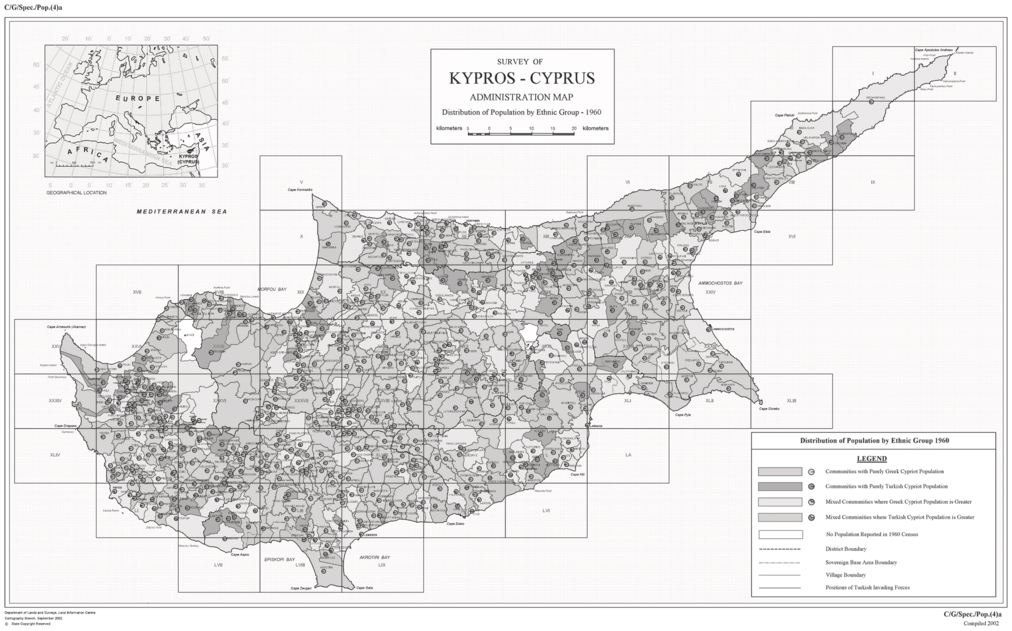
Figure 4.1 Long description
The administrative map of Cyprus from 1960 depicts the ethnic distribution of populations across the island, with different community types. The legend specifies various community classifications, purely Greek Cypriot, purely Turkish Cypriot, mixed communities where Greek Cypriots are the majority, mixed communities where Turkish Cypriots are the majority, and areas with no population recorded in the 1960 census.
The intercommunal conflict of 1963–1964 and the war of 1974 impacted the lives of many people in Cyprus in both direct and indirect ways, as shown in Table 4.1. The data come from a large-scale bicommunal representative survey conducted in 2007 (Psaltis, Reference Psaltis, Marková and Gillespie2012), but of course it is expected that with passing time the percentage of people with direct experience of the conflict will become progressively smaller.
The two communities became geographically completely segregated in 1974. In 1983, the TC leadership established a breakaway state in the northern part of Cyprus internationally recognised only by Turkey. UN resolutions condemned the establishment as an illegal act, and the European Court of Human Rights in 1998 has described the self-styled ‘Turkish Republic of Northern Cyprus’ as ‘a subordinate local administration of Turkey operating in Cyprus’.
The status quo on the island today is that of division, with UN forces patrolling the buffer zone between the two communities. On 23 April 2003, the TC leader announced that he would unilaterally partially lift the travel restrictions that had been enforced since the Turkish intervention/invasion of 1974,Footnote 3 and which had prevented GCs from crossing into the northern part of Cyprus and TCs from crossing into the south. From 2003 to 2020 more checkpoints have been opened, totalling nine by 2024.
In April 2004, one year after the first opening of checkpoints, GCs rejected a UN-sponsored plan (Annan Plan) to reunite Cyprus under a Bizonal Bicommunal Federation (BBF) by 76% whilst Turkish Cypriots accepted it with 65%. Later that year Cyprus as a whole joined the EU, but the acquis communautaire was suspended in the north pending a solution of the Cyprus problem. After the failed UN effort in 2004, negotiations stalled for a few years, and with the election of new leadership in the GC community in 2008 (leftist Demetris Christofias), full-fledged negotiations restarted. After some progress was made, they stalled again in 2010 with the election of a nationalist leader Derviş Eroğlu in the TC community (see Figure 4.2 for a timeline of negotiations). In 2013, the presidential elections in the GC community brought to power Nicos Anastasiades who, as the leader of a right-wing party (DISY), took the risk back in 2003 to support a Yes vote on the Annan Plan under a generally negative climate for solution in the GC community engineered by the late Tassos Papadopoulos. However, little progress was achieved until 2015 when the TCs returned to the negotiating table as their leader a pro-reconciliation veteran politician Mustafa Akinci, which gave a new impetus to the negotiations, with significant progress made in the 2015–2017 period to reach a comprehensive settlement on the basis of a BBF. The two teams of negotiators led by Anastasiades and Akinci discussed the issues of (1) governance and power sharing, (2) property, (3) territory, (4) economic affairs, (5) European Union affairs and (6) security and guarantees.
A timeline of negotiations on the Cyprus problem.
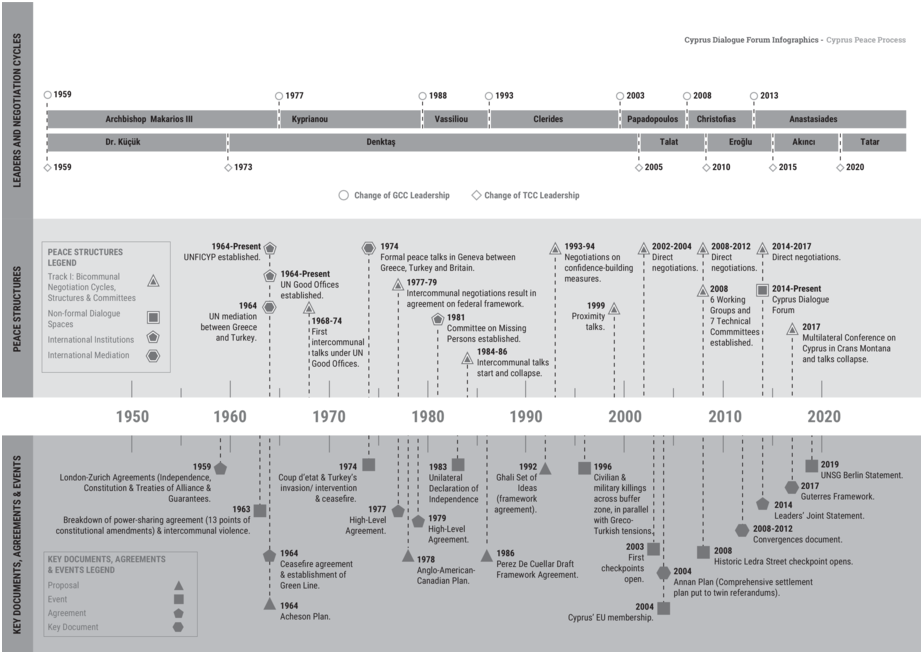
Figure 4.2 Long description
The infographic is divided into three main sections. The section titled Leaders and Negotiation Cycles lists leaders from both the Greek Cypriot and Turkish Cypriot communities, with transitions in leadership and negotiation periods. The section titled Peace Structures provides a legend describing various mediation efforts, bicommunal negotiations, and the involvement of international peace institutions such as the United Nations Peacekeeping Force in Cyprus (U N F I C Y P) and the United Nations Good Offices. The section titled Key Documents, Agreements and Events categorises and chronologically places significant proposals, agreements, and diplomatic events, including the London-Zurich Agreements of 1959, the High-Level Agreement of 1977, the Annan Plan of 2004, and the Guterres Framework of 2017.
In 2017, UN Secretary-General António Guterres brought all interested parties and Guarantor countries (Turkey, Greece and the United Kingdom) into a summit at Crans Montana, Switzerland. There he proposed the so-called Guterres package as a give-and-take peace plan that would essentially give political equality to TCs, end Turkish military occupation and replace the security provisions of the three Guarantor powers with an implementation agreement.
In June 2017, the effort came to its climax in a summit of the two communities, Greece, Turkey and the UK as the guarantor powers, and an EU representative taking part in the negotiations to ensure that any solution would be in line with the European aqui. The Conference on Cyprus in Crans Montana was widely seen as the closest the parties involved in the Cyprus issue had ever come to reaching a settlement. After a week of intensive negotiations, however, in the early morning of 7 July, Secretary-General Guterres announced to reporters that, despite considerable efforts, the Conference was closing without an agreement. Soon after that Guterres called on all parties to take time off to reflect and asked the leaders of the two communities to jointly agree on terms of reference for negotiations to resume.
The period of no negotiations continues until today, however; in the meantime, a negative development emerged which is the claim by Turkey and the new TC leadership of Ersin Tatar, elected in 2020, that they have changed policy and now support the right for TCs to a ‘sovereign equality’, which for GCs is tantamount to claiming a two-state solution instead of a BBF and is considered a non-starter for negotiations.
A detailed chronology of change of leadership in the two communities and milestones in the negotiations can be seen in Figure 4.2, as produced by the Cyprus Dialogue Forum.Footnote 4
The Ontogenesis of Social Representations of the Cyprus Issue as Significant Structures
Given the multifaced nature of the Cyprus problem, representations of the Cyprus issue relate to all dimensions of the problem, such as property, territory, power sharing, representations of the other community of Cyprus and involved countries, representations of the past and so forth. However, if one wants to understand the core of the representation in each community, then the best way to approach this is to study the educational processes in the two communities that produce new political subjectivities in relation to the problem.
In Cyprus, where two communities with distinct linguistic and religious backgrounds are geographically divided across ethnic lines for almost half a century, different social representations have evolved in each community, especially regarding the Cyprus problem and its history. Such narratives are politically manipulated by various political elites and centrally controlled by the administrations for the corresponding ‘national collective struggles’ in each community. The systematic use of rituals, national symbols (see Psaltis, Beydola, Filippou & Vrachimis, Reference Psaltis, Beydola, Filippou, Vrachimis, Dezalia and Moeshcberger2014), memorials, commemorations, national struggle museums (Makriyianni, Reference Makriyianni2006) and politically driven manipulation of the media (Avraamidou & Psaltis, Reference Avraamidou and Psaltis2019) and the educational system all contributed to the creation of different social representations of the past. The teaching of history in public schools reflected a specific official master narrative in both communities (Makriyianni, Reference Makriyianni2006; Makriyianni, Psaltis & Latif, Reference Makriyianni, Psaltis, Latif, Erdmann and Hasberg2011; Papadakis, Reference Papadakis2008; Psaltis, 2012a) that largely contributes, as we will show below, to prejudice and distrust towards members of the other community when uncritically internalised by the individual.
According to Papadakis (Reference Papadakis2008), the central nationalistic historical narrative in the GC textbooks is one that begins with the arrival of the Greeks (14th century BC) in Cyprus that leads to its Hellenization, where the moral centre are the Greeks (of Cyprus) and the major enemy are the Turks. The plot concerns a struggle for survival by Cypriot Hellenism against foreign conquerors and the tragic end is the ‘barbaric Turkish invasion’ and occupation of 37% of Cyprus.
The corresponding TC narrative is one that begins with the arrival of the Turks in Cyprus (in 1571 AD), the moral self are the Turks (of Cyprus) and the major enemy are the Rums (GCs).Footnote 5 The plot concerns a struggle for survival by the Turks of Cyprus against GC domination. The war of 1974 marks a happy ending with the ‘happy peace operation’ by Turkey in Cyprus which saved TCs from a pending union of Cyprus with Greece following the Greek military coup.
Such official narratives clearly promote a particular form of collective remembering of victimisation by others (Psaltis, Reference Psaltis2016). Adherence to the official narratives is not only predictive of threats (of both a realistic and symbolic form and of group esteem threat), but through these threats prejudice is increased and further distrust is created between the two communities in Cyprus. This is eventually reflected in reduced wish to co-exist with the other community in the future (Psaltis et al. Reference Psaltis, Franc, Smeekes, Ioannou, Žeželj, Psaltis, Carretero and Čehajić-Clancy2017). The ontogenesis of the social representation of the Cyprus issue for GCs is mostly a process of internalising a feeling of one-sided victimisation which is formed quite early on. This can be mostly attributed to the educational policy of ‘I do not forget and I struggle’ (Den xechno kai agonizomai). This finding is of crucial political importance, since it reveals that the educational system in the GC community despite its proclaimed aim of reunification of Cyprus was producing dynamics that undermine the spirit of reconciliation and reunification.
This policy in the case of the GCs emerged a few years after the mass displacements of 1974. It did not happen immediately after, since in the first months after the Turkish invasion internally displaced persons believed that they would soon return to their properties with a swift solution of the problem. However, after a few years they realized that this might take much longer. There was also a public discussion about the need for a long-term struggle (makrochronios) and the attempt to cultivate a sense of unity and patience to achieve the goal of everybody returning to their properties.
A primary objective of the GC educational system since 1974 has been to educate the new generation of GCs about the part of the island that is occupied by Turkey (Christou, Reference Christou2006) and instil the desire for a reunification of the island. A major challenge for the GC educational system since 1974 has been to impart the values of ‘humanism, justice, freedom and democracy’ while remaining faithful to the ‘preservation of our national and cultural identity’ (Christou, Reference Christou2006). The aims can be clearly seen in a policy brief sent to the educators by the Ministry of Education in 1994 that stated as the aims of ‘I know, I do not forget and I struggle’ the following:
1. To help students learn about the occupied places, to keep the memory of the occupied places alive and to cultivate the hope and will to struggle for the return;
2. To help students know and understand human rights as they have been recognised by international organisations and to work towards their implementation in Cyprus; and
3. To help students appreciate and respect all the elements (tradition, customs, manners, merits) that promoted the ethnic and physical survival of GCs and to participate in the struggle against the dangers faced by their country.
Figure 4.3 shows a billboard at an elementary school exhibiting the artefacts relating to Den Xechno (‘Do not forget’).
Artefacts relating to Den Xechno on a billboard at an elementary school (retrieved from https://episkopiprimaryschool-denksexno.blogspot.com/p/blog-page_20.html).
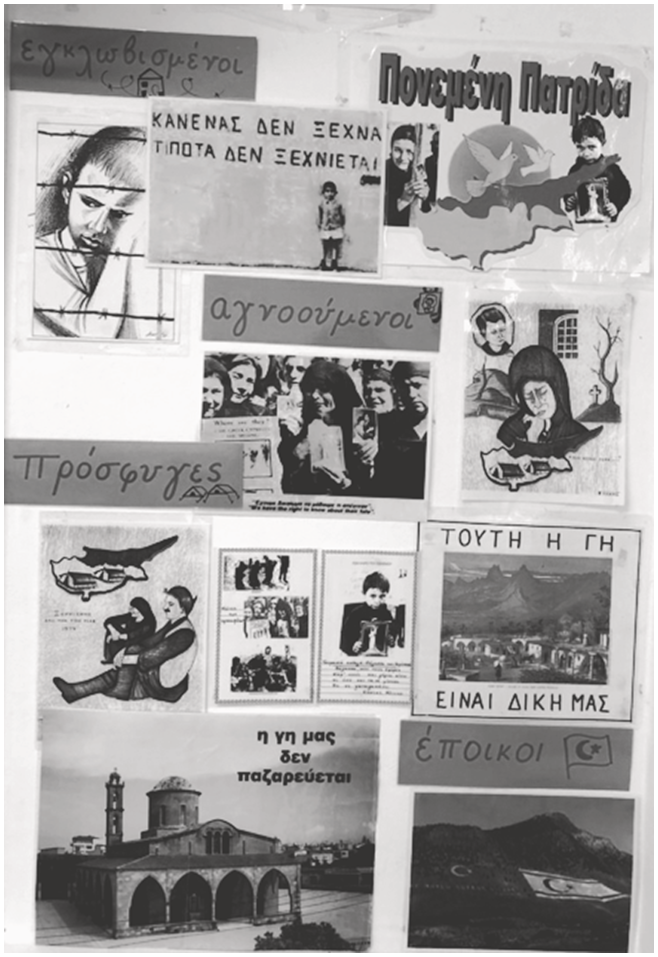
This policy has been criticised by academics in Cyprus, who see a number of problems in its rationale. According to Christou (Reference Christou2006), soon after 1974, the Ministry of Education, with curricular changes, directed teachers to incorporate in their courses references to the events of 1974, the plight of GC refugees and the importance of remembering the part of Cyprus that was occupied by Turkey. This is how Christou (Reference Christou2006) described the activities around the policy:
At the elementary school level, three books aid teachers in creating lesson plans on these themes and integrating them in courses such as Greek language, history, geography, music, and the visual arts. The books are filled with pictures, personal stories and poems about life in the occupied part of the island before 1974 and the refugees’ experience of displacement. Though less regularly, such references continue up to the level of the gymnasium and the lyceum. In general, however, everyday life in Greek Cypriot schools is infused with commemorations of 1974, and all school celebrations (at the primary and secondary levels) include direct references to the Cyprus Problem.
Whilst this bombardment of students with a one-sided victimisation narrative and ‘overdetermination of meaning’ is present from the genetic social psychology point of view, it should not be assumed that all children will passively internalise this master narrative in the same way. Still, as we show below, the template of victimisation that is formed in the elementary school years is present in almost all children, and variations of internalisation are premised on the same template (Wertsch, Reference Wertsch2008, Reference Wertsch2021) and potent enough to undermine any positive developments in the progression of historical thinking.
One early research by Chara Makriyianni (Reference Makriyianni2006) shed light on this question when GC elementary school students aged 9–10 were asked to write a short ‘history’ of their homeland in 2002–2003. To put their narratives into a time perspective one has to be reminded that this point in time is already almost 30 years after the events of 1974; the parents of these children were probably in their early 40s or younger, so about one-third of these parents would have been personally displaced (first-generation internally displaced persons) at the age of 10 (see Makriyianni, Reference Makriyianni2006, p. 240 for more details). One child wrote the following:
My homeland is Cyprus. Cyprus is 8000 years old. Its capital is Nicosia. The mother homeland is Greece and we are Greek-Cypriots. In 1974 there was an invasion by the Turks and we were conquered. Some people are now refugees and they long for their villages.
A shorter narrative written by a boy with no reference to Greece read like this:
My homeland is Cyprus. Various people came and conquered us. The last enemies were the Turks. They made war against us and took half of Cyprus.
If we compare the two narratives, we can see one of the main internal ideological tensions in the GC community relating to identity politics. It is the tension between a hellenocentric and cypriocentric position (Mavratsas, Reference Mavratsas1999). The first sees Cyprus as part of Greece whilst the second suggests a more localised sense of moral centre and national identity. However, both at their core share an asymmetrical structure of small and helpless Cyprus as the unprovoked victim of a mighty and expansionist Turkey.Footnote 6
Below are some more excerpts given by Makriyianni (Reference Makriyianni2006) in her PhD thesis exploring the representations of 9–10-year-old GC students born in the 1991–1992 cohort, with data collected in 2002. These accounts are very telling for how this birth cohort constructed meaning of the Cyprus issue at a time when developmentally they start having the capacity for a more expansive horizon that could include out-groups into a more universalising morality.
The representations of the history of Cyprus extracted from these short histories reflect both messages from Den Xehno policy and indirect personal experience of internal displacement objectified in short narratives that make use of narration as traditional or exemplary types in Rusen’s terms that serve memory functions of a projected future of a ‘free Cyprus’ but devoid of any mention of TCs and their presence in Cyprus:
My homeland is Cyprus. In Cyprus the war between England and Cyprus took place, the Turkish invasion and now we are enslaved by the Turks. Many soldiers were killed; there were orphans, missing people, refugees, and enslaved people. I love my country very much. (Boy from urban school, Date: 10/11/2002)
My homeland is Cyprus. I was born and have lived here for nine years. Cyprus has made loads of wars. Even today is enslaved. Turks do not allow us to go to the other half. My country is a small island. I love her a lot and I do not want to live in any other country. (Girl from urban school, no. 146, Date: 10/11/2003).
My homeland was enslaved by the Turks because Turks came and took away from us our prettiest cities, we made a lot of war and thus we were enslaved. The war, when the Turks came, it was horrific because they took our mother from her house and forced her to leave Morfou with only the clothes she wore. (Girl from urban school, no. 512, Date: 8/3/2004)
My homeland is Skylloura, I think it’s there. It is wonderful, especially in the old times before Turks destroy it in 1974. Skylloura is one of the best villages of Cyprus. (Boy from urban school, no. 132, Date: 10/11/2002)
My homeland is Cyprus and many years ago the Turks came and made war on us. In the end they won and now they have seized almost half of Cyprus. We fought with all our efforts for our country. We were very brave and courageous. I was very sad when they took Cyprus. I used to remember some of the soldiers of Cyprus but now I have forgotten about them.
Around the same period (before the opening of the checkpoints in 2003) a study by Christou (Reference Christou2006) asked 15–18-year-old high school GC students to discuss what they make out of the Den Xechno slogan. Christou (Reference Christou2006) also notes how ideology can operate under a ‘hidden curriculum’, with the tacit ways in which knowledge and behaviour are constructed, outside the usual course materials and formally scheduled lessons. Christou rightly identifies a major weakness of the way the Den Xechno policy operates: ‘The re-united and independent Cyprus is the professed goal, but, as I am arguing here, this goal, for the new generation, represents an official though largely empty imagination. Young Greek Cypriots reiterate “our desire to go back to our homes,” but this is where their imagining of the future stops: the vision of re-united communities, which is crucial for a peaceful solution, does not exist’ (p. 299). She concludes, ‘The political subjectivity of the new generation of Greek Cypriots is constituted through a historical definition of struggle that oscillates between armed resistance and the silent persistence of memory.’
To sum up, the core of the significant structure of social representations is formed quite early in childhood. This can be described as an asymmetrical triadic configuration of loss of control and one-sided victimisation as shown in Figure 4.4. The shorter the distance in the other–object relationship, the stronger is control of the object by other. Such a configuration of loss of control of property depicted in Figure 4.4 in the case of the Cyprus issue is naturally – and expectedly – resisted by GCs, causing anger and resentment for the Turkish army, Turkey and the Turks.
A triadic configuration of loss of control.
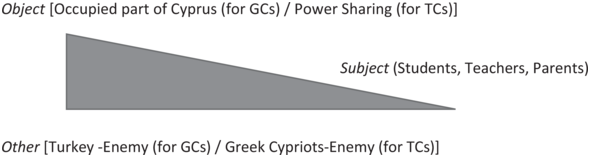
Figure 4.4 Long description
The diagram is structured into three categories. Object, Other, and Subject. It features a triangle pointing to the right, dividing these perspectives. The Object category highlights differing viewpoints: Greek Cypriots perceive the occupied part of Cyprus as their concern, while Turkish Cypriots focus on power-sharing. The Other category depicts perceptions of opposition, with Greek Cypriots viewing Turkey as an enemy and Turkish Cypriots seeing Greek Cypriots as an enemy. The Subject category includes groups involved in shaping opinions and understanding of the situation, specifically Students, Teachers, Parents.
What is most striking in the significant structure in the case of Greek Cypriots is the absence of TCs from the picture. To some extent this is due to the double minority syndrome nature of the Cyprus problem (Michael, Reference Michael2007). TCs feel like a minority in the face of the substantial GC majority on the island; GCs feel like a threatened minority in the face of mainland Turkey 40 miles from the shores of northern Cyprus.
However, the empty imagination of GCs is very problematic, as it has no place for TCs who are not actors in the history of Cyprus. The objective possibility, in Goldmann’s terms (see Chapter 1) of this representation, is exhausted into the quest for freedom for Cyprus to be achieved not by a compromise solution that will include the re-establishment of power sharing with TCs, as envisioned by the UN-supported plan since 1977 in the form of a BBF, but rather with the withdrawal of Turkish troops and the end of occupation of Cyprus. If anything becomes clear about TCs by the end of their school trajectory in public school around 17 years of age (unless they challenge this narrative) is that TCs were given too many privileges in the 1960 constitution that were unfair to the majority (GCs) and that the TCs rebelled against the legal state in 1963–1964. It thus suggests that a majoritarian unitary state that offers TCs minority rights would be all TCs could ask for. As we show in the following sections, even after a history education reform that took place in 2010 and a new curriculum written in 2016, and despite some important changes in the methodology of history teaching, the one-sided victimisation narrative remained intact with important consequences for the progression of historical thinking and orientation towards the other community.
The orientation towards otherness (the tip of the iceberg taking the form of prejudice) formed by this Den Xehno policy is clearly seen in the work of Makriyianni (Reference Makriyianni2006), where the same representative sample of the 9–10-year-old students in 2002 who offered their short historical narratives of Cyprus were also asked to state their feelings towards both TCs and Turks. The results regarding feelings towards TCs were as follows: 5% stated that they like TCs a lot, 21% stated that they like TCs, most (40%) stated they neither liked nor disliked TCs, 21% stated that they do not like TCs and 12% that they do not like them at all. So, on the whole, the dominant feeling was neutral to negative, which can be explained mostly through the absence of knowledge about TCs as a community, their history in Cyprus since 1571 as well as their rightful claims to power sharing in Cyprus as the co-founding community of the 1960 constitution.
When it came to the attitude towards the Turks, the dominant feeling was significantly different: more negative to very negative, with the majority of students (54%) stating that they do not like the Turks at all and 25% stating that they do not like them. Only 16% reported neutral feelings and 5% said that they like the Turks. Only 1% said that they liked Turks a lot, which is only expected given that Turkey and the Turks occupy the position of the enemy and the Turkish state that of a barbaric occupier in the hegemonic narrative.
In the case of TCs, the asymmetrical configuration of control would concern the loss of political equality and power sharing in 1963 accompanied by a threat of marginalisation as the weaker community by GCs who would be the main enemy ‘other’. These are the reasons much research undertaken just after the opening of the checkpoints and before contact started showing its positive effects that TCs showed higher levels of threats, prejudice and distrust towards the GCs compared to the levels of threats, prejudice and distrust experienced by GCs towards TCs (Psaltis, Reference Psaltis, Marková and Gillespie2012) (see Appendix A and Table B.1 in Appendix B for the methodology of data collection of all studies on which the data are based of trend figures in Appendices A and B).
Opening of Crossing Checkpoints in 2003: A Historical Turning Point?Footnote 7
This earlier brief historical framing of the Cyprus issue makes clear that the opening of crossing checkpoints on 23 April 2003 was a unique situation of rupture (Zittoun et al., Reference Zittoun, Duveen, Gillespie, Ivinson and Psaltis2003) of the taken-for-granted no-contact status quo that continued for 30 years since 1974.Footnote 8 Any meaningful analysis of contact in Cyprus needs to keep this historical fact in perspective. People had to face the very tangible dilemma: to cross or not to cross (see Demetriou, Reference Demetriou2007). They had to master the unfamiliar situation of deciding whether or not they would be visiting their houses, now occupied by other people or troops, or places of highly symbolic value and nostalgia that they had left under life-threatening conditions. Crossing the checkpoints and coming into contact with people now occupying a home one left 30 years ago can be an emotionally tormenting but also ideologically laden and filled with tensions that create questions of the capacity of intergroup contact to lead to the reduction of prejudice, the promotion of trust and the reconstruction of the representations of the Cyprus problem and its hegemonic narrative under these unique conditions.
In the context of Cyprus, a meta-regression of a large number of studies (Psaltis & Ioannou, in preparation) undertaken in both communities of Cyprus since 2006 revealed that quantity of contact between GCs and TCs relates to reduced levels of prejudice in both communities. In fact, the mean effect size identified in both communities (r = –0.37 for GCs and r = –0.32 for TCs) is substantially higher than the mean effect size of r = –0.22 reported by Pettigrew and Tropp (Reference Pettigrew and Tropp2006) in their meta-analysis.
In the same year (2003), there was a change in leadership with the election of Tasos Papadopoulos in the GC community with the support of leftist party and pro-reconciliation AKEL in 2003. One year later Cyprus also joined the EU. Both of these developments as well as the opening of the checkpoints led to a reconsideration of the educational policy of ‘I do not forget and I struggle’ and signalled the beginning of an effort for a general educational reform that seemed, at that time, promising in revising the ethnocentric master narrative.
In a November 2003 circular issued by the Ministry of Education and Culture we find elements of attempting rapprochement with the TC community and mention of a need for a solution to the Cyprus issue that would secure GC needs:
[S]o that all the inhabitants of our homeland live peacefully and brotherly in a new European Cyprus, under conditions of security, peace, freedom, prosperity, and justice.
[A] solution that will secure the end of occupation, the withdrawal of occupying troops and settlers, the refugees’ return to their homes, the disclosure of the missing people’s fate, and the re-unification of our island.
With the rejection of the UN plan by the GC leadership of Papadopoulos in 2004, history education reform was put on hold until 2008. This was due to a resurgence of nationalist feelings and pressures from the church not to revise history textbooks, as it was seen by them as an effort to ‘dehellenise’ GCs (Makriyianni, Psaltis & Latif, Reference Makriyianni, Psaltis, Latif, Erdmann and Hasberg2011). However, when the leader of leftist party AKEL Dimitris Christofias was himself elected president of the Republic of Cyprus in 2008 (see Figure 4.1), the educational reform effort obtained a new impetus. In the TC community the election of a left-wing government in 2004 made some radical changes in the history teaching in terms of syllabus and methodology by promoting both multi-perspectivity and a more Cypriot-centric orientation in new history textbooks that replaced the previous nationalistic separatist teaching with clear messages of co-operation between the two communities (Papadakis, Reference Papadakis2008; Makriyianni et al., Reference Makriyianni, Psaltis, Latif, Erdmann and Hasberg2011; Perikleous et al., Reference Perikleous, Onurkan-Samani and Onurkan-Aliusta2021).
A New Policy by the Ministry in 2008 and Resistance to Change: New Co-operative Structures in Place
The newly elected GC leader Demetris Christofias and a leftist and pro-reconciliation ideological partner Mehmet Ali Talat met soon after the February election in March 2008 and agreed to start fully fledged negotiations. They established six working groups and seven technical committees that would work towards facilitating co-operation between the two communities in various spheres of the everyday life (health, crime, environment, cultural heritage, opening of more checkpoints, etc). They also decided to reopen Ledra Street in divided capital Nicosia as a confidence-building measure. Between May and July 2008, the leaders reaffirmed their commitment to the negotiation framework of a Bizonal Bicommunal Federation with political equality. They agreed that this partnership would have a federal government with a single international ‘personality’, as well as a TC constituent state and a GC constituent state of equal status. They agreed in principle on single sovereignty and citizenship. Finally, they agreed that the solution reached would be put to separate simultaneous referenda. The provision of referenda is crucial for the importance of the present book as one that explores the views of possible voters. This is the reason that all research reported in this book (with the exception of school samples) is representative of the two communities sampling people aged 18+ with voting rights. These are the people that will define the future of Cyprus in case of a new referendum in relative autonomy from their political elites.
In August 2008, before the commencement of the school year, the GC Minister of Education, Dr Andreas Demetriou, an academic and a developmental psychologist who had worked for years on developing a neo-Piagetian theory of intelligence, sent the aims of the 2008–2009 school year to all teachers. The first aim referred to the ‘cultivation of a culture of peaceful co-existence, mutual respect and co-operation between Greek and Turkish Cypriots’. This was the first time in the history of Cyprus that such an aim was set by the Ministry of Education, and it was promoted whilst the Den Xechno policy was still in place. This was bound to lead to tensions given that many teachers saw the two aims as incompatible whilst others attempted to redefine the meaning of the ‘I do not forget’ policy in a way that the two could become compatible (Charalambous, Charalambous & Zembylas, Reference Charalambous, Charalambous and Zembylas2014) with the spirit of reconciliation. Chistodoulou (Reference Christodoulou2018) offers empirical findings about the sources of resistance to efforts for history education reform in the GC community through an analysis of interviews, policy documents, newspapers, speeches and circulars revealing a pronounced link between education and security. She identified discourses of resistance that present changes to history textbooks as a betrayal and threat to the nationalist struggle, a process that, she argues, constitutes the securitisation of history textbooks. Such resistances can be further understood by an analysis of the positions in the representational field of the Cyprus problem in Cyprus, as they form significant representational structures that, as documented below, can be largely mapped on the three significant structures described in Chapter 2, Table 2.1 of social relations of constraint (submission or domination) and co-operation.
Identity Positions in the Representational Field of the Cyprus Issue
Reactions to Demetriou’s proposals ranged from enthusiastic support to vehement rejection (see Makriyianni, Psaltis & Latif, Reference Makriyianni, Psaltis, Latif, Erdmann and Hasberg2011). As in the case of the reception of psychoanalysis in France at the end of the 1950s, one could similarly understand the reception of this new policy depending on the ideological positions within the GC community. These reactions can be rendered intelligible by identifying the various significant structures or transindividual subjects in the representational field of the Cyprus issue. In an earlier research project in 2006–2007 we explored intergroup dynamics in Cyprus and representations of the past. There we had the chance to explore the representations of the Cyprus issue in adults 18 years old and over, in relation to the role of intergroup contact between GCs and TCs and several variables that tap the quality of intercommunal relations in Cyprus. This was a large-scale questionnaire survey with a representative sample from both communities (N = 800 GCs and N = 853 TCs) and was made possible by the partial lifting of travel restrictions across the UN buffer zone after 23 April 2003. The questionnaire in particular explored the amount and quality of contact between members of the two communities, national identification, trust, forgiveness, threats (realistic, symbolic, distinctiveness threat), intergroup anxiety, perspective taking, intergroup salience and attitudes towards the other community (see Psaltis, Reference Psaltis, Marková and Gillespie2012 for details).
Attitude towards ‘motherlands’ (Turkey and Greece) and wish for the use of their symbols (flag, national anthem) by the corresponding community was labelled as Helleno/Turco centrism. On the contrary, Cypriocentrism (Mavratsas, Reference Mavratsas1999) was operationalised as the wish for use of Cypriot national symbols and civic identity and feelings of detachment from motherlands. Furthermore, there were questions that explored the representations of the history of the Cyprus problem and in particular the interpretation of the events of intercommunal strife in 1963–1967, the nature of the Cyprus problem and its causes and views concerning organisations like the GC EOKA and the TC TMT that fought for enosis (union with Greece) and taksim (partition), respectively. Finally, the questionnaire included questions that tried to tap the level of acceptance of a variety of possible solutions to the Cyprus issue (Bizonal Bicommunal Federation, Unitary state, Keeping the Status Quo, Two-states solution).
An analysis of this set of data from a social representations perspective (see Psaltis, 2012a) made clear that different representations of the Cyprus issue have indeed evolved between the two communities as they have been geographically divided across ethnic lines for almost half a century. Importantly, however, this research identified three different identity positions within each community: the pro-reconciliation/co-operative, the communitarian and the ethno-nationalist position. From the results, it appeared that in both communities, people in the pro-reconciliation clusters are people who show a very positive orientation towards members of the other community on a series of variables (trust, contact, forgiveness) and who also score lower on perceived threats and intergroup anxiety as proposed in the third row of our model in Table 2.1.
In fact, the Pro-reconciliation clusters in the two communities are almost identical in the profile of their views expressing peace activists, bicommunal non-governmental organisations (NGOs) who have the support of intergovernmental organisations such as the CoE, UN and the EU who advance a social representations project (see Bauer & Gaskell, Reference Bauer and Gaskell1999) of joint collective action for the solution of the problem. In Lucien Goldmann’s terminology, the objective possibility of this significant structure was that of the vision of a reunited Cyprus. These individuals covered the political spectrum from pro-reconciliation left to cosmopolitan right and NGOs doing bicommunal work, although the majority came from leftist parties. The stronger Cypriocentric views of this position suggested that the aim was to form a superordinate political community of Cypriots that includes both GCs and TCs, a solidarity formed on either a basis of cultural similarity between the two communities or a civic form of constitutional patriotism.
The communitarian position in each community was described by more adherence to the ethno-national symbols (flag, national anthem of ‘motherlands’) and was related to high levels of perceived realistic and distinctiveness threats as well as lower levels of trust and contact with the other community. In the two communities these positions share structural similarities, as they represent a form of banal nationalism (Billig, Reference Billig1995), where the ethical horizon of the concern of participants is constrained by the limits of their own community fed by the mundane reality of everyday living in two geographically separated communities for decades. Politically this position is related to parties of the patriotic left or the so-called centre traditionally hard-line and maximalist on the Cyprus that often express a wish for a federation with the ‘right content’ (not accepting political equality, or demanding both the withdrawal of Turkish troops and settlers or immigrants who came to the north of Cyprus after 1974) and sometimes veer towards an antifederalist stance altogether using the majoritarian discourse of ‘one man, one vote’ (Loizides, Reference Loizides2016, Reference Loizides2020).
Lastly, the ethno-nationalist position was expressed in the two communities with ideas of Greek and Turkish ethno-nationalism forming a mirror image of each other where the ethical horizon is a larger ethnic community that includes the mainland nationals but excludes the other community in Cyprus, as suggested by the low levels of intercommunal contact, trust and forgiveness and high levels of prejudice and threats. Politically this position is related to the conservative right-wing DISY and extreme right-wing parties (Allileggyi, ELAM).
To return to the reactions to the new policy of 2008, these came from the communal and the ethnonationalist stance at the grassroots level. At the institutional level it came from EOKA fighter organisations and the church who again saw an effort by the leftist government to ‘dehellenise’ the island. Reactions also came from officials in the ministry itself who were close to the church and the so-called maximalist centre parties against the policy of the minister, since they saw an opportunity to attract votes from the right of the political spectrum, given that in the first two years of the policy the right-wing party of Anastasiades (who supported a Yes vote during the 2004 referendum) did not resist the policies. However, after a few years, DISY started resisting the efforts for a compromise solution, and by 2010, when the TCs elected a new nationalist leader, DISY had already withdrew their support of the pro-reconciliation policies of the ruling party (both for the solution of the problem and the educational policies). Their resistance began when they realised that they started losing votes to the so-called centre maximalist parties and the newly established far-right ELAM that was the sister party of the neo-Nazi Golden Dawn in Greece. By 2010, AKEL was left on its own politically to materialise any positive changes in the educational system and then succumbed to resistance without actually achieving any substantial change in the revision of the history curriculum and textbooks or in their pro-intergroup contact policies. The fact that the newly elected TC leader Derviş Eroğlu changed the pro-reconciliation history textbooks and brought back the nationalist narrative did not help either (Perikleous, Samani & Aliusta, Reference Perikleous, Onurkan-Samani and Onurkan-Aliusta2021). The only positive residue of this process was a new history curriculum in 2010 which emphasised a disciplinary understanding (the way knowledge is constructed in the discipline of history), the writing of a new history textbook for third graders in the elementary school along these lines and some production of teaching proposals and history teaching seminars. However, the ethnocentric narrative and selection of context in the curriculum stayed the same.
In fact, as it can be seen in Appendix A, 2010 was the year that most GCs showed negative feelings towards TCs. In the summer of 2011, a large amount of ammunition and military explosives self-detonated at the Mari Naval Base, killing 13 people. This development brought the Demetris Christofias government into a very difficult position and isolated AKEL more, which eventually retreated from any controversial reform efforts. Before the end of the summer, there was a reshuffle in government, and Andreas Demetriou was replaced by Giorgos Demosthenous who did not make any effort for change in history teaching. In 2013, there were presidential elections. Demetris Christofias lost power and Nicos Anastasiades from right-wing DISY was elected as the new president of Cyprus with the support of DIKO. The new minister of education came from DIKO and actively obstructed the efforts for any reform on history education, annulling secondments of educators in the ministry who were seen as a threat to the official master narrative.
Sociogenetic Change: Transformation and Continuity of Significant Structures from 2013 to 2023
On 11 February 2014, the leaders of the two communities, Nicos Anastasiades and Derviş Eroğlu, issued a joint statement expressing their willingness for fully fledged negotiations aimed at reaching a comprehensive settlement of the Cyprus problem. This led to the resignation of DIKO from the government in the south of the divide. In 2015, there were elections in the TC community that brought to power Mustafa Akinci, the pro-reconciliation veteran politician who gave a new impetus to the negotiations to resolve the Cyprus problem, with significant progress made in the 2015–2017 period. This election could have potentially resulted in significant revision of the official master narrative in the field of history teaching as well; however, the lack of support from the GC leadership of Nicos Anastasiades on this particular issue on initial proposals by Akinci and concentration on track-one negotiations by both leaders until the Crans Montana failure in July 2017 meant that history education reform was not prioritised in the end. This potential for significant change came by the establishment of the Bicommunal Technical Committee of Education by the leaders of the two communities with administrative support from the Good Offices team of the UNSG special adviser on Cyprus Espen Barth Eide, who since 22 August 2014 was appointed in this position by former UN Secretary-General Ban Ki-moon.
The Bicommunal Technical Committee on Education
On 15 November 2015, 32 years had passed since Rauf Denktaş, the TC nationalist leader, unilaterally declared the independence of a state in northern Cyprus, unrecognised internationally (TRNC). The anniversary fell on a Sunday, prompting schools in the southern part of Cyprus to permit students to hold protests the next day, 16 November. Despite ongoing peace talks improving bicommunal relations, some students affiliated with the far-right ELAM party (aligned with Greece’s Golden Dawn) attacked cars with TC registration plates in central Nicosia. These incidents seemed coordinated and occurred on three different occasions.
The leaders of the two communities and the education minister in the south, Dr Costas Kadis, student unions and various political parties (excluding ELAM) condemned these actions and expressed solidarity with the victims. TC leader Mustafa Akinci called for the arrest of those responsible. By 18 November, four students from a Nicosia lyceum were detained.
Subsequent public discourse in newspapers and on social media highlighted the need for educational systems to foster reconciliation, not division. This incident catalysed a political momentum for establishing a new Bicommunal Technical Committee on issues of education. The ensuing week saw intense communication, including phone calls and emails by academics and activists, advocating for a bicommunal educational committee.
Key figures in this lobbying effort included TC Technical Committees coordinator and ex–vice president of the Association for Historical Dialogue and Research, Dr. Meltem Onurkan Samani, and people close to the bicommunal NGO, Association for Historical Dialogue and Research. They, along with associates of Andreas Pirishis, GC coordinator of the Technical Committees, pushed for this initiative.
Dr Samani was tasked by the two leaders to write a proposal outlining the committee’s purpose. Given our previous co-operation with Dr Samani in the context of the intercommunal NGO Association for Historical Dialogue and research, she trusted me to write a first draft of the mandate for the committee. After feedback and revisions from Dr Samani, the final decision on the text was made during a leaders’ meeting a week after the incidents, their sixth meeting in November 2015. Following this meeting, a UN representative by the end of November announced the formation of the Bicommunal Technical Committee on Education. The mandate announced was the following:
1. Review existing research and good practices in education in Cyprus and abroad and undertake new relevant research on how education can contribute to conflict transformation, peace, reconciliation and the countering of prejudice, discrimination, racism, xenophobia and extremism.
2. Work on devising a mutually acceptable mechanism for the implementation of confidence-building measures in schools of the two educational systems and promote contact and co-operation between students and educators from the two communities.
3. Recommend best policy options and course of action that will allow coordination of the two educational systems, thus contributing to a viable, sustainable and functional bicommunal, bizonal federation.
An interesting aside to the origins of the committee and its early-day workings is that a number of current and former members of the bicommunal Association for Historical Dialogue and Research (AHDR) who were appointed to this committee proposed an early study of the curriculum (including history) in the two communities supported by a number of academics in the committee and Professor Andreas Demetriou who was also appointed in the committee. Unfortunately, in the early days of the committee there was resistance from the official GC side to proceed in this direction. A few months later it looked like both official sides decided to not touch sensitive issues such as history in the context of the work of this committee, and the curriculum study component has never materialised.
Nevertheless, the Bicommunal Committee achieved several commendable successes such as establishing a mechanism, which involved co-operation with the education ministries on both sides, to address without any prejudice to the issue of official recognition of the one side by the other. It made possible the launching of the bicommunal peace education project IMAGINE praised by the UN Secretary-General in his reports on the UN operations in Cyprus.Footnote 9
The IMAGINE programme was implemented by the Association for Historical Dialogue and Research at the ‘Home for Co-operation’ under the auspices and scientific guidance of the Bicommunal Technical Committee on Education. The programme was implemented between 2017 and 2022. The activities of the IMAGINE programme were successfully implemented with the participation of approximately 6,000 pupils and 800 teachers from all communities in Cyprus. During the programme, pupils engaged in pedagogical activities in which GC pupils came into contact with TC pupils of the same age, accompanied by their teachers. Activities were held in the UN-controlled area of Ledra Palace during school time. The programme’s pillars included an anti-racist workshop in schools and contact preparation (before the meeting with pupils from the two communities). IMAGINE trainers would visit classrooms and engage children in experiential activities discussing issues of stereotyping, discrimination and racism as components of a culture of violence and preparing the conditions for a bicommunal meeting at the Home for Cooperation. Then the pupils would participate in bicommunal activities that took place in three languages (Greek, Turkish, English), with the option of repetition.
The committee also produced a report (Final Report of the Technical Committee for Education: An Evaluation of the Current State of Affairs in Education, Challenges, Good Practices and Suggestions, October 2017) of the state of affairs in education (on racism, xenophobia, history teaching, intergroup contact between the two communities in and out of schools, anti-racist education and intercultural education). The report also put forward suggestions about the production of educational material, establishment of contact schemes and a coordinating body for educational standards of the two educational systems. The second part of the report also provided a summary of recorded good practices in the two educational systems, and the third part outlined good practices and policies in the international arena that can be applicable for Cyprus.
However, these proposals were not taken up by the two leaderships when these lines were written in early 2024, despite calls by the UNSG to do so. The Committee is yet to make further progress on the issue of history textbooks also, and no substantial suggestion or delivery from the Committee on history education has yet taken place. Some have argued that the absence of history education work is due to ‘concerns about possible reactions caused by changes that could be considered as threatening to the official narratives’ (Perikleous et al., Reference Perikleous, Onurkan-Samani and Onurkan-Aliusta2021, 133). This is therefore another example of how the dominance of the two conflicting ethnocentric narratives does not allow changes in the teaching of history. After the 2020 election of TC leader Ersin Tatar and his consequential policy shift away from the pursuit of BBF, the Bicommunal Technical Committee’s work is almost frozen and the IMAGINE project was unilaterally stopped by the TC leadership in late March 2022. It is worth noting that a few days before this unilateral freezing of the programme, several ultra-nationalist newspapers in Turkey published front-page articles against the IMAGINE project, depicting it as a GC propaganda mechanism to promote BBF in Cyprus.
It should be recognised, nevertheless, that some minor changes in the methodology of history teaching seem to have taken place in the TC community more recently. In 2013, the TC educational system, under the aegis of the TC educational authorities and funded by the Turkish embassy, initiated the Basic Education Curriculum Development Project (TEPGEP) (Perikleous et al., Reference Perikleous, Onurkan-Samani and Onurkan-Aliusta2021). This project was managed by a TC university and marked the first development of a basic education curriculum for Cyprus history within the TC educational framework. The curriculum, titled ‘Cypriot and Turkish Cypriot History Curriculum’ for lower secondary education, was designed to be student centred, drawing on ‘Progressivism and Reconstructionism’ as its guiding educational philosophies, with the goal of enhancing historical thinking. A team comprising Turkish and TC academic historians and history teachers authored three colourfully illustrated school textbooks, but the island’s periods of intercommunal conflict are depicted from the TC viewpoint still.
As Perikelous et al. (Reference Perikleous, Onurkan-Samani and Onurkan-Aliusta2021) state, despite the curriculum’s stated objective of fostering historical thinking, the textbooks primarily deliver factual knowledge and offer limited scope for students to engage in constructing their own understanding or developing critical, historical and reflective thinking skills.
History teachers in Cyprus and beyond are thus correct in noting that what history education is able to deliver ‘may be limited by more culturally powerful representations of a past variously preserved in folk traditions and memorials, perpetuated by the heritage lobby, or invented by the media and entertainment industries’ (Perikleous & Shemilt, Reference Perikleous and Shemilt2011, pp. 12–13). And the argument is correct in more than one way: not only because representations of the Cyprus issue and its history raise resistance in efforts to reform the curriculum as we have seen before, but also in how history teaching is done in the classroom. In a PhD project completed recently by Georgiou (Reference Geogriou2020) at the Institute of Education at University College London under the supervision of Professor Arthur Chapman, it was clear that 17–18-year-old GC students assimilated conflicting historical accounts into the official and practical past they know, since the educational system is such that it does not encourage the distinction between collective memory and history. Georgiou notes that ‘the past is mythologised, fetishized and eternalised, and consequently reproduced as history through curricula, textbooks and the hidden curriculum’. In her work she shows, for example (with data collected in the years 2014–2015), how the interpretation of two conflicting accounts (a key historical thinking skill) about the events of 1974 in Cyprus is assimilated into the official master narrative and textbook narratives students have already internalised in the earlier years of their school career.
Positions in the Representational Field in 2017
Given all these ups and downs in political developments after 2013, the positive climate of 2015–2017 but also the failure of Crans Montana in July 2017, the blame game that followed and the parallel positive but slow movement in the educational systems, one might wonder if the positions in the representational field discussed earlier changed in any way the three positions presented earlier in this chapter (ethnonationalist, communitarian and pro-reconciliation/co-operative) in the representational field of the Cyprus issue in the GC community. To explore this topic, in 2017 we collected data a few months after the Crans Montana failure and proceeded with a similar mapping of the positions in the representational field to the one that was conducted 10 years earlier in 2007. The corresponding two-step cluster analysis in the GC community was interesting because – compared to the similar analysis of 2007 (Psaltis, Reference Psaltis, Marková and Gillespie2012) – a new position was detected that was absent a decade earlier.
The new position was a partitionist position, surprising for GCs given that this was historically equivalent to the Turkish and TC nationalists claim to taksim. But given the apparent increasing acceptance of the idea of partition by some right-wing circles around the GC leader or at least scepticism towards BBF at that time,Footnote 10 this fact might have freed some people from the guilt of expressing an anti-normative view. One might wonder why, if this position was present since 2007 (see Figure A.5 of Appendix A), it was not revealed in the 2007 cluster analysis. This is probably due to the fact that the communitarian position in 2007 already included the seeds of an emerging alienation from TCs in the younger generation, but the correlations between the variables that we identified in Table 2.1 were not articulated clearly enough to form a distinct position in cluster analysis. But most importantly, self-enhancing values related to the golden passport bonanza were not widespread either.
Thus, it is possible that back in 2007 some younger members of the communitarian position without emotional bonds to the north, when asked whether they would accept a two-state solution, answered in the affirmative – without, however, formulating a structured set of beliefs, values and attitudes that would support this position. However, 10 years later, delegitimisation of the previous leftist government and the following financial benefits from development of the real estate sector by a right-wing government flooded by millions from the golden passport scheme (mostly in Limassol and Paphos districts), a more machiavellian and cold-minded neo-liberal stance was already crystalising, freed from the master narrative but motivated by self-enhancing values of power, stimulation and hedonism as described in the second row of Table 2.1 and captured by an expression allegedly used by Anastasiades during this period when he was asked about the solution of the Cyprus issue: ‘I Lemesos peta tziai eseis milate mou gia to kypriako’ (‘Limassol is flying, and you are talking to me about the Cyprus issue’). The fact that a publication by Gregoris Ioannou (Reference Ioannou2020) suggested that many of the GC elites and laypeople normalised partition in their consciousness in this period made the importance of exploring the existence and ‘epidemiology’ of this view in public opinion more urgent.
The four positions that emerged in 2017 were:
1. Pro-reconciliation/Pro-BBF – federalist mentality
2. Neutral towards TCs – favouring a unitary state / BBF as a solution of necessity / against partition
3. Ambivalent/Polarised attitude towards TCs – partitionist
4. Xenophobic/Hellenocentric – anti-federation
It must be stated from the outset that all four groups in their majority agree that the Cyprus problem should be solved through compromise and reject the idea of armed struggle. There is a very small percentage of extremists who do not reject armed confrontation; these constitute the hard core of the xenophobic/Hellenocentric/anti-federal bloc, most of whom bear a grudge about the military defeat in 1974. Moreover, it should be noted that 58% of the entire sample would accept BBF either as a satisfactory solution or as a solution of necessity, while about 70% clearly reject a two-state solution.
Analysis of the first position (18.8%), those clearly in favour of the UN-supported BBF and reconciliation and involved in bicommunal work and NGOs working for reconciliation, reveals the following characteristics: very positive attitude towards the other community, high level of trust, quality contact with the TC community, and low levels of perceived realistic and/or symbolic threats. Identity issues are distinguished by a more Cypriot-centric approach, and this position sees federation and the single state as satisfactory solutions and rejects both the two-state solution and the status quo. The majority believe that the church should not interfere in educational matters. The majority are educated, male and believe firmly in the need for reconciliation and forgiveness. Compared to the other three groups, this group has the least anxiety about the functionality of a future BBF state, Turkey’s intervention in a federal Cyprus and Turkish settlers acquiring citizenship in the new state. Together with the second group, they express the lowest levels of fear that GCs are not ready to co-exist with TCs. On the contrary, they have the highest degree of hope that, in the event of a solution, relations with Turkey will be normalised and economic development and free movement will take place throughout Cyprus. In terms of historical consciousness, one could find both the critical and the genetic types in this position, the hallmark being the future-oriented imaginary of a united Cyprus that overcomes division through co-operation between the two communities.
The second group (Neutral towards TCs), which is also the most numerous (43.1%), maintains a neutral attitude towards TCs and has neutral levels of qualitative contact and trust towards TCs but has a particularly negative attitude towards Turkey and Turkish settlers. Although they express high levels of perception of realistic and symbolic threats, and view the single state as an ideal solution to the Cyprus problem, they are ready to accept federation as a compromise and explicitly reject the two-state solution (90% of the group). About one-third of this group accept the status quo, but the rest reject it. Considering the hopes and fears relating to a possible solution on the basis of BBF, this group profile is very similar to that of the rapprochement group but reveals significantly higher fears for the functionality of the state, Turkey’s possible intervention in the future federation and a significantly lower degree of hope that, in the event of a solution, relations with Turkey will be normalised and economic growth will take place. Another subdivision within this group is those who support federation either as a satisfactory solution or as a solution of necessity (about 63%). This group is estimated to be between 18% and 23% of the general electorate, and they also seem to be influenced by the prevailing climate (optimism or pessimism) in Cyprus at any given time, thus being more susceptible to changing in-group norms compared to the first group. In terms of historical consciousness, it has not completely made a break with the traumatic past, as there is still the fear of Turkish ‘expansionist’ plans, since the reading of history is mostly exemplary. They see Turkey as always being a lurking threat, despite their more neutral disposition towards TCs and their wish for reunification of Cyprus. For them, ideally, TCs would one day demand the end of occupation of Cyprus together with GCs. This would be the condition of full acceptance of TCs as partners in overthrowing Turkish occupation. At the same time, those who see BBF as a painful compromise and not a satisfactory solution find it difficult to accept political equality with the smaller community and share power.
The third group (Mixed attitude to TCs) (18.6%) is comprised by an increased number of youth, and their profile reflects the decades-long geographical separation of the two communities. Thus, this position is expressed by primarily younger, more educated, female and those with few emotional ties to the occupied part of Cyprus. In one sense they have become emancipated from the Den Xechno policy of ‘all refugees should return to their homes’ but not from the idea of ‘expansionist Turkey’. Thus, in the absence of contacts with TCs and increased symbolic threats, stereotypes for the present state of the north of Cyprus and political apathy, they fail to see the usefulness of reunification, which could be a risk to some educated young professionals who are competing for jobs in a shrinking job market.
Although this group has, on average, neutral feelings towards the TCs, and their support comes from the big two parties (AKEL and DISY, who lost hope on the return of refugees or a solution), there is also a minor part (coming from the extreme right-wing party ELAM) with extreme negative emotions towards TCs. The group shows significant distrust and expresses feelings of symbolic threat as they feel different to the TCs; they prefer the two-state solution or maintenance of the status quo to federation or the unitary state. However, about 50% said they could accept the BBF mainly if it were necessary (one may assume if it took the form of a decentralized or ‘loose’ federation as proposed by some centre-right politicians and later in 2019–2021 by GC leader Nicos Anastasiades).
It is important to note the age of this group and consider how the educational curriculum may have contributed to their positions. A series of surveys in the GC community have shown a positive correlation between age and the quality of bicommunal relations / readiness to live together with TCs. Specifically, the older the participant, the higher the wish for a solution – and vice versa (Psaltis et al., Reference Psaltis, Halperin, Loizides, Stefanovic, Leshem and Cakal2021). This relationship is largely due to the youth never having lived with the other community, and therefore not knowing TCs (unless they have established contacts or friensdships after the opening of the checkpoints). Indeed, in another research with inhabitants of formerly mixed villages we found that those who had contacts before 1974 or came from villages with higher intergroup contact and less conflict were, in 2010, less likely to show prejudice and distrust towards members of the other community (Kende et al., Reference Kende, Psaltis, Reiter, Fousiani, Cakal and Green2022).
Although there is a sense of Cypriotness in the historical narrative of this partitionist position which indicates some distance from the Hellenocentric orientation of the narrative, it does not go beyond the official narrative of ‘Turkey has always wanted to conquer the whole of Cyprus’ and shows great ignorance of the mistakes or atrocities committed by the GC community against the TC community. Those who do recognise these atrocities might approach them with a cynical attitude of ‘things like that unfortunately happen in wars, the Turkish army did the same’, making perspective-taking a part of a Machiavellian sociocentric approach. Through these moral disengagement strategies (Psaltis et al., Reference Psaltis, Franc, Smeekes, Ioannou, Žeželj, Psaltis, Carretero and Čehajić-Clancy2017) the sense of victimisation remains unchanged, due in large part to the educational stance of ‘I Know, I Do not Forget, I Claim’ that is taught from primary school onwards. Cyprus history is taught in a way that encourages perceptions of realistic and symbolic threats, bias and lack of trust (Makryianni & Psaltis, Reference Makriyianni and Psaltis2007; Psaltis et al., Reference Psaltis, Franc, Smeekes, Ioannou, Žeželj, Psaltis, Carretero and Čehajić-Clancy2017). Regarding the hopes and fears in relation to a scenario of a solution on the basis of BBF, this group expresses considerably more concern about the functionality of the state, the intervention of Turkey in the future federation and/or problems with Turkish settlers who will acquire citizenship in the new state. They also present, together with the fourth group, the least hope that, in the event of a solution, relations with Turkey will be normalised and economic development and free movement will take place throughout Cyprus. It is worth noting that this group has the greatest fear of living together, declaring that ‘we are unprepared as a society’, ‘we did not grow up to live peacefully together’ and ‘nationalists will mess things up’.
The emergence of this position should be read as age related and partly a longer-term cohort effect and not a recent period effect. It expresses the view of some people from the post-1974 generation that were raised in a partitioned geographical space who have normalised in their mind the partition of the island, mostly due to significant gaps in the cultivation of relationships with the TC community in their educational system for years (with the exception of the recent post-2003 opening of the checkpoints and the IMAGINE years).
The fourth and final group (Xenophobic/Hellenocentric) (19.5%) believes in the continuation of traditional Greek nationalism in Cyprus, characterised particularly by anti-Turkish and negative feelings towards the TCs (whom they often equate with Turks); shows the greatest mistrust, very high perceptions of symbolic and realistic threat arising from difference, and feelings of superiority arising from a generalized ethnocentric, Helleno-centric and xenophobic ethos (also against immigrants). This group is strongly opposed to federation as a solution to the Cyprus problem and sees the ideal solution to the Cyprus problem as the unitary state or ‘liberation’, while a small extreme right-wing nationalist fraction still seeks union with Greece (enosis). However, almost half of this group sees the maintenance of the status quo or even the two-state solution as the second-best solution to avoid federation (about 40% of this group). It should be noted that despite the general anti-federal feelings in this group, one-third reported they could accept the federation as a solution of necessity.
Most in this group are middle-aged, and therefore, apart from their traditional Hellenocentric roots, they are also influencing many in the younger generation through extreme nationalist groups and various ‘right-wing’ football clubs. This group also identifies as the most religious and the most frequent churchgoers, so they may also be influenced by church preachings. Regarding the possible solution of the Cyprus problem on the basis of BBF, this group does not differ significantly from the previous partitionist group, since it is also characterised by a high degree of fear that there will be problems with the Turkish settlers who will acquire citizenship in the new state. They also have a lower degree of hope that, in the event of a solution, relations with Turkey will be normalised and economic development and free movement will take place throughout Cyprus. Moreover, this group believes most strongly in the lack of functionality of the federal state, due to possible interventions by Turkey.
The Role of Ontogenetic and Sociogenetic Changes in Values in the Greek Cypriot Community
Expanded analysis of sociogenetic changes of values in Cyprus further supports the claim that the detection of the fourth partitionist position in the 2017 data could be attributed to age and partly cohort-generational change of values given their crucial role as the organising principles of representations. In Appendix C an analysis of the Round 9 ESS data (collected in 2018) on Shwartz 10 values from the GC community can be found, along with their relationship with various sociodemographic characteristics. The relationships are what one would expect from findings in other parts of the world (Shwartz, Reference Schwartz2021). The social vs personal higher-order focus has a clear relationship with age. The younger the people, the more they prioritise personal (Achievement [AC], Power [PO], Hedonism [HE], Stimulation [ST], Self-Direction [SD]) over social (Universalism [UN], Benevolence [BE], Security [SE], Tradition [TR], Conformity [CO]) values.
Modelling of Age–Period–Cohort effects in our lab using ESS Round 9 data for Cyprus (Nicolaou, in preparation) reveals that for some of the values the relationship of values with age can be attributed more clearly to an age effect. Cohort effects, however, are also present (more on this distinction in the next chapter), having to do with increasing individualism over decades in Cyprus with the exception of cohorts born after 1995, for which a reversal of the trend is noted. In particular, after 1995, a unique pattern related to Cyprus is observed where social values start gaining importance. There is, of course, variation in social values, and not all could be seen as conducive to co-operative relations. Self-transcendence values (BE and UN), for example, are related to more benevolence to in-groupers and out-groupers. The increase in these values that we find in those born after 1995 and in the period of the last decade could be related to generations who in their school and formative years experienced Cyprus as an EU member state. However, in the same cohorts and period there is an increase in the importance of tradition and security values, which could be related to a more threatening Turkey after the Crans Montana failure and the financial crisis of 2012. Self-enhancement values in the same cohorts and period follow the opposite trend of losing importance. Given these general trends in the recent period, the partitionist position identified in the cluster analysis of 2017 should be read as either (a) expressing a minority of people around the golden passport bonanza and not the wider public or (b) a time-lagged expression of increased individualism that mostly affected younger cohorts but not the too young ones born after 1995, following a U-shaped curvilinear relationship with age. This hypothesis will be further explored later in this chapter and the next one.
We also see in Appendix C that the health status of the individual significantly relates to almost all values, with poorer health relating to more social values. This is clearly related to a life stage change of values as an age effect. There is also a similar pattern in relation to gender where females seem to be more oriented towards social values (e.g. Security and Benevolence) compared to men. Women also score significantly lower than men on Self-Determination, Stimulation and Hedonism. These three values probably relate to the influence of religion on women, since there are significantly more religious women than men in the GC community. There is also a clear pattern of findings relating to education of the participant as well as maternal and paternal educational levels, with higher education leading to higher personal focus values at the expense of social focus values, especially conservation values. The pattern of correlations for income is also similar to the education findings, suggesting that higher socio-economic status plays the predicted role of promoting individualist values as in Inglehard and Welzel (Reference Inglehart and Welzel2010) as well as in the work of Henrich (Reference Henrich2020).
Interestingly, political orientation on the left–right spectrum is largely unrelated to values, with the only exception being the value of Benevolence with the left being higher in benevolence compared to the right. On the contrary, religiosity is clearly related to specific social values, with conservation values being higher in more religious people. Interestingly, Universalism is unrelated to religiosity in the GC community, which is different from findings in other European countries. Xenophobic attitudes relate to higher conservation values and lower self-transcendence values. Intergroup contact with TCs relates to higher Openness to Change values and lower self-enhancement and conservation values, which supports our proposal for the relationship between the co-operative significant structure and self-transcendence values in Table 2.1 of Chapter 2.
The findings presented in Appendix C also shed light on the role of communication technologies. The more participants watch, read or listen to news related to politics, the higher they score on social values (especially conservation values). This is probably reflecting youth alienation from politics in Cyprus. On the contrary, the more hours spent on the internet, the more they prioritise personal (especially stimulation and hedonism) over social values. This is an important finding, as it suggests high internet use is related to more individualist values. The findings are suggestive of a negative impact of excessive social media use to the extent that it constricts the ethical horizon of the youth into self-enhancement rather than self-transcendent values, unless of course they use social media to interact with the other community. Indeed, we found evidence that people of Cyprus who have Facebook friends from the other community had lower prejudice levels (Zezelj et al., Reference Zezelj, Ioannou, Franc, Psaltis and Martinovic2017).
In some of our work in progress (Psaltis & Georgiou, in preparation) we found evidence of linkages between values and various social psychological variables relating to intercommunal relations in Cyprus. Specifically, we run hierarchical regression models to predict prejudice levels towards TCs, trust and stance on various forms of solution (BBF, Two States, Unitary state, Continuation of Status Quo) from various demographic variables and all 10 values of Appendix C. It was revealed that age, paternal and maternal educational level, position on the ideological spectrum, contact, rejection of immigrants and health status predicted prejudice levels. Interestingly, the direction of maternal and paternal educational levels was in opposite directions when predicting prejudice and trust, with those having more educated mothers showing more prejudice and less trust towards TCs compared to those with less educated mothers. On the contrary, those with more educated fathers showed less prejudice and more trust compared to those with less educated fathers.
Universalist values predicted less prejudice over and above the demographic variables. The findings for predicting trust were similar, with the only exception that two values predicted prejudice. One was again universalism in the expected direction and the other was security. The higher the score for security values, the higher were the distrust levels. Similarly, higher universalism increased support for BBF and lowered support for Two States and continuation of the Status Quo.
The age-related effects, however, are not clear-cut, as we show below and in the next chapter. Sometimes they are non-linear, taking a U shape, with very young people and older people who lived in a united Cyprus before 1974 being more similar to each other on some measures than compared to people aged between 35 and 55, at least in the GC community. So, the legitimacy of the idea of partition seems to be restricted in the minds of a minority of some younger or middle-aged GCs and political elites who became complacent with the spoils of power irrespective of age. Sometime this position is expressed with the words ‘a wall in the middle and that’s it’ (toicho mes tis mesi tziai kanei), but the present findings clearly show that we cannot talk about normalisation of partition (cf. Ioannou, Reference Ioannou2020) in the GC community as a whole, since this view represents only about 20% of the population and seems to be contained in a young professional’s middle-aged group who are probably already in well-paid jobs, largely unpolitical, narcissistic and individualist usually in the right wing of the ideological spectrum. This position in the representational field is closer to what we described in Chapter 2, Table 2.1 as a significant structure of Machiavellian domination.
Youth and the Cyprus Issue in 2020
The consequences of the empty imagination of GC youth that we identified in 9–10-year-old GC students studied in 2002 by Makriyianni (Reference Makriyianni2006) (the 1991–1992 cohort) can be captured 17 years later when this cohort is about 26–27 years old in a research just published that compared the views of 18–35-year-olds with the views of 36–54-year-olds and those aged 55+ on the Cyprus issue in 2020 (Psaltis et al., Reference Psaltis, Halperin, Loizides, Stefanovic, Leshem and Cakal2021), as well as another research by Dizdaroglu (Reference Dizdaroglu2020) who explored the views of the younger generation of the two communities about the Cyprus issue.
This recent research has pointed to certain generational differences about representations of the Cyprus problem, the feeling of hope and wish for solution, political culture and intergroup relations in research participants of the age group 18–35 in both communities (Dizdaroglou, Reference Dizdaroglu2020; Psaltis et al. Reference Psaltis, Halperin, Loizides, Stefanovic, Leshem and Cakal2021). In both communities there is an increased sense of alienation and low participation in politics and election processes in this age group, which seems to be related to a feeling of distrust for political parties, the government and even the parliament. This seems to be because the youth feel non-recognised as active citizens by the parties but also, as we know from the findings of the European Social Survey (ESSR9) data collected in 2018–2019, the GC youth in their vast majority do not feel confident in contributing to politics. In the GC community this has to do with the low levels of agency that institutional structures in Cyprus support (educational system, the church and some traditional family values that keep the youth at the parental house sometimes until they get married).
On bicommunal relations, there is more recognition by TC youth than GC youth of the importance of the opening of checkpoints and more frequent crossing to the south (about 50% of TCs cross regularly) for shopping or excursions. GC youth cross much less often and are not so keen on the opening of more checkpoints. This is probably because they are trapped into the discourse of some GC ‘centre’ political parties (EDEK, DIKO) but maximalist on the Cyprus issue who claim that ‘crossings normalise partition’ or ‘offer moral recognition and financial support to the non-recognised state in the north’, whereas the reality of social psychological findings is that the opposite of this discourse is true. On a more optimistic note, half of the youth in both communities state as a reason for not visiting the other side that ‘it just didn’t happen’, thus not evoking hatred or ideological resistance to the idea of having intergroup contact (Dizdaroglu, Reference Dizdaroglu2020). Similarly, the majority (around 60–70% in both communities) approve of socialisation of members of the two communities under various conditions, even when some of them assume member of other communities being in positions or roles of higher status (e.g. boss at work) (Dizdaroglu, Reference Dizdaroglu2020). This shows that GC youth would support contact and relationships between the two communities but not crossings of GCs to the other side, which they see as having negative consequences for the collective struggle of not allowing the recognition of the illegal state in the north of Cyprus. At the same time, the lack of a federalist mentality in the youth is also present, as there is a low acceptance of the idea of a president of the country from the other community (Dizdaroglu, Reference Dizdaroglu2020), which can be explained by the content transmitted through the educational system as discussed earlier. This is probably related to educational content of the last years of the lyceum, since in the research of Kyriakides (Reference Kyriakides2020), as students moved from the gymnasium to the lyceum, the percentage of those who disagreed with the idea that GCs and TCs can govern Cyprus together increased.
In Psaltis et al. (Reference Psaltis, Halperin, Loizides, Stefanovic, Leshem and Cakal2021) we found that the GC youth (aged 18–35) compared to older people are less likely to wish for peace, less likely to expect that peace will be achieved and less likely to support peace-promoting steps. Importantly, however, this is not because they are more prejudiced or distrustful than older people. In fact, they score significantly lower on the ethos of conflict scale compared to the older age groups (Psaltis et al., Reference Psaltis, Halperin, Loizides, Stefanovic, Leshem and Cakal2021). So, their weakened willingness to take positive steps should be interpreted more as the result of alienation and apathy than fanaticism. This is supported by another finding that they are less likely, compared to older people, to attend events where the Cyprus issue is discussed. The youth are also more uncompromising compared to older people, although the majority is still in favour of the idea that the solution to the Cyprus issue should satisfy the needs of both communities (around 70% compared to around 85% in older people).
There is also less enthusiasm in the youth about taking steps to promote BBF compared to older people. The less appetite for BBF is seen in another question where they are asked if they wish for a mutually agreed-upon solution on the basis of BBF. On this question 47.8% expressed no wish and 52.2% expressed a wish for a solution on the basis of BBF. In older age groups the wish to solve the issue by going the BBF route was much higher at close to 70%.
Overview of the Impact of Political Developments on Public Opinion and Students Views in the Period 2003–2023
In the GC community there were a few periods since 2003 when most of the people expressed negative feelings towards TCs (2005–2010) and other times when they were positive (2015–2017) (see Appendix A), particularly when the leaders of the two communities exhibited willingness to negotiate in good faith to resolve the Cyprus problem, made public appearances together and publicly showed trust in each other (Karayianni & Psaltis, Reference Karayianni and Psaltis2023). It is hard to believe that such a big portion of the population shifted their views in such a short period of time due to a deep ideological conversion. A more likely candidate is to attribute the change to a change in norms that mostly reduced people’s readiness to express prejudiced views during this period. Long-term positive changes are, however, still noticeable (Yucel & Psaltis, Reference Yucel and Psaltis2020a, Reference Yucel and Psaltis2020b) and mostly have to do with continuing contact and an increasing number of people from both communities that established intergroup friendships – a condition that, according to Pettigrew, satisfies the optimal conditions of intergroup contact. For example, by 2020, about 50% of TCs and 30% of GCs stated that they had at least one friend from the other community.
An additional factor contributing to this significant improvement, given that it was also accompanied by improvement of attitudes of students towards other out-groups (e.g. immigrants) compared to older research, could be related to the impact of EU and CoE policies after Cyprus joining the EU in 2004. Indeed, since 2008, the Ministry of Education, Sport and Youth (MOESY) in Cyprus has been actively promoting peace education more generally, anti-racist education and human rights education. These initiatives, even if they did not often directly relate to the Cyprus problem, included revising curricula and textbooks, altering education policies and participating in European programmes focused on human rights and peace education. For example, the MOESY has integrated human rights, anti-racist and intercultural education into the health education curriculum since 2011. This curriculum, applicable at all educational levels, includes success indicators addressing issues like bullying, violence, social identity, respect for diversity and peaceful co-existence. Teacher manuals, such as ‘Discovering the Elephant’ and Compasito (Council of Europe), support the implementation of these themes. The ministry in the south also gave a lot of attention to teacher training through policies at the Cyprus Pedagogical Institute (CPI) that provided training for teachers to work effectively in multicultural environments. In 2022, various in-service seminars were offered, covering topics like anti-racist policy, managing bullying and school violence, and empowering teachers in these areas. An anti-racist policy was also implemented since 2014–2015 that conceptualises racism broadly (sexism, homophobia, ethnic-related prejudice) and includes steps for schools to handle racist incidents. Additionally, an upgraded educational policy focused on the smooth integration of pupils with migrant backgrounds, emphasising intercultural approaches and teaching Greek as a second language. Finally, the MOESY and CPI have been involved in European projects like the ‘EU/CoE Pilot Projects Scheme on Human Rights and Democracy in Action’. These projects provided resources and training for teachers to address controversial issues holistically. The CPI also participated in implementing the Council of Europe’s Descriptors of Competences for Democratic Culture (CDC), adapting these to the Cypriot context. The ministry in the south of the divide also collaborated with other organizations on human rights education related to antisemitism and refugees. For example, ΜΟΕSY organised educational visits in collaboration with the Vad Yashem International School of Holocaust Studies for teachers and students once a year and a special conference for teachers on the pedagogical practices of the Holocaust, and a specialised educator gives in-service seminars on the subject for students and teachers. Finally, since 2017, the CPI, in collaboration with the UNHCR Cyprus Office, has organised three teacher-training conferences on issues of racism, nationalism, migration and asylum in education.
The broader picture in both communities is one of a positive shift in the period 2007–2017 in both prejudice reduction, trust building (Yucel & Psaltis, Reference Yucel and Psaltis2020a) and the acceptance of BBF as a compromise solution (see Appendices A and B). One cannot stress enough the positive effects of intergroup contact after the opening of the checkpoints that could be seen as a mechanism reversing the negative impact of alienation of the two communities through passing time.
In the recent years there are also a number of findings from TC students and youth and their attitudes towards GCs from the work of Shenel Husnu and her collaborators. Despite the fact that for TC children the GCs fit the picture of the enemy image (Mertan & Husnu, Reference Mertan and Husnu2014), they still found that imagined contact (Husnu & Crisp, Reference Husnu and Crisp2010) with university students and indirect contact interventions through storytelling at the elementary school can decrease prejudice levels towards GCs (Husnu et al., Reference Husnu, Mertan and Cicek2018). They also found that contact and positive in-group norms about contact can predict forgiveness in youth (Stathi et al., Reference Stathi, Husnu and Pendleton2017).
The working of various bicommunal technical committees and the positive climate between the two leaders in the period 2015–2017 also played a positive role in the formation of positive in-group norms. The positive climate was also transferred in education of the GC community as revealed by the study of Kyriakides who collected data in 2017 from public schools for ages 7 to 17. In his findings 44% of GC students expressed positive feelings towards TCs, 33% were neutral and 23% showed negative feelings towards TCs. Regarding feelings towards Turks, there was also an impressive improvement compared to the findings reported in 2003 by Makriyianni (Reference Makriyianni2006): 32% expressed positive feelings, 28% showed neutral feelings and 40% showed negative feelings. This was probably also due to changing in-group norms by a positive policy introduced in 2015 and 2016 in the GC community that connected peace education in relation to the TC community with general anti-racist educational policies announced by a circular to educators at the beginning of the school year as one of the general goals. An anti-racist policy could more easily facilitate a universalising expansion of the ethical horizon of students as described in Chapter 1, Figure 1.2.
In the same work (Kyriakides & Psaltis, Reference Kyriakides and Psaltis2023) exploring the views of GC students between 7 and 17 years old we also explored the role of Piagetian relations of constraint and co-operation with significant others (peers, family and teachers). We found low correlations between prejudice and social relations of constraint and co-operation in the interpersonal sphere in middle childhood but not adolescence, and additionally the increasing influence of both positive and negative norms in the expression of prejudice in early and late adolescence. The other interesting finding from this research is the emergence of resistance in early adolescence against positive norms, which is moderated by the strength of subgroup identification (proud of being GC). Early adolescents who have very high level of identification with the GC identity are not influenced by positive in-group norms by significant others, suggesting friendships with TCs, but they are influenced by negative norms. In contrast, in middle childhood, when interpersonal relations of constraint and co-operation play a stronger role in predicting prejudice, subgroup identification moderates the link in the opposite direction by enhancing the role of positive in-group norms in predicting prejudice reduction. As predicted by Piaget and Weil (Reference Piaget and Weil1951) and proposed in Chapter 1, Figure 1.2, older children start relating to ideals and political views or even world views that free themselves from the here and now. In the case of GCs, due to the Hellenocentric orientation of the education system, they create elective affinities, imaginary fraternal links with Greeks and Greece, or see Cyprus as part of wider Hellenism. Unfortunately, the historical ideological baggage of this ‘imagined community’ (Anderson, Reference Anderson1991) is often linked with ultra-nationalist views of the ‘Cyprus is Greek’ kind, which manifests as resistance in accepting normative suggestions to be friendly towards TCs in the context of relationships with the other community of Cyprus, and their strength of identification as simply Cypriot diminishes through their time in the public school system (see Table 4.2 based on Kyriakides, Reference Kyriakides2020). It is important to note that this is not criticism of positive feelings towards any out-group members. It is only when love for Greece translates to exclusive territorial claims of collective psychological ownership (Storz et al., Reference Storz, Martinović, Verkuyten, Žeželj, Psaltis and Roccas2020), as we discovered in recent research, that repercussions towards reconciliation in Cyprus take their toll.
| 7–8 years old | 10–11 years old | 13–14 years old | 16–17 years old | |
|---|---|---|---|---|
| Cypriot | 57% | 55.9% | 55.6% | 40.2% |
| Cypriot Greek | 9.3% | 11% | 8.5% | 8.5% |
| Greek Cypriot | 16.3% | 21.3% | 29.5% | 36.8% |
| Greek of Cyprus | 12.8% | 1.6% | 1.3% | 4.3% |
| Greek | 4.7% | 10.2% | 5.1% | 10.3% |
Ontogenetic Considerations
From an ontogenetic point of view, it could be hypothesised that as children develop from childhood to adolescence, relations at the interpersonal level of social constraint will diminish and relations of co-operation will increase as their agency develops. However, the actual content of the representations they are surrounded by will be mediated by in-group norms. In this transition the role of intergroup contact will be crucial, as it can define the limits of their ethical horizon beyond any cognitive developmental effect of widening of perspectives. The role of semiotic means the content of various symbolic resources (history textbooks, films, etc.) and school rituals in the orientation of the widening ethical horizon seems crucial. The mastery of part–whole relationships and multiple classification is in fact a prerequisite of an understanding of these more complex part–whole relationships. Dual identities also become more comprehensible. For example, in the research by Makriyianni, 9–10-year-olds had difficulty understanding what a Greek Cypriot and a Turkish Cypriot is. Most often, definitions were ‘people born in Cyprus but who came from Greece’ or speak Greek for GCs and ‘people who live in Cyprus but came from Turkey or speak Turkish’ for TCs. GC children have a difficulty understanding when exactly TCs came to Cyprus. Some mistake TCs with Turkish people from mainland Turkey that came to Cyprus after 1974, called settlers by the RoC, which is expected given that they are never taught anything about the history of the TC community except some cursory mentions of the ‘rebellion’ of TCs in 1963–1964 who did not accept the ‘just’ claims of President Makarios to change the constitution that was not functioning and gave TCs ‘over-privileges’. This kind of content is usually taught in late adolescence (lyceum) just before male students get prepared to enlist for military service.
From Marios Kyriakides’s PhD thesis we have some important empirical evidence about the importance of the transition period of 10–11 years old. This is the same age that Piaget identified as the transition to formal operational thinking. On the one hand, progressively fewer children around this age act trapped within the immediate situation and adults’ directions. Similarly, increasingly more children doubt and challenge authority while strengthening relations of co-operation. This suggests that influence from parents and teachers becomes less pronounced but influence from peers becomes more important. Also, individual intergroup experiences are expected to become a more significant source of information compared to earlier years. Indeed, this was verified by Kyriakides (Reference Kyriakides2020) who found that the effects of contact in the period of 10–14 years of age were more pronounced compared to younger children and older adolescents. In a longitudinal study by Hjerm, Eger and Danell (Reference Hjerm, Eger and Danell2018) of 13- and 16-year-olds that were followed for five consecutive years in Sweden showed that the mean level of prejudice in peer groups in both ages predicts their later individual prejudice levels. Additionally, popular students at the centre of social networks were found to be less influenced by the group having lower prejudice levels. Similar effects for parental attitudes were found. Interestingly, political discussions (irrespective of their content) were also found to have a prejudice reduction effect. This suggests that beyond the importance of the content there is also an important role played by the type of social interaction enacted if it takes the form of skills in democratic processes of open dialogue, which in the terms of genetic social psychology is the significant structure of co-operation.
This again would be predicted by Piaget in his idea of social relations of co-operation (open dialogue where all views can be expressed and new knowledge can be synthesised). The role of the formation of historical consciousness, as discussed earlier, is also crucial, and in contexts of protracted conflict, the misuse of history by politicians and the state is a well-known phenomenon that goes hand in hand with the political socialisation in the educational system (Psaltis, Carretero & Cehajic-Clancy, Reference Psaltis, Carretero and Čehajić-Clancy2017).
The role of constraints to developing agency by infrastructures of a traditional historical culture even in a period of positive bicommunal developments became clear in the work of Eleni Kotzamani (Reference Kotziamani2020), who studied the representations of childhood and children’s rights in Cyprus. Through qualitative analysis she found that in the circulars of the Christian Orthodox Church sent to schools by the Archbishop, minimal agency was extended to students through a patronising attitude that allowed children to take initiatives only to the extent that they satisfied the aims of the church to cultivate religious subjects or become willing participants in the collective struggle for the liberation of Cyprus from Turkish occupation. And although most 16-year-old students would resist any effort by the family, church or state to impose on them organised nationalist or religious rituals, there was about 20% of the sample that had internalised a position of social conformity and who had no problem whatsoever with the curtailment of their rights as long as the national cause or religion was served. This position of submission in our proposal (see Chapter 2, Table 2.1) was related in a sample of both 16-year-old students and their educators with a conservative view of childhood relating to diminished agency, higher religiosity, realistic and symbolic threats as well as patriotism and nationalism.
Developments after 2017
This shift towards conflict transformation became more difficult after November 2016 with a break in trust between the two leaders, when the GC leader Anastasiades showed cold feet to proceed to a solution on a few occasions. Around the same period the Greek Minister of Foreign Affairs Nikos Kotzias promoted publicly and through leaks in the GC press that Greece would not agree to any solution that would not annul the securities by Turkey, Greece and the UK and entail the withdrawal of all Turkish troops from Cyprus (see Avraamidou & Psaltis, Reference Avraamidou and Psaltis2019). This was accompanied by a provocative move by the extreme right-wing party ELAM when it requested in February 2017 in parliament that schools commemorate the plebiscite of 1950 for Union of Cyprus with Greece (a request which was not resisted by right-wing ruling party DISY). This created mistrust between the leaders of the two communities. The negotiations nevertheless proceeded with an international summit in June 2017 at Crans Montana in Switzerland to reach a package agreement. The negotiations collapsed in July 2017 amidst both sides accusing one another of not making the necessary final steps to lock a mutually agreed-upon solution. The 2018–2020 period was quite stagnant in terms of bicommunal negotiations, although very active, and filled with tensions, at the regional level. Foremost, Turkey carried out exploration and drilling for natural gas in parts of the Mediterranean that the Republic of Cyprus had delimited, in agreement with other countries, as their own Exclusive Economic Zone (EEZ). Turkey also undertook explorations in contested parts of the Mediterranean where Greece was laying claims, which led the two countries to the brink of a military confrontation in August 2020. At the same time, Turkey, in collaboration with nationalist TC party leaders, threatened to open Varosha under TC administration – a direct violation of the UN Security Council resolutions that demanded the return of Varosha to their rightful GC owners under UN administration. That threat was partly carried out in the days just prior to the elections for a new TC leadership, when Tayip Erdogan with Ersin Tatar, who eventually won the 2020 elections for the TC leadership with Turkey’s heavy backing, announced the opening of a stretch of beach in Varosha for visits without a change in its administration status, going against UN Security Council resolutions.
Research undertaken in 2019 and 2020 showed that the positive sentiments of GCs towards TCs and a BBF solution registered in 2015 and 2016 showed a lot of resilience, as the aforementioned negative developments after 2017 were not reflected as a turn against the wish for a solution and did not lead to worsening of the views towards TCs. This is probably because these events have made it clear to GCs how dangerous for their communal interests is the continuation of the status quo. Confirming this is the fact that from 2019 to 2020 there was a significant increase in the percentage of those who reject the status quo, from 50.8% to 79.4% (see Appendix A). At the same time, the option of a two-state solution also became less acceptable, with the rejection of it growing from 72.4% in 2019 to 80% in 2020, thus shrinking the appeal of the newly identified significant structure of partitionists.
These latest developments would suggest that the bridging social capital built with TCs in the period 2003–2017 formed a certain resilience in GC attitudes towards the other community. Given that these post-2017 provocations are mostly seen as emanating from Turkey and not TCs, one would not expect a deterioration of relations with the other community.
On the other hand, the relationship with Turkey in the minds of GCs is different. Tensions with Turkey about the EEZ are expected to be read by most GCs as fitting into the representation of an expansionist Turkey. At the same time, worsening relations with an emerging regional power like Turkey would probably lead some GCs into a more pragmatic attitude. The real options for them are not a choice between their ideal solution of a unitary state and the compromise solution of a BBF, but the choice between a compromise BBF and a costly permanent partition with no United Nations Peacekeeping Force in Cyprus patrolling the buffer zone, constant tensions with Turkey over gas exploitation and a complete demographic change in the north. At least some people faced with a dilemma of this nature would choose the compromise solution in order to avoid the costs of permanent partition. In the years after Crans Montana, for example, there was a steady increase in those who could either tolerate the BBF as a solution of necessity or accept it as a satisfactory solution (58.1% in 2018, 65% in 2019, 76% in 2020 and 80.5% in 2023). This finding makes the case that support for BBF is regulated by regional developments beyond the quality of intercommunal relations in Cyprus.
Articulating Change at Different Timescales and Levels of Analysis
Genetic social psychology stands in a privileged position to render intelligible both continuity and change in the process of conflict transformation in post-conflict settings and beyond. Observing change in various timescales can render intelligible mechanisms of microgenetic, ontogenetic and sociogenetic change (Duveen & Lloyd, Reference Duveen and Lloyd1990) and possible openings for change. However, it can also identify regressive forces that undermine this potential for change.
Given the complexity of articulating change in these various timescales from a methodological point of view – what Moscovici called ‘methodological polytheism’ – social psychological imagination is necessary. Under the broad umbrella of mixed methodologies, more specific methods look particularly promising. Autobiographical and diary methods (Zittoun & Gillespie, Reference Zittoun, Gillespie, Abbey and Surgan2017) can help interweave significant social interactions, social relations and social influences in a person’s life trajectory with particular turning points in one’s lifespan development whilst at the same time not losing sight of significant historical and technological developments as they unfold in historical time. The analysis of autobiographical narratives has been recently proposed in the context of the Vygotskian tradition as a powerful method for understanding the subjectivity of research subjects and the articulation of microgenetic and ontogenetic processes in their cultural historical context (Ferreira et al., Reference Ferreira, Aléssio and Pedrosa2023; Rego, Reference Rego2022). What one participant selects to narrate as an important point in a life trajectory is important not only for one’s narrative construction of an identity but also because important social relationships in the ontogenetic construction of consciousness and experiences can be located without etic presuppositions. From the perspective of genetic social psychology, we are also interested in how participants change positions in the representational field, as well as instances of significant turning points in one’s life trajectory. In what follows I expose personal details of my own life trajectory to make visible the experience of an internally displaced person from the events of 1974 and maximise the potential of extraction of theoretical insights given that the narration is at the same time an expression of what the theoretical perspective I am developing allows me to make visible. Of course, collecting multiple autobiographical narratives from various research participants can also allow generalisations beyond single-case studies. Such accounts can also be combined with quantitative approaches where meanings behind numbers and correlations can be made transparent. Recently Fonseca and Jovchelovitch (Reference Fonseca and Jovchelovitch2024) applied some of our theoretical ideas in the study of the microgenesis of social representations relating to the reconciliation process in Colombia. The method they used is very promising, since it is a longitudinal qualitative analysis of change with observations, interviews and diaries before, during and after an 11-day visit programme of urban university students to rural communities of ex-guerillas.
Quantitative methods can also help to disentangle age from period and cohort effects provided that there are available datasets, like the European Social Survey (ESS) or World Values Survey (WVS), that afford such analysis. Ethnographic data from the family and educational context that focus on social interactions between peers and students with educators can shed light on the social construction of relations of co-operation and constraint around various objects of representation. Researchers sensitive to the need for interdisciplinary research have recently added important methodological innovations in similar explorations with the use of big data from the internet. For example, Patricia Greenfield used Google’s ngram viewer of Google Books (Michel et al., Reference Michel, Shen, Aiden, Veres, Gray and Aiden2011) (https://books.google.com/ngrams/) to locate value change in China over the last 40 years (Zeng & Greenfield, Reference Zeng and Greenfield2015). If, for example, one runs a comparison of the words ‘co-operation’ and ‘competition’ in the English language edition of books until 2019, it is interesting to note that competition was discussed more than co-operation in the period from 1800 to 1938. With the beginning of the Second World War, co-operation overtakes competition, but then after 1953, with the exception of the period 1968–1979, competition retakes the lead (Figure 5.1).
Comparison of frequency of words ‘co-operation’ and ‘competition’ in the English edition of books until 2019 in ngram viewer.
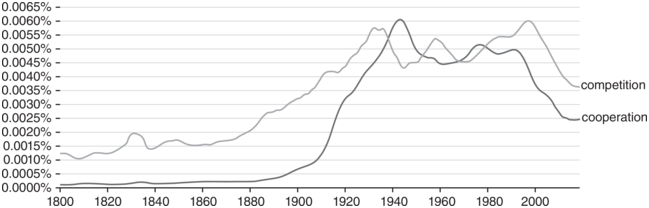
Figure 5.1 Long description
The x-axis represents the years, spanning from 1800 to 2000, while the y-axis quantifies frequency percentages ranging from 0.0000 to 0.0065% in increments of 0.005 units. Competition curve passes through the following points (1800, 0.0012), (1940, 0.0058), (1970, 0.0045), and (2000, 0.006). The cooperation curve passes through the following points (1800, 0.0001), (1940, 0.0060), (1960, 0.0045), and (2020, 0.0025). Values are estimated.
Findings like the one above suggest there are changing trends of representations and significant structures that could be relating to long-term socio-demographic changes but also more abrupt changes that depend on significant historical turning points (war, fall of Berlin Wall, global financial crisis, COVID-19 pandemic, etc.) that capture the attention of the academic community and writers and make some themes more important for discussion and others less so in specific periods.
Disentangling and articulating changes relating to economic and sociopolitical changes in different timescales and different levels of analysis (Doise, Reference Doise1986; Doise, Reference Doise and Valentim2011; Doise & Valentim, Reference Doise, Valentim and Wright2015) is a real methodological challenge. As we have seen in the previous chapter, value changes that follow predictable patterns given certain socio-demographic changes in each sociocultural context can lead to the emergence of new social representations of the Cyprus problem and its solution. How are other levels of explanation in Doise and Valentim’s (Reference Doise, Valentim and Wright2015) recent theorisation of six levels of analysis articulated in this example?
How does one move from the intersocietal level to the ideological/social representational level, the intergroup/positional, the interpersonal and the intrapersonal down to the neurological level? In the case of Cyprus and the Greek Cypriot (GC) community, we have seen in the previous chapter that there is a portion of the younger GCs who have internalised (intrapsychological level) more individualist or personal values related with the values of stimulation, hedonism and power while they feel alienated not only from the other community but also from political processes and decision-making in their own community. Due to their self-centred, egocentric and apolitical stance, they either fall prey to an uncritical internalisation of the hegemonic representation of the Cyprus issue or take a Machiavellian and cynical stance on the existence of multiple interpretations of the Cyprus issue that could also be described as a relativist stance. With colleagues from Israel we have recently discovered that in Israel, Palestine and the two communities of Cyprus the youth is characteristic for showing lower levels of hope for a settlement of their conflicts (Hasler et al., Reference Hasler, Leshem, Hasson, Landau, Krayem, Blatansky, Cakal, Psaltis and Halperin2023). The mechanism behind this finding appeared to be that older people have a longer perspective on the conflict and its fluctuations whilst younger people have a more static perception of the conflict, which resonates with our suggestion about the role of historical consciousness in Table 2.1.
The time-limited view extends to interpersonal relationships among the youth in Cyprus, who tend to be limited to relationships within the limits and ethical horizons of their own communal group (intragroup level), forming a stance of indifference towards the other community or even avoidance of crossing to the other side of Cyprus, having lower intergroup contact or friendships and distancing themselves from the idea of renewed cohabitation with the other group (intergroup level). This individualist turn (which, in any case, does not represent the majority of the youth) was favoured by neo-liberal policies in the government amid serious financial scandals and geopolitical influences from Russia, whose own national interests were not served by a Cyprus settlement (Drousiotis, Reference Drousiotis2022), despite the best efforts of the EU to support the reunification of Cyprus (intersocietal level). It is interesting to note how Russia uses financial leverage through its oligarchs and the Christian Orthodoxy as the prevailing religion in Cyprus, as well as its connections with Mount Athos in Greece, to expand its soft power over Cypriot laypeople and politics. Religion, traditional values (see Stronski, Reference Stronski2021; Varnava, Reference Varnava2023), magical thinking full of miracles and prophecies about the demise of Turkey and support of extreme right-wing parties in countries of the EU all become a vehicle of Russian geopolitical strategy as they contribute to the formation of a consciousness that undermines co-operative significant structures in Cyprus.
In this book I do not touch on the neurological level of analysis added more recently by Doise and Valentim (Reference Doise, Valentim and Wright2015). I would argue, however, that if one wanted to understand the complexity of intergroup relations at the neurological level, the aim would be to understand how the brain forms functional networks to accommodate the articulation of these levels of analysis in the process of social represention of various forms of significant structures of subject–object–other, like the three basic ones proposed in Chapter 1 (submission, domination, co-operation) that weave together emotions, beliefs and values, extending in time through forms of historical consciousness.
To return to our proposal of the three significant structures (submission, domination, co-operation) of Table 2.1, the struggle for the reunification of Cyprus in the recent period after the opening of the checkpoints has to compete not only with this newly emerging dominance-egocentric structure but also with the older traditional-submissive one premised on the uncritical internalisation of a reified and polarised master narrative of one-sided collective victimisation narratives. This latter one curtails the agency that young people might otherwise cultivate if they were helped to hone their critical skills instead of internalising myths and dogmas of the state and church.
Increased intergroup contact with the other community is key in Cyprus, since its value is now proven empirically, but it does not touch the lives of the majority in both communities. If the youth were to massively and systematically come in contact with the other community, Cyprus could be a different place. They would be emancipated to make meaning of the social world in the past–present–future nexus in a transformative and genetic historical consciousness through a co-operative decentring of their master narratives. As things currently stand in public education, the nonsense of conflict gains meaning by situating oneself in a community whose collective trauma is anchored in a common narrative of trauma (Bekerman & Zembylas, Reference Bekerman, Zembylas, Parkes, Clark, Elmersjö and Vinterek2017) as well as a feeling of perceived collective victimisation (Psaltis et al., Reference Psaltis, Franc, Smeekes, Ioannou, Žeželj, Psaltis, Carretero and Čehajić-Clancy2017; Bar-Tal et al., Reference Bar-Tal, Chernyak-Hai, Schori and Gundar2009) that leads to the formation of a fragile and fearful collective ego that is backward instead of forward looking.
The direction of potential positive change is facilitated in Cyprus by intergovernmental organisations like the EU, the Council of Europe (CoE) and the UN. In the case of the GC community, a major driver forward is the opening of the checkpoints in 2003 and the joining of the EU in 2004, which put in motion a number of changes relating to the institutionalisation of diversity management towards more inclusion in both the legal and educational landscapes of Cyprus relating to alterity (gender equality, immigration, ethnic minorities, Roma, LGBTQ+). Methodologically, rendering intelligible developments at lower levels of analysis can be complemented by institutional analysis and collection of statistical information relating to alterity.
For example, the opening of the checkpoints created millions of opportunities for contact and trade via the ‘Green Line Regulation’.Footnote 1 This EU regulation states that the whole of Cyprus is part of the European Union; however, in the northern part of the island, where the government of the Republic of Cyprus does not exercise effective control, EU legislation is suspended in line with Protocol 10 to the 2003 Act of Accession. The Green line is not considered by the EU as an external border of the EU. Council Regulation 866/2004 (‘Green Line Regulation’) sets out the terms under which persons and goods can cross this line from the non-government-controlled areas into the government-controlled areas. The non-government-controlled areas are outside the EU’s customs and fiscal territory, but this does not affect the personal rights of TCs as EU citizens.
Despite the trade part of the regulation not working optimally due to ‘psychological barriers’ (Ersözer, Reference Ersözer2019) relating to non-recognition of the north, each year millions of people are crossing, thus creating opportunities for intergroup contact between the two communities. Figure 5.2 suggests that an increasing number of crossings, especially after the COVID-19–period closings, is taking place. This is partly due to the recent depreciation of the Turkish lira used in the north, but it is also indicative of a decreasing stigmatisation of crossings in the eyes of GC public despite efforts by nationalist parties and economic lobby groups to close the checkpoints. How one goes from opportunities for contact into the study of the impact of contacts on individual prejudice levels, trust, acceptance of Bizonal Bicommunal Federation or renewed cohabitation is an issue of empirical examination that we will tackle later in this chapter.
Number of crossings through the checkpoints in the period 2003–2022 (according to data published by authorities on both sides of the divide).
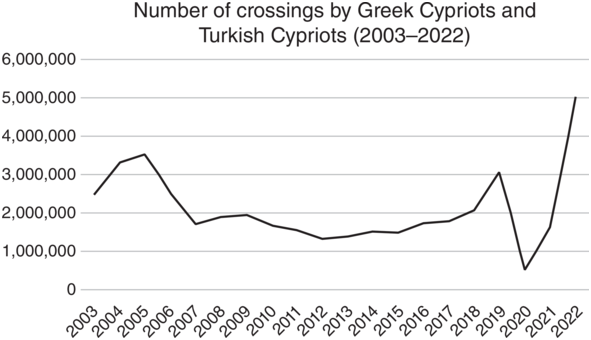
Figure 5.2 Long description
The x-axis spans from 2003 to 2022 in increments of 1 unit. The y-axis quantifies crossings, ranging from 0 to 6,000,000 in increments of 1,000,000 units. The curve for number of crossings passes through the following points (2003, 2,500,000), (2007, 1,700,000), (2019, 3,000,000), (2020, 500,000), and (2022, 5,000,000). Values are estimated.
Promising change is not without its own challenges, however. Recent migration flows to Cyprus due to the war in Syria and other international conflicts brought to Cyprus a record number of immigrants and asylum seekers, which led to a new rising tide of xenophobic attitudes in 2022 (UNHCR-Cyprus, 2023), which followed the previous one of the period 2010–2012, largely as the direct outcome of a governmental policy of securitisation by the Anastasiades government. On the positive side of things there is also regular public discussion about issues of gender equality and discrimination, disability and LGBTQ+ rights in both communities of Cyprus, which shows that change that strengthens self-transcendence values can be supported by various aligned groups acting in solidarity.
Financial downturns also indirectly relate to attitudes towards alterity, as they create a fertile ground for xenophobic media to play on feelings of realistic threat (well-being or financial status of the community). Cyprus was one of the main victims of the financial crisis of 2012–2013 that also deepened some social class divisions as it underwent austerity measures, spending cuts and limitations on the renewal of the public service personnel. The 2012–2013 Cypriot financial crisis involved the exposure of Cypriot banks to overleveraged local property companies, the Greek government debt crisis, the downgrading of the Cypriot government’s bond credit rating to junk status by international credit rating agencies, the consequential inability to refund its state expenses from the international markets and the reluctance of the government to restructure the troubled Cypriot financial sector.
On 25 March 2013, a €10 billion international bailout by the Eurogroup, European Commission (EC), European Central Bank (ECB) and International Monetary Fund (IMF) was announced in return for Cyprus agreeing to close the country’s second-largest bank, the Cyprus Popular Bank (also known as Laiki Bank), imposing a one-time bank deposit levy on all uninsured deposits there, and seizing around 48% of uninsured deposits in the Bank of Cyprus (the island’s largest commercial bank).
In regards to the pursuit of the values of a co-operative society, it is clear that one of the main obstacles is Cyprus is the unresolved Cyprus issue that is draining the resources of people for more trusting approaches to the ‘others’, as one of the usual mottos of various bodies and political actors is that ‘the Cyprus issue is our priority’, and other issues such as violations of human rights and discrimination are not actively addressed with the same sensitivity in the public sphere or are seen through the Cyprus issue perspective. A good example of this is the issue of immigration where, after the failure of Crans Montana, a securitisation discourse was promoted by the GC authorities with claims of Turkey instrumentalising immigration flows to the south of Cyprus through the checkpoints, leading to pushbacks on both land and sea and a very strict asylum regime (Trimikliniotis, Reference Trimikliniotis2019).
The almost 50-year geographic separation also allowed corruption in the two communities to run rampant as financial interests from the separation of Cyprus became more vocal in both communities in the past few years, mainly around the real estate sector in both communities and, in the GC community, also around the Golden Passport scheme, tourism, supermarkets, petrol stations and pharmaceuticals. These find their financial interests challenged by crossings made possible after 2003 and the possibility of reunification of Cyprus on the basis of BBF.
On the whole, despite the fact that Cyprus has adopted a significant number of laws in most policy areas that aim at creating a more co-operative society, especially after its joining the EU in 2004, there is a discrepancy between the existence of clear and positive legal framework and its implementation on issues of discrimination. Cyprus has ratified nearly all of the core international human rights treaties. Equality and non-discrimination are extensively regulated in Cyprus, and legislation has been in place for several years, but Cyprus suffers severely on the implementation part. When it comes to the functioning of the judicial system, there are some critical structural weaknesses that need amendment to tackle corruption more efficiently. The recently published Rule of Law report for 2023 is very telling: its recommendations point to some important deficits around issues of tackling corruption and transparency of financing relating to political parties and of media ownership.Footnote 2 Increasing individualism, the financial crisis and the recent scandals around the golden passport scheme have shaken the public trust in all institutions in Cyprus (except universities) as well as what is called generalised trust according to a recent analysis of Round 10 (2020) data of the European Values Survey (ESS) in the GC community.
Articulating Microgenesis, Ontogenesis and Sociogenesis
Articulating microgenesis, ontogenesis and sociogenesis involves understanding the interplay among these processes and recognising their complementary nature in shaping human development. Each of these processes provides a unique perspective on development, and they are interconnected in various ways. It is possible to suggest the following ways of articulating them:
1. Multi-layered perspective: Recognise that human development is a complex and multi-layered process that incorporates moment-to-moment changes (microgenesis), long-term individual development (ontogenesis) and the influence of social and cultural factors in historical time (sociogenesis) at various levels of analysis (Doise & Valentim, Reference Doise, Valentim and Wright2015). Adopting a comprehensive approach that acknowledges the interactions between these processes and articulation of the various levels of analysis can provide a more complex but accurate and nuanced understanding of human development.
2. Integration of timescales: Understand that these processes operate on different timescales, with microgenesis focusing on immediate changes, ontogenesis on life-long development and sociogenesis on historical and cultural changes. By integrating these timescales we can render intelligible the influence of short-term events on long-term development and how social and cultural factors impact individual growth over time.
3. Interdisciplinary approach: Since these processes involve various aspects of human development, it is essential to adopt an interdisciplinary approach that draws on insights and methodology from psychology, sociology, history, politics, anthropology and other related fields. This enables researchers to explore the interconnections between individual, social and cultural factors and understand how they jointly contribute to human development.
4. Contextualising development: Acknowledge that individual development is shaped by the specific social, cultural and historical contexts in which it occurs. By examining the sociogenesis of psychological phenomena, researchers can better understand how individual development is influenced by broader social and cultural factors, and how these factors change over time.
5. Mutual influence: Recognise that microgenesis, ontogenesis and sociogenesis do not occur in isolation but are mutually influential processes. For example, moment-to-moment experiences (microgenesis) can shape long-term development (ontogenesis) and are influenced by historical changes (sociogenesis). Sociogenetic changes can also lead to the setting up of new institutions and infrastructures that support new significant structures (e.g. the Home for Co-operation in Cyprus). Understanding the dynamic interactions between these processes in both directions of change (Psaltis, Reference Psaltis, Psaltis, Gillespie and Perret-Clermont2015) can help researchers to develop more comprehensive models of human development.
To make this articulation possible in the case of the study of these processes in Cyprus, we need to apply a mixed-methods approach that would entail: (1) the collection of representative samples from both communities of Cyprus in different periods of time and of people covering a wide age range; (2) qualitative data from focus groups discussions, interviews collection and analysis of policy documents from different periods and different age groups at different points in time; 3) identifying new ways to understand complex phenomena of change and transformation such as agent-based modelling and hierarchical age-period-cohort (HAPC) analysis.
In the rest of this final empirical chapter I will show how two methodological approaches, one qualitative and one quantitative, can be applied in the Cyprus case to facilitate disentangling and articulating microgenesis, ontogenesis and sociogenesis.
A Case Example: Some Autobiographical Notes
I was born in 1973 in Varosha, the new city next to historic Famagusta, now occupied by the Turkish army, which has been turned into a military zone. Given that nobody has been allowed to inhabit the town after 1974, it turned into a ‘ghost city’ filled with derelict buildings. I was one of the 160,000 internally displaced persons. My mother and father, after months of temporary refuge at various relatives’ homes, settled down in rented accommodations, in Derynia, a village next to old Famagusta and Varosha, that also happened to be my father’s birthplace. Up to the fifth grade of the elementary school, I attended the village school. I still remember some of the financial hardships of the early years after 1974, and I remember my teachers promulgating the discourse of the barbaric Turkish invasion and its consequences, with our duty being to join the in-group collective struggle for justice. I still remember my father waiting by the radio to hear news of the outcomes of the negotiations to solve the Cyprus problem, and the key to our apartment in Varosha that my mother kept in the drawer next to her bed – experiences very common to many internally displaced GCs, as we know from other research (Loizos, Reference Loizos1981; Zetter, Reference Zetter and Calotychos1998).
One of my first memories from living in Derynia is the image in Figure 5.3 that I would see day in and day out for the first 12 years of my life from the balcony of our rented house, sometimes accompanied by my parents’ commentary: ‘You see this building? This is our house.’ ‘We were living in that apartment.’
A view of Varosha from Derynia.
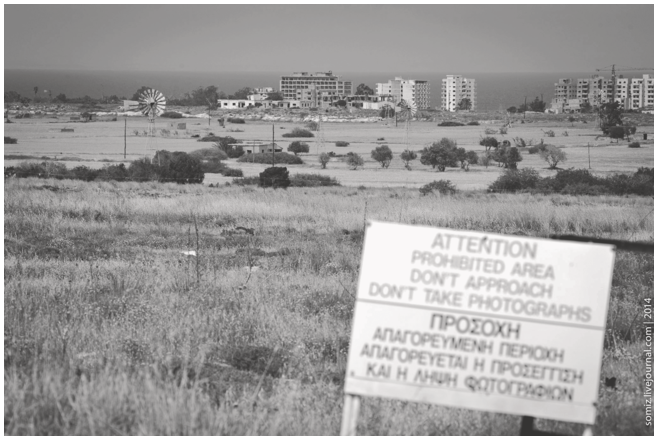
This image was often accompanied by a feeling of loss and sorrow, mixed with resentment towards the Turkish army that occupied my house and a strong will to return. In the work of Ernst Boesch (Reference Boesch2001) and his symbolic action theory we find the distinction between ‘myths and fantasms’ which is relevant here. Myths are the widely held and shared beliefs in a community. In my case, the widely shared myth would be that of the ‘barbaric invasion of expansionist Turkey’ and the duty of a collective struggle ‘for return’ and ‘not forgetting’. Fantasms are the individualised versions of myths that make sense to one particular individual. The image in Figure 5.3 seems to have for me the importance of a ‘fantasm’ that haunts my life since my early childhood, giving orientation and a goal towards striving to return to Varosha. So, this is a fantasm yearning for a fantasm/ghost town. The image in Figure 5.4 captures the sentiment completely. In one of the visits to Varosha a GC internally displaced person left this note on the fence: ‘I LEFT MY SOUL INSIDE. OPEN UP!’
A written note left on the fence of Varosha by a Greek Cypriot Varoshiotis.
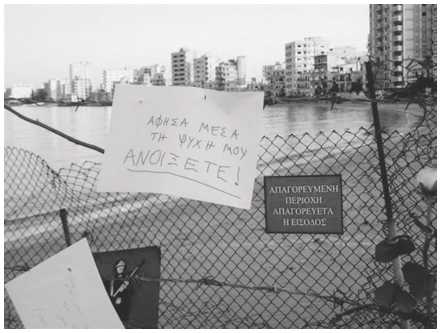
The sign next to the note on the fence states (in Greek, so the GCs would definitely get the meaning): ‘PROHIBITED AREA, ENTRANCE PROHIBITED’, which is an example of what Jaan Valsiner (Reference Valsiner2021) refers to as a hypergeneralised sign. The image is interesting for its contrast of the two signs. Both are hypergeneralised forms that point to different futures for the town. The handwritten one on the left points towards return and the revival of the city while the one on the right points towards the negation of this return in a fine example of what Valsiner described as a demonogenetic representation. It creates the demon of the enemy that scares away GC internally displaced persons from Famagusta, like the scarecrow put in place to keep the birds away. Another variation of this can be found in Figure 5.5, in which the scare function is even clearer.
A military sign by the Turkish army on the fence of Varosha. (Photo taken by Gerard Duveen on a visit to Cyprus in 2007.)
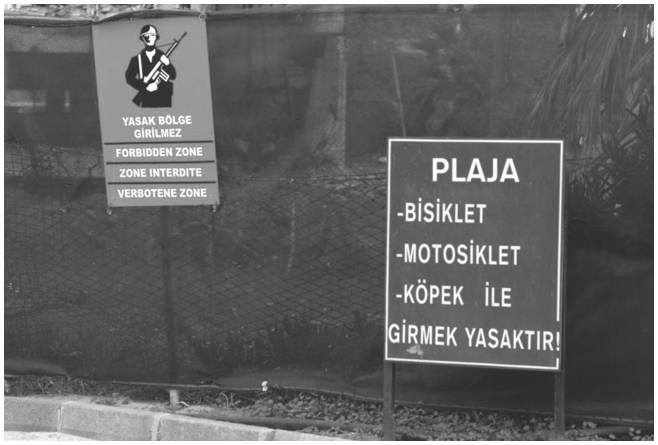
Another of my first memories was visits to my grandparents’ house in Strovilia, a very small ‘enclaved’ village, mostly comprised of a few families, relatives of my father, situated between Varosha and the UK military base of Ayios Nikolaos. Incidentally, this small village figures in the UN Secretary-General (UNSG) reports on the Cyprus issue, every six months, since 2000 when the Turkish troops moved their control a short distance from Varosha up to the UK bases.Footnote 3 This action violated a unique status quo, a no man’s land; before that, a small strip of land in Strovilia was patrolled by two soldiers (a UN peacekeeper and a TC soldier), and my relatives would be obliged every Sunday to confirm, in writing, their presence in the village. My first few visits to this place were a source of horror: I was terrified of the Turkish soldier who patrolled there and resided in a small house, that belonged to my aunt, together with the UN soldier. I remember, years later, to have repeating nightmares until my early adulthood: me being chased by Turkish soldiers in that strip of land and/or the Turkish army moving further forward to kill the whole family, myself included.
A year after 1974, my father was offered a job as a secondary school art teacher. From then on, things started improving financially for our family. My mother stayed at home looking after my sister (born in 1977) and myself. In 1983, my father asked for a transfer to the divided capital, Nicosia, thinking that my sister and I would get better educational opportunities. He was instead transferred to Larnaca, a smaller town; we stayed there for three years. In 1986, the whole family finally moved to Nicosia. Both my sister and I excelled in school.
Just before the end of my studies at the lyceum there were big anti-occupation rallies organised by students, and I remember myself taking part. A student who had lowered a Turkish flag from a poll in Nicosia was celebrated in the press as a new hero from our youth and attracted the admiration of many students.
Becoming an educator back then was considered an excellent career for ‘good students’, as it was a well -paid, secure, civil servant’s job. Hence, I focused on successfully passing the prestigious entry exams that secured me a position at the Pedagogical Academy of Cyprus (a three-year teacher training college). My studies there did not lead to any change of views regarding the bad Turks and certainly did not fill my ignorance gaps regarding TCs, as we never discussed different perspectives nor were able to meet any TCs. Nevertheless, I did start developing an interest in psychology in my studies there.
In terms of my political views, I supported the left-wing patriotic party EDEK (socialists), as I was influenced by my father who was a very active member of the central committee of the party until 1990 and a bold trade-unionist for the same party in his work sphere; his strong involvement meant my attendance of the party’s rallies and anti-occupation marches from a young age. If anything, my political stance, whilst a student at that Pedagogical Academy, had become even more negative towards any solution other than that of a unitary state, with Turkish troops out of Cyprus. I do recall an essay of mine (thought at that time to be a valid research piece, even though my only source of reference was an encyclopedia that I had found on my father’s bookshelf), ‘evidencing’ that federation as a political system did not work in any country, therefore it would be catastrophic if applied to the Cyprus context. In hindsight, the literature review I had provided would have been unacceptable by any academic standard. In my defence, the library of the Pedagogical Academy was an outdated one (called Severios, it also served the historical school Pankyprion, a centre of Hellenic education in Cyprus and with a history of participation in the struggle of EOKA for reunification with Greece) that mainly had old books coming from Greece and not much in terms of current literature.Footnote 4 We also did not have the internet back then. However, I got a very good grade for this ‘research piece’ and warm, public congratulations by our geography teacher, who had made it clear, throughout his teachings, that he was against BBF. I was a thorough opponent of any bicommunal efforts to solve the Cyprus problem. I recollect lashing out at a colleague who revealed that he had contacts with TCs; I accused him of undermining the patriotic fighting spirit that was needed for the anti-occupation struggle. It is now obvious that I was then trapped in a mindset that considered contacts with the ‘other’ as signs of treason and obstructive to the collective struggle that ‘we’ GCs had to sustain to end occupation by Turkey. Back then, I was convinced that the Cyprus problem was ‘solely an issue of invasion and occupation by Turkey’, an oft-cited mantra of the then-EDEK leader, Vassos Lyssarides.
In 1993, I was in my 20s, a graduate of the Cyprus Pedagogical Academy and a qualified primary school teacher. Immediately, I went to complete my military service that I have left unfinished in 1990. During the two years of my military service, I would, every morning, listen to an ultra-nationalist radio show, feeling exhilarated by the radio producer’s militaristic language, extremely nationalistic comments, accusations against expansionist Turkey and his full support of the Kurdish resistance, that last one on the basis of a rationale that ‘the enemy of my enemy is my friend’.
I also applied to become a military officer. I passed the written exams (IQ test and essay writing) and athletic performance with flying colours. I also had to go through an oral examination/interview, during which the strength of my patriotic feelings was evaluated by (1) how hard I hit my foot down when saluting the officers and (2) my capacity to recite from memory a poem about the Greek revolution of 1821. Having passed all tests, I was sent to Sparta, Greece, to train as a cadet.
The Greek military officers treated us Cypriots as Greeks from the periphery of Greece. A particular officer who got the impression that I was not religious enough turned my time there into a living nightmare, with hazing and bullying. The reason? I laughed and said that I am not a real ‘psaltis’ when, after reading my surname, the officer wanted to assign me to sing psalms in the church every Sunday (psaltis is the Greek word for a chanter of religious hymns).
I finished my military service in 1995 with a sense of revulsion for the army and the military mindset, which I considered a degrading experience of wasted human potential and misspent youth. Entering a new chapter in my life, that of a teacher, was a step I anticipated with great joy and relief.
My transition to working as an elementary school teacher could be described as being turned into an active agent of the advancement of the Den Xechno philosophy. I now remember the one-sided kind of history and religious education I taught my students. I was usually following the textbook for each new course and rarely looked for other sources with which to teach my students. I was not even reflective on the propagandistic nature of it. At rare moments of actual reflection I would explain it away by reasoning that we needed to defend ourselves from all-powerful Turkey, so patriotic feelings had to be created in children as a form of resistance to Turkey.
In 1996, I was fortunate enough to take some extra courses for a year at the Pedagogical Institute of Cyprus by academics of the newly founded University of Cyprus as part of a special course that would equalize the three-year pedagogical academy degree with a four-year BA in Education. The influence of Professor Andreas Demetriou, a developmental psychologist (and later colleague and minister in President Demetris Christofias’s cabinet in 2008), was decisive as it furthered my interest in psychology and helped me to grasp what academic rigour and proper research should be. He also sparked my interest in Piaget and cognitive development to the extent that I decided to obtain a second BA in psychology. I prepared again for the national entry exams. Interestingly, my grade in history in the entry exams in 1996 was much lower than in my entry exam in 1990. The reason for this probably was that this time I did not just recite the pages of the textbook and instead tried to elaborate and deepen my thinking. Despite lower scores, I was able to gain admission at the psychology department of Panteion University in Athens. This department had a strong orientation towards social psychology, and in one of my courses I discovered the work of Serge Moscovici and the social Genevans (Doise & Mugny, Reference Doise and Mugny1984) in a Greek translation in a central bookstore in Athens. Having read that book, I knew that this line of research was what I wanted to study for my BA thesis, which I completed in 1999 by reviewing this tradition of research on social interaction and cognitive development.
As soon as I returned to Cyprus, I was seconded for a year at the Educational Psychology Service of the Ministry of Education and Culture, and in the same year I applied for an MSc in Educational Psychology at University College London (UCL). In the spring of 2000, I was invited to interview at UCL as part of their MSc entry processes. Given my plans to visit London, I thought of exploring other possibilities with universities that could accommodate my research interest in the role of social interaction in cognitive development. Searching the internet (dial-up connection just recently made its appearance in Cyprus at that point), I came across the work of Duveen at University of Cambridge, who seemed to be one of the few academics in the United Kingdom who was studying social representations and cognitive development that were my main research interests. I sent him an email, saying I would be traveling to the UK soon and asking for a meeting to discuss a possible collaboration. Being the generous soul that he always was, Duveen replied that he would be happy for us to meet and arranged a meeting at his Corpus Christi College office. When we met, we discussed his work with Patrick Leman, and he said he would be interested to expand that line of research. Upon my professing an enthusiastit interest in this kind of work, Duveen said he would be happy for us to work together if I wanted to apply for an MPhil at Cambridge, which I did. Some months later I was accepted at both UCL and Cambridge and ultimately decided to go to Cambridge for an MPhil in Social and Developmental Psychology. While in the programme, I worked on an empirical investigation of the representations of gender in social interaction around the Piagetian task of the conservation of liquids, which was later published as Psaltis and Duveen (Reference Psaltis and Duveen2006), and overall did well enough to have decided to continue towards a PhD.
Turning Points in Life
Around that time my friendship with Chara Makriyianni, a classmate from the Pedagogical Academy, has turned into a love affair. I was 27 years old. Chara already completed a Master in History Education with Peter Lee at the Institute of Education in London, and she was quite critical of the propagandistic nature of our history teaching in Cyprus. I remember in our first discussions we had disagreements about what the aims of history teaching should be, but once I started reading materials she suggested (and especially the connections of the work of Peter Lee with Piaget that made the epistemological foundations of new history much clearer in my eyes), I started revising my old views.
In the same year I had my first contact with TCs. My best friend arranged for me and Chara to go to a bicommunal workshop in Pyla/Pile, the only mixed village of Cyprus in the Larnaca district, facilitated by Nicos Anastasiou. There we completed an exercise of positioning landmark historical events on a ‘history ladder’ that represented the history of Cyprus. I remember how surprised I was to see how different points were important in the narrations of the two communities and how different a meaning we attributed to events that we all identified on the timeline.
My studies in social developmental psychology at Cambridge helped me to become more critical of our situation in Cyprus and of our educational system. I remember spending many hours in the Cambridge Library locating books on Cyprus history from Turkish, TC and UK perspectives that I never knew existed. In 2002, Chara joined me at Cambridge when she was accepted into a PhD programme at the Department of Education with Professor Peter Cunningham, an expert on oral history. Cohabitation with Chara in Cambridge became a constant source of new readings and discussions for me about nationalism and history, the use and abuse of history and opportunities to attend conferences of the NGO EuroClio where the abuse of history in other parts of the world became very clear in my mind. At one of these meetings Chara discussed with Joke van der Leeuw-Roord, then president of EUROCLIO, the idea of setting up a bicommunal NGO about history teaching in Cyprus, something that would be made possible by the recent opening of the checkpoints in Cyprus. A few months after the opening of the checkpoints in April 2023 we, along with other educator friends, located TC teachers who were interested in the idea. This was not difficult, since TC teachers, along with other trade unionists, had a reputation of always being at the forefront of collective action to reunite Cyprus. This led to the birth of the Association for Historical Dialogue and Research (AHDR), the first bicommunal NGO dealing with the sensitive issue of history teaching in a post-conflict and divided Cyprus. AHDR soon became the local partner of the CoE, and with their support, a number of training seminars for teachers from both communities on history teaching were organised every year. Nationalist press, the media and some right-wing and so-called centre parties trade unionists attacked the work of AHDR from the beginning, and although I understood why they did it, the organised nature of these attacks also made me want to study more institutionalised propaganda in the Cypriot press, which I recently was able to do with a colleague from media studies (Avraamidou & Psaltis, Reference Avraamidou and Psaltis2019).
Given my new reflective stance on nationalism and my study of intergroup relations, once I finished my PhD in 2005, I looked for a way to work in the United Kingdom in a relevant field until my partner would also finish her studies. The perfect opportunity appeared after a discussion with Miles Hewstone at Oxford when he organised a European Association of Social Psychology (EASP) meeting on minority influence in 2003 that I attended; we were approved, for a research grant to study intergroup contact between GCs and TCs in Cyprus, so I started working at the Oxford Centre for the Study of Intergroup Contact with Miles.
Since 2006, I got involved in the study of intergroup relations between GCs and TCs from a social psychological perspective. I remember how many of my stereotypes for TCs and Turks were deconstructed along the way. I now have many TC friends and research partners. A year later I was appointed as a lecturer of social psychology at the University of Cyprus. I was the first GC social psychologist to work in an academic institution in Cyprus. In 2007, I took the initiative to establish the first Association of Social Psychologists in Cyprus on an intercommunal basis, and in 2008 it was officially registered.
That same year we had presidential elections that brought leftist Dimitris Christofias to power, and my colleague Professor Andreas Demetriou was appointed Minister of Education. Demetriou attempted a positive pro-reconciliation educational reform that promoted a culture of co-operation and a policy of contact between students and teachers from both communities. As we were colleagues with Andreas, I had communicated to him several of my research findings about the positive role of contact in prejudice reduction and suggestions by AHDR about history teaching. Members of AHDR during his term in the ministry were seconded in the Pedagogical Institute for the writing of new history textbooks. AHDR also had the support of the government in the establishment of the Home for Co-operation in the UN buffer zone in Nicosia, a bicommunal educational centre for NGOs supported by the European Economic Area (EEA) and Norway Grants financial mechanism. The Home for Co-operation opened its doors on 6 May 2011, with an opening ceremony bringing together the leaders of the GC and TC communities, representatives of civil society and dignitaries from around Europe, including the CoE, Norway, Sweden, Switzerland and the Netherlands, who supported its establishment. As part of a four-day celebration marking the inauguration of the Home, I organised a scientific symposium with the title ‘Human and Societal Development: The role of Social Relationships’ on 9 May 2011. In my talk I explained how Piagetian ideas on social relations of co-operation inspired the establishment and naming of the Home for Co-operation. The talks of the symposium were later published as an edited volume with Alex Gillespie and Anne-Nelly Perret Clermont (Psaltis et al., Reference Psaltis, Franc, Smeekes, Ioannou, Žeželj, Psaltis, Carretero and Čehajić-Clancy2017). The photo in Figure 5.6 is from the conference.
The speakers at the inauguration symposium at the Home for Co-operation.
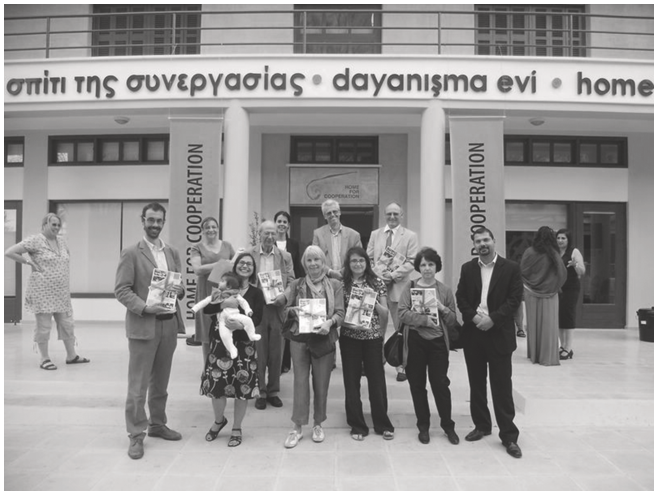
Unfortunately, Demetriou’s positive policy proposals failed to be fully implemented due to resistance from the church, organised teacher trade unions and teachers in the classroom, but they were nevertheless the first seeds of some positive ideas around contact that would materialise later. AHDR and the Home for Co-operation flourished and became internationally recognised. A testament to this is the three prestigious international awards received: Europa Nostra 2014 Conservation Award, celebrating and aiming to promote excellence in cultural heritage work; Max Van der Stoel Award in 2016 in recognition of extraordinary achievements aimed at improving the position of national minorities in the area of the Organization for Security and Co-operation in Europe (OSCE); and the 2018 Seán MacBride Peace Prize in recognition of its outstanding work for peace, disarmament and human rights. The short documentary produced by OSCE about AHDR and the Home for Co-operation provides a nice summary of this story.Footnote 5
In 2009, Chara and I were married and our son was born. In the same year I was invited to join the Greek Turkish Forum (GTF),Footnote 6 which is a 1.5-trackFootnote 7 diplomacy initiative to discuss informally bilateral political issues (e.g. the Aegean contestation), established in 1998 right after Greece and Turkey came to the brink of war (see Ker-Lindsay, Reference Ker-Lindsay2016 for the history of GTF), in order to facilitate dialogue between Greece and Turkey and promote confidence-building measures (CBMs). The GTF brought together politicians who did not hold a formal position in the administration, retired senior diplomats and military officers, business leaders and other figures from the media and academia. After 2002, GTF took more interest in the Cyprus issue as one of the main issues poisoning Greek–Turkish relations, and in 2006 there was a Cyprus chapter established with a GC and a TC team. I was one of the first GC members invited as an academic in 2008, and in 2014 I became the coordinator of the GC team of the Cyprus chapter of GTF. We had many meetings since 2008 in Athens, Istanbul, Ankara and Nicosia, many times with the acting ministers of foreign affairs of the two countries (Greece and Turkey) and the leaders of the two communities in Cyprus. In this context I was fortunate to understand the core issues of the tensions between Greece and Turkey and the core political underpinnings of the Cyprus issue. Above all, I understood the regional dynamics of the Cyprus issue and the way political developments, election cycles and economic developments influence the agenda of discussions. I also realised that trust at the interpersonal level and co-operative relations can facilitate the production of valuable ideas for confidence-building measures that can be implemented by politicians if they are convinced of their value when they have the support of both communities of Cyprus as well as of Greece and Turkey.
My son is 15 years old when these words are written in 2024. I rarely discuss my home in Varosha with him, but whenever we find ourselves in the southern part of Famagusta during a summer holiday, I do point out that somewhere in the buildings of the ‘ghost town’ is the apartment we left in 1974. I remember my surprise when my son came up to me when he was four years old and said: ‘Dad, Turks are bad.’ I asked, ‘Why do you say that, son?’ ‘Because my grandmother said that Turks came and took our houses back in 1974,’ was the reply. That incident made me realise how early in life children internalise that sense of loss described as the figurative nucleus of the representation of the Cyprus problem discussed in Chapter 3.
When we had the chance to visit Varoshia as a family with my parents and located our apartment in 2022 after the opening of a small part of Varosha to visits, my son found the experience distressing and said he did not want to do it again. He did, however, visit the Home for Co-operation many times with me and Chara from his early childhood and had the chance to meet many of our TC friends and their children. He also took part in a bicommunal meeting at the Home for Co-operation in the UN buffer zone in Nicosia organised specifically for children. This was done with the support of the Ministry of Education. A more permanent contact scheme during school time in the mornings was made possible later in 2017 as an initiative by the newly established Bicommmunal Technical Committee of education as part of the IMAGINE programme which by 2020 had touched the lives of more than 5,000 students.Footnote 8
In the past few years, the work of the committee has been slowed by a number of developments: the Crans Montana failure in July 2017; the COVID-19 pandemic in 2020 that led to the closing of a number of checkpoints; and in the same year a change of leadership in the north that brought nationalist Ersin Tatar as head of government for the TC community, with a subsequent change in TC policy from supporting BBF by Akinci to support of a two-state solution in Cyprus and a change in the number of the TC members of the committee (former members of AHDR and other pro-reconciliation academics and supporters of BBF). The committee nevertheless still functions, but the TC side unilaterally decided to end the IMAGINE programme. One does not need a lot of imagination to understand that this programme goes against the separatist views of those in power in the TC community.
This autobiographical analysis could be used both as a window into personal experience and the way personal meanings and fantasms (Boesch, Reference Boesch2001) orient people to certain actions. They are also invaluable in rendering intelligible intergenerational influences and the slow but crucial process of ideological conversion. In the story told in the previous sections one can identify various meetings with alterity that introduced doubt in my subjectivity as suggested by Duveen (Reference Duveen2002). As suggested by Kadianaki and Gillespie (Reference Kadianaki and Gillespie2015), the meeting with alterity can take various forms: (1) rupture with the physical world (alterity in action), (2) social contact (alterity in other), (3) movement between contexts (alterity in self) and (4) semiotic dialogicality (alterity in the structure of knowledge). In my case the feeling of loss of our house in Varosha was formed early on through processes of intergenerational transmission and was reinforced by the educational policy of Den Xechno. Until my attendance of my first bicommunal workshop in Pyla and the exercise on the history line I had developed good defensive mechanisms (semantic barriers) to downplay alternative representations of the Cyprus issue as unpatriotic, still under the spell of an ethos of conflict. Meeting TCs for the first time and encountering their own perspective (alterity in other) were the beginning of a life-changing experience. Then came meetings with other alterities (my wife, professors, colleagues, etc.). Moving abroad to study further changed the social context for me by introducing me to networks of people with an outsider’s perspective on the Cyprus problem. Changing my role from student to university teacher also allowed me to meet alterity in self. My readings about the Cyprus problem from various perspectives increased my multiperspectivity and introduced alterity in my structure of knowledge. Finally, my visits to the other side of the island after 2003 offered plenty of opportunities for rupture with the physical world (alterity in action) that made me deconstruct many misconceptions about the everyday life of the other community.
This narrative analysis can also help in transitioning into a more quantitative analysis that more systematically examines the interaction of age with historical events. Going back in time, compared to my autobiographical note, let us take, for example, the birth cohort of my parents to understand at what age they experienced some important historical turning points. For the quantitative analysis that will follow in this chapter I have created 5-year-band birth cohorts as shown in Table 5.1. Following this categorisation, I fall into cohort 9 and my parents fall into cohort 3, as they were born in 1944.
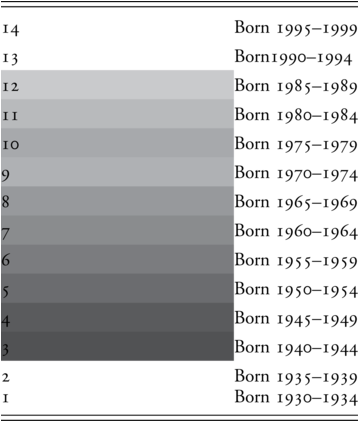
Table 5.1 Long description
The table lists 14 cohorts identified in the study of two communities in Cyprus, with data collected in 2007, 2010, and 2017. Each cohort is defined by a range of birth years, from oldest (Cohort 1) to youngest (Cohort 14).
Cohort 14 is born between 1995 to 1999.
Cohort 13 is born between 1990 to 1994.
Cohort 12 is born between 1985 to 1989.
Cohort 11 is born between 1980 to 1984.
Cohort 10 is born between 1975 to 1979.
Cohort 9 is born between 1970 to 1974.
Cohort 8 is born between 1965 to 1969.
Cohort 7 is born between 1960 to 1964.
Cohort 6 is born between 1955 to 1959.
Cohort 5 is born between 1950 to 1954.
Cohort 4 is born between 1945 to 1949.
Cohort 3 is born between 1940 to 1944.
Cohort 2 is born between 1935 to 1939.
Cohort 1 is born between 1930 to 1934.
NB. Shades connect to Table 5.2 in page 176
A Reconstruction of Important Historical Events for the Cohort Born 1940–1944
According to renowned anthropologist Peter Loizos, the first half of the 20th century in Cyprus was a period of rapid sociodemographic and structural changes (Loizos, Reference Loizos1975, Reference Loizos2001). Whilst in 1878, 9 out of every 10 Cypriots was a villager, in 1955 this figure was closer to 6 out of every 10. In the same period the population increased two and a half times, from 186,000 to more than 450,000. In the meantime, while 18.6% of Cypriots aged 15–24 were illiterate in 1931, this figure fell to just 5.9% by 1946. In his reflection on this period Loizos is especially concerned with transformation of relations of authority, which, according to him, are to be found ‘embedded in central political, economic, religious and social ideas about relations of all kinds-relations between people and their gods, between men and women, between parents and children, masters and servants, employers and employees, rich and poor, between racial and cultural groups, ideas about justice, property and marriage’ (Loizos, Reference Loizos2001, p. 128). His words describe this period eloquently:
So a series of challenges take place within our period. The British displaced the Ottomans and challenged the church. Sons challenge fathers. Workers, challenge employers. Communism and socialism challenge the church and its traditional leadership in both ethical and political life. Women challenge men, at first by their educational and occupational achievements, then by direct confrontation. But later as militant Greek Cypriots came to challenge the legitimacy of the British colonial rule, then those schoolgirls mobilized by EOKA came to confront men of the British security forces.
Of course, these indications of challenging authority were only the first signs of challenging a traditional culture of honour and shame characteristic of Mediterranean societies described through ethnographic work in the Greek Cypriot Pitsilia Highland village of Alona in 1954 by Peristiany (Reference Peristiany1966). This work was foundational in the field, as it was among the first to systematically examine how honour and shame function as central social values that shape interpersonal relationships, gender roles, social structure and community dynamics in these societies.
To return to significant historical periods in the life of the cohort born 1940–1944, their childhood would coincide with the Second World War. Growing up under the British colonial rule, the sociopolitical atmosphere of the island would be charged, with the undercurrents of nationalistic sentiments for enosis (union of Cyprus with Greece) growing stronger. The left–right ideological polarisation would be a defining period in their childhood years, charting trajectories and networks of social interactions of socialisation that could involve closer or more distant relationships with members of the other community. Leftists organised under AKEL and youth or worker organisations in the GC community would be often persecuted or threatened by EOKA members in their teen years, although they would tend to have closer and better relations with TCs. Youth of more centrist and leftist political views (although not AKEL members) would tend to have more ambivalent feelings towards the EOKA struggle given the dominant position of the church and the overwhelming majority of GCs taking active part in religious practices at the time. On the whole, the GC perspective towards TCs during this time would be of a marginal minority and financially worse-off community that should have no say in what GCs as the majority considered their legitimate national aspirations. Another defining experience of these years would be for those who lived in mixed villages who had the chance to establish co-operative and everyday relationships with members of the other community versus areas with no mixed population where opportunities for intergroup contact and co-operation would be much more rare.
Adolescence (1950s): Their teenage years would be marked by the armed struggle of EOKA for the union of Cyprus with Greece. This period would shape their understanding of nationalistic aspirations and the reactions from the British colonial power. Right-wing EOKA supporters would have the chance to be actively involved in the enosis struggle of GCs, but leftists would not. In the TC community there was a much wider acceptance of the TC resistance organisation Türk Mukavemet Teşkilatı (TMT) as a legitimate resistance organisation that could block GC efforts for enosis (Ktoris, Reference Ktoris2013).
Early Adulthood (1960s): The establishment of the Republic of Cyprus in 1960 would be a significant milestone. The subsequent intercommunal clashes would further shape their perceptions and experiences. The propaganda on both sides generated an intense enmity between the members of the two communities and encouraged a number of violent acts across the island. In coffee shops around the island, both GCs and TCs used exaggerated talk, echoing the extremist language and propaganda used in most of the press of both communities (Packard, Reference Packard2008). Children in the mixed villages who had once played together now fought, taunted and threw stones at each other if they met by chance in the street (Patrick, Reference Patrick, Bater and Preston1976a). The educational systems of the two communities in the period continued to be separate, since the 1960 constitution gave responsibility for education to the two communal chambers. The orientation of both systems in the period 1960–1974 continued to be towards their corresponding and opposed national aims of enosis and taksim (Pavlou, Reference Pavlou2015), respectively, with most textbooks imported by the so-called motherlands (Greece and Turkey) that were seen as the ‘national centre’.
However, not all of the population was polarised, nor did the entirety of it blindly followed the extremist groups. Some accounts report that GC villagers were often suspicious and wary of the old EOKA network, as it was claimed that they had connections with the criminal underclass (Packard, Reference Packard2008, p. 90). Similarly, not all TCs blindly followed TMT, as some accounts report that TC leaders in some villages forbade any friendly relations with the GCs, and any TCs caught being friendly with GCs or walking or enjoying themselves in Greek areas were penalised with heavy fines, imprisonment or even whipping (see also Patrick, Reference Patrick, Bater and Preston1976a, p. 133; Drousiotis, Reference Drousiotis2005). There are also accounts that report that TCs in mixed villages were not allowed by their leaders to use the postal services of the government, as this was considered not only to promote fraternisation with the other community but also to be a sign of recognition (Patrick, Reference Patrick, Bater and Preston1976a, p. 112) of the GC-run state. Lastly, there is evidence that in some cases in late 1964, local paramilitary commanders resorted to armed threats, and even to murder, in order to keep TC refugees from moving into areas controlled by the Cyprus government (Patrick, Reference Patrick, Bater and Preston1976b, p. 345).
As a result of the intercommunal violence, many TCs were forced (either by TMT members or simply due to insecurity) to leave their homes in mixed villages and sought refuge in enclaves. These enclaves were predominantly TC areas where they could seek protection from the violence and live in relative safety. The creation of enclaves essentially led to a physical division of the island along ethnic lines, which would later be solidified by the Turkish invasion in 1974. There were many enclaves across the island, ranging in size from small villages to large urban centers. Some of the larger enclaves included Famagusta, Lefka and the Bogaz area between Kyrenia and Nicosia. The number and size of enclaves changed over time as the situation on the ground evolved. These enclaves functioned as states within states for about 10 years until the war of 1974, with internal organisation and economy supported by Turkey and minimal to no contact between members of the two communities, since they were guarded by TC fighters and GCs could not enter these areas. Many of the TCs who spent their early adulthood in enclaves would be deprived of opportunities to study, as they took fighter duties with TMT, although some would get the chance after 1968 to study in Turkey – an important socialisation experience, since many of them would be socialised in the leftist circles of Istanbul in the period around 1968 (Moudouros, Reference Moudouros2020), a period of progressive student activism that was even more strongly felt in other European countries at the same time. GC students who went to study abroad usually report the 1968 events as important political socialisation years, especially in the United Kingdom and Czechoslovakia (where leftist students would also often go to study supported by AKEL in Cyprus). The youth from AKEL families would also often go to study in the USSR on scholarships, but the experience of the USSR was different, to say the least, from the student movement in Western Europe.
Middle Age (1970s–1980s): The 1974 Turkish invasion/intervention would occur when they were 30–34 years old. Like the previous cohort, many would likely have participated in the conflict, and about 30% would experience displacement. This would be a challenging period, especially for those with young families or those who had recently settled into their homes. The 1974 events would be collectively experienced by GCs as a collective trauma but by TCs with an elation of almost apocalyptic proportions because it ended the more difficult 10 years of their lives in enclaves (Bryant, Reference Bryant2010).
Later Life (1990s–2000s): As they transitioned into their older age, the unresolved nature of the Cyprus issue and a history of repeated failures to solve the problem that was becoming protracted would be a significant concern. The opening of the checkpoints in 2003 and Cyprus’s EU accession in 2004 are the events they would witness with a lifetime of experience and understanding. Most GCs and TCs of this birth cohort would take advantage of the newfound opportunity in 2003 to revisit their properties and homes that they left during their early 30s. Those that used to live in mixed villages would get the chance to see childhood and adolescent friends from the other community with whom they probably lost contact since 1963 when they were 19–23 years old. At the same time it was reported that some people with direct involvement in paramilitary organisations and intercommunal conflict would avoid crossing to the other side due to fear of retaliations more than 40 years after the ‘troubles’.
Articulating Microgenesis, Ontogenesis and Sociogenesis through Disentangling Age, Period and Cohort Effects
Three possible effects are at play when data are collected from participants of different age cohorts at different points in time: age, period and cohort. The three variables relate to one another in an exact linear fashion. For example, for each age and calendar year there is a unique birth cohort. This causes the well-known identification problem in modelling. However, the HAPC modelling framework does not incur the identification problem because the three effects are not assumed to be linear and additive at the same level of analysis. HAPC models can capture the contextual effects of periods and cohorts and thus stimulate new conceptualisations of processes of change.
The repeated cross-sectional design (representative sample surveys taking place in different periods with different participants but with same questionnaire such as ESS or WVS) is in fact a multilevel design in which individual-level observations are nested in, and cross-classified simultaneously by, the two higher-level social contexts defined by time period of data collection and birth cohort. Global descriptions of generations and cohorts like, for example, the Millennials, Baby Boomers and the Silent Generation make no sense in the context of Cyprus, since generations are never discussed publicly in this context. However, the original discussion by Mannheim that we covered in Chapter 3 on generations is certainly relevant in this context, especially his insight that big events like war can be a defining moment of rapture that could create groupings of people that self-identify with these categories (e.g. born before or after 1974). A more detailed analysis that would allow for the detection of aggregate generational differences between the various cohorts described in Table 5.1, and specifically comparisons of all other cohorts with the one described in detail earlier (1940–1944), follows below. The data used for the analysis that follows come from three large-N bicommunal representative sample surveys of data collected in 2007, 2010 and 2017. The method was multistage stratified sampling, and more details on the methodology can be found in published work (Psaltis, Reference Psaltis, Marková and Gillespie2012a), OSF (open-source cloud-based project management platform)Footnote 9 and Appendix B, Table B.1.
Disentangling Age, Period and Cohort Effects
The analytical strategy followed here was to test various HAPC models predicting in turn: Prejudice, Trust, Acceptance of Bizonal Bicommunal Federation as the position agreed by leaders since 1977 and Readiness for renewed Cohabitation. Each cohort (different shades in Table 5.1 above) can be located in the accounting model below shown in Table 5.2. The table below presents the mean level of prejudice towards the other community measured with the feeling thermometer ranging from 0 (cold/very negative) to 100 (warm/very positive). A score of 50 indicates neutral feelings.
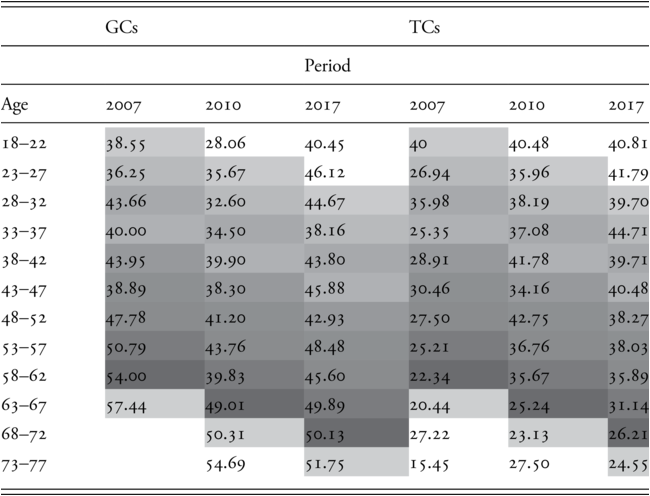
Table 5.2 Long description
The table presents data categorized by age groups from 18 to 22 up to 73 to 77 and shows values for G Cs and T Cs over three periods, 2007, 2010, and 2017.
Below are the values organized by age group and period:
Age 18 to 22:
G Cs: 2007: 38.55, 2010: 28.06, 2017: 40.45
T Cs: 2007: 40.00, 2010: 40.48, 2017: 40.81
Age 23 to 27:
G Cs: 2007: 36.25, 2010: 35.67, 2017: 46.12
T Cs: 2007: 26.94, 2010: 35.96, 2017: 41.79
Age 28 to 32:
G Cs: 2007: 43.66, 2010: 32.60, 2017: 44.67
T Cs: 2007: 35.98, 2010: 38.19, 2017: 39.70
Age 33 to 37:
G Cs: 2007: 44.00, 2010: 34.50, 2017: 38.16
T Cs: 2007: 28.35, 2010: 37.08, 2017: 44.71
Age 38 to 42:
G Cs: 2007: 43.95, 2010: 39.90, 2017: 43.80
T Cs: 2007: 29.91, 2010: 41.78, 2017: 39.71
Age 43 to 47:
G Cs: 2007: 38.89, 2010: 38.30, 2017: 45.88
T Cs: 2007: 34.16, 2010: 34.16, 2017: 40.48
Age 48 to 52:
G Cs: 2007: 47.78, 2010: 41.20, 2017: 42.93
T Cs: 2007: 27.50, 2010: 42.75, 2017: 38.27
Age 53 to 57:
G Cs: 2007: 50.79, 2010: 43.76, 2017: 48.48
T Cs: 2007: 25.21, 2010: 36.76, 2017: 38.03
Age 58 to 62:
G Cs: 2007: 54.00, 2010: 39.83, 2017: 45.60
T Cs: 2007: 22.34, 2010: 35.67, 2017: 35.89
Age 63 to 67:
G Cs: 2007: 57.44, 2010: 49.01, 2017: 49.89
T Cs: 2007: 20.44, 2010: 25.24, 2017: 31.14
Age 68 to 72:
G Cs: 2007: no entry, 2010: 50.31, 2017: 50.13
T Cs: 2007: 27.22, 2010: 23.13, 2017: 26.21
Age 73 to 77:
G Cs: 2007: no entry, 2010: 54.69, 2017: 51.75
T Cs: 2007: 15.45, 2010: 27.50, 2017: 24.55
For each dependent variable six models in total were tested. The first one was a basic model including as predictors only the following demographic variables: Age, Age Squared, Education, Living in Urban or Rural area, IDP status (either first or later generation IDP), Gender, Period of Data Collection (2007, 2010 or 2017) and Recoded Birth Cohorts. A subset of the 14 cohorts presented in the Table 5.2 that satisfied the criterion of having measurements in all three periods was used, excluding cohorts 1, 2 and 12, 13 from the analysis due to the incompleteness of data.
The second was a variation of testing the same variables with period as a fixed factor and recoded cohort as a random factor. The third was a model with the same variables but treating both period and recoded cohort as random factors as suggested by Yang and Lund (Reference Yang and Land2013) in chapter 7 of their authoritative book on age, period and cohort analysis using mixed lineal models.
The fourth, fifth and sixth models tested followed the rationale of a hierarchical regression model and included all the demographic variables tested in the first three models but additionally several social psychological variables that were expected to significantly predict the outcomes. For the models predicting feelings towards the other community and intergroup trust, these were the social psychological predictors: Quantity of Contact with members of the other community, Number of Outgroup friendships, Strength of Communal Identification, Threats (Realistic and Symbolic) and Importance of Religion in their life. Contact and friendships are a good indication of what is happening at the interpersonal level of analysis, and microgenetic processes, strength of communal identification and religiosity capture to some extent the embedding of self in the collectivity and part–whole relationships and affinity to tradition, honour, and shame values and threats that are a good indicator of intergroup dynamics at the intergroup level of analysis.
For the models predicting Acceptance of BBF and Readiness for Cohabitation, two additional predictors were added: Feelings towards the other community, Trust for ordinary people from the other community. This strategy would allow the comparison of basic demographic HAPC models with the more comprehensive models so that we could establish whether any of possible Age, Period or Cohort Effects would still be significant after the inclusion of this set of social psychological variables as predictors, given our hypothesis that political decisions that could influence the restructuring of institutions would be at least partly mediated by the quality of intergroup relations.
Predicting Positive Feelings towards the Other Community
Greek Cypriot Community
From the basic model (see Table 5.3) we see that education, area of residency (urban or rural), gender, period and cohort are significant predictors of positive feelings (reduced prejudice) towards TCs. The higher the education, the more positive the feelings towards TCs. Living in an urban area and being male are also related to more positive feelings towards the other community. There is a linear trend of cohorts so that the older the cohort, the more positive the feelings towards TCs In 2010, there was a significant negative dip in feelings towards TCs that by 2017 has recovered in levels comparable to 2007. The total variance explained by this model was adj R2 = 0.06.
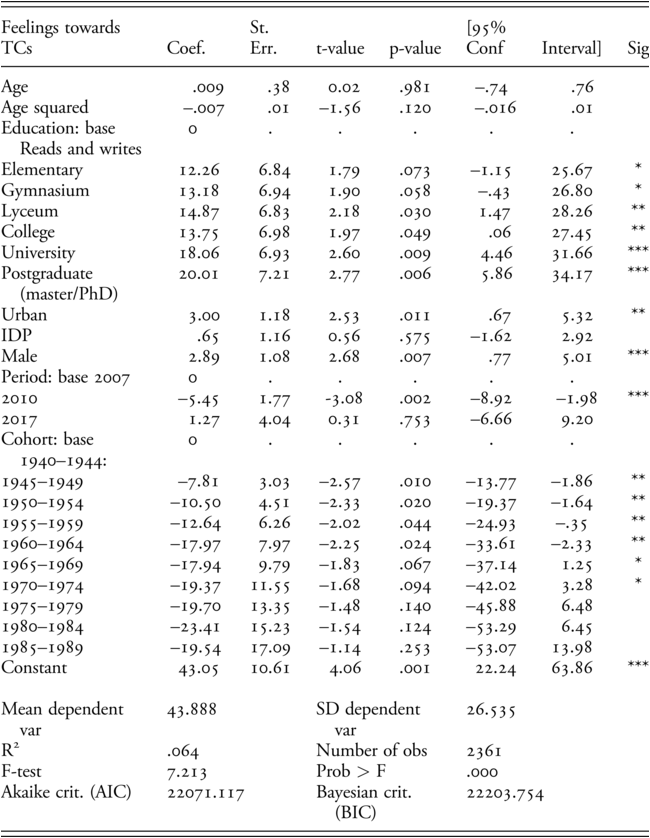
Table 5.3 Long description
The regression output table analyzes predictors of the variable labeled feeling towards T Cs. Each row lists a predictor variable along with its coefficient, standard error, t-value, p-value, ninety-five percent confidence interval, and significance level.
For age, the coefficient is 0.009, with a standard error of 0.38. The t-value is 0.02, and the p-value is 0.981. The 95 percent confidence interval ranges from negative 0.74 to 0.76. This result is not statistically significant.
For age squared, the coefficient is negative 0.007, with a standard error of 0.01. The t-value is negative 1.56, and the p-value is 0.120. The 95 percent confidence interval ranges from negative 0.016 to 0.01. This result is not statistically significant.
For elementary education, the coefficient is 12.26, with a standard error of 6.84. The t-value is 1.79, and the p-value is 0.073. The 95 percent confidence interval ranges from negative 1.15 to 25.67. This result is statistically significant at the 10 percent level, indicated by a single asterisk.
For gymnasium education, the coefficient is 13.18, with a standard error of 6.94. The t-value is 1.90, and the p-value is 0.058. The 95 percent confidence interval ranges from negative 0.43 to 26.80. This result is statistically significant at the 10 percent level, indicated by a single asterisk.
For lyceum education, the coefficient is 14.87, with a standard error of 6.83. The t-value is 2.18, and the p-value is 0.030. The 95 percent confidence interval ranges from 1.47 to 28.26. This result is statistically significant at the 5 percent level, indicated by two asterisks.
For college education, the coefficient is 13.75, with a standard error of 6.98. The t-value is 1.97, and the p-value is 0.049. The 95 percent confidence interval ranges from 0.06 to 27.45. This result is statistically significant at the 5 percent level, indicated by two asterisks.
For university education, the coefficient is 18.06, with a standard error of 6.93. The t-value is 2.60, and the p-value is 0.009. The 95 percent confidence interval ranges from 4.46 to 31.66. This result is statistically significant at the 1 percent level, indicated by three asterisks.
For postgraduate (master’s or P h D) education, the coefficient is 20.01, with a standard error of 7.21. The t-value is 2.77, and the p-value is 0.006. The 95 percent confidence interval ranges from 5.86 to 34.17. This result is statistically significant at the 1 percent level, indicated by three asterisks.
For urban areas, the coefficient is 3.00, with a standard error of 1.18. The t-value is 2.53, and the p-value is 0.011. The 95 percent confidence interval ranges from 0.67 to 5.32. This result is statistically significant at the 5 percent level, indicated by two asterisks.
For I D P, the coefficient is 0.65, with a standard error of 1.16. The t-value is 0.56, and the p-value is 0.575. The 95 percent confidence interval ranges from negative 1.62 to 2.92. This result is not statistically significant.
For male, the coefficient is 2.89, with a standard error of 1.08. The t-value is 2.68, and the p-value is 0.007. The 95 percent confidence interval ranges from 0.77 to 5.01. This result is statistically significant at the 1 percent level, indicated by three asterisks.
For 2010, the coefficient is negative 5.45, with a standard error of 1.77. The t-value is negative 3.08, and the p-value is 0.002. The 95 percent confidence interval ranges from negative 8.92 to negative 1.98. This result is statistically significant at the 1 percent level, indicated by three asterisks.
For 2017, the coefficient is 1.27, with a standard error of 4.04. The t-value is 0.31, and the p-value is 0.753. The 95 percent confidence interval ranges from negative 6.66 to 9.20. This result is not statistically significant.
For 1940 to 1944, the coefficient is negative 7.81, with a standard error of 3.03. The t-value is negative 2.58, and the p-value is 0.010. The 95 percent confidence interval ranges from negative 13.77 to negative 1.86. This result is statistically significant at the 5 percent level, indicated by two asterisks.
For 1945 to 1949, the coefficient is negative 10.50, with a standard error of 4.51. The t-value is negative 2.33, and the p-value is 0.020. The 95 percent confidence interval ranges from negative 19.37 to negative 1.64. This result is statistically significant at the 5 percent level, indicated by two asterisks.
For 1950 to 1954, the coefficient is negative 12.04, with a standard error of 5.17. The t-value is negative 2.33, and the p-value is 0.020. The 95 percent confidence interval ranges from negative 22.18 to negative 1.90. This result is statistically significant at the 5 percent level, indicated by two asterisks.
For 1955 to 1959, the coefficient is negative 16.84, with a standard error of 6.26. The t-value is negative 2.69, and the p-value is 0.007. The 95 percent confidence interval ranges from negative 29.35 to negative 4.33. This result is statistically significant at the 1 percent level, indicated by three asterisks.
For 1960 to 1964, the coefficient is negative 19.97, with a standard error of 6.22. The t-value is negative 3.21, and the p-value is 0.001. The 95 percent confidence interval ranges from negative 32.21 to negative 7.73. This result is statistically significant at the 1 percent level, indicated by three asterisks.
For 1965 to 1969, the coefficient is negative 17.94, with a standard error of 7.95. The t-value is negative 2.26, and the p-value is 0.024. The 95 percent confidence interval ranges from negative 33.61 to negative 2.28. This result is statistically significant at the 5 percent level, indicated by two asterisks.
For 1970 to 1974, the coefficient is negative 9.34, with a standard error of 9.73. The t-value is negative 0.96, and the p-value is 0.337. The 95 percent confidence interval ranges from negative 28.31 to 9.62. This result is not statistically significant.
For 1975 to 1979, the coefficient is negative 13.25, with a standard error of 9.15. The t-value is negative 1.45, and the p-value is 0.147. The 95 percent confidence interval ranges from negative 31.19 to 4.69. This result is not statistically significant.
For 1980 to 1984, the coefficient is negative 15.33, with a standard error of 10.57. The t-value is negative 1.48, and the p-value is 0.144. The 95 percent confidence interval ranges from negative 35.88 to 5.21. This result is not statistically significant.
For 1985 to 1989, the coefficient is negative 19.54, with a standard error of 17.09. The t-value is negative 1.14, and the p-value is 0.253. The 95 percent confidence interval ranges from negative 53.07 to 13.98. This result is not statistically significant.
For constant, the coefficient is 23.41, with a standard error of 10.61. The t-value is 2.21, and the p-value is 0.028. The 95 percent confidence interval ranges from 2.24 to 63.86. This result is statistically significant at the 1 percent level, indicated by three asterisks.
The mean dependent variable is 43.888. S D dependent variable is 26.535. R-squared is 0.064. The number of observations is 2361. F-test is 7.213. The probability greater than F is 0.000. Akaike crit. A I C is 22071.117. Bayesian crit B I C is 22203.754.
*** p < .01, ** p < .05, * p < .1
When the social psychological variables were entered in the model (see Table 5.4), the total variance explained by the model was significantly increased (adj R2 = 0.30). Interestingly, all significant predictors in Table 5.3 except period became non-significant, which suggests that area of residency, education and cohort are having their effects on the outcome (Positive Feelings towards TCs) through the social psychological variables that are significant predictors in this model. These are out-group friendships and threats. There was also a trend for those who are more religious to be more prejudiced towards TCs.
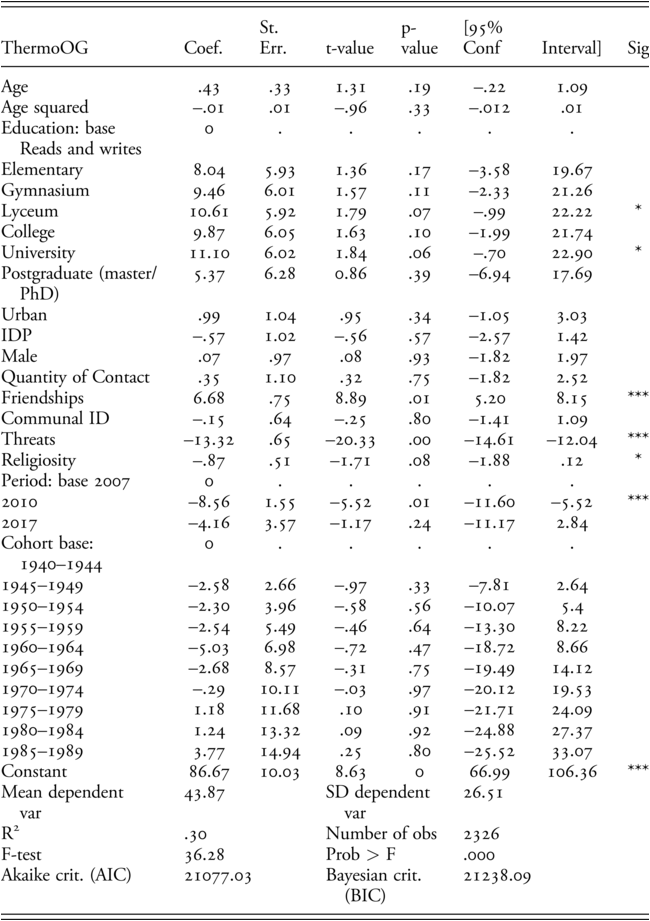
Table 5.4 Long description
The regression output table analyzes predictors of the variable labeled Thermo O G. Each row lists a predictor variable along with its coefficient, standard error, t-value, p-value, ninety-five percent confidence interval, and significance level.
For age, the coefficient is 0.43, with a standard error of 0.33. The t-value is 1.31, and the p-value is 0.19. The 95 percent confidence interval ranges from negative 0.22 to 1.09. This result is not statistically significant.
For age squared, the coefficient is negative 0.01, with a standard error of 0.01. The t-value is negative 0.96, and the p-value is 0.33. The 95 percent confidence interval ranges from negative 0.012 to 0.01. This result is not statistically significant.
For elementary education, the coefficient is 8.04, with a standard error of 5.93. The t-value is 1.36, and the p-value is 0.17. The 95 percent confidence interval ranges from negative 3.58 to 19.67. This result is not statistically significant.
For gymnasium education, the coefficient is 9.46, with a standard error of 6.01. The t-value is 1.57, and the p-value is 0.11. The 95 percent confidence interval ranges from negative 2.31 to 21.26. This result is not statistically significant.
For lyceum education, the coefficient is 10.61, with a standard error of 5.92. The t-value is 1.79, and the p-value is 0.09. The 95 percent confidence interval ranges from negative 1.64 to 22.86. This result is statistically significant at the 10 percent level, indicated by a single asterisk.
For college education, the coefficient is 9.87, with a standard error of 6.05. The t-value is 1.63, and the p-value is 0.10. The 95 percent confidence interval ranges from negative 2.01 to 21.74. This result is not statistically significant.
For university education, the coefficient is 11.10, with a standard error of 6.02. The t-value is 1.84, and the p-value is 0.03. The 95 percent confidence interval ranges from 0.70 to 22.90. This result is statistically significant at the 10 percent level, indicated by a single asterisk.
For postgraduate (master’s or P h D) education, the coefficient is 5.37, with a standard error of 6.28. The t-value is 0.86, and the p-value is 0.39. The 95 percent confidence interval ranges from negative 6.94 to 17.69. This result is not statistically significant.
For urban areas, the coefficient is 0.99, with a standard error of 1.04. The t-value is 0.95, and the p-value is 0.34. The 95 percent confidence interval ranges from negative 1.05 to 3.03. This result is not statistically significant.
For I D P, the coefficient is 0.57, with a standard error of 1.02. The t-value is 1.05, and the p-value is 0.29. The 95 percent confidence interval ranges from negative 0.93 to 3.06. This result is not statistically significant.
For male, the coefficient is 0.07, with a standard error of 0.97. The t-value is 0.07, and the p-value is 0.94. The 95 percent confidence interval ranges from negative 1.82 to 1.97. This result is not statistically significant.
For quantity of contact, the coefficient is 0.35, with a standard error of 1.00. The t-value is 0.35, and the p-value is 0.72. The 95 percent confidence interval ranges from negative 1.62 to 2.32. This result is not statistically significant.
For friendships, the coefficient is 6.68, with a standard error of 0.75. The t-value is 8.89, and the p-value is 0.00. The 95 percent confidence interval ranges from 5.20 to 8.15. This result is statistically significant at the 1 percent level, indicated by three asterisks.
For communal I D, the coefficient is negative 1.59, with a standard error of 0.75. The t-value is negative 2.14, and the p-value is 0.03. The 95 percent confidence interval ranges from negative 3.07 to negative 0.11. This result is statistically significant at the 10 percent level, indicated by a single asterisk.
For threats, the coefficient is negative 13.33, with a standard error of 2.03. The t-value is negative 6.56, and the p-value is 0.00. The 95 percent confidence interval ranges from negative 14.61 to negative 12.04. This result is statistically significant at the 1 percent level, indicated by three asterisks.
For religiosity, the coefficient is negative 0.87, with a standard error of 0.51. The t-value is negative 1.71, and the p-value is 0.08. The 95 percent confidence interval ranges from negative 1.88 to 0.12. This result is statistically significant at the 10 percent level, indicated by a single asterisk.
For the period 2010, with the base year being 2007, the coefficient is negative 5.52, with a standard error of 1.00. The t-value is negative 5.52, and the p-value is 0.00. The 95 percent confidence interval ranges from negative 11.60 to negative 5.52. This result is statistically significant at the 1 percent level, indicated by three asterisks.
For period 2017, the coefficient is negative 3.67, with a standard error of 3.57. The t-value is negative 1.02, and the p-value is 0.24. The 95 percent confidence interval ranges from negative 11.17 to 2.84. This result is not statistically significant.
For 1945 to 1949, the coefficient is 2.66, with a standard error of 7.97. The t-value is 0.33, and the p-value is 0.74. The 95 percent confidence interval ranges from negative 13.00 to 18.32. This result is not statistically significant.
For 1950 to 1954, the coefficient is 2.58, with a standard error of 3.96. The t-value is 0.56, and the p-value is 0.57. The 95 percent confidence interval ranges from negative 10.07 to 5.40. This result is not statistically significant.
For 1955 to 1959, the coefficient is 2.30, with a standard error of 5.49. The t-value is 0.46, and the p-value is 0.64. The 95 percent confidence interval ranges from negative 8.30 to 8.22. This result is not statistically significant.
For 1960 to 1964, the coefficient is 2.54, with a standard error of 6.98. The t-value is 0.72, and the p-value is 0.47. The 95 percent confidence interval ranges from negative 8.72 to 8.66. This result is not statistically significant.
For 1965 to 1969, the coefficient is 5.03, with a standard error of 8.57. The t-value is 0.31, and the p-value is 0.75. The 95 percent confidence interval ranges from negative 19.49 to 14.12. This result is not statistically significant.
For 1970 to 1974, the coefficient is 2.89, with a standard error of 10.11. The t-value is 0.03, and the p-value is 0.98. The 95 percent confidence interval ranges from negative 19.23 to 25.01. This result is not statistically significant.
For 1975 to 1979, the coefficient is 2.12, with a standard error of 11.68. The t-value is 0.19, and the p-value is 0.91. The 95 percent confidence interval ranges from negative 21.71 to 27.09. This result is not statistically significant.
For 1980 to 1984, the coefficient is 1.74, with a standard error of 13.92. The t-value is 0.12, and the p-value is 0.90. The 95 percent confidence interval ranges from negative 24.88 to 27.37. This result is not statistically significant.
For 1985 to 1989, the coefficient is 3.77, with a standard error of 14.94. The t-value is 0.25, and the p-value is 0.80. The 95 percent confidence interval ranges from negative 25.52 to 33.07. This result is not statistically significant.
For constant, the coefficient is 86.67 with a standard error of 10.03. The t-value is 8.63, and the p-value is 0. The 95 percent confidence interval ranges from negative 66.99 to 106.36. This result is statistically significant at the 1 percent level, indicated by three asterisks.
The mean dependent variable is 43.87. S D dependent variable is 26.51. R-squared is 0.30. The number of observations is 2326. F-test is 36.28. The probability greater than F is 0.000. Akaike crit. A I C is 21077.03. Bayesian crit B I C is 21238.09.
*** p < .01, ** p < .05, * p < .1
Turkish Cypriot Community
From the basic model (see Table 5.5) we see that age squared, education and IDP status are significant predictors of feelings towards GCs. The age squared significant findings suggest that older generations of TCs were especially negative towards GCs The period effect was significant, indicating higher scores for years 2010 and 2017 compared to 2007 The total variance explained by this model was adj R2 = 0.06.
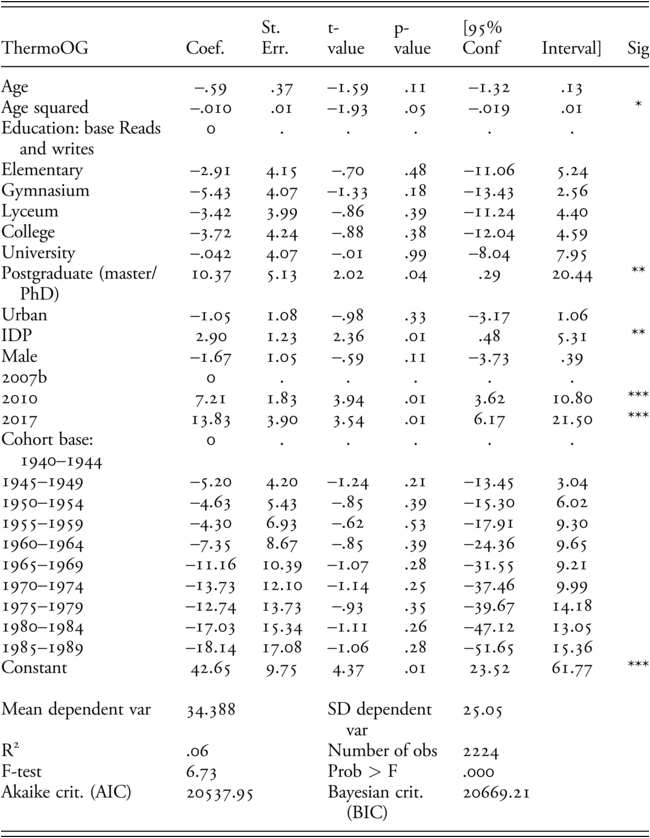
Table 5.5 Long description
The regression output table analyzes predictors of the variable labeled Thermo O G. Each row lists a predictor variable along with its coefficient, standard error, t-value, p-value, ninety-five percent confidence interval, and significance level.
For age, the coefficient is negative 0.59, with a standard error of 0.37. The t-value is negative 1.59, and the p-value is 0.11. The 95 percent confidence interval ranges from negative 1.32 to 0.13. This result is statistically significant at the 10 percent level, indicated by a single asterisk.
For age squared, the coefficient is negative 0.010, with a standard error of 0.01. The t-value is negative 1.93, and the p-value is 0.05. The 95 percent confidence interval ranges from negative 0.019 to negative 0.01. This result is statistically significant at the 10 percent level, indicated by a single asterisk.
For elementary education, the coefficient is negative 2.91, with a standard error of 4.15. The t-value is negative 0.70, and the p-value is 0.48. The 95 percent confidence interval ranges from negative 11.06 to 5.24. This result is not statistically significant.
For gymnasium education, the coefficient is negative 5.43, with a standard error of 4.07. The t-value is negative 1.33, and the p-value is 0.18. The 95 percent confidence interval ranges from negative 13.43 to 2.56. This result is not statistically significant.
For lyceum education, the coefficient is negative 3.42, with a standard error of 3.99. The t-value is negative 0.86, and the p-value is 0.39. The 95 percent confidence interval ranges from negative 11.24 to 4.40. This result is not statistically significant.
For college education, the coefficient is negative 3.72, with a standard error of 4.24. The t-value is negative 0.88, and the p-value is 0.38. The 95 percent confidence interval ranges from negative 21.04 to 4.59. This result is not statistically significant.
For university education, the coefficient is negative 0.42, with a standard error of 4.07. The t-value is negative 0.01, and the p-value is 0.94. The 95 percent confidence interval ranges from negative 8.04 to 7.95. This result is not statistically significant.
For postgraduate (master or P h D) education, the coefficient is 10.37, with a standard error of 5.13. The t-value is 2.03, and the p-value is 0.04. The 95 percent confidence interval ranges from 0.29 to 20.44. This result is statistically significant at the 5 percent level, indicated by two asterisks.
For urban, the coefficient is negative 1.05, with a standard error of 1.08. The t-value is negative 0.98, and the p-value is 0.33. The 95 percent confidence interval ranges from negative 3.17 to 1.06. This result is not statistically significant.
For I D P, the coefficient is 2.90, with a standard error of 1.23. The t-value is 2.36, and the p-value is 0.01. The 95 percent confidence interval ranges from 0.48 to 5.31. This result is statistically significant at the 5 percent level, indicated by two asterisks.
For male, the coefficient is negative 1.67, with a standard error of 1.05. The t-value is negative 1.59, and the p-value is 0.11. The 95 percent confidence interval ranges from negative 3.73 to 0.39. This result is not statistically significant.
For 2010, the coefficient is 7.21, with a standard error of 1.83. The t-value is 3.94, and the p-value is 0.00. The 95 percent confidence interval ranges from 3.62 to 10.80. This result is statistically significant at the 1 percent level, indicated by three asterisks.
For 2017, the coefficient is 13.83, with a standard error of 3.90. The t-value is 3.54, and the p-value is 0.01. The 95 percent confidence interval ranges from 6.17 to 21.50. This result is statistically significant at the 1 percent level, indicated by three asterisks.
For 1945 to 1949, the coefficient is negative 5.20, with a standard error of 4.20. The t-value is negative 1.24, and the p-value is 0.21. The 95 percent confidence interval ranges from negative 13.45 to 3.04. This result is not statistically significant.
For 1950 to 1954, the coefficient is negative 4.63, with a standard error of 5.43. The t-value is negative 0.85, and the p-value is 0.39. The 95 percent confidence interval ranges from negative 15.30 to 6.02. This result is not statistically significant.
For 1955 to 1959, the coefficient is negative 0.43, with a standard error of 6.93. The t-value is negative 0.62, and the p-value is 0.53. The 95 percent confidence interval ranges from negative 17.91 to 9.30. This result is not statistically significant.
For 1960 to 1964, the coefficient is negative 7.35, with a standard error of 8.67. The t-value is negative 0.86, and the p-value is 0.39. The 95 percent confidence interval ranges from negative 24.36 to 9.65. This result is not statistically significant.
For 1965 to 1969, the coefficient is negative 11.16, with a standard error of 10.12. The t-value is negative 1.10, and the p-value is 0.27. The 95 percent confidence interval ranges from negative 31.55 to 9.21. This result is not statistically significant.
For 1970 to 1974, the coefficient is negative 12.10, with a standard error of 12.10. The t-value is negative 1.14, and the p-value is 0.25. The 95 percent confidence interval ranges from negative 37.46 to 9.99. This result is not statistically significant.
For 1975 to 1979, the coefficient is negative 13.73, with a standard error of 7.93. The t-value is negative 1.73, and the p-value is 0.08. The 95 percent confidence interval ranges from negative 29.74 to 2.28. This result is statistically significant at the 10 percent level, indicated by a single asterisk.
For 1980 to 1984, the coefficient is negative 12.74, with a standard error of 7.34. The t-value is negative 1.74, and the p-value is 0.08. The 95 percent confidence interval ranges from negative 26.17 to 0.67. This result is statistically significant at the 10 percent level, indicated by a single asterisk.
For 1985 to 1989, the coefficient is negative 17.08, with a standard error of 6.03. The t-value is negative 2.83, and the p-value is 0.00. The 95 percent confidence interval ranges from negative 29.61 to negative 4.55. This result is statistically significant at the 1 percent level, indicated by three asterisks.
For constant, the coefficient is 42.65, with a standard error of 9.75. The t-value is 4.37, and the p-value is 0.01. The 95 percent confidence interval ranges from 23.52 to 61.77. This result is statistically significant at the 1 percent level, indicated by three asterisks.
The mean dependent variable is 34.388. S D dependent variable is 25.05. R-squared is 0.06. The number of observations is 2224. F-test is 6.73. The probability greater than F is 0.000. Akaike crit. A I C is 20537.95. Bayesian crit B I C is 20669.21.
*** p < .01, ** p < .05, * p < .1
When the social psychological variables were entered in the model (see Table 5.6), the total variance explained by the model was significantly increased (adj R2 = 0.26). Interestingly, the effect of education became non-significant, which suggests that having a master or PhD probably makes people more resistant to succumbing to the ethos of conflict (captured by the social psychological variables). Similarly, the effect of IDP status became non-significant, which probably also suggests some mediation by social psychological variables. The effect of age squared remained close to significance and an age trend was also present. Some demographic variables also became significant, specifically Area of residency and gender. Males were more prejudiced compared to females and those living in urban areas were more prejudiced compared to those living in rural areas. The social psychological variables that are significant predictors in this model are quantity of contact, outgroup friendships and threats, all in the predicted direction. There was also a significant effect for religiosity, suggesting that TCs who are more religious are more prejudiced towards GCs. Finally, running an HAPC model with period and cohort as random effects revealed that age, age squared, period and cohort significant effects were present, with younger TCs and younger cohorts being related to more positive feelings towards GCs and 2010 and 2017 feelings being more positive than the 2007 feelings.
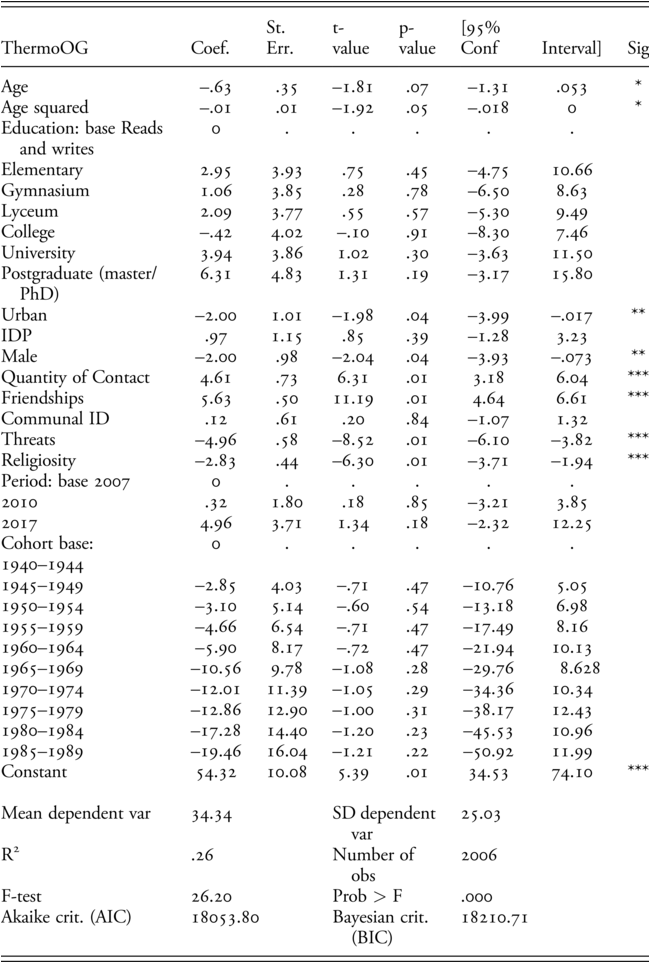
Table 5.6 Long description
The regression output table analyzes predictors of the variable labeled Thermo O G. Each row lists a predictor variable along with its coefficient, standard error, t-value, p-value, ninety-five percent confidence interval, and significance level.
For age, the coefficient is negative 0.63, with a standard error of 0.35. The t-value is negative 1.81, and the p-value is 0.07. The 95 percent confidence interval ranges from negative 1.31 to 0.053. This result is statistically significant at the 10 percent level, indicated by a single asterisk.
For age squared, the coefficient is negative 0.01, with a standard error of 0.01. The t-value is negative 1.92, and the p-value is 0.05. The 95 percent confidence interval ranges from negative 0.018 to 0. This result is statistically significant at the 10 percent level, indicated by a single asterisk.
For elementary education, the coefficient is 2.95, with a standard error of 3.93. The t-value is 0.75, and the p-value is 0.45. The 95 percent confidence interval ranges from negative 4.75 to 10.66. This result is not statistically significant.
For gymnasium education, the coefficient is 1.06, with a standard error of 3.85. The t-value is 0.28, and the p-value is 0.78. The 95 percent confidence interval ranges from negative 6.50 to 8.63. This result is not statistically significant.
For lyceum education, the coefficient is 2.09, with a standard error of 3.77. The t-value is 0.55, and the p-value is 0.57. The 95 percent confidence interval ranges from negative 5.30 to 9.49. This result is not statistically significant.
For college education, the coefficient is negative .042, with a standard error of 4.02. The t-value is negative 0.10, and the p-value is 0.91. The 95 percent confidence interval ranges from negative 8.30 to 7.46. This result is not statistically significant.
For university education, the coefficient is 3.94, with a standard error of 3.86. The t-value is 1.02, and the p-value is 0.30. The 95 percent confidence interval ranges from negative 3.63 to 11.50. This result is not statistically significant.
For postgraduate (master’s or P h D) education, the coefficient is 6.31, with a standard error of 4.83. The t-value is 1.31, and the p-value is 0.19. The 95 percent confidence interval ranges from negative 3.17 to 15.08. This result is statistically significant at the 5 percent level, indicated by two asterisks.
For urban, the coefficient is negative 2.00, with a standard error of 1.01. The t-value is negative 1.98, and the p-value is 0.04. The 95 percent confidence interval ranges from negative 3.99 to negative 0.017. This result is statistically significant at the 5 percent level, indicated by two asterisks.
For I D P, the coefficient is 0.97, with a standard error of 1.15. The t-value is 0.85, and the p-value is 0.39. The 95 percent confidence interval ranges from negative 1.28 to 3.23. This result is not statistically significant.
For male, the coefficient is negative 2.00, with a standard error of 0.98. The t-value is negative 2.04, and the p-value is 0.04. The 95 percent confidence interval ranges from negative 3.93 to negative 0.073. This result is statistically significant at the 5 percent level, indicated by two asterisks.
For the quantity of contact, the coefficient is 4.61, with a standard error of 0.73. The t-value is 6.31, and the p-value is 0.01. The 95 percent confidence interval ranges from 3.18 to 6.04. This result is statistically significant at the 1 percent level, indicated by three asterisks.
For friendships, the coefficient is 5.63, with a standard error of 0.50. The t-value is 11.19, and the p-value is 0.01. The 95 percent confidence interval ranges from 4.64 to 6.61. This result is statistically significant at the 1 percent level, indicated by three asterisks.
For communal I D, the coefficient is 0.12, with a standard error of 0.61. The t-value is 0.20, and the p-value is 0.84. The 95 percent confidence interval ranges from negative 1.07 to 1.32. This result is not statistically significant.
For threats, the coefficient is negative 4.96, with a standard error of 0.58. The t-value is negative 8.52, and the p-value is 0.01. The 95 percent confidence interval ranges from negative 6.10 to negative 3.82. This result is statistically significant at the 1 percent level, indicated by three asterisks.
For religiosity, the coefficient is negative 2.83, with a standard error of 0.44. The t-value is negative 6.30, and the p-value is 0.01. The 95 percent confidence interval ranges from negative 3.71 to negative 1.94. This result is statistically significant at the 1 percent level, indicated by three asterisks.
For 2010, the coefficient is 0.32, with a standard error of 1.80. The t-value is 0.18, and the p-value is 0.85. The 95 percent confidence interval ranges from negative 3.21 to 3.85. This result is not statistically significant.
For 2017, the coefficient is 4.96, with a standard error of 3.71. The t-value is 1.34, and the p-value is 0.18. The 95 percent confidence interval ranges from negative 2.32 to 12.25. This result is not statistically significant.
Cohort (base: 1940 to 1944)
For 1945 to 1949, the coefficient is negative 2.85, with a standard error of 4.03. The t-value is negative 0.71, and the p-value is 0.47. The 95 percent confidence interval ranges from negative 10.76 to 5.05. This result is not statistically significant.
For 1950 to 1954, the coefficient is negative 3.10, with a standard error of 5.14. The t-value is negative 0.06, and the p-value is 0.54. The 95 percent confidence interval ranges from negative 13.18 to 6.98. This result is not statistically significant.
For 1955 to 1959, the coefficient is negative 4.66, with a standard error of 6.54. The t-value is negative 0.71, and the p-value is 0.47. The 95 percent confidence interval ranges from negative 17.49 to 8.16. This result is not statistically significant.
For 1960 to 1964, the coefficient is negative 5.90, with a standard error of 8.17. The t-value is negative 0.72, and the p-value is 0.47. The 95 percent confidence interval ranges from negative 21.94 to 10.13. This result is not statistically significant.
For 1965 to 1969, the coefficient is negative 10.56, with a standard error of 9.78. The t-value is negative 1.08, and the p-value is 0.28. The 95 percent confidence interval ranges from negative 29.76 to 8.628. This result is not statistically significant.
For 1970 to 1974, the coefficient is negative 12.01, with a standard error of 11.39. The t-value is negative 1.05, and the p-value is 0.29. The 95 percent confidence interval ranges from negative 34.36 to 10.34. This result is not statistically significant.
For 1975 to 1979, the coefficient is negative 12.86, with a standard error of 12.90. The t-value is negative 1.00, and the p-value is 0.31. The 95 percent confidence interval ranges from negative 38.17 to 12.43. This result is not statistically significant.
For 1980 to 1984, the coefficient is negative 17.28, with a standard error of 14.40. The t-value is negative 1.20, and the p-value is 0.23. The 95 percent confidence interval ranges from negative 45.53 to negative 10.96. This result is not statistically significant.
For 1985 to 1989, the coefficient is negative 19.46, with a standard error of 16.04. The t-value is negative 1.21, and the p-value is 0.22. The 95 percent confidence interval ranges from negative 50.92 to negative 11.99. This result is not statistically significant.
For Constant, the coefficient is 54.32, with a standard error of 10.08. The t-value is 5.39, and the p-value is 0.01. The 95 percent confidence interval ranges from 34.53 to 74.10. This result is statistically significant at the 1 percent level, indicated by three asterisks.
The mean dependent variable is 34.34. S D dependent variable is 25.03. R-squared is 0.26. The number of observations is 2006. F-test is 26.20. The probability greater than F is 0.000. Akaike crit. A I C is 18053.80. Bayesian crit B I C is 18210.71.
*** p < .01, ** p < .05, * p < .1
Predicting Intergroup Trust, Support for Bizonal Bicommunal Federation and Renewed Cohabitation
Applying the same analytical strategy with three additional outcome variables, the findings are generally in the same direction as the findings about feelings towards the other community reported in the previous section (Table 5.7).
Trust (GCs) | Trust (TCs) | BBF (GCs) | BBF (TCs) | Cohab. (GCs) | Cohab. (TCs) | |
|---|---|---|---|---|---|---|
| Age | √ | ns | ns | Ns | √ | ns |
| Age Squared | Ns | √ | ns | Ns | √ | √ |
| Period | √ | √ | √ | √ | √ | ns |
| Cohort | √ | √ | ns | ns | √ | √ |
| Education | ns | Ns | ns | ns | Ns | √ |
| Urbanisation | ns | Ns | ns | √ | √ | ns |
| IDP status | ns | Ns | √ | ns | Ns | ns |
| Male | ns | Ns | √ | √ | √ | ns |
| Quantity of Contact | ns | √ | ns | √ | √ | √ |
| Friendships | √ | √ | ns | ns | Ns | ns |
| Communal ID | ns | Ns | ns | ns | Ns | ns |
| Threats | √ | √ | √ | √ | √ | √ |
| Feelings | - | - | √ | √ | √ | √ |
| Trust | - | - | √ | √ | √ | √ |
| Religiosity | √ | √ | ns | √ | Ns | √ |
| Adj. R2 | .22 | .19 | .19 | .20 | .49 | .27 |
√: Significant ns: Non Significant
Predicting Trust towards TCs in the Greek Cypriot Community
From the basic model testing only the demographic variables as predictors and treating period and cohort as fixed effects, a significant finding is revealed only for education and gender. Those with a master or PhD are more trustful of TC ordinary people compared to the uneducated. Male participants are more likely to exhibit trust compared to women. The total variance explained by this model was adj R2 = .04.
When the social psychological variables were entered in the model, the total variance explained by the model was significantly increased (adj R2 = .22). Interestingly, age and cohort became significant with older people and those of older cohort showing significantly higher levels of trust compared to younger participants and generations. Indeed, HAPC analysis treating both period and cohort as random effects revealed that there were significant random effects for both variables and a significant effect for age. The social psychological variables that are significant predictors in this model were outgroup friendships and threats in the expected direction. Religiosity was also significant, indicating that those who considered religion important in their life were more likely to show less trust towards TCs.
Predicting Trust towards GCs in the Turkish Cypriot Community
From the basic model testing only the demographic variables as predictors and treating period and cohort as fixed effects, a significant finding is revealed for age squared, area of residency and period. Those living in urban areas showed more trust compared to those living in rural areas. The mean score for data collected in 2010 on the dependent variable was significantly higher compared to the same in 2007. The total variance explained by this model was adj R2 = .08.
When the social psychological variables were entered in the model, the total variance explained by the model was significantly increased (adj R2 = .19). Interestingly, age squared remained significant, but area of residence became non-significant. An HAPC analysis treating both period and cohort as random effects revealed that there were significant random effects for both whilst the age squared effect was still significant. The predicted values of intergroup trust indicated an increased trust in the younger compared to the older cohorts, with a higher rate of increase for cohorts 3–6. Predicted values of intergroup trust were also higher in both the 2010 and 2017 period compared to the same in 2007. The social psychological variables that are significant predictors in this model were quantity of contact and outgroup friendships and threats all in the expected direction. There was also a significant finding for religiosity with those who were more religious being less trustful of members of the other community.
Predicting Acceptance of BBF in the Greek Cypriot Community
From the basic model we see that education, IDP status, gender and period are significant predictors. Higher education (and especially having a master or PhD) increases the odds of acceptance of BBF compared to the odds of no support for BBF. For example, the odds for acceptance of BBF by a master or PhD holder is almost three times (2.89) the odds of somebody who only reads and writes. The male’s odds of accepting BBF are 1.5 times compared to females. The odds of accepting BBF being IDP is 1.19 times the odds of supporting BBF when not being IDP. The findings from this model are significant because, when controlling for period, there is neither an age nor a cohort effect that would show diminishing possibilities for support for BBF in the younger generations as one might expect from our discussion in the previous chapter, and that a partitionist mentality in the Greek Cypriot community seems to be more closely linked with the younger generation and the findings in this chapter about a generational gap in prejudice and trust levels in the GC community. All these go to suggest that the model of BBF is a versatile model of governance that accommodates both centrifugal and centripetal ways of thinking about the future institutional governance of Cyprus.
The effects of period were, however, significant given that acceptance of BBF increased steadily in the period 2007–2017. This increasing trend is in fact continuing after the year 2017 according to more recent research findings (Psaltis et al., Reference Psaltis, Halperin, Loizides, Stefanovic, Leshem and Cakal2021). In fact, the increasing support in recent years is clearly linear (58.1% in 2018, 65% in 2019, 76% in 2020 and 80.5% in 2023) (see also Appendix A), which suggests large dependence on recent political developments.
When the social psychological variables were entered in the models, the total variance explained by the model was significantly increased (pseudo R2 = .137). Interestingly, the IDP status, gender and period effects remained significant, but education became non-significant, which suggests that probably education is having its effects on the outcome (acceptance of BBF) through the social psychological variables that are significant predictors in this model. These are feelings towards the other community (prejudice), intergroup trust and threats.
Predicting Acceptance of BBF in the Turkish Cypriot Community
From the basic model we see that gender, area of living (urban or rural) and period are significant predictors. Living in an urban area increases the odds of acceptance of BBF compared to the odds for those living in rural areas. For example, the odds for acceptance of urban dwellers are 1.32 times the odds for somebody who lives in rural areas. The male’s odds of accepting BBF are 1.22 times compared to females. In the period 2007–2017 there is, as in the case of GCs, a significant increase in the percentage of people who would accept BBF.
The period effect was significant and its effect of big magnitude with a significant linear improvement in the period 2007–2017. Data from the later period (2020–2023) (see Appendix A) suggest that there was a decrease in acceptance levels of BFF at 71.2%, which might relate to the policy turn of newly elected Ersin Tatar, backed by Turkey, away from BBF and towards recognition of separate sovereignty for TCs or two states but the acceptance bounced back (79.8%) in 2023.
When the social psychological variables were entered in the model, the total variance explained by the model was significantly increased (pseudo R2 = 0.19). Interestingly, the area of residency, gender and period effects remained significant. The social psychological variables that are significant predictors in this model are quantity of contact and intergroup trust in the expected direction. There was also a significant finding for religious importance with more religious people being less likely to support BBF.
Predicting Willingness for Renewed Cohabitation in the Greek Cypriot Community
From the basic model testing only the demographic variables as predictors and treating period and cohort as fixed effects, a significant finding is revealed for age and age squared, gender, place of residence (urban or rural) and period. Male participants, those living in urban areas and older GCs are more likely to support renewed cohabitation. Also, the mean score for data collected in 2010 on the dependent variable was significantly lower compared to the same in 2007. The total variance explained by this model was adj R2 = .08.
When the social psychological variables were entered in the model, the total variance explained by the model was significantly increased (adj R2 = .49). Interestingly, age and age squared, gender, place of residence (urban or rural) and period effects remained significant. Additionally, a significant cohort effect was revealed. Indeed, HAPC analysis treating both period and cohort as random effects revealed that there were significant random effects for both variables, with older participants being more ready for renewed cohabitation compared to younger. The social psychological variables that are significant predictors in this model were quantity of contact, feelings towards the other community (prejudice), intergroup trust and threats all in the expected direction.
Predicting Willingness for Renewed Cohabitation in the Turkish Cypriot Community
From the basic model testing only the demographic variables as predictors and treating period and cohort as fixed effects, a significant finding is revealed for age squared, education and period. More educated and younger TCs are more likely to support renewed cohabitation. Also, the mean score for data collected in 2010 and 2017 on the dependent variable was significantly higher compared to the same in 2007, exhibiting an increasing linear trend of support for cohabitation in time. The total variance explained by this model was adj R2 = .04).
When the social psychological variables were entered in the model, the total variance explained by the model was significantly increased (adj R2 = .27). Interestingly, age squared and education effects remained significant, but period effects became non-significant. An HAPC analysis treating both period and cohort as random effects revealed that there were significant random effects only for cohort, whilst the age squared effect became non-significant. The predicted values of cohabitation indicated an increased appetite for renewed cohabitation in the younger compared to the older cohorts. The social psychological variables that are significant predictors in this model were feelings towards the other community (prejudice), intergroup trust and threats all in the expected direction. There was also a trend for those having more contact to be more ready for renewed cohabitation, whilst those who were more religious tended to be less ready for cohabitation.
Summary of Findings and Policy Implications for CBMs, BBF Design and Referendums
All in all, the findings suggest that the social psychological variables of prejudice, trust, threats and contact play a crucial role in regulating the wish for renewed cohabitation and, to a lesser extent, the acceptance of BBF that appears to depend also on political developments and IDP status for GCs (on IDPs and their stance, see Psaltis et al., Reference Psaltis, Cakal, Loizides and Kuşçu Bonnenfant2020). As the negative role of prejudice and distrust is important, policymakers need to realise that there are two major routes for prejudice reduction, intergroup contact and threat reduction, and they both depend on mood in public debate in the media (Avraamidou & Psaltis, 2020; Karayianni & Psaltis, Reference Karayianni and Psaltis2023) and, in the longer term, on good-quality education mostly at the post-graduate level and probably study experiences abroad. Despite the presence of ethnocentric narratives in both communities, education has a positive impact on prejudice reduction. The fact that the effects are more pronounced at the higher levels of education is suggestive of the greater potential of higher education to become critical and reflective of master narratives of conflict compared to the elementary and secondary schools that are still hostages to the propaganda of master narratives.
Cohort effects can be located in the GC community for both prejudice, trust towards TCs and wish for renewed cohabitation showing an increasing alienation of the younger generation of GCs from the other community. On the contrary, the older generation of TCs is more alienated from GCs. Alienation from the other community in terms of trusting relations is higher in rural compared to urban areas where more traditional and conservative values (religiosity included) create a heightened sense of difference through symbolic threats.
Positive period effects relating to decreasing prejudice and distrust since 2007 have been clearly present in the TC community and seem to be related to more contact opportunities with the GC community, thus deconstructing the enemy image that existed since intercommunal strife in the 1960s and the following separatist Rauf Denktas narrative that ‘we cannot live with Greek Cypriots’. Here it is interesting to note that after the Crans Montana failure in two measurements in 2020 and 2023, a majority of TCs for the first time stated that they could accept a unitary state, which also puts in question the policy followed by Ersin Tatar and Turkey recently. Of course, this is a policy not supported by the UN security council resolution on Cyprus, but it is indicative of a trend in the public that goes against the followed policy.
In the GC community there was a temporary worsening of prejudice in the year 2010, which probably relates to the isolation of the ruling leftist party which actively supported rapprochement efforts and the consequent reactionary backlash against the left (Trimikliniotis & Bozkurt, Reference Trimikliniotis and Bozkurt2012). Also, one year earlier, in 2009, saw the rise of nationalist Derviş Eroğlu as prime minister in the north, which could have also influenced the GC view about the wish of TCs for a solution. The period 2010–2012 was also marred by financial hardships and heightened xenophobic attitudes towards immigrants in the GC press (see Kadianaki et al., Reference Kadianaki, Avraamidou, Ioannou and Panagiotou2018), which might have spilled over to bicommunal attitudes also. The election of Mustafa Akinci in 2015, however, completely reversed this picture with an impressive improvement of attitudes that still holds until today, even after the Crans Montana failure. These findings point to an important regulator of prejudice levels in each community which has to do with the outcome of elections, beyond any effects of contact well documented already. When a pro-reconciliation leader is elected in one community on a clear mandate for a compromise solution like BBF, there seems to be a positive impact on the public opinion of the other community, since they probably read the positive outcome of the elections as a collective will for peace within the out-group, thus reducing threats. It is interesting to note here that the election of nationalist Ersin Tatar in 2020 did not seem to negatively influence the emotions of GCs towards TCs, which is probably due to the fact that Mustafa Akinci lost the election by fewer than 5,000 votes and only after significant intervention from Ankara in favour of Tatar, which was interpreted by GCs as not a significant change of the will of the TC laypeople for peace.
Attitude towards BBF mostly depends on two factors. The first is social psychological relating to contact and reduced prejudice, threats and distrust. The second is political developments in the last 20 years that increased the federalist mentality of the two communities, even partly through pragmatic concerns relating to regional tensions or the legitimate wish to return to lost homes among older GC IDPs for whom the emotional connection with their lost home is still alive (see Psaltis et al., Reference Psaltis, Cakal, Loizides and Kuşçu Bonnenfant2020). The increasing alienation of the younger generations of GCs from TCs registered in this and the previous chapter seems to leave unchanged the increasing support for BBF in the past few years. One could legitimately hypothesise, given the versatility of interpretations BBF can accommodate, that a more decentralised form of BBF and bizonality would not be particularly repulsive to the younger generation of GCs compared to the older generation of the same community, given their higher alienation levels from TCs. A decentralised federation might be more acceptable if there were a referendum tomorrow, but of course this does not mean it will be the best model in the long term for the sustainability of the future of reunited Cyprus. What is certain from the current findings in Appendices A and B is that the only model supported by the UN resolution and that could be accepted by a clear majority in both communities is that of BBF.
When it comes to referendums, the dynamics of the voters’ decisions will naturally depend on prejudice levels, trust, stance on renewed cohabitation and BBF, but there are additional factors that will need to be taken into account like the Yes and No campaigns organisation and content, their funding and dynamic, the stance of political parties, not to mention interference by foreign states, influence from political leaders and, of course, the final content of the peace package (Loizides, Reference Loizides2014). In some of our research we asked people of the two communities about their general stance on a possible referendum scenario at various points in time (see Appendices A and B, Figures A.7 and B.7). Despite the variability observed, which partially depends on the state of public debate about the negotiations at a given point, some observations are noteworthy. For example, there was a negative turn around January 2017 (Avraamidou & Psaltis, 2020) in the GC press compared to a much more positive climate in 2015 and 2016 (see Karayianni & Psaltis, Reference Karayianni and Psaltis2023), which is reflected in Figure A.7 of Appendix A. However, by April 2017, and only three months before Crans Montana, those trending to Yes in the GC community were almost double those trending to No. Beyond the aforementioned fluctuation, it is worthwhile noting that in the GC community the dominant trend was for those trending to Yes to outnumber those who trended to No by a 2:1 ratio.Footnote 10 In the TC community the picture was generally not so hopeful, which, compared to the results of the referendum in 2004, was suggestive of a reversal that might have given Akinci a hard time if there was eventually a referendum. Given lower prejudice levels towards GCs in the TC community recently compared to 2007, we have to conclude that the negative stance of TCs on referendum had to do with some provisions in the Guterres framework that they found difficult to accept, and not the quality of their intercommunal relations.
However, beyond speculation, what is more important in the case of exploring referendum intentions is to specify as concretely as possible the content of the peace package before asking people to position themselves with a Yes or a No. In our most recent research we applied the method of conjoint analysis to do exactly that in specifying varieties of all dimensions of the Guterres framework, and we were in a position to identify at least two variations in the framework that could garner a majority vote in both communities simultaneously (see Loizides et al., Reference Loizides, Psaltis, Morgan-Jones, Sudulich, Popp and Baykiz2022). Online dialogues that are now made possible by AI-facilitated platforms can also offer quick and valuable feedback to policymakers about the wish of the two communities and the formulation of a peace package that will be accepted by both communities in a referendum.Footnote 11
Immediate and long-term CBMs with direct impact on the core mediating variables of our findings (e.g. threats) are of crucial importance, as they will facilitate reconciliation prefiguring a reunited Cyprus. The implementation of microgenetic processes through intergroup contact and the revision of one-sided victimisation narratives need to take priority. Our ideas of intergroup contact as microgenesis were recently applied in post-settlement Colombia (Fonseca & Jovchelovitch, Reference Fonseca and Jovchelovitch2024), where urban university students lived for 11 days with former guerillas in rural areas, with impressive transformations of the representations of students about their identities as peacemakers, deconstructing the enemy image of the other and the representation of peace and reconciliation itself. A similar programme of hospitality in houses of the other community on a mass scale can be designed in Cyprus in the pre-settlement period, which is expected to bring the positive effects of contact at massive levels in a short time through direct and indirect forms of contact (Yucel & Psaltis, Reference Yucel and Psaltis2020; Donno et al., Reference Donno, Psaltis and Zarpli2021).
Such CBMs are needed not only to prepare the ground for renewed negotiations and a successful outcome but also for the longer sustainability of living together and co-operating in a BBF. In this sense it is very unfortunate that the IMAGINE programme was halted and that the two communities did not find the way to promote history teaching on both sides of the divide free from nationalistic and one-sided victimisation narratives. One idea that is gaining support in both communities of CyprusFootnote 12 is the writing of school history textbooks by a group of historians and educators from both communities. About 70% of respondents from the GC community and 82% from the TC community accepted this idea in 2023. These high levels of acceptance were another indicator of the positive transformation that took place after the opening of the checkpoints in terms of bicommunal relations and the work of the AHDR in civil society that started more than 20 years prior.
The current statistics about the frequency of checkpoint crossings can also be significantly improved. In the same bicommunal research completed in 2023 (see Appendix B, Table B.1 for its methodology) mentioned in the previous paragraph we also asked two questions relating to crossings. The first was if they visited the other side after the opening of checkpoints in 2003 and, if yes, how many times. In the GC community 31% never crossed to the north of the divide. Those who have crossed only once accounted for 18.9% of the group, 22.7% crossed two to three times, 9.4% crossed four to six times and 18% crossed seven or more times. In the TC community, 19.5% never crossed, 8.1% crossed once, 8.8% crossed two to three times, 6.9% crossed four to six times and 56.6% crossed seven or more times.
Table 5.8 suggests that the stigmatisation of crossing to the north still holds for the majority of the GC community, who either never crossed or crossed only once and did not intend to cross again. Only about 30% of GCs cross at least a few times a year with some regularity. In the TC community the situation is much different, with less than 20% having never crossed, and among those who do, 84% cross at least a few times a year. This translates into about 68% of the overall population crossing regularly. There is even a small percentage (1.4%) of TCs who work in the south and cross on a daily basis.
| GCs (%) | TCs (%) | |
|---|---|---|
| I visited only once and I will not visit again | 24.7 | 4.2 |
| I visited a few times and I will not visit again | 30.8 | 11.8 |
| I visit a few times a year | 35.4 | 40.4 |
| I visit once or twice a month | 7.2 | 26.4 |
| I visit a few times a week | 1.0 | 11.6 |
| I visit almost every day | 0.9 | 4.2 |
| I work there (I visit every day) | 0 | 1.4 |
Clearly there is much more to be done in the GC community to facilitate contacts between the two communities and de-stigmatise crossing to the north.
In terms of the demographic variables, the youth and women need to significantly increase their participation in discussions about the Cyprus problem and bicommunal activities, as well as people living in rural areas and people of lower socio-economic status. IDPs who have ‘skin in the game’ also need to be included in the negotiations. Obviously the educational systems can do much more in not only promoting contact and revising history textbooks or promoting multiperspectivity but also promoting civic education of students and increasing their knowledge about federal systems in the world and basic rules of their functioning. Given some spillover effects from the migration issue to the Cyprus issue, if negotiations are to restart, the xenophobic climate against migration that was purposefully cultivated by the previous government in the south through a securitisation discourse (Trimikliniotis, Reference Trimikliniotis2019; UNHCR-Cyprus, 2023) will need to be defused and alternative narratives of cultural enrichment through diversity and financial benefits will need to be promoted. A national strategy for integration of immigrants could go a long way in helping in this direction. The role of the media is crucial in reducing realistic and symbolic threats towards alterity more generally. Drastic measures in the media landscape in the direction of peace journalism are also urgently needed.
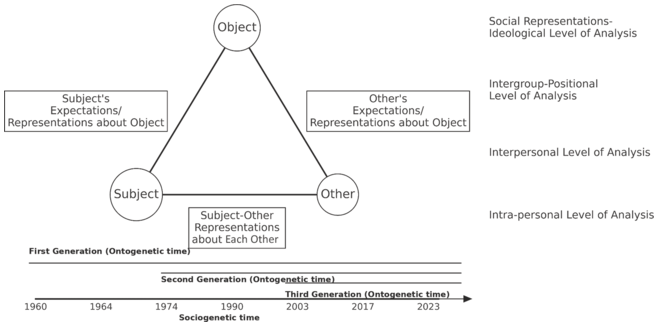
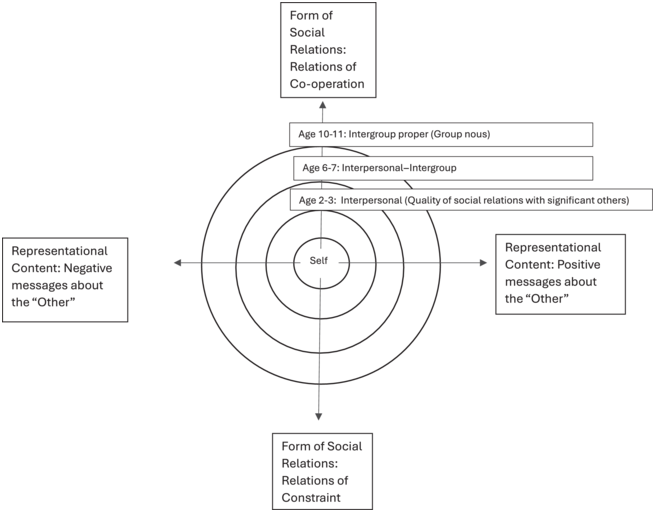
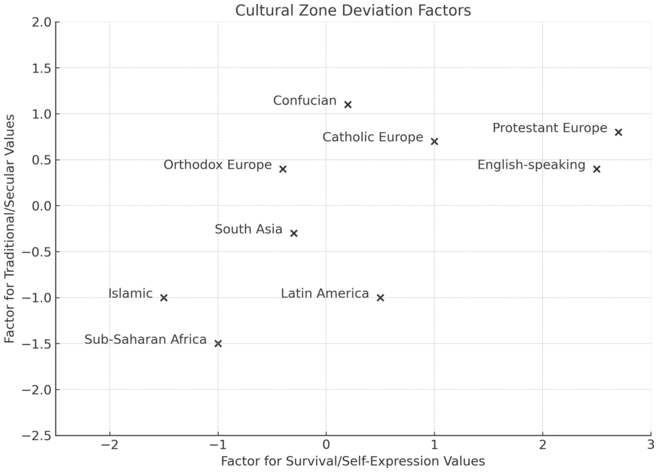
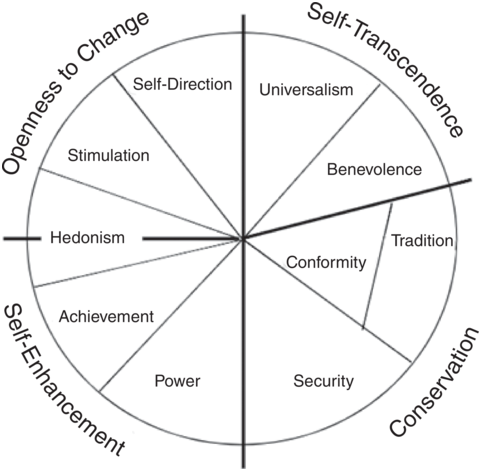
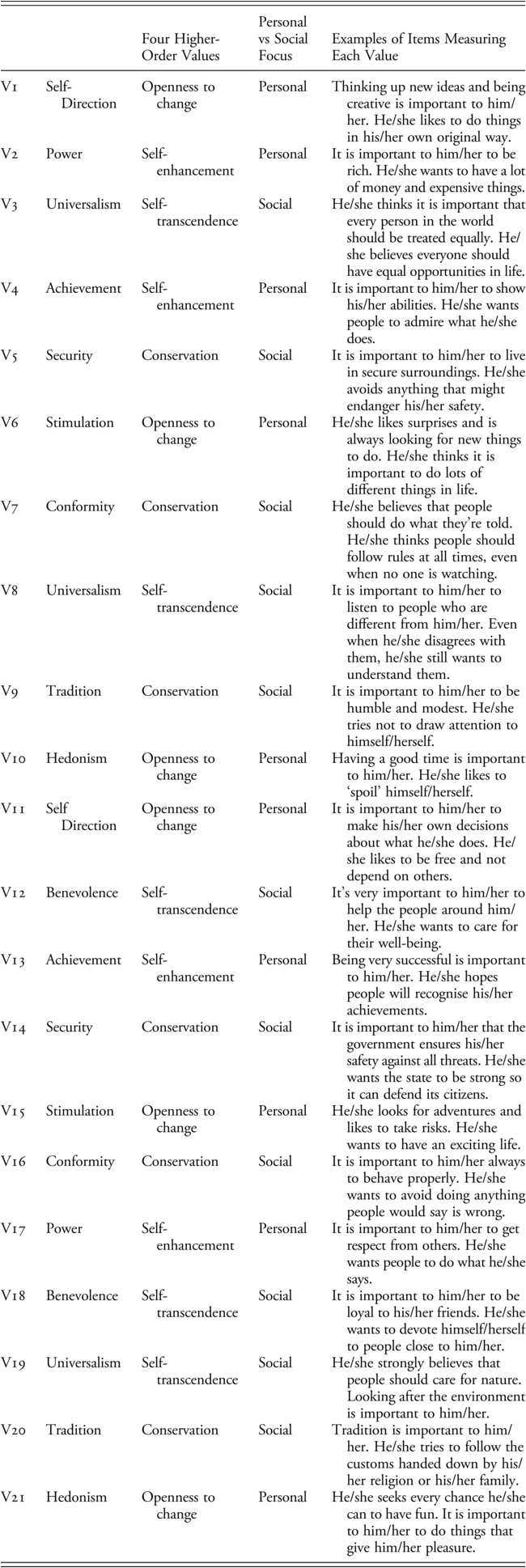
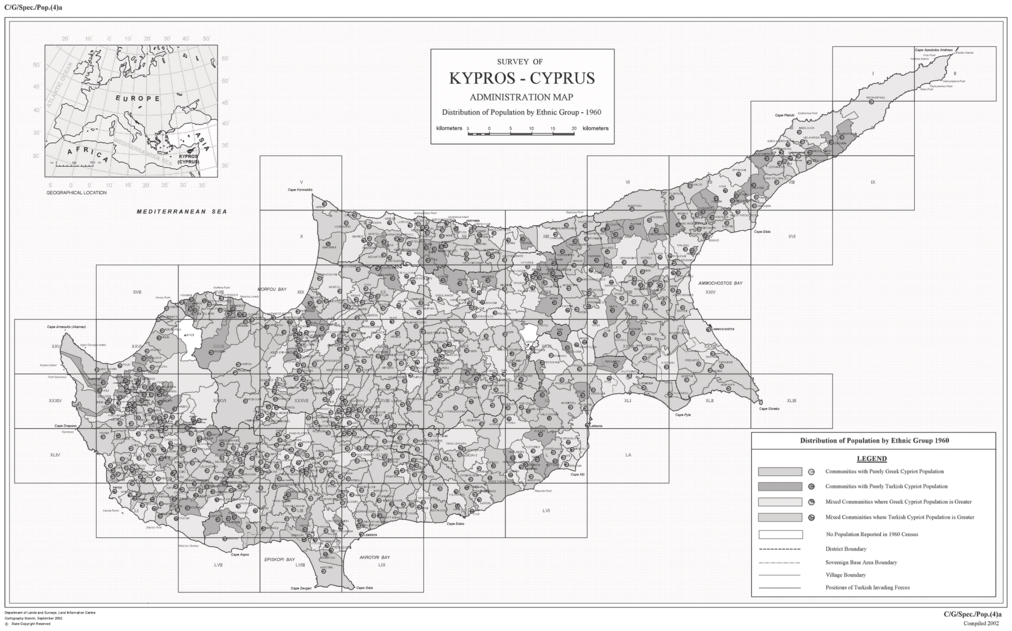
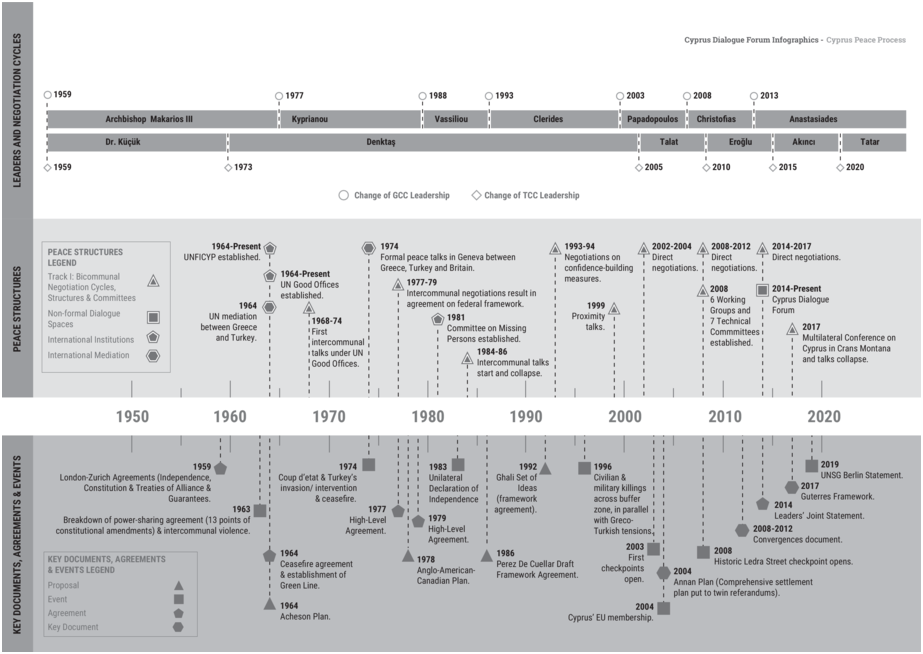
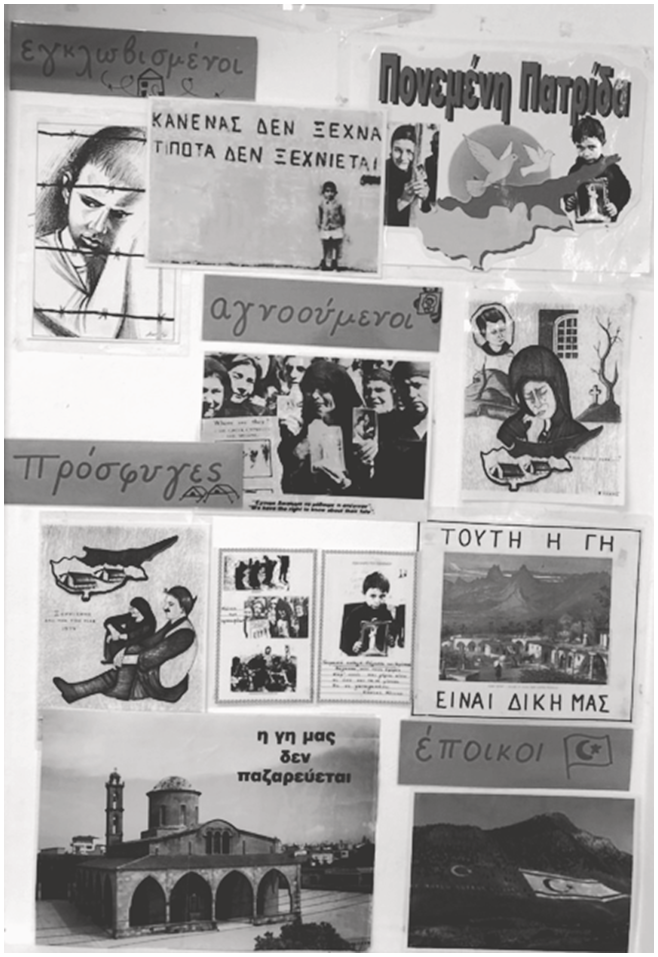
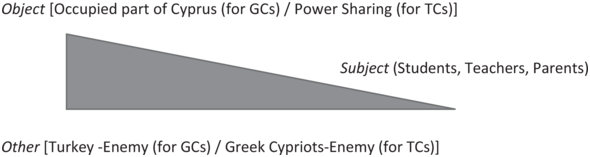
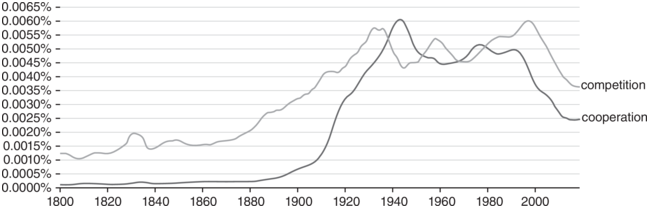
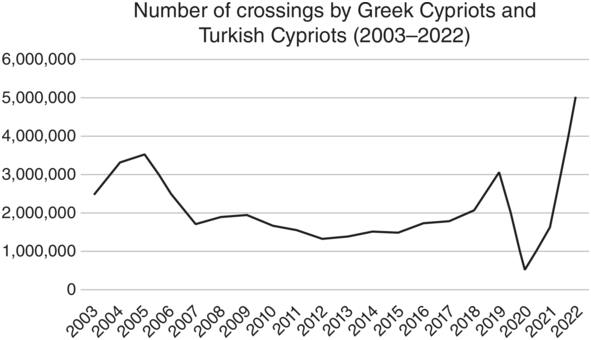
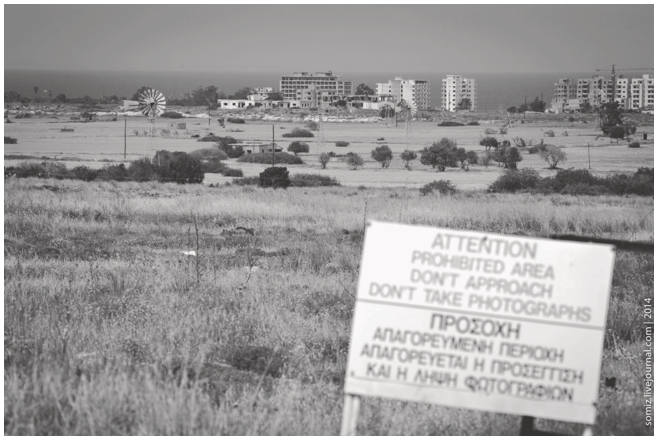
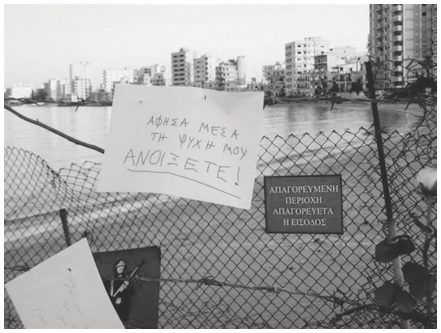
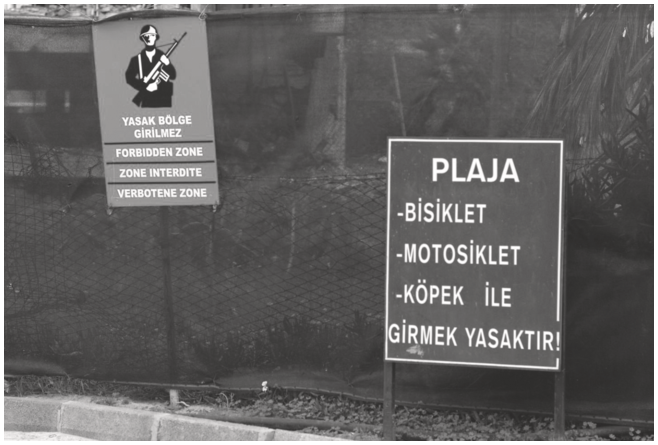
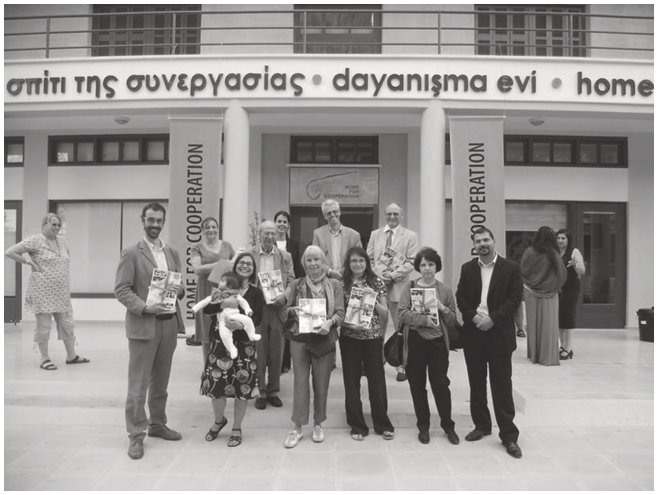
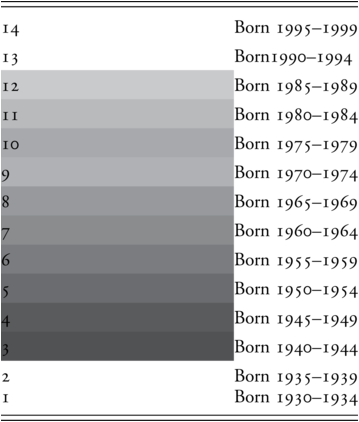
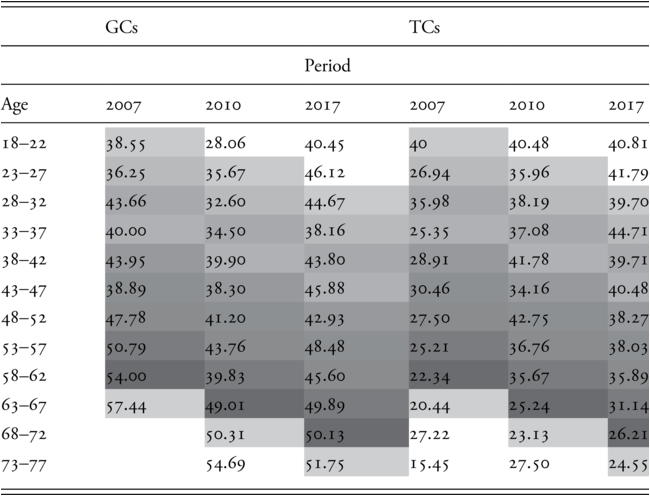
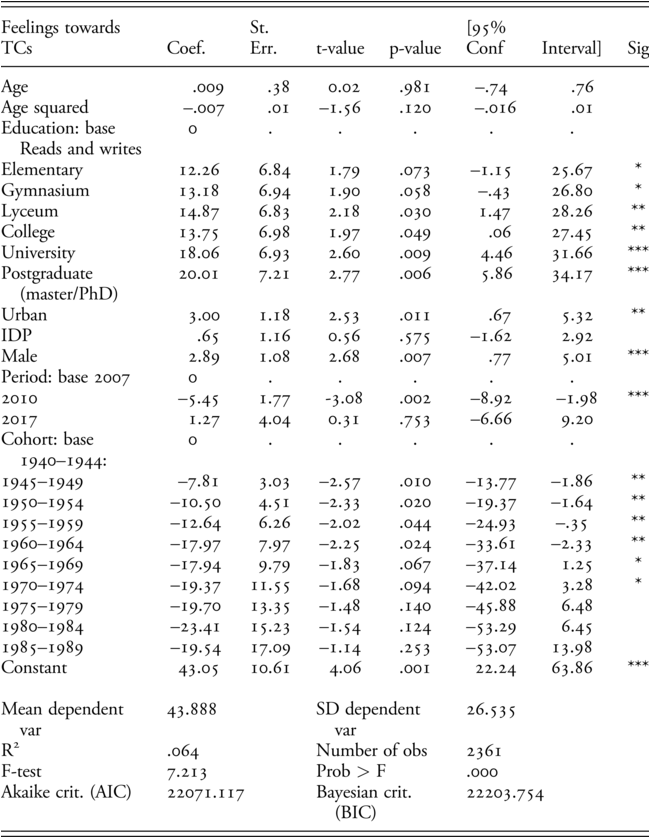
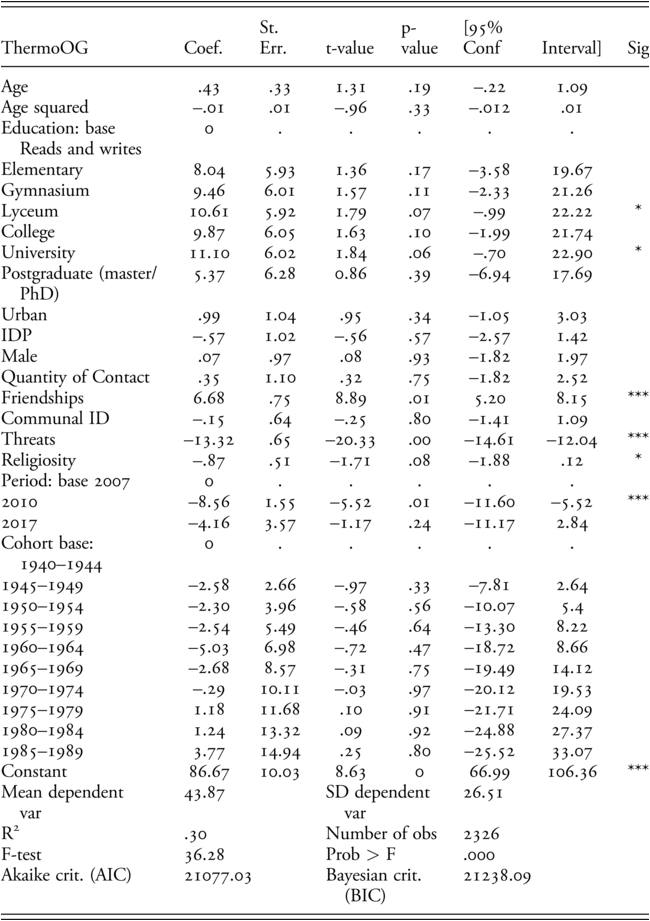
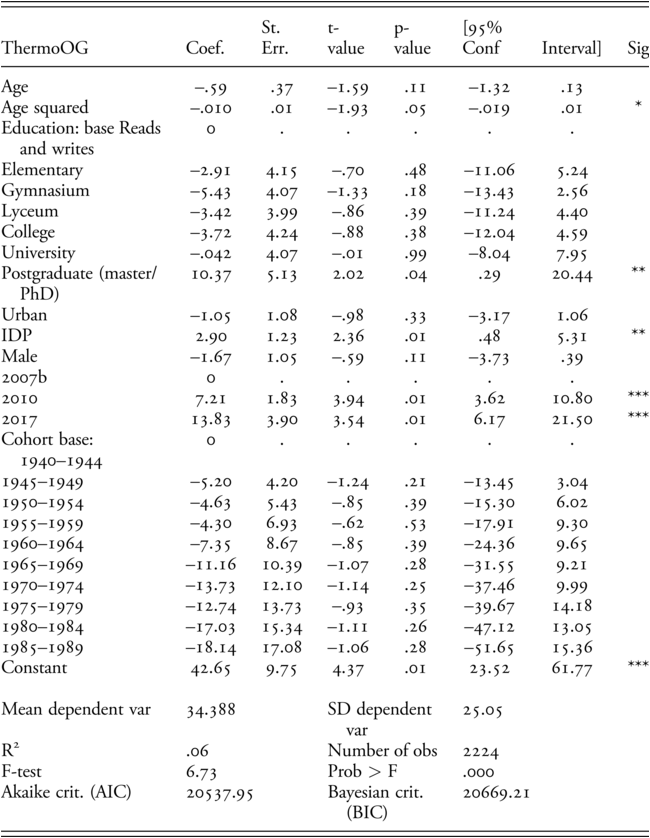
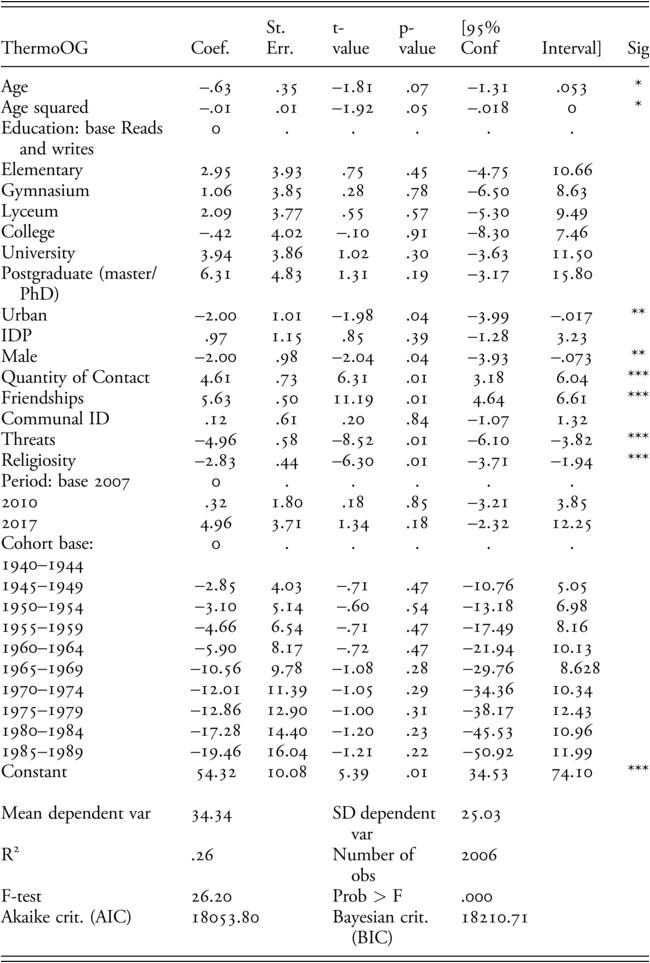

 Open access