INTRODUCTION
At what point does a lexicon begin to develop? Infants show signs of recognizing their own name as early as 4·5 months of age (Mandel, Jusczyk & Pisoni, Reference Mandel, Jusczyk and Pisoni1995; Mandel-Emer & Jusczyk, Reference Mandel-Emer, Jusczyk, Houston, Seidl, Hollich, Johnson and Jusczyk2003), but what about words like baby or ball, which infants are likely to hear often but not as often as their own name? Studies have shown that recognition of such common words does not emerge until 11 months (Vihman, Nakai, DePaolis & Hallé, Reference Vihman, Nakai, DePaolis and Hallé2004), more than six months later than own-name recognition. One possible reason for the delay is that these less frequently heard words take much longer to build stable representations in long-term memory, in other words, representations robust enough to form the beginnings of a working lexicon.
What about the ability to recognize these words in sentences? Would it occur at an equally early age? Or do infants need to hear less frequent words repeatedly in isolation first, for example, before recognizing them in fluent speech? There is evidence that in running speech infants recognize very frequently heard words like mommy or their own name as early as 6 months of age (Mandel-Emer & Jusczyk, Reference Mandel-Emer, Jusczyk, Houston, Seidl, Hollich, Johnson and Jusczyk2003; Bortfeld, Morgan, Golinkoff & Rathbun, Reference Bortfeld, Morgan, Golinkoff and Rathbun2005), but no study to date has examined infants' ability to segment less frequently heard words that they have just begun to learn. This study was designed to fill that gap.
Word form recognition is arguably a foundational skill for segmenting words. (We use the phrase ‘word form’, not ‘word’, advisedly, to highlight the fact that recognizing a word, whether in isolation or in connected speech, need not mean that the infant has attached a meaning to the form.) Hallé and de Boysson-Bardies (Reference Hallé and de Boysson-Bardies1994, Reference Hallé and de Boysson-Bardies1996) used a variation on the headturn preference procedure (HPP) to investigate whether French infants would be able to recognize a list of untrained isolated words that they were likely to have heard frequently in everyday situations (for example, encore ‘again, more’, gateau ‘cake’). They found that 11-month-old French infants did recognize such word forms, presented as a list of isolated words in the absence of any relevant situational context (such as surrounding meaningful speech or pictures of the objects referred to by the words). This effect was replicated with English infants at 11 but not at 9 (Vihman et al., Reference Vihman, Nakai, DePaolis and Hallé2004) or 10 months (Vihman, Thierry, Lum, Keren-Portnoy & Martin, Reference Vihman, Thierry, Lum, Keren-Portnoy and Martin2007), and again with Dutch infants at 11 months (Swingley, Reference Swingley2005).
In contrast to the isolated word form recognition experiments, infants learning American English can segment words with which they are familiarized in the laboratory as early as 7·5 months of age (Jusczyk and Aslin, Reference Jusczyk and Aslin1995; Jusczyk, Houston & Newsome, Reference Jusczyk, Houston and Newsome1999; Houston & Jusczyk, Reference Houston and Jusczyk2000, Reference Houston and Jusczyk2003; Singh, Morgan & White, Reference Singh, Morgan and White2004; Singh, Reference Singh2008), but that task is very different from the everyday task of identifying previously heard words in the absence of any specific training or priming. Segmentation immediately after familiarization with a pair of novel words can be thought of as drawing upon short-term memory, a point made by Houston and Jusczyk (Reference Houston and Jusczyk2003). Word form recognition in the absence of any immediately preceding presentation must be based upon representation in long-term memory – essentially drawing upon a lexicon that is just beginning to emerge. This is the everyday experience of children outside of the laboratory: Newly learned words, whether first heard in isolation or in familiar sentential contexts, must come to be represented in a sufficiently robust and stable form to allow recognition even when unpredictably surrounded by a range of different words – that is, to allow ‘segmentation’.
Since infants begin to recognize word forms presented in isolation at 11 months of age, should they be expected to be able to segment these words from fluent speech as soon as they are able to recognize them? Even if this proved to be the case, it would mean that the segmentation of familiar word forms (at 11 months) occurs several months later than the segmentation of novel words trained as part of the experimental paradigm (at 7·5 months). Such a difference in the ages at which infants succeed at these two tasks is to be expected, since tasks used in different segmentation studies actually form a continuum: at one end are tasks that demonstrate what infants are capable of doing with targeted training in the lab (e.g., Jusczyk & Aslin, Reference Jusczyk and Aslin1995); at the other end are studies that explore what infants do in everyday life, based on pre-existing knowledge or representations.
To our knowledge, Bortfeld et al. (Reference Bortfeld, Morgan, Golinkoff and Rathbun2005) is the only previous study that was designed, like the present one, to test infant segmentation on the basis of word knowledge gained in everyday life, before coming to the lab. However, the Bortfeld et al. study included training on repeated presentations of the target words in the context of the previously known words. In that study infants heard passages in which a target word (e.g., bike, cup) was consistently placed following either (1) the child's own name (or the word mommy) or (2) another child's name (or the name Lola). Infants then heard these two target words and two non-familiarized words presented in isolation. Infants listened longer to the target word coupled with their own name than to the other words. The key manipulation was the placement of target words immediately after one of the earliest words known to be familiar to infants (Mandel et al., Reference Mandel, Jusczyk and Pisoni1995), namely, the infant's own name or the family term used for the usual primary caretaker. In addition to the training, segmentation of the familiarized target word was based on pre-existing knowledge of the previously known word used as context for the target; this procedure led to segmentation by 6 months of age. Thus the present study differs both from previous segmentation studies in which testing depended entirely on training as part of the experiment and from the Bortfeld et al. study, in which both training and previous knowledge were involved: in the present study no specific training was included.
In the current study we begin to provide a perspective on how infants' memory for word forms may actually emerge in the course of everyday life. If 11-month-old infants recognize isolated words without supporting contextual cues or training, at what age will they recognize the same words within the context of a short stretch of running speech? To answer this question we presented infants with words (such as baby) likely to be familiar from everyday interactions. We embedded the words in sentences and used the HPP with 10-, 11-, and 12-month-old infants to determine the age at which infants show signs of recognizing these familiar words in running speech (i.e., of segmenting them out of their sentential contexts).
METHOD
Participants
Three groups of sixteen infants being raised in North Wales (UK) were tested at 10, 11, and 12 months of age. The 10-month-old infants averaged 0;10·0 (range: 0;09·27 to 0;10·15) and included 8 males and 8 females, the 11-month-old infants averaged 0;11·0 (range: 0;10·26 to 0;11·5), with 9 males and 7 females, and the 12-month-old infants averaged 1;00·1 (range: 0;11·24 to 0;12·9), with 8 males and 8 females. Nine additional infants (4, 3, 2 for 10-, 11-, and 12-month-olds respectively) were tested but did not complete the experiment due to crying (8) or equipment failure (1).
Stimuli
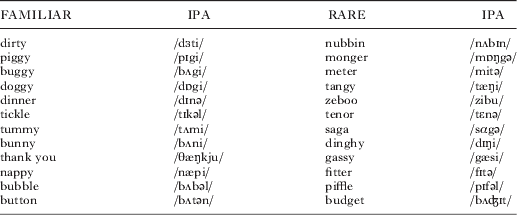
In order to facilitate comparison with a previous study of infant response to untrained isolated words heard in a list format (Vihman et al., Reference Vihman, Nakai, DePaolis and Hallé2004, Reference Vihman, Thierry, Lum, Keren-Portnoy and Martin2007), we chose as stimuli words identical to those used in experiment three in Vihman et al. (Reference Vihman, Nakai, DePaolis and Hallé2004). The words used in the Familiar sentences were reported to be typically comprehended by 11-month-old infants on the Communicative Developmental Inventory (CDI) as adapted for UK English (Hamilton, Plunkett & Schafer, Reference Hamilton, Plunkett and Schafer2000): out of a previous sample of 18 infants being raised with English in North Wales, a mean of six were reported to understand each of the twelve words used as stimuli; five words were reported as understood by 9 infants. Since this study involved only word form recognition rather than the full word comprehension that the CDI asks parents to report, this is most likely a conservative estimate of 11-month-old infants' familiarity with the words used here as stimuli (see Vihman et al., Reference Vihman, Nakai, DePaolis and Hallé2004). The Rare items were words that are uncommon according to the frequency tables of Francis and Kucera (Reference Francis and Kucera1982) (words with less than 62 occurrences in the one million word corpus).Footnote 1 The phonotactic complexity of the Rare items was matched to that of the Familiar: A chi-square test revealed no differences across the two lists for consonant manner (χ2 (5, n = 59) = 5·298, p >.25), vowel height (χ2 (2, n = 48) = .159, p >.90), or the vowel front/back dimension (χ2 (2, n = 48) = .619, p >.50).
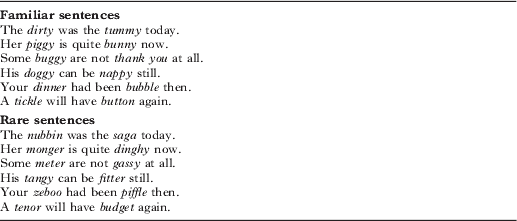
Test passages were made up of carrier sentences, with the target words embedded near the beginning and end of each sentence (see Table 1). Two words were inserted into each sentence to increase the likelihood of each infant being familiar with at least one word in each sentence. Trochaic disyllabic words – words with a strong–weak stress pattern – were used as both Familiar and Rare stimuli (see Table 2) because there is evidence from training studies that infants can segment disyllabic trochees, but not iambs (weak–strong stress pattern), from passages as early as 7·5 months of age (Jusczyk et al., Reference Jusczyk, Houston and Newsome1999).
Stimuli with target words italicized

Words used in the experiment
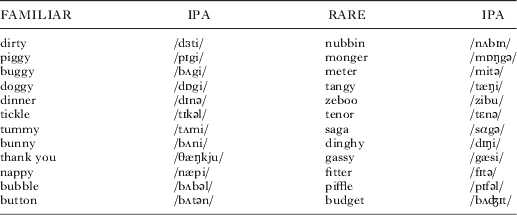
Since the words used in earlier isolated word form studies were here randomly slotted into the carrier sentences the result was often agrammatical (e.g., The dirty was the tummy today). This could serve to make the Familiar words more noticeable than the unfamiliar words, potentially providing a boost to segmentation. This would be the case if (a) the infants had some degree of incipient knowledge of the grammatical status of words they are just beginning to recognize, which would lead them to register surprise at the unusual syntax or, more plausibly, (b) they had already learned something about the typical collocational and rhythmic context in which the words in the Familiar category usually appear, making their unusual deployment here (e.g., a noun not preceded by a determiner) more noticeable than that of Rare words, whose collocational context would not be familiar. Conversely, such unfamiliar grammatical or prosodic contexts might lead the Familiar words to be harder to recognize, due to their unfamiliar linguistic surroundings. Under either alternative, in order for the awkward sentential context to affect the looking times across sentences containing Familiar vs. those containing Rare words, the infant would first have to recognize the Familiar target word or words. Thus, in any case, the presence of a familiarity effect could be attributed to infant representation of the Familiar words based on previous experience.
All items were recorded in a sound treated room using a Sennheiser ME 66 microphone (with K6 power module) connected to a Tascam DA-P1 digital recorder sampling at 44·1 kHz. The stimuli were transferred digitally onto a PC hard drive for eventual output. A Mann–Whitney U test indicated that there was no difference between the Rare and Familiar words for rms amplitude, F0 (median and range) or duration (p >.522). The stimuli were spoken in a manner typical of infant-directed speech by a female speaker of British English free of any strong regional accent.
Procedure
The headturn preference procedure (HPP) used was similar to that described in Kemler-Nelson, Jusczyk, Mandel, Myers, Turk, and Gerken (Reference Kemler-Nelson, Jusczyk, Mandel, Myers, Turk and Gerken1995). Seated on the caregiver's lap in a sound-treated and darkened room, the infants faced the central panel of a three-sided test booth where a camera and red light were mounted. A blue light and speaker were mounted on each side panel. A PC and video monitor were located in the adjoining room where the experimenter controlled stimulus presentation and recorded infant looking times by pressing the left and right mouse buttons. The computer initiated and terminated trials in response to signals from the experimenter, who was unaware of the stimulus type being presented. Multi-talker babble produced from the speaker of the stimuli used in the experiment was delivered to the headphones worn by the experimenter and caregiver to mask the actual test stimuli. The caregiver also wore foam-insert hearing protection.
In each experiment Familiar- and Rare-word sentences were presented and the infant's total listening time to each type of sentence was recorded by the experimenter. The side of presentation of the stimuli was randomized and assigned to either stimulus type. Each experiment with each infant consisted of a ‘familiarization’ and a test phase. In this case the familiarization phase was designed purely to acquaint the infant with the speech stimuli and the procedure as a whole. In both familiarization and test phases the infant's attention was first directed to the center by means of the center light. Once the experimenter judged the infant's gaze to be directed to the midline, the center light was extinguished and one of the side-lights (chosen by the computer) began flashing. The side-light continued to blink for the duration of the test phases. When the infant oriented at least 30° toward the side-light the experimenter held down a button to record the amount of time the infant oriented toward the stimuli; the experimenter released this button whenever the infant turned away. Any interval of time turning away was thus omitted from the total listening time.
Each trial, familiarization, and test consisted of six sentences. A trial was terminated if the infant failed to orient for three seconds in the ‘familiarization’ or two seconds in the test phase. Four trials were presented in the familiarization phase (two Familiar and two Rare) and twelve in the test phase, with no more than two sentence blocks of the same type in a row. The six sentences of each stimulus type in the test phase were pseudo-randomized with the precondition that each word occurred early (i.e., in the first sentence) in one trial to ensure that each infant heard each of the words over the course of the test phase. Note that although all of the words would be heard in each trial if the infant continued listening for long enough, in practice infants generally turn away well before all of the sentences have been heard. In addition, the first four test trials were counterbalanced for stimulus type to ensure that the longer looking times that tend to be associated with initial test trials were distributed across the two conditions (see Vihman et al., Reference Vihman, Nakai, DePaolis and Hallé2004, for an analysis of looking times by trial). The following trials were pseudo-randomized, such that no more than two trials of the same sentence type would appear in a row. Reliability for the measurement of looking times was assessed by having a different experimenter recode five sessions (at least one from each age) from videotapes. The recoding yielded a correlation of r = .98 for the 60 test trials.
RESULTS
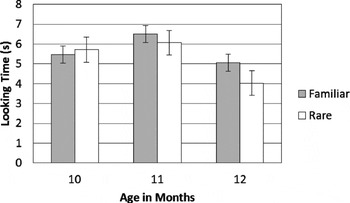
A preference for Familiar over Rare words appeared to emerge progressively over the three months, as documented in Figure 1. The difference in looking times (in seconds) between the familiar and rare words is small at 10 (M = − .26), moderate at 11 (.43) and just over one second (M = 1·02) at 12 months of age. Note, however, that the high standard errors reflect considerable individual differences. In order to explore this change in preference for the Familiar sentences while minimizing the task-irrelevant variability due to differences in attention span, a preference ratio for Familiar over Rare words was calculated: this involved dividing the total looking time to Familiar by the total looking time to both Familiar and Rare words. The preference ratio factors out individual differences in total looking time, focusing in on the relative preference for Familiar over Rare words and making possible a subsequent analysis that is minimally based upon the total attention span of each infant (Hallé & de Boysson-Bardies, Reference Hallé and de Boysson-Bardies1994).
Looking times to Familiar versus Rare words in sentential context. Error bars represent ±1 standard error.

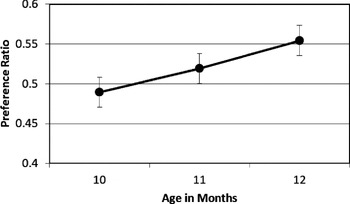
An examination of these preference ratios in Figure 2 suggests a linear increase from 10 to 12 months. An Analysis of Variance with Age as the independent variable and preference ratio as the dependent variable was significant (F(2,45) = 3·555, p = .037, η2 = .136). There was also a significant linear trend for the preference ratios to increase with age (p = .011). Post-hoc Bonferroni tests revealed that the preference ratio at 10 months was significantly different from the preference ratio at 12 months (p = .032). There was no difference between the 10- and 11- (p = .633) and 11- and 12- (p = .509) month-old preference ratios. The mean preference ratio at 12 months (M = .553) was also significantly different from a preference ratio of .5 (t(15) = 2·407, p = .029). Thus, the 12-month-olds looked longer to the familiar than to the rare sentences.
The linear increase in preference ratio for Familiar versus Rare words. Error bars represent ±1 standard error.

Discussion
This study examined the emergence of the segmentation of words that are familiar to the infant through everyday interactions with caregivers (i.e., independent of the experimental paradigm). There is a significant linear increase in preference ratios between 10 and 12 months of age, suggesting increasing ability to segment the words from running speech. There was also a significant difference in preference for Familiar sentences between the 10- and 12-month-old infants but not the 10- versus 11- or 11- versus 12-month-olds, confirming that the ability to ‘notice’ familiar words in running speech emerges progressively from 10 to 12 months of age. Finally, in the 12-month-old group, looking time to the Familiar sentences differed significantly from that to the Rare sentences. The data thus track the emergence of the ability to segment words familiar to the infant from everyday life. In addition, the results provide an indication of the developmental timescale for this ability under the demanding requirements of ordinary listening to large numbers of words in the home, in contrast with previous segmentation studies that focused on infant abilities to respond to words immediately after training in the lab.Footnote 2
There are some similarities of this study to Shi, Werker, and Cutler (Reference Shi, Werker and Cutler2006). In their study infants were presented with either real or nonsense function words followed by a nonsense word. The developmental trend is remarkably close to that of the current study. Eight-month-old infants showed no preference for either real or nonsense functors, 11-month-olds exhibited a trend towards preferring the real functors, while the 13-month-olds exhibited a significant preference for the real functors. Their study resembles the current study in having no training; instead, the infants must match the words they have heard in everyday situations to the words in the experiment. The findings of these studies agree in suggesting that the type of memory access in this type of experiment is very different from what is tapped in experiments in which the infant is tested on words trained as part of the experiment itself.
In comparing these results to previous studies that found isolated word form recognition at 11 months of age (Hallé & de Boysson-Bardies, Reference Hallé and de Boysson-Bardies1994, Reference Hallé and de Boysson-Bardies1996; Vihman et al., Reference Vihman, Nakai, DePaolis and Hallé2004; Swingley, Reference Swingley2005; Vihman et al., Reference Vihman, Thierry, Lum, Keren-Portnoy and Martin2007), it would be tempting to conclude that before infants begin to recognize often heard words embedded in running speech, at least some of those words must first have been heard and recognized in isolation. The group effect for isolated word form recognition was already strong at 11 months in each of these studies, while the group segmentation effect is seen here only a month later (see Figure 1). However, note that what our results show is that recognizing already familiar words in running speech is most likely a more complex task than recognizing them in isolation. These results tell us nothing about the way in which these words came to be known to the infants in the first place – whether from repeated use in isolation, repeated use in running speech, or a combination of the two. Indeed, there is controversy among researchers studying infant-directed speech regarding the importance of isolated words in the input to infants as sources of early word learning (see, e.g., Aslin, Woodward, LaMendola & Bever, Reference Aslin, Woodward, LaMendola, Bever, Morgan and Demuth1996; Brent & Siskind, Reference Brent and Siskind2001; Lew-Williams, Pelucchi & Saffran, Reference Lew-Williams, Pelucch and Saffran2011).
The question addressed in this study is not whether words are first learned from having been heard in isolation or in running speech but, instead, how and when do these words come to be represented in the infants' memory sufficiently robustly for them to begin to form a stable lexicon? Two studies have investigated long-term memory for words in infancy. Jusczyk and Hohne (Reference Jusczyk and Hohne1997) found that 8-month-old infants who were repeatedly played recorded stories over a two-week period showed a preference for the words used in the stories when they were presented in isolation two weeks later (using the same voice as in the stories). Houston and Jusczyk (Reference Houston and Jusczyk2003), using a somewhat different method, first familiarized 7·5-month-old infants with isolated words. They found that, a day later, the infants listened longer to passages containing these familiarized words than to passages with non-familiarized words. Interestingly, in the Houston and Jusczyk (Reference Houston and Jusczyk2003) study both 7·5- and 10·5-month-old infants failed at the task if the stimuli were spoken by a novel speaker during the test trials, but 7·5-month-olds were successful if only half of the test trials were spoken by a novel speaker. Although both studies suggest that long-term memory for word forms is quite impressive, Houston and Jusczyk's results raise the possibility that memory for newly learned words might be rather fragile.
Houston and Jusczyk (Reference Houston and Jusczyk2003) suggested that there may be some similarities between the learning of new words and learning in other modalities. A memory of an event can be primed (or cued) by events that tend to co-occur with it, and the higher the frequency of these co-occurrences, the higher the probability that the priming will lead to recollection (e.g., Rovee-Collier, Reference Rovee-Collier1995). Similarly, each presentation of a new word increases the probability of future recognition of that word, with concurrent events (such as the rolling of a ball accompanying the use of the word ball) serving as cues for its recall. Rovee-Collier and colleagues used a mobile activated by an infant's foot-kicking to examine memory in infants 6 months and younger (see the reviews in Rovee-Collier, Reference Rovee-Collier1995, Rovee-Collier, Hayne & Colombo, Reference Rovee-Collier, Hayne and Colombo2001). Older infants were tested on their ability to recall that pressing a lever initiated the movement of a toy train. The frequency of kicking or lever-pressing was used as a measure of how well the infants remembered the contingent relation between the action (kicking or pressing the lever) and the activation of the mobile or the toy train, respectively.
Using these paradigms this team of researchers found that in the first year of life there is a dramatic increase in memory retention (see Hartshorn et al., Reference Hartshorn, Rovee-Collier, Gerhardstein, Bhatt, Wondoloski, Klein, Gilch, Wurtzel and Campos-de-Carvalho1998a). In addition, the ability to recall an event from a related ‘prime’ or associated contingency or cue increases as a function not only of age, but also of the duration of the prime (Hsu, Rovee-Collier, Hill, Grodkiewicz & Joh, Reference Hsu, Rovee-Collier, Hill, Grodkiewicz and Joh2005): Hsu et al. (Reference Hsu, Rovee-Collier, Hill, Grodkiewicz and Joh2005) found that the duration of a prime needed to reactivate a memory decreased logarithmically with age. Additionally, changes in the cue or context used to elicit a memory (for example, in the kicking paradigm, the color of the mobile or the size of the room) affect memory less and less dramatically from 2 to 12 months of age (Hartshorn et al., Reference Hartshorn, Rovee-Collier, Gerhardstein, Bhatt, Klein, Aaron, Wondoloski and Wurtzel1998b). These developmental patterns in memory could help explain the contrasting results of the segmentation experiments that we are concerned with here.
Early in the first year only the most frequently repeated words would begin to form a stable memory or representation. Ultimately, an unstable (‘fragile’) word form representation would form, but the ability to recall it would be dependent on a match to perceptual features that existed at the time of learning, such as the voice of the speaker (as shown by Houston & Jusczyk, Reference Houston and Jusczyk2000, Reference Houston and Jusczyk2003).Footnote 3 This might also be the reason why 7·5-month-old infants show no signs of recognizing words with which they have previously been presented in a different affect (e.g., happy versus neutral), whereas 10·5-month-old infants retain word form recognition in the face of such changes (Singh et al., Reference Singh, Morgan and White2004). In the current study, the infant is cued with a novel voice, probably following a considerable time-lag from the last time the words were heard – a challenge that is similar to that presented by the Houston and Jusczyk (Reference Houston and Jusczyk2003) study, in which both 7·5- and 10·5-month-olds failed to recognize the trained words.
The duration of the prime or the number of times it is repeated is also relevant. When a word (like ball) is presented repeatedly, each instance can serve as a prime for the next one, thus increasing the likelihood that the word will be learned or, once learned, will be recognized. The threshold for learning, or for the formation of a stable representation, in terms of both the number of instances of the word that need to be heard and the duration of the prime (i.e., the length of the period of repeated uses of the word in a particular situational context) must change as the infant's memory develops. The older the child, the fewer the repetitions and the shorter the period needed for learning or for recognition to occur. This means that repeated instances of a specific word, as used in the stimuli of both Bortfeld et al. (Reference Bortfeld, Morgan, Golinkoff and Rathbun2005) and the familiarization studies (e.g., Jusczyk & Aslin, Reference Jusczyk and Aslin1995; Jusczyk et al., Reference Jusczyk, Houston and Newsome1999), could reliably prime word recall, even at an early age. In contrast, in the current study, no word was repeated in a single list, and the immediate acoustic percept created by any one word in the list would have been immediately overwritten by the word following it. The relatively infrequent presentation of words like ball or baby in the stimuli of the current study would require the more mature or more experienced memory system of a somewhat older infant in order to successfully prime memory for the word form. This would be an additional reason why the ability to recognize words in running speech is observed, in our study, a full six months later than the ability to recognize recurrent presentations of a word such as mommy in Bortfeld et al. (Reference Bortfeld, Morgan, Golinkoff and Rathbun2005).
At what point, then, does a lexicon begin to develop to the stage that words can be reliably recalled and used as a foundation for rapidly learning even more words? Previous studies with isolated word forms have suggested a turning point at 11 months of age, when infants begin to notice words independent of situational cues. One month later this skill has sufficiently strengthened to make it possible for infants to segment those early lexical items from running speech. At this point it is likely that infants can also use these newly established lexical items to learn words contiguous to them in running speech, as was demonstrated by Bortfeld et al. (Reference Bortfeld, Morgan, Golinkoff and Rathbun2005; see also Brent & Siskind, Reference Brent and Siskind2001: B42). The disparity in the age of segmentation of familiar words in this as compared with previous studies suggests that skills demonstrated in carefully controlled laboratory settings may not always translate directly into abilities that infants can use in everyday situations in the home.