Introduction
After the founding of the New China in 1949, the Chinese Government encouraged pronatalist policies. Due to high fertility and eventual fertility behaviour, the population increased from approximately 6 billion in 1953 to 8.3 billion in 1970 (Hesketh & Zhu, Reference Hesketh and Zhu1997). To control population growth rapidly, the one-child family policy (OCFP) was introduced by the central government in China in 1979. Since the 1980s, the fertility preferences of individuals throughout China have declined considerably. The total fertility rate (TFR) dropped from nearly 6 in 1970 to 2.1 in 1991 and to 1.22 in 2000 (National Bureau of Statistics of China, 2002).
At least partly as a result of the success of exceptional family planning restrictions in China, population ageing is emerging as a major government concern. The percentage of adults over 60 years of age of the total population was 7% in 2000, and this increased rapidly to 16.14% in 2015 (National Bureau of Statistics of China, 2012). Currently, China is facing a new serious demographic crisis in which the number of individuals in the labour force will shrink by 8 million per year beginning in 2023 (National Bureau of Statistics of China, 2016). In certain Asian and Eastern European countries, such as China, South Korea and Azerbaijan, tradition favours the birth of sons over that of daughters. This son preference has led to a skewed sex ratio at birth (SRB) (Tafuro & Guilmoto, Reference Tafuro and Guilmoto2020). Over the past 40 years, the one-child policy has led to an increased imbalance in the SRB as a result of prenatal sex diagnosis and access to sex-selective abortion in China. With the implementation of the one-child policy in 1979, the SRB even steeply rose to 1.46 in some rural areas (Zhu et al., Reference Zhu, Lu and Hesketh2009). In addition, demographers agree that fertility behaviour and change was assumed to be causally linked to changes in occupational structure associated with industrialization and urbanization (Dribe et al., Reference Dribe, Hacker and Scalone2014). With rapid rural–urban migration and modernization, employment of women in the world has increased dramatically in the last several decades (Evans, Reference Evans1996). However, women may refuse to have more children, which may result in long-term social inequities or exacerbation of those that already exist (Wallace et al., Reference Wallace and Saurel-Cubizolles2013).
There is no controversy about the neglect effects of current anti-natalist family planning policies as a key factor in preventing the speed of economic growth in China. Therefore, in November 2013, the Third Plenary Session of the Eleventh Central Committee of the Communist Party of China changed the anti-natalist family planning policies so that a couple in which one spouse was an only child would be eligible to have a second child (Communist Party of China, 2013). However, by May 2015, only 1.45 million of the 11 million eligible couples applied for permission to have a second child (National Health and Family Planning Commission, 2015). Several studies have suggested that the effects of the new policy may be far smaller than expected (Rong & Gu, Reference Rong and Gu2014; Chen et al., Reference Chen, Xiao, Chen and Tang2014; Jia & Feng, Reference Jia and Feng2015). In October 2015, the Chinese Government announced that the one-child policy had finally been replaced by a universal two-child policy (a couple can have a second child with no restrictions; Communist Party of China, 2015). The prime purpose of the universal two-child policy was to address the rapid acceleration in population ageing – one of the serious challenges for China in the 21st century. At first, many experts thought that the universal two-child policy was an effective measure that would increase fertility behaviour. However, several studies have already indicated that the two-child policy may not be as widely accepted and endorsed as expected (Xiao et al., Reference Xiao, Huang, Zhang, Zhu, Liu, He and Yang2016; Lau et al., Reference Lau, Huo, Wang, Shi, Li and Mu2018; Li & Liang, Reference Li and Liang2019). For example, according to a survey conducted in Jinan City, only 30.19% of respondents stated that they would have a second child in the future (Li & Liang, Reference Li and Liang2019). In another investigation among respondents with one childbearing experience, only 14.1% stated that they would have a second child (Xiao et al., Reference Xiao, Huang, Zhang, Zhu, Liu, He and Yang2016). These studies indicated that socioeconomic characteristics (e.g. family income, birth place), age at first birth, intention to have a second child and the burdens of family care (e.g. for elderly parents) were all associated with respondents’ fertility intentions. By the end of 2017 (2 years after the establishment of the universal two-child policy), the number of newborn babies in China was only 17.23 million, which was 0.63 million fewer than that in 2016 (National Bureau of Statistics of China, 2017). The fertility intentions and behaviours of people who live in cities are likely to create a potentially serious population decline because the country has rapidly urbanized since 1978.
The city of Dalian is in Liaoning Province – a peninsula in the Yellow Sea and Bohai Sea with an elaborate coastline, located in the north-east of China. It is the largest coastal city in the north of China and is an important economic centre and port city with a population of approximately 5.9 million. There are hundreds of clothing factories and textile companies in Dalian. The textile and shipbuilding industries in Dalian are very famous around the world. Population ageing is a major concern in Dalian. The percentage of aged adults (60+) increased from 11.62% to 15.8% in Dalian during 2000–2010, while the overall percentage in China increased from 10.33% to 13.26% (Wang, Reference Wang2012). Since the 2010s, population ageing has increased markedly. By the end of 2016, the percentage of elderly adults aged 60+ increased to 24.08% in Dalian, compared with 16.7% on average of China (Liu, Reference Liu2018). Meanwhile, the number of newly born babies decreased from 6.95 thousand in 2016 to 6.03 thousand in 2017, and to 4.98 in 2019 (Dalian Bureau of Statistics of China, 2018). This investigation was therefore conducted to examine fertility intentions and future fertility behaviour (whether to have two children) among respondents in Dalian City who were born between 1980 and 1989. Additionally, the potential influential factors on fertility preferences were examined.
Methods
Sample selection
The survey was conducted in Dalian City, China. To optimize the feasibility of the project, a random sample of respondents was selected by cluster sampling from three of six Dalian districts. The survey areas were randomly selected from the public institutions and companies. A detailed list of public institutions and companies was obtained from each district administration. From this list worksites where people were willing to participate in this investigation were selected. A study worksite was defined as a unit within a work unit doing a similar job. Within these selected worksites, people born between 1st January 1980 and 31st December 1989 were included in the survey, because these were the first generation under the one-child policy reaching the age of childbearing. In addition, they were the first generation to be allowed to have a second child with no restriction. At each worksite, all individuals from urban areas were eligible for enrolment in the survey and those from rural areas were excluded.
Trained interviewers gave each respondent a detailed description of the study purpose and design at their worksite. Those who provided written informed consent were included in the survey. Participation was voluntary, and individuals were assured of their anonymity and privacy while completing the questionnaires. The sample size for the study was calculated using the following formula for cross-sectional studies: N=400Q/P. Previous surveys have shown that approximately 30–40% of respondents would not want to have a second child. To estimate the size of the sample, P=40% and Q=1–P were adopted. In addition, 10% of the sample had unusable data because of the substandard quality of the completed questionnaires; therefore, the total minimum sample size was 660. The intention was to recruit respondents from two public institutions and two companies with 330 eligible respondents from each. If the number of eligible respondents did not reach 330 at one worksite, additional similar worksites needed to be sampled until a sufficient sample size was reached. Ultimately, two labour-intensive enterprises and one technological-intensive enterprise (encompassing 663 subjects), and one hospital and ten schools (encompassing 707 subjects), were recruited in this study.
Questionnaire
Responses on ideal number of children were collected using a questionnaire. The item was phrased ‘Without considering other factors, what is the ideal number of children in a family?’, with the response options ‘1’, ‘2’ and ‘3 or more’. Sex preferences were collected from two questions: 1) ‘What is the ideal sex composition of your offspring?’, with the response options ‘should have a son’, ‘should have a daughter’, ‘should have a son and a daughter’ and ‘do not care about the sex of child’; and 2) ‘What is your attitude about the sex composition of your own offspring?’, with the response options ‘only boys’, ‘only girls’, ‘mixed sibset’ and ‘do not care about the sex of child’. Responses for childbearing experience were collected from two questions: 1) ‘How many children do you have so far?’, with the response options ‘0’, ‘1’, ‘2’ and ‘3 or more’; and ‘What’s your overall experience of bearing and raising the first child?’, with the response options ‘positive’, ‘a little painful’ and ‘painful’.
A self-administered questionnaire was employed to obtain data on respondents’ socio-demographic information, including birth data, level of education, marital status and income. In addition, the questionnaire included items on sex preference, childbearing experiences, future fertility intentions and the factors influencing individual reproductive behaviour. The questionnaire was designed by experts from Dalian and Yinchuan cities. Questions on self-reported fertility intentions (twelve items) were used to assess the concurrent validity and reliability of the questionnaire. The Kaiser-Meyer-Olkin measure was 0.814 and Bartlett’s test of Sphericity was significant (p < 0.001), indicating good validity of the questionnaire. Cronbach’s alpha was calculated as 0.826, indicating a high level of internal consistency of the questionnaire. Based on the results of the previous study, some modifications were made in the questionnaire (Hou et al., Reference Hou, Qiu and Ren2018).
Statistical analyses
Data were entered by using Epi-data manager 3.1 and statistical analyses were performed SPSS version 19.0 (SPSS Inc., Chicago, IL), setting the level of significance at two-tailed p<0.05. Descriptive data are presented as the means with the standard errors of the means for continuous data and as percentages for categorical data.
Monthly family income was classified into four categories (5000, 5000–10,000, 10,000–15,000 and ≥15,000 yuan), age into three categories (30, 30–35 and ≥35 years), birth place into two categories (Dalian City and other cities), education into four categories (secondary or below, postsecondary degree, college degree and postgraduate or above) and type of worksite into two categories (enterprise and public institution).
Categorical variables were analysed using the chi-squared test. Logistic regression analysis was applied to estimate the adjusted odds ratio (AOR) and their 95% confidence intervals (95% CI) between dependent and independent variables. Logistic regression was used to select those variables that contributed significantly to the variance, with p>0.05 as the criterion for the removal of a variable from the model. Binary logistic regression analysis was applied to estimate the corresponding influential factors of future fertility (dependent variable categorized as 0=decision to have two children; 1=intend to stick at one child). After experiencing the costs of caring for the first child, parents reassess their fertility intentions, so two regression models were generated to obtain a better understanding of the determinants of future fertility behaviour in Dalian. In effect, the analysis excluded those who never had a child in Model 2. The results were adjusted for socioeconomic characteristics, ideal number of children and sex preference in Model 1; in Model 2, additional adjustments were made for age at first birth, sex of first baby, additional financial support from parents and childbearing experience.
Results
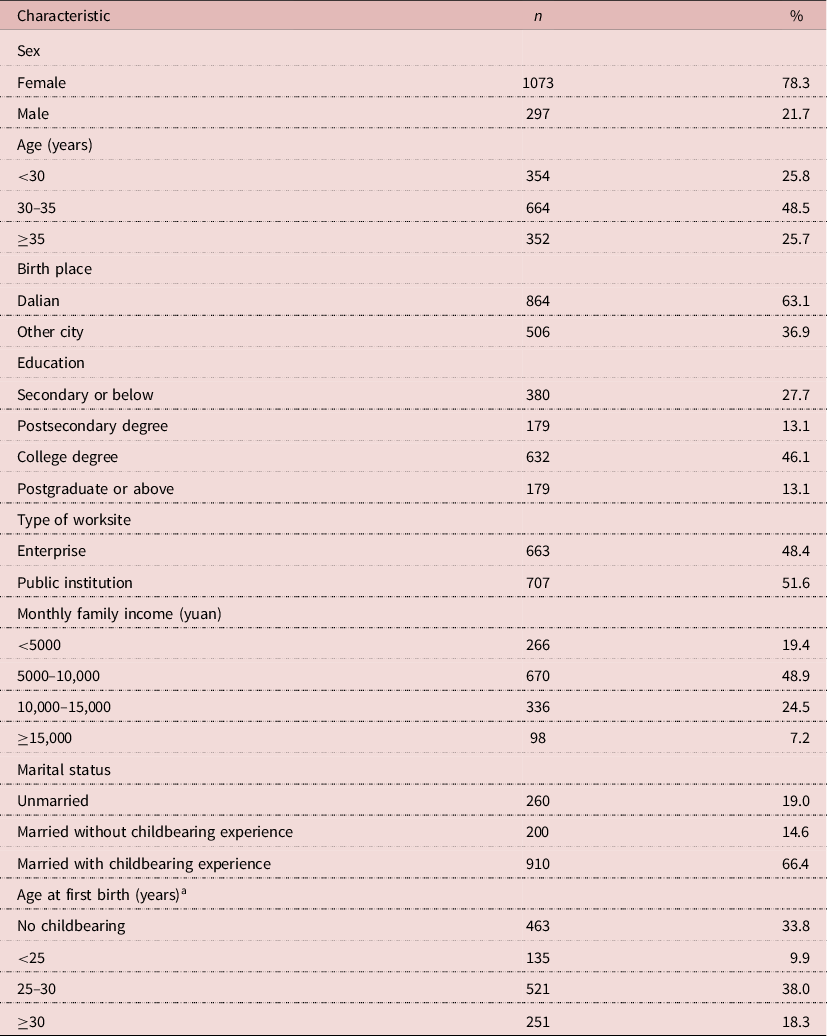
The total enumerated population was 1370, of which 1073 were women and 297 were men. The mean age of the respondents was 32.5±2.95 years, 25.8% were younger than 30 years, 48.5% were between 30 and 35 years of age and 25.7% were older than 35 years. A total of 63.1% of the respondents were born in Dalian, while 36.9% were born in other cities. A total of 48.4% of respondents were employed by enterprises, and 51.6% were employed by public institutions. With respect to level of education, 27.7% had a secondary education or below, 13.1% had a postsecondary degree, 46.1% had a college degree and 13.1% had a postgraduate education or above. Among the 1370 respondents, 19.0% were unmarried and 66.4% were married and had childbearing experience. A total of 9.9% had their first child before 25 years of age, 38.0% had their first birth between 25 and 30 years of age and 18.3% had their first birth after 30 years of age. A large proportion of respondents had a monthly family income of 5000–10,000 yuan. The detailed data are shown in Table 1.
Demographic characteristics of respondents, N=1370

a Three data missing.
Ideal number of children and sex preference
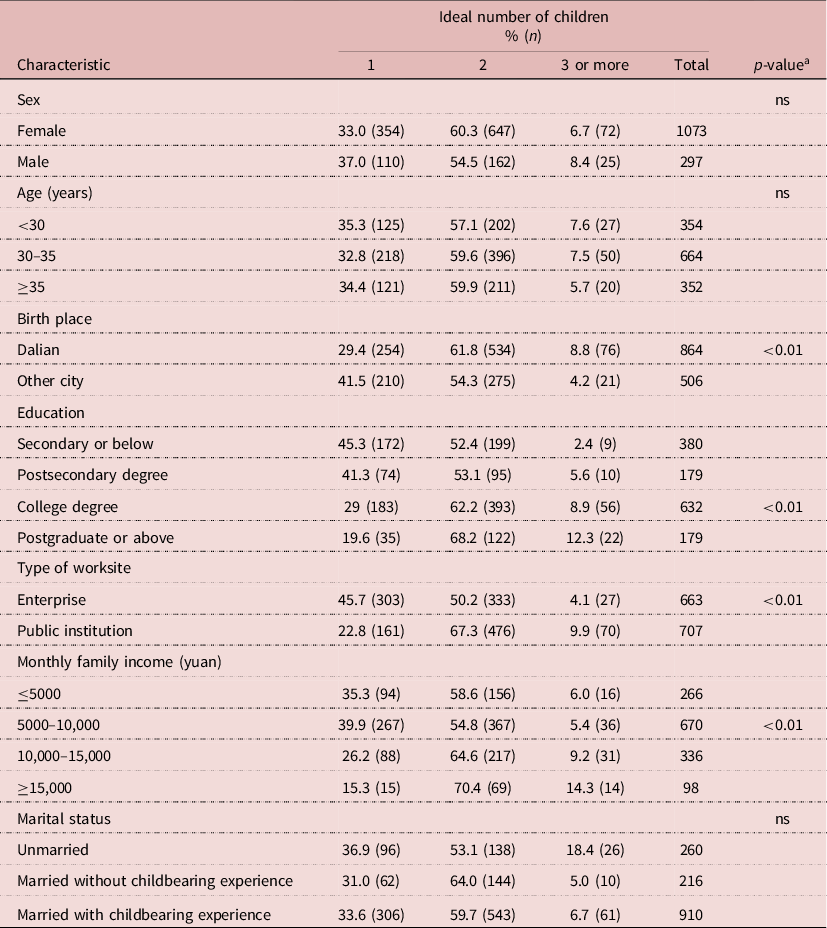
Of the respondents, 33.9% stated a preference for only one child, while 59.1% reported that the ideal number of children was two; only 7.0% reported that they wanted three children. The mean ideal number of children was only 1.73. Table 2 shows the respondents’ ideal number of children according to demographic characteristics. A total of 70.6% of respondents whose birth place was Dalian reported that they wanted two or more children, while 58.5% of respondents whose birth place was other cities stated a preference for two or more children (p<0.05). Type of worksite was another factor that affected a respondent’s ideal number of children desired. A total of 67.3% of respondents who were employed by public institutions reported that they wanted two children, while only 50.2% of respondents who were employed by an enterprise stated a preference for two children (p<0.05). Chi-squared tests indicated that educational level and family income were significantly and positively associated with the ideal number of children desired (p<0.05). The results indicated that although more women than men desired an average of two children, the difference was not significant (p=0.184). There were also no significant differences in the ideal number of children based on age and marital status.
Respondents’ ideal number of children according to demographic characteristics, N=1370

a p-value calculated using the chi-squared test; ns, not significant.
Of the respondents, 51.5% stated that the ideal sex composition of offspring was a mixed sibset, while 32.9% reported that they did not care about the sex of offspring. Interestingly, 11.3% of respondents stated a preference for a daughter, while only 4.2% reported that the ideal sex of offspring was a boy. Although most respondents thought that the ideal sex composition of offspring was a mixed sibset, only 26.2% respondents wanted a mixed sibset; 58% of respondents reported that they did not care about the sex of their own offspring.
Future fertility prospects (decision to have one child or two children) and influential factors
Approximately 80% of the respondents were married. The average age at marriage was 26.7 years, 29.4% of people had married before 25 years of age, 55.9% had married between 25 and 30 years of age and 14.8% had married later than 30 years of age. Of the 1370 respondents, 66.4% of married respondents had their first child already, and only 5.3% (73) of married respondents had two children. The married respondent’s mean age at first birth was 28.14±3.40 years.
Those respondents who already had two children (73) were excluded to explore future fertility behaviour (whether to have two children). Among the remaining 1297 participants, 26.8% stated that they would have a second child, while 73.2% refused to have a second child in the future.
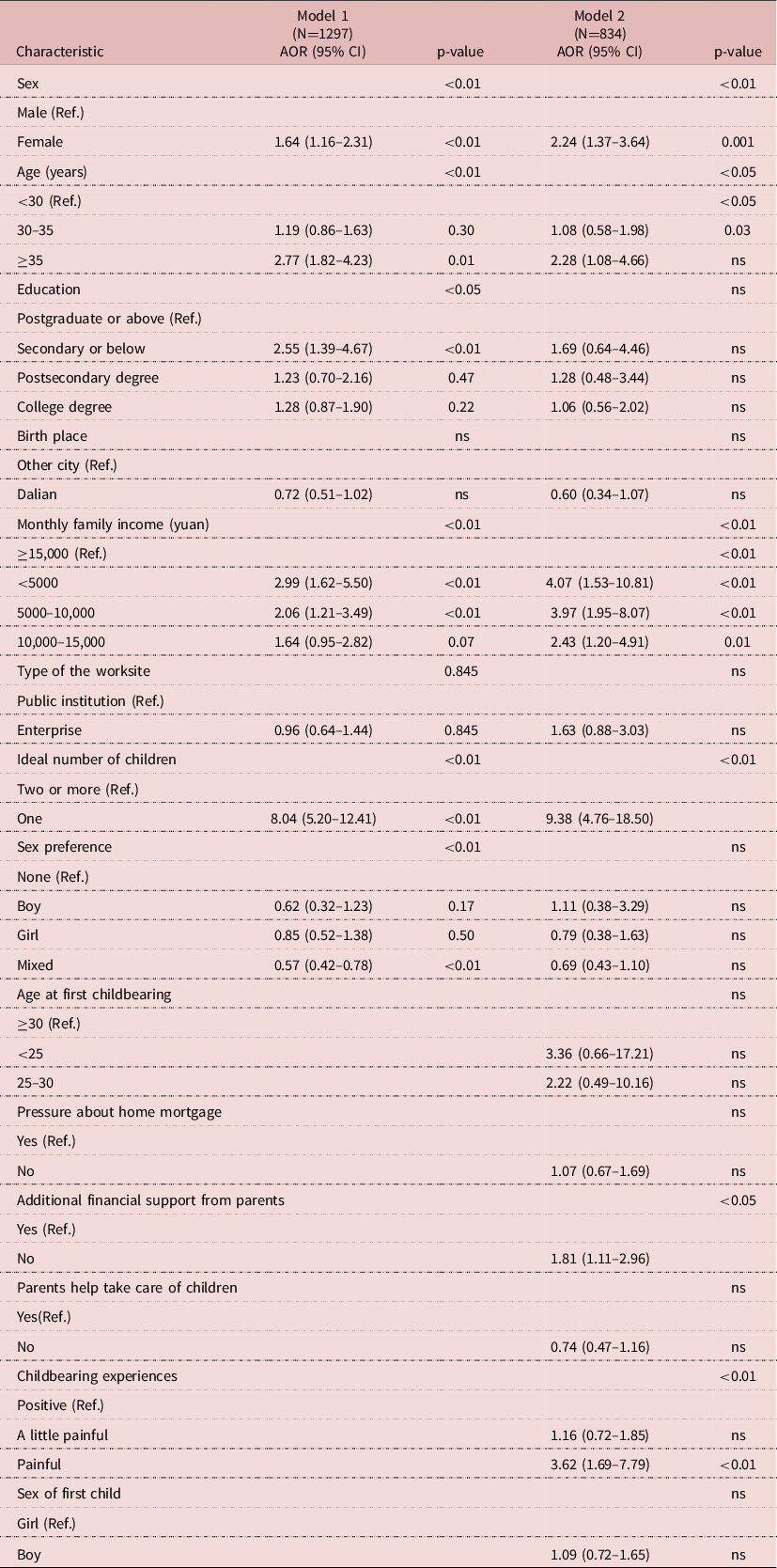
Model 1 in Table 3 shows the corresponding influential factors of future fertility among the 1297 respondents. Compared with men, women were more likely not to want to have two children (p<0.05) (AOR=1.64; 95% CI: 1.16–2.31). Age was significantly and negatively associated with fertility intentions, and respondents who were older than 35 years were more likely to have only one child (p<0.05) (AOR=2.77; 95% CI: 1.82–4.23). Education level and family income were significant and negatively associated with having one child. Respondents with lower education levels or lower family incomes were more likely to have only one child. Respondents with a preference for mixed offspring were less likely to have only one child (p<0.01) (AOR=0.57; 95% CI: 0.42–0.78). The decision to have two children or only one child was also significantly influenced by respondent’s ideal number of children; those reporting one child as the ideal number of children were more likely not to want to have a second child (p 0.05) (AOR=8.04; 95% CI: 5.20–12.41). Birth place and type of worksite did not significantly influence future fertility intentions (p>0.05) when the effects of other factors were excluded.
Adjusted odds ratio with 95% confidence intervals for future fertility prospects and corresponding influential factors (logistic regressions)

Analysis included all respondents in Model 1, and excluded those who had no child so far in Model 2.
In the logistic model (Models 1 and 2), the dependent variable was whether or not the respondent intended to have another child, coded 0 for ‘yes, intend to go on to have a second child’ and 1 for ‘no, intend to stick at one child’.
Model 2 in Table 3 shows the corresponding influential factors of future fertility among respondents who had childbearing experience (for male respondents, their wives were considered to have childbearing experience). Education level, birth place, type of worksite, sex preference, age at first childbearing, pressure about home mortgage, parents’ help with taking care of children and sex of first child had no significant influence on future fertility intentions (p>0.05) among respondents who had childbearing experience. Similar to Model 1, women were less likely to have two children compared with men (p<0.01) (AOR=2.24; 95% CI: 1.37–3.64); respondents older than 35 years of age were more likely to have only one child (p<0.05) (AOR=2.28; 95% CI: 1.08–4.66); those reporting one child as the ideal number of children were more likely not to want to have a second child (p<0.01) (AOR=9.38; 95% CI: 4.76–18.50). Respondents with lower family income were more likely not to want to have a second child. Furthermore, respondents who could not receive additional financial support from parents were more likely to have only one child (p<0.05) (AOR=1.81; 95% CI: 1.11–2.96). The results also indicated that childbearing experience significantly influenced future fertility intentions. Respondents who had painful childbearing experiences were more likely not to want to have two children than those who had positive childbearing experiences (AOR=3.63; 95% CI: 1.69–7.79).
Reasons why respondents were unwilling to bear a second child
Because respondents who already had childbearing experience had lower fertility intentions, the reasons for not wanting to have two children, despite implementation of the universal two-child policy, were explored further. Among 834 respondents, 49.1% indicated that they did not have enough energy to raise another child, 46.7% indicated that they could not afford the cost of educating additional children, 27.6% indicated that they could not afford the daily expense of supporting a second child, 32.1% claimed that one child was enough, 38% indicated that they could not bring up additional children in their poor economic conditions and 17.1% indicated a fear of being too old to have a second child.
Discussion
This survey provides results on fertility preferences that support existing evidence that fertility intentions are still below those needed for replacement in Dalian City. Although half of the respondents reported that the ideal number of children was two children in a family, few wanted more than a total of two children.
The mean ideal number of children was only 1.73 among the 1370 respondents. The results are consistent with those of previous studies in China. After the introduction of the universal two-child policy in 2015, women can gave birth to a second child, which was prohibited before. However, the birth rate did not increase sharply, as expected. For example, a survey conducted among women with one childbearing experience indicated that the mean ideal number in Jinan City was 1.82 (Li, Reference Li2019). Lin et al. (Reference Lin, Liang, Ning and Meng2016) reported that the average intended number of children in Guangdong was 1.86 after introduction of the universal two-child policy. These results indicate that people had less willingness to have more children under the new family planning policy (Hou et al, Reference Hou, Lin, Xin, Sun, Zhang and Dou2014; Rong & Gu, Reference Rong and Gu2014).
Most Chinese elderly adults, especially those in rural areas, lack full pension coverage, so they are largely dependent on their children for financial support (Zhang & Goza, Reference Zhang and Goza2006; Wei & Zhong et al., Reference Wei and Zhong2015). Therefore, a preference for a son has been prevalent in rural areas for a long period of time. In contrast, most urban residents have full pensions and medical insurance to support them in later life. Since urban residents would not need to be supported by their children, there was no significant traditional preference for a son in in this survey.
In the last two decades mean age at first birth has clearly postponed. The fertility rate declines to below replacement level post-1990 in China have been accompanied by increasing ages at first birth (Morgan et al., Reference Morgan, Zhigang and Hayford2009). Delayed fertility is not an inevitable response to economic and social change. According to a survey conducted in China, a decline in the mean age at first childbearing would have the opposite effect on the total fertility ratio (Morgan et al., Reference Morgan, Zhigang and Hayford2009). The postponement of birth has led to low levels of desired and actual fertility in other countries (Sobotka, Reference Sobotka2004; Myrskylä et al., Reference Myrskylä, Goldstein and Cheng2013). However, according to the current results, the postponement of first birth was not a significant influence on future fertility intentions.
These results clearly indicate that the role of fertility policy is diminishing rapidly and that fertility in China, as elsewhere, is socioeconomically determined. Those who have poor economic conditions, who could not afford the cost of educating additional children and could not afford the daily expense of supporting another child, may refuse to have two children in the future. Furthermore, respondents who cannot receive additional financial support from parents are more likely to have only one child. This finding is consistent with those in other studies in China and is explained mainly by socioeconomic and cultural factors (Lin et al., Reference Lin, Cui, Liu, Yang, Chen and Liang2014). Economic growth in China has been accompanied by inflation and, in urban areas, a growing expense of raising children (Morgan et al., Reference Morgan, Zhigang and Hayford2009). These results all indicate that economic concerns are important factors that reduce fertility intentions in China.
This investigation indicates that ideal number of children is an important factor affecting a respondent’s decision to have a second child. Although continued socioeconomic development and demographic determinants are likely to play an increasingly important role in reducing fertility intentions in China, information on other factors of fertility intentions is also needed to explore the increase in the infertility ratio. This research shows that childbearing experience is a major contributing factor to further reproductive plans. After experiencing the transition to parenthood, parents reassess decisions about whether to have another child (Campbell & Campbell, Reference Campbell and Campbell1997). Since the strict one-child policy has been replaced by a universal two-child policy, this investigation reassessed the relationship between parents’ experience with their first birth and individuals’ further reproductive behaviour in Dalian City. The results indicate that women are more likely to reject having two children than are men because childbirth would further exacerbate gender inequality in China’s worksite, especially for those who take maternity leave (Li & Feng, Reference Li and Feng2017; Li & Liang, Reference Li and Liang2019). Therefore, policymakers concerned about low fertility should pay much attention to factors that influence the well-being of new parents.
Several potential limitations of the study should be addressed. First, this cross-sectional study was only performed in Dalian City; since the results indicated that economic concerns were important factors that reduced fertility intentions in Dalian, further studies with consideration of different economic level of cities should be conducted to explore potential influential factors of fertility preferences. Second, future studies considering various confounders (e.g. maternal and child health services, worksite stress and the social pension security system) are needed to explore the effects of China’s universal two-child policy.
In conclusion fertility intentions and reproductive behaviours are still below those needed for replacement fertility in Dalian City. Although half of the study respondents reported that their ideal number of children in a family was two, few wanted two children in the future. Respondents who were female, older, had a lower family income and were unable to obtain additional financial support from parents were more likely not to want to have a second child. In addition, painful childbearing experiences and reporting one child as the ideal number of children were negatively influencing respondents’ decision to have two children in the future. Lee and Mason (Reference Lee and Mason2014) reported that low fertility will indeed challenge government programmes and that very low fertility undermines living standards. A total of 54 governments in 54 countries enacted policies intended to raise fertility in 2013. In China, more effective policy actions are needed to improve fertility intentions and eventual fertility behaviour. The next step – namely, the total removal of the fertility control policy– needs to be considered sooner rather than later.
Funding
This work was supported by the National Social Science Foundation of China (16BRK001).
Conflicts of Interest
The authors have no conflicts of interest to declare.
Ethical Approval
The study was approved by the Ningxia Medical University Ethics Committee. Respondent participation was voluntary and all provided their informed consent. All respondents were adults. Data were collected with an anonymous, self-administered questionnaire that was completed by the employees themselves in each study setting. Respondents were advised that no identifying data would be collected, that their participation was entirely voluntary and that they could withdraw at any time without consequences.
Author contributions
Hongyan Qiu and Liyan Hou conceived the study and wrote the first draft; Qun Zhang, Jin Zhang and Lihong Liu contributed to data collection; Jie Yang contributed to the analysis tools; and Qingshan Wang revised the manuscript.