Introduction
The diagnosis of laryngopharyngeal reflux (LPR) disease can be made on the basis of patient symptoms and endoscopic laryngeal findings. However, there is no clear consensus on the findings or clinical manifestations of LPR disease.Reference Koufman1 Furthermore, there is no ideal diagnostic procedure for evaluating LPR disease, and the diagnostic outcome criteria are ambiguous.Reference Koufman1
Double-probe (i.e. simultaneous oesophageal and hypopharyngeal) 24-hour pH monitoring has been reported to be the current ‘gold standard’ for the diagnosis of LPR disease.Reference Koufman1–Reference Postma3 However, there is no consensus on the number of pH sensors required, their precise location or how best to interpret the resulting data.Reference Postma3, Reference Postma, Belafsky and Aviv4
We have previously reported preliminary findings for tetra-probe, 24-hour pH monitoring in suspected cases of LPR.Reference Sato5 In the present study, more cases were thoroughly investigated, and we examined the clinical significance and advantages of this new technique for simultaneous study of gastric acid levels and laryngopharyngeal and gastroesophageal reflux, using tetra-probe, 24-hour pH monitoring of the hypopharynx, oesophagus and gastric fundus.
Examination procedure
Tetra-probe, 24-hour pH monitoring was performed for 30 suspected cases of LPR. All were adults (11 men and 19 women) with ages ranging from 45 to 86 years (mean 66 years ± standard deviation 12 years). In addition, administration of proton pump inhibitors was examined in five patients, in order to evaluate this drug's efficacy as reflux treatment.
Tetra-probe, 24-hour pH monitoring
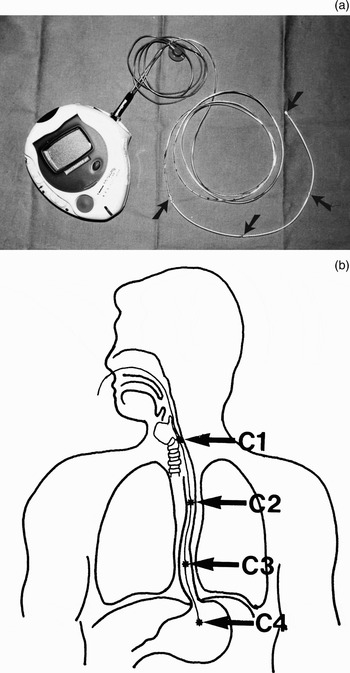
Twenty-four hour pH monitoring was performed using a tetra- probe, antimony pH catheter (Zinetics 24 Me Multi-use pH Catheter; Medtronic Functional Diagnostics, Skovlunde, Denmark) (Figure 1a). The four pH probes of the catheter were located every 10 cm. The proximal probe (channel one) was placed in the hypopharynx (just above the upper oesophageal sphincter), the second probe (channel two) was placed in the middle oesophagus, the third probe (channel three) was placed a few centimetres above the lower oesophageal sphincter, and the distal probe sensor (channel four) was placed in the stomach (Figure 1b).
(a) The pH monitor, with tetra-probe catheter. Arrows indicate the four pH electrodes (probes). (b) Location of the intraluminal pH probes; C1 = channel 1 (just above the upper oesophageal sphincter), C2 = channel 2 (in the middle portion of the oesophagus), C3 = channel 3 (a few centimetres above the lower oesophageal sphincter), and C4 = channel 4 (in gastric fundus).

The proximal probe of the catheter was placed under direct vision using transnasal videolaryngoscopy. A videofluorogram was thereafter performed to ensure accurate placement of the proximal probe just above the upper oesophageal sphincter, as well as correct placement of the other probes, which were present in the middle oesophagus (a few centimetres above the lower oesophageal sphincter) and in the gastric fundus. The pH sensors were simultaneously calibrated in buffer solutions at pH 7 and pH 1 before initiation of the study. The pH values were recorded every second on a pH monitor (Digitrapper pH, Medtronic Functional Diagnostics) (Figure 1a).
Data analysis
Data were analysed using the Polygram Net TM software program (Medtronic, Skovlunde, Denmark). We used pH levels of <4.0 or <5.0 to indicate a significant reflux event at channel one, and a pH level of <4.0 to indicate a significant reflux event at the other channels. The pH values detected at each channel were recorded every second. Patients were monitored while upright, supine, at mealtimes, and during preprandial periods (i.e. excluding mealtimes and postprandial periods) and postprandial periods (i.e. 2 hours after a meal). We evaluated the number of reflux events, number of long reflux events (i.e. >5 minutes), duration of the longest reflux event, time spent at pH < 4 or <5 (in minutes), percentage time spent at pH < 4 or <5, minimum pH, maximum pH, mean pH, and median pH.
Results
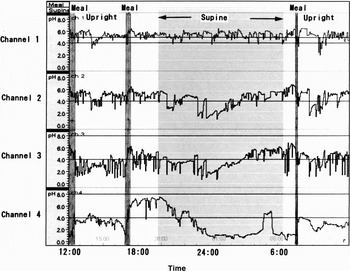
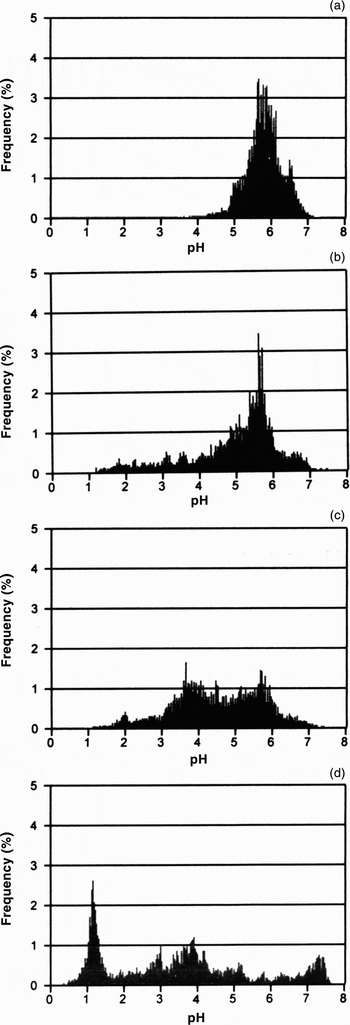
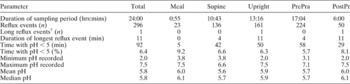
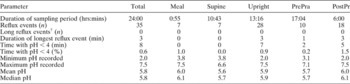
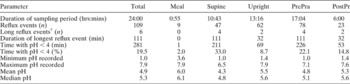
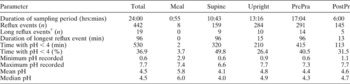
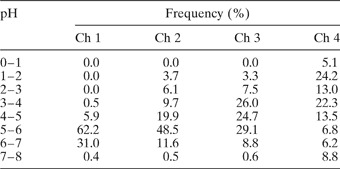
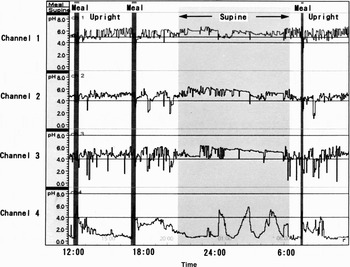
The pH sampling data for each probe site from one patient are shown in Tables I to V. Figure 2 shows results one patient for 24-hour pH monitoring, while Figure 3 and Table VI show the frequency of pH distribution at each probe site.
Results of one patient for 24-hour pH monitoring at each probe.

Frequency of pH distribution at each probe from one patient: (a) channel 1; (b) channel 2; (c) channel 3; and (d) channel 4.

pH sampling data: channel 1*

* Proximal sensor probe, in hypopharynx (just above upper oesophageal sphincter). †>5 minutes. PrePra = preprandial; PostPra = postprandial
pH Sampling data: channel 1*

* Proximal sensor probe, in hypopharynx (just above upper oesophageal sphincter). †>5 minutes. PrePra = preprandial; PostPra = postprandial
pH Sampling data: channel 2*

* In middle oesophagus. †>5 minutes. PrePra = preprandial; PostPra = postprandial
pH Sampling data: channel 3*

* Few centimetres above the lower oesophageal sphincter. †>5 minutes. PrePra = preprandial; PostPra = postprandial
pH Sampling data: channel 4*

* Distal probe sensor, in gastric fundus. PrePra = preprandial; PostPra = postprandial
Frequency of pH distribution at each probe channel

Ch = channel
The advantage of this monitoring procedure were that pH values at the four sensor probes could be monitored simultaneously, enabling the relationship between these pH values to be well documented. Consequently, gastroesophageal and laryngopharyngeal reflux patterns could be thoroughly examined. Gastric acid levels could be examined simultaneously with gastroesophageal and laryngopharyngeal reflux events. In addition, such 24-hour pH monitoring could also be used to assist the evaluation of the efficacy of LPR disease treatments (e.g. proton pump inhibitors) (Figure 4).
Results for tetra-probe, 24-hour pH monitoring in a case of laryngopharyngeal reflux disease treated with proton pump inhibitor administration, but resistant to this therapy.

Discussion
Ambulatory, double-probe, 24-hour pH monitoring has been reported to be the gold standard for the diagnosis of LPR disease.Reference Koufman1–Reference Postma3 However, the current gold standard is still somewhat controversial.
Location and number of pH sensor electrodes
In the current study, the pH catheter was inserted under direct vision using transnasal videolaryngoscopy, and a videofluorogram was thereafter performed to ensure accurate placement of the proximal probe in the hypopharynx (i.e. just above the upper oesophageal sphincter) and of the other three probes. The use of direct vision to position the proximal probe is an accurate method;Reference Postma, Belafsky and Aviv4 in contrast, other authors prefer the use of oesophageal manometry to guide pH probe placement.Reference Postma, Belafsky and Aviv4 PostmaReference Postma3 described use of the station pull-through technique, used to determine the location and length of the upper and lower oesophageal sphincters.
Oesophageal acid exposure 5 cm above the lower oesophageal sphincter has previously been used as a reference point in the assessment of gastroesophageal reflux disease.Reference Feussner, Petri, Walker, Bollschweiner and Siewert6 However, these is no consensus regarding the location or number of pharyngeal pH sensors. The proximal pharyngeal pH sensor (channel one in this study) is crucial when assessing LPR. Proximal pH results should be properly interpreted, and it should clear whether they originate from the pharynx (i.e. above the upper oesophageal sphincter) or from the proximal oesophagus. Smit et al. Reference Smit, Tan, Devriese, Mathus-Vliegen, Brandsen and Schouwenburg7 placed the proximal probe just inside the upper oesophageal sphincter. The upper oesophageal sphincter functions as the final barrier against laryngopharyngeal reflux, and thus the proximal probe should be placed in the hypopharynx, just above the upper oesophageal sphincter, as suggested by Postma et al. Reference Postma, Belafsky and Aviv4
Double-probe (i.e. simultaneous pharyngeal and oesophageal) testing does not assess gastric pH.Reference Postma3, Reference Postma, Belafsky and Aviv4 However, the equipment used in the current study enabled a distal pH sensor (channel four) to be placed in the gastric fundus. This facility confers a distinct advantage when investigating the efficacy of antireflux medication. Proton pump inhibitors can be very successful in controlling gastric acid release in patients with gastroesophageal and LPR disease. However, some of these patients can be resistant to such therapy.Reference Bough, Sataloff, Castell, Hills, Gideon and Spiegel8–Reference Sato10 One reason for this is nocturnal recovery of gastric acid secretion (also know as nocturnal acid breakthrough) despite PPI therapy.Reference Peghini, Katz, Bracy and Castell11 Another factor in LPR disease resistance to proton pump inhibitors is CYP2C19, an isoenzyme of cytochrome P450 in the liver, which plays an important role in catabolism of proton pump inhibitors.Reference Ishizaki and Horai12, Reference Adachi, Katsube, Kawamura, Takashima, Yuki, Amano, Ishihara, Fukuda, Watanabe and Kinoshita13 In cases of LPR disease resistant to drug therapy, placement of a pH probe in the stomach is indispensable when evaluating gastric acid levels and drug efficacy.
Interpretation of pH monitoring results
When assessing gastroesophageal reflux disease, the interpretation of pH monitoring results (for oesophageal acid exposure 5 cm above the lower oesophageal sphincter) has been studied and normal values have been well established (i.e. for pH values and for the percentage of time with pH < 4).Reference Feussner, Petri, Walker, Bollschweiner and Siewert6 However, there are no agreed diagnostic procedures for evaluating LPR, and diagnostic outcome criteria are ambiguous.Reference Koufman1, Reference Koufman, Aviv, Casiano and Shaw2
Smit et al. Reference Smit, Tan, Devriese, Mathus-Vliegen, Brandsen and Schouwenburg7 suggested that, in order to be considered pathological, the percentage of time with pH < 4 should be more than 0.1 per cent of the total time, 0.2 per cent of the upright time, and 0 per cent of the supine time. Likewise, in order to be considered pathological, the number of reflux episodes should exceed four.Reference Smit, Tan, Devriese, Mathus-Vliegen, Brandsen and Schouwenburg7 On the other hand, other authors believe that a single reflux event into the pharynx indicates extraesophageal reflux, i.e. LPR.Reference Postma, Belafsky and Aviv4 Postma et al. Reference Postma, Belafsky and Aviv4 have established four criteria which must be met in order for an event to be defined as a pharyngeal reflux episode: (1) a decrease in the pH level to <4.0 or <5.0; (2) a decrease in the pharyngeal pH level immediately following distal oesophageal acid exposure; (3) no decrease in the pH level during eating or swallowing; and (4) a rapid and sharp decrease in the proximal sensor pH level, rather than a gradual one.
The mucosal linings of the oesophagus, pharynx and larynx differ in their susceptibility to peptic acid injury. The laryngeal epithelium is far more sensitive to reflux-related injury than is the oesophageal epithelium, and peptic acid injury can occur at the former site at a pH level of 5.0 or more.Reference Axford, Sharp, Ross, Pearson, Dettmar and Panetti14 Thus, it may be appropriate to use a pH level of <5.0 to indicate a significant reflux event. The interpretation of results from pH monitoring should be clarified for LPR disease. More research is needed to validate the effect of LPR on laryngeal lesions.
Conclusion
This paper introduces the pH monitoring technique of tetra-probe (i.e. simultaneous hypopharyngeal, oesophageal and gastric), 24-hour pH monitoring for LPR disease. We used pH levels of both <4.0 and <5.0 to indicate a significant reflux event in the hypopharynx, just above the upper oesophageal sphincter.
The equipment used enabled simultaneous pH monitoring at four distinct sites; therefore, the relationship between pH levels at these sites, and between gastric acid levels and gastroesophageal and laryngopharyngeal reflux events, could be well documented and analysed. This procedure also enabled functional examination of reflux treatments, assisting the evaluation of reflux medication efficacy.