Historical background: the urban question in liberal Spain (1840–1936)
Until the late eighteenth century, Spain boasted a consolidated urban tradition. However, a certain backwardness would come to the fore at the early decades of the nineteenth century, when the impact of the Peninsular War was coupled with the loss of most of Spain's colonial empire and a confrontation between absolutists and liberals stretching over a quarter of a century.
Various waves of legislative reform were introduced from the mid-1830s onwards. New laws were enacted in order to establish full ‘Roman’ ownership to the detriment of overlapping domains on land. Church properties and commons were also disentailed. Administrative and political reform was undertaken, whereby the country was divided into 52 provinces and more than 8,000 municipalities, whose officers were elected by suffrage. The end of the century also saw rapid progress in terms of the construction of railway and tramway networks. All these developments led to changes in the urban hierarchy. Growth was concentrated on the northern coastal periphery (Catalonia, the Basque Country and Asturias) and a bipolar balance was forged between the capital Madrid (a city of services) and Barcelona (an industrial city); finally, by the 1920s, the latter outgrew the former in terms of population.Footnote 1
In Spain, the disentailments implied the dismantling of the system of poor relief characteristic of the ancien régime. New developments in education and health facilities were slow to emerge; restricted to the cities (particularly provincial capitals), the creation of these services was left partly to the Catholic Church. Furthermore, Spanish cities suffered from low levels of public health and high levels of child mortality to the extent that many registered negative natural growth rates until the Great War. At the end of the nineteenth century in industrial cities such as Bilbao or Cartagena, life expectancy was around 20 years, while in the rural areas surrounding them it was around 30.Footnote 2 In mid-nineteenth-century Europe, the necessary technology and logistics began to become available to build clean, healthy cities, with the state in Germany and France or local councils in England gradually becoming responsible for infrastructures such as water supplies, sewerage and sanitation.Footnote 3 However, in Spain, until the early twentieth century, the calls for reform from working-class parties fell on deaf ears in the Spanish parliament, which was imbued with liberal trust in private initiative and adverse to the local elites having to pay taxes. Political parties and trade unions attempted to get round this stonewalling through participation in municipal politics.
Following the Great War, the Bugallal Decree (1920) established a freeze on urban rents and the automatic extension of rental contracts. In addition, the ‘Municipal’ Law (1924) converted local authorities into active urban planning agents. The Second Republic (1931–36), with the access to power of a coalition of working-class and liberal parties, opened up a new space for opportunities, at a time when Europe was immersed in the debate regarding the social distribution of the costs of the Great Depression. The Civil War did not come about as the result of Spanish society's tendency to fratricide, but instead was the consequence of the similar strength between those two major forces (liberalism and social democracy vs. fascism and conservatism) that were struggling for supremacy in Europe between the wars.
Franco's dictatorship: from autarky to desarrollismo (1939–75)
The Spanish Civil War (1936–39) left behind it a devastated country and more than 800,000 deaths. It also caused the death or exile of thousands of intellectuals. The conflict wreaked havoc on numerous infrastructures and a number of cities were devastated; examples include Madrid, which was in the frontline throughout the war and where experiments in the use of military aviation against the civilian population were carried out. Until the late 1940s, cities continued to experience famine and severe shortages, not only of food but also of building materials.Footnote 4 Ration books were in use until 1952, and shanty towns dotted the landscapes of urban peripheries.
The extended post-war reconstruction period (which lasted 15 years, between three and five times longer than it took France or Italy to overcome the impact of World War II) is also partly attributable to the misguidedly autarkic economic policy applied during the post-war period. The negative impact was further heightened by the limitations of the business fabric, partly due to the expulsion of foreign capital in key sectors. The state assumed the role of ‘promoter’ through the National Institute of Industry. It was under the auspices of this organization that the foundations were laid for the major financial and business groups of the future (in particular those that would operate in the construction sector),Footnote 5 while patronage and corruption were the rules of the game. The term ‘corruption’ is insufficient: irregular practices were the direct result of the very nature of the political system. Due to the absence of a parliament, political parties or public debate, the cabinet formally concentrated the country's powers, and in practice carried out important consultancy functions: Franco referred to it as ‘my pocket parliament’.Footnote 6 Furthermore, each minister had considerable autonomy within the framework of his responsibilities, and was therefore able to take arbitrary decisions.
Until 1975, Spain was firmly in the grips of an authoritarian political system; one of the dictatorships close to NATO and which, together with Portugal and Greece, would survive in Mediterranean Europe within the context of the Cold War. Repression (more than 40,000 executions during the first 15 years of ‘peace’, hundreds of thousands of political prisoners and half a million people forced into exile) was accompanied by the denial of civil liberties as well as political and union rights. The working-class movement was ruthlessly eradicated. A fiscal policy based on redistribution was unthinkable: Spain did not join the welfare state model that was emerging in western Europe within the framework of the Bretton Woods system; nor did it develop a progressive fiscal policy based on income tax, with the state preferring to resort to the use of indirect taxes and despoil the social security surplus. Shortages of educational, healthcare, welfare and cultural services and facilities would continue to exist throughout the dictatorship, together with the role played by private management (the Catholic Church). This explains the weakness of the domestic market, even during the later years of apparent prosperity: salaries could not act as the driving force for generalized mass consumption.
Spain's international isolation came to an end with the signing over of military bases to the USA (1958) and agreements with the EEC: in particular, the 1970 customs agreement, which favoured Spanish industry by acknowledging its difficulties in competing in international markets. A number of US corporations delocalized to Spain, the mere tip of the iceberg in what was to become a chronic dependence on foreign technology and capital. The result was a deficit in the trade balance and the need for regular devaluations of the peseta.Footnote 7
The World Bank Report (1962) set out a path for Spain based on articulated subordination to the EEC, centred on emigration and tourism.Footnote 8 The proposals included mobilizing millions of people from rural areas, converting them into emigrants willing to accept unskilled jobs and low wages. Spain's migratory balance with Europe reached 1.2 million (4 per cent of the population). Mass tourism emerged, benefiting from the advantages of location and targeting Europe's welfare state beneficiaries. By 1964, Spain had become the world's leading tourist destination: tourism accounted for 9 per cent of the GDP and 25 per cent of the balance of payments income.Footnote 9 This was the period of desarrollismo (policy of development at all costs) characterized by Spain's ‘economic miracle’. Between 1950 and 1970, income per capita rose by 250 per cent, a rate similar to that of Japan. In the 1960s, the average annual growth rate stood at 8 per cent.
The Franco regime's urban policies
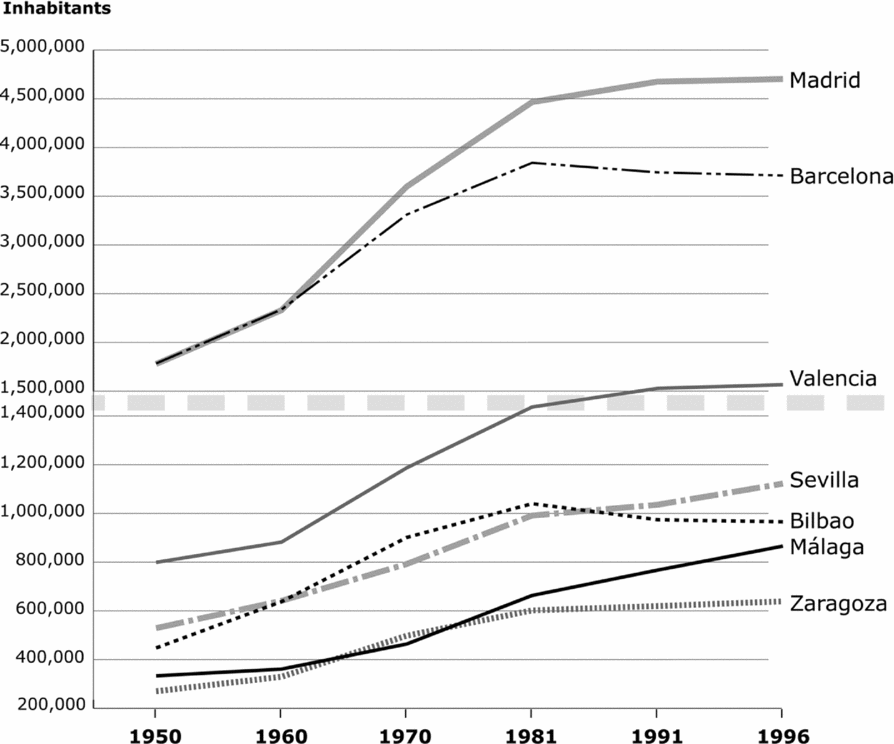
According to Nilsson,Footnote 10 between 1950 and 1980 Spain (together with Italy) boasted the highest rates of urban growth of the future EU, reaching an annual rate of 3.23 in the 1960s. During this and the following decade, nine of Europe's 12 fastest growing urban agglomerations were located in Spain. Furthermore, in the year 2000, Spain was the fourth country of Europe in terms of urban agglomerations of more than 200,000 inhabitants, with a total of 27, out of which the first four (Madrid, Barcelona, Valencia and Seville) had a population of more than one million (Figure 1). The origins of this phenomenon were rooted in the baby boom of the 1960s, but, above all, in mass emigration to cities.
Demographic growth of Spain's seven largest urban agglomerations (1950–96). Data from J.M. Serrano, ‘La red de aglomeraciones urbanas en España cuando finaliza el siglo XX’, Investigaciones Geográficas, 22 (1999), 41.

In the 1960s, government economic policy was based on indicative planning, a watered-down version of the French model structured around four-year ‘development plans'.Footnote 11 In addition to the three major development hubs selected – Madrid, Bilbao and Barcelona – a series of ‘secondary poles of development’ were created, situated at various points around the country. The focus was placed on heavy industry and for the first time ever, Madrid became an industrial city. In terms of the political and administrative structure, the provinces continued to form the base units for the state administration, further reinforcing the role of provincial capitals as centres of industry and services.
The Mediterranean corridor and the Canary and Balearic archipelagos benefited from the waves of mass tourism that flocked from across Europe. Transport infrastructures were put in place in order to facilitate their access, including the airport network (completed in 1970), the national road network and Spain's first motorway.
It was under these conditions that a serious housing problem emerged, the result of both a shortage of homes and the obsolescence of many of the existing ones.Footnote 12 The lack of public housing meant that most people lived in rented accommodation. In 1950, the number of main homes stood at 6.1 million although homeowners made up a mere 46.7 per cent: this percentage would fall sharply in the case of large cities such as Madrid and Barcelona (6 per cent), Seville (10 per cent) or Bilbao (12 per cent). Legislation on rented housing between 1942 and 1946 (which limited rises in rent and established the automatic extension of contracts) led to a strategy that was widely adopted by landlords whereby the buildings fell into a serious state of disrepair.
A radical turnabout would occur during the desarrollismo period, when the government adopted policies to encourage home ownership as an element of social stability. The housing stock in Spain rose by more than 40 per cent between 1960 and 1975; privately owned main homes accounted for 64 per cent of the total in 1970, rising to 73 per cent in 1980.Footnote 13
The reduced dimensions of private construction companies, and their complete lack of interest in satisfying the needs of housing for the working classes, also meant that state institutions were required to intervene. Shortly after the end of the Civil War, the Instituto Nacional de Vivienda (National Housing Agency) set up a collaboration programme with local and provincial corporations, which were obliged to provide free land, while different organizations took over the role of property management. More than half a million homes were built under that programme between 1940 and 1970, offering affordable rents, targeting state workers or employees of large companies.
City growth remained compact, leading to overcrowding in the centres and immediate peripheries. Was it the result of the deliberate action of the local elites, who aimed to preserve the value of land in city cores? This situation is more likely to be attributable to the shortage of cars, and insufficient public transport networks and basic infrastructures such as water supplies and sanitation, which were limited to urban centres, thereby leading to the appearance of peripheral shanty towns in the 1950s.
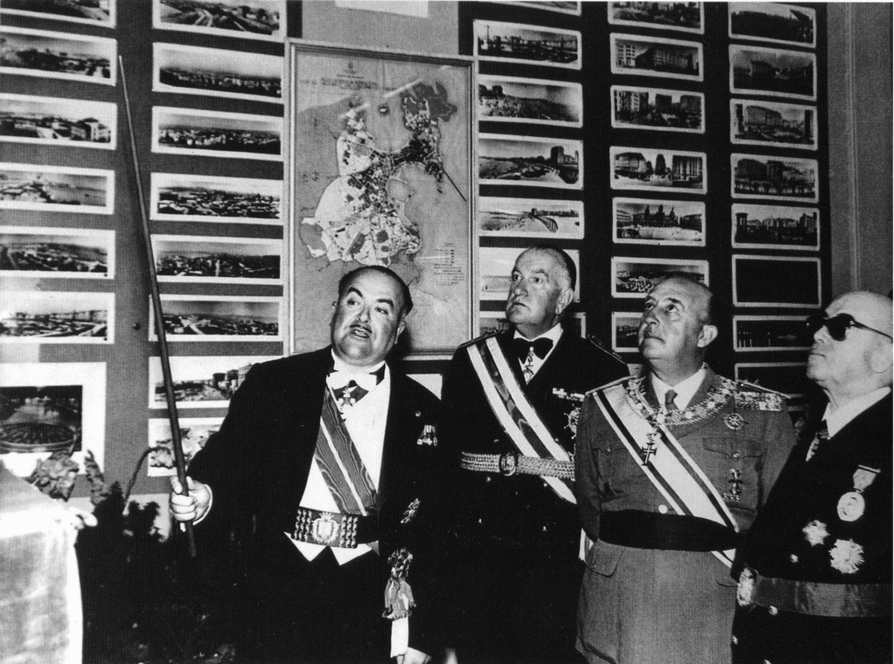
By the 1940s, there were a few cases of fairly well-designed technical planning instruments at a municipal level. Madrid's 1946 Plan de Ordenación Urbana (Urban Development Plan) was based on the principle of zoning, and aimed at completing the historical nucleus of the city, surrounding it with green spaces and a ring road, and organizing new areas for construction beyond. However, in most of Spain's cities, the urban development plans put forward until the late 1950s were poor-quality draft proposals (Figure 2).
The mayor of A Coruña showing Francisco Franco the new plans for the city (c. 1955). © Alberto Martí Villardefrancos, Archive ‘Foto Blanco’.
The 1956 Land Act introduced planning through legal instruments such as the Plan General de Ordenación Urbana (General Urban Development Plan), that should be drafted by the Dirección General de Urbanismo (National Agency for Urban Planning).Footnote 14 This ‘General Plan’ classified all the municipal territory into three categories: suelo urbano (urban land); suelo rústico (rustic land excluded from urbanization) and suelo urbanizable (land approved for development and building). In the latter case, later ‘Partial Plans' were intended to demarcate those sectors where building would take place. However, only a very few cities actually passed a ‘General Plan’, and even in those that did, urban growth was clearly disordered. The absence of democracy at a municipal level led to a generalized collusion between local authorities and private property developers.Footnote 15 Every facility was given for building, in many cases on suelo rústico, and flagrant schemes were hatched between local councillors, municipal architects and some developers when buying plots of land which would then be immediately reclassified as suelo urbanizable. Furthermore, the 1963 Law for Tourist Areas and Centres of Interest allowed for the possibility of declaring the entire municipality as suelo urbanizable, simply by means of a municipal by-law, and without the need for prior planning (as occurred with Marbella on the Costa del Sol). Under this law, the figure of the ‘private developer’ acquired great power.
In spite of innovations in planning, the new laws led to the private appropriation of capital gains generated by public action. Simply by reclassifying an area of suelo rústico as suelo urbanizable, a municipality generated expectations regarding the revaluation of the land that clearly favoured the owner, due to the absence of taxes on capital gains.Footnote 16 Mortgage legislation allowed for this expectation of revaluation to be used to guarantee bank loans and finance building work. In addition, the developer held no responsibility in terms of general development tasks (e.g. connections to the road network, water supplies and sanitation). Indeed, building work often began before these infrastructures were in place.
The year 1957 saw the creation of the Spanish Ministry of Housing. Whilst the ‘National Housing Plan’ of 1955 had replaced the system of direct public development with funding for private builders, the 1961 Plan created the concept of polígono de viviendas (large housing estate). The directives, a density of 500 inhabitants per hectare, and the requirement that the cost of the land should not exceed 15 per cent of the total, led to the appearance of hundreds of housing estates situated on the outskirts of cities, consisting of poor-quality blocks of flats in areas that lacked education, health and cultural facilities and services.Footnote 17
These deficiencies led to the emergence of residents' associations.Footnote 18 These groups benefited from the Law of Association (1964) that provided a space for ‘non-political’ protests. These assembly-based organizations helped to generate a tradition of solidarity and shared management of collective needs, at times based on Christian social organizations or on semi-clandestine political parties and trade unions.
From the democratic transition to the Maastricht Treaty (1975–92)
Franco's death eased the shift to democracy in Spain and a system based on the alternation in national, autonomous community and municipal government of two parties: the Partido Popular (PP, conservative) and the Partido Socialista (PSOE, social-democrat). The actual differences between these two parties when they come to government are a matter of debate, as whilst the former is a staunch defender of neoliberalism, the latter has revealed itself to be increasingly open to this doctrine. Nevertheless, the initial discredit in which those forces most closely associated with Franco's dictatorship were held paved the way for the hegemony of social democracy throughout the 1980s. In addition, the first local authorities to be governed by the left wing (frequently socialists in coalition with communists or peripheral nationalists) were highly sensitive to the population's calls for reform.
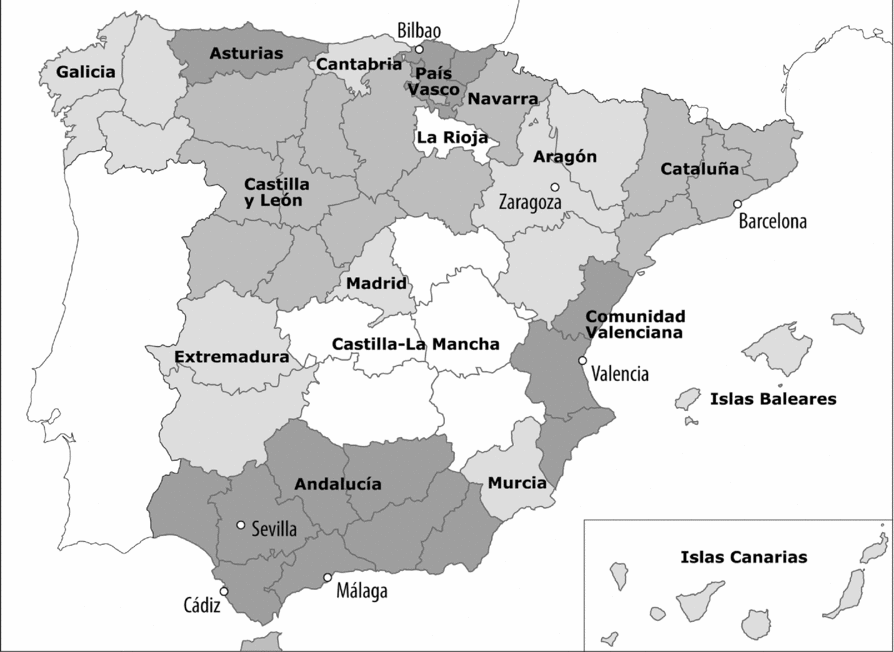
A political and administrative decentralization process led to the reorganization of Spain into 17 autonomous communities (Figure 3) and conferred a considerable degree of autonomy on the local authorities. In addition to stating the right to housing, the Constitution also determined that public authorities should avoid land speculation, reverting capital gains on land on the citizens. Hundreds of leaders from residents' associations were elected to the newly formed local authorities. They addressed the deficiencies of their neighbourhoods and the problem of unemployment by drawing on the administrative powers recognized by the Constitution, urbanism in particular (such as the drawing up of the ‘General Plan’). Madrid and Barcelona were prime examples of the ‘race’ to redress the lack of facilities and services and to eradicate the shanty towns from their outskirts. In Madrid, a programme of ‘districts under remodelling’ was applied to those settlements:Footnote 19 40,000 housing units were built in order to rehouse in situ 150,000 people. Moreover, the 1985 ‘General Urban Development Plan’ laid the foundations for the construction of the network of primary healthcare centres.
Map of Spain with the current autonomous regions and a number of major cities.
An initial expansion of the welfare state occurred, which was based on tax reform and the creation of an income tax. Social spending (public spending on the education, healthcare, welfare, unemployment and pension systems) rose by 11.4 points of Spain's GDP, from representing less than 14 per cent in 1975 to more than 25 per cent in the mid-1980s. Then, social spending stabilized (it kept growing at the same rate as GDP) until 1993. Meanwhile, public spending on health rose between 1970 and 1990 from 2.4 to 5.4 per cent of the GDP.Footnote 20 There was also a considerable rise in public employment (one million workers) in those welfare state sectors that the Constitution associated with local authorities and autonomous communities.
However, during the same years that the welfare state began to take root in Spain, the economic prosperity that had favoured it in western Europe had come to an end. The two oil crises and the end of the Bretton Woods monetary system formed the backdrop for a crisis of the Fordist model that would impact on the major industrial powers, which suffered from excessive industrial capacity, a sudden fall in the rate of technological innovation and waves of labour unrest. As the rate of profit fell, inflation rose sharply:Footnote 21 the ‘stagflation’ of the 1970s which Keynesian solutions appeared unable to resolve. The impact on an economy as vulnerable as Spain's was devastating, with unemployment soaring to 20 per cent. Furthermore, the newly acquired freedom for trade unions led to a wave of strikes and wage rises in the second half of the 1970s.
In 1978, the Moncloa Agreements between the employers' organization, the major political parties and the two main social-democratic trade unions introduced a new framework based on controlling inflation through salaries, which were linked to the Consumer Price Index. These ‘agreements' formed the starting point for a ‘counter-reformation’ whereby successive governments would grant tax exemption on capital income, as well as tolerate flagrant tax fraud and high levels of informal economy. While the situation of the majority of workers became more precarious, increasing their dependency on public spending, the state refused to increase its tax revenue: from 1993 onwards, the public ‘social spending’, measured as a percentage of Spain's GDP, began gradually to decline.
Spanish governments acknowledged the emergence of a new economic paradigm. Neoliberalism spread throughout western Europe, advocating control of the tax deficit and ‘supply theories': offering investment incentives (by cutting taxes) and work incentives (by creating precarious working conditions). The policies implemented in the UK by the Thatcher administration included the outsourcing and subcontracting practices that emerged from Japan. The financial policies, adopted by the Reagan administration in the USA, and later copied in Europe, advocated the liberalization of capital flows and the deregulation of the banking sector. These policies provided a way out of the Fordist crisis through ‘financialization’, which would gain ground amongst domestic economies, with reforms to mortgage markets and pension funds, cheap loans linked to low interest rates and the subsequent equity bubbles. Gradually, the social consequences of what Brenner would term ‘asset price Keynesianism’ would appear,Footnote 22 namely rising house prices as a consumer driving force for the middle and lower classes at times when salaries were either falling or had stagnated. Nor must we forget its ideological counterpart: an ‘ownership society’ which would revolutionize the electoral map.
It was within such a context that the agreements allowing Spain's admission to the EEC in 1986 were signed, shaping the reconstruction of the country. Industrial rationalization laws brought with them the end of national industries that competed with the EEC's core countries. These industries were either closed down (mines, shipyards, steel factories and chemical plants) or sold off to foreign corporations (the car industry). Furthermore, a highly overvalued peseta joined the European Monetary System and the Spanish government applied a monetary policy that led to 15 per cent interest rates in 1986–88, the highest in the EEC.Footnote 23 This situation conferred credibility on the Spanish currency, enabling the country to attract investors, yet at the same time it led to a loss of economic competitiveness. The opening up of Spain's domestic market had an immediate negative impact on the balance of trade and caused the massive capital inflow to the ownership of the country's biggest companies.Footnote 24 The government focused its protection measures on the major financial, construction and energy companies, encouraging a process of financial concentration and high profit margins: the country's banking sector merged into seven major banks – a number that would shortly be reduced to three.
Closely linked to this was a partial deindustrialization of major regions that had been the target of industrial development policies during Franco's regime, namely the Galician coastal areas, Asturias, the Basque Country, Valencia and Cadiz, as well as the industrial belts of Madrid and Catalonia. This process had far-reaching repercussions on the residents of the polígonos de vivienda (housing estates) built during the days of Franco; they were affected by a general labour, social and healthcare crisis, the most serious symptoms of which was the heroin and AIDS epidemic that would devastate an entire generation. This situation also generated serious labour and social unrest during the 1980s, the last time when trade unions and residents' associations would effectively join forces.
A ‘new economy’ or a real state bubble (1992–2012)?
In 1992, the Spanish government presented a series of large-scale urban projects targeting the capital and major cities in the most important autonomous communities (Andalusia, Catalonia and the Basque Country).Footnote 25 Madrid was the European Capital of Culture, Seville was organizing a World Fair, Barcelona was hosting the Olympic Games and Bilbao presented the project of a museum designed by Frank Gehry. These celebrations were accompanied by projects for the renewal of the urban fabric – including obsolete industrial installations – communication infrastructures and iconic buildings that sought to place these cities in the media spotlight, attracting the business community and tourists. The notion of a ‘Barcelona model’ was disseminated through that literature related to urban planning, economy and city branding.
The ‘pomp and pageantry of 1992’ was aimed at marking an about-turn in Spain's historical problems: its economic backwardness and its cultural isolation. The proliferation of festival cities at regional level alluded towards the possibilities that political decentralization offered in responding to the challenges of nationalist aspirations on the part of the Basques and Catalans, and which could be clearly seen in the rivalry between Madrid and Barcelona. The celebrations were also intended to serve as an outward expression of the government's move towards a service and new technologies economy within the framework of the EU and globalization.
However, those celebrations also represented the high point of the first real estate bubble between 1985 and 1993. This process had much in common with the later bubble, although it lacked the same intensity and nationwide character.Footnote 26 Indeed, this initial bubble was limited to the cities that benefited most from the reindustrialization process (Madrid and Barcelona) and the tourist boom (Barcelona, Valencia and Málaga), although it is true that in the 1990s they would be joined by other cities that were reaping the rewards of the new emerging industries, namely the Basque Country (Bilbao) and the Ebro Valley (Zaragoza). All these cities adopted urban marketing policies that during the second property boom would be aped by all the autonomous and provincial capitals.
In practice, however, instead of that ‘service and new technologies economy’, what was actually becoming consolidated in much of Spain was an uncompetitive economic model, built on the precarious foundations of an unskilled labour force, job insecurity, inflation and a high unemployment rate which stood at 8 per cent during periods of prosperity, yet which would shoot up to over 25 per cent in times of recession (as happened during the 1993–96 recession, caused by the failure of the European Monetary System).Footnote 27
Moreover, this was the economic model that was consolidated during the second property bubble, between 1995 and 2008. The property boom was characterized by positive macroeconomic data. GDP grew at an annual rate of 4 per cent and the national income rose 60 per cent in 14 years.Footnote 28 Population grew by six million inhabitants, five million of which were attributable to immigration. Seven million workers joined the workforce, half of whom were immigrants, mainly from Latin America, North Africa and Romania. In Madrid, the number of registered foreign residents rose from 100,000 (in 1996) to 1,100,000 (in 2009), accounting for 17 per cent of the population. Immigrants also represented a significant percentage in other major cities: 14 per cent in Barcelona, and 12 per cent in Valencia and Zaragoza.Footnote 29
The driving force behind these phenomena was the fact that four million housing units were under construction in Spain: work on 800,000 got underway each year during the three-year period from 2005 to 2007, the same number as in France, Germany and the UK together (with a total population five times higher than that of Spain) for the same period. In 2006, 14 per cent of the labour force was employed in the construction sector, the second highest figure in the EU.
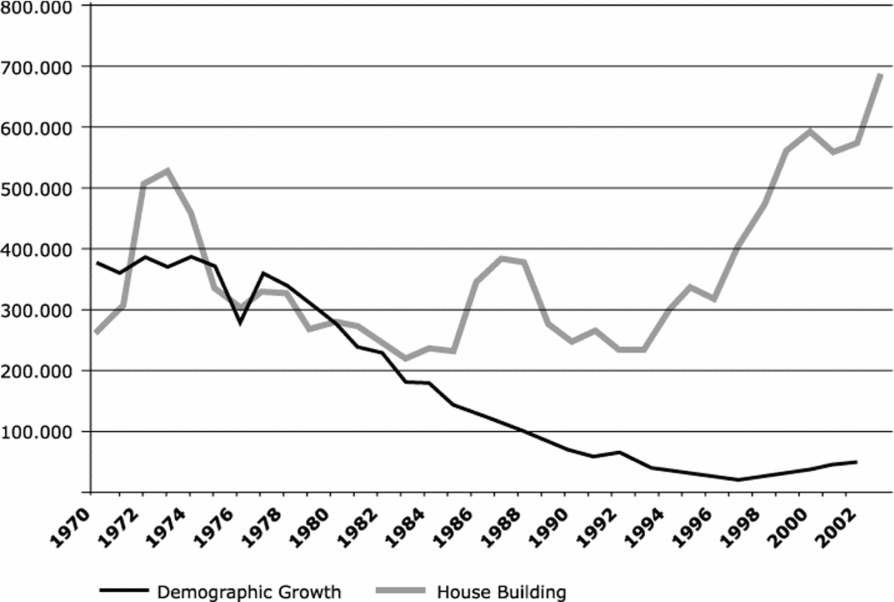
Data such as these led to an almost total consensus from the voices of politicians, business and the media, not only in Spain but even internationally: ‘Spain is doing well’, as a popular slogan said. However, the data were open to radically different interpretations. The rise in housing stock could not be attributed to the immigrant population, which tended to rent properties in run-down inner-city or peripheral working-class districts. Neither did the rise respond to domestic demand for new homes, given the changing demographic trend and the ageing population (Figure 4).Footnote 30 Furthermore, the age at which young Spaniards were leaving their family homes increased by six years between 1980 and 2000, reaching the ages of 28 for women and 30 for men, the oldest in the EU along with Italy. A response to the weakness of the welfare system, the precarious situation of the labour market and high living costs, this delay in the establishment of new families resulted in one of the lowest birth rates in the EU.Footnote 31
Demographic growth (excluding immigration) and house building in Spain (1970–2002). From J.M. Naredo, ‘Perspectivas de la vivienda’, Información Comercial Española, 815 (2004), 146.
Although between 1994 and 2006 the value of residential real estate owned by Spanish households increased threefold, Bank of Spain data pointed to the fact that the property bubble was benefiting a mere 10 per cent; those better-off families that boasted a significant initial capital, and in all cases, only those in a position to speculate with properties other than their main home. Spain was the second country in the EU in terms of the percentage of empty and second homes (160 for every 1,000 inhabitants in 2002).Footnote 32
Meanwhile, the real wages of 60 per cent of the population stagnated between 1994 and 2006 and, in 2007, 40 per cent failed to reach over €1,000 a month. During this same period, whilst nominal wages and consumer prices rose by a mere 30 per cent, housing prices had shot up 192 per cent, rising by 120 per cent between 2002 and 2005 alone. In 1994, acquiring a 90 m2 home would have cost five years' salary of the average worker, yet by 2006 that figure had risen to eleven years.Footnote 33 Mass access to housing ownership was achieved through over-indebtedness. National mortgage debt increased twelvefold, and household indebtedness soared from 62 per cent of disposable income (1995) to 130 per cent (2008). By the end of this period, 40 per cent of privately owned main homes were mortgaged.
The housing ‘wealth effect’ covered up the reduction of purchasing power from salaries: a growing percentage of family spending was sustained by credit. This boom period had a sociological impact on an autochthonous population faced with a situation whereby immigrant workers readily accepted the worst-paid jobs. A Ministry of Labour survey revealed that 94 per cent of the Spanish population considered itself to be ‘middle class'.Footnote 34 The steady advance of these processes of gentrification and urban inequality also led to the emergence of new US-influenced cultural, residential and consumption models, together with a new social and electoral pattern, characterized by the rising popularity of right-wing parties.Footnote 35
The key factors of the real state bubble, and its burst
The property bubble fed on massive over-indebtedness. An international trend towards low interest rates, aggravated by the country adopting the Euro in 2002, caused the annual rate in Spain to fall from 15 to 3 per cent between 1995 and 2001, then remaining stable until 2007. The Spanish state and banks were able to be financed in the international markets with favourable conditions: the government increased public spending; the banks financed property developers and families. Nevertheless, this money would not have reached Spain if it had not been for the concerted action of a series of public policies, which, in accordance with the analysis carried out by López and Rodríguez, ‘put in value’ practically the entire national territory, favouring simultaneously the growth of the housing stock and a sharp rise in the value of existing homes.Footnote 36 This situation was attributable to six key factors: mortgage legislation, land and housing policies, urban planning, municipal politics and infrastructure policies. Some of these factors date back to the neoliberal reforms implemented by the socialist governments of the 1980s, or the years of Franco's desarrollismo, although even in these cases, the urban policies adopted through the property boom gave them a new value.
First, the deregulation of banking and mortgage legislation eased access to credit for low- and middle-income households. The 1981 Law introduced variable interest rates, the financing percentage rose from 50 to 80 per cent of the value of the home and loan repayment periods were extended. Through the bubble years, financing percentage rose to 110 per cent, and repayment periods up to 50 years.
Housing policies were a second factor.Footnote 37 The year 1994 saw a definite move away from the public housing promotion that had characterized both Franco's dictatorship and the transition to democracy. During the 1990s, companies and public administrations sold their stock of low-rental homes to their tenants; in the case of new homes, the number of subsidized housing units dropped from 24 to 9 per cent between 1994 and 2006. Likewise, the 1985 Boyer Decree liberalized urban rent contracts; rents in Madrid increased threefold between 1983 and 1989.Footnote 38 This was accompanied by tax relief measures for house buyers and mortgage payers, whilst tax relief for tenants was eliminated.
The result was a dramatic leap in the domestic demand for home ownership, a demand which was rooted in the desarrollismo years of the Franco regime. Between 1950 and 2001, the number of main homes rose from 6.1 to 13.2 million. During this same period, the percentage of privately owned main homes rose from 46.7 per cent to 88 per cent whilst the number of rented homes fell from 3.2 to 1.6 million. Spain boasted the highest rate of homeowners in the EU – excluding Eastern European countries – and the lowest rate of rented social housing: just 2 per cent.Footnote 39
Land legislation was the third factor. The laws passed in 1996 and 1998 paved the way for large-scale speculation, as they declared the entire national territory as suelo urbanizable, unless urban plans explicitly should prohibit development.Footnote 40 The state delegated supervision of urban development to the autonomous communities, and despite retaining the power to legislate, a sentence issued by the Constitutional Court revoked this right, a decision that was enthusiastically embraced by the national government. The autonomous communities were then free to pass their own land laws; hence the proliferation of figures such as the agente público urbanizador in the Valencia autonomous community. In spite of his name, he was a private developer who could be entitled by the local authority to expropriate and develop land he did not own, even modifying the municipal ‘General Plan’ and reclassifying land as suelo urbanizable.
The new legal framework led to the creation of an ‘elite’ of real estate development companies that retained vast stocks of land, as the public administrations were unable to force them to develop and build within a certain deadline. The price of land shot up: in the autonomous community of Madrid its impact on final home prices rose from 30 to 50 per cent. Also, the legal reforms of the 1990s gave new meaning to the legislation from Franco's time, which allowed property developers to finance a whole project through a mortgage loan whose sole collateral was ownership of the land.
The fourth factor was rooted in the use of urban planning as a means of improving tax revenue. In Spain, the national government is responsible for collecting most of the taxes, half of which it then transfers to the autonomous communities (37 per cent) and local authorities (13 per cent). Throughout the property boom period, state transfers remained stable, despite the steady rise in spending by peripheral administrations, due to the state's willingness to transfer administrative powers in matters of health, education, social services and transport. Autonomous and local authorities would use their far-reaching powers in issues of urban planning (in the case of both) and in housing and transport infrastructures (in the case of the autonomous governments) to encourage a booming property market that represented their only means of substantially adding to their tax revenue: tax levied on the sale and reclassification of land and real estate operations.
A fifth factor was the absence of any urban planning at supra-municipal scale. It had not existed in the legislation of the dictatorship, and in the 1980s the state transferred competences in this area to the autonomous communities. Only the Basque Country and Catalonia proceeded to develop it at regional level, with only the cities of Barcelona and Valencia creating metropolitan areas. The result was that local councils competed to offer land for property development, and in the region of Valencia alone, between 2005 and 2008, a total of 52 municipal plans envisaged the construction of 718,000 new homes, which in the event of actually seeing the light of day would have multiplied the populations of these councils fivefold.Footnote 41
Finally, mention must be made of the role played by transport infrastructure policies, which over a 20-year period attracted half of the financing obtained through European structural and cohesion funds. These funds served as a form of compensation for the industrial rationalization and opening up of the domestic market that Spain was forced to accept when joining the EEC. One of the conditions was that they could not be used to subsidize industries affected by problems of overcapacity within the EU. Investment in public works stood at 5 per cent of the Spanish GDP between 1986 and 1991, and more than 2 per cent in the 1993–2007 period. Whilst the first property boom saw the construction of the general highway network and the first stretches of the high-speed rail lines, during the second bubble Spain became the European country with the largest network of both infrastructures, thereby creating similar real estate market conditions throughout the country.Footnote 42
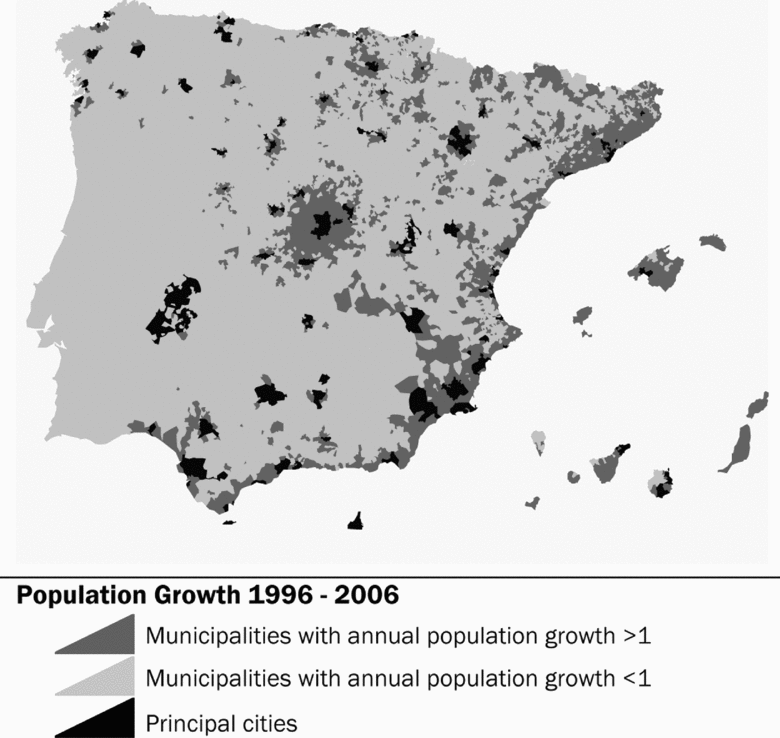
And, indeed, the property boom did eventually affect the whole of Spain, despite the fact that urban growth and immigration were centred in the major metropolitan regions (Catalonia, Madrid and the Basque Country) and those with a flourishing tourist industry (the Mediterranean – Andalusia, Murcia and Valencia – and the Canary and Balearic Islands). Yet its influence also spread to the northern coast and inland regions, which, crisscrossed by high-speed train lines and motorways, flourished under the effects of domestic tourism and the growing number of second homes. The capitals of autonomous communities and provinces echoed the marketing policies of the major metropolises, leading to a sharp rise in the number of extremely costly flagship projects. There was a general shift towards urban sprawl, resulting in the chaotic growth of urban peripheral areas at an annual rate of 1 per cent in 1996–2006, and which today cover an area equivalent to that of the ‘compact’ city (Figure 5).Footnote 43
Map of Spain with those municipalities with an annual population growth > 1%, 1996–2006. From M. García Docampo and R. Otero, ‘Transición territorial’, REIS (2012), 147.
The year 2007 saw the outbreak of the subprime mortgage crisis in the USA and the capital flows towards the Spanish economy suddenly reversed. The property bubble burst, bringing with it insolvency for real estate developers, who had accumulated large amounts of land stock and housing under construction that now had no buyers. The loans used to finance their activity therefore lost the guarantees that enabled the banks to grant them in the first place. Whilst the financial hardships of the developers were being passed on to general contractors, subcontractors and builders' supply companies, banks were transferring their own difficulties onto the general economy by placing severe restrictions on credit.Footnote 44 The immediate impact was the destruction of the productive sector and a dramatic rise in unemployment, which shot up from 8.5 per cent in 2006 to 27 per cent in early 2013. By this time, 40 per cent of all households had their main home mortgaged. They were the troubled witnesses to an ‘epidemic of evictions’, which affected 350,000 families during the period from 2007 to 2012;Footnote 45 52,000 families lost their main home in 2012, 38 per cent of whom were immigrants who had only recently entered the property market.Footnote 46 Meanwhile, almost a million new homes were for sale, but did not find a buyer.
The recession brought to the fore the new conditions for Spain's incorporation in the EU, and the generalized loss of competitiveness experienced by the Mediterranean economies, in contrast to a number of eastern European countries that were joining the EU, in the wake of harsh rationalization processes that severely affected labour and social conditions. The terms of the Maastricht and Lisbon Treaties and its inclusion in the Eurozone in 2003 did away with all Spain's economic stabilizers: customs barriers, resort to devaluation and the intervention of the public sector and the central bank.Footnote 47 The austerity measures recently imposed by the EU are based on a dual principle: control of the tax deficit by limiting public spending rather than through direct tax increases; and inflation control through salary restrictions, rather than business profit. These measures were applied to a country such as Spain where taxation was already centred on VAT and rates of tax fraud were the equivalent of 10 per cent of the country's GDP, three-quarters of which is attributable to large fortunes and major companies.Footnote 48 Policies aimed at dismantling the public education, healthcare, welfare and pension systems emerged in a country where ‘social spending’ had already fallen 3.5 points over the GDP between 1994 and 2003. Whilst per capita income in Spain is 94 per cent of that of the EU-15, its public social spending is just 72 per cent of the EU-15 average, and 79.5 per cent in the case of education.Footnote 49 Data regarding differential mortality rates between social classes are troubling: 6 years' difference in terms of life expectancy between the wealthiest 10 per cent and skilled workers; and 10 years for the long-term unemployed.Footnote 50 Although differential mortality has been there for a long time, the combined effect of recession and austerity policies could widen the gap.
Conclusion
The history of Spain has often been presented as a constant exception, incapable of aligning itself with the model in place in the most advanced European nations: the failure of industrialization and the liberal revolution, the failure of the Second Republic and the installation of Franco's dictatorship, the failure of the transition towards democracy, and of the economic model based on an ‘irrational’ real estate bubble – a situation both depressing and unsatisfactory in scientific terms. A global urban history cannot be written as an inventory of exceptions, but instead based on understanding the different stances held by different territories within a global capitalist order. Cities, regions and states seek to emulate the most cutting-edge territories, mobilize a built environment that is a legacy of the past and negotiate agreements between the main social agents.
In the nineteenth century, urban Spain adopted the innovations of industrialization and the liberal revolution. The oligarchic nature of the parliamentary regime led to weakness on the part of the state in dealing with the problems that accompanied the process of urbanization: precarious labour markets, unhealthy cities, and a short life expectancy. The Second Republic represented an opportunity, which was eventually cut short, to diminish the unequal distribution of wealth, dealing with the intense urban growth that took place during the first third of the twentieth century. Franco's dictatorship was able to take hold thanks to support from the fascist powers, and survived under the aegis of the USA. Spain, stricken by both the war and an obsolete autarkic policy, began to apply Keynesian policies with the desarrollismo of the 1960s, with a weak industry and strong focus on tourism from the EEC. Land legislation laid the guidelines for local oligarchies' appropriation of capital gains, and the housing policies encouraged a cultural trend towards home ownership. The strongest urban growth in Europe was not accompanied by the construction of the welfare state that characterized the system of Bretton Woods.
Spain, Portugal and Greece underwent a transition towards democracy (1974–75), and joined the EEC (1982–85) accepting deindustrialization programmes, and benefiting from their positional advantages for tourism. In Spain, the late arrival of the welfare state occurred at the same time as a process of decentralization, which entrusted these competences to autonomous regions and municipalities. However, at the same time, the monetarist policies adopted by the socialist governments between 1982 and 1996 led to a ‘precariat’-style labour market, finally halting the expansion of the welfare state when it was still far below the EU average. While the last socialist governments (1989–96) promised a ‘service and new technologies economy’, the governments of the Partido Popular (1996–2004) implemented a real estate bubble which was fed on massive over-indebtedness; and then the socialist governments (2004–11) accepted it.
However, this bubble was not an ‘irrational anomaly’. David Harvey has proposed the hypothesis that nationwide or regional property bubbles are one of the outlets for surplus accumulation in a context of globalized capitalism.Footnote 51 The expansion of the EU towards the east meant that new competitors appeared who were in a better position to serve as the sites for delocalized industries. Difficulties arose for those countries on the Mediterranean and Atlantic peripheries, but both Spain and Ireland backed real estate bubbles. Spain's unique characteristics meant that in the mid-1990s it was an ideal location for creating a bubble and attracting international capital: mortgage legislation from the 1980s; infrastructure policies financed by the EU; and a series of factors inherited from Franco's dictatorship which were refined in the 1990s, such as tourism specialization, a culture of home ownership, land and housing policies and the absence of urban planning at supra-municipal scale.
Harvey argues that the eventual burst of these property bubbles could well be one of the factors behind major economic recessions since the mid-nineteenth century. In any event, the recent recession has helped both the government institutions of Spain and the EU to implant an austerity policy which has a boomerang effect in macroeconomic terms, and which has negatively influenced living conditions for the majority of the population.