Introduction
Aphidophagous coccinellids lay their eggs in clusters in the proximity of prey (Hodek, Reference Hodek1973; Carter & Dixon, Reference Carter and Dixon1982; Majerus & Kearns, Reference Majerus and Kearns1989; Dixon, Reference Dixon2000). The size of individual eggs shows little variation within a species, but cluster size varies both within and between species (Dixon & Guo, Reference Dixon and Guo1993; Dixon, Reference Dixon2000). The number of eggs laid per cluster is influenced by the number of ovarioles possessed by a female (Dixon & Guo, Reference Dixon and Guo1993) and by prey availability (Agarwala & Bardhanroy, Reference Agarwala and Bardhanroy1999). It is also possible that the architecture of the oviposition substrate may affect egg-laying behaviour in a similar way that plant structure has been shown to affect ladybird foraging behaviour (Carter et al., Reference Carter, Sutherland and Dixon1984).
The size of the egg cluster may affect the likelihood that individuals within the cluster will become victims of predation or cannibalism. Generally, it has been suggested that, although larger groups are more easily detected by predators, there are overall benefits to individual prey in avoiding predation when existing in clusters above a threshold size (Taylor, Reference Taylor1979). Egg surface alkanes are important in signalling the toxicity of eggs to predators (Hemptinne et al., Reference Hemptinne, Longnay, Doumbia and Dixon2001). Thus, the more eggs present in a cluster, the greater the amount of deterrent surface alkanes. The results from a study by Agarwala & Dixon (Reference Agarwala and Dixon1993) concur with this theory, showing that clustered coccinellid eggs were less likely to be eaten by another coccinellid species than were single eggs. Conversely, however, it might appear that clustering might actually increase the chances of predation and that once found all eggs within a cluster were at greater risk.
Cannibalism of eggs by coccinellids is a commonly documented phenomenon (e.g. Wylie, Reference Wylie1958; Agarwala & Dixon, Reference Agarwala and Dixon1992, Reference Agarwala and Dixon1993; Agarwala et al., Reference Agarwala, Bhattacharya and Bardhanroy1998; Schellhorn & Andow, Reference Schellhorn and Andow1999; Hemptinne et al., Reference Hemptinne, Dixon and Gauthier2000a,Reference Hemptinne, Lognay, Gauthier and Dixonc; Gagné et al., Reference Gagné, Corderre and Mauffette2002). It occurs mainly when prey densities are low, suggesting that it may be an adaptation to enable survival in times of aphid scarcity (Agarwala & Dixon, Reference Agarwala and Dixon1992). A second adaptive benefit of egg clustering in coccinellids is that it may aid social feeding between young larvae, resulting in enhanced survival rates (Hemptinne et al., Reference Hemptinne, Gaudin, Dixon and Lognay2000b).
This study looked at differences between the egg cluster sizes of two ladybird beetles, Aphidecta obliterata (L.) and Adalia bipunctata (L.), on two substrate types and in relation to female body weight. Further investigations were then carried out to determine whether rates of egg cannibalism by neonates differed between the two species for two alternative egg distributions. These coccinellids have both been found in association with the green spruce aphid, Elatobium abietinum (Walker), on Picea spp. (Leather & Owuor, Reference Leather and Owuor1996); but A. obliterata is a conifer specialist (Wylie, Reference Wylie1958) and A. bipunctata an arboreal generalist (Majerus & Kearns, Reference Majerus and Kearns1989), although commonly found on a wide variety of low-lying herbaceous plants (Leather et al., Reference Leather, Cooke, Fellowes and Rombe1999). The aim of this work was to further investigate factors which might shed light on the underlying reasons for the differences in habitat association and oviposition strategies between the two species as part of a larger study into the natural control of E. abietinum.
Materials and methods
Stock cultures of A. obliterata and A. bipunctata (originally started from field-collected individuals) were maintained at 15°C, 16:8 (light:dark) and ambient humidity. Newly emerged adults were taken from the cultures for use in the experiments. Ten adults (five male and five female) were placed in Perspex boxes, measuring 14×9.5×26.5 cm with muslin covered holes in the lid for ventilation. An excess of aphids from laboratory cultures maintained at 15°C, 16:8 (light:dark) and ambient humidity (a mixture of Elatobium abietinum (reared on Picea sitchensis seedlings) and Rhopalosiphum padi (reared on wheat seedlings)) was provided along with corrugated 9-cm diameter circular filter papers and sections of Sitka spruce (Picea sitchensis) as oviposition substrates. Care was taken to ensure that the area afforded for egg laying by both substrate types was approximately equal. A preliminary run of the experiment was used to judge how much substrate was required to provide excess oviposition sites.
A sample of 15 newly emerged females of both species was weighed within an hour of emergence from the pupa, to provide a comparison between the two species.
Substrate, on which eggs had been laid, was removed daily from the boxes; and the number of eggs per cluster (a single egg or group of touching eggs) recorded for each substrate type.
Eggs for use in the cannibalism study were collected only from filter papers by the following method. A wet fine paintbrush was dabbed on the reverse side of the paper directly underneath the egg cluster. After 20–30 s, the eggs were carefully removed singly and placed onto the surface of a 9-cm diameter Petri dish in the required layout. Any eggs which were obviously damaged during this process were discarded and the paintbrush cleaned to remove remnants of the damaged egg. The inner sides of all Petri dishes were coated with Fluon® to prevent larvae from crawling onto the lid. Each dish was prepared to contain either a single cluster of six eggs or three separate clusters containing one, two and three eggs, based on an equilateral triangle to make up the same total. In the case of single clusters, they were placed on one of the points. The points of the triangle were arranged so that the egg clusters were 1 cm from the edge of the dish.
As it was not possible to use eggs laid on spruce seedlings in this experiment, eggs were also collected from filter paper substrate collected from additional rearing boxes not used in the substrate experiment above.
Larvae which had emerged at least four hours previously but which still remained on their egg sacs were selected to ensure that no cannibalism occurred prior to the experiment. These larvae were then placed singly into dishes containing conspecific eggs and were allowed to forage for 48 hours The number of eggs which had been attacked and partly, or entirely, consumed by the larvae was recorded after 24 and 48 hours. Transformed data were analysed using binomial errors.
Results
Egg cluster sizes
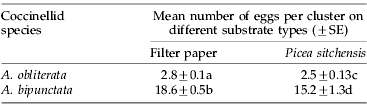
The size of egg clusters laid by the two coccinellids varied significantly between species and substrate types (table 1). Adalia bipunctata laid significantly larger egg clusters than A. obliterata (F=2984, df=1, 889, P=<0.0001), with batches reaching a maximum size of 32 eggs on spruce and 41 eggs on paper, while those of A. obliterata contained a maximum of 5 eggs on spruce and 9 eggs on paper. Of the clusters laid by A. obliterata, 18.6% of those on paper and 21.4% of those on spruce contained only a single egg, whereas a minimum of two eggs per cluster were laid by A. bipunctata. Smaller clusters were laid on the spruce cuttings by both species when compared with those laid on the filter papers (F=6.65, df=1, 889, P=0.01). This difference was more apparent in the case of A. bipunctata (table 1). The interaction between species and substrate was significant (F=3.85, df=1, 889, P=0.05).
Egg cluster size of A. obliterata and A. bipunctata on two substrate types at 15°C.

Different letters denote significant differences (P<0.05).
Female weights
Newly emerged female A. bipunctata were significantly (t=7.45, df=15, P<0.0001) heavier (12.7±0.1 mg; 38% greater) than female A. obliterata (9.2±0.2 mg).
Selection of oviposition substrate
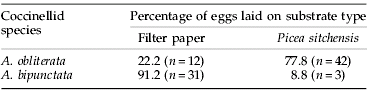
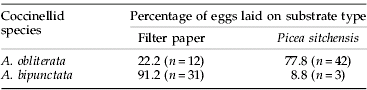
The substrate type was a significant factor in the selection of oviposition sites by these coccinellids (χ2=36.99, df=1, P<0.01). Aphidecta obliterata females mainly selected spruce cuttings on which to lay eggs, while the majority of A. bipuncta eggs were laid on filter papers (table 2).
Placement of egg clusters by Aphidecta obliterata and Adalia bipunctata when provided with two substrate types.
Egg cannibalism by first instar larvae: do species or egg distribution affect cannibalism rates?
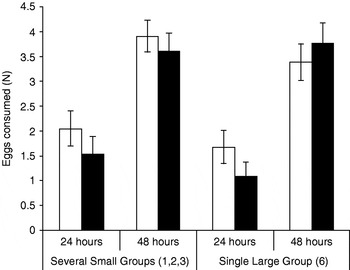
The levels of egg cannibalism were similar between the two coccinellids (fig. 1). There was a significant difference in the proportion of eggs cannibalised between 24 and 48 hours (F=55.70, df=1, 136, P<0.0001) but no significant effects of species (F=1.0) or egg distribution (F=1.68).
Variation in the average number of eggs cannibalised by first instars of Aphidecta obliterata (n=23) and Adalia bipunctata (n=13), provided with two different egg distributions. Error bars:±1SE (□, A. obliterata; ■, A. bipunctata).

Discussion
Laying eggs in clusters can be of benefit to unborn coccinellids in terms of reduced mortality from predation. Agarwala & Dixon (Reference Agarwala and Dixon1993) found that larger clusters were protected to a greater extent than single eggs by means of an odorous deterrent. This deterrent property has been shown subsequently to be conferred by species-specific alkanes present on the surface of the eggs (Hemptinne et al., Reference Hemptinne, Lognay, Gauthier and Dixon2000c).
A significant percentage of the clusters laid by A. obliterata contained only a single egg in contrast to A. bipunctata, which consistently laid larger egg batches. First instar coccinellid larvae are not very efficient predators of aphids and often fail to capture prey that is located (Dixon, Reference Dixon1959). Their survival is dependent on successfully acquiring food soon after leaving the egg sac (Dixon, Reference Dixon1959). Social feeding in coccinellids refers to the sharing of prey which has already been caught by another larva and is a characteristic which may enable young larvae to enhance their chances of survival (Hemptinne et al., Reference Hemptinne, Gaudin, Dixon and Lognay2000b). Early instar A. bipunctata have been found to respond to olfactory cues emanating from aphids which were being fed on by other larvae by searching an area more intensively (Hemptinne et al., Reference Hemptinne, Gaudin, Dixon and Lognay2000b). It is proposed that this response, which increases the likelihood of social feeding, is facilitated by clustered egg laying (Hemptinne et al., Reference Hemptinne, Gaudin, Dixon and Lognay2000b). In fact, in at least one species, it has been shown that a proportion of the eggs laid are there solely as food sources for the hatching larvae (Perry & Roitberg, Reference Perry and Roitberg2005).
Neonates of another coccinellid species, Coleomegilla maculate lengi, have been found to be attracted to extracts from conspecific eggs over that of aphids. These larvae exhibited egg cannibalism, consuming more conspecific eggs than aphids, even when eggs were presented with defenceless (non-mobile) aphids in a ratio of 1:2 (Gagné et al., Reference Gagné, Corderre and Mauffette2002). These results suggest that the neonates of this species actively seek out and cannibalise conspecifics, using the surface alkanes as a cue. Egg cannibalism can decrease mortality and developmental rates, and increase the weight of cannibalistic larvae (Gagné et al., Reference Gagné, Corderre and Mauffette2002; Michaud & Grant, Reference Michaud and Grant2004) in addition to reducing competition for prey. It would, therefore, appear that, in some species, egg cannibalism may be an adaptive characteristic, which would be facilitated by egg clustering in that it may provide a reliable food source for emerging larvae in the absence of aphids.
From the similar number of eggs consumed by larvae in the different treatments, it appears that eggs are cannibalised independently of whether they originate from large batches or singletons. It is possible that in the field, however, distances between egg clusters may be greater than can be covered by first instar larvae. Therefore, laying eggs singly or in small batches may reduce cannibalism compared with a single large cluster. Pre-dispersal sibling cannibalism was not considered, but these rates have been found to be unrelated to cluster size in Coccinella septempunctata (Dixon & Guo, Reference Dixon and Guo1993).
In the light of the fact that egg clustering did not appear to increase mortality through cannibalism by non-siblings (as opposed to those from the same cluster, known as siblings) in this study, and the fact that it has been shown elsewhere to increase survival rates of neonates by social feeding, it would appear advantageous for coccinellids to lay eggs in larger groups. Laying a smaller number of larger egg clusters would also require a lower energy input from the female due to decreased time spent selecting oviposition sites. It would, therefore, appear that A. bipunctata exhibited a more efficient oviposition technique in producing clusters that were far larger than those of A. obliterata. This poses the question, ‘Why do A. obliterata females lay such small egg clusters?’
The difference in egg cluster size between the two coccinellids can be partly explained by the fact that A. bipunctata is a larger coccinellid than A. obliterata, the females weighing almost 38% more. Egg cluster size in coccinellids shows a positive linear relationship to the size of the female, which is related to the fact that the number of ovarioles within a female increase with size (Dixon & Guo, Reference Dixon and Guo1993). The differences seen in this study were, however, far greater than what would be predicted from these relationships, suggesting that this is only one contributory factor. Interestingly enough, though, if one calculates the reproductive biomass (mean egg weight×number of ovarioles) as a proportion of the fresh weight of the adult, using data from other studies (Stewart et al., Reference Stewart, Dixon, Ruzicka and Iperti1991a; Dixon & Guo, Reference Dixon and Guo1993; Hemptinne, unpublished data), values of 38% and 41% for A. bipunctata and A. obliterata are obtained. Thus, as has been shown for other coccinellid species (Stewart et al., Reference Stewart, Dixon, Ruzicka and Iperti1991b), both species invest similarly in reproduction, but there is a different trade-off between egg size and fecundity in the two species. Aphidecta obliterata lays bigger eggs than A. bipunctata, but smaller egg batches than the latter. Therefore, first instar A. obliterata are bigger than those of A. bipunctata and can, therefore, search for a longer period of time before catching their first prey. This is also an advantage to A. obliterata as it also preys on adelgids, which are a significantly poorer food source than E. abietinum (Parry, Reference Parry1992).
Another possible reason for the difference may be adaptation to differing environments. Although A. bipunctata has been reported in association with E. abietinum on spruce (Leather & Owuor, Reference Leather and Owuor1996) and, in some commercial spruce forests in Britain, has been found to be the most abundant coccinellid present (Day et al., Reference Day, Docherty, Leather and Kidd2006), A. obliterata is generally more abundant on this plant (Hussey, Reference Hussey1952; Bejer-Peterson, Reference Bejer-Peterson1962; Parry, Reference Parry1992; Timms, Reference Timms2004) and is regarded as a conifer specialist (Wylie, Reference Wylie1958). Adalia bipunctata, on the other hand, is found on a range of deciduous hosts and generally occurs only rarely on conifers (Majerus & Kearns, Reference Majerus and Kearns1989), but see above.
The most obvious aspect of a conifer ecosystem that may require adaption from a predator in a different manner to other deciduous environments is the architecture of the host tree. Conifer trees possess many small needle leaves, which have a small surface area, unlike the larger flatter leaves of deciduous trees. The substrate study was carried out in order to elucidate whether the host plant might play some role in determining the laying characteristics of each of these coccinellids. Filter papers were readily accepted as oviposition sites by both coccinellid species in the absence of an alternative, so were provided along with cuttings of P. sitchensis in order to investigate whether the substrate affected the size of egg clusters laid.
This experiment showed that the placement of egg clusters by each of these coccinellids was significantly influenced by substrate type. Aphidecta obliterata females chose to lay the majority of their clusters on the conifer host plant rather than on filter papers, while the opposite trend was seen in A. bipunctata females. This suggests that A. obliterata preferred some aspect(s) of the host plant for oviposition. An olfactometer study (Timms, Reference Timms2004) revealed that A. obliterata exhibited a significant preference for the chamber containing a section of P. sitchensis when compared with an empty (control) chamber, while A. bipunctata did not, suggesting that A. obliterata are more likely to be attracted to the volatiles given off by spruce than is A. bipunctata.
This goes part way to explaining the differences seen in the oviposition study but does not explain the apparent preference of A. bipunctata for the filter paper on this basis alone because A. bipunctata did not show any avoidance of P. sitchensis in the olfactometer compared with the control (Timms, Reference Timms2004). It appears that A. bipunctata females may have selected the paper at least partly on a visual, tactile or architectural basis or by a combination of these. The architecture of the folded filter paper had more similarities to a deciduous tree leaf than to spruce needles, being flat as opposed to rounded. This factor may be the underlying cause for the apparent preference for the paper exhibited by A. bipunctata.
The sizes of the egg clusters were also mediated by the substrate on which they were laid. Both coccinellid species laid smaller egg batches on P. sitchensis than on filter papers, suggesting that the cluster size is not only determined by ovariole number but also by characteristics of the oviposition site. Such a response has previously been put forward as an explanation for observed variances in egg deposition patterns of different butterfly species (Stamp, Reference Stamp1980). It is, therefore, possible that the small size of A. obliterata clusters, compared with those of A. bipunctata, is partly a reflection of their adaptation to conifers. The fact that A. obliterata females laid larger batches on filter papers also suggests that they are capable of increasing the cluster size in different circumstances.
It, therefore, appears that the small cluster size of A. obliterata may be partly related to adult size and partly to characteristics of the host plant. Adalia bipunctata, however, was able to lay batches of up to 32 eggs on spruce cuttings, suggesting that, although smaller batches were laid on the plant by both species, there was no physical impediment to A. obliterata laying clusters of the same size on the spruce as on the filter paper. Mortality related to batch size has, however, only previously been considered in terms of predation, cannibalism and humidity (e.g. Michaud & Grant, Reference Michaud and Grant2004). It would be of interest to investigate the ability of larger batches maintaining sufficient cohesion in adverse weather conditions, especially in heavy rainfall.
Unlike other aphid species, E. abietinum does not tend to be washed off conifer needles by rain; this is thought to be due to the small surface area, which does not allow rapid run-off of water (Hussey, Reference Hussey1952). Coccinellid eggs laid singly are more likely to mimic this than larger clusters and are less likely to alter the movement of rain-drops leaving the needle. Adalia bipunctata is often found on deciduous trees (Majerus & Kearns, Reference Majerus and Kearns1989), where eggs are laid on the underside of leaves, affording more protection from the elements. A further factor to be considered when laying eggs on P. sitchensis infested with E. abietinum is that this aphid causes shedding of needles (Hussey, Reference Hussey1952; Bejer-Peterson, Reference Bejer-Peterson1962; Seaby & Mowat, Reference Seaby and Mowat1993). It would, therefore, be prudent not to put all of one's eggs on one needle! Consequently, it is possible that the relatively small clusters laid by A. obliterata and large egg size, are a result of a specific adaptation to the E. abietinum-conifer host system.
Another factor, which may contribute to the egg-laying distributions of a coccinellid, is the density and distribution of its aphid prey. Aphidecta obliterata was the most common predator and virtually the only coccinellid species found feeding on the green spruce aphid, E. abietinum, at Radnor Forest in Wales (Timms, Reference Timms2004). It was also the predominant species in samples taken from conifers by the Forestry Commission as part of their Biodiversity Research Project (Timms, Reference Timms2004). Long-term counts of E. abietinum on P. sitchensis taken by Forestry Research at Radnor Forest, Wales, have shown that densities do not often exceed one aphid per 5-cm section of shoot (Timms, Reference Timms2004). When feeding on prey that is present in low densities such as these, or of poor nutritional value such as Gilletteela (Adelges) cooleyii (Parry, Reference Parry1992), it may be advantageous for this coccinellid to lay a larger number of smaller clusters than fewer larger ones, even though this study has shown that egg cannibalism is unaffected by cluster size. As dispersal away from oviposition sites has been shown to be delayed until all non-hatched eggs have been eaten (Michaud & Grant, Reference Michaud and Grant2004), in the field, small egg clusters will reduce cannibalism rates overall and encourage coccinellid larvae to begin foraging for alternative prey more quickly.
Some of the perceived disadvantages of laying small clusters of eggs may also be less important for A. obliterata feeding on E. abietinum. The increased risk of predation from other coccinellid species associated with smaller cluster sizes (Agarwala & Dixon, Reference Agarwala and Dixon1993) would appear negligible when considering the fact that samples taken from Radnor Forest revealed that coccinellid species other than A. obliterata were rare (Timms, Reference Timms2004). In addition, A. obliterata females are deterred from laying eggs on sites where conspecific females have walked for up to three days, at least in laboratory conditions (Oliver et al., Reference Oliver, Timms, Taylor and Leather2006), again tending to reduce the chances of egg cannibalism. Laboratory studies of cluster size-related predation have also not considered environments such as conifer trees, where predators may be great distances apart, while on the same host. It is possible that A. obliterata egg clusters are generally separated enough from other predators, such as Neuropteran larvae, to make the risk of mortality from predation insignificant.
Social feeding may also be less important when feeding on E. abietinum because this aphid is a small species, adults of which reach a maximum length of only 1.7 mm (Zondag, Reference Zondag1983); and coccinellid larvae are far more efficient at successfully capturing smaller prey (Dixon, Reference Dixon1959). It is, thus, possible that unlike agricultural systems, where biological control using ladybirds is thought to be a remote possibility (Kindlmann & Dixon, Reference Kindlmann and Dixon1993; Dixon, Reference Dixon2000), the prospects for biological control in commercial spruce forests may be a real possibility.
Acknowledgements
It is a pleasure to thank Tilly Collins and Tom Oliver for their perceptive comments. JELT was funded by a NERC/CASE studentship held jointly with the Forestry Commission (Forest Research Station – Alice Holt).